Sample Category Title
Sunset Market Commentary
Markets
Moderna chief Bancel sent a second Omicron shockwave through markets by declaring this morning in an FT interview that he expects a material drop in vaccines’ effectiveness against the Covid-mutant. The market impact of this second scare was less profound than Friday’s sudden shocker when news really broke. The jury remains out as it will take two weeks to really know how dangerous this new mutant is. Losses on European stock market amounted to 2% early in European dealings, but an intraday recovery process started afterwards. Main indices currently suffer losses of slightly over 0.5%. Core bonds thrived. US yields decline by 2.1 bps (2-yr) to 6.8 bps (7-yr) with the belly of the curve outperforming the wings. German Bunds underperform. The German yield curve bull flattens with yields dropping 0.6 bps (2-yr) to 4.2 bps (30-yr). The November European CPI print is probably partly accountable for the European underperformance, but didn’t deliver the likely reaction in a world without Omicron. Both headline and core CPI accelerated much more than forecast to EMU highs at 4.9% Y/Y and 2.6% Y/Y respectively. Pressure is building on the ECB to prepare an exit strategy away from ultra-easy monetary policy at its December 16 meeting. ECB Vice President de Guindos today warned for the risk that inflation will not go down as quickly and as much as the central bank predicted. The new Covid-outbreak, lockdowns in Austria and Slovakia and new curbs in several other European countries complicate matters for the ECB. On the one hand they pose additional downside risks to growth. On the other hand, they might add to inflationary pressures via supply chains which are longer distorted and via the gradual entrenchment in inflation expectations. Those in their turn pose fresh economic risks and the policy challenge faced by global central banks only grows. The toll of higher energy prices already hurts the weakest consumers with Italy today for example announcing readiness to intervene further in order to limit the impact. The single currency extends its rebound against the dollar and sterling. EUR/USD rises from sub 1.13 towards 1.1380. A disappointing November Chicago manufacturing PMI (61.8 from 68.4 vs 67 expected) slightly added to the greenback’s woes. EUR/GBP finally took out the 0.85 big figure. The Japanese yen and Swiss franc are the only ones that manage to keep pace with the euro today. Brent crude oil fell to the lowest level since early September, just above $70/b.
News Headlines
Turkish GDP in the third quarter this year grew 2.7% q/q. An upward revision of Q2 from 0.9% to 1.5% compensated for missing the consensus bar (3.3%). Compared to the same quarter one year ago, the Turkish economy is now 7.4% bigger. Growth was driven by all categories but gross fixed capital formation (-1.8% q/q). Private consumption, government expenditure and net exports rose 1.2%, 8.3% and 3.8% respectively. The Turkish lira fails to profit with the overall risk sentiment overriding solid growth figures. EUR/TRY is nearing the 15 mark. Markets are also much more focused on inflation and the monetary policy response (or the lack thereof) to it. November inflation figures are due on Friday and are seen above 20% y/y. The central bank meets on December 16.
The Hungarian central bank in a statement today announced it had widened its interest-rate corridor while making it asymmetrical too. The overnight and the one-week collateralized lending rate – the upper bound – were increased to 4.1% from 3.05% previously. The overnight deposit rate (lower bound) was brought higher from 1.15% to 1.6%. It has done so because Hungarian money market rates were shifting higher and above the base rate (2.10%) following the central bank’s cumulative 110 bps increase in the one-week deposit rate (2.90%) this month. With the move, the central bank has now created “monetary policy room for manoeuvre”, ie: space for more rate hikes. This will probably already happen at this Thursday’s weekly deposit rate setting. The Hungarian forint strengthened marginally vs the euro after the announcement. EUR/HUF changes hand around 366.23.
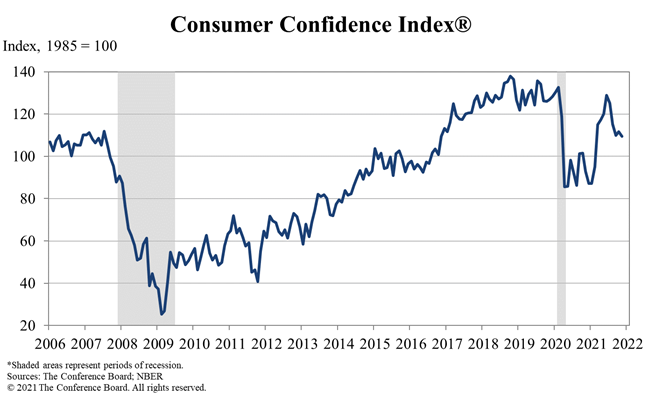
US consumer confidence dropped to 109.5 in Nov
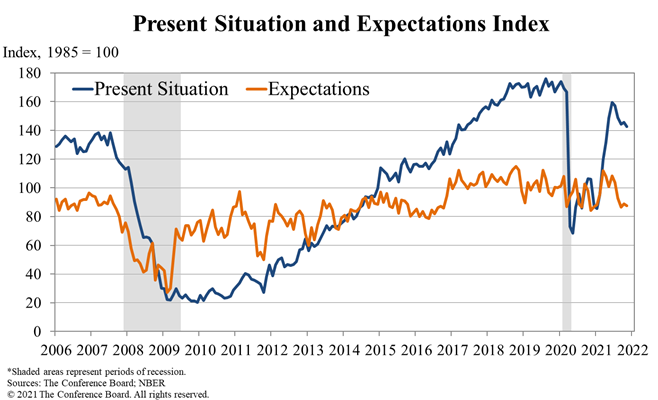
US Conference Board Consumer Confidence dropped from 111.6 to 109.5 in November, below expectation of 110.8. Present Situation Index dropped from 145.5 to 142.5. Expectations Index dropped from 89.0 to 87.6.
"Consumer confidence moderated in November, following a gain in October," said Lynn Franco, Senior Director of Economic Indicators at The Conference Board.
"Expectations about short-term growth prospects ticked up, but job and income prospects ticked down. Concerns about rising prices—and, to a lesser degree, the Delta variant—were the primary drivers of the slight decline in confidence. Meanwhile, the proportion of consumers planning to purchase homes, automobiles, and major appliances over the next six months decreased.
"The Conference Board expects this to be a good holiday season for retailers and confidence levels suggest the economic expansion will continue into early 2022. However, both confidence and spending will likely face headwinds from rising prices and a potential resurgence of COVID-19 in the coming months."
BoE Mann: Premature to even talk about timing of rate hike
BoE policy maker Catherine Mann said in an online event, "there's still a lot of information to come in, especially with regard to omicron, so it is premature to even talk about timing (of rate hike), much less how much."
"It's a particular question mark here as to whether or not that (Omicron) is going to reduce consumer confidence and leave us again in a situation of somewhat of a slacker demand for spending than we might have thought going forward," she noted.
Canadian Economy Rebounds in the Third Quarter
Real GDP rose by 5.4% (annualized) in the third quarter, above the consensus call for 3.3%. This left economic output 1.4% below its pre-pandemic (2019-Q4) level. In nominal terms, GDP increased by 8.9% in the third quarter. Statistics Canada also introduced historical revisions in today's release that showed the economy contracted by 3.2% in the second quarter, worse than the previous estimate of -1.1%.
Household consumption, specifically in semi-durable goods (+68.7% annualized) and services (+27.8%) drove the third quarter rebound. With provinces lifting restrictions, spending on areas hardest hit by the pandemic (transport services, food, beverages and accommodation services, entertainment among others) rose sharply. Meanwhile, expenditure on durable goods (-5.4%) declined due to supply chain disruptions.
In terms of business investment, it contracted by nearly 18% in annualized terms in the third quarter. Residential investment (-31.3%) saw the steepest decline as new construction and renovations dropped in the second quarter. In addition, resale market activity slowed last quarter. Investment in non-residential structures (-1.1%), machinery and equipment (-0.7%), and intellectual property products (-5.7%), saw more modest declines in the third quarter.
As for the external sector, exports (+8%) saw a solid rebound driven by crude oil exports. Imports (-2.3%), on the other hand, decreased due to lower imports of pharmaceutical products and toys, games and small appliances.
On the income side, household disposable income increased by 7.2% on the back of gains in employee compensation. Transfers from governments dropped by 6.3%, but remained elevated in the third quarter. As household consumption had a stronger showing than disposable income gains, the savings rate fell from 14% to 11% last quarter.
Statistics Canada also released monthly GDP data for September, which showed a 0.1% increase. In addition, the statistical agency stated that preliminary data for October indicates a 0.8% expansion in output for the month.
Key Implications
After a disappointing second quarter (one that was made worse by revisions), the Canadian economy rebounded soundly in the third. The reopening of provincial economies and the ramp up in vaccinations propelled strong consumption growth, particularly in areas that were under public health restrictions through much of the pandemic. For example, spending on food, beverage and accommodation services rose 29% (non-annualized), while Canadians' expenditure on air travel increased a whopping 156% (also non-annualized). As a result of these robust bounce backs, services consumption accounted for most of the growth in the economy in the third quarter.
Meanwhile, durable goods consumption and business investment floundered last quarter. Hampered by global supply chain disruptions, consumers spent less on durable goods, specifically automobiles, and businesses invested less in machinery and equipment. If not for supply shortages, GDP growth could have been even stronger in the third quarter.
Looking ahead, the good news is that global supply chain issues are showing signs of easing. Shipping costs have declined, and production in Asia is picking up. The bad news is that new headwinds are forming for the Canadian economy. Flooding in B.C. is wreaking havoc on communities, farmlands, and shipping routes. This will undoubtedly weaken near-term growth. Adding to the woes, is the recent emergence of the Omicron COVID-19 variant. Not much is known about this strain at this point, but if it proves to be more dangerous than other variants or vaccines less effective against it, it will be the key downside risk to Canada's economic recovery.
Dollar Weakens, and Risk Aversion Grows
Fed Chair Powell to draw focus; Chicago PMI and consumer confidence eyed
Market sentiment has subsided, and the greenback seems to have taken a hit as concerns regarding the omicron variant are highlighted. Disappointing comments from the CEO of Moderna on production timeline and efficacy of current vaccines along with concerns from the Fed Chair Powell seem to be the culprit.
Federal reserve Chair Powell mentioned that the omicron variant brings with it uncertainty around inflation and thus could upset growth prospects. The strain of the virus could also slow the recovery in the US job market and prolong supply chain disruptions, which have kept price pressures elevated. The important aspect is, will the new omicron virus variant cause new restrictions on movement and whether it could derail the Fed’s policy tightening, or extend the timeline and that of rate hikes.
That said, the omicron variant is likely to push tightening plans of the ECB, BOJ and SNB further into the horizon, thus these delayed policy outlooks could feed future strength in the dollar.
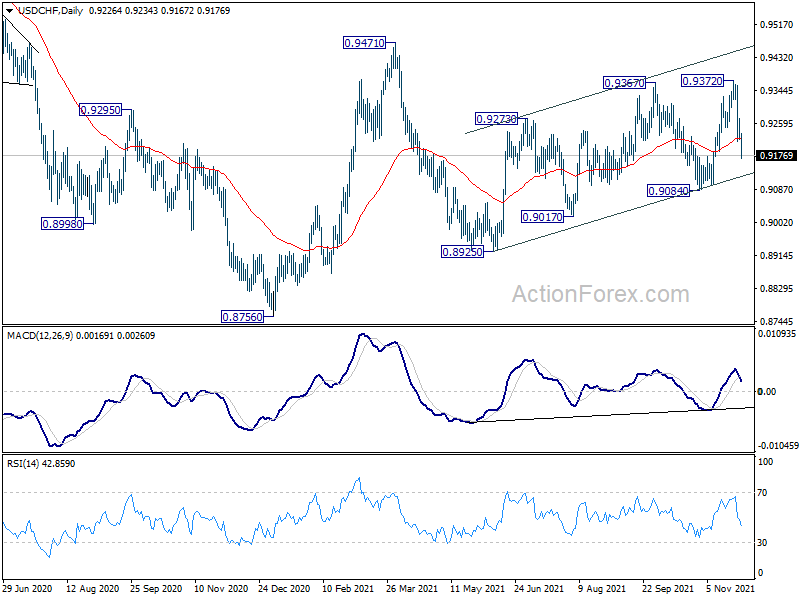
That said, the reserve currency has surrendered ground despite weaker market sentiment with the dollar index trading around 95.78. In the forex arena, haven currencies are seeing oversized moves. The yen and the swiss franc are outperforming with USDCHF at 0.9177 and USDJPY at 112.80.
At 14:45 GMT, the US Chicago PMI figures are due, and the November data is expected to stay elevated, forecasted at 67.0, signalling a sturdy expansion in the manufacturing sector despite supply constraints.
Inflation pokes at Europe
Eurozone inflation in November rose by a record annual 4.9%, the highest ever, which puts pressure now on the ECB moving into its next meeting, even though ECB President Lagarde and the doves still hold the upper hand. The infectious omicron variant is posing a threat, and should new lockdowns and restrictions unfold, this could hurt output and weigh on supply chains.
Nonetheless, the euro surprisingly has geared up, touching the $1.1370 level, also in a risk-off environment in the US. The pound failed to capitalise on dollar weakness, holding around the $1.3340 mark.
Canadian GDP, oil haemorrhages
Canadian real Q3 GDP edged higher by 0.1% in September, related to broad-based expansions in services-producing industries as well as mining, which compensated for the drop in construction, manufacturing, and retail trade.
The continued global shortage of semiconductors and other supply chain disruptions have played their part in hindering manufacturing across industrial sectors.
Oil continues to fall with omicron variant uncertainty and expected delivery of 50mln barrels from the strategic reserves of the US.
It will be interesting to see whether OPEC follows through on its planned output increases in January, under the current trying circumstances. WTI oil futures are trading around the $67.00 per barrel mark.
Fed Chair Powell is due to speak at 15:00 GMT as is Treasury Secretary Yellen. Subsequently US consumer confidence will also be released.
FOMC Members Williams and Clarida are scheduled to speak at 15:30 and 18:00 GMT respectively.
Australian Q3 GDP is set for 00:30 GMT following a huge miss in September building approvals, which dropped 12.9%, coming in weaker than August numbers of -1.4%.
Euro Rebounds as Inflation Climbs
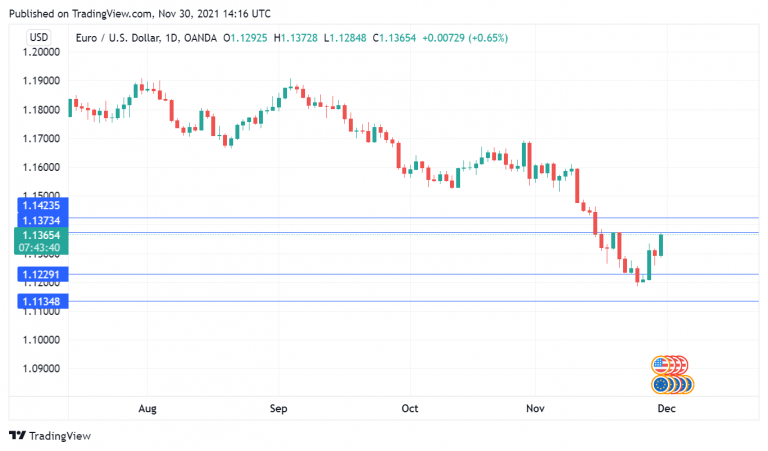
The euro has rebounded in the Tuesday session. In North American trade, EUR/USD is trading at 1.1365, up 065% on the day.
Eurozone inflation hits record high
Eurozone inflation surged to a new high in November. On an annualized basis, inflation is projected to have climbed to 4.9%, up from 4.1% in October and higher than expected. Core CPI showed a similar trend, rising from 2.0% in October to 2.3% in November. Energy prices, which jumped 27%, were the key driver of the rise in inflation.
The headline reading is more than double the ECB’s inflation target of 2 per cent, which raises further doubts in the narrative championed by ECB President Christine Lagarde that high inflation is being driven by temporary factors and will ease in the coming months. Some ECB Governing Council members have expressed concern as inflation continues to accelerate, and this should make for an interesting policy meeting on December 16th. The bank will likely upwardly revise its inflation projections at the meeting, and policy makers may signal their plans for the emergency pandemic program (PEPP). Unlike the BoE and the Fed, the ECB appears far away from any rate moves, but may provide some signals at the meeting about scaling back QE.
The Omicron variant of Covid-19 has caused plenty of volatility on global financial markets, and investors are looking to Fed Chair Jerome Powell for some insights. Powell will speak before US senators later in the day, and his prepared testimony stated that Omicron could hurt the US employment market and exacerbate supply chain disruptions. Powell reiterated that he expects inflation to ease sometime in 2022, but admitted that inflation will remain well above the Fed’s target of 2 per cent. With inflation current galloping at a worrying clip of 6 per cent, Powell may find that lawmakers are skeptical about his assurances that inflation is transitory.
EUR/USD Technical
- EUR/USD has support at 1.1229. This is followed by support at 1.1135
- EUR/USD is putting strong pressure on 1.1373. Above, there is resistance at 1.1423
Australian Q3 GDP Growth to Falter but Will Bears Move to Beat?
While the aussie is at the edge of a cliff, fighting hard to avoid a broad outlook deterioration versus its US counterpart, Australian GDP growth figures for the September quarter are expected to show a dull economic performance. Traders, however, may not rush to sell the aussie unless the US nonfarm payrolls report intensifies the debate for higher interest rates.
Australian economy to lose pace in Q3
The Australian dollar has been in freefall during the month of November, losing almost 5.0% against the US dollar as the strength in the greenback, a dovish stance from the Reserve Bank of Australia (RBA), and more recently a new spike in covid infections weighed on the risk-sensitive currency.
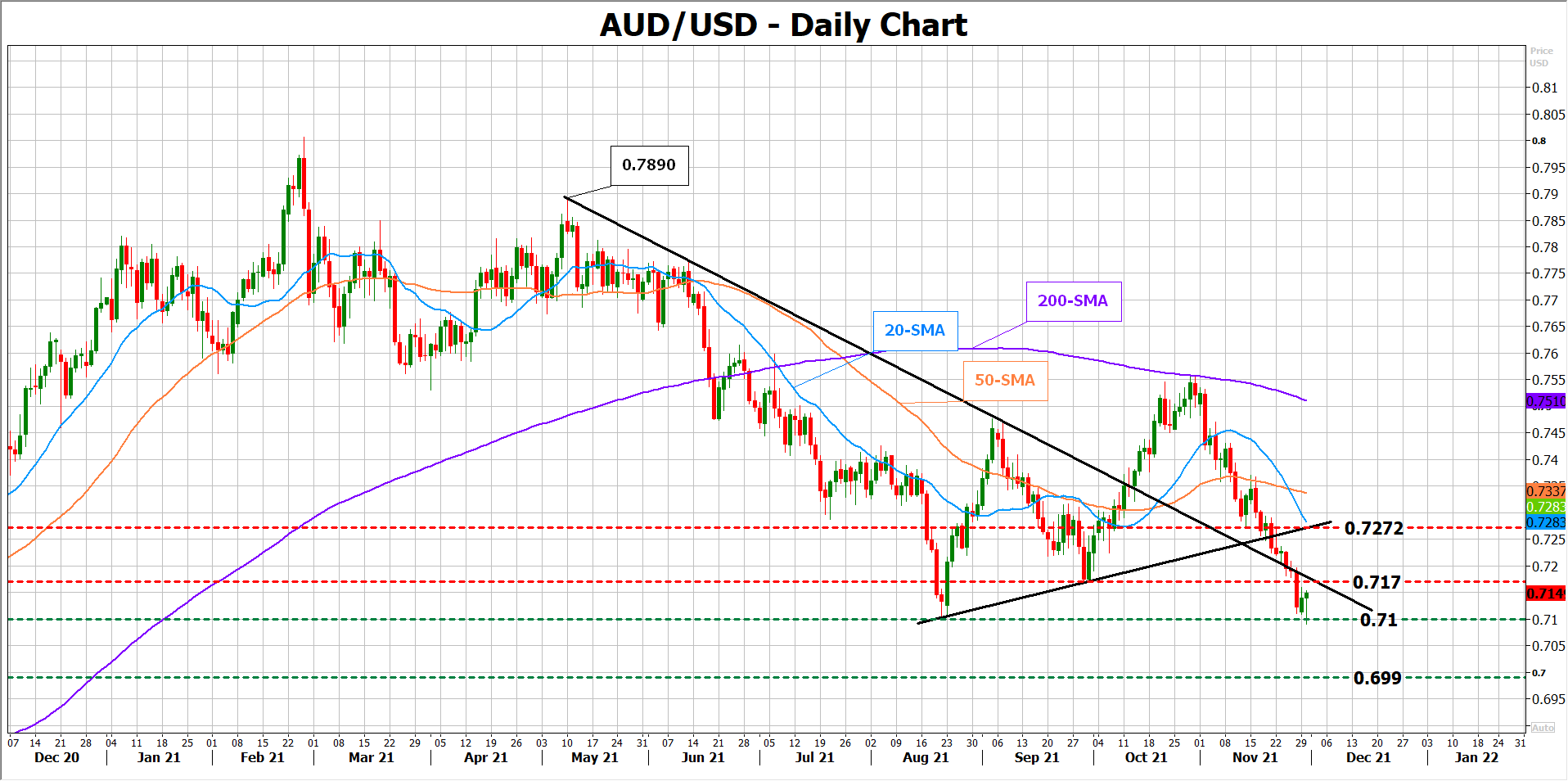
The pair is currently hovering near the bottom of its 2021 downtrend around the 0.7100 level, a break of which could spark a more aggressive sell-off towards 0.6990. Theoretically, worse-than-expected GDP growth data could pull the trigger this week, but Australia has recently abandoned its 200-day long zero-covid measures, brightening the outlook for the rest of the year.
Hence, although forecasts point to a quarterly contraction of 2.7% in the three months to September and a relatively muted annual growth of 3.0% versus the whopping 9.6% expansion in the previous quarter, traders could adopt a wait-and-see approach until the next GDP release. Besides, with retail sales pulling into the negative area during the three months to September and manufacturing and services business PMIs retreating below May’s highs, a growth setback is probably already priced in.
Encouragingly, given the significant upside surprise in construction growth stats and the more-or-less anticipated capital expenditures and exports readings for Q3, a sharp miss in GDP figures is currently looking less likely.
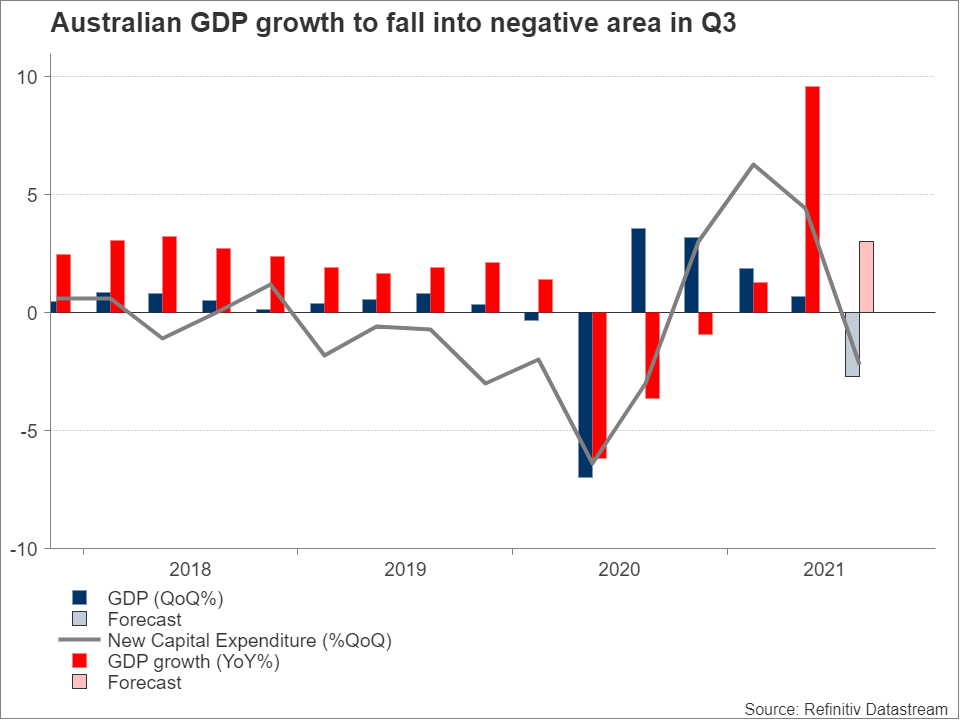
US nonfarm payrolls could be a bigger threat for aussie
Perhaps a stronger-than-expected GDP report could add some support under the aussie, reflecting resilience in the Australian economy despite the latest pandemic restrictions. However, whether any upside correction in aussie/dollar will survive till the end of the week may depend on the US nonfarm payrolls due on Friday.
Particularly, the jobs report will probably be a bigger burden for the aussie if a continuous recovery in the US labor market raises the odds for a 2022 rate hike at a time when the RBA keeps playing down bets for higher borrowing costs next year.
Inflation in Australia pulled back into the 2-3% range target in Q3, providing little incentive for a tighter monetary policy, and the discovery of the new risky omicron variant will probably be another reason for the central bank to maintain its policy settings accommodative at current levels next week and until February when policymakers are due to review another cut in the A$4bln weekly bond-buying program.
In the event, US nonfarm payrolls arrive softer-than-expected, pressing the greenback lower, the aussie may push above the nearby resistance of 0.7170 with scope to reach the next barricade at 0.7272.
EUR/USD Mid-Day Outlook
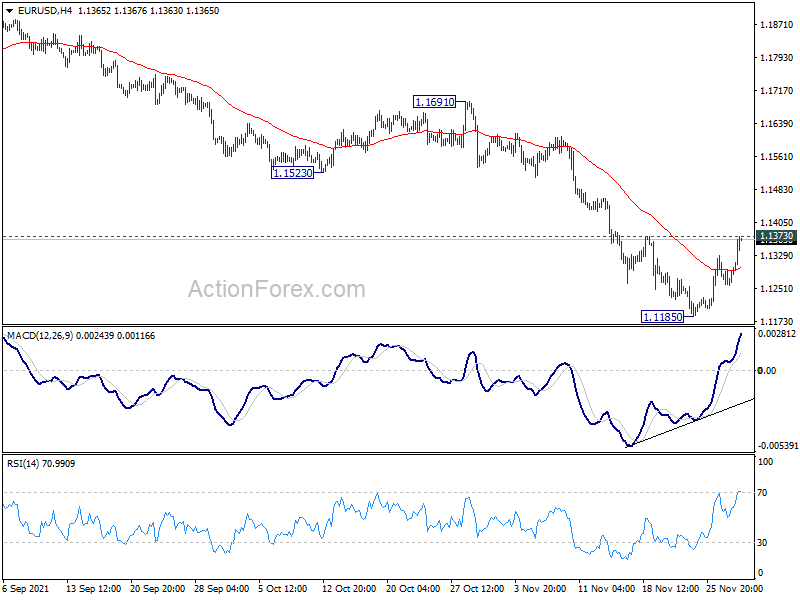
Daily Pivots: (S1) 1.1263; (P) 1.1289; (R1) 1.1320; More...
Intraday bias in EUR/USD remains neutral with focus on 1.1373 resistance. Firm break there will indicate short term bottoming at 1.1185. Intraday bias will be turned back to the upside for 55 day EMA (now at 1.1518). On the downside, break of 1.1185 will resume larger fall from 1.2348.
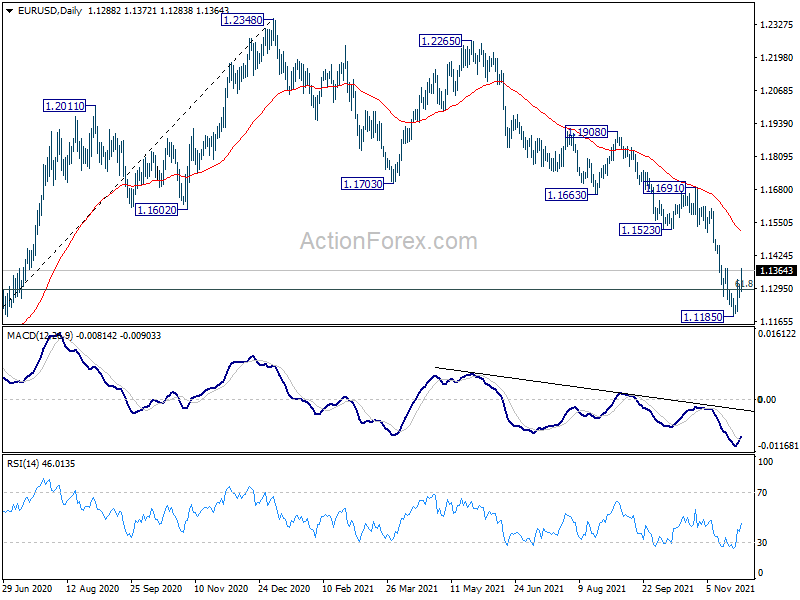
In the bigger picture, there are various ways of interpreting the fall from 1.2348 (2021 high). It could be a correction to rise from 1.0635 (2020 low), the fourth leg of a sideway pattern from 1.0339 (2017 low), or resuming long term down trend. In any case, outlook will now stay bearish as long as 1.1703 support turned resistance holds. Sustained break of 61.8% retracement of 1.0635 to 1.2348 at 1.1289 would pave the way back to 1.0635.
GBP/USD Mid-Day Outlook
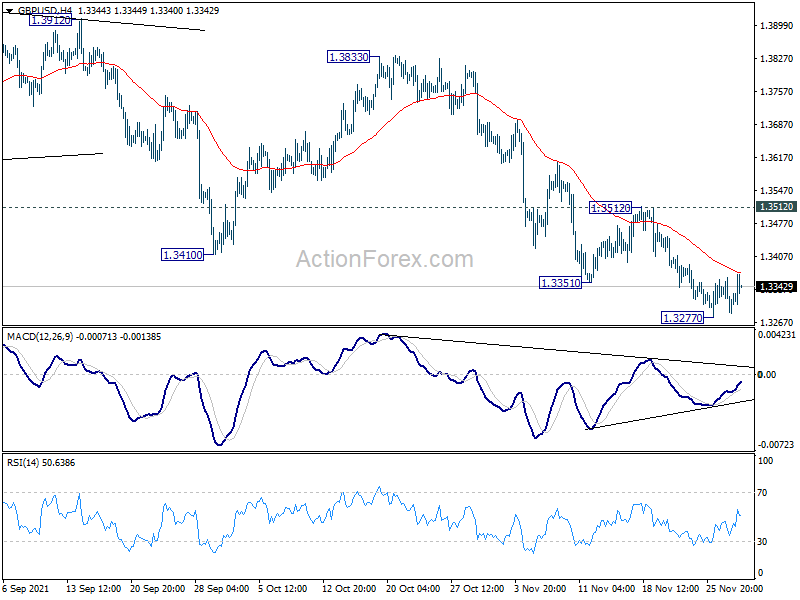
Daily Pivots: (S1) 1.3282; (P) 1.3323; (R1) 1.3357; More...
GBP/USD is still bounded in consolidation from 1.3277 and intraday bias remains neutral first. Upside of recovery should be limited below 1.3512 resistance to bring another fall. On the downside, break of 1.3277 will resume the decline from 1.4248 to 1.3164 fibonacci level next. Nevertheless, break of 1.3512 will indicate short term bottoming and bring stronger rebound.
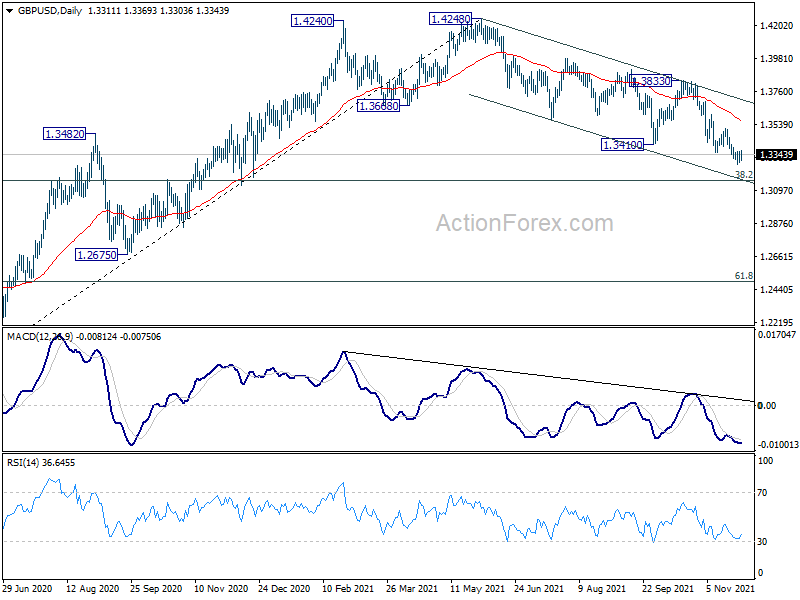
In the bigger picture, the structure of the fall from 1.4248 suggests that it's a correction to the up trend from 1.1409 (2020 low) only. While deeper fall cannot be ruled out yet, downside should be contained by 38.2% retracement of 1.1409 to 1.4248 at 1.3164, at least on first attempt, to bring rebound. On the upside, break of 1.3833 resistance will argue that the correction has completed and bring retest of 1.4248 high. However, sustained trading below 1.3164 will revive some medium term bearishness and target 61.8% retracement at 1.2493.
USD/CHF Mid-Day Outlook
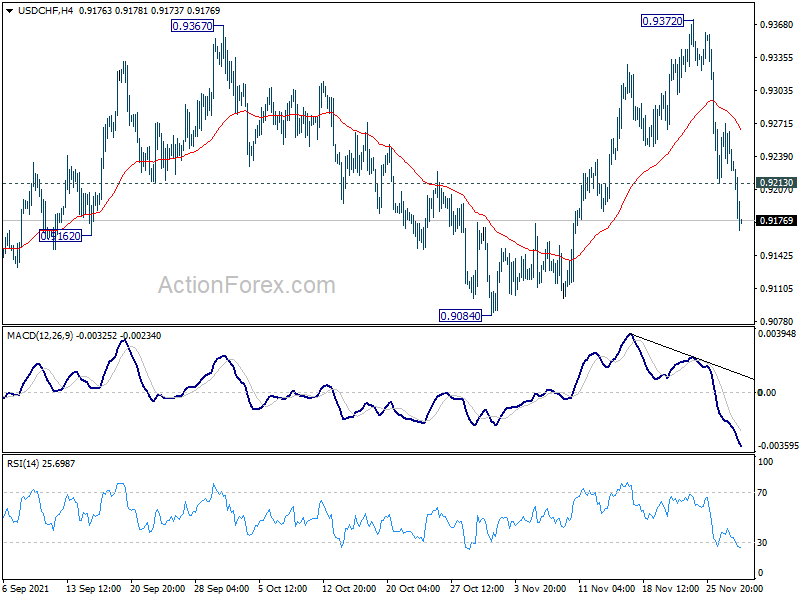
Daily Pivots: (S1) 0.9211; (P) 0.9242; (R1) 0.9259; More....
Intraday bias in USD/CHF remains on the downside for the moment. Fall from 0.9372 is accelerating and should target 0.9084 support first. Firm break there will argue that choppy rise from 0.8925 has completed, and fall from 0.9471 is resuming. Deeper decline would be seen through 0.8925. On the upside, break of 0.9213 minor resistance will turn intraday bias neutral first. But risk will stay mildly on the downside as long as 0.9372 resistance holds, in case of recovery.
In the bigger picture, the corrective structure of the rebound from 0.8925 argues that fall from 0.9471 is not complete yet. It could either be the second leg of pattern from 0.8756 (2021 low), or resuming larger down trend from 1.0237 (2018 high). We'd pay attention to the downside momentum and assess the odds later. But for now, medium term outlook will be neutral at best as long as 0.9471 resistance holds.