

Sample Category Title
USD/JPY Mid-Day Outlook
Daily Pivots: (S1) 113.03; (P) 113.50; (R1) 114.00; More...
Intraday bias in USD/JPY remains on the downside with focus on 112.71 support. Sustained break there will argue that fall from 115.51 is already correcting whole rise from 102.58. Deeper decline would then be seen to 38.2% retracement of 102.58 to 115.51 at 110.57. On the upside, above 113.94 minor resistance will turn intraday bias neutral first. But risk will stay on the downside as long as 115.51 resistance holds, in case of recovery.
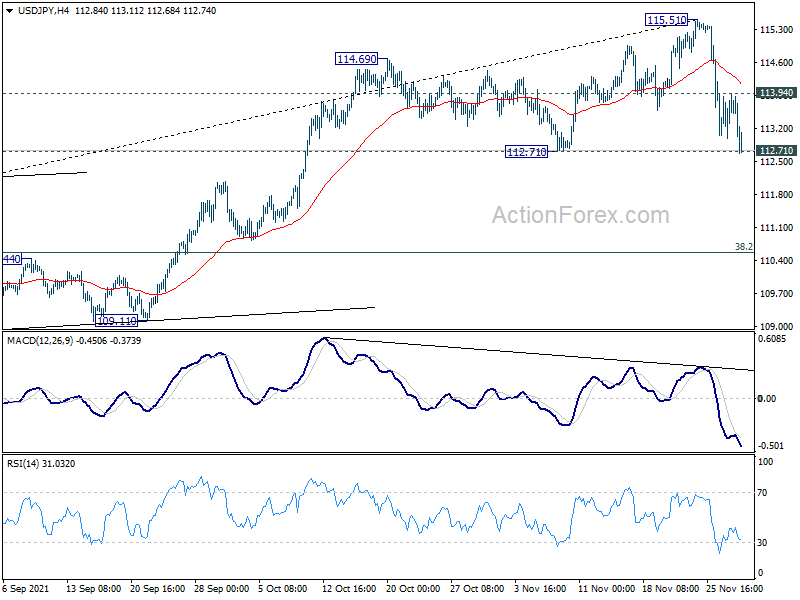
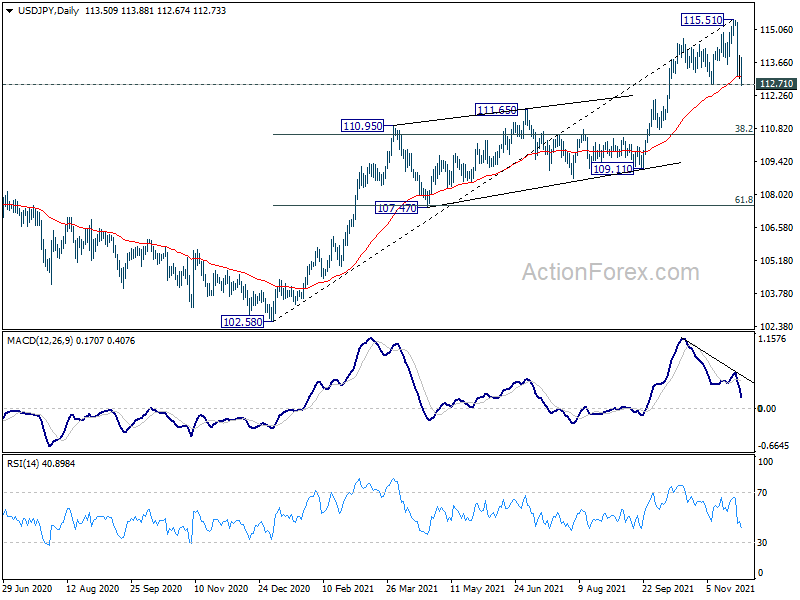
In the bigger picture, no change in the view that rise from 102.58 is the third leg of the up trend from 101.18 (2020 low). Such rally should target a test on 118.65 (2016 high) on resumption. However, firm break of 109.11 structural support will argue that the trend might have reversed and bring deeper fall to 107.47 support and possibly below.
Risk Selloff Resumes on Omicron, Dollar Vulnerable Against Euro and Yen
Selloff in stock markets resume today, after Moderna Chief Executive Stéphane Bancel foresaw "material drop" in effectiveness of current vaccines on Omicron. Benchmark treasury yields also tumble sharply on safe haven flows. In the currency markets, Canadian Dollar lead commodity currencies lower, as oil price tumble. Dollar is dragged down by steep falling in treasury yield. At the same time, Yen, Swiss Franc and Euro are the strongest.
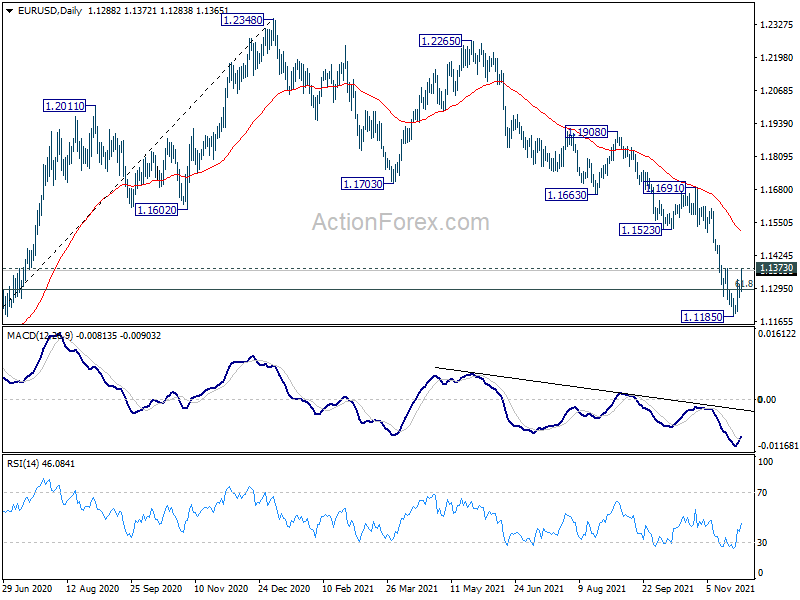
Technically, EUR/USD is finally making some concrete progress, pressing 1.1373 minor resistance. Firm break there will confirm short term bottoming at 1.1185 and bring stronger rise back to 55 day EMA (now at 1.1518). At the same time, USD/JPY is also pressing 112.71 structural support. Sustained break there will bring larger scale correction.
In Europe, at the time of writing, FTSE is down -0.85%. DAX is down -1.07%. CAC is down -1.03%. Germany 10-year yield is down -0.039 at -0.355. Earlier in Asian, Nikkei dropped -1.63%. Hong Kong HSI dropped -1.58%. China Shanghai SSE rose 0.03%. Singapore Strait Times dropped -2.54%. Japan 10-yaer JGB yield dropped -0.0157 to 0.059.
Canada GDP grew 0.1% mom in Sep, to grow further 0.8% in Oct
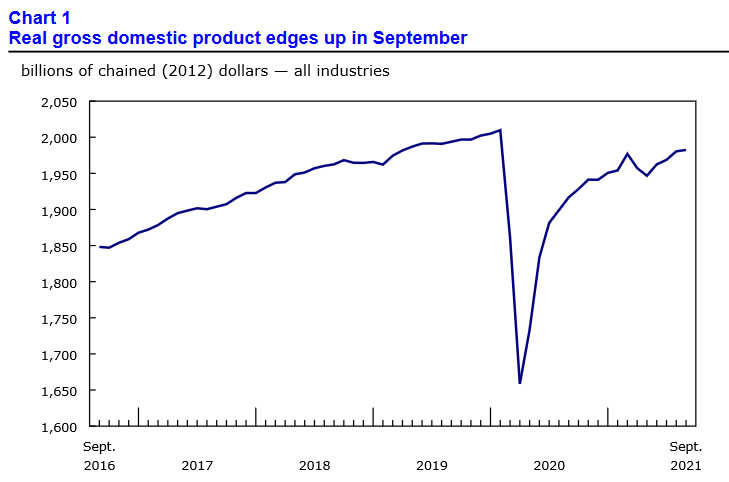
Canada GDP grew 0.1% mom in September, matched expectations. Overall 12 of 20 industrial sectors were up. Growth in services-producing industrials (+0.4%) more than offsetting a decline in goods-producing industries (-0.6%).
Preliminary information indicates that real GDP rebounded in October, up 0.8% with increases in most sectors.
Eurozone CPI surged to record 4.9% yoy in Nov, core CPI rose to 2.6% yoy
Eurozone CPI accelerated to 4.9% yoy in November, up from 4.1% yoy, well above expectation of 4.4% yoy. That's the highest level on record in the 25 years of the series's history. CPI core accelerated to 2.6% yoy, up from 2.0% yoy, above expectation of 2.3% yoy.
Looking at the main components of inflation, energy is expected to have the highest annual rate (27.4%, compared with 23.7% in October), followed by services (2.7%, compared with 2.1% in October), non-energy industrial goods (2.4%, compared with 2.0% in October) and food, alcohol & tobacco (2.2%, compared with 1.9% in October).
France CPI surged to 2.8% yoy, household consumption dropped -0.4% mom
France CPI surged to 2.8% yoy in November, following 2.6% yoy in October. HICP inflation also jumped to 3.4% yoy, up from 3.2% yoy. That's also the highest level since 2008.
"This inflation for us today is temporary, it is linked to strong demand, itself linked to a recovery that is much stronger than we anticipated," Finance Minister Bruno Le Maire said.
Household consumption expenditure on goods in volume dropped -0.4% mom in October, versus expectation of 0.3% mom rise. Consumption remained below 01.8% below its pre-crisis level in Q4 2019. The contraction was mainly due to a sharp drop in consumption of manufactured goods (-1.8%). It is partially offset by the recovery in consumption of food (+0.7%) and energy (+1.0%).
Also released, GDP was finalized at 3.0% qoq in Q3, unrevised.
Germany unemployment dropped -34k in November versus expectation of -20k. Unemployment rate dropped to 5.3%, down from 5.4%.
Swiss KOF dropped to 108.5, a step further back to long term average
Swiss KOF economic barometer dropped to 108.5 in November, down from 110.2, below expectation of 109.0.
KOF said: "The KOF economic barometer moves one step further towards its long-term average shortly before the end of the year. The high-flying of the barometer, which was observed in the middle of the year, is being cushioned by a further corrective movement. However, the barometer remains above its long-term average. The prospects for the Swiss economy remain positive, given that economic activity is not impaired by a recurring spread of the virus."
Japan industrial production rose 1.1% mom in Oct, more growth expected in Nov and Dec
Japan industrial production rose 1.1% mom in October, below expectation of 1.8% mom. That's nonetheless the first rise in four months.
The seasonally adjusted index of production at factories and mines stood at 90.5 against the 2015 base of 100. The index of industrial shipments increased 2.0% to 88.3 while that of inventories was up 0.8% at 98.9.
The Ministry of Economy, Trade and Industry expects industrial production to grow 9.0% mom in November and then 2.1% mom in December.
Unemployment rate dropped from 2.8% to 2.7% in October, better than expectation of 2.8%.
Housing starts rose 10.4% yoy in October, versus expectation of 5.2% yoy.
China PMI manufacturing rose to 50.1, non-manufacturing dropped to 52.3
China official PMI Manufacturing rose from 49.2 to 50.1 in November, above expectation of 49.6. PMI Non-Manufacturing dropped from 52.4 to 52.3, below expectation of 53.0. PMI Composite rose from 50.8 to 52.2.
"A series of policy measures to ensure energy supply and stabilize market prices have borne some fruits. The tight supply of electricity eased while prices of some raw materials dropped significantly in November," said Zhao Qinghe, a senior NBS statistician.
New Zealand ANZ business confidence finalized at -16.4 in Nov
New Zealand ANZ business confidence was finalized at -16.4 in November, down from October's -13.4. Own activity outlook dropped from 21.7 to 15.0. Looking at some more details, export intentions rose from 8.6 to 9.5. Investment intentions rose from1 3.8 to 16.3. Employment intentions rose from 10.9 to 15.8. Cost expectations rose from 87.2 to 88.7. Pricing intentions rose from 65.5 to 66.5. Inflation expectations rose from 3.45% to 4.24%.
From Australia, private sector credit rose 0.5% mom in October, versus expectation of 0.6% mom. Building permits dropped -12.9% mom, versus expectation of -2.0% mom. Current account surplus rose to AUD 23.9B in Q3, below expectation of AUD 27.8B.
Looking ahead
France GDP, Germany unemployment, Eurozone CPI flash and Swiss KOF will be released in European session. Later in the day, Canada will also released GDP. US will release house price index, Chicago PMI and consumer confidence.
USD/JPY Mid-Day Outlook
Daily Pivots: (S1) 113.03; (P) 113.50; (R1) 114.00; More...
Intraday bias in USD/JPY remains on the downside with focus on 112.71 support. Sustained break there will argue that fall from 115.51 is already correcting whole rise from 102.58. Deeper decline would then be seen to 38.2% retracement of 102.58 to 115.51 at 110.57. On the upside, above 113.94 minor resistance will turn intraday bias neutral first. But risk will stay on the downside as long as 115.51 resistance holds, in case of recovery.
In the bigger picture, no change in the view that rise from 102.58 is the third leg of the up trend from 101.18 (2020 low). Such rally should target a test on 118.65 (2016 high) on resumption. However, firm break of 109.11 structural support will argue that the trend might have reversed and bring deeper fall to 107.47 support and possibly below.
Economic Indicators Update
| GMT | Ccy | Events | Actual | Forecast | Previous | Revised |
|---|---|---|---|---|---|---|
| 23:30 | JPY | Unemployment Rate Oct | 2.70% | 2.80% | 2.80% | |
| 23:50 | JPY | Industrial Production M/M Oct P | 1.10% | 1.80% | -5.40% | |
| 00:00 | NZD | ANZ Business Confidence Nov F | -16.4 | -18.1 | ||
| 00:30 | AUD | Current Account Balance (AUD) Q3 | 23.9B | 27.8B | 20.5B | 22.9B |
| 00:30 | AUD | Private Sector Credit M/M Oct | 0.50% | 0.60% | 0.60% | |
| 00:30 | AUD | Building Permits M/M Oct | -12.90% | -2.00% | -4.30% | -3.90% |
| 01:00 | CNY | Manufacturing PMI Nov | 50.1 | 49.6 | 49.2 | |
| 01:00 | CNY | Non-Manufacturing PMI Nov | 52.3 | 53 | 52.4 | |
| 05:00 | JPY | Housing Starts Y/Y Oct | 10.40% | 5.20% | 4.30% | |
| 07:45 | EUR | France Consumer Spending M/M Oct | -0.40% | 0.30% | -0.20% | 0.20% |
| 07:45 | EUR | France GDP Q/Q Q3 | 3.00% | 3.00% | 3.00% | |
| 08:00 | CHF | KOF Leading Indicator Nov | 108.5 | 109 | 110.7 | |
| 08:55 | EUR | Germany Unemployment Change Nov | -34K | -20K | -39K | |
| 08:55 | EUR | Germany Unemployment Rate Nov | 5.30% | 5.30% | 5.40% | |
| 10:00 | EUR | Eurozone CPI Y/Y Nov P | 4.90% | 4.40% | 4.10% | |
| 10:00 | EUR | Eurozone CPI Core Y/Y Nov P | 2.60% | 2.30% | 2.00% | |
| 13:30 | CAD | GDP M/M Sep | 0.10% | 0.10% | 0.40% | |
| 14:00 | USD | S&P/CS Composite-20 HPI Y/Y Sep | 20.00% | 19.70% | ||
| 14:00 | USD | Housing Price Index M/M Sep | 1.20% | 1.00% | ||
| 14:45 | USD | Chicago PMI Nov | 67.2 | 68.4 | ||
| 15:00 | USD | Consumer Confidence Nov | 110.8 | 113.8 |
Canada GDP grew 0.1% mom in Sep, to grow further 0.8% in Oct
Canada GDP grew 0.1% mom in September, matched expectations. Overall 12 of 20 industrial sectors were up. Growth in services-producing industrials (+0.4%) more than offsetting a decline in goods-producing industries (-0.6%).
Preliminary information indicates that real GDP rebounded in October, up 0.8% with increases in most sectors.
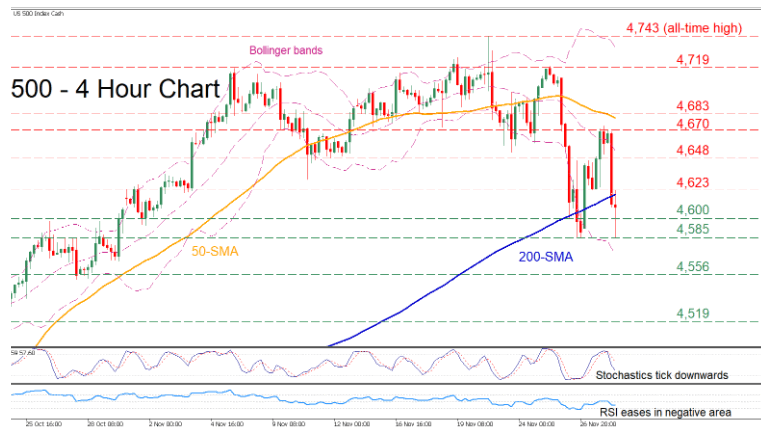
US 500 Extends Decline From All-Time High As Bullish Forces Wane
The US 500 stock index (cash) keeps trending upwards in the long term picture, creating a profound structure of higher highs and higher lows. However, in the four-hour chart, the index has been giving up ground since its rally halted at the new record high of 4,743.
This recent pullback is likely to continue as the short-term oscillators indicate that the positive momentum is fading. The stochastic oscillator is negatively charged, while the RSI is flatlining well below the 50-neutral mark.
Should the selling pressure intensify, the 4,600 psychological mark might act as immediate support. A drop below this level would open the way for the 4,585 region. If sellers overcome this obstacle, 4,556 could prove a strong support point for the price before the spotlight turns to the 4,519 hurdle.
On the flip side, if buyers manage to retake control and the price ascends, initial resistance could be encountered at the 4,623 region. Overcoming this level, the next barricade for the index might be met at 4,648 or even higher at the 4,670 level. Clearing these barricades, the price may then challenge the 4,683 barrier.
Overall, the US 500 index appears to have run out of steam after posting a new all-time high. For the negative short-term picture to alter, the price needs to sustainably move above 4,719.
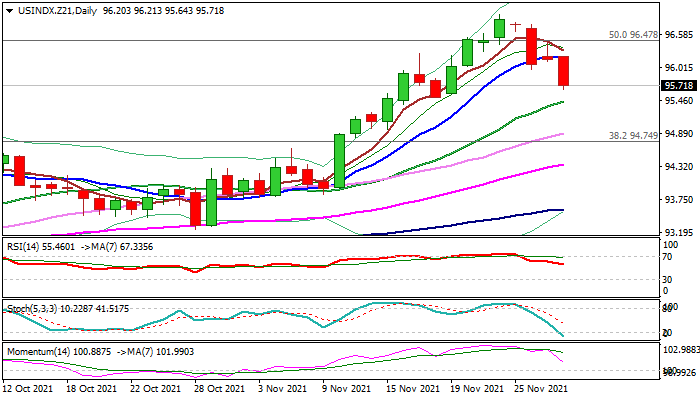
US Dollar Index: Weekly Shooting Star And Bull-Trap Generate Initial Reversal Signal
The dollar index is holding in red for the third straight day and extending pullback from new multi-month high at 96.92.
Bears gained control after the news that new variant of coronavirus was detected last Friday, with narrower range on Monday preceding fresh acceleration lower on Tuesday.
Key supports at 95.52/43 (Fibo 38.2% of 93.24/96.92 / rising 20DMA) are under pressure, with break here to further weaken the structure.
Strong bearish signal is developing on weekly chart as last week’s action ended in a shooting star candlestick, while bulls were trapped above 96.78 (50% retracement of 103.80/89.15 downtrend) and subsequent weakness on Mon/Tue adds to the strength of the signal.
Break of 95.52/43 pivots would risk deeper pullback towards 94.75 (200WMA) violation of which would generate initial signal that dollar’s larger uptrend might be coming to an end.
Res: 95.99, 96.21, 96.47, 96.92.
Sup: 95.43, 95.08, 94.75, 94.36.
Efficacy Of Vaccines Fears Over Omicron Grow
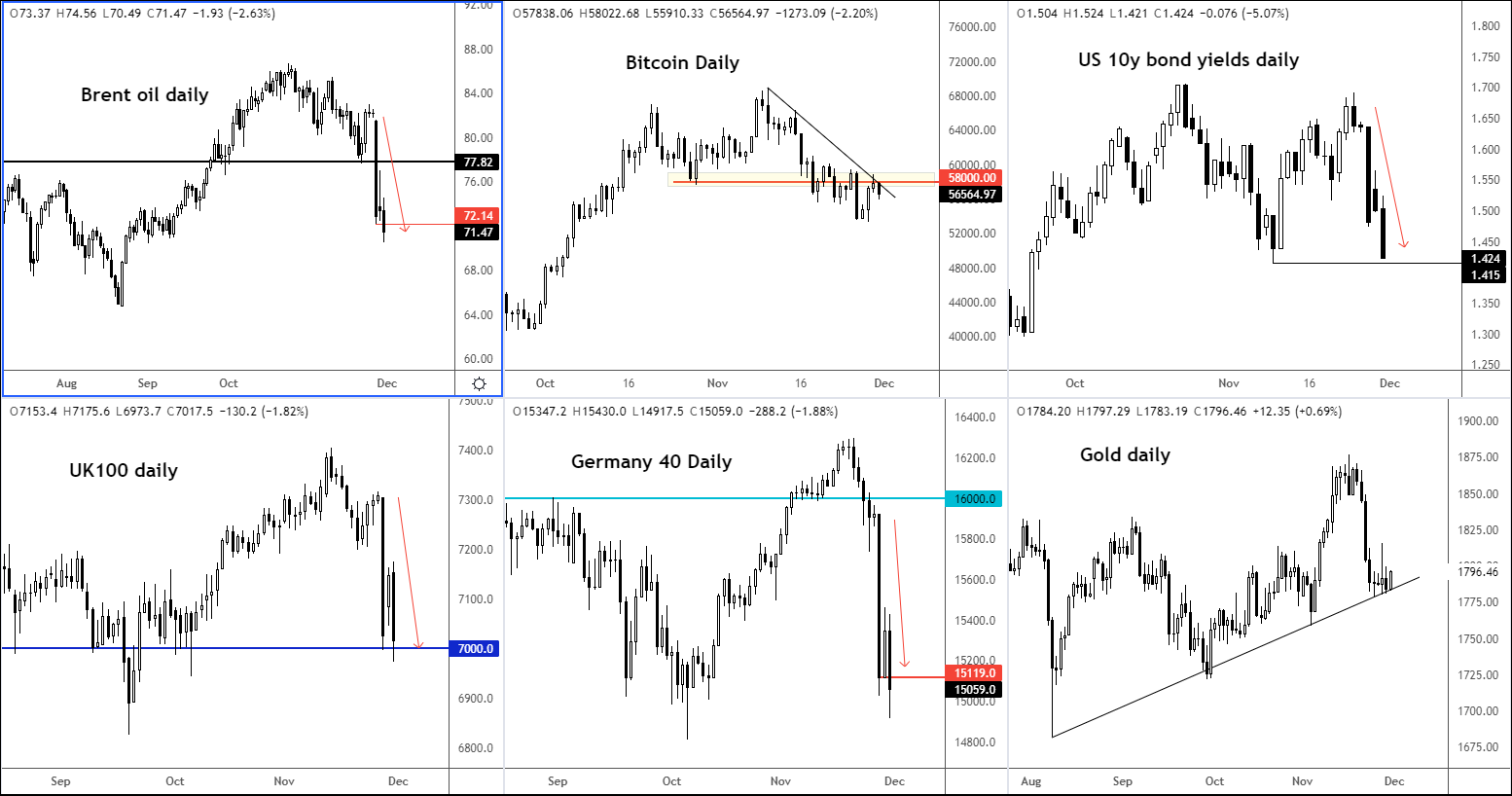
Well, it feels like 2020 all over again. After rebounding sharply off their lows yesterday, US futures are sharply lower after Asian and European markets slumped overnight. Crude oil has retested the lows it had hit on Friday when prices slumped by $10. Sentiment is downbeat as fears over the efficacy of the Covid vaccines against the latest variant of the virus have intensified. Comments from the Moderna boss has cast doubt over whether existing vaccines would be able to work on omicron. If they are not effective, then it probably means more economic growth-choking restrictions and lockdowns until scientists find new vaccines.
Judging by the market’s wild swings, it is clears that more in-depth assessment of the new Covid variant needs to be carried out, before determining whether the economy is facing a major challenge in the coming months. Yesterday, investors assumed that Omicron may not be as bad as had been feared on Friday, and that vaccines may still prove effective. But that thesis has been tested and investors fear they may have got it all wrong, for otherwise the markets wouldn’t have fallen this much. It will take some time to understand this variant better, given how little is known about it. So, get used to this sort of volatility as investors continually take profit and buy the dips here and there, until there’s more clarity on the virus front, while also keeping a close eye on other macro developments. Expect choppy price action to continue over the next few weeks.
With Covid weighing on investor sentiment, investors are pricing out rate hikes from central banks that have become hawkish recently amid inflation upsurge, such as the Federal Reserve. Jerome Powell, the US central bank’s chairman will be talking later today. Investors have been piling back into US debt and out of the dollar in favour of the euro and yen etc. Powell may provide some insight into how the latest worries about the pandemic might influence monetary policy in the US. The key question is whether the Fed would still go ahead and taper its bond buying programme at a faster rate? The markets certainly don’t think so.
It is becoming clear that the market’s direction has now tilted to a more risk-off path. This means that we will likely see resistance levels holding firm after short term recoveries, while support levels are likely to break down one after another until something fundamentally changes. Pay attention to whether bullish signals will lead to any upside follow-through, or whether they prove to be traps and fail the bulls. Judging to the price action over the past couple of days, it is clear the bulls are becoming trapped. So, proceed with extra care until the markets print decisive bottoming formations.
Market Shifts Into A Risk-Off Mood As Moderna CEO Raises Doubts On Vaccine Efficacy
Notes/Observations
- Market shifts into a risk-off mood as Modera CEO foresaw materially lower efficacy of existing vaccines against the Omicron.
- EU inflation and growth data running better but ECB members maintain their dovish stance.
- Euro Zone Nov Preliminary CPI YoY reading of 4.9% was its 5th month above ECB target and record high since EUR currency launch.
Asia
- South Korea Oct Industrial Production M/M: -3.0% v -0.1%e; Y/Y: 4.5% v 2.0%e.
- Japan Oct Jobless Rate: 2.7% v 2.8%e.
- Japan Oct Preliminary Industrial Production M/M: 1.1% v 1.9%e; Y/Y: -4.7% v -4.4%e.
- China Nov Manufacturing PMI (Govt official) registered its 1st expansion in 3 months (50.1 v 49.7e ).
- Japan Fin Min Suzuki held his 1st virtual meeting with US Treasury Sec Yellen and had the US explain inflation in context of US economic situation. Did not discuss currencies but noted FX stability was important. Japan was closely watching currency moves and impact on economy.
Coronavirus
- Moderna CEO stated that he believed that the current coronavirus vaccines would not be as effective against the Omicron Variant of coronavirus.
- UK Health Sec Javid noted that if Omicron variant was proven to be no more dangerous than the Delta variant then all the latest measures would be immediately removed. Focused was on hospitalizations related to Omicron.
- UK MPs to debate and vote on new Covid restrictions in England - including face coverings in shops and public transport.
Europe
- ECB's De Guindos (Spain) stated that was watching omicron variant closely. Covid situation was different from that in 2020 as now had vaccination. Net asset purchases could be resumed if necessary after ending in March. Stressed that monetary policy must remain accommodative” after pandemic emergency purchase program had ended. ECB would not go ahead with tapering like the Fed.
Americas
- Fed Chair Powell testified in Senate that greater virus concerns could slow job market progress and intensify supply chain woes; Omicron variant added to economic risks and inflation uncertainty.
- Treasury Sec Yellen testified that she was confident at this point that the US recovery remained strong and reiterated that it was critical that Congress addressed the debt limit.
Energy
- EU's Mora stated that felt extremely positive about meeting regarding Iran nuclear talks; Discussions in Vienna to continue.
Speakers/Fixed income/FX/Commodities/Erratum
Equities
- Indices [Stoxx600 -1.40% at 460.70, FTSE -1.38% at 7,011.73, DAX -1.47% at 15,056.50, CAC-40 -1.51% at 6,673.73, IBEX-35 -1.91% at 8,293.50, FTSE MIB -1.51% at 25,649.00, SMI -0.86% at 12,115.37, S&P 500 Futures -1.19%].
Market Focal Points/Key Themes:
Equities
- European Indices trade lower amid risk aversion flows following FT interview given by vaccine maker Moderna’s CEO who expressed opinion that current COVID-19 vaccines going to see a material drop in their efficacies against new Omicron variant. Meanwhile, Easyjet trades lower 2% following its final results, capacity guidance for next quarters and comments that it is not seeing any impact to Q3 or Q4 yet from Omicron. In other corporate news, Volvo Cars reported its first resutls after recent IPO and also trade lower as much as 3%.
- Zara brand parent company Inditex changed both CEO and Chairman trading lower in Madrid, while OSE Immunotherapeutics in Paris trades sharply higher on positive COVID-19 vaccine data. Shares of Barclays trade slightly lower in London as traders repricing their inflation and rate hikes expectations.
- Looking ahead notable earners include Baozun, UP Fintech, RedHill Biopharma and Salesforce, Zscaler after US markets close.
- Consumer discretionary: EasyJet [EZJ.UK] -2% (earnings; Moderna CEO comments on vaccine efficacy), Inditex [ITX.ES] -4% (new CEO and Chairman).
- Financials: Barclays [BARC.UK] -1% (rate hikes expectation repricing).
- Healthcare: OSE Immunotherapeutics [OSE.FR] +12% (vaccine data), Molecular Partners [MOLN.CH] +7% (data on Omicron variant).
- Industrials: Volvo Cars [VOLCAB.SE] -3% (earnings).
- Technology: Future plc [FUTR.UK] +15% (earnings), Micro Focus [MCRO.UK] -4% (strategy update).
Speakers
- EU Drug Regulator chief Cooke testified in EU Parliament that did not know if new vaccines against Omicron variant were needed but preparing for that. Working with international regulators, World health and ECDC to ensure we prepared for the worst.
- EU health commissioner Kyriakides issued a letter stressing that govts needed to boost efforts to detect coronavirus mutations; sequencing must be stepped up. Already faced with a challenging winter due to the high transmissibility of the Delta variant. Might now experience further or additional pressures because of the appearance of the Omicron variant.
- EU Economic Commissioner Gentiloni (Italy) noted that the new Omicron variant posed a new risk but there was no need to panic; Conditions for full lockdown were not fulfilled. Growth perspective was uncertain.
- ECB’s Weidmann (hawk, steps down after Dec meeting) stated that should be wary of any pressure to maintain its very loose course longer than the price outlook dictates.
- ECB’s Villeroy (France): EU exemptions should be temporary on Basel III.
- Italy PM Draghi stated that was prepared to continue intervening in order limit the impact of rising energy prices.
- Russia Central Bank (CBR) Gov Nabiullina stated that she expected inflation to slow to target by end-2022. Inflation near the upper end of year-end forecasts. CBR could hold or even raise rates by up to 100bps at the Dec 17th policy meeting.
- Thailand Central Bank official Chayawadee stated that the spike in inflation might be short-lived. To monitor new covid variant and supply disruptions. It saw 2021 GDP growth at or above 0.7% and noted that any impact from Omicron virus variant might be felt during 2022.
- China said to have begun preliminary vaccine studies on Omicron variant (**Note: earlier China CDC stated that Chinese Vaccines were effective against the Omicron variant).
Currencies/Fixed Income
- Sobering vaccine news offset earlier comfort from very early hints that Omicron might be milder than feared.
- The pandemic moved back onto the front burner for FX price action and replace the policy divergence theme of global central banks.
- USD was soft in the session as market participants were pushing back bets for Fed tightening because of the risk to growth.
- EUR/USD tested above 1.1350. The upside could hit resistance at 1.15 approach despite Inflation in the region continued to run red hot. ECB policy makers have recently stuck to their dovish stance despite higher inflation data.
- USD/JPY at 2-week lows with the pair under 1.13 handle as the yen was the main beneficiary of safe-haven flows.
- Bond yields were lower as risk appetite waned with the US 10-year trading in the 1.42% area.
Economic data
- (NL) Netherlands Oct Retail Sales Y/Y: 4.3% v 4.7% prior.
- (FI) Finland Q3 GDP Q/Q: 0.8% v 2.2% prior; Y/Y: 4.2% v 8.2% prior.
- (FI) Finland Oct House Price Index M/M: +1.1% v -0.8% prior; Y/Y: 3.6% v 3.1% prior.
- (ZA) South Africa Oct M3 Money Supply Y/Y: 3.2% v 4.1%e; Private Sector Credit Y/Y: 1.3% v 1.8%e.
- (FI) Finland Sept Final Trade Balance: €0.1B v €0.1B prelim.
- (NO) Norway Oct Credit Indicator Growth Y/Y: 5.3% v 5.3% prior.
- (DK) Denmark Q3 Preliminary GDP Q/Q: 0.9% v 2.2% prior; Y/Y: 3.6% v 9.8% prior.
- (DK) Denmark Oct Gross Unemployment Rate: 3.1% v 3.3% prior; Unemployment Rate (seasonally adj): 2.7% v 2.9% prior.
- (TR) Turkey Q3 GDP Q/Q: 2.7% v 3.3%e; Y/Y: 7.4% v 7.4%e.
- (TH) Thailand Oct Current Account Balance: -$1.1B v -$1.7Be; Overall Balance of Payments (BOP): +$1.2B v -$3.4B prior; Trade Account Balance: $3.8B v $4.0B prior; Exports Y/Y: 17.0% v 17.8% prior; Imports Y/Y: 20.1% v 20.4% prior.
- (FR) France Q3 Final GDP Q/Q: 3.0% v 3.0%e; Y/Y: 3.3% v 3.3%e.
- (FR) France Nov Preliminary CPI M/M: 0.4% v 0.2%e; Y/Y: 2.8% v 2.6%e.
- (FR) France Nov Preliminary CPI EU Harmonized M/M: 0.4% v 0.2%e; Y/Y: 3.4% v 3.2%e.
- (FR) France Oct PPI M/M: 2.9% v 1.7% prior; Y/Y: 14.9% v 11.6% prior.
- (FR) France Oct Consumer Spending M/M: -0.4% v 0.0%e; Y/Y: -5.3% v -5.0%e.
- (ES) Spain Sept Total Mortgage Lending Y/Y: 57.9% v 48.3% prior; House Mortgage Approvals Y/Y: 57.7% v 66.9% prior.
- (ES) Spain Oct Adjusted Retail Sales Y/Y: -0.7% v -0.1% prior; Retail Sales (unadj) Y/Y: -2.5% v +0.2% prior.
- (CH) Swiss Nov KOF Leading Indicator: 108.5 v 109.0e.
- (AT) Austria Nov Preliminary CPI M/M: 0.7% v 0.6% prior; Y/Y: 4.3% v 3.7% prior.
- (AT) Austria Oct PPI M/M: 3.1% v 1.2% prior; Y/Y: 13.9% v 10.6% prior.
- (CZ) Czech Q3 Preliminary GDP (2nd reading) Q/Q: 1.5% v 1.4%e; Y/Y: 3.1% v 2.8%e.
- (HU) Hungary Sept Average Gross Wages Y/Y: 9.1% v 9.3%e.
- (SE) Sweden Sept Non-Manual Workers Wages Y/Y: 3.1% v 3.1% prior.
- (HK) Hong Kong Oct Retail Sales Value Y/Y: 12.0% v 9.7%e; Retail Sales Volume Y/Y: 9.4% v 6.7%e.
- (DE) Germany Nov Net Unemployment Change: -34.0K v -25.0Ke; Unemployment Claims Rate: 5.3% v 5.4%e.
- (ES) Spain Sept Current Account Balance: €2.2B v €1.0B prior.
- (IT) Italy Q3 Final GDP Q/Q: 2.6% v 2.6%e; Y/Y: 3.9% v 3.8%e.
- (NO) Norway Central Bank (Norges) Dec Bank Daily FX Purchases (NOK): 0M v 0Me.
- (IS) Iceland Q3 GDP Q/Q: -2.3% v +4.2% prior; Y/Y: 6.0% v 7.3% prior.
- (IS) Iceland Oct Final Trade Balance (ISK): -12.8B v -12.5B prelim.
- (CZ) Czech M2 Money Supply Y/Y: 8.2% v 8.8% prior.
- (PL) Poland Nov Preliminary CPI M/M: 1.0% v 0.5%e; Y/Y: 7.7% v 7.3%e.
- (PL) Poland Q3 Final GDP Q/Q: 2.3% v 2.1% prelim; Y/Y: 5.3% v 5.1% prelim.
- (PT) Portugal Nov Preliminary CPI M/M: 0.5% v 0.5% prior; Y/Y: 2.6% v 1.8% prior.
- (PT) Portugal Nov Preliminary CPI EU Harmonized M/M: 0.3% v 0.4% prior; Y/Y: 2.7% v 1.8% prior.
- (ZA) South Africa Q3 Unemployment Rate: 34.9% v 34.4% prior (record high).
- (SL) Sri Lanka Nov CPI Y/Y: 9.9% v 7.6% prior.
- (EU) Euro Zone Nov Advance CPI Estimate Y/Y: 4.9% v 4.5%e; Core CPI Y/Y: % v 2.3%e (5th month above target and record high since EUR currency launch).
- (IT) Italy Nov Preliminary CPI M/M: 0.7% v 0.1%e; Y/Y: 3.8% v 3.2%e.
- (IT) Italy Nov Preliminary CPI EU Harmonized M/M: 0.8% v 0.1%e; Y/Y: 4.0% v 3.3%e.
- (BE) Belgium Q3 Final GDP Q/Q: 2.0% v 1.8% prelim; Y/Y: 4.9% v 4.7% prelim.
- (GR) Greece Sept Retail Sales Value Y/Y: 10.1% v 5.3% prior; Retail Sales Volume Y/Y: 13.0% v 7.5% prior.
- (GR) Greece Oct PPI Y/Y: 23.5% v 19.9% prior.
Fixed income Issuance
- (ZA) South Africa sold total ZAR3.9B vs. ZAR3.9B indicated in 2030, 2037 and 2040 bonds.
- (IT) Italy Debt Agency (Tesoro) sold total €4.25B vs. €3.25-4.25B indicated range in 5-year and 10-year BTP Bonds.
- Sold €2.0B vs. €1.5-2.0B indicated range in 0.00% Aug 2026 BTP bonds; Avg Yield: 0.19% v 0.28% prior; Bid-to-cover: 1.52x v 1.53x prior (Oct 28th 2021).
- Sold €2.25B vs. €1.75-2.25B indicated range in 0.95% Jun 2032 BTP; Avg Yield: 1.02% v 1.05% prior; bid-to-cover: 1.47x v 1.35x prior.
- (IT) Italy Debt Agency (Tesoro) sold €1.5B vs. €1.0-1.5B indicated range in 0.65% Apr 2029 Floating Rate Note (CCTeu); Avg Yield: +0.02% v -0.01% prior; Bid-to-cover: 1.49x v 1.73x prior.
Looking ahead
- (MX) Mexico Oct YTD Budget Balance (MXN): No est v -362.0B prior.
- 05:25 (EU) Daily ECB Liquidity Stats.
- 05:30 (IN) India Oct Fiscal Deficit (INR): No est v 588.4M prior.
- 05:30 (HU) Hungary Debt Agency (AKK) to sell 3-Month Bills.
- 05;30 (DE) Germany to sell €3.0B in 0.25% Nov 2028 Bund.
- 05:30 (EU) ECB allotment in 7-Day Main Refinancing Tender (MRO).
- 06:00 (PT) Portugal Q3 Final GDP Q/Q: 2.9%e v 2.9% prelim; Y/Y: No est v 4.2% prelim.
- 06:00 (PT) Portugal Oct Retail Sales M/M: No est v 1.5% prior; Y/Y: No est v 2.7% prior.
- 06:00 (PT) Portugal Oct Industrial Production M/M: No est v 1.6% prior; Y/Y: No est v -5.4% prior.
- 06:00 (IL) Israel Oct Chain Store Sales M/M: No est v 0.1% prior.
- 06:45 (US) Daily Libor Fixing.
- 07:00 (IN) India Oct Eight Infrastructure (Key) Industries: No est v 4.4% prior.
- 07:00 (IN) India Q3 GDP Y/Y: 8.3%e v 20.1% prior; GVA Y/Y: 7.7%e v 18.8% prior.
- 07:00 (ZA) South Africa Oct Trade Balance (ZAR): 23.0Be v 22.2B prior.
- 07:00 (ZA) South Africa Oct Monthly Budget Balance (ZAR): -33.0Be v -7.3B prior.
- 07:00 (BR) Brazil Sept National Unemployment Rate: 12.8%e v 13.2% prior.
- 07:00 (CL) Chile Oct Unemployment Rate: 8.2%e v 8.4% prior.
- 07:00 (CL) Chile Oct Retail Sales Y/Y: 20.1%e v 19.9% prior; Commercial Activity Y/Y: No est v 17.9% prior.
- 07:00 (CL) Chile Oct Industrial Production Y/Y: No est v -0.7% prior; Manufacturing Production Y/Y: 2.0%e v 4.3% prior; Total Copper Production: No est v 451.1K tons prior.
- 07:00 (MX) Mexico Sept Gold Production: No est v 6.8K kilograms prior; Silver Production: No est v 338.7K kilograms prior; Copper Production: No est v 406.7K tons prior.
- 07:30 (BR) Brazil Oct Primary Budget Balance (BRL): 31.4Be v 12.9B prior; Nominal Budget Balance: -20.3Be v -42.0B prior; Net Debt to GDP Ratio: 58.2%e v 58.5% prior.
- 08:00 (UK) Daily Baltic Dry Bulk Index.
- 08:00 (UK) BOE’s Mann.
- 08:30 (CA) Canada Sept GDP M/M: 0.0%e v 0.4% prior; Y/Y: 3.3%e v 4.1% prior; Quarterly GDP Annualized: +3.3%e v -1.1% prior.
- 08:55 (US) Weekly Redbook LFL Sales data.
- 09:00 (US) Sept FHFA House Price Index M/M: 1.2%e v 1.0% prior; Q/Q: No est v 4.9% prior.
- 09:00 (US) Sept S&P Case-Shiller House Price Index (20-City) M/M: 1.25%e v 1.17% prior; Y/Y: 19.35%e v 19.66% prior.
- 09:00 (US) Sept S&P Case-Shiller House Price Index (overall) Y/Y: No est v 19.84% prior.
- 09:00 (EU) Weekly ECB Forex Reserves.
- 09:45 (US) Nov Chicago Purchase Managers Index: 67.0e v 68.4 prior.
- 09:45 (UK) BOE to buy £1.47B in APF Gilt purchase operation (20+ years).
- 10:00 (US) Nov Consumer Confidence: 110.7e v 113.8 prior.
- 10:00 (MX) Mexico Oct Net Outstanding Loans (MXN): N0 est v 4.671T prior.
- 10:00 (MX) Mexico Weekly International Reserve data.
- 10:00 (CO) Colombia Oct National Unemployment Rate: No est v 12.1% prior; Urban Unemployment Rate: No est v 13.0% prior.
- 10:00 (US) Fed chief Powell with Treasury Sec Yellen testifying in Senate.
- 10:30 (US) Fed’s Williams.
- 13:00 (US) Fed’s Clarida.
- 13:30 (BR) Brazil Oct Total Formal Job Creation: +260.0Ke v +313.9K prior.
- 16:30 (US) Weekly API Oil Inventories.
- 16:45 (NZ) New Zealand Oct Building Permits M/M: No est v -1.9% prior.
- 17:00 (AU) Australia Nov Final PMI Manufacturing: No est v 58.5 prelim.
- 18:00 (AU) Australia Nov CoreLogic House Price Index M/M: No est v 1.4% prior.
- 18:50 (JP) Japan Q3 Capital Spending Y/Y: 1.5%e v 5.3% prior; Capital Spending (ex-software) Y/Y: 3.0%e v 3.6% prior.
- 19:00 (KR) South Korea Nov Trade Balance: $2.0Be v $1.7B prior; Exports Y/Y: 27.2%e v 24.1% prior (revised from 24.0%); Imports Y/Y: 39.6%e v 37.7% prior.
- 19:01 (UK) Nov BRC Shop Price Index Y/Y: No est v -0.4% prior.
- 19:30 (AU) Australia Q3 GDP Q/Q: -2.5%e v +0.7% prior; Y/Y: 3.0%e v 9.6% prior.
- 19:30 (JP) Japan Nov Final PMI Manufacturing: No est v 54.2 prelim.
- 19:30 (KR) South Korea Nov PMI Manufacturing: No est v 50.2 prior.
- 19:30 (TW) Taiwan Nov PMI Manufacturing: No est v 55.2 prior.
- 19:30 (ID) Indonesia Nov PMI Manufacturing: No est v 57.2 prior.
- 19:30 (TH) Thailand Nov PMI Manufacturing: No est v 50.9 prior.
- 19:30 (PH) Philippines Nov PMI Manufacturing: No est v 51.0 prior.
- 19:30 (MY) Malaysia Nov PMI Manufacturing: No est v 52.2 prior.
- 19:30 (VN) Vietnam Nov PMI Manufacturing: No est v 52.1 prior.
- 20:01 (IE) Ireland Nov PMI Manufacturing: No est v 62.1 prior.
- 20:45 (CN) China Nov Caixin China PMI Manufacturing: 50.6e v 50.6 prior.
- 22:00 (CN) China to sell 3-year and 7-year Upsize Bonds.
- 23:00 (ID) Indonesia Nov CPI M/M: 0.3%e v 0.1% prior; Y/Y: 1.7%e v 1.7% prior; CPI Core Y/Y: 1.4%e v 1.3% prior.
Virus Worries Keep Markets On Edge
- Concerns around vaccine efficacy spark another round of volatility
- Riskier currencies, stocks, and crude oil erase yesterday’s rebound
- Yen and franc shine as yields edge lower, Powell testimony in focus
 Moderna CEO warns about vaccines
The chief executive of Moderna struck fear into financial markets on Tuesday after he warned that existing vaccines probably won’t be very effective against the new Omicron variant. His comments shouldn’t have been very surprising considering that the entire scientific community has been saying this for days now, but nervous traders still took the opportunity to liquidate riskier bets.
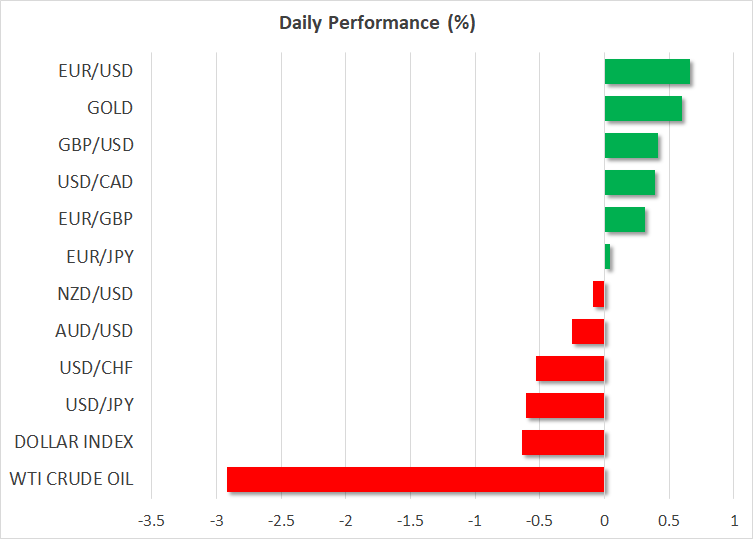
Wall Street futures have fallen back to virtually erase Monday’s rebound, while oil prices and commodity-linked currencies briefly dropped to new post-Omicron lows. Across the risk spectrum, Treasury yields edged lower as investors fled to the safety of US bonds. Admittedly, this tension might run deeper than Omicron itself.
Markets seem to be grappling with the risk that new restrictions will be on the table for years to come despite the vaccines, as mutations are inevitable. The twist is that central banks can’t ride to the rescue this time because inflation is sizzling hot, and there isn’t much political appetite left for gargantuan spending packages.
Ultimately this storm shall pass too but in the meantime, there’s a battle raging between market participants looking to buy any dip and funds trying to protect the profits they’ve already earned heading into year end. Shares of tech darlings have been the place to hide so far, highlighting the ‘defensive’ nature of these stocks when lockdowns are high on the radar.
Dollar gets hit, euro breathes
Risk aversion has rippled through the FX arena too. With expectations for rate hikes by central banks being dialed back and traders piling into the safety of bonds, yield differentials have been compressed again, breathing life back into the Japanese yen and Swiss franc.
Euro/dollar has also bounced back with some force, which likely boils down to US yields falling faster than European ones and retreating energy prices relieving one headache for the euro area economy.
That said, the Eurozone was struggling with growth risks even before a new variant entered the equation, so it is difficult to envision the pair’s rebound being sustained. And if the selloff in equity markets intensifies further, the dollar could simply decouple from US yields and charge higher as safe-haven flows overpower rate differentials.
European inflation, Powell testimony eyed
The show will continue today with the latest inflation data out of the Eurozone. Senior ECB officials have gone out on a limb lately to say this will be the ‘peak’ for inflation, but with German producer prices soaring by 18% in yearly terms, that theory will be tested soon.
The main event of the day will be a dual testimony by Fed Chair Powell and Treasury Secretary Yellen before the Senate at 15:00 GMT. Prepared remarks from Powell have already been released, with the Fed chief saying the Omicron variant poses “increased uncertainty” on inflation but downside risks to employment and growth.
That’s another way of saying the Fed can’t really do much to fight another covid wave when inflation is already so hot and new restrictions threaten to make matters worse by keeping supply chains under stress. The immediate question is whether Omicron is enough to shelve plans for a faster taper of asset purchases, but the real question is whether it could push back rate increases altogether.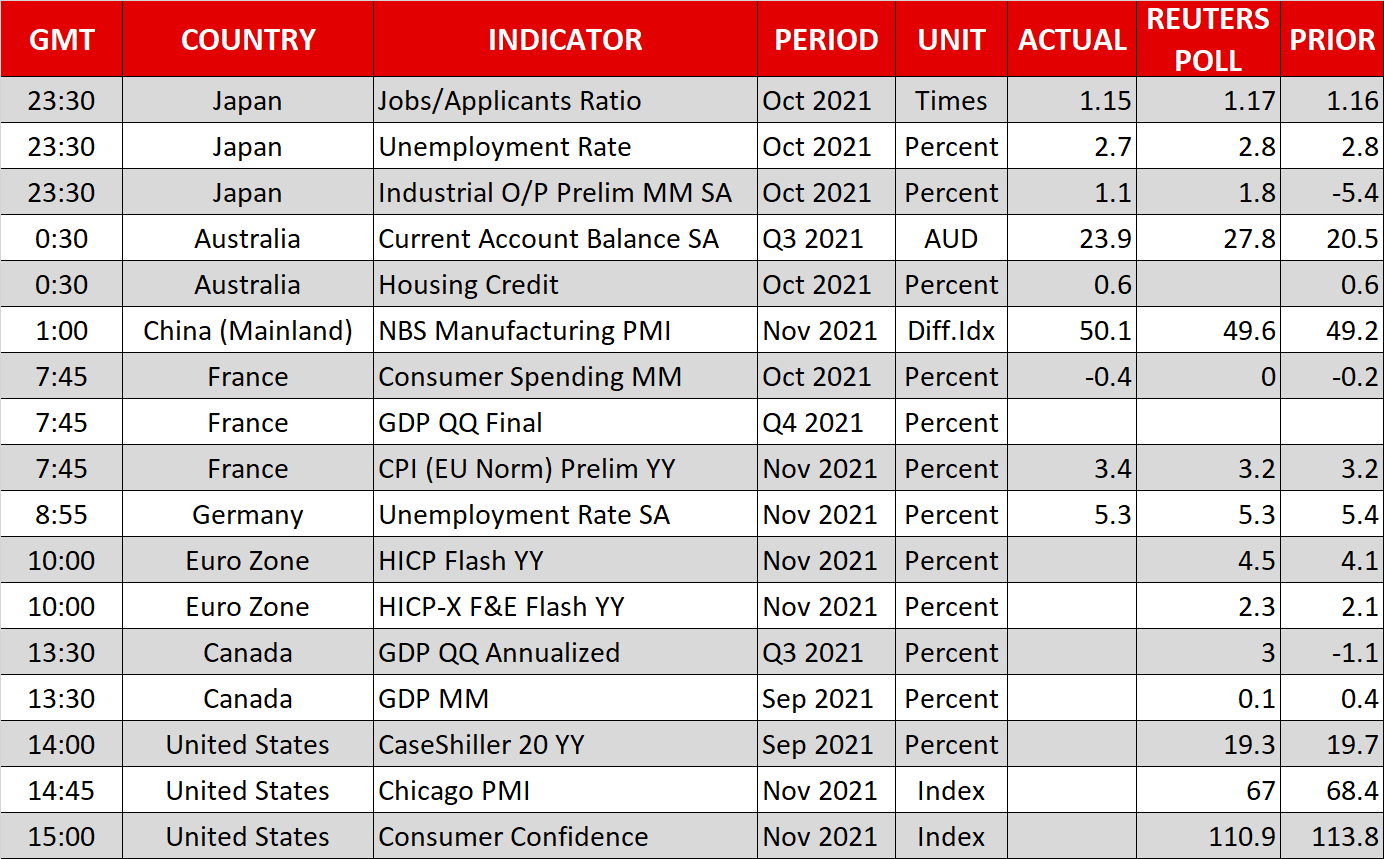
Oil Gives Up Gains, Gold Vulnerable
Oil’s recovery hits an OPEC+ wall
Oil managed to claw back some losses overnight, but the price action was far from impressive. Brent crude left higher initially, climbing over 5.0% intra-day, but gave back almost all those gains to finish just 0.74% higher at USD 73.40 a barrel overnight. WTI fared slightly better, closing 2.75% higher at USD 70.05 a barrel, and reclaiming its 200-day moving average. (DMA) In Asia, both contracts have added another 0.80% to USD 73.95 and USD 70.55.
Brent crude appears to have a higher beta to the OPEC+ meeting, logical given it is an international pricing benchmark, whereas WTI is very much US-centric. Overnight, Russia said that other members had not contacted it regarding halting production increases at the full OPEC+ meeting later this week, and that seems to have capped Brent’s recovery. Things move quickly in OPEC+ circles though and I remain of the opinion that the odds of a temporary halt to production increases are well above 50% now, especially with OPEC+ compliance already above 100%, suggesting limited swing capacity anyway.
That said, Friday’s lows still feel like the bargain of the year if you were an oil buyer, speculative or physical. Rather than second-guessing OPEC+, I am content to watch from the sidelines from here, as oil markets will be more vulnerable than most omicron headlines and violent swings in sentiment. Heightened volatile means that long or short, your P and L can still be nought.
The respective 200-DMAs at USD 72.70 and USD 70.00 a barrel should provide some support, if for no reason that a fall to those points will send the relative strength indexes (RSIs) into oversold territory. Above, some resistance should be found at USD 77.00, and USD 74.00 a barrel respectively.
Gold looks unimpressive
Gold’s price action continues to underwhelm, as it finished the overnight session down 0.46% at USD 1785.00 an ounce, before eking out a 0.20% gain to USD 1788.50 an ounce in Asia. There are zero signs of any safe-haven bids emerging to shelter from virus volatility, and it is falling despite both US yields and the US dollar also falling. Gold has now closed below its 50,100 and 200 DMAs clustered between USD 1791.00 and USD 1792.50 an ounce.
Gold will have resistance at USD 1800.00 and USD 1815.00 to start the week, while yesterday’s spike to USD 1770.00 an ounce, will provide initial support. In between, gold may find some friends around USD 1780.00. Failure of USD 1770.00 signals a retest of USD 1760.00 and USD 1740.00 an ounce. Friends are what gold needs to find quickly though, and I do not rule out a move lower to USD 1720.00 this week, especially if the Non-Farms puts the Fed taper back in the spotlight and we have a lull in virus headlines.
Currency Markets Remain Much More Cautious
US dollar rally runs out of steam
Currency markets were volatile overnight but notably, the recovery rally in the US dollar ran out of steam. US yields rose only slightly after Friday’s sharp falls. The dollar index rose nearly 50 points to test 96.50 intraday but retreated to finish just 0.13% higher at 96.19. In Asia, the last of those gains have been unwound, the index falling 0.08% to 96.11. The index looks like to trade in a choppy 95.75 to 96.50 range over the next few sessions.
Notably, euro, sterling and yen all fell slightly overnight while the Swiss franc still managed to record gains, as did the Chinese yuan and the Canadian dollar. EUR/USD is back to 1.1300, with GBP/USD at 1.3325, while USD/JPY is holding steady at 113.65. USD/JPY will find a recovery back above 114.00 challenging this week. AUD/USD and NZD/USD booked modest gains to 0.7145 and 0.6825 overnight, suggesting caution prevails in the G-10 space regarding omicron, and both antipodeans are only just holding above their 2021 lows still at 0.7100 and 0.6800.
USD/MXN and USD/ZAR fell sharply overnight, and that sees the US dollar is moving lower across the board versus Asian currencies today, helped along by a fall by USD/CNY to 6.3715. USD/KRW, USD/MYR, USD/INR have fallen by 0.25% while USD/SGD and USD/THB are holding steady.
In the G-10 space, currencies appear to be reflecting some well-deserved caution towards omicron still, as usual, refusing to indulge in the mindless FOMO price action in the equity space. However, in the Asian regional space, local currencies appear to be pricing in the likelihood of a slower Fed taper, or even a halt to it thanks to the new variant. It is hard to argue with either thesis at the moment.
That suggests that a lower than expected Non-Farm Payrolls number on Friday is likely to see strength in the emerging space, rather than the DM space versus the US dollar. And omicron will likely mute any strong dollar effects from a higher than 500k print on Friday. Like other asset classes, markets will be on tenterhooks for the latest omicron headlines across the news ticker.