Sample Category Title
Currency Markets Remain Much More Cautious
US dollar rally runs out of steam
Currency markets were volatile overnight but notably, the recovery rally in the US dollar ran out of steam. US yields rose only slightly after Friday’s sharp falls. The dollar index rose nearly 50 points to test 96.50 intraday but retreated to finish just 0.13% higher at 96.19. In Asia, the last of those gains have been unwound, the index falling 0.08% to 96.11. The index looks like to trade in a choppy 95.75 to 96.50 range over the next few sessions.
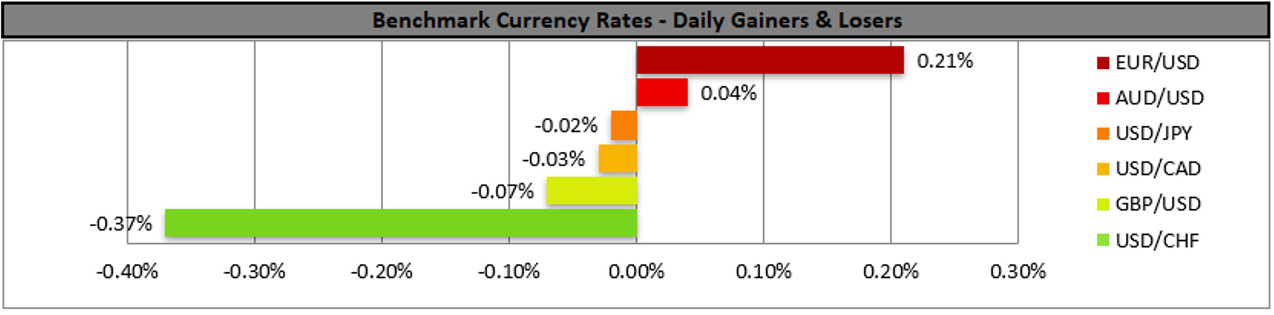
Notably, euro, sterling and yen all fell slightly overnight while the Swiss franc still managed to record gains, as did the Chinese yuan and the Canadian dollar. EUR/USD is back to 1.1300, with GBP/USD at 1.3325, while USD/JPY is holding steady at 113.65. USD/JPY will find a recovery back above 114.00 challenging this week. AUD/USD and NZD/USD booked modest gains to 0.7145 and 0.6825 overnight, suggesting caution prevails in the G-10 space regarding omicron, and both antipodeans are only just holding above their 2021 lows still at 0.7100 and 0.6800.
USD/MXN and USD/ZAR fell sharply overnight, and that sees the US dollar is moving lower across the board versus Asian currencies today, helped along by a fall by USD/CNY to 6.3715. USD/KRW, USD/MYR, USD/INR have fallen by 0.25% while USD/SGD and USD/THB are holding steady.
In the G-10 space, currencies appear to be reflecting some well-deserved caution towards omicron still, as usual, refusing to indulge in the mindless FOMO price action in the equity space. However, in the Asian regional space, local currencies appear to be pricing in the likelihood of a slower Fed taper, or even a halt to it thanks to the new variant. It is hard to argue with either thesis at the moment.
That suggests that a lower than expected Non-Farm Payrolls number on Friday is likely to see strength in the emerging space, rather than the DM space versus the US dollar. And omicron will likely mute any strong dollar effects from a higher than 500k print on Friday. Like other asset classes, markets will be on tenterhooks for the latest omicron headlines across the news ticker.
Wall Street Rebound Lifts Asian Equities
Asian markets rise as omicron concerns ease
Asian equity markets mostly ignored the sharp rally in US index futures yesterday morning, but with the rally consolidating in OTC markets in the US and Europe overnight, Asia feels confident about dipping its toes in the water today, although the gains are not universal. On Wall Street, investors unwound much of Friday’s sell-off drama, and despite the tenuous reasoning behind the move, always respect momentum.
The S&P 500 rose 1.32%, the Nasdaq leapt 1.88% higher, while the Dow Jones turned in a respectable 0.65% gain. In Asia, the FOMO mafia have continued pushing index futures higher with Dow futures lifting by 0.25%, and S&P 500 and Nasdaq futures booking 0.10% gains.
After a stunning downside reversal late in the Tokyo session as the government banned entry to all foreigners, the Nikkei 225 is doing what it does best today, following the Nasdaq. Softer Industrial Production data has tempered the gains, but the Nikkei 225 is still 0.60% higher. However, South Korea’s Kospi is 1.05% lower after the government shelved plans to relax Covid-19 restrictions, highlighting once again, what is really driving markets right now. Meanwhile, mainland China markets have edged higher, the Shanghai Composite and CSI 300 rising by just 0.15%. The casino sell-off persists in Hong Kong today, the latest sector in the Chinese government spotlight, leading the Hang Seng to shed 1.20%.
Across the region, Singapore is unchanged, unable to shake off PM Lee’s comments that Covid-19 freedoms could be rolled back if necessary. Kuala Lumpur though has risen by 0.55%, with Jakarta rising by 0.40% and Bangkok climbing 1.05% as investors build a tourism premium back in once again. Manila has fallen 1.0% while Taipei has rallied by 0.80%. Australian markets, never short of herd-like optimism or a proclivity to slavishly follow Wall Street, have rallied strongly. The All Ordinaries is 1.10% higher, while the ASX 200 has risen by 0.80%.
European markets reclaimed some losses overnight, and the price action in Asia will likely inspire more buying initially. The same is likely on Wall Street as the pull of the FOMO remains irresistible. I would caution, however, that we are just one negative omicron headline from the whole rally everywhere, evaporating into thin air.
V For Volatility
Markets rebound from omicron panic
The buy-the-dip mafia was out in force yesterday, with a fair bit Friday’s Wall Street and European equity sell-off unwound, as well as Friday moves in bond, currencies and commodities and energy. Notably, it hasn’t been a complete reversal by any means, as the world settles into a choppy holding pattern, for clarity about just worried, or not, we should be about the new Covid-19 omicron variant.
President Biden attempted to soothe nerves overnight, but what really drove the retracement were anecdotal reports from the South African medical establishment suggesting that symptoms were milder than delta. Always ready to selectively edit the facts to fit the prevailing market sentiment, cases popping up in multiple locations around the world (they were probably there already), kneejerk travel bans on travellers from southern Africa (there is no evidence it originated there, they just reported it first), and in the case of Japan, all foreigners, and WHO warnings that the new variant posed a “very high” risk, were mostly ignored by investors worldwide. The fact that markets haven’t completely unwound the Friday meltdowns at least suggests a modicum of caution remains.
To be fair, having been scarred by delta, much of Asia is still in ultra-cautious mode, as their recovery was only just gathering steam with borders being tentatively reopened. And one can’t blame national governments for shooting first and asking questions later, after paying the price so badly for their delta complacency earlier this year. Whether that escalates into wider restrictions than a ban on travellers from Southern Africa also remains to be seen.
It will likely be a couple of weeks before the great and good of the global scientific community can make a definitive judgment on how serious the omicron variant is. That means December is likely to be choppy and driven by omicron headlines, and the heavyweight data calendar this week, will be rendered irrelevant. All that will matter is whether more restrictions are coming back around the world, and whether central banks, especially the Fed, hit the pause button on monetary tightening plans. I already know the answer to that one. The big winner this month will be volatility, we should see plenty of it. But with markets selling everything on negative omicron headlines and clasping at the most tenuous of straws to buy everything back on any perceived positive headlines, investors looking for thematic direction moves this month, are likely to be sorely disappointed.
Markets got nothing out of the stream of Fed speakers overnight, who seemed to be going out of their way to avoid thoughts on omicron-world monetary policy. We have had some heavyweight data from Asia today though, although as I have just mentioned, it has been largely ignored. South Korean and Japanese Industrial Production was released, with the YoY data outperforming, while the MoM prints disappointed. South Korea falling -3.0%, while Japan rose on 1.10%. Electronics continued to perform well, but automotive and transport suffered due to the semiconductor bugbear. A cynic might say that the recoveries in both countries are stalling, much like the recent data from China suggests.
Speaking of China, official Manufacturing and Non-Manufacturing PMIs were released for November this morning. Manufacturing PMI managed to recover marginally into expansionary territory, creeping up to 50.1. that follows a sharp rise in Industrial Profits over the weekend, with metals refining and energy, unsurprisingly, leading the way. The data suggests China isn’t out of the woods yet though, although you wouldn’t bet against them. Non-Manufacturing PMI held steady at 52.3, with Covid-19 restrictions potentially offset by Singles Day. The general PMI rose sharply from 50.8 to 52.2, and overall, the data suggests an improvement driven by an easing of China’s power crunch and a slight easing in lending criteria to the property sector. The data is steady, rather than spectacular, and I won’t be breaking out the champagne yet.
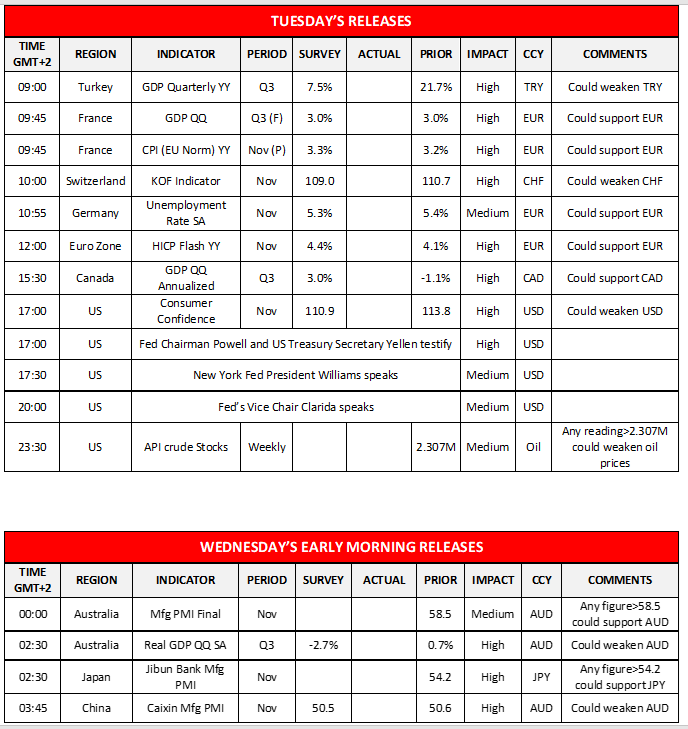
We have a raft of GDPs across the Eurozone, as well as Eurozone November Flash Inflation, and German Unemployment this after. In the US, we have the Case-Shiller Home Price data, as well as CB Consumer Confidence and both Janet Yellen and Jerome Powell are testifying on the Hill I believe. Sadly, unless Mr Powell says the taper will stop if omicron is serious, all of this be ignored. V is for volatility, and there is only one story in town this week, and it is invisible to the human eye.
The Analytical Overview Of The Main Currency Pairs
The EUR/USD currency pair
Technical indicators of the currency pair:
Prev Open: 1.1303
Prev Close: 1.1307
% chg. over the last day: -0.04%
Inflation in Germany increased to 5.2% in November, the highest level since June 1992, surpassing the estimate of 5%. Investors' attention is now focused on the Eurozone inflation figure, which will be published today. Analysts expect the consumer price level in Europe to rise to 4.5%.
Trading recommendations
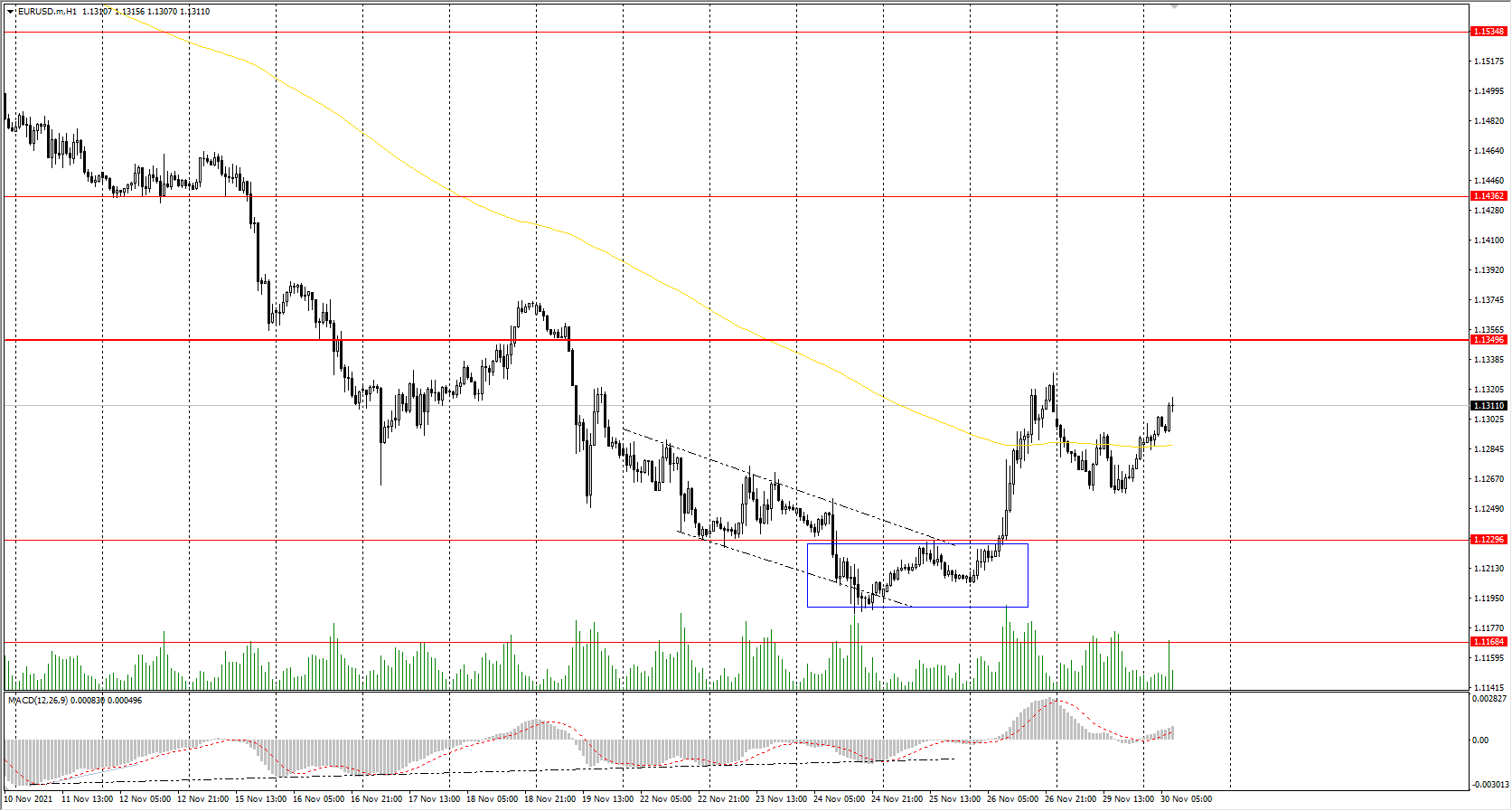
Support levels: 1.1230, 1.1168
Resistance levels: 1.1350, 1.1436, 1.1535, 1.1613, 1.1667, 1.1717
From the technical point of view, the EUR/USD on the hour time frame is bearish. The MACD indicator has become positive, there is a buyers' initiative. Under such market conditions, traders should consider sell positions from the priority change level of 1.1350. Buy trades should be considered only from the support levels of the higher timeframe, given the buyers’ initiative, but only with short targets.
Alternative scenario: if the price breaks out through the 1.1350 resistance level and fixes above, the mid-term uptrend will likely resume.
News feed for 2021.11.30:
- German Unemployment Rate (m/m) at 10:55 (GMT+2);
- Eurozone Consumer Price Index (m/m) at 12:00 (GMT+2);
- US Chicago PMI (m/m) at 16:45 (GMT+2);
- US CB Consumer Confidence (m/m) at 17:00 (GMT+2);
- US Fed Chair Powell Testifies at 17:00 (GMT+2);
- US Treasury Secretary Yellen Speaks at 17:00 (GMT+2);
- US FOMC Member Williams’s Speech at 17:30 (GMT+2);
- US FOMC Member Clarida’s Speech at 20:00 (GMT+2).
The GBP/USD currency pair
Technical indicators of the currency pair:
Prev Open: 1.3330
Prev Close: 1.3313
% chg. over the last day: +0.13%
The UK is not going to introduce restrictions in the next 3 weeks. Business activity in the United Kingdom is gradually increasing, but the energy crisis is still putting pressure not only on businesses but also on households. Analysts are lowering their forecasts about the Bank of England rate hike, it is expected to increase by 8 basis points in December.
Trading recommendations
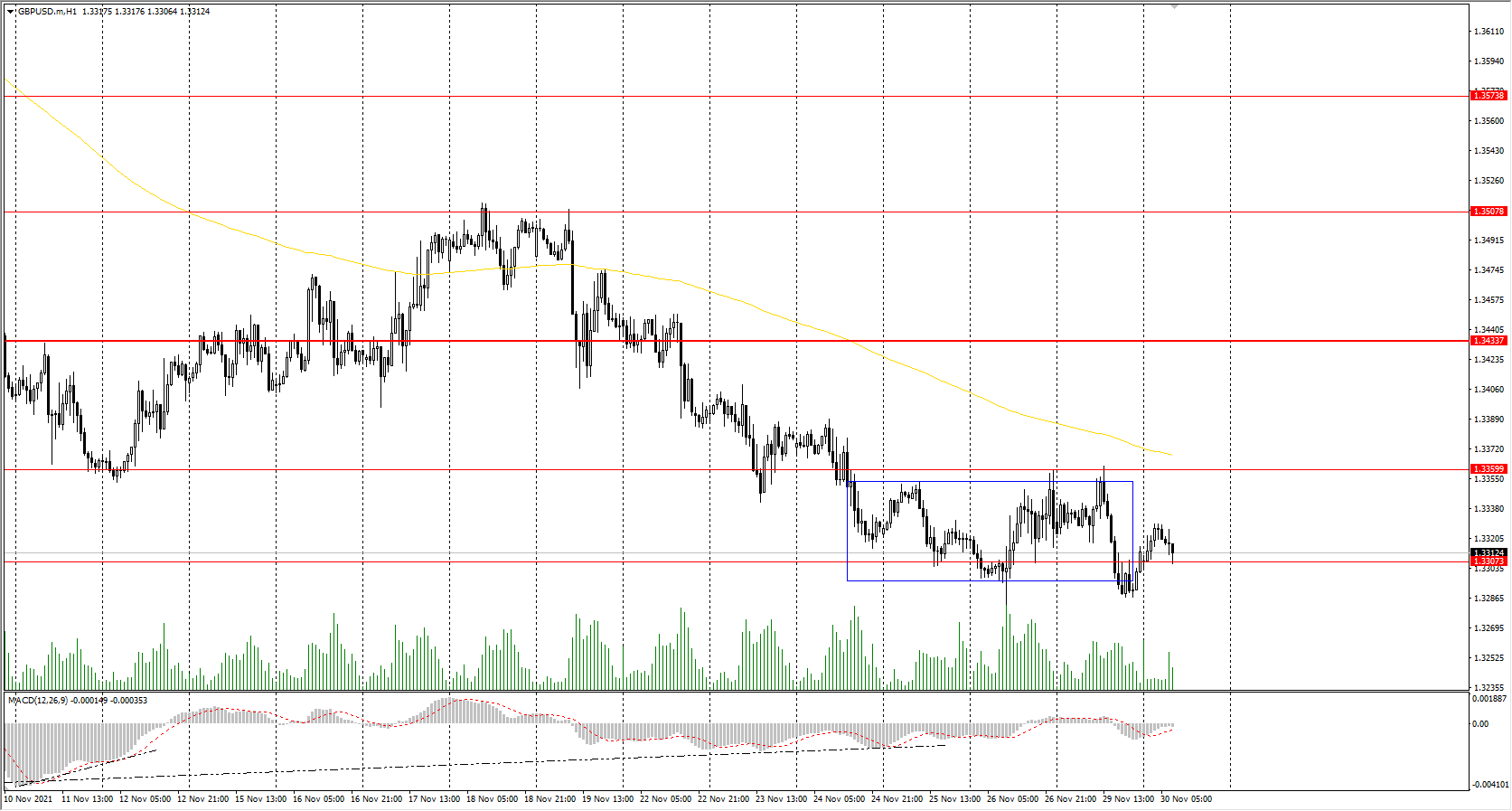
Support levels: 1.3307
Resistance levels: 1.3360, 1.3434, 1.3507, 1.3575, 1.3685, 1.3748
On the hourly time frame, the trend on GBP/USD is bearish. The price has formed a new corridor with a range of 1.3307-1.3360. The MACD indicator has become inactive, but is signaling divergence on several timeframes. Under such market conditions, traders should consider sell positions from the resistance levels around the moving average. It is important for the buyers to get the price back above the 1.3360 level, so buy trades should be considered only if the price returns to the wider 1.3360-1.3507 corridor, given the buyer’s initiative.
Alternative scenario: if the price breaks out through the 1.3434 resistance level and consolidates above, the bullish scenario will likely resume.
The USD/JPY currency pair
Technical indicators of the currency pair:
Prev Open: 113.61
Prev Close: 113.53
% chg. over the last day: -0.07%
Japan's unemployment rate in October fell to the lowest level since March. Industrial production increased for the first time in 4 months. The Japanese Yen continues to strengthen as a safe-haven currency as a new variant of the Omicron virus is much more resistant to vaccines.
Trading recommendations
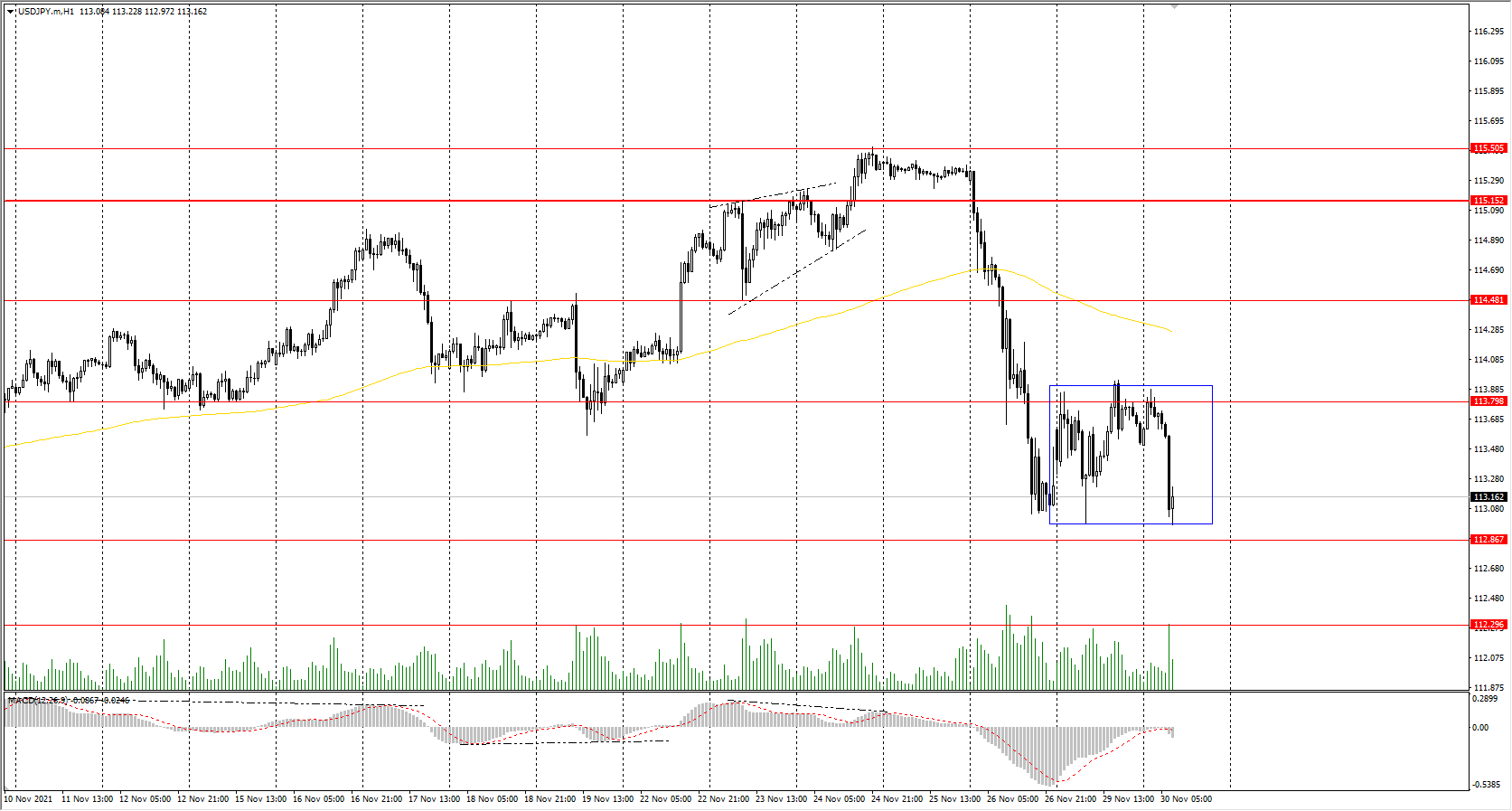
Support levels: 112.87, 112.30
Resistance levels: 113.79, 114.48, 115.15, 115.50
The global trend on the USD/JPY currency pair has changed to bearish. The price confidently broke through the priority change level and consolidated lower. Under such market conditions, it is best for traders to look for sell positions from the resistance levels around the moving average. Buy positions should be considered from the support levels of the higher time frames, given the buyer’s initiative.
Alternative scenario: if the price rises above 115.15, the uptrend will likely resume.
News feed for 2021.11.30:
- Japan Unemployment Rate (m/m) at 01:30 (GMT+2);
- Japan Industrial Production (m/m) at 01:50 (GMT+2).
The USD/CAD currency pair
Technical indicators of the currency pair:
Prev Open: 1.2747
Prev Close: 1.2736
% chg. over the last day: -0.09%
Oil prices continue to decline amid news that a new variant of the Omicron virus is resistant to vaccines, adding to fears that there could be an excess of supply in the first quarter of next year. The Canadian dollar is a commodity currency, so the CAD is falling sharply against the dollar amid a drop in oil.
Trading recommendations
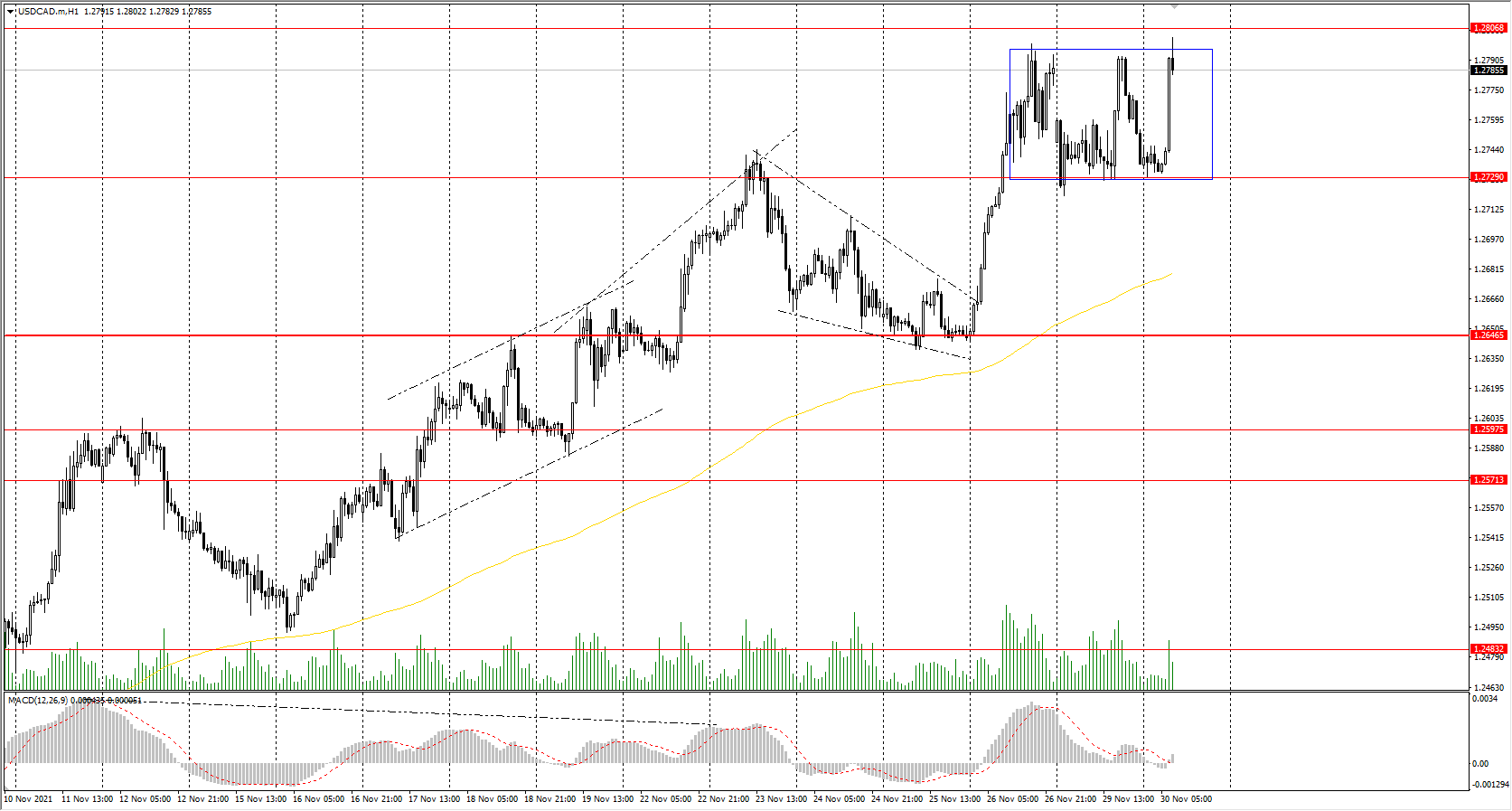
Support levels: 1.2729, 1.2646, 1.2598, 1.2571, 1.2483, 1.2416, 1.2388
Resistance levels: 1.2807
From the technical point of view, the trend of the USD/CAD currency is bullish. The MACD indicator has become inactive, but buyer pressure remains high. Under such market conditions, it is better to look for buy trades from the lower border of the flat corridor. Sell deals should be considered from the resistance levels of the higher time frames.
Alternative scenario: if the price breaks down through the 1.2646 support level and fixes below, the downtrend will likely resume.
News feed for 2021.11.30:
- Canada GDP (q/q) at 15:30 (GMT+2).
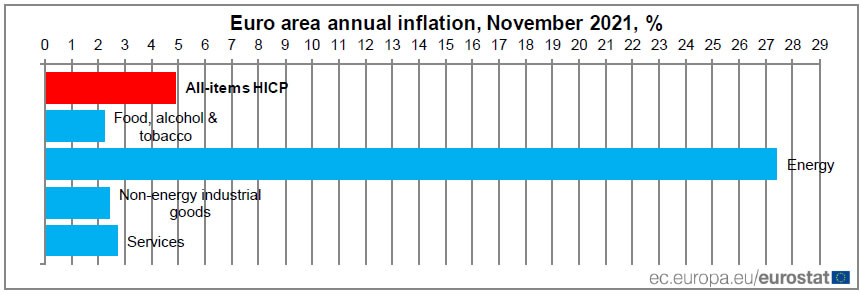
Eurozone CPI surged to record 4.9% yoy in Nov, core CPI rose to 2.6% yoy
Eurozone CPI accelerated to 4.9% yoy in November, up from 4.1% yoy, well above expectation of 4.4% yoy. That's the highest level on record in the 25 years of the series's history. CPI core accelerated to 2.6% yoy, up from 2.0% yoy, above expectation of 2.3% yoy.
Looking at the main components of inflation, energy is expected to have the highest annual rate (27.4%, compared with 23.7% in October), followed by services (2.7%, compared with 2.1% in October), non-energy industrial goods (2.4%, compared with 2.0% in October) and food, alcohol & tobacco (2.2%, compared with 1.9% in October).
Markets Seem To See Through Pandemic As Market Rebalances
The markets seem to look through the new Omicron variant stabilising somewhat in a rebalancing act amidst lower volatility in the FX market, while the USD still remained rather soft yesterday and during today’s Asian session against its counterparts. Comments made by scientists that the symptoms of the Omicron variant seem to be mild tended to sooth market worries for the possible impact of the new variant of the pandemic on the recovery of the global economy. Today we note the release of the US consumer confidence indicator for November while on the monetary front we highlight the testimony of Fed Chairman Powell before the Senate and the speeches of New York Fed President Williams and Fed Vice Chair Clarida. Should the testimony and the speeches actually lean towards the hawkish side we may see the USD getting some support while also please note that US Treasury Secretary Yellen is also to testify before the Senate.
USD/JPY’s bearish tendencies seemed to come to a halt yesterday just below the 113.70 (R1) resistance line, yet during today’s Asian session the bearish tendencies seem to be renewed. As the pair has broken the steep downward trendline characterising its movement since Friday, we switch our bearish outlook initially in favour of a bias for a sideways movement. We have to note though that the RSI indicator below our 4-hour chart is nearing the reading of 30 which could imply that the bearish sentiment is still present. Should the bears regain control over the pair’s direction, we may see USD/JPY breaking the 112.75 (S1) support line and aim for the 112.10 (S2) support level. Should the bulls say enough is enough and take over the initiative over the direction of the pair, we may see it breaking the 113.70 (R1) line and aim for the 114.45 (R2) level.
EUR traders eye inflationary pressures
The common currency corrected a bit lower yesterday against the USD and was slightly lower against safe havens JPY and CHF while was on the rise against the weaker GBP. It should be noted that Germany’s preliminary HICP rate for November showed an acceleration beyond expectations as it reached 6.0% yoy a level not seen in decades in a country which is very sensitive about the level of prices. The release could increase the pressure on the ECB to tighten its monetary policy in a faster pace, yet ECB board member Schnabel stated that inflation has reached its peak in November which could imply that it is expected to retreat afterwards. So, on a fundamental level we still see the pandemic weighing on the EUR as it has a firm grip over the area despite ECB President Lagarde’s optimistic comments yesterday, while on the monetary front ECB’s ultra-loose monetary policy seems to be allowed to continue at least for now. EUR traders are to have a busy day ahead today with France’s final GDP rate for Q3 and preliminary CPI (EU normalized rate) for November due out, yet the crown may be the release of the Eurozone’s preliminary HICP rate for November and should the rate accelerate as forecasted or even more, we may see the EUR getting some support.
EUR/USD seems to have some bullish tendencies in today’s late Asian session, as it broke the 1.1300 (S1) resistance line, now turned to support. Given that the RSI indicator below our 4-hour chart is nearing the reading of 70 and the pair’s upward movement since yesterday’s American session, we maintain a bullish bias for now yet some degree of uncertainty is still present. Should the pair actually find fresh buying orders along its path we may see it aiming if not breaking the 1.1370 (R1) resistance line. On the other hand, should a selling interest be displayed for the pair we may see it breaking the 1.1300 (S1) support line and aim for the 1.1225 (S2) support level.
Other highlights today and during tomorrow’s Asian session
Besides the financial releases allready mentioned we would also like to note Turkey’s GDP rate for Q3, Switzerland’s KOF indicator for November, Canada’s GDP for Q3 and during tomorrow’s Asian session we get Australia’s GDP rates for Q3 and China’s Caixin manufacturing PMI for November.
USD/JPY H4 Chart
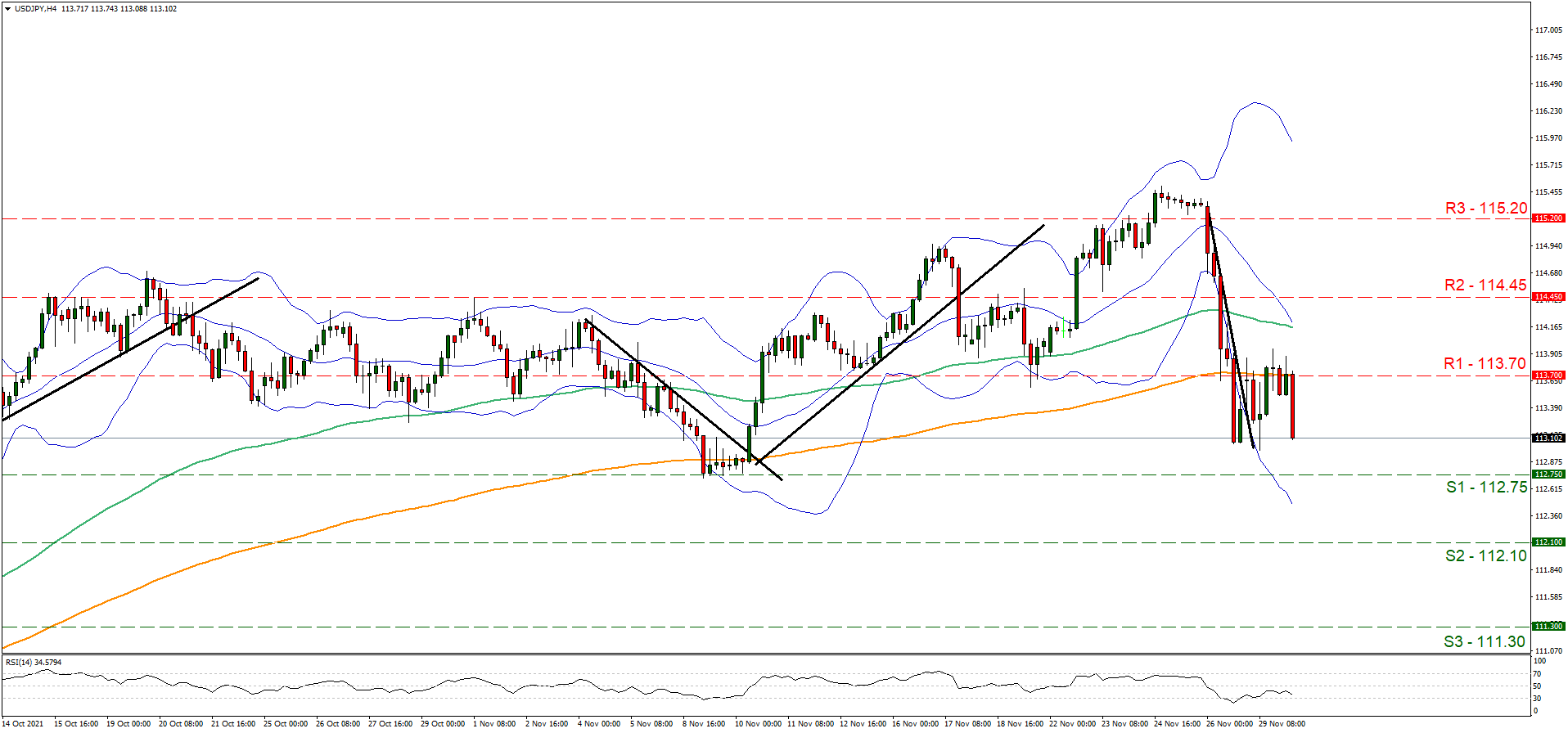 Support: 112.75 (S1), 112.10 (S2), 111.30 (S3)
Resistance: 113.70 (R1), 114.45 (R2), 115.20 (R3)
EUR/USD H4 Chart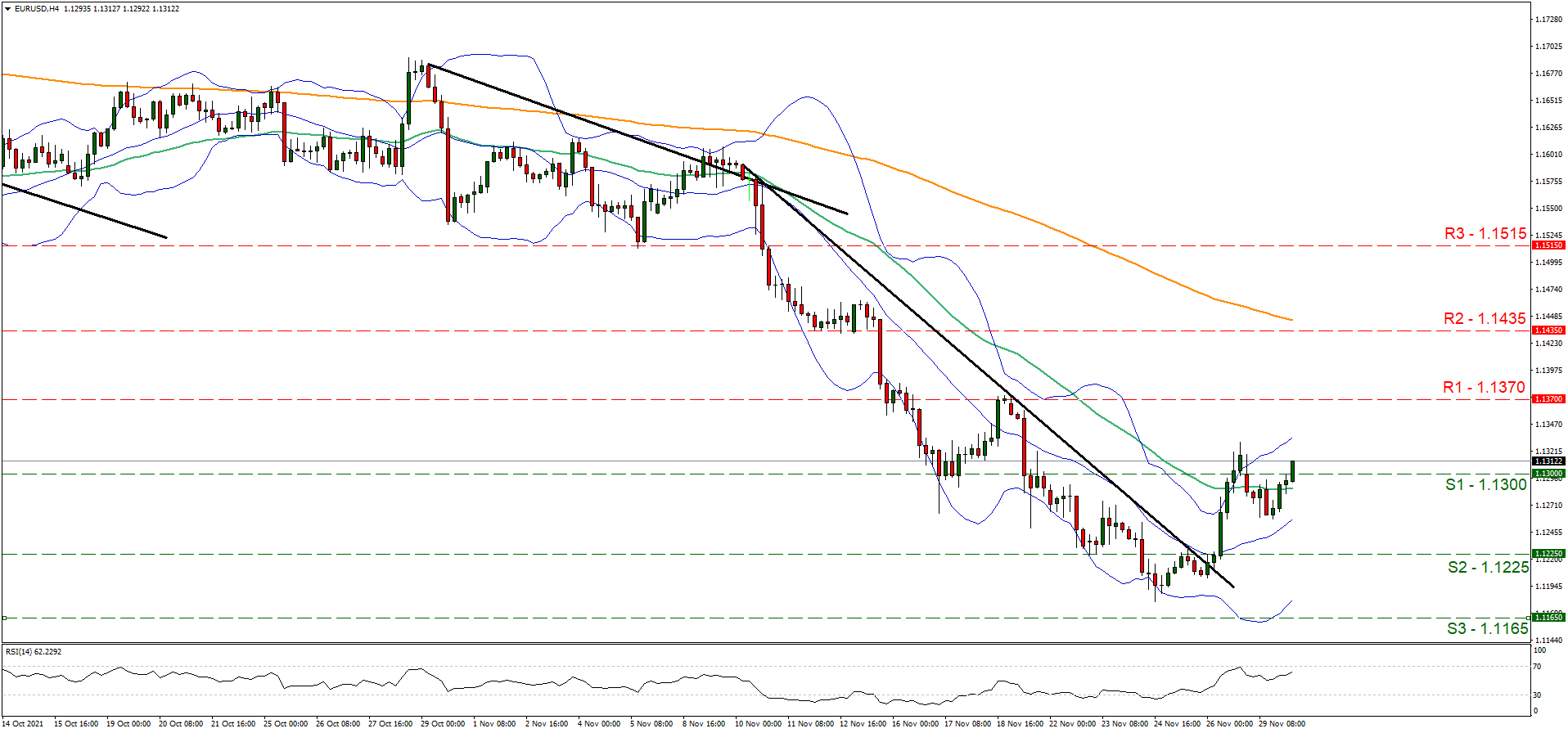
Support: 1.1300 (S1), 1.1225 (S2), 1.1165 (S3)
Resistance: 1.1370 (R1), 1.1435 (R2), 1.1615 (R3)
Moderna’s CEO Stated That The Omicron Strain Of The Virus Is Resistant To Existing Vaccines
On Monday, the US stock indices closed on a positive note but began a sharp decline today amid news that the Omicron strain of the virus is resistant to existing vaccines. According to the WHO, the probability of further global spread of the Omicron coronavirus strain is high.
Many analysts already agree that stock markets are no longer in fear of stimulus cuts and interest rate hikes at the moment. Because of the Covid-19 "sudden" mutations, stimulus cuts and rate hikes can be delayed - indicating that inflation will continue to rise over the medium term.
Japan and Israel were among the last countries that closed their borders to foreign travelers after the WHO officially recognized the Omicron virus variant as a global risk. No Omicron-related deaths have been reported, but more than 10,000 cases have been reported in South Africa this week.
Yesterday, Fed Chairman Jerome Powell said that the Omicron strain is creating more uncertainty for the inflation outlook. This could slow progress in the labor market and strengthen problems in supply chains in turn. The Fed will use all tools to strengthen the economy and the labor market and ensure that higher inflation does not occur. At the same time, Mr. Powell hinted that inflationary pressures will continue next year.
European stock markets increased in yesterday's trading. French CAC 40 (FR40) gained 0.5%, British FTSE 100 (UK100) added 0.9%, German DAX (DE40) increased by 0.2%, Spanish IBEX (ES35) jumped by 0.7%. Inflation in Germany increased to 5.2% in November, the highest level since June 1992, surpassing the estimate of 5%. Investors' attention is now focused on the Eurozone inflation figure, which will be published today. Analysts expect the consumer price level in Europe to rise to 4.5%. The European Central Bank is likely to continue its bond buying program (PEPP) over the next year to stimulate the region's economy, ECB Vice President Luis de Guindos told French newspaper Les Echos on Tuesday. The comments indicate that there will be no rate hike next year because the ECB's directive states that any interest rate hike will take place "shortly after" the end of quantitative easing. This means that there is no fundamental reason for the Euro to strengthen.
OPEC+ postponed monitoring meetings to assess the impact of the new coronavirus strain on oil. Oil prices continued to decline at the opening of trading Tuesday on news that a new variant of the Omicron virus is resistant to vaccines. This adds to fears that there could be an excess of supply in the first quarter of next year.
Asian stock markets fell sharply in late trading today as investors fear that the Omicron variant could cause broader global economic shocks. Japan's Nikkei Index (JP225) decreased by 1.63%, Hong Kong's Hang Seng Index (HK50) lost 1.8%, while Australia's ASX 200 (AU200) added 0.22% as the Australian dollar declined sharply as a risk category currency. As a rule, major country indices are inversely correlated with the exchange rate of the nation's currency.
Main market quotes:
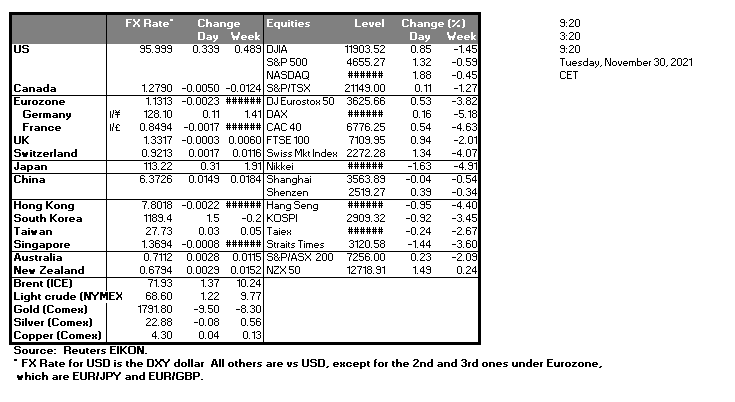
- S&P 500 (F) 4,655.27 +60.65 (+1.32%)
- Dow Jones 35,135.94 +236.60 (+0.68%)
- DAX 15,280.86 +23.82 (+0.16%)
- FTSE 100 7,109.95 +65.92 (+0.94%)
- USD Index 96.27 +0.18 (+0.19%)
Important events for today:
- Japan Unemployment Rate (m/m) at 01:30 (GMT+2);
- Japan Industrial Production (m/m) at 01:50 (GMT+2);
- China Manufacturing PMI (m/m) at 03:00 (GMT+2);
- German Unemployment Rate (m/m) at 10:55 (GMT+2);
- Eurozone Consumer Price Index (m/m) at 12:00 (GMT+2);
- Canada GDP (q/q) at 15:30 (GMT+2);
- US Chicago PMI (m/m) at 16:45 (GMT+2);
- US CB Consumer Confidence (m/m) at 17:00 (GMT+2);
- US Fed Chair Powell Testifies at 17:00 (GMT+2);
- US Treasury Secretary Yellen Speaks at 17:00 (GMT+2);
- US FOMC Member Williams’s Speech at 17:30 (GMT+2);
- US FOMC Member Clarida’s Speech at 20:00 (GMT+2).
GBPUSD Sellers Take A Breather But Bearish Bias Rules
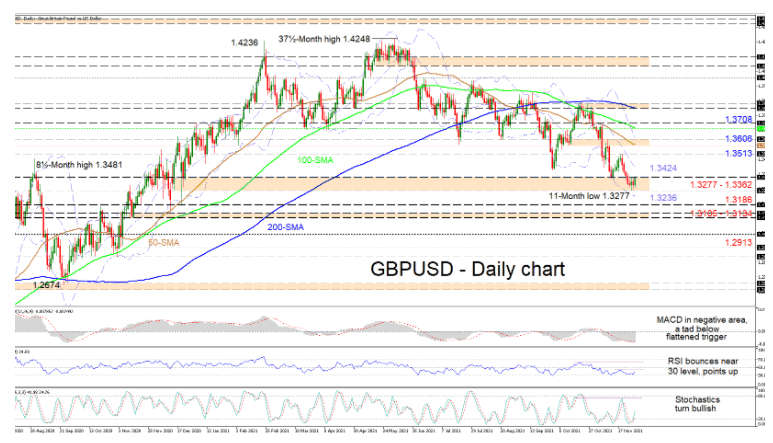
GBPUSD is consolidating around the 1.3300 mark, within the 1.3277-1.3362 support zone that has managed to mute negative forces for now. The falling simple moving averages (SMAs) are presently backing the bearish picture in the pair.
The short-term oscillators are suggesting a moderate waning in negative momentum. The MACD, some distance in the negative zone, is holding beneath its red trigger line. The RSI, in bearish territory, is improving from the 30 level, while the stochastic oscillator is promoting advances in the pair.
In the positive scenario, immediate constraints could originate from the 1.3362 mark and the approaching mid-Bollinger band at 1.3424 ahead of the 1.3513 barrier. Overstepping the latter obstacle, buyers may encounter a fortified section of resistance from the 50-day SMA at 1.3566 until the upper Bollinger band, residing at the 1.3606 high. Conquering this crucial border, the bulls could then eye a region of resistance existing between the 100-day SMA at 1.3675 and the 1.3708 level.
Otherwise, if sellers resurface, initial downside friction could transpire from the 1.3277 boundary of the current buffer zone, which happens to also be the 11-month low. Sliding past this, the neighbouring lower Bollinger band at 1.3236 and the 1.3186 low could delay the test of the 1.3105-1.3134 support band. Piercing below this key barricade, the price may then plunge towards the 1.3000 handle before targeting the 1.2913 obstacle.
Summarizing, GBPUSD’s medium-term outlook is growing increasingly negative, as the pair logs lower highs and lows. That said, buyers are fighting back but they would need to drive the price above the 1.3513 high to start to gain some upside momentum.
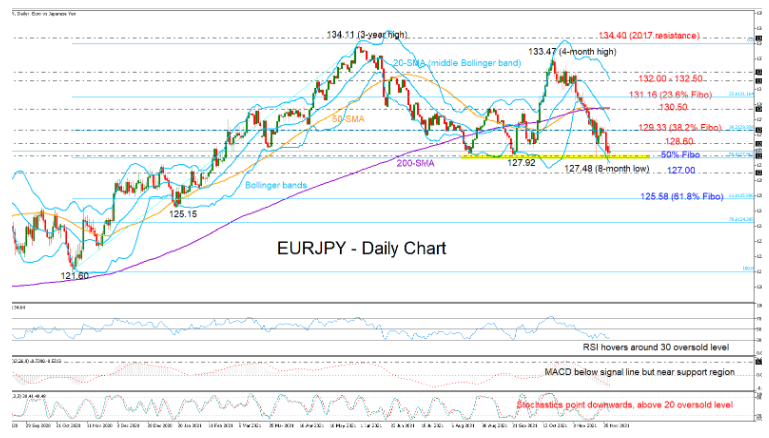
EURJPY Holds Around A Make-Or-Break Point
EURJPY returned immediately above the key 127.92 base after sliding marginally below it on Monday to chart an 8-month low of 147.48.
The market structure in the medium-term picture remains neutral despite yesterday’s flash drop, though the negative intersection between the simple moving averages (SMAs) is not a promising sign for the market trend.
As regards the next price action, the momentum indicators are currently foreseeing persisting bearish pressures as the MACD keeps decelerating below its red signal line, the RSI continues to fluctuate well below its 50 neutral mark, and the Stochastics change course to the downside. Still, with the MACD testing a familiar support region and the RSI being close to its 30 oversold level, selling forces may not last for long. Note that the price has also been hovering around the lower Bollinger band for the past few days. Therefore, the bulls’ fortunes could improve in the near term.
Nevertheless, a decisive close below 127.92, where the 50% Fibonacci of the 121.60 – 134.11 up leg is located, could confirm additional losses likely towards the 127.00 former resistance territory. Diving deeper, the price could stabilize around the 61.8% Fibonacci of 125. 58.
On the upside, the 128.60 region has been occasionally blocking upside and downside movements during the year. Therefore, a break above it could drive the price straight up to the 38.2% Fibonacci of 129.33. This is also where the 20-day SMA is converging. Hence, another step higher from here could unleash the next bullish action towards the important 130.50 barrier.
In summary, EURJPY seems to be at a make-or-break point around the tough 127.92 support region. While the risk remains tilted to the downside, selling appetite looks to be fading, increasing the odds for an upside reversal.
USD/JPY Outlook: Bears Resume Through Key Supports On New Omicron Fears
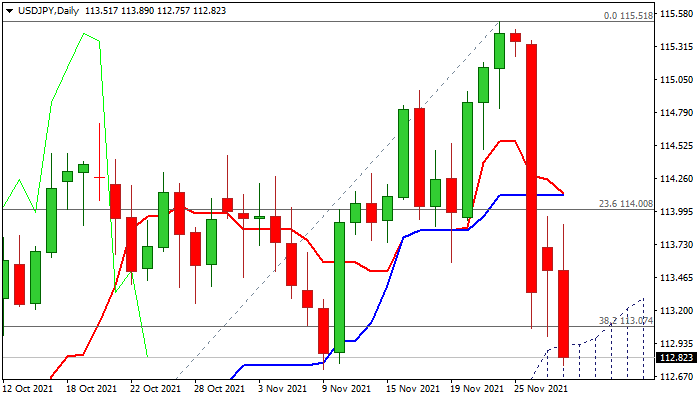
Bears resume on Tuesday after a double rejection at pivotal Fibo support at 113.07 (38.2% of 109.11/115.51).
The latest comments from drugmaker Moderna’s CEO that Covid-19 vaccines were unlikely to be as effective against the new Omicron variant as they have been against the Delta version, raised concerns in the market and further boosted the risk aversion.
Fresh extension of the pullback from 115.51 (2021 high, posted on Nov 24) penetrated thick daily cloud (top of the cloud lays at 112.93), and pressure pivot at 112.72 (Nov 9 trough) generating initial bearish signal.
The near-term action is weighed by last Friday’s massive bearish candle, while bearish momentum is gaining pace on daily chart and MA’s forming bear-crosses, adding to negative outlook.
Today’s close below 112.72 would confirm strong bearish signal and open way for test of next key supports at 112.31 (50% retracement) and 111.90 (daily cloud base), violation of which would confirm reversal and open way for a deeper correction.
Res: 112.93, 113.07, 113.89, 114.00.
Sup: 112.31, 112.07, 111.90, 111.56.