Sample Category Title
EUR/JPY Reaches Target At 127.50
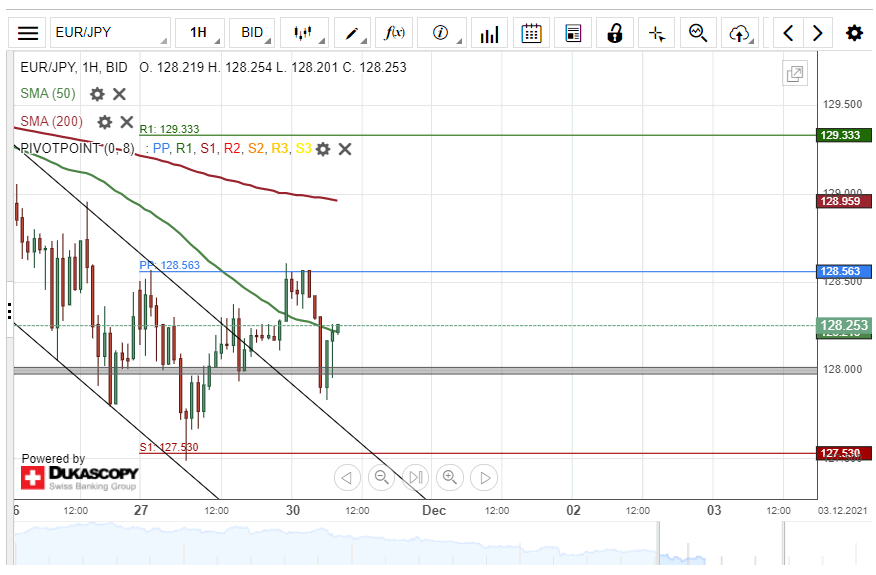
As forecast, the EUR/JPY currency exchange rate reached the support of the 127.50 mark and the weekly S1 simple pivot point at 127.53. The 127.50 provided enough support for the pair to recover and break the channel down pattern. The recovery eventually ended at the weekly simple pivot point at 128.56, which caused a decline.
On Tuesday morning, the currency pair had declined below the 128.00 level. Meanwhile, it appeared that the 50-hour simple moving average had begun to serve as resistance.
In the case that the pair continues to decline, it could once again look for support in the 127.50 mark. If the 127.50 manages to provide support and cause another recovery, the EUR/JPY might first test the resistance of the 50-hour SMA, before aiming at the weekly simple pivot point at 128.56. Meanwhile, note that above the 128.56 level, the next resistance was the 200-hour SMA at 128.96.
On the other hand, a passing below the 127.50 mark might result in a further decline. A potential decline could find support in the 127.00 mark. Below the 127.00 level, the weekly S2 simple pivot point at 126.76 might act as support.
Daily Technical Analysis
EUR/USD
Current level - 1.1300
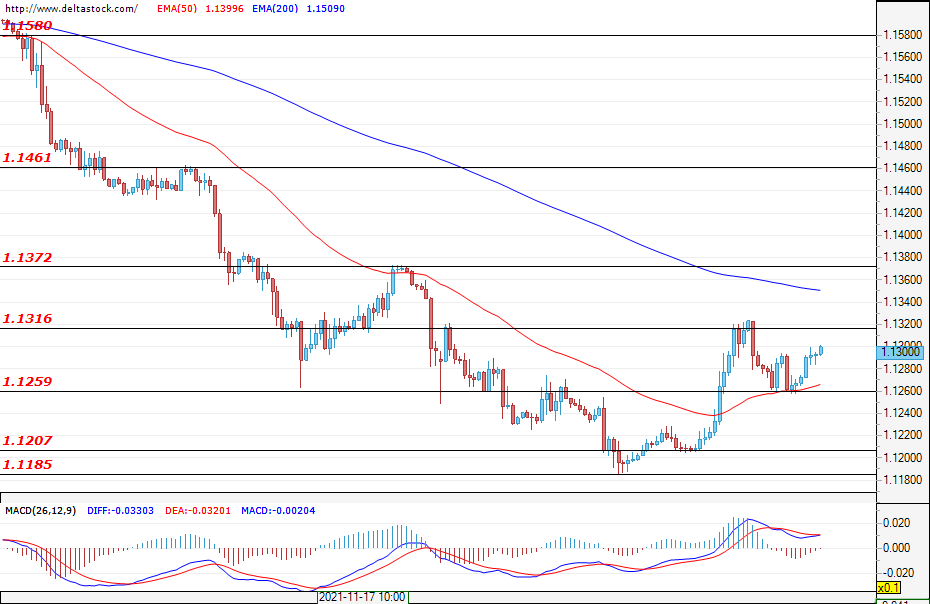
On its first trading day, the pair retraced part of Friday's rally. The bears tested the support at around 1.1260, where the bulls re-entered the market. The market sentiment is changing and so a deeper correction is likely. It is possible for the buyers to breach the resistance at 1.1316 and try to test the high at 1.1372. The first daily support is found at 1.1260, and if the zone holds, short-term rallies towards 1.1370 and 1.1460 are possible. The more significant support coming from the higher time frames is the zone of 1.1180 - 1.1200. The market is expected to find support within this area, but if it is breached, this would open the possibility for new declines that could potentially target 1.1000.
| Resistance | Support | ||
| intraday | intraweek | intraday | intraweek |
| 1.1316 | 1.1460 | 1.1260 | 1.1180 |
| 1.1372 | 1.1580 | 1.1207 | 1.1180 |
USD/JPY
Current level - 113.64
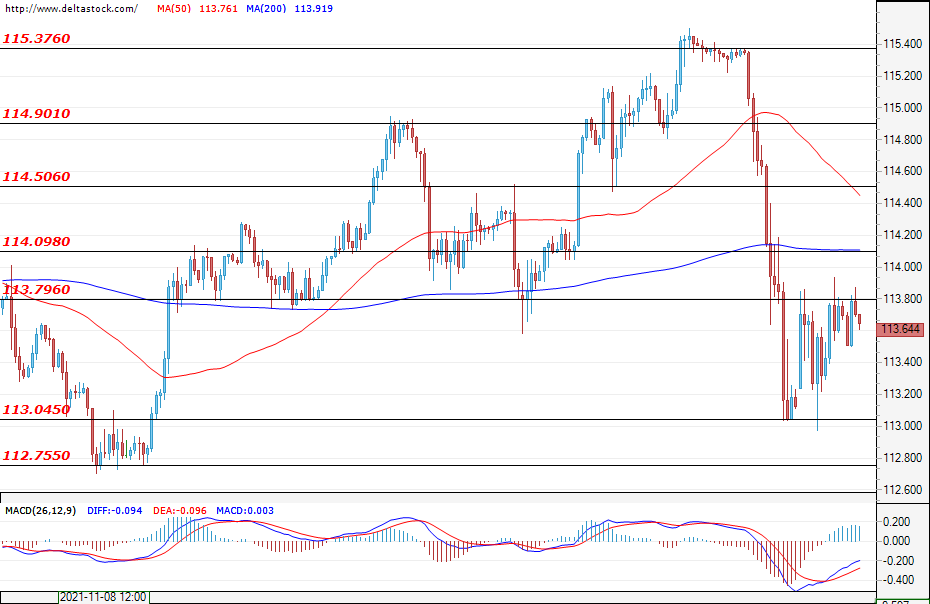
The market retraced last week's sell-offs and, for now, prices remain below the key resistance of 113.80. Deeper declines remain limited by the support at 113.04 and sentiment is rather mixed. A probable scenario for the pair is for trading to continue in the range between 112.75 and 114.90.
| Resistance | Support | ||
| intraday | intraweek | intraday | intraweek |
| 113.80 | 114.50 | 113.04 | 112.75 |
| 114.10 | 114.90 | 112.75 | 110.80 |
GBP/USD
Current level - 1.3320
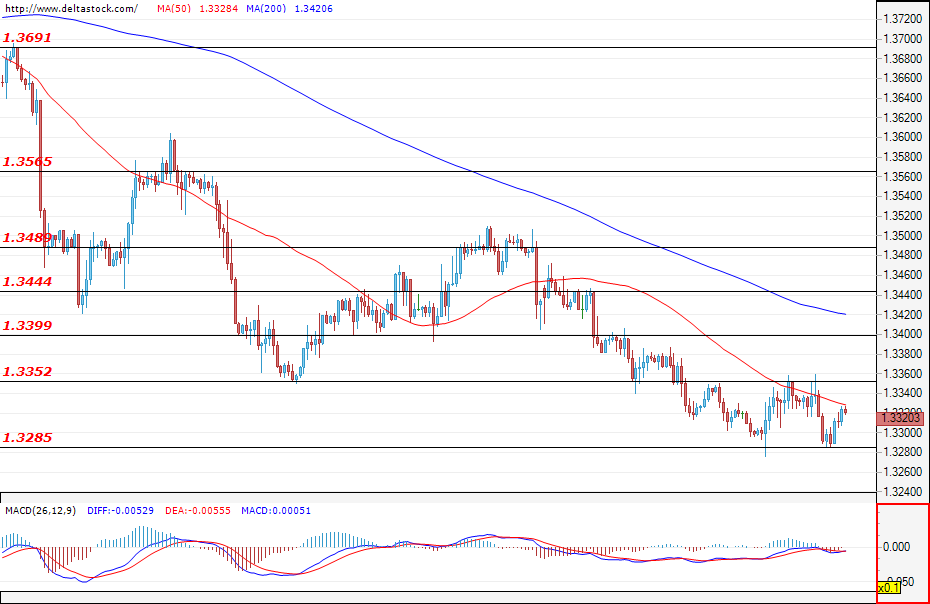
The strength of the bears seems to be waning and the bulls are likely to try to reverse the market. The buyers managed to disrupt the market structure at around 1.3352, and the formation of a bottom at 1.3285 confirmed their intentions. An upward move targeting 1.3490 is possible, while a breach of 1.3352 would confirm the change in market sentiment. The first daily support is 1.3285 and the first resistances are 1.3352 and 1.3400.
| Resistance | Support | ||
| intraday | intraweek | intraday | intraweek |
| 1.3350 | 1.3440 | 1.3285 | 1.3200 |
| 1.3400 | 1.3490 | 1.3285 | 1.3060 |
Core Inflation Will Never Have Been Higher
Markets
Financial markets yesterday retraced a small part of Friday’s heavy moves as initial doom scenarios on the new Covid-variant’ transmissibility and vaccine-beating and symptom intensifying characteristics didn’t materialize over the weekend. Main European equity indices gained 0.5% to 1%, but closed off best intraday levels. The US Dow Jones put up a similar performance with the S&P (+1.3) and Nasdaq (+1.9%) outperforming. The US yield curve steepened with daily yields changes ranging between -2.4 bps (3-yr) and +3.6 bps (20-yr). German yields added 0.1 bp to 1.9 bps with the belly of the curve underperforming the wings. Spanish, Belgian and German November CPI data all accelerated further and suggest yet again upside risks to today’s EMU number. Consensus expects a record high 4.5% Y/Y for the headline outcome and an acceleration from 2% Y/Y to 2.3% Y/Y for the core measure. Apart from a brief spell early 2022, core inflation will never have been higher. EUR/USD closed at 1.1291 yesterday from a 1.1318 open while EUR/GBP ended flat at 0.8481.
This morning’s Asian session had a lot of yesterday’s trading dynamics in Europe and the US up until the final hour. The Financial Times published an interview with Moderna chief Bancel who expects a “material drop” ineffectiveness of current Covid-vaccines against the Omicron-variant. Bancel’s comments mark a contrast with more optimistic ones from Pfizer officials and other health institutions. He did side with them in confirming that it will take around two weeks to have hard evidence on current vaccines’ performance against Omicron. The FT article triggered a new risk-off market reaction. Asian stock markets turned gains into losses of up to 2%, erasing earlier positivism around Chinese PMI’s (see below). Core bonds profit with the US 10-yr yield at risk of losing the uptrend line since early August (<1.5%). The German 10-yr yield is expected to open near/below key support of -0.35%. The hierarchy amongst FX majors remains the same: JPY-EUR-USD-GBP. EUR/USD approaches Friday’s high of 1.1325 while EUR/GBP tries to take out the 0.85 big figure. Brent crude faces a new setback, falling from around $75/b towards $70/b. We continue to advise to err on the side of caution with respect to the developing Omicron story. This morning’s FT headline clearly proved some remaining sensitivity to the issue although market moves are already smaller in absolute terms. Today’s EMU CPI print has the potential to give the single currency some additional intraday support while balancing the drop in yields. The US eco calendar is back-loaded with ISM’s and labour market data to be released between tomorrow and Friday.
News headlines
The Chinese Manufacturing PMI returned in to growth territory in November, rebounding from 49.2 to 50.1. It was the first rise in three months. Activity got some relief as power rationing eased and as prices from some raw materials dropped significantly. Output returned above the 50 thresholds, while orders declined at a slower pace. Both the indices for input prices and prices charged declined sharply. The non-manufacturing PMI eased slightly from 52.4 to 52.3. Construction rebounded to a three-month high, rising from 56.9 to 59.1. Activity was boosted by a pick-up in infrastructure projects. Activity in the services sector eased, mainly due to a slowdown in social-distance sensitive services. The yuan trade strong this morning in the 6.3750 area, nearing the Mid-November low.
Fed Chair Powel said that “the recent rise in Covid-19 cases and the emergence of the omicron variant pose downside risks to employment and economic activity and increased uncertainty for inflation.” The virus could reduce people’s willingness to work in person, which would slow progress in the labor market and intensify supply chain disruptions. In his remarks, Powell didn’t bring any specific guidance on changing the pace of tapering the Fed’s asset purchases. In her part of the testimony, Treasury Secretary Yellen remained confident that the economy stays strong. She reiterated her call for the Senate to approve Biden’s Build Back Better plan and urged lawmakers to raise the debt limit as the Treasury could run out of cash potentially after 15 December.
Fed May Face Worse Trade Off After Omicron
Market movers today
- We get flash November inflation figures out of the euro area today. With another marked increase observed in the German and Spanish inflation figures, we could see euro area HICP inflation printing at yet another record high in excess of 4.5%.
- We also have a few Fed speakers on the wire today. We will look specifically for signals on increased tapering pace.
- Overnight, Chinese Caixin PMIs are released. Here we expect another weak print.
The 60 second overview
Oil: Lots of OPEC+ comments out yesterday ahead of OPEC+ meeting on Thursday speculating on how OPEC+ might respond after the news of a new variant. Oil prices made a brief comeback after the big plunge on Friday, but trades close to Friday's low this morning.
US: Powell's take on omicron: Fed Chair Jerome Powell talked about the economic situation yesterday, including his initial take on risks associated with the new omicron variant. Powell argued that the recent rise in new cases in the US and the new omicron variant "pose downside risks to employment and economic activity and increased uncertainty for inflation". Powell added that outbreaks may "reduce people's willingness to work, which would slow progress in the labour market and intensify supply-chain disruptions". As we have been arguing for quite some time, we believe COVID-19 shocks are inflationary in nature because it prolongs the period with high goods demand and reduces the economy's production potential. In that sense, a new wave (and increased concerns about the omicron variant) makes the trade-off between growth/employment and inflation even worse from a central bank perspective, putting more pressure on Fed to tighten monetary policy sooner and faster. The jobs report on Friday and the next CPI inflation print are key for the Fed's decision on whether to increase the tapering pace at the December meeting or not. For now we stick to our view that the Fed will keep the tapering pace unchanged, but as we argued already after the November meeting, risks are definitely skewed towards a faster pace.
Equities: Equities rebounded on Monday after the knee-jerk sell-off on Friday. While it is still too early for any firm conclusions, equity sentiment was helped by South Africa saying that there is still no indication of more severe symptoms. So, although hospitalization has drifted higher, that is still not the case for severe cases. Long duration cyclicals took the lead in the US session, with tech and consumer discretionary at the top. Friday's losers, financials and industrials, continued to lag, so markets are still positioning for the possibility of new lockdowns. S&P500 closed up 1.3%, Dow 0.7% and Nasdaq surged 1.9% while small cap Russell 2000 dropped -0.1%. VIX drifted lower, albeit still north of 20. The rebound is still absent in Asian markets, where equities are mostly lower this morning. US futures have dipped into red as well.
FI: After the rather panicky market reaction on Friday with the strong rally, markets sentiment was more muted yesterday on speculation on the new COVID-variant may not be as severe as the previous mutations. Core EGBs sold off around 2bp, as spreads tightened marginally. Ireland underperformed a bit from the early trading as their S&P rating on Friday was left unchanged despite some speculation for a change to positive, however, the underperformance was reversed at the end of the day, leaving IRISH to show similar performance as peers.
FX: Markets zig-zag continued Monday where much of the negativity from Friday faded and the moves seen Friday also reversed across FX.
Credit: Following Friday's fierce sell-off, sentiment in credit markets stabilized yesterday though Xover was the main beneficiary (tightening 10bp) while Main tightened a more modest 1.8bp. Cash bonds were even less upbeat, with HY bonds more or less closing unchanged and IG 1.5bp tighter.
Nordic macro
Sweden. Riksbank vice governor Henry Ohlsson participates in a panel discussion about liquidity (or lack thereof?) in the Swedish bond market (10:45). We cannot recall that he has ever had any in-depth thoughts about this very important issue. Maybe he will refer to their own financial market survey, where 75% of the respondents said that the Riksbank's QE has had a negative or very negative impact on the market.
XAUUSD Is Possibly Bearish
Technical analysis
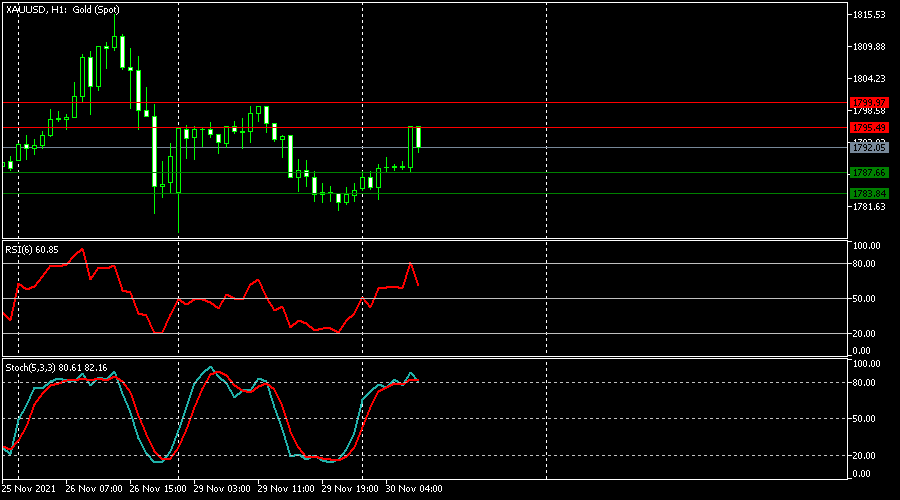
The RSI is above level 50 and headed downwards.
The Stochastics left the overbought zone and headed downwards to level 50.
Most likely scenario – SELL
Target prices: 1,787.66 1,783.84
Alternative scenario – BUY
Target prices: 1,795.49 1,799.97
Key levels
Support 1,787.66 1,783.84
Resistance 1,795.49 1,799.97
GBP/JPY Daily Outlook
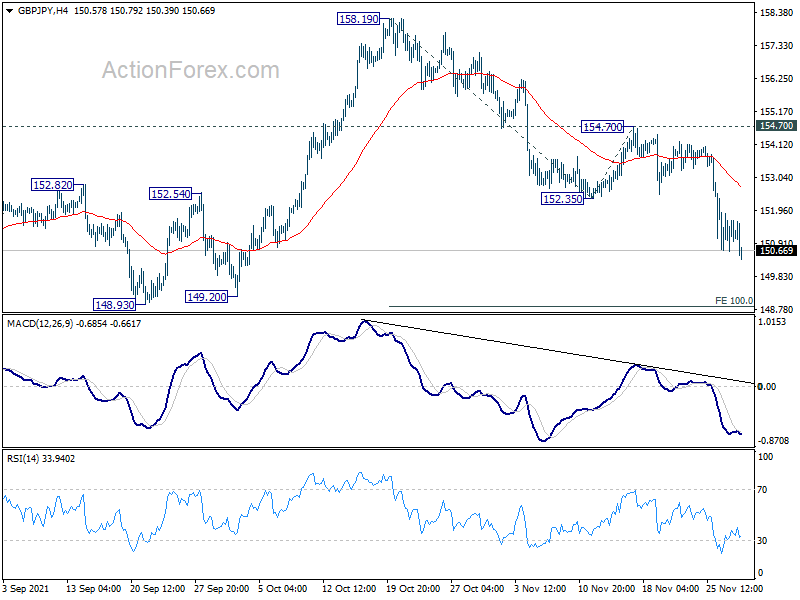
Daily Pivots: (S1) 150.63; (P) 151.27; (R1) 151.84; More...
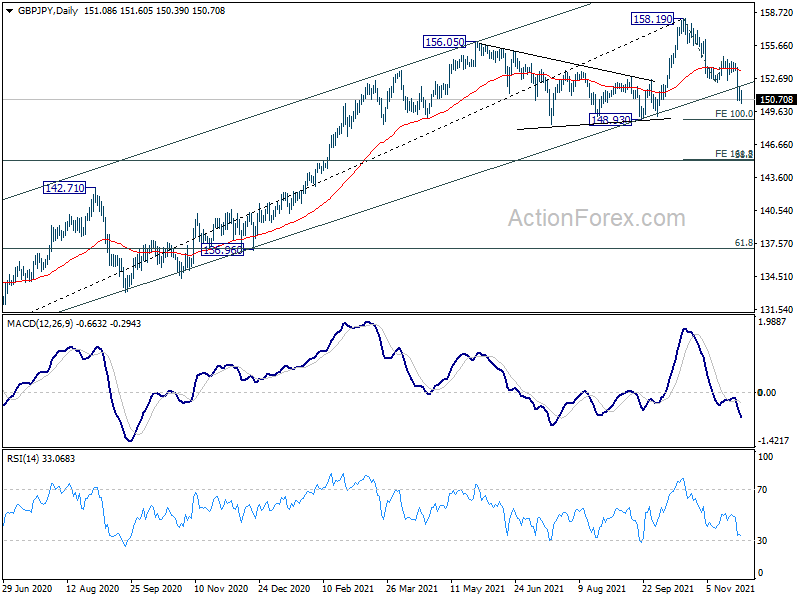
GBP/JPY's fall from 158.19 is still in progress and intraday bias remains on the downside for 100% projection of 158.19 to 152.35 from 154.70 at 148.86 next, which is close to 148.93 key structural support. Decisive break there will carry larger bearish implication and target 161.8% projection at 145.25 next. For now, near term outlook will stay bearish as long as 154.70 resistance holds, in case of recovery.
In the bigger picture, the break of medium term channel support, and bearish divergence condition in week MACD are raising the chance of medium term topping at 158.19. Firm break of 148.93 support will argue that GBP/JPY is at least correcting the whole rise from 123.94 (2020 low). In this case, deeper fall would be seen to 38.2% retracement of 123.94 to 158.19 at 145.10. Nevertheless, strong rebound from 148.93 will retain medium term bullishness for another rise through 158.19 at a later stage.
EUR/JPY Daily Outlook
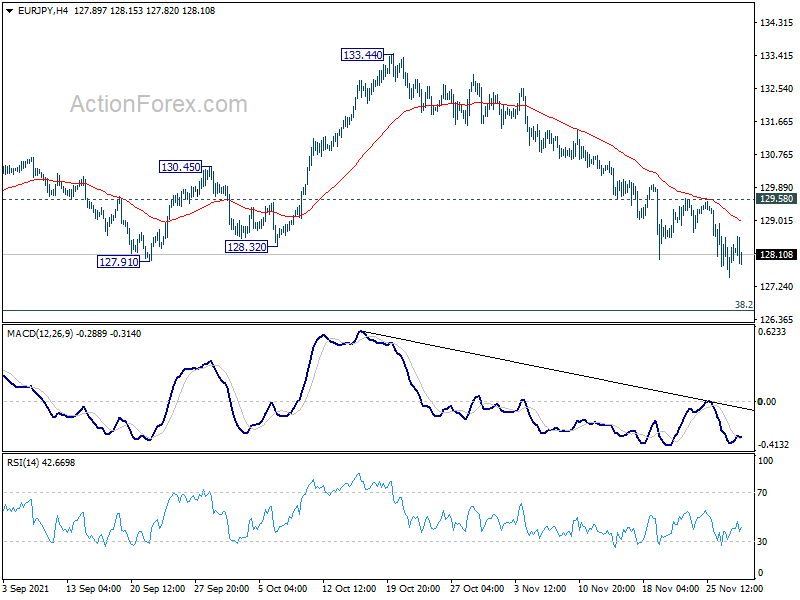
Daily Pivots: (S1) 127.62; (P) 128.09; (R1) 129.69; More....
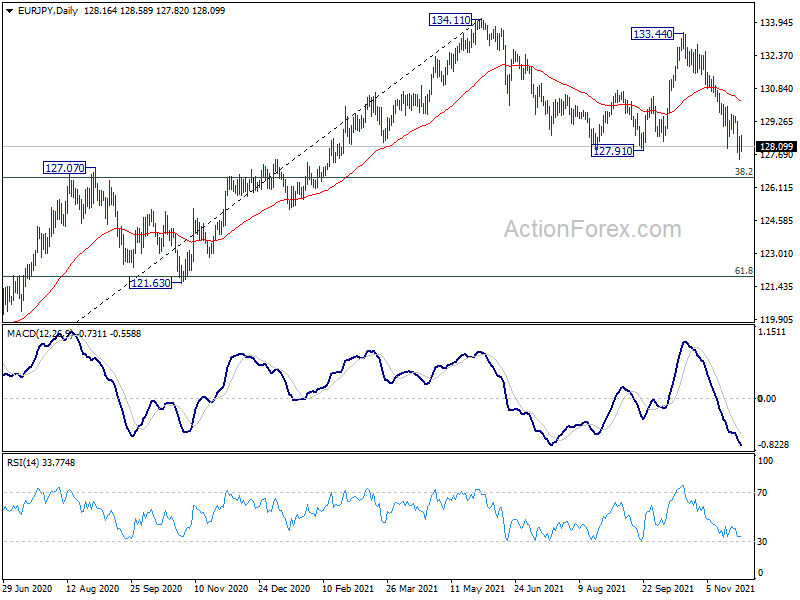
EUR/JPY is losing some downside momentum, but further decline is expected as long as 129.58 minor resistance holds. Corrective pattern from 134.11 should target 126.58 medium term fibonacci level next. On the upside, however, break of 129.58 resistance will indicate short term bottoming, and turn bias back to the upside for rebound back towards 133.44 high.
In the bigger picture, as long as 38.2% retracement of 114.42 (2020 low) to 134.11 at 126.58 holds, up trend from 114.42 is still in favor to continue. Break of 134.11 will target long term resistance at 137.49 (2018 high). However, sustained break of 126.58 will raise the chance of medium term bearish reversal. In this case, deeper decline would be seen to 61.8% retracement at 121.94, and possibly below.
EUR/GBP Daily Outlook
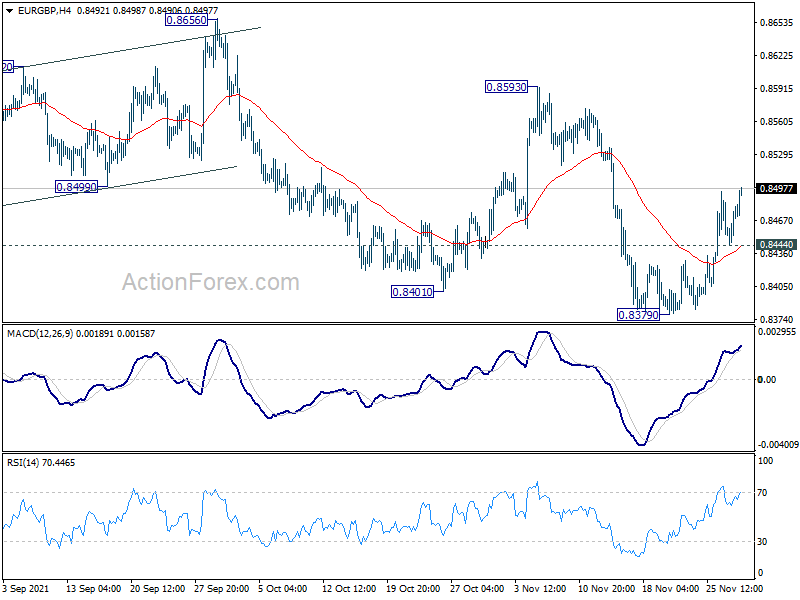
Daily Pivots: (S1) 0.8455; (P) 0.8471; (R1) 0.8496; More...
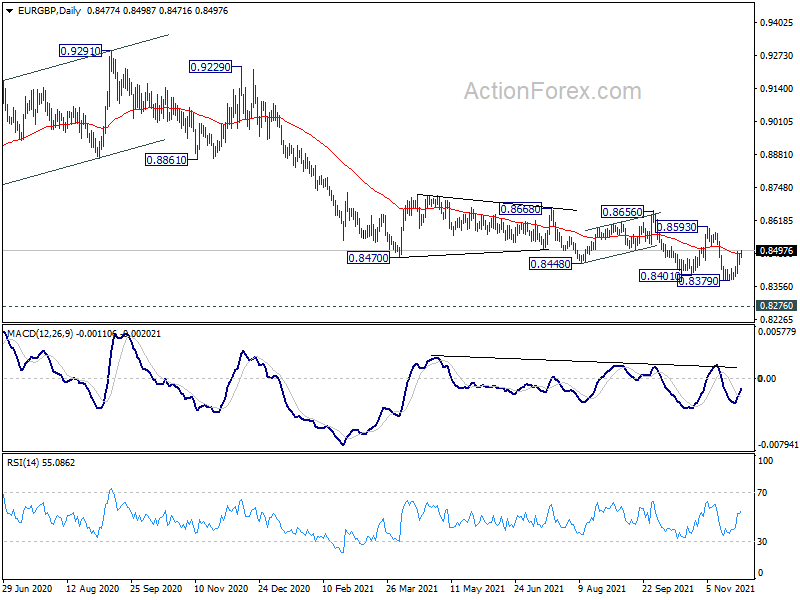
Intraday bias in EUR/GBP stays on the upside as rebound from 0.8379 is in progress. Sustained break of 55 day EMA (now at 0.8486) will target 0.8593 structural resistance. On the downside, though, break of 0.8444 minor support will turn bias back to the downside for retesting 0.8379 low.
In the bigger picture, price actions from 0.9499 (2020 high) are still seen as developing into a corrective pattern. Deeper fall could be seen as long as 0.8593 resistance holds, towards long term support at 0.8276. We'd look for bottoming signal around there to bring reversal. Meanwhile, firm break of 0.8593 will now be an early sign of medium term bottoming. However, sustained break of 0.8276 will be a sign of long term bearish reversal.
EUR/AUD Daily Outlook
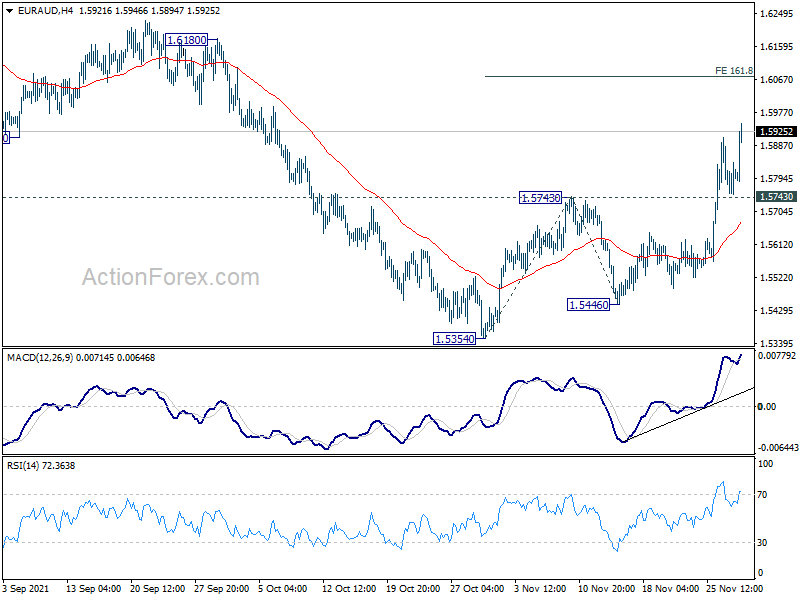
Daily Pivots: (S1) 1.5741; (P) 1.5821; (R1) 1.5888; More...
Intraday bias in EUR/AUD stays on the upside as rebound from 1.5354 resumed after brief retreat. Further rally would be seen to 161.8% projection of 1.5354 to 1.5743 from 1.5446 at 1.6075 next. On the downside, however, break of 1.5743 resistance turned support will mix up the near term outlook and turn intraday bias neutral first.
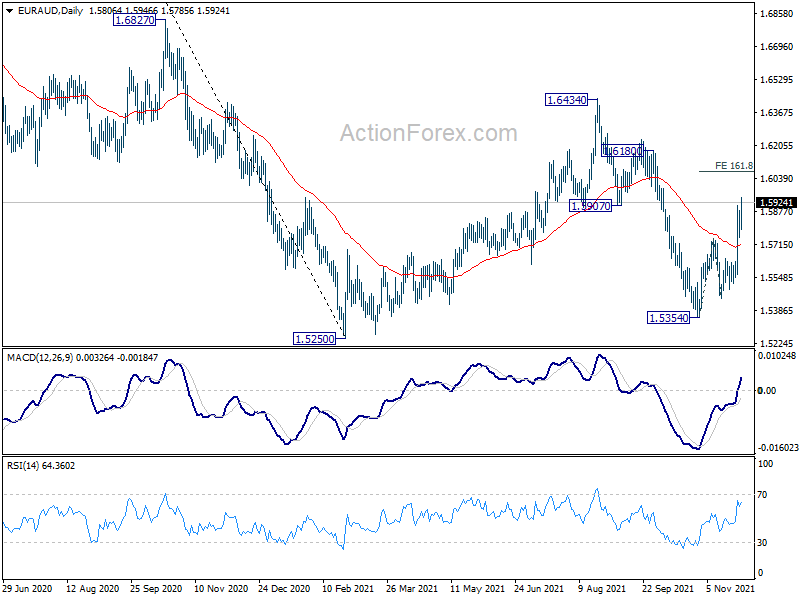
In the bigger picture, the strong rebound from 1.5354 invalidates the case of imminent downside breakout, and turn medium term outlook neutral again. Such rise is seen as the third leg of the corrective pattern from 1.5250. Further rally could be seen through 1.6434 resistance. On the downside, however, break of 1.5446 support will turn focus back to 1.5250 low.
EUR/CHF Daily Outlook
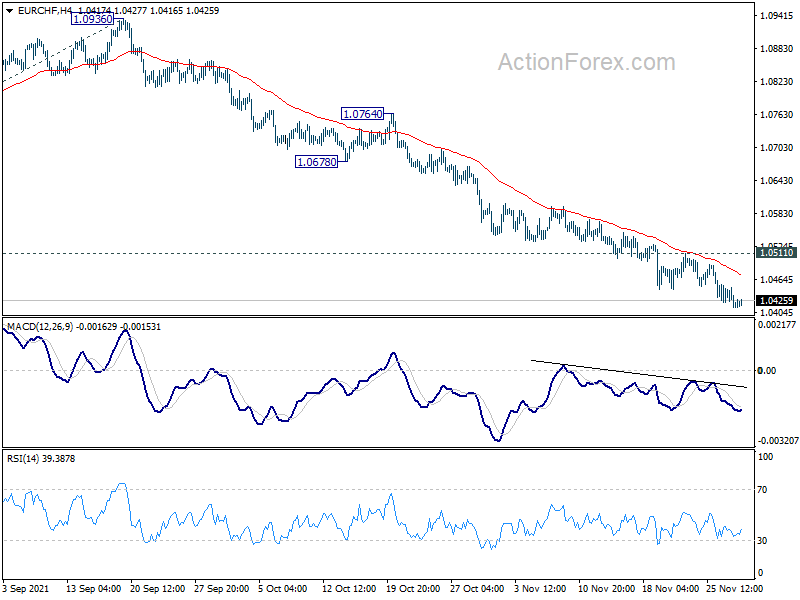
Daily Pivots: (S1) 1.0406; (P) 1.0430; (R1) 1.0445; More....
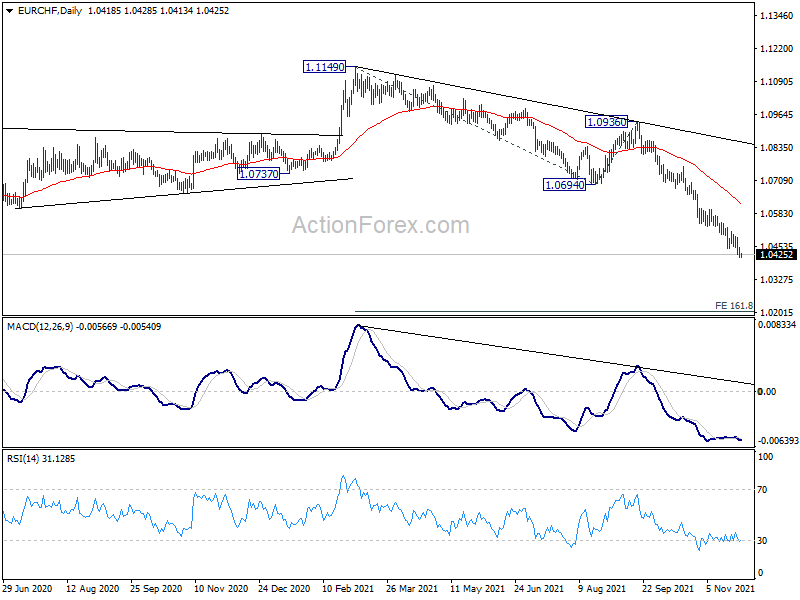
EUR/CHF's down trend is still in progress and intraday bias stays on the downside, for 161.8% projection of 1.1149 to 1.0694 from 1.0936 at 1.0200 next. On the upside, though, break of 1.0511 resistance will now indicate short term bottoming, and turn bias back to the upside for stronger rebound.
In the bigger picture, long term down trend from 1.2004 (2018 high) is now extending. Next target is 61.8% projection of 1.2004 to 1.0505 to 1.1149 at 1.0223. On the upside, break of 1.0694 support turned resistance is needed to be the first sign of medium term bottoming. Otherwise, outlook will remain bearish even in case of rebound.