

Sample Category Title
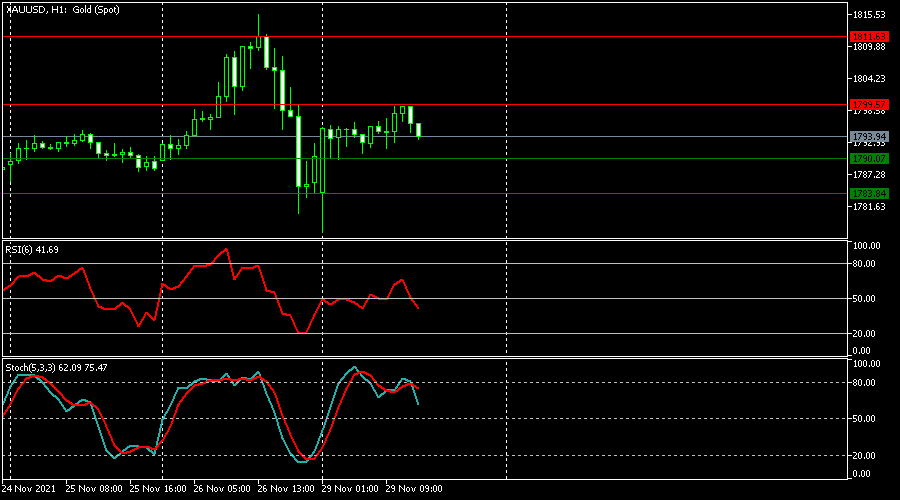
XAUUSD Is Possibly Bearish
Technical analysis
The RSI is below level 50.
The Stochastics left the overbought zone and headed downwards to level 50.
Most likely scenario – SELL
Target prices: 1,790.07 1,783.84
Alternative scenario – BUY
Target prices: 1,799.57 1,811.63
Key levels
Support 1,790.07 1,783.84
Resistance 1,799.57 1,811.63
GBP/CAD Bulls Should Move The Price Bullish SHS Pattern On Daily
GBP/CAD technical analysis
- Bullish SHS on Daily TF.
- Breakout is expected.
- Positional entry has been established.
- M H5/ Q H3 are targets.
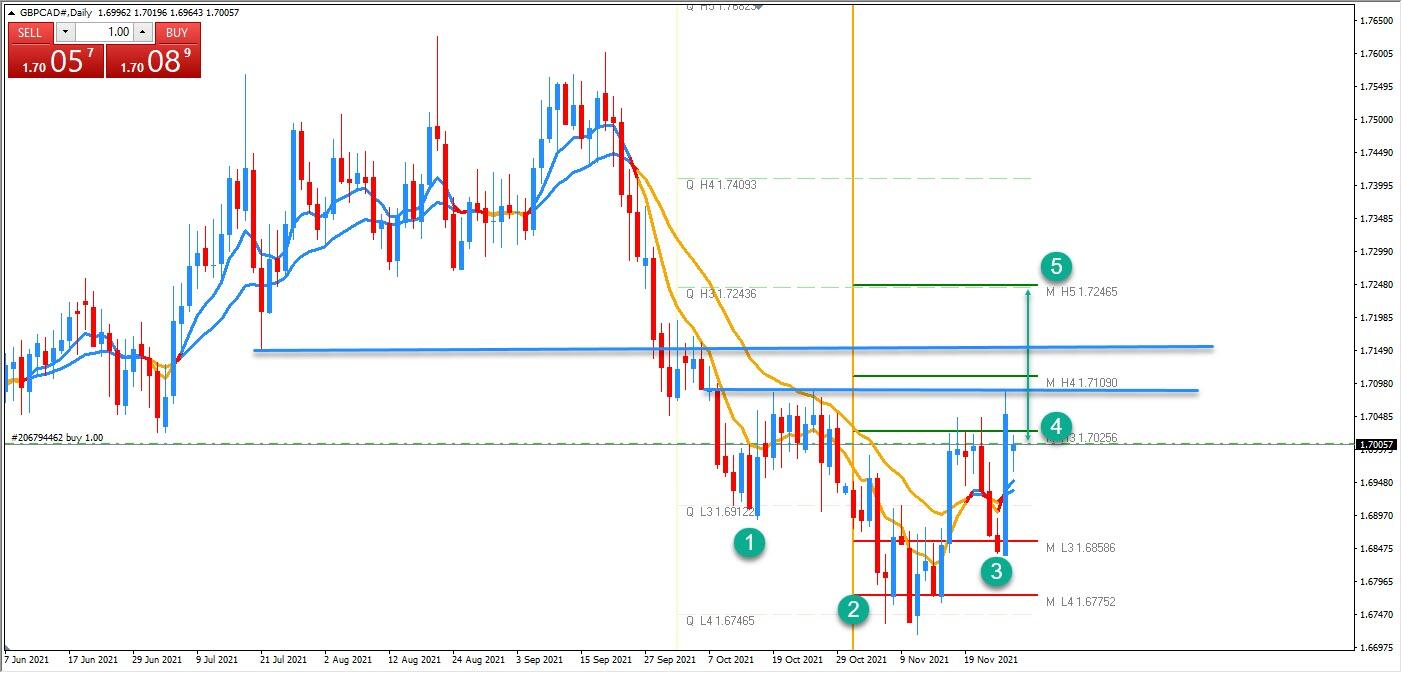
- Left shoulder.
- Head.
- Right shoulder.
- Entry.
- Target.
GBP/CAD is turning bullish and we can see that marubozu candlestick has been printed out. If the market remains bullish, we should secure profits around 1.7100 zone as continuation is expected but its a strong resistance. The market has also made a bullish SHS pattern at the bottom and we should see a steady move up. Any move and close above 1.7025 should see the GBP/CAD moving further up. Watch for a potential breakout of the bullish SHS pattern towards the target zone.
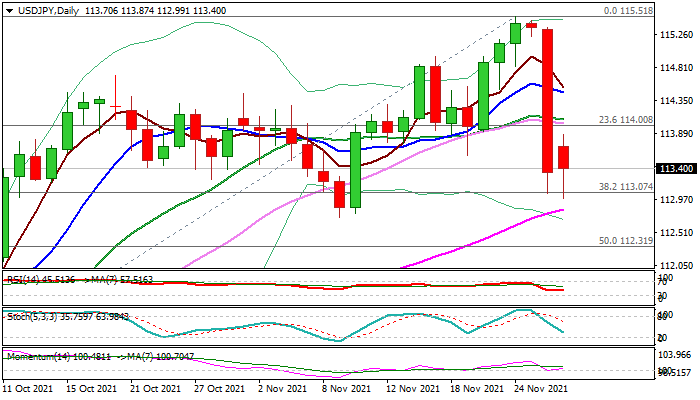
USD/JPY Outlook: Fresh Bears Hold Grip But Face Strong Headwinds From Key Fibo Support
The USDJPY remains in red following Friday’s selloff (the pair was down 1.7%, the biggest daily fall since March 2020) driven by fears of new Omicron variant of coronavirus.
Friday’s massive bearish daily candle weighs heavily but bears continue to face headwinds from pivotal Fibo support at 113.07 (38.2% of 109.11/115.51 upleg) unable to break lower for the second day.
Persisting risk-off mode on Omicron uncertainty keeps the pair under pressure, although daily studies are mixed and lack clearer direction signal.
Bears need a firm break through 113.07 to generate initial signal of extension of pullback from 115.51 peak, with extension through 112.72 (Nov 9 trough) needed to confirm reversal signal.
Caution on repeated failure to break 113.07 Fibo support that would signal consolidation, with near-term bias to remain with bears while the action stays below 114 zone (broken Fibo 23.6% converged 30/20DMA’s).
Return and close above 114 would weaken bears and signal that pullback loses steam.
Res: 113.87, 114.08, 114.46, 114.69.
Sup: 113.07, 112.72, 112.31, 112.07.
Markets Reassess The Omicron Variant, Keen Interest On Vaccine Efficacy Results In The Coming Weeks
Notes/Observations
- Markets reversed some of Friday's moves, calming after the initial shock of discovering a new coronavirus variant. Evaluation of Omicron variant said to cause of only mild symptoms with hope that vaccine reformulations against it could be achieved quickly.
- Vaccine efficacy results in the coming weeks of keen interest.
Asia
- Japan Oct Retail Sales M/M: 1.1% v 1.0%e; Y/Y: 0.9% v 1.1%e.
- RBNZ Chief Economist Ha commented that the new variant of the virus would unlikely to halt Bank Rate rises.
- Japanese government said it would bar new entry of foreigners to the country.
Coronavirus
- World Health Organization's (WHO) issued statement on Omicron variant and noted it was not yet clear whether infection with Omicron caused more severe disease compared to infections with other variants, including Delta, but preliminary evidence suggested there may be an increased risk of reinfection with Omicron.
- UK govt to convene urgent meeting of G7 Health Ministers to discuss developments on Omicron on Monday, Nov 29th.
- Chairman on South African Ministerial Advisory Committee on Vaccines noted that the cases so far had all been mild, mild -to- moderate which was good sign, there had been no real uptick in hospitalizations.
Europe
- ECB's Panetta (Italy; dove): ECB does not need to intervene on inflation for now, it is temporary, do not need to follow US Fed monetary policy choices.
Americas
- Fed's Bostic (FOMC voter, hawk) noted that each successive Covid variant slowed the economy but to a lesser amount; A lot of momentum in economy right now. Looking at how fast Fed might need to reduce asset purchases to address inflation.
Energy
- Russia Dep PM Novak noted that OPEC+ Partners did not ask to review the terms of the agreement; He saw no need for emergency measures on the oil market. OPEC+ to discuss the market situation and necessary steps. JMMC was delayed to get more information on the situation and the virus.
Speakers/Fixed income/FX/Commodities/Erratum
Equities
- Indices [Stoxx600 +0.74% at 467.48, FTSE +0.74% at 7,096.12, DAX +0.38% at 15,315.40, CAC-40 +0.74% at 6,789.57, IBEX-35 +0.66% at 8,460.00, FTSE MIB +0.65% at 26,020.00, SMI +0.11% at 12,212.26, S&P 500 Futures %].
Market Focal Points/Key Themes:
Equities
- European indices open sharply higher bouncing off Friday's sell-off but later cut off some of their gains as session progressed; sectors that are performing better include consumer discretionary, technology and energy; shares of BT Group currently trade higher 6% following speculation of interest from Indian firm Reliance; industrial firm Faurecia cut outlook once again this year and trades lower as much as 6%; Volkswagen also fell in Frankfurt following analyst downgrade; corporate events expected in the upcoming US session include earnings from Li Auto.
- Consumer discretionary: Juventus [JUVE.IT] -3% (police raids).
- Energy: Vestas Wind Systems [VWS.DK] +1.5% (update on cyber incident).
- Financials: Amigo Holdings [AMGO.UK] -25% (earnings).
- Industrials: Faurecia [EO.FR] -6% (cuts outlook again), Knorr-Bremse [KBX.DE] -1% (CMD), Volkswagen [VOW3.DE] -2% (analyst action).
- Materials: Johnson Matthey [JMAT.UK] +5% (divestment speculation).
- Telecom: BT Group [BT.A.UK] +6% (potential offer).
Speakers
- ECB’s Schnabel (Germany) stated that ECB saw inflation peaking in Nov then gradually falling back to target in 2022. Would be a mistake to raise rates prematurely.
- ECB Villeroy (France) stated that the EU was clearly on its way to recovery and that the current Omicron variant of virus would not change outlook too much.
- ECB's de Cos (Spain) reiterated Council view that current pickup in inflation was seen as transitory.
- Poland Central Bank's Lon stated that it was not a given that Poland would continue with rate hikes.
- India Fin Min Sitharaman stated that the uptrend in inflation was due to exogenous factors. No proposal to recognize Bitcoin as currency.
- Japan PM Kishida said to to decide on "GO TO Travel" after new year's.
- BOJ Gov Kuroda noted that addressing climate change was not a restraint for economy.
- Iran Foreign Ministry spokesperson: Window for nuclear talks will not stay open forever.
Currencies/Fixed Income
- USD steadied after Fridays decline as markets re-evaluated the Omicron variant and awaited until the impact of the variant became more clear. Some health officials noted that Omicron caused of only mild symptoms with hopes that vaccine reformulations against it could be achieved quickly.
- The greenback was weakened on Friday as the Omicron variant of the virus was seen as possibly affecting when the Fed would raise rates.
- EUR/USD steady at 1.1280 area while USD/JPY drifted higher to test above 113.30 area.
Economic data
- (NL) Netherlands Nov Producer Confidence Index: 12.7 v 12.3 prior.
- (DE) Germany Nov CPI North Rhine Westphalia M/M: -0.3% v +0.4% prior; Y/Y: 5.1% v 4.5% prior.
- (FI) Finland Nov Consumer Confidence: # v 2.7 prior; Business Confidence: 24 v 22 prior.
- (TR) Turkey Oct Trade Balance: -$1.4B v -$1.5Be.
- (TR) Turkey Nov Economic Confidence: 99.3 v 101.4 prior.
- (ES) Spain Nov Preliminary CPI M/M: 0.4% v 0.3%e; Y/Y: 5.6% v 5.5%e.
- (ES) Spain Nov Preliminary CPI EU Harmonized M/M: 0.3% v 0.3%e; Y/Y: 5.6% v 5.6%e.
- (HU) Hungary Oct Unemployment Rate: 3.9% v 3.9%e.
- (SE) Sweden Q3 GDP Q/Q: 2.0% v 1.8%e; Y/Y: 4.7% v 4.2%e.
- (SE) Sweden Oct Trade Balance (SEK): 0.8B v 6.8B prior.
- (DE) Germany Nov Hesse M/M: -0.2% v +0.6% prior; Y/Y: 5.3% v 4.7% prior.
- (DE) Germany Nov CPI Bavaria M/M: -0.2% v +0.5% prior; Y/Y: 5.3% v 4.6% prior.
- (DE) Germany Nov CPI Baden Wuerttemberg M/M: -0.1 v +0.5% prior; Y/Y: 4.9% v 4.2% prior.
- (DE) Germany Nov CPI Brandenberg M/M: -0.2% v +0.3% prior; Y/Y: 5.7% v 5.0% prior.
- (CH) Swiss weekly Total Sight Deposits (CHF): 719.4B v 719.3B prior; Domestic Sight Deposits: 646.9B v 646.7B prior.
- (IT) Italy Oct PPI M/M: 9.4% v 1.9% prior; Y/Y: 25.3% v 15.6% prior.
- (UK) Oct Net Consumer Credit: £0.7B v £0.4Be; Net Lending: £1.6B v £3.5Be.
- (UK) Oct Mortgage Approvals: 67.2K v 70.0Ke.
- (UK) Oct M4 Money Supply M/M: 0.6% v 0.7% prior; Y/Y: 7.0% v 7.0% prior; M4 (ex-IOFCs) 3M Annualized: 6.7% v 5.6% prior.
- (PT) Portugal Nov Consumer Confidence Index: -13.3 v -10.9 prior; Economic Climate Indicator: 1.9 v 2.0 prior.
- (DE) Germany Nov CPI Saxony M/M: -0.2% v +0.4% prior; Y/Y: 5.0% v 4.5% prior.
- (EU) Euro Zone Nov Economic Confidence: 117.5 v 117.5e; Industrial Confidence: 14.1 v 14.0e; Services Confidence: 18.4 v 17.0e; Consumer Confidence (final): -6.8 v -6.8 advance.
Fixed income Issuance
- (DK) Denmark sold total DKK2.40B in 3-month, 6-month. 9-month and 12-month bills.
- (NO) Norway sold NOK2.0B vs. NOK2.0B indicated in 6-month Bills; Avg Yield: 0.58% v 0.43% prior; Bid-to-cover: 1.36x v 1.78x prior.
Looking ahead
- (BE) Belgium Nov CPI M/M: No est v 1.5% prior; Y/Y: No est v 4.2% prior.
- 05:25 (EU) Daily ECB Liquidity Stats.
- 05:30 ((DE) Germany to sell combined €6.0B in 6-month and 9-month Bubills.
- 06:00 (IE) Ireland Oct Retail Sales Volume M/M: No est v 0.3% prior; Y/Y: No est v 0.7% prior.
- 06:00 (BR) Brazil Nov FGV Inflation IGPM M/M: 0.3%e v 0.6% prior; Y/Y: 18.2%e v 21.7% prior.
- 06:00 (IL) Israel to sell bonds.
- 06:25 (BR) Brazil Central Bank Weekly Economists Survey.
- 06:45 (US) Daily Libor Fixing.
- 07:00 (MX) Mexico Oct Unemployment Rate NSA (unadj): 4.1%e v 4.2% prior.
- 07:30 (IS) Iceland to sell 3-month and 6-month Bills.
- 08:00 (DE) Germany Nov Preliminary CPI M/M: -0.4%e v +0.5% prior; Y/Y: 5.0%e v 4.5% prior.
- 08:00 (DE) Germany Nov Preliminary CPI EU Harmonized M/M: -0.2%e v +0.5% prior; Y/Y: 5.5%e v 4.6% prior.
- 08:00 (UK) Daily Baltic Dry Bulk Index.
- 08:00 (IN) India announces details of upcoming bond sale (held on Fridays).
- 08:00 (ES) Spain Debt Agency (Tesoro) announces details of upcoming bond sale.
- 08:00 (SE) Sweden Central Bank (Riksbank) Dep Gov Skinglsey.
- 08:30 (CA) Canada Q3 Current Account Balance: $5.7Be v $3.6B prior.
- 08:30 (CA) Canada Oct Industrial Product Price M/M: 1.3%e v 1.0% prior; Raw Materials Price Index M/M: 3.5%e v 2.5% prior.
- 09:00 (FR) France Debt Agency (AFT) to sell €4.3-5.5B in 3-month, 6-month and 12-month bills.
- 09:45 (UK) BOE to buy £1.47B in APF Gilt purchase operation (3-7 years).
- 10:00 (US) Oct Pending Home Sales M/M: +0.8%e v -2.3% prior; Y/Y: No est v -7.2% prior.
- 10:30 (US) Nov Dallas Fed Manufacturing Activity Index: 17.0e v 14.6 prior.
- 15:00 (US) Fed's Williams.
- 15:00 (US) Fed chair Powell.
- 17:05 (US) Fed's Bowman.
- 17:05 (AU) RBA Debelle.
- 17:30 (AU) Australia ANZ Roy Morgan Weekly Consumer Confidence Index: No est v 107.4 prior.
- 18:00 (KR) South Korea Oct Industrial Production M/M: No est v -0.8% prior; Y/Y: No est v -1.8% prior.
- 18:30 (JP) Japan Oct Jobless Rate: 2.8%e v 2.8% prior; Job-To-Applicant Ratio: 1.17x v 1.16 prior.
- 18:50 (JP) Japan Oct Preliminary Industrial Production M/M: +1.9%e v -5.4% prior; Y/Y: -4.4%e v -2.3% prior.
- 19:00 (NZ) New Zealand Nov Final Business Confidence: No est v -18.1 prelim; Activity Outlook: No est v 15.6 prelim.
- 19:01 (UK) Nov Lloyds Business Barometer: No est v 43 prior.
- 19:30 (AU) Australia Q3 Current Account Balance: A$30.0Be v A$20.5B prior.
- 19:30 (AU) Australia Q3 Net Exports of GDP: +1%e v -1 prior.
- 19:30 (AU) Australia Oct Building Approvals M/M: -2.0%e v -4.3% prior.
- 19:30 (AU) Australia Oct Private Sector Credit M/M: 0.6%e v 0.6% prior; Y/Y: 5.8%e v 5.3% prior.
- 20:00 (CN) China Nov Manufacturing PMI (Govt official): 49.7e v 49.2 prior; Non-manufacturing PMI: 51.4e v 52.4 prior; Composite PMI: No est v 50.8 prior.
- 21:00 (SG) Singapore Oct M2 Money Supply Y/Y: No est v 4.0% prior; M1 Money Supply Y/Y: No est v 13.4% prior.
- 22:00 (TH) Thailand Central bank to sell THB50B in 3-month bills.
- 22:30 (HK) Hong Kong to sell 3-month and 6-month Bills.
- 22:35 (JP) Japan to sell 2-Year JGB Bonds.
- 23:00 (TH) Thailand Oct ISIC Manufacturing Production Index Y/Y: +2.0%e v -1.3% prior; Capacity Utilization: No est v 62.0% prior.
ECB de Guindos: Economic situation marked by a high degree of uncertainty
Vice-President Luis de Guindos said in Madrid today, "economic situation is marked by a high degree of uncertainty with "outbreaks of infections" and "appearance of new variants." He warned that potential withdrawal of policy support measures has to be taken very carefully. It's important for monetary policy keep all options open.
De Guindos reiterated that factors behind inflation are of "transitory nature. And he expects inflation to start falling next year.
Separately, Governing council member Francois Villeroy de Galhau "obviously, we must monitor closely the latest COVID developments, and the new Omicron strain". But he also noted, "the economic effects of the successive waves have proven so far to be less and less damaging, and this one shouldn't presumably change the economic outlook too much."
Is The Omicron Selloff Done Already?
- Global markets in a better mood as ‘Omicron’ nerves calm down
- Riskier currencies, stocks, and oil rebound but not convincingly
- Spotlight now turns to Fed chief and incoming virus news
Markets lick wounds
Black Friday discounts hit the financial markets this year too and many shoppers were waiting eagerly. European stock markets lost a stunning 5% on Friday but the sense of panic has subsided already after some reports played down the severity of the new ‘Omicron’ variant.
The latest reporting suggests that while the new variant may be more transmissible, it hasn’t been very deadly so far in younger people. We won’t really know anything concrete for a couple of weeks, yet markets have taken comfort in the fact that vaccine manufacturers are already lining up to update their products against this strain.
As such, the dip has been bought once again, although not in a convincing manner. Most assets have only recovered a fraction of their Omicron-related losses, which suggests that money managers are playing some defense here.
Shaky rebound
Taking a look across markets, European equity indices are trading higher by 1% today. That is a mere stabilization after last week’s obliteration. Wall Street futures point to a similar rebound today, but US stocks only fell around 2% on Friday, so this is a much more significant rebound and another testament to the global demand for US assets.
The issue is that as the year draws to a close, fund managers have a greater incentive to safeguard their portfolios from excessive volatility. With the S&P 500 higher by 24% this year, do you protect your yearly performance by slashing risk exposure or take the chance that the Omicron storm will blow over?
Another problem is that the Fed just doesn’t have much maneuvering room to help markets when inflation is already running above 6% and new global restrictions threaten to inflict more damage on supply chains. Normalization can only be slowed so much if inflation stays scorching hot, so the long-standing assumption that the ‘Fed has our backs’ might not hold anymore.
In energy markets, oil prices have recovered less than half of their losses even despite speculation that recent events provide OPEC with the perfect cover to slow down production increases. That speaks to the lingering doubts about global demand, especially with travel bans making a comeback.
Currency markets also uneasy
This fragile recovery was also reflected in the FX complex. Commodity currencies like the Australian, Canadian, and New Zealand dollars are all trading higher but without much conviction, as the rebound only accounts for half of their latest losses.
Echoing this theme, the yen has managed to defend its recent gains, in defiance of the rebound in global yields that is usually a curse for the currency. Safe-haven demand seems to have returned, perhaps as Japanese investors repatriate some cash. The dollar remains undecided, caught between defensive flows and the volatility in yields.
Inflation data from Germany will top the economic calendar today, after the ECB’s Schnabel suggested that ‘peak inflation’ will likely be reached this month. There’s also a heavy dose of Fed speakers, including Chairman Powell and New York Fed chief Williams at 20:00 GMT ahead of Board Governor Bowman at 22:00 GMT.
While they are unlikely to drop bombshells, any comments relating to the Omicron variant could be crucial in setting expectations for the December FOMC meeting.
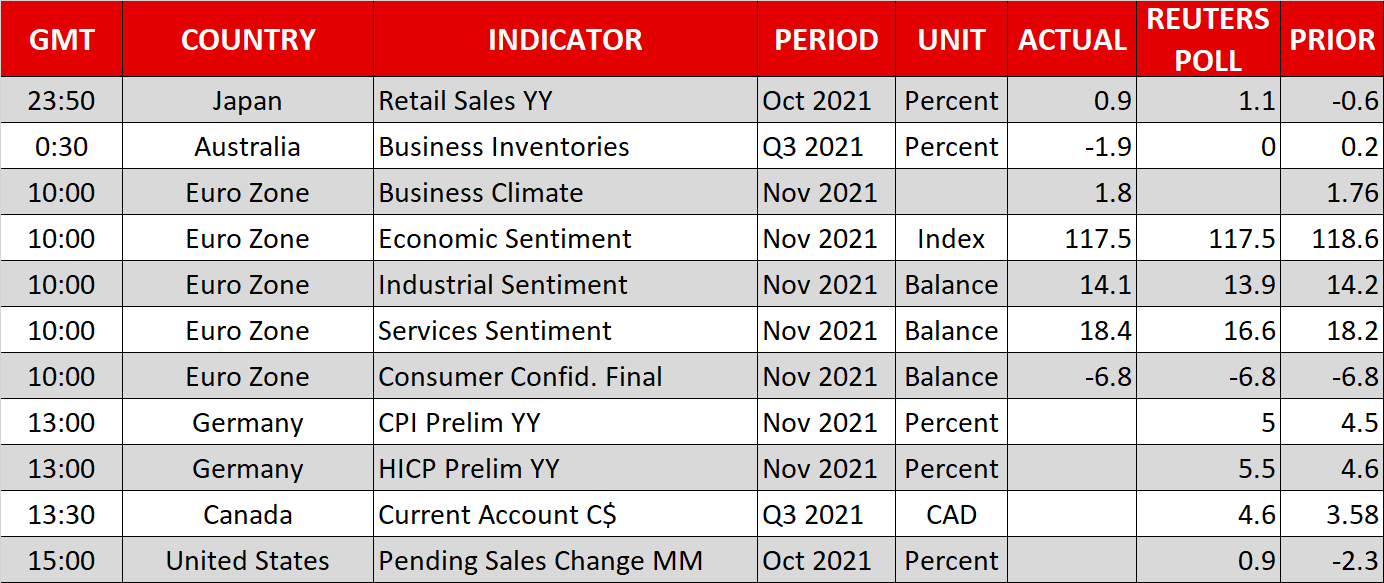
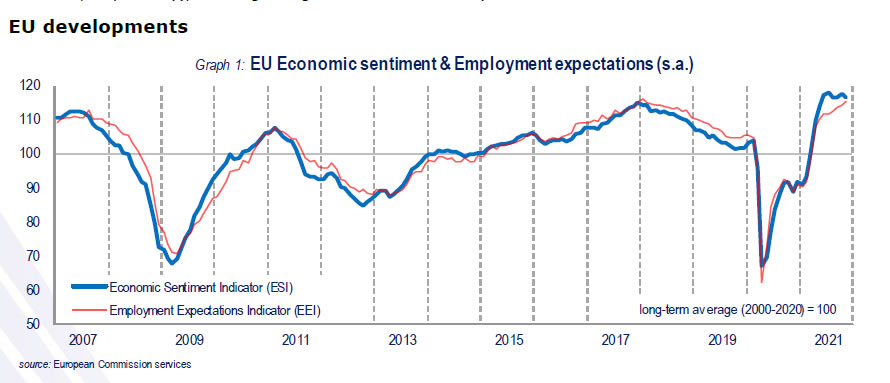
Eurozone economic sentiment rose dropped to 117.5, EU dropped to 116.5
Eurozone Economic Sentiment Indicator dropped from 118.6 to 117.5 in November. Industry confidence dropped from 14.2 to 14.1. Services confidence rose from 18.0 to 18.3. Consumer confidence dropped from -4.8 to -6.8. Retail trade confidence rose from 1.9 to 3.7. Construction confidence rose from 8.6 to 9.0. Employment Expectation Indicator rose from 113.9 to 115.6, highest since January 2018.
EU ESI dropped from 117.6 to 116.5. Employment Expectation Indicator rose from 114.2 to 115.6, highest since January 2018. Amongst the largest EU economies, the ESI rose in France (+3.0), Italy (+0.9) and Poland (+0.5). By contrast, confidence worsened in Spain (-2.6), the Netherlands (-2.1) and Germany (-1.7).
Oil Bounces Back, Gold Unable To Rally
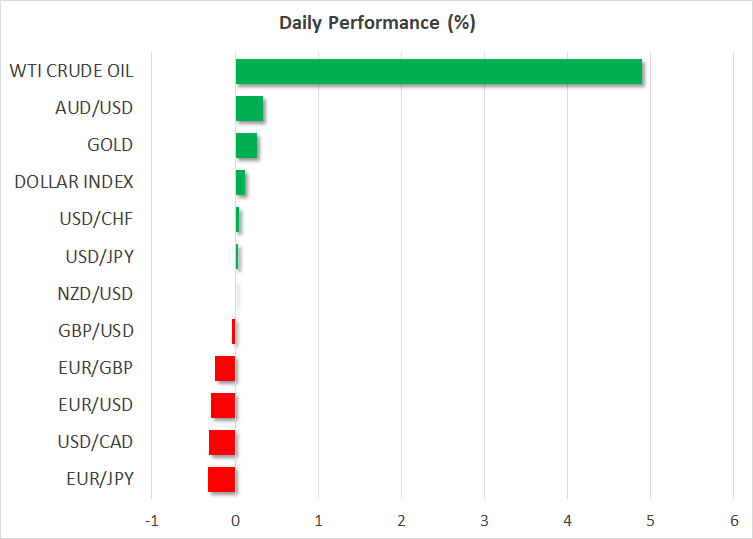
Oil stages an impressive recovery after Friday’s bonfire
Oil will be the market where short volatility traders go to die this week. The omicron whipsaw is on full display today as Brent and WTI, having fallen by over 9.0% on Friday, have staged a very sharp rally in Asia. Brent crude has risen by 4.78% to USD 76.35 a barrel, and WTI has rallied by a mighty 5.45% to USD 71.85 a barrel, thanks to some tenuous reports that Omicron’s symptoms are mild. Time will tell if this is correct (and I hope it is), but financial markets aren’t waiting around to find out.
The picture for oil is further muddied by the OPEC+ JMMC meeting and full meeting this week, the latter occurring on Friday. Negotiations with Iran restart in Vienna today as well over their nuclear programme. The prospect of Iranian crude increasing on international markets, another potential volatility point. Add all that in with virus developments and whipsaw price action this week in oil, is more likely to be chainsaw action.
OPEC+ compliance has held steady above 100% for quite some time now, suggesting there is not much swing production available to open the pumps anyway. I also note that pre-Omicron, US production had recovered to 11.5 million bpd, yet prices were still high. That would suggest OPEC+ would have been comfortable raising production targets as planned, even if they couldn’t actually pump it.
However, OPEC+ has also repeatedly noted that a resurgent virus is one reason why they have been cautious about lifting production. OPEC+ has also forecast markets moving to a global daily surplus in early 2022. Taken with increasing US production, SPR releases, and now a potential Omicron roadblock to the global recovery, OPEC+ probably has all the excuses it needs to hit the pause button on increasing production in December and awaiting further virus clarity. Friday’s capitulation will have cemented that thinking.
Either way you cut it, I can’t help but feel that Friday’s lows were probably the bargain of the year if you were an oil buyer, speculative or physical. Technical indicators are pretty useless in markets like this, but I note that the RSIs on both contracts are close to oversold, and that both Brent crude its 200-day moving average (DMA) on Friday at USD 72.70, while WTI has regained its 200-DMA at USD 70.00 a barrel this morning.
Gold, the forgotten haven
Friday should have been gold’s safe-haven day in the sun, and for a short time it wise, rising USD 23.0 an ounce to USD 1815.50 at one stage. However, by the session’s end, gold had slumped back to a USD 1793.00 close, a minuscule gain. Like bitcoin, gold suffered over the course of Friday even as US yields and the greenback sank. One reason is likely the very poor performance of platinum and palladium on Friday, the other is likely to be cross-margining stop-outs with investors liquidating gold positions to cover losses in equities for instance.
A general recovery by platinum group metals, industrial metals and cryptos today has failed to flow into gold strength, perhaps because US yields and the US dollar are higher. Whatever the underlying dynamics, the price action is negative, gold rising just 0.10% to USD 1794.80 this morning, with the recovery rally leaving it behind. That suggests that the downside is the path of least resistance for gold, and it is a sell on rallies this week.
Gold will have resistance at USD 1800.00 and USD 1815.00 to start the week, with the post-open spike to USD 1770.00 an ounce this morning, a dubious move even by Monday Asia futures open standards, will provide initial support. In between, gold may find some friends around USD 1780.00. Failure of USD 1770.00 signals a retest of USD 1760.00 and USD 1740.00 an ounce.
US Dollar Stages A Post-Friday Recovery
Swiss franc, yen fall as risk sentiment improves
In a rather surprising move for the author, the US dollar suffered heavily on Friday, the dollar index falling by 0.74% to 96.07 as haven currencies like the Swiss franc and Japanese yen staged powerful rallies. EUR/USD rallied as well, perhaps because so much bad news was priced into it, climbing 0.90% to 1.1310. The US dollar suffered, I believe, on cross margining selling, and that an Omicron wave would bring the Fed’s taper to a shuddering halt, something with which I agree with, as US yields fell sharply at the long end of the curve.
This morning, the rally in US equity futures and oil has lessened those fears, with US yields also firming. That has seen the dollar index rally by 0.22% to 96.28, with the JPY, CHF and EUR falling by around 0.25%. USD/JPY fell by an impressive 1.70% to 113.40 on Friday, testing 113.00 intraday. From a technical perspective, USD/JPY should start to form a bottom around 113.50 and EUR/USD will likely struggle to make much progress above 1.1300 unless US bond yields dramatically fall from here.
Currency markets are also sending out a few subtle signs that risk sentiment remains highly elevated, with Asian currencies falling aggressively on Friday, but making back only very modest gains today. Notably, USD/KRW is unchanged at 1193.50 today, and USD/CNY is barely changed at 6.3860. USD/THB, meanwhile, has actually risen 0.70% to 33.740 and USD/MYR is unchanged at 4.2380. Another warning sign comes from USD/TRY which is also unchanged, although the Mexican peso and South African rand, cremated on Friday, have risen 1.0% on thin volumes. The Australian and New Zealand dollars fell 1.0% to test 2021 lows at 0.7100 and 0.6800 on Friday, but the sentiment indicators have only recovered by 0.25% this morning.
So, in the EM and commodity space, currency markets are adopting a much more cautious tone, suggesting the overall market remains very much on edge. Like equities, a negative Omicron headline or two is likely to see the sell-off resume in earnest, which should benefit the yen and franc once again. Markets will be very much set up for a binary outcome this week based on Omicron headlines, subsuming even the US Non-Farm Payrolls results. Positive news, buy everything, sell havens. Negative news, sell everything, buy havens, watch the whipsaw, and rinse repeat. Volatility will be the winner.
A Mixed Start For Asian Stock Markets
Asian markets under pressure over Omicron jitters
US futures markets and Asian stock markets have diverged sharply today, with US index futures rallying after the bonfire of Friday, while Asian markets have moved sharply lower once again early in the session. Part of Asia’s negatively could be a partial catch-up to the scale of the US and European rout, but also their slower pandemic recovery, the scars of delta, and a much higher beta to world trade and the global recovery.
Meanwhile, US index futures raced higher out of the gate this morning and have continued higher, likely grasping at the straw of reports that Omicron’s symptoms are milder. S&P 500 futures are 1.10% higher, with Nasdaq futures jumping 1.40%, while Dow Jones futures have risen by 0.75%.
The halo effect of the US futures is starting to reverse the early losses suffered in Asian markets. The Nikkei 225 have reversed its entire early falls to be unchanged, with South Korea’s Kospi down only 0.40%. Taipei has also recovered, down only 0.30% now. However, Singapore remains 0.90% lower, with Kuala Lumpur 0.25% and Jakarta 0.68% lower. Tourism-centric Bangkok will likely endure a tough start to the day. Australian markets have staged a sharp about-face this morning after a very negative start, both the ASX 200 and All Ordinaries rallying back to be down just 0.10% for the session.
China markets are mixed with casino stocks in Hong Kong sharply lower as China’s clampdowns extend to that sector. Technology stocks have rallied strongly though leaving the Hang Seng down just 0.20%. In mainland China, the Shanghai Composite is down 0.30% with the CSI 300 easing by 0.25%.
Given the price action seen in Asia today, led by the US futures rally, European stocks are poised to jump higher this afternoon if the US futures rally is sustained. Having been stretchered off with serious injuries on Friday, as Europe faced a double whammy of omicron and its 4th virus wave, European markets, theoretically, have the most to gain if the price action in oil this morning, for example, is anything to go by.
I would add a large note of caution however for equities in general. Despite the irresistible pull of buying-the-dip on tenuous early information on Omicron, we have just one negative Omicron headline away from going back to where we started. Expect plenty of headline-driven whipsaw price action this week.