

Sample Category Title
CFTC Commitments of Traders – Global Commodity Prices Slumped on Omicron Worries
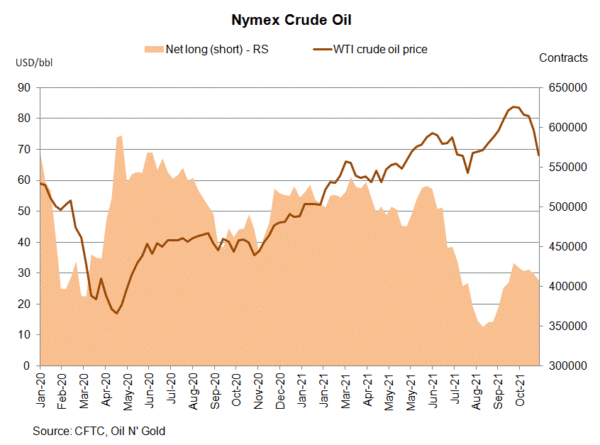
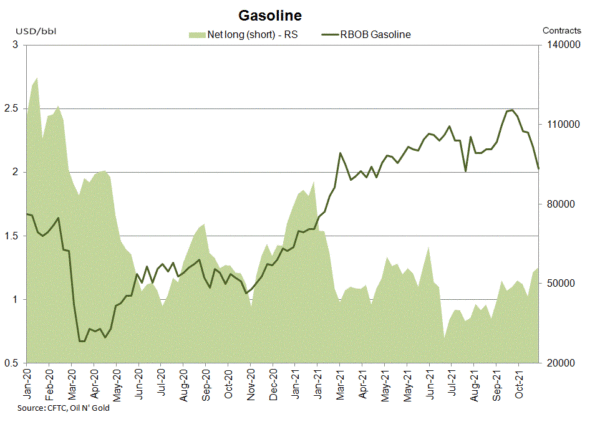
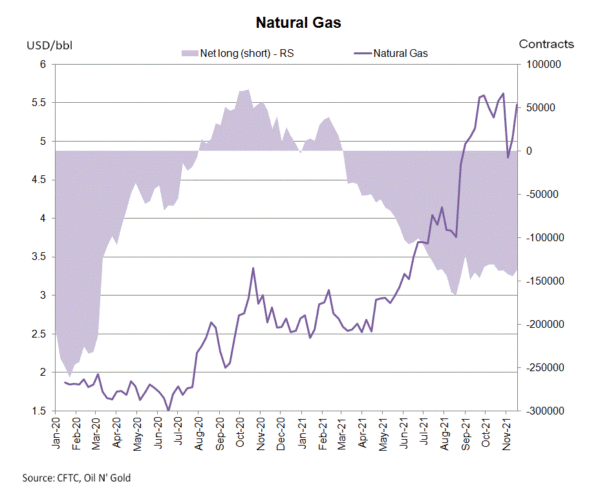
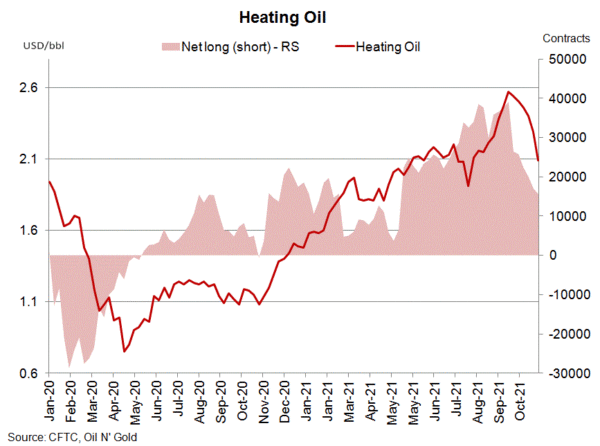
According to the CFTC Commitments of Traders report for the week ended November 23, NET LENGTH of crude oil futures sank -8 128 contracts to 407 657. Speculative longs added +417 contracts while shorts jumped +8 545 contracts. For refined oil products, NET LENGTH for heating oil dropped -1 398 contracts to 15 631, while that for gasoline gained +1 780 contracts to 55 994. NET SHORT of natural gas futures declined -7 365 contracts to 137 255 during the week.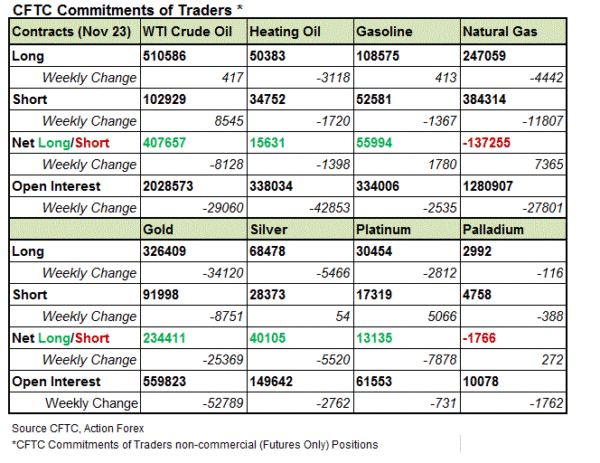
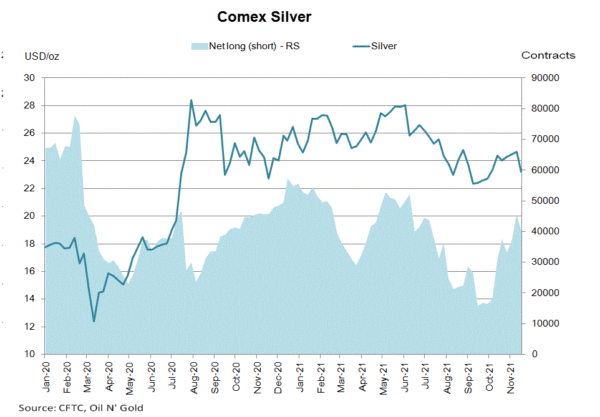
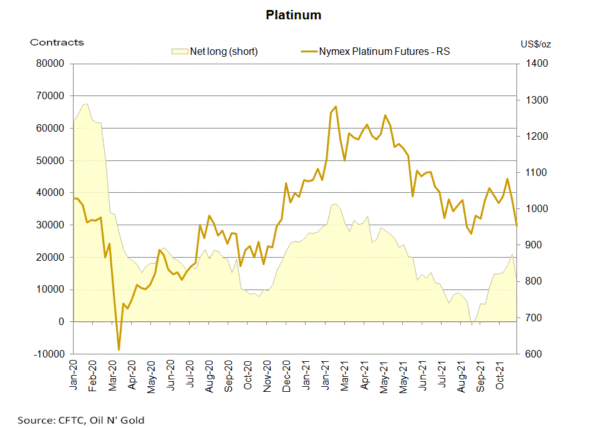
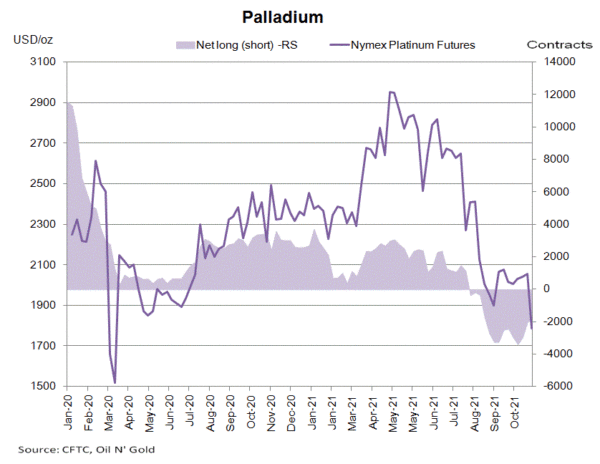
Gold futures’ NET LENGTH slumped -25 369 contracts to 234 411. Silver futures’ NET LENGTH fell -5 520 contracts to 40 105. For PGMs, NET LENGTH of Nymex platinum futures plunged -7 878 contracts to 13 135, while NET SHORT for palladium futures slipped -272 contracts to 1 766.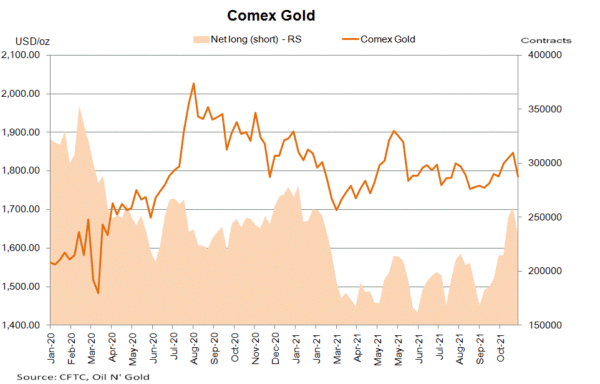
Brent Under Severe Stress
The Brent price reached stability on Monday after experiencing severe stress last Friday; the asset is trading at $75.30. Still, there is too much volatility and emotions in the instrument.
The reason for that is the new coronavirus strain found in South Africa, which has much more mutations than any other before it. The strain is believed to be very aggressive and may complicate the current epidemiological situation. Many countries started sealing their borders from any contact with South African countries. Israel, for example, forbade the country from foreigners. Under such circumstances, a possibility of new lockdowns is not in favour of the commodity market: the demand for energies may plummet.
At the moment, market players are switching their attention to the December meeting of OPEC+. Maybe this time the cartel and its allies will take a break and put the 400K daily output increase in January on hold. Under current conditions, it would be a great relief for the commodity market.
In the H4 chart, completing the descending wave at 71.40 and finishing the correction, Brent is growing with the first target at 82.40. After that, the asset may start a new correction to reach 77.00. From the technical point of view, this scenario is confirmed by MACD Oscillator: its signal line is moving near the lows within the histogram area. Later, the line is expected to leave the area and grow towards 0.
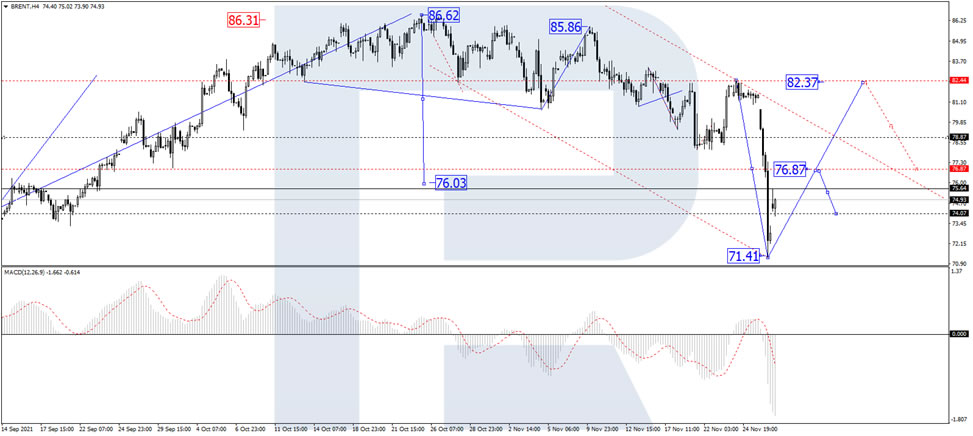
As we can see in the H1 chart, Brent s forming the first ascending structure and may soon reach 77.53. Later, the market may correct towards 74.33 and then resume trading upwards with the first target at 82.52. From the technical point of view, this idea is confirmed by the Stochastic Oscillator: after breaking 50 to the upside, its signal line is expected to test this level and then resume growing to reach 80.
Resilient Dollar Rebounds and Markets Calm
Greenback shrugs off new virus scare, market sentiment bounces back
The calmer markets today seem to have brushed off the shock linked to the new omicron variant that plunged global equity markets on Friday. Despite markets rapidly regaining their composure, risk aversion may linger moving towards the end of the year, as not much has been proved about the new strain of the virus.
That said, the World Health Organisation (WHO) aided markets by reiterating that the current symptoms connected to the new variant have been mild, and on another note, it is most unlikely that the new strain will affect expectations of tightening from the Fed.
With this week’s focus set around Fed Chair Powell’s speech, the NFP jobless report and ISM Manufacturing and Services PMI’s, stronger results could be a booster for the dollar towards year end, especially as the 2-year yield differential starts to shift in favour of the dollar again.
The US will also report October pending home sales at 15:00 GMT, which is forecasted to come in at 0.8% m/m, stronger than September’s figure of -2.3%.
The dollar index managed to dismiss lasting effects from Friday’s omicron variant of the virus, recouping some lost ground after finding its feet around the 96.00 mark. It is currently trading around 96.18. USD/JPY established a foothold around the 113.00 mark and has ticked higher after market sentiment has stabilized from Friday’s shock. The pair is currently trading at 113.50. The swissie is also trading higher at 0.9240 after the plunge near 0.9200 on the back of dollar strength.
Europe and the UK
The euro’s bullish forces seem feeble as they have struggled to keep the common currency above the $1.1300 handle, receiving little aid from some stronger results in eurozone November CPI figures. Spain reported stronger inflation at 5.6% y/y, while Germany’s monthly figure came in better at -0.2%. The ECB seems to be unintimidated by the new strain of the virus and any change to the economic outlook is likely to be minimal.
The pound appears somewhat sluggish, unable to surge above $1.3360. The UK has not imposed any new work restrictions but all travellers arriving in the UK now must take a PCR test and isolate until cleared with a negative result.
The UK’s September mortgage approvals have dropped to 67K from October’s 72K, but consumer confidence remained strong in October, which could encourage the BoE policy makers that the UK economy can cope with a hike in December. Despite economic uncertainty related to the new strain of the virus, BoE comments seem skewed towards tightening in the coming months.
Oil hurts the loonie
WTI oil is currently trading around the $72.40 level after finding its feet around the $68.00 per barrel mark, following one of the biggest intraday plunges. The drop was linked to demand risks associated with the new omicron variant and expected responses from OPEC and oil producing nations. It will be interesting to see what stance OPEC takes when it gathers on Wednesday.
The USD/CAD pair as a result ticked close to the C$1.2800 mark before steading back around the C$1.2750 range. Canada’s current account surplus of 1.4bln did little to aid the Canadian dollar as did the October Industrial Product Price Index (IPPI) and Raw Materials Price Index (RMPI), which beat expectations coming in at 1.3% and 4.8%, up from September figures of 1.2% and 2.4% respectively.
ECB President Lagarde is due to speak at 17:15 GMT, while BOC Governor Macklem is set for 19:00 GMT.
FOMC Member Williams is scheduled at 20:00 GMT and Fed Chair Powell at 20:05 GMT
Sunset Market Commentary
Markets
Friday’s panic Omicron-driven risk-off repositioning evidently was the result of heightened uncertainty with respect to yet a another turn in the never-ending corona saga, but it was also a trigger to rebalance some ‘unidirectional’ market positioning, like in EUR/USD. Short-term US yields probably also discounted quite a positive scenario on accelerated tapering and early Fed rate hikes. There was room for profit taking. Idem for equities. Investors now have to look through the fog of first Omicron headlines and try to assess the impact on growth and policy. Uncertainty on Omicron might give activity data some more weight, especially in Europe as governments were already forced to take new containment measures. Still, today and tomorrow, ‘pre-Omicron’ inflation data also have a role to play. Preliminary German inflation again beat expectations by quite a big margin. HICP inflation jumped 0.3% M/M putting prices 6.0% higher compared to November last year. Already before the data release, German ECB Member Schnabel indicated that the November report might mark a peak. Other members (De Cos) also repeated the ECB mantra on the temporary nature of inflation. ECB’s Villeroy at the same time said Omicron won’t change the economic outlook too much. The ECB will need quite some luck for both growth and inflation to return to the hoped for path. The policy dilemma for the December meeting only deepens. At least for now, the rebound in European yields stays modest given last week’s sharp decline. German yields are rising between 1.5 bps (2-y) and 3.5 bps (5 & 10-y). The 10-y German yield is still struggling to regain -0.30%. Intra-EMU spreads narrow marginally. US yields clearly show more rebound flexibility rising between 4 bps (2-y) and 8.5 bps (10-y). At 1.56% for the US 10-y yield, the cycle top/resistance at 1.70% is quite some distance away, but the technical picture isn’t hurt in a profound way. European equites regain 1.50%. US stock markets open about 1.0/1.5% higher. Especially for European markets, this isn’t enough yet to a assume an new buy-on-dip episode.
The dollar still proves more sensitive to (potential) interest rate support rather than to follow the ‘classic’ risk-on/risk-off paradigm. DXY rebounds to 96.35. The peak just below 97 remains within reach. The yen, but also the euro, ‘suffer’ from the risk-on, annex rewidening of the interest rate differential. USD/JPY trades near 113.80. The EUR/USD picture remains fragile. Friday’s short-squeeze apparently was a selling opportunity. The journey north of 1.13 was short-lived. At 1.1265 the focus returns to downside support in the 1.12/1.1185 area. CE currencies, after a turbulent week, enter calmer waters. The risk-on rebound for now outweighs higher core yields and a strong dollar. (EUR/PLN 4.69; EUR/HUF 368 & EURCZK 25.59). Even so, especial the zloty and the forint need close monitoring (and probably persistent CB assistance). Sterling’s performance is unconvincing even against the euro (EUR/GBP 0.8470). News Headlines
Belgian inflation accelerated from 4.16% Y/Y to 5.64% Y/Y in November, which is the highest level since July 2008. Inflation rose by 1.25% on a monthly basis. The large increase in inflation this month is due, as in recent months, to the sharp rise in energy prices. Energy currently has an inflation rate of 46.4% and contributes 3.92 percentage points to the total inflation. Core inflation stood at 2.14% Y/Y compared to 1.95% Y/Y in October. German inflation accelerated as well and beat consensus: 6% Y/Y from 4.6% Y/Y (vs 5.5% expected). Spanish inflation rose by 0.3% M/M and 5.6% Y/Y. The EMU figure will be published tomorrow with today’s readings pointing to upward risks to the 4.5% Y/Y headline consensus (which would be an EMU record high).
EUR/TRY rises back above the 14 handle after Turkish President Erdogan said that he will never defend interest rate hikes nor compromise on the issue. The Turkish central bank the past months bowed to his demands, slashing rates by a cumulative 400 bps to 15% despite inflation accelerating to 20% Y/Y. Over the weekend, the Turkish President ordered an investigation into possible FX manipulation after the lira’s recent crash. The State Supervisory Council has been asked to identify those institutions that bought large amounts of foreign currency.
Swiss Franc Soars as Risk Sentiment Slides
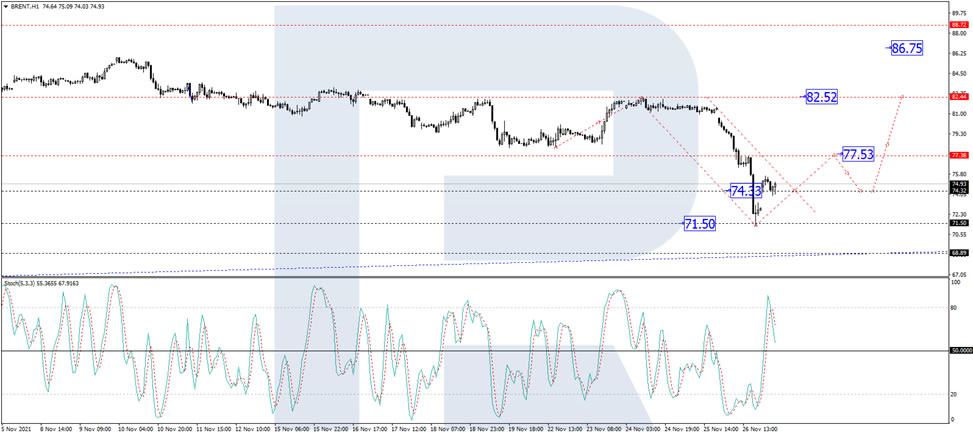
The Swiss franc has edged upwards on Monday, after the currency jumped over 1 per cent at the end of the week. Currently, USD/CHF is trading at 0.9262, up o.22% on the day.
Investors flock to Swiss haven
Omicron, a new variant of Covid, has swept the world and sewed fear and panic in the financial markets. Travel restrictions were quickly enacted, but the variant appears to have spread without any trouble. The week ended in a panic, as oil prices and equities plunged, while safe-haven currencies such as the Swiss franc and Japanese yen soared higher.
USD/CHF took a nasty tumble on Friday, falling 1.21%. Such a steep decline for the relatively stable Swiss franc is extremely unusual, and this was the sharpest one-day drop since March 2020. Still, I don’t expect officials at the Swiss central bank, who loathe a strong franc, to lose any sleep. The Swissie remains at high levels and had recorded five straight winning sessions before Friday’s slide.
The Swiss franc has settled down on Monday, and it appears that Friday’s move was a blip. Still, it would be prudent for market participants to be prepared for volatility in the coming weeks. It’s clear that Omicron has spread very quickly, but how lethal is the new variant? Preliminary reports show that vaccinated persons who were infected with Omicron displayed only minor symptoms, and health officials are scrambling to determine if Omicron is a serious health threat or not.
Science takes time, but the markets, which hate uncertainty, want answers yesterday. We can therefore expect some volatility in the currency markets, especially with risk currencies, until more is known about Omicron. Investors will be anxiously scanning the headlines, looking for any information about Omicron. For now, this week’s key releases such as US nonfarm payrolls will be overshadowed by the latest developments with the Covid pandemic.
USD/CHF Technical
- USD/CHF has support at 0.9183 and 0.9122
- There is resistance at 0.9339, followed by resistance at 0.9434
EUR/USD Mid-Day Outlook
Daily Pivots: (S1) 1.1243; (P) 1.1286; (R1) 1.1366; More...
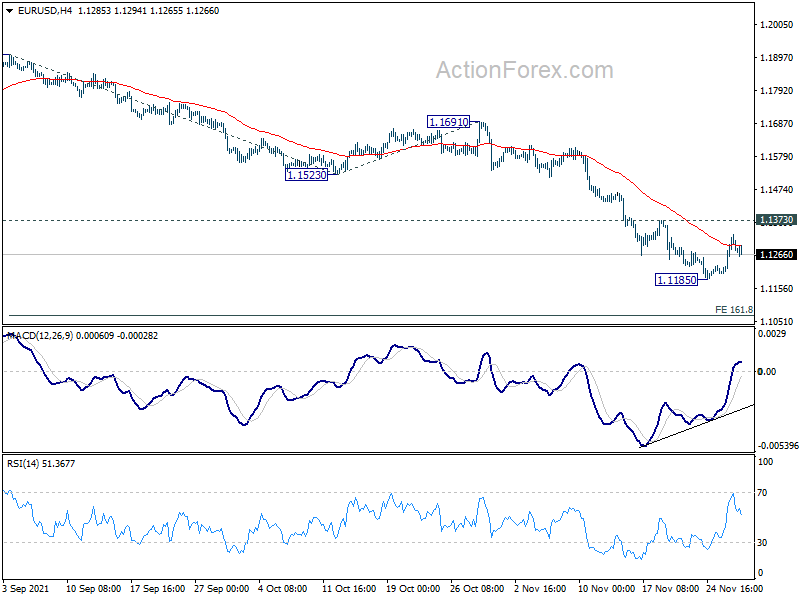
EUR/USD is staying in consolidation from 1.1185 and intraday bias remains neutral. Further decline is still in favor as long as 1.1373 resistance holds. Break of 1.1185 will target 161.8% projection of 1.1908 to 1.1523 from 1.1691 at 1.1068 next. However, firm break of 1.1373 will indicate short term bottoming and turn bias back to the upside for stronger rebound.
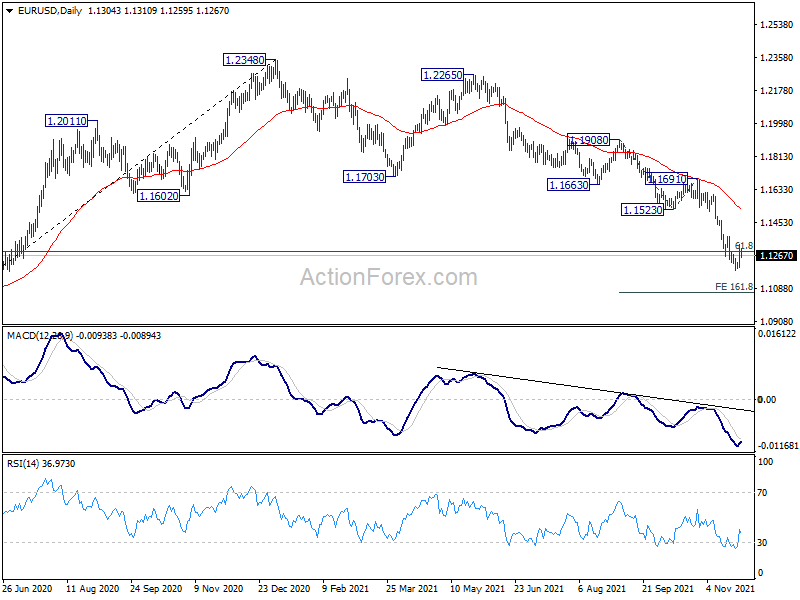
In the bigger picture, there are various ways of interpreting the fall from 1.2348 (2021 high). It could be a correction to rise from 1.0635 (2020 low), the fourth leg of a sideway pattern from 1.0339 (2017 low), or resuming long term down trend. In any case, outlook will now stay bearish as long as 1.1703 support turned resistance holds. Sustained break of 61.8% retracement of 1.0635 to 1.2348 at 1.1289 would pave the way back to 1.0635.
GBP/USD Mid-Day Outlook
Daily Pivots: (S1) 1.3286; (P) 1.3326; (R1) 1.3375; More...
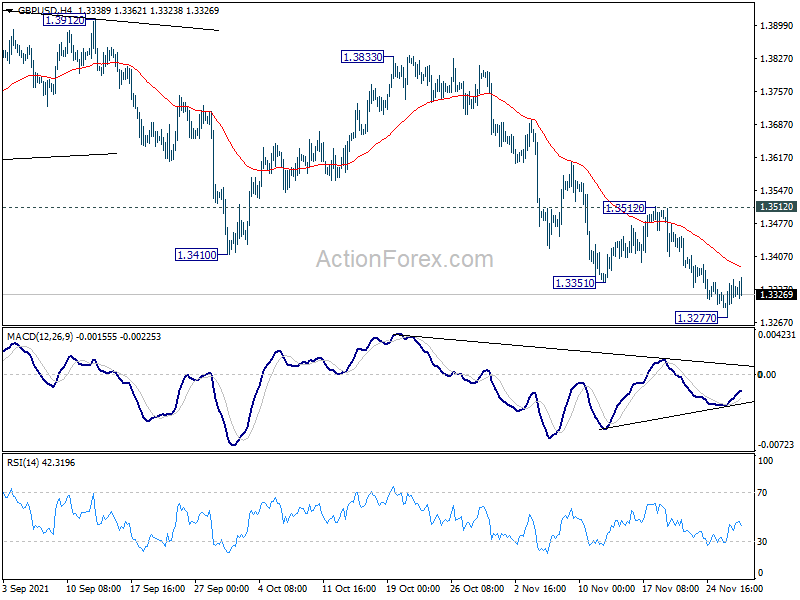
GBP/USD is staying in consolidation from 1.3277 and intraday bias remains neutral first. Upside of recovery should be limited below 1.3512 resistance to bring another fall. Break of 1.3277 will resume the decline from 1.4248 to 1.3164 fibonacci level next. Nevertheless, break of 1.3512 will indicate short term bottoming and bring stronger rebound.
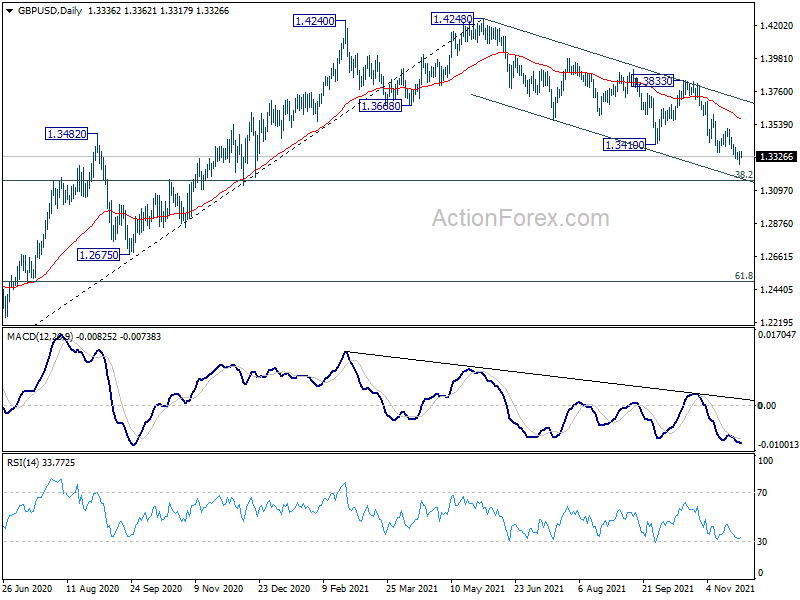
In the bigger picture, the structure of the fall from 1.4248 suggests that it's a correction to the up trend from 1.1409 (2020 low) only. While deeper fall cannot be ruled out yet, downside should be contained by 38.2% retracement of 1.1409 to 1.4248 at 1.3164, at least on first attempt, to bring rebound. On the upside, break of 1.3833 resistance will argue that the correction has completed and bring retest of 1.4248 high. However, sustained trading below 1.3164 will revive some medium term bearishness and target 61.8% retracement at 1.2493.
USD/CHF Mid-Day Outlook
Daily Pivots: (S1) 0.9187; (P) 0.9274; (R1) 0.9329; More....
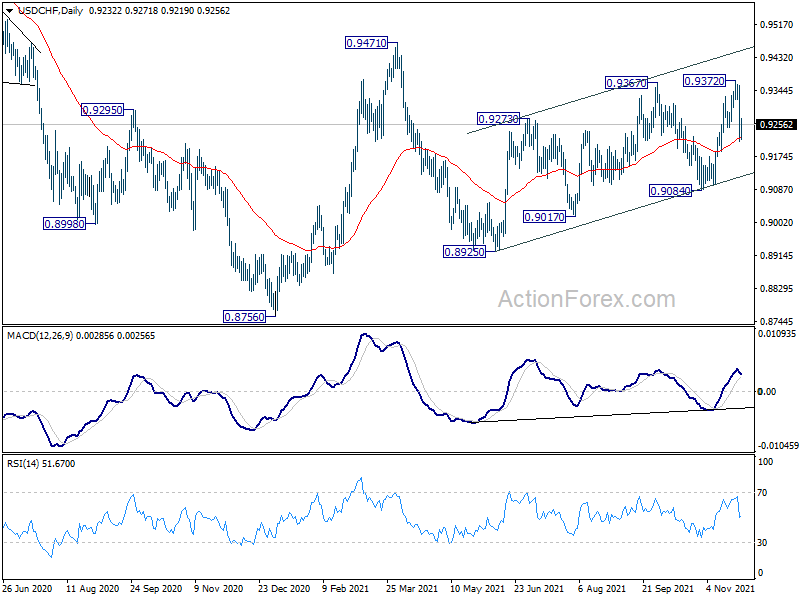
Intraday bias in USD/CHF stays mildly on the downside at this point. Current fall from 0.9372 would target 0.9084 support first. Firm break there will argue that choppy rise from 0.8925 has completed, and fall from 0.9471 is resuming. Deeper decline would be seen through 0.8925. For now, risk will stay mildly on the downside as long as 0.9372 resistance holds, in case of recovery.
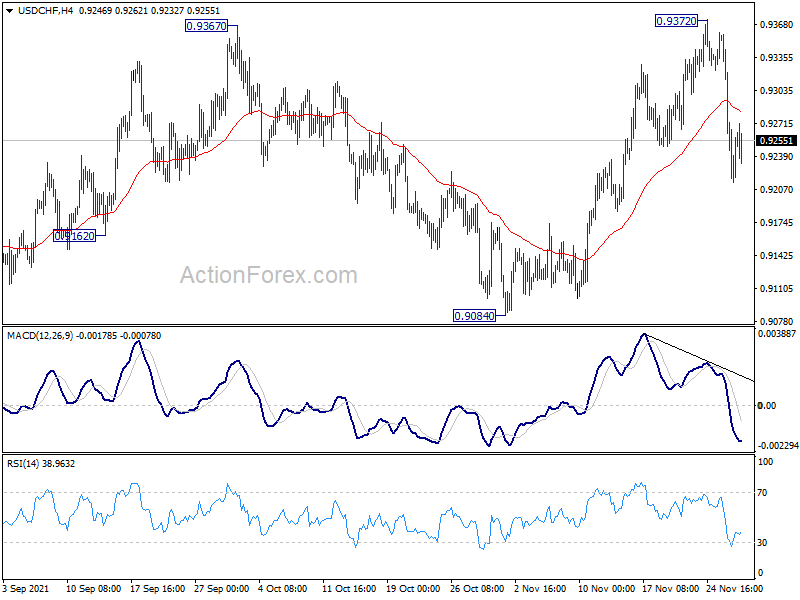
In the bigger picture, the corrective structure of the rebound from 0.8925 argues that fall from 0.9471 is not complete yet. It could either be the second leg of pattern from 0.8756 (2021 low), or resuming larger down trend from 1.0237 (2018 high). We'd pay attention to the downside momentum and assess the odds later. But for now, medium term outlook will be neutral at best as long as 0.9471 resistance holds.
USD/JPY Mid-Day Outlook
Daily Pivots: (S1) 112.48; (P) 113.92; (R1) 114.79; More...
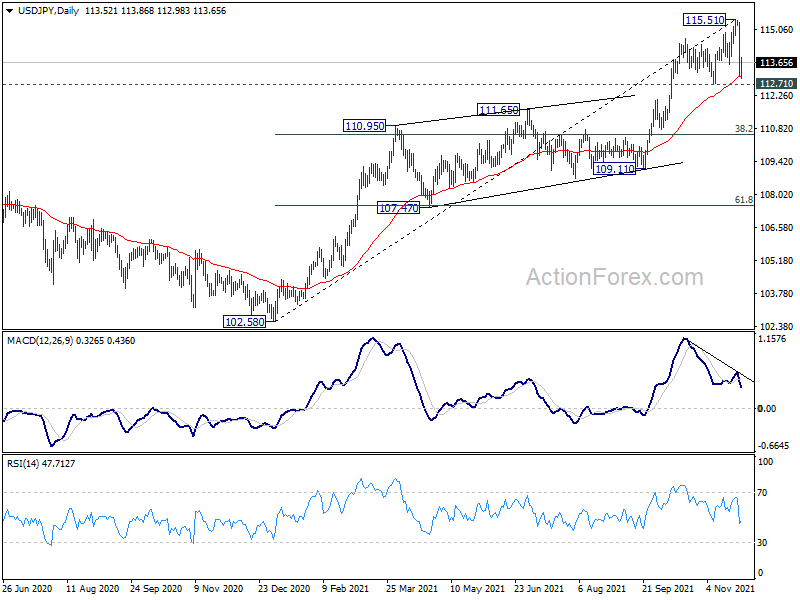
No change in USD/JPY's outlook and intraday bias remains on the downside for 112.71 support. Sustained break there will argue that fall from 115.51 is already correcting whole rise from 102.58. Deeper decline would then be seen to 38.2% retracement of 102.58 to 115.51 at 110.57. For now, risk will stay on the downside as long as 115.51 resistance holds, in case of recovery.
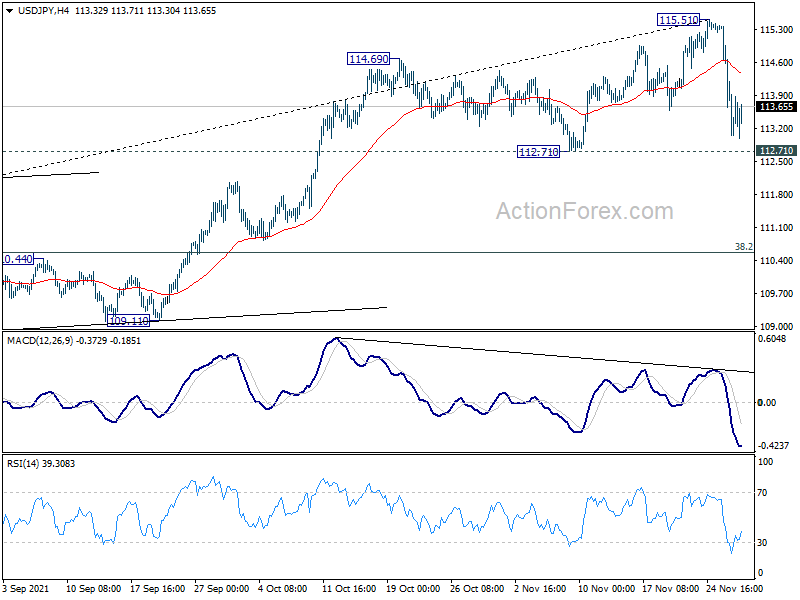
In the bigger picture, no change in the view that rise from 102.58 is the third leg of the up trend from 101.18 (2020 low). Such rally should target a test on 118.65 (2016 high) on resumption. However, firm break of 109.11 structural support will argue that the trend might have reversed and bring deeper fall to 107.47 support and possibly below.
Yen and Franc Consolidate as Market Sentiment Stabilized for Now
The forex markets are staying in consolidative mode today as overall market sentiment stabilized. Major European indexes are paring some of last week's losses while US futures also point to higher open. But it remains to be seen if it's just a dead cat bounce, or a reversal. Canadian and Australian Dollar are currently the stronger ones for today, while Euro, Yen and Swiss Franc are the softest.
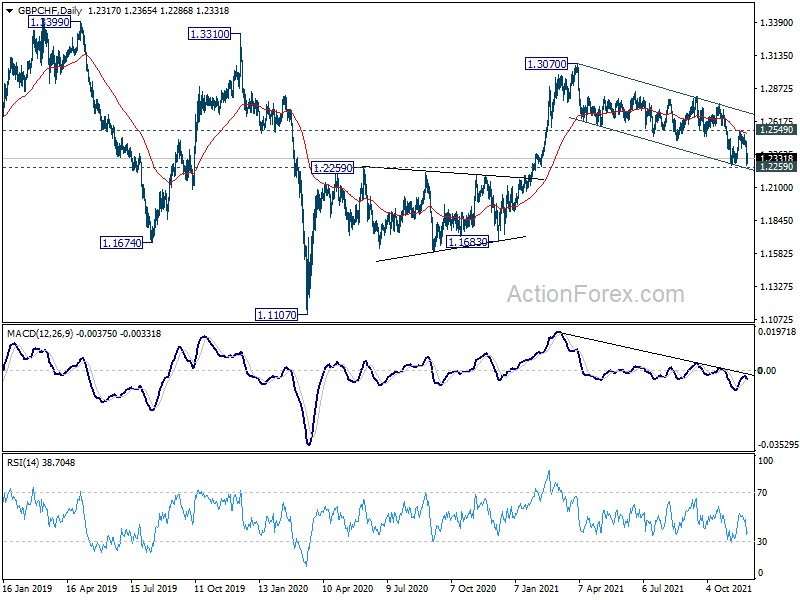
Technically, in addition to Yen crosses, we'd also pay attention to Franc crosses to gauge overall sentiment. In particular, GBP/CHF is now close to 1.2259 key resistance turned support level. Sustained break of this level will argue that medium term rise from 1.1107 is finished and could prompt downside acceleration. Nevertheless, rebound from current level, followed by break of 1.2549 resistance will turn near term outlook bullish again.
In Europe, at the time of writing, FTSE is up 1.35%. DAX is up 0.73%. CAC is up 1.23%. Germany 10-year yield is up 0.0392 at -0.295. Earlier in Asia, Nikkei dropped -1.63%. Hong Kong HSI dropped -0.95%. China Shanghai SSE dropped -0.04%. Singapore Strait Times dropped -1.44%. Japan 10-year JGB yield dropped -0.0028 to 0.074.
Eurozone economic sentiment rose dropped to 117.5, EU dropped to 116.5
Eurozone Economic Sentiment Indicator dropped from 118.6 to 117.5 in November. Industry confidence dropped from 14.2 to 14.1. Services confidence rose from 18.0 to 18.3. Consumer confidence dropped from -4.8 to -6.8. Retail trade confidence rose from 1.9 to 3.7. Construction confidence rose from 8.6 to 9.0. Employment Expectation Indicator rose from 113.9 to 115.6, highest since January 2018.
EU ESI dropped from 117.6 to 116.5. Employment Expectation Indicator rose from 114.2 to 115.6, highest since January 2018. Amongst the largest EU economies, the ESI rose in France (+3.0), Italy (+0.9) and Poland (+0.5). By contrast, confidence worsened in Spain (-2.6), the Netherlands (-2.1) and Germany (-1.7).
ECB de Guindos: Economic situation marked by a high degree of uncertainty
Vice-President Luis de Guindos said in Madrid today, "economic situation is marked by a high degree of uncertainty with "outbreaks of infections" and "appearance of new variants." He warned that potential withdrawal of policy support measures has to be taken very carefully. It's important for monetary policy keep all options open.
De Guindos reiterated that factors behind inflation are of "transitory nature. And he expects inflation to start falling next year.
Separately, Governing council member Francois Villeroy de Galhau "obviously, we must monitor closely the latest COVID developments, and the new Omicron strain". But he also noted, "the economic effects of the successive waves have proven so far to be less and less damaging, and this one shouldn't presumably change the economic outlook too much."
ECB Schnabel: November will prove to be the inflation peak
ECB Executive Board member Isabel Schnabel said "November will prove to be the peak" of inflation. She added, "We predict inflation will fall back below 2%" target.
"I can very well understand that many people have worries," she told Germany's ZDF national television broadcaster in a live interview. "We must understand that this has to do with an extraordinary economic situation", repeating the factors including base effects and rise in energy costs and raw materials prices.
RBNZ Ha: Omicron doesn't change economic outlook, just reinforces downside risks
In a WSJ interview, RBNZ chief economic Yuong Ha said the central bank would have raised interest rate even if Omicron was know before the meeting last week.
He said New Zealand is now "transitioning into a new Covid protection framework" and people are "getting used to the idea of living with Covid". Hence, Omicron doesn't change the outlook. "It probably just reinforces the downside risks we saw in the projections," he said.
RBNZ will be in a better place to assess Omicron's economic impact at next meeting in February. "If Omicron turns out to be a massive game changer, that might be kind of like August where we just took a pause," Ha said.
USD/JPY Mid-Day Outlook
Daily Pivots: (S1) 112.48; (P) 113.92; (R1) 114.79; More...
No change in USD/JPY's outlook and intraday bias remains on the downside for 112.71 support. Sustained break there will argue that fall from 115.51 is already correcting whole rise from 102.58. Deeper decline would then be seen to 38.2% retracement of 102.58 to 115.51 at 110.57. For now, risk will stay on the downside as long as 115.51 resistance holds, in case of recovery.
In the bigger picture, no change in the view that rise from 102.58 is the third leg of the up trend from 101.18 (2020 low). Such rally should target a test on 118.65 (2016 high) on resumption. However, firm break of 109.11 structural support will argue that the trend might have reversed and bring deeper fall to 107.47 support and possibly below.
Economic Indicators Update
| GMT | Ccy | Events | Actual | Forecast | Previous | Revised |
|---|---|---|---|---|---|---|
| 23:50 | JPY | Retail Trade Y/Y Sep | 0.90% | 1.10% | -0.50% | |
| 00:30 | AUD | Company Gross Operating Profits Q/Q Q3 | 4.00% | 3.00% | 7.10% | |
| 09:30 | GBP | Mortgage Approvals Oct | 67.199K | 71.250K | 72.645K | |
| 09:30 | GBP | M4 Money Supply M/M Oct | 0.60% | 0.50% | 0.60% | 0.70% |
| 10:00 | EUR | Eurozone Economic Sentiment Indicator Nov | 117.5 | 117.5 | 118.6 | |
| 10:00 | EUR | Eurozone Industrial Confidence Nov | 14.1 | 13.9 | 14.2 | |
| 10:00 | EUR | Eurozone Services Sentiment Nov | 18.4 | 16.3 | 18.2 | 18 |
| 10:00 | EUR | Eurozone Consumer Confidence Nov F | -6.8 | -6.8 | -6.8 | -4.8 |
| 13:00 | EUR | Germany CPI M/M Nov P | -0.20% | -0.50% | 0.50% | |
| 13:00 | EUR | Germany CPI Y/Y Nov P | 5.20% | 5.00% | 4.50% | |
| 13:30 | CAD | Industrial Product Price M/M Oct | 1.00% | |||
| 13:30 | CAD | Raw Material Price Index Oct | 2.50% | |||
| 13:30 | CAD | Current Account (CAD) Q3 | 4.4B | 3.6B | ||
| 15:00 | USD | Pending Home Sales M/M Oct | 1.00% | -2.30% |