

Sample Category Title
US 30 Struggles To Rally Back
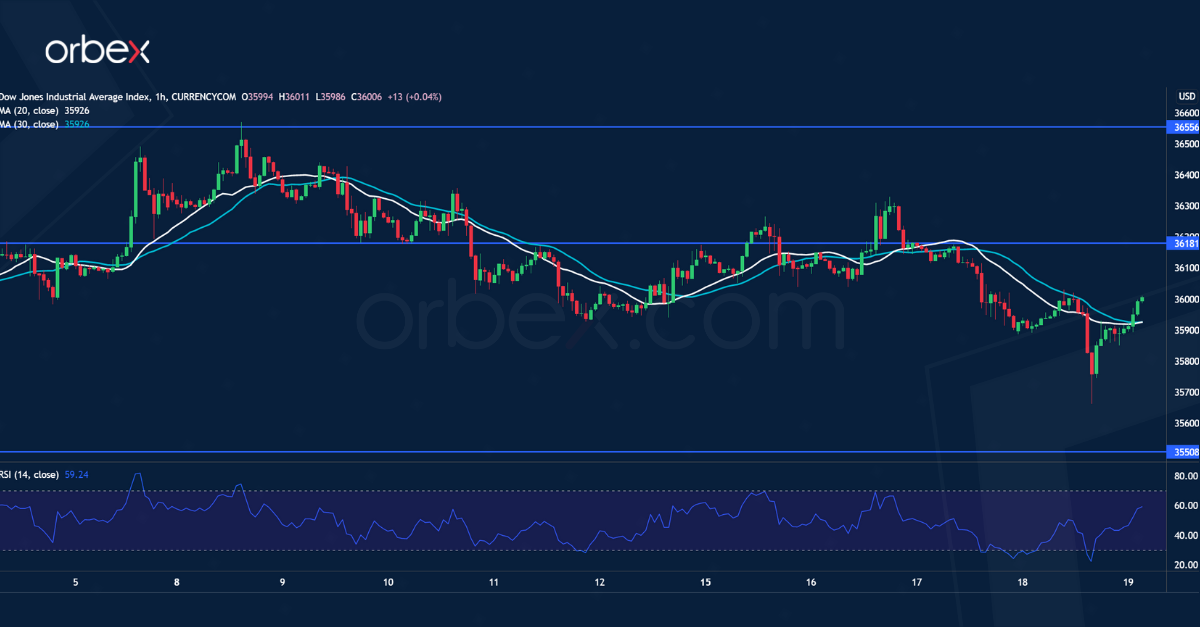
The Dow Jones is under pressure as investors fear that inflation could choke off economic recovery.
The index has been struggling to reclaim the landmark 36000, which coincides with the 20-day moving average. The faded rebound suggests exhaustion after a month-long breakneck rally.
The RSI’s double-dip into the oversold area has attracted buying interest. Though buyers may stay cautious unless the first resistance at 36180 is lifted. On the downside, the previous peak at 35500 has turned into the next support.
NZD/USD Bounces Off Demand Area
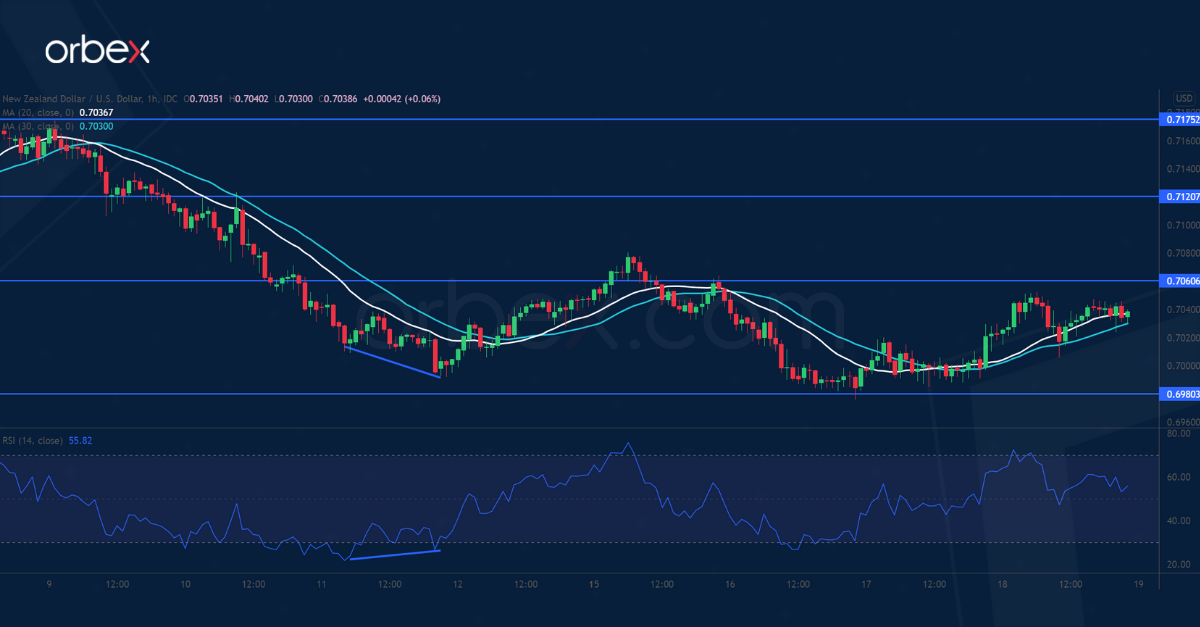
The New Zealand dollar inches higher as traders are positioning for an RBNZ rate hike next week. From the daily chart’s perspective, the pair has bounced off the demand zone near the psychological level of 0.7000.
A bullish RSI divergence indicates a slowdown in the bearish momentum, a sign that sentiment could be turning around. An oversold RSI has attracted buying interest.
A rally above 0.7060 would prompt sellers to cover, paving the way for a recovery towards 0.7175. A break below 0.6980 may drive the kiwi to 0.6900.
USD/CHF Seeks Support
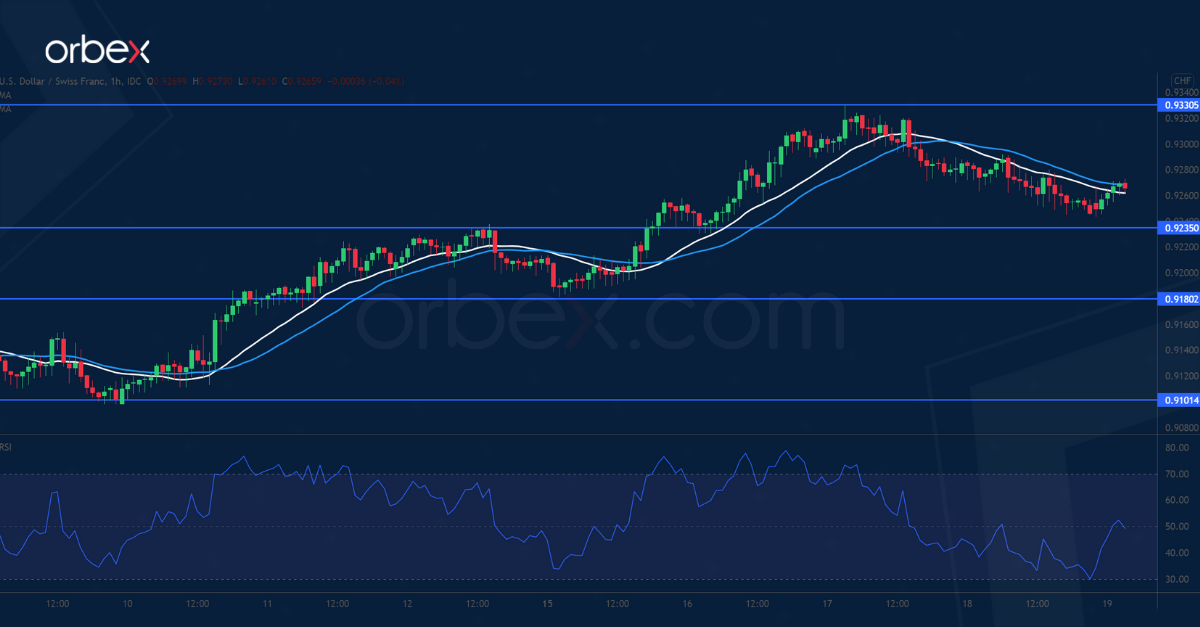
The US dollar stalled after weekly jobless claims came in higher than expected. The pair’s attempt above the daily resistance at 0.9310 suggests that the bulls may have gained the upper hand.
Intraday buyers’ profit-taking led by the RSI’s overbought situation has caused a limited pullback. Buyers may see dips as an opportunity to get in at a discount. Bids could be around the resistance-turned-support at 0.9235.
0.9330 is a fresh resistance. And its breach may trigger an extended rally towards last April’s peak at 0.9450.
USDCAD Gains Momentum Ahead Of Canada Retail Sales Data
US stocks retreated as investors remained concerned about tighter monetary policy. The Dow Jones declined by more than 100 points while the Nasdaq 100 was barely moved. Investors have been concerned that the Federal Reserve will become more aggressive in its tightening process. This is because inflation has surged while the unemployment rate has dropped. The top movers on Thursday were Nvidia, Ford, and GlobalFoundries. Nvidia stock jumped to a record high after the company published strong results. Ford shares dropped while GlobalFoundries rose after the two firms announced a deal to produce more chips.
The US dollar retreated slightly even after positive numbers from the United States. The data showed that the country’s initial jobless claims declined from 269k in the previous week to 268k. In the same period, the continuing jobless claims improved to more than 2.08 million. These numbers have gone to where they were before the pandemic started. Additional data showed that the Philadelphia manufacturing index rose from 23.8 in October to 39.0 in October. There will be no major economic data from the US today.
The Canadian dollar weakened against the US dollar as investors waited for the upcoming retail sales numbers. Economists expect the data to show that the country’s retail sales dropped from 2.1% in August to -1.7% in September. Core sales are expected to have dropped by 1.0% in the same period while the housing price index rose by 0.5%. These numbers will come a day after Canada published strong inflation data. Other important numbers to watch today will be the latest UK retail sales numbers.
USDCAD
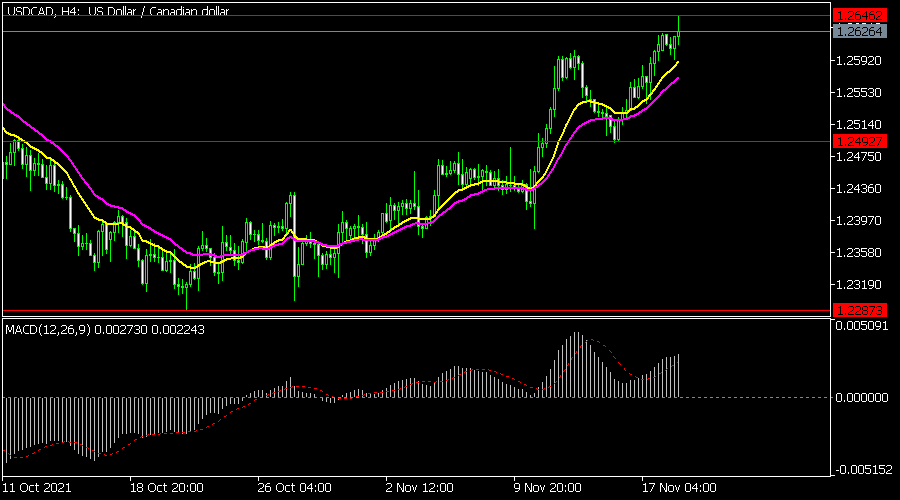
The USDCAD pair rally continued as a summit between the United States, Canada and Mexico happened. The pair rose to a high of 1.2646, which was the highest it has been since October 1. The pair has jumped substantially from its lowest level in October. Along the way, it has moved above the neckline of an inverted head and shoulders pattern. The bullish trend is also being supported by the 25-day and 50-day moving averages. Therefore, the pair will likely keep rising in the near term.
EURUSD
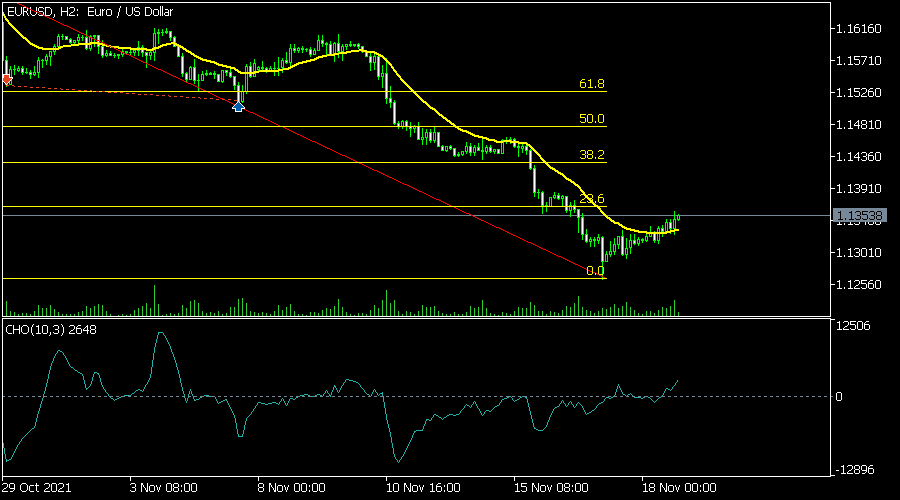
The EURUSD pair held steady as the euro attempted to make a comeback. The pair is trading at 1.1353, which is slightly above this week’s low at 1.1265. On the two-hour chart, the pair has formed a bearish flag pattern. It is also below the 23.6% Fibonacci retracement level and along with the 25-day moving average. Therefore, the pair will likely break out lower in the near term.
USDCHF
The USDCHF pair retreated as the US dollar lost some ground. The pair dropped to a low of 0.9262, which was the lowest level since Monday. It also retested the 23.6% Fibonacci retracement level. The pair moved to the 25-day moving average while the Relative Strength Index (RSI) has moved above the oversold level. Therefore, the pair will likely resume the bullish trend.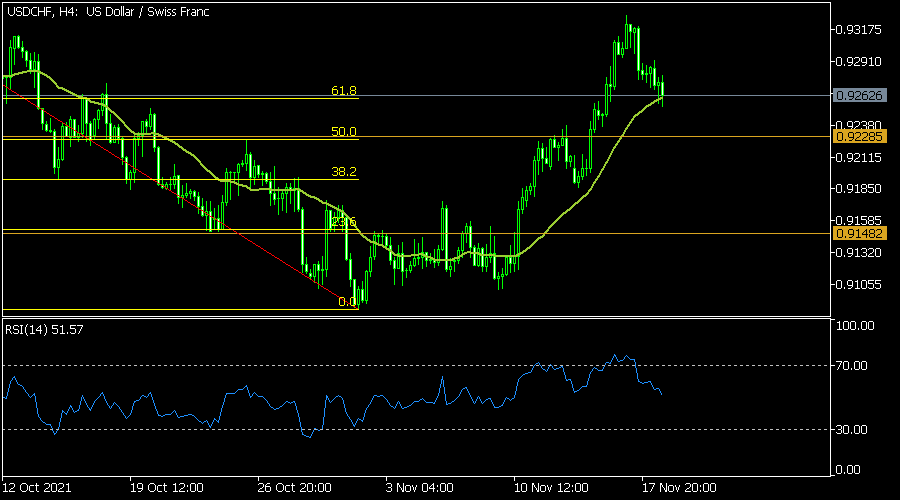
SPY Elliott Wave View: Should Extend Into New Highs
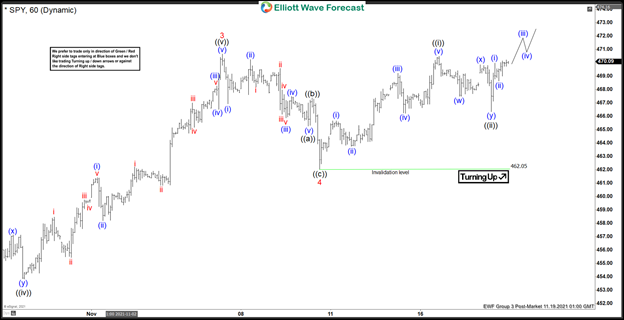
Short-term Elliott Wave view in SPY suggests that the cycle from October 01, 2021 low is showing a higher high sequence favoring new highs to follow. The internals of that rally is unfolding as an Elliott Wave impulse sequence where wave 1 ended at $436.03 high & wave 2 ended at $426.36 low. Up from there, wave 3 unfolded with extension where lesser degree wave ((i)) ended at $441.68 high. Afterwards, wave ((ii)) ended at $431.54 low, wave ((iii)) ended at $458.49 high. Then wave ((iv)) ended at $453.83 low and wave ((v)) ended at $470.65 high.
Down from there, SPY made a pullback in wave 4 to correct the cycle from October 04, 2021 low. The internals of that pullback unfolded as a zigzag structure where wave ((a)) ended at $465.26 low. Then wave ((b)) ended at $467.38 high and wave ((c)) ended at $462.05 low. Up from there, wave 5 remains in progress where wave ((i)) ended at $470.49 high and wave ((ii)) ended at $466.34 low. Near-term, while dips remain above $466.34 low and more importantly above $462.05 low expect SPY to extend higher towards $474.82- $480.04 area higher in wave ((iii)) before a pullback in wave ((iv)) develops.
SPY 1 hour Elliott Wave chart
USDCAD Slips Below 7-Week High And 1.2600
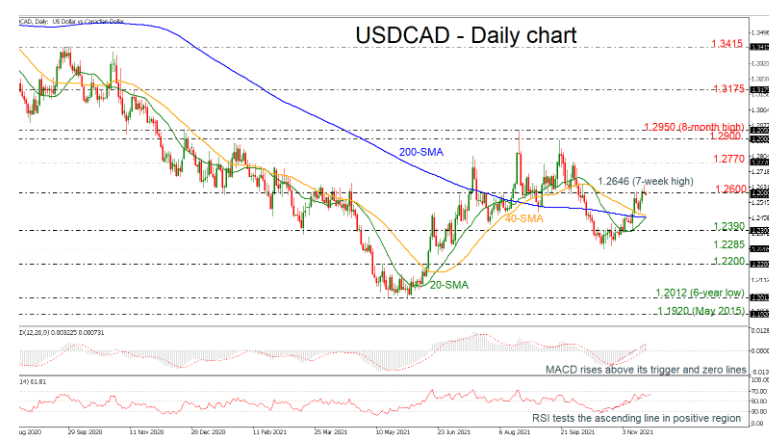
USDCAD is losing momentum after the spike towards the seven-week high of 1.2646 that it posted on Thursday. The pair declined below the 1.2600 psychological number again and it may find immediate supports at the simple moving averages (SMAs), which are hovering around 1.2460. The MACD oscillator is rising in the positive area, holding above its trigger line, while the RSI is testing the ascending line in the bullish area.
In case of more losses, the price could meet the 20- and 40-day SMAs as well as the flat 200-day SMA near 1.2460 before tumbling to the 1.2390 support level. Below these lines, the pair may visit the latest low at 1.2285 ahead of the 1.2200 round number.
In the positive scenario, a successful climb above yesterday’s top it could increase the optimism for bullish bias until the 1.2770 hurdle. Overcoming these obstacles, the bulls may have eyes for the 1.2900 handle and the eight-month peak of 1.2950.
To conclude, USDCAD is heading south in the very short-term; however, over the last month it has been in a bullish correction mode. In case of a jump above the eight-month high of 1.2950, the broader positive outlook would be endorsed.
The Dollar Hit Several Resistance Levels
Markets
The euro snapped a six-day losing streak against the dollar. It was one of the more remarkable observances during a relatively quiet session since fragile stocks (-0.5% in Europe, mixed in the US) and Bund outperformance suggested otherwise. German yields fell 1.9 bps (2y) to 5.1 bps (30y) compared to changes in the US ranging from +0.3 bps to -1.1 bp across the curve. We do note real yield dynamics played in favour of the single currency (+4 bps in 10y). TIPS in the US outperformed after the US Treasury sold 10y inflation-linked bonds at a record low yield of -1.145% (0.4 bps below WI) with dealers awarded a record-low share of the sale. EUR/USD rose half a big figure from 1.132 to 1.137. Technical considerations played their part as well. The dollar hit several resistance levels which hampered its upward momentum. The trade-weighted dollar (DXY) eased from 95.83 to 95.54. Sterling took a breather after the recent rally, fueled in part by strong labour data and higher-than-expected CPI. EUR/GBP clawed back above 0.84. GBP/USD tested the 1.35 big figure on dollar weakness but closed just south eventually.
Overnight news includes Japanese CPI in October rising by 0.1% y/y. Core inflation turned more negative again, coming in at -0.7% (from -0.5% in September). The yen couldn’t care less. Japanese stocks gain a small boost from PM Kishida announcing the 56tn yen fiscal support floated by newspaper Nikkei already yesterday. China’s PBOC warned against one-way bets on the yuan after a trade-weighted gauge hit a six-year high. USD/CNY is broadly unchanged. The euro’s uptick is already melting. Core bonds show little direction.
There’s another flurry of high-profile speeches by members of the Fed, ECB and BoE scheduled for today. They are a wildcard to trading. US politics take center stage with a House vote due on Biden’s $1.75tn bill (cf. infra). On a related note, the discussion on raising the debt ceiling is once again gaining traction. USTS Yellen expects the limit to be hit soon, which will leave the Treasury unable to finance the government after December 15. Bills maturing beyond this X-date have started to rise in recent days. This increased uncertainty is not emerging as an actual dollar negative at this stage. EUR/USD trading today will remain largely technical in nature. In this respect, yesterday’s rise was meaningless. First resistance is situated at 1.1422 but for the ST downside alert to be actually called off, the pair has to take out 1.153 first. The UK finishes its economic update with a bang as (core) retail sales crushed estimates. Sterling is a bit hesitant in early European dealings, keeping north of EUR/GBP 0.84. We wouldn’t be surprised by another attack of that big figure later in the session though.
News headlines
The US House will today vote on the centerpiece of US President’s Biden agenda, the $1.75tn Build Back Better bill for education healthcare and climate. Democratic House leader Pelosi presses ahead with a vote after the Congressional Budget Office provided the estimated cost of the package. The latter was quid pro quo for several moderate Democrats. The CBO projects that the bill would result in a net increase in the deficit totaling $367bn over the 2022-2031 period and added that the figure didn’t include any additional revenue ($127bn) that may be generated by additional funding for tax enforcement. US Treasury Secretary Yellen even stated that the BBB bill is fully paid for as the Treasury estimates at least $400bn in additional revenue after upgrading the internal revenue service. The bill is expected to pass the House on a party-line vote, but then faces a more daunting challenge in the 50-50 split Senate.
The Norges Bank yesterday announced that from today it will reduce its daily FX sales (NOK purchases) on behalf of the government from the equivalent of NOK 700mn to zero for the remainder of the month. The change is due to a reduced need for transfers from the GPFG (sovereign wealth fund) to the government because of a larger-than-expected net cash flow from the petroleum sector. EUR/NOK rebounded from 9.9 to 10, the highest level since October. The move came despite rebounding oil prices. Brent crude closed near $82/b after bouncing off $80/b support.
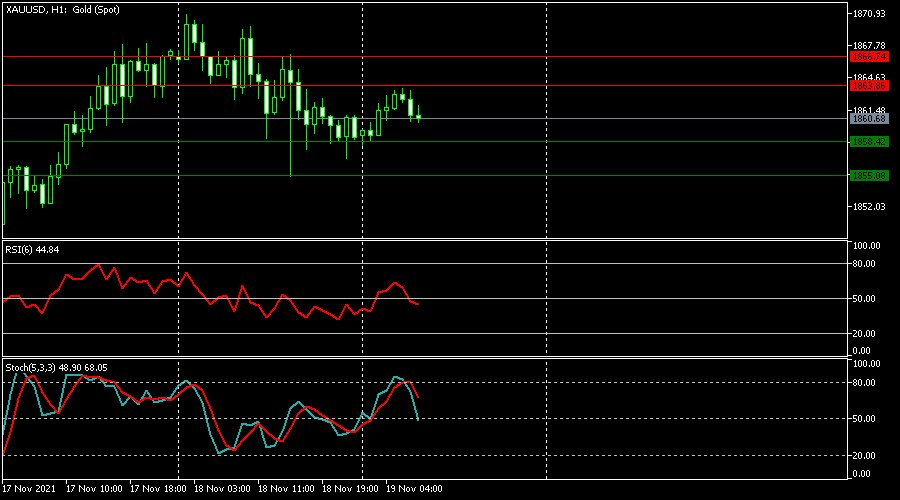
XAUUSD Is Possibly Bearish
Technical analysis
The RSI is below level 50.
The Stochastics is below level 50.
Most likely scenario – SELL
Target prices: 1,858.42 1,855.08
Alternative scenario – BUY
Target prices: 1,863.86 1,866.74
Key levels
Support 1,858.42 1,855.08
Resistance 1,863.86 1,866.74
Good Luck, Joe
Nasdaq hit a fresh record on Thursday, despite the rising prospects of an earlier and perhaps a steeper rate normalization from the Federal Reserve (Fed). Gold consolidated gains around the $1860 per ounce, while Bitcoin missed an important turn as a hedge against inflation, after slipping to $56K after the signature of Joe Biden’s infrastructure bill earlier this week. The bill includes the regulation and the taxation of the digital assets. So, Bitcoin’s inflation hedge status lost over the taxation worries. Oh well.
Elsewhere, the barrel US crude is now exchanged below the $80 mark, as Biden is playing all cards he has in hand to tame the rally in oil prices.
First, there is the rising prospects that the major oil-hungry countries including the US and China, will start tapping into their strategic oil reserves to cool down the tensions over the lack of gas, and the rising fuel prices. And second, the US President Joe Biden is now attacking the oil companies for playing a role in rising oil prices and asks the FTC to investigate whether they are participating in the illegal conduct to keep prices high, as they are collectively operating one-third fewer rigs now than before the pandemic.
If pumping oil from the strategic oil reserves could tame the actual oil rally, there is little chance that Biden’s attack on major oil companies would lead to any concrete outcome, thus it is unlikely it would lead to any sustained weakness on oil prices. The only thing it does is to open a window of opportunities to the bulls to hop on the north train at better prices.
Technically, the actual short term negative trend could gather enough momentum to pull the price of a barrel to $74-75 region, to meet the 100-day moving average, and the lower end of the year-to-date positive trend band. But there is little likelihood that we see the long-term trend reverse in the middle of a worldwide energy crisis. Therefore, the price pullbacks will likely be interesting opportunities to strengthen long positions for the oil bulls, regardless of the deploying of the strategic reserves or convincing oil companies to lower their prices. The strategic reserves is a temporary help, and oil companies can’t pull prices lower than their costs.
Next Fed chair?
Everyone is holding his and her breath to find out who will be the next Fed Chair. Is it going to be Jerome Powell, who has been quite dovish on his rate policy over the pandemic months, or is it going to be Lael Brainard, who is even more dovish than Powell? We’ll see.
In all cases, more or less dovish, will it really matter? The one that will take or keep the helm of the Fed will need to hike rates at some point, because inflation doesn’t look like it would temper itself with zero rates and an ultra-expansive monetary policy in place.
That means that the next Fed Chair won’t be a super hero that Jerome Powell has been, who with his great cash splash strategy managed to send the stock prices to all-time highs even though the US and the world was hit by a deadly pandemic. So maybe, but just maybe, it’s a perfect time for him to leave, and leave Lael with a mess to be tidied fast. Thus, no matter how dovish she is, she will need to deal with a three-decade high inflation., and there are not a million alternatives.
Calm before storm?
The US has another problem than just the energy crisis, it’s the debt problem. US Treasury secretary Janet Yellen is now screaming out that the US may default on its obligations by December 15th if politicians don’t do something about the debt ceiling. The latter deadline is tied to the obligations of the infrastructure bill that Joe Biden signed lately, as that bill will require the Treasury to transfer a good amount like $118 billion to the Highway Trust Fund with the risk of Treasury running out of cash following such big transfer.
Interestingly, we don’t see an additional stress on the US yields, the 2-year yield is consolidating at around the 0.50% and the 10-year yield is just below the 1.60%.
If none of these yields looks like a yield offered by a country that’s at the brink of a default, it’s because no one even dares imagining what would happen to the global financial place if the US papers, which are reckoned as the risk-freest papers, default. The US bond default would be as dramatic as Janet says it would be, and it would trigger a systemic wave across all world markets. So, it brings up the following question: is it the calm before storm in the US yields?
Recovery Continues In Norway
Market movers today
- Another quiet day for markets. ECB President Lagarde and Bundesbank President Weidmann will speak about the European recovery.
- In Norway, we anticipate mainland GDP growth of 2.5% in Q3.
- UK retail sales for October are also on the agenda.
The 60 second overview
Japan: Prime Minister Kishida revealed details of a fiscal package to help aid the economic recovery which was bigger than first expected. Overall, fiscal measures may total as much USD690bn or 10% of GDP.
Fed: Atlanta Fed's Raphael Bostic said yesterday a first rate hike next summer would likely be appropriate, while Chicago Fed's Charles Evans said he thought it might not be appropriate at all to raise rates next year.
Equities: Stock markets retreated somewhat on Thursday, with most markets recording slight declines. Defensives and growth outperformed, while value cyclicals such as materials and banks lagged. Hence, last week's inflation theme in markets reversed. S&P500 closed up 0.3% (but breadth very thin), Dow -0.2%, Nasdaq 0.5% and Russell 2000 0.6%. Asian markets are rebounding this morning. Similarly, US futures point higher.
FI: European curves bull flattened yesterday amid weak risk appetite, mirroring USTs. Bund ASW widened 1bp to 48bp. Short end Germany performed 2bp to levels observed after the cash-collateral increase on Monday.
FX: Yesterday's session was characterised by the rate cut-induced sell-off in TRY and also reflation sensitive currencies in ZAR, MXN and NOK posting losses. EUR/NOK has moved above the 10.00 threshold while EUR/SEK has edged closer to 10.10. EUR/USD remains in the mid 1.13s.
Credit: Yesterday was a fairly neutral day for credit risk. Itraxx Main was unchanged at +49bp while Xover tightened slightly by 1bp to 248bp. We also saw two notable Nordic prints in the investment-grade arena. Maersk printed a 10 year senior unsecured green bond at MS+70bp, while Sandvik printed a 7 year senior unsecured bond at +45bp.
Nordic macro
In Norway, the economic recovery has continued more or less as expected since May, and we anticipate mainland GDP growth of 2.5% in Q3. Mainly higher private consumption is driving the recovery, but there has been solid growth in investment and exports from the mainland economy as well.