Sample Category Title
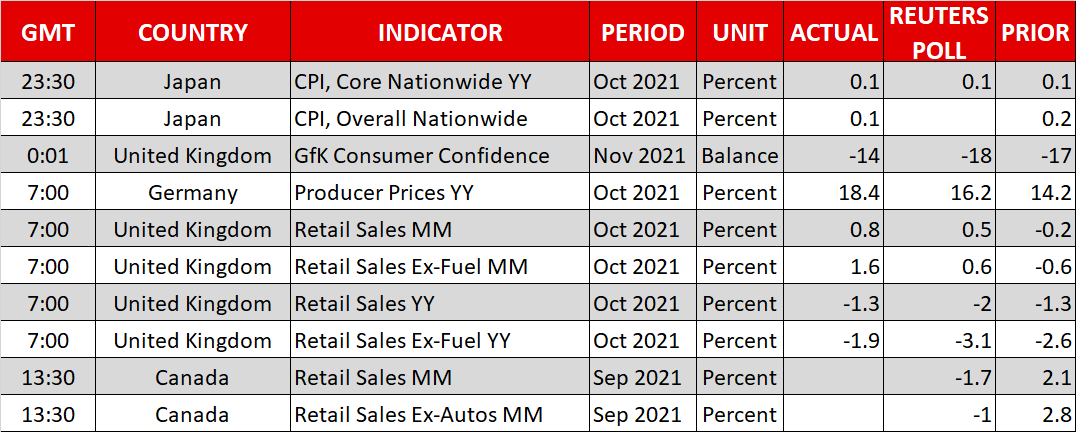
Canada retail sales dropped -0.6% mom in Sep, better than expectation
Canada retail sales dropped -0.6% mom to CAD 56.6B in September, better than expectation of -1.6% mom decline. The contraction was led by sales at motor vehicle and parts dealers (-1.6%) as new car dealer sales (-2.8%) continued to struggle amid global supply shortages for semiconductor chips. Sales dropped in 7 of 11 subsectors, representing 63.5% of retail trade. Excluding gasoline stations and motor vehicle and parts, sales dropped -0.3% mom. In October, advance estimate shows a 1.0% mom rebound in sales.
BoE Pill: No quick fix on inflation means patience required
BoE Chief Economist Huw Pill said in a conference today that there is "no quick fix" on inflation. He added, " lack of a quick fix means some patience will be required." He also said he had not made up his mind whether he would vote for a rate hike in December's meeting.
He added that policy communications was getting more complicated due to the two-side risks to both growth and inflation outlook. But, he said the central wanted to "train" the markets to focus more on the medium-term outlook and the two-side risks. Also, Some volatility was unavoidable give the uncertainty regarding the precise timing of the rate hikes.
Pound Lower, Retail Sales Rebound
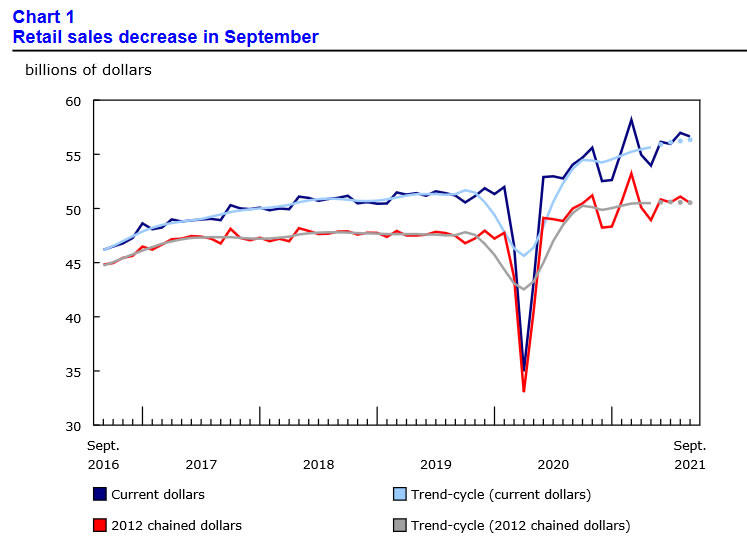
The British pound is in negative territory in the Friday session. GBP/USD is currently trading at 1.3450, down 0.35% on the day.
Retail sales improve
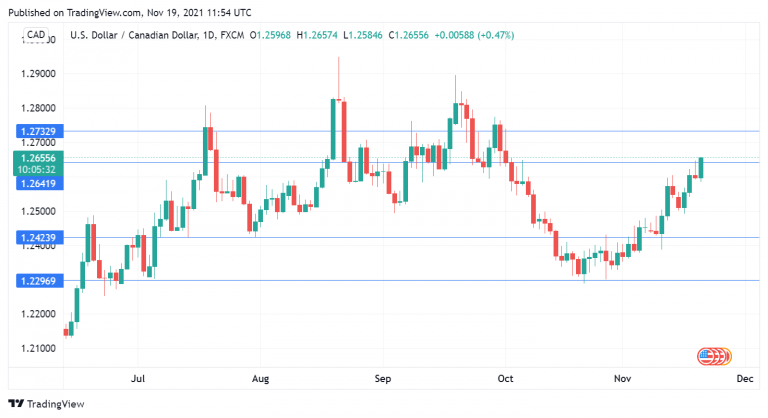
UK retail sales for October surprised the markets, as the gain of 0.8% m/m was the first gain in five months. Clearly good news, but the improvement could well be due to early Christmas shopping rather than a change in the mindset of consumers, who have been slow to spend since the end of the lockdown in the summer. Consumer confidence has been weak as caution is the mantra in what has been a difficult year. On an annual basis, retail sales fell by -1.6%, which follows a read of -1.1% in September.
Inflation continues to accelerate as the “transient” narrative seems out of sync with what is happening on the ground. The UK consumer price index hit 4.2% y/y in October, above the consensus of 3.9%. The data will add to the pressure on the BoE to raise interest rates at the December policy meeting. The bank held rates at the November meeting, which shocked the markets, as Governor Andrew Bailey had sent strong hints that the bank would raise rates in order to contain inflation. The BoE is projecting inflation to go as high as 5% in early 2022 before falling lower in 2023. After being burned by the BoE, investors will be mindful about projecting a December rate hike, but it’s clear to everyone that the bank will need to raise rates shortly – if not in December, then early in the New Year.
With no tier-1 events out of the US today, the markets are focusing on President Biden’s choice for Chair of the Federal Reserve, which should be announced on the weekend. Jerome Powell was considered a strong favourite until recently, but Fed member Laura Brainard could be a surprise choice. Brainard is considered more dovish than Powell and would be expected to raise rates more slowly. If Brainard wins, we could see an immediate reaction from the markets and the US dollar could lose ground.
GBP/USD Technical Analysis
- GBP/USD has support at 1.3310. Below, there is support at 1.3206
- There is resistance at 1.3562 and 1.3710
Canadian Dollar Eyes Retail Sales
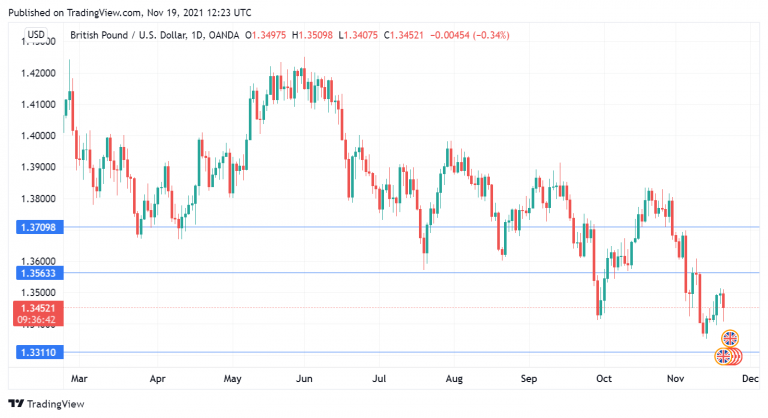
The Canadian dollar has been unusually busy in the European session and has lost ground to the US dollar. USD/CAD is currently trading at 1.2649, up 0.43% on the day.
Retail sales could weigh on the Canadian dollar
Canada posted strong retail sales numbers in August, as the headline read came in at 2.8% y/y and the core release at 2.1%. However, the markets are bracing for a sharp turnaround for September, with a consensus of -1.7% and -1.0%, respectively. A significant decline would put into question the extent of the recovery and could sour investor sentiment towards the Canadian dollar. The currency hasn’t posted a winning week since mid-October, and the streak will continue unless retail sales is stronger than expected.
With inflation continuing to accelerate in Canada, the Bank of Canada is under pressure to provide some relief. October CPI climbed 4.7% y/y, matching the consensus and up from 4.4% in September. Trimmed CPI, which excludes energy, rose 3.3%, matching the gain in September. The headline reading is the highest since 2003, and the markets are watching to see how the BoC reacts. Earlier this week, Governor Tiff Macklem said that economic conditions were not ripe for a rate increase, but the economy was “getting closer” to a hike. Macklem tried to sound positive and said that inflation will be kept under control, but with October CPI hitting an 18-year high, the markets have their doubts.
There are no economic events in the US today, and the markets are focusing on President Biden’s choice for Chair of the Federal Reserve, which should be announced on the weekend. Jerome Powell was considered a strong favourite until recently, but Fed member Laura Brainard is making a race of it. Brainard is considered more dovish than Powell, and would be expected to raise rates more slowly. If Brainard gets the nod, it could make an immediate, negative impact on the US dollar.
USD/CAD Technical
- There is support at 1.2423. Below, there is support at 1.2296
- USD/CAD is testing resistance at 1.2641. The next resistance line is 1.2732
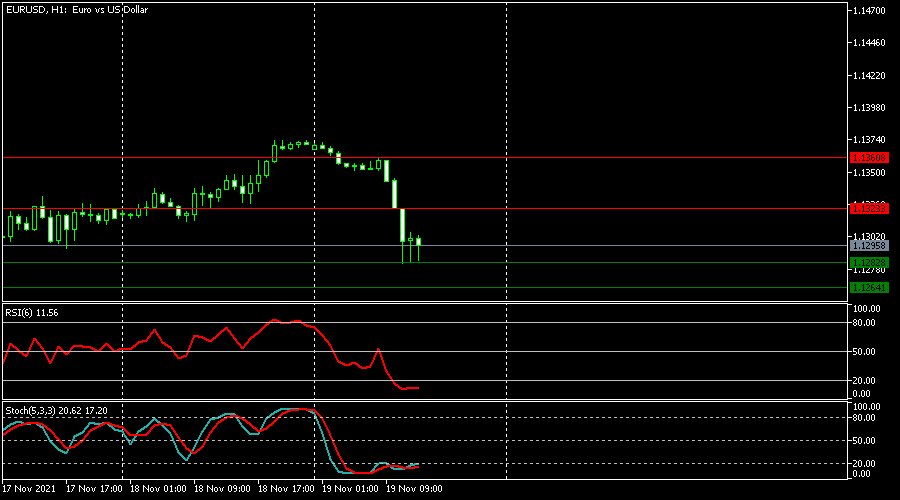
EURUSD Is Possibly Bearish
Technical analysis
The RSI is at the oversold zone.
The Stochastics is near the oversold zone.
Most likely scenario – SELL
Target prices: 1.12828 1.12641
Alternative scenario – BUY
Target prices: 1.13233 1.13608
Key levels
Support 1.12828 1.12641
Resistance 1.13233 1.13608
Oil Down On Demand, Gold Consolidates
Brent crude’s brief dip below USD 80 was short-lived on Thursday and prices were continuing to recover on the final trading day of the week until Austria announced its lockdown. Brent crude quickly reversed course and trades almost 2% lower on the day as it takes another run at USD80.
Oil has been declining over the last week as demand forecasts have been pared back, OPEC and the IEA have warned of oversupply in the coming months and the US has attempted to coordinate an SPR release with China and others.
The market still remains fundamentally in a good position but lockdowns are now an obvious risk to this if other countries follow Austria’s lead. A move below USD 80 could deepen the correction, perhaps pulling the price back towards the mid-USD 70 region. This looks more likely now than it did a day ago and if Germany announces similar measures, it could be the catalyst for such a move. Perhaps OPEC+ knows what it’s talking about after all.
Gold holding near highs on inflation concerns
Gold is continuing to consolidate between USD 1,850 and USD 1,875 after rallying strongly earlier this month. High inflation is continuing to support the yellow metal and is currently stopping this consolidation turning into more of a correction.
As it stands, a run towards USD 1,900 still looks likely as the trend remains bullish but a break below USD 1,850 could lead to a little more softness in the near term, with USD 1,833 key below here.
Inflation isn’t going anywhere soon and it’s continuing to suppress real yields and drive support for hedges. Higher rate expectations could address both of these and take the wind out of gold’s sails but we may have to wait until the Fed meeting for that.
Gold did get a bump from the Austria lockdown announcement as well, especially when paired with the prospect of similar restrictions in Germany. It remains a little off its highs but could be a sign of things to come as we move into the winter.
The Return Of Lockdowns
Europe has turned red on Friday as a new lockdown in Austria and the prospect of similar action in Germany wiped out earlier gains and forced stock markets down close to 1%.
The euro is also falling at the end of the week following the announcement that Austria will begin a 20-day full Covid-19 lockdown from Monday in response to surging case numbers which have far surpassed last year’s peak. While fatalities remain well below the peak, they are accelerating and the government is clearly keen to arrest it before the situation potentially becomes much worse.
With Germany seeing a similar trend, the question now becomes whether the region’s largest economy will follow the same path. Its Health Minister, Jens Spahn, today suggested nothing can be ruled out and that they are in a national emergency.
The situation is not quite so severe in other countries like France, Italy and Spain but that could change in the coming weeks, as we saw around the same time last year. High vaccination rates mean the link between case numbers and fatalities is far lower but the former is rising at a remarkable rate which is clearly making it very hard to ignore.
UK retail sales nothing to get excited about
There was a positive surprise in the UK retail sales report for October, as volumes rose 0.8%, driven by a 4.2% jump in non-food store purchases. While I would like to believe that we’re seeing the return of the UK consumer after five consecutive months of falling sales, it’s hard to put this down to anything other than early Christmas shopping, with sales being lifted by big increases in areas such as clothing and toy retailers.
The prospect of festive shortages is on everyone’s mind and it’s inevitable that many will therefore look to get ahead rather than risk empty shelves and disappointed children next month. I imagine we’ll see this reflected in the November and December numbers.
That’s not to say we can’t see the return of the consumer which would be huge for an economy so dependent on them. But they have been very cautious for most of the year, as evidenced by the weak consumer sentiment data and higher than average savings rate. And with inflation rising, certain pandemic benefits ending and taxes rising next year, I struggle to see those attitudes suddenly improving. It seems traders agree as the pound edged higher before giving most back shortly after.
Bitcoin dips will continue to attract interest
Bitcoin continued to slide on Thursday, falling below USD 58,000 where it saw strong support in late October. We may have just entered into a deeper correction, not that this will panic anyone. I’m sure there’s plenty of bitcoin speculators rubbing their hands together at the prospect of catching some dips, such is the confidence out there in the space at the minute. How far it will fall is anyone’s guess. A move back towards USD 50,000 would be interesting and, given its gains since the summer, no big deal. The dips will continue to attract plenty of interest.
Japanese Yen Higher Despite Weak CPI
The Japanese yen has edged higher on Friday. USD/JPY is trading at 113.93, down 0.28% on the day.
Japanese inflation ticks higher
Japan’s CPI edged up by 0.1% y/y in October, identical to the September gain. Higher energy costs were behind the increase, which would have been higher if not for a sharp drop in mobile phone fees. These inflation figures are certainly much more subdued than what we’re seeing in the US and the UK, where inflation has become a hot issue and is affecting monetary policy. Still, rising fuel prices is a major concern for consumers and businesses, and the government’s new economic package is expected to provide some relief. Many businesses have been hit hard by cost pressures, due to the weak yen, supply chain disruptions and high commodity prices. This hasn’t translated into high inflation, as most firms are reluctant to pass on these costs to consumers.
The Japanese yen remains under pressure and is on target for the dubious honour of being the worst-performing G-10 currency in 2021. The increased likelihood of higher US rates and the surge in oil prices have contributed to the weak yen, which climbed close to the 115 level this week. The yen is extremely sensitive to the USD/JPY rate differential, and a rise in US rates could push the yen above the 120 level.
With inflation soaring in the US and the UK, the Fed and BoE are under pressure to tighten policy. There are growing calls for the Fed to accelerate its tapering and the BoE may raise rates next month. It’s a completely different story in Japan, where inflation remains subdued. On Friday, the government unveiled a USD 490 billion stimulus plan, the largest ever in the country’s history. The government is hoping that the plan will kick-start the lethargic Japanese economy.
USD/JPY Technical
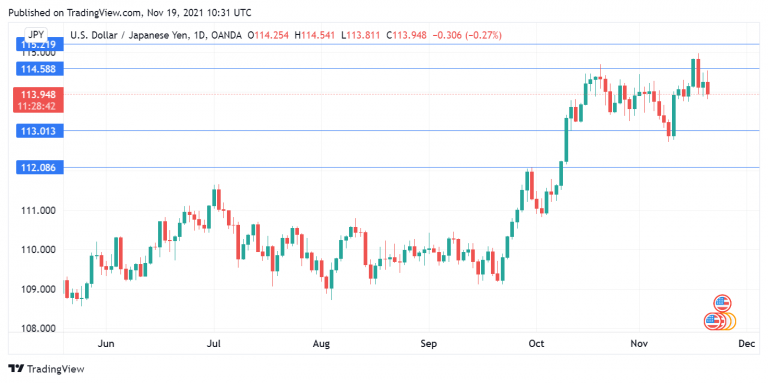
- There is resistance at 115.02 and 116.15
- USD/JPY is testing support at 114.58. This is followed by support at 113.01
Austria Goes Back Into Full Pandemic Lockdown
Notes/Observations
- Pandemic continues to rage in Germany as emergency is declared; Austria moved back in full lockdown mode for both vaccinated and unvaccinated people.
- ECB chief Lagarde continued to push back against expectations of policy tightening in the Euro Zone.
- UK Oct Retail sales registered its 1st month rise in six months.
- US Fed Chair announcement in focus.
Asia
- South Korea Oct PPI registers its fastest annual pace since 2008 (Y/Y: 8.9% v 7.5% prior).
- BOK expected to raise inflation forecasts at next week's policy meeting.
- Japan Oct National CPI Y/Y: 0.1% v 0.2%e; CPI Ex-food (core) Y/Y: 0.1% v 0.1%e.
- Japan PM Kishida stated that had compiled a strong economic package with ¥56T spending and ¥79T overall size for the post coronavirus environment (Note: size of package in-line with press speculation).
Europe
- Compromise on EU judges could be within reach in Northern Ireland Protocol talks.
- France Maritime Min stated that was still short around 150 post-Brexit fishing licenses; talks were continuing.
- UK Nov GfK consumer Confidence: -14 v -18e (1st improvement in 4 months).
Americas
- CBO released estimate that full Biden Build Back Better bill would add $367B to deficit over 10 years.
- Fed's Evans (dove, voter) stated that expected good momentum for US economy into 2022. Rate hikes could start next year [2022] or in 2023, depending on inflation.
- Labor Dept Chief Economist Jones stated that Fed should run economy hot to boost jobs. Should not pump the brakes on the economy.
- House Rep Beatty (D-OH) stated that the House would not vote on Biden Agenda bill on Thursday; aimed to have a vote on Friday, Nov 19th.
Speakers/Fixed income/FX/Commodities/Erratum
Equities
- Indices [Stoxx600 +0.01% at 487.74, FTSE -0.06% at 7,251.90, DAX -0.09% at 16,206.98, CAC-40 -0.17% at 7,129.72, IBEX-35 -0.56% at 8,826.67, FTSE MIB -0.61% at 27,490.00, SMI +0.20% at 12,585.36, S&P 500 Futures +0.04%].
- Market Focal Points/Key Themes: European indices open higher across the board but later turned negative following updates on covid situation; better performing sectors include financials and consumer discretionary; while industrials and materials sectors among the underperforming sectors; Telenor and CP Group looking to merge units in Thailand; Swiss Re partners with Baidu on EV insurance; GB Group to acquire Acuant; earnings expected during the upcoming US session include Foot Locker and Buckle.
Equities
- Consumer discretionary: Kingfisher [KGF.UK] -5% (trading update).
- Industrials: GESCO [GSC1.DE] +4% (earnings).
- Technology: GB Group [GBG.UK] -17% (acquisition; placement).
Speakers
- ECB chief Lagarde reiterated view that saw inflation picking up into year-end and fade over the medium term. Must not rush into premature tightening as need to reach the 2% target on a durable basis.
- EU's Sefcovic stated that engagement with UK to continue to ensure positive outcome of Northern Ireland Protocol.
- UK Brexit Min Frost stated that Article 16 remained an option; significant gaps remained between EU and UK.
- Germany Health Min Spahn stated that the country was in an national emergency as pandemic situation iwas now more serious than last week. Not ruling out a lockdown (**Reminder: Germany reported over 60K new COVID-19 daily cases (record high) on Thursday, Nov 18th).
- Austria Chancellor Schallenberg confirmed a national lockdown for both vaccinated and unvaccinated people from Monday, Nov 22nd.
- Russia Dep Fin Min Oreshkin stated that CPI might return to 4%target only in 2023.
- Japan Cabinet formally approved thes ¥78.9T stimulus package which included fiscal spending of ~¥55.7T (as speculated). To complie extra budget of ¥31.9T. Saw the fiscal package lifting Japan's GDP by 5.6% in FY2021/22. To set aside ¥5T of reserves for next fiscal year emergency spending to combat the pandemic. To prepare for the resumption of the domestic travel discount campaign.
- Japan PM Kishida stated that would employ all funding options including bonds for stimulus and would review 2025 primary balance target if needed. Saw the stimulus adding GDP by 5.6%.
- Japan govt official Miyazawa (tax policy chief) stated that was not in a position to rales the sales tax.
- China Premier Li stated that saw new downward pressure in domestic economy but would meet the annual economic targets. Reiterated to take targeted measures on economic adjustment.
Currencies/Fixed Income
- The USD continued its firm tone and on track for a 4th week of gains aided by the rate divergence theme. Safe haven flows also aided the greenback as renewed lockdown fears in Europe simmered.
- EUR/USD at fresh 16-month lows as the pair probed the lower end of the 1.13 handle. A fresh wave of the coronavirus concerns prompted an emergency from Germany and a fresh full lockdown conditions in Austria. ECB chief Lagarde continued to push back against expectations of policy tightening in the Euro Zone.
Economic data
- (FR) France Q3 ILO Unemployment Rate: 8.1% v 7.9%e; Mainland Unemployment Rate: 7.9% v 7.6%e.
- (DE) Germany Oct PPI M/M: 3.8% v 1.9%e; Y/Y: 18.4% v 16.2%e.
- (UK) Oct Retail Sales (ex-auto/fuel) M/M: 1.6% v 0.6%e; Y/Y: -1.9% v -2.8%e.
- (UK) Oct Retail Sales (including auto/fuel) M/M: 0.8% v 0.5%e; Y/Y: -1.3% v -1.9%e.
- (UK) Oct Public Finances (PSNCR): £61.5B v £6.1B prior; PSNB (ex-banking groups): £18.8B v £14.0Be; Public Sector Net Borrowing: £18.0B v £12.4Be; Central Government NCR: £2.6B v £14.6B prior.
- (NO) Norway Q3 Overall GDP Q/Q: 3.8% v 1.0% prior; GDP Mainland Q/Q: 2.6% v 2.6%e.
- (NO) Norway Sept Overall GDP M/M: 2.2% v 1.9% prior; GDP Mainland M/M: 0.6% v 0.4%e.
- (CN) Weekly Shanghai copper inventories (SHFE): 34.9K v 38.0K tons prior.
- (RU) Russia Narrow Money Supply w/e Nov 12th (RUB):14.33 T v 14.31T prior.
- (TW) Taiwan Q3 Current Account: $26.1B v $28.8B prior.
- (SE) Sweden Q3 Industry Capacity: 90.4% v 91.1% prior.
- (SE) Sweden Q3 Total No. of Employees Y/Y: 2.7% v 1.5% prior.
- (EU) Euro Zone Sept Current Account: €18.7B v €17.1B prior.
- (IT) Italy Sept Industrial Sales M/M: 0.1% v 0.5% prior; Y/Y: 15.2% v 12.4% prior.
- (PL) Poland Oct Employment M/M: 0.1% v 0.0%e; Y/Y: 0.5% v 0.4%e.
- (PL) Poland Oct Average Gross Wages M/M: 1.3% v 1.6%e; Y/Y: 8.4% v 8.9%e.
- (PL) Poland Nov Consumer Confidence: -23.3 v -18.8e.
- (IT) Italy Sept Current Account Balance: €4.7B v €5.0B prior.
- (GR) Greece Sept Current Account Balance: -€0.2B v +€1.4B prior.
- (PT) Portugal Sept Current Account Balance: -€0.1B v +€0.5B prior.
Fixed income Issuance
- (ZA) South Africa sold total ZAR375M vs. ZAR1.2B indicated in I/L 2025, 2038 and 2046 Bonds.
Looking ahead
- UK Brexit Min Frost and and EU's Sefcovic meet in Brussels.
- 05:25 (EU) Daily ECB Liquidity Stats.
- 06:00 (UK) DMO to sell £2.0B in 1-month, 3-month and 6-month bills (£0.5B, £0.5B and £1.0B respectively).
- 06:30 (IN) India Weekly Forex Reserve w/e Nov 12th: No est v $640.9B prior.
- 06:45 (US) Daily Libor Fixing.
- 07:00 (UK) BOE Pill (chief economist).
- 07:30 (IS) Iceland to sell 2024 and 2033 RIKB Bonds.
- 08:00 (DE) ECB’s Weidmann (Germany).
- 08:00 (UK) Daily Baltic Dry Bulk Index.
- 08:30 (CA) Canada Sept Retail Sales M/M: -1.7%e v +2.1% prior; Retail Sales (ex-auto) M/M: -1.0%e v 2.8% prior.
- 10:45 (US) Fed’s Waller on Economic Outlook.
- 11:00 (EU) Potential sovereign ratings after European close (Moody's on Greece and South Africa Sovereign Debt ; S&P on Slovakia and South Africa Sovereign Debt; Fitch on Switzerland Sovereign Debt; Canadian rating agency DBRS on Denmark, Latvia and Lithuania Sovereign Debt.
- 12:15 (US) Fed’s Clarida on Global Monetary Policy Coordination.
- 13:00 (US) Weekly Baker Hughes Rig Count.
Fresh Records For Wall Street, Euro Gets Kicked By Lagarde Again
- Optimism returns to equity markets as US stocks scale fresh all-time highs
- Rate hike expectations go into overdrive, dollar comes out the winner
- Dovish Lagarde deals another blow to battered euro
Growth fears ease after solid data, buoy stocks
After struggling a bit in the last couple of days, global stock markets look set to end the week firmly higher, led by another record close on Wall Street on Thursday. A robust set of economic indicators out of the United States as well as mostly positive earnings helped the S&P 500 and Nasdaq Composite wrap up a choppy session by closing at new all-time highs, though only just.
The tech-heavy Nasdaq was lifted by stellar earnings by Nvidia but a plunge in Cisco shares pulled the Dow Jones lower on the back of its revenue miss. Component shortages were a significant drag on Cisco’s earnings, while many retailers also warned of a profit hit from the lingering supply disruptions in the upcoming quarters even as they reported some strong numbers for the last quarter.
Concerns about how surging inflation and supply-chain issues would harm corporate earnings are slowly coming to the fore. But whilst there have been some disappointments in Q3 earnings, investors have overall been encouraged by corporate America’s resilience to the global supply constraints and the jump in factory and energy prices.
Yesterday’s big drop in continuing jobless claims to a new post-pandemic low and the stronger-than-expected rise in the Philly Fed manufacturing index were the latest reassurances that the US economy can weather the incoming headwinds.
European rally resumes too, Asia mixed
European earnings have also defied gloomy predictions and the Stoxx 600 index is today climbing back towards the record high set on Wednesday. S&P 500 and Nasdaq futures were pointing to more record gains for today.
In Asia, aside from Wall Street’s strong performance, the unveiling of a $490 billion stimulus package by the Japanese government on Friday also boost sentiment. However, there are still some dark clouds hanging over the region, namely, China’s economic slowdown and regulatory crackdowns, which were highlighted by Alibaba’s poor earnings results that pulled the Hang Seng index down by just over 1%.
Fed may be swaying towards earlier liftoff, dollar up
The improved optimism for the global growth outlook appears to be offsetting the intensifying speculation that the Fed and other central banks will hike interest rates much sooner than expected. Atlanta Fed President Raphael Bostic signalled on Thursday that he would support liftoff to begin in the summer of 2022, soon after tapering ends. His Chicago counterpart, Charles Evans, wasn’t as hawkish but was “open-minded” to raising rates in 2022 versus in 2023.
More policy remarks are expected later in the day when Fed Vice Chair Clarida and Governor Waller speak. An expected vote in the House of Representatives on President Biden’s $1.75 trillion social spending bill will also be watched.
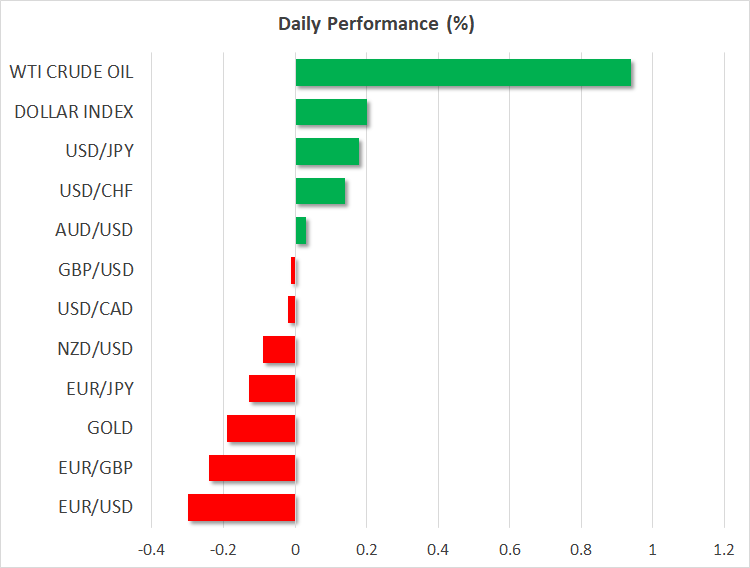
There wasn’t much of a reaction in either the bond or the equity markets to the latest rate hike conversations, but the US dollar nevertheless marched higher. The dollar index was last up almost 0.5%, rising towards Wednesday’s 16-month highs and on track for its fourth weekly gains, while piling renewed downward pressure on its rivals.
Euro & Co get hammered, steadier oil helps loonie
The euro slumped the most, plummeting back below $1.13 after ECB President Christine Lagarde once again warned against premature tightening in comments earlier today. As most other central banks increasingly lay open to the idea of hiking rates early to cap price growth, Lagarde is doubling down on the ECB’s stance of not overreacting to temporary factors that are driving up inflation.
But the euro wasn’t alone in tumbling lower as the pound and commodity-linked dollars also skidded, while the yen and Swiss franc edged higher.
Austria’s announcement that it is entering a full lockdown might have dented the mood as European trading got underway. It comes hours after Germany announced new restrictions for unvaccinated people as virus cases surge in many parts of Europe.
The pound, aussie and kiwi all slipped by around 0.5%. Better-than-expected retail sales figures out of the UK did little to shore up sterling.
The Canadian dollar fared slightly better, though, falling by 0.4% as it found support from steadier oil prices, as investors questioned whether the White House’s plan for a coordinated release of strategic oil reserves by the US, China and others would have a meaningful impact in the oil market.