

Sample Category Title
EUR/GBP Weekly Outlook
EUR/GBP's down trend from 0.9499 resumed by breaking through 0.8401 last week. But as a temporary low was formed at 0.8381, initial bias is neutral this week first. In case of another recovery, upside should be limited well below 0.8593 resistance. break of 0.8381 will turn bias back to the downside and target 0.8276 key long term support.
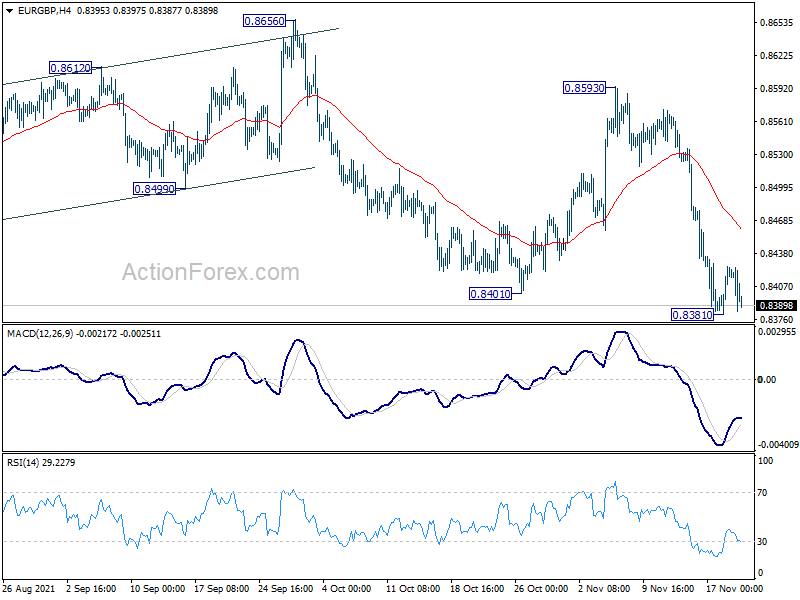
In the bigger picture, price actions from 0.9499 (2020 high) are still seen as developing into a corrective pattern. Deeper fall could be seen as long as 0.8593 resistance holds, towards long term support at 0.8276. We'd look for bottoming signal around there to bring reversal. However, sustained break of 0.8276 will but a sign of long term bearish reversal.
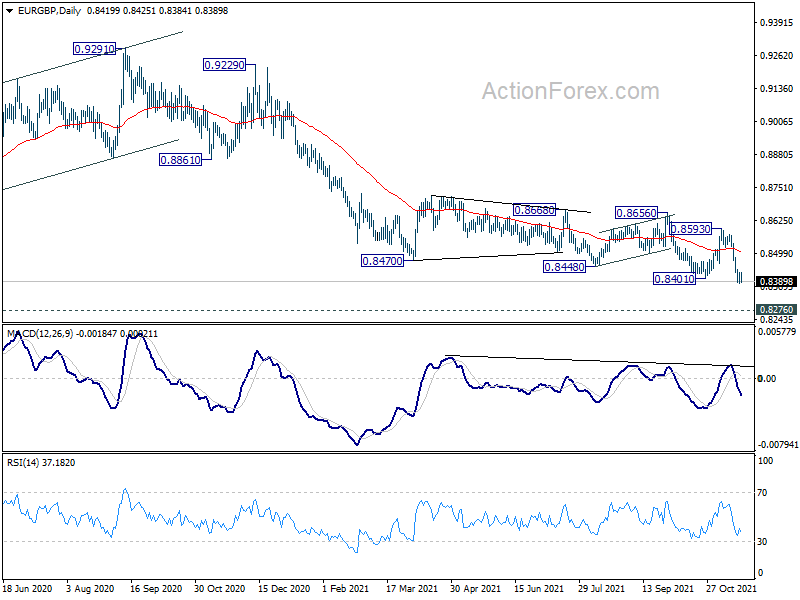
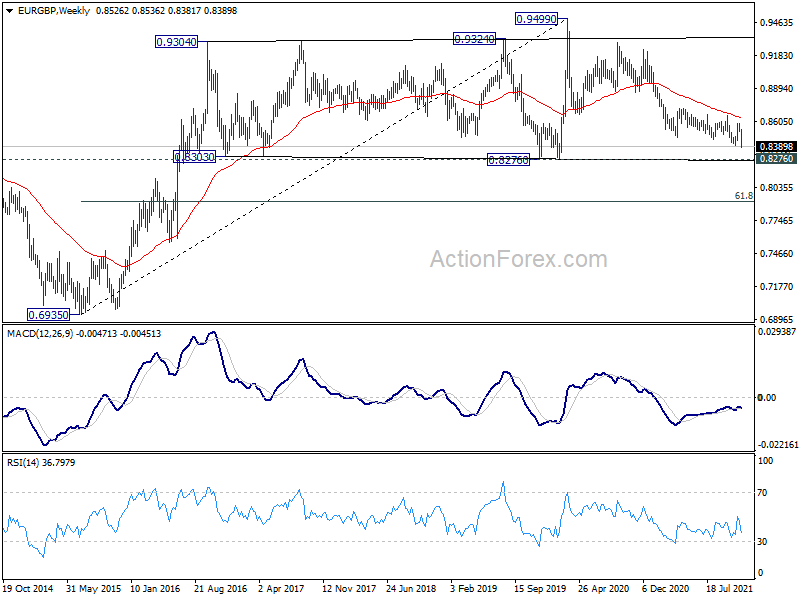
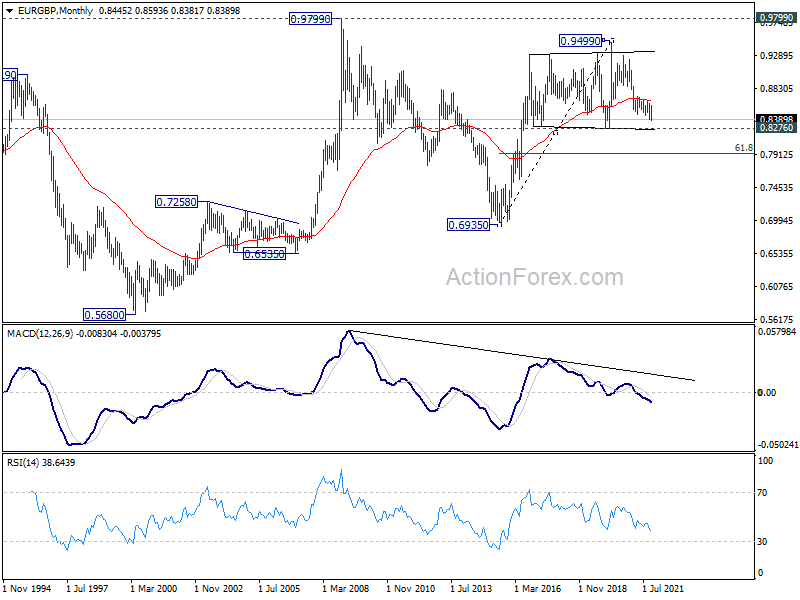
In the long term picture, outlook will stay bullish as long as 0.8276 support holds. Break of 0.9499 is in favor at a later stage, to resume the up trend from 0.6935 (2015 low). However, sustained break of 0.8276 will indicate long term trend reversal, and target 61.8% retracement of 0.6935 to 0.9499 at 0.7917, and possibly below.
EUR/AUD Weekly Outlook
EUR/AUD dropped notably last week but failed to break through 1.5354 low and turned sideway. Initial bias remains neutral this week first, but further fall is in favor as long as 1.5743 resistance holds. On the downside, break of 1.5354 will resume whole fall from 1.6434 to retest 1.5250 low. Nevertheless, break of 1.5743 will turn near term outlook bullish for 1.5907 resistance instead.
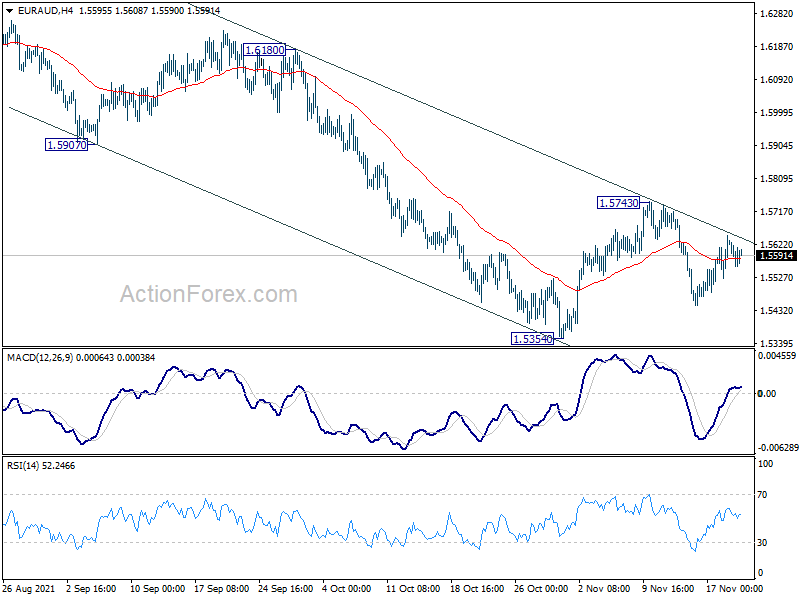
In the bigger picture, the down trend from 1.9799 (2020 high) is in progress. Firm break of 1.5250 low will confirm resumption and target 61.8% retracement of 1.1602 (2012 low) to 1.9799 at 1.4733. Sustained break there could bring more downside acceleration to 61.8% projection of 1.9799 to 1.5250 from 1.6434 at 1.3623. In any case, break of 1.6434 resistance is needed to signal medium term bottoming, or outlook will stay bearish.
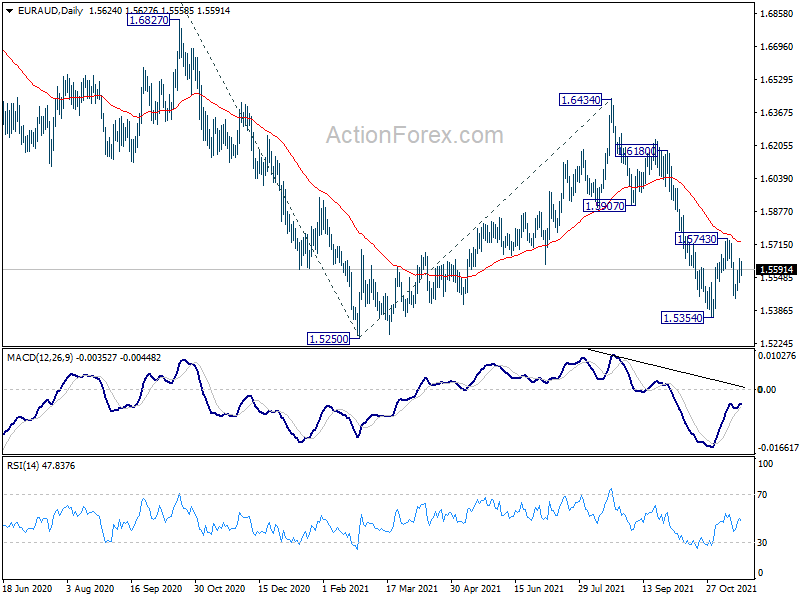
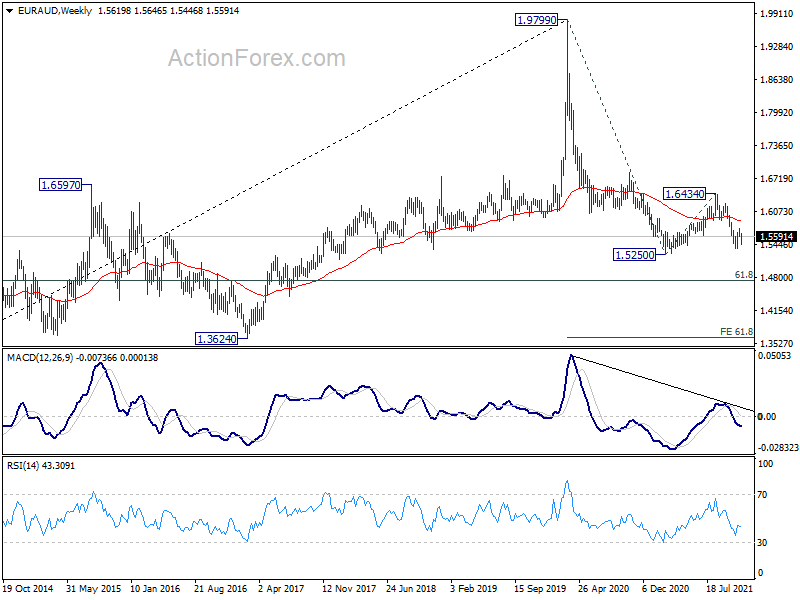
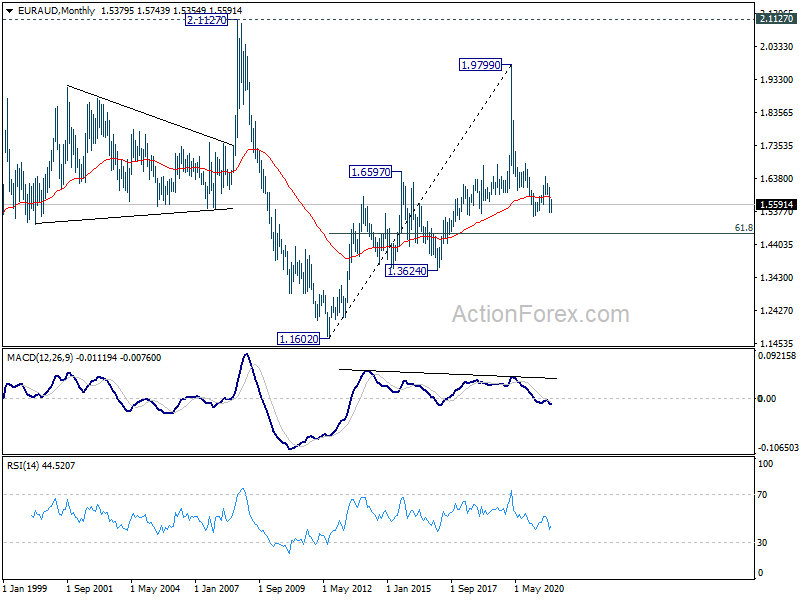
In the longer term picture, fall from 1.9799 (2020 high) is seen as a long term down trend. Sustained break of 61.8 retracement of 1.1602 to 1.9799 at 1.4733 will extend the decline to 1.3624 long term support and possibly below.
EUR/CHF Weekly Outlook
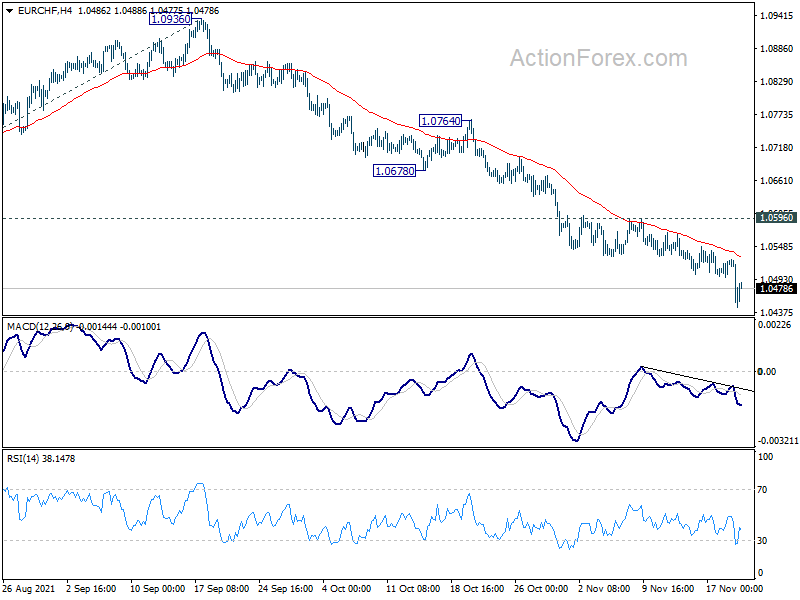
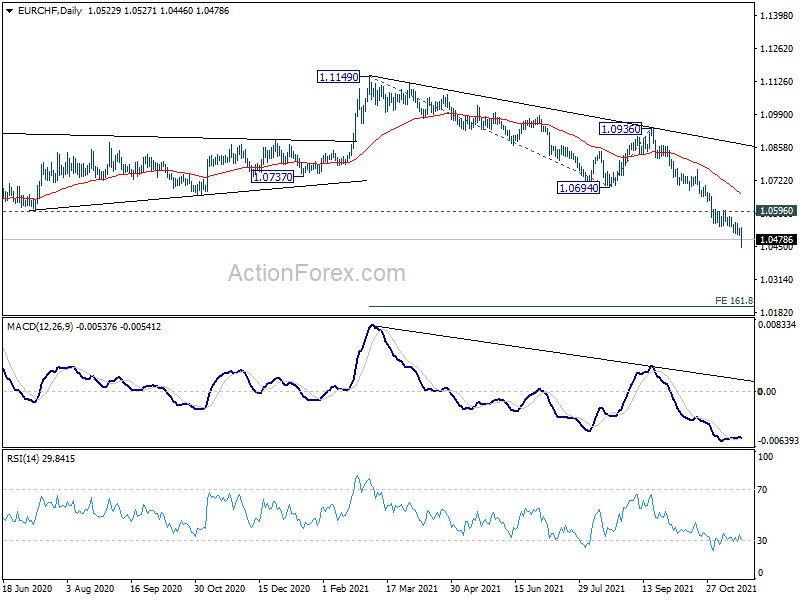
EUR/CHF dropped to as low as 1.0446 last week and break of 1.0505 support indicates long term down trend resumption. Current fall from 1.1149 should target 161.8% projection of 1.1149 to 1.0694 from 1.0936 at 1.0200 next. On the upside, break of 1.0596 resistance is needed to indicate short term bottoming. Otherwise, outlook will remain bearish in case of recovery.
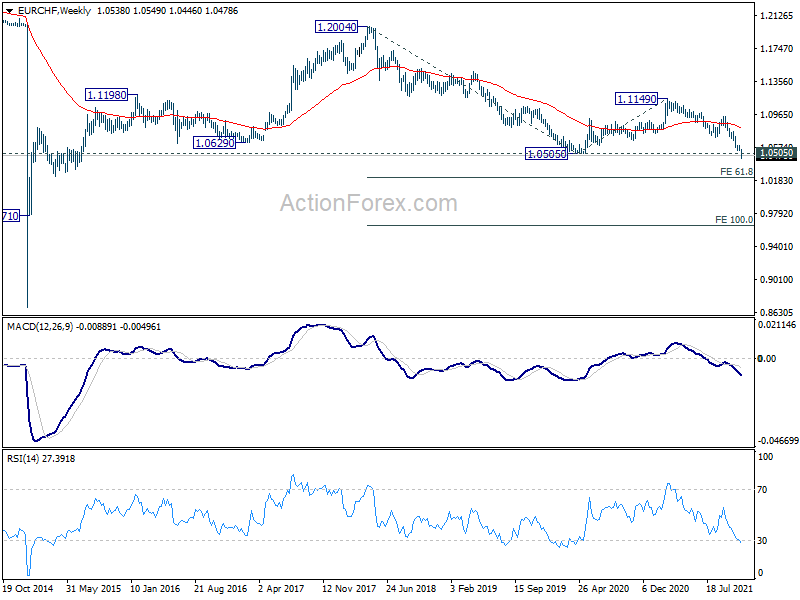
In the bigger picture, down trend from 1.2004 (2018 high) should be resuming with break of 1.0505 (2020 low). Next target is 61.8% projection of 1.2004 to 1.0505 to 1.1149 at 1.0223. On the upside, break of 1.0694 resistance is needed to be the first sign of medium term bottoming. Otherwise, outlook will remain bearish.
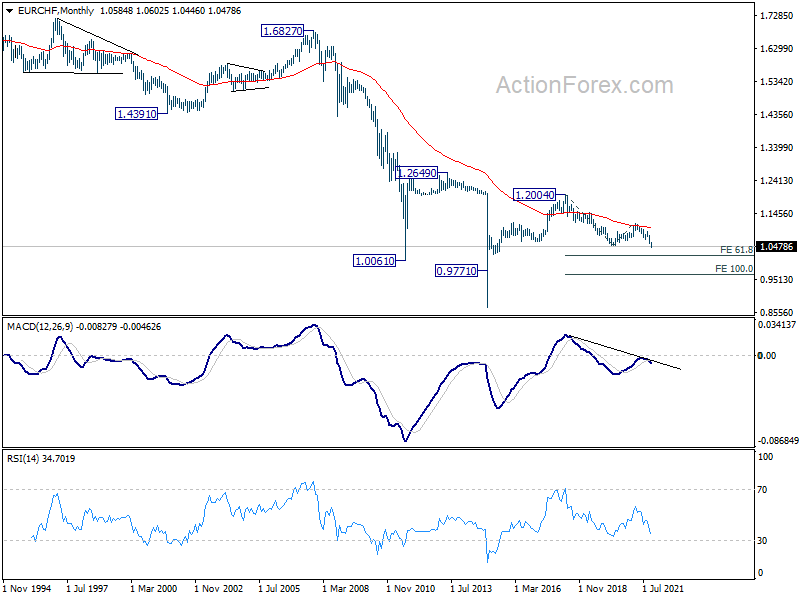
In the long term picture, rejection by 55 month EMA (now at 1.1015) maintains long term bearishness. Break of 1.0505 low will resume the down trend from 1.2004 to 61.8% projection of 1.2004 to 1.0505 to 1.1149 at 1.0223. Firm break there will target 100% projection at 0.9650.
Summary 11/22 – 11/26
Monday, Nov 22, 2021
[php_everywhere instance="1"]
Tuesday, Nov 23, 2021
[php_everywhere instance="2"]
Wednesday, Nov 24, 2021
[php_everywhere instance="3"]
Thursday, Nov 25, 2021
[php_everywhere instance="4"]
Friday, Nov 26, 2021
[php_everywhere instance="5"]
Weekly Economic & Financial Commentary: Delivery Vans Rush to Homes with Shoppers’ Treasure
Summary
United States: Delivery Vans Rush to Homes with Shoppers' Treasure
- Retail sales jumped 1.7% in October, on the back of e-commerce and holiday sales categories. While these nominal figures are buoyed by rising inflation, a sustainable increase in real retail sales may signal an earlier start to holiday shopping this year. Housing supply measures fell 0.7% as demand for housing remains robust, but home builders are having difficulties securing supplies for construction.
- Next week: Home Sales (Mon & Wed), Durable Goods (Wed), Personal Income & Spending (Wed)
International: A Tough Summer for Japan's Economy, But Better Times Ahead
- Japan's Q3 GDP figures confirmed another challenging quarter for the economy, as ongoing COVID-related restrictions in Tokyo and the surrounding areas restrained activity. Overall GDP fell 0.8% quarter-over-quarter (not annualized), with large falls in both consumer and investment spending. The outlook for Q4 and beyond is better however, given the subsequent lifting of restrictions, and with the government announcing a new fiscal stimulus package this week.
- Next week: EZ PMIs (Tues), U.K. PMIs (Tues), NZ Monetary Policy Announ. (Wed)
Interest Rate Watch: Rising Rates and the Federal Debt
- Given that the federal government has borrowed a significant amount of money during the COVID pandemic, how much should we worry about rising rates and the federal debt? For now, the situation appears quite manageable.
Credit Market Insights: Businesses to Confront New Challenges in 2022
- Headlines this week have been littered with mentions of high-profile companies making large structural changes ahead of the new year. With high inflation looking like it has settled in for the near-term, expectations for interest rate increases pulled forward to next year and lending conditions showing early signs of tightening, many firms will have to adopt new strategies in 2022.
Topic of the Week: Thanksgiving Travel Set to Gobble Up Wallet Share
- As millions of Americans prepare to drive home for the holidays, they will likely notice the price at the pump moving higher and higher. Fluctuations in energy prices are a particularly visible display of inflation, and households are increasingly experiencing the sticker shock.
The Weekly Bottom Line: Bank of Canada Reiterates Flexible Approach
U.S. Highlights
- October retail sales rose a better-than-expected 1.7% on the month. Sales in volatile categories were up robustly, but sales in the control group also rose a strong 1.6%. Leading the charge on this front was a 4% gain in non-store sales.
- Housing starts fell 0.7% in October as starts in the larger single-family segment declined for the fourth straight month. Improved homebuilder sentiment in recent months indicates that this sector too may soon turn a positive corner.
- President Biden signing the Infrastructure Investment and Jobs Act (IIJA) into law. The legislation will channel $550 billion in new spending on transportation and other critical infrastructure over the next several years. In addition, the larger Build Back Better (BBB) social spending and climate bill cleared the House and is headed for the Senate.
Canadian Highlights
- CPI inflation took another leg up in October (to 4.7% year/year). Energy continued to act as a major tailwind, but the release showed broad-based price pressures across different spending categories. Meanwhile, retail sales fell 0.6% in September. However, Statistics Canada’s advance estimate pointed to a 1% rebound in October.
- This week’s packed calendar was complemented with communication from Bank of Canada officials. For instance, in a written article, Governor Macklem highlighted the central bank’s continued flexible approach and willingness to adjust policy to changing economic data.
U.S. - Infections Trend Up as Holidays Approach
Last week’s hot inflation report raised plenty of eyebrows, but this third week of November was more balanced on the data front. Retail sales rose a better-than-expected 1.7% month-to-month (m/m) in October. Sales in volatile categories – gas stations (+3.9%), building materials (2.8%), and autos (1.8%) – were up robustly. Receipts at bars at restaurants, meanwhile, were flat on the month. Sales in the remaining subsectors, known as the ‘control group’, did not disappoint, rising a healthy 1.6%. While most categories recorded an improvement, non-store retailers (a good proxy for online sales) led the charge, up 4%.
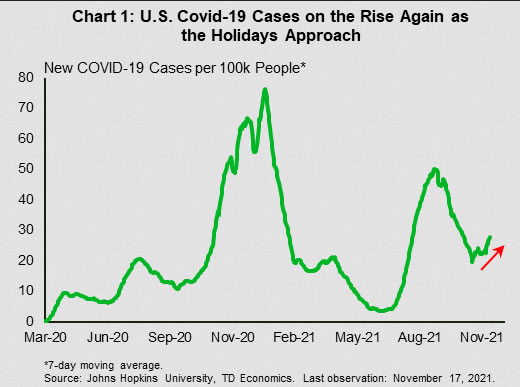
The healthy gain in the control group together with the October increase in auto sales points to a healthy start to goods spending in the fourth quarter. Scratching beneath the surface, however, reveals a more nuanced backdrop. The sales gain appears to reflect some pull-forward in activity from the busy holiday season. Consumers have been consistently warned about supply chain issues and possible shortages and many appear to have got an early start to their holiday shopping as a result. A recent survey showed that roughly half of holiday shoppers planned to start shopping before November. The strength in non-store retail sales, a very popular holiday shopping channel, adds credence to this view. While overall spending should remain healthy, it may slow closer to end of the year, reflecting this pull forward. The rise in new COVID-19 infections is an added risk to consumption growth, given that it could further delay the expected rotation in spending toward services (Chart 1).
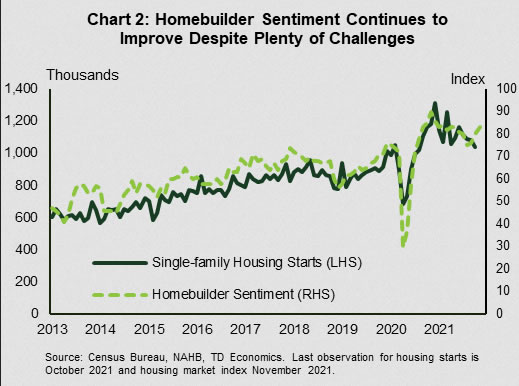
Tilting to the housing market, homebuilding activity continued to lose steam in October, with starts down 0.7% on the month. Given the myriad of hurdles faced by builders, such as supply-chain disruptions, higher material costs and a shortage of workers and serviceable lots, it should be no surprise that homebuilding has eased a bit in recent months. Starts in the larger single-family segment have been the main contributor to recent downward trend. A steady recent improvement in homebuilder confidence indicates that this sector should turn a positive corner in the near-term (Chart 2). While the upcoming removal of monetary stimulus will pose a hurdle to housing demand in the quarters ahead as it weighs on already-stretched affordability, homebuilding activity is likely to remain well-supported given exceptionally low housing inventory.
The other big developments this week were on the political front, as President Biden signing the Infrastructure Investment and Jobs Act (IIJA) into law. The legislation will channel $550 billion in new spending on transportation and other critical infrastructure. This type of spending tends to carry high economic multipliers, resulting in a larger economic impact than the initial dollar amount spent. And, by raising the stock of productive capital, it may even raise the potential growth rate of the American economy. Still, given that the investments are spread out over several years and that such projects take time to be rolled out, the boost to the economy is likely to be modest and will take time to trickle in. In contrast, the larger $2 trillion social spending and climate bill, which passed the House late in the week, would provide a more noticeable near-term boost to growth in 2022. This package, however, faces a divided Senate and is still far from a done deal.
Canada - Bank of Canada Reiterates Flexible Approach
Canada's economic recovery has been choppy in recent months, but as we peer ahead to 2022, above-trend growth is still in the cards. In large part, this expectation is predicated on a continued strong bounce-back in consumer spending, buoyed further by an improving labour market backdrop and a sizeable buildup of excess savings. But this view is not without its downside risks, and key amongst these is the acceleration in consumer price inflation since the early summer.
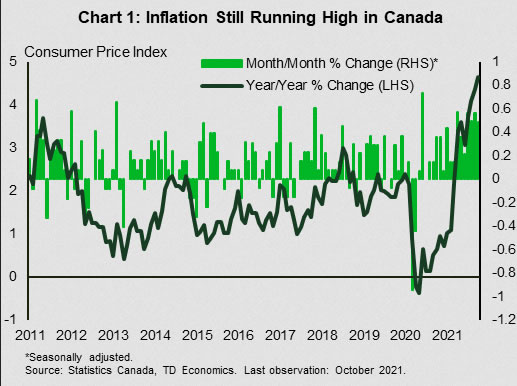
October inflation was the highlight data release (Chart 1) this week. Price growth took another leg up, rising 4.7% year-over-year. Unsurprisingly, energy continued to provide a key tailwind, up a notable 25.5% on the year. But price pressures were seen elsewhere, including a pick-up in spending categories that had previously been witnessing subdued price growth (i.e. clothing). At the same time, inflation in shelter (4.8%) and food (3.9%), the two categories with the largest basket weights, remained elevated and were little changed from the prior month. Monthly momentum, while declining from the prior month, was still high (+0.5% m/m). By all measures, inflation in Canada continues to run hot.
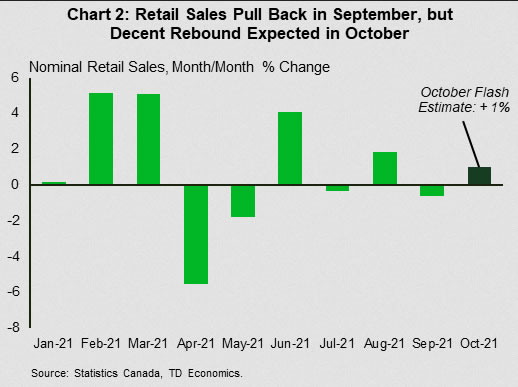
Turning to consumer spending, Friday's retail sales release revealed a 0.6% decline in September, made worse by a larger volumes drop (-1.1%). Motor vehicles (-1.6%) were a major contributor to the overall weakness. Activity in this category has been dragged down by lingering supply chain disruptions. Still, the report was unambiguously subdued, with declines extending to seven of the 11 industries. The silver lining, however, is that Statistics Canada's flash estimate called for a healthy rebound in October (+1%, Chart 2).
The potential interplay between inflation and consumer spending will be among the key themes to watch for in 2022. If price pressures continue to accelerate, economic growth could suffer due to an erosion of real wages and consumer purchasing power. Uncertainty remains elevated, especially on the supply side of the economy, suggesting that these risks should not be downplayed. In our base case, we expect inflation to gradually cool through 2022. But, continuing labour market gains and a gradual drawdown on households' extra savings support strong consumption growth for the year. The Bank of Canada outlined a similar narrative in its October Monetary Policy Report. However, recognizing the risks posed by inflation, the central bank was among the first to bring forward its interest rate hike guidance and end its quantitative easing program. Still, the Bank understands the elevated uncertainty that surrounds the outlook. The Bank of Canada's Governor Tiff Macklem, in an article this week, highlighted the uncertainty presented by the unusual shock to the economy, and in turn, the central bank's readiness to change its position should data evolve contrary to expectations.
Week Ahead – Who Will Lead the Fed?
And what next for Europe?
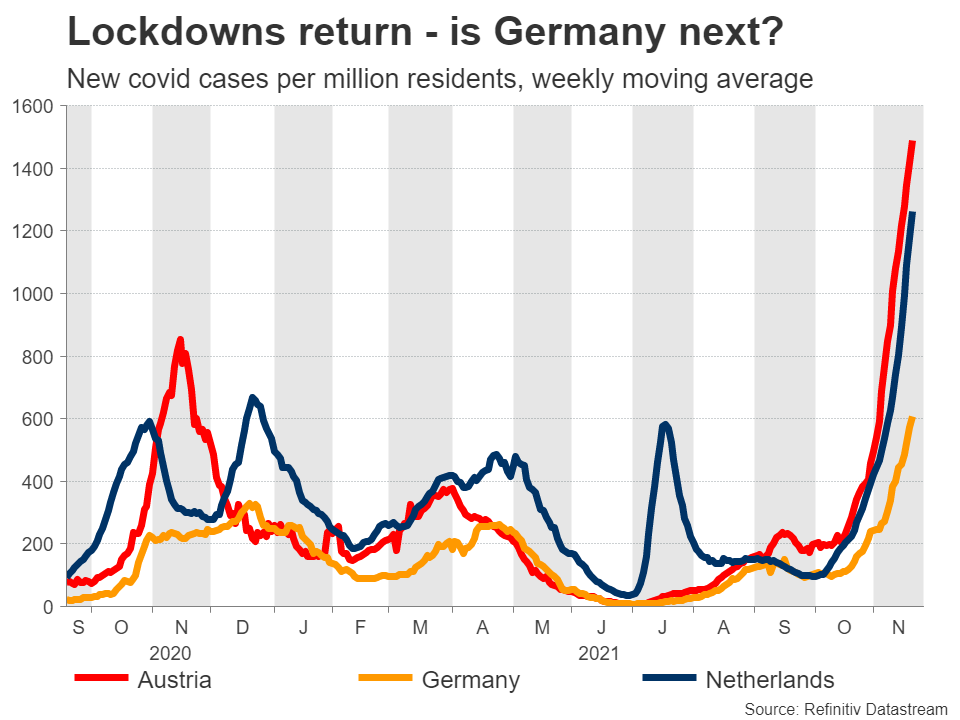
Lockdowns have returned in Europe and suddenly everyone is analysing the data to see which countries will be next. Germany may not be far behind as cases spiral out of control and others could follow in the weeks and months ahead.
Suddenly the topic of conversation may be about to change. From the consequences of not dealing with inflation to the economic hit from winter lockdowns. Of course, the two are very much linked as central banks are all too aware.
On the subject of central banks, we should soon learn who’s going to lead the Federal Reserve when Jerome Powell’s term as Chairman ends in February. Powell remains the favourite to secure another term, while Lael Brainard is also very much in the race. There are reasons to think she may be preferred among Democrats, not least as she’s viewed as being more dovish than Powell, which has its appeal. We’ll soon see who the President prefers.
US
Wall Street will finally find out if President Biden wants to have a change at the head of the Fed. Expectations are still for Fed Chair Powell to get renominated, but the odds have dropped over the past couple of months. Powell is still around a 2 to 1 favourite and the market impact might be minimal if Biden nominates Lael Brainard. Brainard running the Fed would be viewed as being slightly more dovish which could delay interest rates hikes. The immediate impact in the markets may well be a drop in short-term interest rates.
On Tuesday, the release of the November flash PMI readings should show a modest pickup in both the manufacturing and service sectors. Wednesday is mostly about the release of the FOMC minutes from the November 3rd dovish taper announcement. Some traders will pay close attention to both personal income and spending data that should show increases from the prior month, bolstering the case that the US consumer is still in good shape. With US bond and equity markets closed to observe Thanksgiving Day on Thursday, liquidity should be light for the remainder of the week. This Black Friday will not draw its normal attention as many retailers will struggle to provide attractive deals given the strong demand and tight inventory situation that should last throughout the entire holiday season.
EU
Austria delivered the markets a shock to end the week. The country is going into full lockdown for up to (at least?) 20 days. With the case and fatality rates looking remarkably similar to Germany, will they and others follow? Investors seem to think so. Recently, all the talk has been about inflation. While lockdowns will surely exacerbate the problem in the months ahead, the topic of conversation may be about to change.
While all central banks are coming under the spotlight at the moment, the ECB by comparison is in a rather luxurious position. Inflation is running at more than double its target but that’s expected to fall at the turn of the year, much earlier than in other countries, and then back below target over the medium term.
The ECB has spent the last decade fighting the risk of deflation more than inflation and a history of low price pressures will stand it in good stead in these troubling times. It’s not immune but it’s among the best positioned.
The ECB accounts should reinforce the view that inflation is not expected to become a problem and should return below target without the need for rate hikes next year. President Christine Lagarde will likely reinforce this shortly after the minutes on Thursday, as she has repeatedly since the meeting. Flash PMIs are the standout economic releases next week, alongside the German Ifo, Gfk and GDP readings.
UK
The BoE has backed itself into a corner in recent weeks. First, it talked up a rate hike ahead of the November meeting, only to vote heavily against it. Then they blamed a lack of information on the end of the furlough scheme for holding off on raising rates.
The first of the furlough data is out and it doesn’t look too bad at all. The next jobs report, which will give the full picture, will be released on 14 December, a day before the November inflation data and two days before the next MPC meeting. By then it may have run out of excuses, which is what the market is positioning for.
There’ll be plenty of opportunities for policymakers to backtrack before then, if they wish, with many of them making appearances next week including Governor Andrew Bailey on Thursday. Flash PMIs on Monday are the only other noteworthy event next week.
Russia
A couple of notable economic releases over the next week including industrial production and PPI. The currency has fallen over the last week as oil has come off its highs and hit a six week low on Friday.
South Africa
After raising interest rates this week and starting the normalisation cycle, eyes will be on the PPI data next week for further signs of a build-up of inflationary pressures. More hikes are coming over the next couple of years, with the current level still well below its neutral rate. The economy is still in need of support and the process will be gradual.
Turkey
The CBRT cut interest rates by 100 basis points to 15% and signalled it may do so again in December before evaluating its easing cycle. Erdogan’s promise to fight against interest rates is going well; if only he had the same disdain for inflation.
Unsurprisingly, the market is not forgiving of such unconventional policies, or a central bank Governor that’s a puppet for the President, and the lira has once again been spiralling lower. The dollar is above 11 against the lira for the first time ever and there doesn’t seem to be much appetite to take the opposite view on the currency.
China
The one and five year Loan Prime Rates are expected to be left unchanged early next week even as the economy continues to face significant headwinds. The PBOC may opt for RRR cut in the coming months as an alternative way to stimulate the economy.
The property market is one of the primary areas of weakness for the Chinese economy as the restructuring of Evergrande continues to weigh heavily on the sector. The sale of its entire stake in streaming company HengTen for $273m will help to keep the wolf from the door for now but the debt repayments will keep on coming.
The company is successfully buying time at a significant cost but a more sustainable solution is essential, for the rest of the industry and every other that relies on it, which combined accounts for around 25% of the economy.
India
No major data or events next week for India.
Australia
The RBA continues to push back against market expectations for a rate hike next year, with the first currently priced in for next summer. This has been a constant theme recently for central banks in general but the RBA may have done itself no favours when it was bullied off its yield target policy days before a meeting.
PMIs on Monday and retail sales on Friday are the standout data releases. We’ll also hear from Assistant Governor Michele Bullock on Wednesday.
New Zealand
The RBNZ is expected to continue its tightening cycle and raise interest rates by 25 basis points on Wednesday, taking it to 0.75%. Higher inflation and a tighter labour market may tempt policymakers into a 50 basis point hike though, with the next meeting not due to take place until February.
Retail sales are also due on Monday.
Japan
The core Tokyo inflation reading is expected to rise to 0.4% next week, up from 0.1%, as higher imported oil and food lifted prices. The impact should be temporary though and won’t have any impact on the BoJ decision to keep rates at rock bottom levels.
Key Economic Events
Saturday, Nov. 20
- US Secretary of Defense Austin and Saudi Foreign Minister Prince Faisal bin Farhan Al Saud speak at the International Institute for Strategic Studies Manama Dialogue security conference
Sunday, Nov. 21
- Chile’s presidential election
Monday, Nov. 22
- ECB members Holzmann, Kazaks and Kazimir, alongside Czech National Bank Governor Rusnok speak at the Austrian central bank conference on European economic integration.
- UK Labour leader Keir Starmer delivers the keynote address at the nation’s business organization’s CBI 2021 Annual Conference
- US trade representative Tai is in India for trade talks.
Economic Data/Events
- US existing home sales
- China loan prime rates
- Eurozone consumer confidence
- Turkey consumer confidence, foreign tourist arrivals
- Spain trade
- Poland PPI, industrial, construction output
Tuesday, Nov. 23
- BOC Beaudry speaks to the Ontario Securities Commission.
- BOE policymaker Haskel speaks at the Adam Smith Business School on “High inflation now and then.”
- EU general affairs council meeting in Brussels.
Economic Data/Events
- US Nov Prelim manufacturing PMI: 59.0e v 58.4 prior
- European Flash PMIs: Eurozone, Germany, France, and the UK
- Mexico international reserves
- Singapore CPI
- Poland retail sales
- Israel leading ‘S’ indicator
Wednesday, Nov. 24
Economic Data/Events
- FOMC minutes
- US consumer income, wholesale inventories, new home sales, Q3 GDP, initial jobless claims, durable goods, University of Michigan consumer sentiment
- Germany IFO business climate
- RBNZ Rate Decision:
- France manufacturing confidence
- Russia industrial production
- New Zealand rate decision: Expected to raise cash rate 25 basis points to 0.75%.
- Singapore GDP
- South Africa BER business confidence
- Turkey capacity utilization, real sector confidence
- Russia industrial production, PPI, CPI
- BOE policymaker Silvana Tenreyro speaks at the Oxford Economics Society.
Thursday, Nov. 25
- US equity and bond markets closed in observance of Thanksgiving Day.
- BOE Governor Bailey speaks at a Cambridge Union event.
- ECB chief Lagarde and board members Elderson, Schnabel, Panetta and Lane speak at the ECB legal conference on continuity and change.
Economic Data/Events
- Germany Q3 Final GDP
- Mexico Q3 Final GDP; Minutes released
- New Zealand Trade
- Hong Kong Trade
- Sweden Rate decisions: Expected to keep rates steady at 0.00%
- Hungary Rate decisions: Expected to increase interest rates again.
- Germany consumer confidence
- South Africa PPI
- Russia gold and forex reserves
Friday, Nov. 26
Economic Data/Events
- Australia Retail sales
- Sweden Retail sales
- Tokyo CPI
- Mexico trade
- Singapore industrial production
- Switzerland GDP
- France Consumer confidence
- Italy Consumer confidence
- Russia money supply
- BOE’s Pill speaks to CBI North East on the economic outlook.
Sovereign Rating Updates
- Ireland (S&P)
- Belgium (Moody’s)
- Switzerland (Moody’s)
- Poland (DBRS)
Forward Guidance: Supply Chain Challenges to Dominate Data Releases Next Week
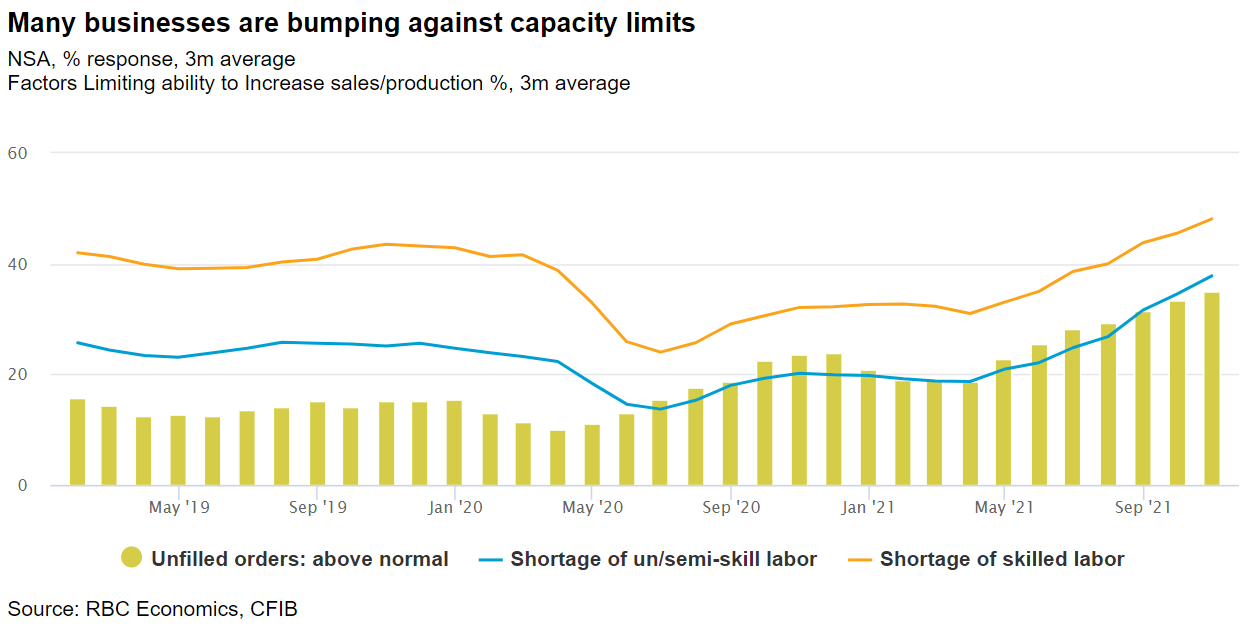
We expect next week’s Canadian survey on businesses confidence (CSBC) to show growing optimism about the outlook for the coming year. The survey was collected at a time (Oct. 1– Nov. 5) when national COVID-19 cases were falling and businesses were reopening. Against this backdrop, we’ll be watching to see what percentage of businesses—particularly in hard-hit sectors—tapped government supports. Indeed, over 64% of restaurant and hotels accessed CEBA loans last quarter with more than half of these firms using the wage subsidy program (CEWS). The report should indicate the degree to which the hard-hit travel and hospitality sectors were able to recover. For many other businesses, order books are again full, and concerns have shifted away from demand uncertainty to their ability to produce given rising input costs, supply chain disruptions, and labour shortages.
Those production capacity issues were clearly evident in the sharp 3% pullback in September manufacturing sales, led by a 36% drop in motor vehicles. We expect the preliminary October manufacturing sales flash estimate next week to look a little better—manufacturing hours worked rose 2% that month. But supply chain challenges remain acute. In last quarter’s CSBC, almost 40% of businesses cited rising input costs as an obstacle for growth. The longer those price pressures persist, the more they will flow into end-consumer prices. With evidence of price pressures broadening, and a growing likelihood of wage pressures building as firms compete for workers, the case is growing for the Bank of Canada to further pull back on policy stimulus. We look for the bank to raise the policy rate in Q2 next year.
Week ahead data watch:
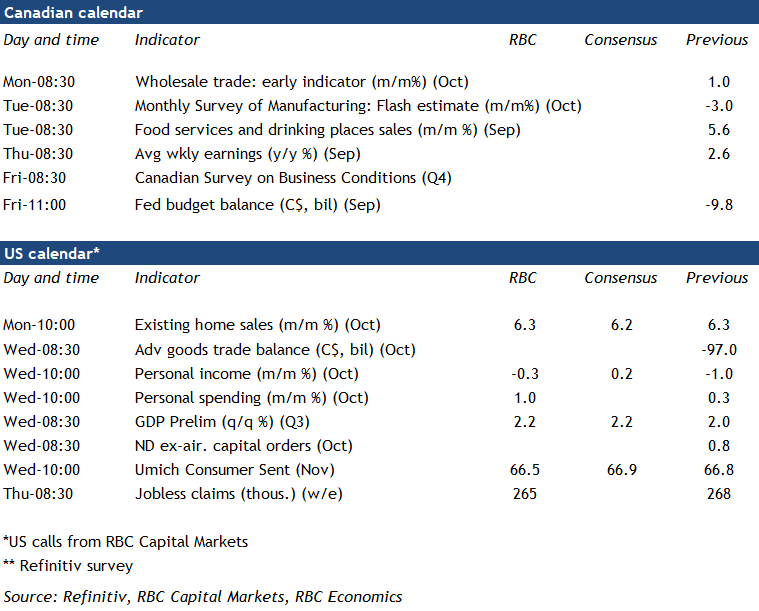
- The Canadian SEPH employment count will likely post another gain in September given an earlier-reported 157,000 increase in the Labour Force Survey. But the bigger issue will be how vacancies translate into wage pressures for firms. There were close to 900,000 unfilled jobs in August.
- We expect Canadian manufacturing sales ticked higher in October after plunging 3% the prior month. Supply chain disruptions remain, but manufacturing hours worked rose 2.0% in October.
- We expect US personal spending to increase by 1% in October after spending at retail stores rose in the month.
Week Ahead – European PMIs Could Spell More Bad News for Euro
The euro has been demolished by fears that new lockdowns will hit economic growth. This has turbocharged the dollar as traders look for shelter, and the upcoming business surveys will be crucial for whether this rotation continues. Meanwhile, markets are split on whether the Reserve Bank of New Zealand will deliver a single or double rate increase, leaving the kiwi vulnerable in case the central bank ‘plays it safe’.
Euro gets hammered
The single currency has been taken to the cleaners lately as several risks threaten to hamstring economic growth. A sharp spike in covid cases across Europe has seen the Netherlands and Austria impose lockdowns again, raising concerns that Germany could follow soon.
Then there’s the spiral in energy prices squeezing consumers and simultaneously providing fuel for anti-European forces in France ahead of next year’s presidential election. And with the Chinese economic machine slowing down, demand for European exports seems shaky.
In this light, it's quite surreal that money markets continue to price in a minor rate increase by the European Central Bank next year. Derivatives traders are essentially betting that intensifying inflationary pressures will eventually force the ECB’s hand. However, that’s very unlikely.
The ECB knows the economy isn’t strong enough to handle higher rates, with the labor market still miles away from recovering. Rate increases could also revive fears around the fiscal health of large indebted economies like Italy, sparking havoc in bond markets.
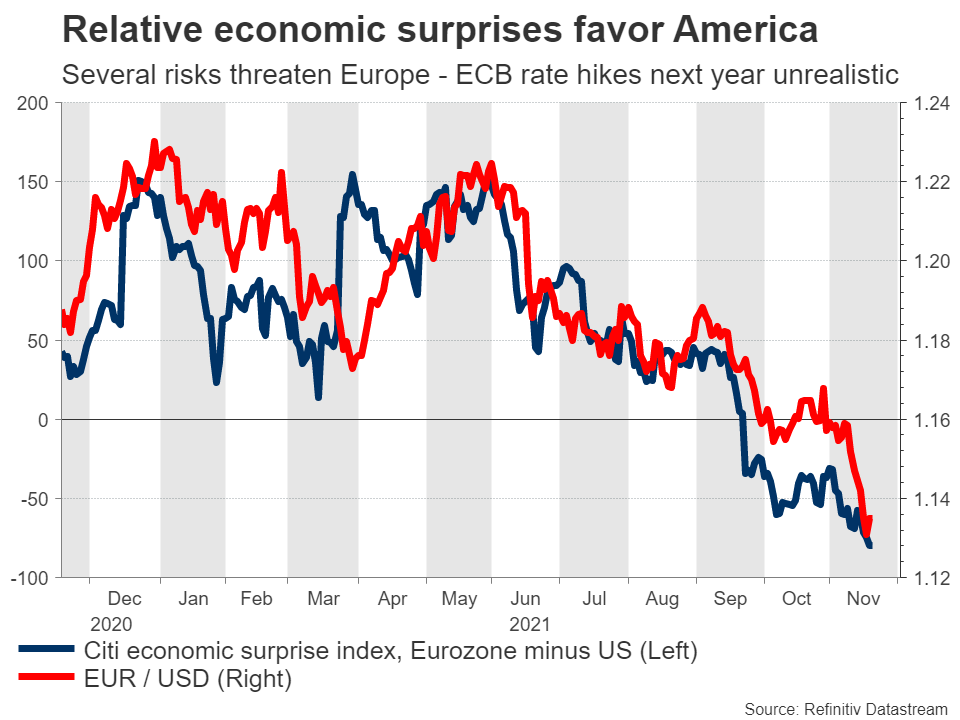
A barrage of PMI business surveys coming up on Tuesday could finally convince investors the ECB is unlikely to raise rates next year. Between new covid restrictions, higher inflation eating into profit margins, and China’s slowdown, there’s a strong risk the PMIs sink further, dealing another blow to the devastated euro.
Fed minutes on the menu
In sharp contrast, the dollar has obliterated its competitors lately as a string of encouraging data fueled expectations for earlier Fed rate increases. Money markets are now pricing in two rate hikes for next year and a 35% chance for a third one.
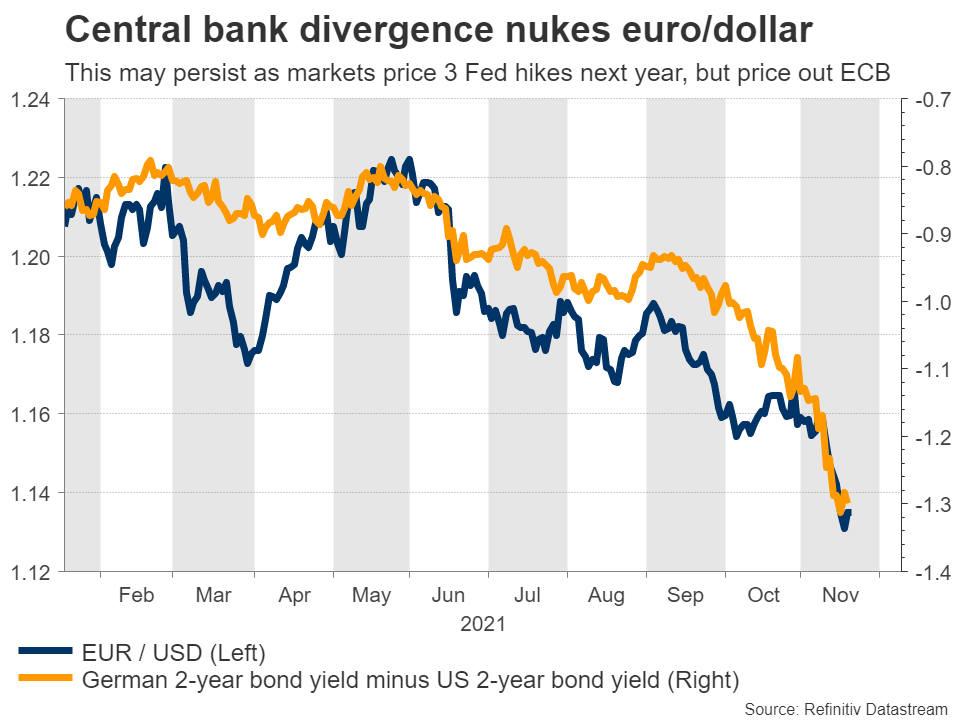
America is probably the strongest major economy at this stage. Consumption is booming, inflation is sizzling hot, lost jobs are coming back quickly, wage growth is firing up, and business surveys point to a powerful spell of growth ahead. On top of everything, Congress is about to bring more spending to this party.
The coming week will bring a storm of US releases. The preliminary Markit PMIs for November are out on Tuesday ahead of durable goods orders, the second reading of GDP for Q3, personal income and consumption, and the core PCE price index - all on Wednesday. A few hours later, the minutes of the latest Fed meeting will hit the markets.
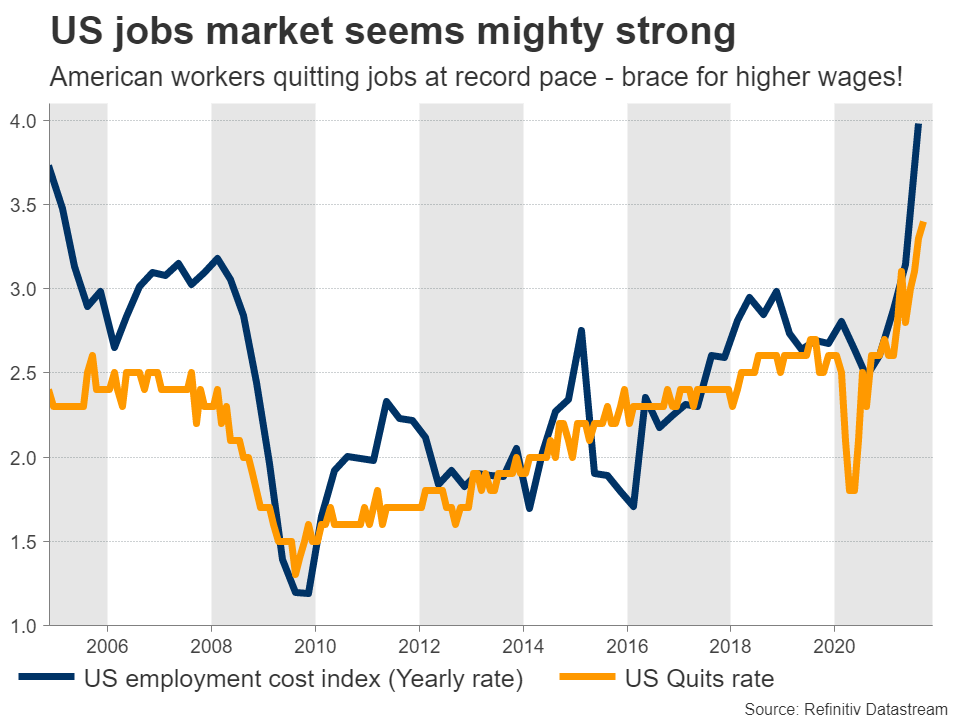
Most of the focus could fall on the PMIs as they are forward-looking indicators. There’s still scope for a third Fed rate hike to be baked in for next year, so if they reaffirm America’s economic supremacy, the dollar could get another shot in the arm. The minutes are always important too but are unlikely to reveal anything new, as most policymakers have spoken publicly since then.
RBNZ meeting: Single or double?
A rate increase from the Reserve Bank of New Zealand on Wednesday is almost certain - the real question is whether it will be just a regular 25 basis points rate hike or whether it will be a ‘double’ of 50 basis points. Markets are currently split between the two.
There are solid arguments why monetary policy needs to be tightened. The unemployment rate hit a record low in Q3, inflationary pressures are intensifying, and the housing market is on absolute fire. However, going for a ‘double’ rate hike seems unnecessary.
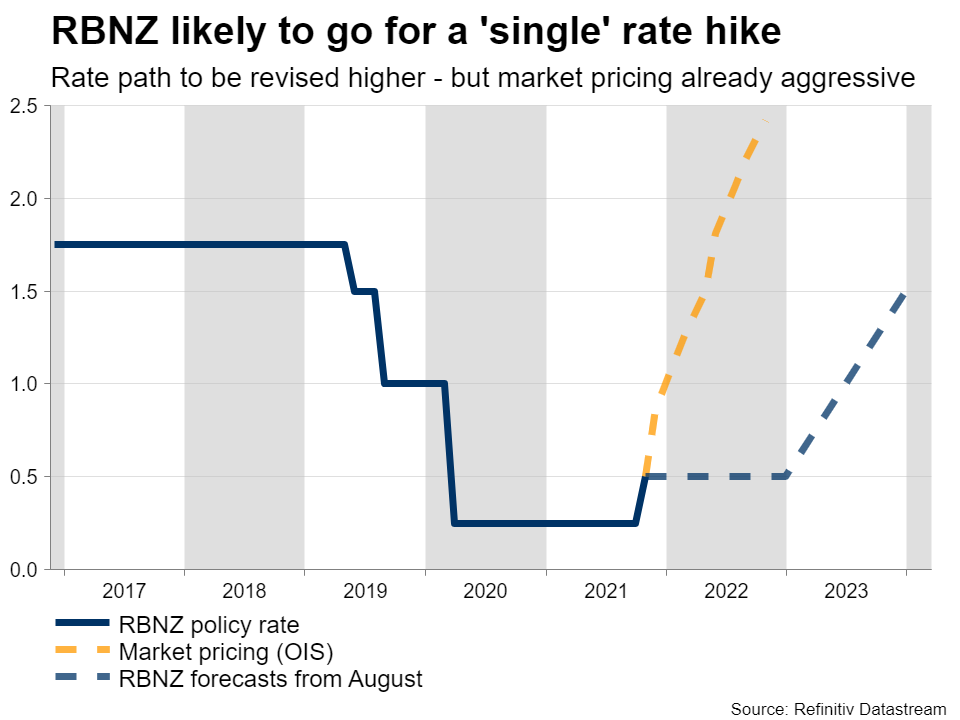
Such a drastic move would risk shocking the economy at a time when there are still several risks on the radar - from covid infections spreading across the country to China’s slowdown threatening demand for New Zealand’s commodity exports.
So while surprises from the RBNZ are always possible, the most likely outcome is just a ‘single’ rate increase that disappoints the kiwi considering how elevated market expectations are.
Australian and British data eyed
Across the Tasman Sea, it’s a busy data week in Australia too. The PMIs for November are out on Tuesday, ahead of capital expenditure numbers for Q3 on Thursday and the final estimate of retail sales for October on Friday.
Sinking iron ore prices and a stronger US dollar have hammered the aussie lately, and the pain could continue as markets are still pricing in three rate increases from the Reserve Bank next year, which seems excessive. The Australian economy is not that strong and could suffer serious collateral damage if China’s slowdown deepens.
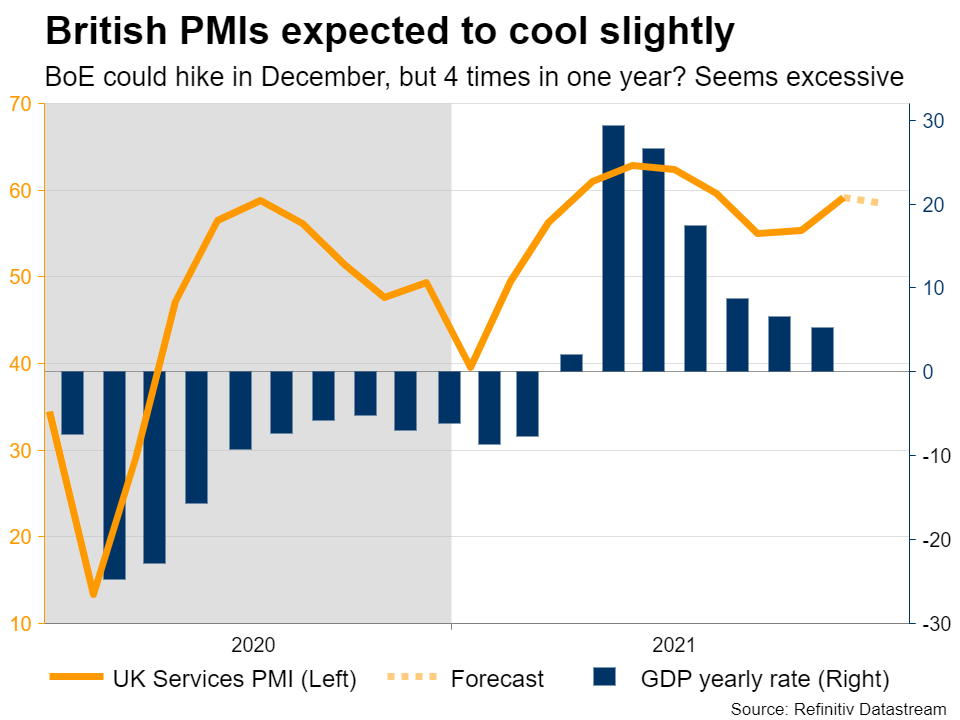
Last but not least, the British pound could enjoy some volatility with the release of PMIs for November on Tuesday. Sterling was the only major currency to hold its nerve in the face of the dollar’s onslaught lately, even managing to touch new post-pandemic highs against the euro.
That likely boils down to hopes the Bank of England will raise rates in December, which seems plausible given the strength of recent data. Markets are only pricing a 50% probability for a rate hike next month, so there is room for more short-term gains. That said, hiking rates four times by this time next year as money markets currently suggest is a bridge too far, which allows scope for longer-term disappointment.
Eurozone PMIs in Focus as Euro Takes a Beating
Flash PMI numbers for the Eurozone will likely attract a lot of attention on Tuesday when they’re released at 09:00 GMT as the euro gets savaged in the currency markets. Expectations that the European Central Bank will lag other central banks in normalizing monetary policy remains the primary cause of the euro’s pain. But fresh concerns about the Eurozone economy have made investors even more nervous about the outlook lately. Can the PMI data bring some relief to the beleaguered euro?
Almost there
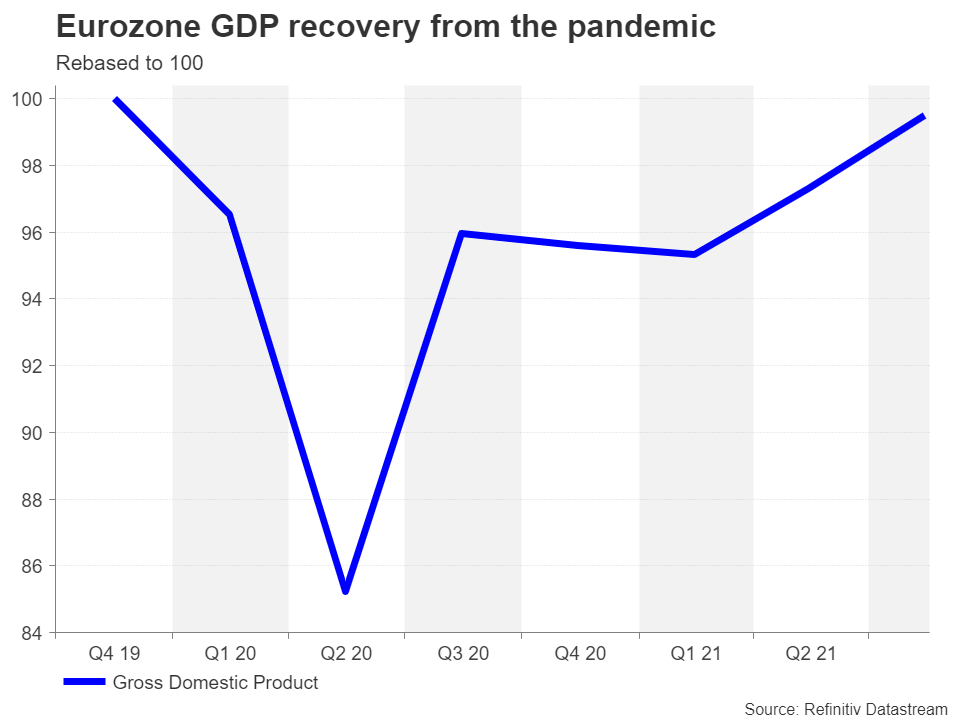
The Eurozone economy has made good progress towards a full recovery from the pandemic this year, with GDP expected to recoup the lost output by the end of this year. Whilst the impact of widespread supply shortages and soaring energy prices is clearly being felt across the continent, particularly in Germany’s vast auto industry, nobody is forecasting a recession, at least not yet.
The closely watched PMI indicators by IHS Markit have been steadily heading lower in recent months but remain comfortably above the 50 level that separates growth from expansion. The downward trend likely continued in November as the supply constraints and energy crisis have yet to subside, while the re-imposition of some virus curbs in several EU states probably also dragged on growth.
Still growing
Analysts are forecasting the manufacturing PMI will fall from 58.3 to 57.5 in November’s flash estimate and the services PMI to ease from 54.6 to 54.0. The composite PMI is expected to drop from 54.2 to 53.6.
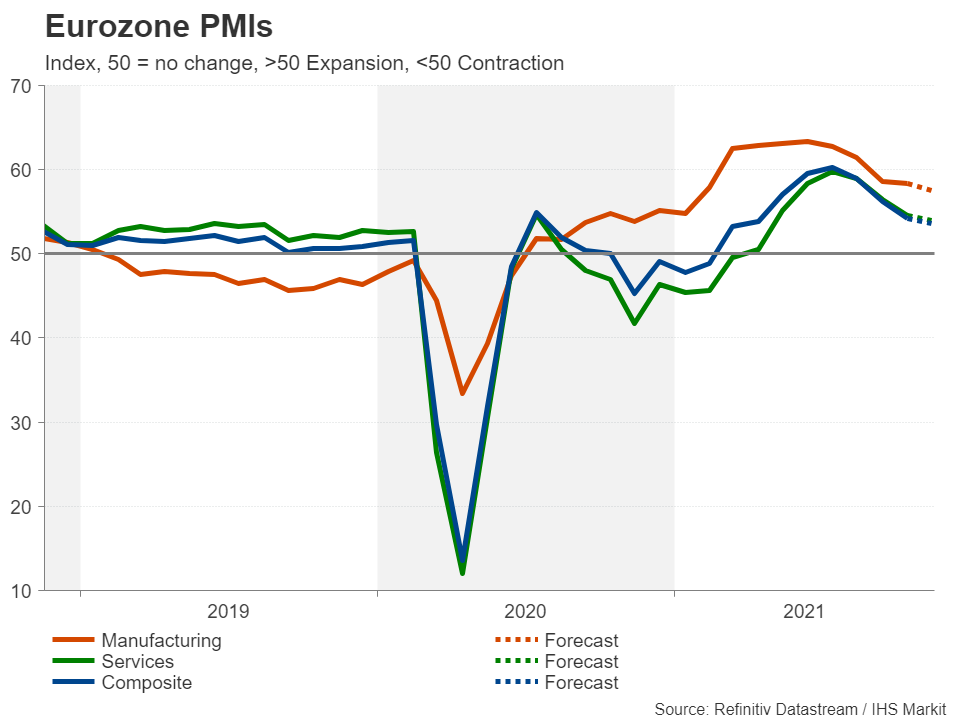
Should the PMI numbers fall by more than expected in November, the euro could resume its downfall as it would heighten worries about a deep economic slowdown in Europe.
How much lower can the euro go?
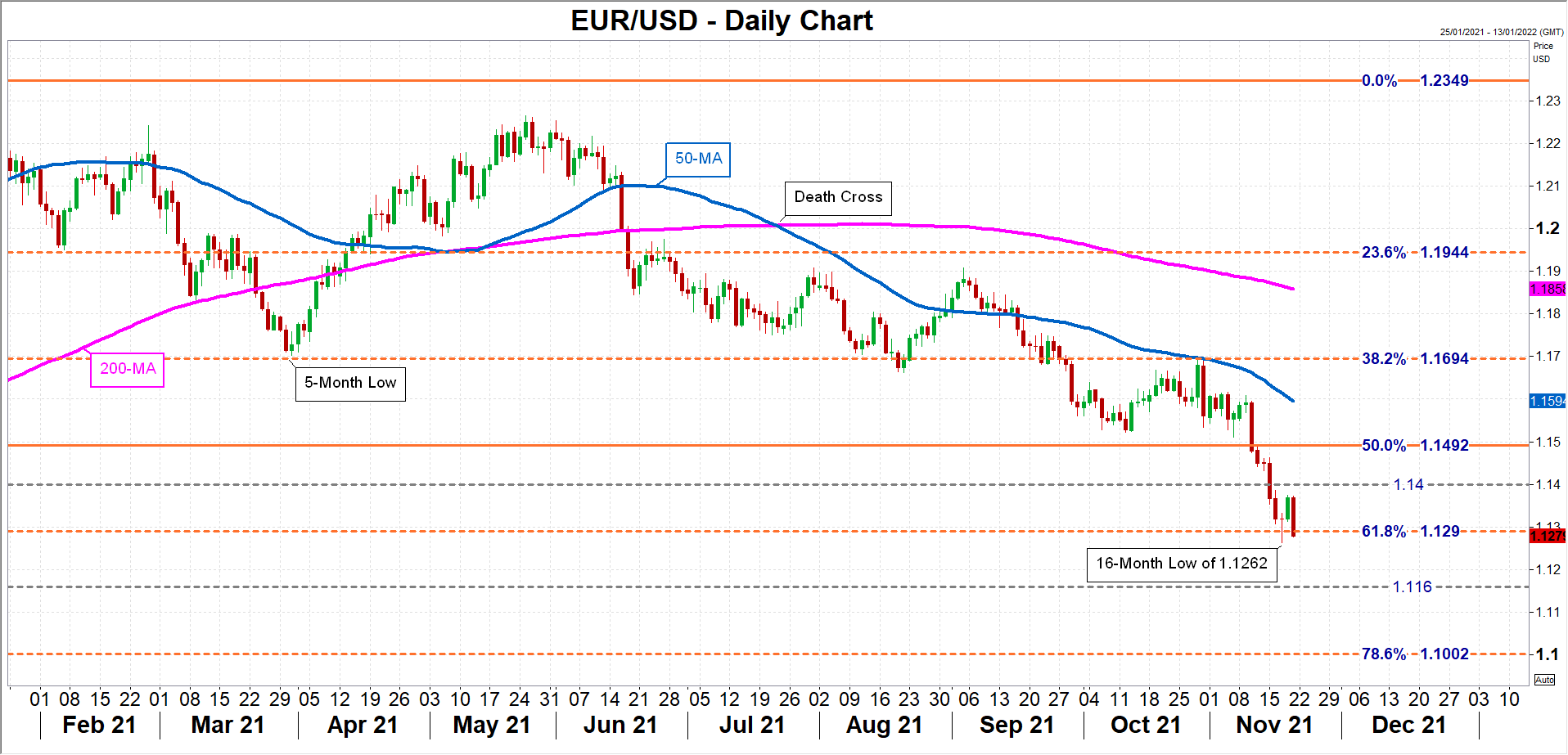
Euro/dollar found support near the 61.8% Fibonacci retracement of the March 2020-January 2021 uptrend when it hit a 16-month low of $1.1262 on Wednesday. Further losses could see the pair sliding towards $1.1160, which has acted as both support and resistance in the past. If this level is breached as well, the 78.6% Fibonacci of $1.1002 would likely become the next target for the bears.
But in the event of positive surprises in the PMI data, the euro could get onto a more solid footing to climb towards the 50% Fibonacci of $1.1492 before reaching for the 50-day moving average, currently at $1.1600.
Too many headwinds
Investors are increasingly downbeat about the growth outlook in 2022 as there are several risks on the horizon. Apart from the supply-chain bottlenecks and the associated jump in the prices of raw materials, virus cases are rising, leading some countries like Austria to announce a nationwide lockdown. Furthermore, flagging growth in China poses an additional problem for Europe’s export-dependent manufacturers.
But all this doesn’t justify why the euro has depreciated so much over the past week. A better explanation is that the recent events have only reinforced expectations that the European Central Bank will likely only manage to beat the Bank of Japan among the big central banks when it comes to raising rates in a post-pandemic world.
It’s all relative
Although inflation in the euro area is surging – the headline figure hit 4.1% in October, it is rising even faster in the United States. Not only that, but the US economy is in a much stronger position comparatively to withstand rate hikes than the Eurozone’s. This means that the ECB can afford to be a lot more patient than the Federal Reserve in waiting for some of the transitory factors to fade before deciding whether it should raise rates to control inflation.
Nevertheless, money markets are still pricing in a substantial probability of a 10-bps rate hike in 2022 so it may be too soon to become overly bearish about the euro. The single currency’s main drawback right now is that the Eurozone economy isn’t shining as brightly, and the ECB is more relaxed about inflation than its peers. But all that could change in the coming months, especially if high inflation proves to be stickier than anticipated.