

Sample Category Title
GER 40 Struggles For Support
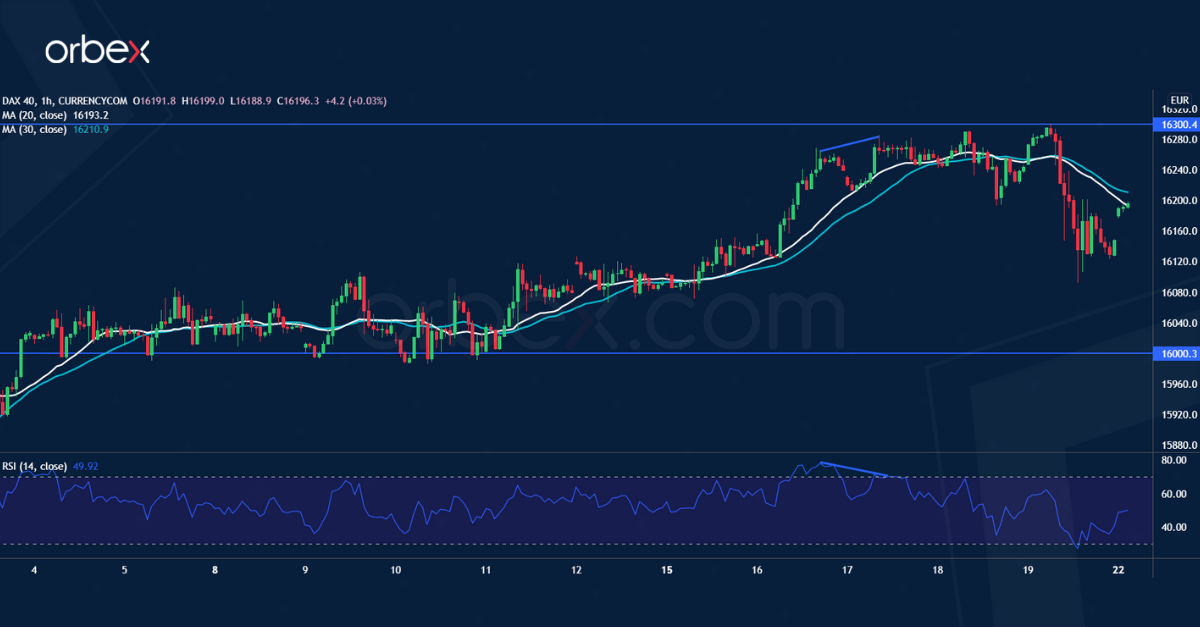
The Dax 40 tumbles as lockdowns across Europe hurt sentiment.
The RSI’s overbought situation on the daily chart has made buyers cautious in pursuing high valuations. On the hourly chart, a bearish RSI divergence suggests a deceleration in the upward momentum.
Then a dip below 16200 confirms weakness in the rally, prompting leverage positions to liquidate. The psychological level of 16000 is a congestion area as it coincides with last August’s peak and the 20-day moving average. 16300 is now a fresh hurdle.
USD/CAD Breaks Higher
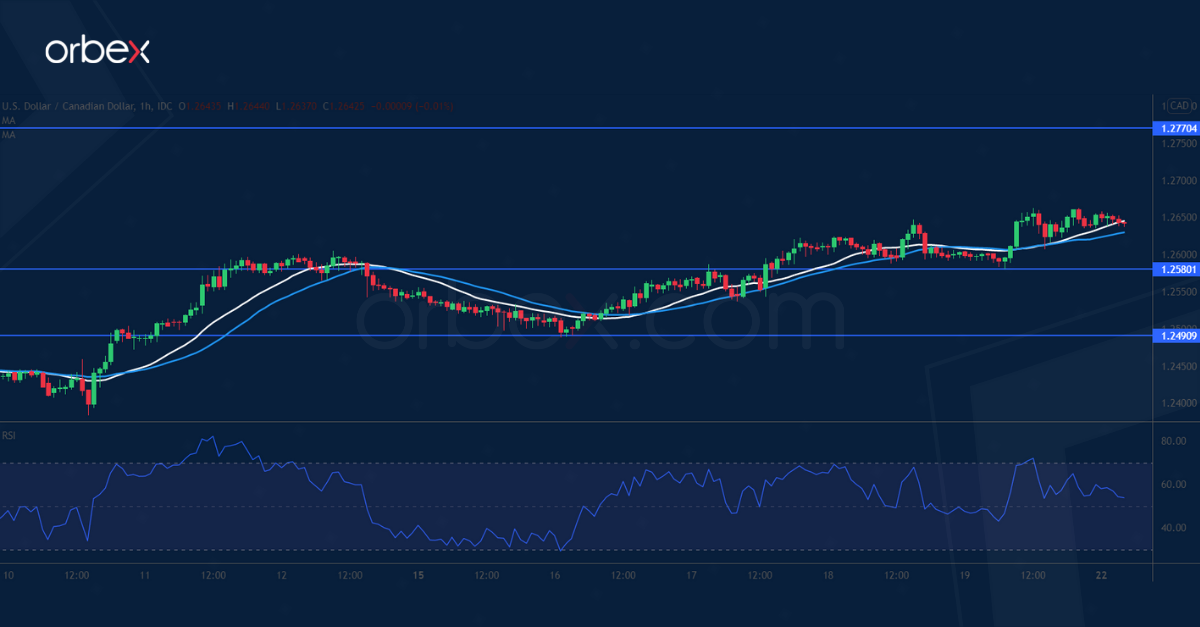
The Canadian dollar struggles after a contraction in September’s retail numbers. The US dollar bounced off the resistance-turned-support at 1.2580. This is a sign that the bulls are still in control.
A bullish MA cross on the daily timeframe confirms the directional bias for the next few days. The daily resistance at 1.2770 would be the next target. Its break would lead to a test of the double top at 1.2900.
In the meantime, the RSI’s overextension has temporarily held the bulls back. We can also expect buying interest during dips.
GBP/USD Hits Resistance
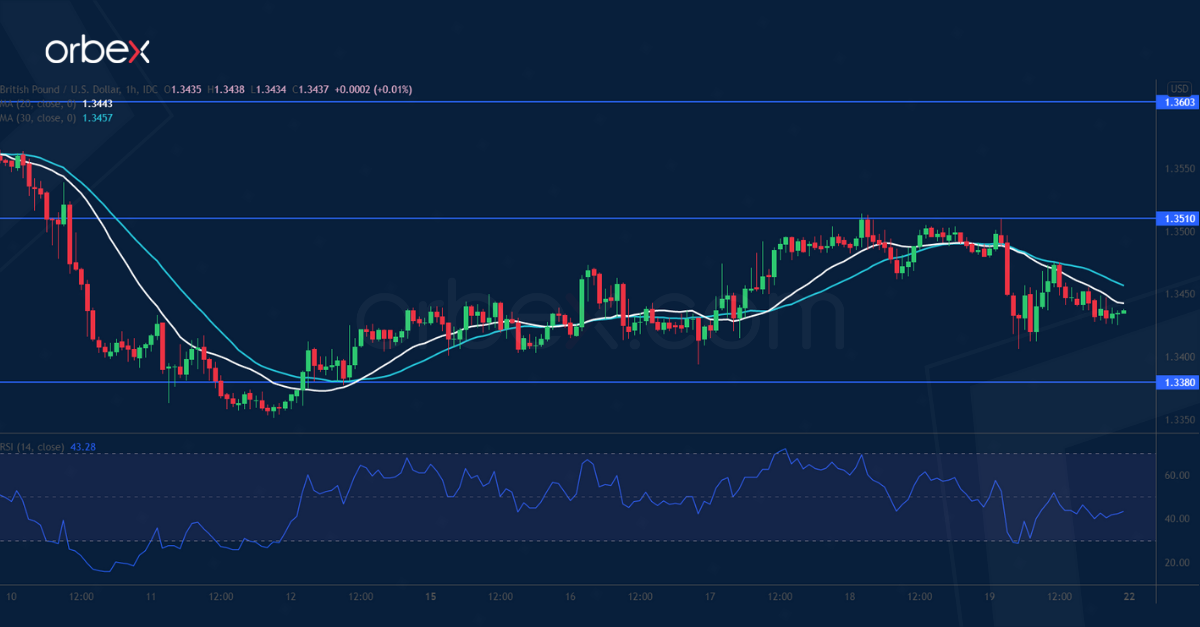
The pound pulled back after Britain’s retail sales registered a steeper drop to -1.3% in October.
The pair has met stiff selling pressure in the supply zone around 1.3510, a support that has turned into resistance after a failed rebound. An oversold RSI may cause a limited rebound.
However, a bearish MA cross on the daily chart suggests that sentiment is still pessimistic. 1.3380 is a key support to keep the sterling afloat. A bearish breakout may trigger an extended sell-off to last December’s lows around 1.3200.
The ECB Will To Take Action On Inflation Anytime Soon
Markets
Rising European corona infections forced governments to take new containment measures last week, triggering a broad risk-off repositioning with Europe evidently in the eye of the storm. Uncertainty on the short-term impact on EMU growth only reinforced doubts whether the ECB will to take (decisive) action on inflation anytime soon. EMU yields tumbled with the belly of the curve outperforming (5y -5.7 bps; 10y -6.7 bps). US (and UK) yields initially followed Europe, but especially US short-term yields rebounded later. Fed’s Waller said conditions for a rate lift-off are met and Fed Clarida indicated that it might already be appropriate to discuss a faster pace of tapering at the December meeting. The US curve flattened sharply with 2 and 5y yields returning in positive territory (2y + 0.4 bps) while longer maturities still finished sharply lower (10y -3.9bps; 30y -6.9 bps), mostly on lower inflation expectations. The EuroStoxx 50 declined 0.6%. US indices ended mixed (Dow -0.75%, but Nasdaq +0.40%). The euro lost against the other majors. Thursday’s tentative EUR/USD bottoming proved premature, with the pair closing below 1.13 (1.129). EUR/JPY tested the key 127.93/128 area (close 128.71). EUR/CHF dropped below 1.05. EUR/GBP also reversed Thursday’s rebound, but no follow-through losses below 0.8383 occurred (yet).
Asian equities are trade mixed this morning as markets ponder the impact on growth of rising (European) corona infections. The China Foreign Exchange Committee advised lenders to take a risk-neutral approach when trading foreign exchange which is seen as an indication that Chinese officials don’t want a further rise of the yuan. Still the yuan is holding strong at USD/CNY 6.3810. The PBOC left its LPR rates unchanged but an easing of policy is still possible if growth were to slow further. Brent oil continues its decline below $80/b (cf infra). The dollar remains in pole position amongst the majors (DXY 96.11, EUR/USD 1.128, USD/JPY 114.15).
The eco calendar is thin today with EC November consumer confidence and US existing Home sales. Later today, we keep an eye at the sale of 2y and 5y US Treasuries as speculation on earlier Fed tightening lingers. European markets will continue to ponder the impact of new corona restrictions on growth and on ECB policy. After last week’s sharp repositioning, the German 10y yield currently tests the 62% retracement level of the August/early November rise. The jury is still out, but at current levels quite some bad news might be discounted. US LT yields are holding a rather tight sideways range. There is no sign of improvement in sentiment on the single currency. A sustained break of EUR/USD 1.1290 suggests a further setback to the 1.104 area (76.% retracement post-corona rebound). BoE Bailey indicated that risks to the UK economy remain two-sided, even after strong data last week. The damage to sterling remains limited. EUR/GBP (0.839) could still fall below last week’s lows.
News headlines
Brent oil extends losses after dipping below $80 barrel last week, breaking neckline support of a double top formation. Next to demand uncertainty with (European) nations contemplating or already having announced new lockdowns, additional supply may arise. A Japanese TV broadcaster on Monday reported that the country is prepared to release oil from its national reserves as part of a joint move with the US. The latter has been threatening to do so for several weeks and discussed the matter with China during last week’s summit as well.
In Chile’s presidential elections over the weekend, main parties’ candidates were well short of the 50% majority needed to win outright. With 28%, Kast, a Conservative pledging to lower corporate taxes and the preservation of market-friendly rules while campaigning to uphold law and order and family values, secured a narrow lead over the 26% Boric secured going into the runoff on December 19. Boric wants to raise company levies, overhaul the pension system and boost social welfare benefits, blaming the current economic model for having left many people behind, despite delivering some of the best growth in Latin America. Turnout was below 50% and voting is voluntary.
GBP/JPY Daily Outlook
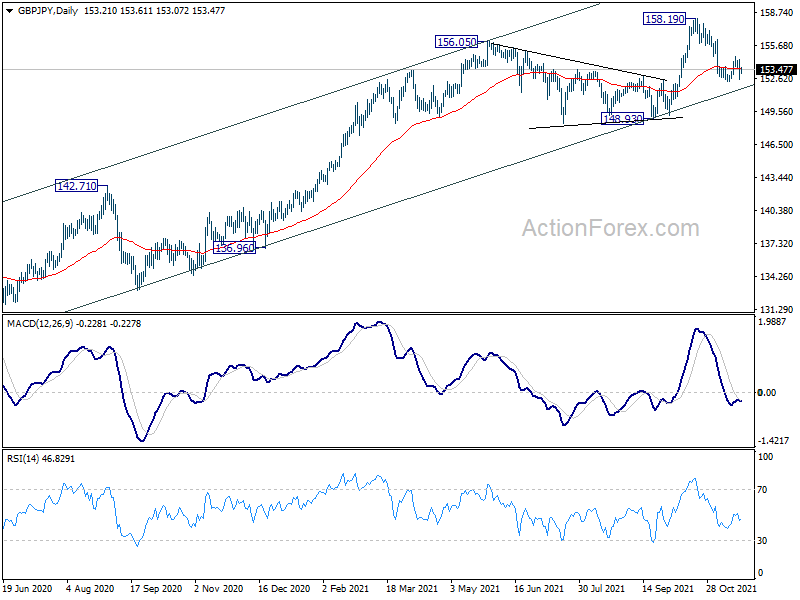
Daily Pivots: (S1) 152.40; (P) 153.43; (R1) 154.32; More...
Intraday bias in GBP/JPY remains neutral for the moment. Further fall is mildly in favor and break of 152.35 will resume the decline from 158.19 to 148.93 key support next. On the upside, however, break of 154.70 will turn bias back to the upside for retesting 158.19 high instead.
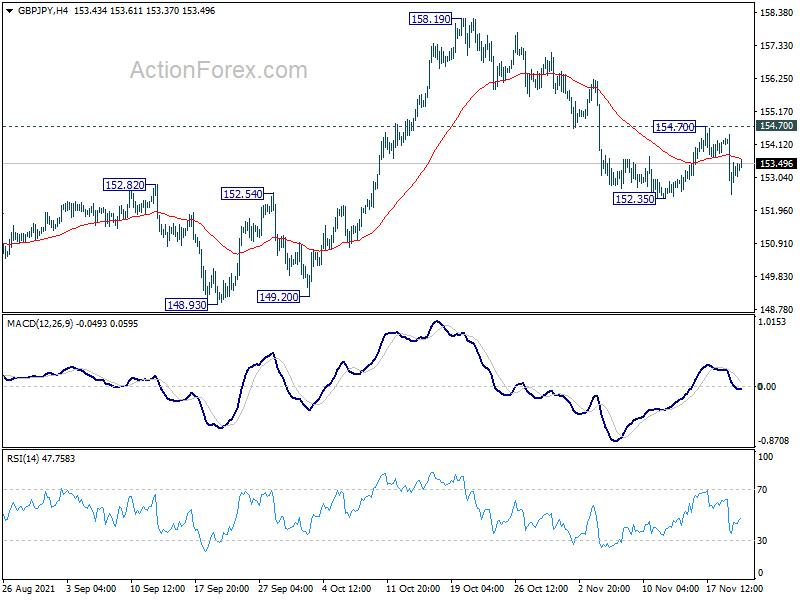
In the bigger picture, rise from 123.94 is seen as the third leg of the pattern from 122.75 (2016 low). Further rally is still expected as long as 148.93 support holds. However, firm break of 148.93 will argue that the medium term trend has reversed and bring deeper fall back to 142.71 resistance turned support first.
EUR/JPY Daily Outlook
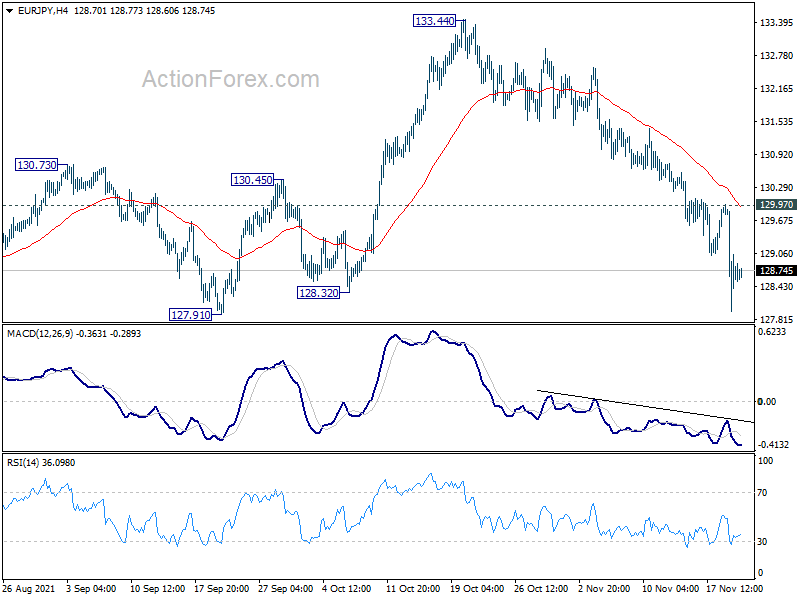
Daily Pivots: (S1) 127.76; (P) 128.87; (R1) 129.77; More....
Intraday bias in EUR/JPY remains on the downside for 127.91 support. Break there will target 126.58 medium term fibonacci level next. On the upside, break of 129.97 minor resistance is needed to indicate short term bottoming. Otherwise, further fall will remain in favor in case of recovery.
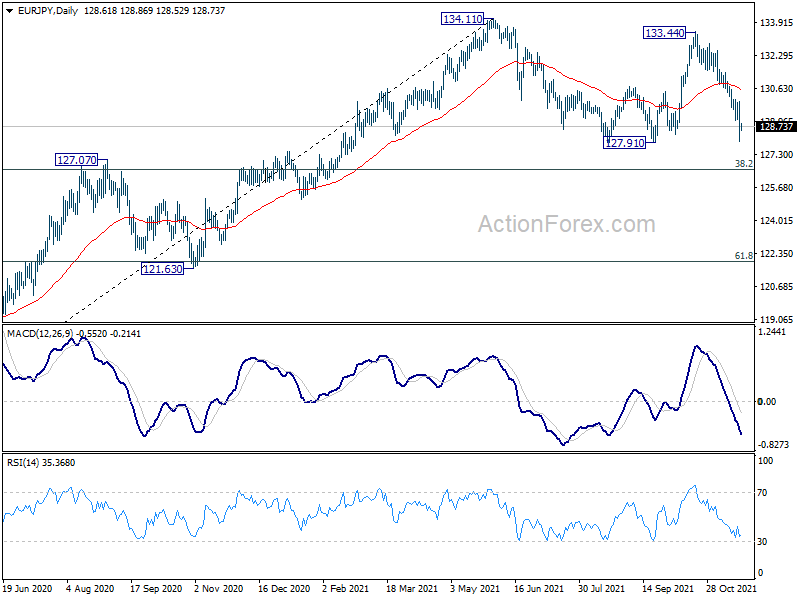
In the bigger picture, as long as 38.2% retracement of 114.42 (2020 low) to 134.11 at 126.58 holds, up trend from 114.42 is still in favor to continue. Break of 134.11 will target long term resistance at 137.49 (2018 high). However, sustained break of 126.58 will raise the chance of medium term bearish reversal. In this case, deeper decline would be seen to 61.8% retracement at 121.94, and possibly below.
EUR/CHF Daily Outlook
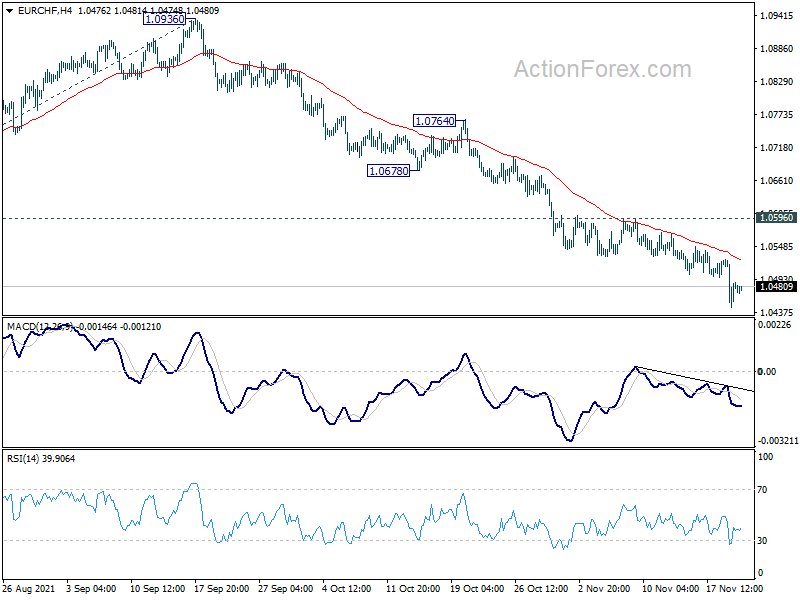
Daily Pivots: (S1) 1.0443; (P) 1.0486; (R1) 1.0524; More....
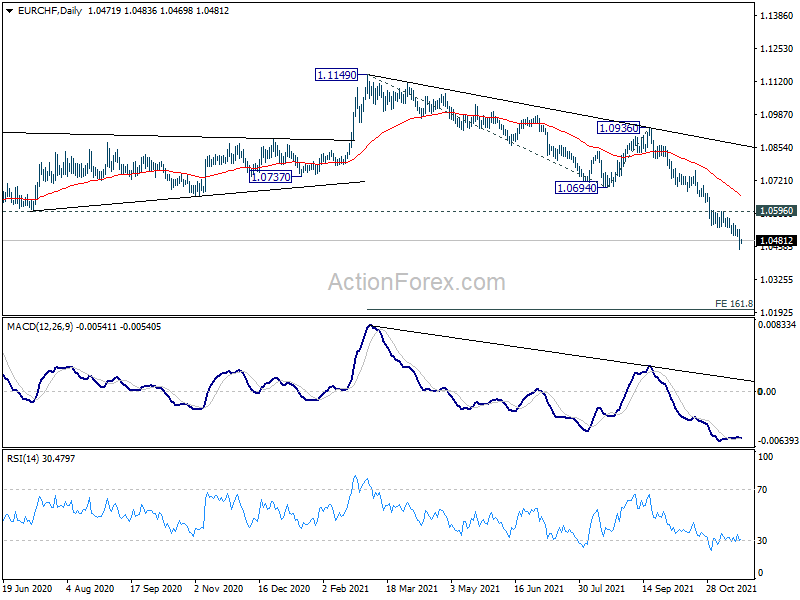
Intraday bias in EUR/CHF remains on the downside for the moment. Current down trend from 1.1149 should now target 161.8% projection of 1.1149 to 1.0694 from 1.0936 at 1.0200 next. On the upside, break of 1.0596 resistance is needed to indicate short term bottoming. Otherwise, outlook will remain bearish in case of recovery.
In the bigger picture, down trend from 1.2004 (2018 high) should be resuming with break of 1.0505 (2020 low). Next target is 61.8% projection of 1.2004 to 1.0505 to 1.1149 at 1.0223. On the upside, break of 1.0694 resistance is needed to be the first sign of medium term bottoming. Otherwise, outlook will remain bearish.
EUR/AUD Daily Outlook
Daily Pivots: (S1) 1.5560; (P) 1.5597; (R1) 1.5633; More...
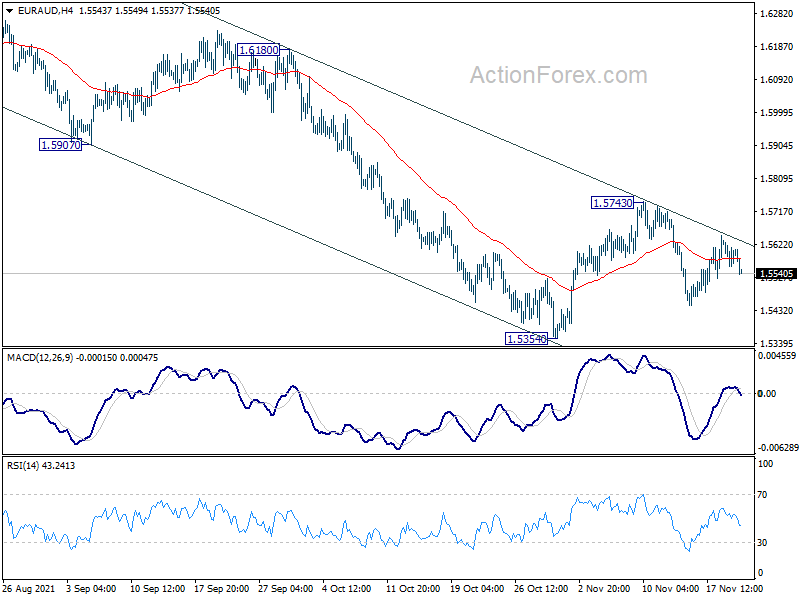
Intraday bias in EUR/AUD remains neutral for the moment. Further fall is expected as long as 1.5743 resistance holds. On the downside, break of 1.5354 will resume whole fall from 1.6434 to retest 1.5250 low. Nevertheless, break of 1.5743 will turn near term outlook bullish for 1.5907 resistance instead.
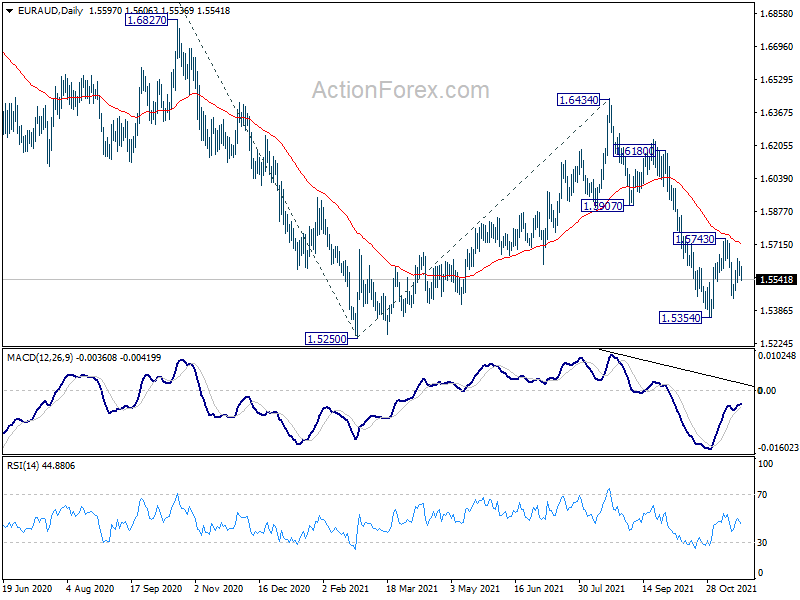
In the bigger picture, the down trend from 1.9799 (2020 high) is in progress. Firm break of 1.5250 low will confirm resumption and target 61.8% retracement of 1.1602 (2012 low) to 1.9799 at 1.4733. Sustained break there could bring more downside acceleration to 61.8% projection of 1.9799 to 1.5250 from 1.6434 at 1.3623. In any case, break of 1.6434 resistance is needed to signal medium term bottoming, or outlook will stay bearish.
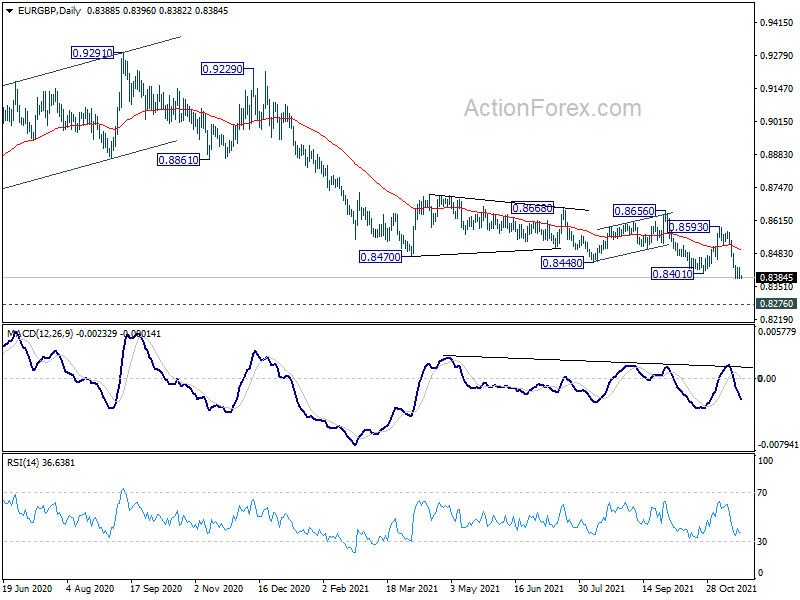
EUR/GBP Daily Outlook
Daily Pivots: (S1) 0.8376; (P) 0.8402; (R1) 0.8417; More...
Intraday bias in EUR/GBP remains neutral first and consolidation from 0.8381 temporary low could extend. In case of another recovery, upside should be limited by 4 hour 55 EMA (now at 0.8452). On the downside, break of 0.8381 will resume larger down trend from 0.9499. Intraday bias will be back to the downside for 0.8276 key long term support.
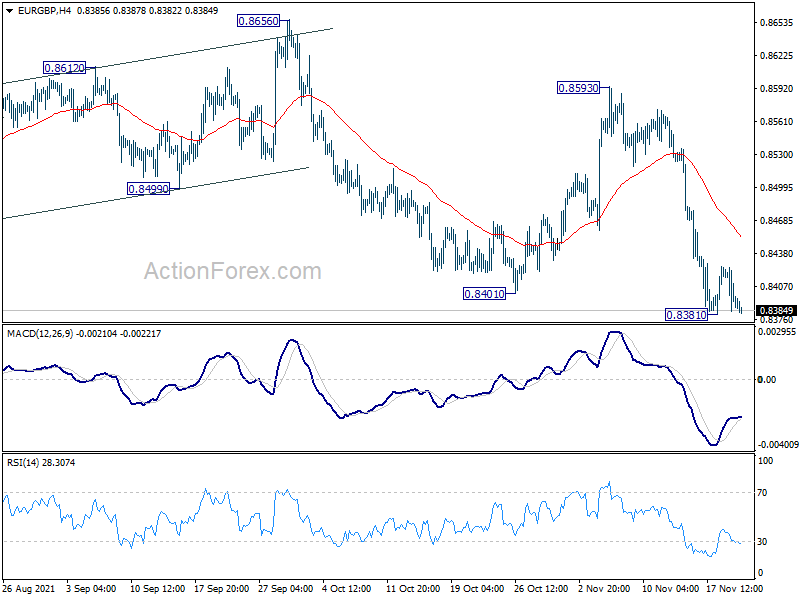
In the bigger picture, price actions from 0.9499 (2020 high) are still seen as developing into a corrective pattern. Deeper fall could be seen as long as 0.8593 resistance holds, towards long term support at 0.8276. We'd look for bottoming signal around there to bring reversal. However, sustained break of 0.8276 will but a sign of long term bearish reversal.
Thanksgiving, Black Friday, Inflation And More
The week kicks off on a mixed note in Asia, but the US futures are in the green at the start of what will be a short trading week in the US.
Based on the historical data, the Thanksgiving week is a strong week for the US equities; there is a two-thirds chance that we will see the US stocks up on the day before and after Thanksgiving.
Of course, the Black Friday sales will be closely watched this week and the expectations are quite strong. The National Retail Federation predicts that the holiday sales between November and December should increase between 8.5 and 10.5% this year, to somewhere around $850 billion. But again, a part of this increase is due to inflation, to the fact that the items that people buy are simply more expensive than they were a year ago, because inflation in the US is at a three-decade high! But the good news is, people still have money to spend, even though they get less goods and services in exchange of what’s spent.
The S&P500 is headed to the Thanksgiving week a touch below its all-time high, and Nasdaq is already at record levels, regardless of the rising expectations for a tighter Federal Reserve (Fed). At this point, it is also possible that investors start factoring in the fact that the rising Covid cases will keep us home another winter, a situation which could give an additional boost to the metaverse dream. In this sense, Meta closed near 2% up on Friday, and the stock price is already up by around 15% since the October dip.
Joe Biden’s other $2 trillion worth of spending proposal just passed the House on Friday. It is now headed to the Senate and will probably sit there for a while, as the US politicians will first need to find a solution to their debt ceiling problem, before adding another $2 trillion debt on top of it. Looking at the soaring inflation, the US can’t continue spending at an accelerated speed and keep the monetary policy this loose. Otherwise, the economy will soon catch a flame!
The US short term yields continue pushing higher, and the upside potential is high.
And on the Fed front, we are still waiting for Joe Biden to decide on who will be the next Fed Chair. But again, bringing the most dovish of the doves wouldn’t guarantee a longer period of zero rates in the US. If the decisions are based on economic fundamentals, the economy is calling for a rate hike. And it’s calling for it quite soon.
And not only in the US. The Reserve Bank of New Zealand is expected to hike rates for the second time this week to 0.75% and the market is pricing in a 100% rate hike from the Bank of England (BoE) in December.
In commodities, US crude remains under a decent selling pressure on prospects of a combined decision from the world’s most oil-hungry countries to tap into their strategic oil reserves to cool down the rally in energy prices. The rising Covid cases, and the announcement of new lockdown measures are now weighing on the prospects of demand, as well, and strengthens the case for a further selloff in the short run, to meet the 100-day moving average near $74 per barrel. There is also a potential for a deeper selloff to the $70 per barrel mark, but I believe the downside potential should be limited at these levels, because we are still in the middle of a global energy crisis and the need for more energy in the winter months doesn’t help.
The weaker oil is pressuring the FTSE to the downside, but the weaker pound should temper a part of that negative pressure on the British blue-chip index. At the end of the day, the FTSE is well positioned to benefit from higher interest rates, as the index is heavy in bank stocks.