

Sample Category Title
Fed’s No. 2 Hints At Faster Taper, Dollar Up But Stocks Stay Calm
- Fed’s Clarida open to quicker tapering, but no panic yet in bond and equity markets
- Dollar eyes fresh highs as euro and pound keep bleeding; commodity dollars steadier
- Flash PMIs and RBNZ may spark some fireworks before Thanksgiving holiday
Markets in positive spirits despite Fed and virus worries
The Fed’s second in command may have just opened the door to a faster pace of tapering, but stocks nevertheless edged higher at the start of the week as there appeared to be little fallout in bond markets. Vice Chair Richard Clarida became the most prominent Fed official on Friday to suggest that policymakers could discuss a quicker exit from QE at the December meeting. It follows similar remarks from Governor Christopher Waller minutes before Clarida spoke and from James Bullard last Tuesday.
However, markets don’t seem spooked by the prospect of accelerated tapering. The recent upturn in economic indicators in the United States, not to mention the exceptional earnings season, might be cushioning the blow. But it’s also possible that investors are betting on President Biden appointing Lael Brainard as the next Fed Chair, which would strengthen the dovish camp at the US central bank.
Biden is due to announce his choice – widely believed to be a two-horse race between incumbent Jerome Powell and Governor Brainard – very soon, likely when he speaks on the economy on Tuesday.
More clues about faster tapering could come on Wednesday when the minutes of the November FOMC meeting are due.
Stocks head north, shrug off uncertainties
Ahead of that, US stock futures were moving into record territory except for the Dow Jones, despite climbing the most at the European open. It follows a mixed session on Friday when only the Nasdaq Composite and Nasdaq 100 managed to finish higher. European and Asian indices were down too on Friday but have swung into the green today.
Hong Kong’s Hang Seng index and the S&P/ASX 200 index in Sydney were the exceptions. China concerns weighed on the Hang Seng, while Europe’s Covid-19 resurgence dampened the mood in Australia.
On the other hand, expectations of a prolonged period of easy monetary policy shored up risk assets in Europe even as storm clouds gathered over the continent. Tighter Covid restrictions triggered a wave of violent protests in several European cities over the weekend as Austria entered a full nationwide lockdown today.
Euro and pound crumble
ECB chief, Christine Lagarde, is keeping the equity bulls happy by reinforcing her objection to premature tightening. But this has come at the expense of the euro, which plunged to a more than 16-month low of $1.1248 on Friday. With the coming winter season potentially being marred yet again by strict Covid curbs, the near-to-medium term outlook for the euro isn’t that great to say the least.
Sterling is being dogged by similar concerns even though the Bank of England continues to talk up rate hike expectations. Governor Andrew Bailey was on the offensive again over the weekend, warning that rates will need to be raised. However, with his credibility damaged recently, it’s a case of ‘seeing is believing’ as far as markets are concerned. So unless there is a rate hike in December, it’s hard to see the pound reclaiming the $1.35 level in the short term.
Aussie up, kiwi struggles, loonie leans on oil rebound
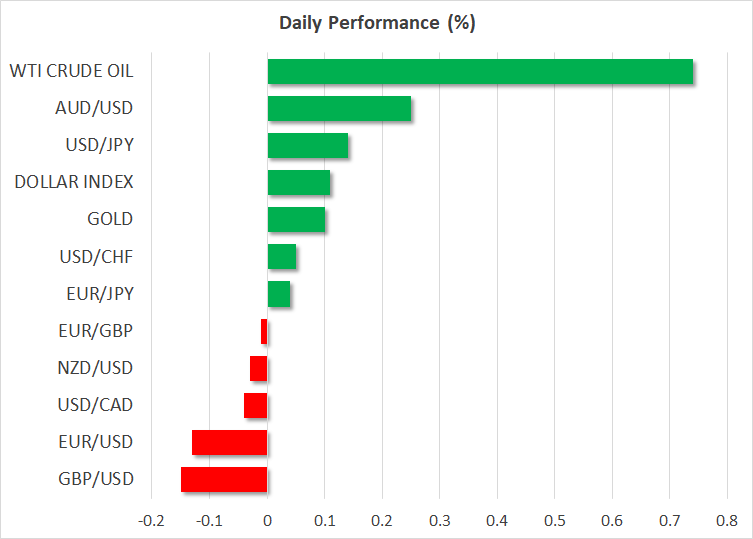
One central bank that is almost certain to hike rates soon is the Reserve Bank of New Zealand. The Bank is widely expected to hike rates on Wednesday, though the New Zealand dollar barely held on to the $0.70 amid the stronger greenback. The aussie outperformed its peers, however, on Monday, rising by 0.3% as it was lifted by higher metal prices.
The Canadian dollar was slightly firmer too even though oil prices rebounded only modestly from last week’s selloff. Japan was the latest country to indicate it might take part in a US request to release some of its strategic oil reserves to ease the energy crisis. Markets are still trying to decipher how significant this limited supply boost would be should the US and its partners go ahead with a coordinated move to unleash oil from their emergency reserves.
In the meantime, WTI futures were last up about 0.5% after finding support around $75/barrel.
Firm start for dollar in busy Thanksgiving week
Gold bucked the trend among commodities, struggling around $1,845/oz as the US dollar inched towards fresh highs against a basket of currencies. Other safe-havens like the Japanese yen were weaker too, drawing little support from growing fears of a possible Russian invasion of Ukraine.
For the rest of the week, flash PMI data out of Europe on Tuesday could set the tone ahead of the US Thanksgiving holiday on Thursday when trading volumes are expected to wind down. Although there could be some drama coming out of Capitol Hill as the Democrats’ Build Back Better bill, which just got approved in the House, heads to the Senate for a contentious debate that could see the size of the spending package being trimmed.
COVID-19 Disease Wave In Europe Could Negatively Impact Global Economic Recovery
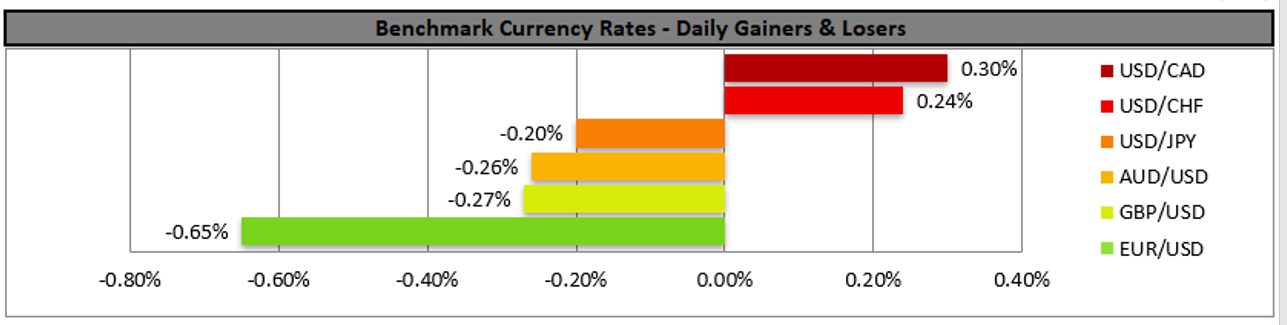
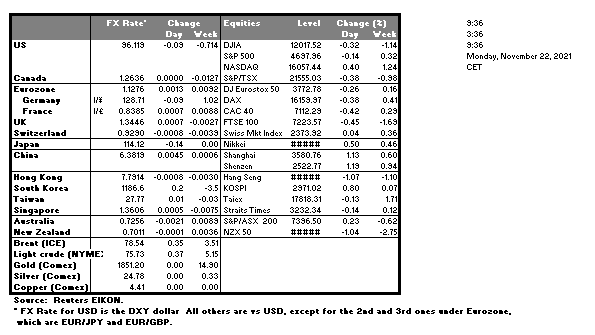
The US stock market traded without a single trend on Friday. By the close of the stock market, the Dow Jones index decreased by 0.75% (+1.46% for the week), S&P 500 lost 0.14% (+0.18% for the week), and the NASDAQ technology index increased by 0.40% (+0.93% for the week) making a new historic high. The dollar index strengthened again. On Friday, the dollar was supported by optimistic comments from Federal Reserve officials Richard Clarida and Christopher Waller. They suggested that a faster pace of stimulus cuts may be appropriate amid rising inflation.
The Fed's balance sheet hit a new record of $8.7 trillion. Total assets will continue to grow in the coming weeks. The Fed's balance sheet is now 37.4% of U. GDP. Reducing the QE program leads to slower growth, but it is still growing. At the next Fed meeting, policymakers will discuss a more rapid reduction in bond purchases.
Moderna announced FDA approval for a booster dose of the COVID-19 vaccine in the United States for adults from 18 years and older.
European stock indexes were mostly down on Friday. British FTSE 100 index decreased by 0.45% (+1.69% for the week), German DAX decreased by 0.38% (+0.42% for the week), Italian FTSE MIB lost 1.17% (-1.48% for the week), French CAC 40 decreased by 0.42% (+0.15% for the week) and Spanish IBEX 35 lost 1.68% and ended the week with -3.10%. Investors' mood was affected by the news about introducing the 10-day lockdown in Austria, which might be extended for another ten days. Austria will introduce a mandatory vaccination on February 1. Germany is considering the opportunity to follow this example. In Germany, during the week, the record was broken by the number of cases per day - more than 65,000 people. The return of restrictions to stop the latest wave of Covid-19 cases in Europe could undermine the economic recovery and cast doubt on the European Central Bank's timetable for rolling back emergency stimulus measures.
British Prime Minister Boris Johnson is considering a diplomatic boycott of the upcoming 2022 Beijing Winter Olympics to protest China's human rights record.
The EU would propose obliging stock exchanges to provide investors with data on stock and bond transactions, with the exchanges receiving reasonable compensation for their data.
The Turkish lira is in free-fall, which increases the cost of food, medicine, and other necessities and threatens the country's financial system. The lira has lost 34% of its value against the dollar in eight months.
The White House says OPEC must meet current demand, ensure adequate supply in the market. Japan is preparing to release its oil reserves to the market. Amid such news, oil prices lost about 3% on Friday, declining for the fourth week in a row for the first time since Marc 2020.
In the commodities market, lumber futures (+28.01%), natural gas (+5.97%), coffee (+5.25%), cocoa (+2.65%), and wheat (+2.16%) showed the biggest gains by the end of the week. WTI oil futures (-6.33%), heating oil (-5%), platinum (-4.89%), Brent oil (-4.27%), palladium (-2.91%), silver (-2.23%), and orange juice (-2.23%) showed the biggest drop.
Asian stock indices traded flat on Friday. Japan's Nikkei added 0.5% (-0.18% for the week), Australia's ASX 200 gained 0.23% on Friday (-0.84% for the week), China's benchmark CSI 300 increased by 1.08% (-0.09% for the week), while Hong Kong's Hang Seng lost 1.07%, ended the week -1.53%, becoming the leader of the fall among Asian indices. China kept its loan prime rate at 3.85%. Last week, the People's Bank of China asked financial institutions and businesses to strengthen their currency risk management and refrain from unilateral bets on the yuan. Currency volatility could increase in the future as foreign central banks have begun to adjust monetary policy.
Taiwan's central bank is concerned that any increase in interest rates now could lift the local currency but will definitely follow the global tightening trend next year.
Main market quotes:
- S&P 500 (F) 4,697.96 −6.58 (−0.14%)
- Dow Jones 35,601.98 −268.97 (−0.75%)
- DAX 16,159.97 −61.76 (−0.38%)
- FTSE 100 7,223.57 −32.39 (−0.45%)
- USD Index 96.07 +0.52 (+0.55%)
Important events for today:
- China PBoC Loan Prime Rate (m/m) at 03:30 (GMT+2);
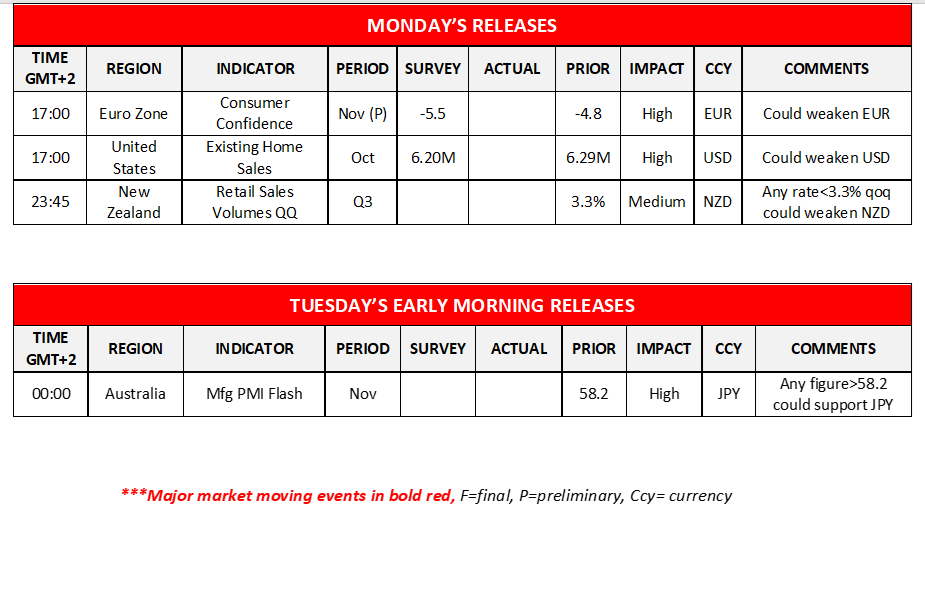
- US Existing Home Sales (m/m) at 17:00 (GMT+2);
- New Zealand Retail Sales (q/q) at 23:45 (GMT+2).
EURUSD Sellers Dominate But Hit A Snag Around The 1.1254 Mark
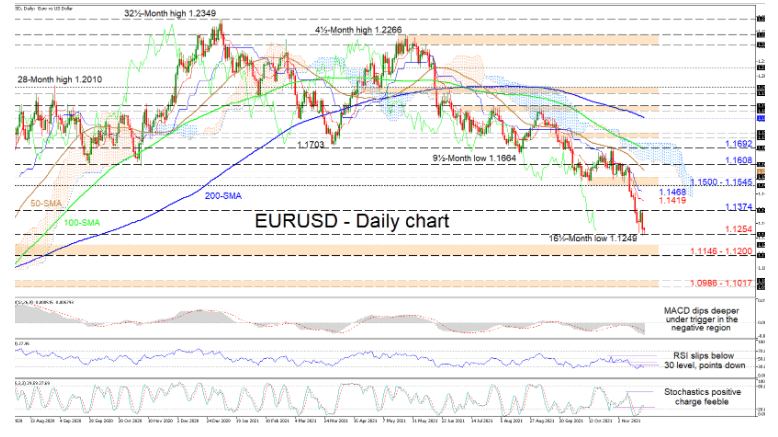
EURUSD sellers have led the pair on a sharp decline towards 1.1249, a low last seen back in July 2020, where the price began a near two-month rally, which reached a 28-month high of 1.2010. The falling simple moving averages (SMAs) are nurturing the bearish structure in the pair.
The negatively charged Ichimoku lines are indicating that downward forces have yet to subside, while the short-term oscillators are implying that negative momentum is gaining power again. The MACD is steering deeper beneath its red trigger line in the negative zone, while the RSI has dived into oversold territory. The positive charge in the stochastic %K line looks frail and suggests upside price action is questionable.
If the current trajectory prevails, immediate support may continue to emanate from the 1.1254 low. Should this key level give way, the bears could then target the support section of 1.1146-1.1200, linked to an area of lows from late March until the end of June 2020. If this boundary also fails to mute negative pressures, the price may sink towards the 1.0986-1.1017 border, associated with the inside swing highs over the April-May 2020 period.
However, if buyers produce positive traction off the 1.1254 barrier, initial resistance could arise at the 1.1374 high. Pushing beyond this, the Ichimoku lines may delay buyers from testing a resistance region formed between the 1.1500 handle and the 1.1545 mark. Should upside momentum endure, the 50-day SMA at 1.1574 could come into focus before the 1.1608 high draws traders’ attention.
Summarizing, EURUSD is exhibiting a bearish bias in the short- and medium-term picture. A dive below the 1.1254 low could further feed negative tendencies, while a drop under the 1.1146 barrier could bolster bearish concerns. For buyers to regain confidence, the pair would need to lift back above the 1.1692 obstacle.
EUR Weakens On Dovish ECB, Yet Opposition Rises
The USD gained against its counterparts on Friday, as the Fed's Vice Chairman Richard Clarida stated that the Fed may discuss the taper pace in its next meeting in December. The statement made headlines, causing market participants to consider the possibility of a faster tightening of the bank's monetary policy as well as the possibility of earlier rate hikes to come. On the other hand, the EUR weakened against the USD, restarting its slide, as ECB President Lagarde reiterated that a rate hike by the bank in 2022 is unlikely, which was considered as a dovish signal in the markets. It should be noted that the bank's ultra-loose monetary policy seems to find opposition from within, as Germany's BuBa President Weidman seems to oppose it and made public statements arguing his case on Friday, raising the stakes for the bank's December meeting. It should be noted that the pound retreated against the USD and JPY on Friday, yet gained against the broadly weaker EUR, failing to capitalise on the better-than-expected retail sales growth rate for October. Also the Loonie's slide against the USD seems to continue as the commodity currency was pushed even lower by weakening oil prices but also the possible effect of a rise in Covid cases in Europe on global trade. Gold's price also tended to be on the retreat as the USD was on the rise, yet inflation worries could support the precious metal as a safe haven. Oil prices seemed to be under pressure as the market eyes the possibility of a number of countries releasing part of their oil reserves which could relieve the tight supply of the oil market.
The USD index regained momentum on Friday testing the 96.15 (R1) resistance line. We tend to maintain a bullish outlook for the index's direction as long as its price action remains above the upward trendline incepted since the 10th of November. Should the USD come under the buying interest of the market we may see the index breaking the 96.15 (R1) and take aim for the 96.65 (R2) resistance level. Should the sellers take the initiative over buyers, for the index's direction we may see the USD Index reversing course, breaking the prementioned upward trendline the 95.60 (S1) support line and take aim for the 95.10 (S2) level.
EUR/USD dropped on Friday breaking the 1.1300 (R1) support line, now turned to resistance. We tend to maintain a bearish outlook for the pair as long as it remains below the downward trendline incepted since the 10th of the month. Should the bears actually maintain control over the pair's direction, we may see the pair breaking the 1.1225 (S1) support line and aim for the 1.1165 (S2) support level. Should the bulls say enough is enough and take over, we may see the pair reversing course breaking the 1.1300 (R1) resistance line, the prementioned downward trendline and aim if not break the 1.1370 (R2) resistance line.
Other market highlights for today
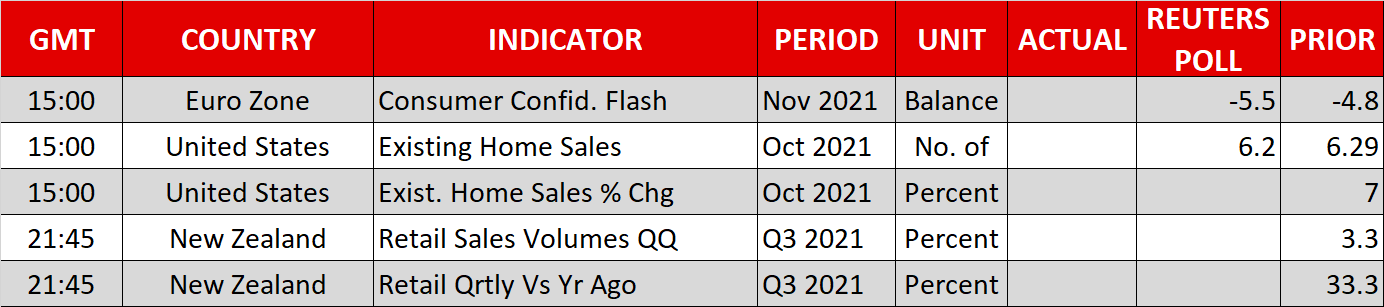
Today in the American session we get Eurozone's preliminary consumer confidence for November and from the US the existing home sales figure for October. Just as the Asian session is about to start, we get from New Zealand the retail sales growth rates for Q3 and from Australia the manufacturing PMI figure for November.
As for the rest of the week
On Tuesday, we get Australia's, France's, Germany's, Eurozone's, UK's and the US preliminary Markit PMI figures for November. On Wednesday we get Japan's preliminary Jibun Manufacturing PMI figure for November, Germany's Ifo indicators for November and from the US the durable goods order growth rates for November, the second estimate of the GDP rate for Q3, the weekly initial jobless claims figure the consumption rate for October, the final University of Michigan consumer sentiment reading, while the Fed is to release the minutes of its latest meeting. On Thursday, we get from Australia the Capital Expenditure growth rate for Q3, and we also note from Sweden Riksbank's interest rate decision. On Friday we note the release from Japan of Tokyo's CPI rates for November while later on we get from Switzerland the GDP rate for Q3.
EUR/USD H4 Chart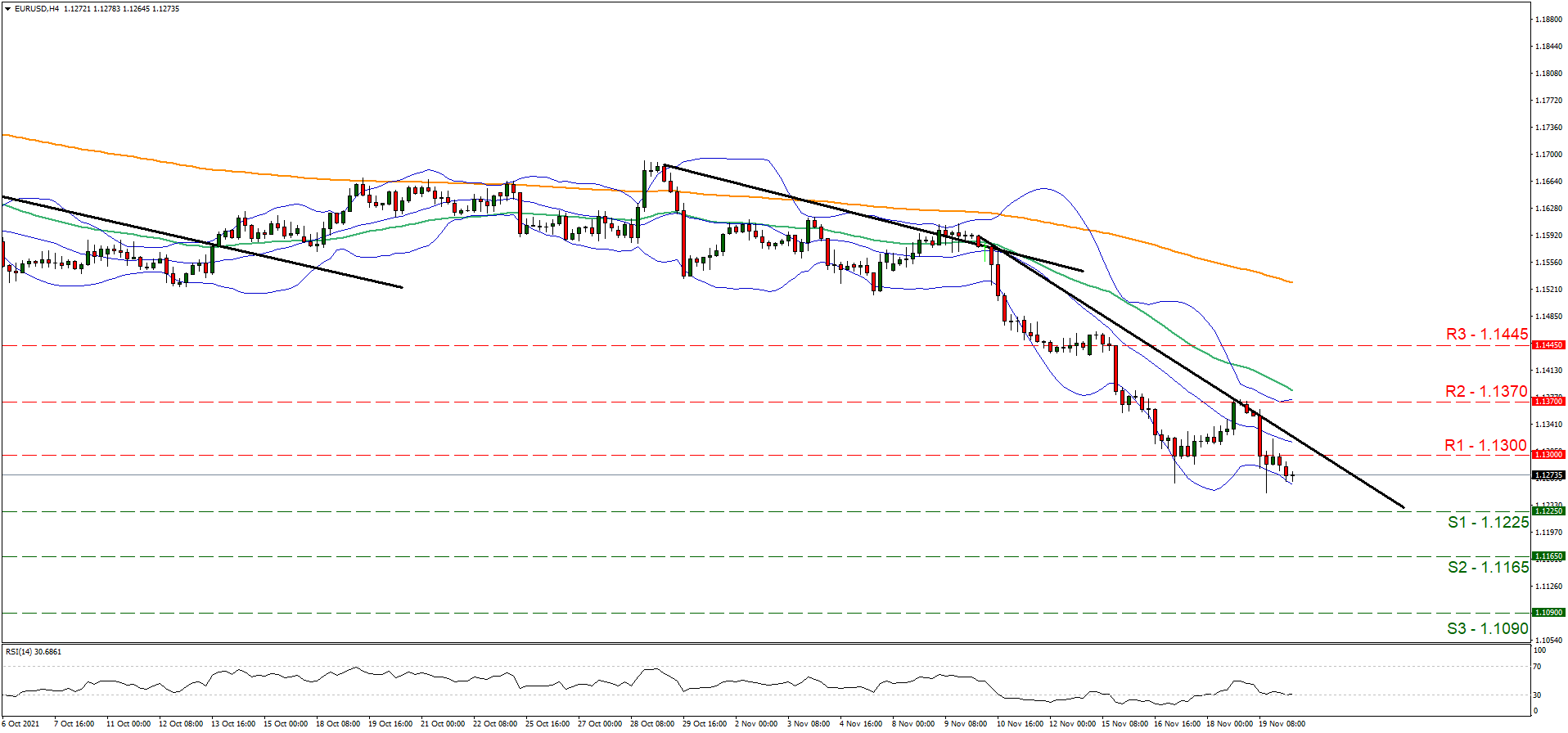
Support: 1.1225 (S1), 1.1165 (S2), 1.1090 (S3)
Resistance: 1.1300 (R1), 1.1370 (R2), 1.1445 (R3)
USD Index H4 Chart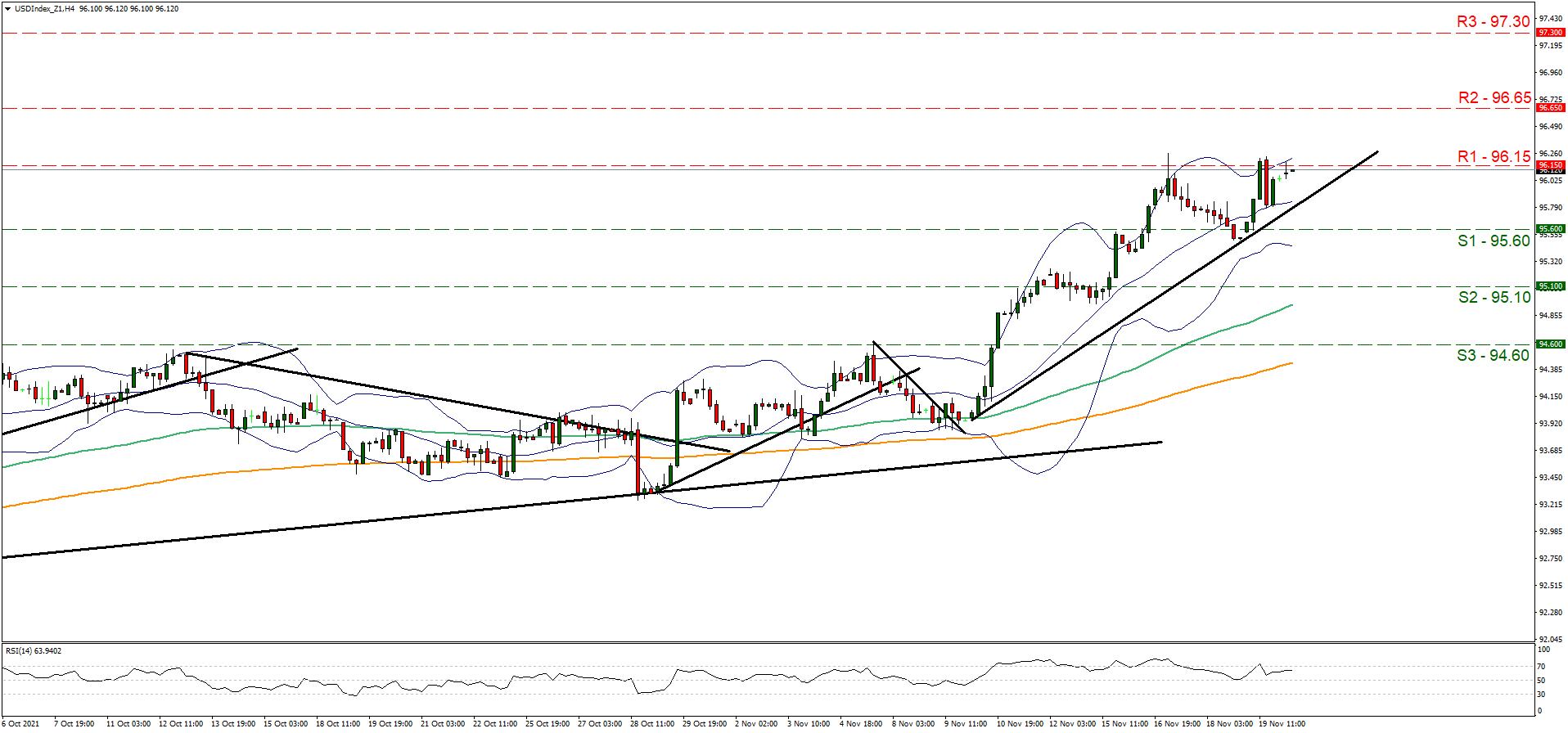
Support: 95.60 (S1), 95.10 (S2), 94.60 (S3)
Resistance: 96.15 (R1), 96.65 (R2), 97.30 (R3)
EUR/USD Outlook: Repeated Close Below Key Fibo Support To Confirm Strong Bearish Signal
The Euro remains heavy in early Monday's trading and attempting to sustain break below pivotal Fibo support at 1.1290 (61.8% of 1.0635/1.2349 ascend), following initial bearish signal on last Friday's marginal close below this level.
Two consecutive large bearish weekly candles (the pair was down 1.4% last week) weigh heavily, adding to bearish daily techs (MA's in full bearish setup and momentum deeply in the negative territory).
Bears need repeated close below 1.1290 to confirm negative signal and open way for acceleration towards key supports at 1.1040/1.1000 (Fibo 76.4% / psychological).
Risk aversion on growing concerns about Covid situation in Europe keeps the single currency under pressure and boosts safe-haven dollar, also inflated by the latest comments from Fed officials, who said that faster pace of stimulus tapering would help economic recovery and increase possibility of earlier start of raising interest rates.
Last Thu/Fri tops at 1.1373 (reinforced by falling 10DMA) offer solid resistance which should keep the upside protected.
Res: 1.1316, 1.1373, 1.1418, 1.1492.
Sup: 1.1250, 1.1200, 1.1168, 1.1100.
EURAUD Trades Below SMAs As Bearish Forces Linger
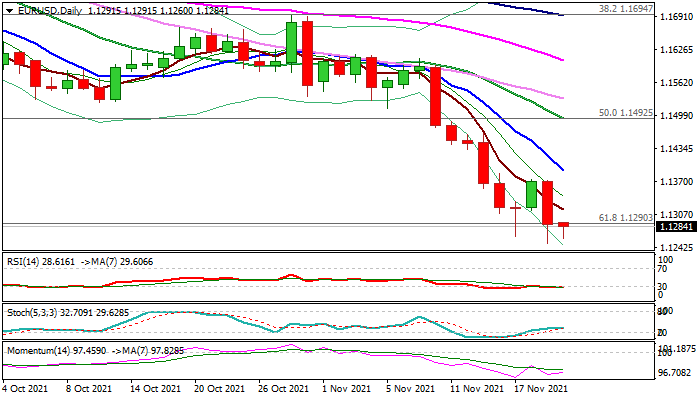
EURAUD has witnessed a minor upside reversal after bouncing back from its November low. However, the overall bearish outlook is still maintained as the price is well below its 50- and 200-day simple moving average (SMA).
The negative bias is mostly supported by the short-term momentum indicators, as the RSI is hovering below its 50 neutral mark. However, the MACD is found below zero but above its red signal line, which indicates that the negative momentum might be fading.
If the bears remain in charge, initial support might be found at the 1.5527 level. Breaking below this barrier, could pave the way towards the 1.5447 obstacle before testing the November low of 1.5355. A further descending movement below this point could strengthen the pair’s negative momentum, sending the price to test its February low of 1.5251.
On the flip side, should the bulls regain control, initial support might be found at the 1.5650 barrier. Surpassing this level could open the door towards the congested region which encapsulates the 1.5744 support, the 200-day SMA and the 50-day SMA currently found at 1.5768. Advancing beyond that region could turn the cards around for the pair, changing its outlook to bullish.
In brief, the overall outlook for the pair is bearish. For that to change, the buyers would need to breach the congested region including the 50- and 200-day SMA.
GBPAUD Crosses Above 50-SMA As Bullish Forces Resurface
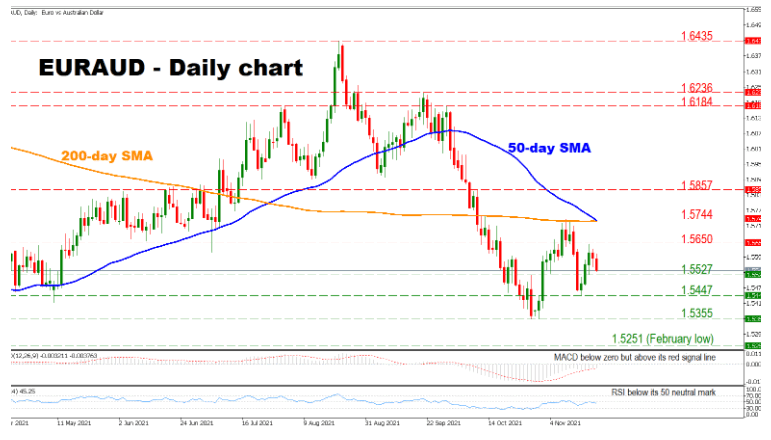
GBPAUD has been giving up ground in the medium-term but managed to find significant support at the 1.8130 region in early November. Since then, the pair has been trending upwards, surpassing both its 50- and 200-period simple moving averages (SMAs) but still trading below the Ichimoku cloud.
The momentum indicators further reinforce the pair’s short-term recovery. The MACD histogram is above both zero and its red signal line, while the RSI is hovering in the positive area.
Should the price continue its ascent in the coming sessions, immediate resistance could be met at the 1.8693 region. Clearing this level would reinforce the resumption of the short-term uptrend, setting the stage for the 1.8768 barrier. Higher up, the price might encounter a tougher test at the 1.8885 hurdle, before buyers target the 1.8968 region.
On the flipside, if positive momentum fades, the price could fall towards the 1.8490 level that has provided both support and resistance on multiple occasions in recent months. A violation of this obstacle would turn the focus to 1.8425. Failing to find support at the aforementioned level, the price could then seek to halt its decline at 1.8335 or even lower at the 1.8254 barricade.
To sum up, GBPAUD has partially bounced back from its medium-term downtrend. A break above the 1.8968 region would erase the pair’s recent dip, while crossing below 1.8335 would alter the short-term picture back to negative.
Gold Fails To Improve The Bullish Move In Near-Term
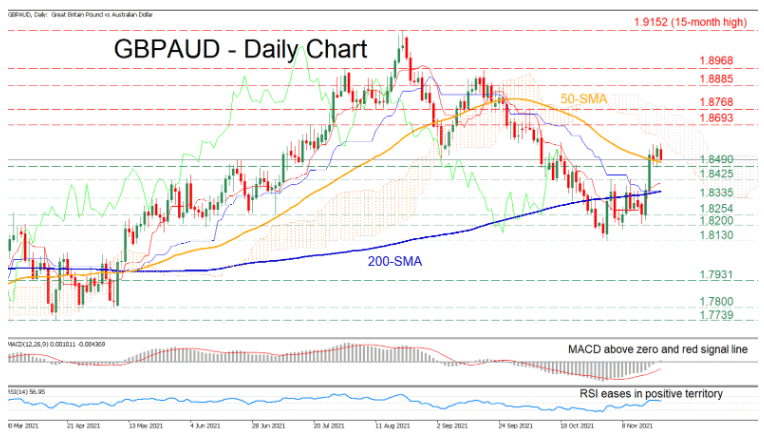
Gold prices are declining following the pullback off the five-month high of 1,877 that was posted last Tuesday. The stochastic is approaching the oversold territory with strong momentum, while the RSI indicator is heading south in the positive region. However, the 20- and 40-day simple moving averages (SMAs) crossed the 200-day SMA higher in the previous sessions.
Should prices reverse lower, immediate support could come at 1,834 ahead of the 20-day SMA currently at 1,825. A drop below this area would take the price closer to the 1,814 support before meeting the 200- and then the 40-day SMAs around 1,795. Further losses would open the way towards the 1,760 barrier.
To the upside, there is immediate resistance at the five-month peak of 1,877 before the bulls drive the price towards the 1,916 high, reached on June 1. Even higher, the bullish bias would be endorsed if the commodity touches the 1,965 hurdle.
All in all, the yellow metal has been in an ascending movement since September 29 and any closures above 1,916 could confirm the recent bullish bias.
Gold Price Started A Fresh Decline From 1,870
Returning from 10 days away in Eastern Indonesia, it seems like my uncanny ability to head off on holiday just before market inflexion points is alive and well. I still have five days holiday left for this year, so I will let readers know when I intend to take them so that you can all buy volatility.
A few things have played out in my absence, some expected, some not; such is the way of the world’s capital markets. The US dollar is finally on its way higher, although the rally has been driven by a flattening of the US yield curve and Euro-virus nerves, and not by a rise in longer-dated US yields. It is clear that longer-term inflation expectation remains anchored capping long-dated yields, helped along by the Fed. Short-dated yields are rising, flattening the curve, and, for now, that is where the stress of the US inflation picture is being felt.
Energy and base metal prices have continued to ease. The first was driven by President Biden & Co’s threats to release strategic reserves, soggy data from Europe along with its new wave of virus restrictions as infections sore in wave number four. Industrial commodities such as coal and iron ore have been crushed thanks to China talking them down, increased domestic coal production and its power crunch restricting industrial demand.
Stock markets continue to trade at or near record highs in the US, and who can blame them? US data remains strong although the inflation noise gets louder by the day. And markets there know that the Fed has an even weaker appetite for negative price action than someone who bought bitcoin at USD 67,000.00. Interestingly, the Dow Jones has retreated since the Biden infrastructure package was passed, perhaps warning that even the perpetual mega-bulls of Wall Street, back-stopped by the Fed, could be in for some two-way price action into the year-end.
European equities are still holding up but in Asia, the picture is far murkier, thanks in no small part to China’s shared prosperity policies, clampdowns, property sector nerves, power crunch, stagflationary environment, insert China risk here ………. If Europe faces a winter of virus lockdowns and discontent, and a cold winter with challenged gas supplies, even the ECB, in its permanent role as the European governments’ chief-debt-monetiser, will struggle to keep the recovery going. That’s what happens when you lack the imagination to do anything by QE forever, you get declining marginal utility for your efforts, just ask Japan.
Gold has finally cracked its mega-resistance at USD 1835.00 an ounce, despite a very much stronger US dollar. It seems that with long-dated US yields in a permanent state of suppression, short-dated US yields are rising in response to inflationary noise and strong US data, and that is what gold is responding to. If the Fed bows to reality and hastens the taper, something the Vice-Chairman suggested last week, gold could yet find itself in another false dawn. But a move towards USD 2000.00 an ounce before the December FOMC can’t be ruled out.
On the Fed, President Biden will announce whether Jerome Powell retains his job after my birthday in February next year or whether he decides to go with Lael Brainard. If Ms Brainard, an uber dove, gets the nod this week, expect US stocks to jump higher and to see some temporary US dollar weakness.
The US data calendar is relatively thin this week, so the Fed Chair news could have an outsized effect. US data is front-loaded to the front half of the week, with Markit PMIs tomorrow, and Durable Goods and October PCE on Wednesday. Thanksgiving, the annual silence of the turkeys, is on Thursday with a partial holiday I expect many Americans to turn into a long weekend, on Friday, That will notably impact volatility in the second half of the week.
European and Australian Markit PMIs are released tomorrow and with growth nerves frayed this week, I am hearing the term stagflation used a lot these days as the world catches up to me; markets will be more sensitive to weaker prints. Australia should outperform as the reopening peace dividend grows. Europe, on the other hand, is going backwards. New restrictions are sweeping the continent as cases surge, as are protests against them. A run of weaker data, notably from Germany, and with Russia showing more proclivity to mass armies on the Ukrainian border, rather than pump natural gas through it, makes it hard to construct a bullish case for the Eurozone at the moment. Weak PMIs will make that negative noise louder although I expect the euro to take the brunt of the pain. The United Kingdom has, by contrast, performed fairly well recently, but risks guilt by association with the Eurozone.
In Asia, China has left its one and five-year Loan Prime Rates unchanged as expected today, with the PBOC adding liquidity to the system via the repo market once again. The latter appears to be its favoured method of quiet support. Capturing the headlines were government officials over the weekend telling banks to limit speculation in the yuan, i.e., stop buying it. The PBOC also set a weaker yuan fix versus the US dollar today. Despite US dollar strength elsewhere, the yuan has continued to appreciate as well, thanks to strong export performance and domestic bond market inflows. The PBOC may finally be signalling that its tolerance for a stronger yuan, particularly on a TWI basis, is waning. A situation exacerbated by the fall of the euro and the yen.
The Bank of Korea has a policy announcement on Thursday with a 0.25% rate increase to 1.0% tentatively pencilled in by markets. I’m 50/50 on this as despite inflation being well north of 3.0%, the Bank of Korea may be watching developments internationally and erring to the side of caution. Notably, the won is not trading like the BOK is going to hike this week. Japan may announce a petroleum reserve release this week, and possibly more supplementary budget number 39459549409 details. It is a short week in Japan with a national holiday tomorrow.
Speaking of central banks who have dropped the ball from their ivory towers and let the country down, the Reserve Bank of New Zealand announces its latest policy decision this Wednesday. Having postponed a previous rate hike due to the arrival and subsequent embedding of the delta-variant in New Zealand, the question on Wednesday is whether it will be 0.25% or 0.50%. As a Kiwi, I can tell you it needs to be 0.50% but markets appear to be pricing 0.25% if the NZD/USD rate is anything to go by. New Zealand releases Retail Sales tomorrow and if the QoQ Q3 number is positive, despite the Auckland lockdown, expect a 0.50% hike to get rapidly priced into the kiwi. Of course, the ambivalent economic inequality over heaters of the RBNZ may choose the global central bank strategy de rigour and go for a fence-sitting hawkishly dovish 0.25% hike. The New Zealand dollar could be in for a wild ride this week.
As for Asia today, I think it could best be described as nervously unchanged, and I don’t blame them for feeling that way one bit.
Gold Price Started A Fresh Decline From 1,870
Gold price extended its increase above $1,865 before it faced sellers against the US Dollar. The price traded towards $1,870 and started a fresh decline.
There was a break below the $1,860 level and the 50 hourly simple moving average. The price even settled below the $1,850 level and the 50 hourly simple moving average. It is now consolidating above the $1,840 level.
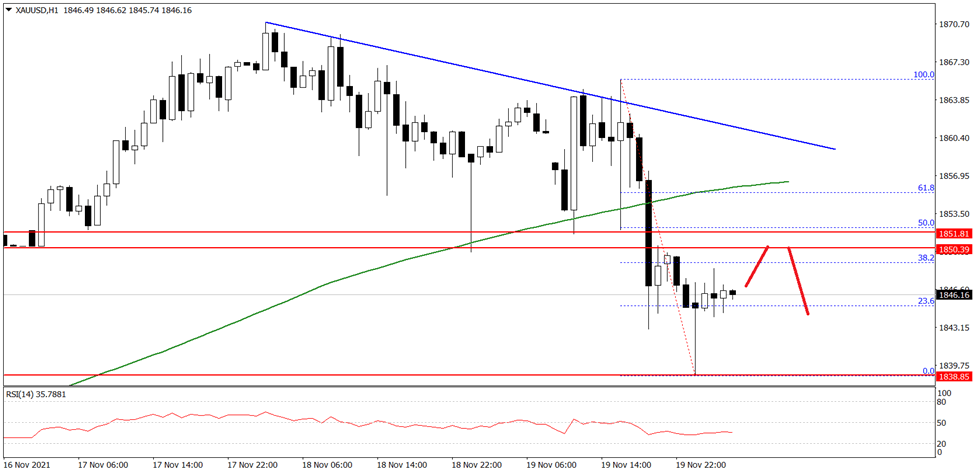
The first key support is near the $1,840 level. The next major support could be $1,835, below which there is a risk of more downsides. Any more losses could lead the price to $1,820 on FXOpen.
On the upside, an immediate resistance is near the $1,850 level. There is also a key bearish trend line forming with resistance near $1,860 on the hourly chart. The next main resistance could be near the $1,870 level.