Sample Category Title
Euro Soft But No Fresh Selloff Yet
Euro stays generally soft today even though there is no follow through selling yet. It's reported that Germany's acting Chancellor Angela Merkel urged in a CDU meeting tougher restrictions to combat the fourth wave of coronavirus infection. But the news was shrugged off as the markets have probably priced in a return to lockdown in Germany already. As for today, Yen and Sterling are the softer ones with Euro. Commodity currencies are firm on positive market sentiment in the US, with NASDAQ likely to extend record run at open.
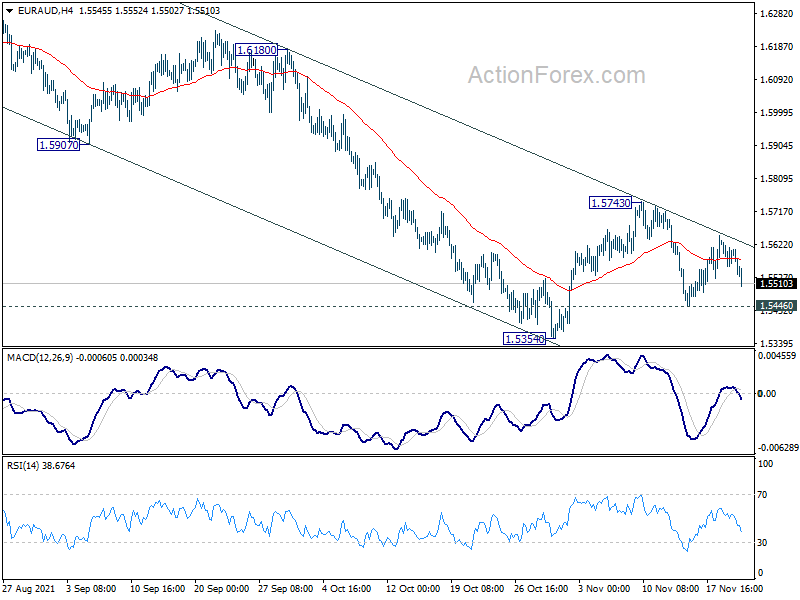
Technically, we'd maintain that Euro bears are probably still waiting to press the button on selling EUR/USD firmly away from 1.125/30 support zone. Thus, the movements in Euro against other relatively limited. One exception is EUR/AUD, which is apparently heading back to 1.5446 minor support. Break there will bring retest of 1.5354 low and could help drag Euro down elsewhere.
In Europe, at the time of writing, FTSE is down -0.18%. DAX is down -0.35%. CAC is down -0.30%. Germany 10-year yield is up 0.0242 to -0.316. Earlier in Asia, Nikkei rose 0.09%. Hong Kong HSI dropped -0.39%. China Shanghai SSE rose 0.61%. Singapore Strait Times rose 0.15%. Japan 10-year JGB yield dropped -0.0050 to 0.074.
Bundesbank: German inflation to be just under 6% in Nov
Bundesbank said in the monthly report that inflation rate will rise to "just under 6 percent in November". Inflation is expected to "decline noticeably in January when statistical special effects (especially the VAT base effect) expire. "But it could still be well over 3 percent for a long time," it added.
It also expects "a breather in the economic recovery" in autumn. Industrial is likely to "continue to be burdened by delivery problems", and thus, "dampen overall economic growth". Risks from an intensified pandemic would exist throughout the winter half-year. "As things stand at present, the macroeconomic effects are likely to be less severe than in previous pandemic waves," it said.
Gold edges lower, heading back to 1800 handle
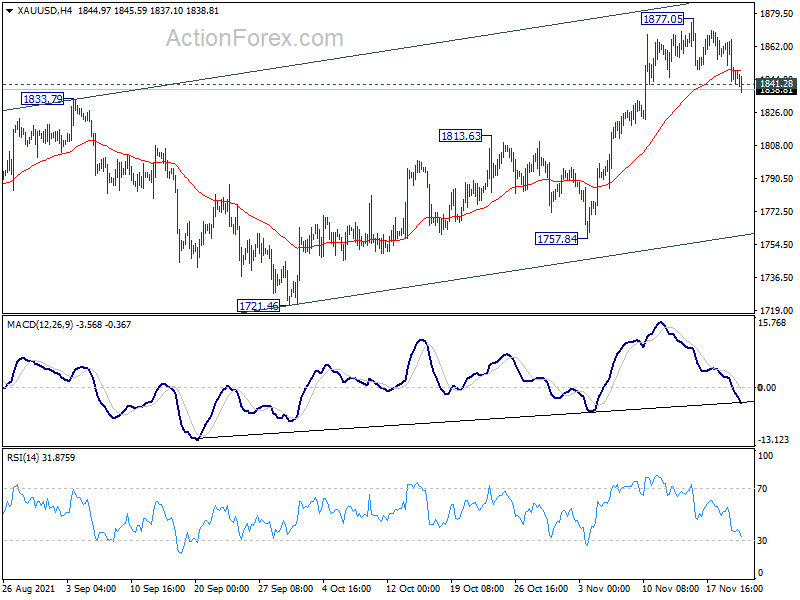
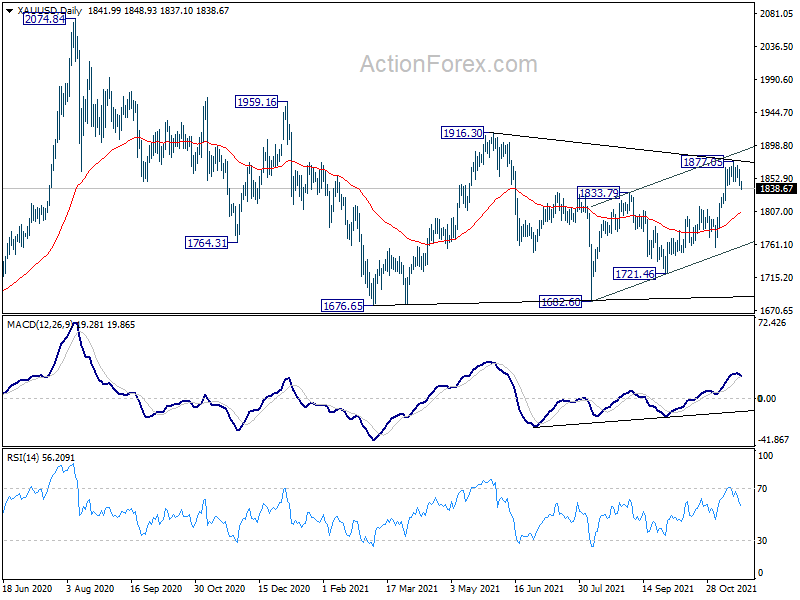
Gold edges lower today and break of 1841.28 support suggests that a short term top was formed at 1877.05 already. It's possible that whole rebound from 1682.60 has completed with three waves up to 1877.05. That means, such rise is just the third leg inside the corrective pattern from 1676.65. More importantly, that in turn argues that larger corrective pattern from 2074.84 high is still unfolding.
For now, deeper fall is in favor back to 55 day EMA (now at 1804.13) first. Sustained break there will affirm the above bearish case and bring retest of 1676.65/1682.60 support zone. On the other hand, break of 1877.05 will revive near term bullishness for 1916.30 key structural resistance.
EUR/USD Mid-Day Outlook
Daily Pivots: (S1) 1.1231; (P) 1.1302; (R1) 1.1354; More...
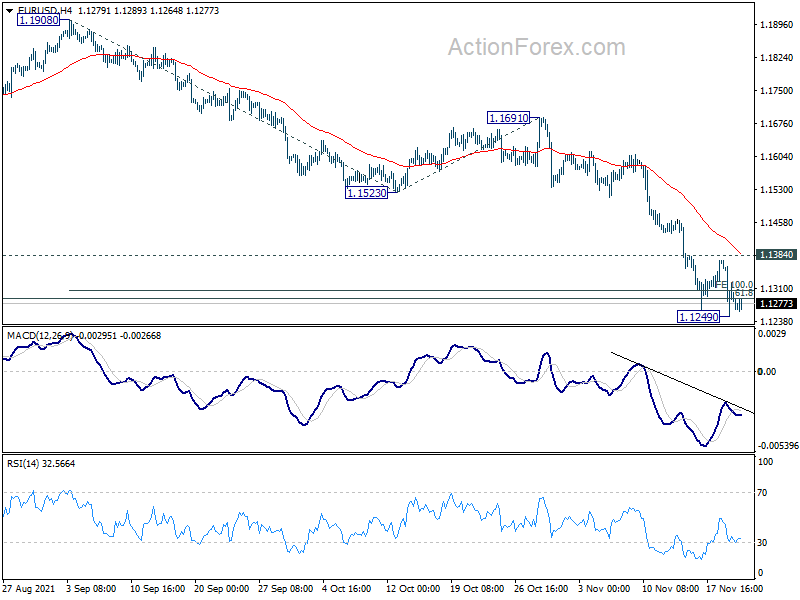
Intraday bias in EUR/USD remains neutral first and outlook is unchanged. On the downside, break of 1.1249 and sustained trading below 1.1289 long term fibonacci level will carry larger bearish implications. Deeper fall would then be seen to 161.8% projection of 1.1908 to 1.1523 from 1.1691 at 1.1068 next. Nevertheless, break of 1.1384 minor resistance will now indicate short term bottoming, and turn bias back to the upside for rebound.
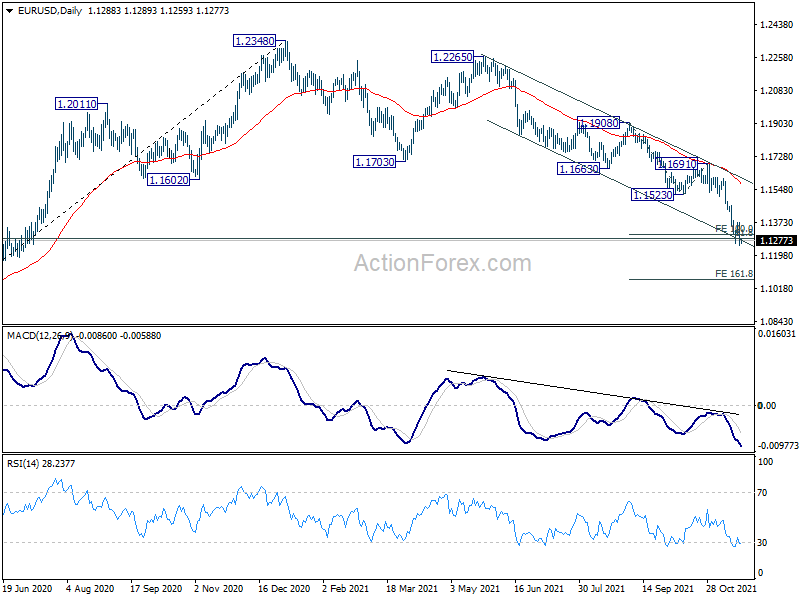
In the bigger picture, there are various ways of interpreting the fall from 1.2348 (2021 high). It could be a correction to rise from 1.0635 (2020 low), the fourth leg of a sideway pattern from 1.0339 (2017 low), or resuming long term down trend. In any case, outlook will now stay bearish as long as 1.1703 support turned resistance holds. Sustained break of 61.8% retracement of 1.0635 to 1.2348 at 1.1289 would pave the way back to 1.0635.
Economic Indicators Update
| GMT | Ccy | Events | Actual | Forecast | Previous | Revised |
|---|---|---|---|---|---|---|
| 15:00 | USD | Existing Home Sales Oct | 6.20M | 6.29M | ||
| 15:00 | EUR | Eurozone Consumer Confidence Nov P | -5 | -5 |
US Dollar Index Outlook: Rising Hopes of Early Fed Rate Hike
US Dollar Index
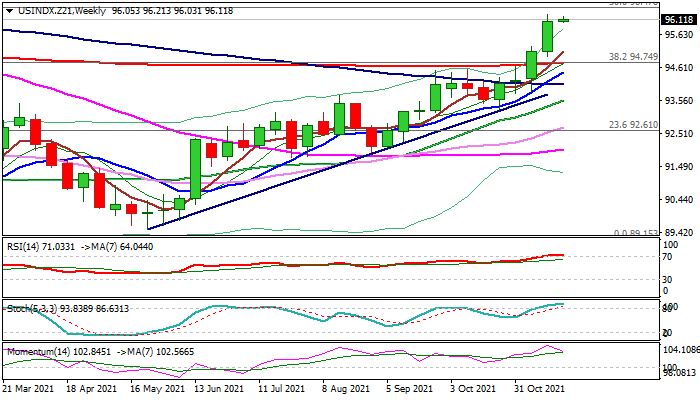
The dollar is holding near the new highest in over 16 months on Monday, maintaining a positive tone on growing hopes that Fed may accelerate tapering stimulus and open way for earlier than expected rate hike, as inflation continues to rise, colliding with US central bank’s stance that increased price pressures are transitory.
The dollar index advanced 1% last week after a strong bullish signal was generated on the previous week’s close above pivotal barrier at 94.76 (Fibo 38.2% of larger 103.80/89.15 fall/200DMA), with bulls pressuring key Fibo level at 96.47 (50% retracement).
Weakening bullish momentum on daily chart signals that bulls face headwinds (already registered two upside rejections) and may hold in extended consolidation before bulls continue.
Firm break of 96.47 barriers would risk extension towards 97.70 (mid-June lower platform and 98.20 (Fibo 61.8% of 103.80/89.15).
Broken barrier at 94.74 (Fibo/200DMA) reverted to strong support, which should contain possible extended dips and keep bulls in play.
Res: 96.25; 96.47; 97.70; 98.20.
Sup: 95.83; 95.10; 94.74; 94.45.
Japanese Yen is Falling a Bit
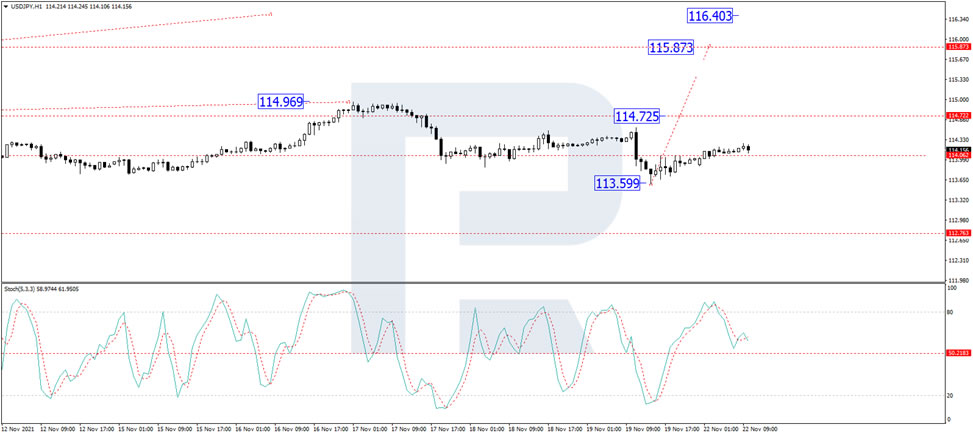
USD/JPY is growing on Monday and trading at 114.24.
The latest comments from the Japanese government are really worth paying attention to: the country’s authorities approved a new stimulus package to support the economy worth ¥79 trillion, which includes the fiscal spending of around ¥56 trillion. The money is expected to go to small and medium-sized businesses and mitigate the consequences of fuel price hikes.
On paper, the new stimulus program is intended for pushing the country’s GDP growth: the government is expecting the indicator to add 5.6%, its plan is to smooth the economic situation and revive the economy first and turn to the budget issues later.
It’s clear that the stimulus extension will lead to the same in the national debt, but the Japanese authorities do not consider this issue as the most important right now.
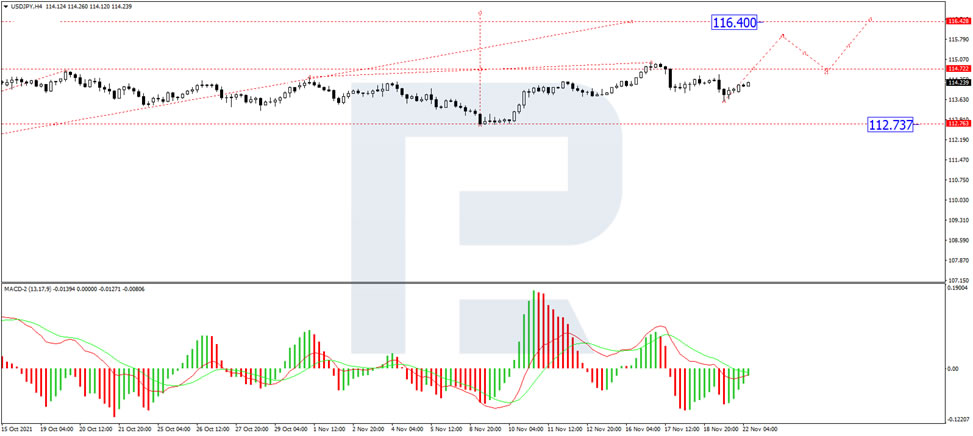
As we can see in the H4 chart, after completing the ascending wave at 114.96 along with the correction towards 113.60, USD/JPY is forming another ascending structure to break 114.96 and may later continue growing with the target at 116.00. After that, the instrument may correct towards 114.90 and then resume trading upwards to reach 116.40. From the technical point of view, this scenario is confirmed by MACD Oscillator: its signal line is growing to reach 0, a breakout of which may lead to further growth towards new highs.
In the H1 chart, after completing the descending structure at 113.63 along with the ascending impulse towards 114.00, USD/JPY is consolidating around the latter level. Possibly, the asset may break the range to the upside and reach 114.72. Later, the market may correct towards 114.00 and then resume trading upwards with the short-term target at 115.87. From the technical point of view, this scenario is confirmed by the Stochastic Oscillator: its signal line is moving above 50 and may later continue growing towards 80.
US Dollar Extend Gains
Europe COVID-19 situation keeps US dollar firm
The US dollar rally continued on Friday after Austria announced a full national lockdown due to spiralling Covid-19 cases. Fears that new virus restrictions across the Eurozone would derail its recovery saw the US dollar rise against the euro, but it was also evident that haven-related buying also boosted the greenback generally. The dollar index rose 0.57% to 96.06, edging higher to 96.11 in Asia.
The deteriorating risk sentiment weighed on the Australian and New Zealand dollars, which gave up over 0.60% to 0.7250 and 0.7000 respectively. With commodity prices also softening still, AUD/USD is likely to remain under pressure with a failure of 0.7220 opening further falls to 0.7150 initially. NZD/USD may find some support ahead of Retail Sales data and the RBNZ policy decision on Wednesday, With 0.25% priced in, if the RBNZ does not go 0.50%, NZD/USD could fall below 0.6900 this week.
USD/JPY is trading at 114.00 this morning and looks to have settled into a 113.50 to 115.00 trading range for now. Haven buying will support the yen, limiting USD/JPY gains unless long-dated US yields start moving higher across the curve again. With anti-lockdown riots sweeping Europe over the weekend, the environment for the single currency is challenging, without also pricing in a potential economic slowdown because of them. EUR/USD could test 1.1160 this week and that in turn sets up a potential retest of 1.1000. GBP/USD continues to find support due to its more impressive data of late but will remain guilty by geographic association with the euro. GBP/USD is steady at 1.3445 today and looks likely to trade in a choppy 1.3400 to 1.3500 range through the start of the week.
The US dollar strength story has been confirmed mostly to the G-10 space so far with Asian currencies remaining firm, mostly due to a constantly appreciating Chinese yuan. The PBOC set a weaker yuan fixing this morning, and noises were made from China officials over the weekend about speculation in the yuan by banks, which means buying yuan. Taken together, it seems that the PBOC may have felt yuan strength had gone far enough for now and thus regional Asian currencies are likely to struggle this week. I expect them to cautiously mark time for now unless the yuan weakens rapidly, which is unlikely, or US data does not impress this week. Any signs of a slowing in the US would be the catalyst for further Asian FX weakness, as would more Fed officials jumping on the Fed Vice-Chairman’s faster taper narrative.
Oil remains on the defensive
Oil prices tumbled on Friday thanks to fears over the European economic recovery and the ongoing threats by President Biden and other leaders to release strategic reserves onto the markets to push down prices. Brent crude tumbled 3.23% to USD 78.45 a barrel, and WTI collapsed by USD 4.05 to USD 75.65 a barrel.
In Asia, both Brent and WTI have added 25 cents to USD 78.70 and USD 75.90 a barrel on modest short-covering. Brent has resistance at USD 77.00 a barrel, with the 100-day moving average (DMA) at USD 74.00 providing support. WTI has resistance at $80.00 a barrel, with the 100-DMA at USD 76.70 the next major support.
The threat of coordinated SPR releases from various economies is more noise than substance, with President Biden unable to release a material amount from the SPR unless the situation can be legally defined as a material supply disruption. That would be a tenuous connection to make, as supplies continue to flow globally, albeit at higher prices. Europe is a rather more sobering situation, and if the Eurozone countries move back into more strict lockdowns into the holiday season, the knock-on effects on consumption will be noticeable.
Until the European situation clarifies one way or the other, oil rallies are likely to struggle for momentum above USD 82.00 and USD 80.00 respectively. Nevertheless, with oil prices now around 10% lower than a few weeks ago, and demand still robust in America and Asia, I do not anticipate another huge sell-off from here.
Fed taper torpedoes gold
Comments on Friday by the Fed Vice-Chairman suggesting that a fast Fed-taper could be in order, torpedoed gold’s rally, sending it 0.70% lower to USD 1846.00 an ounce. Once again, gold’s vulnerability to any hint of tighter US monetary policy has been highlighted, with a US dollar rally on Friday also weighing on gold prices.
That said, gold’s technical picture remains constructive in the medium-term, especially as it has spent over a week above the previously formidable zone of resistance between USD 1832.00 and USD 1825.00 an ounce. Gold’s Relative Strength Index (RSI) also hit extreme overbought levels last week, but Friday’s retreat has moved it back to neutral, another supportive technical factor.
Gold has risen to USD 1847.50 in quiet Asian trading and further losses cannot be ruled out as fast-money longs are culled. They should be limited to USD 1830.00 an ounce though, with a return to USD 1800.00 unlikely at this stage. Gold has topped out a number of times between USD 1870.00 and USD 1880.00 last week, and this denotes its next major barrier to further gains.
In the bigger picture, the repression of rates in the long-end of the US yield curve, along with US data showing that inflationary pressures are rising, finally seems to be bringing the inflation hedging trade back. With inflationary pressures reflecting only in short-dated rates, for now, only more officials jumping on to a faster-taper narrative, or a sudden move higher in longer-term US yields is likely to derail gold’s rally. Gold will likely consolidate in a USD 1830.00 to USD 1860.00 an ounce range over the first half of this week.
RBNZ To Lift Policy Rate Again after Strong Inflation
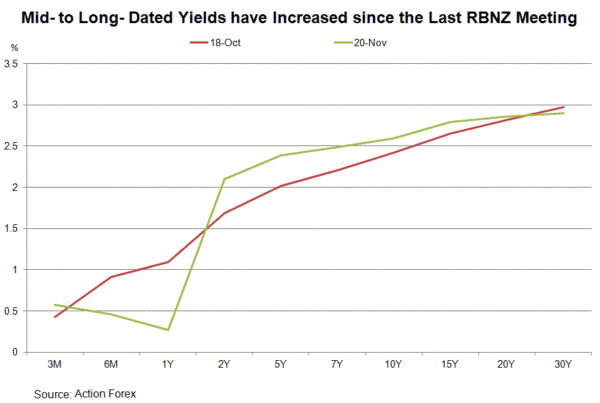
The RBNZ is ready to increase the policy rate again this week. The question is whether, in light of the latest strong inflation data, whether the hike is +25 bps or +50 bps. We continue to expect the former. Several banks have lifted the mortgage rates, while bond yields have risen after October's rate hike. With considerable tightening effects felt in the market, policymakers will likely normalize its monetary policy measures in a gradual manner.
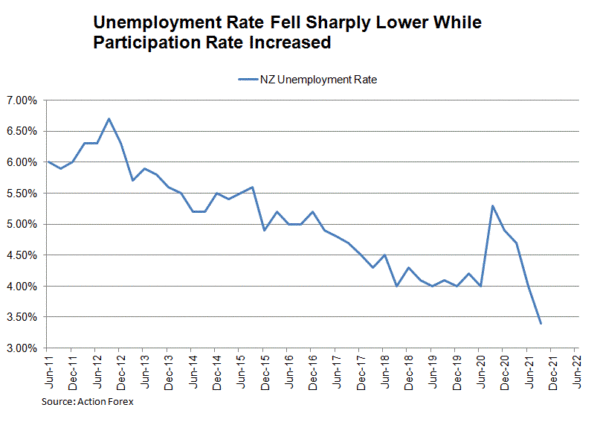
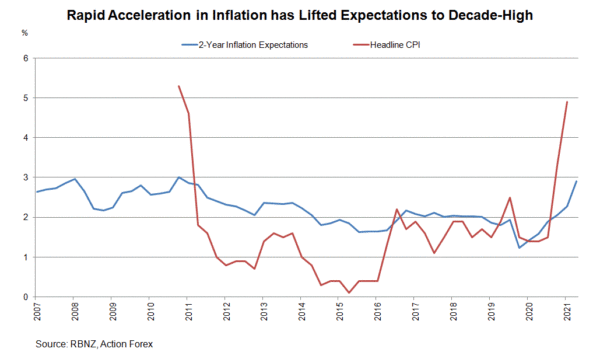
 Economic data since the last meeting have pointed to robust economic recovery in New Zealand. For instance, the unemployment rate fell -0.6 ppt to 3.4% in 3Q21, beating consensus of +3.9%. The decline in the unemployment rate despite higher participation rate was in particular remarkable. The number of employment gained +2% q/q and +4.2% y/y, compared with consensus of +0.4% and +2.7%, respectively. Inflation again surprised to the upside. Headline CPI accelerated to +4.9% y/y in 3Q21, from +3.3% prior. This has exceeded the consensus of an already-strong +4.2%. The 2-year-ahead inflation expectations also strengthened further to +2.96% y/y for 4Q21, from +2.27% previously. This marks the highest since 2Q11. Meanwhile, the one-year inflation also accelerate to +3.7% from +3.02% prior.
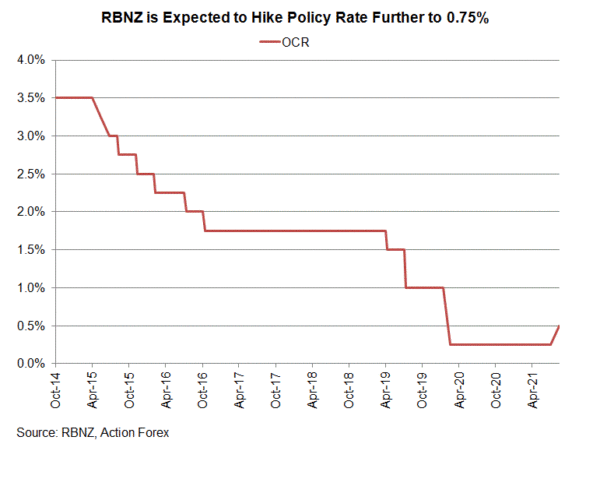
Strong inflation and job market are pushing the central bank to continue its policy normalization. Last month, the RBNZ increased the OCR by +25 bps to 0.5%, the first time in 7 years. Policymakers pledged to tighten further in coming months as inflation pressure continued to exceed target. Economic recovery has remained robust and acceleration of inflation proves faster than previously anticipated. The market has fueled speculations of a +50 bps hike this month, although the consensus remains +25 bps. We also anticipated a +25 bps rate hike. Indeed, the market has done part of the tightening job for the RBNZ. Mortgage rates have risen by around +100 bps so far. The fourth quarter increase is expected to be one of the largest quarterly increases since the OCR was introduced in 1999. Meanwhile, the RBNZ can adjust the OCR to, say, 3% by the end of the forecast, from 2% in August projection. This could also have some tightening effect to the market.
Bundesbank: German inflation to be just under 6% in Nov
Bundesbank said in the monthly report that inflation rate will rise to "just under 6 percent in November". Inflation is expected to "decline noticeably in January when statistical special effects (especially the VAT base effect) expire. "But it could still be well over 3 percent for a long time," it added.
It also expects "a breather in the economic recovery" in autumn. Industrial is likely to "continue to be burdened by delivery problems", and thus, "dampen overall economic growth". Risks from an intensified pandemic would exist throughout the winter half-year. "As things stand at present, the macroeconomic effects are likely to be less severe than in previous pandemic waves," it said.
Quiet Start To Shortened Trading Week
Notes/Observations
- Quiet start to trade shorten Thanksgiving week.
- Awaiting Biden announcement on Fed chair.
- Policy divergence between Fed and ECB and BOJ remain in focus.
Asia
- China Foreign Exchange Market Self-Discipline Mechanism [PBOC led group] said to comment on the FX proprietary trading of domestic banks, said to ask banks to cap the size of proprietary trading accounts related to FX.
- China PBoC Monthly Loan Rate Setting Operation left both the 1-year and 5-year rates unchanged for the 19th consecutive month of steady rates.
Coronavirus
- German govt officials said to be debating making vaccinations compulsory. Several members of Chancellor Merkel’s Conservative bloc said that Federal and State govts should introduce them soon (On Fri, Nov 19th German Foreign Min Haas said to rule out national general lockdown amid rise in COVID case)
- Netherlands saw a 2nd night of riots as people took to streets to protest against new lockdown rules.
Europe
- EU said to be planning to increase restrictions on banks' use of cross border permissions [method used by non Euro Zone banks to sell certain activities in the EU].
- UK Brexit Min Frost confirmed that talks with EU's Sefcovic to continue into week of Nov 22nd; Talks had been intensive and constructive. So far the solutions the EU have provided fail to deal with the problems. We need more ambition and more urgency if we are to sustain the peace process and protect the Good Friday Agreement.
- France President Macron: Fishing and Brexit negotiations are progressing too slowly and without enough firmness.
- BOE Gov Bailey reiterated stance that If the economy evolved in the way the forecasts and reports suggest, we’ll have to raise rates. Not the bank’s job to fix supply chain issues hampering economies around the world which cause inflation to rise.
Americas
- US President Biden said to be prepared to make announcement on Fed Chair before he leaves for his holiday trip during the evening on Tuesday. Nov 23rd.
Energy
- Oil prices lower as reports of coordinated reserves release rises (Japan said to prepares oil-reserve sale as current level of supply deemed excessive).
Speakers/Fixed income/FX/Commodities/Erratum
Equities
- Indices [Stoxx600 +0.19% at 487.02, FTSE +0.26% at 7,242.11, DAX +0.03% at 16,165.25, CAC-40 +0.21% at 7,127.12, IBEX-35 +0.58% at 8,803.95, FTSE MIB -0.11% at 27,307.00 , SMI +0.06% at 12,552.10, S&P 500 Futures +0.34%].
Market Focal Points/Key Themes:
Equities
- European indices opened slightly higher on Monday’s morning; sector among those outperforming others is telecom on potential KKR’s acquisition of Telecom Italia which trades higher over 20%; while sectors trending lower include real estate and materials; UK retailer Marks and Spencer trades 3% higher in London following over-the-weekend speculation of Apollo’s acquisition interest; Ericsson announced to acquire US firm Vonage Holdings in $6.2B deal and trades lower 4%; Frontier Developments stock trade fell sharply on trading update and outlook cut; earnings during the upcoming US session include Twist Biosciences and Spire.
- Consumer discretionary: Marks & Spencer [MKS.UK] +3% (Apollo's interest).
- Financials: Julius Baer [BAER.CH] -3% (trading update).
- Materials: Hochschild Mining [HOC.UK] -48% (response to Peru events).
- Real Estate: Vonovia [VNA.DE] -1% (capital raise).
- Technology: - Frontier Developments [FDEV.UK] -31% (trading update; outlook cut).
- Telecom: Telecom Italia [TIT.IT] +22%, Vivendi [VIV.FR] +3% (KKR offer for Telecom Italia), Ericsson [ERICB.SE] -4% (acquires Vonage Holdings).
Speakers
- ECB noted that the banking sector was not close to meeting expectations on climate risk.
- Germany new govt Cabinet said to include FDP leader Lindner as Finance Minister with Habeck as Economy Minister.
- Romania new ruling parties said to agree on PM.
Currencies/Fixed Income
- USD maintained its firm tone on perceive divergence in central bank policies.
- EUR/USD below the 1.1280 area with the pair softening over concerns regarding the economic impact of renewed restrictions in Europe to contain rising coronavirus cases.
- China said to move to limit financial institutions' speculation on the yuan. Dealers note China policymakers seemed to have grown increasingly uncomfortable with the CNY currency (Yuan) recent rally.
Economic data
- (NL) Netherlands Nov Consumer Confidence: -19 v -10 prior.
- (DK) Denmark Nov Consumer Confidence Indicator: -2.0 v +3.3 prior.
- (TR) Turkey Nov Consumer Confidence: 71.1 v 76.8 prior.
- (MY) Malaysia mid-Nov Foreign Reserves: $116.5B v $116.1B prior.
- (CH) Swiss Oct M3 Money Supply Y/Y: 2.5% v 3.3% prior.
- (TR) Turkey Oct Foreign Tourist Arrivals Y/Y: 99.3% v 59.5% prior.
- (TW) Taiwan Oct Export Orders Y/Y: 14.6% v 22.9%e (20th straight month of growth).
- (TW) Taiwan Oct Unemployment Rate: 3.8% v 3.8%e.
- (HK) Hong Kong Oct CPI Composite Y/Y: 1.7% v 1.8%e.
- (ES) Spain Sept Trade Balance: -€2.4B v -€3.9B prior.
- (CH) Swiss weekly Total Sight Deposits (CHF): 719.3B v 719.2B prior; Domestic Sight Deposits: 646.7B v 644.1B prior.
- (PL) Poland Oct Sold Industrial Output M/M: +2.3% v -0.5%e; Y/Y: 7.8% v 5.3%e.
- (PL) Poland Oct Construction Output Y/Y: % v 3.4%e.
- (PL) Poland Oct PPI M/M: 1.8% v 1.3%e; Y/Y: 11.8% v 11.0%e.
- (BE) Belgium Nov Consumer Confidence Index: 1 v 4 prior.
Fixed income Issuance
- None seen.
Looking Ahead
- (AR) Argentina Oct Budget Balance (ARS): No est v 291.4B prior.
- (MX) Citibanamex Survey of Economists.
- (CO) Colombia Oct Industrial Confidence: No est v 20.4 prior; Retail Confidence: No est v 40.3 prio.
- 05:25 (EU) Daily ECB Liquidity Stats.
- 05:30 ((DE) Germany to sell €3.0B in 12-month BuBills; Avg Yield: % v -0.7424% prior; bid-to-cover: x v 2.70x prior (Nov 15th 2021).
- 06:00 (IE) Ireland Oct PPI M/M: No est v 0.0% prior; Y/Y: No est v -1.9% prior.
- 06:00 (IL) Israel Sept Manufacturing Production M/M: No est v -2.4% prior.
- 06:00 (IL) Israel Oct Unemployment Rate: No est v 5.2% prior; Unemployment Rate (including Covid Effect): No est v 7.9% prior.
- 06:00 (DE) Belgium Debt Agency (BDA) to sell €2.4-3.2B in 2031, 2040 and 2071 OLO Bonds.
- 06:00 (RO) Romania to sell 2027 and 2036 bonds.
- 06:00 (IL) Israel to sell 2024, 2026, 2032, 2051 bonds (5 tranches).
- 06:25 (BR) Brazil Central Bank Weekly Economists Survey.
- 06:30 (EU) EU Commission to sell Bonds.
- 06:45 (US) Daily Libor Fixing.
- 07:00 (IN) India announces details of upcoming bond sale (held on Fridays).
- 07:00 (TR) Turkey to sell Fixed Rate Bonds.
- 08:00 (UK) Daily Baltic Dry Bulk Index.
- 08:30 (US) Oct Chicago Fed National Activity Index: +0.10e v -0.13 prior.
- 09:00 (FR) France Debt Agency (AFT) to sell €4.4-5.6B in 3-month, 6-month and 12-month bills.
- 09:00 (IL) Israel Central Bank (BOI) Interest Rate Decision: Expected to leave Base Rate unchanged at 0.10%.
- 09:00 (AT) ECB's Holzmann (Austria) with members, Kazaks (Latvia), Kazimir (Slovakia), Czech Central bank Gov Rusnok in Vienna.
- 09:45 (UK) BOE to buy £1.47B in APF Gilt purchase operation (3-7 years).
- 10:00 (US) Oct Existing Home Sales: 6.18Me v 6.29M prior.
- 10:00 (EU) Euro Zone Nov Advance Consumer Confidence: -5.3e v -4.8 prior.
- 12:30 (ES) ECB's De Guindos (Spain).
- 16:00 (KR) South Korea Nov Consumer Confidence: No est v 106.8 prior.
- 16:45 (NZ) New Zealand Q3 Retail Sales Q/Q: -10.5%e v +3.3% prior.
- 17:00 (AU) Australia Nov Preliminary PMI Manufacturing: No est v 58.2 prior; PMI Services: No est v 51.8 prior; PMI Composite: No est v 52.1 prior.
- 17:30 (AU) Australia ANZ Roy Morgan Weekly Consumer Confidence Index: No est v 106.0 prior.
- 18:01 (NL) Netherlands Oct House Price Index M/M: No est v 1.6% prior; Y/Y: No est v 18.5% prior.
- 20:05 (AU) RBA's Kohler at virtual conference.
- 21:30 (KR) South Korea to sell KRW400B in 20-year Bonds.
- 22:00 (TH) Thailand Central Bank to sell THB50B in 3-month bills.
- 22:30 (HK) Hong Kong to sell 3-month, 6-month and 12-month Bills.
- 22:30 (TH) Thailand Oct Customs Trade Balance: $0.1Be v $0.6B prior; Exports Y/Y: 16.5%e v 17.1% prior; Imports Y/Y: 29.6%e v 30.3% priora.
Gold edges lower, heading back to 1800 handle
Gold edges lower today and break of 1841.28 support suggests that a short term top was formed at 1877.05 already. It's possible that whole rebound from 1682.60 has completed with three waves up to 1877.05. That means, such rise is just the third leg inside the corrective pattern from 1676.65. More importantly, that in turn argues that larger corrective pattern from 2074.84 high is still unfolding.
For now, deeper fall is in favor back to 55 day EMA (now at 1804.13) first. Sustained break there will affirm the above bearish case and bring retest of 1676.65/1682.60 support zone. On the other hand, break of 1877.05 will revive near term bullishness for 1916.30 key structural resistance.
GBP/AUD Rooftop Pattern In Daily TF Shorts Are Coming With Momentum
GBP/AUD technical analysis
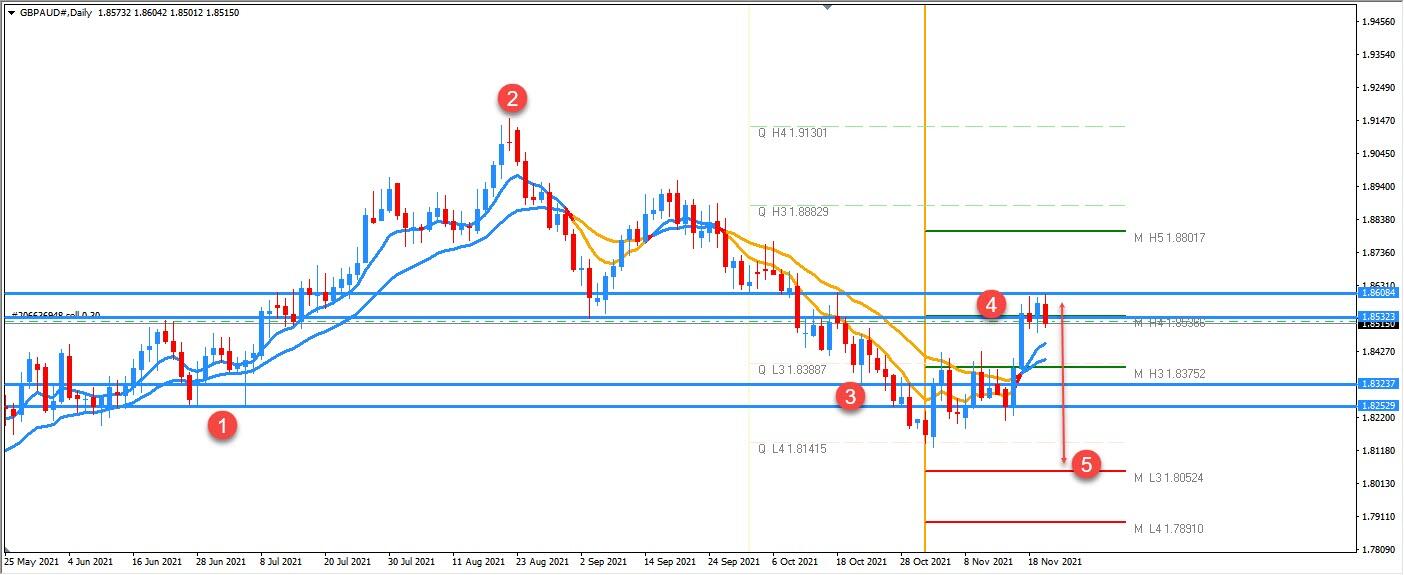
- Rooftop pattern on daily.
- The price should move down.
- Targets are M H3 and M L3.
- 1-2-3 Breakout.
- Double top support.
- High of the move.
- New Support.
- Retest of the swing entry zone.
- Target.
GBP/AUD has formed a rooftop pattern on the daily TF. The pattern has a horizontal or near horizontal bottom with up sloping trend in the first part of the pattern followed by a down-sloping trend in the last part of the pattern. 1-2-3 resembles the roof. The entry zone is around 1.8520. The first target is is M H3 camarilla 1.8375 followed by 1.8250. If the market continues with the trend the final target is M L3 camarilla pivot - 1.8050.
The Analytical Overview Of The Main Currency Pairs
The EUR/USD currency pair
Technical indicators of the currency pair:
Prev Open: 1.1366
Prev Close: 1.1281
% chg. over the last day: -0.75%
With inflation in the Eurozone above 4%, analysts believe that prices in the region will continue to rise, potentially forcing the European Central Bank to raise interest rates by the end of next year. Germany's producer price index increased to a record high. The euro is under pressure not only because of high inflation but also because of fears of new COVID restrictions in the region.
Trading recommendations
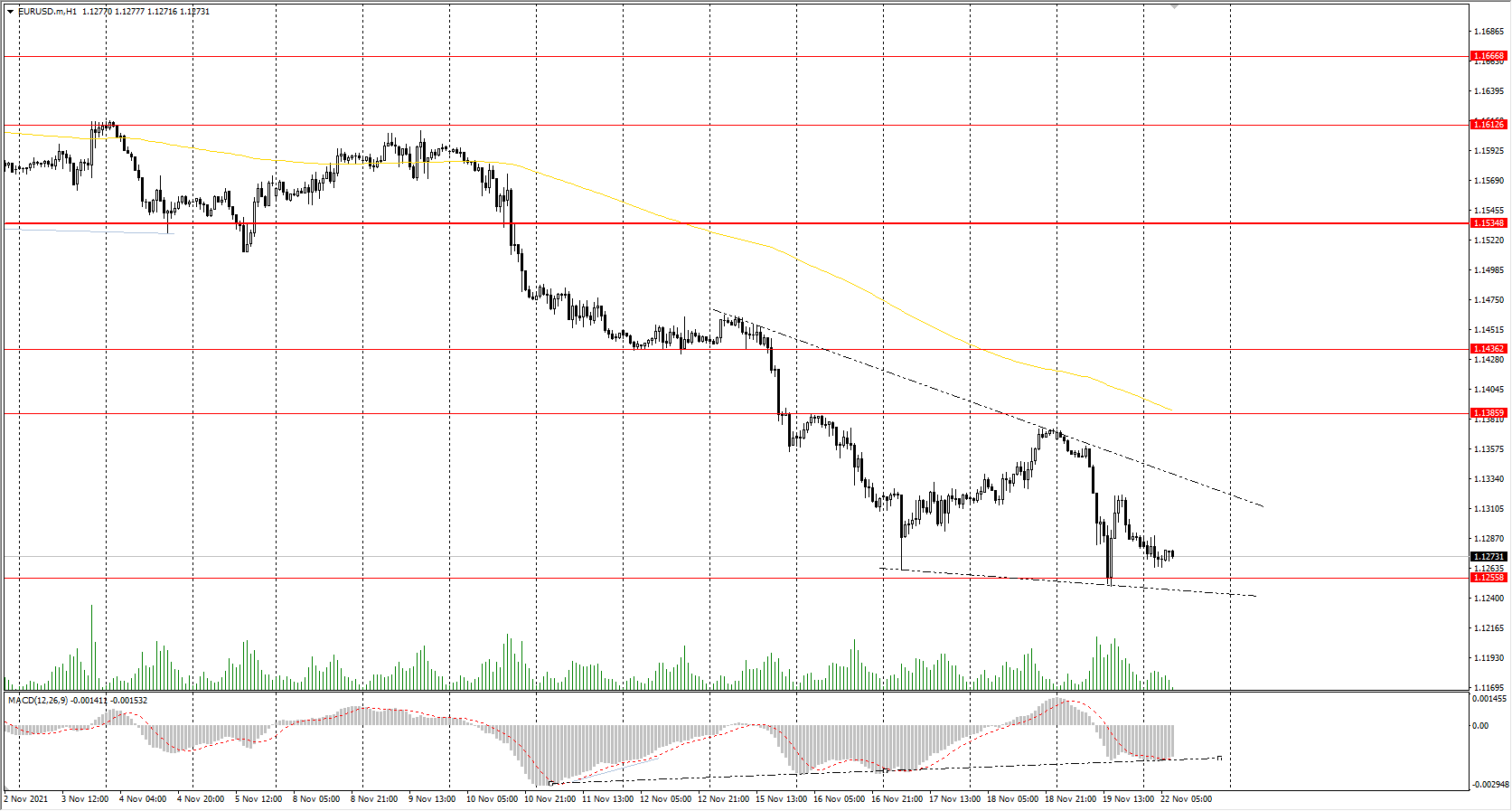
Support levels: 1.1256
Resistance levels: 1.1386, 1.1436, 1.1535, 1.1613, 1.1667, 1.1717
From the technical point of view, the EUR/USD is bearish on the hour time frame. The Euro continues to show weakness. The MACD indicator has become negative again, but the buyers' pressure is weakening. Under such market conditions, traders should consider sell positions from the resistance levels near the moving average since the price has deviated strongly from the averages. Buy trades should be considered only from the support levels of the higher time frame, given the buyers’ initiative, but only with short targets.
Alternative scenario: if the price breaks out through the 1.1436 resistance level and fixes above, the mid-term uptrend will likely resume.
News feed for 2021.11.22:
- US Existing Home Sales (m/m) at 17:00 (GMT+2).
The GBP/USD currency pair
Technical indicators of the currency pair:
Prev Open: 1.3483
Prev Close: 1.3443
% chg. over the last day: -0.30%
The UK retail sales increased by 0.8% in October; a rise of 0.5% was expected. The British pound is now looking more steady than the euro. More analysts believe that the Bank of England will raise the interest rate at its next meeting.
Trading recommendations
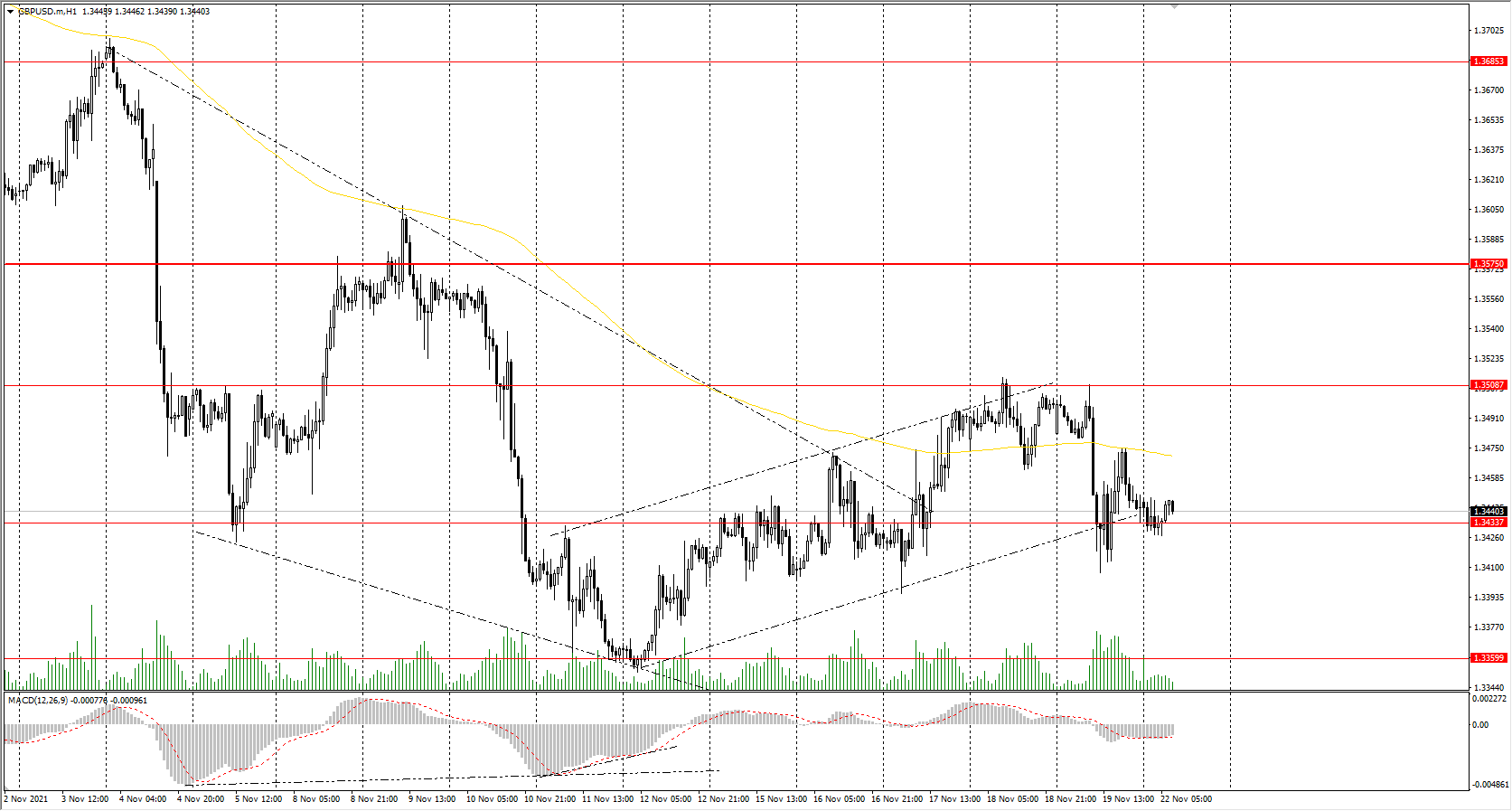
Support levels: 1.3434, 1.3360
Resistance levels: 1.3507, 1.3575, 1.3685, 1.3748
On the hourly time frame, the trend on GBP/USD is bearish. The MACD indicator has become inactive. Under such market conditions, traders should consider sell positions from the priority change level. Buy trades should be considered only from the support levels of the higher time frame, given the buyers’ initiative.
Alternative scenario: if the price breaks out through the 1.3507 resistance level and consolidates above, the bullish scenario will likely resume.
The USD/JPY currency pair
Technical indicators of the currency pair:
Prev Open: 114.25
Prev Close: 114.01
% chg. over the last day: -0.21%
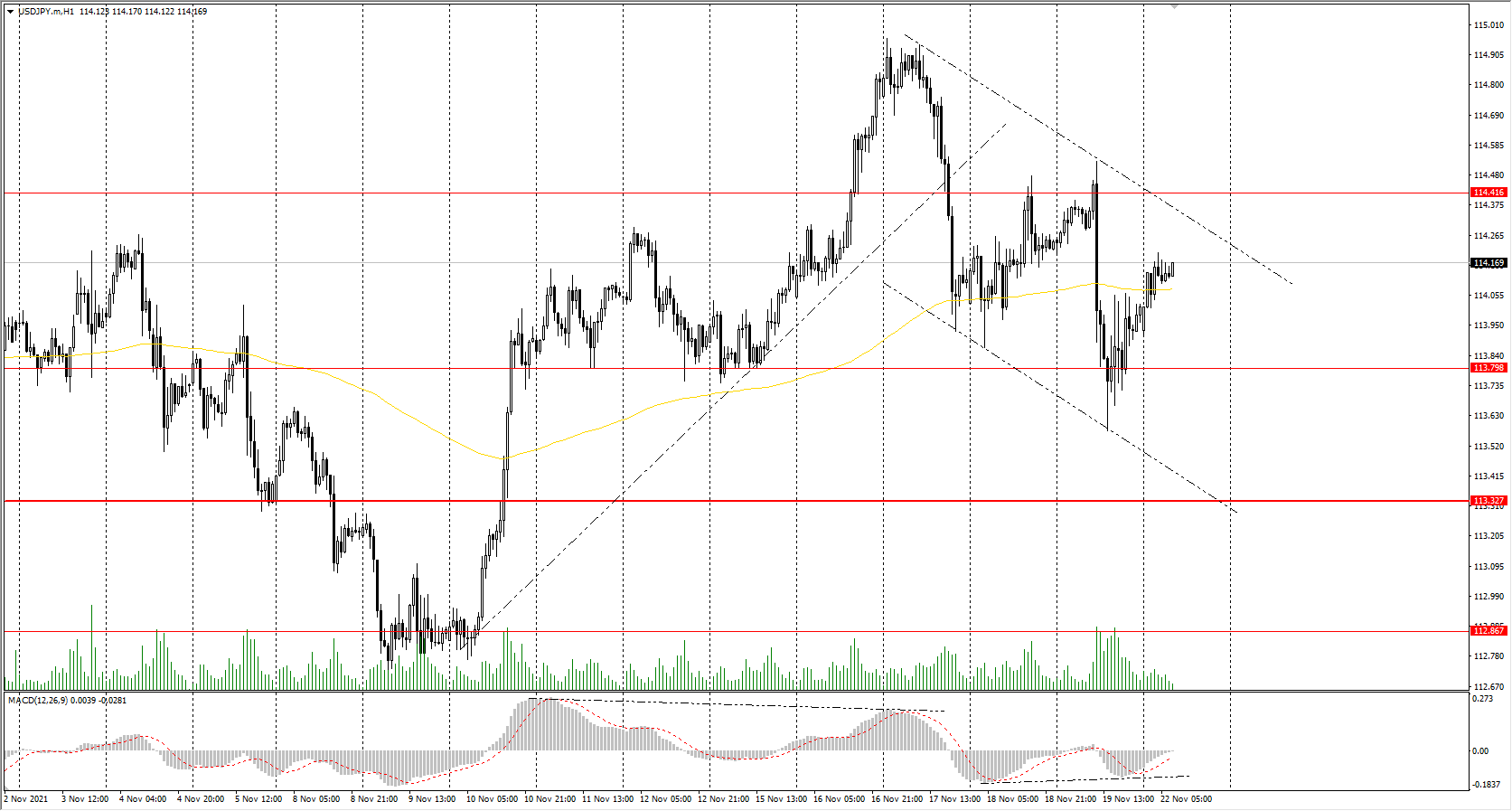
In Japan, there is a sharp decrease in COVID cases. This is a good sign for a complete lifting of restrictions in the near term, which will eventually increase business activity in the country. But because of the ultra-soft monetary policy from the Bank of Japan, the yen will weaken against the US dollar.
Trading recommendations
Support levels: 113.79, 113.32, 112.87, 112.30
Resistance levels: 114.42, 115.15, 115.50
The global trend on the USD/JPY currency pair is bullish. But the price has corrected to the moving average line. The MACD indicator has become inactive. Under such market conditions, it’s better to look for buy positions from the buyers' initiative zone near the moving average. Sell positions should be considered from the resistance levels of higher time frames, given there is sellers' initiative, but only with short targets.
Alternative scenario: if the price falls below 113.32, the uptrend will likely be broken.
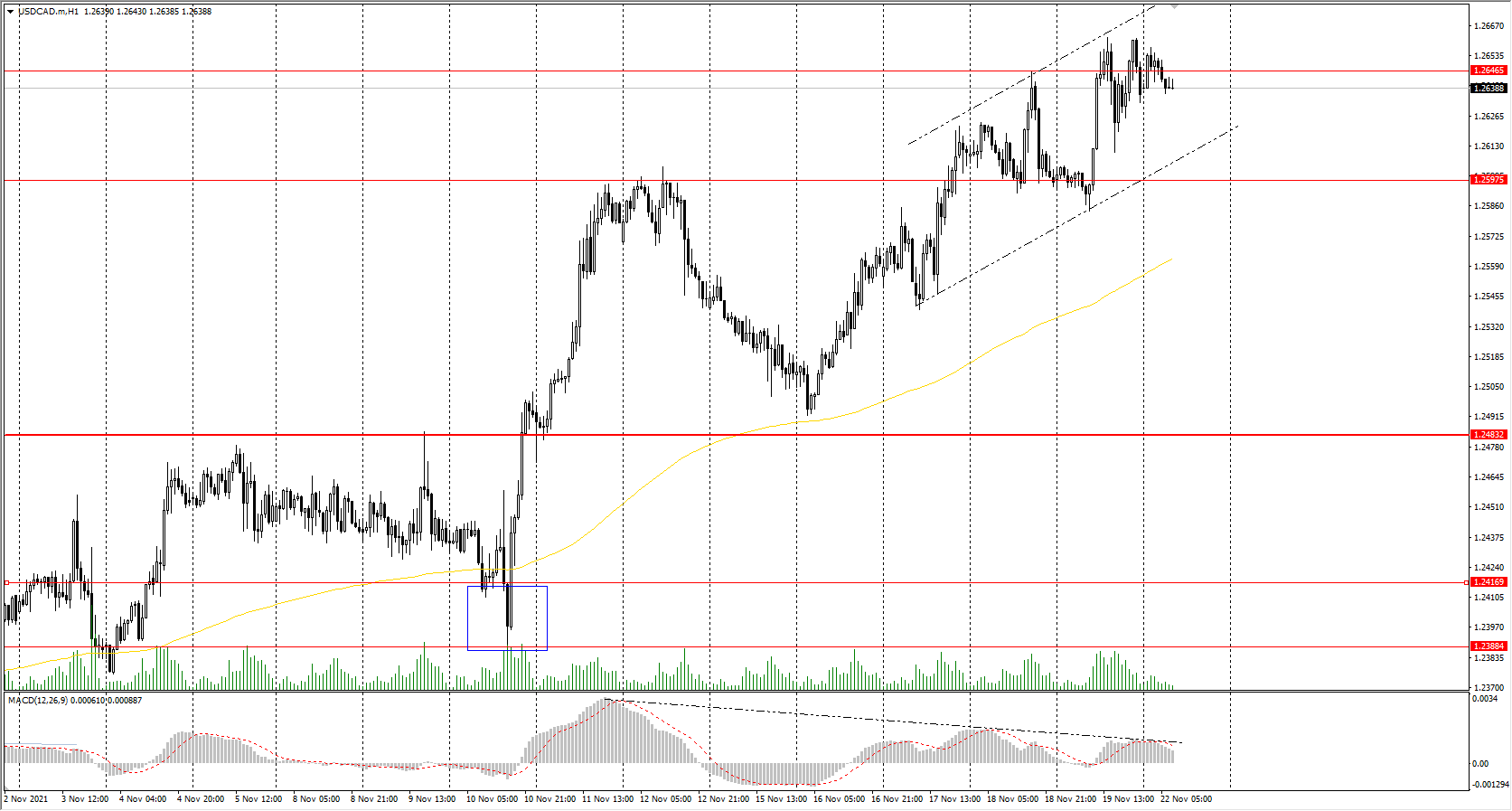
The USD/CAD currency pair
Technical indicators of the currency pair:
Prev Open: 1.2598
Prev Close: 1.2636
% chg. over the last day: +0.30%
The Canadian dollar is a commodity currency, so the USD/CAD currency pair highly depends on the dynamics of the dollar index and oil prices. On Friday, the dollar index increased slightly while oil prices decreased. As a result, the USD/CAD currency pair increased due to the strengthening of the US dollar. Fundamentally, both the dollar index and oil quotes have an upward trend now, so in the medium term USD/CAD will be trading flat.
Trading recommendations
Support levels: 1.2598, 1.2483, 1.2416, 1.2388
Resistance levels: 1.2646, 1.2729
From a technical point of view, the trend of the USD/CAD currency is bullish. The MACD indicator is in the positive zone, but there are signs of divergence on several time frames, which indicates the weakness of the buyers. Under such market conditions, it is better to look for buy trades from the support levels near the moving average. Sell deals should be considered from the resistance levels of the higher time frames.
Alternative scenario: if the price breaks down through the 1.2483 support level and fixes below, the downtrend will likely resume.