Sample Category Title
S&P 500 and NASDAQ hit new records as Fed Powell nominated for second term
Fed Chair Jerome Powell was nominated for a second four-year term by President Joe Biden, as announced today. Governor Lael Brainard is nominated as Vice Chair.
In a statement, Biden said, "fundamentally, if we want to continue to build on the economic success of this year we need stability and independence at the Federal Reserve – and I have full confidence after their trial by fire over the last 20 months that Chair Powell and Dr. Brainard will provide the strong leadership our country needs."
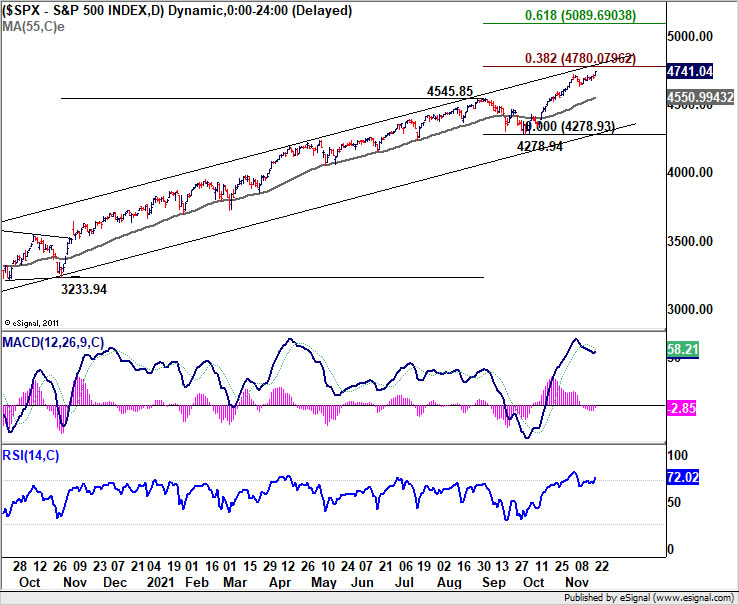
Investors appear to welcome the decision, as S&P 500 and NASDAQ are hitting new record highs. S&P 500 is now on track to 38.2% projection of 3233.94 to 4545.85 from 4278.94 at 5089.69.
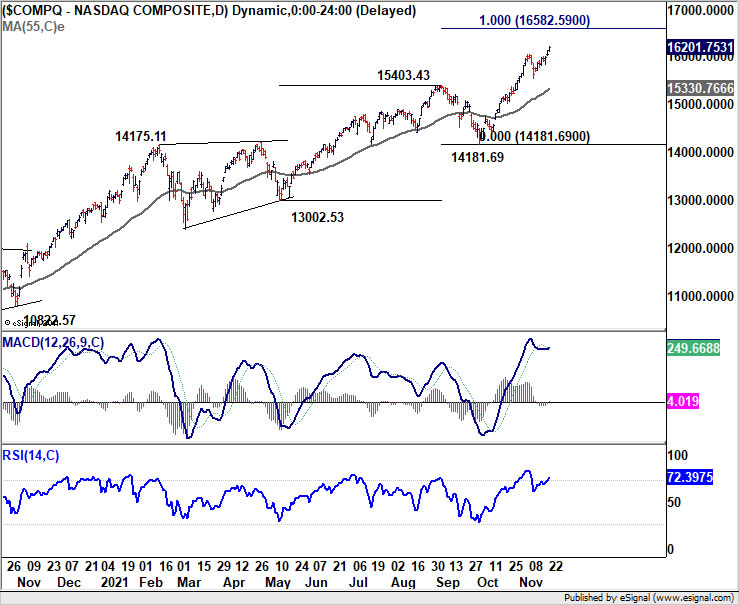
NASDAQ is also on track to 100% projection of 13002.53 to 15403.43 from 14181.69 at 16582.59.
RBNZ Meeting: Single or Double Rate Hike?
The Reserve Bank of New Zealand (RBNZ) will wrap up its latest meeting at 01:00 GMT Wednesday. A rate increase is definitely on the menu - the real question is how much rates will be raised. There’s no real reason why the central bank should go for a ‘double’ rate hike with so many risks still on the radar, which leaves room for disappointment in the FX arena.
Coming in hot
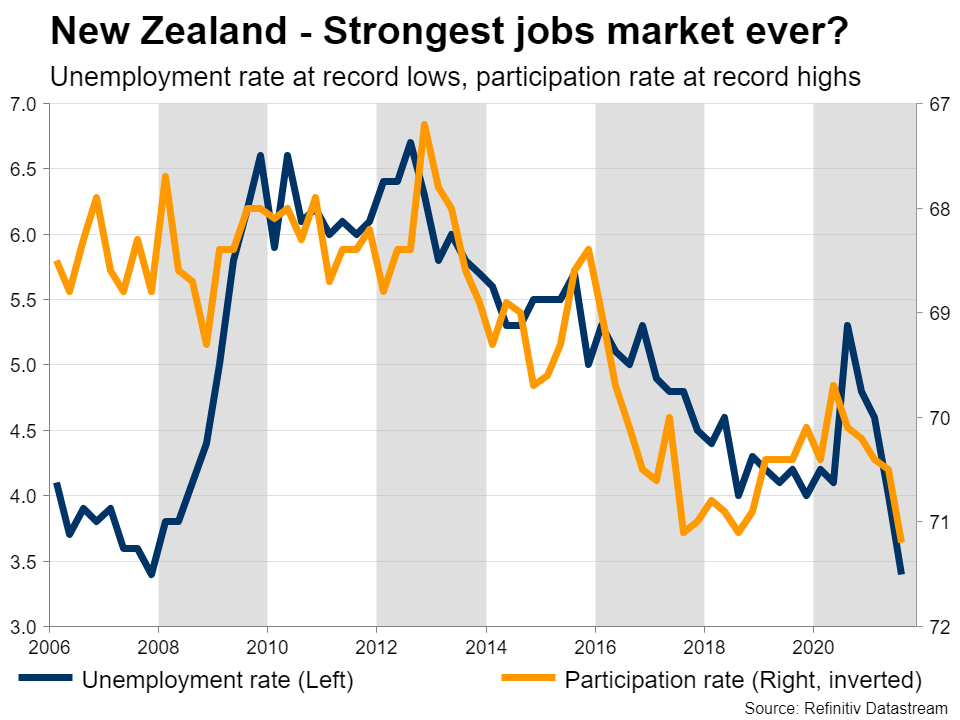
New Zealand’s economy is running like a well-oiled machine. An impressive dose of government spending throughout the crisis coupled with reduced immigration have seen the labor market stage an incredible recovery. The unemployment rate hit a record low in Q3 even as labor force participation hit a record high, which means the jobs market is at its strongest point ever.
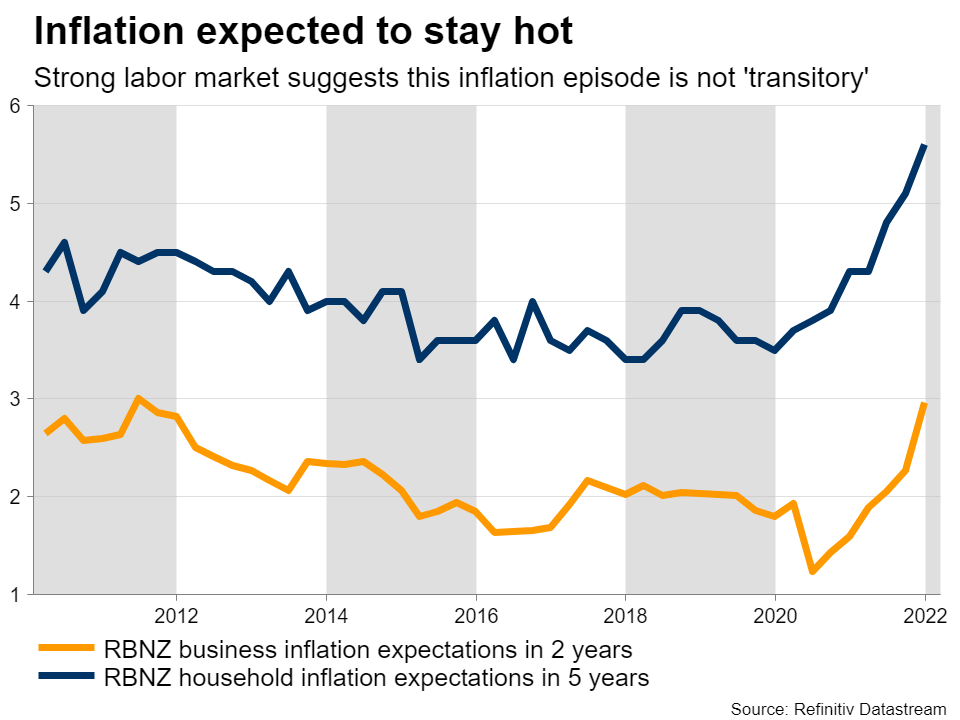
Inflationary pressures have also intensified, with the CPI rate hitting a decade high of 4.9% and inflation expectations surging across the board. This suggests businesses and consumers expect higher inflation to be a more permanent phenomenon over the next few years.
The final argument for raising rates is the housing market. House prices are still rising at an alarming pace, fueling worries of a ‘bubble’. The central bank has already imposed several restrictions to cool this market, but higher interest rates are usually the most powerful tool.
Single vs double
With all this in mind, a rate increase this week seems almost certain. The economy seems ready to overheat and inflation cannot be explained away as ‘transitory’ considering how strong the labor market is. The real question is how much the RBNZ will raise rates.
A regular 25 basis points rate increase is already priced in, and money markets also assign a 40% chance for a ‘double’ hike of 50 basis points. In other words, investors are split on the matter.
While the strength of the economy itself could certainly justify a double hike, it is not really a wise choice from a risk management perspective. Such a drastic move would risk shocking the economy at a time when there are still several risks on the radar.
Covid infections are spreading across the country and China’s slowdown threatens demand for New Zealand’s commodity exports. Both factors argue for some caution.
Kiwi seems vulnerable
If the RBNZ indeed plays it safe and just delivers a ‘single’ rate hike, that could come as a disappointment for the New Zealand dollar. Taking a technical look at kiwi/dollar, a potential break below the 0.6980 barrier would turn the spotlight towards 0.6860.
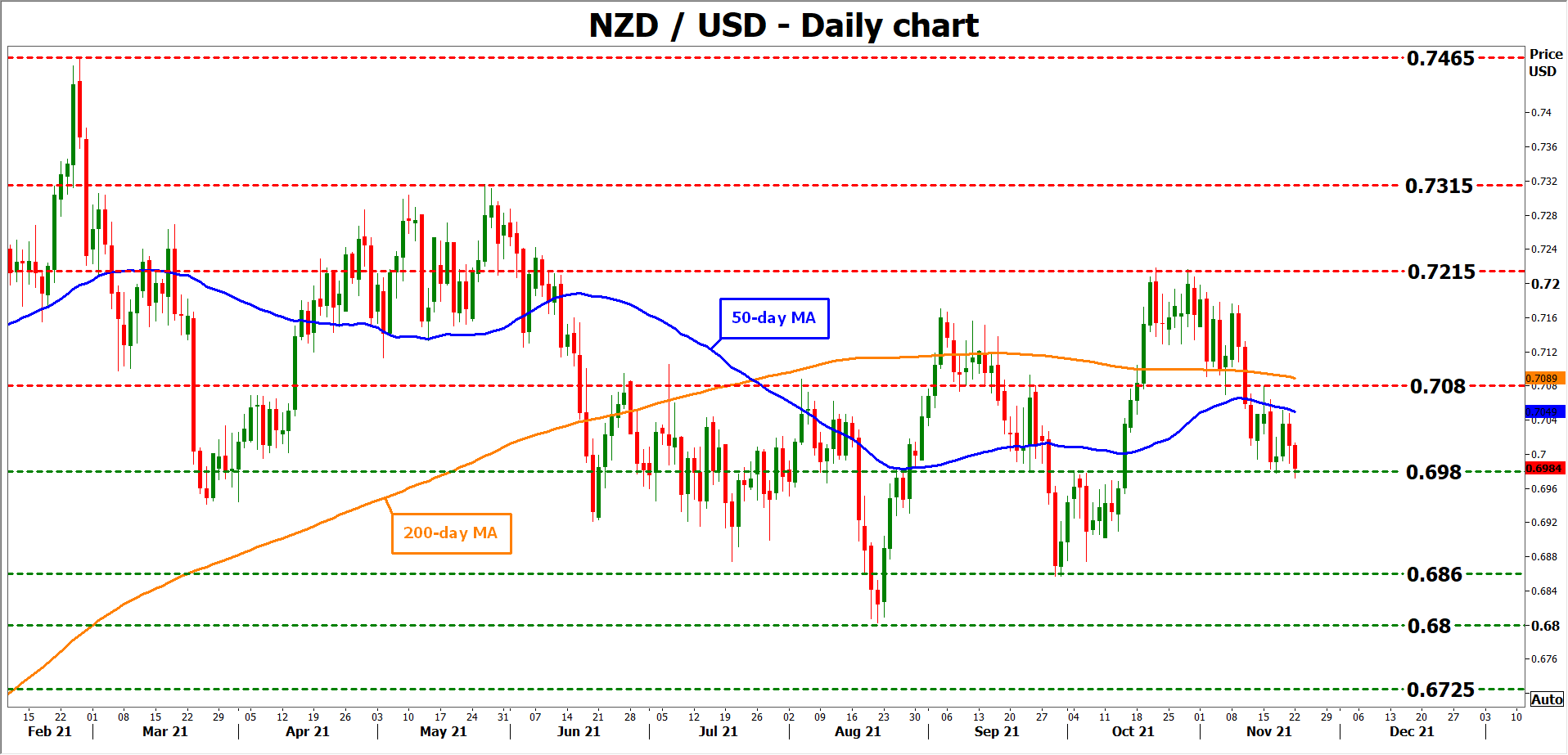
On the other hand, a double rate increase could propel the pair higher for a test of 0.7080, where a violation might open the door for a test of the 0.7215 region.
In the bigger picture, whether the initial move is sustained will depend on the interest rate forecasts the central bank will publish. How quickly do policymakers expect rates to be raised moving forward and what is the likely peak?
Here too, there’s room for disappointment. Markets now anticipate the RBNZ to raise rates at every single meeting over the next year, which seems excessive. It could happen, but everything needs to go perfectly in the economy. And because it is already priced in, the upside potential in the currency isn’t huge.
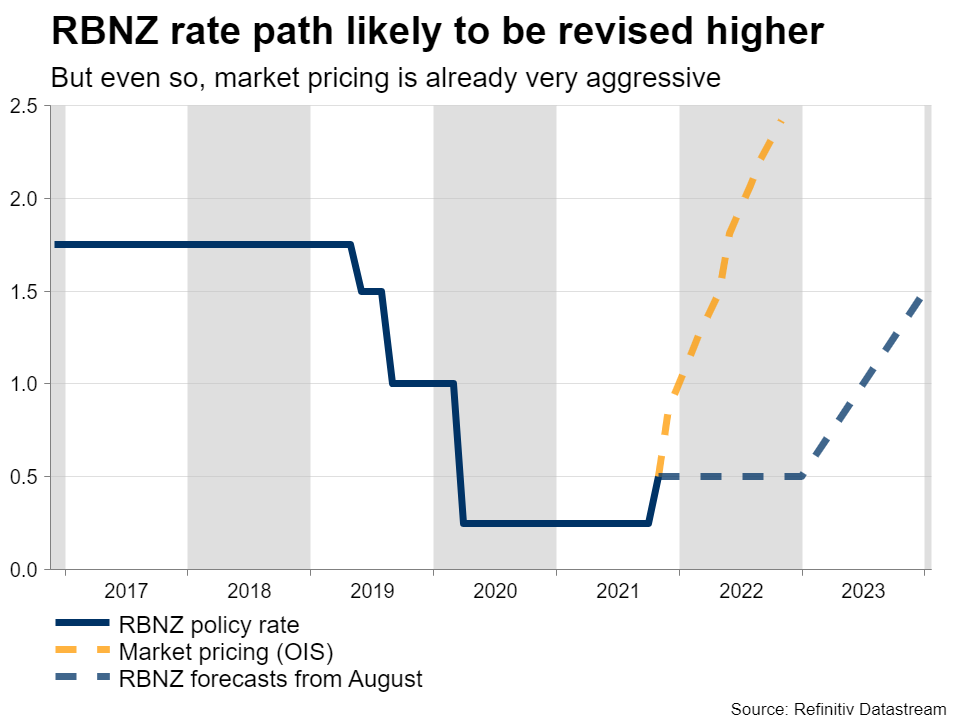
On the flipside, if some shock hits New Zealand and prevents the central bank from tightening so aggressively, the potential downside in the kiwi would be much bigger as markets dial back their aggressive expectations.
When a central bank is priced for perfection, the risk-to-reward profile for its currency is not very attractive.
AUDUSD Bears Reinforce Downward Trajectory
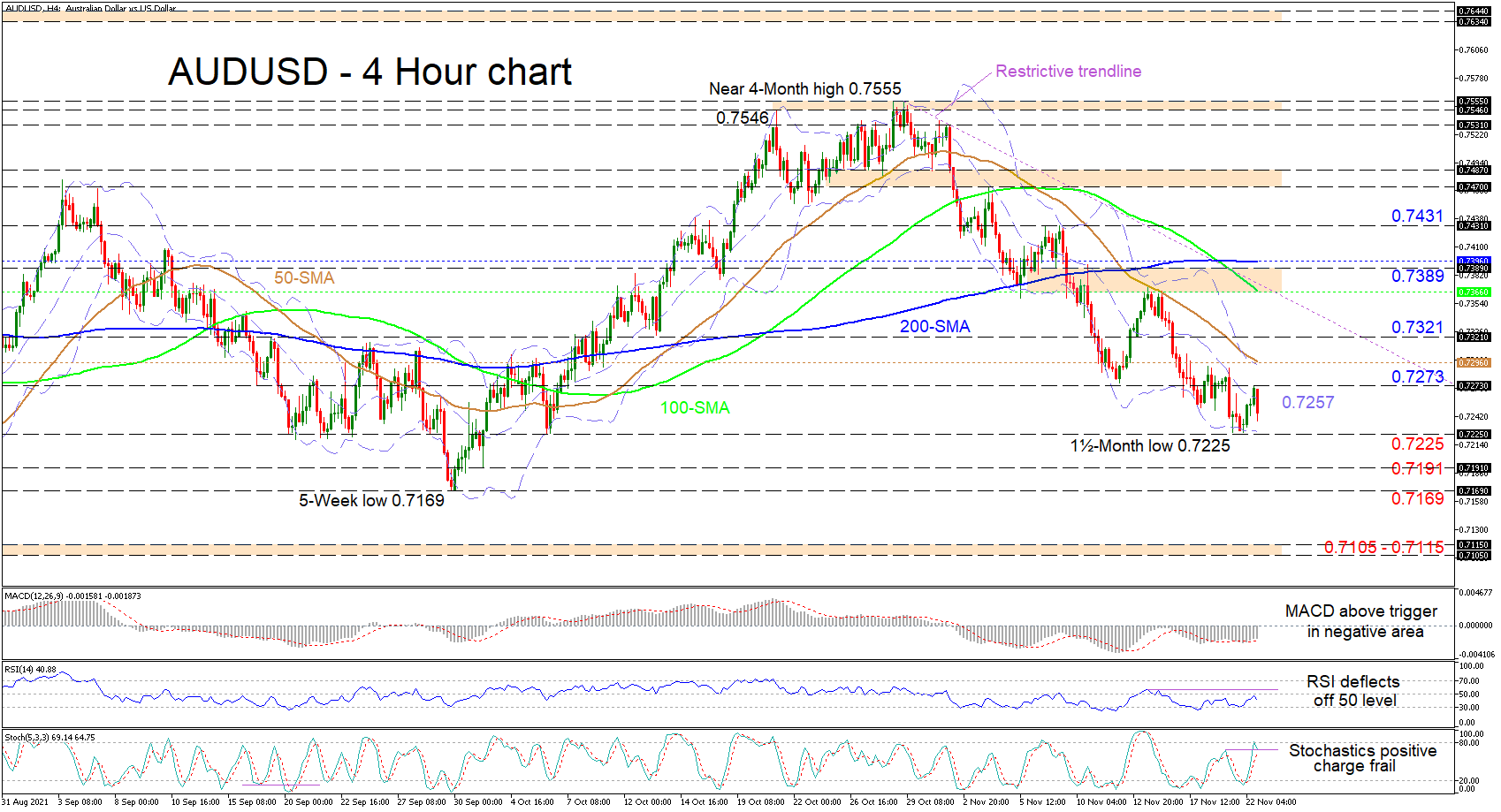
AUDUSD sellers have resurfaced and have driven the price beneath the mid-Bollinger band and towards the 0.7225 level, where the price recently rebounded. The bearish 50- and 100-period simple moving averages (SMAs) are sponsoring the downtrend in the pair from the near four-month peak of 0.7555.
The short-term oscillators are confirming the rise in negative powers. The MACD, although in the negative region and above its red trigger line, looks to reclaim it, while the RSI is steering lower in the bearish territory. The stochastic oscillator is promoting the downside, signalling that the positive bounce in the price may have run its course.
If selling interest increases, preliminary support could commence at the lower Bollinger band, adjacent to the one-and-a-half-month low of 0.7225. Should these boundaries fail to halt the descent, the price may slide towards the 0.7191 barrier and the five-week low of 0.7169, reached at the end of September. Diving deeper, the bears could then aim for the 0.7105-0.7115 support band, moulded by the troughs last seen in August 2021.
If the pair regains buoyancy above the mid-Bollinger band at 0.7257 and the nearby 0.7273 level, initial resistance could arise in the vicinity of the mid-November highs, bordering the approaching upper Bollinger band and the 50-period SMA at 0.7296. Climbing further, the 0.7321 inside swing low could interrupt the test of a possible restrictive trend line, pulled from the 0.7555 high. From here, buyers would need to muster a more profound backing to overcome the resistance zone formed between the 100-period SMA at 0.7366 and the 0.7389 level. Successfully recapturing the area above the 200-period SMA at 0.7396 as well would bolster upside momentum, steering the price to tackle the 0.7431 high.
Summarizing, AUDUSD appears to be sustaining a sturdy bearish bearing below the SMAs and the 0.7366 high.
EUR/USD Elliott Wave: Calling Decline and Selling Rallies at the Blue Box
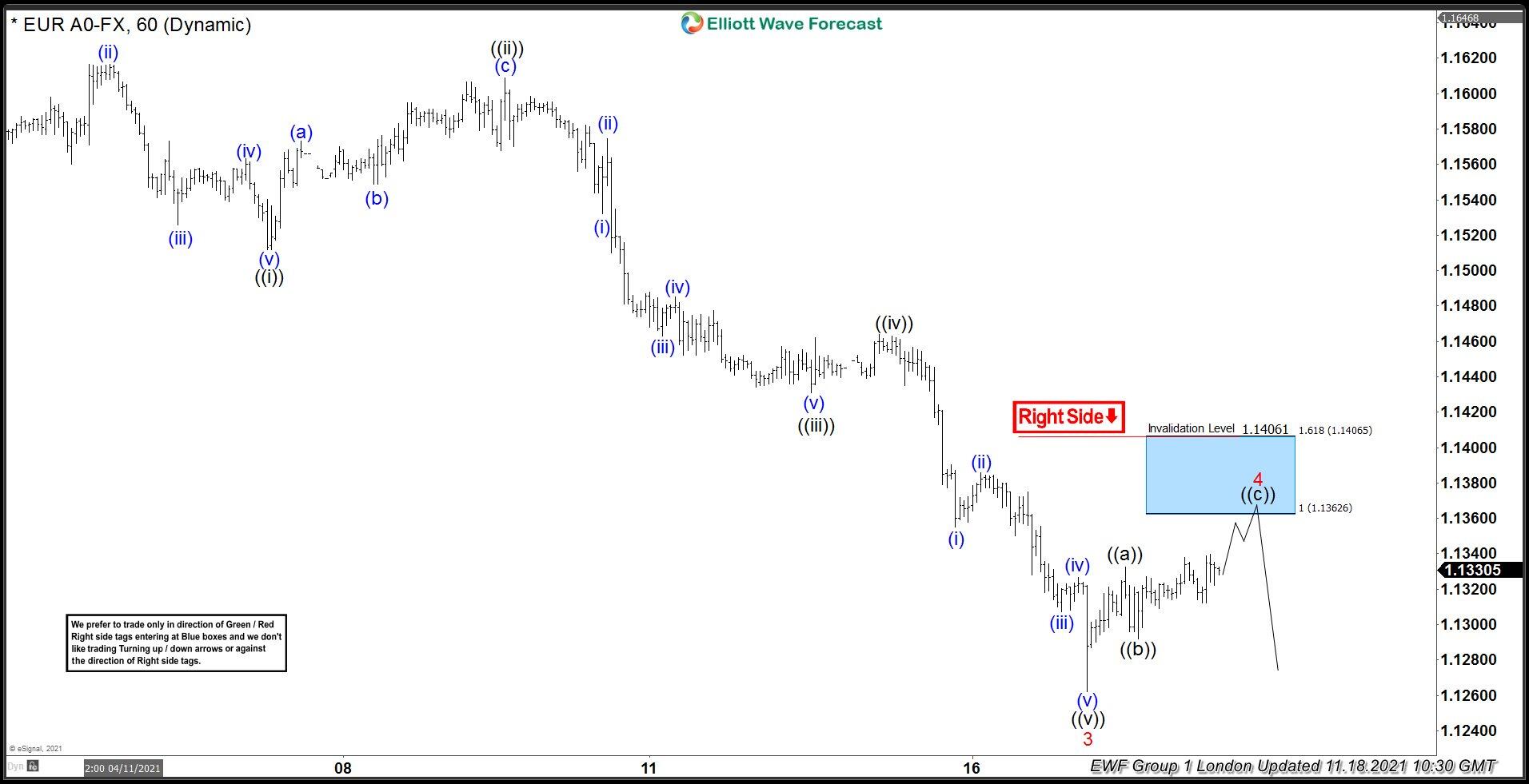
Hello fellow traders. Another instrument that has given us nice trading set up recently is EURUSD Forex Pair. In this technical article, we’re going to take a look at the past charts of $EURUSD presented in the member's area of the Elliottwave-Forecast. EURUSD is showing bearish impulsive sequences in the cycle from the May peak. We got a short-term recovery wave 4 that has given us the opportunity to enter short trades again. In the further text, we’re going to explain the forecast and trading strategy.
EUR/USD 1 hour Elliott Wave analysis 11.18.2021
EURUSD is giving us 4 red recoveries that are unfolding as Elliott Wave Zig Zag Pattern. It’s having ((a))((b)) ((c)) inner labeling. Recovery looks incomplete at the moment, suggesting more short-term strength. The Forex Pair is looking for a 1.1362-1.1406 area, to complete 4 red recoveries. At the marked blue box area, we expect intraday sellers to appear and to pull price lower toward new lows or in 3 waves pull back alternatively. Invalidation level for the trade is broken above 1.618 fib extension (1.14065).
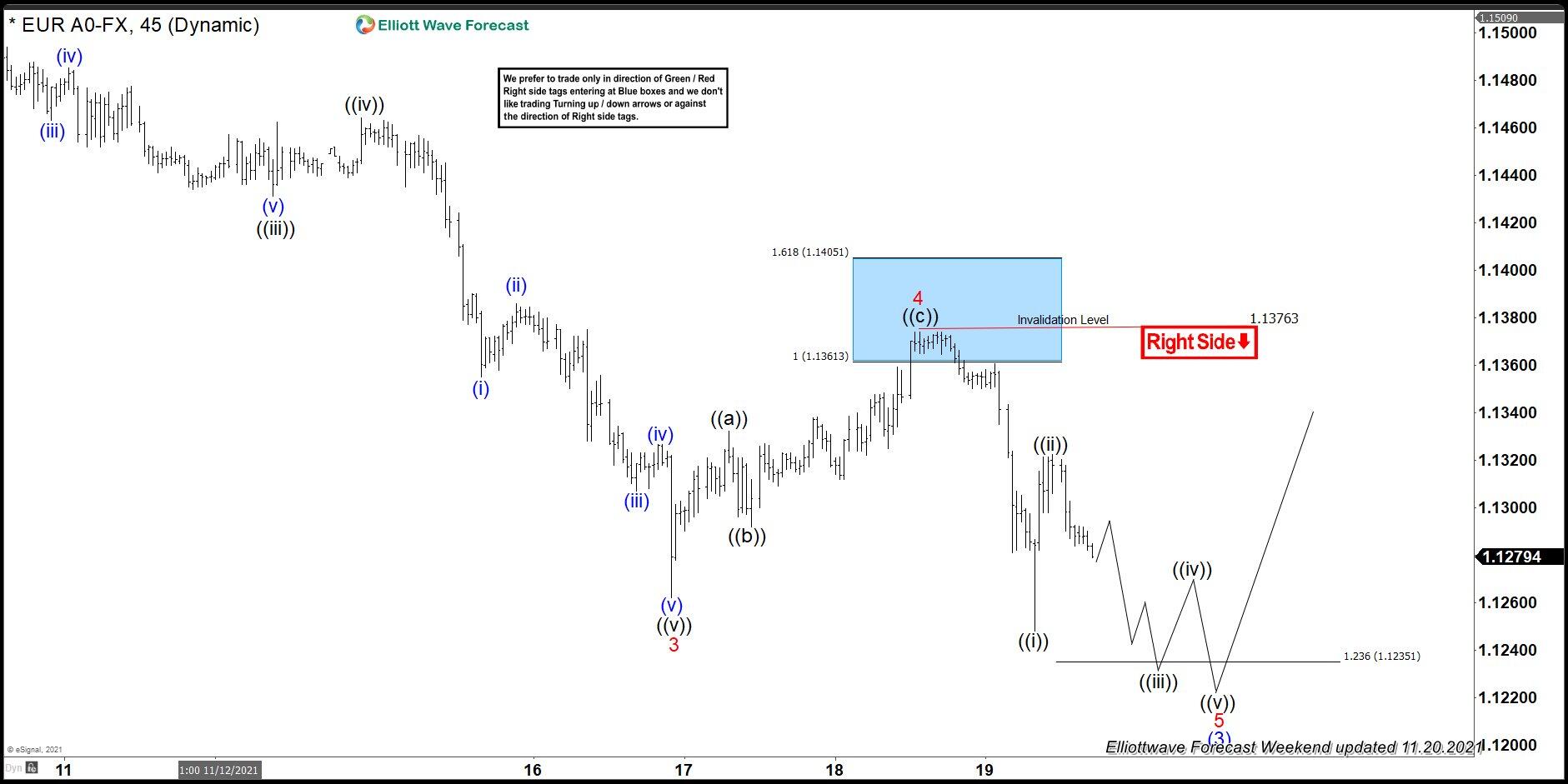
EUR/USD 1 hour Elliott Wave analysis 11.20.2021
Sellers appeared at the blue box and we got good reaction from there. The decline from the blue box unfolded as 5 waves and the price made a break toward new lows. As a result, short positions from the blue box are Risk-Free and partial profit is taken. At this stage, the pair remains bearish against the 1.3763 high. As our members know, Blue Boxes are no enemy areas, giving us an 85% chance to get a reaction.
Sunset Market Commentary
Markets
European stock markets opened slightly positive after Friday’s beating, but risk sentiment gradually dwindled throughout the session. At the time of writing, main indices (-0.4%) are at risk of setting new correction lows. German Chancellor Merkel warned that the latest Covid-19 spike is “highly dramatic” and worse than anything Germany has experienced. She called on the country’s states to introduce tighter restrictions already this week, adding that hospitals would otherwise soon be overwhelmed. Last week’s Covid-warnings by German health minister Spahn and Austria’s effective lockdown announcement sparked the risk aversion at the end of last week. Spillover effects from stocks to bonds and FX remains very limited this time around, especially given the absence of other eco data and/or events. The German Bundesbank warned that German inflation will spike just under 6% in November, while staying north of 3% for a longer period. Simultaneously, GDP could stall in Q4. German Bunds follow US Treasuries south, the latter obviously still underperforming. German yields rise by over 2 bps across the curve. The US yield curve bear rises by 3.1 bps (30-yr) to 6 bps (5-yr) with the frond and belly of the curve underperforming. Three factors are at play. First tonight’s early kick-off to the end of month refinancing operation (2y & 5y Note auctions). The US Treasuries conducts these first sales earlier than normal because of the holiday-shortened Thanksgiving week. Second, last Friday’s Fed comments still resonate. Fed Waller and vice-chair Clarida joined St. Louis Fed Bullard’s call to think about speeding up the recently started QE tapering process. They argue that inflation accelerated more than expected, that activity indicators so far point to a stronger-than-forecast Q4 and that the labour market recovered more quickly than anticipated. They hope to have a debate in December, eying a potential January decision. Doubling the taper process from $15bn/month to $30bn/month at the start of next year implies ending net purchases by the end of Q1 2022 instead of mid-2022. It would allow the Fed to move quicker on rate normalization. Finally, US President Biden today nominated Fed Chair Powell for a second term in office while Washington-based Fed Brainard gets bumped to vicechair after Clarida’s term ends end January next year. Some feared that Fed policy could turn even more dovish should Brainard replace Powell. Interest rate differentials again played in favour of a weaker EUR/USD rate. The pair drops from a 1.1307 op to a new cycle low of 1.1240 currently. The trade-weighted greenback sets a new recovery high at 96.40 with USD/JPY attacking 114.75. The euro and sterling hold a tight balance around 0.8390, with the UK currency unimpressed by backtracking comments by BoE Bailey and Pill.
News Headlines
After reaching a post-corona top in June, July and September (8.0), Belgium consumer confidence dropped for the second consecutive month, printing at 1.0 (down from 4.0 in October), the lowest level in 7 months. Households especially became more pessimistic on the economic outlook for the next 12 months (-7 from 0) and to a lesser extent about a rise in unemployment. The assessment on households’ financial conditions was unchanged at -3. The prospect on savings was little changed at 15 from 16, but still marked the lowest reading since February.
November Hungarian GKI economic sentiment dropped from 2.5 to 0.2. Business confidence improved to a two-and-a-half year high (9.1 from 8.7). However, this was more than offset by a sharp decline in consumer confidence (-25.2 from -15.2), which the survey labelled as ‘a rate rarely seen in a single month’. Consumer confidence is now back at the levels seen in spring. The report also mentioned that all economic players in the economy now expect prices to rise, even after the central bank last week raised the base rate (2.1%) and the 1-week deposit rate ( 2.5%). The forint today touched a historic low against the euro, briefly trading north of EUR/HUF 370. This is putting pressure on the MNB to raise the weekly deposit rate further. The MNB last week said that it will respond to short-term risk in financial and commodity markets by using this instrument in a quickly and flexible manner.
US Dollar Kicks Off the Week Higher as Hawkish Talk Increases
US dollar slopes upwards amid upcoming monetary tightening
The dollar’s upsurge seems to be continuing this week fueled by the Fed’s Vice Chair Richard Clarida, who signaled an imminent acceleration of the tapering program that could eventually result in earlier rate hikes. In addition, the greenback has also benefited from the rebound in Treasury yields today. However, President Biden is expected to reveal his nomination for the Fed’s chair before Thanksgiving on Thursday, where a possible designation of the more ‘dovish’ Brainard might push back projections for a faster rate hike timeline.
The British pound appears to be losing traction today following the BoE’s Governor Andrew Bailey comment on the weekend that inflation issues mostly stem from the supply side, thus tighter monetary policy would not cause any good in the economy. Furthermore, the ongoing tensions between the UK and EU regarding the Northern Ireland protocol are causing further deterioration in the pound’s outlook.
The euro continues to struggle as Lagarde’s comment that the ECB will not proceed with monetary tightening in 2022 combined with the new round of COVID-19 lockdowns that are spreading among an increasing number of European countries, undermine the currency’s prospects.
The New Zealand dollar is trading marginally higher today ahead of the Reserve Bank of New Zealand meeting on Wednesday. This event is of particular interest as the markets have fully priced in a 25 basis points rate hike, but soaring inflation and the latest stronger-than-expected employment report have ignited speculation for a 50 bps increase.
US stock markets rebound after mixed close on Friday
Wall Street is set to open higher in the shortened trading week due to Thanksgiving, despite the rising concerns over the resurgence of Covid-19. Specifically, Nasdaq futures are trading 0.6% higher in the pre-market trade, while S&P500 and Dow Jones futures are gaining 0.3%.
Oil and gold struggle
Oil is losing ground in the current session as rising Covid-19 cases in Europe and a potential release of Japanese oil reserves have cast shadows over both supply and demand sides. Additionally, gold is in the red today, heavily pressured by the stronger dollar.
Flash PMI reports and FOMC minutes on the weekly menu
The November flash PMI readings for several countries are due on Tuesday and will most probably point to slowing economic activity amid soaring inflation, long-lasting supply bottlenecks and the Covid-19 outbreak in Europe. Also, the FOMC minutes will be released on Wednesday and will be closely eyed as markets expect to gain insights on a possible acceleration of the Fed’s rate hike timeline. Wednesday will also feature a barrage of economic data out of the US, which will be released ahead of the Thanksgiving holidays.
USD/JPY Mid-Day Outlook
Daily Pivots: (S1) 113.56; (P) 114.05; (R1) 114.51; More...
Intraday bias in USD/JPY remains neutral first. On the upside, break of 114.96 will resume larger up trend from 102.58. Intraday bias will be turned to the upside for 100% projection of 102.58 to 111.65 from 109.11 at 118.18 next. On the downside, below 113.57 minor support will bring another fall to 112.71 support instead.
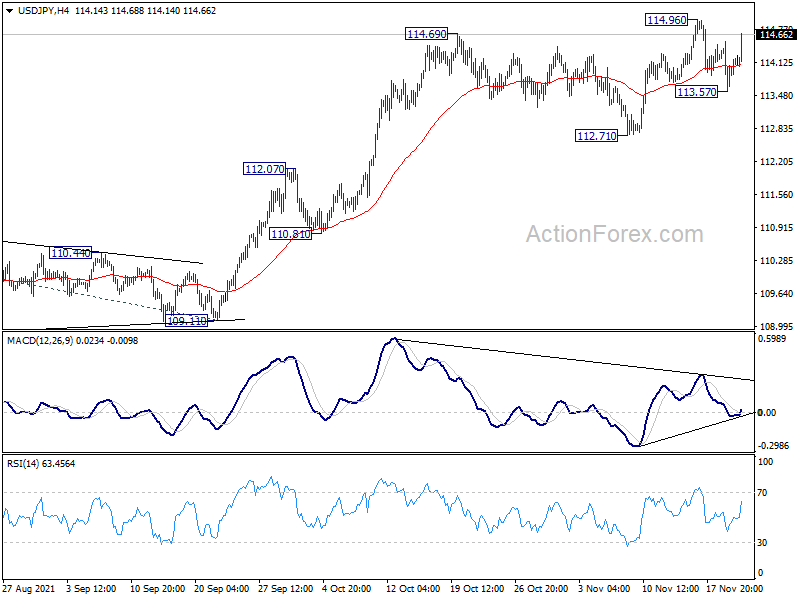
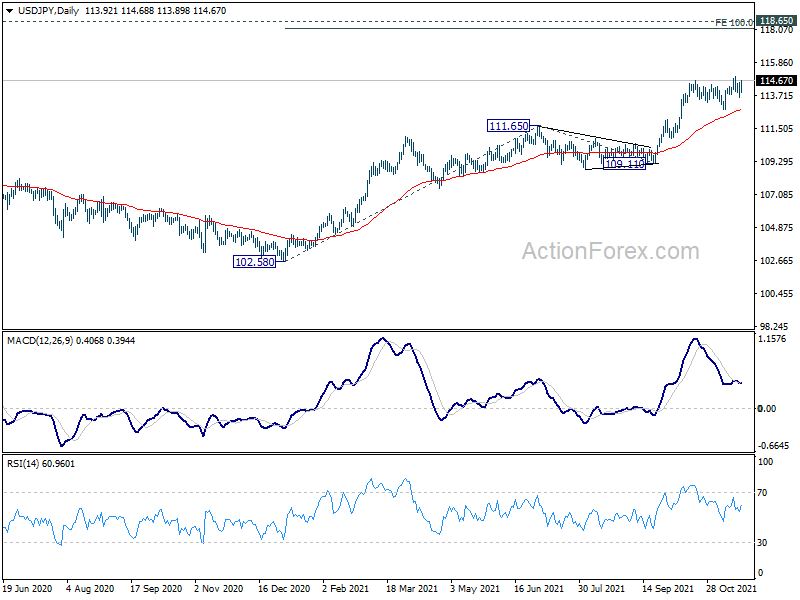
In the bigger picture, corrective decline from 118.65 (2016 high) should have completed at 101.18 already. Rise from the 102.58 is seen as the third leg of the up trend from 101.18. Next target is 118.65 high. This will now be the preferred case as long as 111.65 resistance turned support holds, even in case of deep pull back.
USD/CHF Mid-Day Outlook
Daily Pivots: (S1) 0.9263; (P) 0.9276; (R1) 0.9303; More....
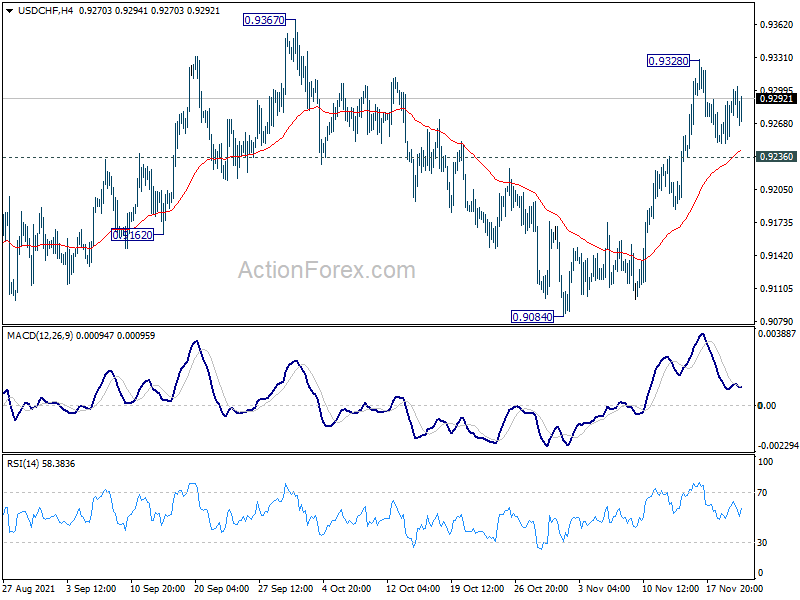
USD/CHF is still extending the consolidation from 0.9328 and intraday bias remains neutral first. On the upside, above 0.9328 will resume the rally from 0.9084 for 0.9367 resistance. On the downside, below 0.9236 minor support will turn intraday bias back to the downside for 0.9084 instead.
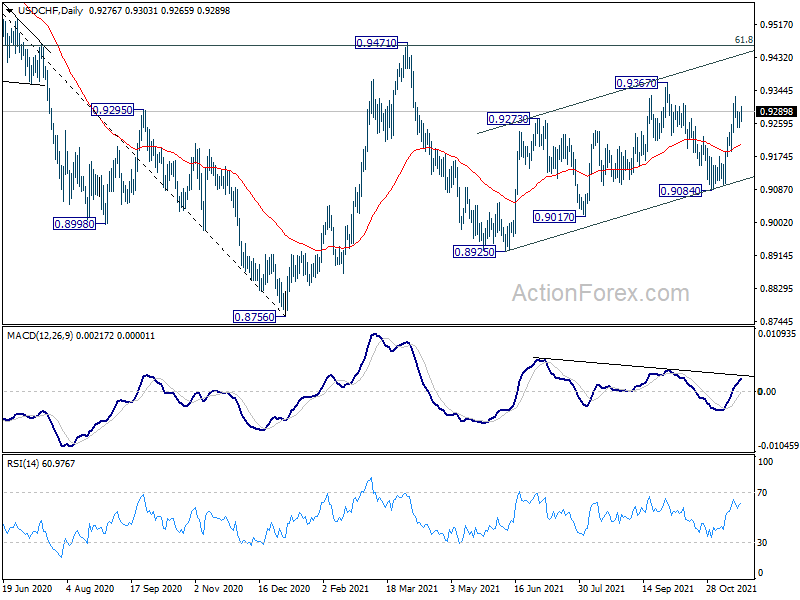
In the bigger picture, the corrective structure of the rebound from 0.8925 argues that fall from 0.9471 is not complete yet. It could either be the second leg of pattern from 0.8756 (2021 low), or resuming larger down trend from 1.0237 (2018 high). We'd pay attention to the downside momentum and assess the odds later. But for now, medium term outlook will be neutral at best as long as 0.9471 resistance holds.
GBP/USD Mid-Day Outlook
Daily Pivots: (S1) 1.3399; (P) 1.3454; (R1) 1.3501; More...
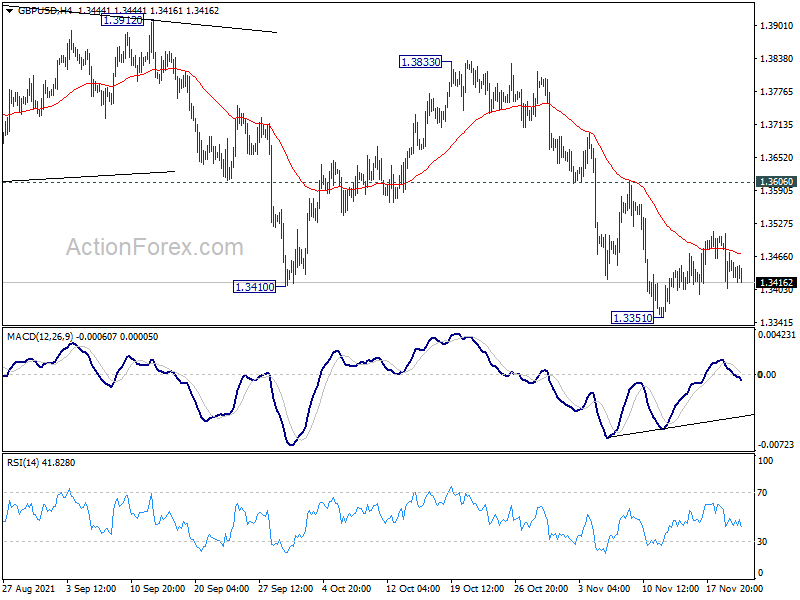
GBP/USD is staying in consolidation from 1.3351 and intraday bias remains neutral first. In case of another recovery, upside should be limited below 1.3606 resistance. On the downside, break of 1.3351 will extend the decline from 1.4248 to 1.3164 fibonacci level next.
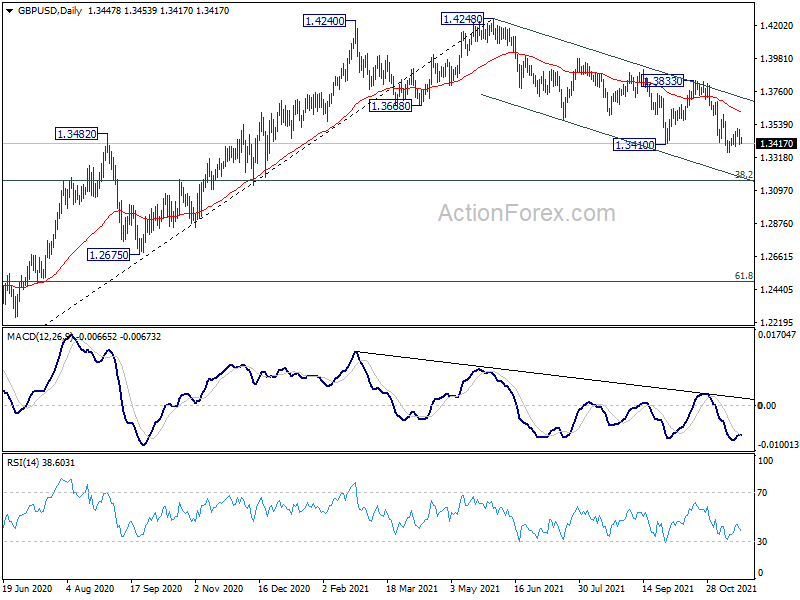
In the bigger picture, the structure of the fall from 1.4248 suggests that it's a correction to the up trend from 1.1409 (2020 low) only. While deeper fall cannot be ruled out yet, downside should be contained by 38.2% retracement of 1.1409 to 1.4248 at 1.3164, at least on first attempt, to bring rebound. On the upside, firm break of 1.4376 key resistance (2018 high) will add to the case of long term bullish reversal. However, sustained trading below 1.3164 will revive some medium term bearishness and target 61.8% retracement at 1.2493.
EUR/USD Mid-Day Outlook
Daily Pivots: (S1) 1.1231; (P) 1.1302; (R1) 1.1354; More...
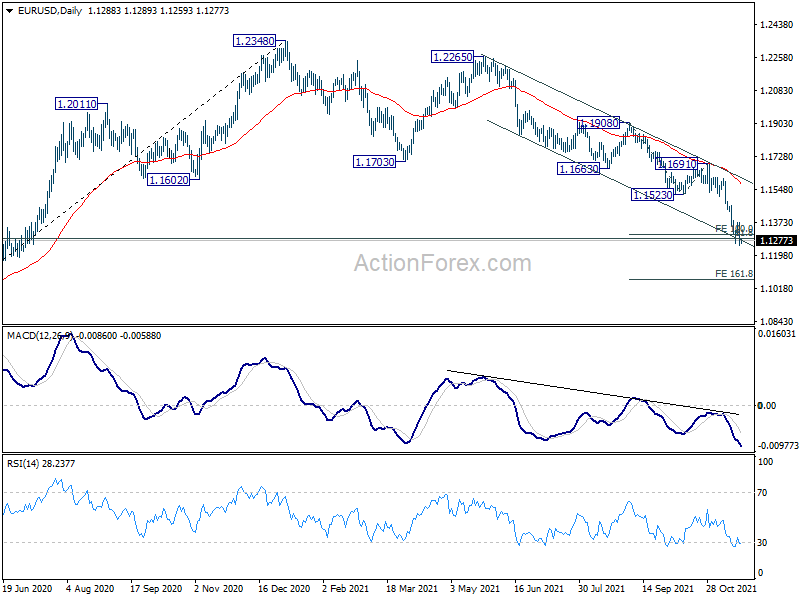
Intraday bias in EUR/USD remains neutral first and outlook is unchanged. On the downside, break of 1.1249 and sustained trading below 1.1289 long term fibonacci level will carry larger bearish implications. Deeper fall would then be seen to 161.8% projection of 1.1908 to 1.1523 from 1.1691 at 1.1068 next. Nevertheless, break of 1.1384 minor resistance will now indicate short term bottoming, and turn bias back to the upside for rebound.
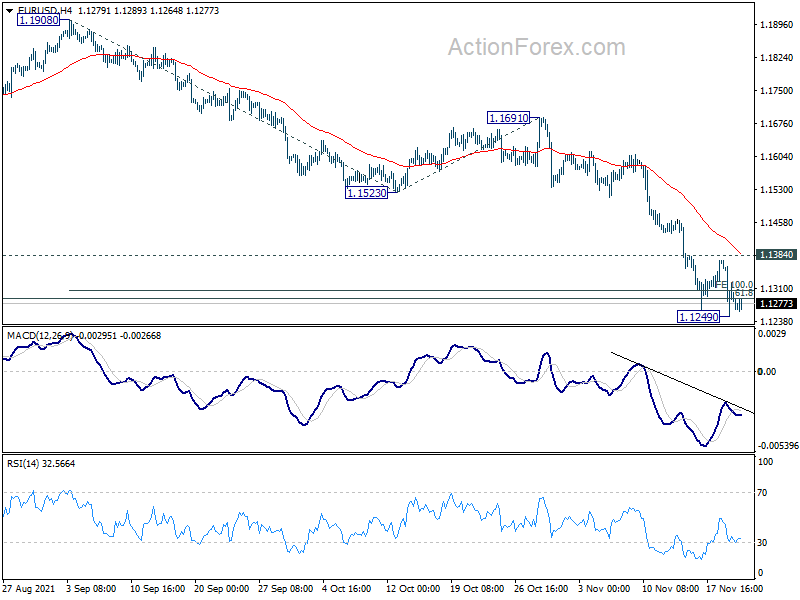
In the bigger picture, there are various ways of interpreting the fall from 1.2348 (2021 high). It could be a correction to rise from 1.0635 (2020 low), the fourth leg of a sideway pattern from 1.0339 (2017 low), or resuming long term down trend. In any case, outlook will now stay bearish as long as 1.1703 support turned resistance holds. Sustained break of 61.8% retracement of 1.0635 to 1.2348 at 1.1289 would pave the way back to 1.0635.