

Sample Category Title
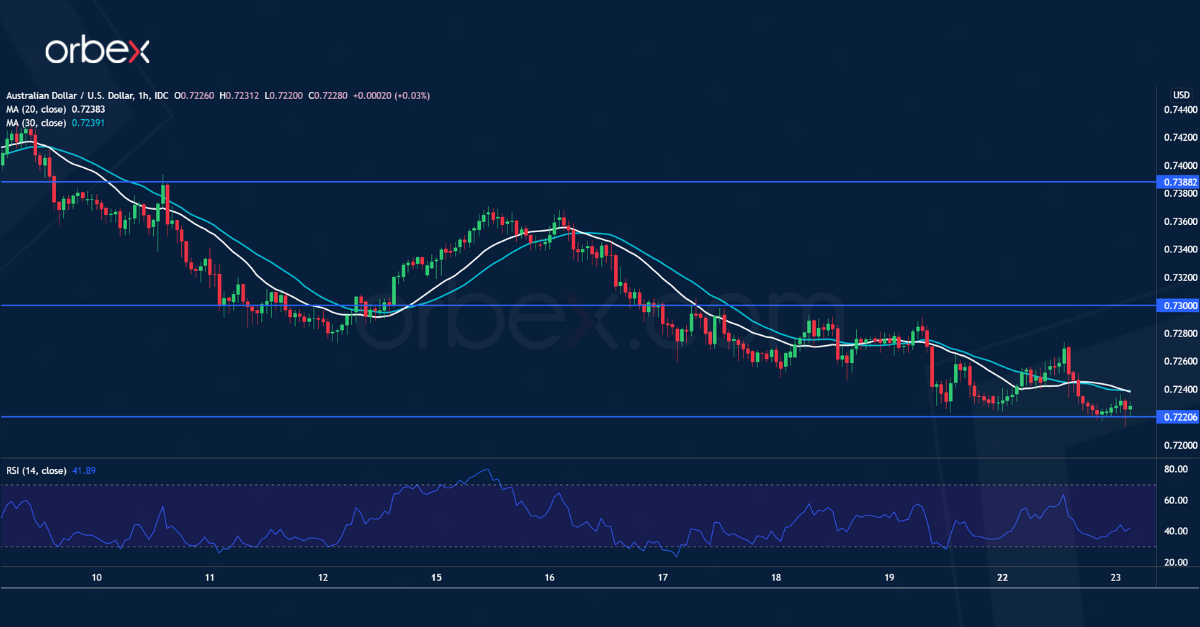
AUD/USD Struggles For Support
China’s property slowdown and lower commodity prices weigh on the Australian dollar.
The pair has given up most of its gains from the October rally, a sign that support is hard to come by. Nonetheless, a series of lower lows has attracted trend followers’ interest in maintaining the status quo.
0.7220 is an intermediate support. An oversold RSI may prompt the short side to cover, raising bids in the process. However, the bulls will need to lift offers around the former support at 0.7300 before they could expect to turn the tables.
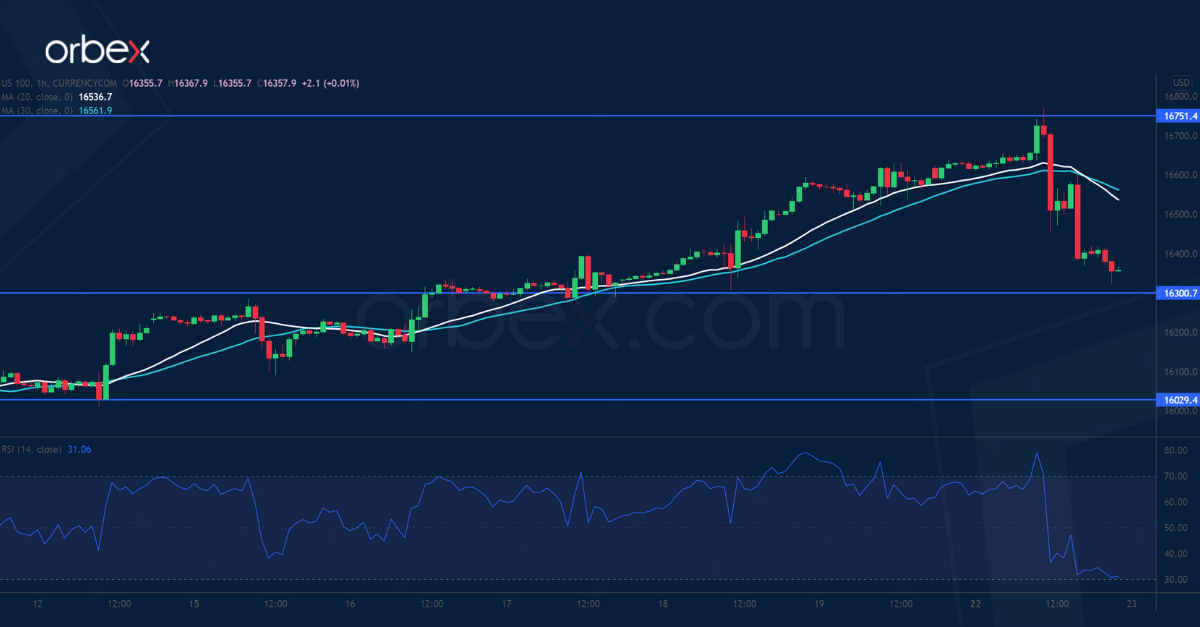
NAS 100 Pulls Back
Investors took profit after Jerome Powell’s renomination as US Federal Reserve Chairman. The tech index saw an acceleration in its rally after a break above the previous peak (16450).
Strong momentum suggests that buyers are committed to keeping the uptrend intact after a brief pause. However, the RSI’s triple top in the overbought area indicates exhaustion, and a fall below 16550 has triggered a correction.
16300 is the next support from a previous supply zone. A rebound needs to clear 16750 before the rally could resume.
Daily Technical Analysis
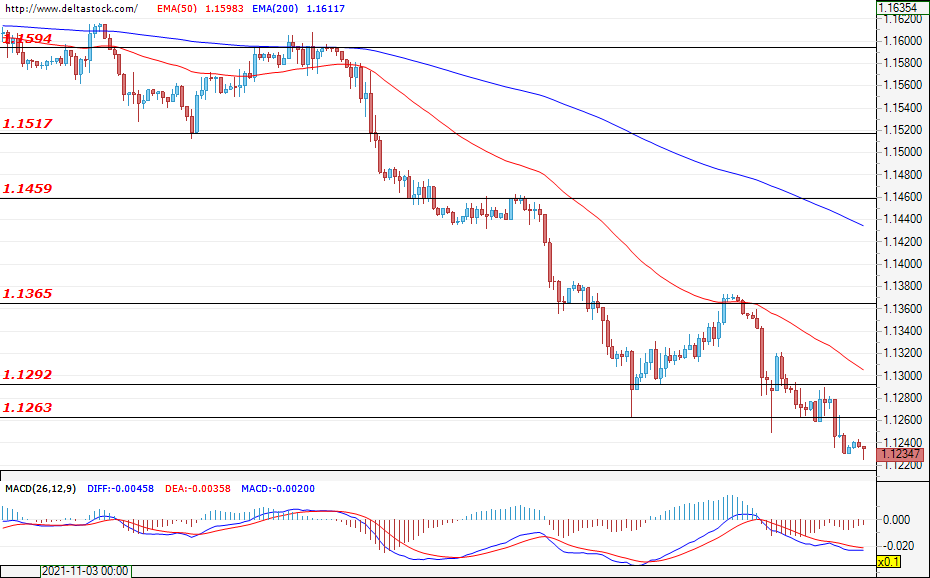
EUR/USD
Current level - 1.1234
The dollar continues to appreciate against the common European currency as it violated yet another support level – that of 1.1263 after Jerome Powell got nominated for a second term as head of the Federal Reserve. The sentiment remains strictly negative and the expectations are for the resumption of the downtrend, with a potential next target being the level of 1.1180. In the positive direction, the main resistance is found at 1.1365.
| Resistance | Support | ||
| intraday | intraweek | intraday | intraweek |
| 1.1260 | 1.1460 | 1.1200 | 1.1125 |
| 1.1290 | 1.1517 | 1.1180 | 1.1060 |
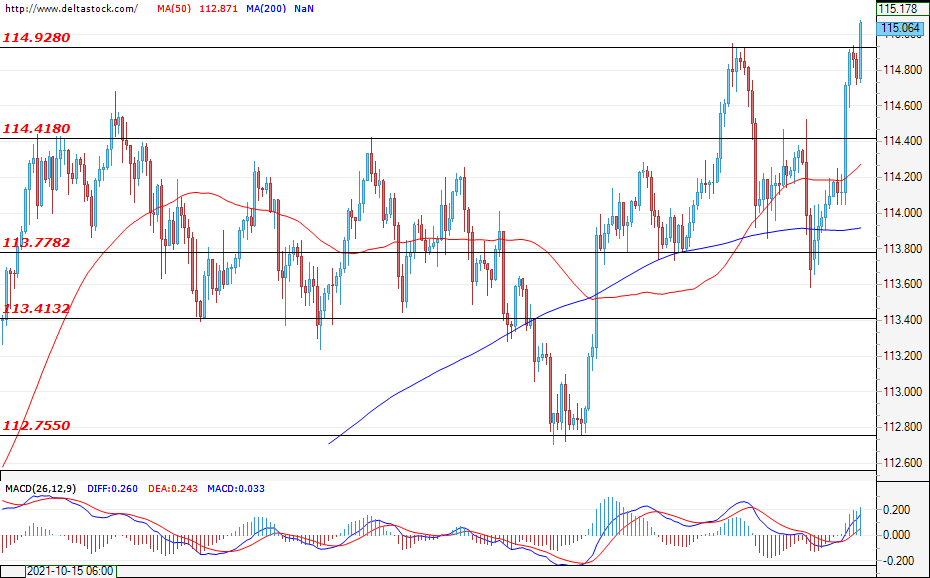
USD/JPY
Current level - 115.06
Following the unsuccessful test of the support of 113.77, the pair bounced back and breached the resistance at 114.40 and, in the early hours of today's trading session, also ploughed through the next resistance at 114.90. In case this breach is confirmed, then the pair would continue rising towards the next target at 115.50 that is coming from the higher time frames. In the negative direction, the mentioned level of 114.40 is now acting as a support and the major support for the pair is found at 113.40.
| Resistance | Support | ||
| intraday | intraweek | intraday | intraweek |
| 115.50 | 115.50 | 114.40 | 113.40 |
| 117.00 | 117.00 | 113.40 | 112.75 |
GBP/USD
Current level - 1.3387
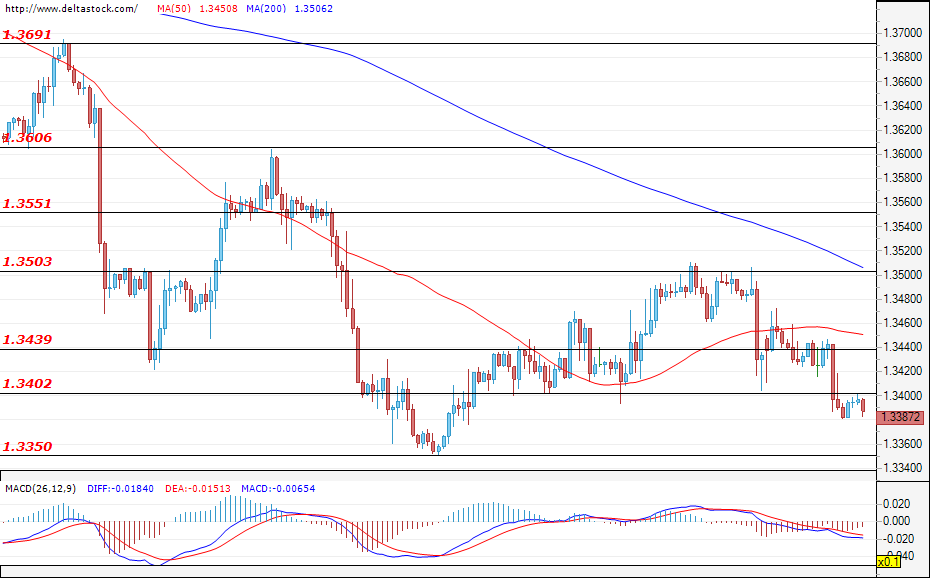
The Cable is currently found in a consolidation phase between 1.3400 and 1.3500. At the time of writing, the pair is headed towards a test of the lower border of the range. In case it is violated, then the pair is expected to test the support level at 1.3350. In the positive direction, the upper border of the range is acting as a resistance for the Cable. Today, increased activity can be expected around the release of the manufacturing PMI and services PMI data for the U.K. (09:30 GMT).
| Resistance | Support | ||
| intraday | intraweek | intraday | intraweek |
| 1.3440 | 1.3600 | 1.3400 | 1.3350 |
| 1.3500 | 1.3690 | 1.3350 | 1.3200 |
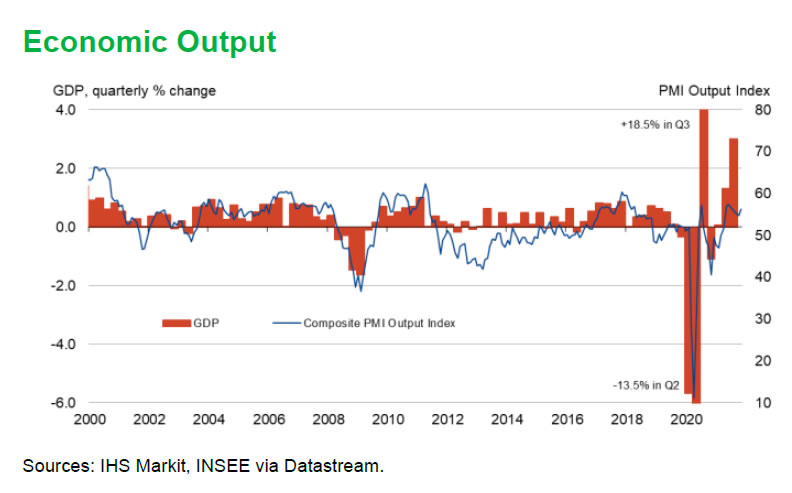
France PMI manufacturing rose to 54.6, services jumped to 58.2
France PMI Manufacturing rose to 54.6 in November, up from 53.6, above expectation of 52.8. PMI Services rose to 58.2, up from 56.6, above expectation of 55.5. That's also the highest level in 46 months. PMI Composite rose to 56.3, up from 54.7.
Joe Hayes, Senior Economist at IHS Markit said:
"Having embarked on a clear period of slowing growth in the months leading up to October, the flash PMI data for November showed a fresh acceleration in French economic expansion. As well as stronger growth in output, new orders rose at a faster pace, which firms suggest is down to businesses recovering, helping to lift client demand.
"However, the driving force behind improvements in the data is services. Manufacturers are still struggling with component shortages, long lead times and subdued demand conditions. These factors drove back-to-back drops in production.
"Unfortunately, this puts the wider economic recovery in a precarious position, especially with the raft of new COVID-19 containment measures being implemented across other parts of Europe. While French officials have talked down the prospect of imminent restrictions, the trajectory of the virus in the coming weeks will be a key determinant of near-term economic activity, as any new restrictions are likely to hit the service sector, which at present is giving the economic recovery its principal impetus."
This Morning Asian Equities Are Trading Mixed
Markets
Markets pondering the consequences for growth and monetary policy from the spike in corona infections in Europe still dominated market headlines at the start of the new week. European equities mostly incurred modest losses and EUR/USD drifted further south. However, in US dealings, the debate on faster Fed tightening gradually returned to the forefront. US President Biden reappointing Fed Chair Powell for a second term even triggered an outright sell-off on US bond markets. Dove Powell, this time was perceived as a hawk compared to Lael Brainard. The US yields rose up to 9.5 bps (5-y) with the belly of the curve again underperforming the wings (2-y +7.7 bps; 30-y +5.1 bps). The move was solely driven by a rise in real yields. The rise in yields didn’t revive investor interest for the auctions of 2- and 5-y year Treasuries. Yields trended further north after the sale. After the close of the market, Fed Bostic joined the chorus for speeding up tapering. Markets currently discount 3 Fed rate hikes by the end of next year. Despite uncertainty on the new covid wave, European yields, at a distance, joined the rebound in US yields. German yields rebound about 4 bps across the curve. The German 10-y closed near the previous support of -0.30%. Interestingly, ECB’s Villeroy repeated that the ECB is serious about ending PEPP in March as each wave of the pandemic is causing less economic damage compared to the previous one. He also indicated the need to step APP purchases might be limited, if any. US equities suffered from the sharp rise in yields with the Nasdaq underperforming (-1.26%). European equites ended mixed. Anticipation of faster Fed tightening further propelled the dollar. DXY closed near 96.5. USD/JPY finished within reach of the 115 mark (114.88). EUR/USD closed at 1.1237; the lowest level since July last year. The rise of the dollar and higher core yields also pressured the likes of the forint and zloty which set all-time/multi-year lows. The ascent of the Swiss franc slowed (close EUR/CHF 1.0483).
This morning Asian equities are trading mixed (Japan is closed). The yuan stays very resilient (USD/CNY 6.38) despite broad USD strength. USD/JPY (115.05) touched the strongest level since March 2017. Today, the preliminary Markit PMI’s will be published. US measures are expected to hold at lofty levels or even improve slightly further (59 area). European PMI’s are expected to ease, both for manufacturing (57.4) and services (53.0). We don’t expect a big market reaction. Given recent ‘dovish positioning’ especially in EMU interest rate markets on the rise in Covid infections, a positive surprise and/or persistent high inflation readings might have a bigger impact compared to a soft report. For the 10-y EMU swap yield, 0.10% is a key/strong support. For the US yield curve, the focus remains on the short end with the 2-y yield setting a new post-corona top north of the 0.56% resistance. The technical picture for most major USD cross rates improved further. A bottoming in European yields might slow the decline in EUR/USD. Even so, for now there is no sign of a U-turn in the broad USD ascent. EUR/USD 1.1168 (June 2020 low) marks intermediate support ahead of 1.1040.
News headlines
The IMF approved a $700m disbursement to Ukraine yesterday. The funds are the second tranche from a $5bn programme agreed in the spring of last year to help the country handle the pandemic. While intended to battle Covid-19, the aid also provides a critical and timely financial cushion amid the build-up of 90 000 -" 114 000 Russian troops near Ukraine’s borders, raising red flags in the US and Europe about a potential deeper invasion after Russia annexed the Crimean peninsula in 2014.
Romania’s two largest parties have agreed to form a broad coalition government with the ethnic Hungarian party UMDR. Together they have a two-thirds majority in parliament. The deal ends weeks of political paralysis after previous government imploded in October. In the meantime, the country saw an upsurge of coronavirus cases and inflation that prompted the central bank to tighten policy twice as of yet. Ciuca from the National Liberal Party will hold the premier’s job for the first 18 months before handing over the title to one of his coalition partners from the Social Democrats. The Romanian leu held steady at a record low of EUR/RON 4.95.
ECB Schnabel: Time plan to end PEPP in March still valid
ECB Executive Board member Isabel Schnabel said in an interview, rising COVID-19 infections and containment measures is "likely to have a moderating effect on activity in the short run", and it will not derail the overall recovery. Supply-side disruptions "do not diminish growth potential" but "merely shift activity over time". Hence, her baseline is that "some growth deceleration in the short run, but then a continued strong recovery in the medium term."
Schnabel expected ECB staff's inflation projections to be "revised upwards for next year". But inflation is "going to decline over the course of next year". "It's plausible to assume that inflation is going to drop below our target of 2% in the medium term," she said. "however, the risks to inflation are skewed to the upside."
She also noted the "time plan is still valid" for ending the PEPP purchases in March. "But we will have to see how this evolves until our December meeting." She added, " it has become clear that it's very unlikely that a rate hike is going to happen next year. But it's also clear that the uncertainty remains very high and this is reflected in markets."
XAUUSD Is Possibly Bearish
Technical analysis
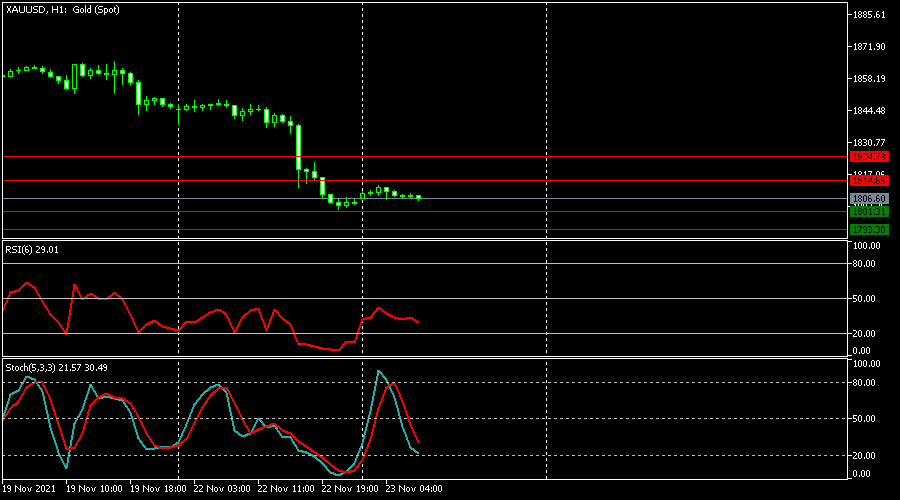
The RSI is below level 50.
The Stochastics is near the oversold zone.
Most likely scenario – SELL
Target prices: 1,801.31 1,793.30
Alternative scenario – BUY
Target prices: 1,814.65 1,824.78
Key levels
Support 1,801.31 1,793.30
Resistance 1,814.65 1,824.78
Habemus Papam
The battle on the oil field is getting heated as Joe Biden is expected to start releasing the strategic oil reserves as soon as today, to tame the upside pressure in oil prices, which also boost inflation and leaves the Federal Reserve (Fed) with a decision that it doesn’t want to make: hike rates. And Biden is not playing alone; the world’s biggest oil eaters, like Japan, India, South Korea and even China consider making similar statements in the coming days. So, this is a war declaration to OPEC+ which refused to answer Biden’s call to increase supply to cool down the rally in oil prices over the past months. As a result, the US will help itself, and release 35 million barrels over time to help easing the energy crisis.
US crude eased to $75 a dollar following the US announcement. The selloff was moderated as most of the information was already priced in. But the downside pressure may continue depending on what’s coming next.
OPEC thinks that the US move is unjustified by the current market conditions – which is of course nothing but a bad faith, but the cartel will likely scrap its plans to pump 400’000 barrel of additional daily supply when it meets next Thursday. Until then, we will probably see the oil traders’ heart pounding between larger strategic supply from the biggest oil consumers and prospects of lower OPEC supply. Therefore, there is little chance we see oil breaking important price levels. On the downside, the $74 pb level should act like a solid support, while offers should come in play into the $80 psychological level.
It is also important to note that the rising Covid cases is also weighing on demand prospects for the winter, as the lockdown measures and travel restrictions are being brought back on the table.
In other and much-awaited news, the new Fed Chair is, drum roll, Jerome Powell! The weeks of wait is now over, and Jerome Powell will be keeping the helm of the Fed and Brainard will be the Vice-Chair.
But in reality, we all know it doesn’t matter, as the Fed has no alternative regarding the direction it will take in the months ahead: the rising inflation won’t temper itself in the environment of zero rates and loose monetary policy, so an eventually faster QE taper and higher rates are on the menu of 2022.
The S&P500 and Nasdaq hit a fresh record before closing the session in the negative. Investors loved the idea of keeping the Republican Powell at the head of the Fed instead of bringing in his Democrat alternative Brainard. But the US 2-year yield jumped to 0.60% on rising prospects of an upcoming rate hike in the US. The fed funds futures now price in the first-rate hike in June this year, and the pricing is quite modest because if the inflation keeps accelerating at the current speed, the expectation of the first rate hike could be brough earlier to as soon as February next year. This means, there is still room for a further hawkish pricing in the market, which would push the short-term yields, and the US dollar higher across the board.
Gold dropped near $50 per ounce yesterday on the back of the jump in the short-term US yields and is now back around the $1800 level. Now, because the north is the only possible direction for the US yields, gold will likely remain under the pressure of rising yields, and the US dollar may again be a better safe haven if we say any selloff across the equities as well.
Dollar Gets A Fresh Boost From Powell Re-Nomination
Market movers today
- Today, we get the flash PMIs from the US, UK and euro area. In the euro area, given the downtrend in new orders and rising Covid-19 headwinds we should continue to see weaker momentum, but there have also been some rays of light lately from the ZEW expectations and the Bundesbank activity indicator ticking up that could point in the other direction. Also in the UK, consensus foresees slight moderation in both manufacturing and service sector activity. Optimism prevails in the US, where analysts expect an improvement in conditions for both sectors.
- The Reserve Bank of New Zealand will meet early Wednesday morning. Consensus is looking for a 25bp hike as RBNZ has already initiated a tightening cycle, and inflation expectations have continued rising. Markets are pricing in at least a 25bp hike, but also around 40% risk of a 50bp hike.
The 60 second overview
Powell re-nominated: Yesterday, President Joe Biden announced he re-nominates Jerome Powell as Fed chair (and nominating Lael Brainard as Fed Vice Chair). This was our base case and also consensus. Powell's approval for another four years is a formality, as he enjoys backing from most Democrats and Republicans (despite criticism from the left wing of the Democratic Party). Near-term, it does not change how the Fed sees the world, but 2022 looks like a difficult year from a central bank perspective. Inflation is set to moderate next year but remain above target and hence the Fed cannot afford being as patient as it would like to be based on people not returning back to the labour force yet. Most recently, Fed policymakers have started discussing whether to increase the tapering pace or not, supporting our view that risk is tilted towards the Fed tightening sooner and faster than what we have pencilled in right now (and much more than what the Fed is signalling at the moment). Our base case is an unchanged tapering pace of USD15bn per month (i.e. QE ends in June) and two rate hikes in H2 2022.
Fed pricing: After Powell's re-nomination, the markets are now pricing in a 25bp hike by June next year, another 25bp by September and a third hike by December 2022. Expected monetary policy divergence between the Fed and the ECB is increasingly starting to weigh on EUR/USD with the pair approaching 1.12 level, while the stock market also seems to be taking a breather after a series of new record highs.
The EU flash consumer confidence indicator yesterday fell below its pre-pandemic levels for the first time since April, as new COVID-19 containment measures and concerns over economic growth and accelerating inflation are starting to weigh on the European consumer. We look for more signals on the health of the global consumer in tomorrow's US PCE release and the German consumer confidence indicator on Thursday.
Equities: Equities were weaker yesterday as bond yield volatility is picking up again. The slow but steady grind in yields Monday trigger a reversal of the rotations we saw Friday. Banks and value stocks came back into favour just as energy stocks. Long duration tech stocks underperformed. VIX index move higher for the fourth day in a row closing north of 19 yesterday. In US Dow +0.1%, S&P 500 -0.3%, Nasdaq -1.3% and Russell 2000 -0.5%. Asian markets are mostly red this morning with Hang Seng once again leading the market lower. European and US futures down as well this morning.
FI: Yesterday, there was a solid rebound in the global bond markets with rising yields and wider spreads between Germany and Italy on the back of slightly hawkish comments from the Banque de France governor Villeroy.
FX: Yesterday was overall a quiet day in FX space although EUR/USD drifted further down, trading closer to 1.12 at the time of writing. EUR/GBP, EUR/NOK and EUR/SEK all moved sideways trading just below 0.84, slightly above 10.00 and above 10.11, respectively.
Credit: Credit finished Monday in red, with iTraxx Xover widening 2.6bp and Main 0.9bp. HY bonds were marked 1bp wider and IG 0.5bp wider.
Nordic macro
The temperature is rising in Swedish politics. Social Democrats failed to reach an agreement with the Left Party yesterday. Despite that failure, there is going to be a parliamentary vote on PM candidate Magdalena Andersson tomorrow (09:00). The background is that she needs support from both the Left and the Centre party. The Centre party has said they will tolerate her as PM, but they will not support the government's budget if is negotiated with the Left party. The Left party on their side demands a lift of pension for the poorest to be included in the budget for next year to give their support for Andersson. How can this possibly be solved? If the government yields to the Left party, a scenario could be that she is accepted, but that the Centre party then says no to the government budget, which is also voted upon tomorrow (16:00). If so, Social Democrats will - again - be forced to govern on a Moderate/Christ Democrat/Sweden Democrat budget - one year ahead of next year's election. That said, politics is the art of the possible, so nothing can be ruled out. Unless we end up in a real government crisis, with snap election (not likely), we deem market impact from this will be muted.
AUD/NZD Rises Ahead Of Wed’s RBNZ Rate Decision
General trend
- USD/JPY tests ¥115 (first time since 2017) amid Powell reappointment and recent Fed speak.
- US equity FUTs pare gains.
- Nikkei closed for Labor Thanksgiving.
- Press continues to debate if PBOC will cut RRR rates, some banks in China were said to be instructed by regulators to issues more loans to property companies.
- Samsung said to pick Texas for new factory location in the US.
- Hang Seng has traded lower; TECH index declines amid continued regulatory concerns related to online cos.; Companies due to report earnings include Kuaishou, Xiaomi and XPeng.
- Shanghai Composite traded slightly higher during the morning session (+0.4%).
- S&P ASX 200 has remained higher; Iron ore miners rise on bounce in Chinese ore prices.
- Looking ahead to tomorrow RBNZ will hold its last rate decision for the year. rates widely expected to go up by 25bps to 0.75%, but 33% see a 50bps rate hike to 1.00%, though previously RBNZ had said they would not hike by 50bps.
- Companies due to report during the NY morning include Analog Devices, American Eagle, American Woodmark, Abercrombie & Fitch, Best Buy, Burlington Stores, Kanzhun Limited, Cracker Barrel, Dick's Sporting Goods, Dollar Tree, Dycom Industries, Jacobs Engineering, Jack in the Box, Aurora Mobile, Medtronic, Movado, J. M. Smucker, Tarena International, Titan Machinery.
Headlines/Economic data
Australia/New Zealand
- ASX 200 opened +0.1%.
- (AU) AUSTRALIA NOV PRELIMINARY PMI MANUFACTURING: 58.5 V 58.2 PRIOR (18th month of expansion, highest since June).
- (NZ) New Zealand Q3 Retail Sales (ex-inflation) Q/Q: -8.1% v -10.5%e.
- BKW.AU Notes steady start to FY22, expect strong half from property unit – AGM.
- (AU) Reserve Bank of Australia (RBA) Kohler: RBA's package of measures has lowered funding costs across the economy and supported the availability of credit for households and businesses - speech Australian Securities Markets Through the Pandemic.
Japan
- Nikkei 225 closed for holiday.
Korea
- Kospi opened 0.0%
- (KR) South Korea Nov Consumer Confidence: 107.6 v 106.8 prior (5 month high); Households' inflation expectation for next 12 months 2.7%.
- (KR) South Korea Fin Min: To reduce govt bond sales by KRW2.5T; To extend tax cuts on automobile purchases through June; Govt will unveil a package of measures to support small merchants, including low interest rate loans and cuts in electricity bills – Yonhap.
- 005935.KR Expected to build $17B US Chip factory in the US, to begin production by end of 2024 - press.
China/Hong Kong
- Hang Seng opened -1.1%; Shanghai Composite opened 0.0%.
- (CN) China and Hong Kong Officials to hold Travel talks on Thurs (Nov 25); Hong Kong doesn't expect travel resumption by Dec 19th.
- (CN) China seen as less likely to cut Medium Term lending Facility (MLF) during this year - China Press.
- (CN) Reportedly some Chinese banks were told to issue more loans to property development companies in Nov than in Oct – press.
- (CN) China PBoC advisor Liu Shijin: Domestic economy could enter a period of quasi stagflation if demand stays weak.
- (CN) China PBOC sets Yuan reference rate: 6.3929 v 6.3952 prior.
- (CN) China PBOC Open Market Operation (OMO): Injects CNY50B in 7-day reverse repos v CNY50B prior; Net CNY0B v Net inject CNY40B prior.
North America
- (US) SEMI Oct North America-based Manufacturers of Semi Equipment Billings: $3.74B, +0.6% m/m and +41.3% y/y.
- (US) Treasury Sec Yellen: Expect monthly CPI 0.2-0.3% in H2 2022, price pressures to subside as life normalizes in 2022.
- (US) Fed's Bostic (FOMC voter, hawk): Fed Chair Powell Reappointment removes uncertainty; Good arguments for faster taper, we should consider how fast we execute taper.
- (US) PRESIDENT BIDEN NOMINATES FED CHAIR POWELL FOR SECOND TERM; BRAINARD AS VICE-CHAIR - WHITE HOUSE; Currently, 3 job openings remain opened in Fed including Vice Chair for Supervision position; To name those seats in early Dec.
Europe
- (FR) France President Macron approval rating +4ppt to 44% - Odoxa poll.
- (RU) US is reportedly considering sending extra weaponry and military advisers to Ukraine amid growing fears of Russian invasion - CNN.
Levels as of 00:15ET
- Hang Seng -1.1%; Shanghai Composite +0.4%; Kospi -0.6%; Nikkei225 +0.1%; ASX 200 +0.8%.
- Equity Futures: S&P500 +0.0%; Nasdaq100 -0.2%, Dax +0.0%; FTSE100 -0.3%.
- EUR 1.1244-1.1226; JPY 115.14-114.74; AUD 0.7237-0.7217; NZD 0.6977-0.6927.
- Commodity Futures: Gold +0.1% at $1,807/oz; Crude Oil -0.7% at $76.19/brl; Copper +0.3% at $4.40/lb.