

Sample Category Title
EU Major PMI Data Improves But Fresh COVID-19 Uncertainty Remains
Notes/Observations
- Major European Preliminary PMI readings showed regions gained momentum (Beat: Euro Zone, France; Germany and UK) but covid uncertainty remains.
- Markets await coordinated oil reserve release (US, China, Japan, India and South Korea all potentially joining a coordinated release).
Asia
- Nikkei 225 closed for holiday.
Europe
- ECB's Knot (Netherlands) reiterated Council stance that there was no indication inflation would keep exceeding expectations.
- UK Intl Trade Sec Trevelyan said to rule out triggering the Article 16 process ahead of Christmas. Govt expected Frost and Sefcovic to continue on with talks for a while yet.
Americas
- Fed Chair Powell stated that growth carried the promise of a return to maximum employment; Fed to use their tools both to support the economy-a strong labor market- and to prevent higher inflation from becoming entrenched. Looking forward to closely working with Brainard.
- Fed's Brainard stated that was committed to getting inflation down and confident would see strong recovery for all Americans.
- Treasury Sec Yellen stated that she expected monthly CPI between 0.2-0.3% in H2 2022, price pressures to subside as life normalizes in 2022. Had confidence in nominated leadership team at Fed and not worried about 1970s inflation occurring again.
- Fed's Bostic (FOMC voter, hawk): Fed Chair Powell Reappointment removes uncertainty; Good arguments for faster taper, we should consider how fast we execute taper.
Energy
- Biden Administration noted that no decision had yet been made whether to tap US Oil Reserves. Conversations were ongoing and to consider a range of tools for if and when action was needed.
- Department of Energy said to announce on Tues (Nov 23rd) a loan from the Strategic Petroleum Reserve (SPR) in tandem with other countries.
- Saudi-based analysis firm International Energy Forum (IEF) noted that OPEC+ might reassess oil output increases if oil consumers released reserves.
Speakers/Fixed income/FX/Commodities/Erratum
Equities
- Indices [Stoxx600 -1.04% at 480.40, FTSE -0.34% at 7,230.50, DAX -1.07% at 15,943.25 , CAC-40 -0.83% at 7,045.94, IBEX-35 -0.79% at 8,751.50, FTSE MIB -1.24% at 27,044.00, SMI -0.96% at 12,390.40, S&P 500 Futures -0.15%].
Market Focal Points/Key Themes:
Equities
- European indices open generally lower amid COVID-19 cases surges and potential lockdowns fears; sectors under pressure and leading to the downside include energy and technology; Shares of Thyssenkrupp trade lower 5% in Frankfurt following shareholder placement; AO World fell sharply in London on its earnings report and outlook cut amid UK shortage of delivery drivers; elsewhere, shares of financial firm Intertrust rose as much as 20% on confirmation of interest to acquire the company; earnings expected during the upcoming US session include XPeng, Best Buy Co., Abercrombie & Fitch, Dollar Tree Stores, Analog Devices and DICK’s Sporting Goods.
- Consumer discretionary: Pets At Home [PETS.UK] +3% (earnings), AO World [AO.UK] -24% (earnings; cuts outlook).
- Consumer staples: Compass Group [CPG.UK] +1.5% (earnings).
- Financials: Intertrust [INTER.NL] +16% (confirms it received interest), River & Mercantile Group [RIV.UK] +10% (confirms in acquisition discussions).
- Industrials: ThyssenKrupp [TKA.DE] -6% (placement).
- Materials: CRH plc [CRH.UK] +3% (trading update).
Speakers
- ECB’s Schnabel (Germany) stated that was plausible that inflation would be below the 2% target in the medium term but risks were skewed to the upside. New covid curbs could moderate activity in the short-term. Plan to end PEPP purchases in March remained valid and saw diminishing returns, increased side effects of QE program.
- ECB's Knot (Netherlands) noted there were a lot of uncertainty on lockdowns. Did not see impact of lockdowns on the winding down of stimulus programs. If markets were right about inflation then perhaps right about rates but he saw ECB rate liftoff after 2022 (**Note: Money markets see ECB hiking deposit rate by 10 basis points as soon as December 2022).
- Bank of Italy (BOI) saw 2021 GDP growth over 6.0%.
- Germany Health Min Spahn stated that could not rule out any measures to combat pandemic - including lockdowns.
- Sweden Financial Stability Report noted that there were growing risks within commercial real estate companies. It raised Q3 capital requirement for the largest three lenders. Stated that the Riksbank should begin phase-out of asset purchases.
- Russia govt spokesperson Peskov stated that new US sanctions on Nord Stream 2 were illegal and wrong; President Putin had no plans as yet for OPEC+ calls
Turkey President Erdogan stated there would no early elections; Date was Jun 2023. - Turkey MHP Party leader Bahceli (Erdogan ally) stated that tight monetary policy would hurt economy more. Govt policy on the economy was correct. Believed CBRT (central bank) Independence must be debated.
- India said to be planning to release 5M barrels of oil from its reserves.
- UAE Energy Min Mazrouei stated there was no need to change OPEC+ production plan and saw no logic to increasing production faster.
- IAEA chief Grossi stated that was looking for common ground in talks with Iran; to continue and deepen dialogue.
Currencies/Fixed Income
- USD was initially firmer during the Asia session as the re-nomination of Fed’s Powell for a 2nd term was seen keeping policy normalization intact as a theme over the coming quarters. The greenback saw its best level slip away during the EU morning.
- EUR/USD drifted higher as EU PMI data showed the region gaining momentum in November. Pair was above 1.1260 after testing yearly olows of 1.1226.
- USD/JPY consolidated after testing above the tests above the ¥115 level for the 1st time since 2017. Central Bank divergence continued to aid the greenback amid recent Fed speak. Dealers also cited the expected steady path of of the Fed’s withdrawal of its monetary accommodation. Pair at 114.70 by mid-session.
- TRY currency continued to hit record lows as the USD/TRY glided past the 12 handle. Turkey MHP Party leader Bahceli (Erdogan ally) noted that the CBRT (central bank) Independence must be debated.
Economic data
- (FI) Finland Oct Unemployment Rate: 6.0% v 7.0% prior.
- (ZA) South Africa Sept Leading Indicator: 125.0 v 127.9 prior.
- (FR) France Nov Preliminary Manufacturing PMI: 54.6 v 53.1e (12th month of expansion); Services PMI: 58.2 v 55.5e; Composite PMI: 56.3 v 53.9e.
- (DE) Germany Nov Preliminary Manufacturing PMI: 57.6 v 56.5e (17th month of expansion but still the lowest reading of 2021); Services PMI: 53.4 v 51.5e; Composite PMI: 52.8 v 51.0e.
- (EU) Euro Zone Nov Preliminary Manufacturing PMI: 58.6 v 57.3e (17th month of expansion); Services PMI: 56.6v 53.5e; Composite PMI: 55.8 v 53.0e.
- (IS) Iceland Oct Wage Index M/M: 0.5% v 0.7% prior; Y/Y: 7.6% v 7.7% prior.
- (PL) Poland Oct Real Retail Sales M/M: 3.6% v 2.8%e; Y/Y: 6.9% v 6.3%e; Retail Sales Y/Y: 14.4% v 12.5%e.
- (UK) Nov Preliminary Manufacturing PMI: 58.2 v 57.4e (18th straight expansion); Services PMI: 58.6 v 58.4e; Composite PMI: 57.7 v 57.5e.
Fixed income Issuance
- (UK) DMO opened its book to sell Mar 2073 inflation-linked Gilt (UKTi) via syndication; guidance seen -3.5bps to -3.0bps to UK Treasuries.
- (NL) Netherlands Debt Agency (DSTA) sold €2.1B vs. €2.0-3.0B indicated range in 0% Jan 2029 DSL Bonds; Avg Yield: -0.280% v -0.251% prior.
- (ZA) South Africa sold total ZAR3.9B vs. ZAR3.9B indicated in 2030, 2031 and 2035 bonds.
Looking Ahead
- (IL) Israel Oct Leading 'S' Indicator M/M: No est v 0.1% prior.
- (NG) Nigeria Central Bank Interest Rate Decision: Expected to leave Interest Rates unchanged at 11.50%.
- 05:15 (CH) Switzerland to sell 3-month Bills.
- 05:25 (EU) Daily ECB Liquidity Stats.
- 05:30 (HU) Hungary Debt Agency (AKK) to sell 3-Month Bill.
- 05:30 (EU) ECB allotment in 7-Day Main Refinancing Tender (MRO).
- 06:00 (UK) BOE’s Haskel.
- 06:45 (US) Daily Libor Fixing.
- 07:00 (TR) Turkey to sell Bonds (2 tranches).
- 07:00 (MX) Mexico Sept Retail Sales M/M: 0.5%e v 0.0% prior; Y/Y: 5.7%e v 7.2% prior.
- 07:00 (BR) Brazil Dec CONAB Sugar Production data.
- 08:00 (UK) Daily Baltic Dry Bulk Index.
- 08:00 (RU) Russia announcement on upcoming OFZ bond issuance (held on Wed).
- 08:55 (US) Weekly Redbook LFL Sales data.
- 09:00 (EU) Weekly ECB Forex Reserves.
- 09:00 (EU) ECB weekly QE bond buying update.
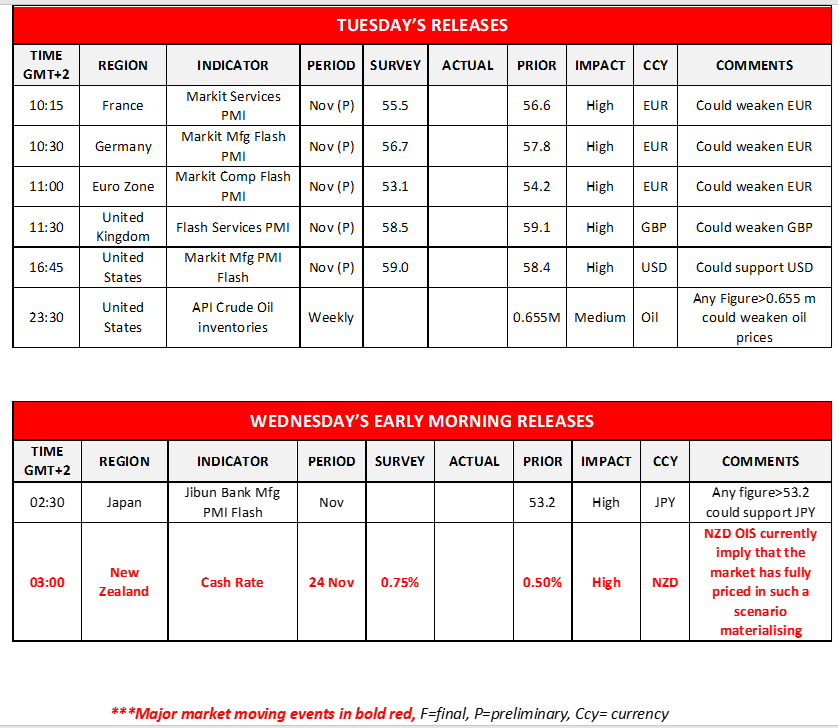
- 09:45 (US) Nov Preliminary Markit Manufacturing PMI: 59.1e v 58.4 prior; Services PMI: 59.0e v 58.7 prior; Composite PMI: No est v 57.6 prior.
- 09:45 (UK) BOE to buy £1.47B in APF Gilt purchase operation (20+ years).
- 10:00 (US) Nov Richmond Fed Manufacturing Index: 11e v 12 prior.
- 10:00 (MX) Mexico Weekly International Reserve data.
- 10:00 (UK) BOE Gov Bailey.
- 10:30 (CA) Canada to sell 3-month, 6-month and 12-month.
- 11:30 (US) Treasury to sell 2-year FRN.
- 12:30 (IE) ECB's Makhlouf (Ireland).
- 13:00 (US) Treasury to sell new 7-year notes.
- 13:00 (CA) Bank of Canada (BOC) Beaudry.
- 14:00 (AR) Argentina Oct Trade Balance: $1.1Be v $1.7B prior.
- 14:00 (AR) Argentina Sept Economic Activity Index (monthly GDP) M/M: 0.6%e v 1.1% prior; Y/Y: 7.7%e v 12.8% prior.
- 16:00 (KR) South Korea Dec Business Manufacturing Survey: No est v 88 prior; Non-Manufacturing Survey: No est v 85 prior.
- 16:30 (US) Weekly API Oil Inventories.
- 17:15 (AU) RBA's Bullock participates in panel event.
- 19:30 (JP) Japan Nov Preliminary Manufacturing PMI: No est v 53.2 prior; PMI Services: No est v 50.7 prior; PMI Composite: No est v 50.7 prior.
- 19:30 (AU) Australia Q3 Construction Work Done: No est v 0.8% prior.
- 19:40 (AU) RBA's Bullock participates in panel event.
- 19:00 (SG) Singapore Q3 Final GDP Q/Q: 0.8%e v 0.8% prelim; Y/Y: 6.5%e v 6.5% prelim.
- 20:00 (NZ) Reserve Bank of New Zealand (RBNZ) Interest Rate Decision: expected to raise the Official Cash Rate (OCR) by 25bps to 0.75%.
- 20:10 (JP) BOJ Outright Bond Purchase Operation; to buy 1~3 Years; 3~5 Years and 5~10 Years maturities.
- 22:00 (TH) Thailand to sell THB45B in 2024 and 2035 bonds.
- 22:30 (JP) Japan to sell 6-Month Bills.
The $BEL20 Index Bullish Cycles And Longer Term Swings
1st the BEL20 Index has trended higher with other world indices since the benchmark was established. The index remained in a long-term bullish trend cycle into the May 2007 highs. From there it made a sharp correction lower that lasted until March 2009 similar to other world indices. That is where the index corrected the whole long-term bullish cycle from the all-time lows. At this point is where this bullish trend, cycle and swing analysis begins.
Secondly, the 2009 lows corrected the whole longer-term cycle higher from inception in the benchmark index. The bounce from the March 2009 lows into the January 2018 highs was a clear five swing impulse. The pullback lower from that high is strong enough to suggest it is correcting the whole cycle up from the March 2009 lows. This is determined by reading the RSI and other momentum indicators. The analysis continues below the monthly chart.
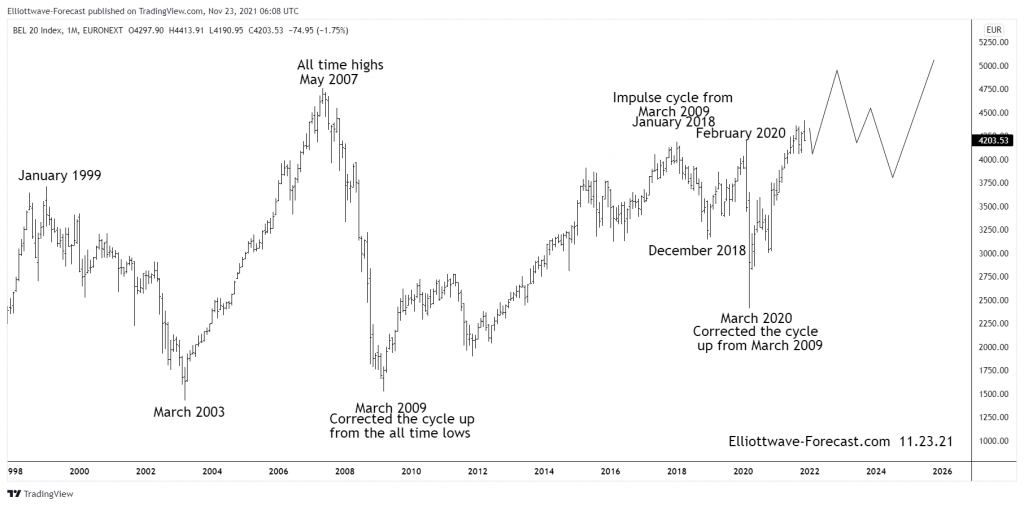
Thirdly, previously mentioned earlier, the pullback from January 2018 high to the December 2018 lows was strong enough to suggest it is correcting the cycle up from the March 2009 lows. At this point, the index could have possibly completed a corrective sequence against the uptrend however some related instruments suggested an otherwise deeper pullback. In February 2020 it did the next swing lower into the March 2020 lows which appeared to have completed an expanded flat from the January 2018 highs.
In conclusion, this expanded flat is a typical and common Elliott Wave corrective structure. As previously mentioned earlier, this corrected the cycle from the 2009 low. At this point in time from the March 2020 lows, it appears the index is ending or at least near ending the third wave. Ideally, while pullbacks remain relatively shallow like above the 3706 area the index can see another high before it corrects the cycle from the March 2020 lows. While above there it is expected to resume the longer-term bullish trend higher back above the May 2007 highs.
Oil Rises, Gold Falls Sharply
Oil stages corrective rally
Oil prices reversed sharply overnight, despite a stronger US dollar and persistent noise from the White House and other nations about a coordinated oil reserve release into domestic markets. Brent crude rose 1.30% to USD 79.45 a barrel, and WTI rose by 1.10% to USD 76.45 a barrel. In Asia, both contracts have eased by 10 cents in quiet trading.
Brent has resistance at USD 80.00 a barrel, followed by USD 82.00 a barrel, while yesterday’s low at USD 77.60 and the 100-day moving average (DMA) at USD 76.70 provide support. WTI has resistance at USD 77.20 and USD 79.35 a barrel, with yesterday’s low at USD 74.80 and the 100-DMA at USD 74.30 providing support.
The SPR release story, whether by the US and/or other nations, appears to be losing momentum. In the bigger picture, the amounts allowable by law to be released are only enough to temporarily cap prices. There is no possible way that President Biden can spin the present oil market situation as a supply disruption, allowing a much greater SPR release. Oil is still flowing; it is just that prices are high. The oil sell-off is as much about the weight of speculative long positioning as it is about potential SPR releases.
Additionally, OPEC+ compliance remains well above 100%, and as a group, they missed their production targets last month. That implies that OPEC+’s capacity to hike production, even if they wished to, is limited to a few members. With speculative positioning somewhat more balanced, international travel reopening and lifting fuel demand, and with OPEC+ constraints in mind, any further sell-offs are likely to be short-term in nature and not sustained. Only Europe can throw a spanner in the works and if the northern hemisphere winter is a cold one, all bearish bets should be off.
Gold stages post-Powell whipsaw correction
I was impressively wrong about gold overnight and I really should have known better than turning bullish was going to end in tears. Following the re-nomination of Jerome Powell overnight, the Fed taper trade reignited and once again, rising US long-dated yields reasserted their dominance over gold prices, as the prospect of rising real yields reasserted themselves.
That led to a sharp fall by gold and when the critical USD 1832.00 to USD 1835.00 an ounce zone failed, it appeared to trigger a mass exodus of the algo and fast money through a very small exit door, as well as triggering other sell stop-losses. Once again gold has whipsawed the bulls in brutal fashion. Gold slumping by over USD 40.00, or 2.25% to USD 1805.00 an ounce. In Asia, some modest bargain hunting has seen it rise slightly by 0.17% to USD 1808.00 an ounce.
Having been burnt so badly, even if US yields retreat over the next few sessions before the Thanksgiving holiday, investors are likely to be much more cautious at re-entering long positions. Momentum will be muted and that means that the USD 1835.00 to USD 1850.00 region will cap gains this week, although I feel it unlikely, we will even get that far. If US yields remain firm this week, gold will be vulnerable to further losses through USD 1800.00. The 50-day, 100-day, and 200-day moving averages are clumped together between USD 1789.30 and USD 1794.00 an ounce. A daily close below this zone potentially signals deeper losses to USD 1760.00 an ounce.
Steepening Yield Curve Lifts US Dollar
US dollar rises as Powell to remain Fed Chair
The Powell renomination put the Fed taper trade front and centre once again overnight, with markets quickly moving to price in a first 0.25% hike by mid-2022 and long-dated US yields rising sharply. That saw yet another impressive move higher for the US dollar, with the dollar index climbing by 0.45% to 96.50 where it remains this morning. The index’s initial target is the June 2020 highs around 97.80 with support at 96.00 and 95.50. Having come a long way in a short time, the index’s relative strength index (RSI) indicator is now in overbought territory. That suggests the US dollar is vulnerable to a short-term correction lower before resuming its uptrend.
The Australian and New Zealand dollars held steady at 0.7225 and 0.6950 overnight as risk sentiment steadied after the Powell announcement. Rising commodity prices see AUD/USD unchanged in Asia, helped by AUD/JPY buying. It is likely to remain under pressure though if the US dollar keeps rising and failure of 0.7220 opening further falls to 0.7150. NZD/USD has eased to 0.6935 after soft Retail Sales and if the Reserve Bank only hikes by 0.25% tomorrow, Kiwi could come under sustained pressure targeting 0.6900 initially and potentially 0.6800 later in the week.
USD/JPY volumes have been thinned by a Japan holiday today, but the effect of the US/Japan yield differential was there for all to see overnight as US yields spiked higher. USD/JPY has risen 100 points in the last 24 hours to 115.10 this morning, moving through resistance at 115.00. If the US yield rise is maintained, USD/JPY could extend to 115.60 in the first instance, while support remains at 114.00 and 113.50.
EUR/USD suffered once again overnight, weighed down by Covid-19 recovery fears and a broad rally in the US dollar. It retreated another 0.40% to 1.1240 where it remains in Asia. The single currency remains on track to test 1.1160 this week and that in turn sets up a potential retest of 1.1000. A reversal by US yields tonight could grant it a stay of execution, although weak PMIs this afternoon would likely see renewed selling. GBP/USD continues to find support due to its more impressive data of late but will remain guilty by geographic association with the euro. GBP/USD has fallen to the bottom of its 1.3400 to 1.3500 range. EUR/GBP selling continues to alleviate the effects of a stronger US dollar and only failure of 1.3350 signals a new move lower.
The PBOC set yet another weaker yuan fix versus the US dollar today, but so far, currency markets are refusing to take the bait. USD/CNY remains anchored below 6.3900, perhaps aided by inflows related to the massive trade surplus, weakness in ex-dollar basket components, and inflows into China’s investment-grade bond market. Elsewhere, some weakness is starting to show in regional currencies, with the Malaysian ringgit, Thai baht, Indian rupee, and Indonesian rupiah showing some nerves over the climb in US yields overnight. Only the Korean won is holding its own as the street awaits to see if the Bank of Korea hikes rates this week. The persistent strength in the Chinese yuan continues to shield regional Asia from the worst of the US dollar rally seen in the G-10 space. With policy rates at record lows and going nowhere in most of Asia, their currency strength will depend on the persistence of the rise in US yields.
WTI Oil Outlook: Oil Price Comes Under Fresh Pressure On Talks Of Releasing Emergency Reserves
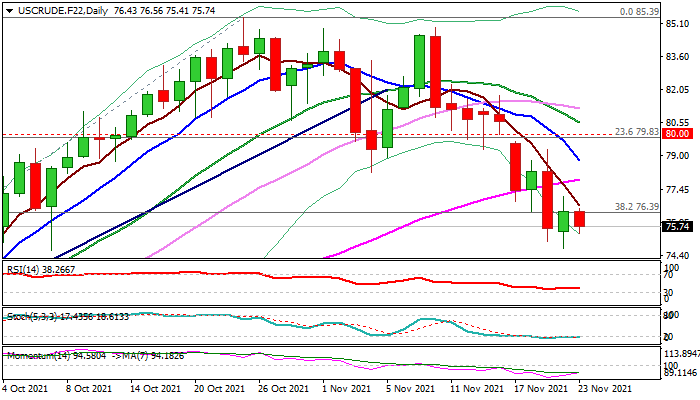
WTI oil returned to red on Tuesday after Monday’s recovery attempt from new seven-week low lost steam on probe through broken Fibo support at $76.39 (38.2% of $61.83/$85.39) and failed to register daily close above this level.
Oil came under fresh pressure on talk that the Unites States and major Asian consumers will release their strategic crude reserves to lower energy prices, despite growing concerns that rising Covid-19 cases and new restrictive measures in Europe, may hurt demand.
On the other side, OPEC+ group of major oil producers said it could adjust its plan to raise oil production if large consuming countries release their reserves or new wave of virus dampens demand.
Initial negative signal was generated on completion of bearish failure swing pattern on daily chart, with further downside extension and repeated close below pivotal Fibo support at $76.39, adding to reversal signals.
Daily chart stochastic is oversold and momentum turned north, suggesting that bears may take a breather before resuming towards next pivotal supports at $74.11 (100DMA) and $73.61 (50% retracement of $6.83/$85.39), violation of which would confirm reversal.
Broken Fibo 38.2% support ($76.39) reverted to resistance which so far caps and guards upper pivots at $78.22/82 (Nov low / falling 10DMA).
Res: 76.39; 77.59; 77.91; 78.22.
Sup: 75.41; 74.75; 74.11; 73.61.
Taper Trade Sees Mixed Results In Asia
Powell renomination weighs on Wall Street
Wall Street had a torrid session overnight as US long-dated bond yields jumped higher after the renomination of Jerome Powell as Federal Reserve Chairman. Rate-sensitive technology stocks slumped pushing the Nasdaq lower. Meanwhile, banking stocks rose in sympathy with a steeper yield curve, which bodes well for future profitability, while a rise in commodity and oil prices boosted the mining and energy sector. The S&P 500 fell by 0.32%, with the Nasdaq retreated by 1.26% as the Dow Jones edged 0.05% higher. Futures on all three are almost unchanged in Asia.
With Japan on holiday today, the price action in US markets is being broadly repeated in Asia. Tech-heavy indices are suffering while those with more traditional resource, banking and property weightings are holding their own. South Korea’s Kospi is down 0.45% with Taipei falling by 0.35%.
Mainland China sees the Shanghai Composite rising by 0.35%, aided by reports of renewed lending to the property sector. The more tech-centric CSI 300 remains unchanged though. Hong Kong has seen locally listed mainland China tech-titans sold heavily, pushing the Hang Seng down by 0.75%.
In regional markets, Singapore has eased by 0.10% with Kuala Lumpur edging 0.15% lower and Jakarta easing by 0.30%. Bangkok has risen by 0.15% with Manila jumping by 0.65%. In Australia, the rise in US yields overnight, and rallies in oil, iron ore and coal, have lifted the bank and resource sector. That has pushed the All Ordinaries 0.55% higher, while the ASX 200 has rallied by 0.75%.
The Covid-19 hangover in Europe is likely to continue today, although a lower euro should take the edge of exporters. Weaker than expected PMIs from Germany and France could well deepen the malaise and raise fears that the European recovery faces a number of challenges.
J-La Sets Of Wall Street Taper Trade
Powell renomination puts taper trade in spotlight
It was a frisky session on Wall Street overnight as President Biden renominated Jerome Powell for another term as Fed Chairman while elevating his rival, Lael Brainard, to Vice-Chair. Ms Brainard is very much a dove, and it appears that stock and bond markets, in particular, had been simmering near recent highs in case Ms Brainard got the nod for the top job.
With Mr Powell nominated, Europe was knocked off the front page as the new J-La combination saw US markets rush to price in faster tapering by the Fed and earlier rate hikes. The US yield curve steepened as long-dated bond yields from ten years out rose sharply, notably in the 30-year tenor. The US dollar recorded another impressive rise, with the yield differential-sensitive USD/JPY jumping nearly 90 points. Rate-sensitive technology stocks didn’t like the J-La song, thanks to their galactic valuations, and headed south, while gold plummeted as it was shown who its boss was, thanks to US yields finally reacting to the reel-in-inflation chorus. Of course, being bullish on gold yesterday, after returning from holiday, should have been a major warning sign to readers. Short gold is my happy place, and to there, I shall return like MacArthur wading ashore in the Philippines.
The moves overnight did bitcoin no favours either, with the digital Dutch tulip looking wobbly at USD 56,800.00 this morning. Failure of USD 55,500.00 could see USD 53.300.00 tested and failure there sets up a deeper move lower targeting the 100 and 200-day moving averages lurking under USD 49,000.00. Momentum appears to have stalled between USD 60,000.00 and USD 61,000.00 for now. As usual, tee-shirt-clad frontiers of finance-istas, don’t fill up my inbox with mail extolling how you bought Bitcoin at USD 1.0, someone also paid USD 67,000.00 and they’re not as happy. Cryptos remain a tradeable, but not investable asset in my mind, and I haven’t changed my mind.
Whether the Fed taper trade has legs or not, I do not yet know. Long-time readers will know that this is my favoured view into the year-end and early 2022, but I have been led numerous times to water only to find a giant crocodile in the watering hole. Currency markets seem to agree with me, helped by external factors like Europe, but central bank repression in the bond markets and bottomless zero per cent world FOMO in equities continues to frustrate. Given that global central banks will hit the wimp/ease button at the first hint of trouble, I wouldn’t bet against either right now, but I am sure that we are in for a lot more two-way directional volatility into December.
In Asia, Japan is on holiday today reducing trading volumes. Market chatter seems to be focused on a Reuters report that China has instructed some banks to lend a bit more to the property sector projects. Additionally, the noise is increasing around a possible RRR cut in December after the PBOC changed some wording in its latest quarterly report. The PBOC set another weaker CNY fixing versus the US dollar today as well, after hinting that the CNY rally had become too one-way over the weekend. Mainland stocks rose yesterday on the weaker yuan story, but the jury is out on whether that will continue. China equities will remain a challenging market into 2022 thanks to the “shared prosperity” policies of Beijing. I do not believe the process of repricing of China equity prices to reflect that policy, or the “there’s never just one cockroach” in the property sector, is complete.
The data calendar is quiet in Asia, with Australian PMIs and New Zealand Retail Sales already out. Singapore inflation will remain benign, while Taiwan Industrial Production, if it prints lower than 11.0% YoY for October, could spark more peak-recovery nerves in regional markets where the collapse in coal and base metal prices continues to be mostly ignored.
Circling back to Australia and New Zealand, Australian Markit Manufacturing PMI held steady at 58.20, but Markit Services PMI for November disappointed at 51.80. With the RBA sitting dovishly on the hawkish fence, and the border and domestic reopening proceeding at breakneck speed, the Services PMI should improve rapidly, and today’s number will have little impact.
With an RBNZ policy decision tomorrow, today’s Retail Sales have gone a long way towards whether they hike by 0.25% or 0.50%. The data was very weak, thanks to the extended Auckland lockdown. YoY for Q3 fell -5.20%, and QoQ by an even uglier -8.10%, both huge misses. With 0.25% priced into the New Zealand dollar, and no RBNZ meeting until February after tomorrow, the New Zealand dollar has lost its rate-hike premium and is now entirely at the mercy of development in the greenback.
This afternoon sees pan-Europe and United Kingdom Markit Manufacturing and Services PMIs. I expect the UK to continue to surprise to the upside, in line with recent data releases. Given Europe’s already vulnerable outlook, thanks to virus restrictions and riots, low readings from heavyweights Germany and France are likely to see another wave of investors head for the exit door in European stocks and the Euro. The US also releases Markit PMIs this evening, but I wouldn’t bet in them disappointing. High prints should keep the taper trade alive for another day, while low numbers will likely see a short-term pause.
Powell Renomination Turbocharges Dollar, Sinks Gold
- Dollar charges higher as Fed chief Powell gets a second term
- Stock markets pull back from record peaks, gold cracks
- European PMIs pause euro’s slide, RBNZ rate decision next
Powell gives dollar more fuel
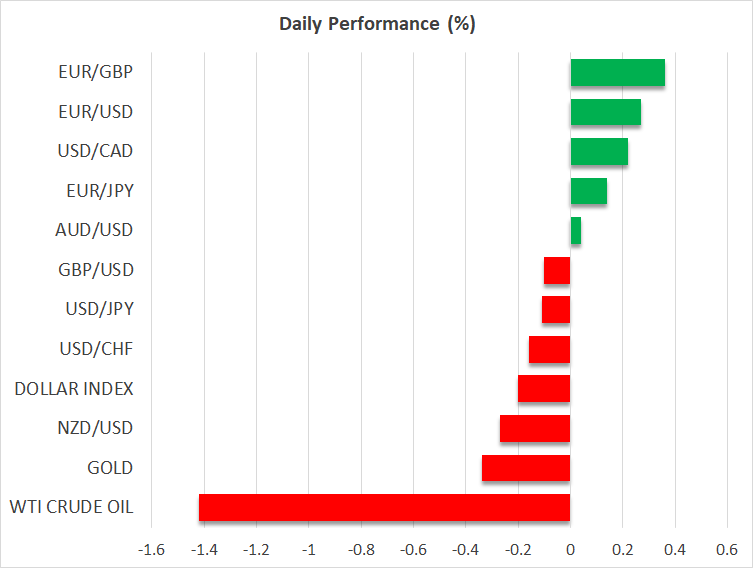
The White House announced yesterday that Jerome Powell will get a second term as Fed Chair, while Lael Brainard will be promoted to Vice Chair. Even though the decision was as expected, the news still caught markets by storm, propelling the dollar higher as traders doubled down on bets for faster tightening.
Markets have now fully priced in three rate hikes for next year starting in June. For that to happen, the Fed would need to accelerate the pace of tapering, something that senior officials including current Vice Chair Clarida have indicated they are open to. This will probably be a hot topic at the December FOMC meeting.
It is becoming clearer that the Fed can no longer afford to be patient. Inflation is scorching hot, consumption is booming, the labor market seems tight by several metrics, business surveys point to a powerful spell of growth ahead, and Congress is about to bring more spending to the party.
With the prospect of accelerated tapering in play, the dollar could continue to rule over the FX arena, especially while the euro grapples with new lockdowns. But with the Fed now ‘fully priced’, the risk is the US virus situation. If restrictions return to America too, the reserve currency might lose some of its shine as markets revert back to pricing two rate hikes for next year.
Stocks shiver but don’t break
The market reaction reflected the view that Powell is likely to step on the policy brakes harder than Brainard. Yields spiked higher across the curve, with short-term rates rising faster, which cooled inflation expectations a little.
Equity markets didn’t enjoy this cocktail. It was a classic case of rising rates making stocks less attractive, with unprofitable or ‘richly valued’ shares taking the sharpest hit as higher yields decrease the present value of their future cash flows. As such, the tech-heavy Nasdaq lost more than 1%.
To be fair though, stocks have been remarkably resilient considering just how much central bank tightening has been priced into bond markets. This is likely a testament to the unstoppable force of corporate buybacks, which are headed for a record year.
Gold cracks, PMIs rescue euro
Gold was the biggest victim of the Fed leadership news, suffering at the hands of rising real yields and a rampaging dollar, with some large option expiries scheduled for today likely adding fuel to the selloff. Bullion’s fate now hangs on whether the Fed will speed up tapering, which in turn will depend on the virus trajectory in America.
The euro got some much-needed relief after the latest Eurozone PMIs pointed to a slight improvement in business activity. However, these surveys were mostly conducted before the new wave of covid restrictions rocked Europe, so next month’s data are unlikely to be so cheerful. Markets are still pricing some chances of a minor ECB rate hike next year. That's quite unrealistic and a repricing could spell more pain for the battered euro.
Finally, PMI surveys will also be released in the UK and America today. Beyond those, the spotlight will fall on the Reserve Bank of New Zealand, which concludes its meeting at 01:00 GMT Wednesday. A rate increase is almost certain as the nation’s economy is on steroids - the real question is whether it will be a ‘single’ or a ‘double’ hike.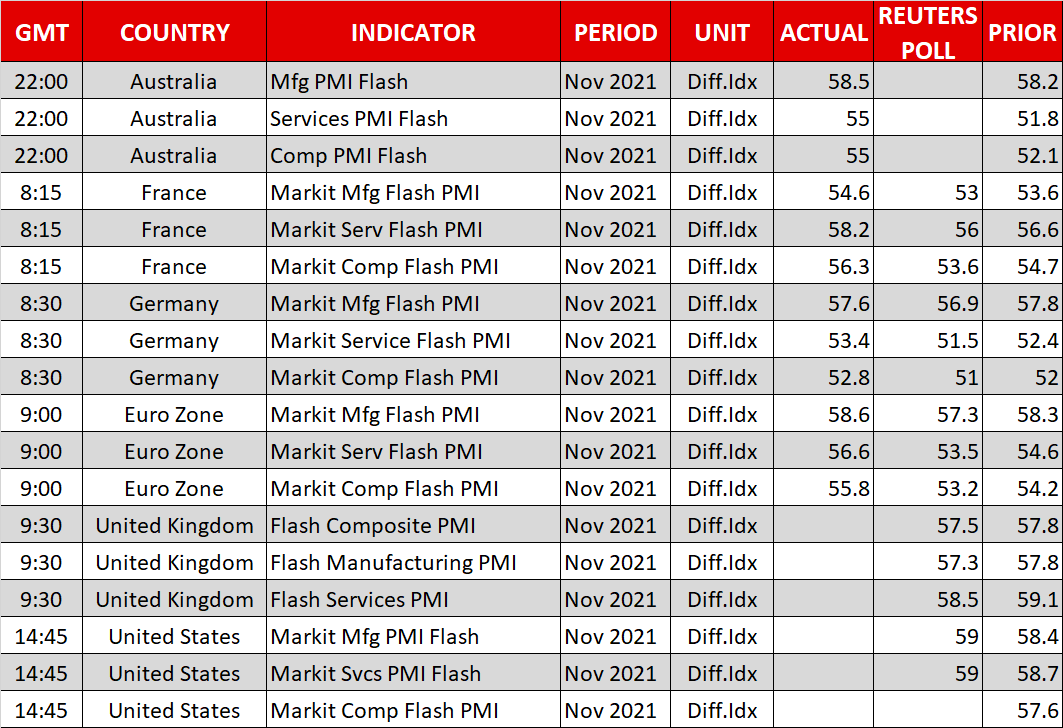
USD Gains On Powell’s Reappointment
The USD tended to gain against its counterparts yesterday as President Biden chose Jerome Powell for another term in the Fed's highest post. The reappointment reaffirmed market expectations for a faster tightening of the bank's monetary policy with rate hikes being possible next year. US stockmarkets tended to provide mixed reactions on the news yesterday, with S&P 500 and Nasdaq being in the reds for the day. As for financial releases we note the release of November's US Markit preliminary PMI figures, which could provide some volatility for the USD, while the release of respective PMI readings for the Eurozone and the UK could also increase volatility for EUR and GBP pairs today. On the commodities front, we note the headlines by Reuters that the US is set to announce a release from government oil reserves in order to ease the pressure of a tight supply and to lower prices. Oil traders today may also turn their attention on the release of the API weekly crude oil inventories figure, and should another surplus be reported, we may see the bearish tendencies for oil prices intensifying.
USD/JPY rose yesterday aiming for the 115.20 (R1) line. The pair's price action seems to have been moving in a sideways motion between the 115.20 (R1) resistance line and the 117.70 (S2) support line since the 15th of November. For our current sideways bias to change in favour of a bullish outlook we would require the pair to break clearly the 115.20 (R1) level. Please note that the RSI indicator below our 4-hour chart is near the reading of 70 implying a rather bullish sentiment. Should the bulls actually keep control over the pair's direction, we may see it breaking the 115.20 (R1) line and aim for the 116.00 (R2) level. If the bears take over, we may see the pair reversing course, breaking the 114.45 (S1) support line and aim for the 113.70 (S2) level.
RBNZ to hike cash rate
On Wednesday's Asian session we get from New Zealand RBNZ's interest rate decision. The market currently has fully priced in the possibility of the bank hiking its cash rate by 25 basis points, raising it from 0.50% to 0.75%. It should be noted that since the last meeting of the bank which had resulted in a rate hike of 25 basis points, the CPI rate for Q3, has been released showing that inflation has accelerated reaching 4.9% yoy, but accelerated also on a quarter-on-quarter level. At the same time the employment market has tightened further for Q3, recovering somewhat from the blow caused by the pandemic. Should the bank actually proceed with a 25-basis points rate hike as its widely expected we may see the Kiwi getting some moderate support, as such a scenario may be allready priced in. If the bank proceeds with a rate hike and provide a warning that more rate hikes are yet to come, the support for the Kiwi may be greater, while in the scenario of a rate hike greater than 25 basis points, NZD may jump substantially. On the other hand, one should not underestimate the possibility of the bank remaining on hold, which could make the Kiwi tumble.
NZD/USD continued and even intensified its slide lower yesterday breaking the 0.6965 (R1) support line, now turned to resistance. We tend to maintain a bearish outlook for the pair given that the RSI indicator below our 4-hour chart is near the reading of 30 implying a bearish sentiment. On the other hand, we note that the pair's direction may be affected heavily by RBNZ's interest rate decision tomorrow during the Asian session. Should the pair find extended buying orders along its path we may see it reversing course and breaking the 0.6965 (R1) resistance line aiming for the 0.7025 (R2) level. Should the selling interest be maintained or even intensified we may see NZD/USD breaking the 0.6910 (S1) support line and aim for the 0.6860 (S2) level.
Other market highlights for today
Today we note the release of November's preliminary Markit PMI readings for France, Germany, the Eurozone, UK and the US, while oil traders may be more interested in the release of the API crude oil inventories figure.
USD/JPY H4 Chart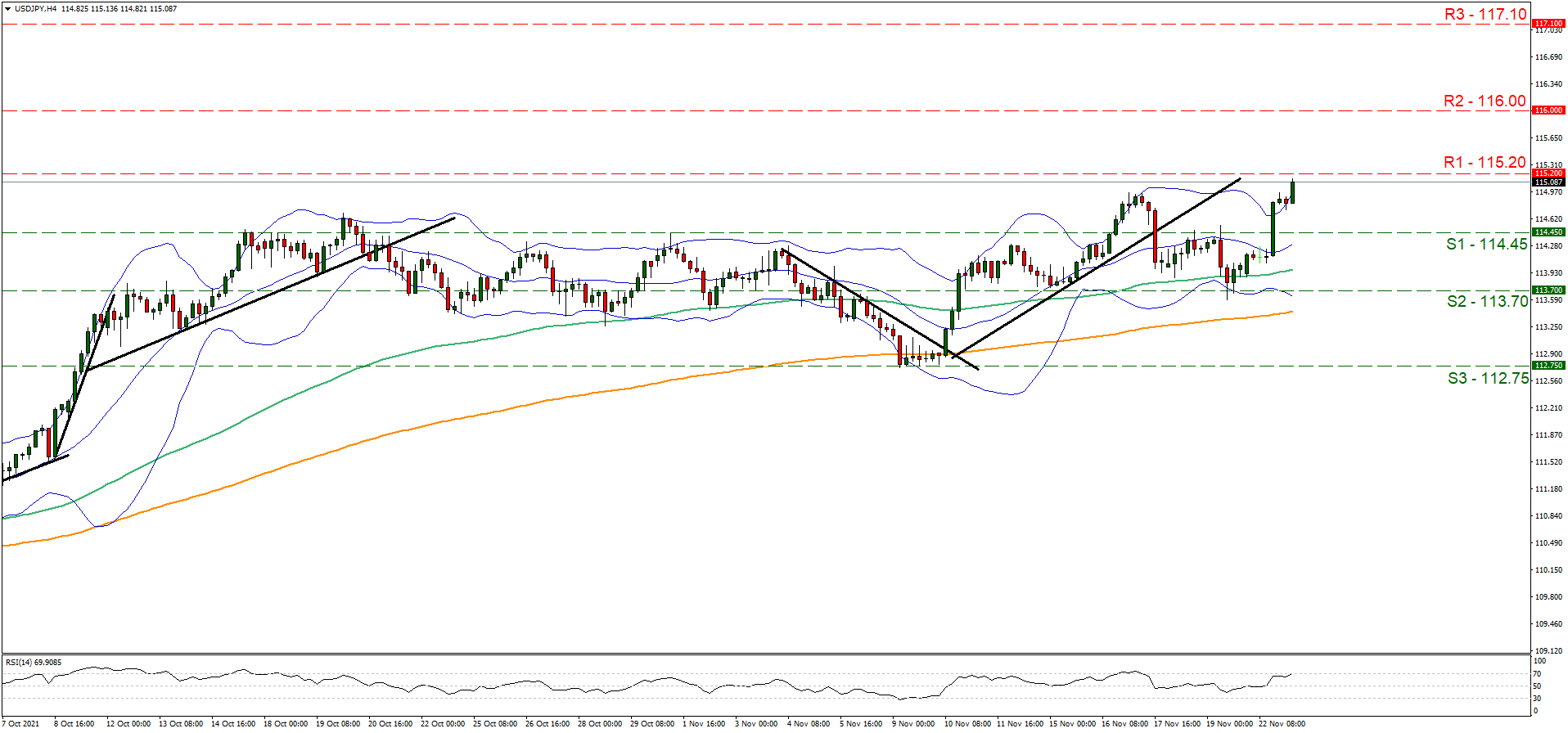
Support: 114.45 (S1), 113.70 (S2), 112.25 (S3)
Resistance: 115.20 (R1), 116.00 (R2), 117.10 (R3)
NZD/USD H4 Chart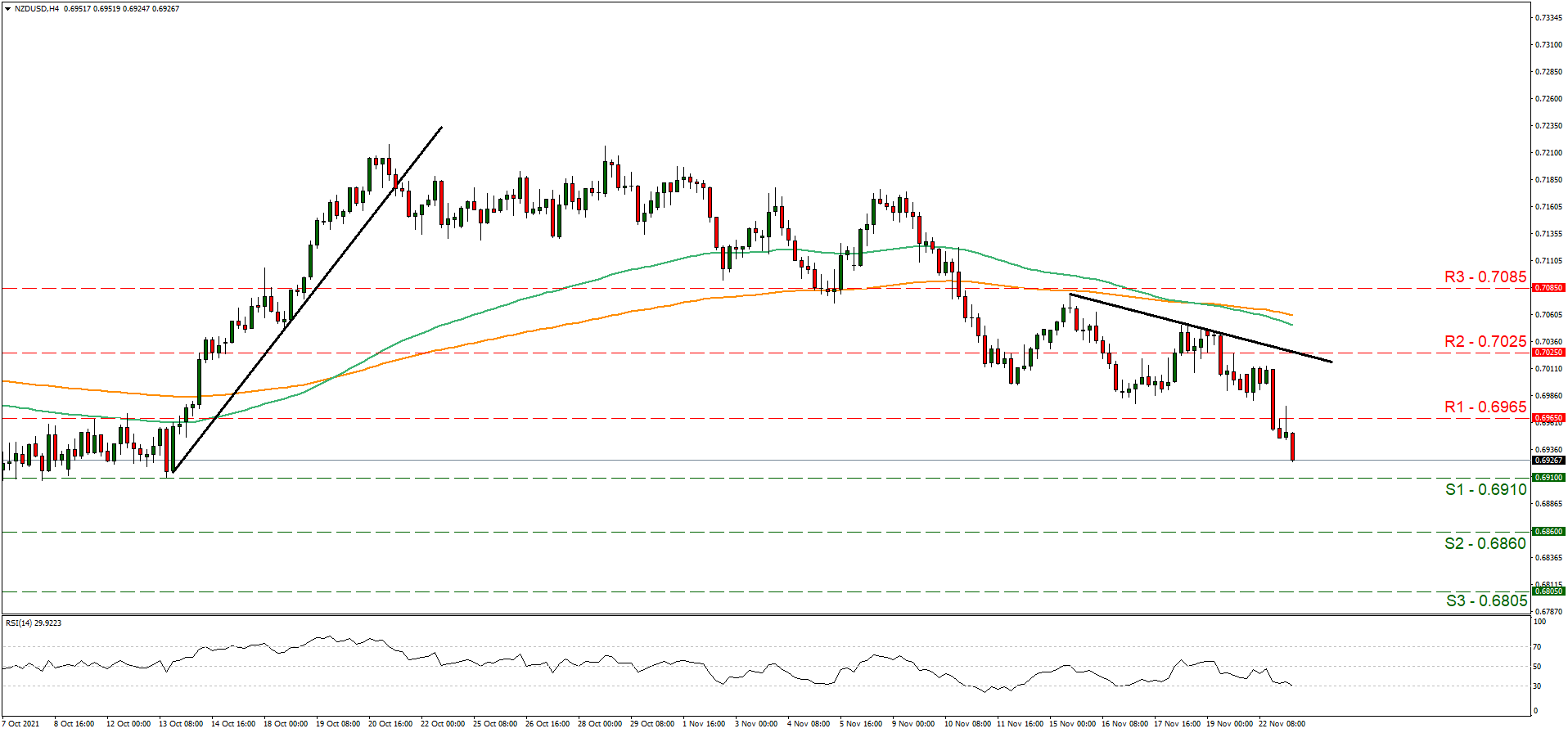
Support: 0.6910 (S1), 0.6860 (S2), 0.6805 (S3)
Resistance: 0.6965 (R1), 0.7025 (R2), 0.7085 (R3)
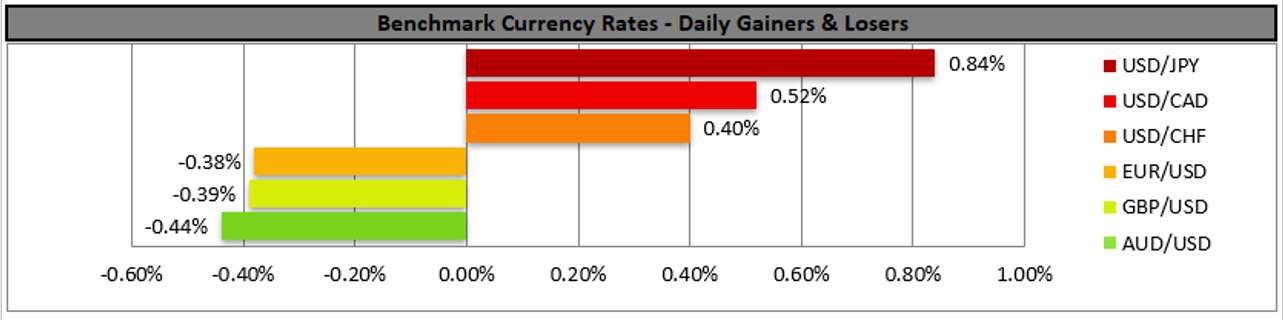
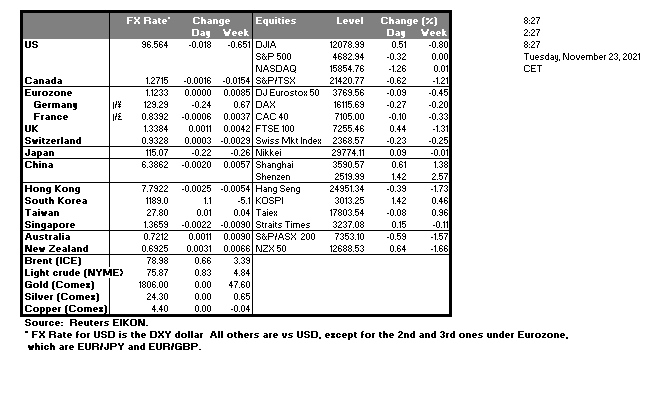
Jerome Powell Will Remain A Head Of The Fed For Another Four Years
The US President Joe Biden supported Jerome Powell for a second four-year term as Chairman of the US Federal Reserve and nominated Lael Brainard as Vice Chairman. Such news positively affected financial markets. The S&P 500 increased by 0.51% and made a new all-time high, the Dow Jones Industrial Average gained 0.77%, but the Nasdaq Technology Index fell by 0.3%.
Treasury yields jumped on news of Powell's reappointment, suggesting that many investors were betting on Brainard leaning more “dovish”, which would likely lead to a longer-term approach to monetary policy.
Rising government bond yields contributed to the sharp drop in gold and silver prices, as these instruments have an inverse correlation to the Treasury yield indicator. Fundamentally, the reduction of the QE program contributes to the decline in prices of precious metals.
Bank of America Corp. strategists are bearish for next year and urged investors to focus on cash since faster inflation and higher interest rates change the trajectory of global asset prices. The dollar index continues to rise as investors shift funds into dollars amid volatile markets. Many analysts are beginning to believe that the Democrats will "drop" the stock market.
European stock indexes finished Monday's trading without a single dynamic. The German DAX dropped 0.27%, the French CAC 40 lost 0.1%, the British FTSE 100 added 0.4%, the Italian FTSE MIB gained 0.2%, and the Spanish IBEX increased by 0.8%. Investors are still concerned about the coronavirus infection in the region. Last week, Austria decided to introduce a lockdown. German authorities began to talk about the possibility of a similar measure because of the record numbers of the disease per day. In Germany so far, restrictions have been imposed only on those who have not been vaccinated against COVID-19. French authorities claim a new wave of disease in the country.
Oil prices are falling in anticipation of the US decision to use oil from the strategic reserve. One OPEC+ delegate said that the global oil-producing alliance may adjust its production plans if consumer countries release their reserves to increase supply on the market to push prices lower. The United States is preparing to sell oil from its inventories within the next 24 hours and that this move will be done in cooperation with other consumer countries (Japan, India).
Asian stock indexes traded multidirectional on Tuesday, watching a decline on Wall Street, as traders increasingly believe a rate hike in the US in 2022 after President Joe Biden re-elected Federal Reserve Chairman Jerome Powell for a second term. China's benchmark CSI 300 index is on the opening level, while Hong Kong's Hang Seng index decreased by 1.05%. The Australian ASX 200 was better than the market and increased by 0.78% on the back of gains in mining and energy stocks. Japanese markets are closed due to the bank holiday. Singapore's inflation rate rose to 3.2% in October, the highest one since 2013.
Main market quotes:
- S&P 500 (F) 4,682.94 −15.02 (−0.32%)
- Dow Jones 35,619.25 +17.27 (+0.05%)
- DAX 16,115.69 −44.28 (−0.27%)
- FTSE 100 7,255.46 +31.89 (+0.44%)
- USD Index 96.53 +0.50 (+0.52%)
Important events for today:
- Singapore Consumer Price Index (m/m) at 07:00 (GMT+2);
- Germany Manufacturing PMI (m/m) at 10:30 (GMT+2);
- Germany Services PMI (m/m) at 10:30 (GMT+2);
- Eurozone Manufacturing PMI (m/m) at 11:00 (GMT+2);
- Eurozone Services PMI (m/m) at 11:00 (GMT+2);
- UK Manufacturing PMI (m/m) at 11:30 (GMT+2);
- UK Services PMI (m/m) at 11:30 (GMT+2);
- US Manufacturing PMI (m/m) at 16:45 (GMT+2);
- US Services PMI (m/m) at 16:45 (GMT+2).