

Sample Category Title
NZD/USD dips after RBNZ hike, staying mildly bearish
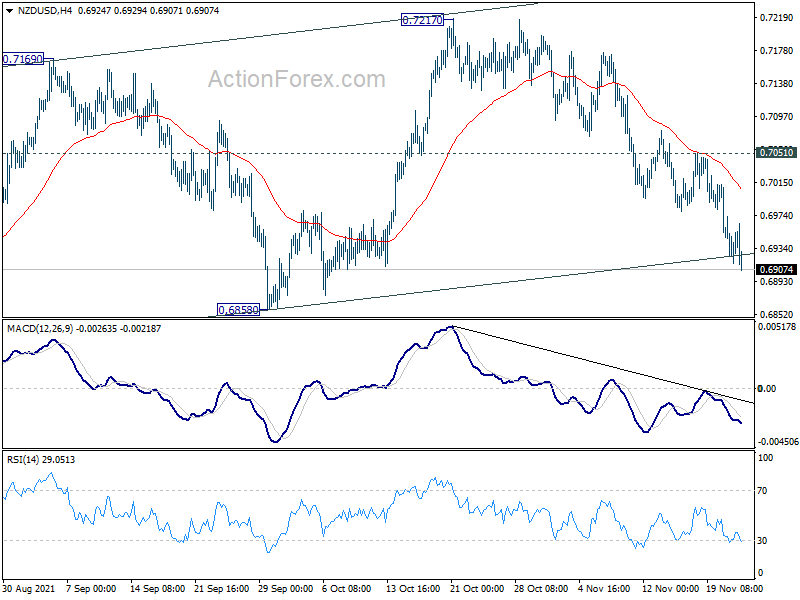
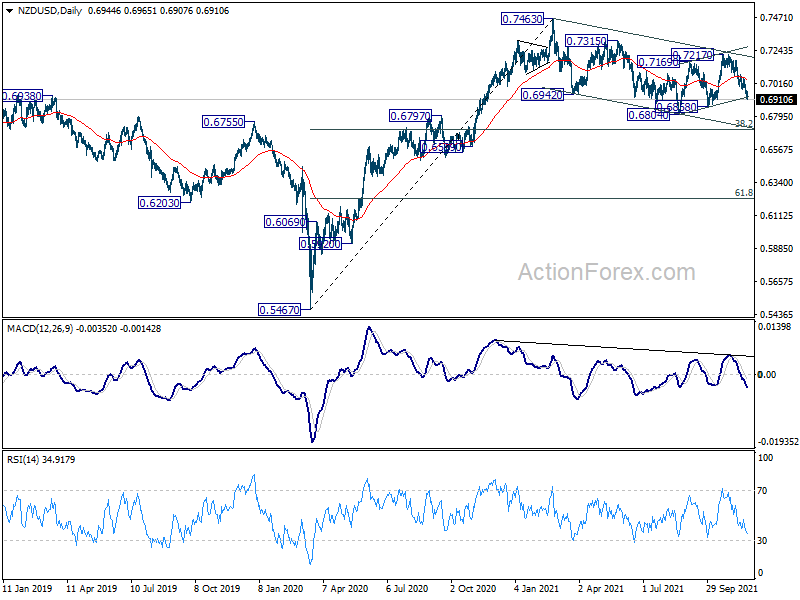
NZD/USD softens slightly after RBNZ rate hike and near term outlook stays mildly bearish with 0.7051 resistance intact. Deeper fall should be seen to 0.6858 support first. Break there will affirm the case that larger down trend from 0.7463 is resuming. Further decline should then be seen through 0.6804 support to 38.2% retracement of 0.5467 to 0.7463 at 0.6731 next.
Market Morning Briefing: Dollar Index Continues To Sustain Above 96.50
STOCKS
Apart from the Indian and US equities other indices have fallen from levels seen yesterday. Dow can rise further on a break above 36000 while Dax has scope to fall to 15900 before a bounce is seen. Failure to hold above 15900 will be strongly bearish. Nikkei and Shanghai too need to hold above 29000 and 3550 to keep bullish possibilities intact. Nifty and Sensex are bullish above immediate supports.
Dow (35813.80, +194.55, +0.55%) has risen well and may test 36000. A break above 36000 is needed to rise further towards 36250-36500 in the medium term. Immediate support near 35500 looks strong just now.
DAX (15937.00, -178.69, -1.11%) has come down sharply, breaking below our mentioned support at 16100. Lower support is now visible near 15900 which if breaks can take the index down to 15800/400 on the downside. Watch price action near 15900 just now.
Nikkei (29436.73, -337.38, -1.13%) has fallen sharply and looks bearish while below 29500 to fall towards 29250-29000-28500 from where a bounce can again be possible in the medium term.
Shanghai (3581.87, -7.22, -0.20%) has come down as warned yesterday. While below 3600 view is bearish for a fall to 3550. A break above 3600 is needed for initial indication of a fresh rally towards 3625-3675 on the upside.
Nifty (17503.35, +86.80, +0.50%) rose very well yesterday. The view is bullish above 17200 to see a test of 17800 and higher eventually. A break below 17200 if see can drag the index down towards 17000. Narrow range of 17800-17200 and broad range of 17000-18200 is possible over the next 1-2 weeks.
Sensex (58664.33, +198.44, +0.34%) has risen back and the view is bullish to see a rise towards 59000/60000 on the upside.
COMMODITIES
Gold and Silver have fallen sharply on Dollar strength and has scope to fall to 1780/1760/1740 and 23-22 in the near term. Copper may trade within 4.45-4.30 while below 4.45. Crude prices have risen sharply but may hold below resistances near 84/85 (Brent) and 80 (WTI) respectively.
Brent (82.32) and WTI (78.62) have risen sharply on news that US President Joe Biden had authorized the release of 50 million barrels from the country’s Strategic Petroleum Reserve. We see immediate resistance at 84/85 on Brent and 80 on WTI which may hold to push back oil prices down towards 78-75 soon. The OPEC+ would meet next on 2nd Dec, 2021.
Gold (1793.40) has fallen to the 1780-1800 support region. Need to see if the price bounces from 1780 to rise back to 1800+ or falls off below 1780 to test 1760/40 on the downside. With the Dollar Index trading strong, Gold may either remain stable or see a sharp fall.
Silver (23.56) has sharply broken below 24 and could test 23-22 on the downside before again bouncing back from there. Immediate view is bearish.
Copper (4.4035) seems to be holding below 4.45 just now and unless a break above 4.45 is seen, view is to see a ranged movement between 4.45 and 4.30 for the near term. A break above 4.45 is needed for a rise to 4.50/60
FOREX
Most currencies are stable and seen near levels mentioned in yesterday’s edition. Dollar Index continues to remain strong keeping possibility of euro to fall to 1.12 or lower. Aussie and Pound have paused but look bearish for the near term. USDCNY could trade within 6.37-6.42 while EURJPY needs to break above 130 to turn further bullish else can remain within 130-128 for some more time. USDINR can trade within a narrow range of 74.60-74.40 and a broad range of 74.80-74.00.
Dollar Index (96.552) continues to sustain above 96.50 and looks fairly bullish towards 97.50-98.
Euro (1.1237) has paused just now and could remain ranged for a couple of sessions before falling back to 1.12 or lower. It would be important to see if Euro breaks below 1.12 in the near term.
EURJPY (129.29) tested 129.60 before coming off from there. A rise above 130 is needed to turn the cross bullish again. Else we may expect a fall back to 128 soon. Watch price action near 130.
Aussie (0.7222) fell to 0.7206 yesterday before bouncing back from there as expected. While above 0.72-0.7170, we may expect some corrective upmove towards 0.7250-0.7265 before again coming off from there.
Pound (1.3377) tested 1.3342 as expected before bouncing from there. A short corrective upmove is possible to 1.34-1.3450 before a fall is again seen in the longer run.
Dollar-Yen (115.06) needs to move up sustaining above 115 to slowly head towards 116 and higher. View is bullish for now.
USDCNY (6.3899) trades near the upper end of the 6.39-6.37 range mentioned yesterday. A break above 6.39 if seen can take the pair up to 6.42 extending the range to 6.37-6.42 for the near term.
USDINR (74.42) held below 74.60 well. While resistance at 74.60 holds, we may expect trade within 74.40-74.60. a break below 74.40 will drag the pair down to 74.20/00. Narrow range of 74.60-74.40 and broad range of 74.0-74.80 may hold till the next one week.
INTEREST RATES
The US Treasury yields have risen further sharply at the far-end and are coming closer to their key resistances. The US PCE data release today will be key to see if it is providing a trigger to break the resistances and move higher or not. We will have to wait and watch. The German yields have risen further sharply. A break above the immediate resistances will prove our bearish view wrong and in turn will take the yields further higher. The 5Yr and 10Yr GoI are likely to trade sideways for some time.
The US 2Yr (0.60%) and the 5Yr (1.32%) Treasury yields remain stable while the 10Yr (1.65%) and the 30Yr (2%) have moved up further as expected. The 10Yr has a crucial resistance in the 1.65%-1.68% region which if broken can take it up to 1.75% and even higher. The 30Yr on the other hand has room to test 2.1% from here and need to see if it is reversing lower from there to keep our expected range intact.
The German 2Yr (-0.74%), 5Yr (-0.55%), 10Yr (-0.22%) and 30Yr (0.10%) yields have risen further sharply yesterday. A further rise above -0.2% (10Yr) and 0.10% (30Yr) can take the yields up to -0.1% (10Yr) and 0.2% (30Yr). That in turn will then negate our earlier bearish view of seeing -0.45% and -0.5% on the 10Yr and -0.1% and -0.2% on the 30Yr.
The Indian 10Yr GoI (6.3648%) tested 6.38% and has come-off from there. The narrow range of 6.3%-6.38% mentioned yesterday remains intact and a test of 6.3% is possible while below 6.38%. We reiterate that 6.3%-6.45% is the broader range of trade possible and the bias is bearish to see a break below 6.3% and a fall to 6.2% eventually.
The 5Yr GoI (5.6967%) has come-off from the high of 5.7156%. The yield is likely to oscillate in the 5.66%-5.75%/5.78 range for some more time before breaking below 5.66% and falling to 5.63%-5.62%.
EUR/USD – Losing Momentum?
Correction may be coming
The dollar has been on a strong run the last couple of weeks, which when coupled with the broad weakness we’ve seen in the euro has led to an accelerated sell-off in the EURUSD pair.
Higher inflation, a strong consumer and a strengthening labour market has backed the Fed into a corner, despite strong pushback on rate talk over recent weeks. But it was Powell’s renomination that was the straw that broke the camels back – beating Lael Brainard (viewed as more of a dove) to the post – and now markets are pricing in a few rate hikes next year starting in June.
While that has driven the dollar higher, the question now becomes how much more can be priced in? Is it primed for correction? Has the sell-off become oversold?
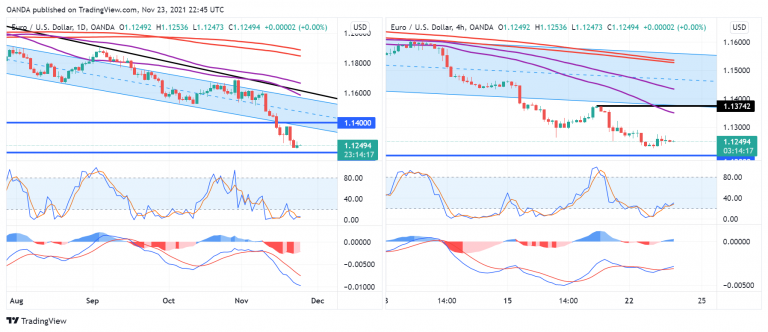
The momentum indicators certainly suggest so. The stochastic on the daily chart remains deep in oversold territory as price approaches 1.12, while on the 4-hour chart we can clearly see a divergence, with the MACD making higher lows as price continued to decline.
That doesn’t mean we’ve hit a bottom but when approaching a key level of support, it may suggest the trend is weakening. If so, a rotation higher could draw attention back to 1.13 initially – recent support and resistance – and then 1.1375 where the high from late last week coincides with the bottom of the descending channel and the 55/89-period SMA band on the 4-hour chart.
RBNZ hikes OCR to 0.75%, maintains hawkish bias
RBNZ raised the Official Cash Rate to by 25bps to 0.75% as expected. It also maintained a hawkish bias, noting that " further removal of monetary policy stimulus is expected over time given the medium term outlook for inflation and employment."
The central bank also said that despite recent nationwide lockdown, "underlying economic strength remains supported by aggregate household and business balance sheet strength, fiscal policy support, and strong export returns." Capacity pressured have "continued to tighten" with employment "above its sustainable level". A broad range of economic indicators highlight the economy "continues to perform above its current level".
Headline CPI is expected to be "above 5 percent in the near term" before returning towards 2% midpoint "over the next two years.
(RBNZ) MPC Continues to Reduce Monetary Stimulus
The Monetary Policy Committee agreed to raise the Official Cash Rate (OCR) to 0.75 per cent. The Committee agreed it remains appropriate to continue reducing monetary stimulus so as to maintain price stability and support maximum sustainable employment.
The level of global economic activity continues to rise, supported by accommodative monetary and fiscal policy settings, and the relaxation of COVID-19 health-restrictions. The pace of global economic growth has ebbed however, due to the elevated uncertainty created by the persistent COVID-19 virus.
Global supply-chain disruptions are causing both cost pressures and constraints on production, at a time when consumer demand remains strong. Central banks globally face the challenge of distinguishing between transitory price increases and underlying sustained inflation pressures to assess the need for, and timing of, reductions in the level of monetary policy stimulus.
New Zealand's public health restrictions are easing as the country transitions into the COVID-19 Protection Framework. The framework will enable greater mobility of people, and goods and services. With the easing of restrictions, it is anticipated that the COVID-19 virus will become more widespread geographically, albeit manageable for health authorities and less harmful for those vaccinated. However, household spending and business investment will be dampened in the near-term by these ongoing health uncertainties.
The recent nationwide health-related lockdown, the more prolonged restrictions in Auckland, Northland and the Waikato, and the continued 'Level 2' restrictions elsewhere, resulted in a sharp contraction in economic activity. Despite these lockdowns, underlying economic strength remains supported by aggregate household and business balance sheet strength, fiscal policy support, and strong export returns.
Capacity pressures have continued to tighten. For example, employment is now above its maximum sustainable level. A broad range of economic indicators highlight that the New Zealand economy continues to perform above its current potential.
Headline CPI inflation is expected to measure above 5 percent in the near term before returning towards the 2 percent midpoint over the next two years. The near-term rise in inflation is accentuated by higher oil prices, rising transport costs and the impact of supply shortfalls. These immediate relative price shocks risk generating more generalised price rises given the current domestic capacity constraints.
The Committee noted that further removal of monetary policy stimulus is expected over time given the medium term outlook for inflation and employment.
More information:
- View the November 2021 Monetary Policy Statement
- Download the November 2021 Monetary Policy Statement (PDF 7.4MB)
Summary Record of Meeting
The Monetary Policy Committee discussed economic developments since the August Statement. Global economic activity continues to recover, as public health restrictions ease and COVID-19 vaccine rates increase. However, the near-term outlook for global growth has weakened somewhat because of the continued spread of the Delta variant and related disruptions to production.
Global inflation has increased due to the rapid recovery in global demand combined with significant supply chain bottlenecks and labour shortages in some sectors. An ongoing boost from government spending and monetary policy stimulus in many countries is adding to strong demand. There is considerable uncertainty about the persistence of global inflationary pressures.
The New Zealand economy was in a strong position before the national lockdown in August, supported by resilient household spending, strong construction activity, and demand for our key dairy and meat exports. This had more than offset ongoing weakness in hospitality and sectors reliant on international tourism. While public health restrictions to control the spread of the Delta variant will result in a slowdown over the second half of the year, Government support for business and jobs has helped the economy weather the impact. Nevertheless, some customer-facing businesses in Auckland and a range of service sectors are suffering acute stress.
The Committee noted that the economy is expected to recover as public health restrictions are eased as the country moves into the COVID-19 Protection Framework. However, the Committee discussed the risk that consumer and business confidence weakens as COVID-19 becomes more widespread across the country, dampening household spending and investment in the near term.
Despite recent lockdowns, capacity pressures in the economy have continued to tighten. Employment is now assessed as being above its maximum sustainable level. Measures of labour market slack such as unemployment and underutilisation are at their lowest levels in over a decade. This has been reflected in stronger aggregate wage growth, albeit below the rate of CPI inflation.
The Committee discussed the outlook for net migration and how this could affect labour supply. For example, it is currently easier to leave New Zealand than arrive, so there could be a net loss of labour in the near term. There will be ongoing uncertainty as to the relative impact net migration will have on overall supply and demand in the economy.
Rising capacity pressures have led to an increase in domestic inflation. At the same time, continued bottlenecks in global and local supply chains and further increases in global oil prices have added to inflationary pressures. Annual CPI inflation has increased to 4.9 percent in New Zealand, above the Committee's 1 to 3 percent Remit target band. Measures of core inflation have also increased into the top half of the target band. The Committee noted that inflation is expected to remain high in the near term, and return to the midpoint of the target band over the next two years.
The Committee assessed that near-term risks to inflation are skewed to the upside, and discussed the risk that higher near-term inflation could become embedded in price setting behaviour. The Committee noted that near-term inflation expectations tend to move with actual inflation. Medium-term measures provide a better gauge of whether inflation expectations remain anchored, and these remain close to the target midpoint.
The Committee discussed the Reserve Bank's assessment that the level of house prices are unsustainable. Members noted that higher mortgage interest rates, continued strong home building, tighter lending rules and changes in tax settings should all act to moderate house prices over the medium term. The Committee discussed the risk that house prices could keep rising in the near term, increasing the risk of a sharper fall later. Continued increases in the OCR are expected to support more sustainable house prices.
The importance of overall monetary conditions was considered by the Committee, including medium-term borrowing rates for households and businesses, to achieving its price stability and maximum sustainable employment objectives. In 2020, additional monetary policy tools were used to support the economy by further lowering interest rates when the OCR was near zero. The Committee agreed that higher interest rates are now needed to maintain price stability and maximum sustainable employment, and that the OCR remains their preferred tool to do this.
The Committee noted that the Large Scale Asset Purchase (LSAP) programme provided significant monetary stimulus and supported bond market functioning through 2020 as the Reserve Bank bought government bonds as an additional monetary policy tool. As bond market functioning has improved, the impact of the LSAP programme on monetary stimulus has fallen, and it is assessed that current bond holdings are providing a small amount of ongoing stimulus.
The Committee expects to gradually manage LSAP bond holdings down, in a way that maintains the smooth functioning of financial markets. More details on how bond holdings will be reduced will be provided early next year.
The Committee discussed that funding remains available to banks under the Funding for Lending Programme (FLP) until the end of 2022, as another part of the Bank's additional monetary policy toolkit. The programme provides banks with assured access to some medium-term funding at the OCR. This commitment has been factored into banks' funding plans. Any adjustment to the terms of the programme would increase funding and operational risks for banks, and would undermine future effectiveness if a similar programme is required in the future. The Committee agreed that changing the terms of the programme would not be consistent with its risk appetite.
As the OCR is increased, the cost to banks of borrowing through the FLP will rise, helping to remove monetary stimulus. Since banks have provided assets as collateral to access funding under the FLP, the scheme does not pose material financial risk to the Crown.
The Committee discussed how much monetary stimulus needed to be removed over the next 12-18 months to meet their price stability and maximum sustainable employment Remit. The Committee expected that the OCR would need to be progressively increased and, conditional on the economy evolving as expected, the OCR would likely need to be raised above its neutral rate.
The Committee discussed how fast interest rates need to be increased, taking into account primary and secondary objectives of its Remit. Higher starting point inflation and capacity pressures, and the risk that higher near-term inflation becomes embedded in price setting behaviour were discussed as factors arguing for a more rapid removal of monetary stimulus.
However, the Committee expressed uncertainty about the resilience of consumer spending and business investment as the country adapts to living with the COVID-19 virus in the community. The Committee also noted that increases in interest rates to households and businesses had already tightened monetary conditions. High levels of household debt, and a large share of fixed-rate mortgages re-pricing in coming months, could increase the sensitivity of consumer spending to these interest rate increases.
Weighing these factors, the Committee assessed risks to their price stability and maximum sustainable employment objectives as being broadly balanced over the medium term. The Committee judged that considered steps in the OCR were the most appropriate way to continue reducing monetary stimulus for now.
On Wednesday 24 November, the Committee reached a consensus to increase the OCR to 0.75 percent.
Attendees:
Reserve Bank staff: Adrian Orr, Geoff Bascand, Christian Hawkesby, Yuong Ha
External: Bob Buckle, Peter Harris, Caroline Saunders
Observer: Bryan Chapple
Secretary: Chris Bloor
Eco Data 11/24/21
[php_everywhere instance="1"]
USDCAD Runs Out of Steam at 8-Week Highs, Rally at Risk
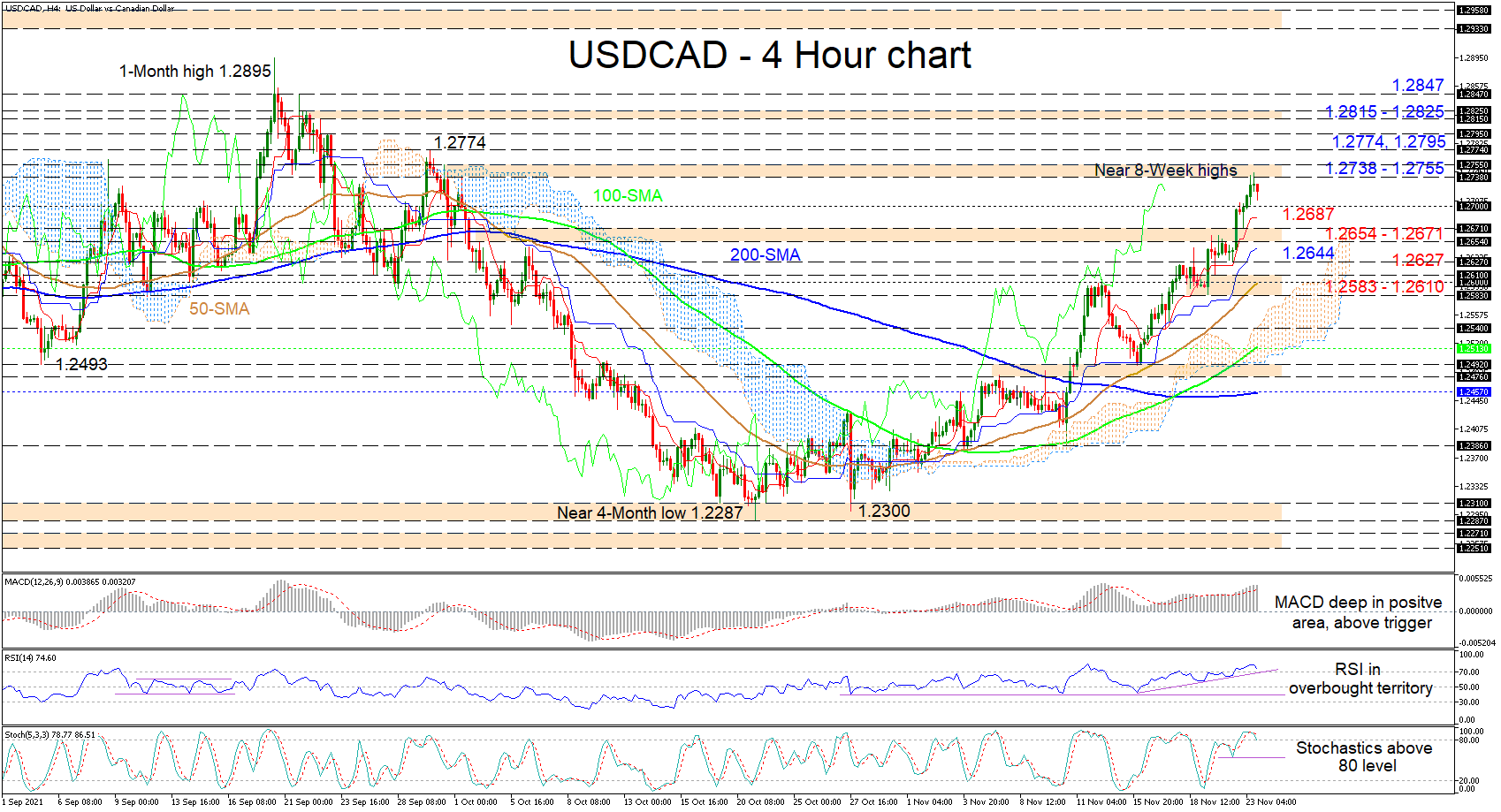
USDCAD advances have encountered some downside pressure from the 1.2738-1.2755 obstacle, formed by the October 1 and September 30 highs, hinting that bullish powers may be subsiding. However, the soaring 50- and 100-period simple moving averages (SMAs) are still backing the uptrend in the pair.
That said, the bullish Ichimoku lines are starting to signal minor waning in the upward drive as the red Tenkan-sen line’s incline falters, while the short-term oscillators are reflecting the increase in negative momentum. The MACD, far in the positive zone, is flattening above its red trigger line, while the RSI is falling in the overbought section and is looking to test the 70 level. The stochastic %K line has pierced beneath the 80 level and is promoting a bearish pullback in the pair.
If sellers manage to sustain their minor lead, initial downside friction could arise from the 1.2700 handle and the red Tenkan-sen line at 1.2687 ahead of the support border of 1.2654-1.2671. Breaching this, the blue Kijun-sen line at 1.2644 may delay the test of the 1.2627 low. In the event a deeper retracement evolves, the key 1.2583-1.2610 support boundary, which encapsulates the 50-period SMA, may attempt to halt additional declines from snowballing.
Alternatively, if buyers retake control, preliminary resistance could radiate from the 1.2738-1.2755 obstacle. If the bulls overcome the eight-week highs, they may then clash with the 1.2774 high from September 29 before confronting the 1.2795 barrier. If buying interest endures, the bulls could tackle the resistance band of 1.2815-1.2825 prior to aiming for the 1.2847 mark.
Summarizing, USDCAD is sustaining a bullish bearing above the 1.2654-1.2671 boundary and the SMAs, despite the fresh minor pullback. That said, for the bears to regain the upper hand, the price would need to drop below the 1.2492 trough.
Sunset Market Commentary
Markets
Core bonds lose ground with Bunds underperforming USTs. European PMIs beat consensus with both manufacturing and services rising to 58.6 and 56.6 respectively, the first increase in several months. The headline series thus advanced from 54.2 to 55.8. However, the upbeat readings come with the usual warning of supply delays leading to still-strong and even record-high price pressures, reinforced by energy price spikes. Combined with the renewed threat of lockdowns, optimism about future output sank to the lowest since January. The German yield curve bear steepens nevertheless with nice gains mounting up to 6 bps (10y), driven by real yields. ECB’s Schnabel and Knot struck a similar tone like Villeroy’s yesterday, both downplaying the impact from possible new Covid restrictions on the economy and thus on monetary policy. Schnabel also said the ECB shouldn’t pre-commit over a too long timespan and that risks to inflation are tilted to the upside. Dutch governor Knot later told Bloomberg that any APP adjustments after PEPP ends in March 2022 should be possible in either direction. It follows Villeroy saying boosting APP is possible but not a necessity. ECB officials are clearly preparing markets going into the crucial December meeting. US bond yields’ rise is more evenly distributed with 2-3 bps increases across the curve. Here too real yields are driving the upleg. The euro is in a slightly better shape than yesterday but it remains unconvincing, especially against the USD. Front-end rate support for the dollar might be counterbalancing Bund’s underperformance at the long end. EUR/USD barely recovers from yesterday’s hit. At 1.125 the pair isn’t even trying to recoup previously lost support at 1.129. The yen is pretty resilient given that it’s real yields in action today. USD/JPY is attacking the previous cycle highs just below 115, EUR/JPY inches higher north of 129. A fragile (but admittedly improving) equity sentiment probably limits the damage for the Japanese currency.
There was some central bank talk also in the UK. MPC member Haskel said he’s concerned about second-round effects of inflation and that rates would have to rise if the jobs market remains tight. While stressing he first wants more evidence on the latter, it does mean something coming from one of the most dovish MPC members. His comments prompted an acceleration of the bear steepening trend that was already in place. UK Gilt yields rise 4-5 bps from the 2y tenor to the 10y. Unlike yesterday, it’s not enough to counter the minor risk-off setting for the pound though. EUR/GPB rises north of 0.84 again, the fifth day of flipflopping around that big figure.
News Headlines
The US will release 50 mln barrels of crude oil from its strategic reserve in an effort to reduce prices for consumers, the WH announced. The release is part of a coordinated action with other major oil consumers, including Japan, China, India, South Korea and the UK. The release will add to market supply from mid-to-late December. 32 mln of the supply are part of an exchange. 18 mln will take the form of an earlier release of a sale that was already decided before. India also committed to release 5 mln of its strategic reserves. The impact on oil prices was modest after prices already lost substantial ground of late. WTI ($76.5) trades off the intraday lows. Brent even gains a bit ($79.75). OPEC+ already warned that it would slow its production rises in case of additional supply from stocks.
Retail sales in Poland at current prices in October rose at 14.4% Y/Y, a faster pace than expected. Real sales (constant prices ) also rose a solid 3.6% M/M and 6.9% Y/Y up from (-2.4% M/M and 5.1% Y/Y in September). October construction output also printed at a stronger than expected 4.2% Y/Y. However, strong October eco data again didn’t help the zloty. A sharp rise in Covid cases might slow activity in the near future as new containment measure might be considered. The zloty also suffers from low real yields as markets doubt recent NBP hikes will be enough to arrest inflation while at the same time core yields in the US and Europe are rising again. The zloty today touched a 12-year low against the euro trading at around EUR/PLN 4.74 (currently 4.72).
Dollar Shines again as Gold and Lira Prints Losses
Biden’s Fed picks drives dollar up
The Fed nomination decision caused some tremors in the financial markets on Monday. In the decision's wake, futures markets have firmed up expectations for a rate hike in June, which had previously been biased towards July. Governor Brainard has been selected to replace Clarida as Vice Chair at the end of January next year.
The US dollar index is extending its gains towards a fresh 16½-month high of 96.59, while dollar/yen is hovering slightly below the four-and-a-half year high of 115.15 that it posted earlier in the day after President Joe Biden recommended Jerome Powell for a second term as Federal Reserve chair. US stock futures are suggesting a negative open today.
Moreover, a 50-basis-point rate hike by the RBNZ is expected on Wednesday, which is why the kiwi appears to be trading sharply lower today around $0.6920. The loonie and aussie are losing momentum too, while cable is testing again the eleven-month low around 1.3350. Euro/dollar is ticking marginally higher after the slip to a new 16-month low of 1.1225.
Germany is back to covid restrictions
German chancellor Angela Merkel has demanded tighter measures to contain the latest Covid surge. She called the latest outbreak the worst the country has seen, and the circumstances “highly dramatic.” During the fourth wave of Covid, Germany's hospitals may again be swamped. Vaccination rates are still low, and while the death rate is currently low, it is expected to rise.
Erdogan important comment takes lira sharply lower
President Erdogan's fresh request for lower interest rates has given the Turkish currency a jolt, continuing its downward trend. Yesterday, the administration reaffirmed its commitment to growth and jobs, despite high inflation and a weakening currency. The currency tumbled to 13,4913 per dollar to a new all-time low.
Oil and gold back in negative area
WTI oil futures are easing around $76.33 per barrel after the fall to $75.29 earlier as several countries, notably the United States, India and Japan, have said that they will begin drawing on their strategic reserves to alleviate recent pricing concerns.
In other markets, gold prices are creating the fourth consecutive red day, diving beneath the $1,800 crucial level once again.
Equity Bulls Stumble as Covid Fears Grip Investors
The mood across European markets darkened on Tuesday as surging Covid-19 cases on the continent dented risk sentiment.
Austria reintroduced a national lockdown on Monday to curb new infections spreading across Europe. However, fears continue to mount over larger countries in Europe following Austria’s lead, with Germany at the top of the list.
Across the Atlantic, US futures are pointing to a negative open as investors evaluate Jay Powell’s nomination for a second term as Federal Reserve Chair. When considering how his renomination boosted rate hike expectations and propelled Treasury yields higher, US equity bulls could face some obstacles down the road.
Dollar boosted by rate hike bets
Dollar bulls trampled on the currency markets yesterday after President Joe Biden nominated Jerome Powell for a second four-year term as Fed Chair. Lael Brainard, the other candidate, was seen as more dovish than Powell, although she will become Vice Chair, the White House announced.
Powell’s renomination injected dollar bulls with renewed confidence, as this means there will be policy continuity at a crucial time when US inflation is at a 30-year high. Markets are now expecting the Fed to raise interest rates from near zero in June 2022. This could fuel the dollar’s upside momentum if we hear more Fed chatter around a faster tapering of bond buying, with the Dollar Index already hitting a fresh 16-month high today.
On the data front, all eyes will be on the flash PMI for November which will provide insight into the health of the US economy. The dollar could extend gains if this data meets or exceeds market expectations.
Commodity spotlight – Gold
The likely re-election of Jerome Powell sent gold prices tumbling yesterday with bearish momentum rolling over into Tuesday’s session.
Gold stood little chance against an appreciating dollar and rising US Treasury yields, as markets continued to price in higher interest rates next year and beyond. Given how gold is a zero-yielding asset, it tends to perform poorly in a high interest rate environment. With prices down almost 3% since the start of the week, bears are clearly in the driving seat and may remain there for the rest of November, especially if bond yields advance higher.
Looking at the technical picture, it is certainly a painful sight to behold with gold falling from five-month highs into the 50, 100, and 200-day Simple Moving Averages. If bears break through this key support region and secure a solid weekly close below $1777, this could signal further downside in the short to medium term. Alternatively, a move back above $1800 could encourage gold bugs to push towards $1813 and $1832.