Sample Category Title
USD/JPY Mid-Day Outlook
Daily Pivots: (S1) 114.22; (P) 114.59; (R1) 115.24; More...
Intraday bias in USD/JPY remains on the upside for the moment. Current up trend from 102.58 should target 100% projection of 102.58 to 111.65 from 109.11 at 118.18 next. On the downside, break of 113.57 support is needed to indicate short term topping. Otherwise, outlook will stay bullish in case of retreat.
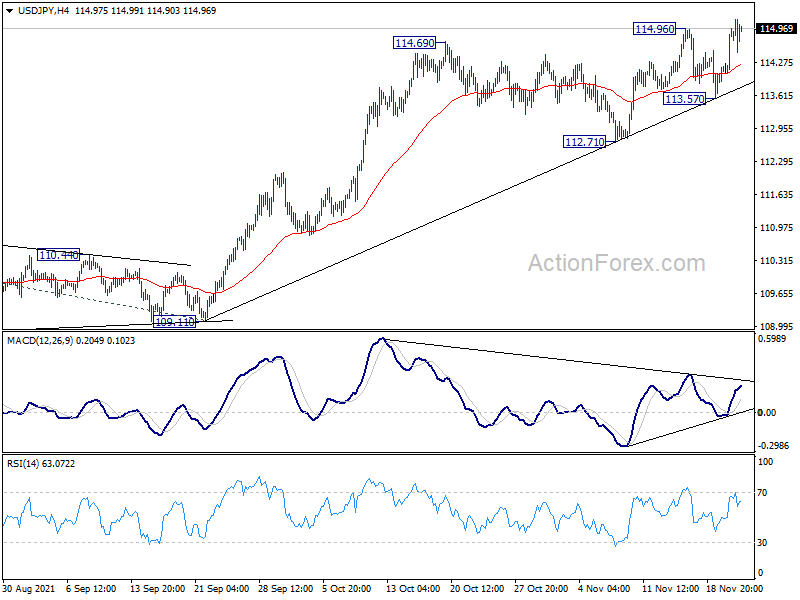
In the bigger picture, corrective decline from 118.65 (2016 high) should have completed at 101.18 already. Rise from the 102.58 is seen as the third leg of the up trend from 101.18. Next target is 118.65 high. This will now be the preferred case as long as 111.65 resistance turned support holds, even in case of deep pull back.
USD/CHF Mid-Day Outlook
Daily Pivots: (S1) 0.9287; (P) 0.9311; (R1) 0.9355; More....
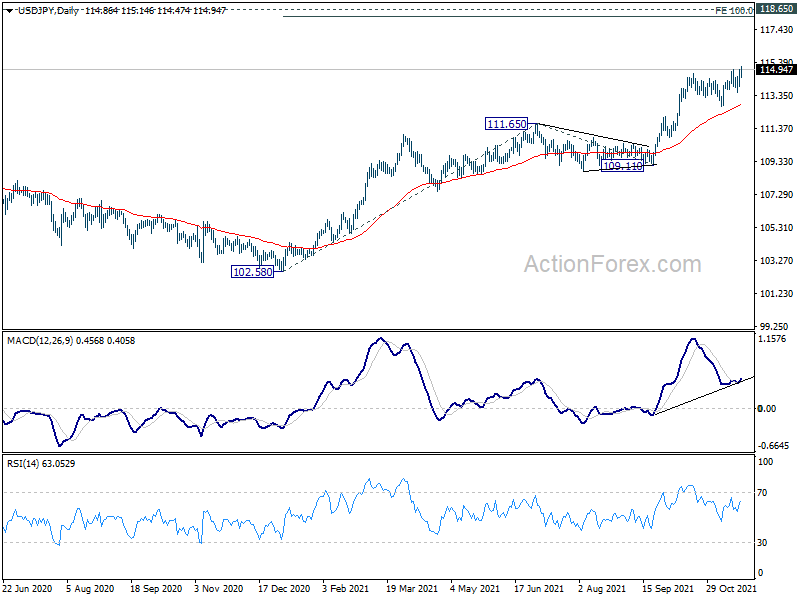
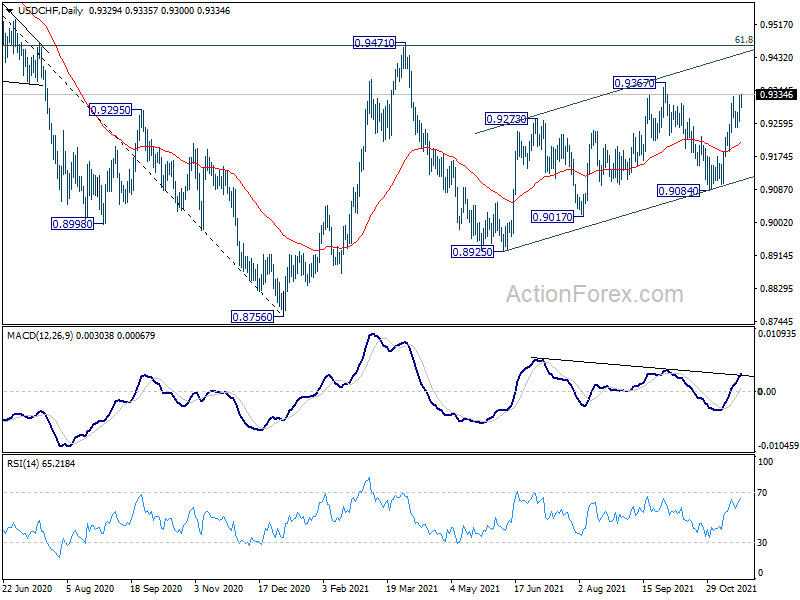
Intraday bias in USD/CHF remains on the upside as rise from 0.9084 is in progress for 0.9367 resistance. Break there will resume whole choppy rise from 0.8925 to 0.9471 key resistance. On the downside, break of 0.9248 support is needed to indicate near term topping. Otherwise, further rally will remain in favor in case of retreat.
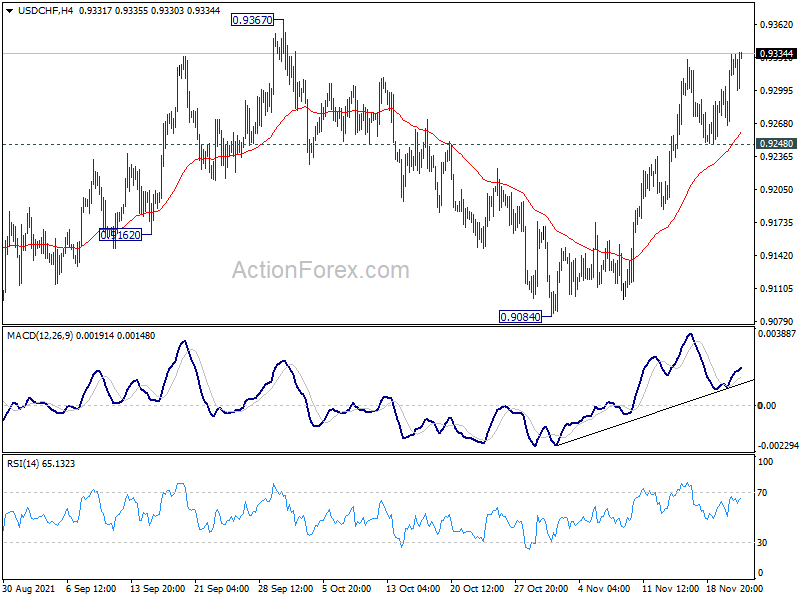
In the bigger picture, the corrective structure of the rebound from 0.8925 argues that fall from 0.9471 is not complete yet. It could either be the second leg of pattern from 0.8756 (2021 low), or resuming larger down trend from 1.0237 (2018 high). We'd pay attention to the downside momentum and assess the odds later. But for now, medium term outlook will be neutral at best as long as 0.9471 resistance holds.
EUR/USD Mid-Day Outlook
Daily Pivots: (S1) 1.1214; (P) 1.1253; (R1) 1.1275; More...
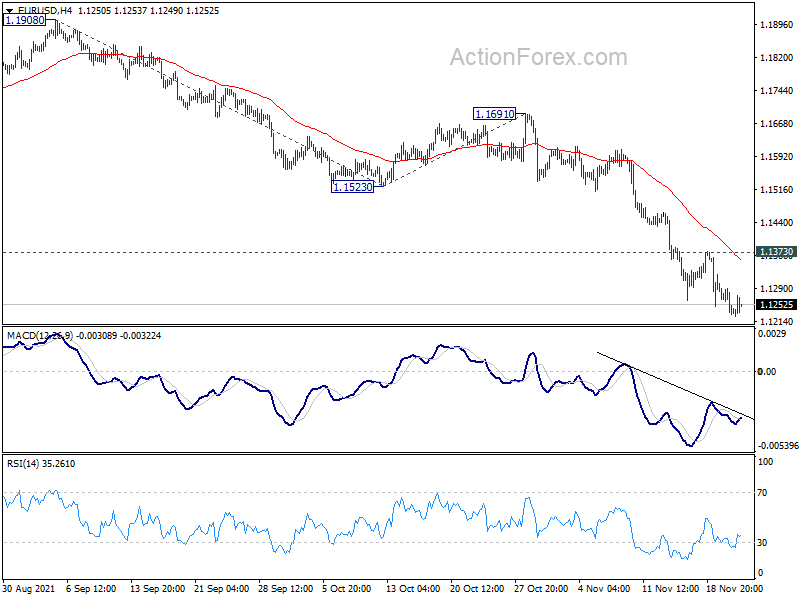
Intraday bias in EUR/USD remains on the downside for the moment. Current down trend from 1.2348 should target 161.8% projection of 1.1908 to 1.1523 from 1.1691 at 1.1068 next. On the upside, break of 1.1373 resistance is needed to indicate short term bottoming. Otherwise, outlook will stay bearish in case of recovery.
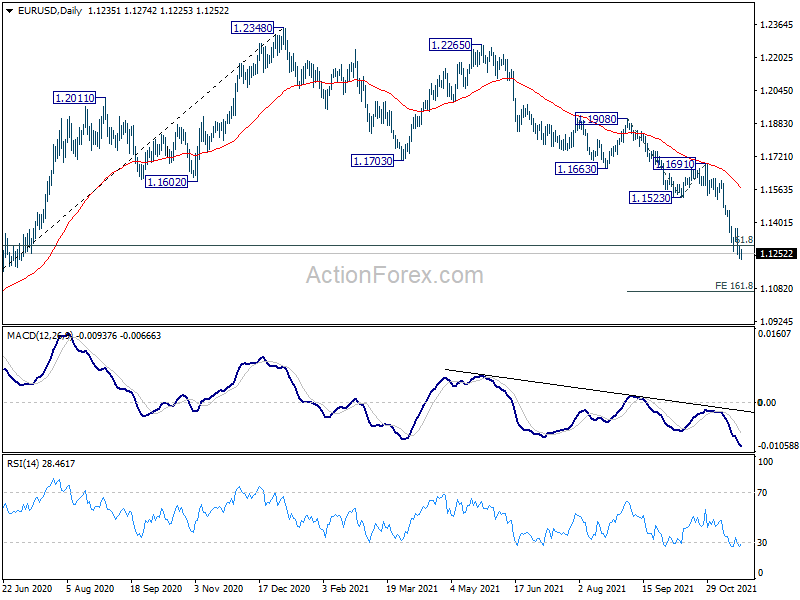
In the bigger picture, there are various ways of interpreting the fall from 1.2348 (2021 high). It could be a correction to rise from 1.0635 (2020 low), the fourth leg of a sideway pattern from 1.0339 (2017 low), or resuming long term down trend. In any case, outlook will now stay bearish as long as 1.1703 support turned resistance holds. Sustained break of 61.8% retracement of 1.0635 to 1.2348 at 1.1289 would pave the way back to 1.0635.
GBP/USD Mid-Day Outlook
Daily Pivots: (S1) 1.3367; (P) 1.3412; (R1) 1.3439; More...
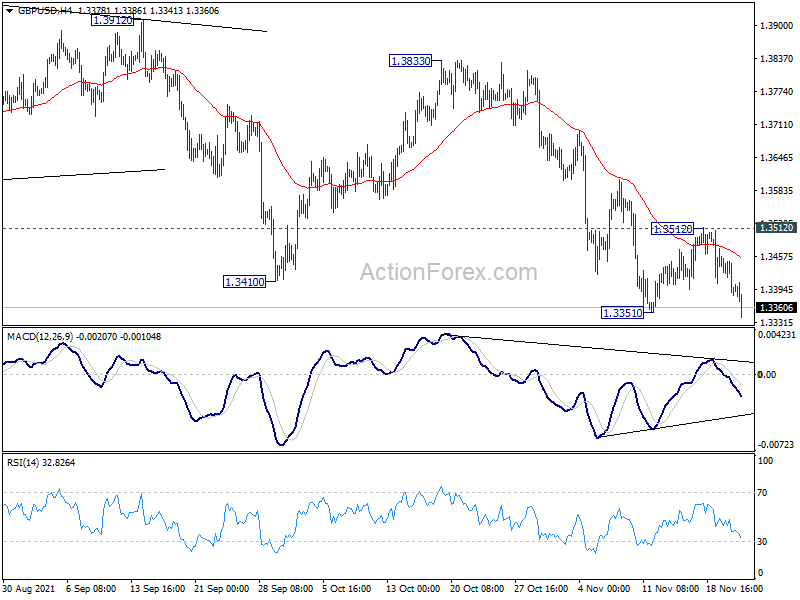
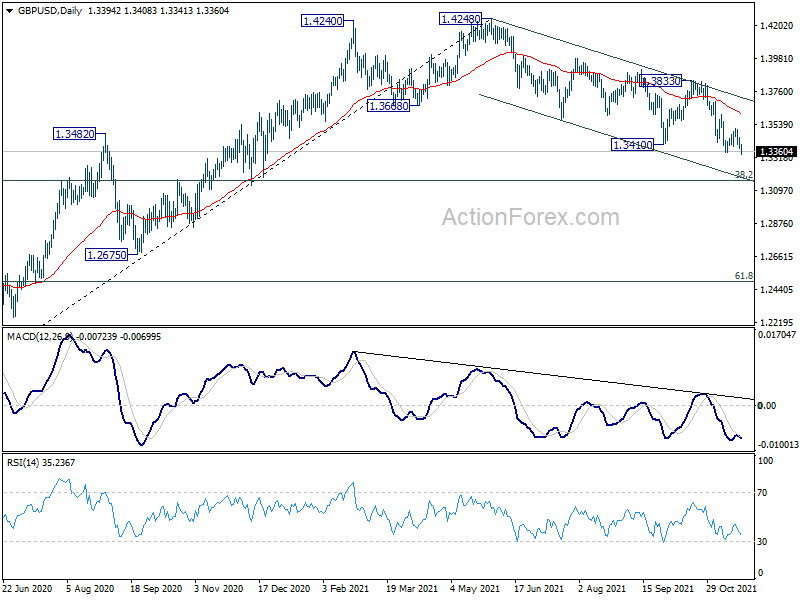
GBP/USD's break of 1.3351 suggests resumption of whole fall from 1.4248. Intraday bias is back on the downside for 1.3164 fibonacci level next. On the upside, break of 1.3512 resistance is needed to indicate short term bottoming. Otherwise, outlook will stay bearish in case of recovery.
In the bigger picture, the structure of the fall from 1.4248 suggests that it's a correction to the up trend from 1.1409 (2020 low) only. While deeper fall cannot be ruled out yet, downside should be contained by 38.2% retracement of 1.1409 to 1.4248 at 1.3164, at least on first attempt, to bring rebound. On the upside, firm break of 1.4376 key resistance (2018 high) will add to the case of long term bullish reversal. However, sustained trading below 1.3164 will revive some medium term bearishness and target 61.8% retracement at 1.2493.
Sterling Breaking to the Downside, Euro in Weak Recovery
Markets are trading in mild risk off sentiment, while treasury yields also surge. New Zealand Dollar is leading other commodity currencies lower, and Sterling is week too. On the other hand, Euro and Swiss Franc are currently the stronger ones, followed by Dollar and Yen. But overall, it should be noted that Euro's recovery is rather weak and risk remains higher for selloff to resume sooner or later.
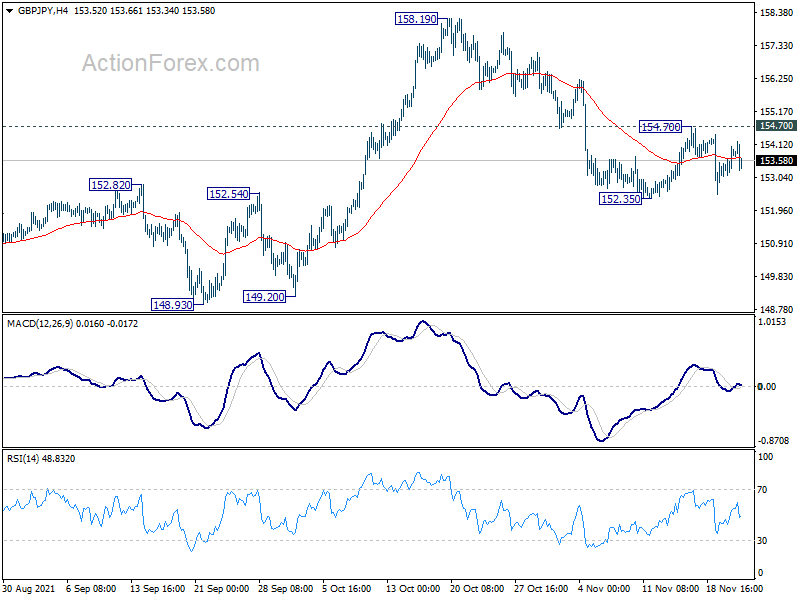
Technically, GBP/USD's breach of 1.3351 temporary low suggests that recent decline is ready to resume. We'd pay attention to see if the selloff would accelerate during the rest of the day. At the same time, We'll also see if GBP/JPY would follow by breaking through 152.35 temporary low. If that happens, it would be a signal of more broad-based weakness in the Pound.
In Europe, at the time of writing, FTSE is up 0.09%. DAX is down -0.67%. CAC is down -0.23%. Germany 10-year yield is up 0.062 to -0.238. Earlier in Asia, Hong Kong HSI dropped -1.20%. China Shanghai SSE rose 0.20%. Singapore Strait Times dropped -0.30%. Japan was on holiday.
ECB Schnabel: Time plan to end PEPP in March still valid
ECB Executive Board member Isabel Schnabel said in an interview, rising COVID-19 infections and containment measures is "likely to have a moderating effect on activity in the short run", and it will not derail the overall recovery. Supply-side disruptions "do not diminish growth potential" but "merely shift activity over time". Hence, her baseline is that "some growth deceleration in the short run, but then a continued strong recovery in the medium term."
Schnabel expected ECB staff's inflation projections to be "revised upwards for next year". But inflation is "going to decline over the course of next year". "It's plausible to assume that inflation is going to drop below our target of 2% in the medium term," she said. "however, the risks to inflation are skewed to the upside."
She also noted the "time plan is still valid" for ending the PEPP purchases in March. "But we will have to see how this evolves until our December meeting." She added, " it has become clear that it's very unlikely that a rate hike is going to happen next year. But it's also clear that the uncertainty remains very high and this is reflected in markets."
ECB Knot: Today's inflation outlook clearly more favorable than pre-corona
ECB Governing Council member Klaas Knot said, "today's inflation outlook is clearly more favorable than it was pre-corona, in the sense that it's closer to out target."
"That's something to take into account and that should also be a measure for the recalibration of asset purchases that we need to undertake in December," he added.
Knot also predicts that the PEPP asset purchase would end in March, in spite of new pandemic restrictions being rolled out. He expects rate hike to happen some time after 2022. But, "if market is right on inflation, then it is also right on rates pricing."
Eurozone PMI manufacturing rose slightly to 58.6, services rose to 56.6
Eurozone PMI Manufacturing rose slightly to 58.6 in November, up from 58.3, above expectation of 57.2. PMI Services rose to 56.6, up from 54.6, above expectation of 53.6.
Chris Williamson, Chief Business Economist at IHS Markit said:
"A stronger expansion of business activity in November defied economists' expectations of a slowdown, but is unlikely to prevent the eurozone from suffering slower growth in the fourth quarter, especially as rising virus cases look set to cause renewed disruptions to the economy in December.
"The manufacturing sector remains hamstrung by supply delays, restricting production growth to one of the lowest rates seen since the first lockdowns of 2020. The service sector's improved performance may meanwhile prove frustratingly short-lived if new virus fighting restrictions need to be imposed. The travel and recreation sector has already seen growth deteriorate sharply since the summer.
"With supply delays remaining close to record highs and energy prices spiking higher, upward pressure on prices has meanwhile intensified far above anything previously witnessed by the surveys.
"Not surprisingly, given the mix of supply delays, soaring costs and renewed COVID-19 worries, business optimism has sunk to the lowest since January, adding to near-term downside risks for the eurozone economy."
Germany PMI Manufacturing ticked down to 57.6 in November, from 57.8, but beat expectation of 56.7. That's nonetheless the lowest level in 10 months. PMI services rose slightly to 53.4, up from 52.4, above expectation of 51.5. PMI Composite rose to 52.8, up from 52.0.
France PMI Manufacturing rose to 54.6 in November, up from 53.6, above expectation of 52.8. PMI Services rose to 58.2, up from 56.6, above expectation of 55.5. That's also the highest level in 46 months. PMI Composite rose to 56.3, up from 54.7.
BoE Haskel: Rate hike from emergency level it not a bug, but a feature
BoE MPC member Jonathan Haskel said in a speech that "much of the variation in inflation is due to global factors such as imported goods and energy prices." He expected much of that variation to be "transitory".
"The latest data continues to indicate a tight labour market, putting upward pressure on wages," he said. "From a living standards point of view, this is of course excellent news, but from an inflation point of view this has to be matched by increased productivity and so we have to be vigilant."
The prospective rise in Bank Rate from its emergency level – when that comes - is not a bug, but a feature," he added. "It reflects the success of the policies, mostly fiscal, health and science that have supported the economy over the pandemic."
UK PMI composite ticked down to 57.7, giving green light for BoE rate hike
UK PMI Manufacturing rose to 58.2 in November, up from 57.8, above expectation of 56.7. PMI Services dropped to 58.6, down from 59.1, below expectation of 58.5. PMI Composite ticked down to 57.7, down from 57.8.
Chris Williamson, Chief Business Economist at IHS Markit, said: "A combination of sustained buoyant business growth, further job market gains and record inflationary pressures gives a green light for interest rates to rise in December... For policymakers concerned about the health of the labour market after the end of the furlough scheme, the buoyant jobs growth signalled should bring some reassuring comfort.
"A record increase in firms' costs will meanwhile further stoke fears that inflation will soon breach 5%, with lingering near-record supply delays adding to indications that price pressures may show few signs of abating in the near-term. The relatively poor performance of manufacturing is likely to remain a concern for some time, however, as is the potential to see tighter growth-inhibiting COVID-19 restrictions applied amid high COVID-19 case numbers both at home and now also in continental Europe.
Australia PMI composite rose to 55, business confidence improved
Australia PMI Manufacturing rose from 58.2 to 58.5 in November. PMI Services rose from 51.8 to 55.0. PMI Composite rose from 52.1 to 55.0. All three indexes hit 5-month highs.
Jingyi Pan, Economics Associate Director at IHS Markit, said: "Supply chain issues featured strongly in the Australian PMI survey as delivery times lengthened, widespread shortages were reported and price increases continued to be seen. While some of these can be attributed to the presence of pent-up demand that was reported, it will be worth watching if the constraints clear over time.
"Overall business confidence improved in the latest survey and this was a very positive sign. Private sector firms were also more willing to expand their workforce capacity, though instances of labour shortages had continued to surface."
New Zealand retail sales dropped -8.1% qoq in Q3, 12 of 15 industries down
New Zealand retail sales dropped -8.1% qoq in Q3, better than expectation of -10.2% qoq. Ex-auto sales dropped -6.7% qoq, also better than expectation of -7.6% qoq.
Twelve of the 15 industries had lower sales volumes. By industry, the largest movements were: Food and beverage services – down -19%; Motor vehicle and parts retailing – down -12%; Department stores – down -24%; Hardware, building, and garden supplies – -down 15%.
The Auckland region dominated the national fall with a record decrease of -15% (1.5 billion), compared with the 6.2% ($618 million) rise in the June 2021 quarter.
GBP/USD Mid-Day Outlook
Daily Pivots: (S1) 1.3367; (P) 1.3412; (R1) 1.3439; More...
GBP/USD's break of 1.3351 suggests resumption of whole fall from 1.4248. Intraday bias is back on the downside for 1.3164 fibonacci level next. On the upside, break of 1.3512 resistance is needed to indicate short term bottoming. Otherwise, outlook will stay bearish in case of recovery.
In the bigger picture, the structure of the fall from 1.4248 suggests that it's a correction to the up trend from 1.1409 (2020 low) only. While deeper fall cannot be ruled out yet, downside should be contained by 38.2% retracement of 1.1409 to 1.4248 at 1.3164, at least on first attempt, to bring rebound. On the upside, firm break of 1.4376 key resistance (2018 high) will add to the case of long term bullish reversal. However, sustained trading below 1.3164 will revive some medium term bearishness and target 61.8% retracement at 1.2493.
Economic Indicators Update
| GMT | Ccy | Events | Actual | Forecast | Previous | Revised |
|---|---|---|---|---|---|---|
| 21:45 | NZD | Retail Sales Q/Q Q3 | -8.10% | -10.20% | 3.30% | |
| 21:45 | NZD | Retail Sales ex Autos Q/Q Q3 | -6.70% | -7.60% | 3.40% | |
| 22:00 | AUD | CBA Manufacturing PMI Nov P | 58.5 | 58.2 | ||
| 22:00 | AUD | CBA Services PMI Nov P | 55 | 51.8 | ||
| 8:15 | EUR | France Manufacturing PMI Nov P | 54.6 | 52.8 | 53.6 | |
| 8:15 | EUR | France Services PMI Nov P | 58.2 | 55.5 | 56.6 | |
| 8:30 | EUR | Germany Manufacturing PMI Nov P | 57.6 | 56.7 | 57.8 | |
| 8:30 | EUR | Germany Services PMI Nov P | 53.4 | 51.5 | 52.4 | |
| 9:00 | EUR | Eurozone Manufacturing PMI Nov P | 58.6 | 57.2 | 58.3 | |
| 9:00 | EUR | Eurozone Services PMI Nov P | 56.6 | 53.6 | 54.6 | |
| 9:30 | GBP | Manufacturing PMI Nov P | 58.2 | 56.7 | 57.8 | |
| 9:30 | GBP | Services PMI Nov P | 58.6 | 58.5 | 59.1 | |
| 14:45 | USD | Manufacturing PMI Nov P | 59.1 | 58.4 | ||
| 14:45 | USD | Services PMI Nov P | 59.1 | 58.7 |
New Zealand Dollar Slides to 5-Week Low
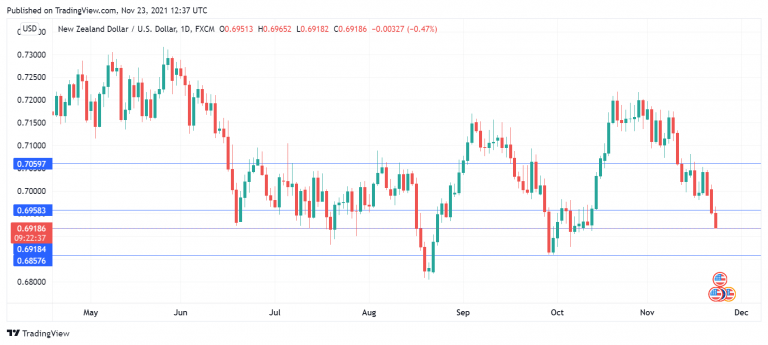
The New Zealand dollar is in negative territory on Tuesday and has posted two straight losing sessions. NZD/USD is currently trading at 0.6925, down 0.40% on the day. In the European session, the pair touched a low of 0.6921, its lowest level since October 13th.
Retail sales sends New Zealand dollar lower
The New Zealand dollar is having a rough start to the week and is already down 1.0%. The struggling kiwi didn’t get any help from retail sales for Q3, which declined sharply due to the lengthy lockdown in Auckland. Retail sales fell -5.20% y/y and -8.10% q/q, both of which were much softer than expected. As well, supply disruptions led to a shortage of motor vehicle parts and other products, hurting sales.
The disappointing drop in consumer spending comes just ahead of the RBNZ’s policy decision. The central bank has signalled that it will embark on a series of rate hikes, after getting the ball rolling with a 0.25% increase in October. With another hike a virtual certainty at the Thursday meeting, the burning question for the markets is whether the bank will play it safe with a 0.25% hike or will we see an aggressive move of 0.50%. The uncertainty in the markets over the RBNZ could mean further volatility for the New Zealand dollar during the week.
Aside from domestic troubles, the New Zealand dollar is also being weighed down by a deterioration in risk sentiment, which began late last week. There are a host of hot spots across the globe that have dampened risk appetite. We are seeing a fourth wave of Covid in Europe which has resulted in a huge number of cases in Germany and elsewhere. In China, the property sector remains in trouble and the central bank has taken measures to limit speculation in the yuan and stem its appreciation. Finally, the Russian military build-up on the border with Ukraine could lead to a military escalation. These hotspots have resulted in a risk-off environment which has curbed demand for risk currencies such as the New Zealand dollar.
NZD/USD Technical
- There is resistance at 0.6958 and 0.7059
- NZD/USD continues to break below support levels. The pair is currently testing support at 0.6918. Below, there is support at 0.6857
Market Priced in Faster Rate Hike after Powell’s Nomination for Second Term
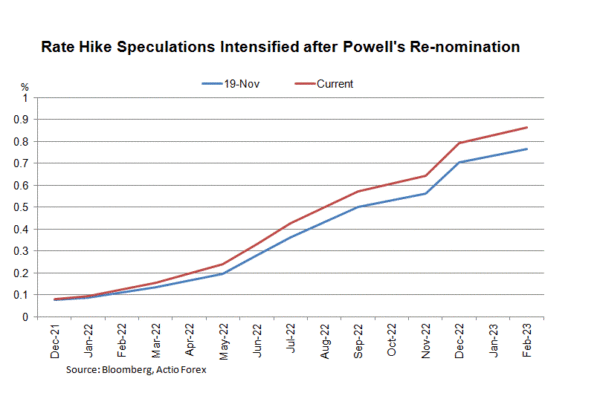
Hawks were thrilled with Biden’s nomination of Jerome Powell for the second term, thinking that his chairmanship would lead to more rate hikes in the coming year, than that of Lael Brainard, initially viewed as the leading candidate of the Fed Chair in the next term. She is now nominated as the vice chairman. US dollar strengthened and gold plunged on heightened speculation of the first Fed fund rate hike. The market has now fully priced in a rate hike in June 2022, compared with July 2022 a week ago.
After nomination, Brainard vowed to bring down inflation. As she suggested, “I’m committed to putting working Americans at the center of my work at the Federal Reserve…this means getting inflation down at a time when people are focused on their jobs and how far their paychecks will go”. The stance appears in line with that of Powell, who pledged to “use our tools both to support the economy and a strong labor market, and to prevent higher inflation from becoming entrenched”.
While Brainard and Powell, as well as the FOMC members, viewed inflation as transitory, she is viewed as more dovish that Powell as she appeared more concerned about economic recovery than high inflation. Back in September, Brainard noted in a speech that she expected “inflation to decelerate, and pre-covid inflation dynamics to return when Covid disruptions dissipate”. She added that employment remained below the levels seen before the pandemic, with the delta variant continued to inflict damage on the economy. The comments were made after the September FOMC meeting, at which the Fed gave advance notice on QE tapering by noting that a reduction in the pace of asset purchases “may soon be warranted”.
The median dot plots, with 9 out of 18 members projected the first rate hike in 2022, also revealed that members pushed forward the timing of the first rate hike. The staff projection also showed that the policy rate would increase to 0.3% next year, up from the current 0.1%. This would be followed by further increase to 1% in 2023 and 1.8% in 2024. The longer-term policy rate will stay at 2.5%.
The price reaction could be explained by the market’s confidence about Powell given his track record over the past years, while a new chair would more or less involve some sort of uncertainty. Yet, one should not be overestimate the authority of a Fed chair as a monetary policy decision is made by voting.
BoE Haskel: Rate hike from emergency level it not a bug, but a feature
BoE MPC member Jonathan Haskel said in a speech that "much of the variation in inflation is due to global factors such as imported goods and energy prices." He expected much of that variation to be "transitory".
"The latest data continues to indicate a tight labour market, putting upward pressure on wages," he said. "From a living standards point of view, this is of course excellent news, but from an inflation point of view this has to be matched by increased productivity and so we have to be vigilant."
The prospective rise in Bank Rate from its emergency level – when that comes - is not a bug, but a feature," he added. "It reflects the success of the policies, mostly fiscal, health and science that have supported the economy over the pandemic."
WTI Futures’ Bearish Course In Play, Downside Risks Stand
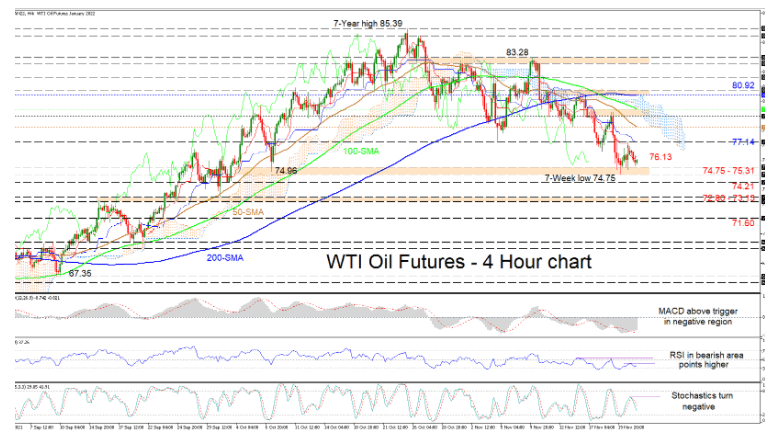
WTI oil futures have been drifting downhill for the last two-weeks from the 83.28 high, producing lower highs and lows, reinforcing the bearish outlook. The 200-period simple moving averages’ (SMA) positive incline has softened, while the diving 50- and 100-period SMAs are endorsing the descent in the commodity.
The Ichimoku lines are indicating that downward forces remain active, despite the uptick in the red Tenkan-sen line, while the short-term oscillators are conveying conflicting signals in directional momentum. The MACD, deep in the negative zone, is above its red trigger line but looks set to steer back below it, while the RSI’s marginal improvement in the bearish region seems questionable. The fresh negative charge in the stochastic oscillator is sponsoring the resumption of the down trend in the black liquid.
If sellers maintain the upper hand, initial downside constraints could arise from the 74.75-75.31 support base. If the price slides beneath the seven-week low of 74.75, it may snag at the 74.21 low before stretching to test the 72.80-73.13 support border. If this obstacle fails to halt the decline from gaining pace, the price could then target the September 23 low of 71.60.
On the other hand, if buyers manage to nudge the price over the red Tenkan-sen line at 76.13, resistance could commence around the blue Kijun-sen line, currently residing at the 77.14 nearby high. Recouping some previously lost ground, the bulls may meet the approaching 50-period SMA at 78.20 ahead of the Ichimoku cloud and a resistance zone formed between the 79.00 handle and the 100-period SMA at 79.51. Successfully overcoming this tough barrier and the cloud, the bulls could then gain confidence and aim for the 80.55-80.92 resistance band, the former being the flattening 200-period SMA and the latter the November 11 high.
Summarizing, WTI oil futures are exhibiting a sturdy bearish bias and a decisive break below the tough base of 74.75-75.31 would give extra credence to the drop in the commodity. That said, for the bulls to regain some confidence, the price would need to climb above the 79.00 hurdle and adjacent 79.31 high.
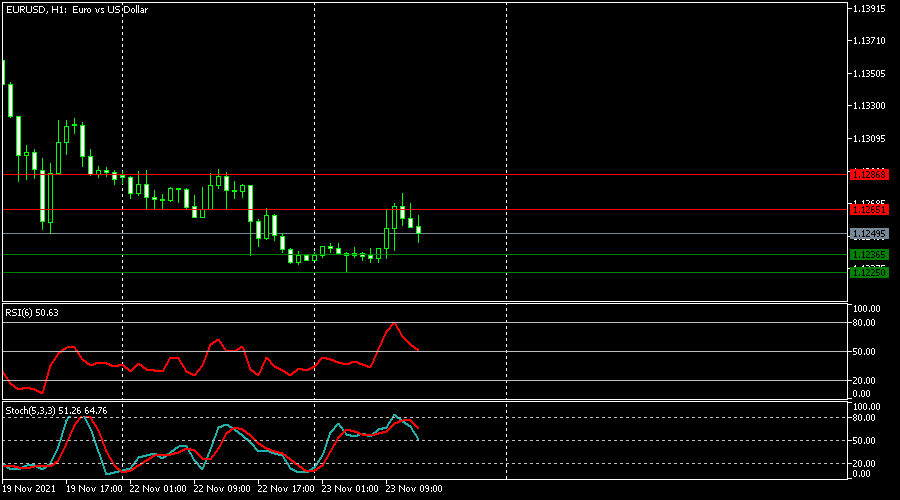
EURUSD Is Possibly Bearish
Technical analysis
The RSI is below level 50.
The Stochastics is above level 50.
Most likely scenario – SELL
Target prices: 1.12365 1.12250
Alternative scenario – BUY
Target prices: 1.12651 1.12868
Key levels
Support 1.12365 1.12250
Resistance 1.12651 1.12868