Sample Category Title
Oil Bounces Back As The US Release Reserves
The price of crude oil rose in the overnight session even as Joe Biden moved to release strategic oil reserves. Brent jumped by more than 2% to $81.39 as investors reflected on the additions. It also rose since the market had already priced in the release. The new move will be coordinated with key countries like China, South Korea, India, Japan, and India. Still, analysts believe that this release is lower than what is needed to stabilize prices. They also believe that any action that does not include members of OPEC+ will not push prices lower.
The British pound was little changed as investors reflected on the strong UK manufacturing and services PMI numbers and a hawkish statement by Andrew Bailey. Data published by Markit revealed that the country’s manufacturing PMI rose to 58.2 in November while the services PMI rose to 58.6. Other numbers from the UK like employment and inflation have been strong lately. In a statement, the Bank of England (BOE) governor said that the bank will eventually have to unwind the QE program. The bank will end QE in December and possibly start hiking rates in the first quarter of 2022.
The US dollar will be in the spotlight as the country publishes the latest personal consumption expenditure (PCE), initial jobless claims, GDP, and durable goods order numbers. The data will come out today because of the upcoming Thanksgiving weekend. Analysts expect the data to show that durable goods orders rose by 0.2% in October. Also, going by the first estimate, they expect these numbers to show that the economy expanded by just 2.1% in the third quarter. This was a drop from the previous expansion of 5.7%.
EURUSD
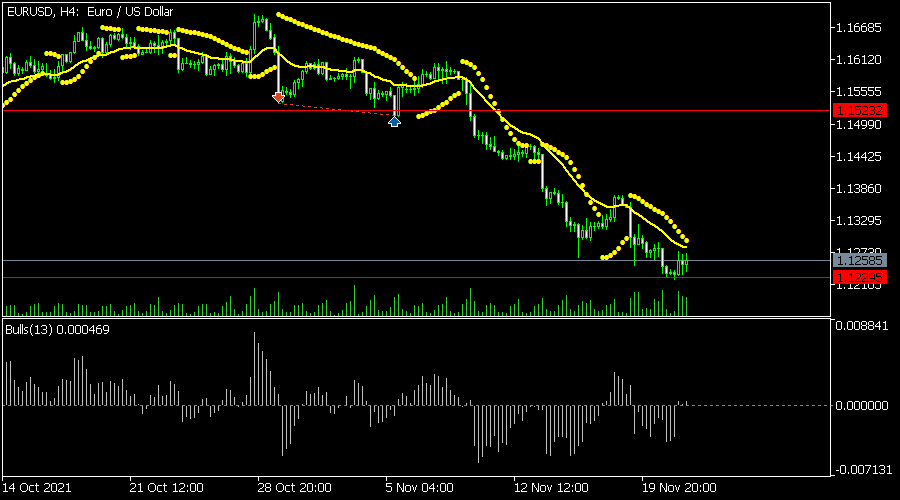
The EURUSD pair stabilized after strong EU PMI numbers and as traders waited for the upcoming data dump from the US. The pair is trading at 1.1260, which is slightly above this week’s low of 1.1220. On the four-hour chart, the pair is still below the 25-day moving average. It is also below the important resistance at 1.1523, which was the lowest level in October. Therefore, the pair will likely keep falling in the near term.
XBRUSD
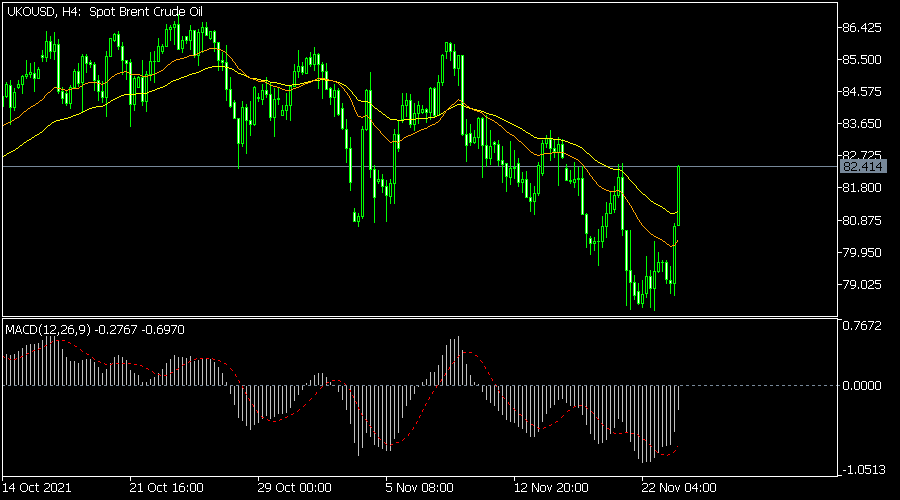
Brent has been in a bearish trend in the past few days. It dropped from a year-to-date high of $86.80 to a low of $78. It then rebounded in the overnight session after the US announced plans to release strategic reserves. The pair also moved above the 25-day and 50-day moving averages while the MACD indicator made a bullish crossover. Therefore, the pair will likely keep rising as bulls target the key resistance at 86.
NDX100
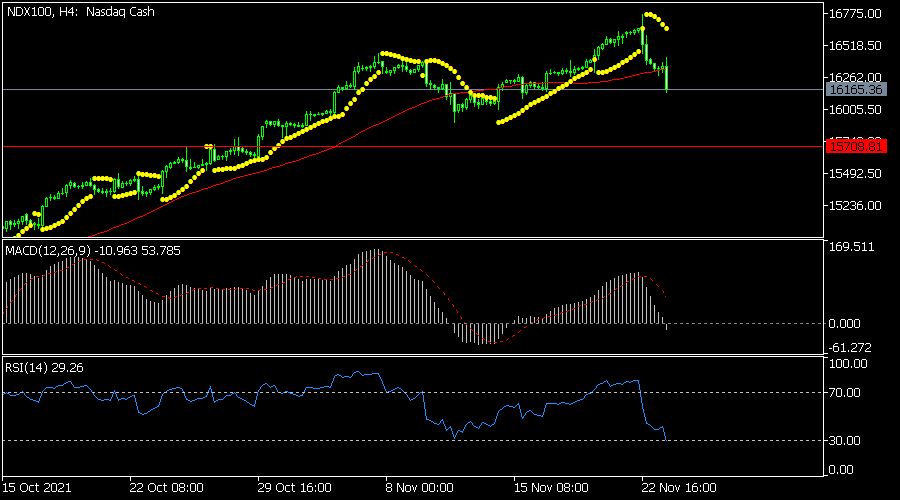
The Nasdaq 100 index declined as investors reflected on Jerome Powell’s reappointment. It dropped to $16,207, which was the lowest level since November 14. The index is trading below the dots of the Parabolic SAR and slightly below the 25-day moving average. The MACD made a bearish crossover while the Relative Strength Index (RSI) moved below the oversold level. The index will likely keep falling in the near term.
Inflation To Stay Higher For Longer
Markets
Markets, for now, conclude that the new corona wave will probably only have a modest impact on growth. With inflation to stay higher for longer, policy normalization will have to come anyway. In the US, in the UK but even also in Europe. EMU PMI’s beat consensus, both for the headline manufacturing index (58.6) and the services measure (56.6). Admittedly, details indicated that supply delays and persistent high prices complicate the future outlook for growth. The conclusion remains that inflation and factors that are nursing inflation are also the main risk to growth. This has consequences for monetary policy. In this respect, ECB Schnabel, Villeroy, and Knot indicated that asset purchases beyond the end of PEPP in March might be less exuberant than some in the market hoped for. European yields succeeded a nice rebound. The German 2y yield rose 1.2 bps. The 10y & 30y added about 8 bps. The rise was fully due to a rise in real yields. US Treasuries this time slightly outperformed with the 5y adding 2.25 bps and the 30y up 6.5 bps. The 7y US auction was much better accepted that the 2y and 5y on Monday, and eased pressure on the Treasury market. US equities finally also entered calmer waters. The Dow and S&P closed in positive territory. The Nasdaq lost 0.5%. European equities were hit harder with losses of mostly about 1%+. The dollar rally slowed, but there was no clear sign of a trend reversal yet. DXY closed little changed at 96.5. USD/JPY (115.14) finished at the highest level since march 2017. EUR/USD tried to move away from the 1.1230 area, but gains remain unconvincing (close 1.125). CE currencies with low real yields struggled with the forint and the zloty again setting all-time/multi-year lows. EUR/GBP also gained modestly, closing at 84.08.
Asian equities are trading mixed this morning. US yields are taking a breather after the recent rise and so does the dollar (DXY 96.5). The eco calendar contains German Ifo confidence, US jobless claims, durable orders, spending and income data (including the closely watched PCE deflators) and FOMC Minutes. PCE deflators are expected to rise further (5.1% Y/Y headline, 4.3 Y/Y core). This shouldn’t come as a big surprise. Markets will also keep a close eye at the internal debate on the pace of tapering. The US 10y yield is gradually nearing 1.7% resistance. In EMU, 0.1% proved strong support for the 10y EMU swap rate. A sustained return above 0.22% would call off the ST alert. The technical picture for EUR/USD and EUR/GBP remains fragile. There is no sign of a U-turn in sentiment yet.
News headlines
The RBNZ raised policy rates as expected from 0.5% to 0.75%. Though wary of the Covid’s impact on the economy, the RBNZ expects it to be mainly short-term. As restrictions ease, the economy should continue to recover. Growth was revised downwardly for the FY year ending March 2022 but significantly raised for 2023. Meanwhile, rising capacity pressures, supply disruptions and labour market tightness keep inflation elevated. CPI is seen higher at 5.7% in FY 2022 before easing to 2.1% into 2024. The RBNZ adjusts the expected policy rate path, penciling in a tightening pace that would end up with an average OCR of 2% in FY 2023. This means a minimum of 25 bps rate hikes at every meeting next year. The RBNZ will decide early next year on how to reduce bond holdings. Despite the hawkish tone, NZD/USD loses ground this morning, slipping from 0.695 to 0.691. The kiwi dollar hoped for a bolder 50 bps move. Gouvernor Orr said it was discussed, but judged that incremental 25 bps are appropriate for now.
Sweden’s Finance Minister Andersson is set to become the country’s first female PM. She secured a deal with the ex-communist Left Part that said it would block the nomination. In Sweden, the PM does not need the backing from a majority in parliament but must avoid a majority voting against. Andersson replaced former Lofven as leader of the Social Democrats earlier this year. Lofven also stepped down as PM on November 10th, saying it is important to have a smooth handover of power before the general elections of September next year. The Swedish crown trades stoic around EUR/SEK 10.17 this morning after a sharp losing streak since early November.
Oil Bulls Are Gaining The Upper Hand
It's Joe Biden against the oil bulls, and oil bulls seem to be gaining the upper hand as oil prices rebounded the day Joe Biden announced to release not 35 but 50 million barrels from the US strategic reserves. This is the biggest amount released from these strategic reserves in the US history, but helas, the barrel of US crude is already up and flirting with the $80 level, and there is little left to be priced on the bearish side, as other big oil consumers like Indian and China announced they will be joining the US effort as well.
China announced it will release some 7 billion barrels, India 5 million barrels, South Korea didn't specify a volume, and Japan said it will be releasing several DAYS of volume. Several days!
Obviously, such news doesn't necessarily scare OPEC, but it probably frustrates them. The expectation is that they will hit back at their meeting next week, and their decision will have an impact longer than a couple of days or weeks. This is probably why we are seeing the oil bulls coming back to the market, and yes, there is a chance now that we see the $80 offers cleared and a push above that level into next week's OPEC meeting. The only thing that Joe could do at this point is to pray for OPEC to not hit back too strong, because if they decided to cut supply for a couple of weeks, Joe's oil reserves would be very quickly down.
On a side note, it is also said that the US could do much more than this in terms of oil output, but engaging on a bloody oil war is not the best strategy to bring and to keep oil prices at affordable levels.
On other energy news, the Arctic blast brings snow to Europe and the cold weather brings along higher energy prices. Coal futures are surging, and the natural gas futures could start doing so as well, given that problems on the Ukrainian border somehow gets the relationship between Europe and Russia tense, and Russia was supposed to get a historic amount of natural gas to Europe to help taming the soaring nat gas prices.
Popcorn prices in Saudi are exploding as they are rushing on popcorns to watch the… snow show!
Overall, the market sentiment is mixed. Nasdaq is down from an all-time high, as the US short term yields continue pushing higher. The bond traders have been cutting their projections on US inflation as they expect the new Fed Chair Jerome Powell to move aggressively to slow rising consumer prices, as Powell hasn't been the one downplayingthe rising inflation for months. Therefore, all this aggressive pricing has no reason to be, unless if it's really for inflation and the fact that the Federal Reserve (Fed) has no choice but to fasten up the QE taper, and to raise rates earlier and faster.
Speaking of raising rates, the Reserve Bank of New Zealand (RBNZ) rose its policy rate by another 25bp to 0.75% at today's meeting as expected, and as expected the move didn't help the kiwi stay above the 70 cents levels against the US dollar. The hawkish pricing in the US dollar is what drives the pair right now. Due today, a better than expected US growth number could further boost the USD bulls.
In Europe, yesterday's PMI figures showed price pressures continued to rise for business. (No, really?) Despite strong headline figures, the outlook looks far from optimistic with new lockdown measures in play. Some European Central Bank (ECB) officials are getting tense with the rising price pressures in Europe, especially in Germany and Netherlands which don't necessarily watch the soaring inflation with a light heart. But the market continues pricing in a dovish ECB. At this point, I am wondering whether the dovishness in the euro is overdone, as Christine Lagarde will likely start facing some opposition to her ultra-dovish stance if inflation in the Eurozone doesn't ease magically in the coming months. And magic is not something the Germans rely on.
Inflation Concerns Stay High On The Agenda
Market movers today
- Today's highlight will be the US PCE data. The inflation part of it is not so interesting given we already got CPI statistics two weeks ago, but instead, the monthly private consumption data is the one to watch. Considering the strong retail sales data, we could expect goods consumption to remain elevated.
- We will keep an eye on ECB Schnabel's speech this afternoon after her hawkish comments yesterday saying inflation risks are skewed to the upside.
- We will also pay attention to any signals from Turkish officials on a potential intervention on lira after the currency's freefall yesterday.
- We expect the FOMC minutes this evening to be a non-event for markets since several FOMC policymakers have spoken since the meeting.
The 60 second overview
Oil prices have extended gains overnight after announcements by the US and other nations on a coordinated release of strategic oil reserves fell short of market expectations. Brent is trading at above 82 USD/barrel at the time of writing. The US said it would release 50M barrels of oil over the coming months, corresponding roughly to 2.5 days of domestic consumption. India said it would release 5M barrels and UK 1.5M barrels. South Korea has indicated a contribution of 3.5M, while according to Nikkei, Japan would release around 4.2M. China's contribution has not been confirmed but according to officials close to talks it could be in the range of 7-15M. All eyes are now on OPEC ahead of their monthly meeting next week, as the group has said earlier that they consider a release from strategic reserves unjustified by market conditions and could respond by reconsidering plans to add supply to the market.
The Reserve Bank of New Zealand hiked rates by 25bp to 0.75% this morning, in line with consensus expectations. The kiwi weakened 0.5% after the decision as some analysts were expecting an even larger hike.
November flash PMIs yesterday indicated resilience in economic activity but higher inflation pressures, though the picture was a bit mixed in the euro area compared to the US. In euro area, French and German PMIs both signalled an improvement in activity after a period of declines, with particularly the service sector advancing, while long delivery times and higher input costs continued to weigh on manufacturers. As a signal of rising inflation pressures, selling price inflation accelerated to the fastest in euro area fastest in almost two decades as firms sought to pass higher costs on to customers. In the US, service sector fared worse than expected, delivery times improved slightly but inflation pressures remained elevated.
Equities: A rollercoaster ride in equities yesterday resulted in declines as European performance dragged down overall performance. On the surface, it could look like a classic risk-off sentiment with VIX higher, large cap outperforming small cap and defensives outperforming cyclicals. However, the moves we saw yesterday come down to inflation concerns and rising bonds yields. Hence, value outperforming defensives and energy, banks and materials being the best performing sectors. We would not have seen this if investors had tuned in at full risk-off mode. In the US equities ended mixed but way off day lows with growth intense indices suffering. Dow +0.6%, S&P 500 +0.2%, Nasdaq -0.5% and Russell 2000 -0.2%. Asian stocks are mostly lower today but for a change dragged down by Japan despite some relatively solid macro data out this morning. US and European futures slightly negative.
FI: A strong sell-off in European fixed income markets all through yesterday's trading session, continuing Monday's sell-off. Schnabel's hawkish comments with upside risks to inflation, strong preliminary PMIs from France, Germany and the Euro Area as well as Villeroy's comment on 'Increasing ... APP ... is at this stage a possibility, but not yet a necessity' drove core European yields 8bp higher (10y point), in a bearish curve steepening of the curves. Spreads widening slightly in the periphery after BTPs-Bund spreads took a strong beating on Monday, now leaving the spread at 128bp.
FX: EUR/USD traded sideways still above 1.12 yesterday, while EUR/GBP moved back above 0.84 amid overall risk-off sentiment. EUR/NOK moved lower now trading closer to 10.00 on a smaller-than-expected draw on US strategic oil reserves. USD/TRY rose more than 10% yesterday.
Credit: CDS indices were under heavy pressure yesterday where iTraxx Xover widened 6.6bp and Main 1.2bp. Cash bonds were not in demand either, but were much less affected, with HY and IG bonds selling off a more modest 1bp and 0.5bp, respectively.
Nordic macro
The main event in Sweden today is the parliamentary voting on Social Democrats (S) new chairman Magdalena Andersson getting sufficient support to become new Prime Minister (09.00 CET). Although most likely, this is still not 100% certain. At 16.00 CET there is a budget voting. The basic budget proposal is NOT from the government S/Greens but rather from the right-wing opposition i.e. Conservatives, Christian Democrats and Sweden Democrats. It could end up in a situation with a red/green government ruling a right-wing budget. It has happened twice before over the past eight years.
Equity Indices Trade Generally Lower After Nasdaq Decline
General trend
- US equity FUTs have traded slightly lower.
- Nikkei 225 lags following holiday.
- Hang Seng traded generally flat during the morning session; Tech earnings remain in focus [Kuaishou rises, Xiaomi declines].
- Shanghai Composite ended morning trading slightly lower (-0.1%); Kweichow Moutai supported by broker comments.
- S&P ASX 200 ended slightly lower.
- Taiwan said to be considering an entry ban on senior China officials (press).
- Companies due to report during the NY morning include Cheetah Mobile, Deere & Co., Futu, Yiren Digital.
Headlines/Economic data
Australia/New Zealand
- ASX 200 opened -0.1%.
- (AU) AUSTRALIA Q3 CONSTRUCTION WORK DONE Q/Q: -0.3% V -2.9%E.
- (AU) Australia sells A$1.0B v A$1.0B indicated in 1.75% Nov 2032 bonds, Avg Yield: 1.969% v 1.9302% prior, bid to cover 3.39x v 4.09x prior [from Oct 29th].
- (NZ) RESERVE BANK OF NEW ZEALAND (RBNZ) RAISES OFFICIAL CASH RATE (OCR) BY 25BPS TO 0.75%; AS EXPECTED; raises rate path outlook to above 2% neutral by Q4 2022.
- (NZ) Reserve Bank of New Zealand (RBNZ) Gov Orr: Did consider 50bps rate hike today, amid a range of options, 25bps gives more optionality; RBNZ can take our time at this point - post rate decision comments.
Japan
- Nikkei 225 opened -0.4%.
- (JP) Japan PM Kishida: Confirms to release oil from state reserves in coordination with the US, the amount and timing to come from the Trade Ministry.
- (JP) Bank of Japan (BOJ) considering reducing corporate bond purchases - Japan press.
- (JP) JAPAN NOV PRELIMINARY PMI MANUFACTURING: 54.2 V 53.2 PRIOR (10th month of expansion).
- (JP) Japan govt plans to set aside ¥600B ($5.2B) for fund to support semiconductor firms – Nikkei.
- (JP) Consortium of 70 Japan companies (including 3 megabanks) to start experimental launch of digital currency – Nikkei.
- (JP) Japan to hold auctions by end of the year for release of oil from stockpile – Nikkei.
- 6502.JP Second largest shareholder, 3D Investment Partners, sends letter objecting to 3 way split, extremely unlikely to solve Toshiba's problems., likely to create 3 under performing companies.
Korea
- Kospi opened +0.3%.
- (KR) South Korea Govt: Have decided to accept the US request to release crude stockpiles, considering the need for international coordination on global oil prices, importance of the S. Korea-U.S. alliance and participation of major economies.
- 005930.KR Confirms $17B Texas factory, expect to start mass production of chips in H2 2024.
China/Hong Kong
- Hang Seng opened +0.1%; Shanghai Composite opened 0.0%.
- (CN) China Vice Premier Liu He reiterated call for stable housing market, reiterates housing is not for speculation - Chinese press.
- (CN) China PBOC sets Yuan reference rate: 6.3903 v 6.3929 prior.
- (CN) China PBOC Open Market Operation (OMO): Sells CNY100B in 7-day reverse repos v CNY50B prior; Net inject CNY50B v Net inject CNY0B prior.
- (CN) Analysts note that China PPI may have peaked on coal price decline - China Securities Journal.
- 1810.HK Reports Q3 (CNY) adj Net 5.18B v 4.81Be, Rev 78.1B v 77.5Be; Expects to launch EV mass production in H1 2024.
- (CN) China Economic Inflation Daily: rare earth price index 317.4, +8.3% from Nov 1st.
Other
- (SG) SINGAPORE Q3 FINAL GDP Q/Q: 1.3% V 0.8%E; Y/Y: 7.1% V 6.5%E; Narrows 2021 GDP outlook to 7.0% (prior 6-7%); Gives initial 2022 GDO outlook 3.0-5.0%.
- (SG) Singapore Central Bank (MAS) Official: To remain careful and vigilant on price developments.
- (SA) Saudi-based analysis firm International Energy Forum (IEF): Oil prices will probably fall for the rest of the year, OPEC+ will be cautious in reacting to SPR oil release.
North America
- (US) Weekly API Crude Oil Inventories: +2.3M v +0.7M prior.
- DELL Reports Q3 $2.37 v $2.33e, Rev $28.4B v $27.4Be; Guides Q4 $1.85-2.05 v $1.76e, Rev $27-28B v $25.9Be - earnings call comments.
- GPS Reports Q3 $0.27 v $0.49e, Rev $3.9B v $4.45Be; Cuts FY guidance.
- (US) US Energy Sec Granholm: Notes cutting gasoline taxes is a tool.
Europe
- (EU) EU's Sefcovic: EU-UK talks on Northern Ireland trade rules will 'probably' continue into next year – Politico.
- (UK) Former Bank of England (BOE) Gov King said central banks have 'King Canute' theory of inflation, said to question theory that inflation will stay low 'because we say it will' - UK press.
Levels as of 00:15ET
- Hang Seng +0.1%; Shanghai Composite +0.1%; Kospi -0.3%; Nikkei225 -1.8%; ASX 200 -0.2%.
- Equity Futures: S&P500 -0.2%; Nasdaq100 -0.2%, Dax -0.2%; FTSE100 -0.0%.
- EUR 1.1254-1.1233; JPY 115.24-114.92; AUD 0.7229-0.7200; NZD 0.6957-0.6896.
- Commodity Futures: Gold +0.6% at $1,794/oz; Crude Oil +0.3% at $78.77/brl; Copper -0.4% at $4.40/lb.
GBP/JPY Daily Outlook
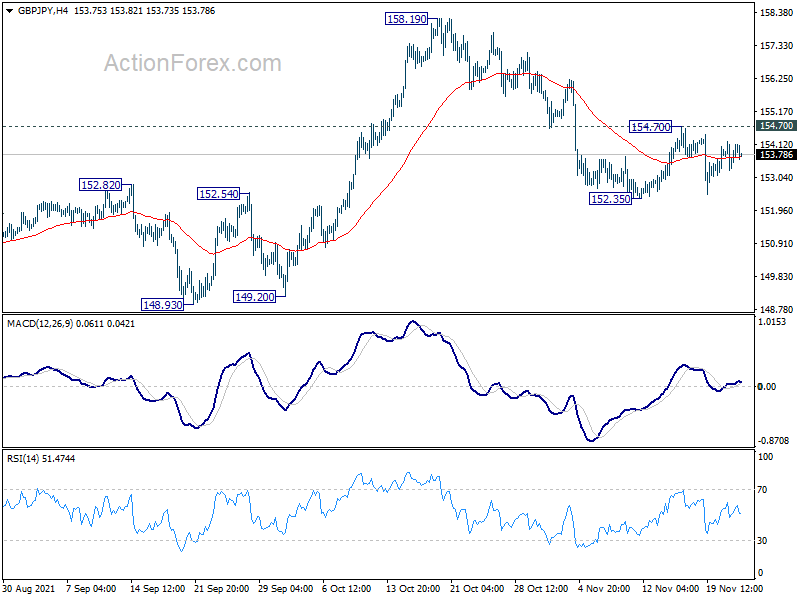
Daily Pivots: (S1) 153.48; (P) 153.85; (R1) 154.41; More...
Intraday bias in GBP/JPY remains neutral for the moment. With 154.70 resistance intact, further decline remains mildly in favor. On the downside, break of 152.35 will resume the decline from 158.19 to 148.93 key support next. On the upside, however, break of 154.70 will turn bias back to the upside for retesting 158.19 high instead.
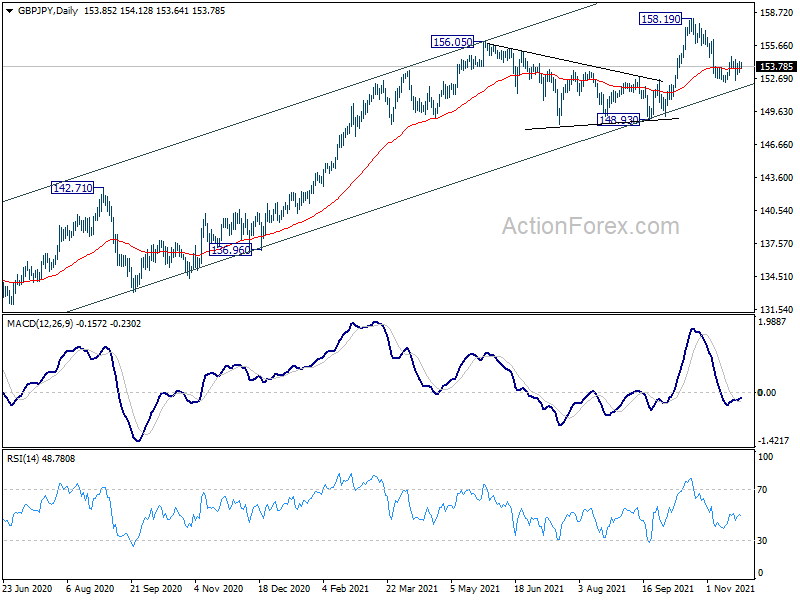
In the bigger picture, rise from 123.94 is seen as the third leg of the pattern from 122.75 (2016 low). Further rally is still expected as long as 148.93 support holds. However, firm break of 148.93 will argue that the medium term trend has reversed and bring deeper fall back to 142.71 resistance turned support first.
EUR/JPY Daily Outlook
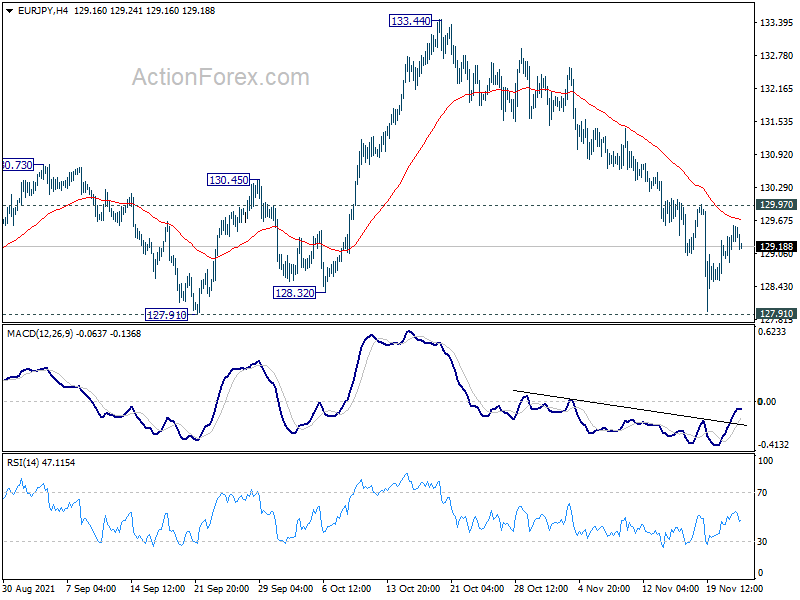
Daily Pivots: (S1) 129.08; (P) 129.34; (R1) 129.78; More....
Intraday bias in EUR/JPY stays neutral at this point. On the upside, break of 129.97 will indicate short term bottoming, and turn bias back to the upside for rebound back towards 133.44 high. On the downside, however, break of 127.91 will extend the whole corrective pattern from 134.11, to 126.58 medium term fibonacci level next.
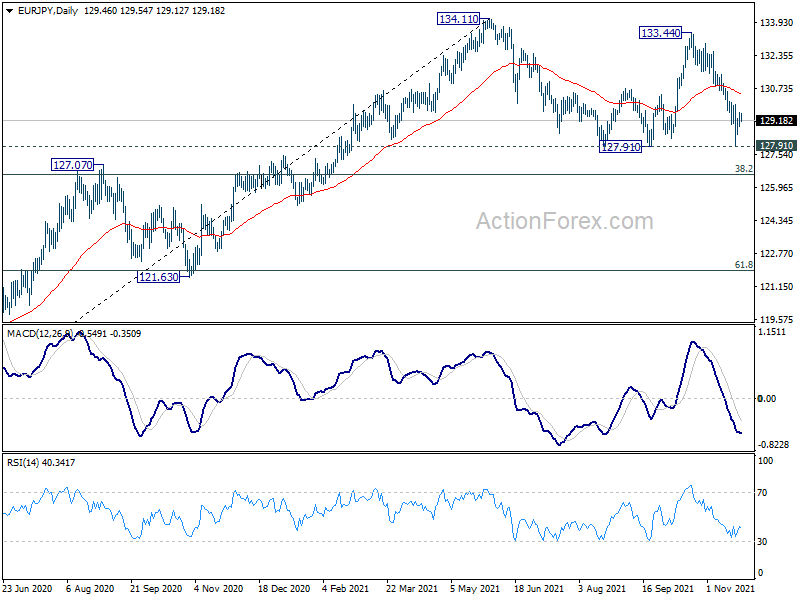
In the bigger picture, as long as 38.2% retracement of 114.42 (2020 low) to 134.11 at 126.58 holds, up trend from 114.42 is still in favor to continue. Break of 134.11 will target long term resistance at 137.49 (2018 high). However, sustained break of 126.58 will raise the chance of medium term bearish reversal. In this case, deeper decline would be seen to 61.8% retracement at 121.94, and possibly below.
EUR/GBP Daily Outlook
Daily Pivots: (S1) 0.8385; (P) 0.8408; (R1) 0.8431; More...
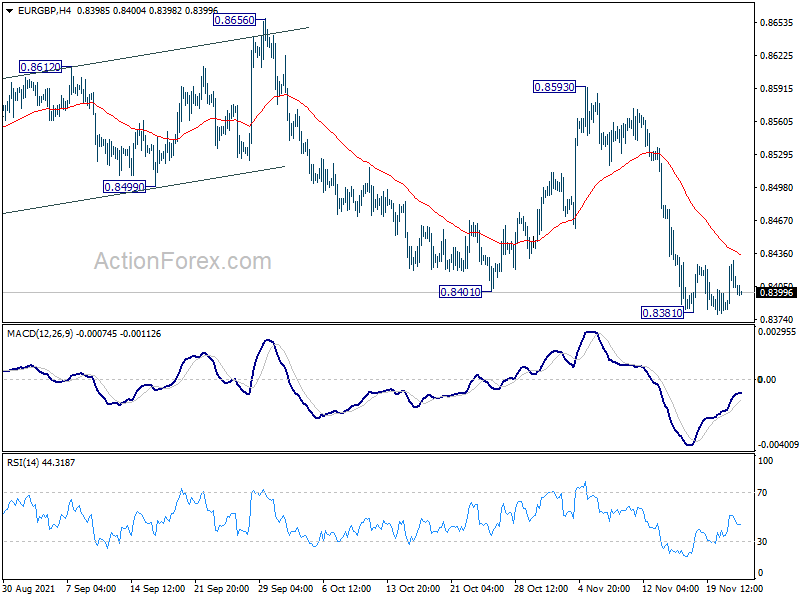
EUR/GBP is still bounded in consolidation from 0.8381 and intraday bias remains neutral first. In case of another recovery, upside should be limited by 4 hour 55 EMA (now at 0.8434). On the downside, break of 0.8381 will resume larger down trend from 0.9499. Intraday bias will be back to the downside for 0.8276 key long term support.
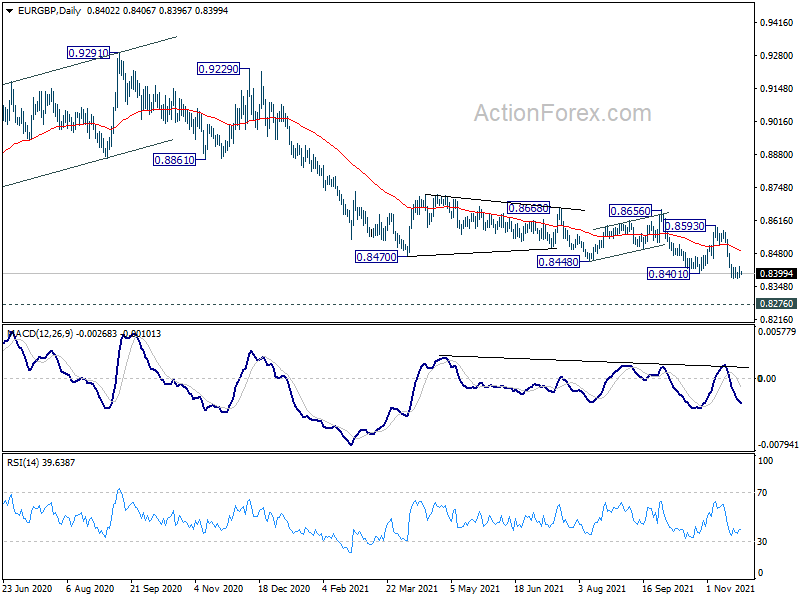
In the bigger picture, price actions from 0.9499 (2020 high) are still seen as developing into a corrective pattern. Deeper fall could be seen as long as 0.8593 resistance holds, towards long term support at 0.8276. We'd look for bottoming signal around there to bring reversal. However, sustained break of 0.8276 will but a sign of long term bearish reversal.
EUR/AUD Daily Outlook
Daily Pivots: (S1) 1.5525; (P) 1.5576; (R1) 1.5619; More...
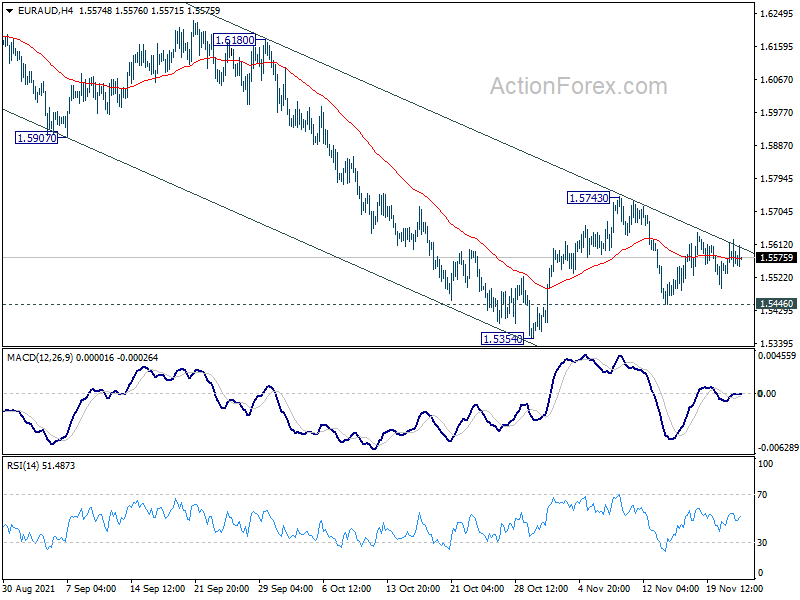
Intraday bias in EUR/AUD remains neutral and outlook is unchanged. Further fall is expected as long as 1.5743 resistance holds. On the downside, break of 1.5354 will resume whole fall from 1.6434 to retest 1.5250 low. Nevertheless, break of 1.5743 will turn near term outlook bullish for 1.5907 resistance instead.
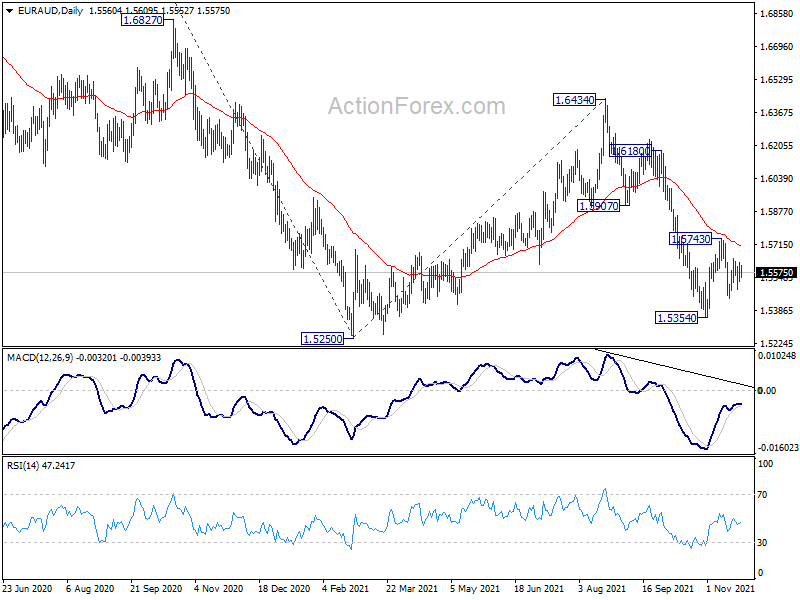
In the bigger picture, the down trend from 1.9799 (2020 high) is in progress. Firm break of 1.5250 low will confirm resumption and target 61.8% retracement of 1.1602 (2012 low) to 1.9799 at 1.4733. Sustained break there could bring more downside acceleration to 61.8% projection of 1.9799 to 1.5250 from 1.6434 at 1.3623. In any case, break of 1.6434 resistance is needed to signal medium term bottoming, or outlook will stay bearish.
EUR/CHF Daily Outlook
Daily Pivots: (S1) 1.0475; (P) 1.0494; (R1) 1.0519; More....
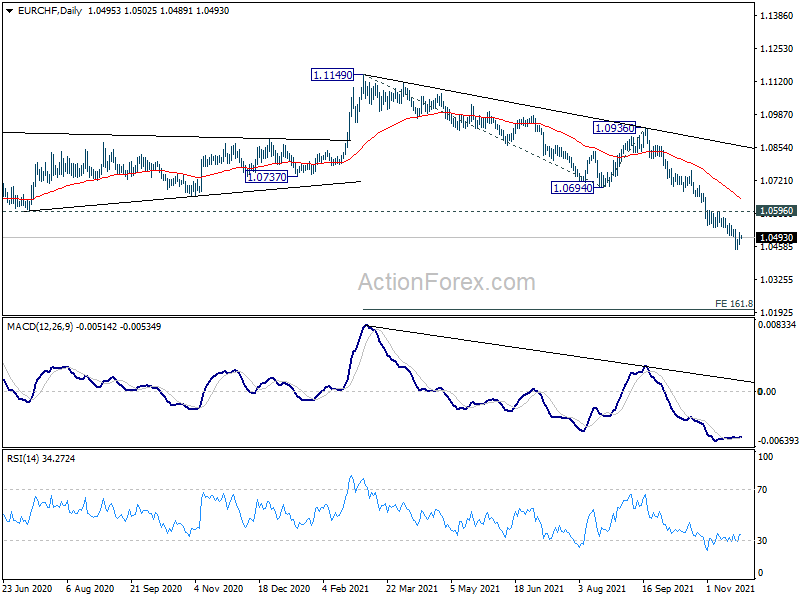
Intraday bias in EUR/CHF is turned neutral with current recovery. But further decline is expected with 1.0596 resistance intact. Break of 1.0446 will resume the down trend from 1.1149 to 161.8% projection of 1.1149 to 1.0694 from 1.0936 at 1.0200 next. Nevertheless, break of 1.0596 will indicate short term bottoming and turn bias back to the upside for stronger rebound.
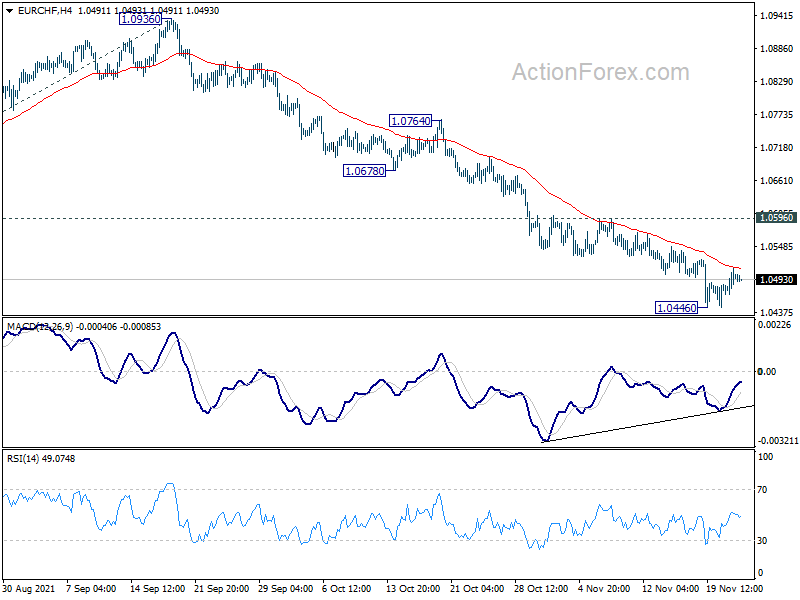
In the bigger picture, down trend from 1.2004 (2018 high) should be resuming with break of 1.0505 (2020 low). Next target is 61.8% projection of 1.2004 to 1.0505 to 1.1149 at 1.0223. On the upside, break of 1.0694 resistance is needed to be the first sign of medium term bottoming. Otherwise, outlook will remain bearish.