

Sample Category Title
USD/JPY Mid-Day Outlook
Daily Pivots: (S1) 114.69; (P) 114.93; (R1) 115.37; More...
USD/JPY's rally continues today and intraday bias remains on the upside. Current up trend from 102.58 should target 100% projection of 102.58 to 111.65 from 109.11 at 118.18 next. On the downside, below 114.81 minor support will turn intraday bias neutral first. But break of 113.57 support is needed to indicate short term topping. Otherwise, outlook will stay bullish in case of retreat.
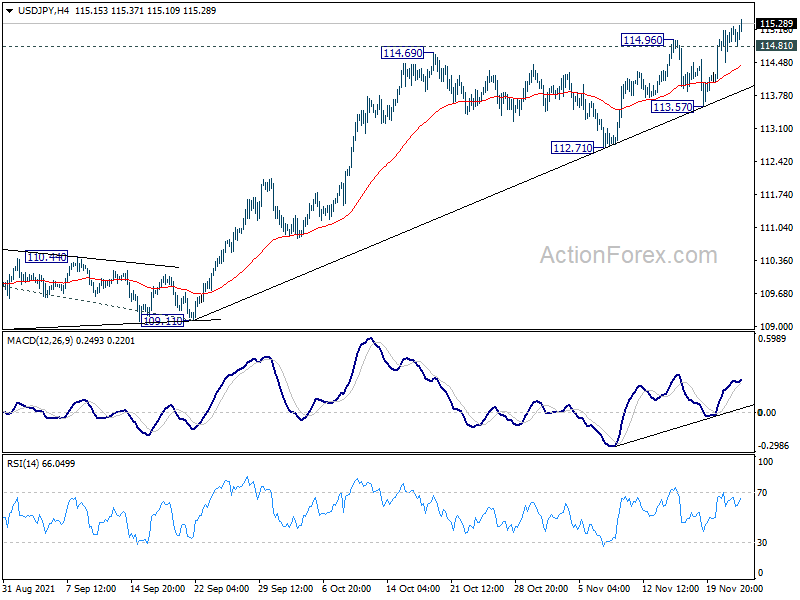
In the bigger picture, corrective decline from 118.65 (2016 high) should have completed at 101.18 already. Rise from the 102.58 is seen as the third leg of the up trend from 101.18. Next target is 118.65 high. This will now be the preferred case as long as 111.65 resistance turned support holds, even in case of deep pull back.
Dollar Rally Continues as Jobless Claims Dropped to Lowest Since 1969
Dollar's rally continues today and stays firm after much better than expected jobless claims data. Yen is following as second strongest on risk-off sentiment, as major European indexes and US futures are in red. On the other hand, New Zealand Dollar remains the worst performing one on post-RBNZ selloff, Aussie and Loonie are following.
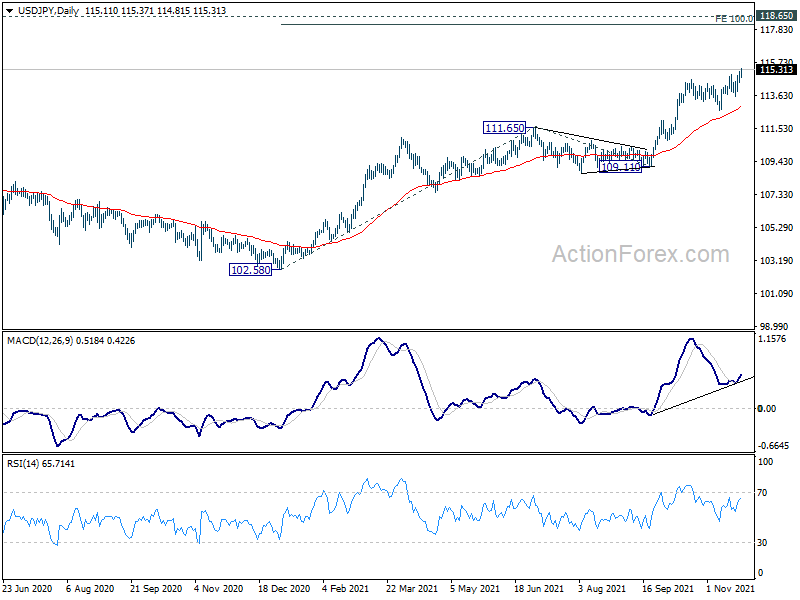
Technically, we'd keep an eye on Gold's development. Fall from 1877.05 is in progress and sustained break of channel support (now at 1762.19) could bring deeper fall back to 1700 handle (just above 1676.65/1682.60 support zone). Such decline would also come with intensified buying in Dollar, in particular against Euro.
In Europe, at the time of writing, FTSE is down -0.21%. DAX is down -1.11%. CAC is down -0.82%. Germany 10-year yield is up 0.0163 at -0.203. Earlier in Asia, Nikkei dropped -1.58%. Hong Kong HSI rose 0.14%. China Shanghai SSE rose 0.10%. Singapore Strait Times dropped -0.01%. Japan 10-year JGB yield rose 0.0012 to 0.086.
US initial jobless claims dropped to 199k, lowest since 1969
US initial jobless claims dropped -71k to 199k in the week ending November 20, well below expectation of 260k. That;s the lowest level since November 15, 1969. Four-week moving average of initial claims dropped -21k to 252k, lowest since March 14, 2020.
Continuing claims dropped -60k to 2049k in the week ending November 13, lowest since March 2020. Four-week moving average of continuing claims dropped -48k to 2117k, lowest since march 21, 2020.
US Q3 GDP growth revised slightly up to 2.1% annualized
According to the second estimate, US real GDP grew at annualized rate of 2.1% in Q3, comparing to Q2's 6.7%. The upward revision from advance estimate of 2.0% primarily reflects upward revisions to personal consumption expenditures (PCE) and private inventory investment.
US durable goods orders dropped -0.5% in Oct, ex-transport orders rose 0.5%
US durable goods orders dropped -0.5%to USD 260.1B in October, below expectation of 0.2%. Ex-transport orders rose 0.5%, matched expectations. Ex-defense orders rose 0.8%. Transportation equipment dropped -2.6% to USD 75.3B.
Goods trade deficit narrowed to USD -82.9B in October, versus expectation of USD -94.7B.
ECB Panetta: Monetary policy should remain patient
ECB Executive Board member Fabio Panetta said, "the data suggest the current picture is dominated by a bout of 'bad' inflation generated outside the euro area, whereas we are far from seeing abnormally large domestic demand." "Monetary policy should remain patient. A premature tightening would restrain spending before demand has returned to trend," he added.
"We should not exacerbate the risk of supply shocks morphing into a demand shock and threatening the recovery by prematurely tightening monetary policy – or by passively tolerating an undesirable tightening in financing conditions," Panetta warned.
Panetta also urged to continue with asset purchases. "First, the surge in the number of (COVID-19) infections and the renewed introduction of pandemic-related restrictions in some euro area countries mean that the pandemic is not over yet," he said. "Second, an inappropriate, sharp reduction of purchases would be tantamount to a tightening of the policy stance."
Separately, Governing Council member Robert Holzmann said, "the statements until now including of my colleagues on the Governing Council all suggest that net PEPP purchases will probably expire in March but that PEPP as such will not be done away with but perhaps be put in a waiting room."
This will be in order to "save the advantages of flexibility in case they become necessary in the event of economic shocks, which are definitely possible, but we do not expect," Holzmann said.
Germany Ifo dropped to 96.5, challenged by supply bottlenecks and 4th wave of coronavirus
Germany Ifo Business Climate dropped to 96.5 in November, down form 97.7, missed expectation of 96.7. Current Assessment index dropped to 99.0, down from 100.2, missed expectation of 100.3. Expectations index dropped to 94.2, down from 95.4, missed expectation of 96.3.
By sector, manufacturing dropped from 17.5 to 16.5. Service dropped sharply again from 16.6 to 11.5. Trade dropped from 3.7 to 2.6. Construction dropped from 12.8 to 12.0.
Ifo said: "Companies were less satisfied with their current business situation, and expectations became more pessimistic. Supply bottlenecks and the fourth wave of the coronavirus are challenging German companies."
From Swiss, Credit Suisse Economic Expectations tumbled sharply from 15.6 to -10.8 in November.
RBNZ hikes OCR to 0.75%, maintains hawkish bias
RBNZ raised the Official Cash Rate to by 25bps to 0.75% as expected. It also maintained a hawkish bias, noting that " further removal of monetary policy stimulus is expected over time given the medium term outlook for inflation and employment."
The central bank also said that despite recent nationwide lockdown, "underlying economic strength remains supported by aggregate household and business balance sheet strength, fiscal policy support, and strong export returns." Capacity pressured have "continued to tighten" with employment "above its sustainable level". A broad range of economic indicators highlight the economy "continues to perform above its current level".
Headline CPI is expected to be "above 5 percent in the near term" before returning towards 2% midpoint "over the next two years.
Japan PMI manufacturing rose to 54.2, services rose to 52.1
Japan PMI Manufacturing rose to 54.2 in November, up from 53.2, but missed expectation of 54.5. PMI Services rose to 52.1, up from 50.7. PMI Composite rose to 52.5, up from 50.7.
Usamah Bhatti, Economist at IHS Markit, said:
"Flash PMI data indicated that activity at Japanese private sector businesses rose for the second month running in November. Growth in output quickened from October and was the quickest recorded since October 2018. By sector, service providers noted the sharpest rise in activity since September 2019, while manufacturers indicated the fastest rate of growth for six months.
"Firms across the Japanese private sector reported intensifying price pressures. Input prices across the private sector rose at the fastest pace for over 13 years with businesses attributing the rise to higher raw material, freight and staff costs amid shortages and deteriorating supplier performance.
"As vaccination rates rose and economic restrictions eased, Japanese private sector companies were strongly optimistic that business activity would rise in the year ahead. Positive sentiment was the strongest on record and stemmed from hopes that the end of the pandemic and lifting of international restrictions would provide a broad-based boost to activity."
USD/JPY Mid-Day Outlook
Daily Pivots: (S1) 114.69; (P) 114.93; (R1) 115.37; More...
USD/JPY's rally continues today and intraday bias remains on the upside. Current up trend from 102.58 should target 100% projection of 102.58 to 111.65 from 109.11 at 118.18 next. On the downside, below 114.81 minor support will turn intraday bias neutral first. But break of 113.57 support is needed to indicate short term topping. Otherwise, outlook will stay bullish in case of retreat.
In the bigger picture, corrective decline from 118.65 (2016 high) should have completed at 101.18 already. Rise from the 102.58 is seen as the third leg of the up trend from 101.18. Next target is 118.65 high. This will now be the preferred case as long as 111.65 resistance turned support holds, even in case of deep pull back.
Economic Indicators Update
| GMT | Ccy | Events | Actual | Forecast | Previous | Revised |
|---|---|---|---|---|---|---|
| 00:30 | AUD | Construction Work Done Q3 | -0.30% | -3.10% | 0.80% | 2.20% |
| 00:30 | JPY | Manufacturing PMI Nov P | 54.2 | 54.5 | 53.2 | |
| 00:40 | AUD | RBA's Bullock speech | ||||
| 01:00 | NZD | RBNZ Interest Rate Decision | 0.75% | 0.75% | 0.50% | |
| 02:00 | NZD | RBNZ Press Conference | ||||
| 09:00 | CHF | Credit Suisse Economic Expectations Nov | -10.8 | 15.6 | ||
| 09:00 | EUR | Germany IFO Business Climate Nov | 96.5 | 96.7 | 97.7 | |
| 09:00 | EUR | Germany IFO Current Assessment Nov | 99 | 100.3 | 100.1 | 100.2 |
| 09:00 | EUR | Germany IFO Expectations Nov | 94.2 | 96.3 | 95.4 | |
| 13:30 | USD | Initial Jobless Claims (Nov 19) | 199K | 260K | 268K | 270K |
| 13:30 | USD | GDP Annualized Q3 P | 2.10% | 2.20% | 2.00% | |
| 13:30 | USD | GDP Price Index Q3 P | 5.90% | 5.70% | 5.70% | |
| 13:30 | USD | Goods Trade Balance (USD) Oct P | -82.9B | -94.7B | -96.3B | |
| 13:30 | USD | Wholesale Inventories Oct P | 2.20% | 1.20% | 1.40% | |
| 13:30 | USD | Durable Goods Orders Oct | -0.50% | 0.20% | -0.30% | |
| 13:30 | USD | Durable Goods Orders ex Transportation Oct | 0.50% | 0.50% | 0.50% | |
| 15:00 | USD | Personal Income M/M Oct | 0.30% | -1.00% | ||
| 15:00 | USD | Personal Spending Oct | 0.90% | 0.60% | ||
| 15:00 | USD | PCE Price Index M/M Oct | 0.40% | 0.30% | ||
| 15:00 | USD | PCE Price Index Y/Y Oct | 4.60% | 4.40% | ||
| 15:00 | USD | Core PCE Price Index M/M Oct | 0.40% | 0.20% | ||
| 15:00 | USD | Core PCE Price Index Y/Y Oct | 4.10% | 3.60% | ||
| 15:00 | USD | New Home Sales Oct | 801K | 800K | ||
| 15:00 | USD | Michigan Consumer Sentiment Index Nov F | 66.8 | 66.8 | ||
| 15:30 | USD | Crude Oil Inventories | -1.7M | -2.1M | ||
| 17:00 | USD | Natural Gas Storage | -23B | 26B | ||
| 19:00 | USD | FOMC Minutes |
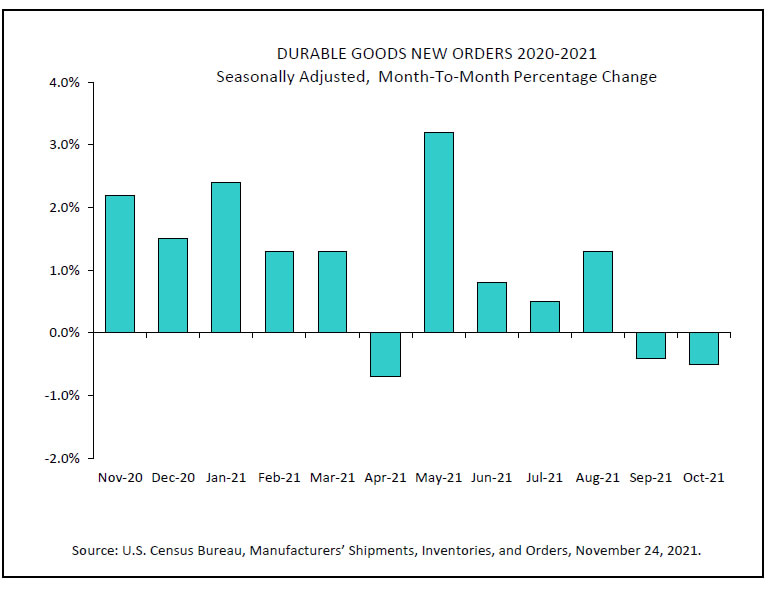
US durable goods orders dropped -0.5% in Oct, ex-transport orders rose 0.5%
US durable goods orders dropped -0.5%to USD 260.1B in October, below expectation of 0.2%. Ex-transport orders rose 0.5%, matched expectations. Ex-defense orders rose 0.8%. Transportation equipment dropped -2.6% to USD 75.3B.
Goods trade deficit narrowed to USD -82.9B in October, versus expectation of USD -94.7B.
US Q3 GDP growth revised slightly up to 2.1% annualized
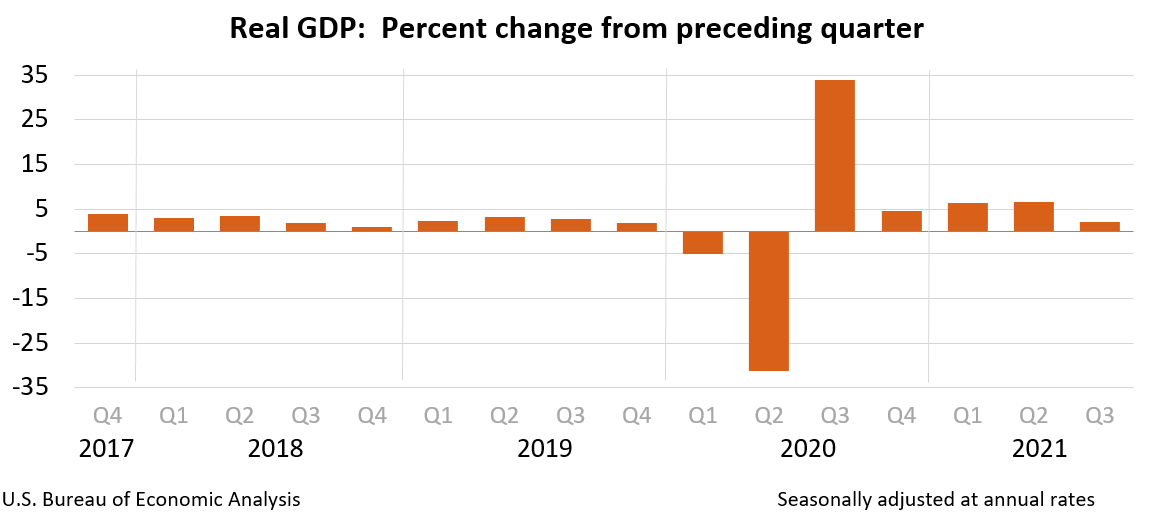
According to the second estimate, US real GDP grew at annualized rate of 2.1% in Q3, comparing to Q2's 6.7%. The upward revision from advance estimate of 2.0% primarily reflects upward revisions to personal consumption expenditures (PCE) and private inventory investment.
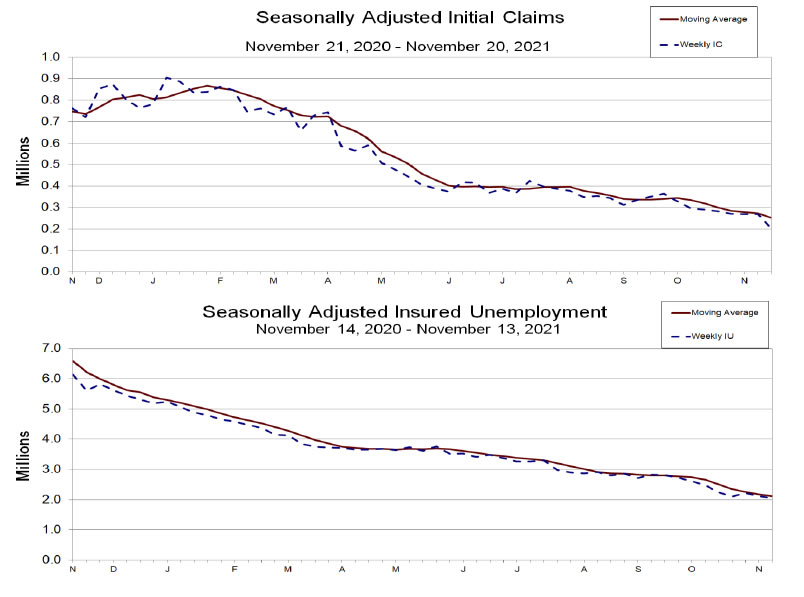
US initial jobless claims dropped to 199k, lowest since 1969
US initial jobless claims dropped -71k to 199k in the week ending November 20, well below expectation of 260k. That's the lowest level since November 15, 1969. Four-week moving average of initial claims dropped -21k to 252k, lowest since March 14, 2020.
Continuing claims dropped -60k to 2049k in the week ending November 13, lowest since March 2020. Four-week moving average of continuing claims dropped -48k to 2117k, lowest since march 21, 2020.
GBPJPY Marks Yet More Lower Highs as Bearish Forces Linger
GBPJPY is struggling to gain positive traction amid successive lower highs. Moreover the 50-period simple moving average (SMA) has crossed below the 200-period SMA, increasing fears of a sustained bearish outlook.
Short-term momentum indicators are reflecting a mixed picture for the pair, as the RSI is hovering slightly above its 50 neutral mark. However, the MACD is negligibly below its red signal line and is looking ready to cross beneath zero which would be another sign of negative momentum.
Should the bears remain in charge, initial support might be found at the 50-period SMA currently located at 153.60. A break below this barrier, could pave the way towards an area which is comprised by the 153.33 and 153.10 level. A further descending movement below this point could strengthen the pair’s negative momentum, sending the price to test the congested region which encapsulates the 152.51 and 152.34 support.
On the flip side, should the price cross the 154.20 level, the bulls might then target the resistance region which consists of the 154.70 barrier and the 200-period SMA currently found at 154.90. Advancing beyond this point could turn the cards around for the pair, sending the price towards the 156.25 resistance level.
In brief, the overall outlook of the GBPJPY is negative. For that to change, the bulls would need to break above the 200-period SMA.
NZ Dollar Falls Below 69 after RBNZ Hike
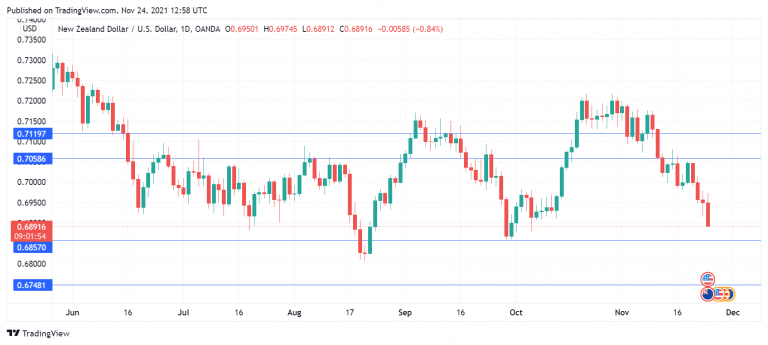
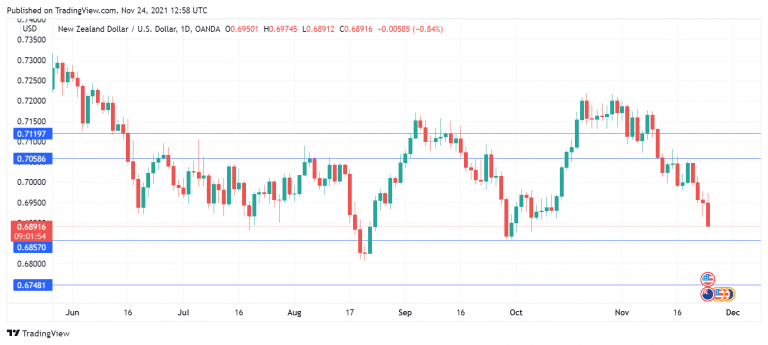
The New Zealand dollar has sustained sharp losses on Wednesday. NZD/USD is currently trading at 0.6892, down 0.84% on the day.
RBNZ rate hike sends kiwi lower
At the November policy meeting, the RBNZ raised rates for a second straight month, as promised. Policy makers likely didn’t expect the decision to send the New Zealand dollar for a tumble, but investors were clearly not impressed with the 0.25% rate hike, which brought the policy rate to 0.75%. The markets had priced in a 0.25% move, but there was disappointment from those traders who were hoping that the central bank would show an aggressive side and hike by 0.50%.
The New Zealand dollar took it on the chin, even though the bank signalled that it will need to tighten policy more quickly than anticipated in order to contain inflation. The RBNZ is now projecting that rates will rise to 2% by the end of 2022, a full year ahead of the previous projection in August. The rate statement noted that “the economy continues to perform above its current potential” and that employment was “above its maximum sustainable level”. In other words, the bank is clearly concerned about the economy overheating, and will raise rates to prevent that from happening.
The next policy meeting is not until February, so the New Zealand dollar, which is down 3.89% in November, will have to look elsewhere for support in the meantime. After the decision, Governor Orr said that the bank would act with caution and planned to tighten in 25 bps increments “for now”. Inflation will certainly be on the minds of Orr and his colleagues, as inflation is currently at 4.9% and the RBNZ is projecting it will hit 5.7% in the fourth quarter.
NZD/USD Technical
- There is resistance at 0.6958 and 0.7059
- NZD/USD is down sharply and continues to break below support levels. There is support at 0.6857, which has held since late August. Below, 0.6747 is a monthly support level
ECB Panetta: Monetary policy should remain patient
ECB Executive Board member Fabio Panetta said, "the data suggest the current picture is dominated by a bout of 'bad' inflation generated outside the euro area, whereas we are far from seeing abnormally large domestic demand." "Monetary policy should remain patient. A premature tightening would restrain spending before demand has returned to trend," he added.
"We should not exacerbate the risk of supply shocks morphing into a demand shock and threatening the recovery by prematurely tightening monetary policy – or by passively tolerating an undesirable tightening in financing conditions," Panetta warned.
Panetta also urged to continue with asset purchases. "First, the surge in the number of (COVID-19) infections and the renewed introduction of pandemic-related restrictions in some euro area countries mean that the pandemic is not over yet," he said. "Second, an inappropriate, sharp reduction of purchases would be tantamount to a tightening of the policy stance."
Separately, Governing Council member Robert Holzmann said, "the statements until now including of my colleagues on the Governing Council all suggest that net PEPP purchases will probably expire in March but that PEPP as such will not be done away with but perhaps be put in a waiting room."
This will be in order to "save the advantages of flexibility in case they become necessary in the event of economic shocks, which are definitely possible, but we do not expect," Holzmann said.
Gold Meets New Resistance But Sell-Off Already Overstretched
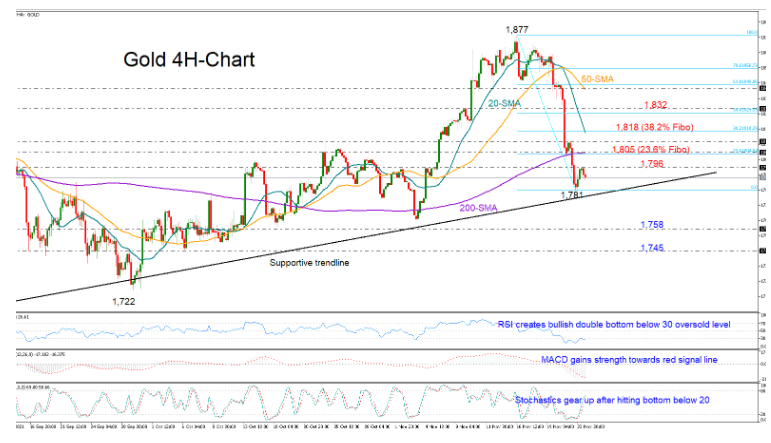
Gold could not find enough buying interest to close above the 1,796 resistance on Tuesday despite the bounce off the 20-day low of 1,781 in the four-hour chart.
Nevertheless, traders could still derive some optimism from the momentum indicators as the RSI has formed a double bottom below its 30 oversold level, while the Stochastics are swiftly strengthening after printing a similar pattern below 20. The MACD is encouragingly swinging upwards in the negative area, reflecting fading selling forces.
Hence, the bulls may not easily give up the battle with the 1,796 barrier. Should they win this time, the next obstacle could pop up near the 200-period at 1,805, where the 23.6% Fibonacci retracement of the latest freefall happens to be. If the swing high of 1,812 proves easy to clear, the price could then crawl straight up to the 38.2% Fibonacci of 1,818 and the 20-period SMA. A decisive close higher from here would open the door for the key resistance of 1,833.
Alternatively, if selling pressures persist, all eyes will turn to the supportive trendline drawn from the August low of 1,680, currently seen around 1,778. A sustainable decline lower from here could stretch towards the monthly low of 1,758, while a more aggressive sell-off may see a test near the October 6 floor of 1,745.
In summary, gold seems to have found a bottom in the oversold area, signalling buying pressures could resume in the short-term despite the latest pullback in the price. A step above 1,796 could activate the next bullish action.
Oil Gives Biden A Bashing
SPR release triggers gains for oil
Oil delivered a resounding slap to the face of President Biden overnight after he finally announced his well-telegraphed intention to release oil from the SPR onto open markets. Totalling some 70 to 80 million barrels, if you include international partners joining the US, the releases will be spread over several months. With President Biden using most of his discretionary quota available last night from the SPR, the amounts released over the time frame will not be enough to materially impact oil prices, and clearly, markets also thought the same. European Covid-19 lockdown concerns may act as a cap to prices in the short-term, but again, will not structurally upset the bullish dynamics underpinning oil and energy prices. Additionally, OPEC+ does not have the capacity to radically increase production, even if they wanted to, which they don’t.
After the announcement, Brent crude leapt 3.50% higher, finishing at USD 82.25 a barrel. WTI jumped 2.65% higher, closing at USD 78.50 a barrel. In Asia, prices on both contracts have crept another 25 cents a barrel higher, with physical buyers perhaps ruing a missed opportunity earlier this week. Both contracts bottomed out above their 100-day moving averages and yesterday’s move likely signals the correction lower for oil is over.
Brent crude is testing resistance at USD 82.50 this morning which is followed by USD 83.25 a barrel. Support is distant at USD 78.60 and USD 77.60 a barrel with the 100-DMA lurking at USD 76.85. WTI has nearby resistance at USD 79.30 a barrel followed by USD 80.00 and USD 82.00 a barrel. Support is at USD 75.30 and USD 77.70 a barrel, followed by the 100-DMA at USD 74.30. A larger than 1 million barrel fall by US official Crude Inventories this evening could spark and jump in prices.
Gold’s bond torment continues
Gold’s awful week continues to go from bad to work, thanks to another jump higher by US 10-year, and especially, 30-year bond yields overnight. Combined with a rock-solid US dollar, gold was pummelled once again, falling 0.87% to USD 1789.00 an ounce, having tested the 50, 100 and 200 DMAs intraday. Some short-covering has once again lifted gold in Asia, climbing 0.35% to USD 1795.00 an ounce. The rally, however, looks strictly corrective.
Having been burnt so badly, even if US yields correct lower tonight ahead of the Thanksgiving holiday, investors are likely to be much more cautious at re-entering long positions. Momentum will be muted and that means that the USD 1835.00 to USD 1850.00 region will cap gains this week, although I will be surprised if we even get as far as USD 1810.00 an ounce. If US yields remain firm this week, gold will be vulnerable to further losses. The 50-day, 100-day, and 200-day moving averages are clumped together between USD 1789.30 and USD 1793,50 an ounce. A daily close below this zone signals deeper losses targeting USD 1760.00 an ounce with interim support at USD 1780.00.