

Sample Category Title
US oil inventories rose 1m barrels, more downside still expected in WTI
US commercial crude oil inventories rose 1m barrels in the week ending November 19, versus expectation of -1.7m fall. At 434.0m barrels, oil inventories are around -7% below the five year average for this time of year.
Gasoline inventories dropped -0.6m barrels. Distillate dropped -2.0m barrels. Propane/propylene dropped -1.0m barrels. Total commercial petroleum inventories dropped -6.0m barrels.
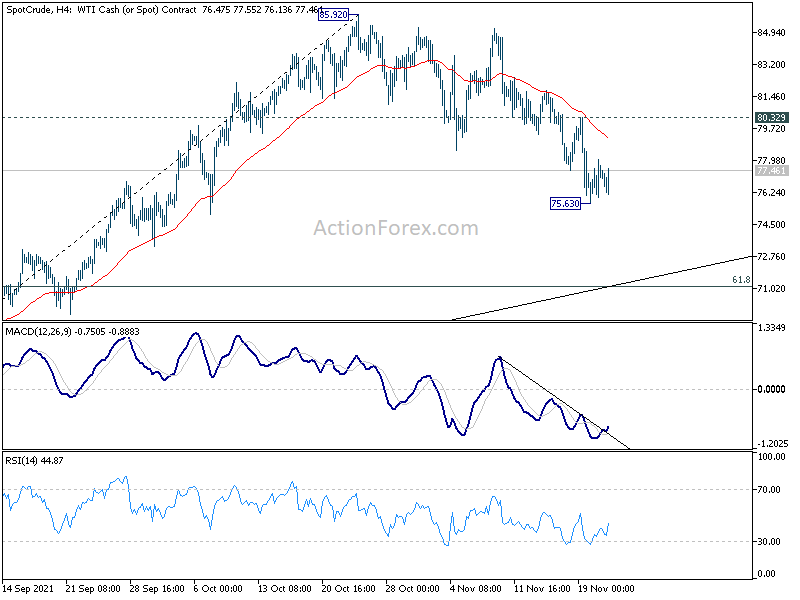
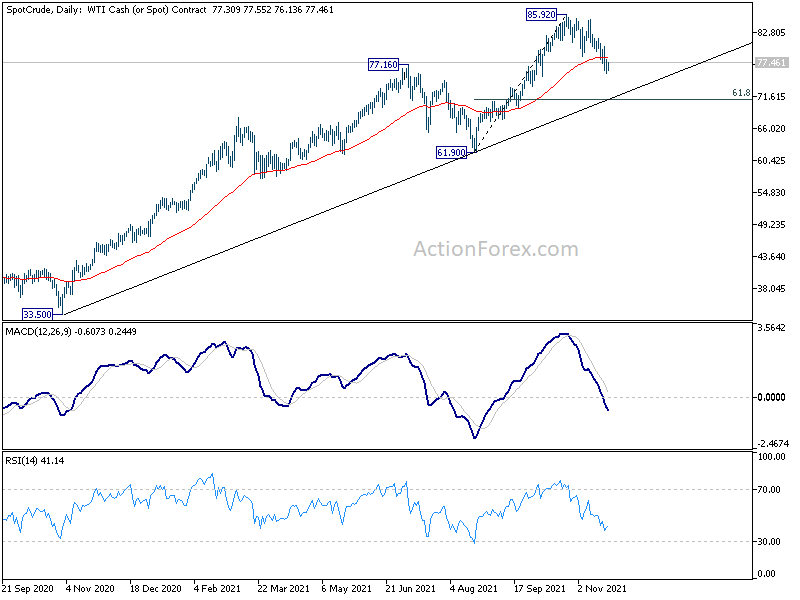
WTI crude oil is losing some downside momentum after hitting 75.53. But there is no clear sign of bottoming yet. As long as 80.32 resistance holds, it's still more likely to extend the correct from 85.92 to 61.8% retracement of 61.90 to 85.92 at 71.07 before completion.
Brent Crude – Correction Over?
Or more to go?
Oil prices are on the rise again after a correction over the last month but how much support does it now have?
It didn’t take long for oil to rebound after the US, China, India, Japan, UK and South Korea announced their coordinated SPR release. A sign that the market had fully priced in the announcement, perhaps even that it isn’t the game-changer it was sold to be.
The bigger threat to oil prices is lockdowns and restrictions, as we’re now seeing emerge again in Europe and that could potentially cap prices in the near term. Unless, of course, OPEC+ responds in kind to the actions of the consuming countries.
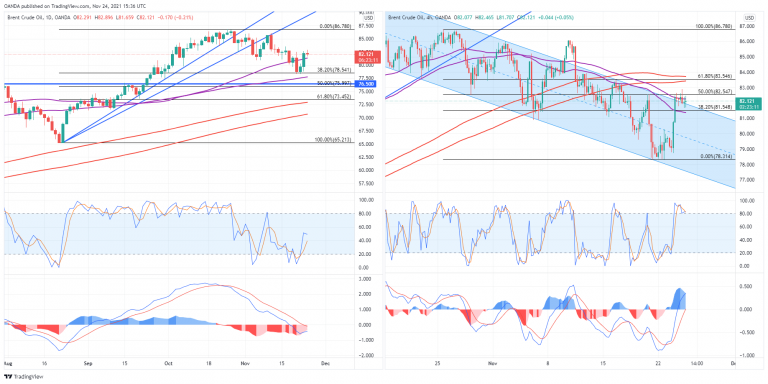
Brent rebounded off $78.50 initially, where the 38.2 fib – August lows to October highs – combines with prior resistance and the lower end of the 55/89-day SMA . If this is only a shallow correction, that would be a bullish signal for the market.
Brent is currently struggling around $82.50 with the 50 fib level – October highs to November lows – providing significant resistance. The next test above is $83.50 where the 61.8 fib combines with the 200/233-period SMA on the 4-hour chart.
A move above here would be another bullish signal for crude. A move below $78.50 and $76 becomes key, with a combination of support making it a big test to the downside.
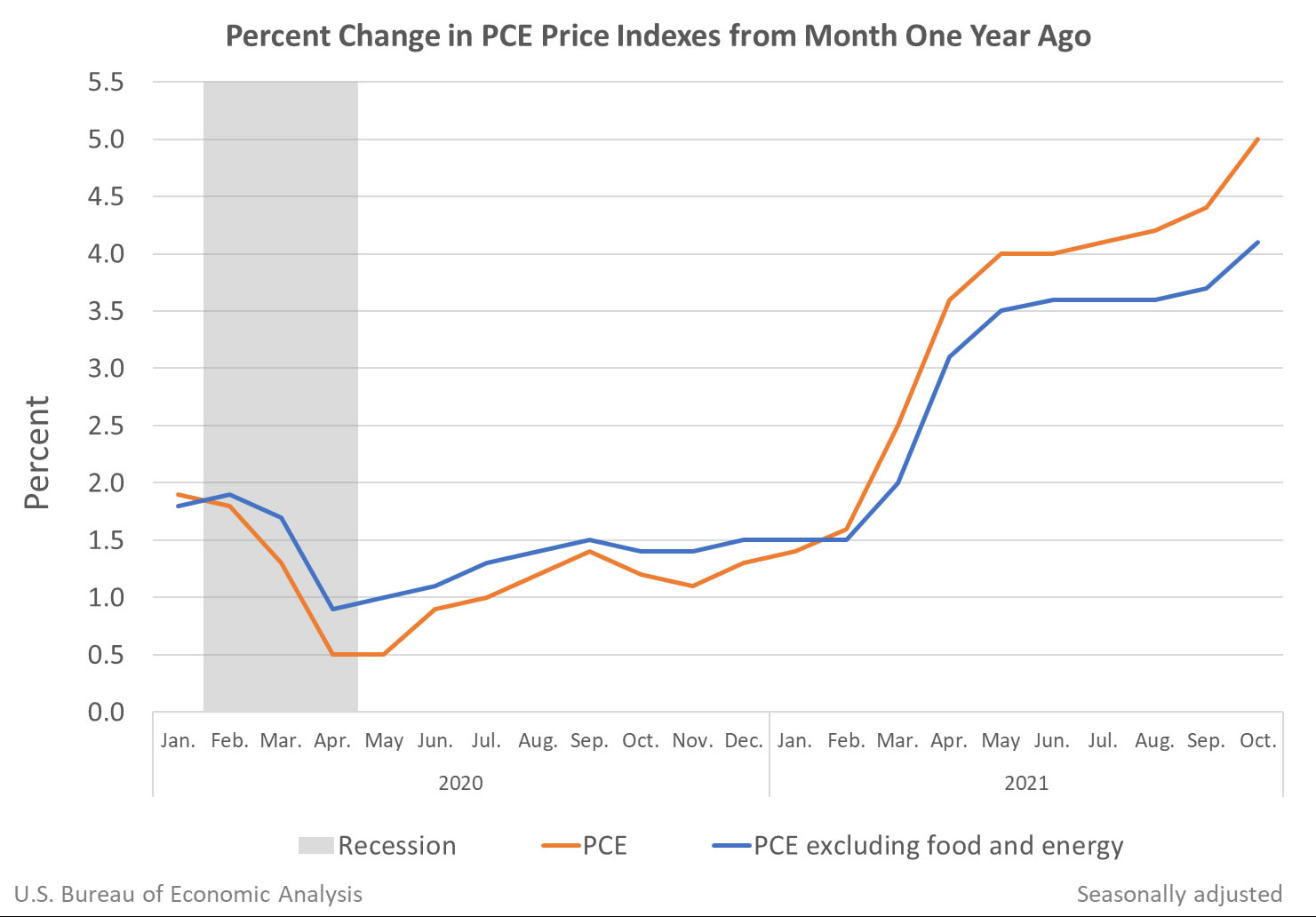
US PCE inflation rose to 5% yoy, core PCE to 4.1% yoy, highest since 1990
US personal income rose 0.5% mom to USD 93.4B in October, above expectation of 0.3% mom. Personal spending rose 1.3% mom to USD 214.3B, above expectation of 1.0% mom.
Headline PCE accelerated 5.0% yoy, up from 4.4% yoy, above expectation of 4.6% yoy. That's the highest level since December 1990. Core PCE rose to 4.1% yoy, up from 3.7% yoy, matched expectations, also the highest since December 1990.
Australian Dollar’s Woes Continues
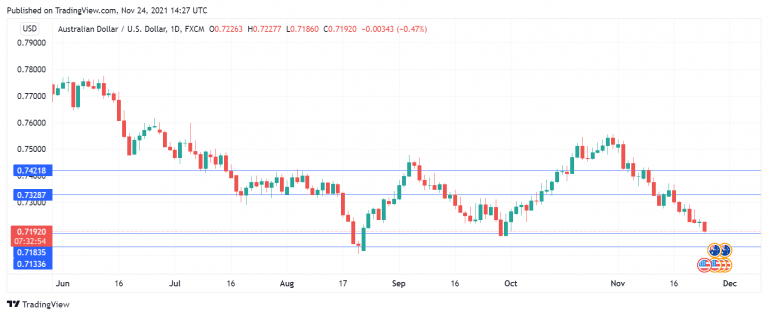
The Australian dollar is in negative territory in North American trade. Currently, AUD/USD is trading at 0.7190, down 0.50% on the day.
RBA unlikely to follow RBNZ tightening
The RBNZ made good on its promise and raised interest rates earlier today by 0.25%. This brings the cash rate to 0.75%, and the bank is projecting that rates will reach 2% in 2022. This tightening in policy, which started in October, is unlikely to be followed in Australia. Both countries are heavily dependent on trade, and the Australian and New Zealand dollars have fallen sharply in November (NZD is down 4.05% and AUD 4.36%), as risk appetite has waned and the US dollar is showing newfound strength.
As far as monetary policy, the RBA can afford to be much more dovish than the RBNZ. For one thing, Australia’s inflation is comfortably within the RBA’s 1-3% target, although there are inflationary pressures. In New Zealand, inflation is red-hot and is threatening to overheat the economy. Currently, inflation is running at 4.9% y/y and the RBNZ is projecting that inflation will accelerate to 5.7% in Q4. The RBNZ does not have the luxury of ignoring these numbers and has embarked on a series of rate hikes which will last into 2022, with rates expected to rise to 2.0%.
The RBA, however, can afford to sit on the fence, and Governor Lowe continues to insist that the bank will not raise rates before 2023, or possibly 2024, saying the bank is prepared to be patient. Many analysts believe that Lowe will have to act hike earlier if wages reach the RBA’s target of 3% faster than the RBA is anticipating. The markets have been much more hawkish than Lowe, and have priced in three rate hikes in 2022, despite the pushback from Lowe. With inflation on the rise and the Australian dollar falling, it will be interesting to see if the RBA brings forward its guidance in the coming months.
AUD/USD Technical
- There are resistance lines at 0.7328 and 0.7422
- AUD/USD is testing support at 0.7184. Below, there is support at 0.7134
Sunset Market Commentary
Markets
There’s no stopping the ruling EUR/USD trend south. Especially if eco data surprise on the downside in Europe and on the upside in the US. November German Ifo business sentiment (96.5 from 97.7) disconnected from yesterday’s stronger PMI’s. Both the current assessment and expectations component declined; the latter to the lowest level since January. Ifo president Fuest referred to continuous problems from (supply) bottlenecks and on top of that fresh, very serious, Covid outbreaks. Services and services expectations are falling very quickly, in particular in hospitality and tourism. The US eco calendar showed weekly jobless claims crashing below 200k (199k from 268k vs 260k expected) for the first time since the series started 1969. The drop can partly be explained (and reversed next week) by seasonal factors around Veteran’s Day and Thanksgiving Day holidays. Simultaneously, the October trade deficit was much smaller than forecast and than in October ($82.9bn from $97bn vs $95bn expected). Exports rose by 10.7% on a monthly basis while imports increased by a much smaller 0.5% M/M. Trade data provide a positive start for net exports in Q4 GDP. Later today, October PCE deflators and income/spending data will still be released. Inflation is expected to run ever hotter in line with the earlier CPI print. The combination of today’s eco numbers pushed EUR/USD below the 1.12 handle for the first time since June last year. Next minor support comes in at 1.1168. EUR/GBP tested the recent lows just south of 0.84, but a break lower didn’t occur. Adding to general US strength today were comments from SF Fed Daly who joined the chorus of Fed governors (Bullard, Clarida, Waller) in favor of an accelerated taper process in order to free space on the interest rate channel. Eco indicators so far point to a stronger Q4 GDP while the labour market seems tighter than forecast and inflation is running hotter than the September SEP suggested. The trade-weighted dollar has the 97 big figure within reach. Key resistance stands at 97.72 which is 62% retracement on the 2020 USD decline. USD/JPY left the 115-zone behind and nears the 115.51 resistance. From a technical point of view, the next target stands at the 2017 high of 118.60. The US Treasury yield curve bear flattens again with yields rising by 2.2 bps to 2.5 bps at the front end and only by 0.3 bps to 0.5 bps at the (very) long end. The US 10y yield approaches the September top at 1.7% with the US 2-yr yield setting a cycle high at 0.65%. The German yield curve steeps with yield changes ranging between -1.2 bps (2-yr) and +3.8 bps (30-yr). 10-yr yield spread changes vs Germany widen by up to 5 bps for Greece and 3 bps for Italy as German real yields are the driving factor between higher European rates for a second straight session.
News Headlines
ECB Governing Council member Holzmann said the central bank could put PEPP on hold rather than to completely abolish after net purchases end in March next year. Such a move would “save the advantages of flexibility in case they become necessary in the event of economic shocks”, he added. His comments came after Schnabel yesterday also suggested that PEPP would continue to play a role even after deciding to stop net buying next year. The Austrian played down the impact of his home country’s total lockdown on the economy, siding with other governors that recently said the same about possible tighter restrictions for the European Union as a whole.
Olaf Scholz is set to become Germany’s next chancellor. After almost two months of negotiating, Scholz’ SPD, the liberal FDP and the Greens forged a so-called traffic light coalition – the first of its kind on a national level. The FDP’s Lindner, an advocate of fiscal discipline, is touted for the all-important position as finance minister. According to the coalition deal’s text, Germany will re-introduce the debt brake in 2023 but will tweak the rules since spending will increase dramatically in order to achieve its climate goals. On a related note, it will expand green bond sales. The coalition agreement did not mention the Bundesbank nor dropped any hints on Weidmann’s successor.
EUR/USD Mid-Day Outlook
Daily Pivots: (S1) 1.1226; (P) 1.1250; (R1) 1.1275; More...
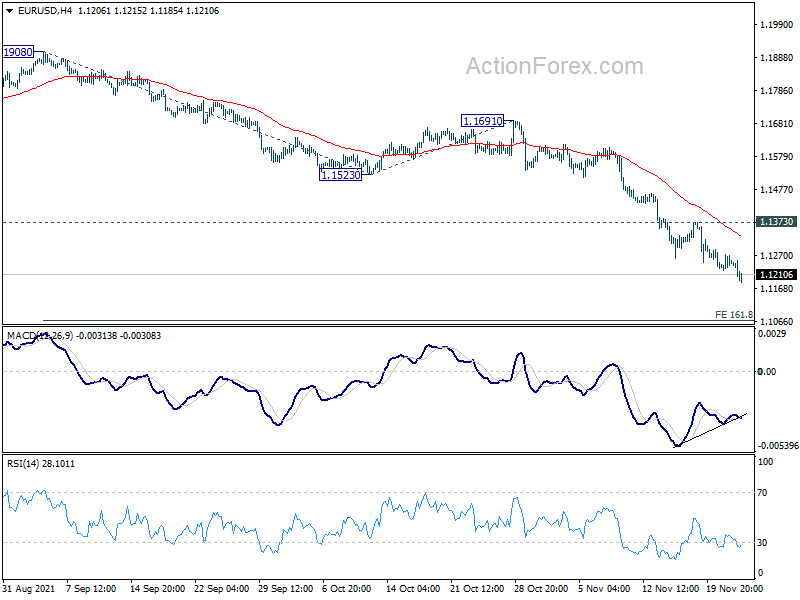
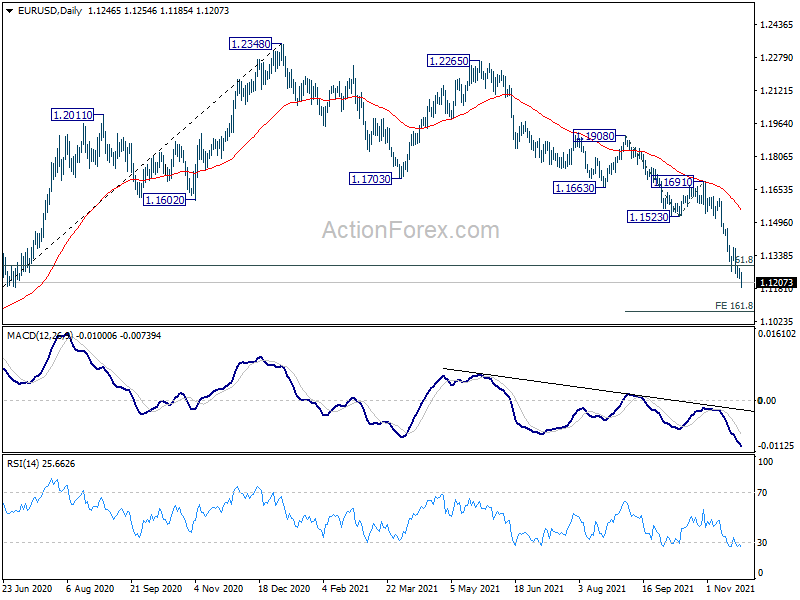
EUR/USD's down trend is still in progress and intraday bias remains on the downside. Further fall should be seen to 161.8% projection of 1.1908 to 1.1523 from 1.1691 at 1.1068 next. On the upside, break of 1.1373 resistance is needed to indicate short term bottoming. Otherwise, outlook will stay bearish in case of recovery.
In the bigger picture, there are various ways of interpreting the fall from 1.2348 (2021 high). It could be a correction to rise from 1.0635 (2020 low), the fourth leg of a sideway pattern from 1.0339 (2017 low), or resuming long term down trend. In any case, outlook will now stay bearish as long as 1.1703 support turned resistance holds. Sustained break of 61.8% retracement of 1.0635 to 1.2348 at 1.1289 would pave the way back to 1.0635.
GBP/USD Mid-Day Outlook
Daily Pivots: (S1) 1.3345; (P) 1.3377; (R1) 1.3411; More...
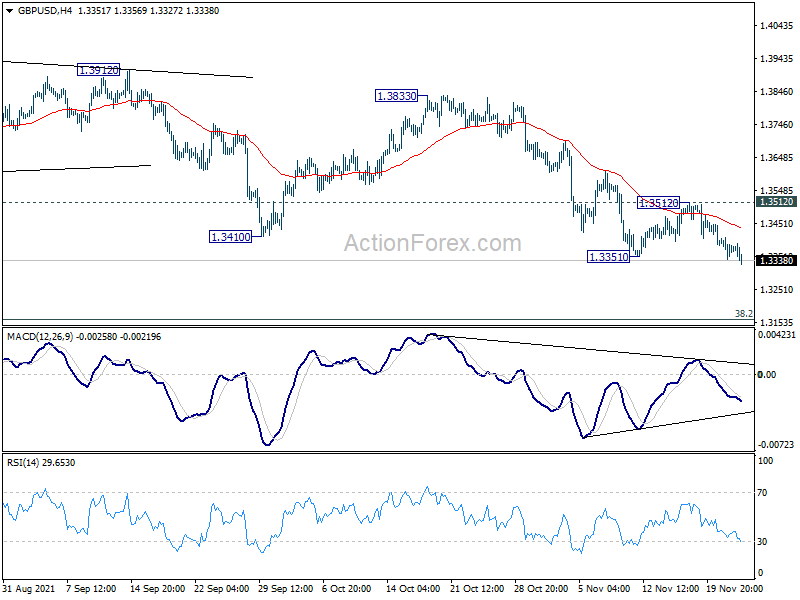
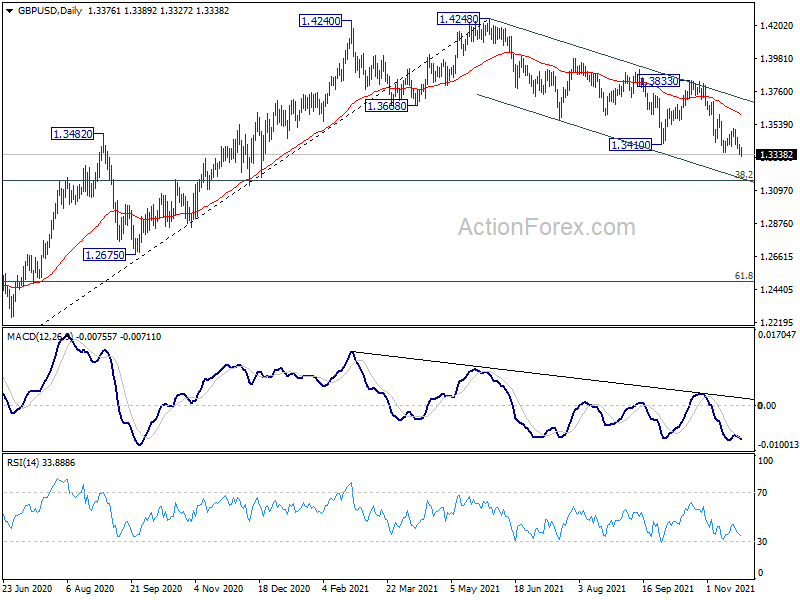
GBP/USD's decline is still in progress and intraday bias remains on the downside. Current down trend from 1.4248 should target 1.3164 fibonacci level next. On the upside, break of 1.3512 resistance is needed to indicate short term bottoming. Otherwise, outlook will stay bearish in case of recovery.
In the bigger picture, the structure of the fall from 1.4248 suggests that it's a correction to the up trend from 1.1409 (2020 low) only. While deeper fall cannot be ruled out yet, downside should be contained by 38.2% retracement of 1.1409 to 1.4248 at 1.3164, at least on first attempt, to bring rebound. On the upside, firm break of 1.4376 key resistance (2018 high) will add to the case of long term bullish reversal. However, sustained trading below 1.3164 will revive some medium term bearishness and target 61.8% retracement at 1.2493.
USD/CHF Mid-Day Outlook
Daily Pivots: (S1) 0.9308; (P) 0.9327; (R1) 0.9351; More....
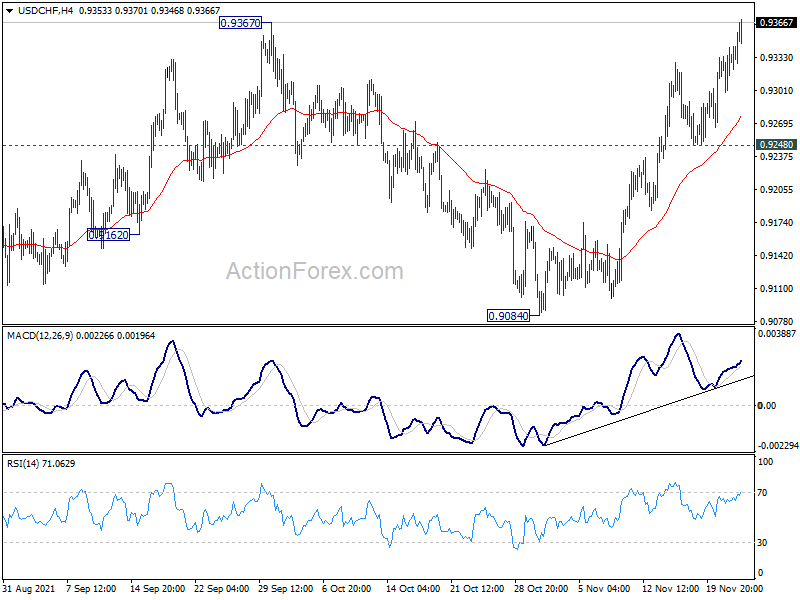
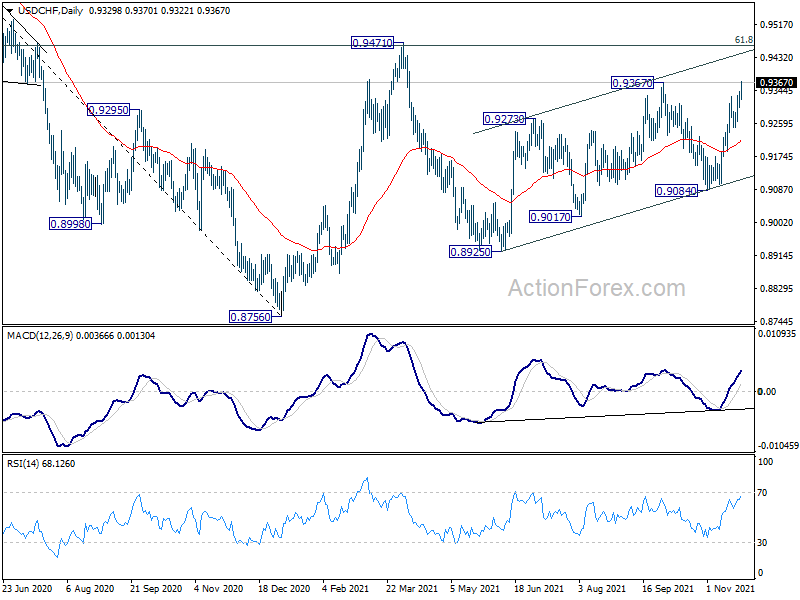
Rise from 0.9084 is still in progress and intraday bias remain son the upside. Break of 0.9367 will target 0.9471 key resistance next. Decisive break there will carry larger bullish implications. On the downside, break of 0.9248 support is needed to indicate near term topping. Otherwise, further rally will remain in favor in case of retreat.
In the bigger picture, as long as 0.9471 resistance holds, larger down trend from 1.0237 (2018 high) could still extend through 0.8756 low. However, sustained break of 0.9471 will revive the case of medium term bullish reversal. In this case, we'd assess the change of retesting 1.0342 high at a later stage, by looking at the upside momentum first.
US Dollar Edges Higher ahead of US Data Releases
Dollar hits fresh 16-month high
The US dollar resumed its rally today, reinforced by markets' expectation of an eventual Fed rate hike move by June 2022, and the weaknesses observed in most major currencies. In addition, the dollar got an extra boost as the weekly jobless claims plunged to 199k, which is the lowest figure reported since 1969, providing optimistic signals about the labor market recovery. However, the slight retreat in short-dated Treasury yields has capped the greenback’s gains in the current session.
The British pound is flirting with a near two-year low today versus the dollar amid increasing Brexit woes. Furthermore, the euro is struggling as the ECB’s pushback against rate hikes in 2022 combined with the new round of COVID-19 restrictions that are spreading among an increasing number of European countries, act as a headwind for the currency.
The kiwi slipped to a six-week low after the Reserve Bank of New Zealand's decision to increase interest rates by 25 basis points disappointed the markets, which had bet on a more aggressive 50 bps increase.
US stocks in the red
Wall Street is set to open lower today as futures for the major indexes are trading lower in the current session. However, the outlook might change as investors will probably weigh the slew of economic data coming out later in the day.
In individual stock news, Elon Musk resumed selling his shares in Tesla, while he is currently more than halfway to making good on his promise to offload 10% of his stake.
Oil stabilizes, gold dips
Oil prices fell at the beginning of today’s session as investors questioned the effectiveness of the US-led initiative for the release of strategic oil reserves. However, oil prices have currently rebounded as markets shifted their focus on how the producer countries will respond to the US move. On the other hand, gold is trading lower today, pressured by the stronger dollar.
Main events coming up
There is a barrage of US data releases today ahead of the Thanksgiving holiday. The core PCE price index will be reported at 15:00 GMT, which will be closely monitored for further signs of price pressures following the 6.2% CPI reading. Moreover, the FOMC minutes at 19:00 will be in the spotlight as hints might emerge on whether the Fed will speed up both its tapering program and its interest rate hike timeline.
US: Economic Growth Remained Modest in Second Estimate for Q3, Corporate Profits Hit Record High
U.S. economic growth was revised up one tenth of a percentage point to 2.1% annualized in the third quarter.
Consumer spending growth was also upgraded one tenth to 1.7% (versus 1.6% in advance release), driven by a smaller drop in durables spending than initially reported (-24.4% vs. -26.2% adv.). This was partially offset by a downward revision to services spending (+7.6% vs. +7.9% adv.).
Headline growth in business investment was revised down slightly, to 1.5% (from 1.8%). A downward revision to intellectual property products was offset by upward revisions to spending on equipment and structures.
Revisions for residential investment, government spending and imports and exports were similarly negligible. The contribution to growth from inventory building was revised one tenth higher to 2.1 percentage points.
Corporate profits are reported with the second estimate and showed profits up $ 121.4 billion (or 18.4% annualized), downshifting from a $267.8 billion in the second quarter. Corporate profits continue to gain ground as share of GDP, now at 12.7%, the highest share in over 60 years.
Key Implications
The story of the economy in the second quarter remained the same. Growth slowed, largely driven by consumer spending cooling from its blistering stimulus-driven pace in the first half of the year, worsened by shortages of autos. Services spending growth was still healthy, with some evidence the pace was muted a bit by the Delta wave of infections.
We continue to expect growth to pop higher in the fourth quarter, at a better-than 4% pace. A more precise estimate will come after we comb through October's consumer spending data released later this morning. Stay tuned.