Sample Category Title
US Dollar Consolidates
US dollar takes a pause
The US dollar paused for breath overnight, despite more gains by long-dated US yields. With a US holiday ahead and data this evening, currency markets in New York appeared content to consolidate recent greenback gains. The dollar index was almost unchanged at 96.49, before rising to 96.56 in Asia today. The index’s initial target is the June 2020 highs around 97.80 with support at 96.00 and 95.50. The index’s relative strength index (RSI) indicator remains in overbought territory suggesting the US dollar is vulnerable to a short-term correction lower before resuming its uptrend.
USD/JPY volumes were thinned by a Japan holiday yesterday, leaving USD/JPY unchanged around 115.00 this morning. Comments from a Japanese official that they were watching USD/JPY appears to be capping the upside temporarily. Assuming the US yield rise is maintained, USD/JPY could extend gains to 115.60 in the first instance, while support remains at 114.00 and 113.50.
EUR/USD traded in a narrow range overnight but remains covered in silt at 1.1235 today. US dollar strength has been compounded by Europe’s delta situation and the single currency remains on track to test 1.1160 this week. That in turn sets up a potential retest of 1.1000. Only a reversal of US yields lower alleviates the negative outlook, although the Covid-19 situation will cap any gains. GBP/USD probed support at 1.3350 overnight but has since recovered to 1.3375 in Asia. 1.3400 and 1.3500 are resistance while sterling remains vulnerable to a test of 1.3300, being guilty by geographic association with the euro.
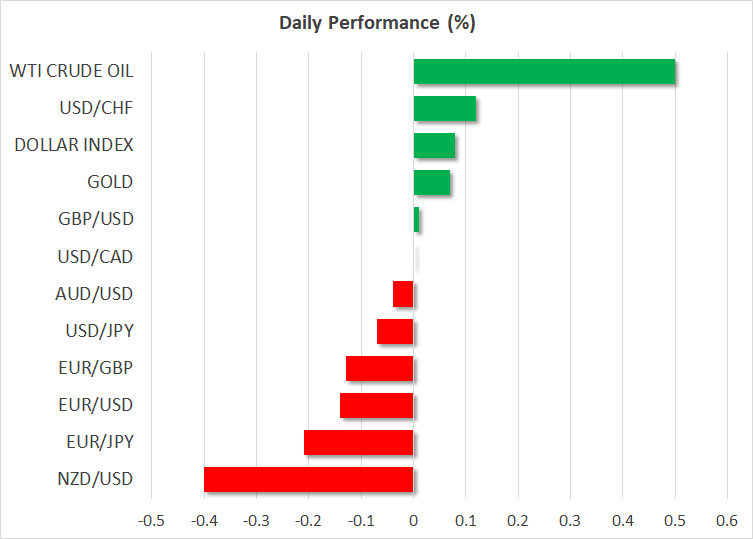
An as expected 0.25% hike by the RBNZ today has seen NZD/USD drop sharply by 0.65% to 0.6905, with nearby support at 0.6900 in danger of failing. That would open further losses to 0.6800 initially. With no RBNZ meeting until February now, the kiwi is looking a lot more vulnerable than in recent times. With market hopes of a 0.50% hike now dashed, its yield differential support has eroded. AUD/USD has been dragged lower by the kiwi, falling 0.35% to support at 0.7200 today. Failure signals further losses to 0.7100. With risk sentiment weighted negatively globally now, further US dollar haven buying will darken the outlook further for AUD and NZD.
The PBOC set a neutral fixing, almost unchanged at 6.3903 today while adding CNY 100 billion in liquidity via the repos. USD/CNY, however, remains anchored below 6.3900. That continues to provide some support to regional Asian currencies, but it is only slowing the slow sell-off in weakness Malaysian ringgit, Thai baht, Indian rupee, and Indonesian rupiah as US yields continue to rise. The Korean won is holding steady at 1189.50 as markets await the Bank of Korea policy decision tomorrow. The won could weaken sharply and play catch-up if the BOK hikes by 0.25%, as expected.
Asia Equity Markets Are Drifting Today
Asia follows a subdued Wall Street
Asian equity markets are drifting today in sympathy with the price action on Wall Street overnight. Wall Street once again marked down technology stocks as US 30-year yields moved sharply higher once again, while banking and energy outperformed. The S&P 500 closed just 0.17% higher, and the Nasdaq fell by another 0.50% as the Dow Jones rose by 0.55%. Futures on all three indexes have eased by around 0.20% in Asia.
Price action in Asian markets is broadly reflecting Wall Street. Japan’s Nikkei has slumped 1.55% on its return from holiday, while South Korea’s Kospi has fallen by 0.30% and Taipei by 0.25% reflecting their more tech-heavy makeup. In mainland China, the PBOC added liquidity via the repo today and that is providing some modest support. The Shanghai Composite is -0.10% lower with the narrower Shanghai 50, loaded with SOE heavyweights and banks, which has risen by 0.20%. The CSI 300 is just 0.10% higher and Hong Kong is unchanged.
ASEAN markets, which more closely resemble the Dow Jones and S&P in makeup, have risen modestly. Singapore is 0.20% higher, Kuala Lumpur is unchanged, and Jakarta is up just 0.05%. Manila is flat while Bangkok has risen by 0.65%. Australian markets are also marching on the spot with the ASX 200 and All Ordinaries flat for the session. A post RBNZ rate hike fall by the kiwi and an impending easing of international visitor restrictions has left the NZX50 up 0.35%.
European markets were crushed on fourth wave delta concerns yesterday, and I expect that sentiment to persist throughout today’s session as well, particularly as Wall Street is providing no strong lead. A weak German IFO will add to the dark clouds as will announcements of further movement restrictions from major European governments. Wall Street will be awaiting the US PCE and Durable Goods data this afternoon before heading for the door early for Thanksgiving. Only a series of low prints, easing inflation concerns, is likely to change the cautious narrative in US stock markets this week.
German IFO Survey Falls For The 5th Straight Month
Notes/Observations
- Scholz poised to become the next German Chancellor as coalition deal said to be in place.
- German IFO falls for the 5th straight month to lowest level since Feb.
- Markets appear skeptical about effectiveness of joint oil reserve release.
Asia
- RBNZ raised the Official Cash Rate (OCR) by 25bps to 0.75% (as expected); raised its rate path outlook.
- RBNZ Gov Orr post rate decision comments noted that it did consider a 50bps rate hike amid a range of options. Added that the 25bps hike gave more optionality and the MPC could take its time at this point.
- Japan Nov Preliminary Manufacturing PMI registered its 10th month of expansion and fastest pace since Jan 2018 (54.2 v 53.2 prior).
- Japan Econ Min Yamagiwa stated that was watching all markets aspects carefully; FX prices moved on various factors.
- Analysts noted that China PPI might have peaked on coal price decline (Note: China Oct PPI registered its highest pace since 1995 with Y/Y: 13.5% v 12.3%e).
Europe
- BOE Gov Bailey noted that he did not believe MPC would go back to a hard form of guidance; Not off the table that we give no guidance at all on rates; Decisions being made meeting by meeting.
- ECB's De Guindos (Spain) noted that Inflation drivers were becoming more structural. Still believed that inflation rebound in recent months was of a transitory factors.
- EU's Sefcovic noted that EU-UK talks on Northern Ireland trade rules would 'probably' continue into next year.
- EU said to be preparing new COVID-19 travel recommendations inside union called 'Recommendation on free movement'; To be unveiled as soon as Nov 25th.
Energy
- Weekly API Crude Oil Inventories: +2.3M v +0.7M prior.
Speakers/Fixed income/FX/Commodities/Erratum
Equities
- Indices [Stoxx600 -0.09% at 478.80, FTSE +0.09% at 7,272.96, DAX -0.40% at 15,873.19, CAC-40 -0.25% at 7,027.19, IBEX-35 -0.06% at 8,809.69, FTSE MIB +0.19% at 26,991.00 , SMI -0.02% at 12,364.13 , S&P 500 Futures -0.30%].
Market Focal Points/Key Themes:
Equities
- European indices remainded under pressure and opened mostly in red with exception to FTSE 100 amid potential lockdown measures imposed by newly formed German govt; sectors among those trending lower are consumer discretionary and technology; elsewhere, Telecom Italia in Milan trades as much as 10% higher on press speulation that KKR may improve its offer for the company; cybersecurity firm Darktrace issued AGM and trades slightly lower in London; French company Elior provided its earnings report and CMD update trading higher 3% in Paris; expected during the upcoming US session include Deere & Company, Futu Hondings and Centogene.
- Consumer discretionary: Elior Group [ELIOR.FR] +3% (earnings; targets), Mulberry [MUL.UK] +24% (earnings).
- Consumer staples: Kerry Group [KYGA.UK] -5% (placement).
- Healthcare: Santhera Pharmaceuticals [SANN.CH] -5% (seeks funding).
- Technology: IQE [IQE.UK] -19% (trading update), Darktrace [DARK.UK] -1% (AGM statement).
- Telecom: Telecom Italia [TIT.IT] +9% (KKR said to prepare raising offer).
Speakers
- ECB's Holzmann (hawk, Austria) stated that inflation expectations had recently increased but not sure by how much exactly. Reiterates Council view that Inflation was largely transitory and to likely slow during 2022. To assess the inflation outlook at the Dec meeting and make decisions on tapering.
- ECB's Panetta (Italy; dove) noted that downside risks for EU economy might be growing; but should not be alarmed if saw signs of a one-off catch-up in wages in 2022. Reiterated stance that current inflation spike was purely a mixture of temporary factors. Forward guidance condition on rise in underlying inflation was not even close to being met. Premature tightening of policy could turn the supply shock into a prolong recession; needed to be patient.
- ECB Vasle (Slovenia) reiterated Council view that inflation was more pronounced and the pickup was likely to last longer than previously anticipated.
- German SPD, FDP and Greens parties said to present coalition deal as soon as today, Nov 24th. Scholz to become the next German Chancellor.
- France Fin Min Le Maire stated that was not concerned about the impact of covid on the economic growth. Did not see the need for further restrictions to be imposed to curb the virus.
- Italy govt said to be debating restrictions on unvaccinated people; Measures could be approved as soon as today, Nov 24th.
- German IFO Economists stated that the latest decline in Survey was a cause for concern and saw no signs of any letup in bottlenecks. The latest covid outbreak was making the situation worse. Clear majority of companies to increase prices and it saw Q4 GDP stagnating.
- Poland Central Bank (NBP) Gov Glapinski stated that future rate hikes to be data-dependent. Rate hikes should be favorable for the PLN currency (Zloty) and added that it could intervene in FX market.
- Japan said to plan ¥22.1T of govt bond sale as part of economic stimulus and FY21 extra budget (**Reminder: On Nov 19th Japan Cabinet formally approved the ¥78.9T stimulus package which included fiscal spending of ~¥55.7T).
- China Vice Commerce Min noted that it would introduce new round of measures to stabilize trade in due course.
- China Foreign Min spokesperson Zhao Lijian reiterated stance that US should abide by the "One China" policy; firmly opposes the invitation of Taiwan to the Democracy Summit. Keeping close contact with those nations releasing oil reserves and producers; To release reserves according to its needs.
- China Banking and Insurance Regulatory Commission (CBIRC) stated that the banking sector needed to step up internal controls to avert risks.
Currencies/Fixed Income
- USD continued to find steady legs to hold onto recent gains.
- EUR/USD hit fresh 16-month lows at 1.1210 area as German IFO fell for the 5th straight month to lowest level since Feb. Weakness also being attributed to speculation that the new German govt could announce a full lockdown to contain the virus. ECB speak continued to express hope that inflation was transitory but conceding it could take longer for CPI to move move than previously anticipated.
- USD/JPY continued to probe the 115 handle.
Economic data
- (FI) Finland Oct PPI M/M: 1.2% v 2.3% prior; Y/Y: 20.8% v 19.1% prior.
- (TR) Turkey Nov Real Sector Confidence (seasonally adj): 112.0 v 111.3 prior; Real Sector Confidence NSA (unadj): 108.4 v 109.6 prior.
- (TR) Turkey Nov Capacity Utilization: 78.1% v 78.0% prior.
- (FR) France Nov Business Confidence: 114 v 112e; Manufacturing Confidence: 109 v 106e; Production Outlook Indicator: 20 v 18e; Own-Company Production Outlook: 20 v 16e.
- (CZ) Czech Nov Consumer Confidence Index: -16.0 v -8.5 prior; Business Confidence: 8.4 v 6.7 prior; Composite Confidence (Consumer & Business Confidence): 3.5 v 3.6 prior.
- (TW) Taiwan Oct M2 Money Supply Y/Y: 8.5% v 8.7% prior; M1 Money Supply Y/Y: 14.9% v 15.0% prior.
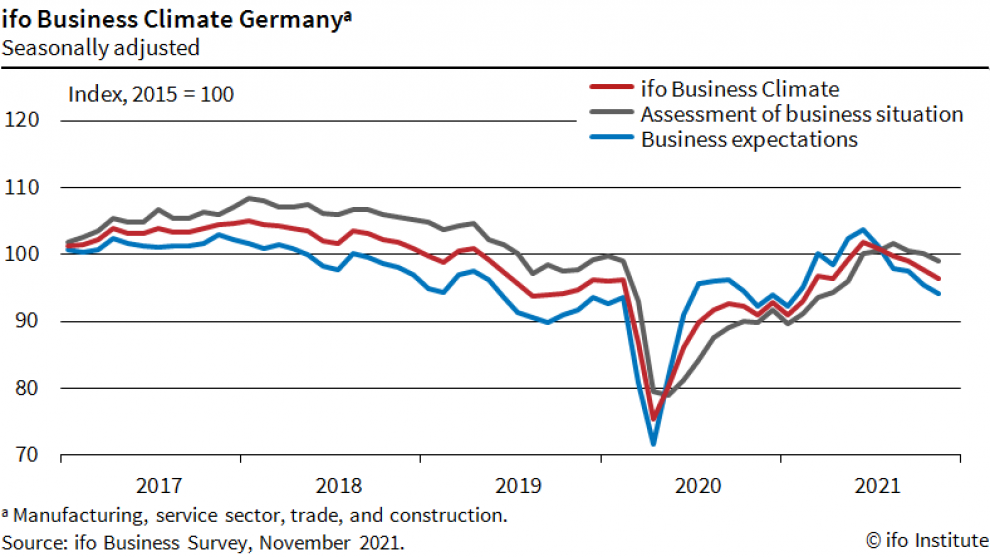
- (DE) Germany Nov IFO Business Climate Survey: 96.5 v 96.7e (5th straight decline); Current Assessment Survey: 99.0 v 99.0e; Expectations Survey: 94.2 v 94.6e.
- (CH) Swiss Nov Expectations Survey: -10.8 v +15.6 prior.
- (ZA) South Africa BER Business Confidence: 43 v 43 prior.
Fixed income Issuance
- (IN) India sold total INR vs. INR200B indicated in 3-month, 6-month and 12-month bills.
- (SE) Sweden sold SEK7.5B vs. SEK7.5B indicated in 3-month Bills; Avg Yield: -0.5126% v -0.3643% prior; bid-to-cover: 5.90x v 2.74x prior.
- (NO) Norway sold NOK2.0B vs. NOK2.0B indicated in 1.25% Sept 2031 Bonds; Avg Yield: 1.69% v 1.57% prior; bid-to-cover: 3.61x v 2.80x prior.
Looking ahead
- 05:25 (EU) Daily ECB Liquidity Stats.
- 05:30 (DE) Germany to sell €2.0B in 0% May 2036 Bunds.
- 05:30 (EU) ECB 3-month LTRO Allotment.
- 05:30 (HU) Hungary Debt Agency (AKK) switch auction.
- 06:00 (UK) Nov CBI Industrial Trends Total Orders: 8e v 9 prior; Selling Prices: 57e v 59 prior.
- 06:00 (BR) Brazil Nov FGV Consumer Confidence: No est v 76.3 prior.
- 06:45 (US) Daily Libor Fixing.
- 07:00 (RU) Russia OFZ Bond auction (if any).
- 07:00 (US) MBA Mortgage Applications w/e Nov 19th: No est v -2.8% prior.
- 07:00 (CL) Chile Oct PPI M/M: No est v -0.2% prior.
- 07:00 (UK) Weekly PM Question time in House.
- 08:00 (PL) Poland Oct M3 Money Supply M/M: 1.0%e v 0.6% prior; Y/Y: 8.4%e v 8.6% prior.
- 08:00 (UK) Daily Baltic Dry Bulk Index.
- 08:30 (US) Q3 Preliminary GDP Annualized (2nd reading) Q/Q: 2.2%e v 2.0% advance reading; Personal Consumption: 1.6%e v 1.6% advance reading.
- 08:30 (US) Q3 Preliminary GDP Price Index: 5.7%e v 5.7% advance; Core PCE Q/Q: 4.5%e v 4.5% prior.
- 08:30 (US) Oct Preliminary Durable Goods Orders: +0.2%e v -0.3% prior; Durables (ex-transportation): 0.5%e v 0.5% prior; Capital Goods Orders (non-defense/ex-aircraft): 0.5%e v 0.8% prior; Capital Goods Shipments (non-defense/ex-aircraft): 0.5%e v 1.4% prior.
- 08:30 (US) Initial Jobless Claims: 260Ke v 268K prior; Continuing Claims: 2.03Me v 2.080M prior.
- 08:30 (US) Oct Preliminary Wholesale Inventories M/M: 1.0%e v 1.4% prior; Retail Inventories M/M: +0.4%e v -0.2% prior.
- 08:30 (US) Oct Advance Goods Trade Balance: -$95.0Be v -$96.3B prior.
- 09:30 (UK) BOE’s Tenreyro.
- 10:00 (US) Oct Personal Income: +0.2%e v -1.0% prior; Personal Spending: 1.0%e v 0.6% prior; Real Personal Spending (PCE): 0.6%e v 0.3% prior.
- 10:00 (US) Oct PCE Deflator M/M: 0.7%e v 0.3% prior; Y/Y: 5.1%e v 4.4% prior.
- 10:00 (US) Oct PCE Core Deflator M/M: 0.4%e v 0.2% prior; Y/Y: 4.1%e v 3.6% prior.
- 10:00 (US) Nov Final University of Michigan Confidence: 67.0e v 66.8 prelim.
- 10:00 (US) Oct New Home Sales: 800Ke v 800K prior.
- 10:30 (US) Weekly DOE Oil Inventories.
- 11:00 (RU) Russia Oct Industrial Production Y/Y: 5.8%e v 6.8% prior.
- 11:00 (RU) Russia Oct PPI M/M: 1.1%e v -1.0% prior; Y/Y: 27.6%e v 26.3% prior.
- 11:00 (DE) ECB’s Schnabel (Germany).
- 12:00 (US) Weekly EIA Natural Gas Inventories.
- 13:00 (US) Weekly Baker Hughes Rig Count.
- 14:00 (US) FOMC Nov Minutes.
- 16:45 (NZ) New Zealand Oct Trade Balance (NZD): No est v -2.2B prior; Exports: No est v 4.4B prior; Imports: No est v 6.6B prior.
- 18:50 (JP) Japan Oct PPI Services Y/Y: 0.9%e v 0.9% prior.
- 19:30 (AU) Australia Q3 Private Capital Expenditure: No est v 4.4% prior.
- 20:00 (KR) Bank of Korea (BoK) Interest Rate Decision: Expected to raise 7-Day Repo Rate by 25bps to 1.00%.
- 21:00 (SL) Sri Lanka Central Bank (CBSL) Interest Rate Decision: Expected to keep Key Rates unchanged; Standing Lending Rate at 6.00%; Standing Deposit Rate at 5.00%.
- 22:35 (JP) Japan to sell 40-Year JGB Bonds.
NZDUSD Traces Lower Bollinger, But Neutral Stance Stands
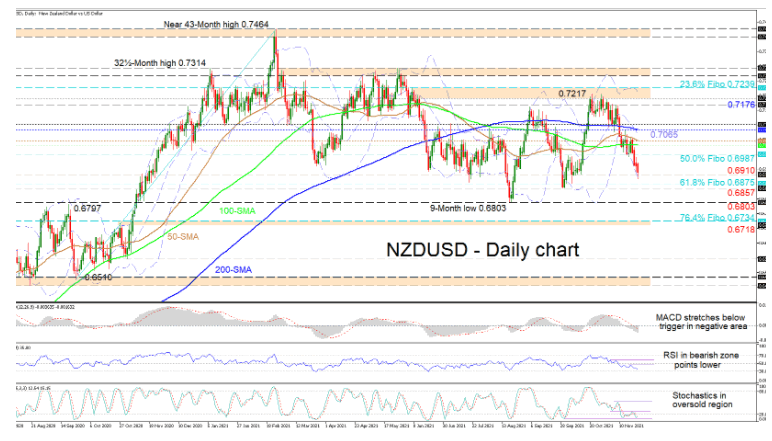
NZDUSD is following the declining lower Bollinger band and is confronting the October 13 inside swing low of 0.6910, after a one-month price drop from the 0.7200 vicinity, which steered beneath the simple moving averages (SMAs). The longer-term 100- and 200-day SMAs are reflecting the absence of a trend, while the dipping 50-day SMA, is mirroring the slight lead sellers have managed to secure.
Despite the commanding sideways market in the pair, the short-term oscillators are skewed to the downside. The MACD, in the negative zone, is dropping deeper below its red trigger line, while the RSI is sliding in the bearish region. The stochastic lines are in oversold territory and the %K line has yet to confirm that negative momentum is waning.
If the current price trajectory prevails, instant downside friction could stem from the 0.6910 barrier and the bordering lower Bollinger band. Navigating down, a zone of support may manifest itself among the 0.6875 obstacle and the 0.6857 low, the former being the 61.8% Fibonacci retracement of the up leg from 0.6510 until 0.7464. If selling interest intensifies, the bears could then aim for the nine-month trough of 0.6803. Should this key trough fail to halt the descent, steeper losses may then guide the price towards the 0.6718-0.6734 support band.
However, if buyers retake the reins and push higher, preliminary upside constraints could evolve at the 50.0% Fibo of 0.6987 before a resistance belt emerges between the 100- and 50-day SMAs at 0.7022 and 0.7038 respectively. Overstepping this, the mid-Bollinger band at 0.7065, the adjacent 200-day SMA at 0.7080 and the 0.7100 handle may prove tough obstacles to surpass. Piloting higher though, the price could then seek out the 0.7176 mark and the neighbouring 0.7200-0.7239 resistance border.
Summarizing, NZDUSD is currently sustaining a bearish bearing, but the short-to-medium term picture remains neutral. In order to replenish buoyancy in the pair, the price would need to manoeuvre above the 0.7200-0.7239 ceiling, while a drop below the 0.6803 trough could strengthen negative moves.
The Market Is A Harsh Mistress
Financial markets have been dishing up some harsh lessons to the accepted narrative this week. Having been blithely unkerned about US inflation since the FOMC, the renomination of transitory inflation dove, Jerome Powell, to the Federal Reserve Chair has seen long-dated bond yields ramping higher this week. Markets are now flapping about a faster Fed taper and earlier rate hikes.
Oil jumps despite SPR release
Overnight, it was the turn of US President Biden to receive a similar lesson. Markets thanked Mr Biden for his early signalling of an SPR oil release by taking back their shorts and sending oil over 3.0% higher overnight, after the President formally announced a release, in conjunction with other countries, totally between 70 and 80 million barrels. The devil is in the detail of course. The release will be dripped in gradually over the coming months. Given there is no way that President Biden can construe the present level of oil prices as a supply disruption, it’s just a market with rising prices; that caps his ability to release more oil. The overnight announcement was a one-shot wonder, and markets responded appropriately. OPEC+ refused to be cowed, but I do not expect them to fly too close to the sun and reduce their planned 400,000 bpd increase next month.
Today, the Reserve Bank of New Zealand raised its policy rate by 0.25% to 0.75% and signalled interest rates had seen their lows. I would argue we have seen the lows globally, and not just in New Zealand. The RBNZ signalled a steady pace of hikes ahead, but instead of rallying, the New Zealand dollar is 0.50% lower at 0.6915. That was despite the government announcing an easing in its totalitarian quarantine requirements for overseas visitors (and citizens) which should have also been ostensibly bullish. The street had priced in 0.25% and, like me, was probably looking for 0.50% to be meaningful.
Despite inflation concerns ramping up in the US as if it was a new and worrying development, gold is now around 90 dollars an ounce lower than a week ago, at USD 1794.00 this morning. Bitcoin continues to look wobbly as well. Both are allegedly inflation hedges and should thus, outperform in this environment, both having shrugged off a stronger US dollar recently. I would argue that though, that gold, and possibly maybe infinitesimally, bitcoin, are only inflation hedges when inflation is running really really hot and real yields are collapsing. That’s not the case at the moment. US front-end yields have risen in recent weeks in response, flattening the curve, and long-dated yields have now started to play catch-up. A faster Fed taper, removing the oppression of QE, will help this process along.
Technology stocks have been under pressure this week and rising US bond yields (and yields elsewhere), lie behind the shakiness. Technology valuations have been sub-orbital for a long time now, and they are thus, more vulnerable to an upward adjustment in interest rates. It is hard to justify paying a 14285 P/E with a yield between -1.50% to 1.50% when you may be able to earn 2.0% on a “risk-free” US government bond in a couple of months’ time. I’m not calling the top in technology, by the way, there are a number of oligopolies out there in the space that will remain cash-generating machines. If US bond yields continue to rise though, those of us mere mortals may finally be able to contemplate buying the dip, a real dip. Legacy sectors, such as banking and energy and resources, should theoretically outperform in this environment.
The Korean won has held steady this week as other regional currencies have weakened in the face of the mighty dollar and higher US yields. My reasoning behind forthcoming Asian FX weakness is well documented in past notes, so I won’t repeat myself again. I believe the won has remained firm because the Bank of Korea is expected to raise policy rates by 0.25% tomorrow. I do, however, feel it will play catch-up and have a kiwi moment if the hike is less than or equal to 0.25% as like oil, gold and kiwi, the news is priced in. Markets are hedging their bets for now in case there is a surprise.
The buy/sell the rumour, buy/sell the fact (depending on the asset class), price action this week can be traced back to one occurrence, the sudden jump in the US 30-year yield this week, and to a lesser extent, the 10-year yield. For evidence, look at the rally in USD/JPY, the world’s premier yield differential play. USD/JPY has topped 115.00 this week, a 45-month high by my calculations, although I ran out of fingers and toes to count and the kitten asleep next to me refused to make her paws available. I will just add, the Japanese Ministry of Finance has no intention of intervening in USD/JPY at these levels so let’s put that to bed right now. Call me back when we get to 135.00.
Until long-dated US yields start reversing their recent gains, and the author has long believed that is not a given, we shouldn’t expect an end to US dollar strength, nor should we be getting excited about equity markets for the rest of this month and possibly into Christmas. The FOMC Minutes tonight might bring solace if they have a dovish tone; my bet is that they will not and that the FOMC members are as divided as the US Congress on the next course of action. US GBP Q3 estimate tonight is old news, but Durable Goods and Personal Income and Spending should be good for some volatility. If anything, markets are more vulnerable to the data reflecting more inflationary pressures, especially if Personal Income exceeds 0.50% for October.
Germany’s IFO this afternoon may reinforce the Covid-19 Euro-gloom if it is weaker than expected. For now, Europe’s issues are being thrust from the spotlight by events in US markets and are unlikely to materially impact energy prices, for example, this week, short of a German and/or France lockdown, partial or otherwise. Tomorrow is Silence of the Turkeys’ Day in the US, and I expect most Americans will make a long weekend of it. Thus, in an act of famous last words, I expect markets in Asia especially, to coast into the end of the week.
Oil Laughs At Strategic Reserves Release
- Oil jumps after US releases reserves, signaling it’s not enough
- Dollar relatively stable ahead of US data and Fed minutes
- Stocks mixed, RBNZ disappoints, Turkish lira implodes
Oil unscathed
After weeks of speculation, the United States announced that it will release 32 million barrels of crude oil from its strategic reserves to counter the supply deficit in energy markets and cool prices. Several other nations have joined this effort, but their combined contributions will amount to less than what America is releasing alone.
Energy traders made a mockery out of this move, pushing oil prices much higher once the news rolled in. Releasing around 50 million barrels is a drop in the ocean for a global economy that consumes almost double that every day, and could even backfire by making OPEC hesitant to raise its own production or discouraging smaller players from drilling.
In other words, releasing half a day’s worth of global consumption from storage isn’t a real solution. What has brought oil prices here is chronic underinvestment in an industry that was left for dead, so the fix would be more drilling and production, which requires higher prices for longer to incentivize. As the old adage goes: ‘the cure for high oil prices is high oil prices’.
Another lever the White House can pull is striking a nuclear deal with Iran and relaxing the sanctions that have crippled the nation’s oil exports. Those negotiations will resume next week and Iran now holds a lot of leverage.
FX market quiet, stocks mixed
The major currency pairs have been relatively quiet, with the overwhelming theme of dollar strength still coursing through the veins of the FX market. Dollar/yen briefly touched a new multi-year high today before pulling back, while Cable fell to its lowest in almost two years yesterday but rebounded.
Several events will test the dollar’s supremacy today. The latest FOMC minutes will be dissected for any clues as to whether the tapering process could be accelerated after senior Fed officials floated the idea lately. There’s also a barrage of data releases including durable goods orders, the second reading of GDP for Q3, and the Fed’s favorite inflation metric.
In the stock market arena, it was a mixed session as traders continue to grapple with the fallout of rising bond yields. While the major indices on Wall Street haven’t retreated much from their record highs, under the hood there’s been a massacre in cash-burning or barely profitable companies.
Investors are essentially moving higher along the quality spectrum, slashing their exposure to shares with bloated valuations that could get decimated if real yields move any higher. Today is the last full trading day before the Thanksgiving holiday, so volatility could remain elevated amid some position squaring and de-risking ahead of the long weekend.
RBNZ disappoints, Turkish lira breaks down
The Reserve Bank of New Zealand raised interest rates by 25 basis points overnight, but the kiwi fell in the aftermath as the central bank disappointed those looking for a ‘double’ hike. Market pricing around future hikes is now exactly in line with the RBNZ’s own forecasts, both expecting around one rate increase per meeting for the next year.
The Turkish lira has been blown to smithereens, losing 12% of its value against the dollar yesterday to bring its total losses for this month to a shocking 30%. FX reserves are already depleted and the nation's president, who essentially runs the central bank, refuses to raise rates to fight runaway inflation.
At this point, it might take a leadership change or capital controls to stop the lira’s avalanche.
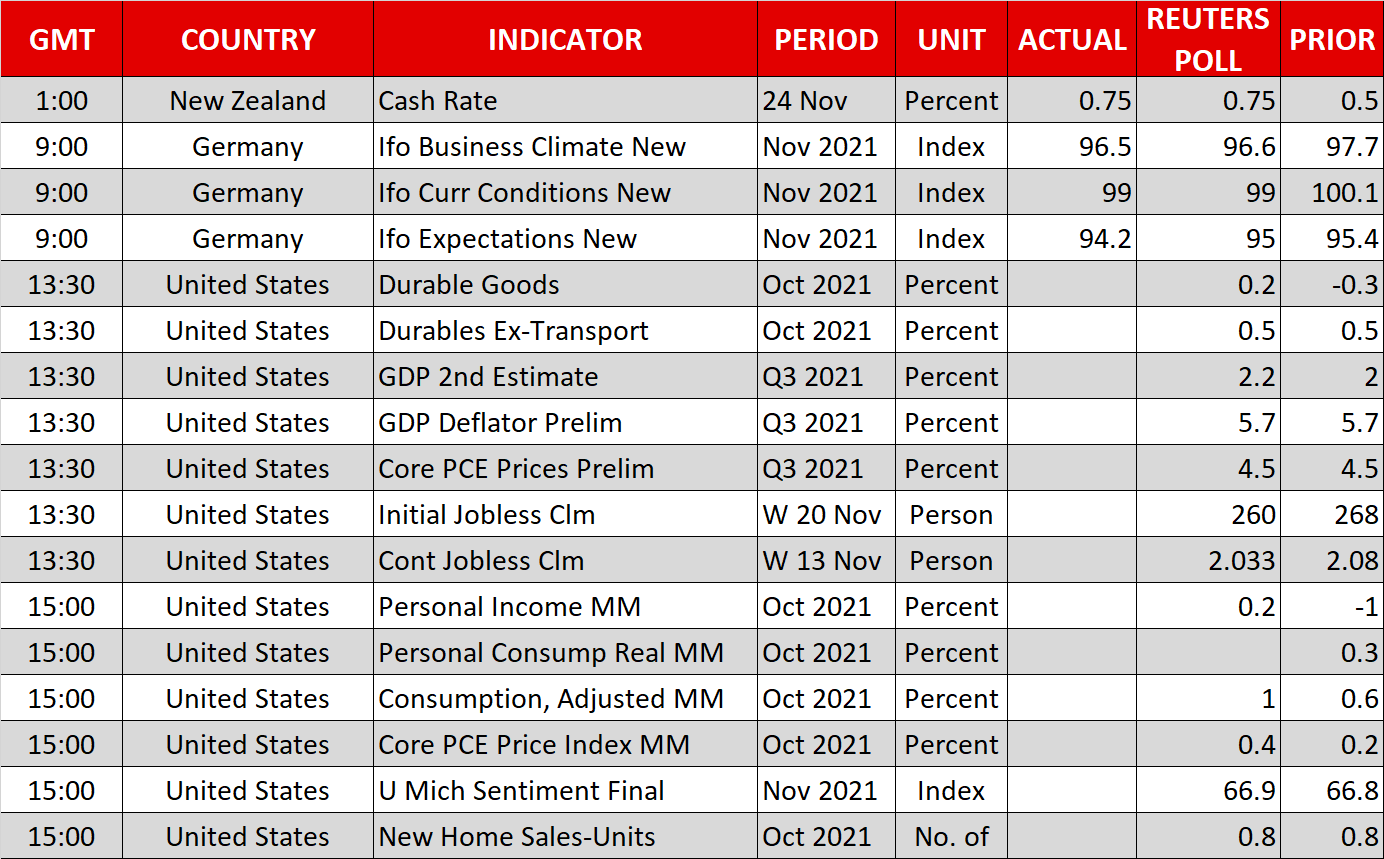
The FOMC Protocols Are Expected To Be Published Today
At the close of the New York Stock Exchange, the Dow Jones index increased by 0.55%, the S&P 500 index added 0.17%, and the NASDAQ index decreased by 0.50%. The Nasdaq technology showed the drop since rising Treasury yields put pressure on major technology stocks. At the same time, gains in bank stocks and energy stocks helped limit broader market losses.
FOMC protocols are expected to be released today, along with a number of other important US economic data before tomorrow's bank holiday. Any hints from the Fed to accelerate the pace of QE reduction or to raise interest rates could push the dollar index higher. If the pace of the cuts remains the same, the dollar index may start a technical correction.
A rise in the dollar index usually leads to higher government bond yields and lower gold and silver prices, which have an inverse correlation to Treasury yields. Gold has already dropped below $1800 per troy ounce and this downward trend is likely to continue.
European stock markets were mostly down yesterday. German DAX decreased by 1.11%, French CAC 40 decreased by 0.85%, Italian FTSE MIB lost 1.62%, Spanish IBEX decreased by 0.07%. The only exception was the British FTSE 100, which added 0.15%. In the UK, there is an increase in business activity. Data for October showed a rise in the manufacturing sector, while in the services sector the data was negative. With expectations of an interest rate hike from the Bank of England, the British pound might be strengthened soon.
After fixing a record daily sickness rate, Germany is considering options to tighten its anti-covids measures, including introducing regional lockdowns as the Netherlands has already done. Meanwhile, Germany has one of the lowest rates of vaccinated citizens in Western Europe. Analysts believe that a new wave of disease in Europe will cause more economic problems in December.
The United States, China, India, Japan, South Korea, and the United Kingdom plan to release oil from strategic reserves to decrease global oil prices. Biden's decision to use the US strategic oil reserve calls for a release of 50 million barrels. But the long-awaited coordinated release of oil with other major consuming countries has so far only increased oil prices by more than 3%, which was unexpected for the White House. Analysts believe that the release of inventories is hardly enough to meet global needs. Barclays Bank raised its forecast for average oil prices for the next 2022 to $77 and $80 a barrel of WTI and Brent, respectively.
The Turkish lira dropped another 10% while continuing to fall, to 12 per dollar after Erdogan acted at lower interest rates. Turkey's inflation rate is second after Venezuela and Zimbabwe.
On Wednesday, the Reserve Bank of New Zealand raised its interest rate by 25 basis points to 0.75%. Analysts had expected an increase of 50 b.p. This is the second rate hike within the last 2 months. This is the Central Bank of New Zealand's response to the fight against inflation. New Zealand consumer prices increased to 4.9% in annual terms, well above the RBNZ target of 1.0-3.0%.
Asia-Pacific stock markets are decreasing in Wednesday trading. Technology sector companies are among the leaders of the fall on Asian exchanges because of the increase in government bond yields. The growth of government bond yields leads to an increase in the discount rate used for the valuation of shares. In addition, it affects the technology companies most of all because the perspectives of the rapid growth of profits are laid in these companies.
Main market quotes:
- S&P 500 (F) 4,690.70 +7.76 (+0.17%)
- Dow Jones 35,813.80 +194.55 (+0.55%)
- DAX 15,937.00 −178.69 (−1.11%)
- FTSE 100 7,266.69 +11.23 (+0.15%)
- USD Index 96.49 −0.06 (−0.06%)
Important events for today:
- Japan Manufacturing PMI (m/m) at 02:30 (GMT+2);
- New Zealand RBNZ Interest Rate Decision (m/m) at 03:00 (GMT+2);
- New Zealand RBNZ Monetary Policy Statement (m/m) at 03:00 (GMT+2);
- New Zealand RBNZ Press Conference at 04:00 (GMT+2);
- German Ifo Business Climate (m/m) at 11:00 (GMT+2);
- US Prelim GDP (q/q) at 15:30 (GMT+2);
- US Core Durable Goods Orders (m/m) at 15:30 (GMT+2);
- US Initial Jobless Claims (w/w) at 15:30 (GMT+2);
- US PCE price index (m/m) at 17:00 (GMT+2);
- US New Home Sales (m/m) at 17:00 (GMT+2);
- US Michigan Consumer Sentiment (m/m) at 17:00 (GMT+2);
- US Crude Oil Reserves (w/w) at 17:30 (GMT+2);
- US Natural Gas Storage (w/w) at 19:00 (GMT+2);
- US FOMC Meeting Minutes at 21:00 (GMT+2).
RBNZ Hiked Rate but More Cautious about Economic Outlook
The RBNZ raised the OCR by +25 bps to 0.75%, as we had anticipated. Policymakers sounded more cautiously about the economic outlook while reiterating the stance of continued reduction of stimulus. Kiwi extended recent correction after the announcement.
On the monetary policy outlook, the central bank reiterated that “it remains appropriate to continue reducing monetary stimulus so as to maintain price stability and support maximum sustainable employment” and that “further removal of monetary policy stimulus is expected over time given the medium term outlook for inflation and employment”. More importantly, it “judged that considered steps in the OCR were the most appropriate way to continue reducing monetary stimulus for now”.
As we mentioned in the preview, the RBNZ can achieve some sorts of tightening by revising its OCR forecast. The accompanying statement revealed that the policy rate could reach 2.1% by end-2022 and then to 2.6% by end-2023 and into 2024. While the RBNZ maintained its assessment of the neutral rate of around 2%, the minutes noted that “conditional on the economy evolving as expected, the OCR would likely need to be raised above its neutral rate”.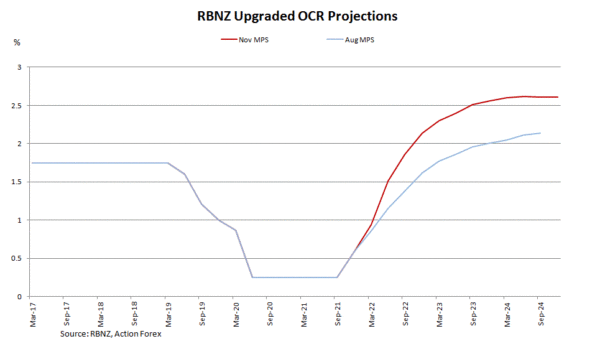
Policymakers sounded more cautious about the economic outlook than previously. They acknowledged that the pace of global economic growth “has ebbed... due to the elevated uncertainty created by the persistent COVID-19 virus”. At home, they warned that the pandemic “will become more widespread geographically” and that “household spending and business investment will be dampened in the near-term by these ongoing health uncertainties”. The uncertainties could increase as the New Zealand government begins to reopen it borders early next year.
On inflation, the staff projected that it would overshoot above +2% sustainably until late 2023 before coming back towards 2% in 1H24. Near-term inflation is expected to rise above +5%. Policymakers continued to attribute the strong inflation to transitory factors. As noted, “the near-term rise in inflation is accentuated by higher oil prices, rising transport costs and the impact of supply shortfalls. These immediate relative price shocks risk generating more generalized price rises given the current domestic capacity constraints”.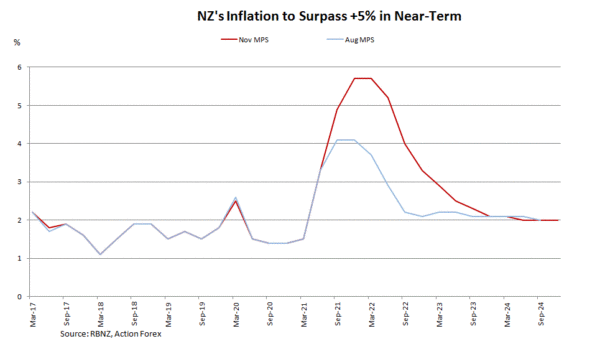 Meanwhile, the central bank acknowledged that “employment is now above its maximum sustainable level”. Moreover, “a broad range of economic indicators highlight that the New Zealand economy continues to perform above its current potential”. The staff projections showed that the unemployment would drop further to 3.2% in 4Q2021, before gradually increasing to 4.1% over coming years.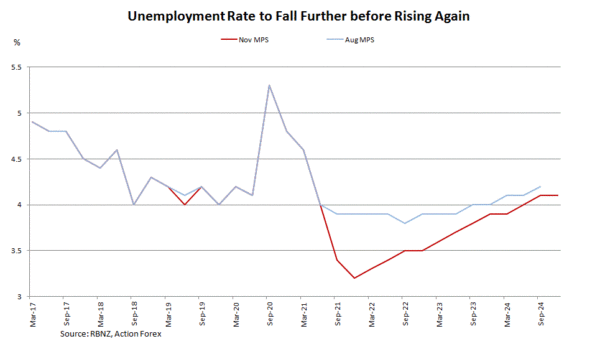
GBP/USD Pair Is Currently Consolidating Losses From The 1.3347 Low
The British Pound faced sellers near the 1.3500 resistance zone against the US Dollar. The GBP/USD pair started a fresh decline below the 1.3420 support zone.
The pair even traded below the 1.3400 level and the 50 hourly simple moving average. The pair traded as low as 1.3347 and is currently consolidating losses. An initial support on the downside is near the 1.3350 level.
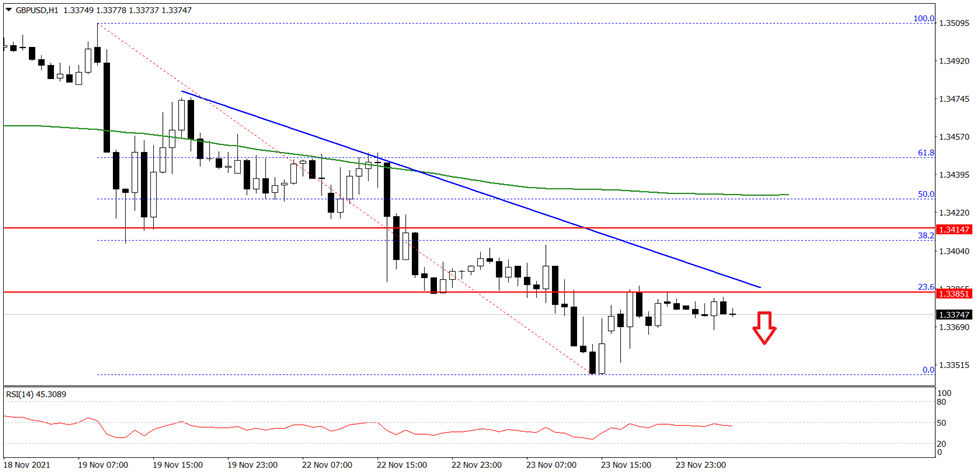
The main support is forming near the 1.3320 level. A break below the 1.3320 support level could even push the pair below the 1.3300 support.
An initial resistance on the upside is near the 1.3385 on FXOpen. There is also a key bearish trend line forming with resistance near 1.3390 on the hourly chart. The main resistance is now forming near the 1.3400 level. If there is a clear break above the 1.3390 and 1.3400 resistance levels, the pair could climb higher towards 1.3450 or even 1.3500.
Germany Ifo dropped to 96.5, challenged by supply bottlenecks and 4th wave of coronavirus
Germany Ifo Business Climate dropped to 96.5 in November, down form 97.7, missed expectation of 96.7. Current Assessment index dropped to 99.0, down from 100.2, missed expectation of 100.3. Expectations index dropped to 94.2, down from 95.4, missed expectation of 96.3.
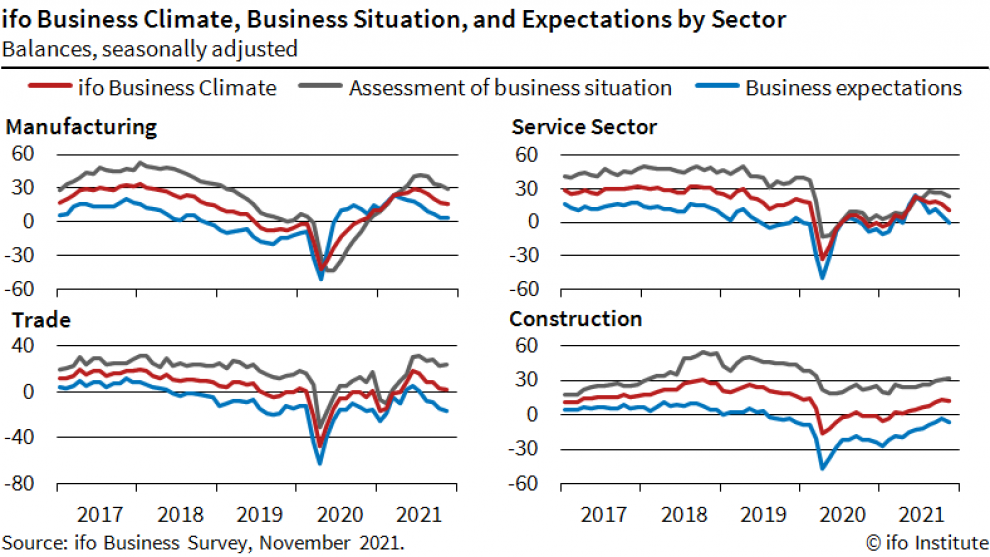
By sector, manufacturing dropped from 17.5 to 16.5. Service dropped sharply again from 16.6 to 11.5. Trade dropped from 3.7 to 2.6. Construction dropped from 12.8 to 12.0.
Ifo said: "Companies were less satisfied with their current business situation, and expectations became more pessimistic. Supply bottlenecks and the fourth wave of the coronavirus are challenging German companies."