Sample Category Title
Market Consolidates in Tight Range But Euro Looks Vulnerable
The forex markets are generally staying in tight range in Asian session, digesting last week's moves. Euro remains generally soft and looks vulnerable to extend the near term decline, in particular against commodity currencies and Yen. Sterling is so far resilient, awaiting more BoE officials to speak up their mind regarding the chance of an imminent rate hike. Dollar will probably need to clear out 1.125/30 resistance zone against Euro decisively before making some committed moves elsewhere.
Technically, we'll also pay some attention to Sterling pairs today. GBP/JPY has defended 152.35 temporary low late last week. But a downside breakout is still in favor. GBP/USD's price actions from 1.3351 are clearly corrective looking, suggesting that a downside breakout should follow sooner or later. At the same time, EUR/GBP could also break through 0.8381 any time to resume recent fall. These forces will continue to counter each other and keep the Pound mixed.
In Asia, Nikkei closed up 0.09%. Hong Kong HSI is down -0.59%. China Shanghai SSE is up 0.63%. Singapore Strait Times is up 0.12%. Japan 10-year JGB yield closed flat at 0.79.
BoE Bailey: Second-ground effects are our concerns
BoE Governor Andrew Bailey said in an interview published over the weekend that the risks to the UK economy are "two-sided" at the moment. He said that "activity in the economy is slowing". Also, "he proximate cause of many of these inflation issues is on the supply side, and monetary policy isn't going to solve these directly".
However, "the concern for us is what they classically call 'second-round effects', particularly in wage bargaining and the labour market," he added. "If the economy evolves in the way the forecasts and reports suggest, we'll have to raise rates. Which, by the way, is entirely consistent with what I said in October."
WTI dips below 76 as Japan considers releasing reserves
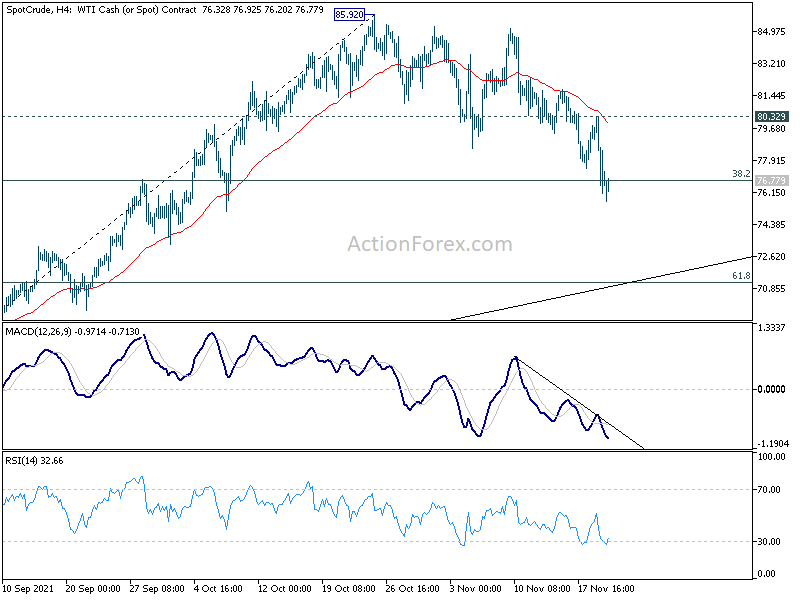
Oil price extends its near term corrective decline in Asian session, with WTI dipping to 75.63. The move came as Japan Prime Minister Fumio Kishida said he is considering releasing oil from its reserves, in response to US request to quell high energy prices. He told reporters, "we want to draw a conclusion after thoroughly considering the situation each country faces and what Japan can do."
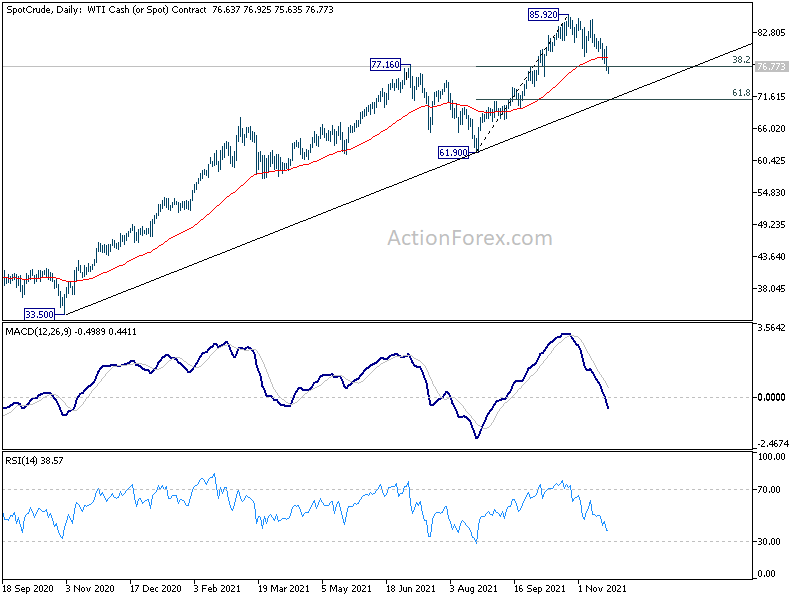
WTI's fall from 85.92 high is currently see as a correction to rise from 61.90 only. Hence, even in case of deeper fall, down side should be contained by 61.8% retracement of 61.90 to 85.92 at 71.07, which is also close to medium term trend line support. But break of 80.32 resistance is needed to indicate completion of the pull back. Otherwise, risk will stay on the downside in case of recovery.
RBNZ hike, Fed and ECB minutes to watch
RBNZ rate decision is widely expected to raise OCR by 25bps to 0.75% this week. The question is whether it will surprise the markets and hike 50bps. But it should note that based on the latest RBNZ survey of expectations, a hike to 0.75% is the consensus, followed by three more bps to 1.5% for next year. Hence, we don't expect RBNZ to press the panic button for now, but just continues to sound hawkish, setting the stage for more tightening later.
On the central banks front, both Fed and ECB will release monetary policy meeting minutes. While investors are eager to know the debates on timing of rate hike, main focuses would probably be more on US President Joe Biden's pick of he Fed Chair. Jerome Powell and Fed Governor Lael Brainard are currently the favorites and we'll see who would get the job. ECB minutes will likely just reiterate the dovish stance.
Regarding data, PMIs will take the center stage, shedding lights of activities, prices and employment in Australia, Eurozone, UK, US, Japan. Other focuses will include Germany Ifo business climate, US PCE inflation and durable goods orders, Swiss GDP as well as New Zealand retail sales.
- Monday: Eurozone consumer confidence; US existing homes sales.
- Tuesday: New Zealand retail sales; Australia PMIs; Eurozone PMIs; UK PMIs; US PMIs.
- Wednesday: Australian construction work done; RBNZ rate decision; Japan PMIs; Swiss Credit Suisse economic expectations; Germany Ifo business climate; US GDP, durable goods orders, jobless claims, trade balance, personal income and spending, new home sales; FOMC minutes.
- Thursday: New Zealand trade balance; Australia private capital expenditure; Japan corporate service price index; Germany GDP final, Gfk consumer climate; ECB monetary policy meeting accounts.
- Friday: Japan Tokyo core CPI; Australia retail sales; Germany import prices; Swiss GDP; Eurozone M3 money supply.
EUR/GBP Daily Outlook
Daily Pivots: (S1) 0.8376; (P) 0.8402; (R1) 0.8417; More...
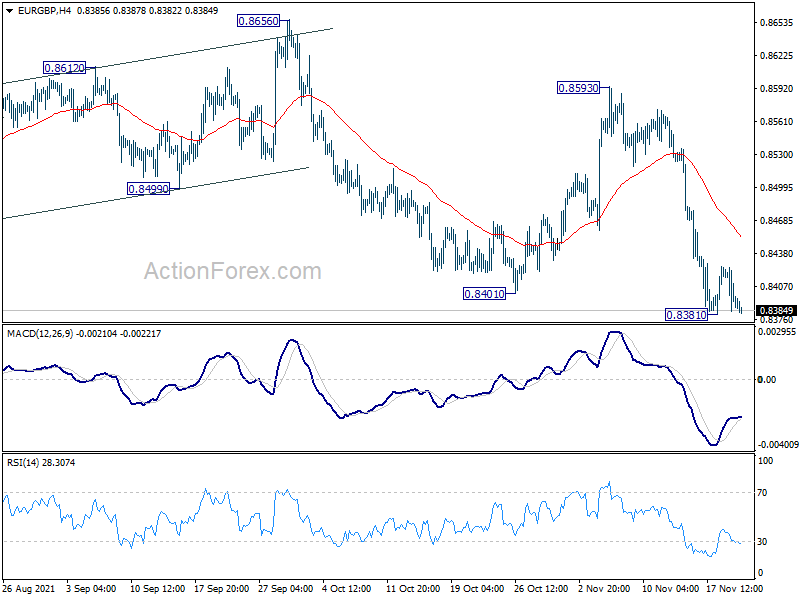
Intraday bias in EUR/GBP remains neutral first and consolidation from 0.8381 temporary low could extend. In case of another recovery, upside should be limited by 4 hour 55 EMA (now at 0.8452). On the downside, break of 0.8381 will resume larger down trend from 0.9499. Intraday bias will be back to the downside for 0.8276 key long term support.
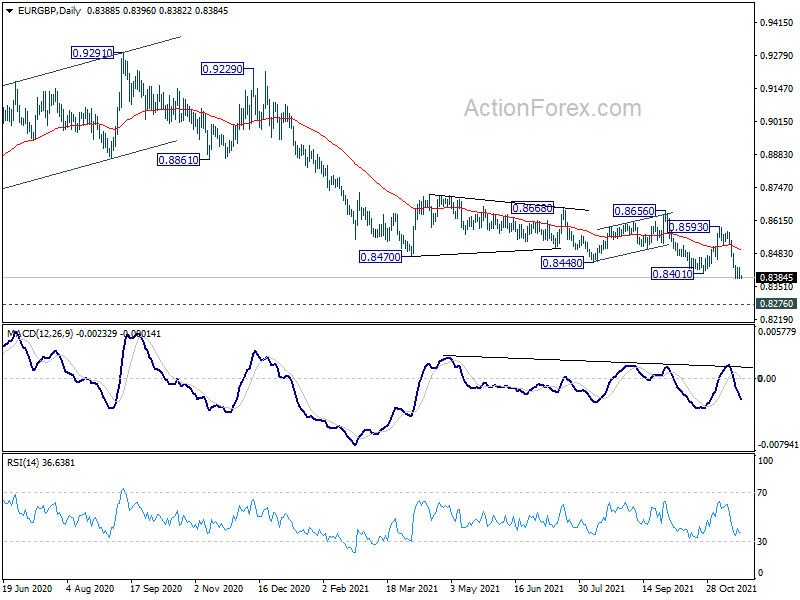
In the bigger picture, price actions from 0.9499 (2020 high) are still seen as developing into a corrective pattern. Deeper fall could be seen as long as 0.8593 resistance holds, towards long term support at 0.8276. We'd look for bottoming signal around there to bring reversal. However, sustained break of 0.8276 will but a sign of long term bearish reversal.
Economic Indicators Update
| GMT | Ccy | Events | Actual | Forecast | Previous | Revised |
|---|---|---|---|---|---|---|
| 15:00 | USD | Existing Home Sales Oct | 6.20M | 6.29M | ||
| 15:00 | EUR | Eurozone Consumer Confidence Nov P | -5 | -5 |
Geopolitical Tensions Are Building Up
Market movers today
- Consumption-related indicators remain in focus this week after last week's evidence of robust global goods demand. We get the euro area consumer confidence data for November today, and it will be interesting to see whether we will see a decline similar to the decline in the US in light of high inflation pressures. So far consumer confidence has been quite resilient, still standing above pre-pandemic levels. Also, the US PCE release will be out on Wednesday and German consumer confidence on Thursday.
- On the central bank front this week, pay attention to the FOMC minutes on Wednesday and the ECB minutes on Thursday.
- Also worth keeping an eye on German politics this week, with the 'traffic-light' negotiations on the final streak and parties aiming to present a coalition agreement by end-November and elect the chancellor in the first December week. Climate policies and financing remain the biggest hurdles between the parties according to media reports.
The 60 second overview
COVID-19: The focus remains on rising news cases in the Northern Hemisphere. In Europe, many countries are imposing (partial lockdowns), see our Covid-19 Update: Parts of Europe are closing down - more to follow, 19 November. Starting today, Austria is closing down for at least 10 days. It is also the first EU country planning to make the vaccination a legal requirement from February 1. Germany's Health Minister has not ruled out new lockdowns. FT reports how protests and riots against government-imposed restrictions are spreading across Europe and have in many places erupted in violence.
Geopolitics: Apart from the clashes between the West and Russia on natural gas supplies and the manufactured immigrant crisis on the Poland-Belarus border, tensions are also on the rise in Ukraine. Over the weekend, the US intelligence shared information with key European allies showing a build-up of Russian troops and weapons to prepare for a rapid and large-scale push into Ukraine. According to Ukraine's military intelligence (Reuters), more than 92,000 troops are amassed around Ukrainian borders, preparing for an attack by the end of January or beginning of February. According to media reports, any new attack on Ukraine would be on a scale far larger than in 2014 when Russia annexed Crimea.
China: In its quarterly monetary policy report published on Friday, the PBOC removed from its policy outlook a reference to stick with "normal monetary policy", a move seen as allowing the central bank to shift its stance towards more supportive monetary policy. CNY is the best-performing EM currency this year and we look for continued strength in the near-term as we have written in our CNY Strategy - Why is the CNY so strong?, 18 November. However, we expect CNY to weaken next year, driven by increasing monetary policy divergence between the Fed and the PBOC.
Equities: Equities mostly lower on Friday as Covid-19 flare up forced several countries in Europe to take on new measures to curb the outbreak. Austria initiating new lockdown and aiming to be the first country in the Western world to run compulsory vaccination.
As yields dropped, value underperformed to growth with energy as the biggest loser. Reopening and reflation trade suffering as a massive rotation took place. The mixed performance also visible in US indices with Dow -0.8%, S&P 500 -0.1%, Nasdaq +0.40% and Russell 2000 -0.9%. Asian markets this morning are very mixed with South Korea outperforming while Hang Seng once again underperforming. European and US futures are flat to slightly higher this morning.
FI: It was a volatile week in the global bond market last week as shown by the moves in the US Treasury market and European market. The 10Y US Treasury yields ended last week more or less unchanged from the start of the week. On Monday, the 10Y Treasury bond traded with a yield of 1.55%, and rose to 1.65% before declining to 1.55% on Friday as the market are facing higher inflation relative to rising infections and more lockdowns especially in Europe. Hence, 10Y German government bond yields are back to -35bp.
FX: EUR/USD dropped below 1.13 on Friday, as a new wave of EU COVID restrictions and hawkish Fed talk weighed on the cross. EUR/GBP is still trading below 0.84 at the time of writing. EUR/CHF dropped below 1.05 on Friday and the question is whether the SNB will start intervening in order to avoid a too strong CHF.
Credit: Credit generally had a tough day on Friday with iTraxx Xover widening 3.3bp and Main 0.4bp. HY bonds widened 2bp while IG tightened 0.5bp.
Equity Indices Trade Mixed After Similar US Session On Friday
General trend
- Seeing recirculation of Friday’s report that China Foreign Exchange Committee has called on banks to cap speculation on yuan.
- EUR/USD extends drop, USD Index extended rise.
- WTI crude pared opening decline.
- Only modest moves seen for equity markets thus far.
- Travel-sensitive cos. trade generally lower, some have focused on COVID cases in Europe.
- Nikkei 225 has pared decline.
- Japan markets are closed for holiday on Tues (Nov 23rd).
- Hang Seng has remained in the red; TECH index extends decline; Hang Seng announced index changes on Fri.
- S&P ASX 200 has traded modestly lower, Financials and Energy indices lag.
- US equity FUTs remain higher.
- Taiwan Central Bank (CBC) Gov said will move towards tightening in 2022.
- Companies due to report earnings during the NY morning include Niu Technologies, Zhihu.
Headlines/Economic Data
Australia/New Zealand
- ASX 200 opened 0.0%.
- (AU) Australia PM Morrison: Will allow overseas workers, students starting Dec 1st.
- (NZ) RBNZ Shadow Board overwhelmingly in favor of raising rates amid surging inflation (Nov 24th will be the next and last meeting for the RBNZ in 2021).
- (AU) Australia sells A$300M v A$300M indicated in 1.75% Jun 2051 bonds, Avg Yield: 2.4794% v 2.3718% prior, bid to cover 1.94x v 3.52x prior.
Japan
- Nikkei 225 opened -0.4%.
- (JP) Japan PM Kishida and EC President Michel making plans to meet in Japan on Nov 29th - Japan press.
- (JP) Japan Chief Cabinet Sec Matsuno: No plan on releasing oil reserves yet, but under consideration; Will continue to pay attention to global energy market trends and impact on the Japanese economy.
Korea
- Kospi opened +0.4%.
- (KR) South Korea Nov 1-20 Exports y/y: 27.6% v 36.1% prior; Imports y/y: 41.9% v 48.0% prior; Chip Exports y/y: 32.5% v 23.9% prior.
- (KR) Bank of Korea sells KRW820B v 700B indicated in 3-month Monetary Stabilization Bonds (MSB): avg yield 0.90% v 0.99% prior.
- (KR) South Korea main opposition People Power Party (PPP) presidential candidate Yoon and ruling Democratic Party (DP) candidate Lee are nearly tied in polling ahead of elections next year - Yonhap.
China/Hong Kong
- Hang Seng opened 0.0%; Shanghai Composite opened +0.1%.
- (CN) CHINA PBOC MONTHLY LOAN PRIME RATE (LPR) SETTING: LEAVES BOTH 1-YEAR AND 5-YEAR RATES UNCHANGED (19th consecutive month of steady rates).
- (HK) MSCI to track NetEase and JD.com via their Hong Kong shares rather than their ADRs in the US, may be the start of a gradual shift in liquidity away from the US for China stocks - press.
- (CN) Owners of China developers said to have used at least $3.8B in personal funds to save their companies from default - press.
- 388.HK To reduce the minimum market capitalization requirement for secondary listings of Chinese companies without dual voting rights structures.
- (CN) Golden Credit rating analyst says Yuan FX rate expected to remain strong toward the end of 2021 [in line]; notes Chinese exports - Chinese press.
- (CN) China PBOC Open Market Operation (OMO): Injects CNY50B in 7-day reverse repos v CNY50B prior; Net inject CNY40B v Net drain CNY50B prior.
- (CN) China PBOC sets Yuan reference rate: 6.3952 v 6.3825 prior.
- (CN) China President Xi: A China ASEAN summit will help regional peace, development and stability; ASEAN has gotten rid of shadow of a cold war and maintained regional stability.
Other
- (TW) Taiwan Central Bank: Will not use interest rates to rein in housing market costs.
- (TW) Taiwan Econ Min Wang: US-Taiwan economic dialogue will be on the supply chain and 5G Tech.
North America
- MNST Said to be exporing a deal with Constellation - press.
Europe
- TIT.IT KKR expected to make a €5.50/shr cash offer, €10.8B – press.
- (UK) BOE Gov Bailey: it’s not the bank’s job to fix supply chain issues hampering economies around the world which cause inflation to rise.
- (NL) Netherlands Oct House Price Index M/M: 1.0% v 1.6% prior; Y/Y: 18.3% v 18.5% prior.
- (RU) Ukraine Defense Intelligence Agency chief Budanov: Russian troops prepare to attack Ukraine by end-Jan 2022 or early Feb 2022.
Levels as of 00:15ET
- Hang Seng -0.6%; Shanghai Composite +0.6%; Kospi +1.2%; Nikkei225 +0.1%; ASX 200 -0.5%.
- Equity Futures: S&P500 +0.3%; Nasdaq100 +0.2%, Dax +0.3%; FTSE100 +0.3%.
- EUR 1.1292-1.1265; JPY 114.21-113.93; AUD 0.7256-0.7228; NZD 0.7010-0.6983.
- Commodity Futures: Gold -0.2% at $1,848/oz; Crude Oil -0.1% at $75.90/brl; Copper -0.7% at $4.37/lb.
WTI dips below 76 as Japan considers releasing reserves
Oil price extends its near term corrective decline in Asian session, with WTI dipping to 75.63. The move came as Japan Prime Minister Fumio Kishida said he is considering releasing oil from its reserves, in response to US request to quell high energy prices. He told reporters, "we want to draw a conclusion after thoroughly considering the situation each country faces and what Japan can do."
WTI's fall from 85.92 high is currently see as a correction to rise from 61.90 only. Hence, even in case of deeper fall, down side should be contained by 61.8% retracement of 61.90 to 85.92 at 71.07, which is also close to medium term trend line support. But break of 80.32 resistance is needed to indicate completion of the pull back. Otherwise, risk will stay on the downside in case of recovery.
EUR/USD Turns Red, Risk Of More Downsides
Key Highlights
- EUR/USD extended decline below the 1.1350 support zone.
- A connecting bearish trend line is forming with resistance near 1.1320 on the 4-hours chart.
- GBP/USD is still struggling to clear the 1.3500 resistance zone.
- Gold price started a downside correction from the $1,875 resistance zone.
EUR/USD Technical Analysis
The Euro gained bearish momentum after it broke the 1.1500 support against the US Dollar. EUR/USD even traded below the 1.1400 support to enter a bearish zone.
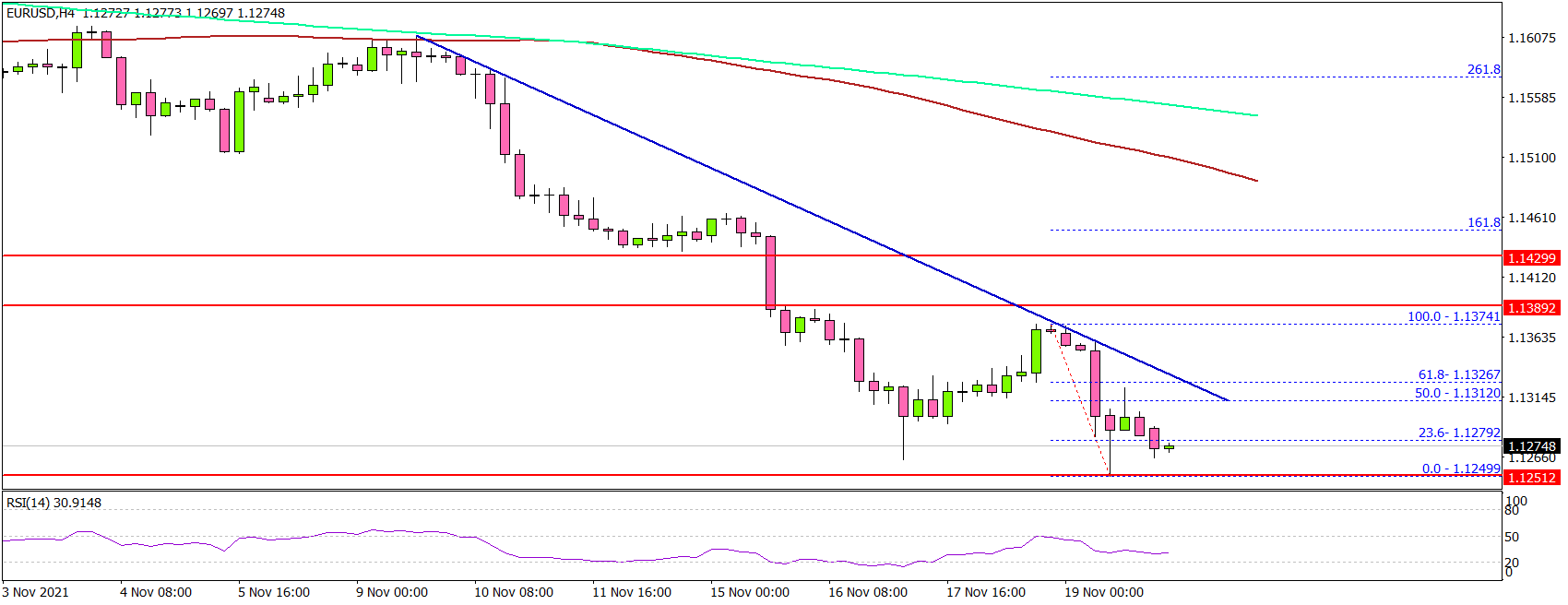
Looking at the 4-hours chart, the pair even settled below the 1.1350 zone, the 100 simple moving average (red, 4-hours), and the 200 simple moving average (green, 4-hours).
The pair even traded below the 1.1320 support zone. A low is formed near 1.1249 and the pair is now consolidating losses.
On the upside, the pair is facing resistance near 1.1315. It is near the 50% Fib retracement level of the recent decline from the 1.1374 swing high to 1.1249 low. There is also a connecting bearish trend line forming with resistance near 1.1320 on the same chart.
A clear break above the 1.1315 and 1.1320 resistance levels could open the doors for more gains. The next key resistance could be 1.1400.
On the downside, an initial support is near the 1.1250 level. A downside break below 1.1250 may perhaps open the doors for a move towards 1.1220. The next major support sits at 1.1200, below which the pair could dive to 1.1150.
Looking at GBP/USD, the pair is facing hurdle near the 1.3500 zone. Besides, gold price started a downside correction below the $1,850 level.
Economic Releases
- US Existing Home Sales for Oct 2021 (MoM) - Forecast +1%, versus +7% previous.
BoE Bailey: Second-ground effects are our concerns
BoE Governor Andrew Bailey said in an interview published over the weekend that the risks to the UK economy are "two-sided" at the moment. He said that "activity in the economy is slowing". Also, "he proximate cause of many of these inflation issues is on the supply side, and monetary policy isn't going to solve these directly".
However, "the concern for us is what they classically call 'second-round effects', particularly in wage bargaining and the labour market," he added. "If the economy evolves in the way the forecasts and reports suggest, we'll have to raise rates. Which, by the way, is entirely consistent with what I said in October."
Market Morning Briefing: Aussie Has Broken Below Immediate Support Mentioned Near 0.7250
STOCKS
Most global indices trade lower and can fall further in the near term, Dow can fall to 35000. Dax can test 16400 before falling sharply while Nikkei and Shanghai have fair scope to rise towards 30000/31000 and 3600/3700 if the indices sustain above 29750 and 3550 respectively in the near term. Nifty and Sensex can be sideways to bearish for the near term.
Dow (35601.98, -268.97, -0.75%) has come down further and can test 35000 in the coming weeks as we had mentioned earlier.
DAX (16159.97, -61.76, -0.38%) has come down slightly today but the view remains bullish to see a test of 16400 while above 16000. A strong break below 16000 is needed to negate bullish view.
Nikkei (29677.95, -67.92, -0.23%) has surged above 29500 again contrary to our expectation of seeing a fall to 28000. The index has interim resistance at 29750, which needs to be broken to see a test of 30000/31000. While below 29750, a consolidation between 29500-29750 can be seen before we see a break on either side.
Shanghai (3580.30, +19.93, +0.56%) has risen today and has broken the resistance at 3550. While above 3550, the view remains bullish to see a test of 3600 and 3700 eventually.
Nifty (17764.80, -133.85, -0.75%) went down steadily on Thursday to close below 17800. A gap up opening followed by a fall can be seen in Nifty as it is opening after 3 days. The overall view remains bearish below 18200/00.
Sensex (59636.01, -372.32, -0.62%) has broken the support at 59900. The view is now bearish to see a test of 59500/59000 in the coming sessions.
COMMODITIES
Most commodities are trading lower today on the back of fresh strength in the US Dollar. While the Dollar strengthens, it could keep commodities prices especially precious metals low for the near term. Crude prices fell sharply on rising Covid-19 cases in Europe that may affect the economic recovery. Some European countries are said to go on a lockdown to curb the rise in cases. Impact is expected to be short lived but may dampen crude demand in the near term. Gold and Silver trade lower and may dip some more before bouncing while Copper may trade within 4.45-4.25 before breaking on either side of the range.
Brent (78.25) has fallen sharply as expected breaking below our initial mentioned support at 79. While the price sustains below 79, there is scope for a fall to 75 on the downside before a corrective rise is again seen. Immediate view is bearish while below 79.
WTI (75.42) has scope to test support near 70 before rising from there in the medium term. While above 70, the channel uptrend since 2020 remains intact.
Gold (1847.40) and Silver (24.71) have dipped on Dollar strength and can fall towards 1840/20 and 24 respectively before bouncing from there again. Immediate view is bearish while Dollar remains strong.
Copper (4.3795) rose well in the last two sessions and has dipped slightly today from resistance near 4.45. We may expect trade within 4.45-4.25 for some sessions before breaking on either side.
FOREX
Dollar Index trades higher and has dragged down Euro below 1.13 again. While Dollar Index rises, Euro can fall to 1.12 or even lower in the longer run. Aussie and Pound have fallen and look bearish. EURJPY needs to hold above 128 to keep alive the upward momentum else could be vulnerable to a sharp fall. USDCNY can trade within 6.40-6.37 while Dollar Rupee may trade within 74-74.45.
Dollar Index (96.15) has risen back, rising strongly above 96 after a brief dip to 95.50 last week. The index looks strong a break above 96.50, if seen can take it higher towards 98 before facing any decline from there. Watch price action near 96.50 this week.
Euro (1.1271) has fallen below 1.13 again instead of a possible rise above 1.13. While Euro sustains trade below 1.13, it can be bearish towards 1.12 from where a possible bounce looks possible. Any break below 1.12, will open up chances of a fall to 1.10 before a reversal is seen.
EURJPY (128.69) has bounced back well from 128 and needs to sustain above 128 to move up again towards 130-131 in the medium term. Failure to hold above 128 could make the cross vulnerable for a deeper decline towards 126-125 in the coming weeks. Watch price action near current levels.
Aussie (0.7236) has broken below immediate support mentioned near 0.7250 and if the fall sustains, we may have to look for a test of 0.7170/60 in the near term.
Pound (1.3432) has fallen too from levels above 1.35 seen last week. A fall to 1.3350-1.330 looks possible while below 1.35.
Dollar-Yen (114.15) sustains above 114 and could trade within 115-113 region for the medium term before a decisive break on either side is seen.
USDCNY (6.3753) may remain within 6.40-6.37/36 region for the near term. Any break on either side if sustains will indicate the medium term direction.
USDINR (74.24) had risen sharply from 74 last week abiding with our expectation of a possible bounce from 74. While above 74 there is scope for a trade within 74.40/45-74.00 for the near term. A decisive break above 74 will be needed for a test of 73.80/60 in the longer run. Weakness in Euro could impact the Dollar Rupee and make it trade above 74 today.
INTEREST RATES
The US Treasury yields have dipped further as expected at the far-end on Friday. The view of seeing a fall within the broad expected range remains intact. The German Yields have tumbled across tenors following the lock-down announced in Austria. The reversal to keep the broader downtrend intact that we have been expecting has happened, though slight swiftly. The yields can fall further in the coming days. The 10Yr GoI remains lower and can come down from here within the current range. The 5Yr GoI on the other hand is holding above the range support and keeps the sideways range intact for now. The bias is bearish on the GoI and we expect the yield to break their ranges on the downside eventually in the coming days and see a fresh fall.
The US 2Yr (0.52%) and 5Yr (1.24%) Treasury yields have inched up while the 10Yr (1.56%) and the 30Yr (1.92%) have dipped further. The 10Yr can come down to 1.5%-1.45% again and the 30Yr can revisit 1.85% levels. Overall, we expect the yields to oscillate in a broad range of 1.35%-1.65% (10Yr) and 1.75%-2.1%/2.2% (30Yr) for some time.
The German 2Yr (-0.79%), 5Yr (-0.64%), 10Yr (-0.35%) and 30Yr (-0.02%) yields have declined sharply across tenors. The expected reversal has happened much sharper and quicker than expected. While this fall sustains, the 10Yr can test -0.45% and -0.5%. The 30Yr can fall to -0.1% and -0.2% while it sustains below 0%.
The Indian 10Yr GoI (6.3455%) has turned down from the resistance at 6.38% again last week. A test of 6.3% is likely. 6.3%-6.45% is the range of trade now. The bias is bearish to see a downside break of this range below 6.3% and a fall to 6.2% and lower over the medium-term.
The 5Yr GoI (5.6738%) is managing to hold above 5.66%. This keeps the 5.66%-5.75%/5.78 range intact. A bounce to 5.7%-5.73% cannot be ruled out from here. But we expect the 5Yr GoI to break 5.66% and fall to 5.63%-5.62% eventually in the coming days.
Eco Data 11/22/21
[php_everywhere instance="1"]
Forex and Cryptocurrencies Forecast
EUR/USD: Closer to Parity
We made a short equation in the title of the previous review on the EUR/USD pair: "Inflation growth = USD growth", and last week's events confirmed its fairness. Strong data on retail sales in the US, released on Tuesday, November 16, allowed the dollar to rally again, and the USD DXY index to return to the values of one and a half years ago and renew the highs of 2021. With the forecast of 1.4%, retail sales in October increased by 1.7% (the growth was twice less in September, 0.8%). The retail control group indicator went up as well, showing an increase in October by 1.6% (forecast 0.9%, growth a month earlier - 0.5%). Recall that this indicator represents the volume of retail trade in the entire industry and is used to calculate the chain price index for most goods.
Investors were also pleased with the data on industrial production and the housing market in the United States. As a result, the EUR/USD pair dropped to 1.1263 on Wednesday, November 17.
It is clear that in the current situation the market is most interested in how this or that macro statistics will affect the rate of curtailing monetary stimulus (QE) and the rise in interest rates by central banks.
Thus, the data published last week gave investors another argument in favor of an earlier rate increase by the US Federal Reserve. According to John Williams, President of the Federal Reserve Bank of New York, the country's economy is recovering at a steady pace, the US has a huge growth in employment, and unemployment is falling very quickly. St. Louis Fed President James Bullard also added fuel to the fire when he said that the Fed should become more aggressive. If it accelerates the pace of QE reduction to $30 billion a month, this could provide an opportunity for raising rates in Q1 2022. Another "hawk", the head of the Federal Reserve Bank of Atlanta Rafael Bostic, believes that the Fed may start increasing rates in the middle of next year. And even such a famous "dove" as Chicago Fed President Charles Evans agreed that "raising rates in 2022 may be appropriate."
As for analysts, Bank of America believes that rising prices and wages will push the US central bank to raise the federal funds rate in the summer of 2022, and maybe even earlier. The most conservative aggregate forecast is given by Reuters experts. According to them, the rate will rise for the first time in the Q4 2022, followed by two more increases, in Q1 and Q2 2023, as a result of which it will reach 1.25-1.5% by the end of the year.
Unlike the United States with its economic growth, things are not at all so rosy in the Eurozone with its energy crisis and the impending economic war with Great Britain. The preliminary data on GDP of the Eurozone for the Q3 published on Tuesday, November 16, showed the absence of even minimal growth. Well, at least there's no fall.
ECB President Christine Lagarde said speaking to the European Parliament that the increase in interest rates in 2022 does not correspond to the plans of her bank, since the conditions for monetary restriction will not be implemented in the coming year. According to the regulator, tightening monetary policy in such a situation will do more harm than good.
The euro weakened not only against the dollar, but also against other currencies after such statements by the head of the ECB. Great Britain helped the European currency a little. A record rise in inflation in this country pushed the GBP/USD pair up, and it pulled EUR/USD along with it. Two more factors also played into the hands of the euro. The first is the 66th update by the S&P 500 of its all-time high for this year. The second one is the possible resignation of Fed Chairman Jerome Powell and the appointment of Lael Brainard, who is considered to support a softer monetary policy, in his place.
A number of investors, influenced by the above factors, decided to take profit on short positions. But this only briefly helped the European currency. Having risen to 1.1373, the EUR/USD pair turned around and continued its southward movement, updated the local low at 1.1250 and closed the trading session at 1.1288.
If we translate what is happening on both sides of the Atlantic into the language of the military, then things have not yet come to real military clashes: neither side has yet raised the interest rate. The matter is limited to the maneuvers and statements of the chiefs of the "general staffs", that is, of the Central Banks. Although, of course, divergences in economic growth, as well as in the monetary policy of the Fed and the ECB, are likely to push the EUR/USD pair further down. Moreover, there is still room for it to fall. Recall that the quotes were at the level of 1.0635 in March 2020, 1.0352 in December 2016, and the pair was even below the parity line at 0.8225 in October 2000.
Indicators at D1 confirm the bearish forecast, pointing south. These are 100% among the trend indicators. The same can be said about oscillators, although 15% of them are in the oversold zone.
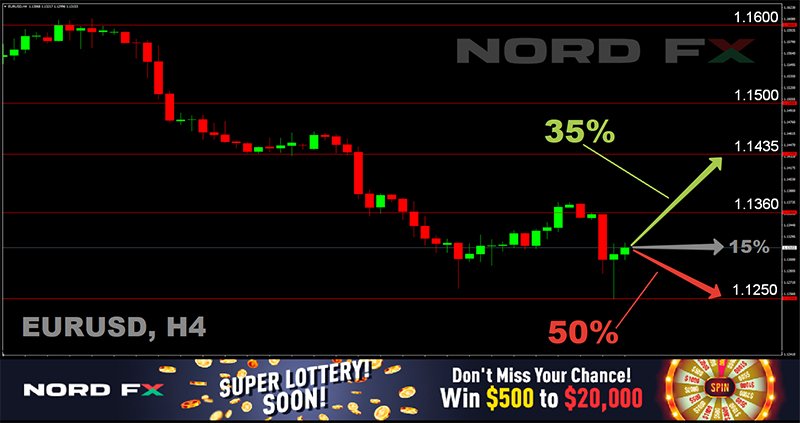
35% of experts vote for the correction and growth of the pair in the short term, 50% vote for its further fall, and 15% expect a sideways movement. Resistance levels are located in the zones and at levels 1.1315, 1.1360, 1.1435-1.1465 and 1525. The nearest support level is 1.1250, then 1.1175 and 1.1075-1.1100, then 100 points lower.
As for the upcoming release of macroeconomic statistics, preliminary data on business activity (Markit) in Germany and the Eurozone will be released on Tuesday, November 23. And the volumes of orders for capital and durable goods in the United States, as well as preliminary data on US GDP for the third quarter, will become known the next day. And finally, the minutes of the meeting of the US Federal Reserve Committee (FOMC) will be published on Thursday, November 25, from which investors will try to understand how strong the "hawkish" attitude among the leadership of this regulator is.
GBP/USD: Awaiting the Rate Hike on the Pound
As mentioned above, inflation in Britain hit 4.2%: the highest level since 2011 (it was 3.1% in September). The jump came amid rising energy prices and worsening supply problems. However, the core consumer price index (CPI), which excludes volatile food and energy prices, showed an increase of 3.4% (2.9% a month earlier). According to many economists, consumer prices will continue to rise further in the coming months.
The released statistics increased the likelihood that the Bank of England will decide to raise the interest rate on the pound this December. This contributed to the rebound of the GBP/USD pair from November 12 low of 1.3352, to which it fell after the US recorded its highest growth in 30 years inflationary pressure.
In general, the macroeconomic statistics of the United Kingdom looked quite optimistic last week, supporting the pound.
It became known last Tuesday that the number of jobs in the country increased by 160K in October. This figure is especially important against the background of the fact that the state program for subsidizing wages, which was in force during the COVID-19 pandemic, was completely phased out in September. Many experts expected employers to start cutting jobs after the end of support. However, this did not happen and the labor market, on the contrary, continues to recover. The UK unemployment rate fell to 4.3% in the Q3.
Recall that the Governor of the Bank of England, Andrew Bailey, speaking of curbing inflation on November 4, did not rule out the possibility of raising interest rates more quickly than planned. And now the published indicators allowed the bulls to seize the initiative and raise the pair to a height of 1.3513 on Thursday, November 18. However, this was followed by a rebound, and it completed the five-day period at 1.3444.
If the key rate for the pound increases in December, we can expect the GBP/USD pair to grow to the 1.3800-1.3900 zone. However, while this has not happened, most analysts (75%) expect the pair to fall further. Only 25% bet on a quick victory for the bulls.
As for the oscillators on D1, 80% are red, 10% are green and 10% are neutral gray. Trend indicators are still 100% red. Support levels are 1.3400, 1.3350, 1.3200, the target of the bears is 1.3135. The resistance levels and targets of the bulls are 1.3475, 1.3515, 1.3570, 1.3610, 1.3735, 1.3835.
As for the macro statistics for the coming week, it is worth noting the publication of the UK Services Business Activity Index (PMI) on Tuesday November 23. This indicator, published by the Chartered Institute of Procurement and Supply in conjunction with Markit Economics, is an indicator of the economic situation in the field of sales and employment in this sector. However, it is not as important as the country's manufacturing PMI.
USD/JPY: Still East
While the US Federal Reserve cuts monetary stimulus, the ECB has frozen QE at the previous level, the Japanese government announced an unprecedented program of economic stimulus for the total 55.7 trillion yen ($487 billion) on Friday November 19. Tokyo hopes that this measure will increase the country's GDP by 5.6%. As stated, the Bank of Japan will pursue an appropriate monetary policy, closely monitoring market movements and the impact of the coronavirus pandemic on the economy.
"We hope that the Bank of Japan is clearly aware of the urgency of the measures and continues to coordinate closely with the government to achieve a proper mix of fiscal and monetary policy," the Cabinet of Ministers of Japan said in a statement.
In what way did the USD/JPY pair react to this event? well, actually... in no way. A safe harbor should remain calm no matter what.
In general, the dynamics of the pair fully followed the forecast given the previous week. Most analysts expected the pair to rise, break through the upper border of the 113.40-114.40 channel and try to update multi-year highs. This is exactly what happened: the pair was noted at a height of 114.96 on November 17. However, then the strength of the bulls dried up, and the pair returned to the mid-term trading range, putting the last chord in its central part, at the level of 114.00.
Given the ultra-soft monetary policy of the Bank of Japan and the expansion of control over the yield curve, it is highly likely that the weakening of the yen and the growth of the pair will continue. And that USD/JPY will not only reach the 115.00-116.00 range, but will also consolidate there, updating the 2017 highs. Of course, the decisions of the US Federal Reserve regarding interest rates as well as the yield of American treasuries will also affect the dynamics.
As a result of the backward movement that the pair demonstrated last week, the oscillators on D1 are completely confused: 20% of them point north, 40% - south and 40% - east. There is no unity among trend indicators either: 60% look up, 40% - on the contrary, down.
The picture is similar among analysts. 40% of them expect the growth of the pair, the same amount expect its fall, and the remaining 20% just shrug their shoulders. The resistance levels are 114.40, 114.70, 115.00 and 115.50, the long-term target of the bulls is the December 2016 high of 118.65. The nearest support level is 113.40, then 112.70, 112.00 and 111.65.
CRYPTOCURRENCIES: Where Will Bitcoin Fall and Rise II
Bitcoin updated its all-time high, reaching $68,917 on Wednesday, November 10. Ethereum also set a record, rising to $4,856. The total capitalization of the crypto market at the maximum reached $2.972 trillion. At the same time, the Crypto Fear & Greed Index rose to 84, being in the Extreme Greed zone, which indicated that the main cryptocurrency was strongly overbought and the need for a correction that was not long in coming.
We cited the opinion of specialists from the Kraken crypto exchange in the previous review, according to which if the current growth of bitcoin stops at strong resistance around $70,000, a correction of up to 20% can be expected. That is, the BTC/USD pair may fall to $55,000.
The cryptocurrency analyst Altcoin Sherpa called the same figure. Another well-known journalist and expert, Willy Woo, cited a wider range from $50,000 to $60,000 as a reliable support.
In addition, Willie Woo argues that bitcoin is not ready for impulse growth and renewal of all-time highs at the moment. Woo identified three factors that hinder the rise in price of the main cryptocurrency.
The first factor is bitcoin's high speculative activity. Woo argues that while long-term investors continue to accumulate cryptocurrency, a large number of positions are being opened for short-term speculative purposes.
Another factor that can hold bitcoin back is the launch of the first US exchange-traded fund (ETF) based on bitcoin futures. According to Woo, most institutional investors prefer to buy fund stocks and futures at the moment instead of buying the coin itself.
Recall that the first US exchange-traded fund based on bitcoin futures began trading on the New York Stock Exchange (NYSE) on October 19. Its assets exceeded $1 billion two days after the start of trading. Thus, the fund broke the record growth rate to $1 billion, which was held for 18 years.
The third factor is the overly optimistic sentiment of investors who are confident in the further growth of bitcoin and the entire cryptocurrency market. "Whenever most investors are bullish, it is very difficult for the price to go up because there are a lot of speculative longs in the markets," Woo explains.
Analyst Nicholas Merten is also skeptical about the near future of the flagship cryptocurrency. "We won't get $100,000 or $150,000 in this Q4 or next Q1," he says. "I'm sorry, but I'll have to say that. I think that many experts are mistaken. Bitcoin is aiming for growth, but we will only see around $100,000 or $150,000 by the fall of next year."
At the time of writing the review, the BTC/USD pair is around $58,000, the local minimum was recorded on November 19 at $55,638. The total capitalization of the crypto market fell to $2.590 trillion. At the same time, the Crypto Fear & Greed Index fell by as much as 50 points, to 34, being in the zone of Fear.
The news background is neutral. More precisely, it is ambiguous. On the one hand, for example, the Bitcoin Taproot network was updated on November 14 - the first major change in functionality since 2017. The main cryptocurrency needs to become more efficient, scalable and confidential. On the other hand, US President Joe Biden signed a bill to upgrade the infrastructure. Depending on the interpretation of this document, it may turn out that miners, wallet developers, liquidity providers in DeFi-protocols and other players in the digital market may be required to report to the tax office. The crypto community is also concerned about another amendment to the infrastructure plan, which will oblige recipients of digital assets worth more than $10,000 to verify the sender's personal information.
No confidentiality!
A very good reason is needed for bitcoin to rise sharply again. And if it does not appear, the BTC/USD pair has many chances to stay stuck for a long time in the zone $50,000 to $60,000, sagging from the maximum by 15-30%. However, the current drawdown does not prevent many crypto enthusiasts from maintaining remarkable optimism.
Thus, Anthony Scaramucci, the founder of SkyBridge Capital investment company, is confident that bitcoin will "easily" reach the price of $500,000. He gave such a forecast, referring to the limited emission of the first cryptocurrency and the potential number of wealthy investors. He noted that according to JPMorgan, there are at least 49 million dollar millionaires, but the supply of digital gold is limited to 21 million coins. "You don't have enough bitcoins for every millionaire in our society to have at least one coin," Scaramucci said.
In his opinion, the current price level is still an early opportunity to enter the asset, and the price of the first cryptocurrency will reach the specified $500,000 mark by the end of 2024 or mid-2025. However, this requires that Ark Invest's forecast come true, according to which the number of bitcoin wallets should reach 1 billion by this time.
EUR/USD Weekly Outlook
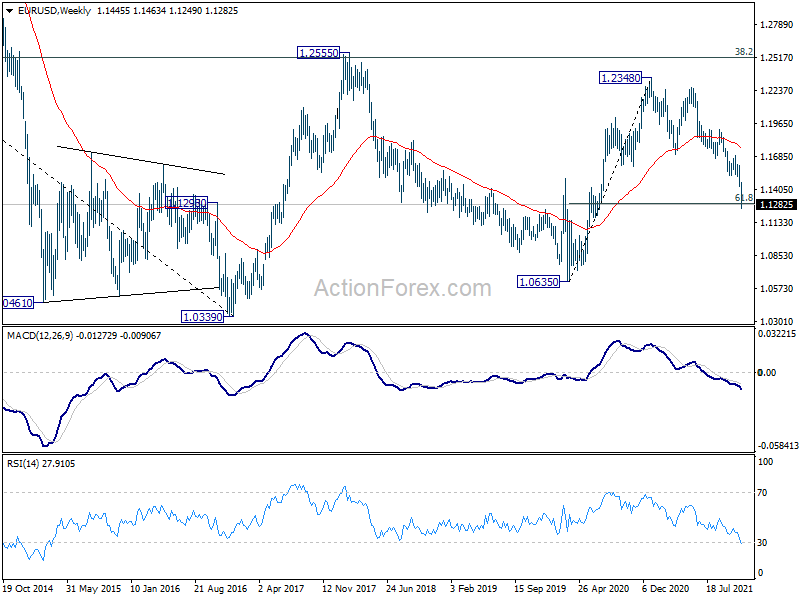
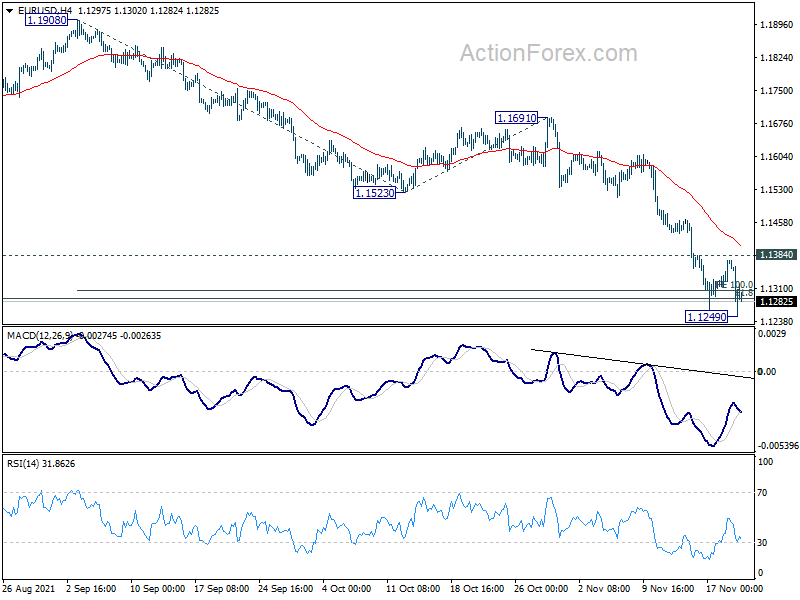
EUR/USD dropped further to as low as 1.1249 last week but couldn't clear 1.1289 long term fibonacci level yet. Initial bias remains neutral this week first. On the downside, break of 1.1249 and sustained trading below 1.1289 will carry larger bearish implications. Deeper fall would then be seen to 161.8% projection of 1.1908 to 1.1523 from 1.1691 at 1.1068 next. Nevertheless, break of 1.1384 minor resistance will now indicate short term bottoming, and turn bias back to the upside for rebound.
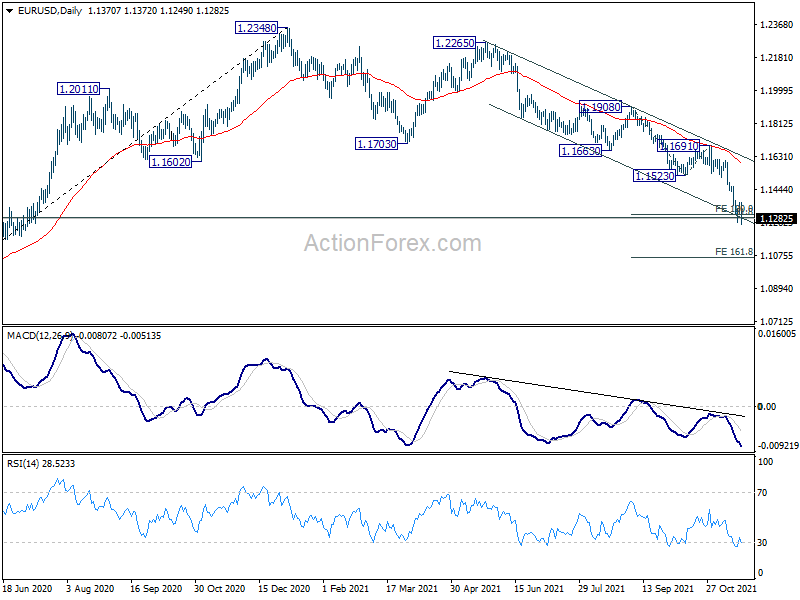
In the bigger picture, there are various ways of interpreting the fall from 1.2348 (2021 high). It could be a correction to rise from 1.0635 (2020 low), the fourth leg of a sideway pattern from 1.0339 (2017 low), or resuming long term down trend. In any case, outlook will now stay bearish as long as 1.1703 support turned resistance holds. Sustained break of 61.8% retracement of 1.0635 to 1.2348 at 1.1289 would pave the way back to 1.0635.
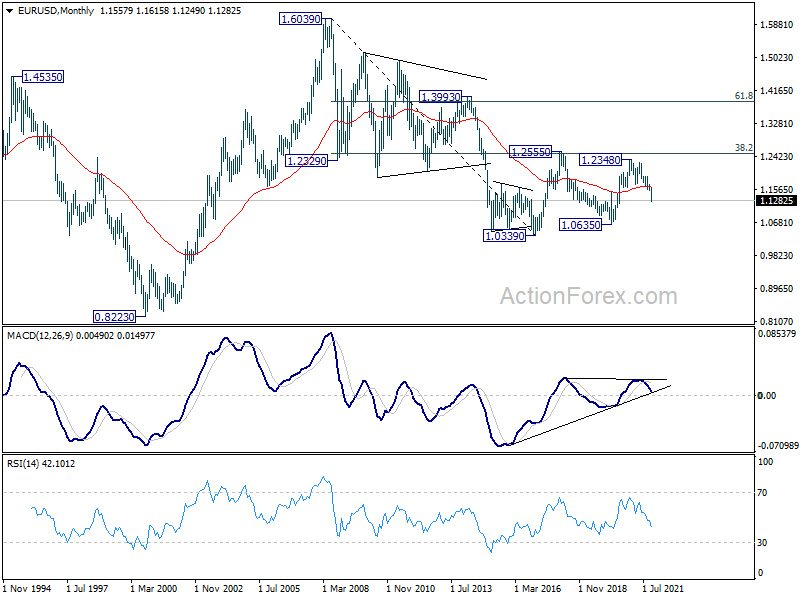
In the long term picture, EUR/USD has possibly failed 1.2555 cluster resistance (38.2% retracement of 1.6039 to 1.0339 at 1.2516) again. Long term outlook will remain neutral as sideway pattern from 1.0339 (2017 low) is extending with another medium term fall. For now, we'd hold back from assessing the chance of downside breakout, and monitor the momentum of the decline from 1.2348 first.