

Sample Category Title
Weekly Focus – Is the Market Starting to Believe the ECB?
Expectations of increasing monetary policy divergence between the Federal Reserve and the ECB drove the markets this week. Rate markets pushed back expectations of the first ECB rate hike from 2022 to 2023 after both ECB Lagarde and Schnabel said that conditions for rate increases next year would be very unlikely to be met. On the back of these comments, EUR/USD hit a 16-month low and briefly dipped below 1.13. The US-DE 10-year spread has widened by 20 basis points in November. Long-term market-based inflation expectations have stabilised just below 2% in euro area and in the range of 2.5-2.6% in the US for now. We expect euro area inflation to remain above the ECB's target until H2 22, but fall back to a 1.5-1.7% range thereafter, see our Euro Area Research: Measuring the euro area inflation pulse,15 November.
Equity markets maintained a good spirit this week, supported by evidence that the global consumer is holding up strong. Chinese retail sales surprised on the upside on Monday with 4.9% annual growth (cons. 3.7%). After a string of worse-than-expected figures, this gave some investor relief. On Tuesday, the US (nominal) retail sales rose 1.7% in October and even when factoring in some increase in prices, this was a surprise. The strong retail sales are a reflection that the pandemic is still having an effect on consumer dynamics, as it equally indicates that goods demand remains elevated while service consumption is subdued versus pre-pandemic trends. Overall, resilience in goods consumption implies no near-term relief for global supply chain bottlenecks (longer delivery times and elevated freight rates) while it does provide some relief to fears of the global growth slowing down.
Consumption-related indicators will remain in focus next week. Euro area consumer confidence data for November will be released on Monday and it will be interesting to see whether we see a decline similar as in the US in light of high inflation pressures. So far consumer confidence has been quite resilient, still standing above pre-pandemic levels. We also get the German consumer confidence data on Thursday. In the US, the most important release is the PCE data on Wednesday. The inflation part of it is not so interesting given we already got CPI statistics two weeks ago. Instead, the monthly private consumption data is the one to watch. Considering the strong retail sales data, we could expect goods consumption to remain elevated. Also, watch out for the flash PMIs from euro area, UK and the US on Tuesday. Recently, the gap between US and euro area economic surprise indices has been growing with data releases from the US often surprising to the upside. Negative data surprises from the euro area could add further pressure on EUR/USD.
On the central bank front, we keep an eye on the FOMC minutes on Wednesday and the ECB minutes on Thursday. Several FOMC policymakers have spoken since the November meeting so we expect this to be a non-event for markets. For ECB, the focus will be on the inflation debate in the Governing Council and on any indications why Lagarde at the time was not willing to push back more on the aggressive market pricing on the short-end. Lastly, the Reserve Bank of New Zealand will meet early Wednesday morning, and consensus is looking for a 25bp hike.
Canada: Retail Sales Declined in September, but Should Improve in October
Retail sales fell by 0.6% month-on-month in September. The decline was more pronounced after stripping away the effect of prices, with the volume of sales down 1.1%. Looking ahead, the Statistics Canada flash estimate calls for some improvement in October, with sales projected to increase by 1.0%.
Lower sales of cars weighed on the headline. Sales of motor vehicle & parts were down 1.6%, held back by the lingering semiconductor shortage. Sales of gasoline were little changed in nominal terms (+0.2%), and were down 0.7% in volume terms.
Core sales, which exclude autos and gasoline, edged lower by 0.3% in September. Core sales were held back by a pullback in clothing and accessories stores (-5.9%), which posted its first decline since May. September was also another disappointing month for electronics & appliance stores (-0.7%), with sales falling for the sixth consecutive month. Sales were slightly lower at building materials and garden equipment stores (-0.2%) as well as at health & personal care stores (-0.5%).
On the other hand, food & beverage stores had a good month, with sales up 1.3%, partially due to higher food prices. Furniture stores also fared better in September (+1.3%).
On a regional basis, sales were up in every province other than Ontario (-4.4%). The decrease in Ontario was driven by lower sales at motor vehicle and parts dealers.
Online sales rose 5.1% on the month. This left online sales up 1.8% from the year ago and 66% above their pre-pandemic level.
Key Implications
Retail sales fell in September. However, the decline appears to be driven overwhelmingly by Ontario, where a large drop in vehicle sales weighed heavily on the headline number. Excluding Ontario, retail sales were up 1.7% on the month.
Some of the categories that underperformed in September were the ones most impacted by global supply-chain challenges: autos and appliances. Sales at clothing and accessories stores also pulled back, but this likely reflects some moderation in activity following three consecutive months of very strong gains.
Shortages of various inputs due to supply chain issues have led to brisk price increases for consumer goods. In October, prices of goods were 6.5% higher than they were a year ago, rising at the fastest clip since the 1980s. While households finances remain in fairly good shape, higher prices and limited availability of some items may begin to chip away at how much consumers spend on goods, particularly as they direct a larger share of their budgets toward services.
Sunset Market Commentary
Markets
A Friday with only second tier data scheduled in the US and Europe. This was supposed to yield technical trading going into the weekend. However, the scenario was overthrown by ‘good old corona’ returning back to the spotlights from never been really away. Austria imposed a lockdown that can last 20 days. At the same time, the German Health Minster said that corona infections are developing in a way that a new lockdown in Europe’s largest economy can’t be rule out. Such a move inevitably would be an unexpected blow to, at least short term growth prospects. The comments sent markets in an outright risk-off spiral. German yields nosedived, with the belly of the curve outperforming (5-y -5.5 bps; 10y -6.2 bps) the wings (2-y -2.2 bps;30-y -4.5 bps). A bit surprisingly, the move was driven by a sharp fall in EMU inflation expectations. (10-y inflation swap -7.5 bps, returning below 2.0%). German October PPI rising an astonishing 18.4% Y/Y was absolutely no topic for markets anymore. ECB Lagarde repeated that despite ‘unwelcome and painful’ inflation, the ECB doesn’t intend to raise rates. Her analysis that ‘at a time when purchasing power is already being squeezed by higher energy and fuel bills, an undue tightening would represent an unwarranted headwind for the recovery’, at once also looked less ‘controversial’. The safe haven bond rally also spilled over outside Europe. Of course, today’s corona developments in Europe at some point still might reoccur in other regions, including the US, as well. US yields are declining between 4.5 bps for the 30-y yield and 6 bps for the 5-10 y sector. Even sterling yields dropped approximately 5 bps across the curve. Solid October retail sales completed a strong update on the UK economy this week, but couldn’t help. European equity indices are off the intra-day lows, ceding 0.5%-1%. In the US the Dow loses 0.5%. The S&P is little changed. In this ‘low yield context’, the Nasdaq apparently also still has some safe haven role to play (+0.4%) .
FX trading developed according to an old-school risk-off script. Especially the comments from German health minister Jens Spahn pushed the euro off a cliff. EUR/USD at some point dropped more than one big figure to the 1.1250 area and currently trades near the 1.13. So, yesterday’s pause in the EUR/USD sell-off was very short-lived. The technical picture remains fragile. The DXY trade-weighted USD index returned to the 96 area but the move was mitigated by yen outperformance (USD/JPY 113.85 from 114.50 this morning). EUR/JPY intraday came close to the 127.93 key support, but for now no break occurred yet. The risk-off repositioning for sure will also ring alarm bells at the Swiss national bank. Safe have flows pushed EUR/CHF below the 1.05 key support. At 1.0470, the franc trades at the strongest level against the euro since July 2015! The opposite reaction is visible for smaller, currencies especially from countries that are battling high inflation. Despite recent efforts from the NBP and the MNB, the zloty (EUR/PLN 4.69) is trading at the weakness level since March 2009. The forint (EUR/HUF 367.75) is nearing record low levels just below EUR/HUF 370. Even the Czech krona weakened from EURCZK 25.25 to 25.40. Sterling largely escapes the risk-off repositioning even as UK yields decline in line with Europe. EUR/GBP dropped below the 0.84 handle on the back of solid UK retail sales and broad euro weakness. At 1.3460, cable is limiting potential damage.
News Headlines
Norwegian mainland GDP grew 0.6% q/q in the third quarter. That’s slightly more than consensus estimates of 0.4% but came with a minor downward revision of Q2 from 1.1% to 1%. Compared to the same quarter a year earlier, the Norwegian economy is now 2.6% larger. Growth was broad-based with household consumption (6% q/q) taking the lead over government expenditures (1.3%) and gross fixed capital formation (1.1%). Net exports contribution was positive with exports rising 6.5% vs. imports 5.8%. Including Norway’s vast oil sector, GDP expanded 2.2% q/q thanks to a whopping 10.7% q/q increase in petroleum activities. The NOK loses out against the euro today in a decline solely driven by risk-off. EUR/NOK surpassed 10 yesterday and is testing resistance at 10.05 today (38.2% EUR/NOK recovery of the July-Oct decline).
Stocks Improve and Dollar Surges
King dollar comes on top as rate hike prospects grow
US stock futures are near their highs but are showing minor slack, more so the S&P and Dow Jones composites than the Nasdaq 100. Expectations of lift-off in rate hikes in 2022, once tapering ends, has aided the reserve currency.
The dollar index has shot back above the 96.00 mark, but USDJPY plunged past the 114.00 level and is currently around 113.80.
While unlikely, should job projections be around pre-pandemic levels close to the summer period, this could boost the narrative for normalisation, however with the virus persisting across the globe, some timelines of hikes remain optimistic.
UK spending shows no hard times, while Lagarde fails to aid euro
Dollar strength is somewhat exacerbating the pandemic and inflation woes, which are still playing a serious part in the UK and the eurozone. Dovish ECB President Largarde added additional blows to the euro after suggesting that tightening too soon is not the right course of action for the common currency despite the hardships the virus and inflation are causing. The euro has slipped slightly beneath the $1.1300 barrier even after October German PPI came in strong at 18.4% y/y. Elevated levels of infections are putting pressure on economic growth in the bloc, which looks to be at risk after Austria announced a national lockdown, while Germany and Greece will implement restrictions on the unvaccinated.
The pound found its feet around the $1.3400 hurdle and returned to $1.3447. Sterling still looks softer even after stronger than expected 0.8% m/m growth in October retail sales. Furthermore, the GfK Consumer Confidence Index increased to -14 in November from -17 in October, beating the expectations of -18. Consumers seem to be willing, despite elevated prices and shortages, to spend also ahead of Black Friday and Christmas. It is surprising that spending is elevated, also in virtual retail, given the current strains on households, from the termination of pandemic welfare support and inflation.
Canadian retail sales upbeat and oil becomes easier on the pocket
USDCAD surged to an intraday high around C$1.2650 and seems to be the best performing pair today up by 0.39%. The Canadian dollar, heavily correlated with oil, has weakened with the drop in crude prices and ahead of September’s retail sales.
Canadian retail sales in September came in at -0.2%, beating the estimation of -1.0%, signalling that retail sales improved slightly. The headline figure also improved to -0.6% from -1.6%.
On another note, Canadian housing prices also grew by 0.9% in November rising from 0.4% in October.
WTI oil futures have plunged to the $76.00 per barrel vicinity, amid reports of a potential coordinated reserve release by major oil-consuming nations. According to Reuters, the US asked China, India, Japan, and South Korea to aid in the release to bring prices down.
The antipodean currencies remain heavy with the aussie falling to 0.7235 and the kiwi flirting with the 0.7000 psychological mark. Gold is consolidating around the $1,862/oz level.
Coming up, FOMC Member’s Waller and Clarida are due to speak at 15:45 and 17:15 GMT respectively.
Tomorrow the US Treasury will publish its FX report to Congress.
EUR/USD Mid-Day Outlook
Daily Pivots: (S1) 1.1333; (P) 1.1354; (R1) 1.1393; More...
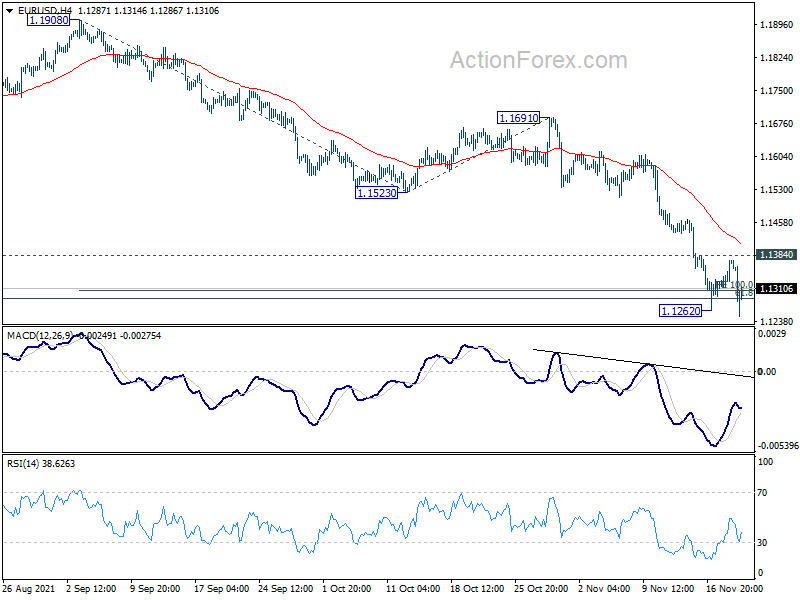
EUR?USD is staying in range despite dipping to 1.1249. Intraday bias remains neutral first. On the upside, break of 1.1384 minor resistance will indicate short term bottoming at 1.1262, after defending 1.1289 long term fibonacci level. Intraday bias will be turned back to the upside for rebound back to 1.1523 support turned resistance first. On the downside, however, sustained break of 1.1289 will carry larger bearish implication, and extend the fall from 1.2348 to 161.8% projection of 1.1908 to 1.1523 from 1.1691 at 1.1068.
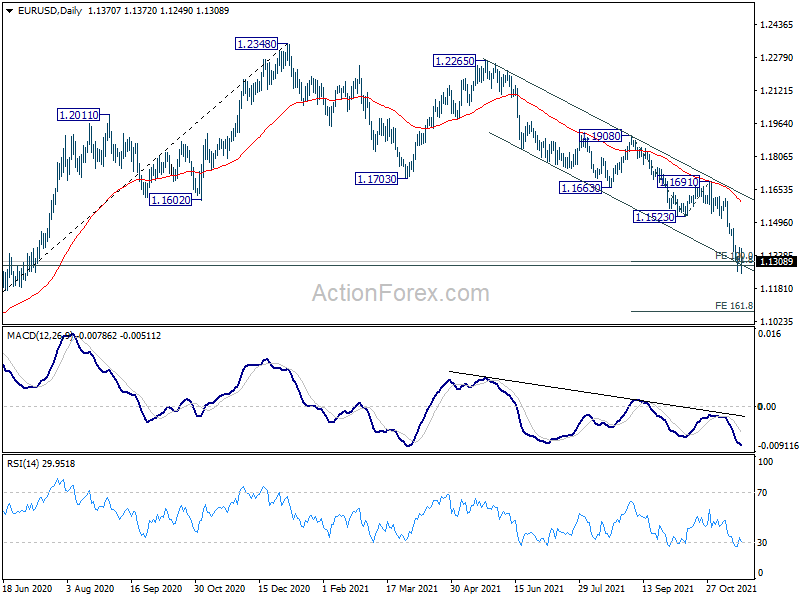
In the bigger picture, there are various ways of interpreting the fall from 1.2348 (2021 high). It could be a correction to rise from 1.0635 (2020 low), the fourth leg of a sideway pattern from 1.0339 (2017 low), or resuming long term down trend. In any case, outlook will now stay bearish as long as 1.1703 support turned resistance holds. Sustained break of 61.8% retracement of 1.0635 to 1.2348 at 1.1289 would pave the way back to 1.0635.
GBP/USD Mid-Day Outlook
Daily Pivots: (S1) 1.3472; (P) 1.3493; (R1) 1.3521; More...
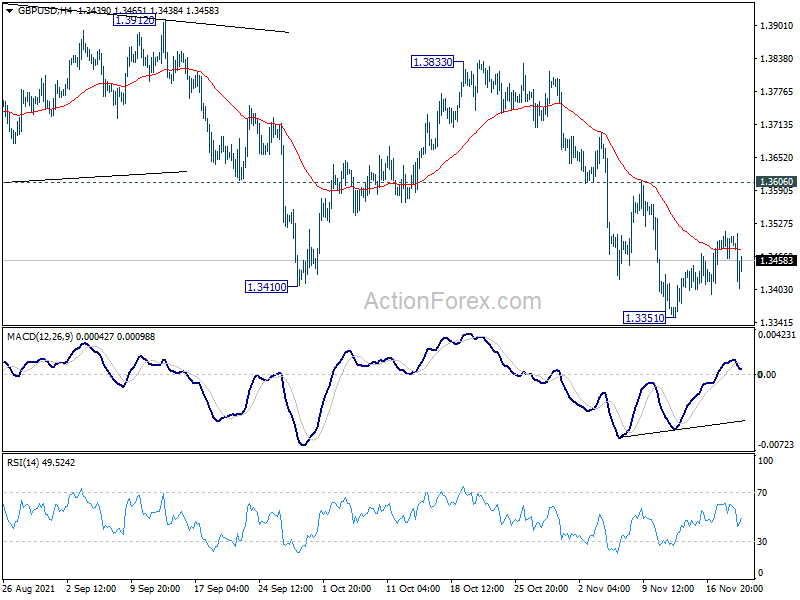
Intraday bias stays neutral first as consolidation from 1.3351 is still extending. Upside of recovery should be limited below 1.3606 resistance to bring down trend resumption. On the downside, break of 1.3351 will extend the decline from 1.4248 to 1.3164 fibonacci level next.
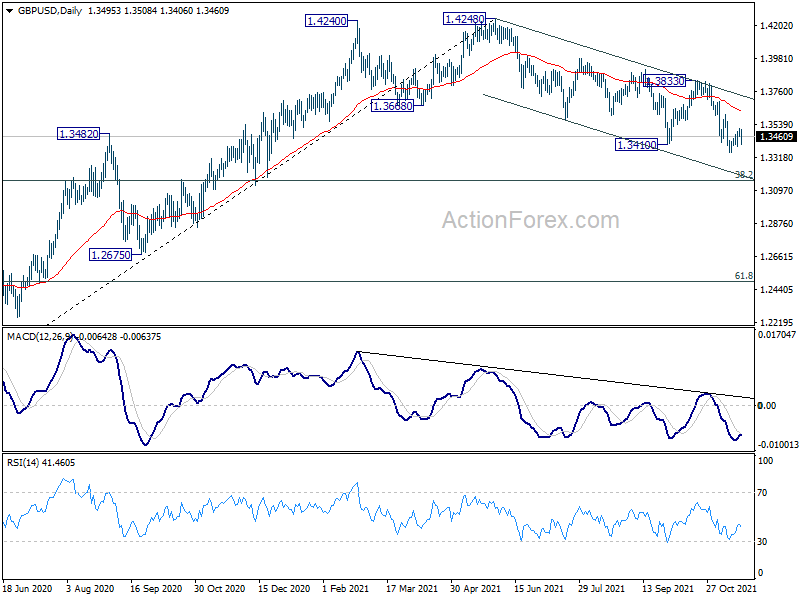
In the bigger picture, the structure of the fall from 1.4248 suggests that it's a correction to the up trend from 1.1409 (2020 low) only. While deeper fall cannot be ruled out yet, downside should be contained by 38.2% retracement of 1.1409 to 1.4248 at 1.3164, at least on first attempt, to bring rebound. On the upside, firm break of 1.4376 key resistance (2018 high) will add to the case of long term bullish reversal. However, sustained trading below 1.3164 will revive some medium term bearishness and target 61.8% retracement at 1.2493.
USD/CHF Mid-Day Outlook
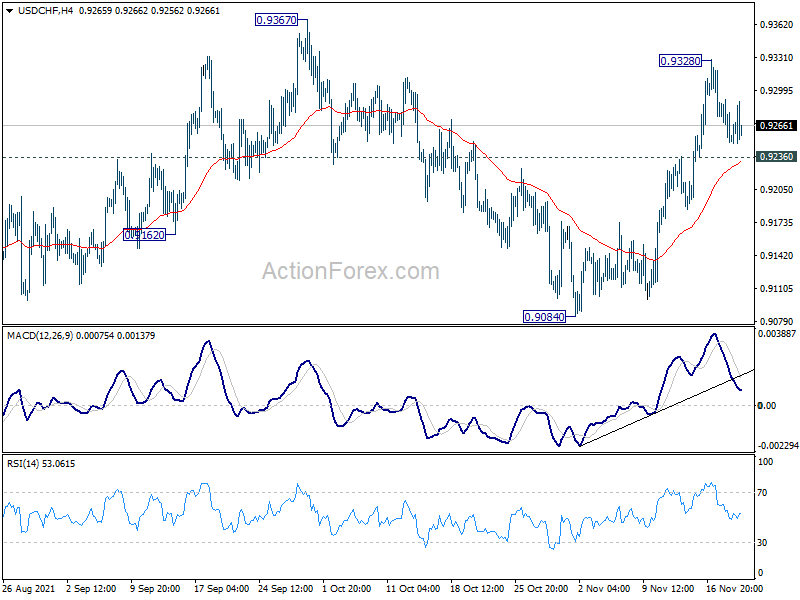
Daily Pivots: (S1) 0.9240; (P) 0.9266; (R1) 0.9281; More....
Intraday bias in USD/CHF stays neutral at this point. On the upside, above 0.9328 will resume the rally from 0.9084 for 0.9367 resistance. On the downside, below 0.9236 minor support will turn intraday bias back to the downside for 0.9084 instead.
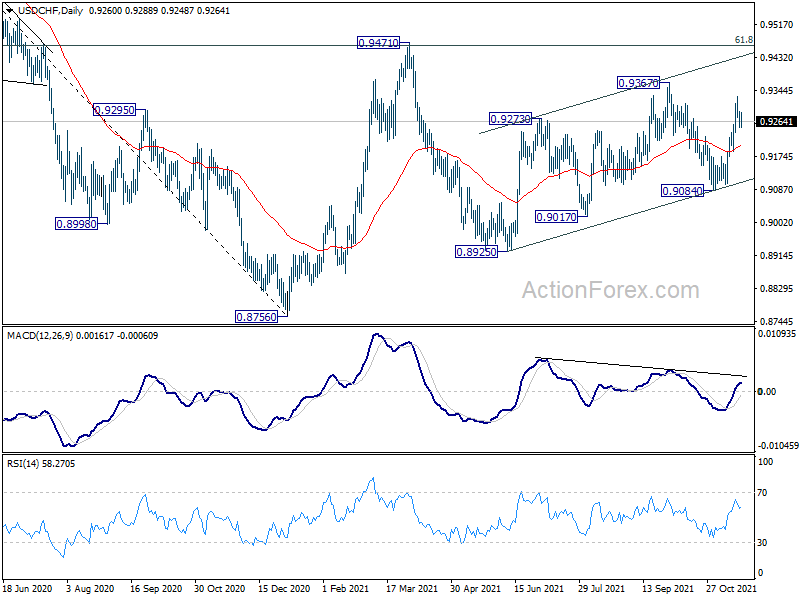
In the bigger picture, the corrective structure of the rebound from 0.8925 argues that fall from 0.9471 is not complete yet. It could either be the second leg of pattern from 0.8756 (2021 low), or resuming larger down trend from 1.0237 (2018 high). We'd pay attention to the downside momentum and assess the odds later. But for now, medium term outlook will be neutral at best as long as 0.9471 resistance holds.
USD/JPY Mid-Day Outlook
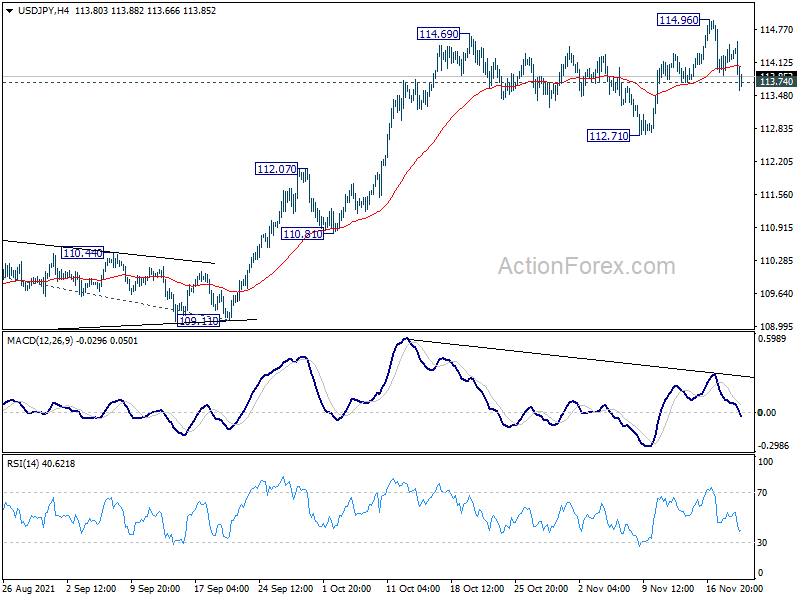
Daily Pivots: (S1) 113.92; (P) 114.20; (R1) 114.52; More...
Intraday bias in USD/JPY is turned back to the downside with break of 113.74 minor support. Fall from 114.96 would target 112.71 structural support next. Firm break there will bring deeper correction bask towards 111.65 resistance turned support. On the upside, break of 114.96 is now needed to confirm up trend resumption. Otherwise, outlook will be neutral for more corrective trading first.
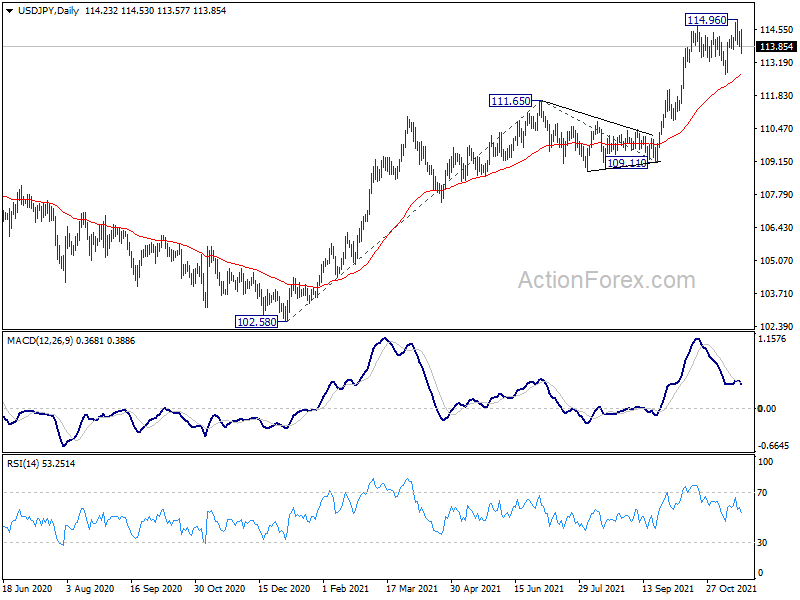
In the bigger picture, corrective decline from 118.65 (2016 high) should have completed at 101.18 already. Rise from the 102.58 is seen as the third leg of the up trend from 101.18. Next target is 118.65 high. This will now be the preferred case as long as 111.65 resistance turned support holds, even in case of deep pull back.
EUR/CHF Mid-Day Outlook
Daily Pivots: (S1) 1.0507; (P) 1.0517; (R1) 1.0536; More....
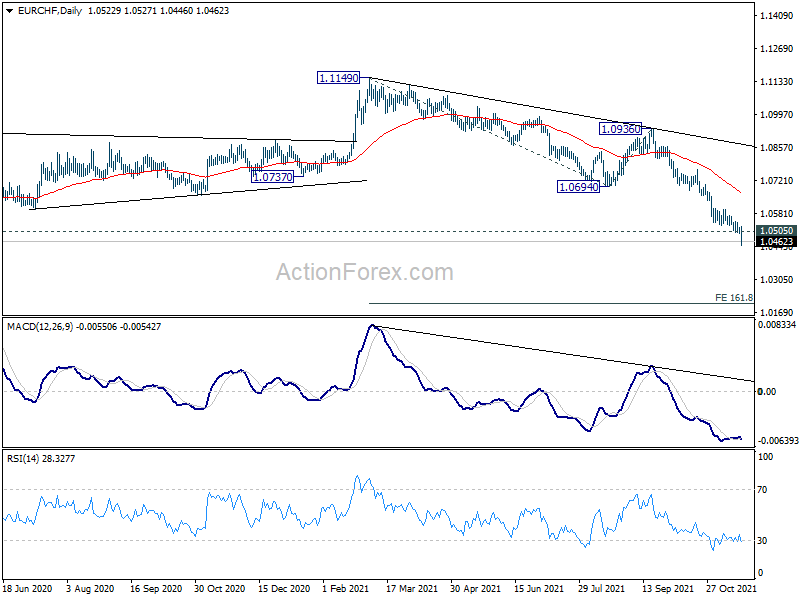
EUR/CHF's down trend resumes and hits as long as 1.0446 so far. The break of 1.0505 long term support should confirm resumption of long term down trend. Intraday bias is back on the downside for 161.8% projection of 1.1149 to 1.0694 from 1.0936 at 1.0200 next. On the upside, above 1.0527 minor resistance will turn intraday bias neutral and bring consolidations first, before staging another decline.
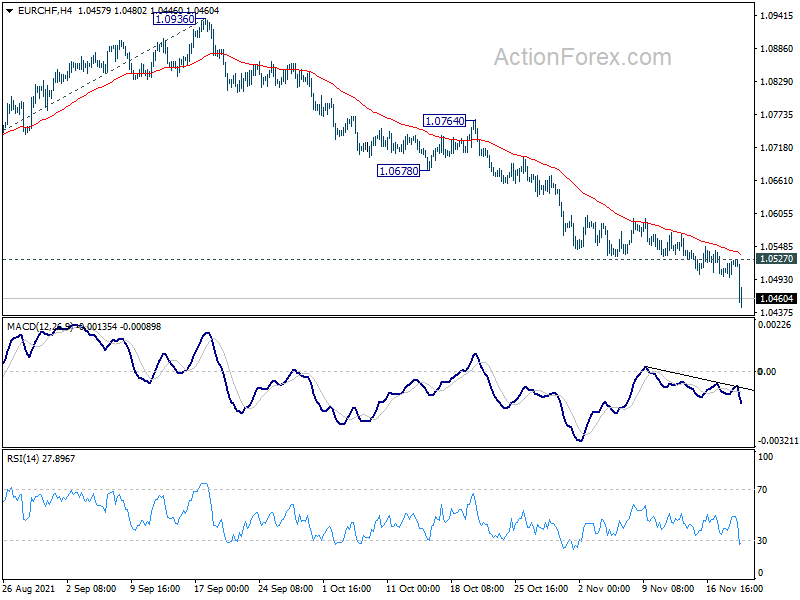
In the bigger picture, current downside momentum argues that fall from 1.1149 is probably resuming the down trend from 1.2004 (2018 high). Focus is now on 1.0505 (2020 low). Decisive break there will confirm this bearish case and target 61.8% projection of 1.2004 to 1.0505 to 1.1149 at 1.0223 next. Strong support from 1.0505 will bring rebound first. But outlook will stay bearish as long as 1.0936 resistance holds.
Euro Hammered as Lockdown Returns, Risk Sentiments Turn Sour
Euro's recovery was rather short-lived as selling returns after dovish comments from ECB president. Also, Austria returned to full lockdown while Germany may follow on the fourth wave of COVID-19 infections. Yen rises broadly today as risk sentiments turn sour. For the week, Euro remains the worst performer, followed by Aussie. Sterling is still the best performer, followed by Yen and then Dollar.
Technically, EUR/CHF should have taken out 1.5050 key long term support decisively. Current down trend should now target 161.8% projection of 1.1149 to 1.0694 from 1.0936 at 1.0200. We'll now see if selling in EUR/UISD would pick up below 1.13 handle.
In Europe, at the time of writing, FTSE is down -0.59%. DAX is down -0.65%. CAC is down -0.85%. Germany 10-year yield is down -0.056 at -0.331. Earlier in Asia, Nikkei rose 0.50%. Hong Kong dropped -1.07%. China Shanghai SSE rose 1.13%. Singapore Strait Times dropped -0.14%. Japan 10-year JGB yield dropped -0.0042 to 0.079.
Canada retail sales dropped -0.6% mom in Sep, better than expectation
Canada retail sales dropped -0.6% mom to CAD 56.6B in September, better than expectation of -1.6% mom decline. The contraction was led by sales at motor vehicle and parts dealers (-1.6%) as new car dealer sales (-2.8%) continued to struggle amid global supply shortages for semiconductor chips. Sales dropped in 7 of 11 subsectors, representing 63.5% of retail trade. Excluding gasoline stations and motor vehicle and parts, sales dropped -0.3% mom. In October, advance estimate shows a 1.0% mom rebound in sales.
Also from Canada, new housing price index rose 0.9% mom in October, above expectation of 0.5% mom.
ECB Lagarde: Doesn't make sent to react to current inflation by tightening policy
In a speech, ECB President Christine Lagarde said that the central bank focus on "medium term, not on current inflation numbers". "When inflation pressure is expected to fade – as is the case today – it does not make sense to react by tightening policy," she added. "The tightening would not affect the economy until after the shock has already passed."
Lagarde also said, "supply shock" will tend to "push up inflation and depress output. In this case, "tighter monetary policy would only exacerbate the contractionary effect on the economy." The Eurozone is facing a "mixture of shocks", partly related to catch-up demand but has a "strong supply-driven element". "Tightening policy prematurely would only make this squeeze on household incomes worse."
"The conditions to raise rates are very unlikely to be satisfied next year," she said. "Moreover, even after the expected end of the pandemic emergency, it will still be important for monetary policy – including the appropriate calibration of asset purchases – to support the recovery and the sustainable return of inflation to our target of 2%."
Also from Eurozone, current account surplus widened to EUR 18.7B in September. Germany PPI came in at 3.8% mom, 18.4% yoy, well above expectation of 1.2% mom, 12.7% yoy.
BoE Pill: No quick fix on inflation means patience required
BoE Chief Economist Huw Pill said in a conference today that there is "no quick fix" on inflation. He added, " lack of a quick fix means some patience will be required." He also said he had not made up his mind whether he would vote for a rate hike in December's meeting.
He added that policy communications was getting more complicated due to the two-side risks to both growth and inflation outlook. But, he said the central wanted to "train" the markets to focus more on the medium-term outlook and the two-side risks. Also, Some volatility was unavoidable give the uncertainty regarding the precise timing of the rate hikes.
UK retail sales rose 0.8% mom in Oct, ex-fuel sales grew 1.6% mom
UK retail sales grew 0.8% mom in October, above expectation of 0.5% mom. Ex-fuel sales jumped 1.6% mom, above expectation of 0.2% mom.
However, over the three months to October, sales volumes dropped -2.3% when compared with the previous three months. Compared with the same period a year earlier, sales volumes over the last three months dropped -0.5%.
Retail sales values, unadjusted for price changes, rose by 1.6% in October 2021, following an increase of 0.2% in September. Over the last three months to October 2021, the value of sales was up 3.3% on the same period a year earlier, reflecting an annual retail sales implied price deflator of 3.8%.
UK GfK consumer confidence rose to -14 despite higher inflation
UK GfK consumer confidence rose from -17 to -14 in November, better than expectation of -16. Expectation of personal financial situation over the next 12 months rose 1pt to 2. Expectation of general economic situation over the next 12 months rose 3 pts to -23.
Joe Staton, Client Strategy Director GfK, comments:"Headline consumer sentiment has ticked upwards this month despite decade-high inflation, fears of higher prices and worries over rising interest rates, and as the deepening cost-of-living squeeze leaves UK household finances worse off this winter.
Also released, UK public sector net borrowing dropped to GBP 18.0 in October.
Japan CPI core rose 0.1% yoy in Oct, second month of rise
Japan all-time CPI dropped from 0.2% yoy to 0.1% yoy in October. CPI core (all-item ex food) was unchanged at 0.1% yoy. CPI core-core (all-item ex food and energy), dropped further from -0.5% yoy to -0.7% yoy.
The CPI core reading is now rising for the second straight month. Overall energy prices rose 11.3%. Gasoline prices surged at highest rate in over 13 years, up 21.4%, while kerosene also rose 25.9%. Accommodation fees gained 59.1%.
But CPI core-core was negative for the seventh straight month, as weighed down by record -53.6% fall in mobile communications fees.
EUR/CHF Mid-Day Outlook
Daily Pivots: (S1) 1.0507; (P) 1.0517; (R1) 1.0536; More....
EUR/CHF's down trend resumes and hits as long as 1.0446 so far. The break of 1.0505 long term support should confirm resumption of long term down trend. Intraday bias is back on the downside for 161.8% projection of 1.1149 to 1.0694 from 1.0936 at 1.0200 next. On the upside, above 1.0527 minor resistance will turn intraday bias neutral and bring consolidations first, before staging another decline.
In the bigger picture, current downside momentum argues that fall from 1.1149 is probably resuming the down trend from 1.2004 (2018 high). Focus is now on 1.0505 (2020 low). Decisive break there will confirm this bearish case and target 61.8% projection of 1.2004 to 1.0505 to 1.1149 at 1.0223 next. Strong support from 1.0505 will bring rebound first. But outlook will stay bearish as long as 1.0936 resistance holds.
Economic Indicators Update
| GMT | Ccy | Events | Actual | Forecast | Previous | Revised |
|---|---|---|---|---|---|---|
| 23:30 | JPY | National CPI Core Y/Y Oct | 0.10% | 0.10% | 0.10% | |
| 00:01 | GBP | GfK Consumer Confidence Nov | -14 | -16 | -17 | |
| 07:00 | EUR | Germany PPI M/M Oct | 3.80% | 1.20% | 2.30% | |
| 07:00 | EUR | Germany PPI Y/Y Oct | 18.40% | 12.70% | 14.20% | |
| 07:00 | GBP | Retail Sales M/M Oct | 0.80% | 0.50% | -0.20% | 0.00% |
| 07:00 | GBP | Retail Sales Y/Y Oct | -1.30% | -0.40% | -1.30% | -0.60% |
| 07:00 | GBP | Retail Sales ex-Fuel M/M Oct | 1.60% | 0.20% | -0.60% | -0.40% |
| 07:00 | GBP | Retail Sales ex-Fuel Y/Y Oct | -1.90% | -3.10% | -2.60% | -1.90% |
| 09:00 | EUR | Eurozone Current Account (EUR) Sep | 18.7B | 16.2B | 13.4B | 17.1B |
| 09:30 | GBP | Public Sector Net Borrowing (GBP) Oct | 18.0B | 22.3B | 21.0B | 19.9B |
| 13:30 | CAD | Retail Sales M/M Sep | -0.60% | -1.60% | 2.10% | |
| 13:30 | CAD | Retail Sales ex Autos M/M Sep | -0.20% | -1.00% | 2.80% | |
| 13:30 | CAD | New Housing Price Index M/M Oct | 0.90% | 0.50% | 0.40% |