

Sample Category Title
GBP/USD Daily Outlook
Daily Pivots: (S1) 1.3472; (P) 1.3493; (R1) 1.3521; More...
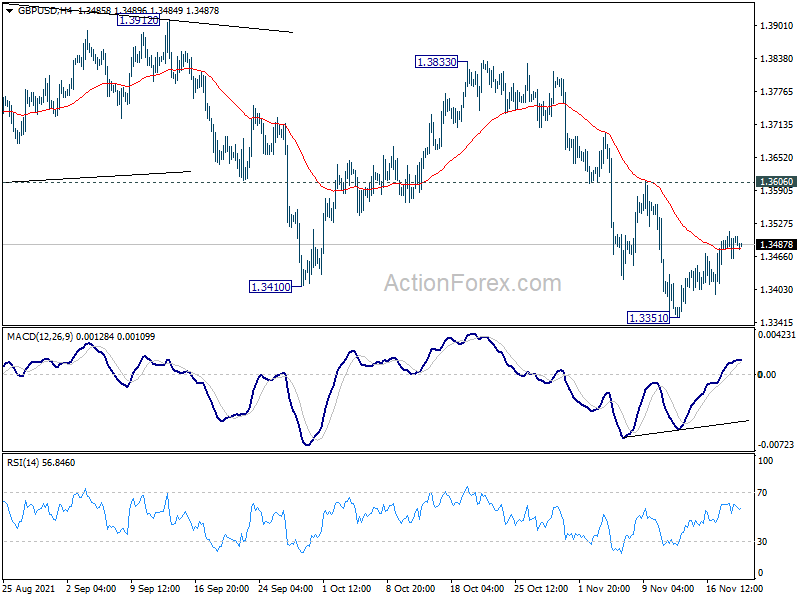
Intraday bias in GBP/USD remains neutral for the moment. Consolidation from 1.3351 is still in progress and could extend further. But upside of recovery should be limited below 1.3606 resistance to bring down trend resumption. On the downside, break of 1.3351 will extend the decline from 1.4248 to 1.3164 fibonacci level next.
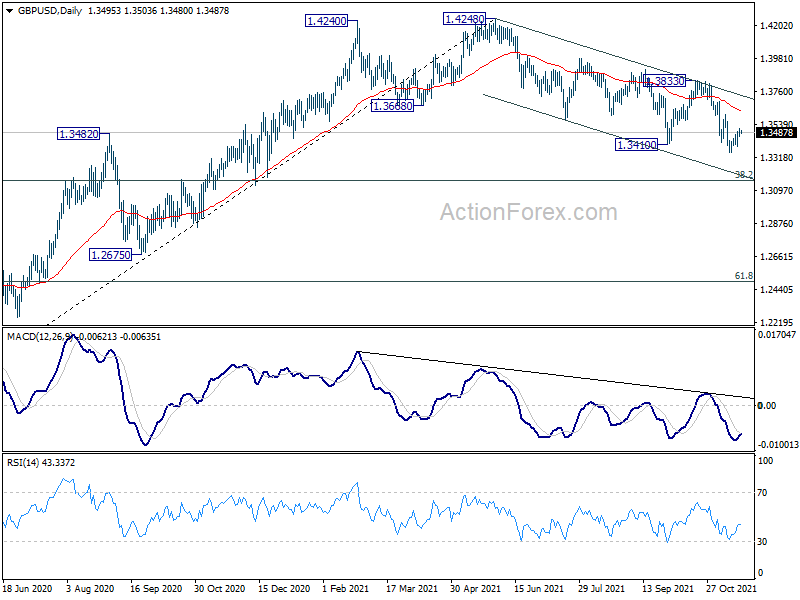
In the bigger picture, the structure of the fall from 1.4248 suggests that it's a correction to the up trend from 1.1409 (2020 low) only. While deeper fall cannot be ruled out yet, downside should be contained by 38.2% retracement of 1.1409 to 1.4248 at 1.3164, at least on first attempt, to bring rebound. On the upside, firm break of 1.4376 key resistance (2018 high) will add to the case of long term bullish reversal. However, sustained trading below 1.3164 will revive some medium term bearishness and target 61.8% retracement at 1.2493.
EUR/USD Daily Outlook
Daily Pivots: (S1) 1.1333; (P) 1.1354; (R1) 1.1393; More...
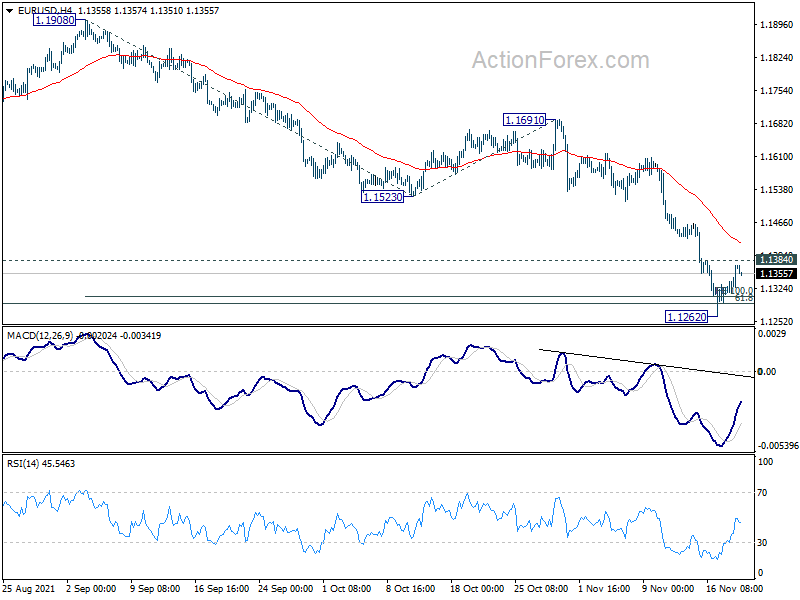
Intraday bias in EUR/USD stays neutral at this point. On the upside, break of 1.1384 minor resistance will indicate short term bottoming at 1.1262, after defending 1.1289 long term fibonacci level. Intraday bias will be turned back to the upside for rebound back to 1.1523 support turned resistance first. On the downside, however, sustained break of 1.1289 will carry larger bearish implication, and extend the fall from 1.2348 to 161.8% projection of 1.1908 to 1.1523 from 1.1691 at 1.1068.
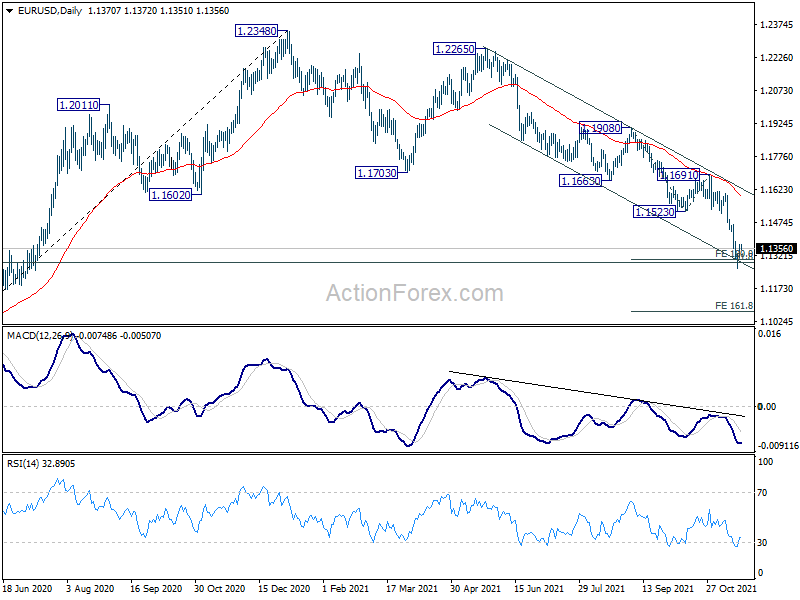
In the bigger picture, there are various ways of interpreting the fall from 1.2348 (2021 high). It could be a correction to rise from 1.0635 (2020 low), the fourth leg of a sideway pattern from 1.0339 (2017 low), or resuming long term down trend. In any case, outlook will now stay bearish as long as 1.1703 support turned resistance holds. Sustained break of 61.8% retracement of 1.0635 to 1.2348 at 1.1289 would pave the way back to 1.0635.
Euro Recovers, Dollar Retreats as Markets Turn Quiet
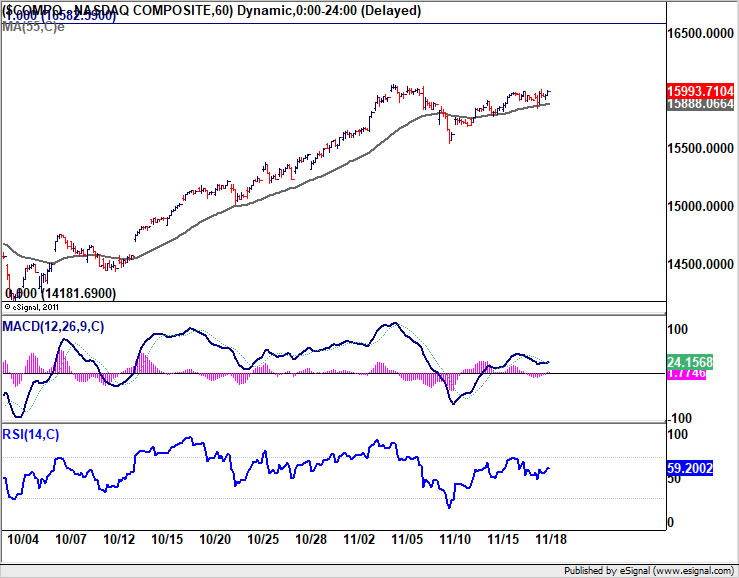
Dollar's retreat continues in Asian session, but it remains one of the strongest for the week, just next to Sterling. On the other hand, while Euro is recovering, it's still the worst performing one followed by Aussie. Overall, the markets are staying in a near term consolidative phase with mixed performance in stocks and yield, while gold and silver are range bound. As week end approaches, we'll see if NASDAQ could ride on yesterday's buying pace to make new record, and set the risk sentiment tone for next week.
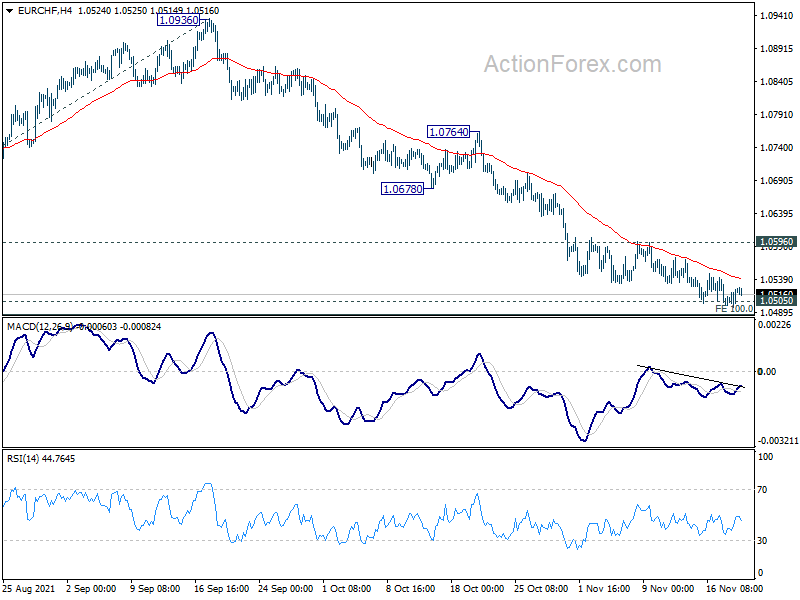
Technically, Euro continues to pare back recent losses against other major currencies. We'll keep an eye on 1.1384 minor resistance in EUR/USD and 130.58 minor resistance in EUR/JPY. Break of these levels could trigger some short covering ahead of the weekend and lift Euro generally higher. On the other hand, intensified selling in EUR/CHF through 1.0505 key support could hammer Euro down elsewhere too.
In Asia, at the time of writing, Nikkei is up 0.41%. Hong Kong HSI is down -1.71%. China Shanghai SSE is up 0.43%. Singapore Strait Times is down -0.13%. Japan 10-year JGB yield is down -0.0030 at 0.081. Overnight, DOW dropped -0.17%. S&P 500 rose 0.34%. NASDAQ rose 0.45%. 10-year yield dropped -0.015 to 1.589.
Fed Bostic: Appropriate to normalize interest rate by summertime next year
Atlanta Fed President Raphael Bostic said on Thursday, "right now, our projections suggest that by the summertime of next year, the number of jobs that we have in the economy will be pretty much where we were pre-pandemic."
"And at that point, I think it's appropriate for us to try to normalize our interest rate policy," he added.
Fed Evans: Inflation is not hair on fire
Chicago Fed President Charles Evans said he wouldn't describe inflation as "hair on fire". But he admitted, high inflation is "gone on longer", and things are "not quite as clean as I was hoping for".
Evans also tried to solidify the expectation that Fed won't raise interesting rate before completing tapering. Also, there won't be adjustment in the tapering pace, "state-contingent, we see a big change in the data."
Japan CPI core rose 0.1% yoy in Oct, second month of rise
Japan all-time CPI dropped from 0.2% yoy to 0.1% yoy in October. CPI core (all-item ex food) was unchanged at 0.1% yoy. CPI core-core (all-item ex food and energy), dropped further from -0.5% yoy to -0.7% yoy.
The CPI core reading is now rising for the second straight month. Overall energy prices rose 11.3%. Gasoline prices surged at highest rate in over 13 years, up 21.4%, while kerosene also rose 25.9%. Accommodation fees gained 59.1%.
Bot CPI core-core was negative for the seventh straight month, as weighed down by record -53.6% fall in mobile communications fees.
UK Gfk consumer confidence rose to -14 despite higher inflation
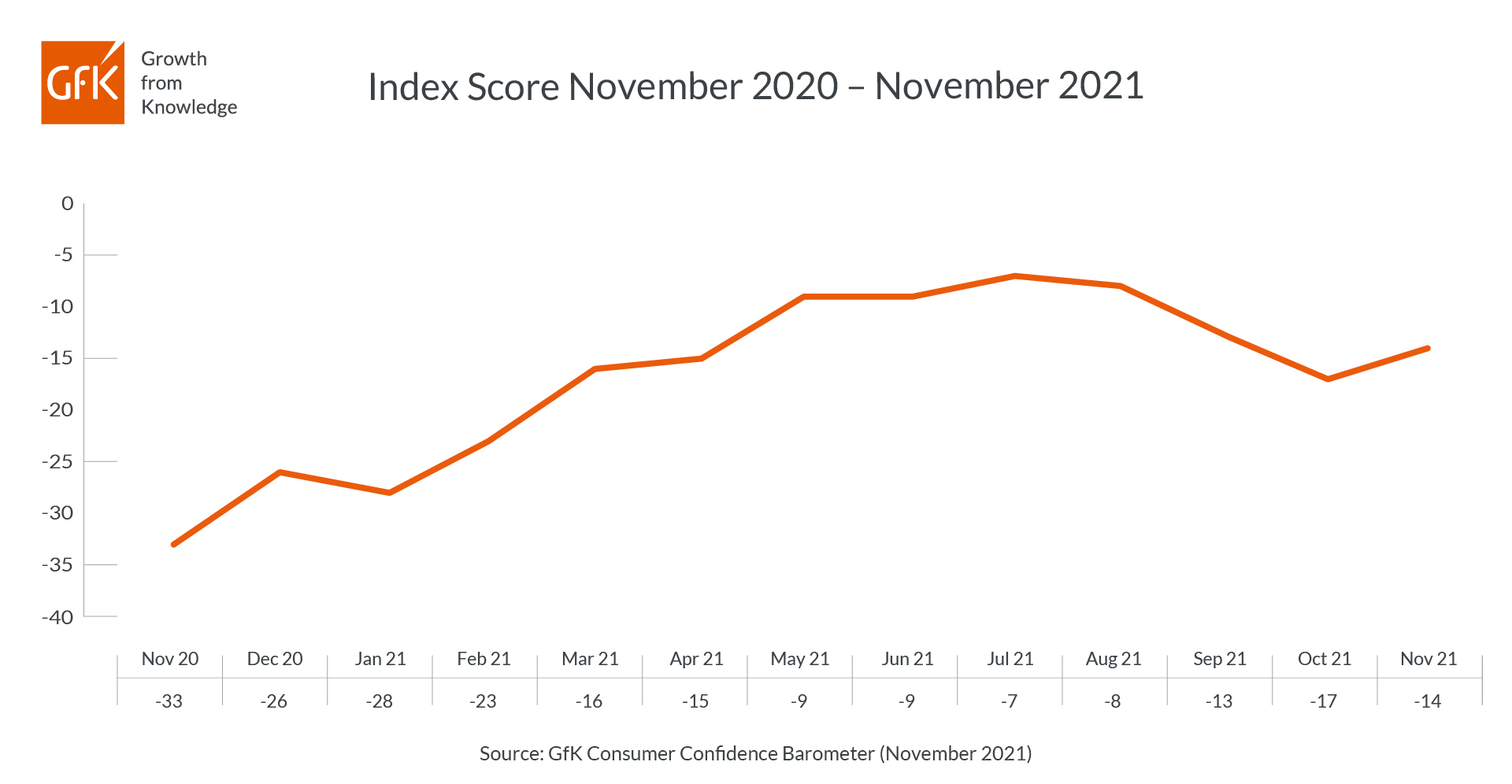
UK GfK consumer confidence rose from -17 to -14 in November, better than expectation of -16. Expectation of personal financial situation over the next 12 months rose 1pt to 2. Expectation of general economic situation over the next 12 months rose 3 pts to -23.
Joe Staton, Client Strategy Director GfK, comments:"Headline consumer sentiment has ticked upwards this month despite decade-high inflation, fears of higher prices and worries over rising interest rates, and as the deepening cost-of-living squeeze leaves UK household finances worse off this winter.
Looking ahead
UK retail sales and public sector net borrowing will be released in European session, along with Germany PPI and Eurozone current account. Canada will release retail sales and new housing price index later in the day.
EUR/USD Daily Outlook
Daily Pivots: (S1) 1.1333; (P) 1.1354; (R1) 1.1393; More...
Intraday bias in EUR/USD stays neutral at this point. On the upside, break of 1.1384 minor resistance will indicate short term bottoming at 1.1262, after defending 1.1289 long term fibonacci level. Intraday bias will be turned back to the upside for rebound back to 1.1523 support turned resistance first. On the downside, however, sustained break of 1.1289 will carry larger bearish implication, and extend the fall from 1.2348 to 161.8% projection of 1.1908 to 1.1523 from 1.1691 at 1.1068.
In the bigger picture, there are various ways of interpreting the fall from 1.2348 (2021 high). It could be a correction to rise from 1.0635 (2020 low), the fourth leg of a sideway pattern from 1.0339 (2017 low), or resuming long term down trend. In any case, outlook will now stay bearish as long as 1.1703 support turned resistance holds. Sustained break of 61.8% retracement of 1.0635 to 1.2348 at 1.1289 would pave the way back to 1.0635.
Economic Indicators Update
| GMT | Ccy | Events | Actual | Forecast | Previous | Revised |
|---|---|---|---|---|---|---|
| 23:30 | JPY | National CPI Core Y/Y Oct | 0.10% | 0.10% | 0.10% | |
| 00:01 | GBP | GfK Consumer Confidence Nov | -14 | -16 | -17 | |
| 07:00 | EUR | Germany PPI M/M Oct | 1.20% | 2.30% | ||
| 07:00 | EUR | Germany PPI Y/Y Oct | 12.70% | 14.20% | ||
| 07:00 | GBP | Retail Sales M/M Oct | 0.50% | -0.20% | ||
| 07:00 | GBP | Retail Sales Y/Y Oct | -0.40% | -1.30% | ||
| 07:00 | GBP | Retail Sales ex-Fuel M/M Oct | 0.20% | -0.60% | ||
| 07:00 | GBP | Retail Sales ex-Fuel Y/Y Oct | -2.60% | |||
| 09:00 | EUR | Eurozone Current Account (EUR) Sep | 16.2B | 13.4B | ||
| 09:30 | GBP | Public Sector Net Borrowing (GBP) Oct | 22.3B | 21.0B | ||
| 13:30 | CAD | Retail Sales M/M Sep | -1.60% | 2.10% | ||
| 13:30 | CAD | Retail Sales ex Autos M/M Sep | -1.00% | 2.80% | ||
| 13:30 | CAD | New Housing Price Index M/M Oct | 0.50% | 0.40% |
UK Gfk consumer confidence rose to -14 despite higher inflation
UK GfK consumer confidence rose from -17 to -14 in November, better than expectation of -16. Expectation of personal financial situation over the next 12 months rose 1pt to 2. Expectation of general economic situation over the next 12 months rose 3 pts to -23.
Joe Staton, Client Strategy Director GfK, comments:"Headline consumer sentiment has ticked upwards this month despite decade-high inflation, fears of higher prices and worries over rising interest rates, and as the deepening cost-of-living squeeze leaves UK household finances worse off this winter.
Japan CPI core rose 0.1% yoy in Oct, second month of rise
Japan all-time CPI dropped from 0.2% yoy to 0.1% yoy in October. CPI core (all-item ex food) was unchanged at 0.1% yoy. CPI core-core (all-item ex food and energy), dropped further from -0.5% yoy to -0.7% yoy.
The CPI core reading is now rising for the second straight month. Overall energy prices rose 11.3%. Gasoline prices surged at highest rate in over 13 years, up 21.4%, while kerosene also rose 25.9%. Accommodation fees gained 59.1%.
Bot CPI core-core was negative for the seventh straight month, as weighed down by record -53.6% fall in mobile communications fees.
RBA: More Support For Scaling Back Bond Purchase Program While Wages Message Is Clear
On November 16 the RBA Governor gave a detailed speech with an extensive Question and Answer session to the Australian Business Economists. Westpac remains comfortable with its key views: that the first-rate hike in this cycle will be at the February Board meeting in 2023 (held since June this year despite legendary market and forecaster volatility) and that the Bond Buying Program will be wound back to $2 billion per week in February 2022 prior to the program being wound up in May.
1. Timing of the First-Rate Increase
Readers will be aware that the Bank has quite cautious forecasts for end 2022 – underlying inflation at 2.25%; wages growth at 2.5%; and the unemployment rate at 4.25%.
That compares with Westpac’s forecasts of – underlying inflation rate of 2.8%; wages growth of 2.75%; and the unemployment rate at 3.8%.
The RBA’s forecasts are consistent with the Governor’s ongoing implied preference to delay the rate hike until 2024.
But if we are right, he will have overachieved on his inflation target; will have some evidence that the trajectory for wages growth is accelerating; and will have good reason to expect that as the unemployment rate falls below 4% - (something we have not seen since the 1970’s) the response of wages growth could be somewhat non – linear. For Australia, the “flat” Phillips curve has not been tested at unemployment rates below 4%.
It is true that he raised the bar on the importance of wages growth by answering one question that asked for his policy response if underlying inflation printed 3% or higher but wages growth was lagging behind at 2–2.5%. His argument was that inflation I the target zone would not be sustainable without wages growth around 3%.
But unlike the policy prescription that rates will not be raised until inflation is sustainably within the target band and we have reached full employment a particular rate for wages growth is not part of formal policy.
We expect that ultra low unemployment complemented by an upward trajectory for wages growth will allow a rate hike even if the latest annual print for wages growth is below 3%.
For markets which are expecting a much earlier rate increase the Governor does point out the inertia in his preferred measure of wages growth (Wage Price Index). The Australian wage setting scene includes an annual minimum wage agreement; 2–3 year enterprise bargaining agreements; and a slow moving wage setting process for the public sector.
It is only the informal sector where individuals negotiate directly with employers that any immediate labour shortages appear quickly in the WPI. We saw some evidence for that in the September quarter WPI which printed on November 17 where the sector receiving the largest increase – professionals, including lawyers and accountants, registered 3.4% for the year and 1.3% for the quarter – a sector where individual agreements prevail.
This inertia in the WPI is also behind our own view that the WPI will still only be increasing by 2.75% by end 2022. Of course, the RBA will be watching for the informal component of the WPI to provide a “lead indicator” for other components. The upward trajectory in growth of WPI along with the signals from the informal sector; should be enough to allow a rate move despite the official wages growth print below that “magic” 3%. Also recall that the September quarter WPI will print after the
November Board meeting but will be the last print before the February meeting in 2023. Unlike the CPI which will be available for the December quarter the WPI measure will be a little “stale” by February, but other high frequency data should provide the Board with enough evidence to start the process despite the official WPI growth rate holding below that 3%.
2. The Quantitative Easing Program.
In the speech the Governor gave some emphasis to the revised forecasts which the Board will receive for the February Board. Recall that following the lock downs in both Sydney and Melbourne the Board deferred its decision to review its bond buying program at the November Board to the February Board.
At the November Board the forecast for underlying inflation in 2022 was lifted from 1.75% to 2.25% and 2023 was lifted from 2.25% to 2.5%. It is reasonable that if there had been a review in November that recognition in the forecasts of much faster progress on the inflation target would have justified a scaling back in the purchase program from $4 billion per week to $3 billion.
We think the 2022 forecast for underlying inflation can be further scaled up at the February Board.
That would be consistent with a reduction in the purchase program to $2 billion, incorporating a catch up from November along with further recognition about the inflation target in February.
Now that the RBA has discontinued its Yield Curve Targeting having not extended the Term Funding Facility, we are only left with one more component of unconventional policy – the bond buying program.
The program began in November 2020 with a commitment to purchase a total of $100 billion in bonds ($80 billion in AGS and $20 billion in local and semi government securities) at a pace of $5 billion per week.
A second $100 billion tranche was announced at the February 2021 Board meeting which would extend until September 2021.
In July the Board announced that it would further extend the purchase program from September at a scaled back $4 billion pace with a review at the November Board meeting.
In response to the delta related lock downs in NSW and Victoria the Board announced that it would delay the November review of the program until the February 1 Board meeting in 2022.
Following the November Board meeting where the Governor announced that the Yield Curve Target would be dropped, he confirmed that the bond buying program would be reviewed at the February Board.
He noted that the review would be based on three considerations:
1. The actions of other central banks.
2. How our bond market is functioning.
3. Most importantly, the actual and expected progress towards
our goals for inflation and unemployment. And added in the speech the importance of the revised forecasts (as discussed above).
Other Central Banks and Market Conditions
I think the two central banks that will have the most significant impact on the Board’s deliberations will be the US Federal Reserve and the Bank of Canada.
I choose these two Banks because the FOMC is the benchmark for QE policy while the BOC is often cited as having a similar steady approach to policy, in contrast, say, with the recent more volatile policies from the RBNZ and, arguably, the Bank of England.
Following the RBA’s meeting on November 2 the FOMC decided at its meeting later in that week that it would begin reducing the monthly pace of its purchase program (currently $80 billion in Treasury bonds and $40 billion in agency mortgage-backed securities) by $10 billion for Treasury bonds and $5 billion for mortgage- backed securities.
By end December it will have reduced its monthly purchases to $60 billion in Treasuries and $30 billion in agencies.
At that pace the purchase program can be expected to cease in June. The FOMC allowed for the possibility of adjusting that pace if warranted by the economic outlook.
On October 27 the Bank of Canada announced that it was ending quantitative easing and moving into the reinvestment phase during which it will purchase bonds solely to replace maturing bonds.
Because the RBA did not begin QE until November 2020 and its purchases were in the 5–10 year maturity window it will not be confronted with a large scale maturity program until around 2025, although its much more modest purchases of April 2023 bonds under the first stage of YCT will mature in 2023.
The BOC has been ahead of the RBA in terms of its QE. It began its program in March 2020 by purchasing $5 billion in bonds per week. During 2020 it cut the purchase pace back to $4 billion and at the time of the decision to cease purchases had reduced weekly purchases to $2 billion.
As with the FOMC’s current plan the BOC’s policy has been to gradually scale back purchases. That approach, complemented by the reinvestment policy, is akin to the RBA’s condition of supporting a smoothly functioning bond market without any unintended consequences of a sharp withdrawal of central bank support for the market.
By mid February the RBA estimates that it will hold 36% of AGS outstanding and 18% of semi and local government bonds.
That share of AGS will compare with BOC of around 44% and FOMC of around 30% in central government holdings.
Note that the RBA’s run up in holdings has been much sharper than FOMC or BOC.
In early 2020 RBA held around 2% of total AGS compared to around 16% by the BOC and 18% by the FOMC.
So, RBA’s holdings of AGS in terms of the outstanding volume will be high but not excessive by February.
In the “excessive” camp we would class Japan; UK; and Euro area at near 50%.
Central banks claim to assess the impact of their QE policies in terms of the size of their balance sheets relative to the size of the economy. That is considered to be much more important than the flow of new purchases.
Deputy Governor Debelle noted (May 2021 – “Monetary Policy during Covid”) that “it is the stock of central bank purchases that matters rather than the flow…. It is the total size of the purchases that affects bond yields and financial conditions including the exchange rate rather than how many bonds the central bank is buying each week.”
In that regard the RBA’s holdings of AGS will be around 16% of GDP by February compared with nearly 20% for the BOC and around 22% for the FOMC.
So the Board should assess that its QE policies are having a comparably stimulatory impact on the economy as is the case in both US and Canada.
Actual and Expected Progress Towards Goals
When the Board meets on February 1 next year, we forecast that the key data points it will focus on will be progress on inflation (the print for the December quarter CPI will be available on January 27); employment (December employment report mid January); wages (December report only available in late February).
We expect that the Board discussion in February will be in the context of an underlying inflation print of 2.3%; an unemployment rate of 4.9%; and wages growth of 2.1%. (to the September quarter); and high frequency data indicating a sharp and sustainable lift in demand in the context of a 90% national vaccination rate amongst eligible adults.
That will be signalling an improving outlook but not sufficient improvement to justify the ending of the program.
Cutting weekly purchases from $4 billion to zero might also have some potential disruptive effects for the bond market (market functioning will be a factor in the decision).
With the Governor currently seeking to calm impatient financial markets with respect to the timing of the beginning of the tightening cycle a decision to abruptly end the bond buying program might trigger more unwanted volatility in the market.
But progress towards the goals will have been clear (especially on the inflation and growth fronts) so a tapering of purchases can be justified.
In fact, cutting the purchase program to $2 billion per week would be a sensible balance between stability and recognising the need to move away from the unconventional policies that were justified by the Covid emergency.
That $2 billion purchase program would be reviewed at the May Board meeting.
By the May meeting we expect that underlying inflation will print 2.5%; wages growth will have lifted to 2.3%; the unemployment rate will have fallen to 4.7%; and growth momentum in the first half of 2022 will be assessed at around 5%.
The FOMC will be very close to the end of its QE program (expected in June) while the BOC will have already established the precedent of a step down from $2 billion per week to zero.
Conditions will be ideal for an orderly end to a very successful unconventional policy initiative.
The scene will then be set for the first-rate increase at the February Board meeting in 2023.
Fed Bostic: Appropriate to normalize interest rate by summertime next year
Atlanta Fed President Raphael Bostic said on Thursday, "right now, our projections suggest that by the summertime of next year, the number of jobs that we have in the economy will be pretty much where we were pre-pandemic."
"And at that point, I think it's appropriate for us to try to normalize our interest rate policy," he added.
Fed Evans: Inflation is not hair on fire
Chicago Fed President Charles Evans said he wouldn't describe inflation as "hair on fire". But he admitted, high inflation is "gone on longer", and things are "not quite as clean as I was hoping for".
Evans also tried to solidify the expectation that Fed won't raise interesting rate before completing tapering. Also, there won't be adjustment in the tapering pace, "state-contingent, we see a big change in the data."
Cliff Notes: Market Anxiety Over Inflation at Odds with Central Bank View
Key insights from the week that was.
It has been another week focused on inflation, wages and monetary policy in Australia and abroad.
Tuesday saw the release of the RBA’s November meeting minutes and a speech by Governor Lowe on inflation. Our Chief Economist Bill Evans subsequently discussed the key ideas conveyed. From the minutes, most notable is that the RBA Board is planning an enquiry into Yield Curve Control and the other extraordinary monetary policy measures implemented during the pandemic.
Governor Lowe’s speech on the other hand focused on global and local inflation dynamics. A key explanation for the recent strength in inflation globally is the disparity between goods supply and demand, with production limited by the pandemic at the same time as lifestyle changes and support from fiscal policy saw goods demand skyrocket. Ahead, authorities believe these pressures will subside as supply chains reset and consumer services fully open, allowing for a more balanced consumption basket.
The prime issue for inflation going forward will therefore be how the labour market, particularly wages growth, responds to recent inflation pressures. Broadly, Governor Lowe was sanguine on the outlook for wages in Australia. In particular, he highlighted that the strong wages growth seen in the US and UK had been supported by a mismatch of labour supply and demand. Countries like Australia and Japan, in contrast, had not built up an imbalance thanks to the success of programs like JobKeeper which kept employees attached to their employers during lockdown. The inertia of our wage setting system was also seen as a mitigating force.
All told, the speech emphasised the focus of the Board on achieving its medium-term policy objectives and, while aware of the risks, their belief that they need to be patient to do so. The Q3 wage price index out this week supports this view, with wages rising 0.6% in the three months to September and 2.2%yr – growth in keeping with conditions prior to the pandemic, but weak versus the history of the survey.
In stark contrast to the RBA, next week in New Zealand the RBNZ is set to follow-up its 25bp October rate increase with another at the November meeting. Indeed, while not their base case, our New Zealand team recognise a 50bp move as a “meaningful risk”.
Either way, Westpac New Zealand economics believe the RBNZ is only at the beginning of a long tightening cycle to 3.00% in mid-2023. Justifying this course, the RBNZ’s gauge of inflation expectations rose to a decade high in Q4, with both the 1-year and 2-year measures materially above the 2.0%yr mid-point of the RBNZ’s inflation target range. These outcomes come as the New Zealand economy is showing strong underlying momentum and with closed borders and the financial position of households heightening inflation risks. Our New Zealand team’s latest quarterly Economic Overview provides an in-depth look at the state of their economy and the outlook.
Moving further afield, following last week’s extremely strong US CPI for October, inflation updates for the UK and Euro area this week confirmed that price pressures related to supply chains and energy are global phenomena, with annual inflation at 4.2%yr and 4.1%yr respectively. For both jurisdictions, these are highly unusual outcomes, more than double their central bank’s targets.
Arguably, the difference between the outcomes seen in the US versus the UK/ Euro Area is the breadth of price pressures, with less evidence of demand-led inflation in the UK/Euro Area arguing for a more rapid return towards target in these economies. The policy consequence of such an outturn would be a more muted rate hike cycle from the Bank of England than the FOMC, and likely no move on rates by the ECB. Note though the Bank of England could act well ahead of the FOMC given their asset purchases will conclude six months earlier.
Finally, a quick note on China. October retail sales surprised to the upside this week, suggesting that authorities have significantly improved their ability to control sporadic outbreaks of delta without a material consequence for consumption. Recognising that this delta disruption came later in the month, we will however have to wait until the November data is received before we can have full confidence in this view. The investment data that accompanied retail was weaker though, all considered, still robust. In the months ahead we will be looking for an acceleration in private sector business investment, with external demand and domestic economic development providing strong justification for capacity expansion. It will take some time for the property sector and infrastructure investment to reset however following the lengthy program of reform seen over the past few years.
EUR/GBP – Could We Finally See A Breakout?
Or will the long term channel hold?
The euro has been grinding lower against the pound for more than a year now, with much of 2021 spent within a shallow descending channel.
But with the two central banks likely to see some divergence in monetary policy over the next 12-18 months, could we finally see the pair break out of this long-standing trend?
The BoE bottled the rate hike at its November meeting, opting instead to wait for the furlough data before making its decision. Not bad logic in itself but when coupled with the communication in the run-up to the meeting, it’s confusing, to say the least.
While most central banks appear to be on the same page that the huge inflation overshoots are transitory, the responses to this are looking quite different which is what could be the catalyst for a breakout in this pair.
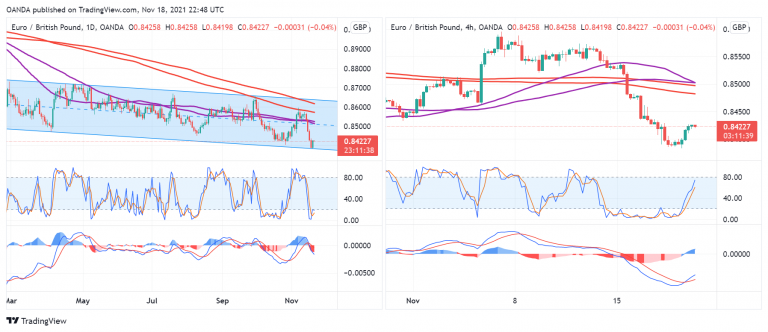
Already we’re seeing it trading at the bottom of the channel as more rate hikes are priced in for the UK. The ECB has pushed back and inflation data at the turn of the year may allow it plenty of flexibility to do so.
The pair has once again rebounded off the lower end of the channel after once again losing momentum on approach to it, but can it generate much upside from here? If not, will it break out and accelerate lower or continue to grind along the lower edge of the channel?
It is already running into some resistance around the late October lows which suggests we may not have to wait long to see. It could take a big push, perhaps some hawkish warnings from BoE policymakers as a catalyst, but should it break, the pair could spring to life for the first time in quite a while.