Sample Category Title
Crude Oil Price At Risk Of More Downsides
Key Highlights
- Crude oil price is struggling to recover above $80.50.
- A major bearish trend line is forming with resistance near $80.50 on the 4-hours chart of XTI/USD.
- EUR/USD extended decline below the 1.1300 support zone.
- GBP/USD is attempting an upside correction above 1.3450.
Crude Oil Price Technical Analysis
Crude oil price started a downside correction from the $85.00 zone against the US Dollar. The price traded below the $82.50 support to move into a short-term bearish zone.
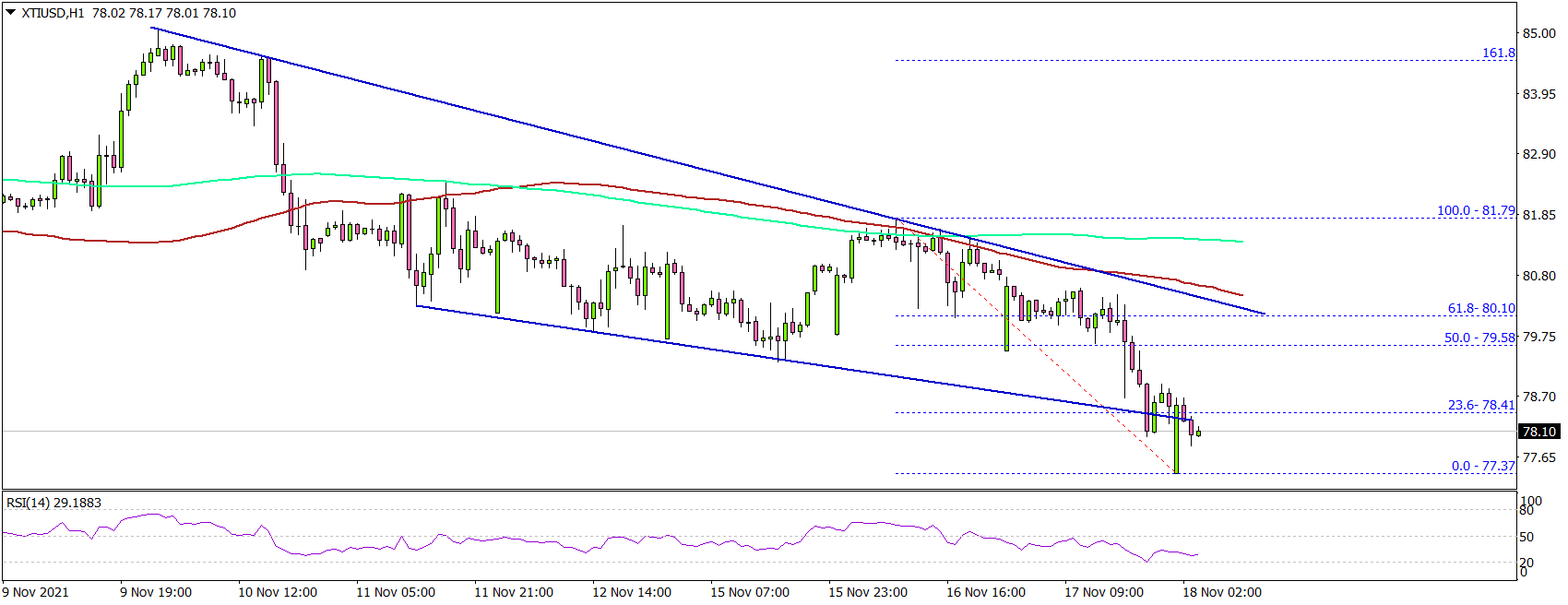
Looking at the 4-hours chart of XTI/USD, the price even settled below $82.50, the 100 simple moving average (4-hours, red) and the 200 simple moving average (4-hours, green).
There was a break below the $81.20 support zone and the $80.00 zone. The price even spiked below $79.20. If the bears remain in action, the price could slide towards the $78.20 level. The next major support is near the $77.50 level.
On the upside, an initial resistance is near the $80.50 level. There is also a major bearish trend line forming with resistance near $80.50 on the same chart.
The next major resistance is near the $81.50 level and the 200 SMA, above which the price could rise towards the $82.50 level. Any more gains could send the price towards $83.20.
Looking at EUR/USD, the pair failed to recover above 1.1350 and extended losses below the 1.1300 support zone. Besides, GBP/USD could recover further if it clears the 1.3500 level.
Economic Releases to Watch Today
- US Initial Jobless Claims - Forecast 260K, versus 267K previous.
RBNZ survey: Four rate hikes over next seven meetings
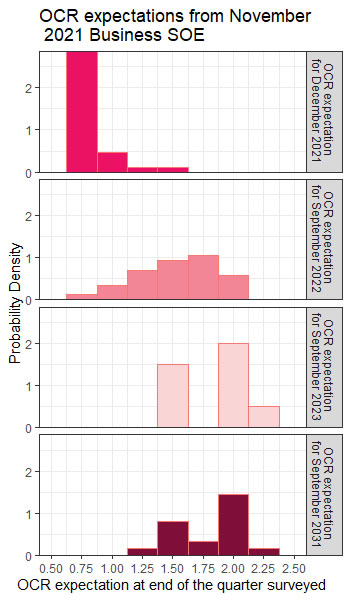
In the latest RBNZ survey for Q4, 2-year ahead inflation expectations rose from 2.27% to 2.96%, highest since June 2011. 5-year inflation inflation expectation rose from 2.03 to 2.17%, highest since September 2017.
Currently, the OCR is standing at 0.50%, after a rate hike of 25bps in October 6. Survey respondents expect Oct. to rise further to 0.75% by the end of the current quarter. Mean estimate for OCR one year ahead was 1.53%, translating to four 25bps hike over the next seven RBNZ meetings. Two year-head expectations stands at 1.83%, with more respondents expecting OCR to be either at 1.50% or 2.0)% by the end of September 2023.
CAD/JPY and AUD/JPY resume corrective decline
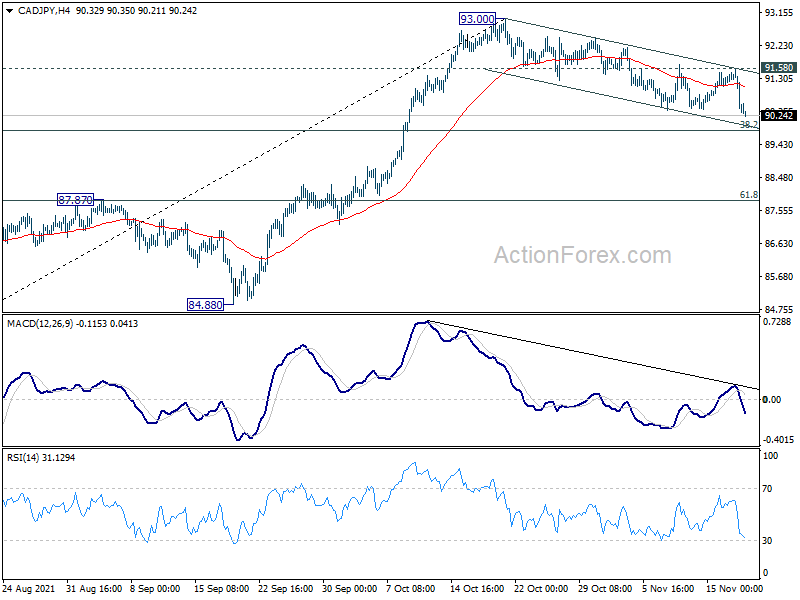
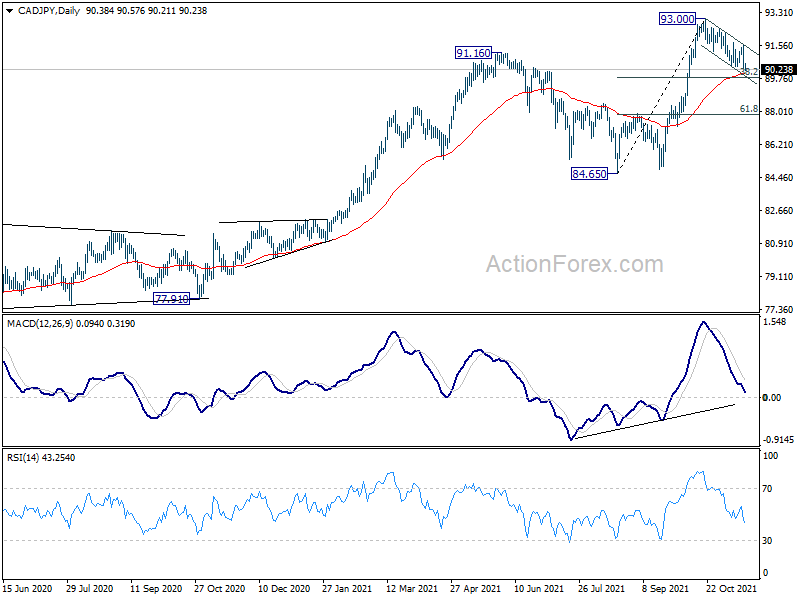
Following the pullback in US stocks overnight, Yen crosses are trading generally lower. In particular, CAD/JPY resumed the decline from 93.00 by breaking through 90.40 temporary low. Judging from the development in Yen pairs elsewhere, there is prospect of deeper decline even if such fall is still a corrective more.
For now, further decline is expected in CAD/JPY as long as 91.58 minor resistance holds. 38.2% retracement of 84.65 to 93.00 at 89.81 might provide some initial support. But firm break there will bring deeper fall to 61.8% retracement at 87.83.
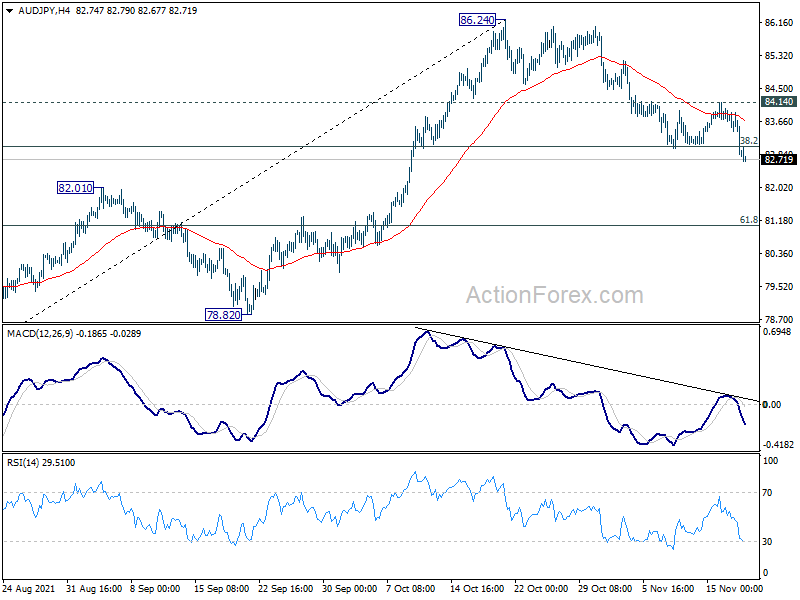
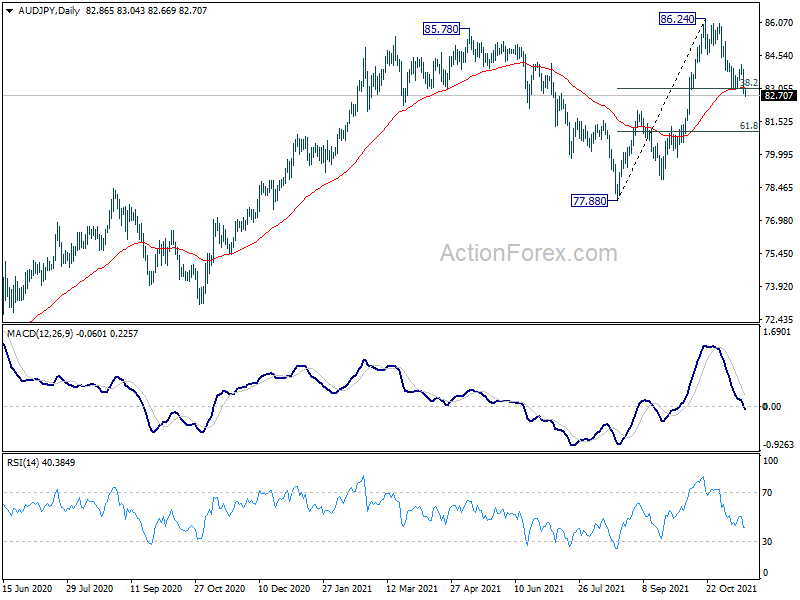
Development in AUD/JPY is slightly more bearish, as 55 day EMA and 38.2% retracement of 77.88 to 86.24 at 83.04 are both taken out. Fall from 86.24 has just resumed. Deeper decline is expected as long as 84.14 resistance holds, for 61.8% retracement at 81.07 and possibly below.
Fed Evans: Going to take us until the middle of next year to complete tapering
Chicago Fed President Charles Evans said in a virtual conference, "we learned back in 2013 that tapering these asset purchases was preferable for financial market functioning; that if we did a sudden stop on our purchases that wasn't well received. It's going to take us until the middle of next year to complete that".
"It's going to take us until the middle of next year to complete that; we are going to be mindful of inflation; we're going to be looking to see how much additional accommodation is boosting inflation; if indeed that is the case, we'll be thinking about when the right time to start raising rates will be," he added.
Eco Data 11/18/21
[php_everywhere instance="1"]
US Crude Oil Inventory Surprisingly Dropped. Yet, This Fails to Rescue Price Decline
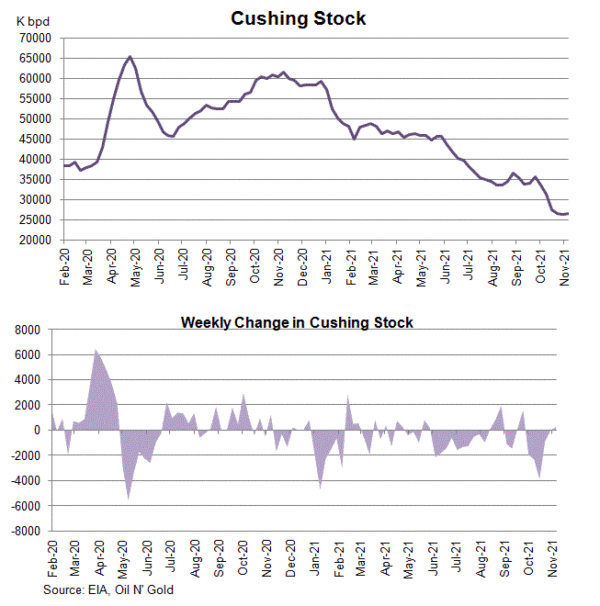
The report from the US Energy Information Administration (EIA) shows that total crude oil and petroleum products (ex. SPR) stocks sank -8.87 mmb to 1223.87 mmb in the week ended November 12. Crude oil inventory dropped -2.1 mmb to 433 mmb, compared with consensus of a +1.4 mmb increase. Inventory increased in 3 out of 5 PADDs. Yet, PADD3 (Gulf Coast) slumped -4.87 mmb growth during the week. Cushing stock added +0.22 mmb to 26.6. Utilization rate added +1.2 percentage points to 87.9% while crude production slipped -0.1 mmb to 11.4M bpd for the week. Crude oil imports increased -0.08M bpd to 6.19M bpd in the week.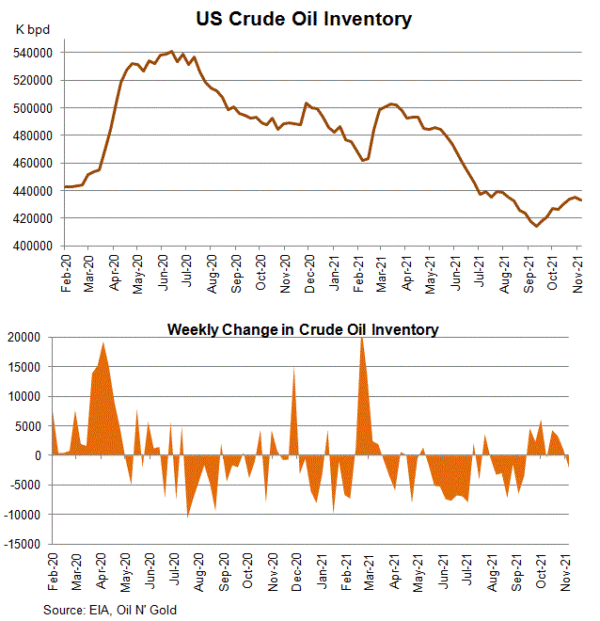
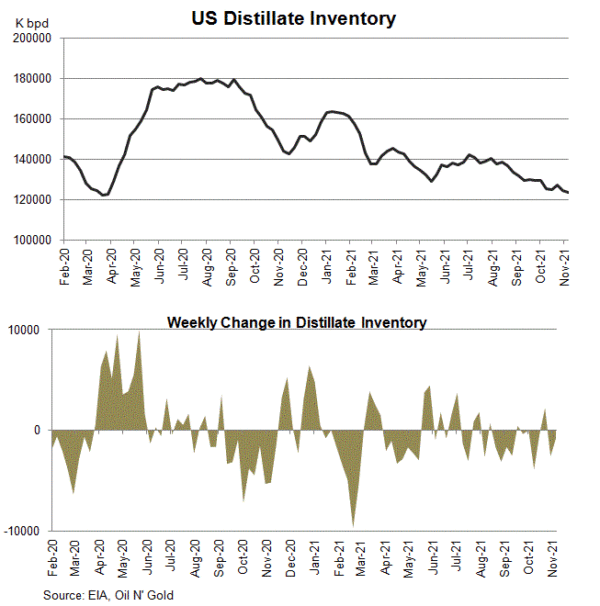
 Concerning refined oil product inventories, gasoline inventory dropped -0.71 mmb to 212 mmb while demand slid -0.19% to 9.24M bpd. The market had anticipated a -0.58 mmb fall in stockpile. Production slipped -1.31% to 9.92M bpd while imports soared +40.2% to 0.82M bpd during the week. Distillate stockpile slipped 0.82 mmb to 123.69 mmb. The market had anticipated a -1.23 mmb decrease. Demand added +1.64% to 4.35M bpd. Imports slumped -14.03% to 0.24 mmb while production slipped -0.53% to 4.84M bpd during the week.
A day earlier, the industry-sponsored API estimated that crude oil inventory climbed higher, by +0.66 mmb. Gasoline stockpile dropped -2.79 mmb, while that for distillate was up +0.11 mmb.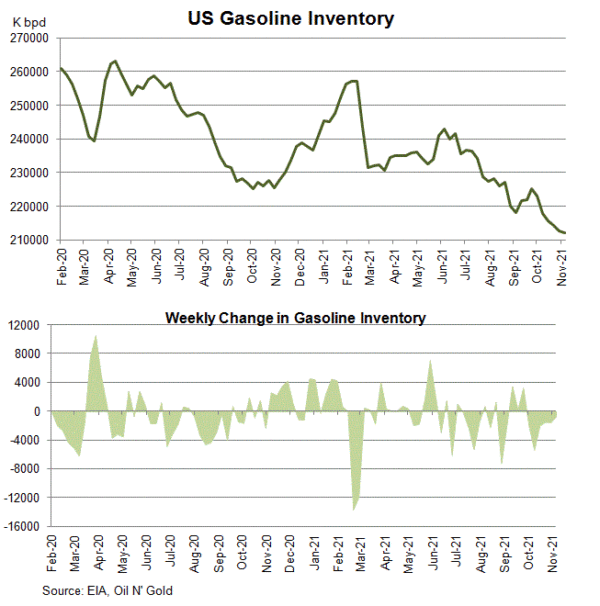
US oil inventories dropped -2.1m barrels, WTI extending consolidation
US commercial crude oil inventories dropped -2.1m barrels in the week ending November 12, versus expectation of 1m rise. At 433.0m barrels, oil inventories are about -7% below the five year average for this time of year.
Gasoline inventories dropped -0.7m barrels. Distillate inventories dropped -0.8m barrels. Propane/propylene dropped -0.2m barrels. Total commercial petroleum inventories dropped -8.9m barrels.
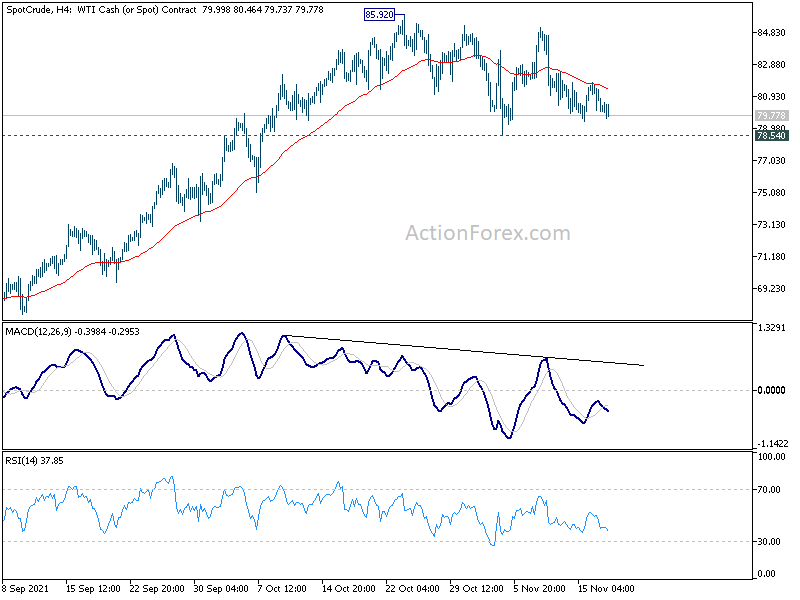
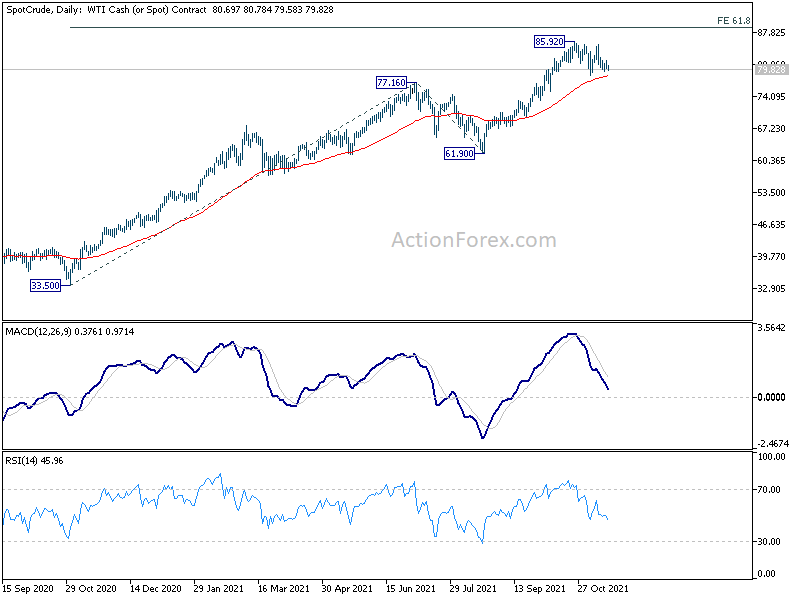
WTI crude oil has little reaction to the data. It's still extending the consolidation pattern from 85.92 short term top. For now, we'd continue to expect strong support from 78.54 to contain downside to bring rebound. This level is slightly above 55 day EMA at 78.47.
Medium term up trend should resume sooner or later and the real test is from 61.8% projection of 33.50 to 77.16 from 61.90 at 88.88. However, firm break of 78.54 will turn near term outlook bearish for deeper pull back into 61.90/77.16 support zone.
Canada: Inflation Heats Up Further in October
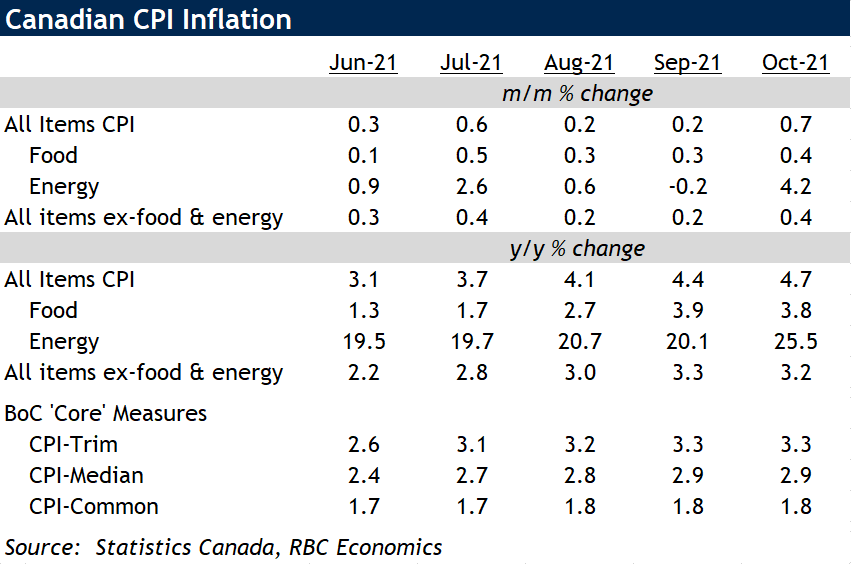
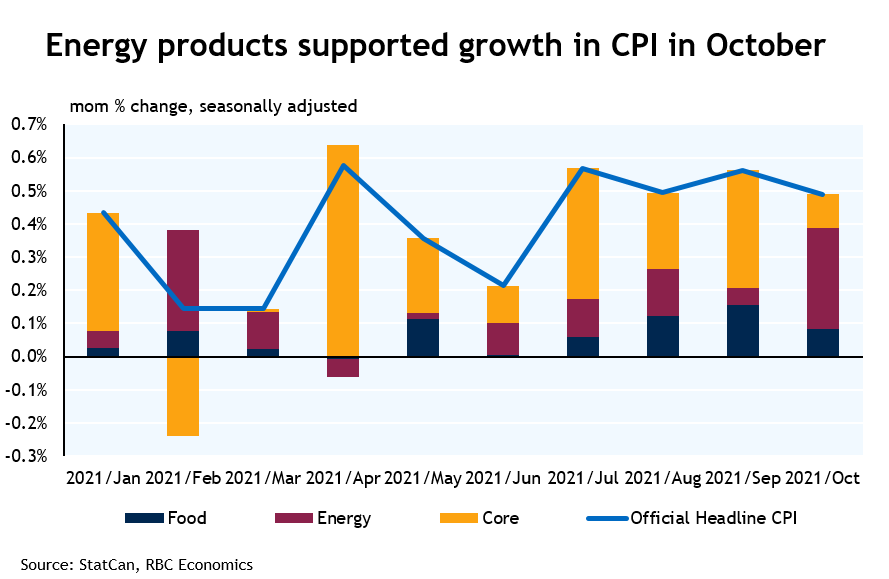
Consumer price inflation accelerated to 4.7% year-on-year (y/y) in October, up from 4.4% in September. Energy prices remained a key contributor to hotter inflation. Energy prices were 25.5% higher than a year ago, with gasoline prices up a whopping 41.7%. Excluding energy, prices were up 3.3% y/y, same as the pace in September.
In addition to energy, some other categories also saw faster price growth in October. Clothing and footwear prices were up 0.6% y/y from the 0.2% gain seen in September. Household operations, furnishings and equipment prices were 1.8% higher than a year ago, also marking an acceleration from September. Food and shelter prices were up by 3.8% and 4.8% respectively, matching the strong gains in the prior month.
Seasonally adjusted, month-on-month price were up 0.5%, continuing a string of strong monthly growth. Prices for recreation, reading & education rose by whopping 1.8% on the month. Shelter prices were up 0.7% with food prices posting a similar increase (+0.6%). Transportation prices increased by 1% on the month, and clothing and footwear prices posted their first monthly gain since July.
All three of the Bank of Canada's core inflation metrics were unchanged in October. The CPI-trim was at 3.3% y/y, CPI-Median at 2.9%, and the CPI-common measure at 1.8%. Taken together, the three measures averaged 2.7%, same as in September and was at its the highest level since December 2008.
Key Implications
The temperature outside might be plunging but inflation continued to heat up in October. Energy prices remain a major contributor, but consumers are feeling the pinch seemingly everywhere: at grocery and clothing stores, car dealerships, and at home.
Supply disruptions remain acute and continue to impact a broad range of items. Today's report flagged higher meat prices, which are up by 10% year-on-year driven by labor shortages and higher prices of feed for livestock. Prices for other items, such as recreation and clothing, continue to rise on the back of recovering consumer demand as well as higher input costs. As supply chain issues are expected to linger, inflation is likely to maintain a four handle for the remainder of this year.
The recovering economy and hot inflation will likely prompt the Bank of Canada to react and raise interest rates sooner rather than later. We expect the Bank of Canada to start raising its key interest rate in April of 2022, but cannot rule out the possibility the central bank will act earlier if the job market remains resilient and inflation keeps surprising to the upside.
NZD Steady ahead of Inflation Expectations
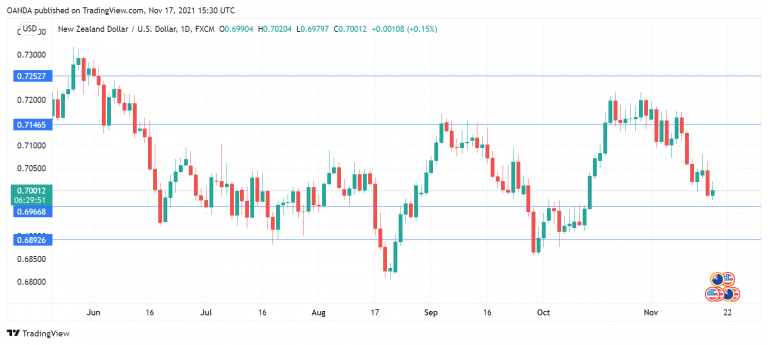
The New Zealand dollar is slightly higher in the Wednesday session. NZD/USD is currently trading at 0.6999, up 0.12% on the day.
New Zealand will release Q3 Inflation Expectations early on Thursday. The indicator has been accelerating and rose to 2.27% in the second quarter. If the report points to inflation expectations continuing to accelerate, it would lend support to the odds of the RBNZ raising rates next week, perhaps by 50 basis points. A strong reading would also provide a boost for the New Zealand dollar, which has declined by 2.3% in November and is struggling to stay above the 70 level, which has psychological significance.
The RBNZ will be paying close attention, as inflation expectations can manifest into actual inflation. In October, annual inflation for Q3 jumped to 4.9%, up from 3.3% and above the consensus of 4.2%. The central bank was one of the first major central banks to tighten policy when it raised rates last month, and the RBNZ is widely expected to make a series of rate hikes lasting into 2022.
In the US, the Federal Reserve is feeling the pressure to take action in order to put a lid on red-hot inflation. CPI hit a 30-year high in October, and the Fed’s narrative that inflation is transient is drawing more scepticism with every CPI report. Inflation may finally start to ease next year, but that seems a long, long time away for consumers who are feeling the pinch of across-the-board price increases. The surge in inflation is eating away at President Joe Biden’s popularity, and the White House has asked regulators to look into illegal conduct on the part of oil and gas companies.
The chorus of voices calling on the Fed to accelerate tapering is getting longer. We’ll be hearing from Fed members throughout the week, and the markets will be listening closely, looking for some insights as to what the Fed may be planning next.
NZD/USD Technical
- There is resistance at 0.7146 and 0.7252
- 0.6966 is a weak support line. Below, there is support at 0.6892
Canada’s Inflation Rate Rose to 4.7% in October
- Headline CPI rose to 4.7% supported by higher energy costs.
- Growth in prices ex-food & energy ticked lower to 3.2%.
- Inflation pressure will continue to broaden; central bank to ease off the accelerator with rate hikes starting in the second quarter of next year.
Canada’s headline inflation rate rose to 4.7% in October from 4.4% in September. All of the 0.3 ppt gain can be attributed to higher energy prices (+25.5%). Gasoline grew more expensive for consumers as global demand for oil firmed for power generation amidst a shortage of other energy sources. Prices for food ticked slightly lower but remained elevated (3.8%) as meat products grew pricier (+9.9%). High agricultural commodity and oil prices are expected to underpin food and energy prices near-term. But the breadth of growth across other products and services has also been edging higher, with 57.9% of the consumer basket seeing faster-than-target growth compared to pre-pandemic (2019) levels on average over the last 3 months.
Excluding both food and energy, prices grew a slower 3.2% from a year ago in October or 2.2% on an annualized seasonally adjusted basis from pre-shock February 2020 levels. Much of the latter can be attributed to home-owning related expenses (realtor/broker fees and higher housing ‘replacement’ costs), which look poised to remain elevated in the near-term given the recent resurgence in resale activity. Prices to purchase or lease autos was still elevated in October (+6.6%) with the global semi-conductor shortage limiting vehicle supply. Even outside of autos, supply chain disruptions and strong demand are pushing up production input costs, though much of those increases have yet to be passed on to final consumer customers.
While inflation has bounced back dramatically from pandemic-low levels, the labour market recovery also looks increasingly on firm footing. Job openings have been outpacing the amount of available unemployed workers in the market for months. That is expected to begin to bid up wages in the months ahead. Against that backdrop, we expect the Bank of Canada to begin to ease off the monetary-policy accelerator by beginning to hike rates in the second quarter of next year.