Sample Category Title
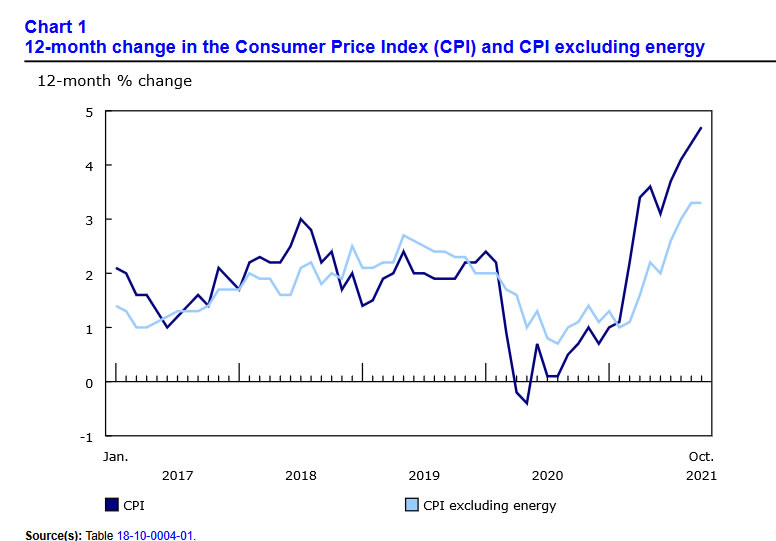
Canada CPI accelerated to 4.7% yoy in Oct, highest since 2003
Canada CPI accelerated to 4.7% yoy in October, up from September's 4.4% yoy, matched expectations. That's the highest reading since February 2003. Excluding energy, CPI rose 3.3% yoy, unchanged from September's reading. On a monthly basis CPI rose 0.7% mom, largest gains since June 2020.
CPI common was unchanged at 1.8% yoy, below expectation of 1.9% yoy. CPI median rose to 2.9% yoy, up from 2.8% yoy, matched expectations. CPI trimmed slowed to 3.3% yoy, down from 3.4% yoy, below expectation of 3.4% yoy.
Canadian Dollar Flat ahead of CPI
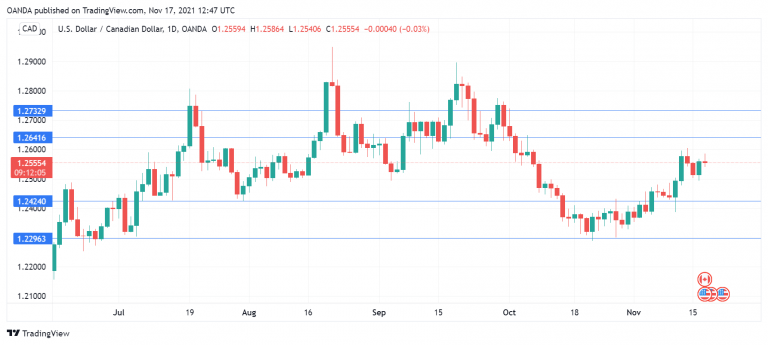
The Canadian dollar is drifting ahead of the North American session. Currently, USD/CAD is trading at 1.2559, unchanged on the day.
Canada will release October inflation reports later in the day. As is the case in the US, inflation is accelerating and has become a headache for the Bank of Canada. In September, headline inflation hit 4.4% y/y, its highest level since 2003. The BoC has signalled that it may raise rates around mid-2022, but the markets have priced in a hike for March of next year. If the CPI release beats expectations, the BoC will be under pressure to bring forward its timeline for a hike, which would be bullish for the Canadian dollar.
In the US, inflation has hit its highest level in 30 years, and pressure is mounting on the Fed to take action in order to contain inflation. The Fed’s message that inflation is transient has grown more stale with every CPI report. Inflation may finally start to ease next year, but that seems a long, long time away for consumers who are feeling the pinch of across-the-board price increases.
The Fed announced earlier this month that it would taper its bond program, but the chorus of voices calling on the Fed to accelerate tapering is getting longer. We’ll be hearing from Fed members throughout the week, and the markets will be listening closely, looking for some insights as to what the Fed may be planning next.
Ahead of the December policy meeting, the Fed will have had a chance to review key inflation data, including the October PCE index, the Fed’s favorite inflation gauge, as well as the November CPI report. These releases could have a significant impact on what if any moves the Fed announces at the December meeting.
USD/CAD Technical
- There is support at 1.2423. Below, there is support at 1.2296
- There is resistance at 1.2641, followed by 1.2732
UK CPI surged to 4.2% yoy in Oct, highest since 2011
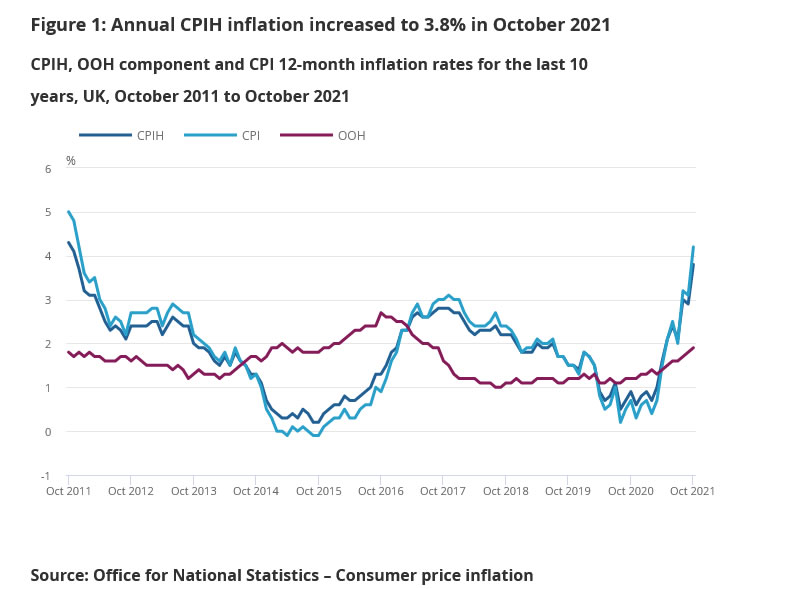
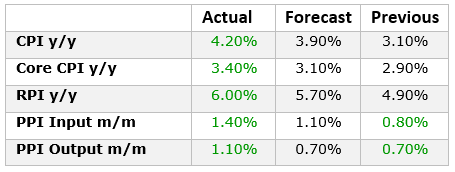
UK CPI surged to 4.2% yoy in October, up from 3.1% yoy, above expectation of 3.8% yoy. That's the highest level in nearly 10 years since November 2011. Core CPI also jumped to 3.4% yoy, up from 2.9% yoy, above expectation of 3.0% yoy. RPI also accelerated to 6.0% yoy, up from 4.9% yoy, above expectation of 5.6% yoy.
PPI input came in at 1.4% mom, 13.0% yoy, versus expectation of 1.1% mom, 11.6% yoy. PPI output was at 1.1% mom, 8.0% yoy, versus expectation of of 0.7% mom, 6.8% yoy. PPI core output was at 0.8% mom, 6.5% yoy, matched expectations.
GBPCAD Takes A Breather, But Downtrend Still In Play
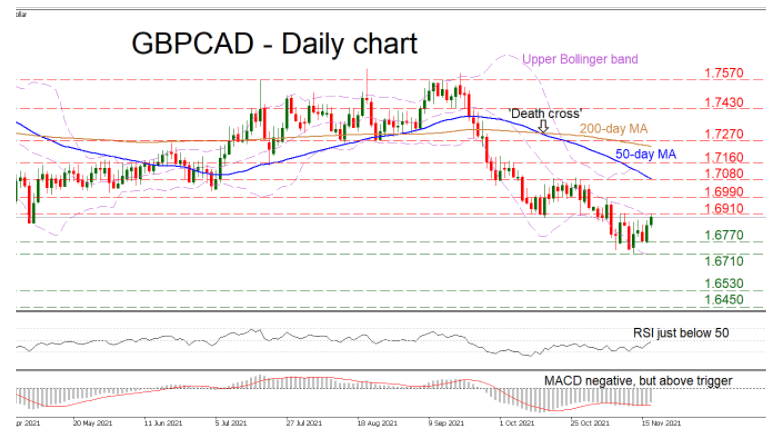
GBPCAD has rebounded in recent sessions, finding fresh buy orders after hitting 1.6710, a low last reached in March 2020. Despite this bounce, the structure of lower lows and lower highs remains intact. The pair is also trading below both its 50- and 200-day moving averages (MAs), which have posted a ‘death cross’ lately. Therefore, the outlook remains negative.
The short-term momentum oscillators reflect the latest bounce in the price. The RSI is trying to exit the bearish territory while the MACD has crossed above its red trigger line and looks to be moving higher. Both suggest that negative momentum is fading.
If buyers remain in control and manage to pierce above 1.6910, the next battle could take place around the 1.6990 zone. If that is breached as well, the spotlight would turn towards the 1.7080 region, which also encompasses the 50-day MA. Another upward violation could shift the outlook back to neutral, opening the door for a test of 1.7160.
Should the bears retake the wheel, preliminary support to any declines may be found near the recent lows at 1.6770. The multi-month trough of 1.6710 is close by and could be considered part of the same area. If that support barrier falters too, that would signal a resumption of the broader downtrend, turning the focus to 1.6530 next.
Summarizing, the outlook for GBPCAD remains firmly negative. A powerful break above 1.7080 is needed to bring that into doubt.
EUR/GBP: Pound Jumps On Soaring UK Inflation
Today’s very hot inflation numbers from the UK reaffirms expectations that the Bank of England will hike interest rates in December. After leaving policy unchanged in a move that surprised the markets last time, we have now seen more evidence to justify a small rate rise and the start of a hiking cycle with the latest inflation, wages and employment data all rising more than expected.
Following the publication of the UK inflation data this morning, the pound responded in the way you would expect – rising across the board. The key question is whether it will hold onto those gains. While I am not so sure it would be able to against the US dollar, owing to an improving US economy and where inflation is even hotter than in the UK, sterling is likely to remain supported against her weaker rivals i.e. currencies where the central bank is likely to remain more dovish or less hawkish than the BoE. Among others, these include the euro, yen and franc.
Indeed, the EUR/GBP today slipped to its lowest level since early 2020, as expectations over a growing UK-Eurozone rate differential caused UK yields to perform comparatively better than German yields. This comes as the UK Consumer Prices Index (CPI) rose by 4.2% in the year to October, on the back of rising petrol and household energy costs. This was much higher than 3.9% expected and marks a sharp increase from 3.1% the month before. Bank of England Governor Andrew Bailey has already warned inflation could climb as high as 5% but judging by today’s print it could rise even higher. Other measures of inflation were also stronger:
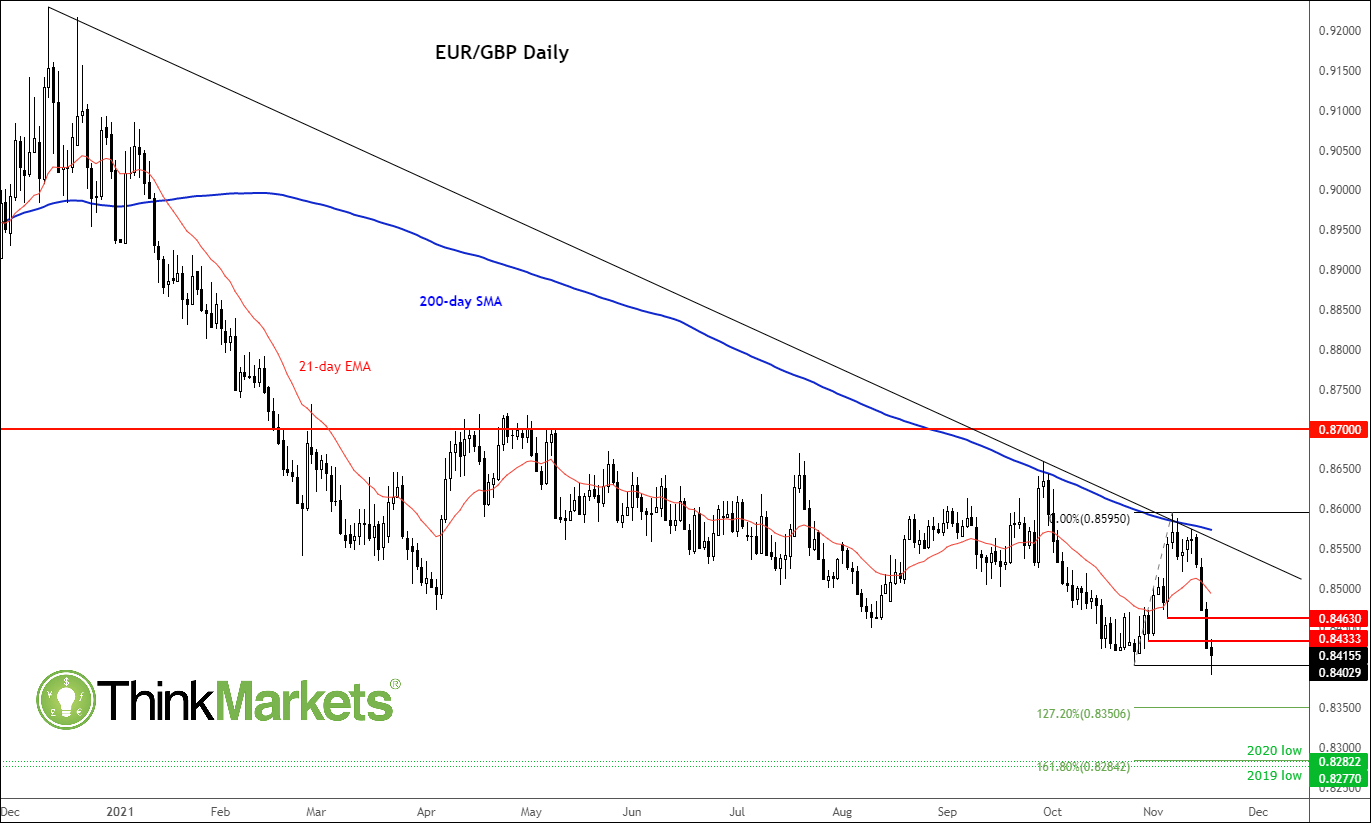
 As mentioned, the EUR/GBP broke to a fresh yearly low, although it did bounce off its lows. Still, the path of least resistance remains to the downside. I wouldn’t be surprised to see a return to the lows from 2019 and 2020 around the 0.8275-85 area in the days ahead. This is also where the 161.8% Fibonacci extension of the most recent up move come into play (see the daily chart).
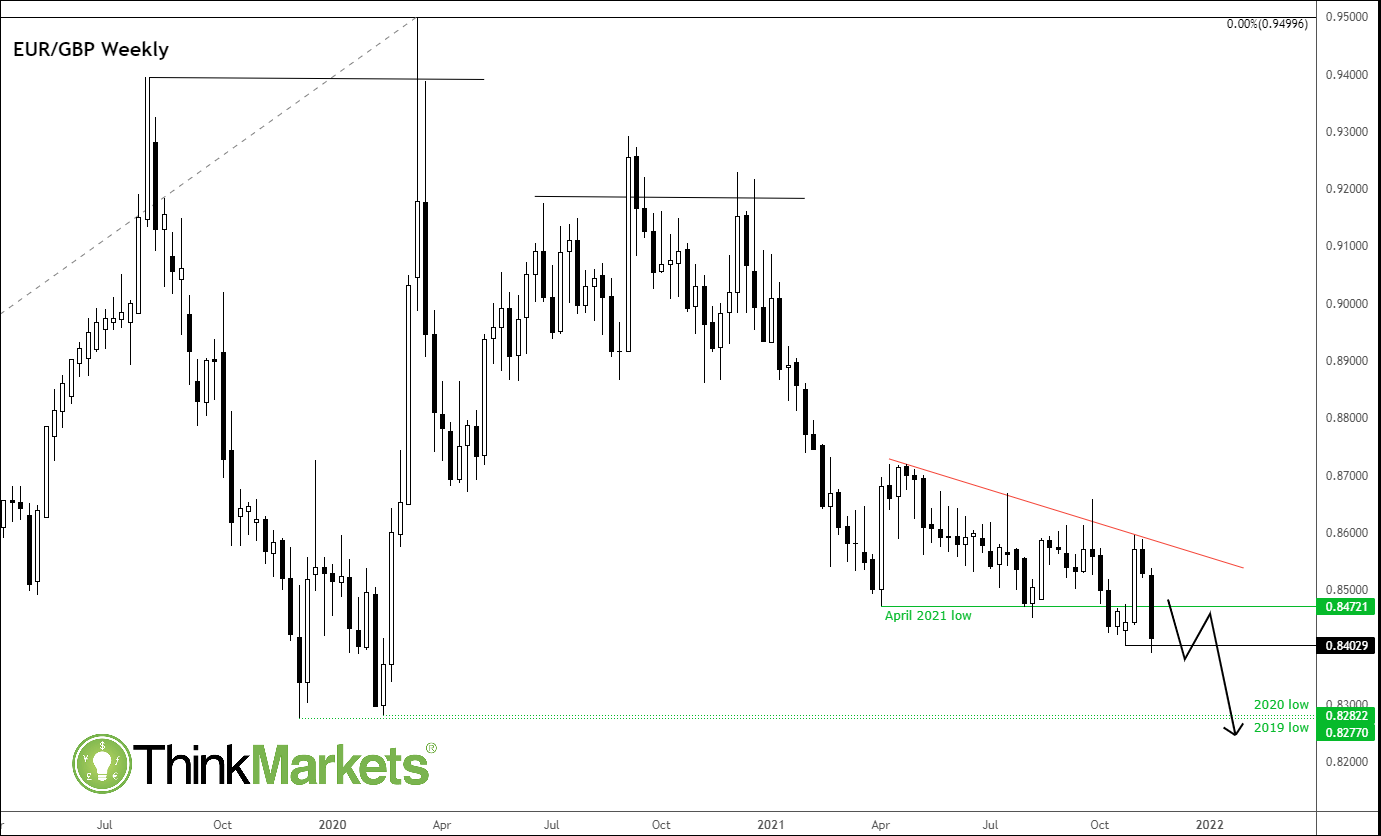
With the BoE likely to hike rates, the ECB is far from doing so. The single currency may be hurt further if fears materialise that Germany and other Eurozone nations introduce fresh lockdown measures for unvaccinated people amid rapidly rising coronavirus infections in the region. This should keep the EUR/GBP fundamentally undermined.
CPI Jumps But Pound Yawns
The British pound is drifting on Wednesday. GBP/USD is currently trading at 1.3432, up 0.04% on the day.
UK inflation hits 10-year high
Inflation in the UK surged in October and reached a 10-year high. Headline CPI climbed to 4.2% y/y, up sharply from 3.1% in September. This was above the consensus of 3.9%.
For BoE policymakers, the headache of high inflation is turning into a migraine. CPI is now more than double the BoE’s target of 2.0% and is putting further pressure on the bank to raise rates at the December meeting. The bank held rates at the November meeting, which caused shock waves in the markets, as Governor Andrew Bailey had sent strong hints that the bank would raise rates in order to contain inflation. The non-move has hurt the bank’s credibility and now Bailey & Co. are facing even higher inflation than a month ago. The BoE is projecting inflation to go as high as 5% in early 2022 before falling lower in 2023. With inflation on the move, the December meeting will be a live one, with a strong chance that the BoE finally presses the rate trigger.
Bailey has also said that employment numbers, in particular the termination of the furlough scheme, were important factors in the rate debate, and Tuesday’s strong data is further ammunition in support of a December hike. Unemployment fell sharply in the July-September period, with 304 thousand persons finding work, and the unemployment rate dipped to 4.3%, down from 4.4%.
Sterling continues to have a sleepy week, oblivious to the jump in employment and inflation. Next up is the release of October retail sales on Friday, with the markets bracing for a headline reading of -2.0% y/y, compared to -1.1% a month earlier. If retail sales did worsen, I would expect the pound to lose ground.
GBP/USD Technical Analysis
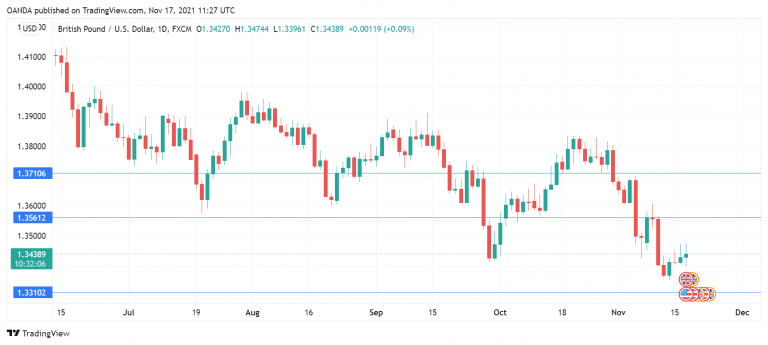
- GBP/USD has support at 1.3310. Below, there is support at 1.3206
- There is resistance at 1.3562 and 1.3710
Sterling Spikes After Faster-Than-Expected UK Inflation
- UK inflation surge ramps up BOE December rate hike prospects.
- Asian stocks lower despite Wall Street gains.
- Better-than-expected US retail sales boost the dollar.
- Oil weighed down by supply and demand risks, stronger buck.
Inflation in the UK last month climbed 4.2% compared to October 2020, beating market estimates for a 3.9% print. That’s the steepest year-on-year surge for the CPI in nearly a decade, while the core and month-on-month figures also exceeded median forecasts. The inflation overshoot prompted cable to test the Tuesday high at 1.3472, with the pound still the only G10 currency to have advanced against the US dollar so far this week.
The case for a rate move by the BOE has been strengthened by rising inflationary pressures, along with signs of an improving labour market last month even after the government’s furlough scheme came to an end. Economic data is seemingly paving the way for a December rate hike and such prospects should translate into support for the pound over the near-term.
Dollar’s resilience buffered by robust Retail Sales data
The pound’s advance this morning has weighed on the greenback, dragging the benchmark dollar index (DXY) back below the psychologically important 96.0 level. Still, dollar bulls were encouraged by Tuesday’s US economic data releases, as retail sales and industrial production both grew at their fastest pace since March. The robust data also helped the S&P500 and the Nasdaq Composite indices move within touching distance of their all-time highs. Futures are little changed at the time of writing.
The latest figures out of the world’s largest economy speak of resilient spending levels even in the face of stickier inflation. If the US economic recovery remains steadfast, the Fed’s concerns about the potential negative effects of a rate hike should ease.
However, October’s stellar retail sales growth ought to be read alongside the early-November slump in consumer sentiment. If the spike in spending last month was mere front-loading before prices get higher or supply disruptions become more severe during the peak holiday shopping season, then such elevated consumption may not be sustainable. Signs of waning growth momentum, alongside consumer prices that stay stubbornly higher, could in turn trigger significant losses in risk assets.
Oil struggles amid threat of strategic reserves release
After advancing in six of the past seven months, oil benchmarks have refused to climb higher so far in November amidst a narrowing backwardation. Worrying headlines about the resurgence of Covid cases in major European economies are fueling demand-side concerns while over on the supply side, news of a possible joint release of strategic reserves by the US and China are also capping oil’s gains.
If President Biden succumbs to the political pressures from voters as well as from party colleagues and announces a release of the Strategic Petroleum Reserve, that could force oil prices to pare more of the year-to-date gains which currently stand at over 60%. Oil may also retreat further if the EIA announces later today that US crude stockpiles have increased for a fourth consecutive week. Overall, upside momentum has stalled and might not need much of an excuse to pull back, even as it continues to battle against the resilient US dollar.
AUD/JPY: Bearish Move As Plannes Below M L3 82.38 Is Target
AUD/JPY technical analysis
- AUD/JPY is bearish.
- Clear rejection below M L3.
- Q H3 should be the target.
- Connected to equities.
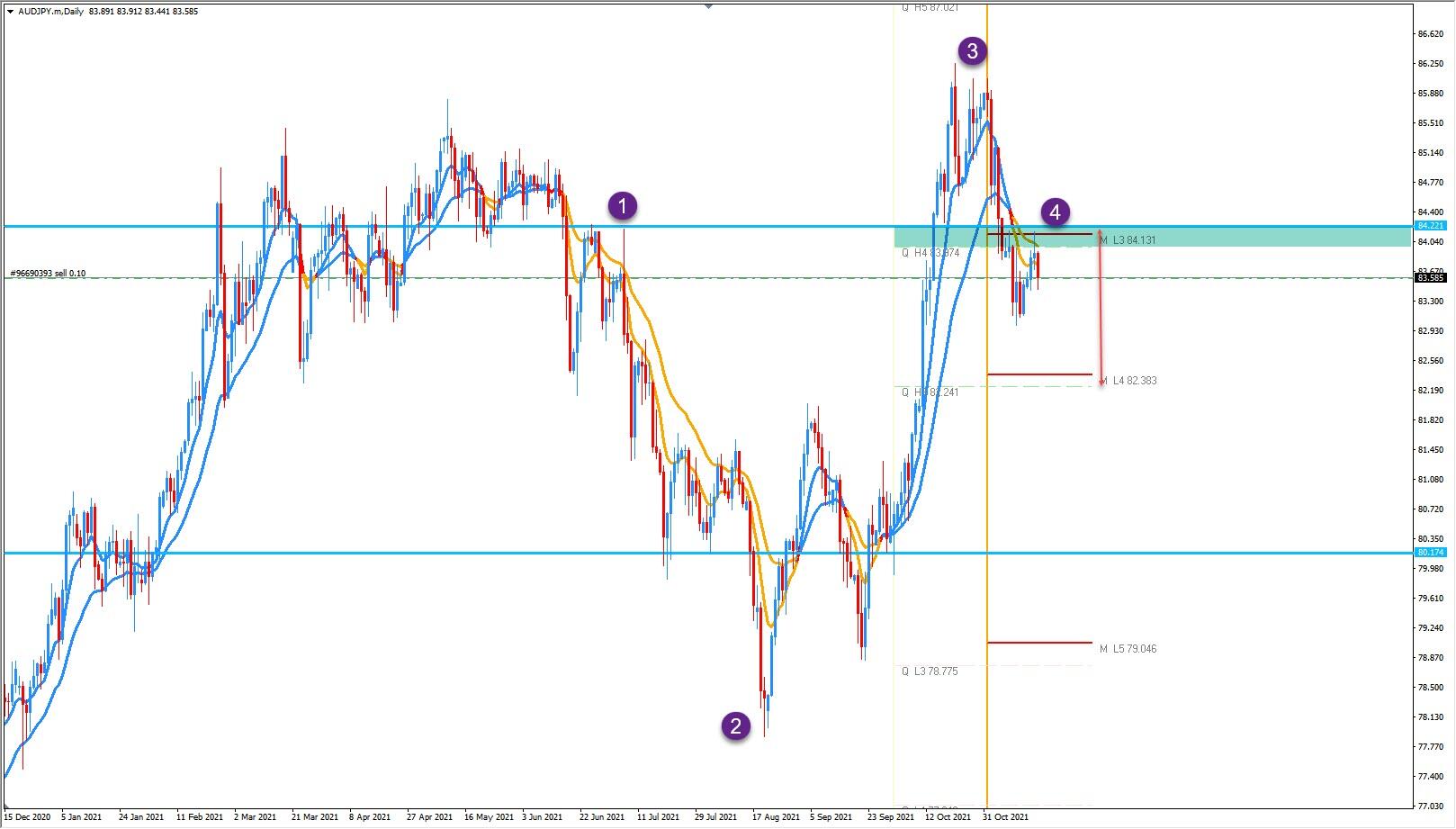
- Resistance level pinbar.
- Low.
- High.
- Bearish rejection.
The price is bearish. When it's a risk-on environment, Commodities prices tend to increase, and traders go long AUD due to that factor. When commodities prices go up, Stock Markets go up and there is demand for positive swaps on AUD pairs currently as opposed to JPY. When it's a risk-off environment, usually the opposite occurs, and as a result, the JPY appreciates as foreign flows from Japan are repatriated back to their local currency. At this point, we can see that the market is rejecting. 83.70 is the zone for short trades. Targets are 82.38 and 82.24.
UK CPI Keeps Door Open For A December BOE Rate Hike
- UK Oct inflation data saw CPI register its 3rd month above target and highest annual pace since Dec 2011; boosts BOE rate-hike expectations.
- Euro Zone Final CPI for Oct confirmed its 4th month above ECB target and the highest annual pace since 2008; ECB continues to backpedal on any concern.
Asia
- Japan Oct Trade Balance: -¥67.4B v -¥350Be; Exports Y/Y: 9.4% v 10.5%e; Imports Y/Y: 26.7% v 31.9%e.
Americas
- Fed's Daly (non-voter, dove) stated that expected to have more clarity on economy by next summer. If today's inflation was in mid-2022 then it would be a different conversation. If the country did not have Delta variant then would be thinking about raising rates, but not where we were at this time.
- Treasury Dept stated that the new deadline for dealing with debt ceiling was Dec 15th (prior Dec 3rd) (Insight: New deadline would give Congress more time to strike a deal on how to lift or suspend the debt ceiling).
- US Senator Shelby (R-AL) stated that had no plans to meet with Fed Brainard but did meet with Powell earlier on Tues (Nov 16th).
- Pres Biden stated that would announce news on Fed Chair nomination in about four days.
- Senate Maj Leader Schumer (D-NY) stated that the goal was to pass the President’s BBB plan before Christmas.
- President Biden said to back US diplomatic boycott of Beijing Olympics (Reminder: President Biden and Xi held a virtual summit on Monday, Nov 15th and the Olympics did not come up in the talks).
Energy
- Weekly API Crude Oil Inventories: +0.7M v -2.5M prior.
- US asked China to release oil from reserves as part of discussion on economic cooperation. President Biden asked China President Xi to join the US in releasing oil reserves to help stabilize soaring international crude prices.
Speakers/Fixed income/FX/Commodities/Erratum
Equities
- Indices [Stoxx600 +0.11% at 489.80, FTSE -0.37% at 7,299.70 , DAX +0.13% at 16,269.70, CAC-40 +0.03% at 7,155.02, IBEX-35 -0.32% at 9,011.42, FTSE MIB +0.13% at 27,841.00, SMI +0.17% at 12,578.16, S&P 500 Futures -0.03%].
- Market Focal Points/Key Themes: European indices open generally mixed and failed to gain direction as the session wore on; sectors trending toward the upside are industrials and materials; while laggard sectors include financials and consumer discretionary; travel and liesure subsector under pressure following new reports of covid case increases in Europe; Czechia and Slovakia closed for holiday; Glencore sells Ernest Henry Minding to Evolution Mining; reportedly SSE looking to sell stake in power network portfolio; focus on plethora of central bank speakers scheduled for the rest of the day; earnings expected during the upcoming US session include Nvidia, Target and Cisco Systems.
Equities
- Consumer discretionary: Home24 [H24.DE] +7% (analyst action), McColl's Retail Group [MCLS.UK] -24% (trading update).
- Financials: Barclays [BARC.UK] +1% (UK CPI data), Experian [EXPN.UK] -2% (earnings), CMC Markets [CMCX.UK] -3% (earnings).
- Technology: Sage Group [SAGE.UK] +3% (earnings), Auto1 Group [AG1.DE] +6% (earnings; raises outlook).
- Utilities: SSE [SSE.UK] -4% (earnings).
Speakers
- ECB Financial Stability Review stated that near-term pandemic-related risks to financial stability had declined as economy rebounded. It noted growing vulnerabilities in housing markets and stretched financial asset valuations.
- ECB De Guindos (Spain) noted in the Stability Review that equity, risky assets were susceptible to corrections. - Risks of high rates of corporate defaults and bank losses were now significantly lower than six months ago. But risks from the pandemic had not disappeared entirely.
- ECB’s Rehn (Finland) reiterated Council stance that Inflation was accelerating due to bottlenecks and energy; CPI should easing during 2022. Inflation was not showing any 2nd round effects; not showing up in wages.
- UK Brexit Min Frost expressed hope that would be able to bring protocol talks to conclusion, but if not - Article 16 remained real option.
- Iceland Central Bank (Sedibanki) Policy Statement noted that Inflation outlook had deteriorated somewhat since August, owing in part to more persistent global price increases, a more rapid rebound in domestic economic activity, and rising wage costs. Added that is saw the inflation outlook continuing rising in coming months while inflationary expectations would remain anchored. Underlying inflation was lower and had declined in recent months. Maintained 2021 GDP growth at 4.0% and 2022 GDP growth over 5.0%.
- Turkey President Erodogan reiterated stance that interest rates was the reason and inflation the the result. To lift the interest rate burden from the people and not have them be crushed.
- Japan Industry Ministry (METI) stated that Japan was unlikely to release oil from reserves.
Currencies/Fixed Income
- USD continued its form tone aided by central bank policy divergence as perceived Fed normalization to take place faster compared to BOJ and ECB where rates seen lower for longer.
- GBP/USD moved higher after UK Oct inflation data saw CPI register its 3rd month above target and highest annual pace since Dec 2011. BOE Gov Bailey did note earlier in the week that the Dec MPC was a ‘live’ meeting. Data did boost BOE rate-hike expectations.
- EUR/USD hovering around the 1.13 area as ECB official continue to dismiss concerns over the pick-up in in flation.
- USD/JPY approaching the 1.15 level for its highest level since spring 2017.
- TRY currency (Lira) at fresh record lows against USD near 10.50 as Turkey President Erdogan vowed to take on interest rates.
Economic data
- (UK) Oct CPI M/M: 1.1% v 0.8%e; Y/Y: 4.2% v 3.9%e (3rd month above target and highest annual pace since Dec 2011); CPI Core Y/Y: 3.4% v 3.1%e; CPIH Y/Y: 3.8% v 3.6%e.
- (UK) Oct RPI M/M: 1.1% v 0.8%e; Y/Y: 6.0% v 5.7%e; RPI-X (ex-mortgage interest payments) Y/Y: 6.1% v 5.9%e; Retail Price Index: 312.0 v 311.2e.
- (UK) Oct PPI Input M/M: 1.4% v 1.1%e; Y/Y: 13.0% v 12.1%e.
- (UK) Oct PPI Output M/M: 1.1% v 0.7%e; Y/Y: 8.0% v 7.3%e.
- (AT) Austria Oct Final CPI M/M: 0.6% v 0.5% prelim; Y/Y: 3.7% v 3.6% prelim.
- (ZA) South Africa Oct CPI M/M: 0.2% v 0.2%e; Y/Y: 5.0% v 5.0%e (8th straight reading within target band).
- (ZA) South Africa Oct CPI Core M/M: 0.2% v 0.2%e; Y/Y: 3.2% v 3.2%e.
- (IS) Iceland Central Bank (Sedibanki) raised the 7-Day Term Deposit Rate by 50bps to 2.00%.
- (IT) Italy Sept Total Trade Balance: €2.5B v €1.3B prior; Trade Balance EU: +€0.8B v -€0.3B prior.
- (UK) Sept ONS House Price Index Y/Y: 11.8% v 10.2% prior.
- (EU) Euro Zone Oct Final CPI Y/Y: 4.1% v 4.1%e; CPI Core Y/Y: 2.0% v 2.1%e.
- (EU) Euro Zone Sept Construction Output M/M: +0.9% v -1.4% prior; Y/Y: +1.5% v -2.6% prior.
- (GR) Greece Sept Unemployment Rate: 13.0% v 13.9% prior.
- (CY) Cyprus Oct CPI Harmonized M/M: +0.9% v -0.5% prior; Y/Y: 4.4% v 3.6% prior.
Fixed income Issuance
- (IN) India sold total INR vs. INR200B indicated in 3-month, 6-month and 12-month bills.
- (IT) Italy Debt Agency (Tesoro) opened its book to sell USD-denominated May 2051 bond via syndicate; guidance seen +185bps to Libor mid-swaps.
- (DK) Denmark sold total DKK2.24B in 2024, 2031 and 2052 DGB bonds.
- (SE) Sweden sold total SEK2.5B vs. SEK2.5B indicated in 2026 and 2032 bonds.
Looking Ahead
- (IL) Israel Nov 12-month CPI Forecast: No est v 1.8% prior.
- 05:25 (EU) Daily ECB Liquidity Stats.
- 05:30 (DE) Germany to sell €1.0B in 0% Aug 2052 Bunds.
- 05:30 (PT) Portugal Debt Agency (IGCP) cancelled planned 6-month and 12-month bill auction.
- 06:00 (IE) Ireland Sept Trade Balance: No est v €5.7B prior.
- 06:00 (ZA) South Africa Sept Retail Sales M/M: 2.6%e v 4.9% prior; Y/Y: +0.7%e v -1.3% prior.
- 06:00 (PT) Portugal Oct PPI M/M: No est v 2.1% prior; Y/Y: No est v 13.3% prior.
- 06:00 (EU) EU Commission to sell combined €2.0B in 3-month and 6-month Bills.
- 06:00 (RU) Russia combined RUB30.1B in 2031 and 2032 OFZ bonds.
- 06:45 (US) Daily Libor Fixing.
- 07:00 (US) MBA Mortgage Applications w/e Nov 12th: No est v 5.5% prior.
- 08:00 (UK) Daily Baltic Dry Bulk Index.
- 08:30 (US) Oct Housing Starts: 1.579Me v 1.555M prior; Building Permits: 1.630Me v 1.586M prior (revised 1.589M).
- 08:30 (CA) Canada Oct CPI M/M: 0.7%e v 0.2% prior; Y/Y: 4.7%e v 4.4% prior; Consumer Price Index 143.8e v 142.9 prior; CPI Core- Common Y/Y: 1.9%e v 1.8% prior; CPI Core- Median Y/Y: 2.9%e v 2.8% prior; CPI Core- Trim Y/Y: 3.4%e v 3.4% prior.
- 08:30 (CA) Canada Oct Teranet House Price Index (HPI) M/M: No est v 0.1% prior; Y/Y: No est v 17.3% prior; HPI: No est v 284.96 prior.
- 09:00 (DE) ECB's Schnabel (Germany).
- 09:00 (UK) BOE's Mann.
- 09:45 (UK) BOE to buy £1.47B in APF Gilt purchase operation (7-20 years).
- 10:30 (US) Weekly DOE Oil Inventories.
- 11:00 (RU) Russia Q3 Advance GDP Y/Y: 4.5%e v 10.5% prior.
- 11:00 (US) Fed's Bowman at Dallas Fed roundtable.
- 11:20 (US) Fed's Mester and Waller speak at financial-stability conference.
- 12:00 (CA) Canada to sell C$3.5B in 0.75% 2024 Bonds.
- 12:40 (US) Fed's Daly at New York Fed's Treasury Market Conference.
- 12:40 (US) Fed’s Waller on Stablecoins.
- 13:00 (US) Treasury to sell 20-Year Bonds.
- 14:00 (AR) Argentina Sept Capacity Utilization: No est v 64.4% prior.
- 16:05 (US) Fed’s Evans.
- 16:10 (US) Fed’s Bostic.
- 21:00 (NZ) New Zealand Q4 2-year Inflation Expectation Survey: No est v 2.27% prior.
- 21:05 (AU) RBA's Richards gives online speech.
- 22:00 (TH) Thailand Central Bank to sell THB25B in 2023 Bonds.
- 22:30 (JP) Japan to sell 12-Month Bills.
- 22:35 (JP) Japan to sell 20-Year JGB Bonds.
- 23:00 (AU) RBA's Ellis gives online speech.
US Dollar Index Skyrockets Fed Tightening Hopes Rise
The US dollar index surged to the highest level since July 2020 after strong economic data from the United States. This month, the US has published strong non-farm payrolls and inflation data. And on Tuesday, the country released spectacular numbers. The data showed that the country’s retail sales jumped from 0.8% to 1.7% while core sales rose from 0.7% to 1.7%. Further data revealed that import and export prices and manufacturing and industrial production numbers did well. Therefore, the market believes that the Fed will turn more aggressive in the coming months. Later today, the US will publish the latest building permits numbers that analysts expect will be strong.
The British pound held steady as investors reflected on a slew of positive economic numbers from the UK. Last week, data by Nationwide Society showed that the country’s home prices kept rising in October. On Tuesday, numbers showed that the labour market is tightening. For example, the unemployment rate declined to 4.4%, which is the lowest level since the pandemic started. The country has the second-lowest unemployment rate in the G7 after Japan. The currency will be in the spotlight today since the UK is also expected to publish strong inflation numbers.
The economic calendar will have some key events today. In addition to the UK inflation data, the Eurozone and Canada will publish their inflation numbers. Analysts expect these numbers to show that inflation jumped sharply in October. For Europe, the situation will likely worsen. In a statement yesterday, the CEO of Trafigura warned that the bloc will see more power shortages in the fourth quarter. And yesterday, Germany suspended the certification of Nord Stream 2, which pushed gas prices higher. Elsewhere, the Energy Information Administration (EIA) will publish the latest inventories numbers.
EURUSD
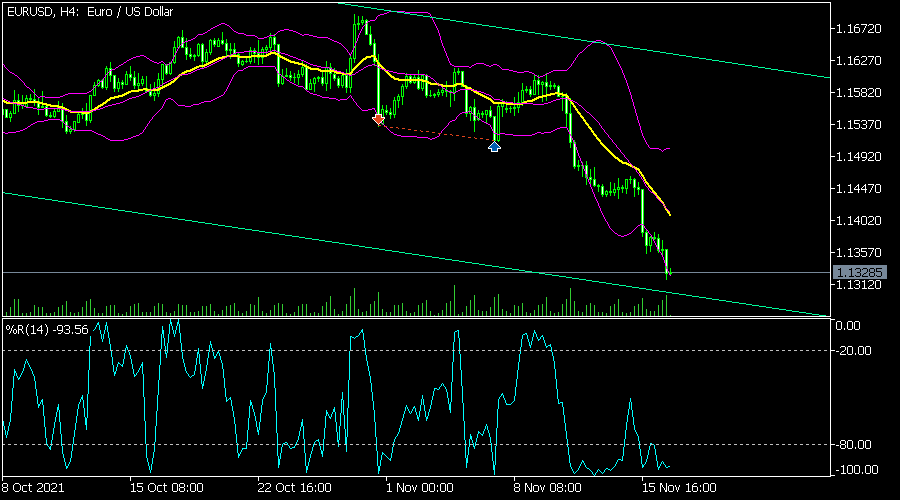
The EURUSD pair has been in a steep sell-off in the past few days. The pair has moved from a high of 1.1600 this month to a low of 1.1330. It is also approaching the lower side of the descending channel. It has also moved to the lower side of the Bollinger Bands. The Williams %R has moved to the oversold level. Therefore, while the overall trend is bearish, the pair will likely have a relief rally when it hits the lower side of the channel at 1.1300.
USDCHF
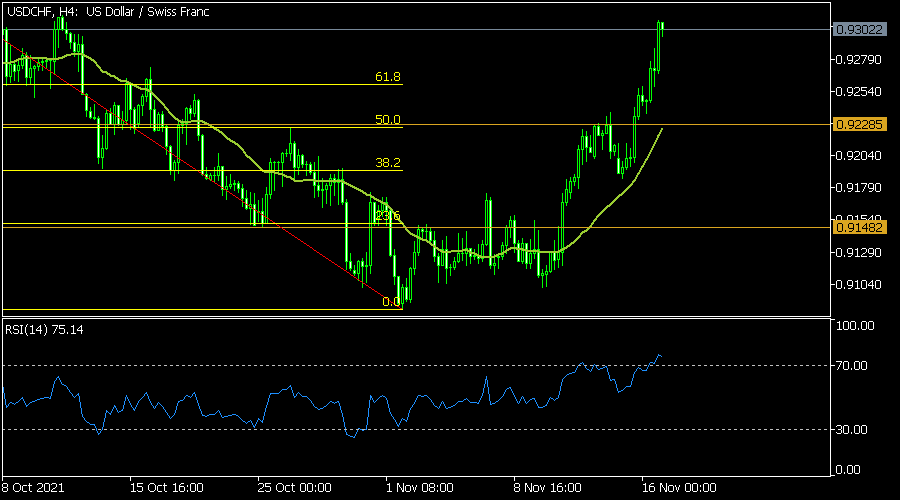
The USDCHF soared to the highest level since October 14 as the US dollar strength continued. The pair has managed to move above the 61.8% retracement level on the four-hour chart. It has also rallied above the 25-day moving averages while the Relative Strength Index (RSI) has risen to the overbought level. Therefore, the pair will likely keep rising as bulls target the year-to-date high of 0.9368.
GBPUSD
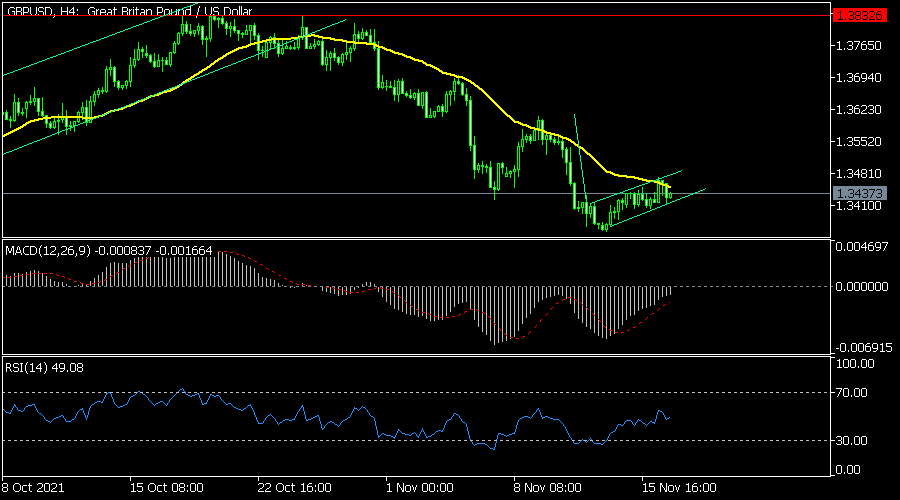
The GBPUSD pair has been relatively stable even as the US dollar has strengthened. The pair is trading at 1.3440, where it has been in the past few days. Notably, it has formed a bearish flag that is shown in green. It has also moved below the 25-day moving average while oscillators are facing upwards. Therefore, the pair will likely break out lower after the UK inflation data.