

Sample Category Title
Canada’s Inflation Rate Rose to 4.7% in October
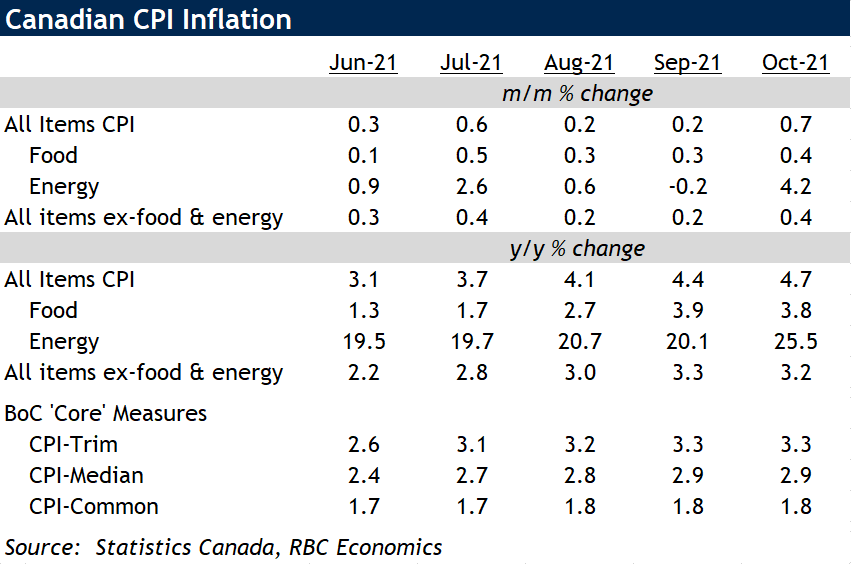
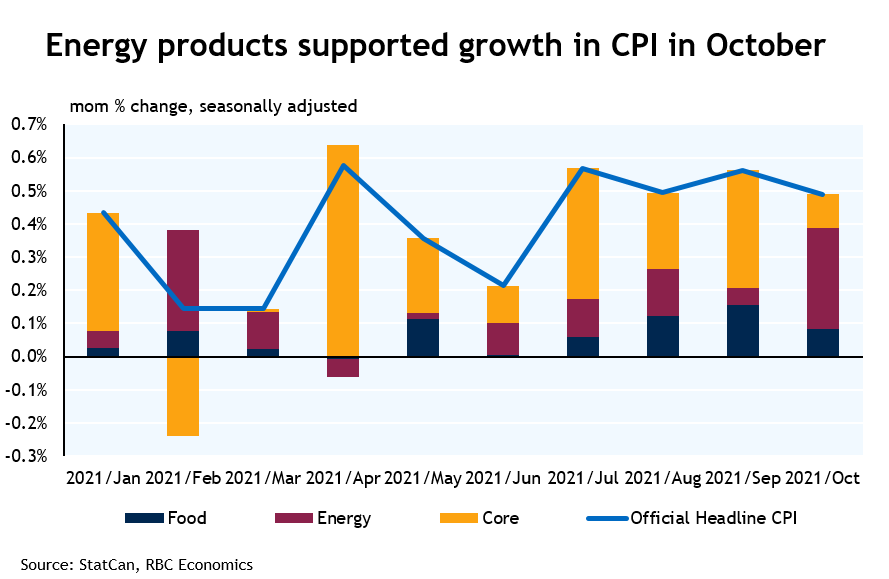
- Headline CPI rose to 4.7% supported by higher energy costs.
- Growth in prices ex-food & energy ticked lower to 3.2%.
- Inflation pressure will continue to broaden; central bank to ease off the accelerator with rate hikes starting in the second quarter of next year.
Canada’s headline inflation rate rose to 4.7% in October from 4.4% in September. All of the 0.3 ppt gain can be attributed to higher energy prices (+25.5%). Gasoline grew more expensive for consumers as global demand for oil firmed for power generation amidst a shortage of other energy sources. Prices for food ticked slightly lower but remained elevated (3.8%) as meat products grew pricier (+9.9%). High agricultural commodity and oil prices are expected to underpin food and energy prices near-term. But the breadth of growth across other products and services has also been edging higher, with 57.9% of the consumer basket seeing faster-than-target growth compared to pre-pandemic (2019) levels on average over the last 3 months.
Excluding both food and energy, prices grew a slower 3.2% from a year ago in October or 2.2% on an annualized seasonally adjusted basis from pre-shock February 2020 levels. Much of the latter can be attributed to home-owning related expenses (realtor/broker fees and higher housing ‘replacement’ costs), which look poised to remain elevated in the near-term given the recent resurgence in resale activity. Prices to purchase or lease autos was still elevated in October (+6.6%) with the global semi-conductor shortage limiting vehicle supply. Even outside of autos, supply chain disruptions and strong demand are pushing up production input costs, though much of those increases have yet to be passed on to final consumer customers.
While inflation has bounced back dramatically from pandemic-low levels, the labour market recovery also looks increasingly on firm footing. Job openings have been outpacing the amount of available unemployed workers in the market for months. That is expected to begin to bid up wages in the months ahead. Against that backdrop, we expect the Bank of Canada to begin to ease off the monetary-policy accelerator by beginning to hike rates in the second quarter of next year.
Sunset Market Commentary
Markets
UK CPI for the month October immediately set the tone for European dealings. Headline inflation accelerated from 3.1% y/y to 4.2% (1.1% m/m), faster than the 3.9% expected. Core inflation sprinted from 2.9% to 3.4%, another consensus beat. The price data comes after yesterday’s strong labour report. Both nudge the Bank of England towards a delayed rate hike in December. UK bond markets are still a bit hesitant with the short end of the curve edging >2 bps lower. Sterling on the other hand does enjoy a good bid. EUR/GBP eases towards the 0.84 support/big figure. A break lower in early European/late Asian dealings reversed but the couple clearly isn’t out of the woods yet, especially since the euro has nothing to offer in staging a countermove. ECB’s Schnabel serves as a point in case. The former-hawk reiterated the central should avoid a premature tightening, adding that conditions for a rate hike are very unlikely to be met in 2022. She implicitly refers to markets pricing a first rate somewhere end next year. Should sterling succeed in a technical breach sub 0.84, we’re looking at the 0.8282 March 2020 low as a next support. Friday’s retail sales could be the trigger needed. Cable extends yesterday’s trip back north of 1.34(7).
Other core bond markets and major currency pairs had a rather dull session. Both US and German yields are going nowhere. In FX, USD/JPY’s rally driven by yesterday’s strong retail sales ran into resistance at the 115 lever. The couple is filling bids at 114.71, marginally down from 114.82. The trade-weighted dollar (DXY) sought to escape the upward sloping trend channel through the upper bound but was forced to retrace its steps. It holds just south of 96. Parallel to DXY, EUR/USD rebounded from 1.129 support hit during the Asian session but the move clearly has no strong legs. The combo falls for a sixth working day straight and is currently struggling to retain the 1.13 big figure. Things look ugly for the euro. It can only hope the combination of the aforementioned dollar resistance levels (115 USD/JPY, 96 DXY, 1.129 EUR/USD) will hold for some short-term reprieve. More fundamentally, it’s the ECB that has to show signs of finally taking a policy U-turn.
News Headlines
Turkish president Erdogan did it again. On the eve of the next central bank meeting, he claims to lift the interest rate burden from citizens by repeating his unorthodox stance that high policy rates are the cause of rather than the cure to higher inflation. Ever since Kavcioglu heads the CRBT, the central bank already cut policy rates by a cumulative 300 bps. Kavcioglu is the fourth central bank governor since 2019 and clearly on the same line as Erdogan. The central bank U-turn comes at a price though, because the Turkish lira went into a fresh tail spin being deprived from zero/marginally positive real rates. EUR/TRY yesterday surged to a fresh all-time high above 11.50 and is currently attacking the 12 mark.
ECB vice president de Guinos presented the central bank’s biannual financial stability review. The recent economic recovery in the euro area brought a recovery in corporate activity that reduced risks related to economic scarring and rising credit risk. Pandemic-related risks haven’t disappeared entirely though, with inflation being a prominent one. In search of market vulnerabilities, de Guindos stresses the striking buoyancy for equity and risky assets, more novel and more exotic investments and rapidly expanding housing markets in absence of tightening lending standards. This FSR also zooms in on addressing some long-standing challenges which affect the strength of euro area banks. They examine the usability of capital within the regulatory buffer framework, consider how mergers and acquisitions could help the sector to return to more sustainable levels of profitability and explore approaches for managing non-performing loans, which can be a long-term drag on bank balance sheets.
Dollar Climbs as Prices and Yields Tick Higher
Global inflation risks prevail, Canada delivers CPI data
The US economy is recovering well in the last quarter of the year and subsequently news of a fresh Fed Chairman being appointed seems to be fading in the horizon. Yesterday’s surprise surge in the US retail sales by 1.7% m/m for October hints that consumption remains at elevated levels however, these figures are nominal as rising price pressures persist.
The dollar index has touched 96.24, just shy of the 96.35 high from back in July 2020 but currently has retracted a tad below the 96.00 mark. Rising yields and upbeat sentiment has managed to keep the greenback buoyant, while gold surprisingly has kept its haven appeal trading at the 1,862/oz level, somewhat acting as an inflation hedge as well.
That said, its likely pressure on the Fed to take a more aggressive approach with tapering will continue towards the end of the year as inflation risks linger.
The USDCHF pair is holding above the 0.9300 handle, eyeing the long-term restrictive trendline pulled from the April 2019 peak of 1.0235. The yen is consolidating around the 114.80 mark but should the dollar retain strength, a jump above the 115.00 level does not look unlikely.
US building permits in October improved to 1.65M versus the forecast of 1.63M however, new housing starts disappointed coming in at 1.52M, from expectations of 1.58M.
Sterling resilience beats deteriorating euro
The euro returned above the $1.1300 handle after touching a 16-month low of $1.1254. The ECB is unlikely to remove accommodation in December as the bloc continues to lag other economies like the US and the UK, hindered by the scars from the pandemic. Inflation risks prevail and risks that the ECB’s financial stability review highlighted revolve around higher debt levels in corporate and public sectors as well as more risk-taking and borrowing.
Across the channel, while Northern Ireland issues with the EU continue to fester in the background, the UK delivered stronger headline inflation of 4.2% y/y as opposed to the estimate of 3.9% while the core component came in at 3.4% compared to September’s 2.9% and expectations of 3.1%. Furthermore, raw material costs, PPI input, came in stronger at 1.4% as well as PPI output at 1.1% m/m.
Moreover, the September HPI yearly figure shot up to 11.8%, beating expectations and the August number of 10.2%. Inflation is above the 2% target and expectations of a rate hike in December lingers around a 55% chance after the BoE failed to raise rates last month. The pound is largely unchanged, ticking only slightly up to $1.3467 after strong CPI and PPI data.
EURGBP fell back below the 0.8400 handle heading for a retest of its fresh 20-month low of 0.8389.
Canadian inflation disappoints, dollar strength governs
The loonie pushed higher to C$1.2592 after yearly inflation came in line at 4.7% and the headline monthly figure at 0.7%. The core common number ticked 0.1% lower in October than the forecast but was unchanged compared to September’s 1.8%. Dollar strength and yesterday comments from BOC Deputy Governor Schembri on concerns around the labour market may have aided the move. He mentioned that labour market uncertainties have become more pronounced during the pandemic and the digital shift in employment has caused shortages in workers with related skills sets that existed previously.
WTI oil futures are holding above the $80.00 per barrel mark after growing odds that the US may dip into the Strategic Petroleum Reserves and cooperate with China in a coordinated effort to help ease oil prices.
US Crude oil inventories will follow at 15:30 GMT
Then starting from 16:00 until 21:10 GMT there will be various FOMC Members speaking from Bowman, Daly, Waller, Evans, and Bostic
ECB Schnabel: Monetary policymakers need to focus on the entire range of possible outcomes
ECB Executive Board member Isabel Schnabel said in a speech, "inflation will remain higher for longer than previously anticipated". In will "decline over the course of next year", but, "uncertainty has increased around the pace and extent of the slowdown".
"In such situations of elevated uncertainty, monetary policymakers need to focus on the entire range of possible outcomes to ensure that they will be able to deliver on their mandate," she added.
"On the one hand, this means avoiding the mistake of a premature tightening of monetary policy in response to a temporary and possibly short-lived inflation spike. "
"On the other hand, it means keeping a watchful eye on the upside risks to inflation that financial markets currently anticipate and retain optionality to be able to act if needed, so as to maintain trust in our determination to defend price stability in a symmetric way and prevent a deanchoring of inflation expectations in both directions."
EUR/USD Mid-Day Outlook
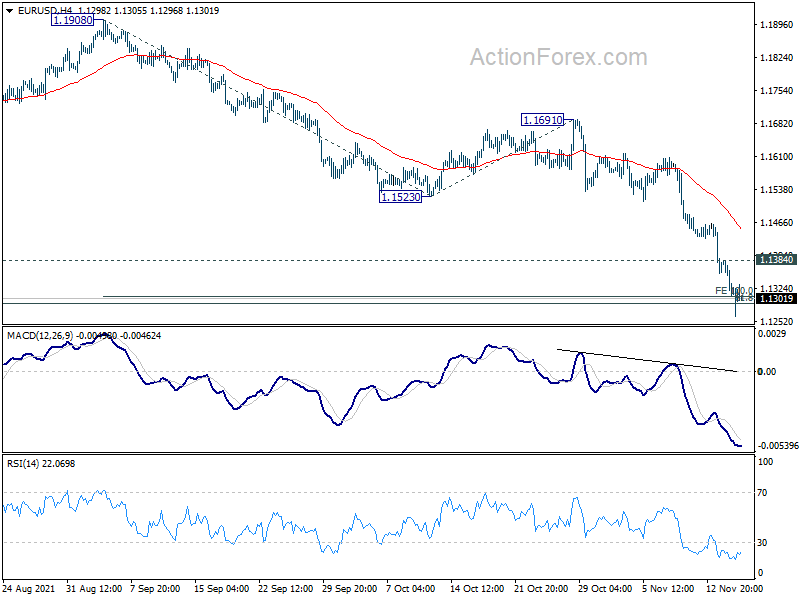
Daily Pivots: (S1) 1.1290; (P) 1.1338; (R1) 1.1366; More...
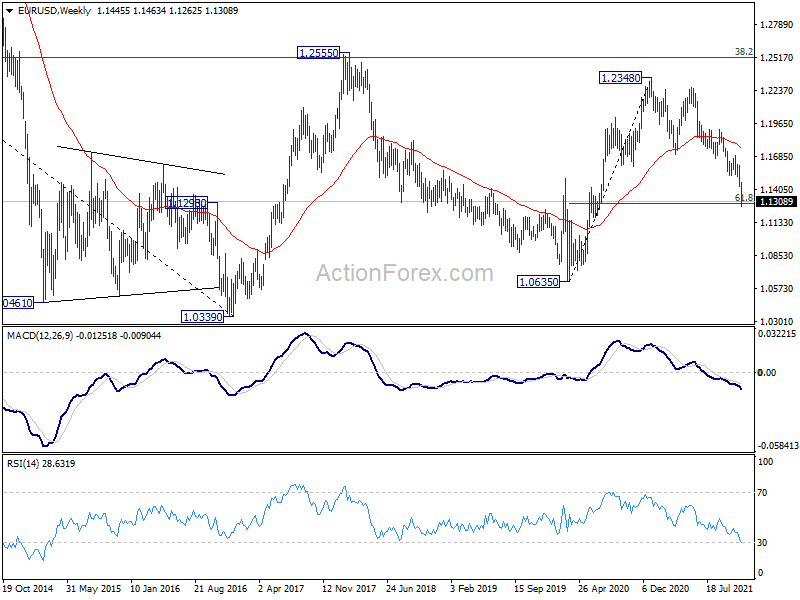
Intraday bias in EUR/USD remains on the downside at this point. Sustained break of 1.1289 long term fibonacci level will carry larger bearish implication. Next target will be 161.8% projection of 1.1908 to 1.1523 from 1.1691 at 1.1068. On the upside, above 1.1384 minor resistance will turn intraday bias neutral first. But outlook will remain bearish as long as 1.1523 support turned resistance holds.
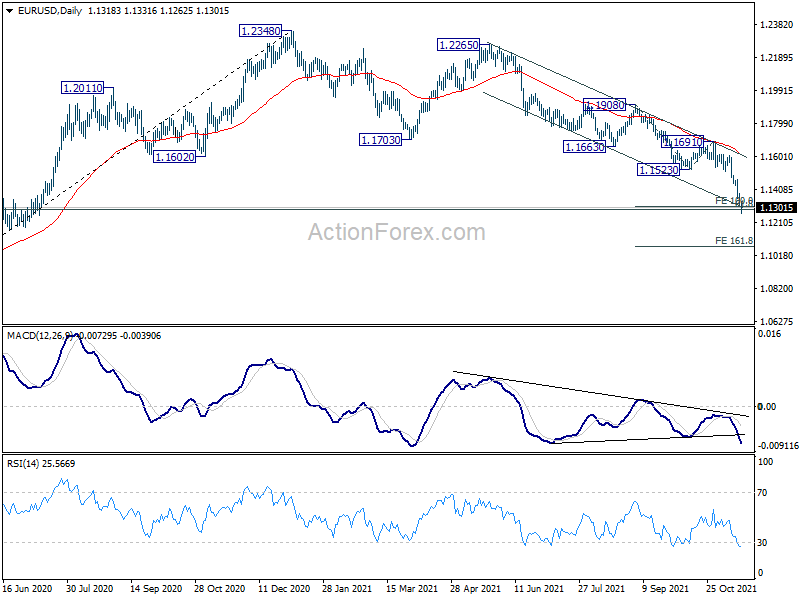
In the bigger picture, there are various ways of interpreting the fall from 1.2348 (2021 high). It could be a correction to rise from 1.0635 (2020 low), the fourth leg of a sideway pattern from 1.0339 (2017 low), or resuming long term down trend. In any case, outlook will now stay bearish as long as 1.1703 support turned resistance holds. Sustained break of 61.8% retracement of 1.0635 to 1.2348 at 1.1289 would pave the way back to 1.0635.
GBP/USD Mid-Day Outlook
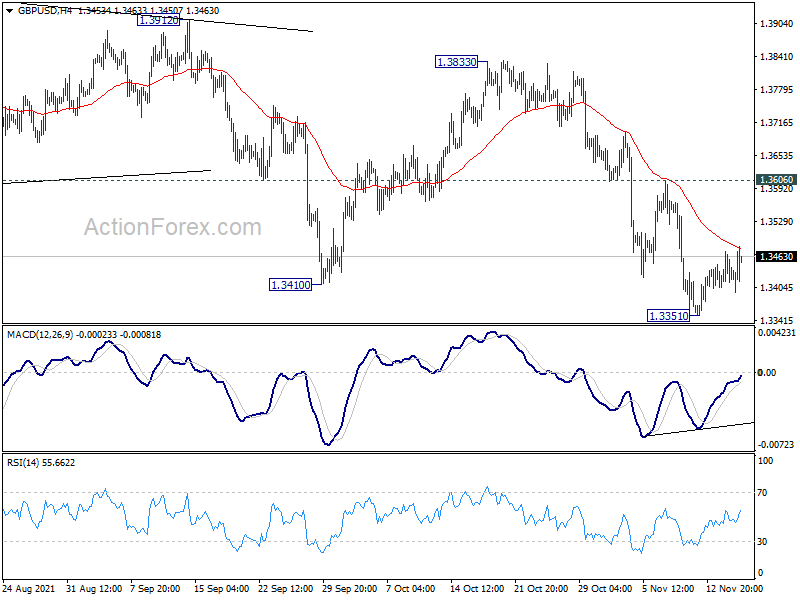
Daily Pivots: (S1) 1.3396; (P) 1.3435; (R1) 1.3464; More...
Intraday bias in GBP/USD remains neutral and consolidation from 1.3351 could extend. But upside of recovery should be limited below 1.3606 resistance to bring down trend resumption. On the downside, break of 1.3351 will extend the decline from 1.4248 to 1.3164 fibonacci level next.
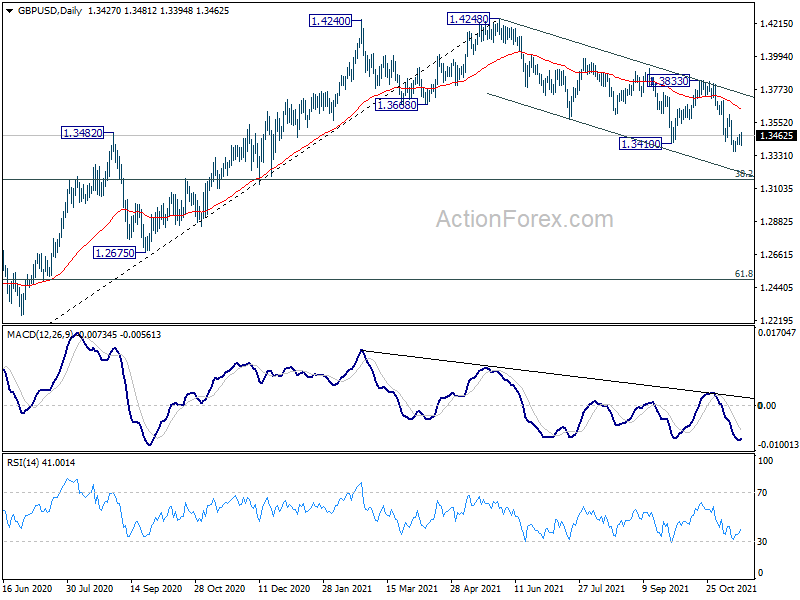
In the bigger picture, the structure of the fall from 1.4248 suggests that it's a correction to the up trend from 1.1409 (2020 low) only. While deeper fall cannot be ruled out yet, downside should be contained by 38.2% retracement of 1.1409 to 1.4248 at 1.3164, at least on first attempt, to bring rebound. On the upside, firm break of 1.4376 key resistance (2018 high) will add to the case of long term bullish reversal. However, sustained trading below 1.3164 will revive some medium term bearishness and target 61.8% retracement at 1.2493.
USD/CHF Mid-Day Outlook
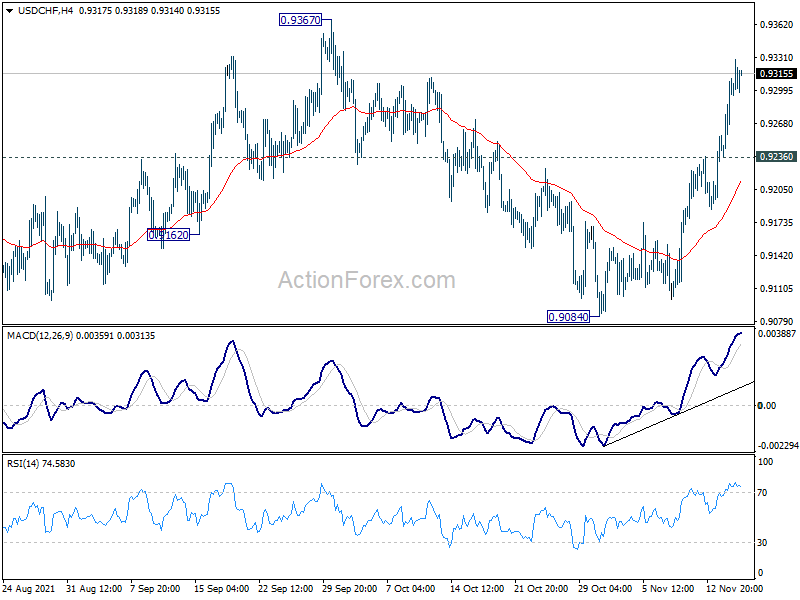
Daily Pivots: (S1) 0.9256; (P) 0.9284; (R1) 0.9331; More....
Intraday bias in USD/CHF remains on the upside for the moment. Current rise from 0.9084 should target 0.9367 resistance next. On the downside, below 0.9236 minor support will turn intraday bias back to the downside for 0.9084 instead.
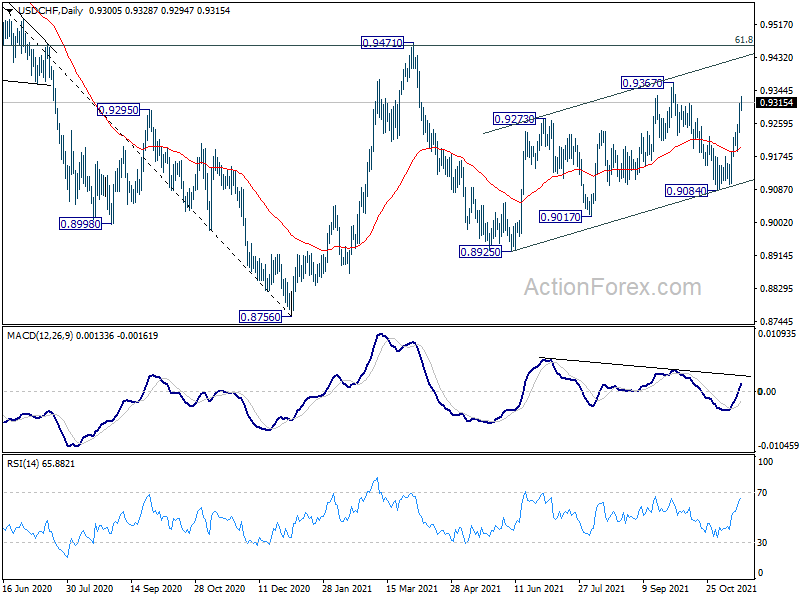
In the bigger picture, the corrective structure of the rebound from 0.8925 argues that fall from 0.9471 is not complete yet. It could either be the second leg of pattern from 0.8756 (2021 low), or resuming larger down trend from 1.0237 (2018 high). We'd pay attention to the downside momentum and assess the odds later. But for now, medium term outlook will be neutral at best as long as 0.9471 resistance holds.
USD/JPY Mid-Day Outlook
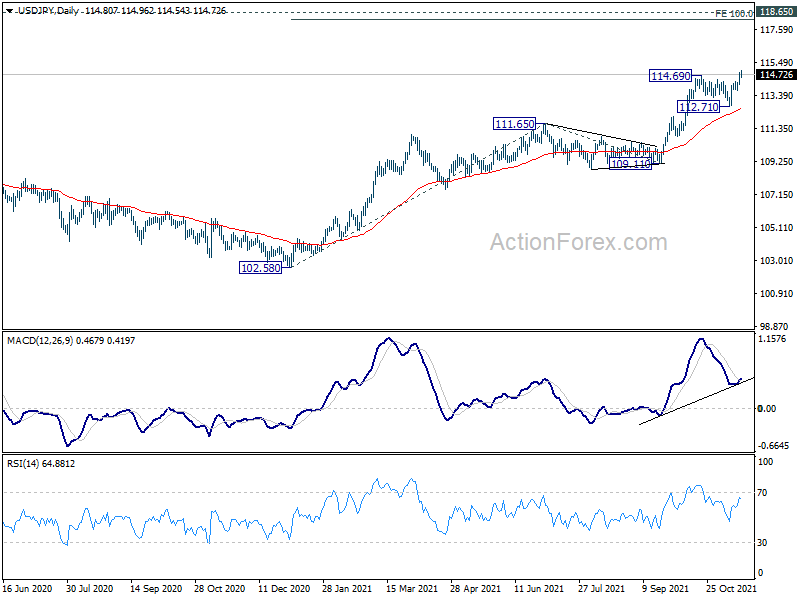
Daily Pivots: (S1) 114.34; (P) 114.59; (R1) 115.09; More...
Intraday bias in USD/JPY remains on the upside for the moment. Current up trend from 102.58 will target 100% projection of 102.58 to 111.65 from 109.11 at 118.18. On the downside, break of 113.74 support is needed to indicate short term topping. Otherwise, outlook will stay bullish in case of retreat.
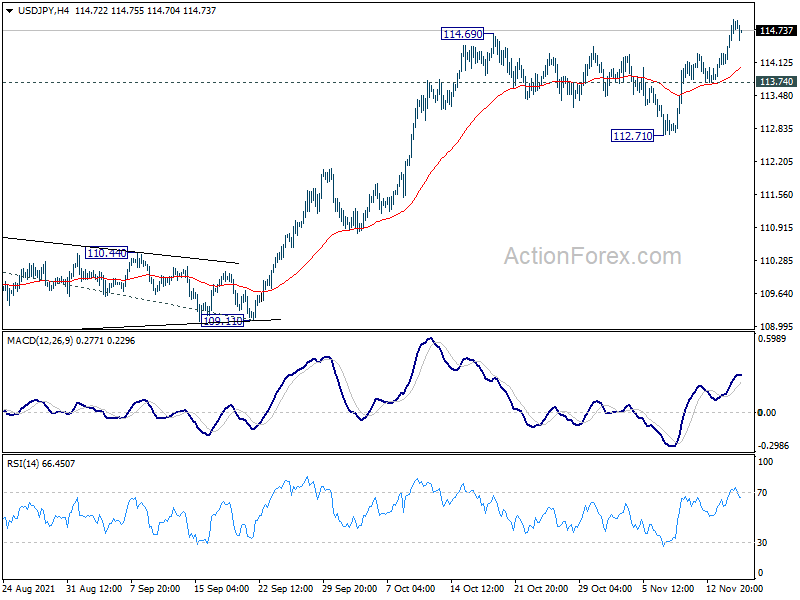
In the bigger picture, corrective decline from 118.65 (2016 high) should have completed at 101.18 already. Rise from the 102.58 is seen as the third leg of the up trend from 101.18. Next target is 118.65 high. This will now be the preferred case as long as 111.65 resistance turned support holds, even in case of deep pull back.
EUR/GBP Mid-Day Outlook
Daily Pivots: (S1) 0.8410; (P) 0.8447; (R1) 0.8466; More...
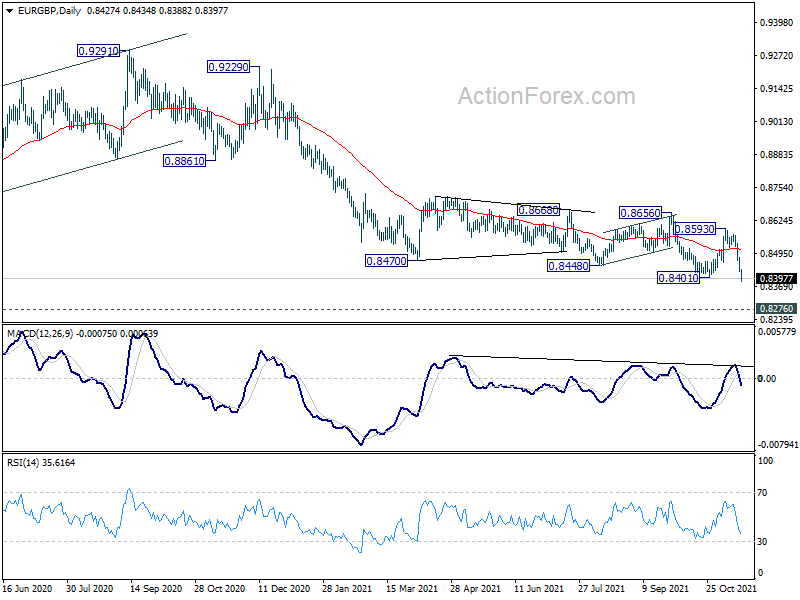
EUR/GBP's break of 0.8401 support indicates resumption of larger down trend from 0.9499. Intraday bias stays on the downside. Deeper fall would now be seen towards 0.8276 long term support next. On the upside, however, break of 0.8460 minor resistance will delay the bearish case and turn intraday bias neutral first.
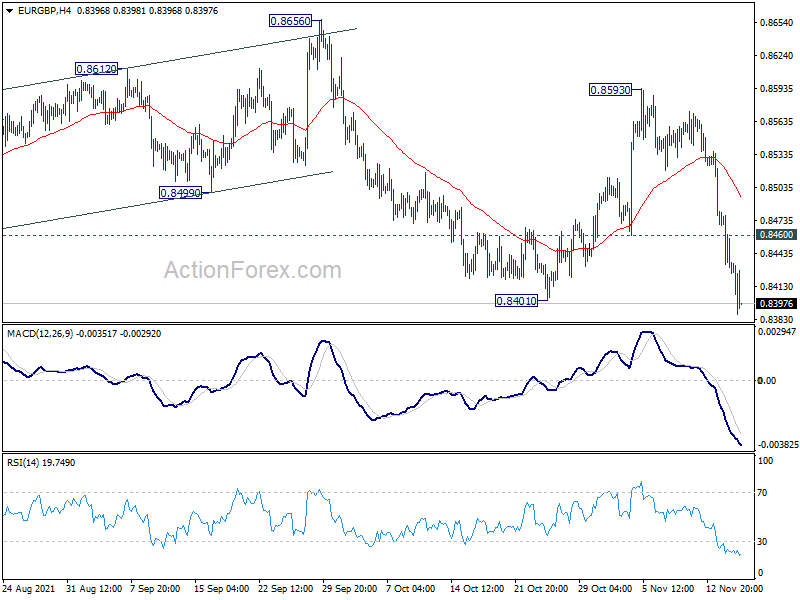
In the bigger picture, price actions from 0.9499 (2020 high) are still seen as developing into a corrective pattern. Deeper fall could be seen as long as 0.8656 resistance holds, towards long term support at 0.8276. However, firm break of 0.8656 resistance would argue that a medium term bottom was already formed. Stronger rise would be seen to 0.8861 support turned resistance to confirm completion of the corrective pattern.
Sterling Jumps on Strong CPI, Euro Selloff Continues
Sterling jumps broadly today after much stronger than expected consumer inflation data, that raises the chance that BoE will "have to act" on interest rates soon. On the other hand, Canadian Dollar shrugs off strong, but inline with expectation CPI. Dollar is still among the strongest for the week, but it's apparently taking a breather for now. On the other hand, Euro is the worst performing, on expectation that ECB will lag behind other central banks in stimulus removal.
Technically, we'd continue to focus on EUR/USD's reaction to 1.1289 long term fibonacci support. Sustained trading below this level will carry larger bearish implication and would bring even deeper down trend to 1.0635 (2020 low). Nevertheless, rebound from current level, followed by break of 1.1384 minor resistance, will indicate that selling pressure has eased, at least temporarily. And EUR/USD would then start to build a bottom.
In Europe, at the time of writing, FTSE is down -0.42%. DAX is up 0.11%. CAC is up 0.06%. Germany 10-year yield is up 0.0036 at -0.237. Earlier in Asia, Nikkei dropped -0.40%. Hong Kong HSI dropped -0.25%. China Shanghai SSE rose 0.44%. Singapore Strait Times dropped -0.19%. Japan 10-year JGB yield dropped -0.0012 to 0.074.
Canada CPI accelerated to 4.7% yoy in Oct, highest since 2003
Canada CPI accelerated to 4.7% yoy in October, up from September's 4.4% yoy, matched expectations. That's the highest reading since February 2003. Excluding energy, CPI rose 3.3% yoy, unchanged from September's reading. On a monthly basis CPI rose 0.7% mom, largest gains since June 2020.
CPI common was unchanged at 1.8% yoy, below expectation of 1.9% yoy. CPI median rose to 2.9% yoy, up from 2.8% yoy, matched expectations. CPI trimmed slowed to 3.3% yoy, down from 3.4% yoy, below expectation of 3.4% yoy.
From US, building permits rose to 1.65m annualized rate in October, above expectation of 1.63m. Housing starts dropped to 1.52m, below expectation of 1.58m.
UK CPI surged to 4.2% yoy in Oct, highest since 2011
UK CPI surged to 4.2% yoy in October, up from 3.1% yoy, above expectation of 3.8% yoy. That's the highest level in nearly 10 years since November 2011. Core CPI also jumped to 3.4% yoy, up from 2.9% yoy, above expectation of 3.0% yoy. RPI also accelerated to 6.0% yoy, up from 4.9% yoy, above expectation of 5.6% yoy.
PPI input came in at 1.4% mom, 13.0% yoy, versus expectation of 1.1% mom, 11.6% yoy. PPI output was at 1.1% mom, 8.0% yoy, versus expectation of of 0.7% mom, 6.8% yoy. PPI core output was at 0.8% mom, 6.5% yoy, matched expectations.
Eurozone CPI finalized at 4.1% yoy in Oct, EU at 4.4%
Eurozone CPI was finalized at 4.1% yoy in October, up from September's 3.4%. The highest contribution came from energy (+2.21%), followed by services (+0.86%), non-energy industrial goods (+0.55%) and food, alcohol & tobacco (+0.43%).
EU CPI was finalized at 4.4%, up from September's 3.6% yoy. The lowest annual rates were registered in Malta (1.4%), Portugal (1.8%), Finland and Greece (both 2.8%). The highest annual rates were recorded in Lithuania (8.2%), Estonia (6.8%) and Hungary (6.6%). Compared with September, annual inflation rose in all twenty-seven Member States.
Japan exports growth slowed to 9.4% yoy on fall in car shipments
Japan exports rose 9.4% yoy to JPY 7.18B in October. That was the slowest expansion since a decline in February. By region, exports to China rose 9.5% yoy, slowed from 10.3% yoy in the prior month, on -46.8% yoy fall in car shipments. Exports to US grew just 0.4% yoy, also weighed down by -46.4% yoy fall in car exports. Imports rose 26.7% yoy to JPY 7.25B. Trade balance came at as JPY -0.07B deficit
In seasonally adjusted terms exports rose 2.7% mom to JPY 6.93B while imports rose 0.3% mom to JPY 7.38B. Trade deficit came in at JPY -0.44B.
Also from Japan, machine orders rose 0.0% mom in September, versus expectation of 1.8% mom.
Australia wage price index rose 0.6% qoq in Q3
Australia wage price index rose 0.6% qoq 2.2% yoy in Q3. Private sector rose 0.6% qoq, 2.4% yoy. Public sector rose 0.5% qoq, 1.7% yoy. The three largest states were the main contributors to growth, New South Wales, Victoria, and Queensland. The most significant industries to contribute to growth this quarter were the Professional, scientific and technical services, Health care and social assistance and Construction industries.
Westpac leading index rose 0.20% mom in October.
From New Zealand, PPI input rose 1.6% qoq in Q3, versus expectation of 1.7% qoq. PPI output rose 1.8% qoq, versus expectation of 1.4% qoq.
EUR/GBP Mid-Day Outlook
Daily Pivots: (S1) 0.8410; (P) 0.8447; (R1) 0.8466; More...
EUR/GBP's break of 0.8401 support indicates resumption of larger down trend from 0.9499. Intraday bias stays on the downside. Deeper fall would now be seen towards 0.8276 long term support next. On the upside, however, break of 0.8460 minor resistance will delay the bearish case and turn intraday bias neutral first.
In the bigger picture, price actions from 0.9499 (2020 high) are still seen as developing into a corrective pattern. Deeper fall could be seen as long as 0.8656 resistance holds, towards long term support at 0.8276. However, firm break of 0.8656 resistance would argue that a medium term bottom was already formed. Stronger rise would be seen to 0.8861 support turned resistance to confirm completion of the corrective pattern.
Economic Indicators Update
| GMT | Ccy | Events | Actual | Forecast | Previous | Revised |
|---|---|---|---|---|---|---|
| 21:45 | NZD | PPI Input Q/Q Q3 | 1.60% | 1.70% | 3.00% | |
| 21:45 | NZD | PPI Output Q/Q Q3 | 1.80% | 1.40% | 2.60% | |
| 23:30 | AUD | Westpac Leading Index M/M Oct | 0.20% | 0.00% | ||
| 23:50 | JPY | Machinery Orders M/M Sep | 0.00% | 1.80% | -2.40% | |
| 00:30 | AUD | Wage Price Index Q/Q Q3 | 0.60% | 0.50% | 0.40% | |
| 07:00 | GBP | CPI M/M Oct | 1.10% | 0.80% | 0.30% | |
| 07:00 | GBP | CPI Y/Y Oct | 4.20% | 3.80% | 3.10% | |
| 07:00 | GBP | Core CPI Y/Y Oct | 3.40% | 3.00% | 2.90% | |
| 07:00 | GBP | RPI M/M Oct | 1.10% | 1.00% | 0.40% | |
| 07:00 | GBP | RPI Y/Y Oct | 6.00% | 5.60% | 4.90% | |
| 07:00 | GBP | PPI Input M/M Oct | 1.40% | 1.10% | 0.40% | 0.80% |
| 07:00 | GBP | PPI Input Y/Y Oct | 13.00% | 11.60% | 11.40% | 11.90% |
| 07:00 | GBP | PPI Output M/M Oct | 1.10% | 0.70% | 0.50% | 0.70% |
| 07:00 | GBP | PPI Output Y/Y Oct | 8.00% | 6.80% | 6.70% | 7.00% |
| 07:00 | GBP | PPI Core Output M/M Oct | 0.70% | 0.70% | 0.50% | 0.60% |
| 07:00 | GBP | PPI Core Output Y/Y Oct | 6.50% | 6.50% | 5.90% | 6.00% |
| 10:00 | EUR | Eurozone CPI Y/Y Oct F | 4.10% | 4.10% | 4.10% | |
| 10:00 | EUR | Eurozone CPI Core Y/Y Oct F | 2.00% | 2.10% | 2.10% | |
| 13:30 | CAD | CPI M/M Oct | 0.70% | 0.70% | 0.20% | |
| 13:30 | CAD | CPI Y/Y Oct | 4.70% | 4.70% | 4.40% | |
| 13:30 | CAD | CPI Common Y/Y Oct | 1.80% | 1.90% | 1.80% | |
| 13:30 | CAD | CPI Median Y/Y Oct | 2.90% | 2.90% | 2.80% | |
| 13:30 | CAD | CPI Trimmed Y/Y Oct | 3.30% | 3.40% | 3.40% | |
| 13:30 | USD | Building Permits Oct | 1.65M | 1.63M | 1.59M | |
| 13:30 | USD | Housing Starts Oct | 1.52M | 1.58M | 1.56M | 1.53M |
| 15:30 | USD | Crude Oil Inventories | 1.0M | 1.0M |