

Sample Category Title
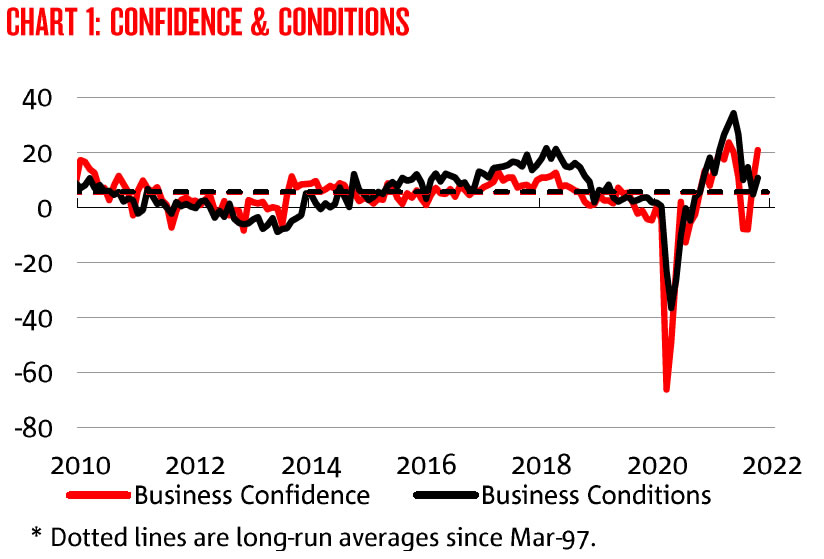
Australia NAB business confidence rose to 21 in Oct, conditions rose to 11
Australia NAB business confidence rose sharply from 10 to 21 in October. Business conditions rose from 5 to 11, back above long-run average. Trading conditions rose from 10 to 17. Profitability conditions rose from 2 to 8. Employment conditions rose from 1 to 6.
"The large improvement in forward orders provides further evidence of the strong rebound in economic activity that is underway," said NAB Chief Economist Alan Oster. "Businesses can see that conditions are improving and that momentum should continue over coming months."
"We are starting to see some price pressures, but these remain largely in the form of pressure on input costs," said Oster. "These pressures should pull back as global supply chain disruptions ease and labour markets normalise, although this process may take some time yet."
BoE Bailey: We will have to act on interest rates if evidence becomes clear
BoE Governor Andrew Bailey there was "a risk of more bottlenecks in the economy, especially in demand for labour which could fuel expectations of higher inflation.''
And, "once you start to get an increase in inflation of this sort we want to stop it becoming generalized in the economy."
"That's why we would, and will, have to act on interest rates if we see that evidence becoming clear," he said.
Fed Evans: Inflation to stay more elevated in 2022
Chicago Fed President Charles Evans said, "inflation will stay more elevated in 2022", but "we have time to be patient". In his own view, Fed will not need to raise interest rates until 2023.
Nevertheless, in a speech, he said there are signs that inflation pressures could build up more broadly. "These developments deserve careful monitoring and present a greater upside risk to my inflation outlook than I had thought last summer."
Separately, Fed Governor Michelle Bowman said, "housing supply issues are unlikely to reverse materially in the short term, which suggests that we are likely to see higher inflation from housing for a while."
Fed Harker: No rate hike before tapering is complete
Philadelphia Fed President Patrick Harker said yesterday "I don't expect that the federal funds rate will rise before the tapering is complete." But he added, "we are monitoring inflation very closely and are prepared to take action, should circumstances warrant it."
Harker expected the economy to grow by around 5.5% this year and 4% next, provided that there is no further wave of COVID-19 infections. Then growth was slow to 2-3% in 2023.
Oil Rebounds, Gold Shines
Oil prices rise on Saudi Arabia increase
Crude prices pared earlier gains after constant posturing by the Biden administration that shows they are getting closer to tapping the Strategic Petroleum Reserve. In the morning, Energy Secretary Granholm noted that Biden wants to see added supply of oil and that an announcement could be made this week. In the afternoon, White House Principal Deputy Secretary noted that the White House continues to monitor energy prices.
Earlier oil prices were boosted after Saudi Arabia delivered a significant increase to Arab light grade of crude for Asian customers. For Saudi Arabia to deliver such an increase, the demand outlook must be improving, somewhat contradicting the uncertainty to the outlook they touted last week.
It is hard to be overly bullish crude prices in the short-term until after the Biden administration intervenes. If the administration taps the SPR, WTI crude should find support around the USD 76.63 area.
WTI crude got an added boost after the DOE reported the SPR declined by 3.14 million bbl last week, the largest drop since July 2017.
Gold
Gold is breaking out as investors scramble for inflation hedges. Fed and BOE rate hike expectations remain influx as investors await the next round of inflation data. Gold is having a good start to the week after President Biden finally got a big win with infrastructure spending and as real yields in the UK fall to record lows. The UK 10-year yield fell to a fresh record low and the 30-year dropped below 1% for the first time since the summer.
If this week’s inflation data does not disrupt the gold rally, bullish momentum could eye the USD 1900 level.
Eco Data 11/9/21
[php_everywhere instance="1"]
Aussie Climbs Up ahead of Confidence Data
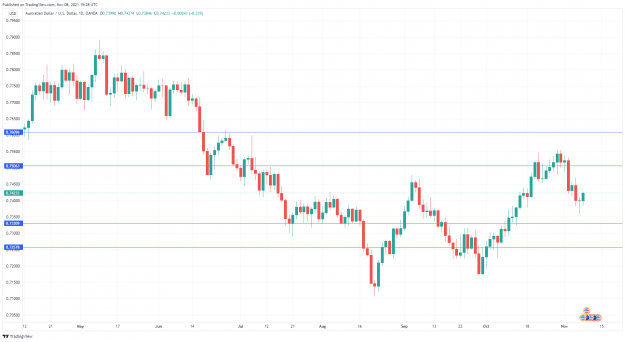
The Australian dollar is in positive territory at the start of the week and has punched above the 74 level. AUD/USD is currently trading at 0.7424, up 0.34% on the day.
The RBA was in the headlines for much of the week, and investors were all ears as the RBA released its quarterly policy statement on Friday. The bank sounded guardedly optimistic about the economy, saying that it expected wage growth to hit 3% and inflation to reach 2.5% by the end of 2023. As for what investors were most interested in, the bank stuck to its projection that it wouldn’t raise interest rates prior to 2024.
The bank has been consistent in projecting a rate hike in 2024, which has meant pushing back against market pricing of a hike in 2023. Australia’s economy is expected to have contracted in Q3, but the markets have been hawkish about a rate hike, and the removal of lockdowns in Sydney and Melbourne has boosted consumer and business confidence. We’ll get a look at business and confidence data later on Tuesday, and the readings could have an impact on the movement of the Australian dollar.
The Australian dollar had its worst week since mid-August, falling 1.57%. The currency was hit hard after the RBA failed to defend its 0.10% bond year target and then formally abandoned the target at last week’s policy meeting.
In the US, October nonfarm payrolls was solid, as the reading of 535 thousand beat the consensus of 455 thousand. As well, the September reading was revised upwards from 194 thousand to 312 thousand, pointing to impressive growth in the labour market. There was more positive news as the unemployment rate dropped and wage growth rose. This all made for an excellent day at the office, but the fly in the ointment was the participation rate, which remained at 61.6%, shy of the forecast of 68.6%. Federal member Esther George said after the FOMC meeting that the Fed would be keeping a close look at whether workers were re-entering the labour market, so investors would be wise to keep a look at the participation rate in upcoming NFP reports.
AUD/USD Technical
- There is resistance at 0.7506 and 0.7609
- AUD/USD has support at 0.7330 and 0.7257
Sunset Market Commentary
Markets
The end of last week’s fireworks mark a stark contrast with today’s muted start to the trading week. Admittedly, the empty eco calendar didn’t stimulate action. In mostly technical trade, core bonds returned some of the post-BoE gains. US yields add 1.7 bps to 3.4 bps with the belly of the curve underperforming the wings. Some weakness is also normal going into the US Treasury’s mid-month refinancing operation. Tonight’s $56bn 3-yr Note sale will be followed by $39bn 10-yr Note and $25bn 30-yr bond sales tomorrow and on Wednesday. The outcome will be telling for investor appetite at current market levels and given current inflation dynamics. Additionally, US Congress on Friday finally approved the Biden’s infrastructure bill which includes $550bn in new funding. It suggests that last week’s falling projected sales in the quarterly refunding announcement will be a one-off and potentially even reversed. The German yield curve bear steepens today with yields rising by 0.4 bps (2-yr) to 4.3 bps (30-yr). Spanish newspaper El Pais published an article with ECB chief economist Lane in which he sounded dovish as usual. He referred to today’s situation as very unusual and temporary and very different from the 1970s and 1980s. Extensive monetary accommodation is still required to ensure that inflation pressure builds on a persistent basis. Tightening monetary policy at the current juncture would be counter-productive in his view as the inflation rate over the medium term is still too low. Medium- to long-term European inflation expectations in the meantime did evolve towards the 2%-target though. He added that unsustainable and undesirable price pressures are a risk factor. Markets didn’t respond to the comments, sticking to their hawkish view that even the ECB will sooner than later have to abide to persisting inflation pressures.
The US dollar last week attempted to take out 94.47/74 resistance, but failed to do so. The greenback remains slightly in the defensive at 94.20. EUR/USD changes hands around 1.1575. USD/JPY is finally capitulating in a move which we expected during last week’s core bond rally. The pair falls below first support at 113.26 even if today’s market setting doesn’t really warrant the JPY strength (slightly positive bourses; slightly weaker bonds; overall low volatility). Sterling performs remarkably well following last week’s huge BoE-setback and as EU/UK heavyweight officials step up hawkish trade rhetoric over the Northern Ireland protocol. Protagonists meet on Friday with the UK still threatening to trigger article 16 (unilaterally taking appropriate safeguard measures if the Protocol leads to serious economic, societal or environmental difficulties that are deemed to persist). News Headlines
In its November inflation report, the National Bank of Poland upwardly revised its inflation forecast for the whole policy horizon 2021/2023 compared to the previous projection in July. Average inflation now is seen at 5.3% for this year (from 5.0%), 5.8% next year (from 3.3%) and 3.6% in 2023 (from 3.4%). Poland wants inflation to be near its 2.5% with a 1.0% tolerance band. Growth was upwardly revised for this year (5.3% from 5.0%) but was seen lower in 2022 (4.9%) and 2023 (4.9%). The NBP last week raised its policy rate from 0.50% to 1.25% in order to arrest accelerating inflation. EUR/PLN today stabilized near 4.60. As is the case for the likes of the Czech koruna and the forint, the zloty still only modestly profits from the prospect of a more protracted hiking cycle.
Bank of Canada Governor Macklem said that they will keep inflation under control. He admitted that 5% inflation is uncomfortable given the 2%-target. He described the current inflation outlook of the central bank as ‘transitory but not short-lived’. This translates into inflation returning to 2% by the end of next year. With respect to monetary policy he reiterated that the BoC will probably raise rates sooner than it expected until now. Given the current economic projections the lift-off of the interest rate cycle might take place between April and September. After a modest, USD-driven setback last week, the loonie currently stabilizes near USD/CAD 1.2450.
Fed Bullard: May have to act sooner to keep inflation under control
St. Louis Fed President James Bullard told Fox Business network, that supply chain disruption is expected to extend through 2022. "if inflation is more persistent than we are saying right now, then I think we may have to take a little sooner action in order to keep inflation under control," he added.
But he said, "we've done a lot to move the policy in a more hawkish direction." And, "if we had to, we could end the taper somewhat sooner than June".
He penciled in two rate hikes in 2022.
Fed Clarida: Necessary conditions for rate hike to be met by 2022 end
In a speech, Fed Chair Vice Clarida said the US is "a ways away from considering raising interest rates". However, if outlook for inflation and unemployment realized over time, the "three necessary conditions for raising the target range for the federal funds rate will have been met by year-end 2022".
Clarida also said his individual projections for GDP growth, the unemployment rate, inflation and the policy rate path were quite close the the September median projections. Real GDP would return to its prepandemic trend growth trajectory by Q4 this year, representing "one of the most rapid such recoveries in 50 years." The 4.2 "employment gap" relative to the previous cycle peak will be eliminated by the end of 2022.
Realized PCE inflation so far this year was "much more than a 'moderate' overshoot" of the 2% target. But " I would not consider a repeat performance next year a policy success". Also, risks to inflation outlook are "to the upside".