Sample Category Title
Eco Data 11/3/21
[php_everywhere instance="1"]
Pound Under Pressure ahead of BoE Meeting
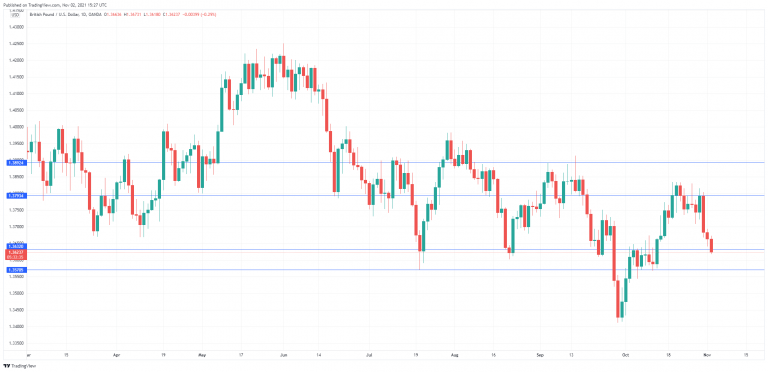
The British pound has edged lower in the Tuesday session. GBP/USD is currently trading at 1.3625, down 0.28% on the day.
Will BoE press rate trigger?
There is plenty of anticipation ahead of the BoE policy meeting on Thursday. There is a palpable feeling of unpredictability in the air, as it is unclear whether the bank will raise rates or maintain the current rate of 0.10%. A hike would likely be limited to 15 basis points, but such a move would mark the first hike by a major central bank since the Covid pandemic hit in early 2019.
BoE Governor Andrew Bailey and two other MPC members have expressed the need to take action and contain surging inflation; two members have voiced strong opposition to the move and four members are yet to weigh in. Analysts are split on which way the vote will go, which means that we could see some volatility from the pound, whatever the outcome of the vote.
Adding to the uncertainty is that the BoE is still running its QE programme. One could make the argument that there is somewhat of a contradiction in policy by raising rates while QE is still in effect, but Bailey, who appears hell-bent on raising rates, has said that that the bank was prepared to raise rates before winding up QE. If the bank does move ahead with a rate hike, the markets may find this confusing and Bailey may need to explain the bank’s thinking.
The pound is also under pressure as the dispute with the EU continues over Brexit, in particular the thorny issue of Northern Ireland. The UK wants to renegotiate the trade rules of the Northern Ireland protocols and remove the jurisdiction of the European Court of Justice (ECJ). The Europeans are willing to make some allowance in the trade rules but insist on the ECJ retaining its role in the Ireland/Northern Ireland/UK relationship.
Ahead of the BoE, the Federal Reserve concludes its policy meeting on Wednesday, with the Fed widely expected to taper its bond purchase programme. Fed Chair Powell will likely remind the markets that tapering does mean that a rate hike is coming anytime soon, but for the markets, the guessing game will intensify as to when the Fed might hike rates.
GBP/USD Technical Analysis
- On the upside, there is support at 1.3793 and 1.3892
- GBP/USD is testing support at 1.3632. This is followed by support at 1.3570
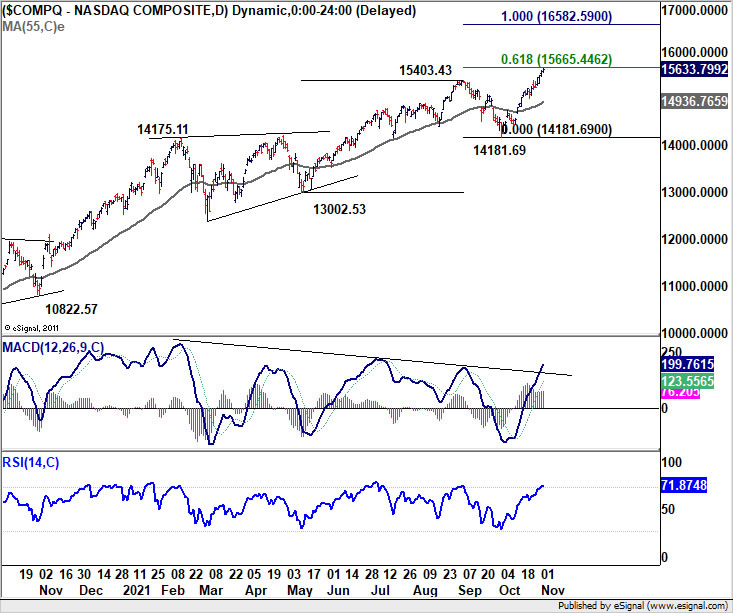
NASDAQ extending record run, pressing projection level at 15665
NASDAQ extends recent record run today, together with other major US indexes. Daily MACD's break of the falling trend line suggests upside acceleration. Focus is now on 61.8% projection of 13002.53 to 15403.43 from 14181.69 at 15665.44. Decisive break there will likely bring acceleration to 100% projection at 16582.59. That would also solidify near term bullishness that would probably last for the rest of the year.
Meanwhile, rejection by 15665.44 would bring corrective pull back. But outlook will stay bullish as long as 55 day EMA (now at 14936.75) holds, even in case of deep correction.
New Zealand Jobs Data Could Bolster Case for Another Rate Hike
Employment indicators for the third quarter are due out of New Zealand on Wednesday (Tuesday, 21:45 GMT). Despite the return of tough lockdowns since August, New Zealand’s labour market is expected to have weathered the latest pandemic storm well. Hence, the data is unlikely to stand in the way of the Reserve Bank of New Zealand hiking its policy rate for the second time this year when it meets later in the month. However, will upbeat numbers be enough for the kiwi to resume its rally, which has stalled recently?
Economy resilient in the face of Delta
Following the onset of the highly infectious Delta variant, New Zealand has joined Australia in abandoning its zero Covid strategy. Nevertheless, the government is keeping strict curbs in place until at least 90% of the population aged 12 or above have been fully vaccinated. But meeting that target could take several more weeks, meaning economic activity looks set to remain dampened in Q4 as well. However, as seen in many other countries, subsequent lockdowns have not been as disruptive as the first shutdowns and New Zealand’s experience is no different.
House prices have continued to soar during the latest lockdown, retail sales appear to have stabilized after the August drop, agricultural exports – the lifeline of New Zealand’s economy - are booming thanks to higher commodity prices, and the government has loosened its purse strings once again to support the economy through the crisis. Most important of all for policymakers, inflation is surging.
Inflation is a worry
The consumer price index jumped to 4.9% year-on-year in Q3 – well above the RBNZ’s target band of 1-3%. Although wage growth has yet to accelerate to similar levels, the surprising tightness of the labour market suggests that this could only be a matter of time, especially if inflation doesn’t come down as quickly as everybody is hoping it would.
Will jobs market go unscathed by Delta?
Looking at Wednesday’s data, employment is expected to have increased by 0.4% in the three months to September compared to the prior quarter when it rose by 1.0%. The government’s wage subsidy scheme, which was reactivated in August after the Delta outbreak plunged the country into a fresh shutdown, likely played a big role in minimizing the impact. Unemployment in the hardest hit sectors such as tourism and retail would most definitely have been much higher had it not been for generous government assistance.
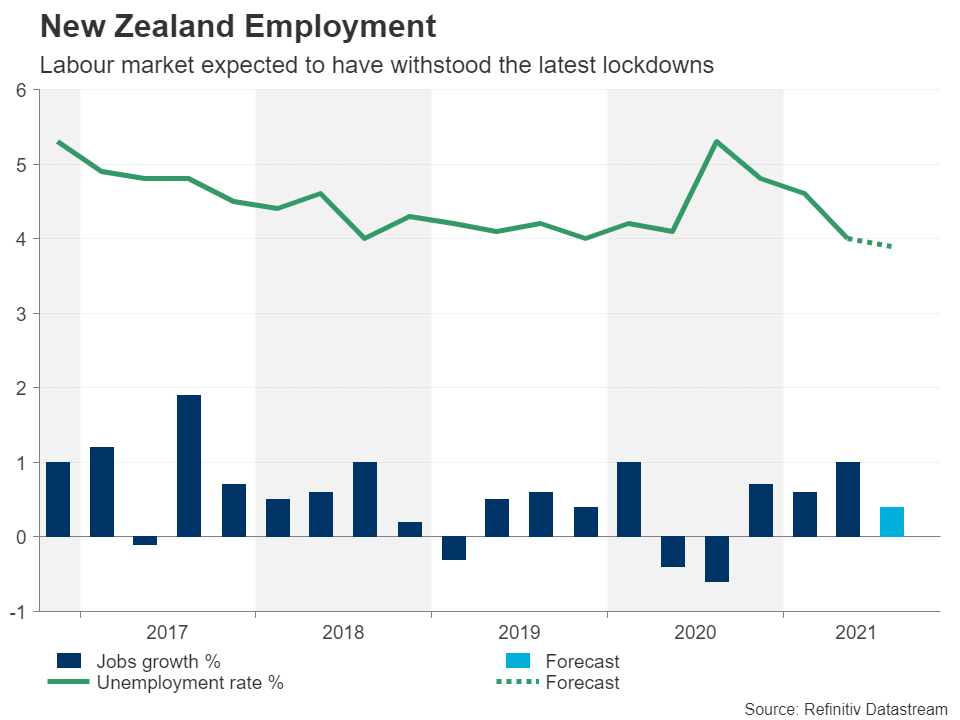
The jobless rate is forecast to have edged down one percentage point to 3.9% in Q3, while the labour force participation rate is expected to have ticked up slightly to 70.6%. As for wages, the labour cost index is predicted to have increased from 2.2% to 2.6% year-on-year.
RBNZ rate hike: not if but by how much
If the upcoming numbers are more or less in line with expectations, there will be no reason for the RBNZ to hesitate to hike rates at its next meeting on November 24. It’s also questionable whether policymakers would be deterred from tightening monetary policy further if the jobs figures disappoint by a sizeable margin.
Unless the employment report is shockingly bad, the RBNZ will likely go ahead and lift the cash rate in November. The real question is, what are the chances that the RBNZ raises rates by an aggressive 50 basis points instead of the more regular increment of 25 bps? A much stronger-than-expected set of jobs numbers could shift the odds in favour of a larger hike, bolstering the kiwi.
Can the kiwi resume its uptrend?
The New Zealand dollar is currently being capped by the 61.8% Fibonacci retracement of the February-August downtrend at $0.7211. A positive surprise could push the currency above this resistance barrier, opening the way for the $0.73 handle, which halted advances in May.
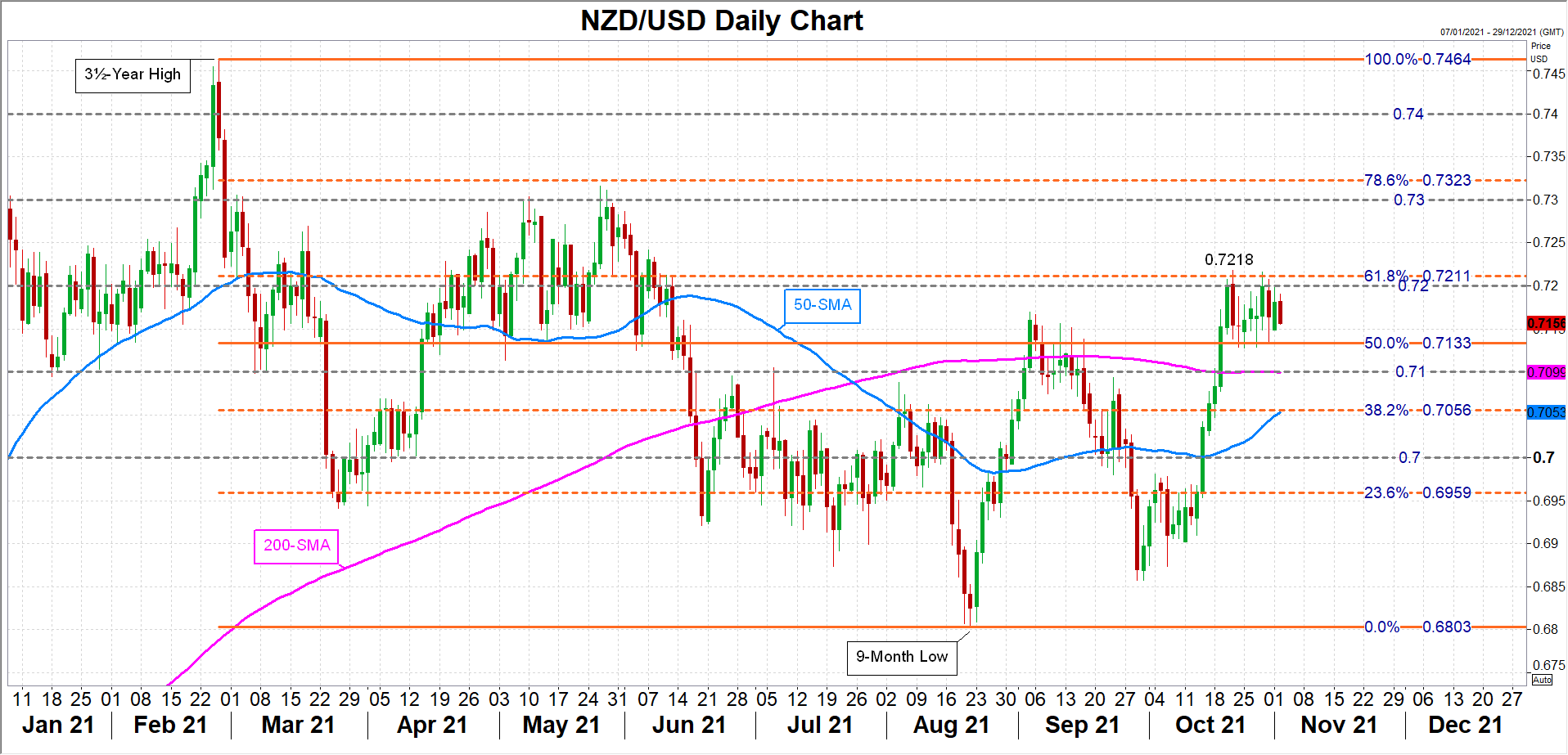
However, if the data is weaker than anticipated, forcing investors to scale back some of their more bullish bets, kiwi/dollar could slip below the immediate support of the 50% Fibonacci at $0.7133 and head for the 200-day moving average (MA) at the critical $0.71 level. If this support fails too, the next big test would be the 38.2% Fibonacci of $0.7056, which is about to be intersected by the 50-day MA.
With markets pricing in a rate rise at every meeting for at least the next six meetings, the kiwi is vulnerable to a downside correction. However, this week’s employment report is unlikely to be what triggers it.
Stocks Near Highs, Dollar Stabilizes, New Zealand Employment Data Due
FOMC and NFP draw focus; RBA sends dovish signals; eurozone data soften
US stocks are trading near their all-time highs and the dollar index looks largely unchanged at present as the FOMC meeting is set to get under way today, with the Fed announcing its decision tomorrow. A tapering announcement is already priced in. After yesterday’s stronger-than-expected US ISM manufacturing PMI, including the pricing component, the economy is showing strong expansionary signs and that it may end the year on a high note.
The Fed is expected to deliver the taper timeline tomorrow, which is likely to result in a muted effect in the reserve currency. Significance therefore remains aimed at rhetoric around interest rate hikes from the Fed moving into 2022, as the taper timeline will be out in the open, and moreover October’s NFP payroll report could exacerbate any reaction in the greenback following the Fed’s message. The FOMC meeting and NFP payrolls report are expected to nourish dollar strength along with rising yields.
The dollar index is consolidating below the 94.00 mark, while the euro is around the $1.1600 handle and the pound in the $1.3650 price vicinity. The euro seems to be faring slightly better than the pound, as the UK continues to be hurt by the energy crisis, labour constraints, and supply risks. Furthermore, the BoE has failed to boost the pound with the prospect of a rate hike before the end of the year.
Mixed results within the eurozone area on manufacturing PMIs resulted in a slight tick lower in the final October reading to 58.3 versus the 58.5 preliminary estimate, but the industry continues to grow. Nonetheless, softer data gives the ECB doves more power to advocate for a patient approach towards tapering.
Commodity currencies and oil
Should the coronavirus cause another slowdown in China, this could weigh on the aussie, fuelling its recent weakness on the back of a dovish tone from the RBA, which conveyed doubt about the scenario of multiple rate hikes in 2022. The aussie has since dived towards the $0.7460 mark.
The RBA kept the cash rate at 0.10% and asset purchases at AUD 4 billion a week at least until mid-February 2022.
Expectations are that the economy may strengthen relatively quickly moving towards the end of the year with relaxations in restrictions, immunization improvements and increased hiring. This could feed inflation but until wage growth steers higher, the risks are likely to be muted for now. Furthermore, the RBA will not hike rates until inflation enters the 2-3% range sustainably.
The kiwi has weakened today falling to $0.7115 ahead of the country’s employment data scheduled for 21:45 GMT. The move down could be related to some weakness in commodity prices.
Persisting effects from the energy crisis have caused oil to reach its highest levels in several years in October of $85.39 per barrel. That said, WTI oil futures are currently lower at $83.50 with OPEC’s meeting on the horizon, which is expected to stick to its plan to bring back 400k barrels each month. That said, there is a lot of pollical pressure on OPEC to deliver more.
Coming up at 20:00 GMT, the RBNZ is to provide its outlook around inflation and growth in its financial stability report.
At 21:30 GMT, Australia’s AIG construction index will signal whether the construction industry is growing.
Then at 00:30 GMT, Australian monthly building approvals are due.
Central Banks in Retreat
An uninspiring start to trading on Tuesday, with Europe and the US hovering around flat on the day as focus turns to central bank meetings in the coming days.
The RBA got us underway today and to put it mildly, the performance was underwhelming. At a time when central bank communication is so important, policymakers have failed miserably this past week when put under pressure by the markets.
To simply abandon a policy tool, without warning, days before a meeting is unforgivable. It undermines their credibility after a period in which unconventional tools and trustworthy central bank communication has been the cornerstone of their monetary policy response, to borrow a phrase from another central bank that abandoned its flagship policy with far more severe consequences.
Other central banks have been on the PR offensive when it comes to preparing markets for upcoming policy changes. The Federal Reserve is almost certain to announce tapering on Wednesday as it pares back its pandemic response and prepares for rate hikes next year.
Given the path of travel for central banks around the world, I expect it will gradually accept that some hikes will be needed once tapering draws to a close, perhaps even immediately after. But that will become much more apparent in December when new forecasts are released.
The Bank of England won't wait that long and may even start raising rates on Thursday. The market appears split on whether they will move this week, with either no change or a 15 basis point hike the likely outcome. While I'm probably in the latter camp, I wouldn't be surprised if they even opt for 25 to give the tightening process a kick start.
There is the argument that they should wait until December to see what impact the end of the furlough scheme and benefits top-up, higher energy prices, Covid, etc will have on the economy. This makes sense, except for the fact that the MPC wanting to raise rates is an inflation play, not a reflection of our booming economy. Whether they act this week or next month makes little difference.
Oil slips ahead of OPEC+ but no increase expected
Oil prices are pulling back a little again today after recovering over the past three sessions. There remains plenty of reasons to be bullish on the oil market at the minute, not least the seeming unwillingness of OPEC+ to ramp up the pace of monthly output increases in the face of strong demand, a tight market, and high prices.
Who knows, maybe they'll surprise us on Thursday and dial it up a little, even temporarily, but I doubt it. They've been through a period of low prices and with US shale not responding particularly quickly to these higher prices as their priorities have shifted, the prospect of high but not recessionary prices may appeal to many.
Especially when demand could soften over the winter months if Covid does trigger restrictions or more cautious behavior. One thing that could take some of the froth out of the market is Russia sending more natural gas supplies to Europe as Vladimir Putin recently suggested they are prepared to do. That could reduce demand for it as an energy alternative but ultimately, it's OPEC+ that holds the key to lower prices.
Gold looking vulnerable ahead of FOMC
Gold is a little lower this morning as it continues to struggle to recapture $1,800 despite numerous attempts to break and hold above that key level to the upside. A close above here would be a big statement with a break of $1,810 then potentially setting the stage for greater gains to the upside.
But with the Fed probably announcing a taper tomorrow and maybe even laying the groundwork for rate hikes later next year, in keeping with hawkish shifts from central banks around the world in recent weeks and months, it may struggle. A stronger dollar could pile further pressure on the yellow metal as it already appears to have entered into a corrective pattern.
Gold broke below a rising channel on Friday as the price plunged after the US data and it's failed to break back into it this week. It's rebounded but only as far as the 50 and 61.8 fib levels, which fall around the lower end of the channel. A failure here, as we appear to be seeing, leaves it vulnerable to another run at $1,770.
Bitcoin heading for new highs?
Bitcoin is continuing to recover from its post-ETF pullback today, trading a couple of percents higher on the day and testing resistance around $63,500. How it trades around here could tell us whether we're seeing a corrective rally as part of a deeper pullback in the bitcoin price, or another run for record highs. Whichever it is, I don't think it will be long before we're seeing the latter as there's so much hype in the space right now.
Sunset Market Commentary
Markets
A standstill on FX markets, minor gains on stock markets and technical corrective action on the European bond markets wraps up today’s action. The eco calendar was empty apart from final EMU PMI’s, leaving a void between yesterday’s good US manufacturing ISM (60.8 from 61.1) and tomorrow’s ADP employment, non-manufacturing ISM and Fed meeting. With the latter, we arrived at today’s main reason for inaction. Investors won’t put up any additional directional bets until that elephant leaves the room. Fed Chair Powell will give the final go-ahead to tapering asset purchases, but the pace and timing have already been well-flagged. Asset purchases will be reduced by $15bn on a monthly basis ($10bn Treasuries & $5bn MBS) to grind to a halt by June next year. The absence of new growth and inflation forecasts and an updated dot plot leaves investors guessing on the timing of a first rate hike. Fed chair Powell won’t commit himself to addressing this thorny issue. The September SEP showed Fed governors split on starting the hiking cycle already next year. Money markets are already positioned more aggressively. The policy statement will be the only potential tell on whether governors are reassessing the nature of the inflation spike. The official narrative so far reads that elevated inflation largely reflects transitory factors. Watering down “largely” or leaving behind the transitory reference all together, won’t go unnoticed.
In summing up today’s action, we’ll start with European bond markets. The German 10-yr yield and European 10y swap rate failed to pierce YTD highs at -0.07% and +0.3% respectively in the wake of last week’s ECB action, causing return action. German yields lose 5.1 bps to 7 bps in the 2y-10y segment with the very long end underperforming (flat). Trading at the very long end of yield curves remains very peculiar and often inexplicable over the past months. Underlying details show a setback in last week’s sudden jump in real rates. The US yield curve bull steepens with yield changes ranging between -3.2 bps (2-yr) and 0.1 bp (30-yr) as the December 15 policy meeting is the likelier occasion to give new guidance on rate normalization. The FX market is an ocean of calm with EUR/USD switching sides around the 1.16 big figure. EUR/GBP shows a similar choppy trading pattern around the 0.85 handle with investors anxiously awaiting Thursday’s verdict by the BoE. Markets and analysts are split on whether or not the BoE will hike its policy rate.
News Headlines
The next Czech government is unlikely to adopt the euro during its four-year term, Stanjura, the man tipped to be the finance minister in the new centre-right coalition, said today. All five parties that form the coalition are generally pro the introduction of the euro but made clear it was not high on the agenda. Instead they will focus on bringing public finances in order after the ravage of the pandemic. Stanjura added that the long-time position was and still is that the Czech Republic should only adopt the euro when it is in their favour, which hasn’t been the case so far. The new Czech coalition seeks to have the government agenda and ministerial jobs distribution ready by November 8, when the fresh lower house of parliament meets for the first time.
Swiss inflation accelerated more than expected in October, from 0.8% y/y to 1.3%. It’s the fastest pace since 2010, matching the speed in 2018. Core inflation stayed muted at 0.6%. The Swiss statistical office said heating oil, gas and fuel recorded a price increase whereas prices for salads and fruiting vegetables decreased. The quickening price evolutions are unlikely to worry the SNB as (core) inflation is still far away from the 2% target. The notoriously strong Swiss franc also serves as an anti-inflationary factor. EUR/CHF recently slipped below 1.06 and neared levels seen at the height of the pandemic. The currency pair today tries to recover some of the lost ground.
Australian Dollar Slides after RBA
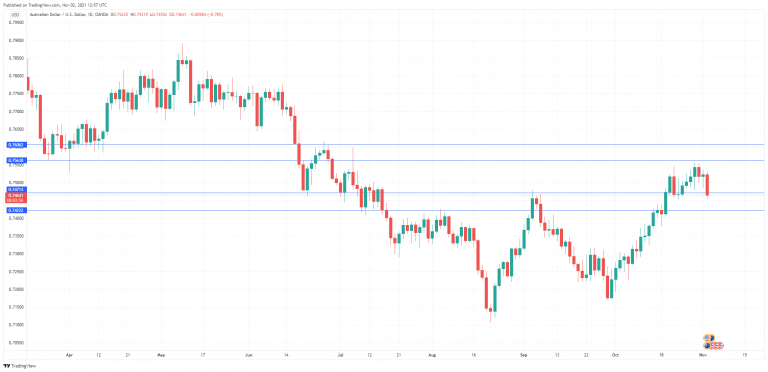
The Australian dollar has posted sharp losses in response to the RBA policy decision earlier on Tuesday. Currently, AUD/USD is trading at 0.7463, down 0.78% on the day.
RBA abandons yield curve control
The Australian dollar took a tumble after the RBA policy meeting. The markets reacted sharply after the RBA formally abandoned its yield curve control of targeting the April 2024 Australian Commonwealth Government bond at 0.10%. The bank essentially threw in the towel on yield curve control last week, and the yield surged as high as 0.75% last week. The RBA maintained the cash rate at 0.10% for a 12th straight month, and QE purchases of AD 4 billion/week will be kept until at least February 2o22.
The RBA’s move means that the bank has become more hawkish (or if you prefer, less dovish), as the yield curve control tool was a key pillar in the bank’s QE programme. The markets, however, were not impressed and the Australian dollar fell sharply. RBA Governor Philip Lowe was somewhat vague on when the RBA would raise rates, saying that the bank would be “patient” and wait until economic conditions were suitable for a rate hike. Lowe has said on numerous occasions that the bank would not raise rates prior to 2024, but the markets have been much more hawkish, given the country’s strong recovery and high inflation. The markets have been aggressive in pricing in a series of rate hikes, with the cash rate projected to rise to around 1.5% by the end of next year. Unless growth and inflation drastically decrease, a strong case can be made for Lowe having to accelerate forward guidance to 2023. If Lowe insists on the 2024 timeline, the Australian dollar could face further headwinds.
The Federal Reserve concludes its policy meeting on Wednesday, with expectations that the Fed will press the taper button while emphasising that no rate hikes are planned. It’s questionable whether a taper has been fully priced in by the markets, even though the Fed has been very transparent about its plans. This means that there is room for the US dollar and US Treasury yields to head to higher ground.
AUD/USD Technical
- There is resistance at 0.7563, followed by resistance at 0.7606
- AUD/USD is testing support at 0.7471. Below, we find support at 0.7422
EUR/USD Mid-Day Outlook
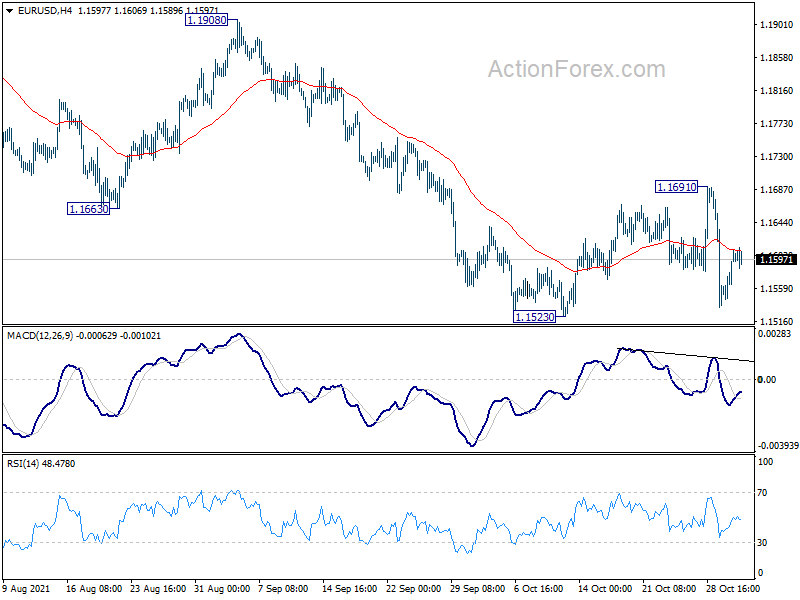
Daily Pivots: (S1) 1.1566; (P) 1.1587; (R1) 1.1629; More...
Intraday bias in EUR/USD remains neutral at this point. Further decline is expected as long as 1.1691 resistance holds. On the downside, break of 1.1523 will resume the fall from 1.2265, and that from 1.2348 too, for long term fibonacci level at 1.1289 next. However, firm break of 1.1691 will indicate short term bottoming and turn bias back to the upside for stronger rebound, towards 1.1908 resistance.
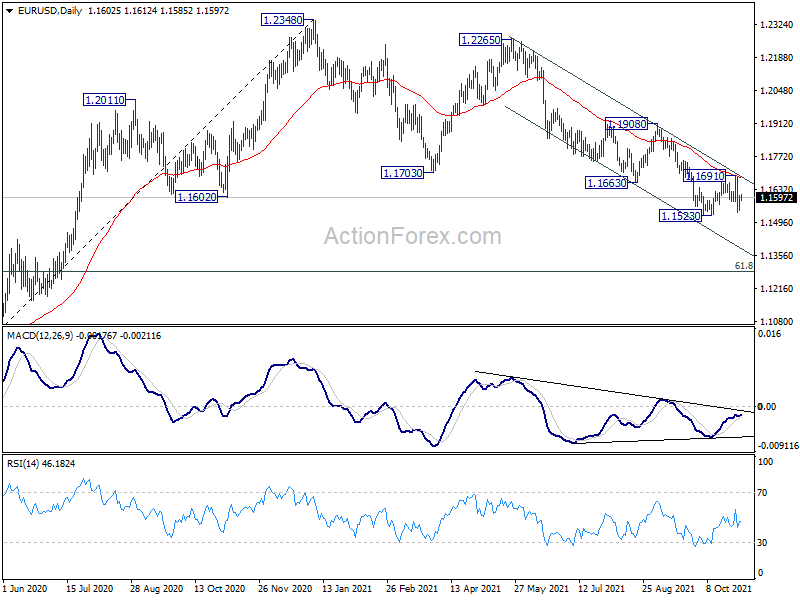
In the bigger picture, price actions from 1.2348 should at least be a correction to rise from 1.0635 (2020 low). As long as 1.1908 resistance holds, deeper fall would be seen to 61.8% retracement of 1.0635 to 1.2348 at 1.1289. Nevertheless break of 1.1908 resistance will revive medium term bullishness and turn focus back to 1.2348 high.
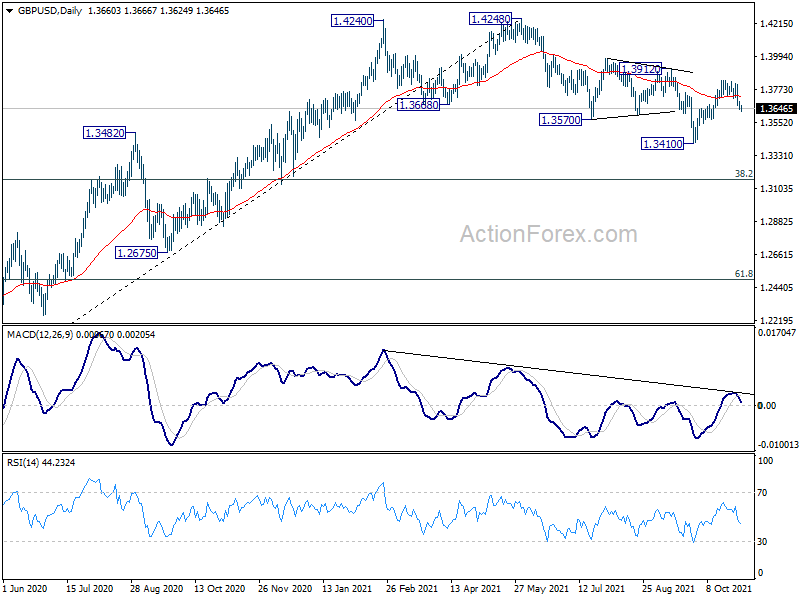
GBP/USD Mid-Day Outlook
Daily Pivots: (S1) 1.3640; (P) 1.3666; (R1) 1.3691; More...
The break of 1.3646 support argues that rebound from 1.3410 has completed at 1.3833. Intraday bias is mildly on the downside for retesting 1.3410 low. On the upside, though, break of 1.3708 minor resistance will turn bias back to the upside for 1.3833 resistance again.
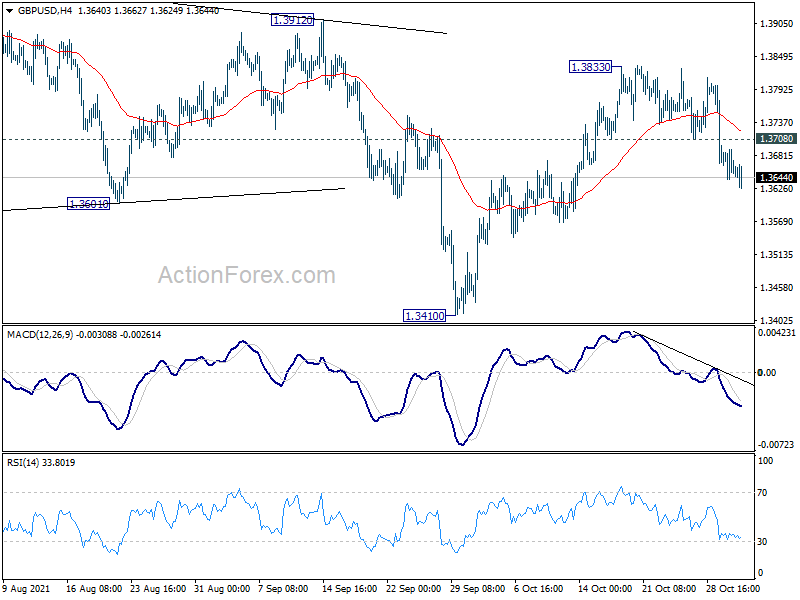
In the bigger picture, the structure of the fall from 1.4248 suggests that it's a correction to the up trend from 1.1409 (2020 low) only. While deeper fall cannot be ruled out yet, downside should be contained by 38.2% retracement of 1.1409 to 1.4248 at 1.3164, at least on first attempt, to bring rebound. On the upside, firm break of 1.4376 key resistance (2018 high) will add to the case of long term bullish reversal. However, sustained trading below 1.3164 will revive some medium term bearishness and target 61.8% retracement at 1.2493.