

Sample Category Title
USD/CAD Daily Outlook
Daily Pivots: (S1) 1.2348; (P) 1.2375; (R1) 1.2399; More...
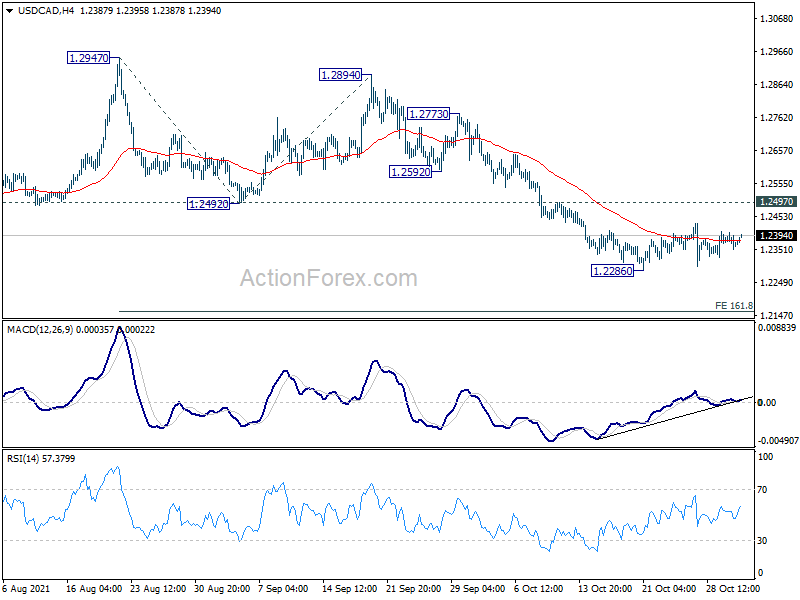
USD/CAD is still extending the consolidation pattern from 1.2286 and intraday bias remains neutral. In case of stronger recovery, upside should be limited by 1.2497 resistance. On the downside, break of 1.2286 will resume the fall from 1.2947 to 161.8% projection of 1.2947 to 1.2492 from 1.2894 at 1.2158 next.
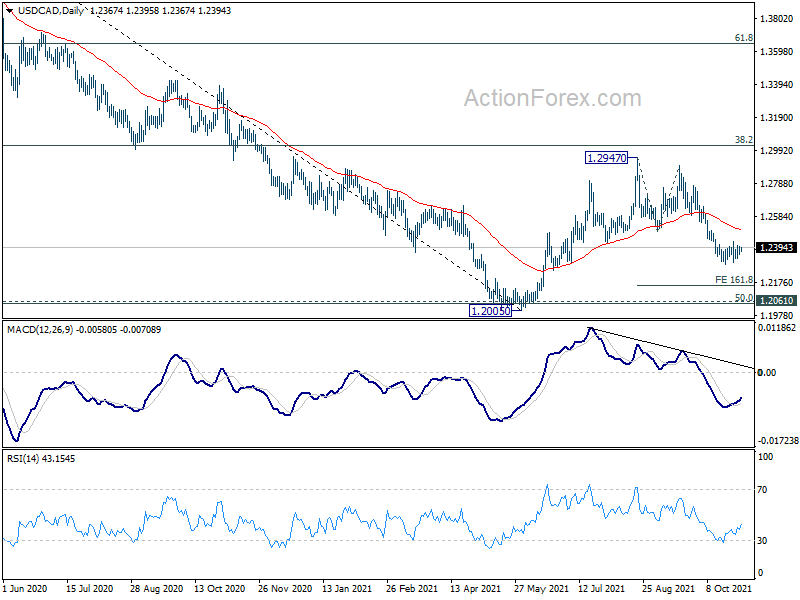
In the bigger picture, the rejection by 38.2% retracement of 1.4667 to 1.2005 at 1.3022 argues that rebound from 1.2005 is merely a corrective rise, which is complete. More importantly, the down trend from 1.4667 (2020 high) is not over yet. Sustained break of 1.2005 will extend the down trend to next long term fibonacci level at 61.8% retracement of 0.9406 to 1.4689 at 1.1424. In any case, outlook will not turn bullish as long as 1.2947 resistance holds.
AUD/USD Daily Report
Daily Pivots: (S1) 0.7493; (P) 0.7514; (R1) 0.7543; More...
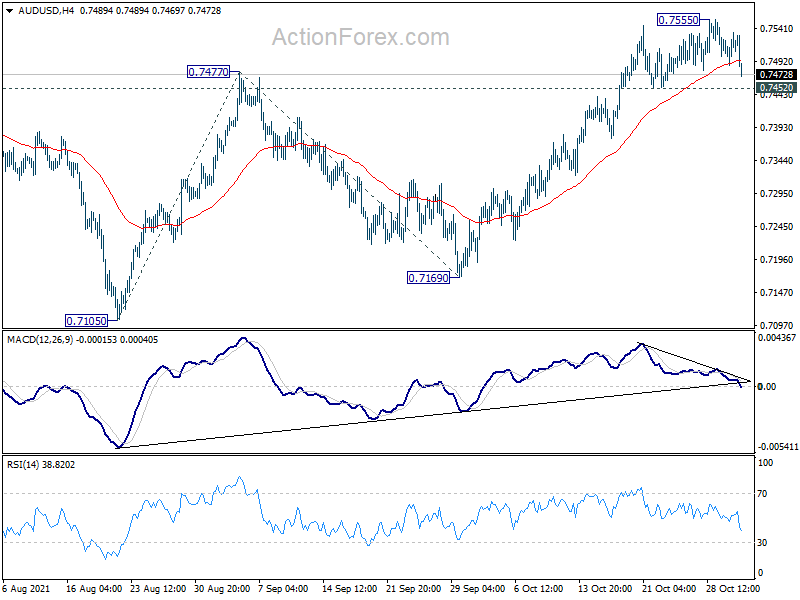
Intraday bias in AUD/USD is neutral for now as consolidation from 0.7555 is extending. But further rally is still expected as long as 0.7452 support holds. On the upside, break of 0.7555 will resume the rise from 0.7105 to 161.8% projection of 0.7105 to 0.7477 from 0.7169 at 0.7771. On the downside, however, break of 0.7452 minor support will turn bias to the downside for 55 day EMA (now at 0.7394) and possibly below.
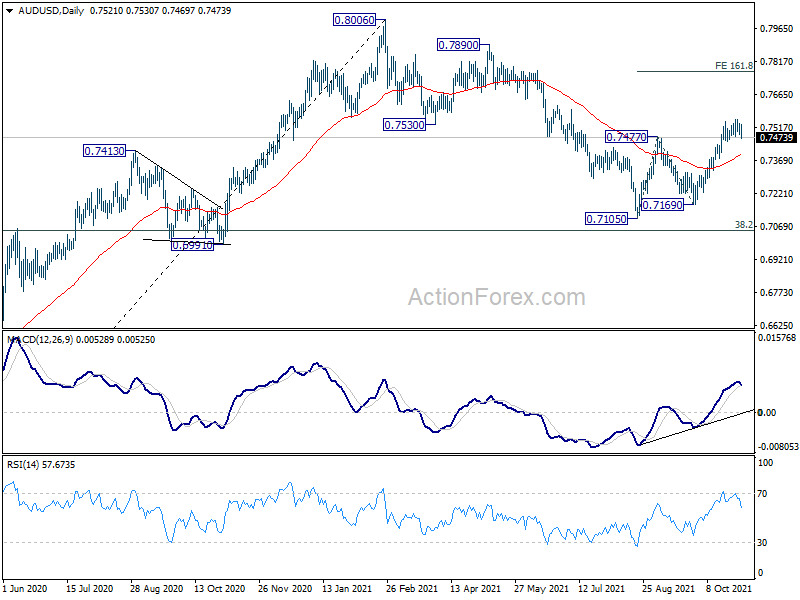
In the bigger picture, with 0.6991 cluster support (38.2% retracement of 0.5506 to 0.8006 at 0.7051) intact, we're seeing price action from 0.8006 as a correction only. That is, up trend from 0.5506 low would resume after the correction completes. In that case, main focus will be 0.8135 key resistance (2018 high). Sustained break there will carry larger bullish implications. However, sustained break of 0.6991 will argue that the whole medium term trend has indeed reversed.
EUR/USD Daily Outlook
Daily Pivots: (S1) 1.1566; (P) 1.1587; (R1) 1.1629; More...
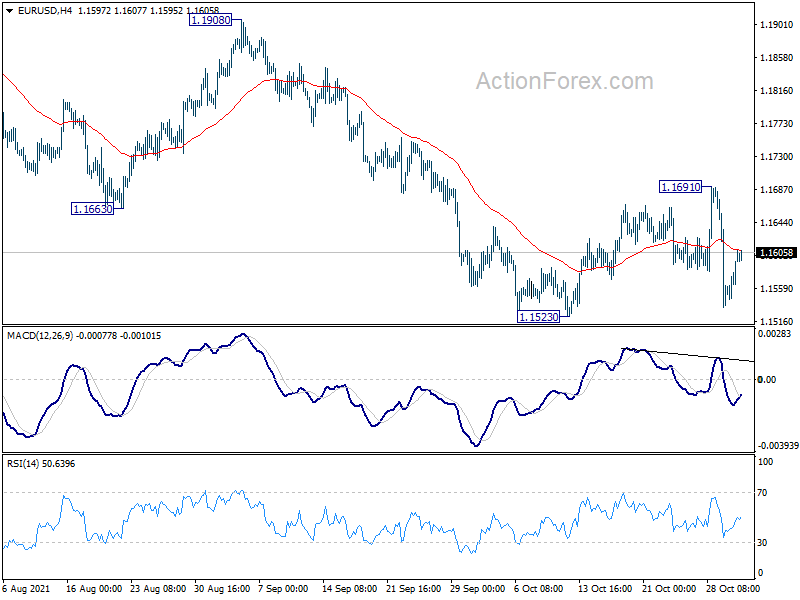
Intraday bias in EUR/USD is turned neutral with current recovery. But further decline is expected as long as 1.1691 resistance holds. On the downside, break of 1.1523 will resume the fall from 1.2265, and that from 1.2348 too, for long term fibonacci level at 1.1289 next. However, firm break of 1.1691 will indicate short term bottoming and turn bias back to the upside for stronger rebound, towards 1.1908 resistance.
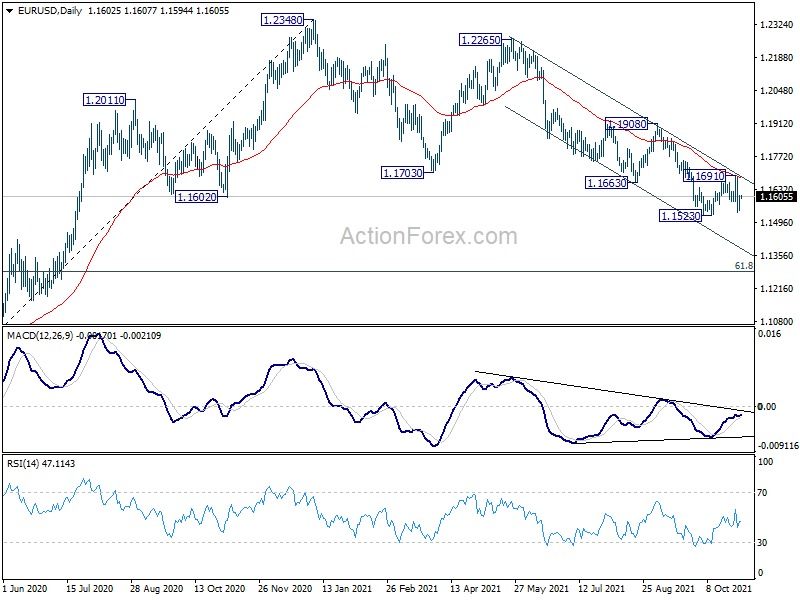
In the bigger picture, price actions from 1.2348 should at least be a correction to rise from 1.0635 (2020 low). As long as 1.1908 resistance holds, deeper fall would be seen to 61.8% retracement of 1.0635 to 1.2348 at 1.1289. Nevertheless break of 1.1908 resistance will revive medium term bullishness and turn focus back to 1.2348 high.
GBP/USD Daily Outlook
Daily Pivots: (S1) 1.3640; (P) 1.3666; (R1) 1.3691; More...
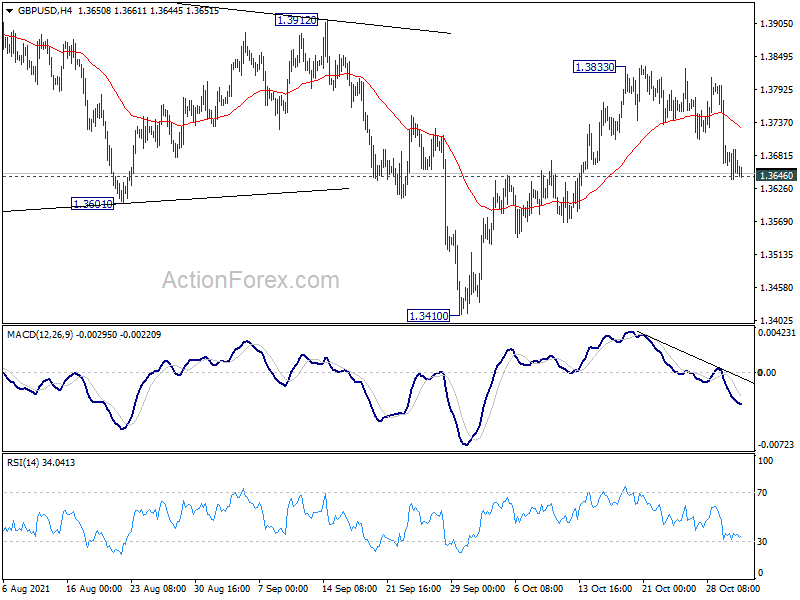
Intraday bias in GBP/USD remains neutral first with focus on 1.3646 support. On the upside, above 1.3833 will resume the rebound from 1.3410 to 1.3912 key structural resistance. Firm break there will indicate that the correction from 1.4248 is complete with three waves down to 1.3410. On the downside, however, break of 1.3646 will turn bias to the downside for retesting 1.3410 low instead.
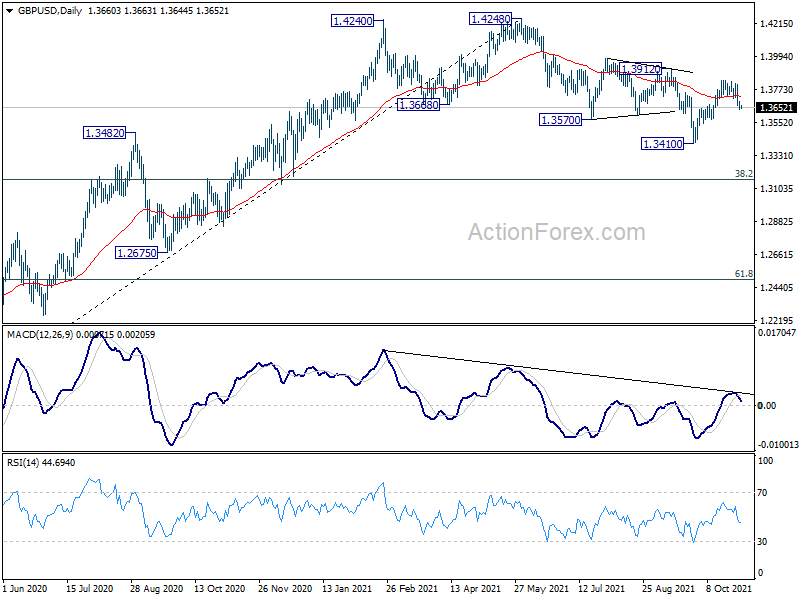
In the bigger picture, the structure of the fall from 1.4248 suggests that it's a correction to the up trend from 1.1409 (2020 low) only. While deeper fall cannot be ruled out yet, downside should be contained by 38.2% retracement of 1.1409 to 1.4248 at 1.3164, at least on first attempt, to bring rebound. On the upside, firm break of 1.4376 key resistance (2018 high) will add to the case of long term bullish reversal. However, sustained trading below 1.3164 will revive some medium term bearishness and target 61.8% retracement at 1.2493.
USD/CHF Daily Outlook
Daily Pivots: (S1) 0.9063; (P) 0.9118; (R1) 0.9146; More....
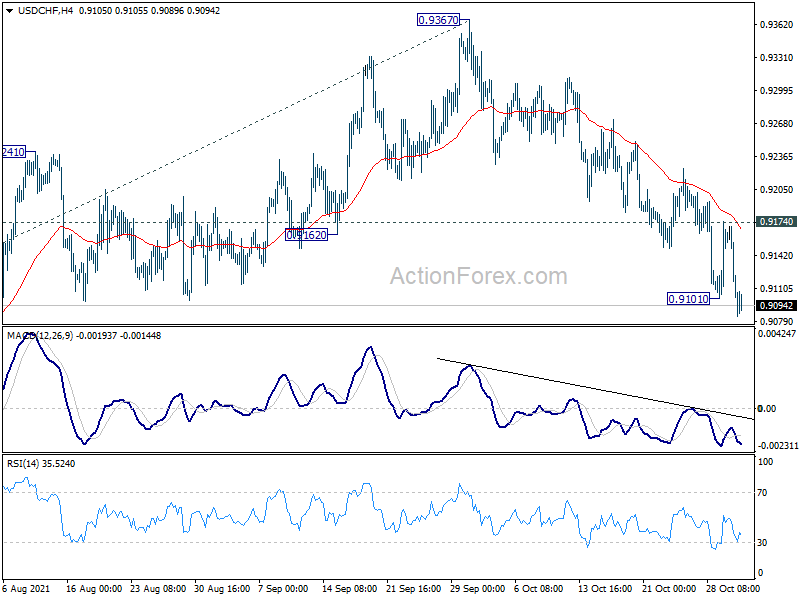
USD/CHF's fall from 0.9367 resumed after brief recovery and intraday bias is back on the downside. Current fall should target 0.9017 support first and then 0.8925. On the upside, however, break of 0.9174 resistance will indicate short term bottoming and turn bias back to the upside for stronger rebound instead.
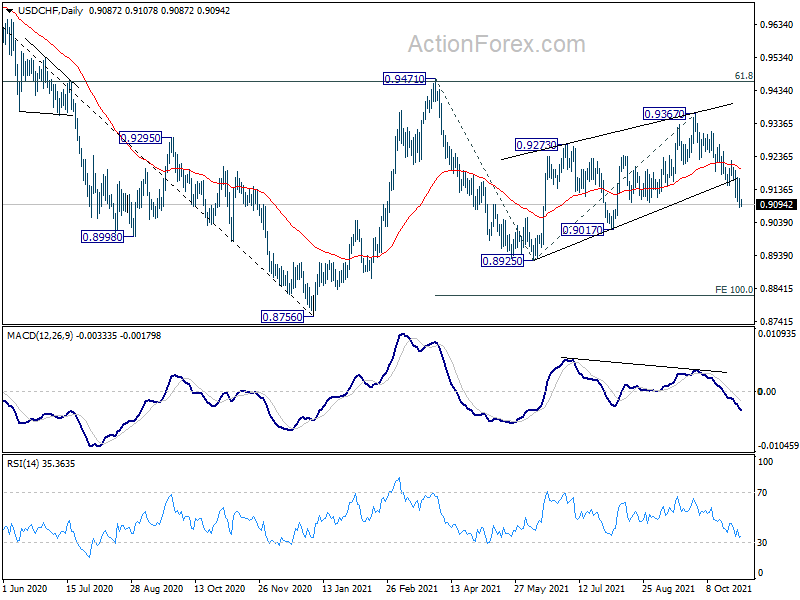
In the bigger picture, the corrective structure of the rebound from 0.8925 argues that fall from 0.9471 is not complete yet. It could either be the second leg of pattern from 0.8756 (2021 low), or resuming larger down trend from 1.0237 (2018 high). We'd pay attention to the downside momentum and assess the odds later. But for now, medium term outlook will be neutral at best as long as 0.9471 resistance holds.
USD/JPY Daily Outlook
Daily Pivots: (S1) 113.81; (P) 114.13; (R1) 114.31; More...
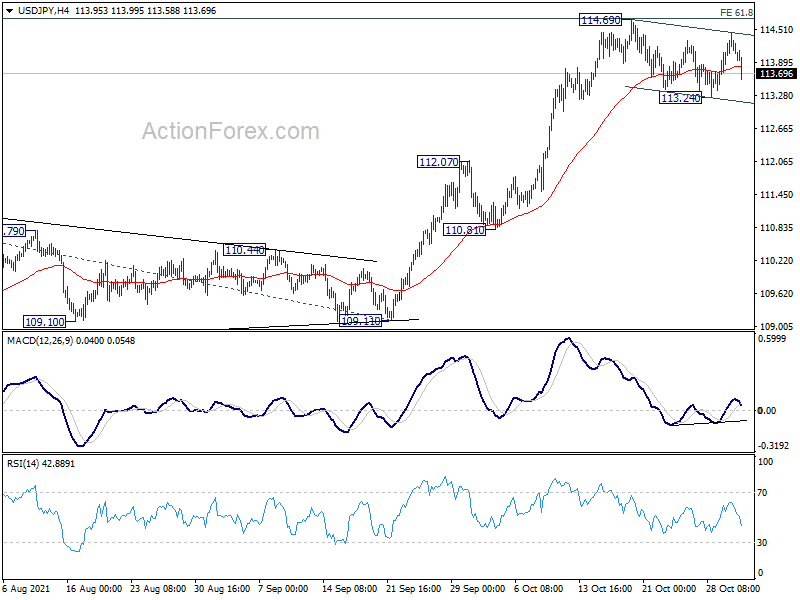
USD/JPY failed to break through 114.69 high and reversed. Consolidation from there is extending with another falling leg. Intraday bias remains neutral first. Break of 113.24 will bring deeper pull back, but downside should be contained above 112.07 resistance turned support to bring rebound. On the upside, firm break of 114.69 will resume the larger up trend to 100% projection of 102.58 to 111.65 from 109.11 at 118.18 next.
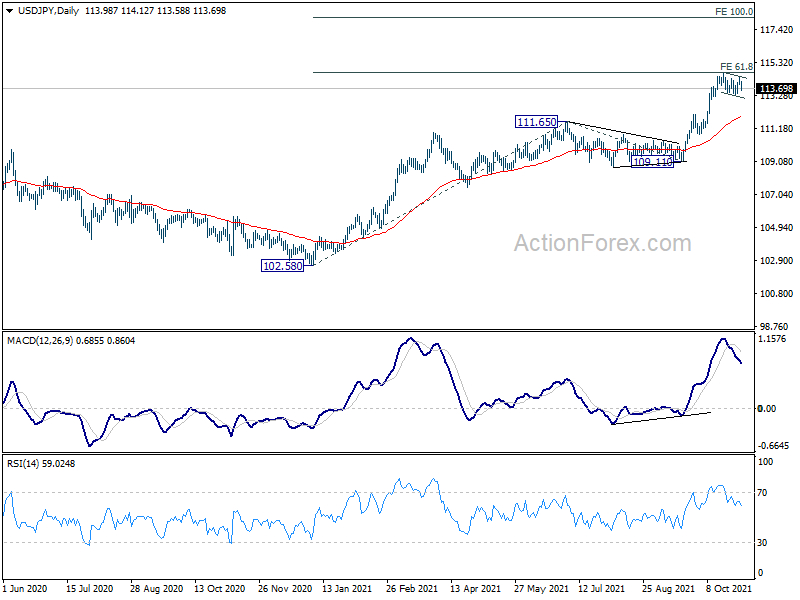
In the bigger picture, corrective decline from 118.65 (2016 high) should have completed at 101.18 already. Rise from the 102.58 is seen as the third leg of the up trend from 101.18. Next target is 114.54 resistance and then 118.65 high. This will now be the preferred case as long as 109.11 support hold, even in case of deep pull back.
Aussie Tumbles after RBA, Yen Staging a Rebound
Australia Dollar tumbles broadly today as markets are dissatisfied with RBA's dovish stance, even though yield curve control is abandoned. Commodity currencies are also trading generally lower. On the other hand, Yen is staging a strong rebound after Japanese Finance Minister Shunichi Suzuki said he's keeping an eye on the weakening exchange rate. The move is also accompanied by pull back in both Nikkei and benchmark JFB yield. Dollar and Euro are also trading mildly firmer.
Technically, EUR/GBP's break of 0.8474 minor resistance suggests short term bottoming at 0.8401. We'll see if that would be translated into break of 1.3646 support in GBP/USD, or stronger rebound in EUR/USD, or both. At the same time, USD/JPY is also extending the consolidation pattern from 114.69 as another falling leg. Break of 113.24 would bring deeper correction.
In Asia, at the time of writing, Nikkei is down -0.56%. Hong Kong HSI is up 0.74%. China Shanghai SSE is down -0.62%. Singapore Strait Times is up 0.09%. Japan 10-year JGB yield is down -0.0107 at 0.086. Overnight, DOW rose 0.26%. S&P 500 rose 0.18%. NASDAQ rose 0.63%. 10-year yield rose 0.018 to 1.575.
RBA abandons yield curve control, hints on earlier hike
RBA kept cash rate target unchanged at 0.10% as widely expected today. The asset purchase program, however, will continue at AUD 4B per week until at least February 2022. However, without much surprise, it discontinue 0.10% target for April 2024 government bonds, effectively abandoning yield curve control.
As for forward guidance, RBA maintain that cash rate won't be raised until actual inflation is "sustainably within the 2 to 3 per cent target range". But now, it forecasts inflation to be no higher than 2.50% at the end of 2023, hinting that rate hike could come earlier than that.
In the new economic projection, RBA expects GDP growth to b 3% in 2021, 5.50% in 2022, and 2.50% in 2023. Unemployment rate is expected to trend lower to 4.25% at the end of 2022 and 4.00% at the end of 2023. Inflation is projected to be at 2.25% over 2021 and 2022, and pick up to 2.20% over 2023.
AUD/JPY dips as consolidation from 86.24 extends with another leg
Aussie drops notably after even though RBA abandoned yield curve control, and signaled that interest rate could be raised earlier than previously expected. Yet, it's clear that RBA would hold their hands, probably after well into 2023, before making a decision, if inflation is not out of control. That is, it will still lag behind some other major central banks in stimulus removal.
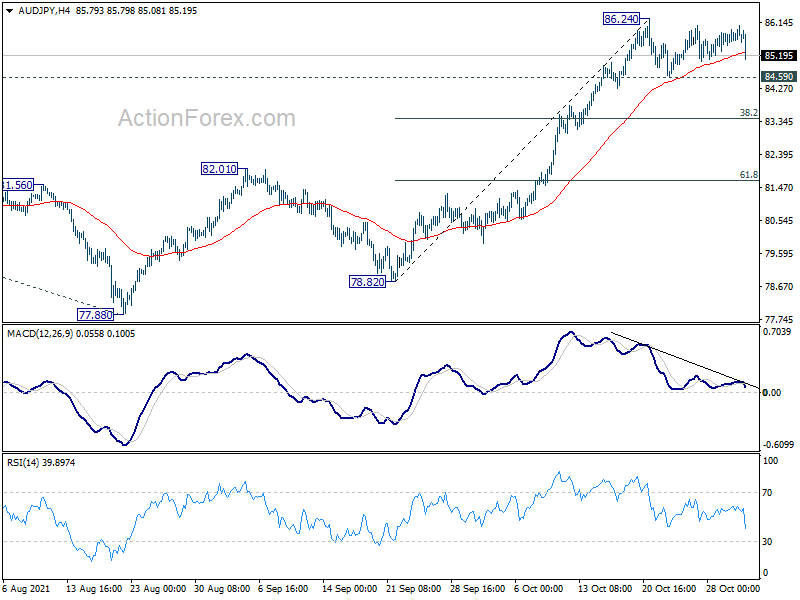
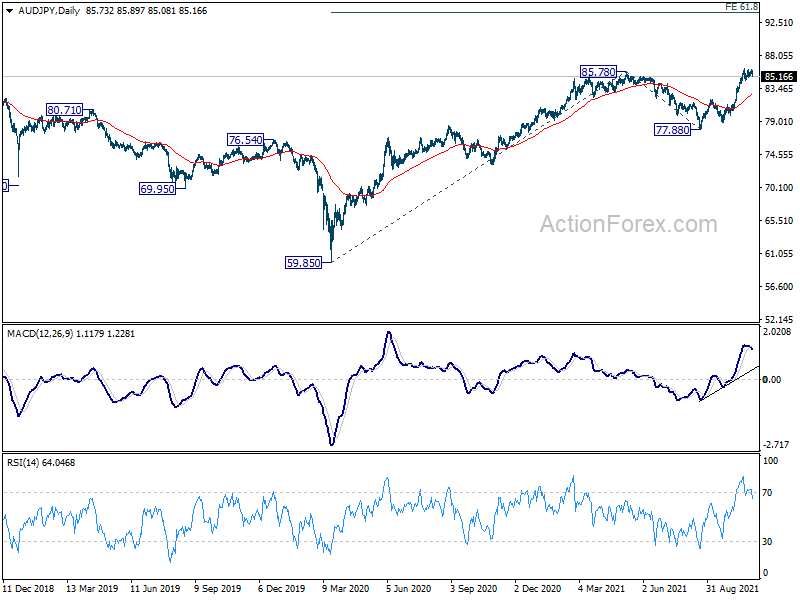
AUD/JPY is now extending the consolidation pattern from 86.24 short term top with another falling leg. 84.59 support would provide the first defense. As long as this level holds, the consolidation should be relatively brief, and we'd expect a break of 86.24 high to come sooner rather than later. In that case, the medium term up trend would continue to 61.8% projection of 59.85 to 85.78 from 77.88 at 93.90 next.
However, break of 84.59 will bring deeper correction to 38.2% retracement of 78.82 to 86.24 at 83.40 first, or even to 55 day EMA (now at 82.80), before up trend resumption.
RBNZ Orr views level of house prices as unsustainable
In a speech, RBNZ Governor Adrian Orr warned, "it will come as no surprise to you that in our forthcoming Financial Stability Report we will again elaborate on why we view the level of house prices as unsustainable, and why this matters."
"At the source of the financial stability risk is the inability of housing supply to respond in a timely fashion to changes in demand, and the drivers that lead to a bias towards housing as an investment choice beyond simply a place to reside," he said.
"There is no one agency or silver bullet. House prices and housing affordability are affected by both supply and demand factors, ranging across immigration, tax policy, government benefits or transfers, land availability, building standards, infrastructure, and training programmes," he added"
"Ultimately, it is access to land and space that has recently proved to be the biggest challenge to enabling a smooth functioning housing market".
On the data front
New Zealand building permits dropped -1.9% mom in September. Japan monetary base rose 9.9% yoy in October, versus expectation of 12.3% yoy.
Looking ahead, Swiss will release retail sales and CPI. Eurozone will release PMI manufacturing final. Later in the day, Canada will release building permits.
USD/JPY Daily Outlook
Daily Pivots: (S1) 113.81; (P) 114.13; (R1) 114.31; More...
USD/JPY failed to break through 114.69 high and reversed. Consolidation from there is extending with another falling leg. Intraday bias remains neutral first. Break of 113.24 will bring deeper pull back, but downside should be contained above 112.07 resistance turned support to bring rebound. On the upside, firm break of 114.69 will resume the larger up trend to 100% projection of 102.58 to 111.65 from 109.11 at 118.18 next.
In the bigger picture, corrective decline from 118.65 (2016 high) should have completed at 101.18 already. Rise from the 102.58 is seen as the third leg of the up trend from 101.18. Next target is 114.54 resistance and then 118.65 high. This will now be the preferred case as long as 109.11 support hold, even in case of deep pull back.
Economic Indicators Update
| GMT | Ccy | Events | Actual | Forecast | Previous | Revised |
|---|---|---|---|---|---|---|
| 21:45 | NZD | Building Permits M/M Sep | -1.90% | 3.80% | ||
| 23:50 | JPY | Monetary Base Y/Y Oct | 9.90% | 12.30% | 11.70% | |
| 23:50 | JPY | BoJ Minutes | ||||
| 3:30 | AUD | RBA Rate Decision | 0.10% | 0.10% | 0.10% | |
| 7:30 | CHF | Real Retail Sales Y/Y Sep | 1.40% | 0.50% | ||
| 7:30 | CHF | CPI M/M Oct | 0.10% | 0.00% | ||
| 7:30 | CHF | CPI Y/Y Oct | 1.10% | 0.90% | ||
| 8:45 | EUR | Italy Manufacturing PMI Oct | 59.7 | 59.7 | ||
| 8:50 | EUR | France Manufacturing PMI Oct F | 53.5 | 53.5 | ||
| 8:55 | EUR | Germany Manufacturing PMI Oct F | 58.2 | 58.2 | ||
| 9:00 | EUR | Eurozone Manufacturing PMI Oct F | 58.5 | 58.5 | ||
| 12:30 | CAD | Building Permits M/M Sep | 2.20% | -2.10% |
AUD/JPY dips as consolidation from 86.24 extends with another leg
Aussie drops notably after even though RBA abandoned yield curve control, and signaled that interest rate could be raised earlier than previously expected. Yet, it's clear that RBA would hold their hands, probably after well into 2023, before making a decision, if inflation is not out of control. That is, it will still lag behind some other major central banks in stimulus removal.
AUD/JPY is now extending the consolidation pattern from 86.24 short term top with another falling leg. 84.59 support would provide the first defense. As long as this level holds, the consolidation should be relatively brief, and we'd expect a break of 86.24 high to come sooner rather than later. In that case, the medium term up trend would continue to 61.8% projection of 59.85 to 85.78 from 77.88 at 93.90 next.
However, break of 84.59 will bring deeper correction to 38.2% retracement of 78.82 to 86.24 at 83.40 first, or even to 55 day EMA (now at 82.80), before up trend resumption.
RBNZ Orr views level of house prices as unsustainable
In a speech, RBNZ Governor Adrian Orr warned, "it will come as no surprise to you that in our forthcoming Financial Stability Report we will again elaborate on why we view the level of house prices as unsustainable, and why this matters."
"At the source of the financial stability risk is the inability of housing supply to respond in a timely fashion to changes in demand, and the drivers that lead to a bias towards housing as an investment choice beyond simply a place to reside," he said.
"There is no one agency or silver bullet. House prices and housing affordability are affected by both supply and demand factors, ranging across immigration, tax policy, government benefits or transfers, land availability, building standards, infrastructure, and training programmes," he added"
"Ultimately, it is access to land and space that has recently proved to be the biggest challenge to enabling a smooth functioning housing market"
RBA abandons yield curve control, hints on earlier hike
RBA kept cash rate target unchanged at 0.10% as widely expected today. The asset purchase program, however, will continue at AUD 4B per week until at least February 2022. However, without much surprise, it discontinue 0.10% target for April 2024 government bonds, effectively abandoning yield curve control.
As for forward guidance, RBA maintain that cash rate won't be raised until actual inflation is "sustainably within the 2 to 3 per cent target range". But now, it forecasts inflation to be no higher than 2.50% at the end of 2023, hinting that rate hike could come earlier than that.
In the new economic projection, RBA expects GDP growth to b 3% in 2021, 5.50% in 2022, and 2.50% in 2023. Unemployment rate is expected to trend lower to 4.25% at the end of 2022 and 4.00% at the end of 2023. Inflation is projected to be at 2.25% over 2021 and 2022, and pick up to 2.20% over 2023.