Sample Category Title
(RBA) Statement by Philip Lowe, Governor: Monetary Policy Decision
At its meeting today, the Board decided to:
- maintain the cash rate target at 10 basis points and the interest rate on Exchange Settlement balances at zero per cent
- continue to purchase government securities at the rate of $4 billion a week until at least mid February 2022
- discontinue the target of 10 basis points for the April 2024 Australian Government bond.
The Australian economy is recovering after the interruption caused by the Delta outbreak. As vaccination rates increase even further and restrictions are eased, the economy is expected to bounce back relatively quickly. The central forecast is for GDP growth of 3 per cent over 2021 and 5½ per cent and 2½ per cent over the following two years. One important source of uncertainty continues to be the possibility of a further setback on the health front.
The Delta outbreak caused hours worked in Australia to fall sharply, but a bounce-back is now underway. The Bank's business liaison and the data on job ads suggest that many firms are now hiring, which will boost employment over coming months. The central forecast is for the unemployment rate to trend lower over the next couple of years, reaching 4¼ per cent at the end of 2022 and 4 per cent at the end of 2023.
Inflation has picked up, but in underlying terms is still low, at 2.1 per cent. The headline CPI inflation rate is 3 per cent and is being affected by higher petrol prices, higher prices for newly constructed homes and the disruptions in global supply chains. A further, but only gradual, pick-up in underlying inflation is expected. The central forecast is for underlying inflation of around 2¼ per cent over 2021 and 2022 and 2½ per cent over 2023. Wages growth is expected to pick up gradually as the labour market tightens, with the Wage Price Index forecast to increase by 2½ per cent over 2022 and 3 per cent over 2023. The main uncertainties relate to the persistence of the current disruptions to global supply chains and the behaviour of wages at the lowest unemployment rate in decades.
Housing prices are continuing to rise in most markets and housing credit growth has picked up due to stronger demand for credit by both owner-occupiers and investors. The Bank welcomes APRA's recent decision to increase the interest rate serviceability buffer on home loans. It is important that lending standards are maintained at a time of historically low interest rates.
Financial conditions in Australia remain highly accommodative, with most lending rates at record lows. Bond yields have increased recently and bond market volatility has also risen significantly. The exchange rate has appreciated a little, but remains within the range of the past year.
The decision to discontinue the yield target reflects the improvement in the economy and the earlier-than-expected progress towards the inflation target. Given that other market interest rates have moved in response to the increased likelihood of higher inflation and lower unemployment, the effectiveness of the yield target in holding down the general structure of interest rates in Australia has diminished.
The Board is committed to maintaining highly supportive monetary conditions to achieve a return to full employment in Australia and inflation consistent with the target. While inflation has picked up, it remains low in underlying terms. Inflation pressures are also less than they are in many other countries, not least because of the only modest wages growth in Australia.
The Board will not increase the cash rate until actual inflation is sustainably within the 2 to 3 per cent target range. This will require the labour market to be tight enough to generate wages growth that is materially higher than it is currently. This is likely to take some time. The Board is prepared to be patient, with the central forecast being for underlying inflation to be no higher than 2½ per cent at the end of 2023 and for only a gradual increase in wages growth.
The Governor will conduct a webinar, including a question and answer session, at 4.00 pm AEDT today. This will be broadcast live on rba.gov.au.
Market Morning Briefing: EURJPY Is Holding Above Support At 131.50
STOCKS
Dow and Dax have risen well and could head towards 36100 and 15900 where some profit taking can be seen before resuming the overall uptrend. Nikkei is bullish towards 30000/31000 before reversing from there. Shanghai is stuck within 3500-3600 for now and a decisive break on either side is needed for the index to indicate further direction. Nifty and Sensex too can rise towards 18000+ and 61000 before any profit taking is seen in the medium term.
Dow (35913.84, +94.28, +0.26%) rose to test 36009.74 yesterday but could see some profit taking near 36100 that may lead to a fall towards 35500/00 in the near term.
DAX (15806.29, +117.52, +0.75%) has risen sharply today. The range of 15900-15400 is still holding well. While below 15900, a dip towards 15400 can be seen in the coming sessions. Unless a sustained break above 15900 is seen, it would be difficult for Dax to indicate any fresh rally.
Nikkei (29580.49, -66.59, -0.22%) has come down slightly but is still above 29500.While above 29500 the view is bullish to see a rise towards 30000/31000 and negate the view of seeing 28500 on the downside. Watch price action near current levels.
Shanghai (3531.15, -13.33%) has come down slightly after rising yesterday. While above 3500, a rise towards 3600 is possible but if a break below 3500 is seen then a dip towards 3400 cannot be negated. For now watch levels of 3500-3600 to hold.
Nifty (17929.65, +258, +1.46%) rose sharply after testing 17697.10 on the downside. The index needs a strong break above 18000 to be bullish towards 18200/400 and negate the view of a fall towards 17400 else we retain our view of a possible fall to 17400 while below 18000.
Sensex (60138.46, +831.53, +1.40%) tested 59355.12 before bouncing back to close above 60000. While above 60000, a test of 61000/62000 is possible in the coming sessions from where some profit taking can be seen.
COMMODITIES
Crude prices are holding within 85-80 region and needs some catalyst to break on either side of the range, Preference is to see a fall below 80. Gold and silver could trade within 1780-1810/20 and 23.50-25 respectively. Copper is bullish while above 4.30.
Brent (84.93) and WTI (84.19) have risen well today and could trade below 86/85 levels to fall back towards 81/80 in the medium term. The spread between the two has narrowed but may not remain so for long. We may expect a decline in crude prices by next week.
Gold (1791.70) and Silver (24.02) have risen a bit but is likely to remain within the sideways range of 1780-1810/20 and 23.50-25 respectively for the near term. Only a break on either side can confirm on further direction.
Copper (4.3755) has support at 4.30 which if holds can produce a rise towards 4.50/55 in the near term. View is to see a rebound while above 4.30.
FOREX
Dollar Index fell sharply while below 94.50 and indicates a possible trade within 93.0-94.50 for the near term with a possible test of 95 on the upside. Euro too could spend time within 1.15-1.1650 while below resistance at 1.1750-1.1700 that may hold for the medium term. Aussie and Pound look bearish for the near term while below 0.7560 and 1.3850. USDCNY is likely to be ranged within 6.3750/38-6.42 for sometime while USDINR may spend time within 74.75/80-75.00/05.
Dollar Index (93.9220) fell from 94.30 yesterday. A range of 93.00-94.50 may hold for now while we expect a test of 95 eventually on the upside. Consolidative trade is possible while above 93. A very broad range of 93-95 may hold for the coming weeks.
Euro (1.1598) has bounced a bit but is likely to trade within 1.1500/50-1.1650 region for the near term within an overall downtrend. As Dollar Index sustains above 94, Euro bearishness could be intact.
EURJPY (132.17) is holding above support at 131.50 and can rise to 133-133.40 on the upside. Our earlier mentioned range of 131.50-133.50 can hold for the coming sessions.
Aussie (0.7520) has immediate resistance near 0.7550 which if holds can push the exchange down towards 0.7450 or lower in the coming sessions. A break above 0.7550, if seen would break above the immediate resistance indicating a rally towards 0.78 in the longer run, but that looks less likely for now.
Pound (1.3654) continues to fall sharply and could be headed towards 1.36-1.3550 on the downside in the near term. Immediate view is strongly bearish.
Dollar-Yen (113.95) is in a sideways range of 113-115 which is likely to hold for some more sessions before a break on either side is seen.
USDCNY (6.3996) has dipped a bit but while above support at 6.3750, we may expect 6.3750/38-6.42 range to hold for the medium term.
USDINR (74.87) continues to hold within 74.75/80-75.00/05 region and may remain so over today and tomorrow too. A maximum rise to 75.10 could be possible on the upside on a break above 74.90.
INTEREST RATES
US Treasury Yields at the far-end (10Yr and 30Yr) are attempting to bounce-back ahead of the Federal Reserve meeting tomorrow. The outcome of this meeting could bring in some volatility in the movement. Until then the yields can remain stable within their near-term supports and resistances. The German yields continue to look mixed. The 10Yr is range bound with a bearish bias and the 30Yr looks vulnerable to fall further from here. The 10Yr and 5Yr GoI are inching up slowly and are likely to rise in the near-term before reversing lower again.
The US 2Yr (0.51%) and the 5Yr (1.19%) Treasury yields continue to remain stable while the 10Yr (1.57%) and the 30Yr (1.97%) have risen back slightly. While below 1.6% (10Yr) and 2% (30Yr) a dip to 1.5% (10Yr) and 1.9%-1.85% (30Yr) is possible. If the yields manage to break above 1.6% (10Yr) and 2% (30Yr) a fresh rise to 1.7%-1.75% (10Yr) and 2.2% (30Yr) can be seen. It’s a wait and watch situation ahead of the US Federal Reserve meeting tomorrow.
The German 2Yr (-0.62%), 5Yr (-0.41%) yields have dipped slightly while the 10Yr (-0.11%) remains stable and the 30Yr (0.16%) has moved back up slightly. Our view remains the same. The 30Yr can dip to test 0.1%-0.05% in the coming days. The 10Yr is currently stuck in between -0.1% and -0.2%. The bias is negative to see a downside break below -0.2% and a fall to -0.3% and -0.4% going forward.
The India 10Yr GoI (6.3874%) continues to hover higher below the upper end of the expected 6.3%-6.4% range. While above the immediate support at 6.35%, the near-term bias is positive to break 6.4% and test 6.42%-6.43% on the upside. Thereafter a pull-back to 6.35% is possible.
The 5Yr (5.7587%) GoI keeps our bullish bias intact to break 5.76% and see a rise to 5.80%-5.82%. Supports are at 5.74% and 5.72%-5.71%.
GBP/USD: Key Support Nearby At 1.3650
Key Highlights
- GBP/USD started a downside correction from 1.3830.
- It traded below a key bullish trend line with support near 1.3750 on the 4-hours chart.
- EUR/USD is still trading above the 1.1525 support zone.
- The US ISM Manufacturing Index declined from 61.1 to 60.8 in Oct 2021.
GBP/USD Technical Analysis
The British Pound struggled to stay above 1.3800 against the US Dollar. GBP/USD formed a high near 1.3830 and started a downside correction.
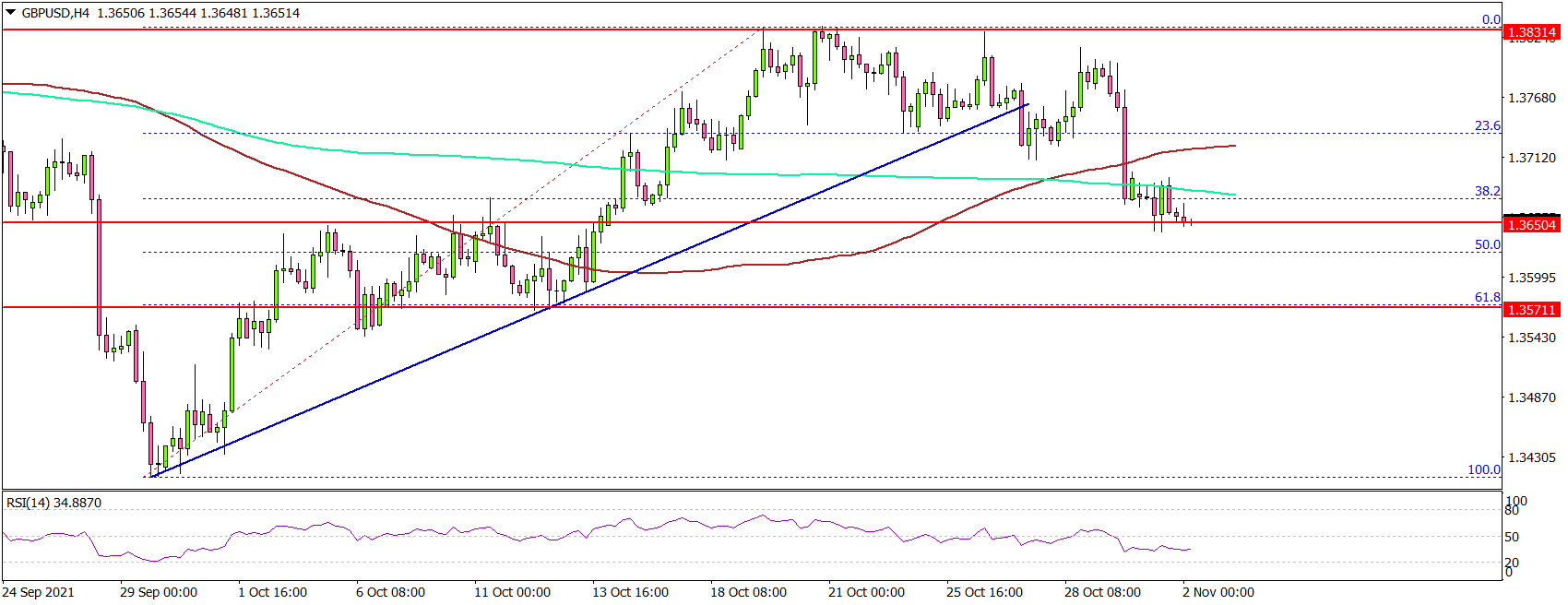
Looking at the 4-hours chart, the pair corrected lower below the 1.3800 and 1.3780 support levels. The pair traded below the 23.6% Fib retracement level of the upward move from the 1.3414 swing low to 1.3833 high.
There was also a break below 1.3750 and the 100 simple moving average (red, 4-hours). It tested the 1.3650 support zone and the 200 simple moving average (green, 4-hours).
On the downside, an initial support is near 1.3650 level. The next major support is near 1.3620. It is near the 50% Fib retracement level of the upward move from the 1.3414 swing low to 1.3833 high.
A close below the 1.3620 level might push the pair towards the 1.3570 support. On the upside, an immediate resistance is near the 1.3720 level and the 100 SMA. The next major resistance is near the 1.3750 level, above which the pair might rise towards the 1.3800 level. The main resistance still stands near 1.3830.
Looking at EUR/USD, the pair stayed above the 1.1525 support, but it is facing a lot hurdles on the upside near 1.1620 and 1.1650.
Economic Releases
- Germany’s Manufacturing PMI for Oct 2021 - Forecast 58.2, versus 58.2 previous.
- Euro Zone Manufacturing PMI for Oct 2021 – Forecast 58.5, versus 58.5 previous.
Eco Data 11/2/21
[php_everywhere instance="1"]
BOE Preview – Rate Hike Cycle to Begin?
The market has fully priced in a +15 bps increase BOE's bank rate (currently at 0.1%). The mixed economic developments since the September indicate that the Committee will be very divided over whether to hike or to stand on the sideline this month. Th staff will also release the latest economic projections which likely show downgrade in the GDP growth outlook but upward revision in inflation in this year and in 2022.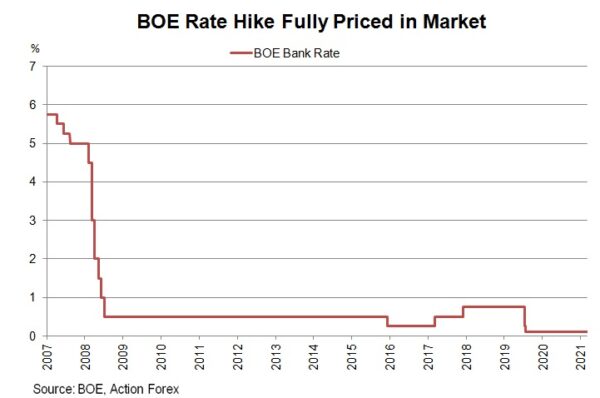
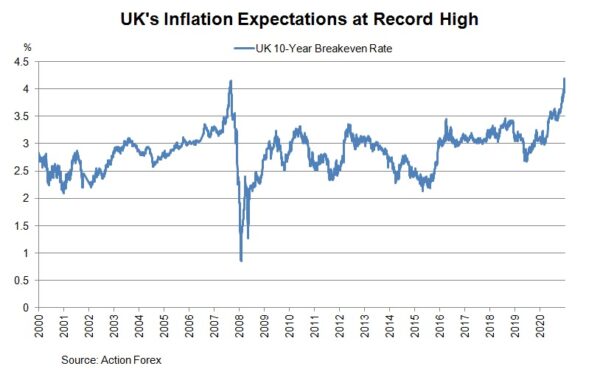
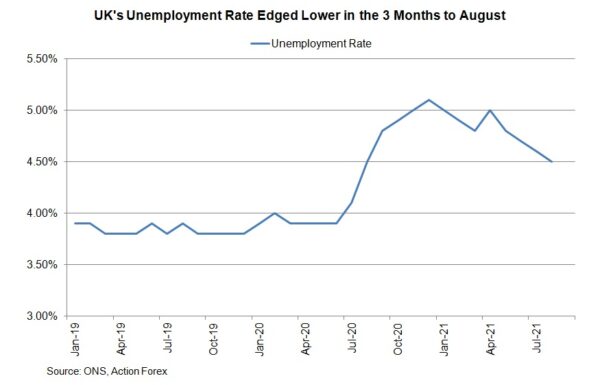
Economic developments have been mixed since the September meeting. Acceleration in the energy price is the most prominent change. Inflation remains elevated despite mild slowdown. Headline CPI eased slightly to +3.1% y/y in September, compared with consensus of, and August’s, +3.2%. The core reading also moderated -0.1 ppt to +2.9% y/y. Yet, the retail price index climbed +0.1 ppt higher to +4.9%, beating consensus of +4.7%. The 10-year breakeven rate revealed that long-term inflation expectation has stayed above +4%. The job market remains resilient. The unemployment rate slipped -0.1% ppt to 4.5% in the 3 months through to August. Labour shortage is expected to send wages higher.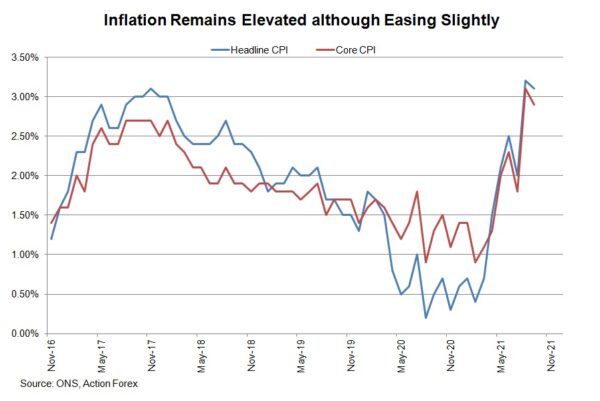
 However, the economic recovery has lost some steam. GDP growth slowed to +2.9% y/y in the 3 months through to August, compared with consensus of +3% and the upwardly revised +4.2% previously. Consumer spending has shown signs of moderation. Retail sales contracted -1.3% y/y in September, compared with consensus of -0.4%. The August reading was also revised lower to -0.2%. Excluding auto fuel, retail sales sank -2.6%, missing consensus of -1.6%. Sentiment in October worsened further. Gfk consumer confidence weakened to -17 in October, compared with consensus of -13 and consensus of -16.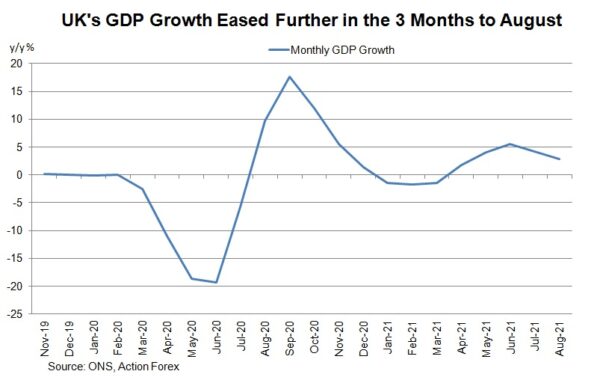
The market has fully priced in a +15 bps rate hike in November. Yet, Bloomberg’s consensus reveals that a thin majority of economists still expect no change in the policy rate. The market response has been driven by recent comments from BOE officials. Governor Andrew Bailey warned at the G-30 meeting 2 weeks ago that inflation “will last longer and it will of course get into the annual numbers for longer as a consequence”. The added that the central bank has “signaled, and this is another signal, that we will have to act”. Separately, new BoE Chief Economist Huw Pill warned that UK’s inflation "likely to hit 5%", adding that the November meeting is "live" as the stance on the monetary decision is "finely balanced". These comments sent yields higher although Pill had noted that “maybe there’s a bit too much excitement in the focus on rates right now”.
No matter whether the central bank hikes in November or not, it will be a divided committee. Hawks Michael Saunders and Dave Ramsden will likely vote for a rate hike. The market expects Bailey and Pill are also in favor of the move given their recent comments. Doves Jonathan Haskel and Jon Cunliffe have not made public comments but it’s not surprising to see them favoring the status quo. Silvana Tenreyro last week noted that slowdown in GDP growth can continue over winter, noting that inflationary pressures are expect to wane in coming months. Catherine Mann cited that the recent increase in bond yields has tightened financial conditions. We expect both would vote to keep the policy rate unchanged. Ben Broadbent will likely cast the decisive vote on the policy rate.
Another Big Week Ahead
Stock markets are off to a mixed start at the beginning of the week, with much of Europe back in record territory and the US now flat after a positive start.
Not bad considering central banks around the world are having a small panic about inflation and planning multiple rate hikes over the next year or so. In the past, the idea of this has sent shockwaves through the markets and that was when economies were in a far healthier position.
Contrast the current situation with the last US tightening cycle and the economy has almost two years of growth to makeup and a labor market that is still not fully recovered. What's more, an energy crisis and higher prices will eat away at disposable incomes and be a significant headwind throughout the winter.
And yet, investors remain bullish after what has been, in fairness, a very strong earnings season, albeit with plenty of caveats. Whether that continues beyond the reporting period is another thing, with it potentially being harder to find positives to drive markets higher.
The Fed will announce tapering this week, the Bank of England may raise rates and the RBA could offer a less dovish view on the outlook after some strange activity this past week. And that's just the start, with other central banks already heading in that direction and prepared to do more over the next year as inflation remains uncomfortably high.
PMIs a mixed bag
This week brings a broad selection of PMI data from around the world and so far it's been a bit of a mixed bag. China alone saw its official readings for manufacturing and non-manufacturing slip to 49.2 and 52.4, respectively, falling short of expectations, before Caixin released its manufacturing PMI this morning which rose to 50.6 and eased concerns. Still, higher input prices, lower demand, and power rationing continue to make the environment very tough for manufacturers and that will persist for some time yet.
Bank holiday's across Europe today mean final PMIs from many countries will be a day late this week. The UK saw its number revised slightly higher although the sector continues to suffer multiple challenges from supply chains to Brexit. US PMIs were mixed, with the more closely followed ISM falling a little but exceeding expectations, while the official reading fell further than expected.
Oil higher as natural gas prices slide
Oil prices are recovering at the start of the week following a brief pullback last week that appears to have quickly run its course. It was always likely that dips were going to attract interest but to be so close to last week's highs already is quite impressive.
Especially coming on the back of reports that China has released gasoline and diesel reserves in a bid to keep regions well supplied and prices stable. Not to mention the softer PMI data over the weekend that pointed to ongoing challenges for the economy. This is clearly a very bullish market, still.
It seems quite clear that traders are not expecting any action from OPEC+ this week considering their conclusions last month and comments since. The group is clearly perfectly happy with price levels and doesn't consider them the economic risk that other countries, like the US, do. This week's meeting will likely be swift and consistent with the last, we stay the course.
One thing that could have dragged on prices is Vladimir Putin's surprise announcement that he has ordered Gazprom to start filling European storage facilities as the company nears its targets in Russia. Natural gas prices have fallen heavily in recent days and are lower again today which could have weighed a little on oil, given how it's been a supportive factor in the rally. If only there was a way for Europe to return Putin's goodwill gesture.
Gold support buckling?
Gold is rallying on Monday after once again failing to end the week above $1,800. Prices tumbled on Friday after such a strong recovery in the dollar which is marginally lower today. Higher yields continue to be a massive downside risk for gold, despite it showing incredible resilience so far, but that will likely continue to weigh.
In terms of the key levels, little has changed on that front. A close above $1,800 would be encouraging but resistance lies around $1,810. If it can overcome that then the real test comes around $1,833 where it has repeatedly failed. Another failure to do so and $1,770 is key to the downside and further pain could follow.
Bitcoin holding for now
Bitcoin is continuing to hold on in there above $60,000 after coming under a little pressure over the weekend. It bounced back quickly after breaking this level last week which suggests there's plenty of desire to push for new records but it is struggling to take off following the ETF launch. A break of $60,000 could see the correction deepen but there still seems to be plenty of support longer term.
Stocks Mark a Rosy Start to the Month; FX Markets in Quiet Trading
New record highs for stocks
Looking solely at stock markets, one could get the impression that nothing goes wrong, and the remaining pandemic constraints are just a tentative phenomenon, which still allows economies to run up and grow. Of course, some key stocks such as Facebook and Amazon could not jump back into uncharted waters following their earnings releases last week, though overall, guidance from businesses has surprisingly signaled little concern about their future performance, with the pan-European STOXX 600 unlocking a fresh record high at 479.62 in the first day of November on the back of financials and energy.
Wall Street is also having a rosy start to the month. However, a glance at bond markets suggests that some uneasiness exists among investors probably in the face of the persisting inflation pressures and monetary policy normalization.
Bond yields reflect some anxiety
Particularly, last week’s gap narrowing between shorter- and longer-term global bond yields reflected weakening prospects for longer-term economic growth as central banks shift to monetary tightening.
The Fed is widely expected to announce the start of bond tapering on Wednesday, but the outlook on interest rates remains cloudy. As the ECB chief Christine Lagarde expressed last week, markets are trying to get ahead of central banks, pricing earlier rate hikes, but policymakers keep talking down the scenario, reiterating that high inflation is transitory including the former Fed chairwoman Janet Yellen, who attempted to cool inflation expectations today.
The 10-year treasury yield corrected higher to 1.5821% during the early US trading hours, while the 2-year equivalent remains elevated near last week's highs at 0.5209%
RBA policy announcement ahead
The RBA will probably try to push back rate hike expectations early on Tuesday as international borders are just reopening this month in Australia and China’s economy seems to be losing pace. However, failure to meet some of its bond buying targets last week raised speculation that February could be a long deadline for deciding on additional bond tapering actions. If the RBA flags some form of an earlier stimulus withdrawal, aussie/dollar could fracture the key resistance of 0.7558 to test the 0.7615 barrier.
ISM manufacturing PMI inches above expectations
On the data front, the ISM manufacturing PMI index for October inched above expectations to 60.8, revealing that strong sales continue, but at the same time "Import costs and delays keep hurting businesses, requiring more safety stock for uncertainty”.The dollar ignored the minor upside surprise in the ISM data, remaining almost stable around 114.15 against the yen. Euro/dollar and pound/dollar were in quiet trading as well, flattening at 1.1565 and 1.3670 respectively.
Oil tests key resistance; gold on the sidelines
In commodities, oil prices are under the spotlight again ahead of the OPEC’s monthly meeting on Thursday, which will see oil exporters debating about further supply increases. WTI oil futures have resumed their positive momentum today, currently looking for a close above October’s ceiling of 84.65 – 85.39.In precious metals, gold is directionless for the sixth consecutive day, stuck below the $1,808 resistance.
US: ISM Manufacturing Index Shows Expansion Continues
The October ISM manufacturing index decreased to 60.8, topping market expectations for 60.5. This marked a 0.3 percentage point decline from the September reading of 61.1.
New orders decreased by 6.9 percentage points to 59.8, while new export orders increased by 1.2 percentage points to 54.6.
The backlog of orders sub-index came in at 63.6, falling 1.2 percentage points from September's 64.8.
The production index fell 0.1 points, but employment rose 1.8 points.
The supplier deliveries sub-index rose to 75.6 from 73.4 in September. The sub-index continues to reflect difficulties in improving delivery rates due to production issues related to the pandemic.
16 of 18 manufacturing industries reported growth in July. Growth was led by Apparel, Leather & Allied Products; Furniture & Related Products; Textile Mills; Electrical Equipment, Appliances & Components; and Machinery.
Key Implications
The expansion rambles on – seventeen consecutive months and counting. Manufacturing activity cooled again, but the 60.8 print is in line with the best reading from the post-Great Financial Crisis expansion. Despite tight labor conditions, the employment index has registered its second consecutive gain, a smidge of relief for employers.
The supplier delivery times sub index showed worsening conditions as lead times continue to expand. Worryingly, new orders pulled back on the month to their lowest levels since June 2020. The effects of ongoing supply chain constrictions are coming through as manufacturing output stayed relatively flat despite customer inventories holding in depleted territory (31.7).
Respondents are seeing strong demand; however, they continue to report being held back by supply chain limitations. There may be some relief on the horizon as virus cases recede into the fall and consumer spending shifts toward services. Slower consumer goods purchases should allow producers to restock inventories – providing a key source of demand into 2022.
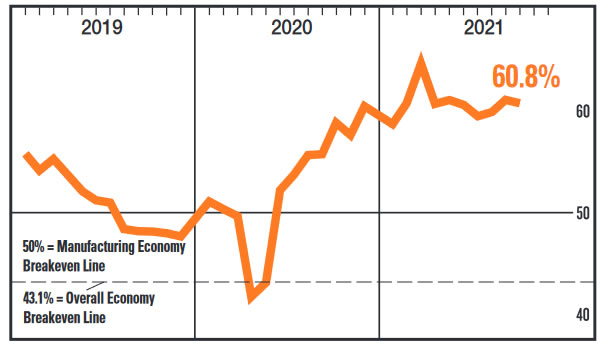
US ISM manufacturing ticked down to 60.8, corresponds to 5% annualized GDP growth
US ISM Manufacturing dropped to 60.8 in October, down from 61.1, but beat expectation of 60.4. Looking at some details, new orders dropped from 66.7 to 59.8. Production dropped from 59.4 to 59.3. Employment rose from 50.2 to 52.0. Prices rose from 81.2 to 85.7.
ISM said: "The past relationship between the Manufacturing PMI and the overall economy indicates that the Manufacturing PMI for October (60.8 percent) corresponds to a 5-percent increase in real gross domestic product (GDP) on an annualized basis."
Gold is Too Much Affected By USD
The Gold price is barely moving although the short-term market situation is not in favour of the precious metal. On Monday, 1 November 2021, the troy ounce costs $1,788. Gold has been rather volatile recently and definitely shows an inverse correlation to the USD.
It’s safe to say now that the Gold price will fluctuate pretty much this week in anticipation of the US Fed meeting. The regulator is slowly moving towards the reduction of the QE programme but this factor has already been included in the “greenback” price. If the Fed announces the QE reduction and hints at some more fiscal moves in the future, Gold may rise.
A lot of attention is currently paid to American inflation. If the CPI and its components continue growing, the demand for Gold as a “safe haven” asset will surely expand. The inflation rally calls into question the rate and prospects of economic growth and that won’t make market players happy.
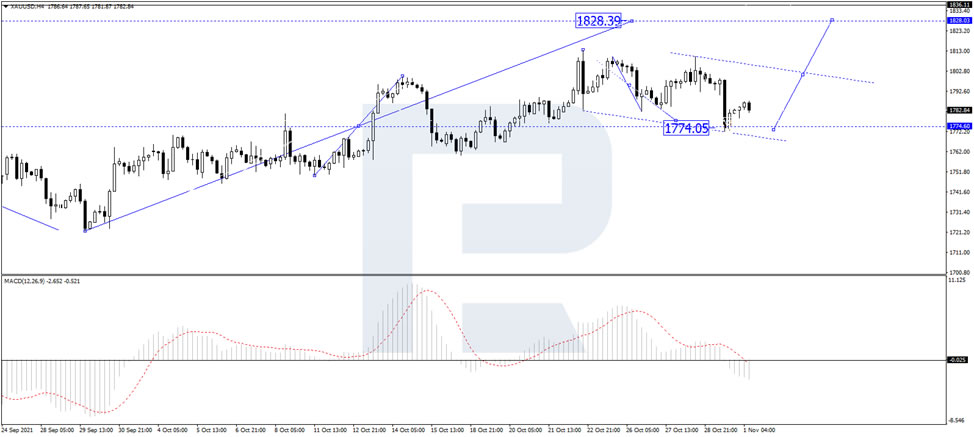
As we can see in the H4 chart, after completing the correctional wave at 1774.05 along with the ascending structure towards 1781.10, XAU/USD is expected to start another decline to reach 1763.81. After that, the instrument may resume trading upwards with the target at 1830.00. From the technical point of view, this scenario is confirmed by MACD Oscillator: its signal line is moving downwards below 0 inside the histogram area. Later, the indicator is expected to continue falling towards new lows.
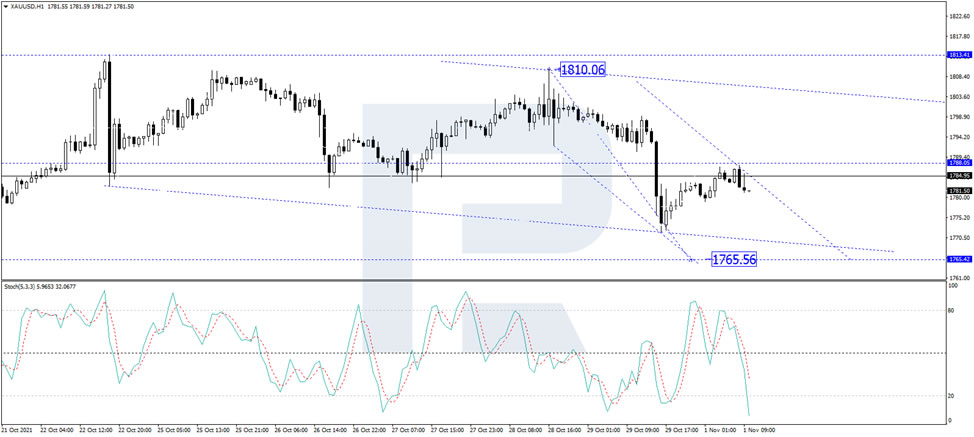
In the H1 chart, Gold has finished the descending wave at 1772.00 along with the ascending structure towards 1787.60. Possibly, the metal may form a new consolidation range below the latter level. If later the price breaks this range to the downside, the market may resume falling to reach 1765.56 or even extend the correction down to 1750.00. From the technical point of view, this scenario is confirmed by the Stochastic Oscillator: after breaking 50 to the downside, its signal is expected to continue moving downwards to reach 20.