

Sample Category Title
EUR/CHF Daily Outlook
Daily Pivots: (S1) 1.0532; (P) 1.0569; (R1) 1.0589; More....
Intraday bias in EUR/CHF remains on the downside at this point. Current down trend from 1.1149 should target 100% projection of 1.1149 to 1.0694 from 1.0936 at 1.0481. On the upside, break of 1.0678 support turned resistance is needed to indicate short term bottoming. Otherwise, outlook will stay bearish in case of recovery.
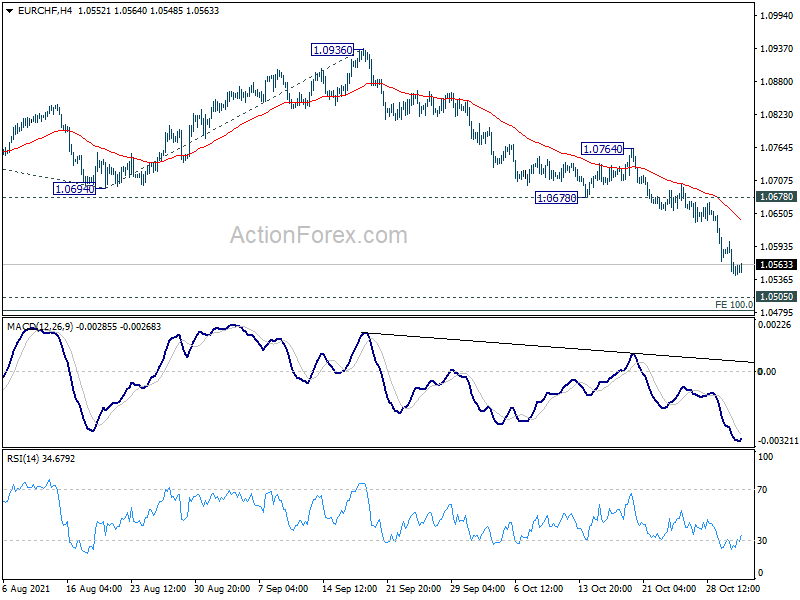
In the bigger picture, current downside momentum argues that fall from 1.1149 is probably resuming the downside from 1.2004 (2018 high). Next focus is 1.0505 (2020 low). Decisive break there will confirm this bearish case and target 61.8% projection of 1.2004 to 1.0505 to 1.1149 at 1.0223 next. Strong support from 1.0505 will bring rebound first. But outlook will stay bearish as long as 1.0936 resistance holds.
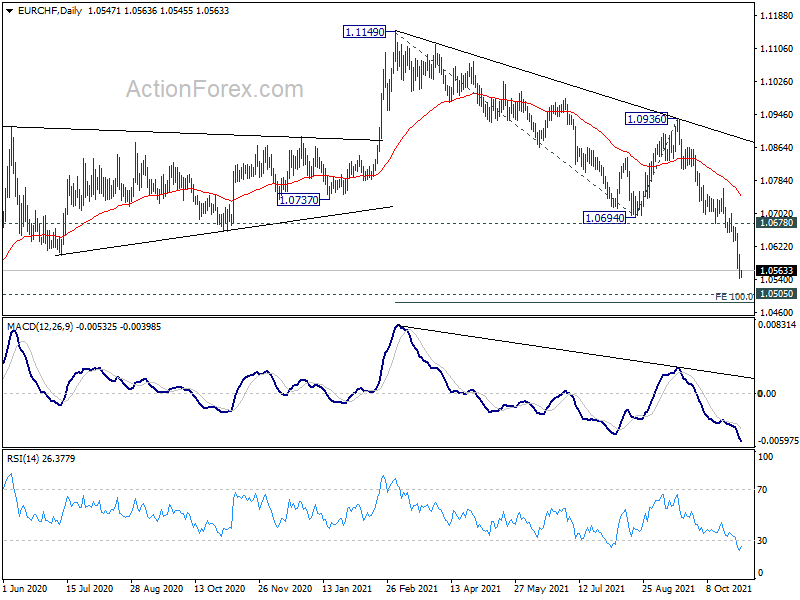
Swiss CPI rose to 1.2% yoy in Oct, retail sales rose 2.5% yoy in Sep
Swiss CPI came in at 0.3% mom, 1.2% yoy in October, above expectation of 0.1% mom, 1.1% yoy. Annual rate also accelerated from September's 0.9% yoy. The 0.3% increase compared with the previous month is due to several factors including rising prices for heating oil. Gas also recorded a price increase, as did fuel. In contrast, prices for salads and fruiting vegetables decreased.
Retail sales rose 2.5% yoy in September, above expectation of 1.4% yoy.
Markets Remain Fairly Confident
Markets
Markets took a constructive start for the new week/month yesterday. The US majors (Dow, S&P, Nasdaq) closed at record levels. The EuroStoxx 50 set a new cycle top. Positive earnings are part of the story. Markets remain fairly confident that central bankers will be able to strike a good balance between addressing the inflation acceleration without killing growth, with the Fed, the BoE and several smaller CB’s holding key policy meetings later this week. The US manufacturing ISM also provided some comfort. The headline index declined only marginally from 61.1 to 60.8. Supply disruptions still complicate production. Prices paid remained at a very elevated level (85.7). Orders eased, but production growth remained at a high level (59.3) while job creation improved (52.0 from 50.2) despite a persistent mismatch between supply and demand for labour. At the end of the day, US yields changed less than one basis point for the 2y/10y sector. The 30y yield rose 2.5 bps. This apparent calm masked a sharp rise in real yields (10y +7.75 bps) and a more or less similar decline in inflation expectations. The German yield curve steepened (-2.4 bps 2y vs +3.2 bps for the 30y). Swings in real yields/inflation expectations were more modest than in the US. Still, the German 10y real yield stays well north of -2% (-1.97% vs a low near -2.21% last week). The dollar yesterday showed a rather ‘inconsistent’ pattern. The rise in US real yields didn’t help the US currency. Also the impact from a constructive risk sentiment was not that straight forward. EUR/USD regained modest ground after Friday’s battering (close 1.1606). USD/JPY couldn’t hold on to intraday gains and closed little changed at 114. Sterling lost further ground, especially against the euro as markets ponder the pace and timing of BoE interest rate hikes (close 0.849).
Asian markets fail to join the constructive risk sentiment in the US and Europe, with China underperforming. The RBA takes a first step to policy normalization (cf infra). The eco calendar is almost empty except from some central bank speak. Investors mainly will keep an eye at the corporate results and look forward to the central bank meetings later this week. US yields recently took a breather, both at the front end and at the longer maturities as investors try to assess the link (time-gap) between tapering and a first rate hike. 1.51%/1.54% is first important support for the US 10y yield. The German 10y yield yesterday again tested the post-corona top near -0.07%. This is also the case for the 10y EMU swap (0.30% area). Further gains would be highly significant from a technical point of view. EUR/USD is still going nowhere in a tight range between 1.1530/1.1690. A break before tomorrow’s FOMC meeting looks unlikely. Sterling traders apparently grow less confident on an aggressive start of the BoE normalization cycle . Sterling momentum is easing. with EUR/GBP trying to regain the 0.85 handle.
News headlines
The Reserve Bank of Australia kept the main policy rate at 0.1%, sticks to buying government bonds at a pace of A$4 bn per week but ditched its 0.1% target on the three year yield. It does so because the economy has improved and the RBA sees inflation reaching target earlier than expected. Growth has been revised upwards to 3% this year, 5.5 % the next and 2.5% in 2023 and 2024. Underlying inflation is expected at 2.25% in 2021 and 2.5% in 2023. The RBA remains committed not to raise rates before inflation is sustainably at target. It did scrap, however, a reference saying it doesn’t expect that to happen “before 2024”, saying instead it is “likely to take some time”. Australian yields fell across the curve in a bull steepening move. The Aussie dollar loses AUD/USD 0.75 in a contained decline.
France backed down from a threat to impose additional custom controls on British goods entering and to block UK fishing boats from landing their catches in France. The dispute is centred around French accusations the UK is denying French fishermen access to British waters. Macron said the UK promised to come up with new proposals today, adding that it won’t bring in sanctions while they are negotiating. The fishing rights dossier is symbolic in nature rather than economically crucial but it highlights the difficult relationship between the EU and UK post-Brexit. The UK is also on a collision course with the EU over the Northern Ireland protocol which it seeks to overhaul.
Daily Technical Analysis
EUR/USD
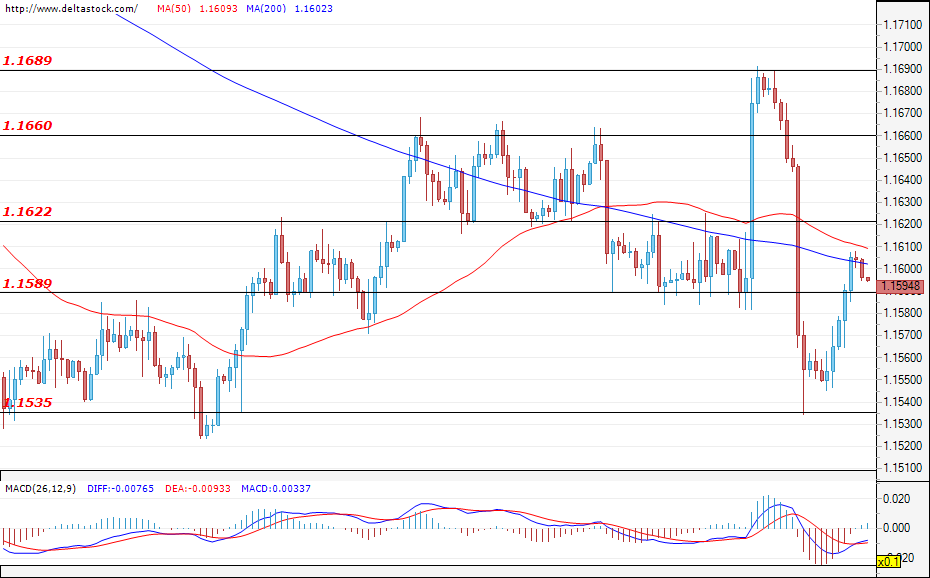
Current level - 1.1594
The sell-off was limited to the level of 1.1535 and the common European currency recovered some of its recent losses against the greenback. At the time of writing, the pair is hovering above the level of 1.1589 and а test of the next target of 1.1622 is a highly probable scenario that could easily pave the way for a test of the resistance of 1.1660. However, if the bears re-enter the marкet, a violation of the mentioned zone of 1.1589 and a successful attack on the support of 1.1535 would easily deepen the sell-off towards the levels from July at around 1.1410.
| Resistance | Support | ||
| intraday | intraweek | intraday | intraweek |
| 1.1622 | 1.1660 | 1.1589 | 1.1410 |
| 1.1660 | 1.1690 | 1.1535 | 1.1350 |
USD/JPY
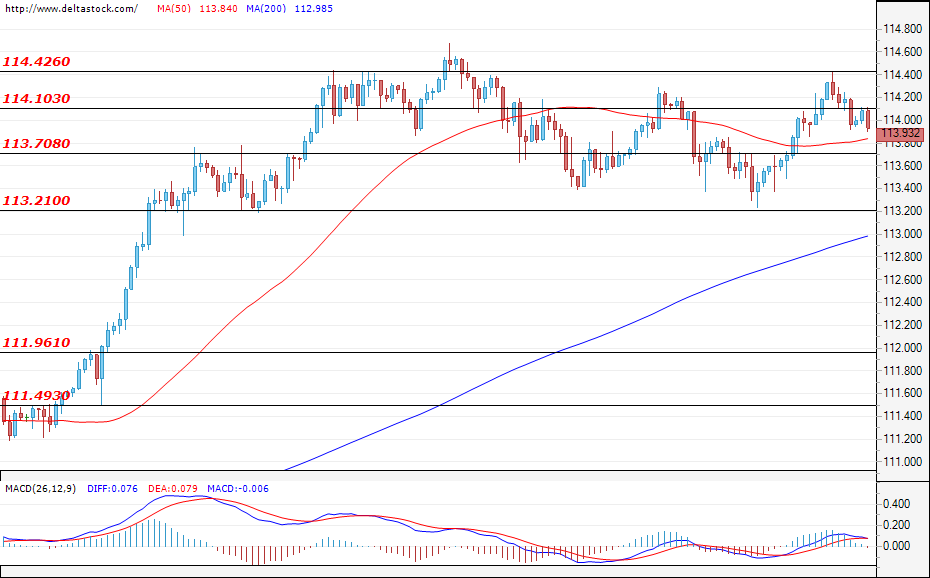
Current level - 113.93
The attempt to violate the resistance of 114.42 was not successful and the dollar lost some ground against the yen. The pair breached the nearby support of 114.10 and a successful breach of the 113.70 level should head the Ninja towards the lower border of the range and main support of 113.21. If the bulls regain control, their first target would be the mentioned level of 114.10, but only a breach of 114.42 could lead to new gains and a more sustained rally for the USD/JPY.
| Resistance | Support | ||
| intraday | intraweek | intraday | intraweek |
| 114.10 | 115.25 | 113.70 | 111.96 |
| 114.42 | 116.20 | 113.21 | 111.49 |
GBP/USD
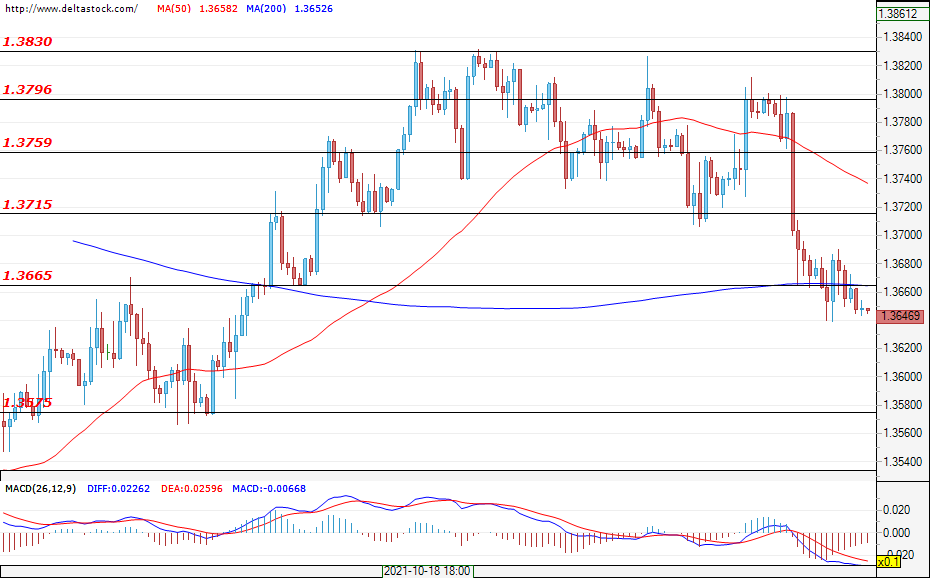
Current level - 1.3646
During yesterday’s session, the bulls did not have enough strength to start a significant correction, but despite that the Cable stabilised around the zone of 1.3665. If the pair remains under the mentioned level, the most probable scenario will be for a move towards the support of 1.3575, which would strengthen the negative expectations for the future path of the GBP/USD. If the buyers prevail, their first resistance could be found at the level of 1.3715, followed by the next target of 1.3759.
| Resistance | Support | ||
| intraday | intraweek | intraday | intraweek |
| 1.3665 | 1.3759 | 1.3575 | 1.3500 |
| 1.3715 | 1.3796 | 1.3500 | 1.3400 |
Equities Hit Record As Fed Meets
Nothing gets in the way of the equity bulls: not chip shortages, nor labour shortages, or the energy crisis, or the pandemic, not even the fact that the Federal Reserve (Fed) is just about to announce scaling back its massive bond purchases program in order to contain the rising inflation.
The bulls continue pushing the equity rally to fresh records. The S&P500 and Nasdaq both renewed record on Monday’s session, whereas the major headline on Bloomberg this morning was that ‘the supply chain crisis risks taking the global economy down with it’.
Still, investors prefer seeing the glass half full: we have a strong earnings season, 80% of the S&P500 companies that announced earnings so far, beat expectations.
Also, people are craving for positive news and wild moves. If there are none, they make them up.
The latest GameStop rally was backed by no good news at all. The company COO, which was welcomed with fireworks and a lot of enthusiasm seven months ago just left the company abruptly. Normally, it’s no good sign. But traders preferred hitting the buy button on the CEO Ryan Cohen’s ‘MGGA’ tweet, which was interpreted as Make GameStop Great Again. A single tweet triggered a 9% rally on Monday, a tweet that came following a suspicious departure from an important figure in the company. But this is what people want: wild moves.
Fed meets
The Fed starts its two-day meeting. The US policymakers see that there is an ongoing and aggravating issue with the rising inflation, they also see that it is not as transitory as they first thought. And they also know that the longer it sticks, the less transitory it will be. Action is needed.
In this respect, there is no doubt that the Fed will announce its plans to start tapering the bond purchases from tomorrow. That’s a well digested and a broadly priced in decision. It is not even a decision, it will simply be a confirmation.
We know that the tapering will happen gradually, but guess that tapering alone would not help easing inflationary pressures, as buying less bonds still means continue buying bonds: it is not a tighter monetary policy, it is simply a less expansive monetary policy, that should, in theory continue backing a higher inflation.
So, the market is pricing in two 25-bp rate hikes before the end of 2022, versus no rate hike at all that the Fed has promised until 2023. And that first rate hike could come as soon as June next year – this is what the activity on fed funds futures tell us.
We have been seeing an exponential rise in the US short-term yields since a month, but zooming out, the US 2-year yield for example is still very, very much low compared to the historical levels. The yield which is a touch below the 0.50% right now was flirting with the 3% mark three years ago, before the pandemic hit the fan. Therefore, there is a lot left to be priced in the bond markets. This is why the Fed meeting could still shake the markets, because even though we know the concrete outcome of the meeting, which is the opening bell of the QE tapering, the risks remain tilted to the hawkish side, and that should continue giving some more support to the US dollar index into the decision.
XAUUSD Is Possibly Bullish
Technical analysis
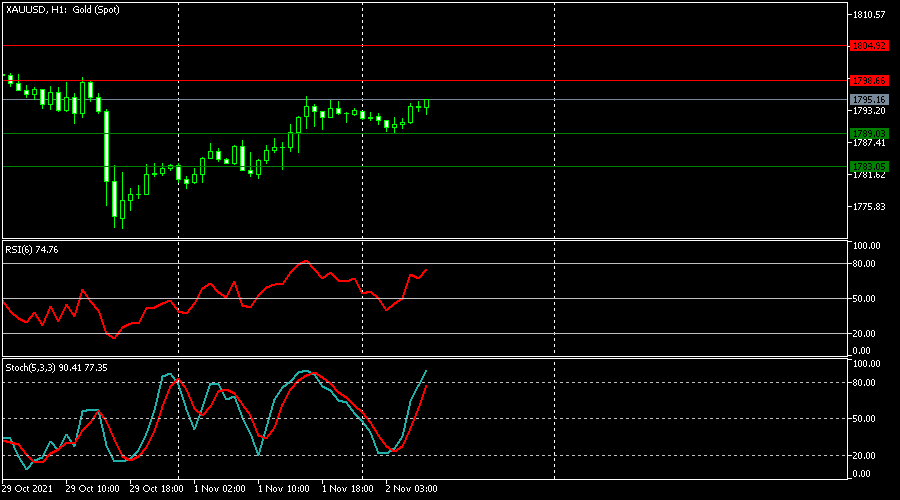
The RSI is at the overbought zone.
The Stochastics is near the overbought zone.
Most likely scenario – BUY
Target prices: 1,798.66 1,804.92
Alternative scenario – SELL
Target prices: 1,789.03 1,783.05
Key levels
Support 1,789.03 1,783.05
Resistance 1,798.66 1,804.92
S&P 500 Wavers As Corporate Dealmaking Continue
American stocks wavered as investors waited for the upcoming interest rate decision by the Federal Reserve. The Dow Jones rose by 50 points while the S&P 500 and Nasdaq 100 indices declined modestly. The Fed will start its November meeting later today and then deliver its decision on Wednesday. Analysts expect that the bank will turn hawkish since the American economy remains strong. In a statement on Monday, Janet Yellen, the Treasury Secretary, said that while the economy was doing well, it was not yet overheating. Her comments came shortly after the US published relatively weak manufacturing PMI data.
American stocks also wavered as the earnings season and corporate consolidation continued. On Monday, Coca-Cola said that it will spend $5.6 billion to acquire Gatorade, the company that owns BodyArmor. In another statement, Franklin Resources, the parent company of Franklin Templeton, said that it will acquire Lexington Partners for more than $1 billion. Lexington provides secondary investments in private equity firms. The earnings season will continue today, with the key companies to watch being private equity companies like KKR and Apollo Global Management. Others will be Gartner, Eaton, H&R Block, and Mondelez.
The economic calendar will have several important events today. Earlier, the Reserve Bank of Australia (RBA) delivered a relatively hawkish interest rate decision. It left interest rates unchanged and tweaked its asset purchases program. In the morning session, Switzerland will deliver the latest inflation data. The data is expected to show that inflation in the country was under pressure even as the unemployment rate fell. Markit will then publish the latest manufacturing PMI data from Europe.
EURUSD
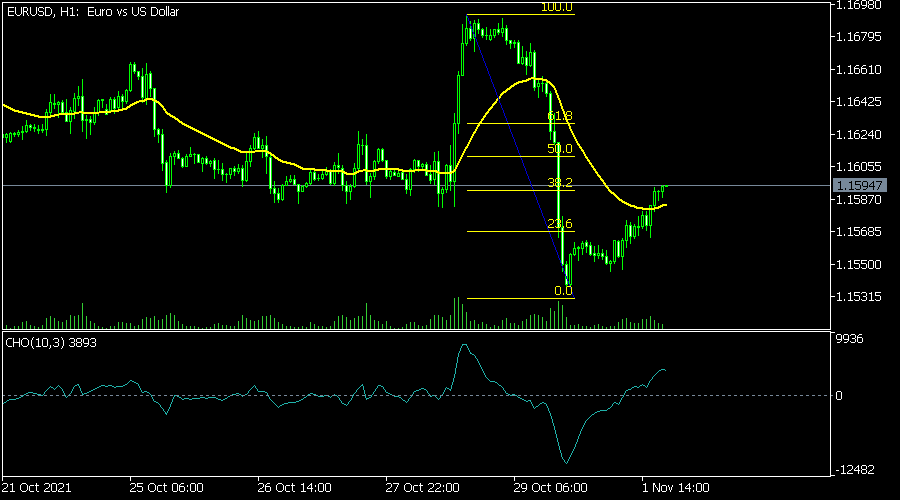
The EURUSD pair bounced back on Monday as bulls attempted to pare back the losses experienced on Friday. The pair rose to a high of 1.1595, which was the highest level since Friday. On the hourly chart, it has risen above the 25-day moving average while the Chaikin Oscillator has risen above the neutral level. The pair has also moved above the 38.2% Fibonacci retracement level. Therefore, the pair will likely pull back later today as the rally loses steam.
USDCAD
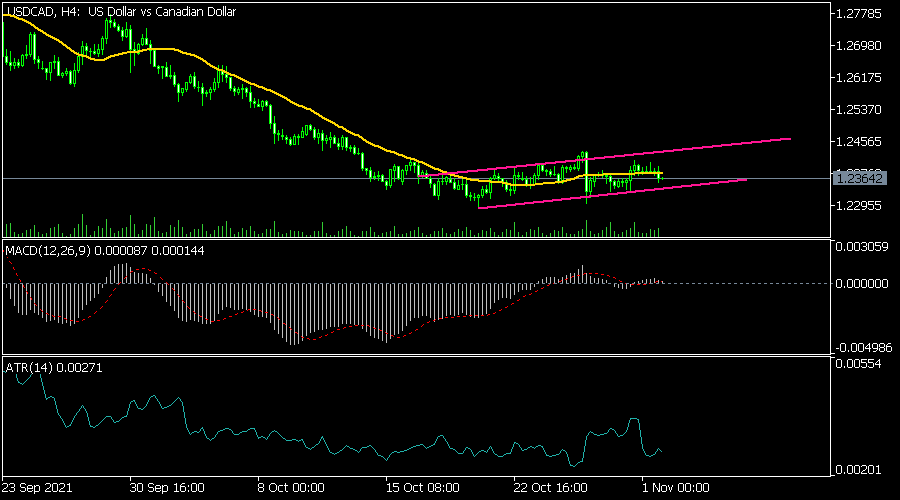
The USDCAD pair was in a relatively tight range in the overnight session as investors awaited the Fed decision. The pair is trading at 1.2365, which is inside the ascending channel shown in pink. This channel is part of a bearish flag. The pair has also moved to the 25-day moving average because of low volatility. The MACD and the Average True Range (ATR) have also declined slightly. Therefore, the pair will likely remain in this range today and then break out lower later this week.
NZDUSD
The NZDUSD pair was also little changed during the American session. On the four-hour chart, the pair has formed a horizontal channel. It is also above the 25-day and 50-day moving averages. The pair has also moved above the important support at 0.7168, which was at the highest level on September 3. Therefore, the pair will likely have a bullish breakout in the near term.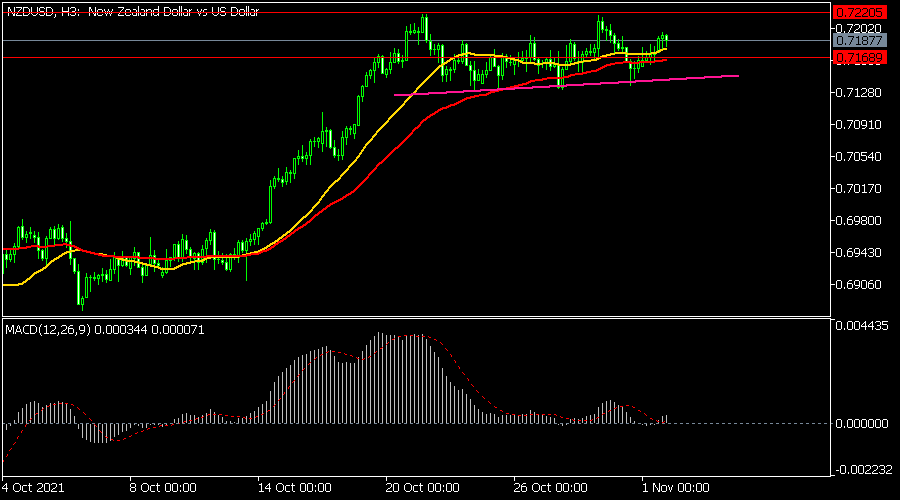
Happy Days
Market movers today
- Overnight, we will get the Caixin services PMI from China. Keep in mind that the official PMIs released over the weekend signalled a slower growth and continued supply chain bottlenecks.
The 60 second overview
Happy days: Looking back just a few weeks, markets were well in turmoil. But having gone through most of the earnings season, it now looks like markets have shifted back into a fairly benign risk sentiment. For example, value, small caps, energy and banks did well yesterday, as e.g. US small caps (Russel 2000) rose 2.7%, to a 2021-high and so far, (rapidly) rising interest rates appear to be less of an issue. In FX however, there is a small bias towards dollar strength in some crosses (mostly versus the EUR).
Monthly Executive Briefing: Both US and euro area GDP remain below the pre-COVID trend path, inflation remains high and central banks are under pressure to act. See more in Monthly Executive Briefing - More pressure on central banks (1. November). This week, the market will remain focused on the FOMC meeting and Friday's payrolls.
UK: The Bank of England (BoE) meeting on Thursday 4 November is going to be a key market mover. What was unthinkable in the beginning of the year, is now a real possibility. Will the BoE raise the Bank Rate or not? Investors have more or less fully priced in a 15bp rate hike while economists are evenly divided between unchanged and a 15bp rate hike. The sudden hawkish shift in September was a major driver of higher yields also in Europe, so BoE's policy decision is also going to be interesting from a broader market perspective., see more in UK Research - Bank of England Preview: Unchanged or dovish rate hike (1. November).
RBA: The Reserve Bank of Australia maintained the cash rate unchanged at 0.10%, but dropped the April 2024 0.10% yield cap, which was not a surprise given that they failed to defend the target already last week. While this effectively opens up the door for a rate hike before 2024, the overall message was still dovish. RBA acknowledges the risk of higher inflation and tighter-than-expected labor markets, but expects inflation to remain moderate as wages are only seen rising moderately over the coming years. AUD weakened following the release, and markets slightly pulled back on the rate hike expectations, but the current pricing of three hikes in 2022 still appears too aggressive in our view.
Equities: The week started on a solid note and US logging fresh records. Despite volatility in yields eased, value was the preference for the day, with energy the standout. US markets all higher with S&P 500 0.2%, Dow 0.3% and Nasdaq 0.6% but Russell 2000 jumping 2.7%. Sentiment is more varied this morning, with Asian markets mixed and US futures a notch lower.
FI: It was again a volatile day in the bond markets as shown by the intra-day move in 10Y Treasuries and the 10Y spread between Italy and Germany. Initially, 10Y Treasury yields rose by almost 5bp from 1.55% to 1.6% before ending the day at 1.55%. The spread between 10Y Italy and 10Y Germany initially widened with 10-11bp but in the afternoon Italy performs and the spread ends 4-5bp wider. However, the 10Y BTPS-Bund spread has still widened some 20bp after the ECB meeting last week.
FX: EUR/SEK continues to trade on a heavy note.
Credit: Credit markets remained soft yesterday where iTraxx Xover widened 0.7bp and Main 0.1bp. HY bonds closed 1bp wider and IG 0.5bp wider.
Equity Indices Trade Mixed
General trend
- Nikkei 225 has remained modestly lower.
- Japanese companies expected to report earnings include Nippon Steel and Japan Airlines; Fast Retailing due to issue monthly sales.
- Japan markets are closed tomorrow (Nov 3rd).
- Hang Seng has pared the opening gain [TECH index rises, Property sector lags].
- Shanghai Composite ended morning trading lower [Property index extends drop].
- China's most traded Dalian iron ore futures contract falls 10% after steel curbs continue to weigh on demand.
- S&P ASX 200 declined ahead of the RBA decision [Financials and Resources indices dropped]; the index later pared decline.
- South Korea CPI again comes in above target range in October, but mostly attributed to low base effect, but analysts note that even adjusting for this CPI remains well above 2% target for the 7th month, adding to the case for another rate increase.
- NZ Q3 Labor Market data is due on Wed (Nov 3rd).
- Companies due to report during the NY morning include Arconic, Bausch Health Companies, Cummins, CNH, ConocoPhillips, Corsair Gaming, DowDuPont, Estee Lauder, Eaton Corp, Evonik, Generac, Henry Schein, Ingredion, IPG Photonics, Gartner, KKR, Lear Corp, Louisiana Pacific, Martin Marietta Materials, Marathon Petroleum, Pfizer, Ralph Lauren, Thomsons Reuters, Under Armour, Westlake Chemical, Zebra Technologies.
Headlines/Economic data
Australia/New Zealand
- ASX 200 opened 0.0%.
- (AU) RESERVE BANK OF AUSTRALIA (RBA) LEAVES CASH RATE TARGET UNCHANGED AT 0.10%; AS EXPECTED; REMOVES 3-YEAR YIELD TARGET (AS EXPECTED); Adjusts wording of forward guidance to "likely to take some time" (drops 2024 reference).
- (AU) Reserve Bank of Australia (RBA) Gov Lowe: Now plausible that lift in cash rate could be appropriate in 2023+; Latest data and guidance do not warrant increase in cash rate in 2022; still entirely possible cash rate will remain at current level until 2024; Finally, in terms of the bond purchase program, we will be including the April 2024 bond in our regular auctions from next week; 2.5% inflation would not justify higher rates.
- (NZ) Reserve Bank of New Zealand (RBNZ) Gov Orr: Unsustainable level of house prices poses monetary and financial stability challenges and have become more so over the last 12 months, reiterates using monetary policy to target house prices is not our mandate.
- (NZ) New Zealand Sept Building Permits M/M: -1.9% v 3.8% prior (1st contraction in 5 months).
- IAG.AU Cuts FY22 Reported Margin 10-12% (prior 13.5-15.5%); Raises FY22 Natural Perils claims to A$1.05B.
Japan
- Nikkei 225 opened -0.6%.
- (JP) Japan Fin Min Suzuki: Still considering details of cash handouts; FX Stability remains important.
- (JP) Japan to ease COVID-related entry rules for certain foreigners for short business trips, study abroad, and technical training; To announce policy changes as soon as this week – Nikkei.
- (JP) Bank of Japan (BOJ) Meeting Minutes: Economy to improve as pandemic impact subsides; To closely monitor impact of coronavirus, discussed COVID program tapering.
- (JP) Japan Chief Cabinet Sec Matsuno: One idea for raising wages is to require small and medium sized companies to receive subsidies.
Korea
- Kospi opened +0.6%.
- (KR) SOUTH KOREA OCT CPI M/M: 0.1% V 0.2%E; Y/Y: 3.2% V 3.3%E (highest since Jan 2012); CPI Core Y/Y: 2.8% v 2.6%e (fastest since 2015).
- (KR) South Korea Finance Ministry: To conduct KRW2.0T ($1.70B) of emergency South Korea Treasury Bond (KTB) buyback to stabilize markets; To announce which govt bonds to buyback.
China/Hong Kong
- Hang Seng opened +1.8%; Shanghai Composite opened 0.0%.
- (CN) China Securities News: PBOC lower injections does not signal tighter liquidity.
- (CN) China People's Daily calls on Govt to build more EV charging stations.
- (CN) China PBOC sets Yuan reference rate: 6.4009 v 6.4192 prior.
- (CN) China PBOC Open Market Operation (OMO): Injects CNY10B in 7-day reverse repos v CNY10B prior; Net Drain CNY190B v Net drain CNY190B prior.
- 388.HK Said to be considering relaxing three requirements in SPAC framework - local press.
- (CN) China State Planner (NDRC): China has seen significant improvement in coal supply as production has expanded and prices have stabilized (yesterday after the close).
- (CN) Global Times' Hu Xijin: Reunification of Taiwan island is inevitable, the most important thing is not the timetable, but at which point and in which specific way the reunification will be most beneficial to China's overall national strategy (yesterday after the close).
- (HK) Hong Kong Q3 Advance GDP Q/Q: 0.1% v 0.6%e; Y/Y: 5.4% v 5.7%e (avoids technical recession) (yesterday later in session).
Other
- (SG) Monetary Authority of Singapore (MAS) Gov Menon said prepared to act against inflation risks; recently announced policy tightening was deliberately small on risk related to growth – US financial press.
North America
- AAPL Said to cut iPad production to use saved chips in iPhone 13 production - Press.
- CLX CEO: To raise prices on 70% of our consumer product portfolio - earnings call comments.
- JNJ California judge finds JNJ, Teva Pharmaceutical and other former opioid makers didn’t create a public health crisis through misleading marketing of Opioids, defeating $50.0B case – press.
- DD Said to be exploring options for mobility and materials unit, also close to deal to acquire electronics materials company, Rogers Corp for $4.0B, could be announced tomorrow – press.
- TSLA CEO Musk: No contract has been signed with Hertz yet, deal would have 0 effect on economics, will sell them cars at the same margin as consumers.
Europe
- STAN.UK Reports Q3 adj Pretax $1.08B v $745M y/y, Op income $3.77B v $3.52B y/y.
- (UK) UK Govt: Welcome France's decision to not go ahead with measures, ready to continue talks on fisheries, welcome France's acknowledgement that in depth talks are needed.
Levels as of 01:15ET
- Hang Seng +0.4%; Shanghai Composite -1.2%; Kospi +1.4%; Nikkei225 -0.5%; ASX 200 -0.6%.
- Equity Futures: S&P500 -0.2%; Nasdaq100 -0.1%, Dax -0.2%; FTSE100 -0.1%.
- EUR 1.1608-1.1595; JPY 114.14-113.64; AUD 0.7532-0.7487; NZD 0.7190-0.7169.
- Commodity Futures: Gold -0.0% at $1,795/oz; Crude Oil -0.1% at $84.00/brl; Copper -0.8% at $4.35/lb.
RBA Board Drops YCC and 2024 Guidance
The Reserve Bank Board has made a sensible decision to move away from extreme policies of Yield Curve Targeting and naming the timing for the first rate hike. The Bank’s revised forecasts point to an expected first increase in 2023 but as and when circumstances evolve that view can be adjusted in the traditional way.
The Reserve Bank Board has decided to discontinue the Yield Curve Target of 10 basis points for the April 2024 Australian Government bond and has excluded the line “The central scenario for the economy is that this condition will not be met before 2024”. Of course that line referred to the Bank’s expected timing for the first increase in the cash rate.
That condition has been changed in the Statement to, “That is likely to take some time. The Board is prepared to be patient”.
We acknowledge these decisions as an appropriate response to the changing economic scenario. The adoption of a Yield Curve Target, which supported the guidance around 2024, may have been appropriate when the Australian economy was facing the emergencies of COVID but the economy has now recovered; there is evidence of rising inflation; and the growth and employment outlook is encouraging.
The time for unprecedented policy measures has passed and the Board has made an astute decision.
Westpac’s view since June 18 has been that the first-rate increase will be at the February 2023 Board meeting.
The key forecast changes which have lifted the Bank’s outlook are: core inflation is now expected to print 2.25% in 2022 (up from 1.75%) and 2.5% in 2023 (up from 2.25%).
GDP growth in 2022 is forecast at 5.5% (up from 4.25%), although this mainly reflects the downgrade of 2021 from 4% to 3%, as the Bank revises down its assessment of the contraction in the September quarter.
There is no change to the forecasts for wages growth in 2022 (still 2.5%) although, significantly, 2023 has been lifted from 2.75% to 3.0%.
The forecasts for the unemployment rate are unchanged – 4.25% in 2022 and 4% in 2023. However, the Governor does note that “one of the main uncertainties relates to the behaviour of wages at the lowest unemployment rate in decades.”
These forecasts are a little more cautious than we had expected but certainly indicate that the Board expects that the conditions necessary for the first-rate hike will be in place during 2023.
However, the Board very sensibly avoided moving the guidance to 2023 given the range of uncertainties particularly around wages and inflation.
This cautious message on the policy outlook is emphasised when the Governor compares Australia’s position with the other developed economies where rate increases appear to have been brought forward by their respective central banks.
He notes that, “Inflation pressures are also less than they are in many other countries, not least because of only modest wages growth in Australia.”
The formal explanation for discontinuing the Yield Curve Target was that “other market interest rates have moved in response to the increased likelihood of higher inflation and the effectiveness of the yield target in holding down the general structure of interest rates in Australia has diminished”.
But an equally convincing reason is that because the forecasts no longer point to 2024 as the most likely lift off date then the Target is redundant.
Overall, we still assess that the revised forecasts are too cautious. Westpac expects core inflation to print above 2.5% during the second half of 2022; the unemployment rate to reach 3.8% by end 2022; and wages growth to print 2.75%. That will be underpinned by much stronger GDP growth (7.4%) than the Bank is expecting.
Conclusion
The Board has made a responsible decision to move away from the extreme policies that served the economy well during the COVID emergencies but now the economy is recovering and inflation is lifting it is appropriate to revert back to a standard policy approach.
The implication in the Board’s forecasts that the first-rate increase is now expected to be in 2023 is interesting but dependent on the forecasts.
Westpac has stronger forecasts for growth; inflation; and the labour market which we think are consistent with an earlier first increase than implied by the Bank but we certainly agree that the market, anticipating multiple hikes in 2022, appears to have overshot.
The Governor is due to speak later today and any further insights will be signalled in a separate note.