Sample Category Title
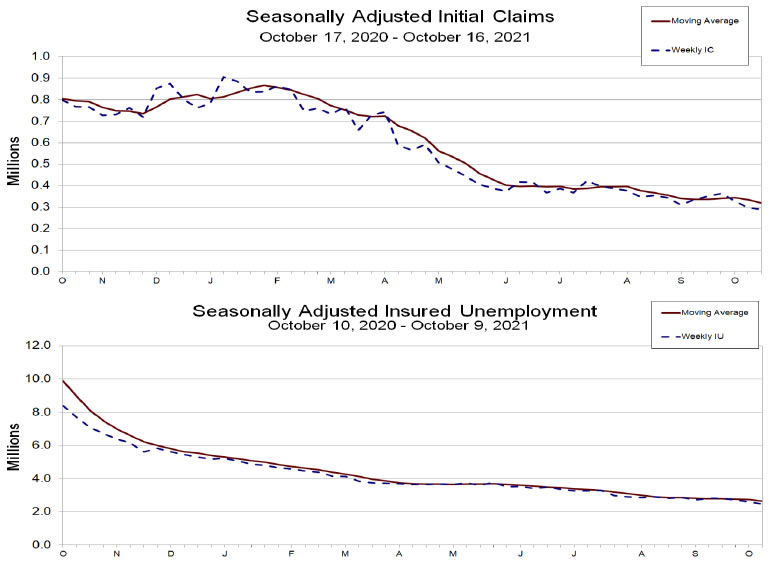
US initial jobless claims dropped to 281k, continuing claims down to 2.24m
US initial jobless claims dropped -10k to 281k in the week ending October 23, slightly better than expectation of 289k. That's the lowest level since March 14, 2020. Four-week moving average of initial claims dropped -21k to 299k, lowest since March 14, 2020 too.
Continuing claims dropped -237k to 2243k in the week ending October 16, lowest since March 14, 2020. Four-week moving average of continuing claims dropped -142k to 2513k, lowest since March 21, 2020.
ECB Lagarde press conference live stream
https://www.youtube.com/watch?v=oggV578FTiA
ECB stands pat, continues PEPP with moderately lower pace
ECB kept monetary policy unchanged as widely expected. The interest rates on the marginal lending facility and the deposit facility will remain unchanged at 0.00%, 0.25% and -0.50% respectively. The forward guidance is maintained.
That is, "the Governing Council expects the key ECB interest rates to remain at their present or lower levels until it sees inflation reaching two per cent well ahead of the end of its projection horizon and durably for the rest of the projection horizon, and it judges that realised progress in underlying inflation is sufficiently advanced to be consistent with inflation stabilising at two per cent over the medium term. This may also imply a transitory period in which inflation is moderately above target."
PEPP purchases will continue with a total envelop of EUR 1850B, until at least end of March 2022. The pace of net asset purchases will remain "moderately lower" than in Q2 and Q3. APP purchases will continue at a monthly pace of EUR 20B too.
ECB, US GDP Eyed For Gold Traders As Crude Tumbles
- US GDP growth seen at 2.6% in Q3
- ECB to stick to dovish rhetoric
- How will gold respond to ECB?
- Crude oil prices ease
- Earnings from Apple and Amazon later
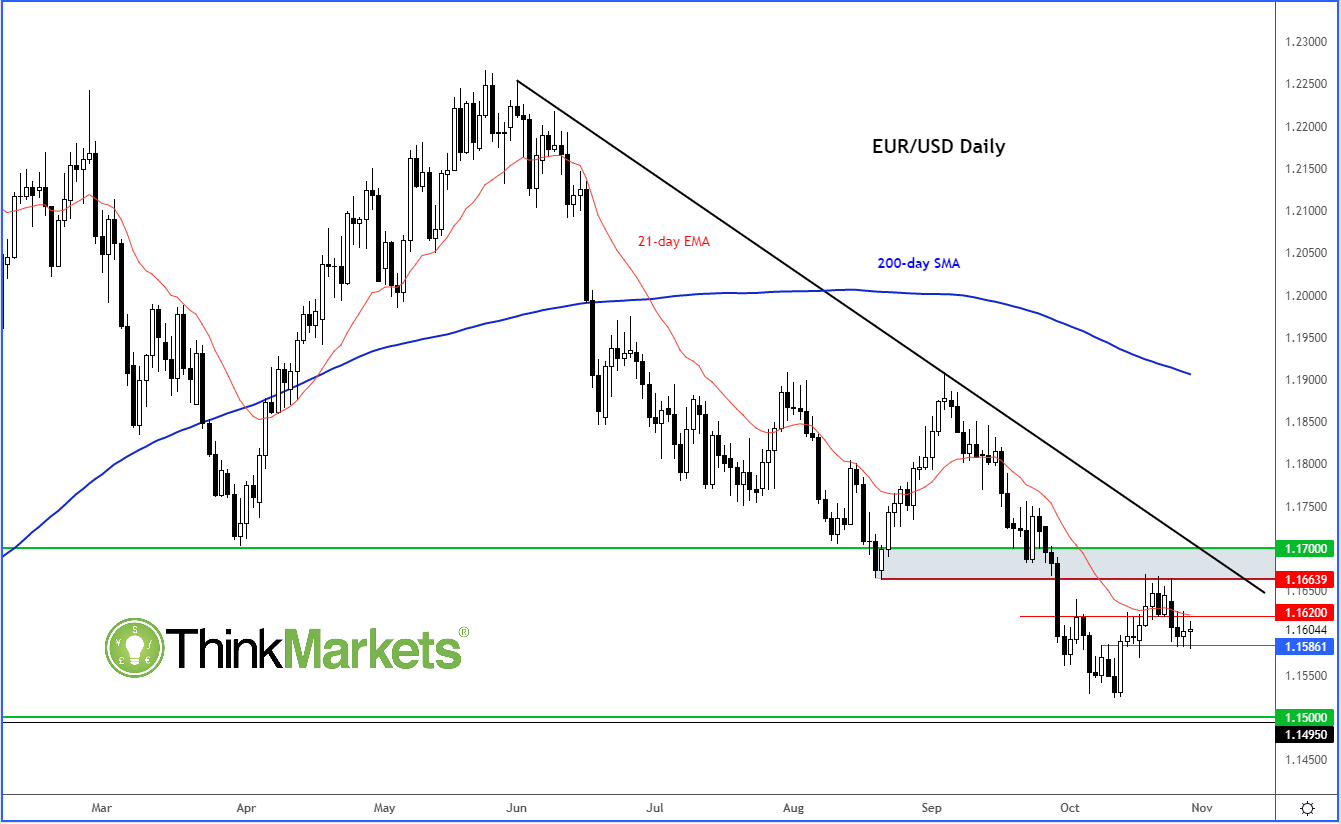
After a slow start for the markets, expect to see a bout of volatility from around 13:30 BST. This is when we will have the advance estimate of third quarter US GDP released, while the European Central Bank’s press conference will also get underway. The EUR/USD will be in sharp focus.
US GDP eyed
The world’s largest economy is expected to have grown by 2.6% in Q3 on an annualised basis, a sharp slow down from 6.7% growth in Q2. If the data turns out to be stronger, then expect to see some dollar strength.
ECB to stick to dovish rhetoric
In as far as the ECB is concerned, well investors have been buying European stocks and selling the euro in recent weeks leading up to today’s meeting. The single currency’s performance suggest investors are not expecting any action in response to surging inflation. Still, you can’t completely rule out the prospect of the ECB ending the pandemic emergency purchase programme (PEPP) earlier than expected. That said, our base case scenario is that the ECB will stick to its view that rising inflation is only temporary, and Christine Lagarde will likely dismiss talks of an earlier end of PEPP. This is partly because ECB staff’s economic projections will not be out until the December meeting. So, wait-and-see might be the approach at today’s meeting, with Lagarde unlikely to offer much in the way of fresh information. At best, Christine Lagarde may show signs she and her ECB colleagues are worried about rising inflation, which would indicate a policy response in December. If that’s the case, expect the EUR/USD to squeeze some weaker shorts.
How will gold respond to ECB?
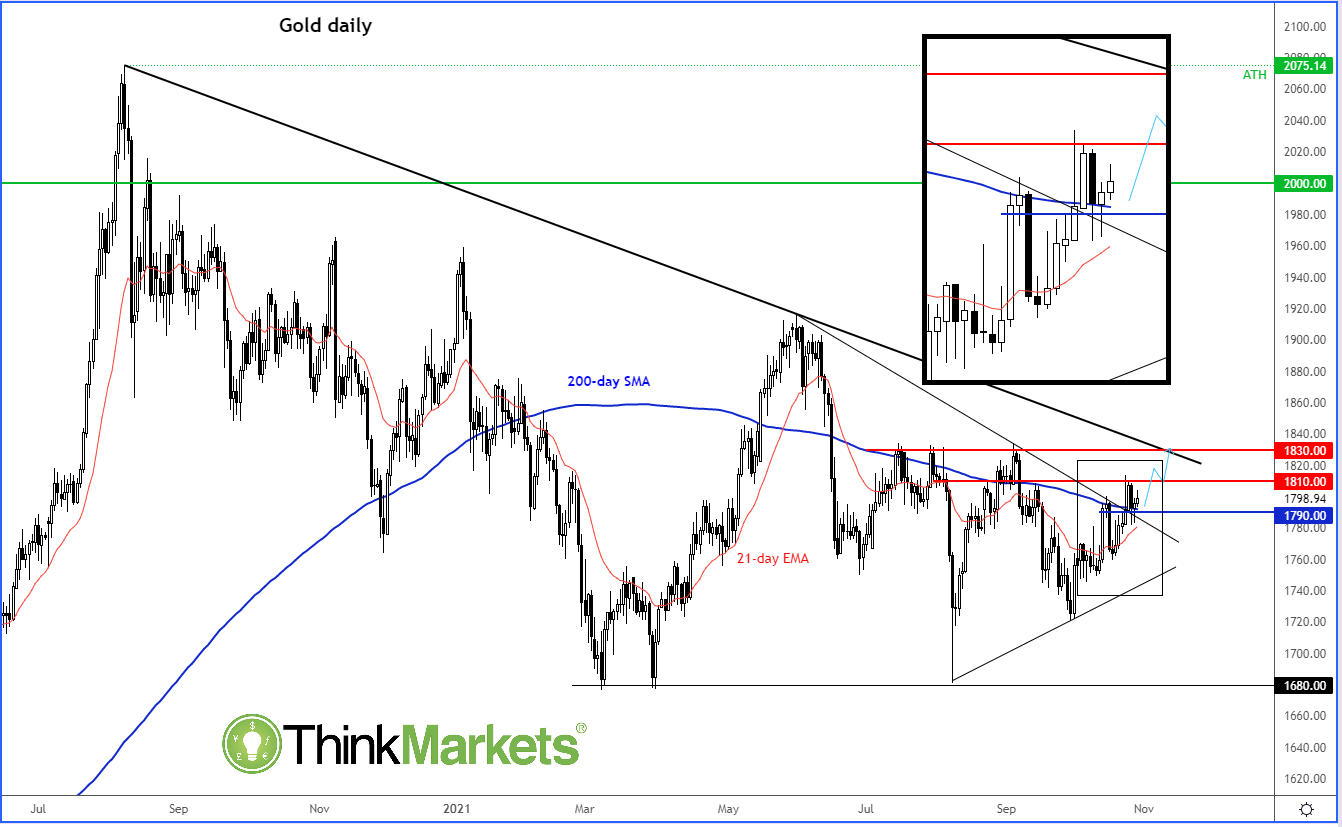
Gold initially fell after the Bank of Canada yesterday surprised the markets with a hawkish decision to end QE. The precious metal then quickly recovered as global long-end bond yields resumed lower. Judging by its reaction to the BOC’s decision, a hawkish ECB might trigger a quick drop in prices, but it appears like the market is positioned long. So, any weakness is likely to be short-lived. If the ECB is dovish, this should keep gold supported.
Gold fundamentally supported in the long term
Gold investors are realising that the major central banks as a whole will probably not tighten monetary policy too aggressively even if inflation remains elevated. The rationale is that there’s still much spare capacity in the economy and the impact of temporary factors will wane in the months ahead, causing inflation to cool and reduce the need for central banks to tighten aggressively. In a welcoming sign, crude prices have dropped (see below). Meanwhile higher taxes in the years ahead to pay for the cost of various pandemic stimulus measures by western governments will probably also mean slower economic growth and lower rates of inflation. Thus, any policy tightening that we will see from now on could be very limited. Gold stands to benefit in the long term.
Crude oil prices ease
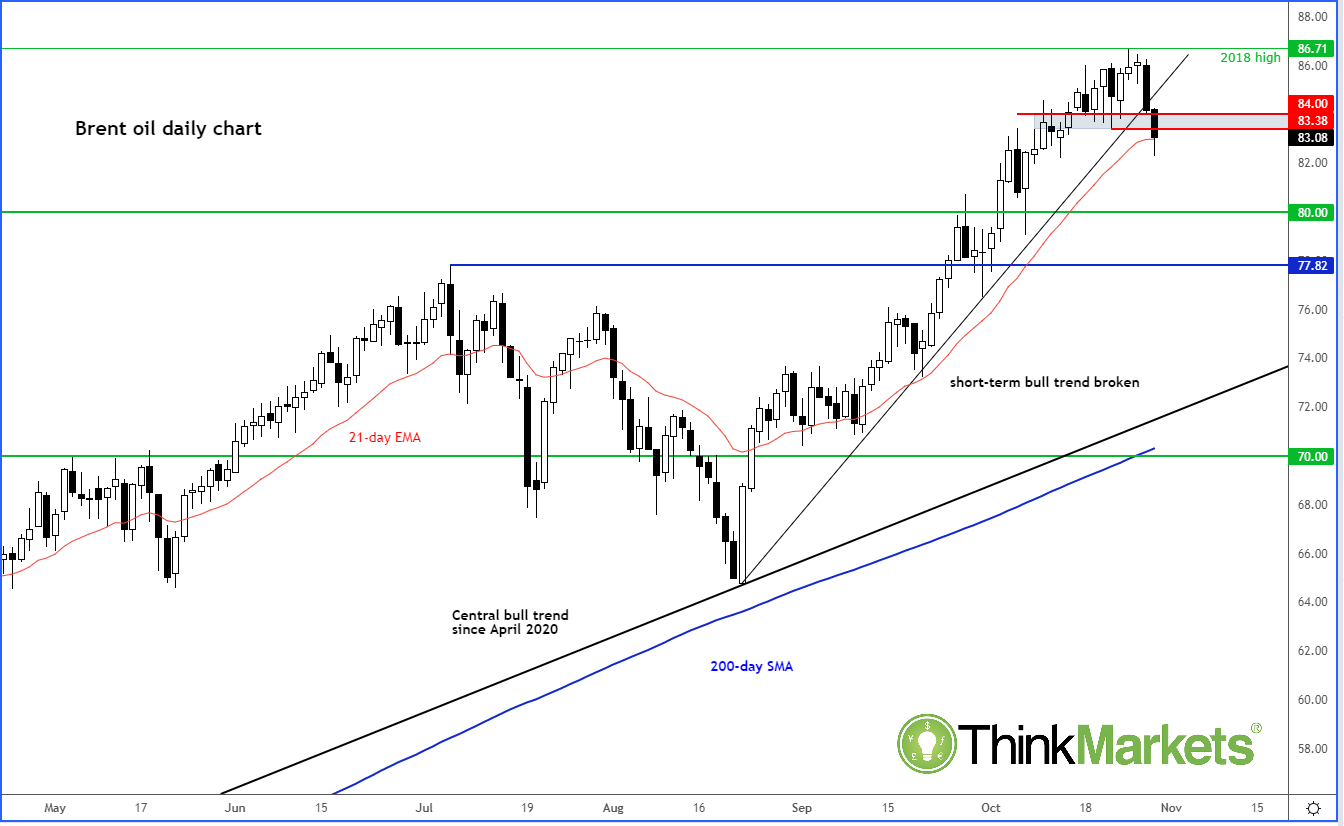
In a welcoming development for those worried about high levels of inflation, crude and gas prices fell after Iran and the EU agreed to restart nuclear negotiations. If sanctions are eventually lifted, this could ultimately lead to increased supply of oil from Iran to the tune of 1.3 million barrels per day. On top of this, Russian President Putin promised increased gas supplies to Europe, while in China, the government has stepped up its efforts to secure power supplies, a development that cause coal prices to tumble.
(ECB) Monetary policy decisions
The Governing Council continues to judge that favourable financing conditions can be maintained with a moderately lower pace of net asset purchases under the pandemic emergency purchase programme (PEPP) than in the second and third quarters of this year.
The Governing Council also confirmed its other measures, namely the level of the key ECB interest rates, its forward guidance on their likely future evolution, its purchases under the asset purchase programme (APP), its reinvestment policies and its longer-term refinancing operations. Specifically:
Key ECB interest rates
The interest rate on the main refinancing operations and the interest rates on the marginal lending facility and the deposit facility will remain unchanged at 0.00%, 0.25% and -0.50% respectively.
In support of its symmetric two per cent inflation target and in line with its monetary policy strategy, the Governing Council expects the key ECB interest rates to remain at their present or lower levels until it sees inflation reaching two per cent well ahead of the end of its projection horizon and durably for the rest of the projection horizon, and it judges that realised progress in underlying inflation is sufficiently advanced to be consistent with inflation stabilising at two per cent over the medium term. This may also imply a transitory period in which inflation is moderately above target.
Asset purchase programme (APP)
Net purchases under the APP will continue at a monthly pace of €20 billion. The Governing Council continues to expect monthly net asset purchases under the APP to run for as long as necessary to reinforce the accommodative impact of its policy rates, and to end shortly before it starts raising the key ECB interest rates.
The Governing Council also intends to continue reinvesting, in full, the principal payments from maturing securities purchased under the APP for an extended period of time past the date when it starts raising the key ECB interest rates and, in any case, for as long as necessary to maintain favourable liquidity conditions and an ample degree of monetary accommodation.
Pandemic emergency purchase programme (PEPP)
The Governing Council will continue to conduct net asset purchases under the PEPP with a total envelope of €1,850 billion until at least the end of March 2022 and, in any case, until it judges that the coronavirus crisis phase is over.
The Governing Council continues to judge that favourable financing conditions can be maintained with a moderately lower pace of net asset purchases under the PEPP than in the second and third quarters of this year.
The Governing Council will purchase flexibly according to market conditions and with a view to preventing a tightening of financing conditions that is inconsistent with countering the downward impact of the pandemic on the projected path of inflation. In addition, the flexibility of purchases over time, across asset classes and among jurisdictions will continue to support the smooth transmission of monetary policy. If favourable financing conditions can be maintained with asset purchase flows that do not exhaust the envelope over the net purchase horizon of the PEPP, the envelope need not be used in full. Equally, the envelope can be recalibrated if required to maintain favourable financing conditions to help counter the negative pandemic shock to the path of inflation.
The Governing Council will continue to reinvest the principal payments from maturing securities purchased under the PEPP until at least the end of 2023. In any case, the future roll-off of the PEPP portfolio will be managed to avoid interference with the appropriate monetary policy stance.
Refinancing operations
The Governing Council will continue to provide ample liquidity through its refinancing operations. In particular, the third series of targeted longer-term refinancing operations (TLTRO III) remains an attractive source of funding for banks, supporting bank lending to firms and households.
***
The Governing Council stands ready to adjust all of its instruments, as appropriate, to ensure that inflation stabilises at its two per cent target over the medium term.
The President of the ECB will comment on the considerations underlying these decisions at a press conference starting at 14:30 CET today.
Canadian Dollar Jumps After BoC Move
The Canadian dollar had a busy day on Wednesday in the aftermath of a key Bank of Canada policy meeting. In the European session, USD/CAD is trading quietly at 1.2368, up 0.05% on the day.
BoC surprises by ending stimulus
The Bank of Canada announced on Wednesday that it would end its bond-purchase stimulus programme (QE) and maintained its extraordinary forward guidance. The dramatic move caught the markets off guard, as the investors were widely expecting that the bank would taper QE to CAD 1 billion, down from CAD 2 billion. The Canadian dollar rose as USD/CAD fell to 1.2301, but the loonie could not consolidate at these levels, as USD/CAD ending the day at 1.2360, down 0.24% on the day.
The BoC went one step further as BoC Governor Tiff Macklem said after the meeting that, “we will be considering raising interest rates sooner than we previously thought”. In his rate statement, Macklem reiterated that the bank would not raise rates before the recovery was complete, which was projected to occur in the “middle quarters” of 2022. Prior to yesterday’s meeting, the BoC had signalled that it expected to raise rates in the H2 of 2022.
The BoC has acknowledged that high inflation will likely persist longer than had been expected, but like the Federal Reserve, the BoC continues to insist that inflation, which is running way above the bank’s target of 2%, is temporary. Investors are not buying into the “inflation is transitory” script, as CPI rose 4.4% in September, its highest reading since 2003. For this reason, the markets have priced in a rate hike for January of next year, with five rate hikes projected in 2022. If the BoC is forced into again bringing forward its rate timeline, the Canadian dollar should receive a boost.
USD/CAD Technical
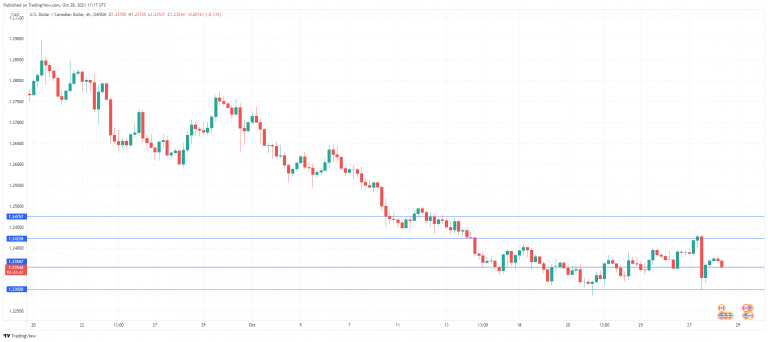
- 1.2355 is fluid. Below there is support at 1.2302
- There is resistance at 1.2422, followed by 1.2475
EURJPY Points To More Losses Ahead Of ECB Policy Meeting
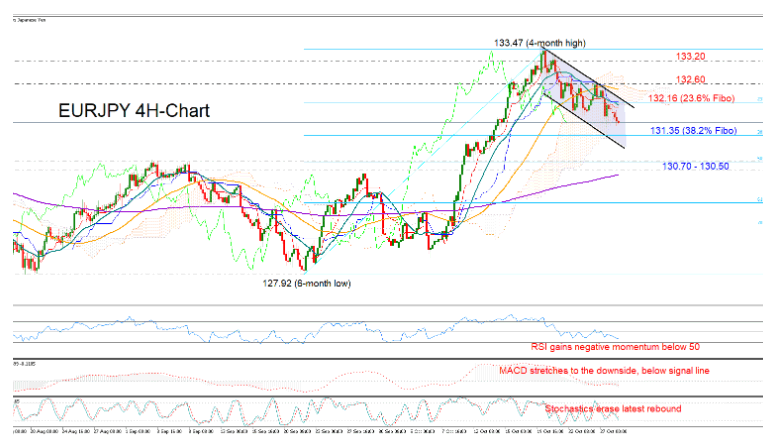
EURJPY entered a downhill race following the peak at a four-month high of 133.47 in the four-hour chart, correcting below its shorter-term simple moving averages (SMA) and more recently below the Ichimoku cloud, which kept the bears under control on Wednesday.
The downturn in the RSI and the MACD is gaining fresh momentum in the bearish territory as the Stochastics are drifting lower again despite their latest bounce off the oversold area, all flagging additional losses ahead for the market.
The 38.2% Fibonacci of the 127.92 – 133.47 upleg at 131.35 is the nearest support zone for an upside correction, but the lower line of the descending channel seen at 131.00 could immediately guarantee a halt in declines. If the latter fails to act, the sell-off could sharpen towards the key restrictive region formed between the 50% Fibonacci of 130.70 and the 130.50 level. Another failure here would snap the upward pattern, switching the outlook in the broad picture back to neutral.
On the upside, a forceful move above the channel and the 23.6% Fibonacci of 132.16 would shift the bias back to positive, likely raising buying orders up to the 132.60 resistance. If upside pressures further intensify, the pair will probably take a rest near last week’s limitations around 133.20 before crawling to the top of 133.47.
In brief, EURJPY is holding a bearish bias in the very short-term picture ahead of today’s ECB policy meeting. The next turning point is expected to develop within the 131.35 – 132.00 zone.
WTI Oil Outlook: Oil Risks Deeper Pullback On Surprise Build Of Inventories
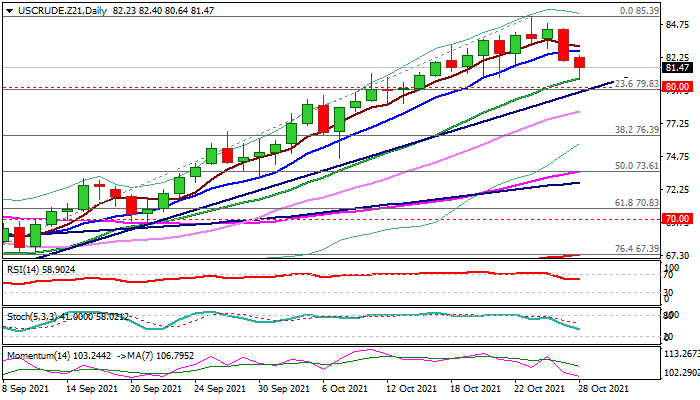
The WTI oil extends weakness on Thursday and hit two-week low, following Wednesday’s 2.8% drop (the biggest one-day loss since Aug 4).
Oil prices came under increased pressure on surprise rise of US crude inventories last week (4.26 mln bls vs expected 1.91 mln bls build) and rising cases of Covid-19 in Europe, Russia and some parts of China that hurts expectations for an economic and oil demand recovery.
Adding to negative near-term outlook are expectations that the US economy grew at the slowest pace in more than one year in the third quarter, amid resurgence of coronavirus infections and supply shortages.
Daily chart studies started to weaken on extension of pullback from new 7-year peak ($85.39) that cracked 20DMA support ($80.67) and threaten of attack at more significant supports at $80 / $79.75 (psychological / bull-trendline off Aug 23 low at $61.79 / Fibo 23.6% of $61.83/$85.39).
Break of these levels would generate initial reversal signal and open way for deeper correction of $61.83/$85.39).
Res: 82.74, 84.46, 85.39, 85.90.
Sup: 80.67, 80.00, 79.75, 78.16.
Awaiting ECB Rate Decision As Region’s Inflation Remains Hot
Notes/Observations
- EU inflation data continues to hit decade highs (Spain, various German States).
- Focus on ECB rate decision later this today. Dealers not ECB likely to err on the side of caution and stick to its expansionary monetary policy.
Asia
- Japan Sept Retail Sales M/M: 2.7% v 1.5%e; Y/Y: -0.6% v -2.4%e.
- BOJ left Policy steady (as expected) with Interest On Excess Reserves (IOER) unchanged at -0.10% and maintain Yield Control Target (YCC) at 0.00%.
- BOJ Quarterly Outlook for Economic Activity and Prices cut FY21/22 GDP growth (current fiscal year) from 3.8% to 3.4% while raising FY22/23 GDP growth from 2.7% to 2.9. Cut FY21/22 core CPI (current fiscal year) from 0.6% to 0.0% while maintaining FY22/23 core CPI at 0.9%.
- China PBOC Open Market Operation (OMO) again injected CNY200B via 7-day reverse repos with net injection of CNY100B.
Europe
- Brexit Min Frost stated that was very disappointing that France had felt it necessary to make threats against the UK fishing industry and seemingly traders more broadly.
- UK said to vow to retaliate with an appropriate and calibrated response if France followed through with their threats to disrupt trade and hamper energy supplies.
- Portugal said to be likely to head for a snap election after Parliament rejected minority govt's 2022 budget plan.
Americas
- President Biden to delay trip to Europe by a few hours to attend House Democrat Caucus meeting on morning of Oct 28th (Thursday).
- US Senator Manchin (D-WV) stated that a deal on Biden's agenda is possible on Thurs.
- Ways and Means Chair Neal stated that the billionaire tax was out; there was no support to get it through Congress.
- Brazil Central Bank (BCB) raised Selic Target Rate by 150bps to 7.75% (as expected) for its 6th straight hike in the current tightening cycle and indicated a Hike of the same size appropriate for next meeting in Dec.
Speakers/Fixed income/FX/Commodities/Erratum
Equities
- Indices [Stoxx600 +0.06% at 474.32, FTSE -0.37% at 7,226.51, DAX -0.17% at 15,679.55, CAC-40 +0.33% at 6,775.74, IBEX-35 -0.23% at 8,951.50, FTSE MIB +0.16% at 26,850.00, SMI +0.07% at 12,095.35, S&P 500 Futures +0.23%].
- Market Focal Points/Key Themes: European indices open mixed, with a negative bias and failed to gain direction as the session progressed; better performing sectors include technology and consumer discretionary; while underperformers include materials and real estate; SUSE acquires NeuBector; Eastman sells it’s adhesive resin business to Synthomer; earnings expected during the upcoming US session include KBR , Linde, Xcel Energy and Caterpillar.
Equities
- Consumer discretionary: Nokia [NOKIA.FI] +4% (earnings), Anheuser-Busch InBev [ABI.BE] +7% (earnings).
- Energy: TotalEnergies [TTE.FR] -1.5% (earnings).
- Financials: Lloyds Banking Group [LLOY.UK] +1.5% (earnings).
- Industrials: Airbus [AIR.FR] +2% (earnings), Volkswagen [VOW3.DE] -3% (earnings; cuts outlook).
- Technology: STMicroelectronics [STM.FR] +4% (earnings), CapGemini [CAP.FR] % (earnings).
Speakers
- France Maritime Min Giradin stated that could examine France electricity tariffs to UK. He added that Govt was not serious to cut off electricity to UK.
- France EU Affairs Min Beaune stated that UK could face higher electricity prices. France could take another set of retaliation measures against the UK if it did not resume dialogue and grant fishing licenses. Stressed that France would use the language of force now since that seemed only thing UK could understand.
- German Association of Chambers of Trade and Industry (DIHK) updated its forecasts which cut 2021 GDP growth from 3.0% to 2.3% and set 2022 GDP growth at 3.6%. DIHK also raised the 2021 CPI forecast from 2.25 to 3.0% and set 2022 CPI at 2.5%.
- Turkey Central Bank (CBRT) Gov Kavcioglu stated that it continued to target FX accumulation. Supply issues are pressuring domestic inflation.
- BOJ Gov Kuroda post rate decision press conference reiterated overall assessment that domestic economy remained on a recovery trend. Risks were skewed to the downside for inflation. He saw very little risk that Japan would experience inflation as seen in other countries. Reiterated stance to ease policy further without hesitation if necessary. No comment on FX or short-term price movements but did not believe the current weakness in JPY currency (Yen) was a bad thing. Yield Control (YCC) could bring weak JPY currency (yen) as it widened interest rate differential compared to overseas.
- China Commerce Ministry (MOFCOM) spokesperson Shu Jueting stated to maintain active communication with US. Concerned about US removing China telecom license, moves destroyed the collaborative atmosphere. China to adopt necessary measures to safeguard legitimate interest of Chinese companies.
Currencies/Fixed Income
- EUR/USD was slightly lower despite hot inflation data out of Europe. Dealers noted they expected the ECB to push back against growing expectations for a rate hike next year. Expectations for any withdrawal of ECB stimulus today would also be disappointed. ECB only seen reducing asset purchases gradually in the coming months.
Economic data
- (DE) Germany Oct CPI North Rhine Westphalia M/M: 0.4% v 0.0% prior; Y/Y: 4.5% v 4.4% prior.
- (NL) Netherlands Oct Producer Confidence: 12.3 v 11.1 prior.
- (FI) Finland Sept House Price Index M/M: -0.9% v -0.4% prior; Y/Y: 4.1% v 4.8% prior.
- (NO) Norway Sept Retail Sales M/M: +0.5% v -1.0%e.
- (NO) Norway Aug AKU Unemployment Rate: 4.0% v 4.3% prior.
- (ES) Spain Oct Preliminary CPI M/M: 2.0% v 1.2%e; Y/Y: 5.5% v 4.5%e (highest annual pace since 1992).
- (ES) Spain Oct Preliminary CPI EU Harmonized M/M: 1.7% v 0.9%e; Y/Y: 5.5% v 4.6%e.
- (ES) Spain Q3 Unemployment Rate: 14.6% v 14.1%e.
- (SE) Sweden Oct Consumer Confidence: 103.1 v 106.6prior; Manufacturing Confidence: 128.5 v 126.1 prior; Economic Tendency Survey: 120.0 v 119.4 prior.
- (HU) Hungary Sept Unemployment Rate: 4.0% v 3.9%e.
- (SE) Sweden Q3 GDP Indicator Q/Q: 1.8% v 1.0%e; Y/Y: 4.7% v 3.0%e.
- (SE) Sweden Sept GDP Indicator M/M: 1.6% v 2.4%e; Y/Y: 3.3% v 2.4% prior.
- (SE) Sweden Sept Retail Sales M/M: -0.3% v +0.5% prior; Y/Y: 4.8% v 6.0% prior.
- (DE) Germany Oct Net Unemployment Change: -39K v -20.0Ke; Unemployment Claims Rate: 5.4% v 5.4%e.
- (DE) Germany Oct CPI Brandenburg M/M: +0.3% v -0.1% prior; Y/Y: 5.0% v 4.8% prior.
- (DE) Germany Oct CPI Hesse M/M: 0.6% v 0.1% prior; Y/Y: 4.7% v 4.0% prior.
- (DE) Germany Oct CPI Bavaria M/M: 0.5% v 0.0% prior; Y/Y: 4.6% v 4.2% prior.
- (IT) Italy Oct Consumer Confidence Index: 118.4 v 118.5e; Manufacturing Confidence: 114.9 v 112.3e; Economic Sentiment: 115.0 v 113.7 prior.
- (TR) Turkey Sept Foreign Tourist Arrivals Y/Y: 59.5% v 119.4% prior.
- (PT) Portugal Oct Consume Confidence Indicator: -10.9 v -12.9 prior Economic Climate Indicator: 2.0v 1.6 prior.
- (DE) Germany Oct CPI Baden Wuerttemberg M/M: 0.5% v 0.0% prior; Y/Y: 4.2% v 3.8% prior.
- (EU) Euro Zone Oct Economic Confidence: 118.6 v 116.6e; Industrial Confidence: 14.2 v 12.9e; Services Confidence: 18.2 v 14.6e; Consumer Confidence (final): -4.8 v -4.8 advance.
- (DE) Germany Oct CPI Saxony M/M: 0.4% v 0.0% prior; Y/Y: 4.5% v 4.1% prior.
- (IT) Italy Sept Hourly Wages M/M: 0.1% v 0.2% prior; Y/Y: 0.7% v 0.6% prior.
- (BE) Belgium Q3 Preliminary GDP Q/Q: 1.8% v 1.7% prior; Y/Y: 4.7% v 15.1% prior.
Fixed income Issuance
- (SE) Sweden sold total SEK1.25B vs. SEK1.25B indicated in 2030 and 2039 I/L Bonds.
- (IT) Italy Debt Agency (Tesoro) sold total €B vs. €4.75-5.75B indicated range in 5-year and 10-year BTP bonds.
- Sold €2.0B vs. €1.5-2.0B indicated range in 0.00% Aug 2026 BTP bonds; Avg Yield: 0.28% v 0.11% prior; Bid-to-cover: 1.53x v 1.84x prior.
- Sold €3.75B vs. €3.25-3.75B indicated range in 0.95% Jun 2032 BTP; Avg Yield: 1.05% v 0.86% prior; bid-to-cover: 1.35x v 1.73x prior.
- (IT) Italy Debt Agency (Tesoro) sold €1.25B vs. €1.0-1.25B indicated range in 0.65% Apr 2029 Floating Rate Note (CCTeu); Avg Yield: -0.01% v 0.03% prior; Bid-to-cover: 1.73x v 1.46x prior.
Looking Ahead
- (BE) Belgium Oct CPI M/M: No est v -0.3% prior; Y/Y: No est v 2.9% prior.
- 05:25 (EU) Daily ECB Liquidity Stats.
- 05:30 (HU) Hungary Debt Agency (AKK) to sell 12-month Bills.
- 06:00 (IE) Ireland Sept Retail Sales Volume M/M: No est v 3.5% prior; Y/Y: No est v 6.0% prior.
- 06:00 (IT) Italy Sept PPI M/M: No est v 0.4% prior; Y/Y: No est v 13.8% prior.
- 06:00 (CA) Canada Oct CFIB Business Barometer: No est v 57.8 prior.
- 06:00 (IL) Israel Aug Manufacturing Production M/M: No est v 1.0% prior.
- 07:00 (BR) Brazil Oct FGV Inflation IGPM M/M: +0.2%e v -0.6% prior; Y/Y: 21.3%e v 24.9% prior.
- 07:30 (IS) Iceland to sell 3-month and 6-month Bills.
- 07:45 (EU) ECB Interest Rate Decision: Expected to leave 7-Day Main Refinancing Rate unchanged at 0.00%; Expected to leave Marginal Lending Facility unchanged at 0.25%; Expected to leave Deposit Facility Rate unchanged at -0.50%.
- 08:00 (DE) Germany Oct Preliminary CPI M/M: 0.4%e v 0.0% prior; Y/Y: 4.4%e v 4.1% prior.
- 08:00 (DE) Germany Oct Preliminary CPI EU Harmonized M/M: 0.4%e v 0.3% prior; Y/Y: 4.5%e v 4.1% prior.
- 08:00 (UK) Daily Baltic Dry Bulk Index.
- 08:30 (US) Q3 Advance GDP Annualized Q/Q: 2.6%e v 6.7% prior; Personal Consumption: 0.8%e v 12.0% prior.
- 08:30 (US) Q3 Advance GDP Price Index: 5.3%e v 6.1% prior; Core PCE Q/Q: 4.4%e v 6.1% prior.
- 08:30 (US) Initial Jobless Claims: 289Ke v 290K prior; Continuing Claims: 2.42Me v 2.481M prior.
- 08:30 (US) Weekly USDA Net Export Sales.
- 08:30 (EU) ECB chief Lagarde post rate decision press conference.
- 09:00 (RU) Russia Gold and Forex Reserve w/e Oct 22nd: No est v $620.3B prior.
- 10:00 (US) Sept Pending Home Sales M/M: 0.5%e v 8.1% prior; Y/Y: -3.0%e v -6.3% prior.
- 10:30 (US) Weekly EIA Natural Gas Inventories.
- 11:00 (US) Oct Kansas City Fed Manufacturing Activity Index: 19e v 22 prior.
- 11:30 (US) Treasury to sell 4-Week and 8-Week Bills.
- 13:00 (US) Treasury to sell 7-Year Notes.
- 13:30 (BR) Brazil Sept Central Govt Budget Balance (BRL): -6.7Be v -9.9B prior.
- 17:00 (NZ) New Zealand Oct Consumer Confidence Index: No est v 104.5 prior.
- 17:00 (KR) South Korea Nov Business Manufacturing Survey: No est v 93 prior; Non-Manufacturing Survey: No est v 81 prior.
- 19:00 (KR) South Korea Sept Industrial Production M/M: -0.3%e v -0.7% prior; Y/Y: 2.0%e v 9.6% prior.
- 19:01 (UK) Oct Lloyds Business Barometer: No est v 46 prior.
- 19:30 (JP) Japan Oct Tokyo CPI Y/Y: 0.4%e v 0.3% prior; CPI (ex-fresh food) Y/Y: 0.3%e v 0.1% prior; CPI (ex-fresh food/energy) Y/Y: 0.0%e v -0.1% prior.
- 19:30 (JP) Japan Sept Jobless Rate: 2.8%e v 2.8% prior; Job-To-Applicant Ratio: 1.14e v 1.14 prior.
- 19:50 (JP) Japan Sept Preliminary Industrial Production M/M: -2.7%e v -3.6% prior; Y/Y: 0.2% v 8.8% prior.
- 20:30 (AU) Australia Sept Retail Sales M/M: 0.4%e v -1.7% prior; Q/Q: -5.1%e v +0.8% prior.
- 20:30 (AU) Australia Sept Private Sector Credit M/M: 0.5%e v 0.6% prior; Y/Y: 5.0%e v 4.7% prior.
- 20:30 (AU) Australia Q3 PPI Q/Q: No est v 0.7% prior; Y/Y: No est v 2.2% prior.
- 22:00 (SG) Singapore Sept M2 Money Supply Y/Y: No est v 3.1% prior; M1 Money Supply Y/Y: No est v 12.9% prior.
- 23:30 (JP) Japan to sell 3-Month Bills.
EUR/USD Remains Near 1.1620
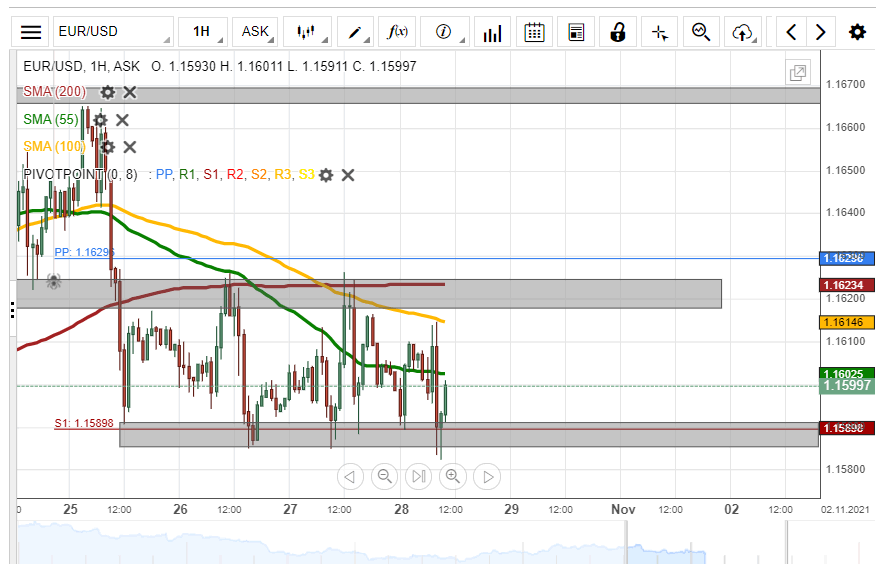
Since the decline on October 25, the EUR/USD has continued to trade in range between the support of the 1.1585/1.1590 zone and the resistance of the 1.1618/1.1625 zone. Meanwhile, it has been spotted throughout the week that the hourly simple moving averages from time to time manage to impact the direction of the currency exchange rate.
In the case of a decline below the 1.1585/1.1590 zone, the currency exchange rate might find support in the 1.1550 level. Below the 1.1550 mark, the currency pair might find support in the weekly S2 simple pivot at 1.1532.
On the other hand, a surge would not only test the 1.1618/1.1625 zone, but also the 100 and 200-hour simple moving averages at 1.1615 and 1.1623. Above these levels, the weekly simple pivot point at 1.1630 might act as a resistance. Above these levels, the October high level zone might once again keep the rate down at 1.1665 /1.1670.