Sample Category Title
BoJ Kuroda: Yen’s recent weakening is definitely positive
In the post meeting press conference, BoJ Governor Haruhiko Kuroda said, "the yen's recent weakening, as a whole, is definitely positive for Japan's economy. It's good for exports and lifts the yen-based profits firms earn overseas. It more than offsets the negative impact from rising import costs."
"At present, currency rates are moving in line with fundamentals," he said. "I therefore see no problems with the moves". He added, "there's no pre-set norm on the desirable level of real, effective exchange rates. I won't comment on specific levels."
"In the long run, if growth accelerates and the output gap turns positive, we'll likely see inflation accelerate and heighten inflation expectations," Kuroda said. "Under current conditions, there are more merits than demerits in maintaining ultra-loose monetary policy."
GBP/JPY Daily Outlook
Daily Pivots: (S1) 155.64; (P) 156.46; (R1) 157.21; More...
Intraday bias in GBP/JPY is mildly on the downside a corrective pull back from 158.19 is extending. Downside should be contained by 153.66 support to bring another rally. On the upside, break of 158.19 will resume larger up trend from 123.94. Next target will be 61.8% projection of 136.96 to 156.05 from 148.93 at 160.72.
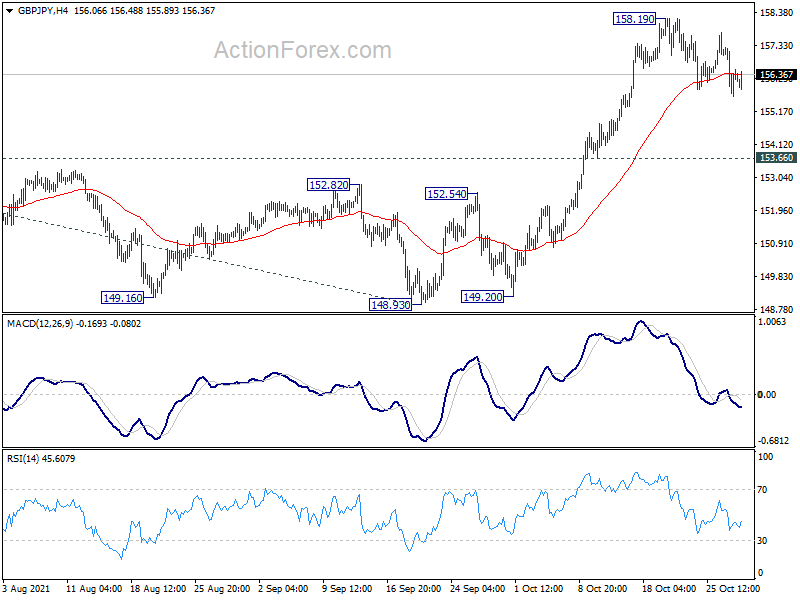
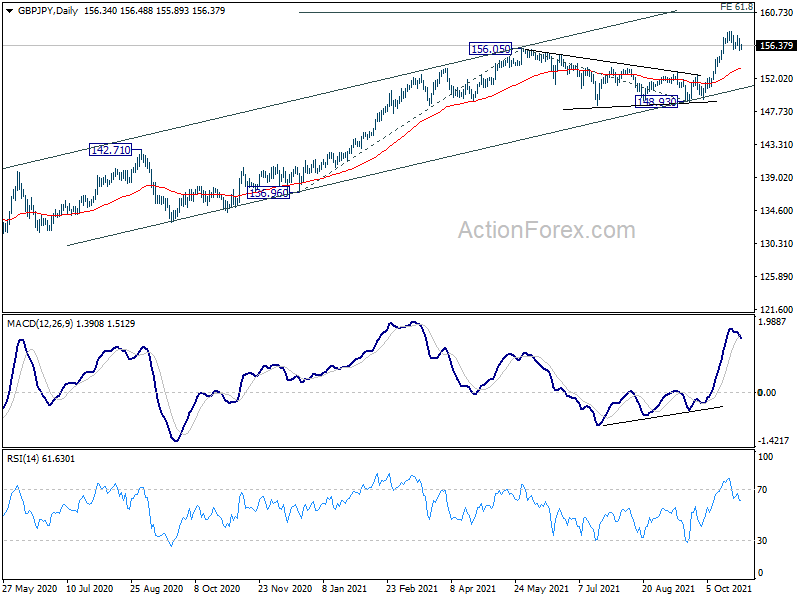
In the bigger picture, rise from 123.94 is seen as the third leg of the pattern from 122.75 (2016 low). The stay above 55 week EMA affirms medium term bullishness. Current rise should now target 61.8% retracement 195.86 (2015 high) to 122.75 at 167.93 next. In any case, outlook will remain bullish as long as 148.93 structural support hold, even in case of deep pull back.
EUR/JPY Daily Outlook
Daily Pivots: (S1) 131.59; (P) 132.06; (R1) 132.54; More....
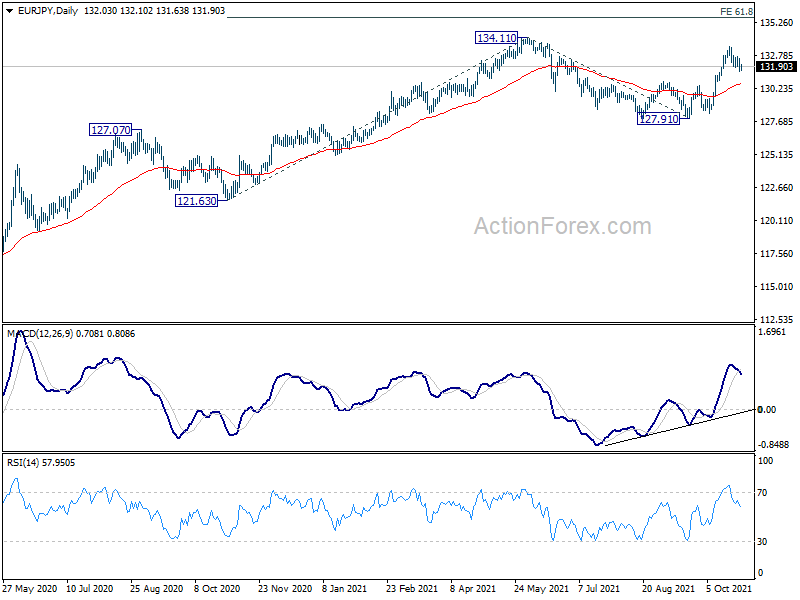
Intraday bias in EUR/JPY is mildly on the downside as corrective pull back from 133.44 is extending. Downside should be contained above 130.45 resistance turned support to bring another rally. On the upside, break of 133.44 will target 134.11 high first. Firm break there will resume larger up trend from 114.42. Next target is 61.8% projection of 121.63 to 134.11 from 127.91 at 135.62.
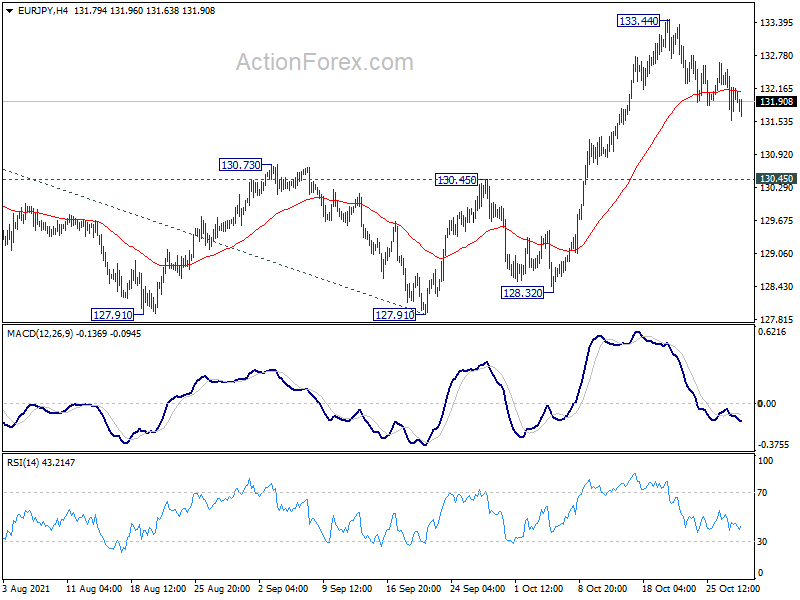
In the bigger picture, rise from 114.42 (2020 low) is still in progress and the strong support support from 55 week EMA affirms medium term bullishness. Further rise would be seen to retest 137.49 (2018 high). Decisive break there will resume the whole long term rise from 109.03 (2016 low). Next target will be 100% projection of 109.03 to 137.49 from 114.42 at 142.88. This will now remain the favored case as long as 127.91 support holds.
EUR/GBP Daily Outlook
Daily Pivots: (S1) 0.8407; (P) 0.8421; (R1) 0.8440; More...
Intraday bias in EUR/GBP is turned neutral with current recovery. But further fall is expected as long as 0.8467 resistance holds. Break of 0.8401 will resume larger down trend from 0.9499 towards 0.8276 key long term support next. On the upside, break of 0.8467 minor resistance will now indicate short term bottoming, and bring stronger rebound back to 55 day EMA (now at 0.8513).
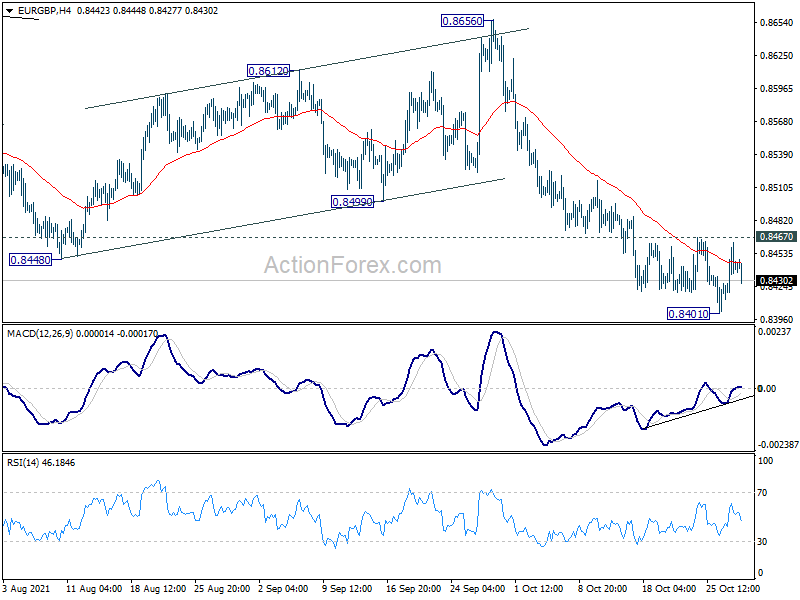
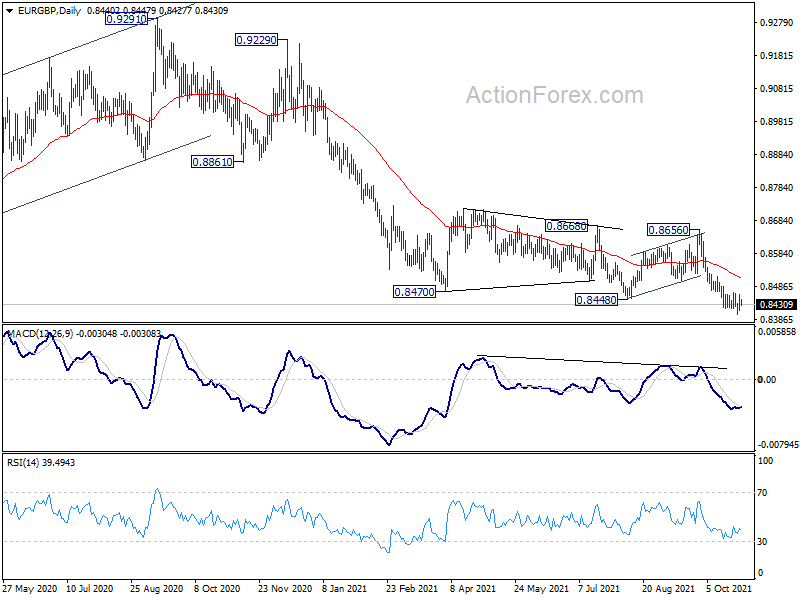
In the bigger picture, price actions from 0.9499 (2020 high) are still seen as developing into a corrective pattern. Deeper fall could be seen as long as 0.8656 resistance holds, towards long term support at 0.8276. However, firm break of 0.8656 resistance would argue that a medium term bottom was already formed. Stronger rise would be seen to 0.8861 support turned resistance to confirm completion of the corrective pattern.
EUR/AUD Daily Outlook
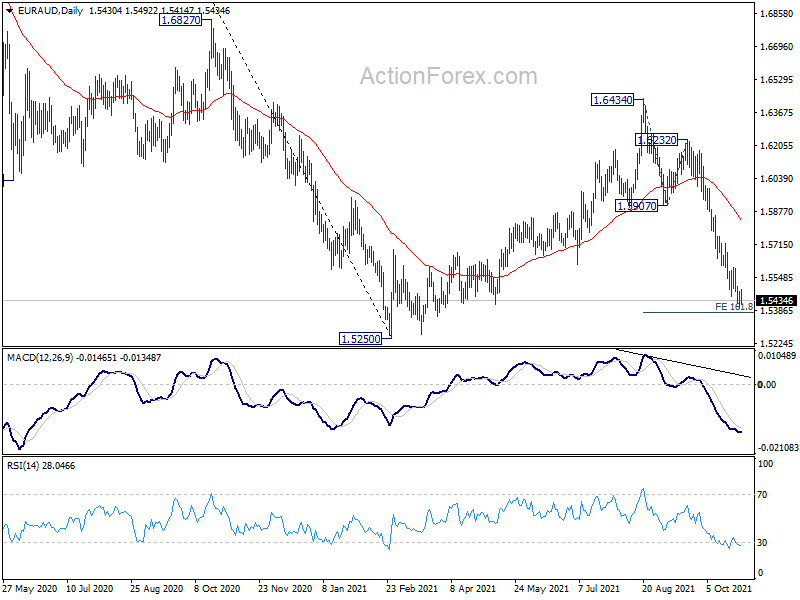
Daily Pivots: (S1) 1.5391; (P) 1.5438; (R1) 1.5478; More...
Intraday bias in EUR/AUD stays on the downside for 161.8% projection of 1.6434 to 1.5907 from 1.6232 at 1.5379. Sustained break there will pave the way to retest on 1.5250 low. On the upside, break of 1.5598 minor resistance will indicate short term bottoming, and turn bias to the upside for stronger rebound to 55 day EMA (now at 1.5833).
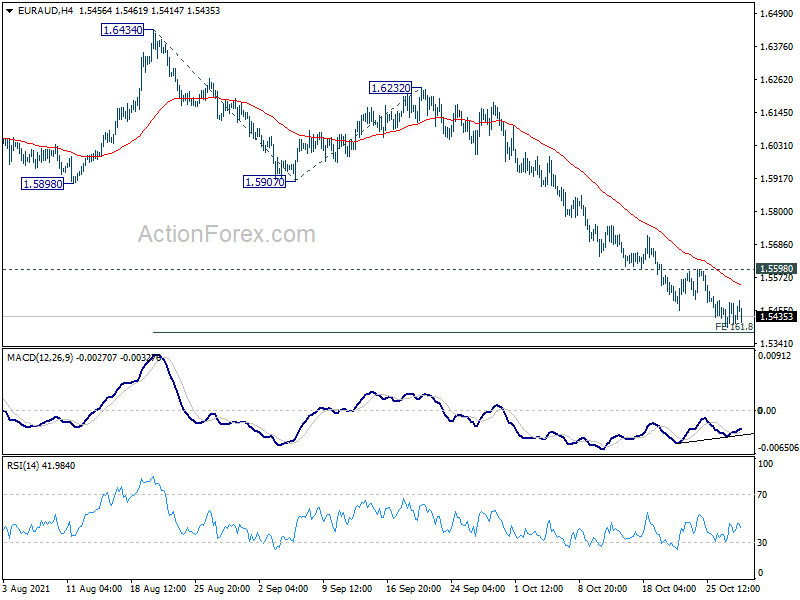
In the bigger picture, with 38.2% retracement of 1.9799 to 1.5250 at 1.6988 intact, the down trend from 1.9799 (2020 high) is expected to resume at a later stage. Firm break of 1.5250 will target 61.8% retracement of 1.1602 (2012 low) to 1.9799 at 1.4733. In any case, sustained break of 1.6988 fibonacci level is needed to indicate long term reversal.
EUR/CHF Daily Outlook
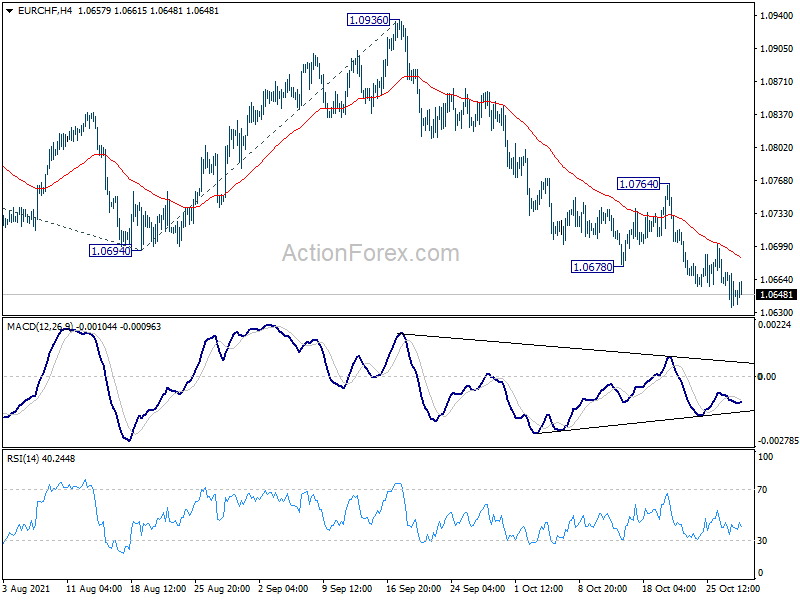
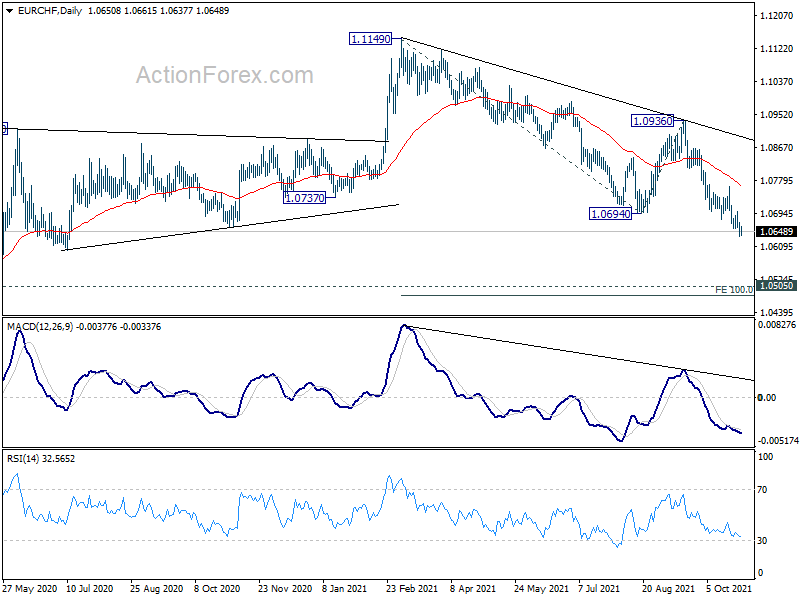
Daily Pivots: (S1) 1.0635; (P) 1.0655; (R1) 1.0674; More....
Intraday bias in EUR/CHF is back on the downside as fall from 1.0936 resumed after brief recovery. Current fall is seen as part of the down trend from 1.1149. Next target is 100% projection of 1.1149 to 1.0694 from 1.0936 at 1.0481. On the upside, break of 1.0764 resistance is needed to indicate short term bottoming. Otherwise, outlook will stay bearish in case of recovery.
In the bigger picture, the rejection by 55 week EMA maintains medium term bearishness. Fall from 1.1149 (2021 high) is currently seen as the second leg of the patter from 1.0505 (2020 low) first. Hence, in case of deeper fall, we'd look for strong support from 1.0505 to bring rebound. However, sustained break of 1.0505 will resume the long term down trend from 1.2004 (2018 high). Also, medium term outlook will now be neutral at best as long as 1.0936 resistance holds.
The Bond Rally Doubled Down In Ihe UK
Markets
Another incredible bull flattening wave rolled over on core bonds, from the EU over the UK to the US. The decline was both driven by easing (LT) real yields and inflation expectations. This may mean markets have come to fully realize monetary tightening is on the way, not only by tapering QE but also by raising rates much sooner than expected. The latter may explain the underperformance at the short end of the yield curve while expectations for declining growth overwhelmingly dominated the back end. Yields eventually changed +1.6 bps (3y) to -9 bps (30y) in the US. German yield changes varied from +1.8 bps (2y) over -6.1 bps (10y) to -8.9 bps (30y). The bond rally doubled down in the UK, where yields tanked a stunning 12-18 bps at the longer tenors. Sentiment in risky assets (equity, commodities) was weak but that didn’t help the dollar much. EUR/USD finished nearly unchanged near the 1.16 handle. The yen did well but could have done better given the size of the yield declines. Sterling felt the decline of UK Gilt yields but a still-unimpressive euro capped gains in EUR/GBP (finished at 0.844 from 0.842).
Central bank news dominates the Asian session. The BoJ kept the main policy rate unchanged at -0.1% and the 10y yield target at 0%. It slashed growth for this fiscal year (ending in March) to 3.4% (-0.4ppt) to reflect setbacks from a Covid surge during the summer and supply chain issues. Growth in FY+1 was seen at 2.9% and 1.3% for the next. Inflation was cut to 0% this FY and at an unchanged 0.9% and 1% in the following years. JPY strengthens marginally. The massive bond sell-off in Australia after yesterday’s core CPI continues this morning. The RBA refrained from ramping up April 2024 bond buying. The yield on that reference bond for the RBA’s 3y yield target (0.10%) sears 33 bps! The Aussie dollar loses slightly, probably as commodities (oil) decline further this morning. The USD is trading mixed while core bond yields seek to recover a tiny bit of the lost ground yesterday.
The eco calendar is jam-packed today. Growth (Q3) and September PCE inflation is due in the US. We had a glimpse of the latter with CPI figures earlier this month while the former, in a context of markets pondering growth effects of monetary normalization, may be discarded as outdated. In this respect, the ECB meeting may draw most attention even though it is an intermediate one. We’re keen on Lagarde’s reaction to soaring inflation expectations: the ECB’s favourite 5y5y forward gauge trades >2%, highest since 2014. This has triggered quite some repositioning in EU money markets who see a rate hike liftoff occurring already next year. It’s very likely Lagarde will push back against such bets, labelling them as premature since inflation is temporary anyway. While bad for real rates, it may spur inflation expectations even further, thus capping the net damage for European bond yields. This won’t benefit EUR/USD. Downside risks remain with 1.153 as a first reference. Regarding PEPP, we expect to know little more from today’s meeting. Lagarde will deflect any question saying it will be discussed at the December meeting.
News headlines
The Bank of Canada kept is policy rate unchanged at 0.5%. At the same, robust economic growth allows the BoC to end its QE net bond buying program. The BoE expects growth of 5.0% this year, moderating to 4.25% and 3.75% in 2022 and 2023 respectively. The economy also saw strong employment gains in recent months. The current increase in inflation was anticipated, but forces pushing up prices appear to be stronger and more persistent than expected. The Bank now expects economic slack to be absorbed by the middle quarters of next year, sooner than earlier indicated. In this context, interest rates can be raised sometime between April and September. USD/CAD spiked from the 1.2430 area to the low 1.23 area on the hawkish twist but market sentiment later eroded loonie gains.
The Bank of Brasil yesterday raised its Selic policy rate by 150 bps to 7.75%. The move was bigger than expected, following three consecutive rate hikes of 100 bps. The Bank indicated that another similar rate hike will probably come in December. Amongst other factors, it cited that "Recent questioning regarding the fiscal framework increased the risk of deanchoring inflation expectations”. President Bolsonaro recently announced big plans to boost spending ahead of next year’s election.
USD/CAD Breaks Channel Pattern
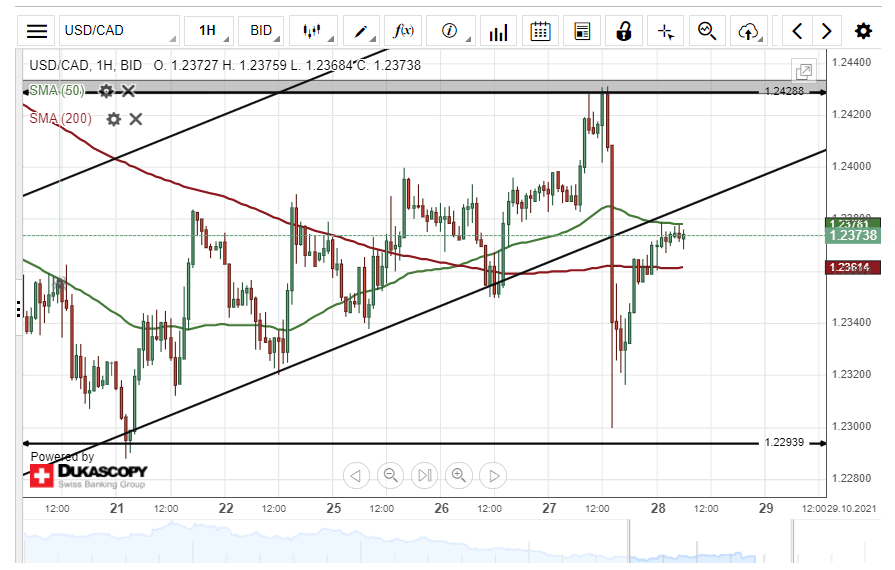
Downside risks dominated the USD/CAD currency pair on Wednesday. As a result, the US Dollar fell by 114 pips or 0.92% against the Canadian Dollar during Wednesday's trading session.
Given that a breakout has occurred, bears could continue to drive the exchange rate lower on Thursday. The potential target for bearish traders will be near the 1.2280 level.
However, if the currency exchange rate breaks the resistance level at 1.2376, a surge towards the 1.2440 area could be expected today.
ECB Meets Amid Hawkish Shifts From Other Central Banks
Market movers today
- Today, we expect ECB will attempt to make their policy meeting as uneventful as possible. The meeting is largely a prelude to the December meeting, where new staff projections will base the foundation for the exact calibration of ECB's instruments. We expect ECB to flag risks to the outlook and as such not deviate from the current baseline.
- In Germany, we get flash October HICP figures, a good indicator for tomorrow, which will reveal whether inflation has continued higher in October in the euro area.
- In the US, we will look out for Q3 flash GDP figures.
- We get a bunch of releases out of Sweden with September and Q3 GDP indicator, retail sales and NIER confidence data, see more below.
The 60 second overview
Canada: Yesterday, Bank of Canada took yet another shift in a more hawkish direction by not only ending its QE purchases but also by moving forward its indicated timing for the first rate hike from H2 2022 to the "middle quarters" of 2022, i.e. potentially as early as April next year. The interesting part of the move is that this is yet another central bank acknowledging that growth prospects are weaker than expected yet still accelerate the timing for tightening monetary policy forward in time. Canadian fixed income sold off aggressively while CAD FX strengthened.
Australia: Expectations are mounting for a hawkish shift from the Reserve Bank of Australia before it meets next week after its latest bond purchase announcement overnight, where it opted not to buy short-term bonds and defend it is yield curve target.
Japan: Bank of Japan (BoJ) kept its QQE with yield curve control policy unchanged at a meeting ending this morning. As opposed to other major economies, high inflation is not a theme in Japan. The BoJ cut both its growth and inflation forecasts and now expects 0.0% inflation in the fiscal year 2021. This also means the BoJ will be in no rush to tighten policy by much any time soon.
Oil: Iran said yesterday nuclear negotiations would resume before the end of November. Oil prices fell sharply with Brent falling below USD83/bbl in anticipation of a deal which would see sanctions on Iran oil exports lifted.
Equities: Equities were lower yesterday across regions and across most sectors. Busy reporting day and earnings remains rock solid. Reporting have shown fears on margin pressure were overdone as we argue before the earnings season. However, yesterday it was all about the massive curve flattening and a huge drop in long bond yields. Unsurprisingly, growth stock being the relative winners in this environment while banks, materials and energy being the relative losers. Worth noting small caps suffering yesterday as well. In US yesterday, Dow -0.7%, S&P 500 -0.5%, Nasdaq flat while Russell 2000 lost 1.9%.
Sentiment still sour this morning in Asia where Hong Kong is a relative outperformer for a change, despite being lower. US and European futures are flattish but with the massive pick up in bond volatility we would not be surprise if more volatility is sneaking into equity markets today.
FI: Yesterday saw large moves in medium term and long terms yields that dropped significantly with 10Y Germany dropping 6bp, 10Y UK dropping 12bp and 10Y Italy tightening nearly 2bp to Germany on the back of lower equities. Further, 5s10s flattening nearly 3bp in Germany and 10s30s flattened 3bp. As opposite, the 2Y yields rose 0-2bp in Europe and the big curve movements indicating worry on future growth rates and central banks acting on high inflation.
FX: EUR/USD moved sideways yesterday still trading around 1.16. EUR/GBP moved a bit higher trading closer to 0.845. EUR/SEK still trades marginally below 10.00 while EUR/NOK moved up to 9.77 from 9.70-ish. CAD had a strong session yesterday, as Bank of Canada's shift towards a faster tightening of monetary policy sent USD/CAD back below 1.24.
Credit: Credit performance was somewhat mixed yesterday. iTraxx Xover widened 1bp while Main closed 0.1bp tighter. HY bonds tightened 3bp and IG was unchanged.
Nordic macro
In Sweden, there is a busy calendar today. The release of the September and Q3 GDP indicator will give an overall outlook of the economic activity during the third quarter. So far July and August have been on the weak side indicating GDP at 0.5% q/q giving a downward risk to our 'low' GDP forecast at 1.1%. The Riksbank's latest monetary policy report shows that they expect a GDP increase of 2.3% q/q, which currently appears a bit stretched. We also get September retail sales and October NIER confidence data, where in the latter manufacturing and consumers remain at high levels though seemingly on the verge of rolling over suggesting loss of growth momentum. Finally, Riksbank 'relative hawk' Henry Ohlsson holds a speech on the economy and policy at 10.00.
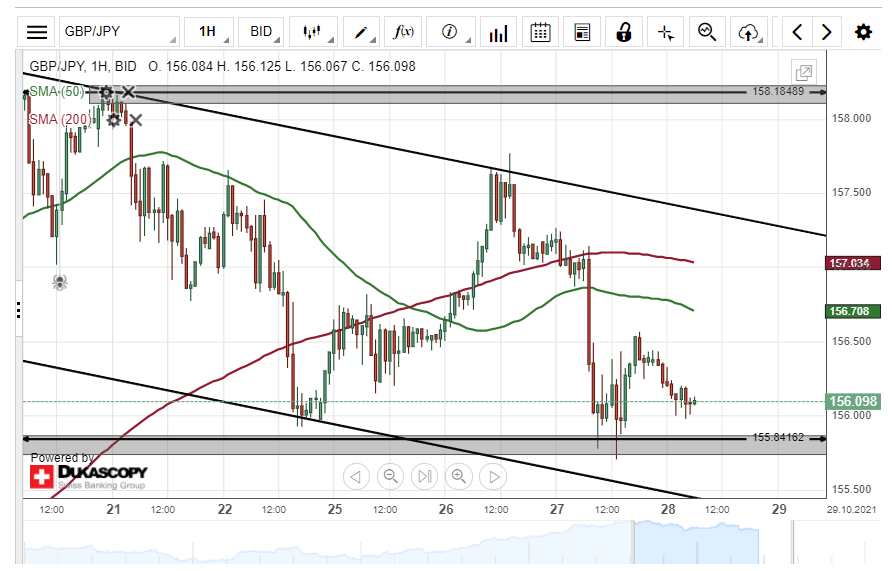
GBP/JPY Decline To Continue
On Wednesday, the British Pound fell by 125 pips or 0.80% against the Japanese Yen. The currency pair breached the 50– and 200– hour SMAs during Wednesday's trading session.
By and large, bearish traders are likely to continue to pressure the exchange rate lower in a descending channel pattern during the following trading session. The possible target for sellers will be near the 155.50 area.
However, bears could encounter a support level at 155.84 within the following trading hours.