Sample Category Title
BoC press conference live stream
https://www.youtube.com/watch?v=Z3JCxfyxyBg
Bank of Canada Adjusts Forward Guidance, Now Sees Excess Slack Absorbed in the Middle Quarters of 2022
The Bank of Canada kept its key policy interest rate at 0.25%, while announcing it will end the quantitative easing (QE) program and that it will move into the reinvestment phase, during which the Bank will purchase Government of Canada bonds to replace maturing bonds.
The Bank continued to provide extraordinary forward guidance as it stated it will hold the policy rate at the effective lower bound until economic slack is absorbed and the 2 percent inflation target is sustainably achieved. The Bank pulled forward when it expected this to occur from the second half of 2022 to the middle quarters of that year.
Along with today's announcement, the Bank released an updated economic forecast in the Monetary Policy Report (MPR). There were significant revisions to GDP as the 2021 estimate was revised down to 5.1% (July MPR: 6.0%), 2022 was also revised lower to 4.3% (July: 4.6%), but 2023 was moved higher to 3.7% (July: 3.3%). The Bank noted that the downward revisions to this forecast was due to "more severe supply disruptions and weaker foreign demand". The Bank acknowledged however that there is significant uncertainty around the outlook as the impacts of supply disruptions, labour market mismatches, and accelerated digital investments remain difficult to quantify.
Given negative supply side impacts, the Bank weakened its estimate of potential output growth to 1.6% over 2021-23, which is 0.2 percentage points lower than what it had assumed in the July MPR. Notably, as the downward revision in supply was larger than the drop in GDP at the beginning of the Bank's projection, the output gap was narrower than what it had previously expected.
On inflation, the Bank continued to expect consumer price index (CPI) inflation to remain elevated through the remainder of 2021 and into 2022, once again due to supply issues as well as higher energy prices. The 2021 forecast was lifted to 3.4% (July: 3.0%), 2022 was revised up to 3.4% (July: 2.4%), and 2023 was a touch higher at 2.3% (July: 2.2%). The MPR stated that inflation was expected to ease to about 2% at the end of 2022 as supply disruptions dissipate, but then rise modestly as economy moves into excess demand territory. The Bank projects inflation to gradually return to target in 2024.
Key Implications
In today's highly anticipated decision, the Bank of Canada changed up the script. It pulled forward the timing of when it expected the output gap to close to the middle quarters of next year as it judged that supply disruptions were weighing more heavily on the economy's productive capacity. So, even as the GDP forecast was revised down in this MPR, the output gap closed sooner than what the Bank had projected in July.
In terms of our own view, we expect the Bank will raise rates three times next year, taking the overnight rate to 1% by the end of 2022. Inflation is heating up, and it would be prudent to remove some monetary stimulus as the economy continues down the road to recovery.
That being said, we must acknowledge that there is significant uncertainty around the economic outlook right now. A resurgence of the pandemic could result in greater stimulus, but if there is a faster-than-expected acceleration in household spending, the Bank could raise rates at a faster clip. The Bank of Canada is showing that it is nimble and will react quickly to the evolving economic landscape.
EUR/CAD downside breakout after BoC, GBP/CAD to follow?
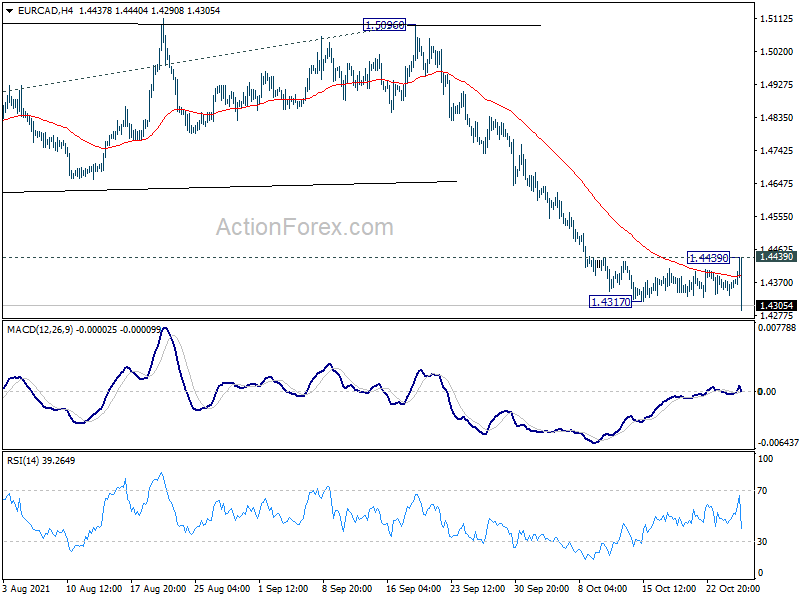
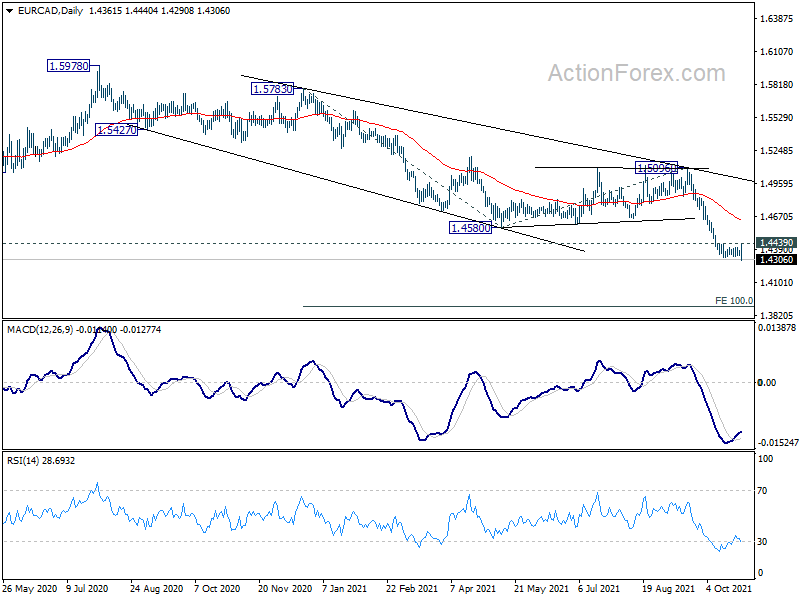
Canadian Dollar jumps broadly after surprisingly hawkish BoC policy decision. USD/CAD and CAD/JPY are still bounded in range. But EUR/CAD is taking the lead with downside breakout.
The break of 1.4317 in EUR/CAD suggests resumption of fall from 1.5096. More importantly, it's now resuming the medium term down trend. Sustained trading below 1.4317 will confirm the breakout and pave the way to 100% projection of 1.5783 to 1.4580 from 1.5096 at 1.3839. In any case, outlook will stay bearish as long as 1.4439 resistance holds, even in case of recovery.
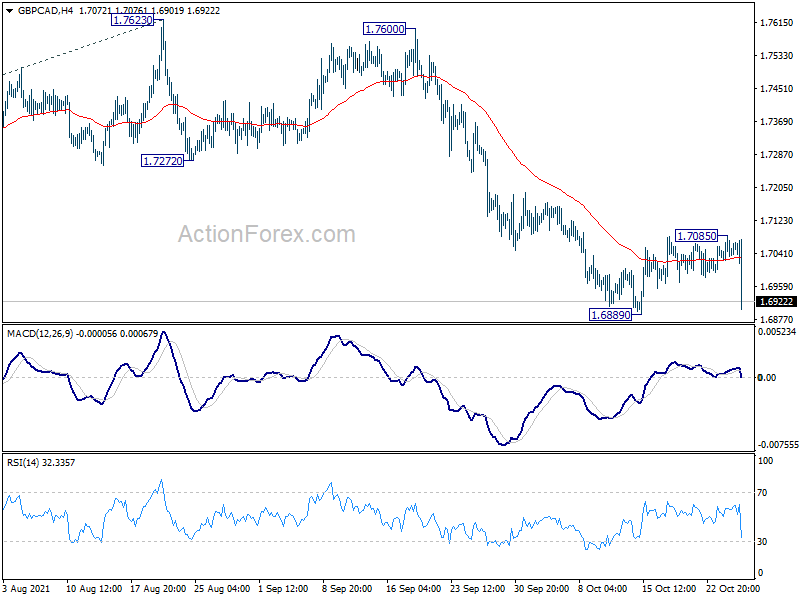
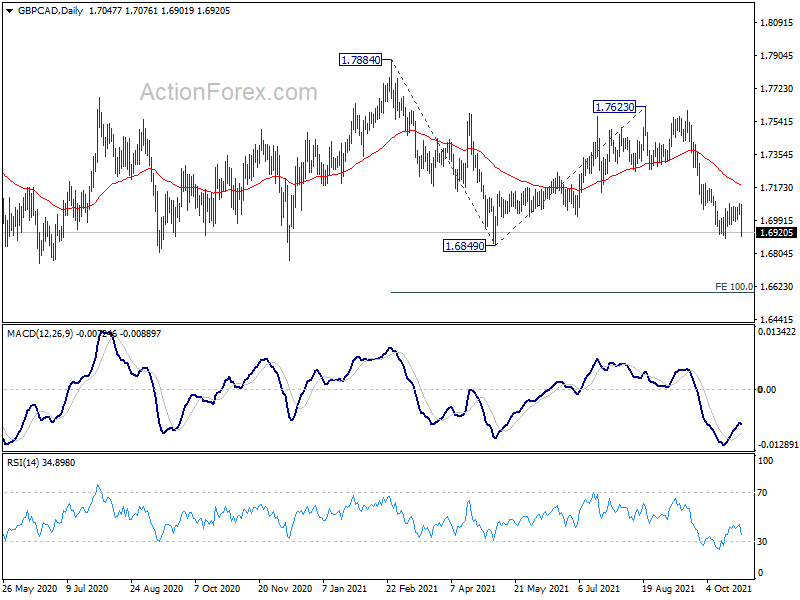
GBP/CAD will be a focus now too as it's diving towards 1.6889 support. Firm break there will resume the fall from 1.7623, and the decline from 1.57784 too. 100% projection of 1.7884 to 1.6849 from 1.7623 at 1.6588 will be next target.
GBPJPY Sellers Struggle to Amplify Price Pullback
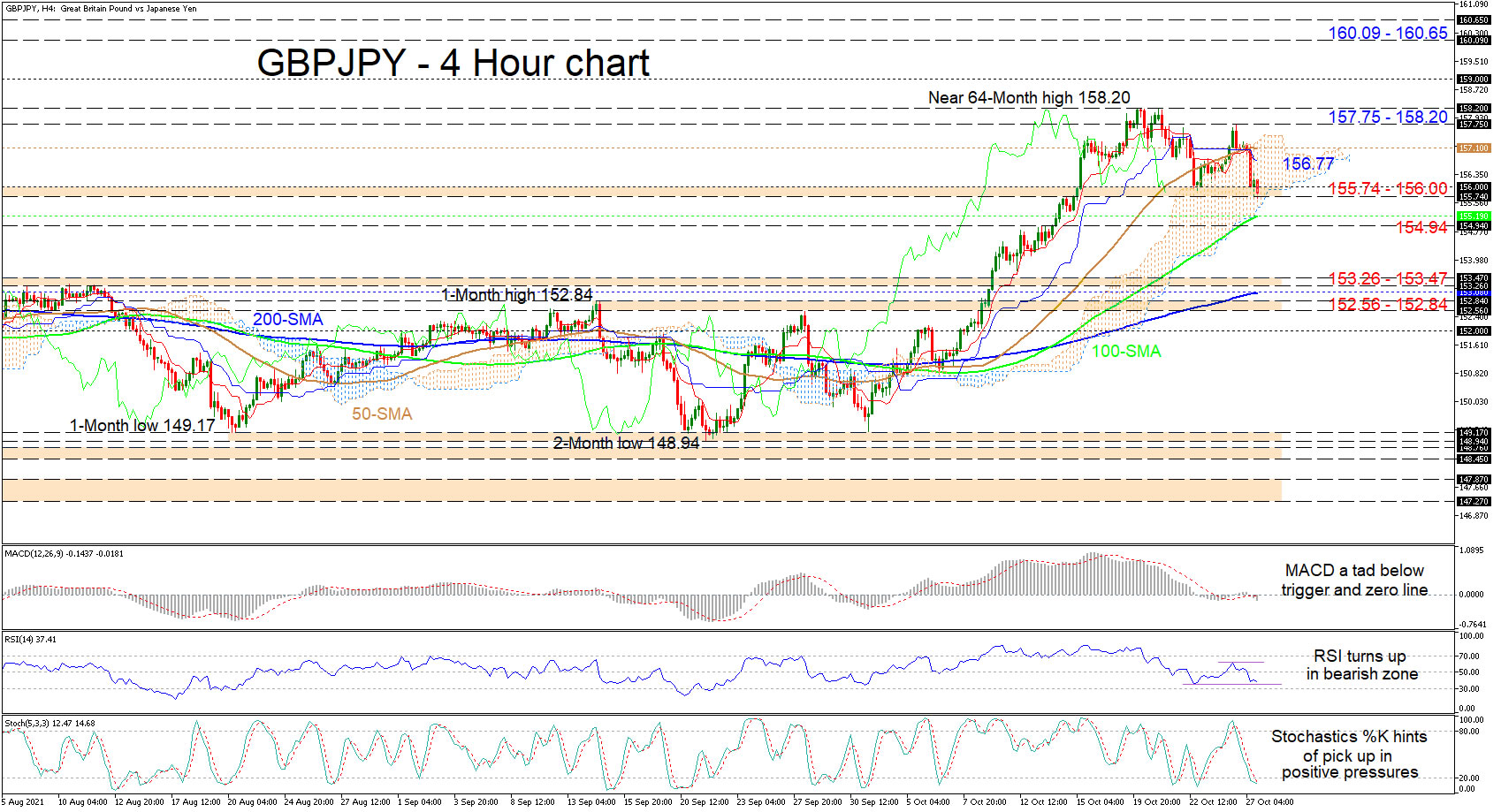
GBPJPY is currently finding its feet around a support barrier shaped between the 156.00 handle and the highs reached in late May and early June. Even though the 100- and 200-period simple moving averages (SMAs) are defending the positive structure, the price dip beneath the 50-period SMA is implying some waning in positive drive.
Currently, the Ichimoku lines are not clear of a price direction, while the short-term oscillators are conveying conflicting signals in momentum. The MACD is slightly beneath its red trigger and zero lines, while the RSI is heading lower in the bearish territory. Alternatively, the stochastic oscillator is promoting bullish impetus as the %K line has turned up in oversold territory and above its %D line.
If sellers manage to dip beneath the 155.74-156.00 barricade and the Ichimoku cloud’s lower band, the bears could then aim for the 100-period SMA at 155.19 and the 154.94 barrier slightly beneath. A price drop past these obstructions may feed negative forces, which could steer the price towards the 153.26-153.47 key border, shaped between the highs reached in July and the first part of August. From here, looming below is the 200-period SMA at 153.08 and the 152.56-152.84 support band, which are reinforcing upside defences that sellers will inevitably have to breach to gain command.
If buyers regain traction off the 155.74-156.00 zone or cloud’s floor, initial resistance could stem from the Ichimoku lines around 156.77 and the 50-period SMA at 157.10. Moving above the cloud, buyers may then meet a resistance section, formed by the recent high of 157.75 and the near 64-month peak of 158.20. Conquering the more than 5-year high, the price could encounter the 159.00 handle before propelling for the 160.09-160.65 border, moulded between the peaks reached in June.
Summarizing, GBPJPY is sustaining a neutral-to-bullish bias above the longer-term averages. While a drop below 155.00 could reinforce a correction, a price jump above the cloud may feed upside momentum.
Sunset Market Commentary
Markets
What started as a corrective bull flattening move on last week’s sharp hawkish repositioning is starting to take on bigger proportions. End of month extension buying might be at play, but falls short from explaining what’s happening. Bond investors perhaps get some cold feet going into tomorrow’s ECB meeting and next week’s BoE gathering. The German Bundesbank’s 2021 GDP downgrade (2.6% from 3.5% in 2021) serves as a warning with scarcity of materials and rising gas prices the main culprits. The stagflation scenario doesn’t materialize completely though with 2022 growth upwardly revised from 3.6% to 4%. The bond rally continued unabated with UK Gilts and German Bunds outperforming US Treasuries. Underlying details again show that the UK move is driven almost solely by lower inflation expectations whereas real yields in the US and Germany are also downwardly oriented. German yields fall by 0.7 bps (2-yr) to 7 bps (30-yr) in a daily perspective. From a technical point of view, the German 10-yr yield drops out of the steep upward trend channel in place since the end of August. First support stands at -0.19% which is the neckline of a short term double top formation with targets at -0.39% and -0.41%. US yields lose up to 5 bps (30-yr) on a daily basis. Better-than-expected September US durable goods orders had no real influence. US investors due still face 5y and 7y Note auctions in the Treasury’s end-of-month refinancing operation. Today’s risk sentiment was less ebullient with main European indices losing slightly under 0.5% at the time of writing.
The Japanese yen and Swiss franc are today’s main beneficiaries of the yield setback. EUR/JPY spike below 132. USD/JPY again loses the 114-handle. Technical pictures for JPY aren’t really improving yet though. The Swiss franc reached its strongest level against the euro since the Summer of 2020 (EUR/CHF 1.0650). CHF is the odd one out these days, rising against the euro both in times of rising (real) yields and in the opposite (risk-off) environment. It’s noticeable that during the early October repositioning, even Swiss money markets started discounting a first rate hike over a 12-month horizon. We think that the invisible hand of the SNB will start to show in sight deposit data if the CHF-appreciation continues at the current pace. Today’s dollar performance was rather disappointing given the market context. DXY failed to retake the 94 big figure, changing hands around 93.80. EUR/USD opened just below 1.16 to currently trade near 1.1620.
News Headlines
The Swedish National Debt office said that a faster than expected economic recovery lowers the borrowing requirement of the Central government. The budget office upwardly revised the 2021 growth projection to 4.2% (from 3.5%). This higher growth will cause the Government budget balance to already become positive this year. Central government debt will this year decline from 26% of GDP tot 23% and drop further to 18% of GDP in 2023. Debt as measured according to the Maastricht criterion will ease for 40% in 2020 to 32% in 2023. The interest rate on 10-y Swedish government bonds declined 6.6 bps today. At the same time, the 2-yr yield rose marginally (-0.20%, +1.2 bps). Markets are pondering the consequences for Riksbank policy as a result of this faster than expected Swedish economic recovery. EUR/SEK extends its decline below 10.00 (9.9725 currently).
UK Finance Minister Sunak delivered a growth supportive message in the semi-annual statement on the UK budget. The UK government upwardly revised the UK 2021 growth forecast to 6.5% from 4% in March. In this scenario, the UK economy will probably return to a pre-corona level at the turn of the year. The OBR projected a budget deficit for the 2021/22 at around 7.9% down from of 10.3%. The better budgetary outcome gives minister Sunak leeway for additional spending. In this respect Sunak said that every government department would get a real increase in spending. The Chancellor also announced new rules to govern borrowing: a commitment that underlying public sector net debt must be falling as share of GDP and the government's day-to-day spending must be balanced by revenues within three years. In normal times the government should thus only borrow to invest.
BoC ends QE, could lift rates in middle quarters next year
BoC surprisingly announced to end quantitative easing today, and move to the reinvestment phase. That's ahead of market expectation of tapering today and ending QE in December. Overnight rate is held at effective lower bound of 0.25%, bank rate is kept at 0.50% and deposit rate at 0.25%.
Regarding forecast guidance, BoC reiterated that its "remain committed to holding the policy interest rate at the effective lower bound until economic slack is absorbed so that the 2 percent inflation target is sustainably achieved."
Now, BOC expects this to happen "sometime in the middle quarters of 2022", ahead of September's guidance of " the second half of 2022."
(BOC) Bank of Canada maintains policy rate and forward guidance, ends quantitative easing
The Bank of Canada today held its target for the overnight rate at the effective lower bound of ¼ percent, with the Bank Rate at ½ percent and the deposit rate at ¼ percent. The Bank's extraordinary forward guidance on the path for the overnight rate is being maintained. The Bank is ending quantitative easing (QE) and moving into the reinvestment phase, during which it will purchase Government of Canada bonds solely to replace maturing bonds.
The global economic recovery from the COVID-19 pandemic is progressing. Vaccines are proving highly effective against the virus, although their availability and distribution globally remain uneven and COVID variants pose risks to health and economic activity. In the face of strong global demand for goods, pandemic-related disruptions to production and transportation are constraining growth. Inflation rates have increased in many countries, boosted by these supply bottlenecks and by higher energy prices. While bond yields have risen in recent weeks, financial conditions remain accommodative and continue to support economic activity.
The Bank projects global GDP will grow by 6½ percent in 2021 – a strong pace but less than projected in the July Monetary Policy Report (MPR) – and by 4¼ percent in 2022 and about 3½ percent in 2023.
In Canada, robust economic growth has resumed, following a pause in the second quarter. Strong employment gains in recent months were concentrated in hard-to-distance sectors and among workers most affected by lockdowns. This has significantly reduced the very uneven impact of the pandemic on workers. As the economy reopens, it is taking time for workers to find the right jobs and for employers to hire people with the right skills. This is contributing to labour shortages in certain sectors, even as slack remains in the overall labour market.
The Bank now forecasts Canada's economy will grow by 5 percent this year before moderating to 4¼ percent in 2022 and 3¾ percent in 2023. Demand is expected to be supported by strong consumption and business investment, and a rebound in exports as the US economy continues to recover. Housing activity has moderated, but is expected to remain elevated. On the supply side, shortages of manufacturing inputs, transportation bottlenecks, and difficulties in matching jobs to workers are limiting the economy's productive capacity. Although the impact and persistence of these supply factors are hard to quantify, the output gap is likely to be narrower than the Bank had forecast in July.
The recent increase in CPI inflation was anticipated in July, but the main forces pushing up prices – higher energy prices and pandemic-related supply bottlenecks – now appear to be stronger and more persistent than expected. Core measures of inflation have also risen, but by less than the CPI. The Bank now expects CPI inflation to be elevated into next year, and ease back to around the 2 percent target by late 2022. The Bank is closely watching inflation expectations and labour costs to ensure that the temporary forces pushing up prices do not become embedded in ongoing inflation.
The Governing Council judges that in view of ongoing excess capacity, the economy continues to require considerable monetary policy support. We remain committed to holding the policy interest rate at the effective lower bound until economic slack is absorbed so that the 2 percent inflation target is sustainably achieved. In the Bank's projection, this happens sometime in the middle quarters of 2022. In light of the progress made in the economic recovery, the Governing Council has decided to end quantitative easing and keep its overall holdings of Government of Canada bonds roughly constant.
We will continue to provide the appropriate degree of monetary policy stimulus to support the recovery and achieve the inflation target.
Information notes
A market notice outlining details of the reinvestment phase will be published on the Bank's web site at 10:30 am ET today.
The next scheduled date for announcing the overnight rate target is December 8, 2021. The next full update of the Bank's outlook for the economy and inflation, including risks to the projection, will be published in the MPR on January 26, 2022.
EUR/USD Mid-Day Outlook
Daily Pivots: (S1) 1.1579; (P) 1.1603; (R1) 1.1620; More...
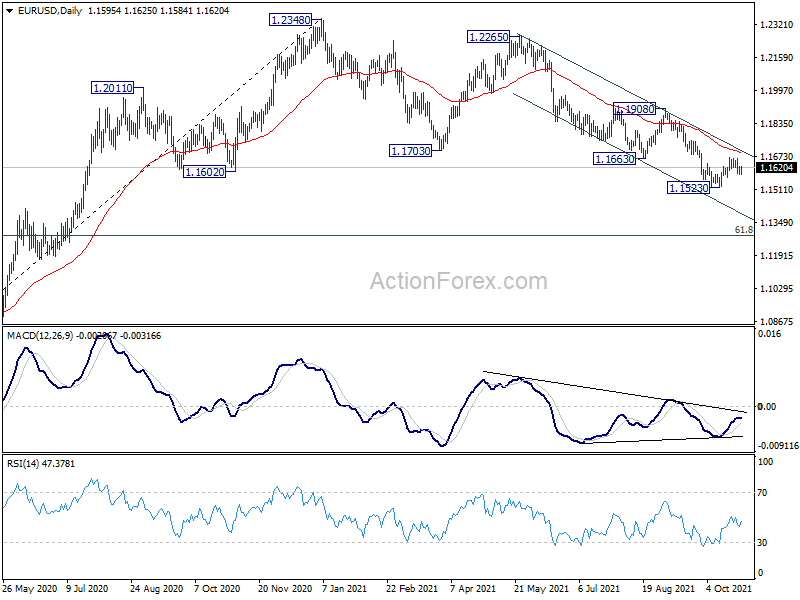
Outlook in EUR/USD unchanged and intraday bias remains neutral first. On the upside, break of 1.1668 will target 55 day EMA (now at 1.1695). Sustained break there will be a sign that larger correction from 1.2348 has completed. Stronger rally would be seen to 1.1908 resistance for confirmation. On the downside, though, break of 1.1571 minor support will turn bias back to the downside for 1.1523 support instead. Break there will resume larger fall from 1.2348.
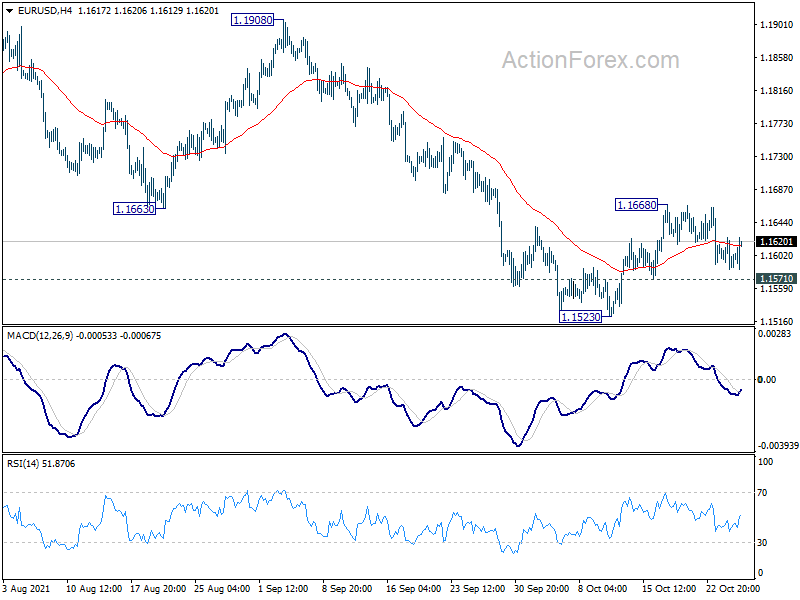
In the bigger picture, price actions from 1.2348 should at least be a correction to rise from 1.0635 (2020 low). As long as 1.1908 resistance holds, deeper fall would be seen to 61.8% retracement of 1.0635 to 1.2348 at 1.1289. Nevertheless break of 1.1908 resistance will revive medium term bullishness and turn focus back to 1.2348 high.
GBP/USD Mid-Day Outlook
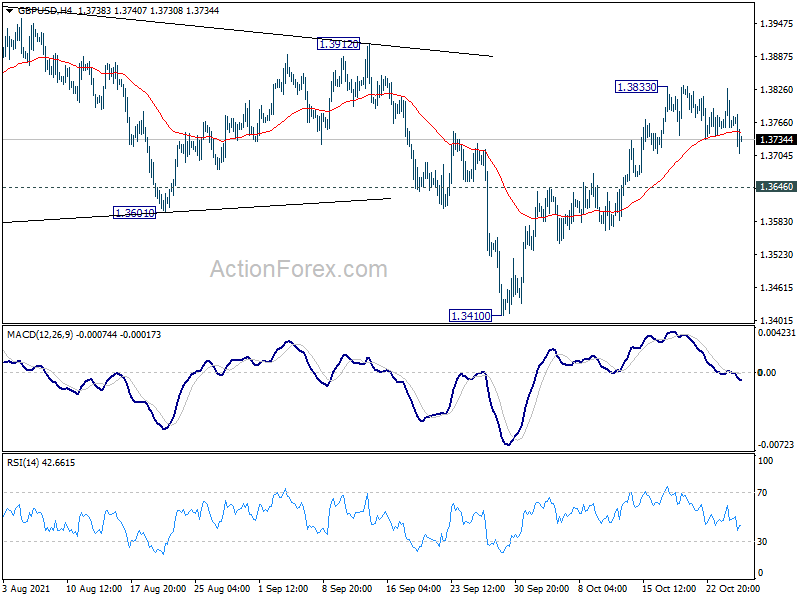
Daily Pivots: (S1) 1.3738; (P) 1.3784; (R1) 1.3811; More...
GBP/USD is staying in consolidation from 1.3833 and intraday bias remains neutral. Further rise is expected with 1.3646 support intact. On the upside, above 1.3833 will target 1.3912 key structural resistance. Firm break there will indicate that the correction from 1.4248 is complete with three waves down to 1.3410. Further rally would then be seen to retest 1.4248 high. However, break of 1.3646 will turn bias to the downside for retesting 1.3410 low.
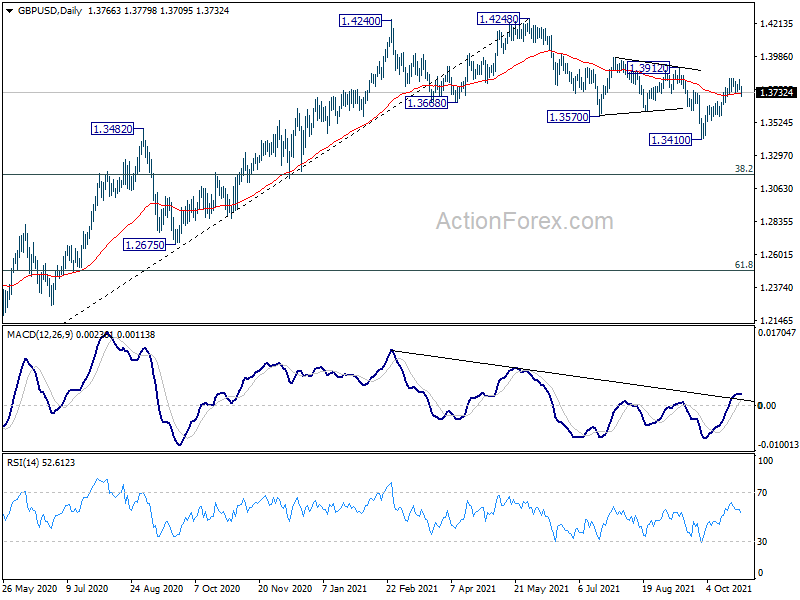
In the bigger picture, the structure of the fall from 1.4248 suggests that it's a correction to the up trend from 1.1409 (2020 low) only. While deeper fall cannot be ruled out yet, downside should be contained by 38.2% retracement of 1.1409 to 1.4248 at 1.3164, at least on first attempt, to bring rebound. On the upside, firm break of 1.4376 key resistance (2018 high) will add to the case of long term bullish reversal. However, sustained trading below 1.3164 will revive some medium term bearishness and target 61.8% retracement at 1.2493.
USD/CHF Mid-Day Outlook
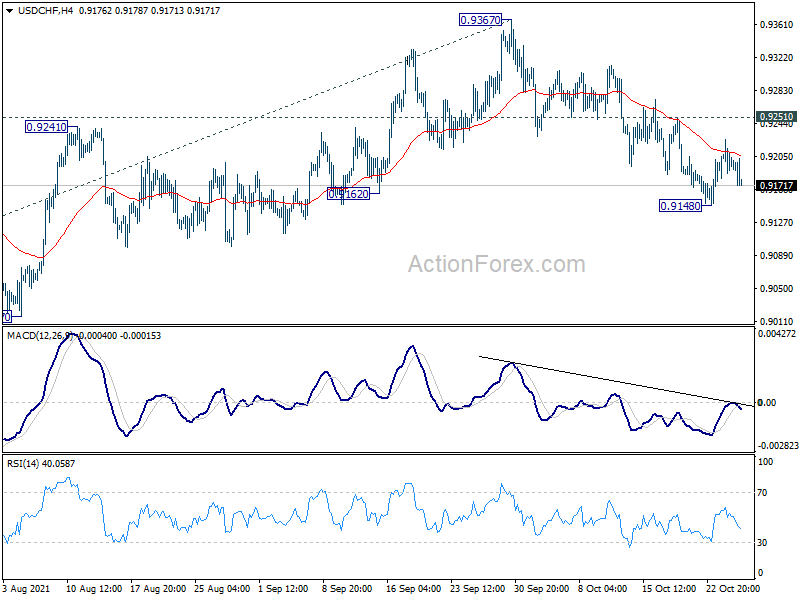
Daily Pivots: (S1) 0.9182; (P) 0.9204; (R1) 0.9220; More....
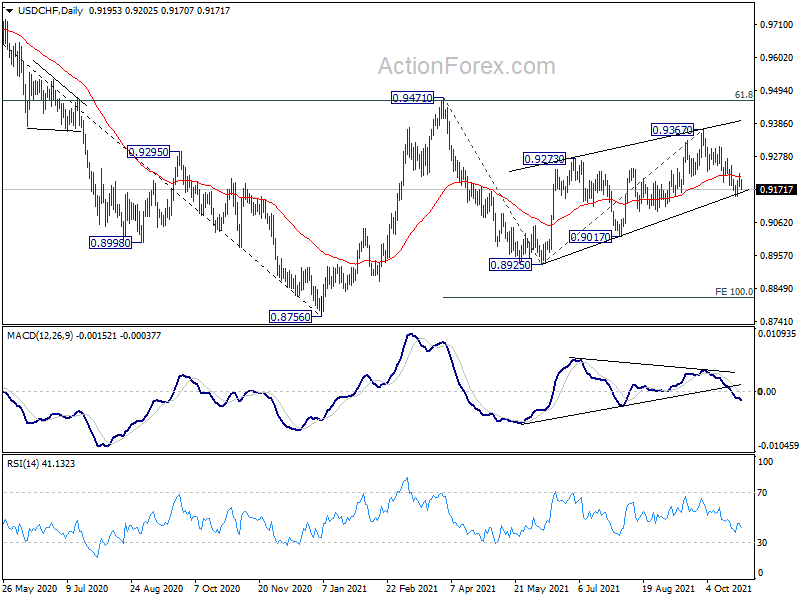
Intraday bias in USD/CHF remains neutral and outlook is unchanged. Further decline is still in favor with 0.9251 minor resistance intact. Corrective rise from 0.8927 should be complete with three waves up to 0.9367, on bearish divergence condition in daily MACD. Below 0.9148 will target 0.9017 support first, and then 0.8925 support next. On the upside, however, break of 0.9251 minor resistance will turn bias back to the upside for retesting 0.9367 instead.
In the bigger picture, the corrective structure of the rebound from 0.8925 argues that fall from 0.9471 is not completed yet. It could either be the second leg of pattern from 0.8756 (2021 low), or resuming larger down trend from 1.0237 (2018 high). We'd pay attention to the downside momentum and assess the odds later. But for now, medium term outlook will be neutral at best as long as 0.9471 resistance holds.