Sample Category Title
Bank of Canada Takes Center Stage; Dollar Loses Momentum
BoC rate decision coming up
The Bank of Canada’s interest rate decision is the main event of the day. Policymakers are predicted to leave rates unchanged at 0.25%. Economic growth has fired up, inflation is hot, businesses are feeling optimistic, the housing market is booming, and oil prices continue to climb. Macroeconomic projections that will be updated may provide some hints.
The CPI for September came in at 4.4% year on year, more than double the target of 2% and significantly higher than the intended range of 1-3%. Retail sales and employment data have also been very robust recently, prompting the market to reprioritize expectations of BoC tightening. Dollar/loonie has been moving up over the last sessions, following the bounce off 1.2287.
BoJ next on the radar
The Bank of Japan meeting begins today and will be completed tomorrow. The market expects the Bank to remain dovish and cut its inflation according to newly disclosed macroeconomic forecasts. The anticipation is that the new predictions will show that lift-off in interest rates won't happen soon.
FX market remains calm
In the FX sphere, dollar/yen is diving underneath the 114.00 psychological mark and euro/swiss franc is gaining some ground after the fall to the new 15-month low of 1.0635. Compared to the previous month, orders for durable goods fell by 0.4% in September, driving the dollar index down to 93.70.
The single currency is rising marginally above $1.1600, while the pound is holding around $1.3720, finding support at the 40-day simple moving average (SMA). This is during Chancellor Sunak's budget speech.
Despite giving up most of its gains late in the session, the S&P 500 index set a new all-time high yesterday. Coca Cola, Ford, McDonald's, and Boeing are among the companies presenting their quarterly results today. McDonald's stock has increased by 11% so far this year, putting the company's market capitalization at $176.5 billion.
In other markets, WTI oil prices have been retreating below $84/per barrel after a strong bullish rally in the preceding days, while the yellow metal is moving back below $1,800/per ounce. The aussie and kiwi are waging a battle with $0.7515 and $0.7165 correspondingly.
USD/JPY Mid-Day Outlook
Daily Pivots: (S1) 113.79; (P) 114.05; (R1) 114.41; More...
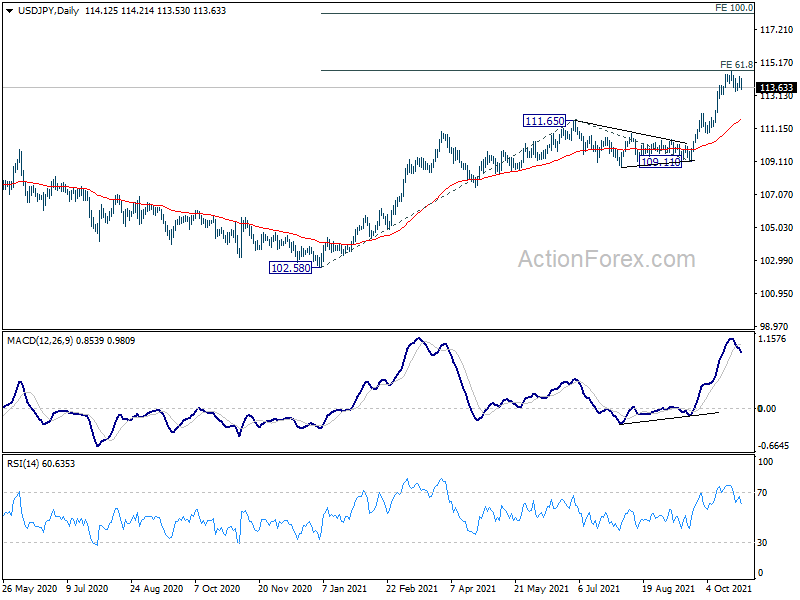
Intraday bias in USD/JPY remains neutral for the moment. Break of 113.40 minor support will bring deeper pull back. But downside should be contained above 112.07 resistance turned support to bring rebound. On the upside, firm break of 114.69 will resume the larger up trend to 100% projection of 102.58 to 111.65 from 109.11 at 118.18 next.
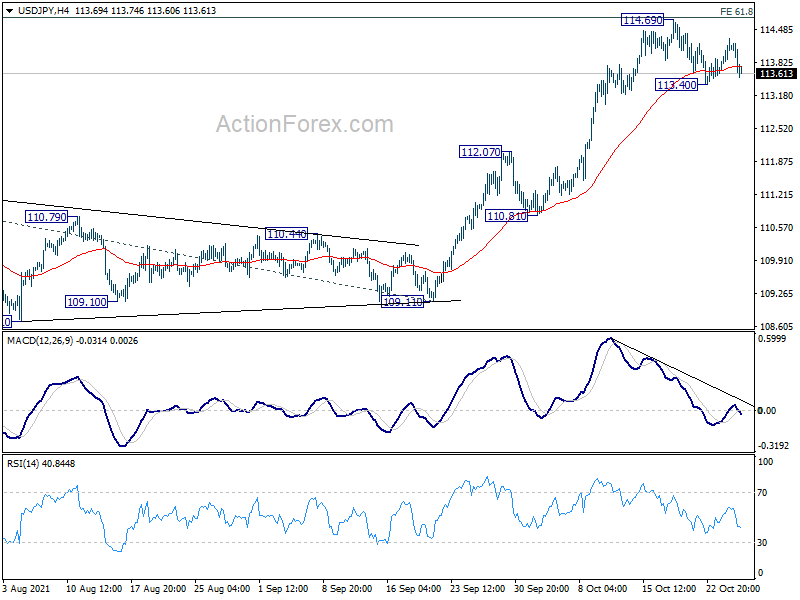
In the bigger picture, corrective decline from 118.65 (2016 high) should have completed at 101.18 already. Rise from the 102.58 is seen as the third leg of the up trend from 101.18. Next target is 114.54 resistance and then 118.65 high. This will now be the preferred case as long as 109.11 support hold, even in case of deep pull back.
Yen Recovers as Markets Extend Corrective Pattern
The forex markets are extending near term corrective moves today, with Yen turning slightly stronger, followed by Swiss Franc. Canadian Dollar and Sterling are the weaker ones, followed by Dollar. The Loonie will look into BoC policy decision for guidance. Meanwhile, broader markets will look at development in overall risk sentiments. European indexes are trading slightly lower but US futures point to high open.
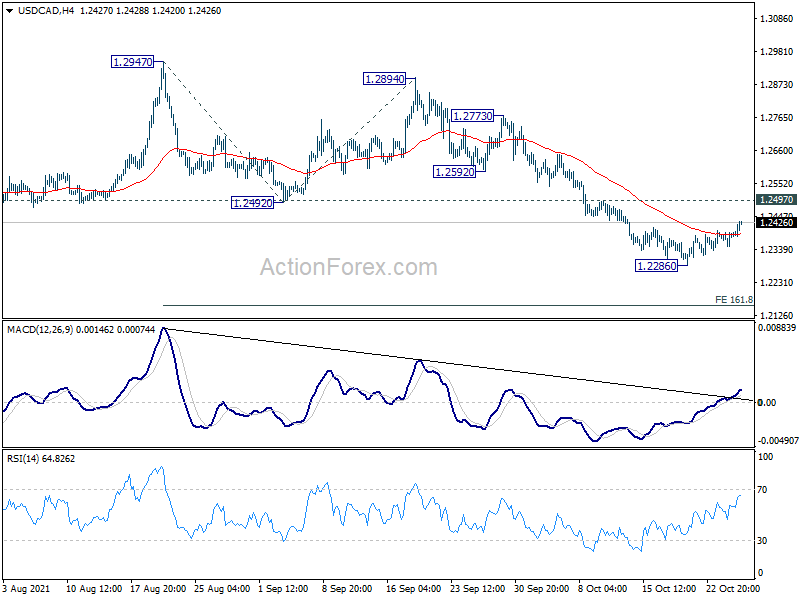
Technically, USD/CAD would be a focus in US session. While recovery from 1.2286 is extending, there is no change in the view that it's just a corrective recovery. As long as 1.2497 resistance holds, larger fall from 1.2947 should still resume, sooner or later, through 1.2286 to 161.8% projection of 1.2947 to 1.2492 from 1.2894 at 1.2158 next. However, break of 1.2497 wall bring even stronger rebound. We'll see which one it goes.
In Europe, at the time of writing, FTSE is down -0.14%. DAX is down -0.35%. CAC is down -0.25%. Germany 10-year yield is down -0.0573 at -0.173. Earlier in Asia, Nikkei dropped -0.03%. Hong Kong HSI dropped -1.57%. China Shanghai SSE dropped -0.98%. Singapore Strait Times rose 0.42%. Japan 10-year JGB yield dropped -0.006 to 0.098.
US durable goods orders dropped -0.4% mom in Sep, ex-transport orders rose 0.4% mom
US durable goods orders dropped -0.4% mom to USD 261.3B in September, better than expectation of -1.1% mom. Ex-transport orders rose 0.4% mom, matched expectations. Ex-defense orders dropped -2.0% mom. Transportation equipment dropped -2.3% to USD 77.7B.
Also released, goods trade deficit came in at USD -93.6B in September, smaller than expectation of USD -88.2B. Goods exports dropped USD -7B to USD 142.2B. Goods imports rose USD 1.1B to USD 238.4B. Wholesale inventories rose 1.1% mom to USD 739.5B. Retail inventories dropped -0.2% mom to USD 602.9B.
Germany downgrades 2021 growth forecast to 2.6%, upgrades 2022 to 4.1%
German government cut 2021 economic growth forecast sharply to just 2.6%, comparing to April's expectation of 3.5%. Economy Minister Peter Altmaier said the downgrade was partly due to supply bottlenecks and rising energy prices, particularly for gas.
Nevertheless, for 2022, growth forecast was upgrade from 3.6% to 4.1%, as the supply bottlenecks ease. Growth is expected to normalize to 1.6% in 2023.
"The precondition is that we stabilize international supply chains, and, for example, make sure that more of the chips are produced that are built into almost every device, especially cars," Altmaier said earlier in an interview with ARD television.
Germany Gfk consumer sentiment rose to 0.9, defying increasing inflation
Germany Gfk consumer sentiment for November rose to 0.9, up from 0.4, above expectation of -0.4. For October, economic expectations dropped from 48.5 to 46.6. Income expectations dropped sharply from 37.4 to 23.3. Propensity to buy rose from 13.4 to 19.4.
"This second increase to consumer sentiment in a row defies increasing inflation. German citizens are clearly expecting further price increases. That is why they consider to make purchases, in order to avoid even higher prices", explains Rolf Bürkl, GfK consumer expert. "If the surge in prices continues, it would put a strain on consumer sentiment and a fundamental recovery would likely be further delayed."
Also released, Eurozone M3 money supply rose 7.4% yoy in September, below expectation of 7.7% yoy. Swiss Credit Suisse economic expectations dropped from 25.7 to 15.6 in October.
Australia trimmed mean and weighted median CPI rose to highest in over 5 yrs
Australia CPI rose 0.8% qoq in Q3, matched expectations. Over the 12-month period, headline CPI slowed from 3.8% yoy to 3.0% yoy. Trimmed mean CPI jumped from 1.6% yoy to 2.1% yoy. Weighted median CPI rose from 1.6% yoy to 2.1% yoy too. Both trimmed mean and weighted mean CPI readings were highest in over five years, and the first annual movements above 2% since September 2015 quarter.
Head of Prices Statistics at the ABS, Michelle Marquardt said the most significant price rises in the September quarter were new dwellings (+3.3 per cent) and automotive fuel (+7.1 per cent).
New Zealand reports record imports and trade deficit in Sep
New Zealand goods exports rose 10% yoy or NZD 387B to NZD 4.4B in September. Goods imports rose 30% yoy or NZD 1.5B to NZD 6.6B. Trade deficit came in at NZD -2.2B, versus expectation of NZD -0.8B. The set of data marked the third successive month of record imports, resulting in a record trade deficit.
Exports to China rose 25%, to Australia dropped -8.4%, to US rose 23%, to EU rose -10%, and to Japan dropped -5.5%. Imports from China rose 48%, from EU rose 29%, from Australia rose 28%, from US dropped -2.1%, from Japan rose 41%.
"These three consecutive record months for imports are a reflection of both the higher prices New Zealanders are paying for consumer goods, and strong demand for capital goods such as machinery used in construction, and passenger vehicles," international trade manager Alasdair Allen said.
New Zealand ANZ business confidence dropped to 13.4 in Oct
New Zealand ANZ Business Confidence was finalized at -13.4 in October, down from September's -7.2. Own Activity Outlook rose from prior month's 18.2 to 21.7. Export intentions rose from 7.4 to 8.6. Investment intentions rose from 9.2 to 13.8. Employment intentions dropped from 14.1 to 10.9. Cost expectations rose from 84.2 to 87.2. Pricing expectations rose from 58.1 to 65.5. Inflation expectations rose further from 3.02 to 3.45.
ANZ said: "Despite living week to week to some extent, firms appear to be getting on with it as best they can. There are clearly challenges, with costs extremely high and profits expected to fall, but more positively, activity expectations, investment intentions and employment intentions are holding up. The COVID situation remains unpredictable, however, and we'll be watching closely for any evidence of that uncertainty derailing plans."
USD/JPY Mid-Day Outlook
Daily Pivots: (S1) 113.79; (P) 114.05; (R1) 114.41; More...
Intraday bias in USD/JPY remains neutral for the moment. Break of 113.40 minor support will bring deeper pull back. But downside should be contained above 112.07 resistance turned support to bring rebound. On the upside, firm break of 114.69 will resume the larger up trend to 100% projection of 102.58 to 111.65 from 109.11 at 118.18 next.
In the bigger picture, corrective decline from 118.65 (2016 high) should have completed at 101.18 already. Rise from the 102.58 is seen as the third leg of the up trend from 101.18. Next target is 114.54 resistance and then 118.65 high. This will now be the preferred case as long as 109.11 support hold, even in case of deep pull back.
Economic Indicators Update
| GMT | Ccy | Events | Actual | Forecast | Previous | Revised |
|---|---|---|---|---|---|---|
| 21:45 | NZD | Trade Balance (NZD) Sep | -2171M | -762M | -2144M | -2139M |
| 23:01 | GBP | BRC Shop Price Index Y/Y Sep | -0.40% | -0.50% | ||
| 00:00 | NZD | ANZ Business Confidence Oct | -13.4 | -8.6 | ||
| 00:30 | AUD | CPI Q/Q Q3 | 0.80% | 0.80% | 0.80% | |
| 00:30 | AUD | CPI Y/Y Q3 | 3.00% | 3.80% | 3.80% | |
| 00:30 | AUD | RBA Trimmed Mean CPI Q/Q Q3 | 0.70% | 0.50% | 0.50% | |
| 00:30 | AUD | RBA Trimmed Mean CPI Y/Y Q3 | 2.10% | 1.60% | 1.60% | |
| 06:00 | EUR | Germany Gfk Consumer Confidence Nov | 0.9 | -0.4 | 0.3 | 0.4 |
| 08:00 | CHF | Credit Suisse Economic Expectations Oct | 15.6 | 25.7 | ||
| 08:00 | EUR | Eurozone M3 Money Supply Y/Y Sep | 7.40% | 7.70% | 7.90% | |
| 12:30 | USD | Durable Goods Orders Sep | -0.40% | -1.10% | 1.80% | |
| 12:30 | USD | Durable Goods Orders ex Transportation Sep | 0.40% | 0.40% | 0.30% | |
| 12:30 | USD | Goods Trade Balance (USD) Sep P | -96.3B | -88.2B | -87.6B | |
| 12:30 | USD | Wholesale Inventories Sep P | 1.10% | 1.00% | 1.20% | |
| 14:00 | CAD | BoC Interest Rate Decision | 0.25% | 0.25% | ||
| 14:30 | USD | Crude Oil Inventories | 2.0M | -0.4M | ||
| 15:00 | CAD | BoC Press Conference |
US durable goods orders dropped -0.4% mom in Sep, ex-transport orders rose 0.4% mom
US durable goods orders dropped -0.4% mom to USD 261.3B in September, better than expectation of -1.1% mom. Ex-transport orders rose 0.4% mom, matched expectations. Ex-defense orders dropped -2.0% mom. Transportation equipment dropped -2.3% to USD 77.7B.
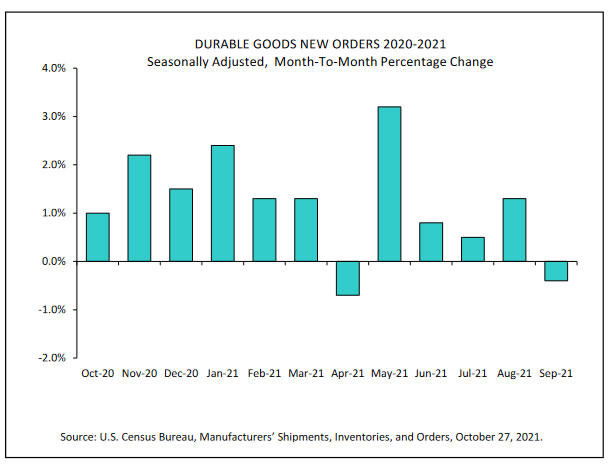
Also released, goods trade deficit came in at USD -93.6B in September, smaller than expectation of USD -88.2B. Goods exports dropped USD -7B to USD 142.2B. Goods imports rose USD 1.1B to USD 238.4B. Wholesale inventories rose 1.1% mom to USD 739.5B. Retail inventories dropped -0.2% mom to USD 602.9B.
Aussie Steady After CPI
The Australian dollar is trading sideways a the pair continues to hover close to the symbolic 75 level. AUD/USD is currently trading at 0.7498, up 0.03% on the day.
Australia Core CPI higher than expected
Australian inflation for the third quarter hasn’t had much of an impact on the Australian dollar but did give the markets plenty to chew on. Headline CPI rose 0.8%, matching expectations. The annual rate of headline inflation came in at 3.0%, vs. expectations of 3.1% and down from the Q2 gain of 3.7%. What was of more interest was Core CPI, which was higher than expected. The annual rate came in at 2.1%, vs. expectations of 1.8%, and on a quarterly basis, the 0.7% print beat the estimate of 0.5%. This means that core inflation has crept back into the RBA’s 2-3% inflation band for the first time since 2015.
This will invariably raise speculation about the RBA raising rates in response to high inflation, but this may be wishful thinking. The RBA has previously stated that it will not hike rates before inflation is “sustainably” within its target band, and one high core CPI reading as such doesn’t appear to qualify. There is a wide discrepancy between the RBA’s stance that rate hikes will not occur prior to 2024, and the market perception that the central bank could raise rates in 2023. The RBA holds a policy meeting on November 2, and it will be interesting to see if the bank shifts from its dovish stance.
In the meantime, Australian front-end yields have moved higher, which has helped the Aussie push into 75-territory. A hawkish tone from the RBA at next week’s meeting could give a boost to the Australian dollar.
AUD/USD Technical
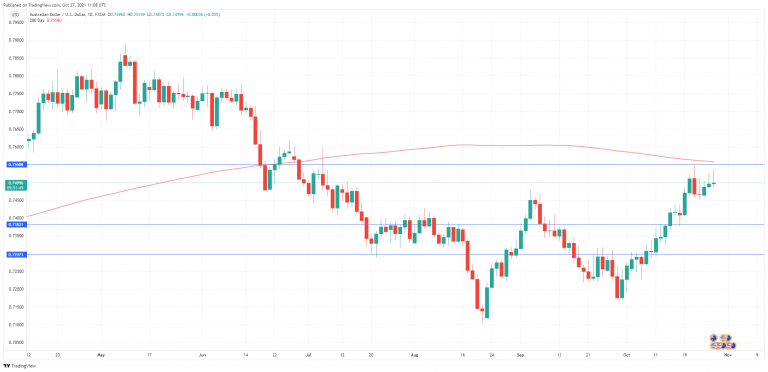
- There is resistance at 0.7532, followed by the 200-SMA at 0.7560. Above, there is resistance at 0.7624
- We find support at 0.7382 and 0.7297
Gold Eases After Failing To Hold Gains Above $1800, Weighed By Expectations For Start Of Reducing Stimulus And Rate...
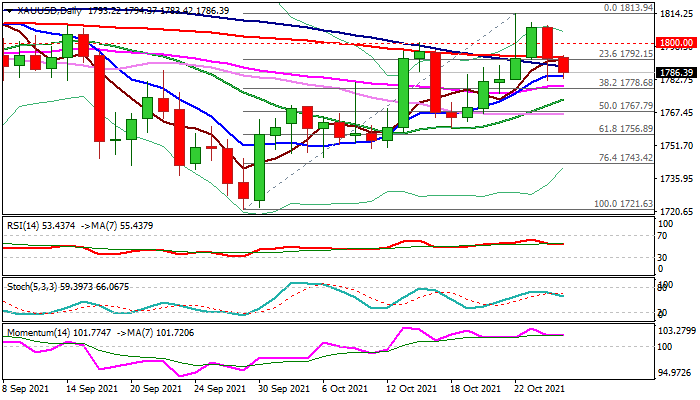
Spot Gold eases after repeated failure to sustain gains above psychological $1800 barrier, with rising expectations that the US Federal Reserve could finally announce the start of reducing stimulus in its Nov 3 policy meeting and market participants operating with information about higher probability of rate hikes in 2022.
Reduced stimulus and higher interest rates are usually negative factors for the yellow metal, with short-term outlook also turning negative on ongoing risk-on environment.
Technical studies are weakening on daily chart, as the price returned below 200-day moving average and stochastic heading south after diverged from rising price earlier.
Pivotal supports lay at $1781 (top of thinning daily Ichimoku cloud) and $1778 (Fibonacci 38.2% retracement of $1721/$1813 bull-leg), break of which would generate reversal signal and open way for extension towards next strong supports at $1760/56 (Oct 18 higher low / Fibonacci 61.8% retracement of $1721/$1813) and a higher base at $1750 zone.
Repeated weekly close below $1800 would add to negative signals, but the metal is on track for positive monthly performance after 3% drop in September.
Res: 1793, 1800, 1813, 1834
Sup: 1781, 1778, 1767, 1760
USD/JPY Returns Back Below 114.00
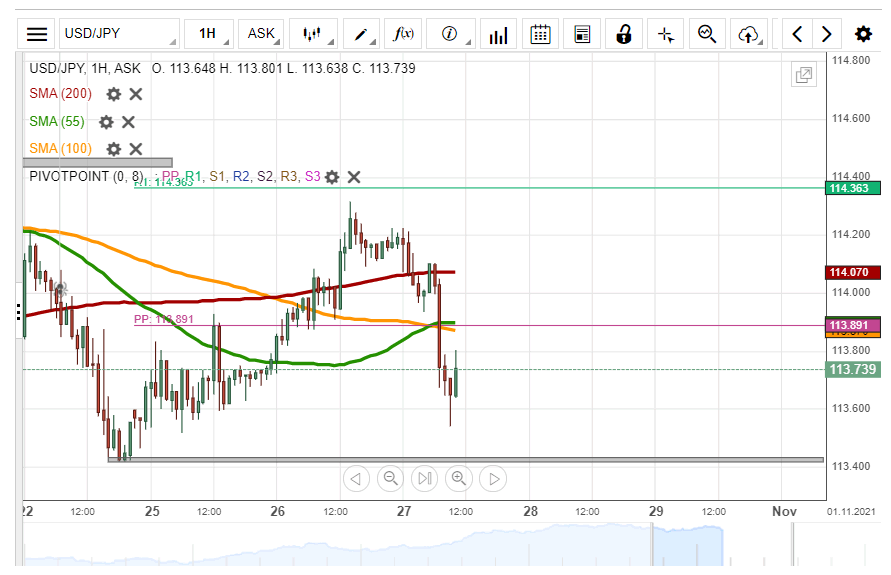
The recovery of the USD/JPY ended at the 114.30 level. The USD/JPY did not reach the resistance of the weekly R1 simple pivot point at 114.36, and started a decline. By the middle of Wednesday's European trading hours, the currency exchange rate had reached the 113.55 level.
A continuation of the decline of the USD/JPY pair might reach the last week's low level at 113.42. The rate found support in this level on Friday, which was followed by the recovery to 114.30.
However, another recovery of the rate would have to face the combined resistance of the 55 and 100-hour simple moving averages and the weekly simple pivot point at near 113.90.
GBP/USD Plummets On Wednesday
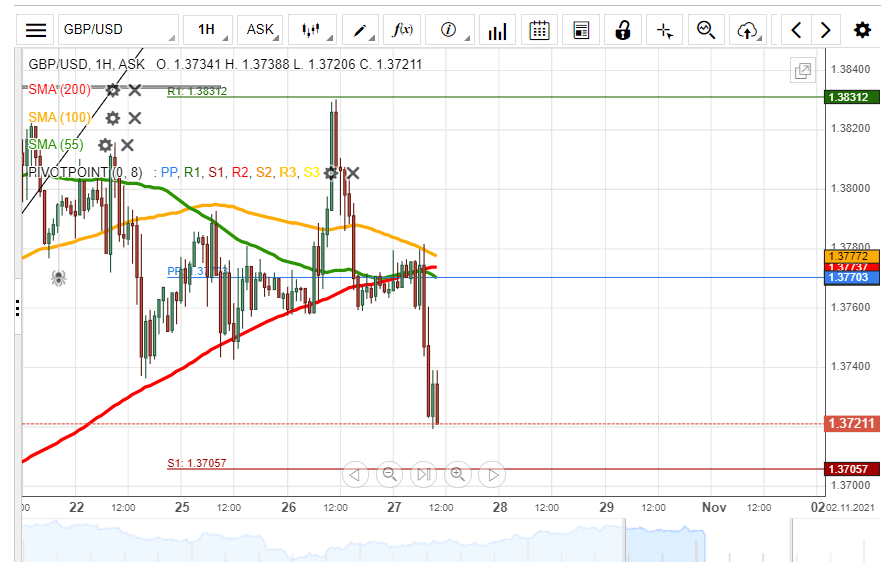
On Tuesday, the GBP/USD currency exchange rate bounced off the resistance of the weekly R1 simple pivot point and the 1.3830 mark. The following decline reached the 200-hour simple moving average near 1.3760 and began to trade around the moving average.
However, on Wednesday morning, the 100-hour simple moving average provided resistance at 1.3780. The event resulted in a sharp move down to the 1.3720 level.
In the case that the decline of the GBP/USD continues, the rate might look for support in the weekly S1 simple pivot point at 1.3706. Immediately below the pivot point, the 1.3700 mark could provide support.
On the other hand, a recovery of the pair would most likely encounter resistance in the combination of the 55, 100 and 200-hour simple moving averages and the weekly simple pivot point at 1.3770/1.3775.
EUR/USD Is Pushed Down By SMA
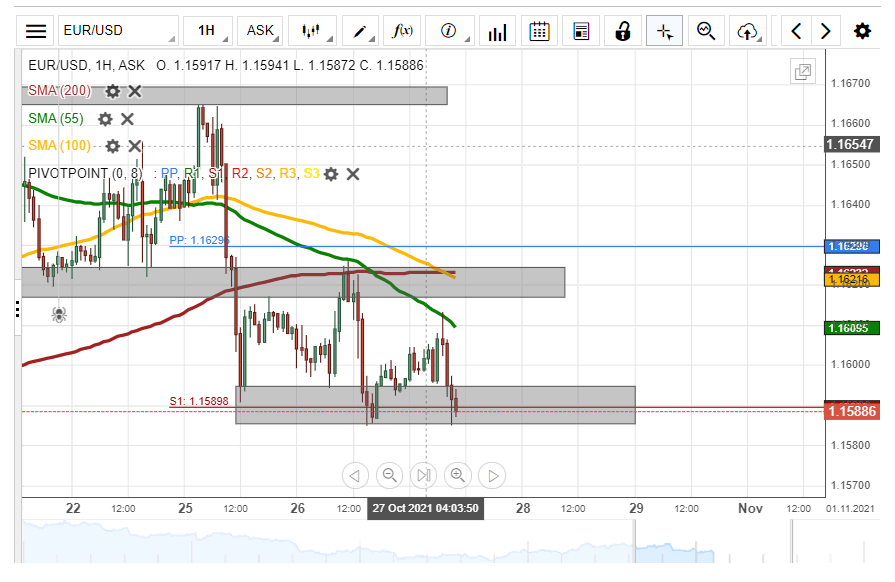
Since Monday, the EUR/USD has been testing the support of the 1.1585/1.1595 zone. In the meantime, it was spotted that on Tuesday and Wednesday the currency exchange rate failed to recover due to the resistance of the 55-hour simple moving averages.
If the 55-hour simple moving average continues to push the pair down, it could pass the support of the 1.1585/1.1595 zone. A potential decline might look for support in the weekly S2 simple pivot point at 1.1532. However, note that the 1.1550 mark might slow down a drop of the EUR/USD.
Meanwhile, a recovery and breaking of the resistance of the 55-hour SMA would encounter resistance in the 1.1615/1.1625 zone and the 100 and 200-hour simple moving averages, which have moved into the zone.
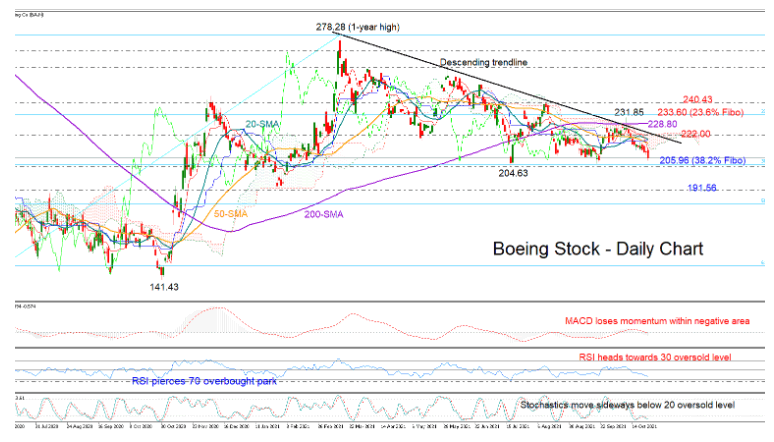
Boeing’s Stock Nears Key Support Ahead Of Q3 Earnings
Boeing's stock price has been on the sidelines since the peak to a one-year high of 278.28 in March, remaining trapped below the strong ascending trendline for another month and far below its pre-pandemic levels.
The American aircraft designer will publish its Q3 earnings results today before the market open, but the technical picture is currently providing little hope for any significant progress. The MACD seems to have started a new bearish cycle in the negative area, while the RSI is strengthening its negative momentum towards its 30 oversold mark as the Stochastics look indecisive below their 20 oversold level.
Despite the discouraging signals, the nearby key support of the 204.63 area will be closely watched for any bullish spikes. This is where the price sharply rebounded in mid-July, and the presence of the 38.2% Fibonacci retracement of the 2020 upleg in the neighborhood is adding further importance to the region. Should the bears clear that floor, the sell-off could extend towards January's low of 191.56.
Otherwise, a bounce off the 204.63 bar would shift the spotlight back to the descending trendline seen around 222.00 and near the surface of the Ichimoku cloud. A clear break higher from here could face immediate resistance around the 200-day simple moving average (SMA) at 229.80, while not far above, the 23.6% Fibonacci of 233.60 may prevent any moves towards the August high of 240.43.
Summarizing, Boeing's neutral outlook remains unchanged in the short- and medium-term. A break above 222.63 or below 204.63 could direct the market accordingly.