Sample Category Title
German PPI Hits 40-Year High
Notes/Observations
- German Sept PPI data hits 40-year high.
- European bond yield showing signs of stabilization ahead of the ECB policy meeting on Thursday.
- UK budget speech in focus later this morning.
- Australia bond yield spike 20bps higher after core CPI moved back into RBA target range for 1st time in 6 years.
- Companies due to report during the NY morning include ADP, Amphenol, Avery Dennison, Boeing, Brink’s , Bunge, Bristol-Myers, Boston Scientific, CME, GM, Garmin, Hess Corp, Hilton Worldwide, Harley Davidson, International Paper, Kraft Heinz, Coca-Cola, McDonald’s, Norfolk Southern, Old Dominion Freight Line, Penske Auto, Ryder System, Silicon Labs, Silgan Holdings, Spotify, TE Connectivity, Teva, Thermo Fisher.
Asia
- Australia Q3 CPI Q/Q: 0.8% v 0.8%e; Y/Y: 3.0% v 3.1%e (Trimmed mean inflation move back into RBA Target range for the first time since Q4 2015).
- China Sept Industrial Profits Y/Y: 16.3% v 10.1% prior.
- New Zealand Sept Trade Balance registered a record deficit (NZ$): -2.2B v -2.1B prior.
Europe
- UK Oct BRC Shop Price Index Y/Y: -0.4% v -0.5% prior; BRC chief exec Dickinson noted that was now clear that the increased costs from labour shortages, supply chain issues and rising commodity prices had started filtering through to the consumer.
- UK Chancellor of the Exchequer Sunak (Fin Min) budget speech to use up to £30B coming from faster economic growth to pay for investments in public services and reduce borrowing. To declare Britain could start to look beyond Covid to an economy fit for a new age of optimism.
Americas
- Congressional Democrats said to disagree on multiple major issues on President Biden’s spending Bill which was reducing odds of getting a quick vote.
- Sen Maj Leader Schumer stated that was on track to get economic agenda measure done; 3-4 issues left to solve on Pres Biden's economic bill.
- Senator Manchin (D-WV) said to be undecided on the Billionaire's Tax. Against IRS reporting proposal.
Energy
- Weekly API Crude Oil Inventories: +2.3M v +3.3M prior (4th straight weekly build).
Speakers/Fixed income/FX/Commodities/Erratum
Equities
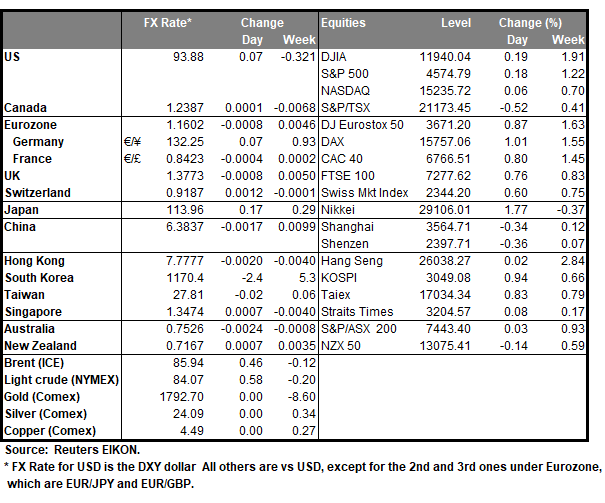
- Indices [Stoxx600 -0.46% at 473.56, FTSE -0.34% at 7,252.80, DAX -0.47% at 15,683.35, CAC-40 -0.38% at 6,740.75, IBEX-35 -0.73% at 8,935.50, FTSE MIB -0.60% at 26,809.00, SMI -0.42% at 12,095.50, S&P 500 Futures -0.15%].
- Market Focal Points/Key Themes: European indices open marginally lower and slipped further into the red as the session progressed; health care and utilities sectors among the better performers; while consumer discretionary and industrials sectors among those leading to the downside; Wacker Chemie takes stake in SICO; earnings expected during upcoming US session include Spotify, Coca-Cola, GlaxoSmithKline and McDonald’s.
Equities
- Consumer discretionary: Puma [PUM.DE] +2.5% (earnings), Electrolux AB [ELUXB.SE] +1% (earnings), Heineken [HEIA.NL] -1.5% (trading update).
- Energy: Equinor ASA [EQNR.NO] -3% (earnings; buyback).
- Financials: Deutsche Bank [DBK.DE] -5% (earnings), Santander [SAN.ES] -2.5% (earnings).
- Industrials: BASF [BAS.DE] -1% (earnings; raises outlook).
- Utilities: Iberdrola [IBE.ES] +1% (earnings).
Speakers
- Swiss govt noted that the SNB viewed CHF currency (franc)as 'highly valued' and stressed the need for easy monetary policy.
- German Economy Ministry formally updated its economic outlook. Cut 2021 GDP growth forecasts from 3.5% to 2.6% while raising 2022 GDP growth forecast from 3.6% to 4.1%.
- German Econ Min Altmaier noted that growth was being hampered by supply bottlenecks but saw the economy back at pre-pandemic growth by Q1 2022.
- Turkey President Erdogan stated that he did not compromise on issue about 10 envoys (**Note: threaten to expel Western ambassadors). To discuss F-35 aircraft purchase with Preidebnt Biden at COP26 in Glasgow..
- Thailand Central Bank said to extend corporate bond stabilization fund’s support by one year to end-2022 to maintain market liquidity amid high uncertainty of the Covid-19 outbreak..
- Thailand Fin Min Arkhom stated that expected 2021 GDP growth over 1.0%.
- China Foreign Ministry spokesman Zhao Lijian stated that recent comments by Sec of State Blinken on Taiwan violates “one China”understanding between two sides; recent US actions could bring huge risks.
- China said to agree on plan to cap key coal price at CNY440/ton to help ease energy crisis.
Currencies/Fixed Income
- Focus on upcoming rate decision (BOJ and ECB in the next 24 hours and plethora of Q3 GDP data (including US and Germany).
- USD was mixed in trading on Wed. Dealers were focus on Thursday’s release of US GDP data and its potential to disappoint markets.
- EUR/USD steady at 1.16 area with focus on Thursday’s ECB decision. Markets currently pricing an almost 10 basis-point interest-rate rise by the ECB before the end of 2022. Recent inflation data continued to be hot with Germany’s Sept PPI reading hitting a 40-year high.
- AUD currency steady despite the sharp rise in Australia bond yield after core CPI moved back into RBA target range for 1st time in 6 years.
Economic data
- (FI) Finland Oct Consumer Confidence: 2.7 v 6.0 prior; Business Confidence: 22 v 21 prior.
- (DK) Germany Nov GfK Consumer Confidence: +0.9 v -0.5e (2nd straight positive reading).
- (DE) Germany Sept Import Price Index M/M: 1.3% v 1.5%e; Y/Y: 17.7% v 17.9%e (highest annual pace since August 1981).
- (DK) Denmark Sept Retail Sales M/M: -1.1% v -0.9% prior; Y/Y: 3.1% v 3.8% prior.
- (FR) France Oct Consumer Confidence: 99 v 101e.
- (FR) France Sept PPI M/M: 1.7% v 1.0% prior; Y/Y: 11.6% v 10.0% prior.
- (ES) Spain Aug Total Mortgage Lending Y/Y: 48.3% v 5.7% prior; House Mortgage Approvals Y/Y: 66.9% v 36.8% prior.
- (TR) Turkey Sept Trade Balance: -$2.6B v -$2.6Be.
- (TR) Turkey Oct Economic Confidence: 101.4 v 102.4 prior.
- (SE) Sweden Sept Trade Balance (SEK): +6.3B v -10.5B prior.
- (SE) Sweden Sept Household Lending Y/Y: 6.5% v 6.4% prior.
- (EU) Euro Zone Sept M3 Money Supply Y/Y: 7.4% v 7.4%e.
- (AT) Austria Oct Manufacturing PMI: 60.6 v 62.8 prior (16th straight expansion).
- (CH) Swiss Oct Expectations Survey: 15.6 v 25.7 prior.
- (TW) Taiwan Sept Monitoring Indicator: 38 v 39 prior.
- (IS) Iceland Oct CPI M/M: 0.6% v 0.5% prior; Y/Y: 4.5% v 4.4% prior.
Fixed income Issuance
- (IN) India sold total INR200B vs. INR200B indicated in 3-month, 6-month and 12-month bills.
- (IT) Italy Debt Agency (Tesoro) sold €6.0B vs. €6.0B indicated in 6-month Bills; Avg Yield: -0.550% v -0.545% prior; Bid-to-cover: 1.27x v 1.29x prior.
- (NO) Norway sold NOK vs. NOK2.0B indicated in 1.75% Mar 2025 Bonds; Avg Yield: 1.45% v 1.02% prior; bid-to-cover: 4.01x v 3.90x prior.
- (SE) Sweden sold SEK7.5B vs. SEK7.5B indicated in 3-month bills; Avg Yield: -0.3875% v -0.3985% prior; bid-to-cover: 1.75x v 1.84x.
Looking ahead
- (DE) German Economy Ministry to update economic outlook.
- (PT) Portugal Debt Agency (IGCP) Switch auction results to hold reverse auction.
- 05:25 (EU) Daily ECB Liquidity Stats.
- 05:30 (DE) Germany to sell €2.0B in 0% May 2036 Bunds.
- 05:30 (HU) Hungary Debt Agency (AKK).
- 05:30 (EU) ECB allotment in its Monthly 3-month LTRO operation.
- 05:30 (ZA) South Africa announces details of next bond auction (held on Tuesdays).
- 06:00 (FR) France Q3 Total Jobseekers: No est v 3.511M prior.
- 06:00 (RU) Russia to sell RUB10B in Mar 2032 inflation-linked OFZ Bonds.
- 06:45 (US) Daily Libor Fixing.
- 07:00 (US) MBA Mortgage Applications w/e Oct 22nd: No est v -6.3% prior.
- 07:00 (MX) Mexico Sept Trade Balance: -$2.6Be v -$3.9B prior.
- 07:00 (UK) Weekly PM Question time in House.
- 07:30 (UK) Chancellor of the Exchequer (Fin Min) Sunak budget speech.
- 08:00 (BR) Brazil Aug National Unemployment Rate: 13.4%e v 13.7% prior.
- 08:00 (BR) Brazil Sept PPI Manufacturing M/M: No est v 1.9% prior; Y/Y: No est v 30.2% prior.
- 08:00 (UK) Daily Baltic Dry Bulk Index.
- 08:30 (US) Sept Preliminary Durable Goods Orders: -1.0%e v +1.8% prior; Durables (ex-transportation): 0.4%e v 0.3% prior; Capital Goods Orders (non-defense/ex-aircraft): 0.5%e v 0.6% prior; Capital Goods Shipments (non-defense/ex-aircraft): 0.5%e v 0.8% prior.
- 08:30 (US) Sept Advance Goods Trade Balance: -$88.4Be v -$87.6B prior.
- 08:30 (US) Sept Preliminary Wholesale Inventories M/M: 1.0%e v 1.2% prior; Retail Inventories M/M: 0.2%e v 0.1% prior.
- 09:45 (UK) BOE to buy £1.147B in APF Gilt purchase operation (7-20 years).
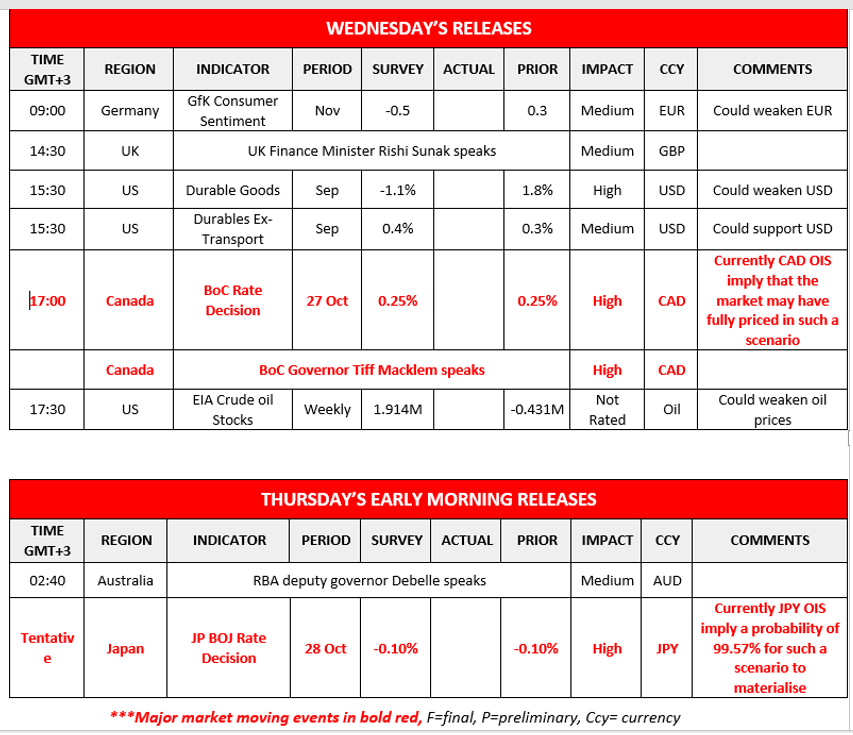
- 10:00 (CA) Bank of Canada (BOC) Interest Rate Decision: Expected to leave Interest Rates unchanged at 0.25%.
- 10:30 (US) Weekly DOE Oil Inventories.
- 12:00 (RU) Russia Sept Industrial Production Y/Y: 4.6%e v 4.7% prior.
- 13:00 (US) Treasury to sell 2-Year FRN.
- 13:00 (US) Treasury to sell 5-Year Notes.
- 13:30 (BR) Brazil Sept Total Federal Debt (BRL): No est v 5.481T prior.
- 17:30 (BR) Brazil Central Bank (BCB) Interest Rate Decision: Expected to raise Selic Target Rate by 150bps to 7.75%.
- 19:50 (JP) Japan Sept Retail Sales M/M: +1.5%e v -4.0% prior (revised from -4.1%); Y/Y: -2.4%e v -3.2% prior.
- 19:50 (JP) Japan Sept Dept. Store, Supermarket Sales Y/Y: -3.3%e v -4.7% prior.
- 20:30 (AU) Australia Q3 Import Price Index Q/Q: 3.4%e v 1.9% prior; Export Price Index Q/Q: 6.5%e v 13.2% prior.
- (JP) BOJ Interest Rate and Policy Decision (no set time); Expected to leave Interest On Excess Resereves (IOER) unchanged at -0.10% and maintain Yield Control Target (YCC) at 0.00%.
- (JP) BOJ Quarterly Outlook for Economic Activity and Prices.
Bank Of Canada Showtime, US Spending Deal In Sight
- BoC rate decision today could spark fireworks in the loonie
- Yen awaits BoJ meeting, aussie in focus after inflation stats
- Earnings season fires up but all eyes on Capitol Hill
BoC to validate market pricing?
The main event today will be the Bank of Canada decision at 14:00 GMT, which will likely spark fireworks in the loonie as policymakers either validate market expectations for an aggressive rate hike cycle or tone them down. Money markets are pricing in almost four rate increases for next year because the Canadian economy is roaring.
Growth has come back online, inflation is sizzling hot, businesses are feeling optimistic, the housing market is on fire, and oil prices are going through the roof. Best of all, the labor market has already recovered all the jobs lost after the crisis, so wage growth could fire up soon to keep inflation dynamics rolling.
Hence, another reduction in weekly asset purchases today seems almost certain. The question is whether the central bank will also recalibrate its forward guidance to signal the hiking cycle could begin earlier. Admittedly, with the economy firing on all cylinders, the BoC may not have much of a choice, even though it doesn’t want to get too far ahead of the Fed. A hawkish message could reactivate the loonie’s uptrend.
BoJ coming up, FX market quiet
Yen weakness emerged as the dominant FX theme yesterday but the currency has recouped all its losses already, capitalizing on the slow grind lower in global yields. The BoJ will wrap up its own meeting early on Thursday. Not much is expected. The economy has barely escaped deflation despite the inflationary shockwave in the rest of the world and the growth outlook is bleak.
Since the BoJ has essentially exhausted all its ammunition and without any expectations for normalization, the yen doesn’t react to policy decisions anymore. While the beatdown in the Japanese currency has taken a breather for now, the trend still seems negative with stock markets going into overdrive and the Bank of Japan not expected to join the global normalization party.
Elsewhere, Australian core inflation was a little hotter than expected in Q3, adding fuel to bets the Reserve Bank will raise rates next year already. Investors now seem to be playing a game of chicken with the RBA.
The central bank insists rates won’t rise until 2024 but money markets are pricing in three rate increases for next year alone. That seems way too aggressive, leaving ample scope for disappointment in the aussie, especially with China battling its own economic slowdown and iron ore prices in the gutter.
Earnings and politics in the spotlight
Sterling will also receive its fair share of attention today when UK Chancellor Sunak unveils his latest budget. Many investment and spending initiatives have already been announced, but the elusive question is whether the budget as a whole will be stimulatory or whether spending will be dialed back further.
In the stock market, the S&P 500 reached another record yesterday even though the index surrendered most of its gains late in the session. The earnings season will kick into full gear today with Coca Cola, Ford, McDonalds, and Boeing releasing their quarterly results.
Yet the most crucial element for this options-driven market could be whether the Democrats finally strike a deal on social spending. The party’s leadership suggests a compromise is imminent and if the plan doesn’t include higher corporate taxes after all, this could serve as jet fuel for equity markets.
But that doesn’t mean investors should throw caution into the wind. There are several risks markets are happy to ignore for now, from unresolved supply constraints to liquidity being withdrawn to the fact that inflation expectations just won’t stop rallying as traders search for inflation hedges.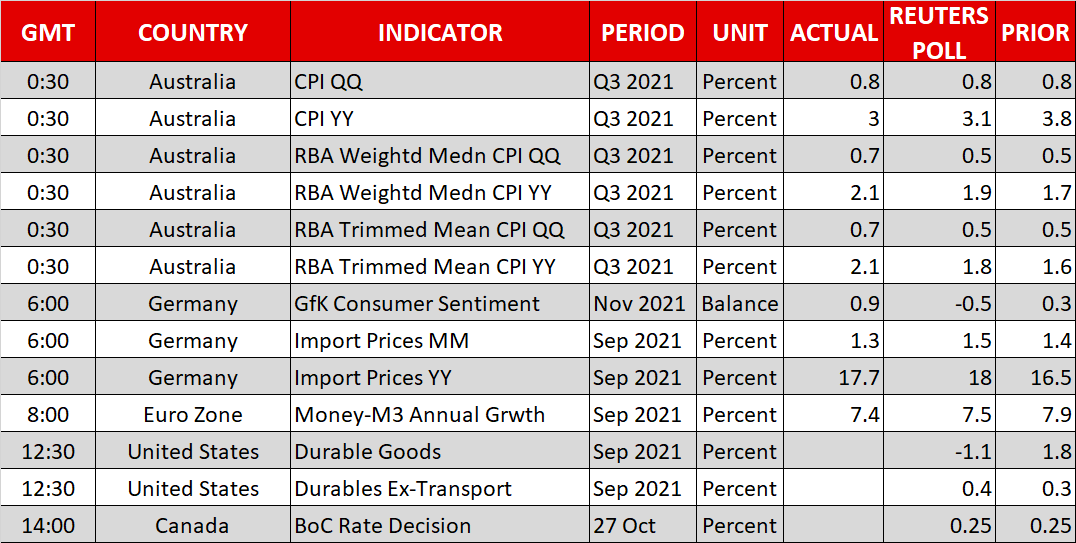
NZDUSD Gains At Risk As Sellers Push Back
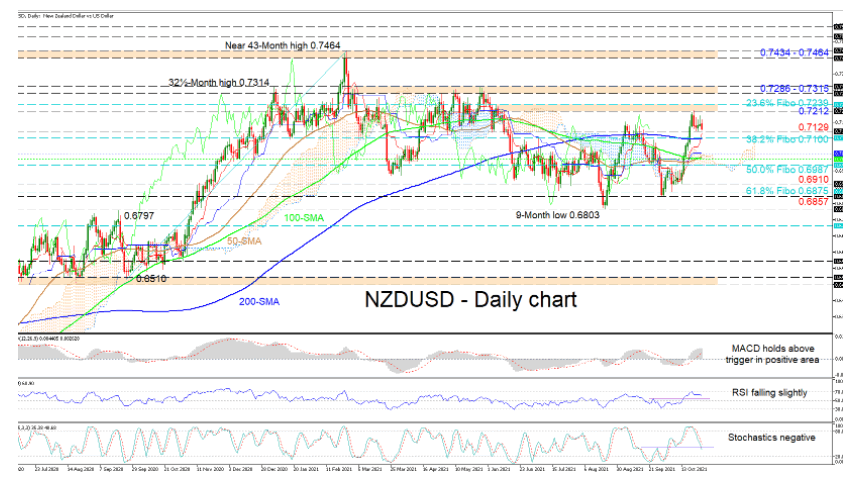
NZDUSD buyers have re-emerged after the minor price retreat but attempts to limit sellers’ ruling power are looking to have been in vain. As of late, the trendless simple moving averages (SMAs) are proposing a more neutral bearing in the pair.
The Ichimoku lines are reflecting the fresh rally and are indicating a pause in positive momentum, while the short-term oscillators are transmitting conflicting messages of directional impetus. The MACD, north of the zero threshold, is keeping above its red trigger line, while the RSI is looking to fall further in bullish territory. Moreover, the stochastic oscillator is promoting the price pullback in the pair as its negative charge is showing no signs of abating.
In the negative scenario, initial downside friction could develop in the area amongst the 0.7129 obstacle and the 0.7100 handle, that being the 38.2% Fibonacci retracement of the up leg from 0.6510 until 0.7464. If the pair dips past the 200-day SMA, a sturdy support zone may arise in the vicinity of the blue Kijun-sen line at 0.7035 until the 50.0% Fibo of 0.6987. Sinking beneath this buffer zone and beyond the 0.6910 low, the bears could then tackle the region between the 61.8% Fibo of 0.6875 and the 0.6857 trough.
If buying interest increases, preliminary upside constraints could manifest from the 0.7212 level until the 23.6% Fibo of 0.7239. Successfully breaching this, the 0.7286-0.7315 area of highs could try to deny further progress in the pair. However, if the bulls are triumphant, they may aim for the 0.7434-0.7464 section, moulded between the rally peaks of January 2017, January and February 2018 and the near 43-month high in February of this year.
Summarizing, NZDUSD is exhibiting a neutral-to-bullish tone as its recent rally is persisting above the SMAs. Furthermore, to decisively repower negative tendencies, the price would need to close below the 9-month low of 0.6803, while a jump above 0.7315 could fuel buyers’ confidence.
Oil Moving Sideways, Gold Drops Below 1800
Oil consolidation continues
Oil prices continue to move sideways, despite some decent intra-day volatility. In the bigger picture though, both Brent and WTI continue consolidating near the top of their recent ranges thanks to favourable supply/demand characteristics in both the physical oil market and firm natural gas and coal prices.
Brent crude finished the overnight session 0.10% higher at USD 86.10, while WTI rose 0.73% to USD 84.35 a barrel after US API Crude Inventories rose by less than last week. In Asia, both contracts have edged 0.35% lower to USD 85.90 and USD 84.05 a barrel.
Tonight's official US Crude Inventory data looms as the next volatility point with stocks expected to rise by 1.9 million barrels. Attention will be focused on gasoline and distillate inventories as well, and sharp drops similar to last week could boost oil prices once again. Similarly, if stocks at the Cushing hub drop further, nerves over supply issues will increase as we head into the colder northern hemisphere months.
The technical picture still has the respective relative strength indexes in modest overnight territory which means a sharp correction lower to flush out speculative longs cannot be ruled out. However, as previously noted, I expect any sudden fall to be met with an equally fast rally. Brent crude has resistance at USD 86.70 and WTI at USD 85.40 a barrel. Trendline support at USD 83.90 and USD 80.65 a barrel respectively and should be the limit for any downside correction. Only a daily close below those levels suggest a deeper correction is possible.
Gold's retreat
Gold fell from above USD 1800.00 an ounce overnight, finishing the session 0.83% lower at USD 1792.00 an ounce. In Asia, its retreat continued as it falls 0.20% to USD 1789.15 an ounce, moving it back below the 100 and 200-day moving averages at USD 1789.20 and USD 1793.40 an ounce.
The price action is somewhat disappointing, and it appears that gold is struggling to maintain gains above USD 1800.00. It appears that despite longer-dated yields easing in the US, the rise of the short-dated yields and the flattening of the US yield curve is weighing on gold, as is the US dollar's quiet, but firm strength this week. Notably, gold's fellow supposed inflation-hedge, bitcoin, appears to be suffering a similar fate.
Investors may well be turning their attention to next week's FOMC meeting now and looking past earnings. It is almost certain that a start to the Fed taper will be announced, and I do not believe this has been remotely fully priced by markets. US yields should start to move higher once again, as will the greenback. In this environment, gold will struggle to hold near USD 1800.00. A move above USD 1835.00 would be a powerful bullish technical signal, but my base case is that gold's retreat resumes into next week.
Gold now has resistance ahead of USD 1795.00 and again at USD 1813.50 an ounce, its recent highs. Trendline support, a very nice line extending back to its USD 1720.00 low in late September, is now nearby at USD 1882.50 an ounce. Failure of USD 1780.00 therefore, likely signals deeper losses targeting USD 1750.00 in the first instance.
The US Dollar Maintains Its Gains
US yields, oil supporting dollar
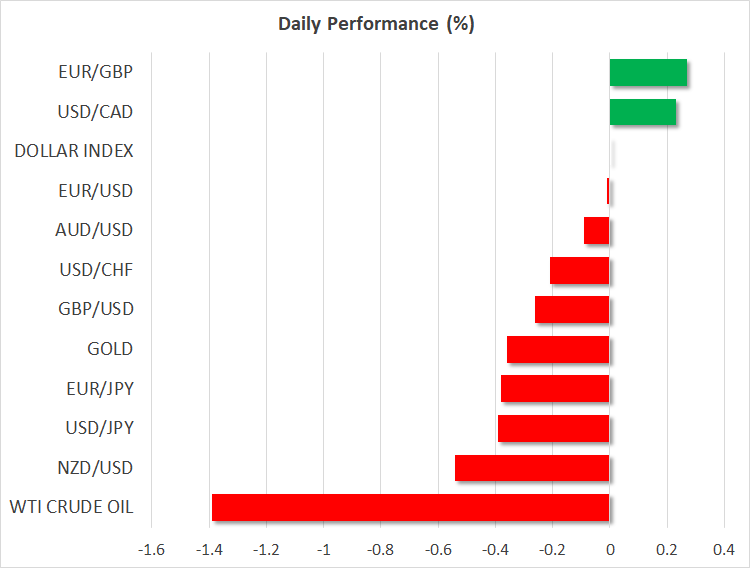
Although long-dated US yields have eased slightly this week, short-dated ones continue rising. This flattening of the yield curve, along with high energy prices, appears to be continuing to support the US dollar versus the G-7 currencies. The dollar index maintained its gains overnight, finishing 0.15% higher at 93.96.
EUR/USD held steady at 1.1600, as did GBP/USD at 1.3770, while USD/JPY rose 0.40% to 114.15 before exporter selling saw it fall back to 114.00 in Asia this morning. A dovish ECB tomorrow likely sees the EUR/USD sell-off recommence targeting 1.1500 initially. GBP/USD will be at the mercy of the UK budget this afternoon while USD/JPY is befitting from the flattening of the US yield curve. A hawkish FOMC next week could see it rise to 116.00.
Elsewhere, the commodity currencies continue to maintain gains thanks to positive risk sentiment from the US earnings season and firm resource prices. Momentum appears to be stalling in USD/CAD and NZD/USD though with a rise through 1.2410 in USD/CAD potentially triggering a short squeeze. Likewise, a fall by NZD/USD through 0.7130 will signal a temporary end to the kiwi rally. AUD/USD remains constructive thanks to rising inflation and RBA expectations, with a rise through 0.7550 signalling more gains potentially reaching 0.7700.
Asian currencies remain near the higher end of their recent ranges, thanks to a neutral PBOC and a rise in investor sentiment over the past week. Once again though, momentum seems to be stalling. It looks like the Asian currency space is now moving to wait-and-see mode ahead of next week’s FOMC.
North Asia Woes See The Usual ASEAN Pivot
US earnings jump but equities yawn
US equities eked out tiny gains overnight despite excellent results from heavyweights such as Microsoft, and Alphabet after-hours. All three major indexes closed out at record or near-record highs, but it increasingly seems that markets have priced in so much good news expectations on the earnings from, that stocks are struggling for further upward momentum. That said, the lack of downside earnings shocks means that equities are not inclined to rush for the exit door either.
In this context, Apple’s earnings call today will be vital. With markets running on vapours, an expected excellent result should keep the status quo with US markets. However, if Apple was to show supply chain stresses and challenges in future sales because of that, it could be the catalyst for a downside correction. Investors may well be begrudgingly starting to ponder the full implications of next week’s FOMC meeting and the start of the taper.
Overnight, the S&P 500 limped to a 0.18% gain, while the Nasdaq edged 0.06% higher, and the Dow Jones produced a minuscule 0.04% rise. In Asia, the negative headlines seeping out of China are also weighing on US futures in Asia for the first time this week, also indicating waning bullish momentum. All three are slightly in the red despite the impressive after-hours Alphabet release.
In Asia, the fast-money FOMO market of Japan has corrected lower this morning after a banner session yesterday. The Nikkei 225 has fallen 0.60% with South Korea’s Kospi falling 0.75%. Mainland China has headed directly south today as that stream of negative headlines has hit the wires. The Shanghai Composite is down 0.95% with the CSI 300 falling by 0.80%. Hong Kong has tumbled, led by mainland heavyweights, the Hang Seng tumbling by 1.70%. Taipei is holding its own unchanged for the day.
As is often the case these days when the North Asia heavyweights have a bad day at the office, ASEAN markets see a pivot of fast-money investor inflows. Singapore has climbed by 0.60% today with Kuala Lumpur edging 0.05% higher and Jakarta rallying by 0.50%. Bangkok is 0.15% higher while Manila has climbed by 0.30%. The multi-year highs for inflation in Australia have ramped up RBA nerves, pushing the All Ordinaries down by 0.30%, and the ASX 300 by 0.10%. ASEAN and Australia’s higher beta to primary resources seems to be supporting regional equities with market sentiment swinging to inflation-watching today.
European stock markets should open modestly higher this afternoon, but they, and US markets, will once again be beholden to the tender mercies of the US earnings season this evening, especially Apple.
US Stocks Revel In Earnings, G10 Currencies Await Catalysts
- Asian stocks lower amid fears of contagion, stagflation, and US-China tensions.
- US earnings provide relief from macro worries.
- Pound little changed ahead of UK budget announcement.
- Euro, yen to reflect cues out of dovish ECB and BOJ.
Most Asian markets are in the red as concerns persist over contagion risks stemming from the Evergrande saga, a potentially souring global economic outlook, as well as the return of US-China tensions. This downbeat mix is contributing to a cloud of caution over Asian assets, with the MSCI Asia Pacific index being left far behind US benchmark indexes so far this year.
At the time of writing, European markets have opened lower although US futures are in the green, with the Nasdaq looking to join the S&P 500 and the Dow at fresh all-time highs. The ongoing US earnings season has proven to be quite a positive distraction from the ‘wall of worry that dominated market sentiment in the previous weeks.
It remains to be seen whether these risk-on mood inequities can persist once the Fed announces its tapering plans and the spotlight shines back on its rate hike trajectory. Should market chatter return to the prospects of a major policy misstep that ramps up stagflation risks, that could undo a fair amount of the recent gains seen in risk assets.
Sunak’s spending to sway sterling?
GBP/USD has been sandwiched between its 50-day and 200-day simple moving averages for over a week, with markets now doubting a November rate hike by the Bank of England. Expectations for a rate move next week have been reduced over the past week from over 80% to now 57%, although a December hike remains fully priced in.
The catalyst for cable’s immediate move may come via Chancellor of the Exchequer Rishi Sunak’s Autumn budget later today. A surprise loosening of the fiscal spending taps that fan's inflationary pressures could restore expectations for a faster rate hike path for the BOE. In turn, sterling bulls might see the 200-day SMA resistance at 1.3848 as the next area of interest.
ECB and BOJ: Battle of the doves
EUR/USD is hanging on to the 1.16 psychological level for the time being. The world’s most popular currency pair remains mired in the downtrend that began in the early summer months, due in part to the dovish policymakers on the continent.
The ECB is not expected to make any policy adjustments at this week’s meeting, while ECB President Christine Lagarde is likely to reiterate her dovish bias about policy patience and transitory inflation. Barring any hawkish surprise out of the ECB on Thursday, the euro is expected to continue underperforming its G10 peers until policymakers get closer to changing their collective tune.
The Japanese yen is the worst-performing G10 currency against the greenback on a year-to-date basis and it doesn’t seem like it will be relinquishing that title anytime soon. With Japan showing green shoots of a return to inflation, a sustained ramp-up in price pressures in the world’s third-largest economy should help the Bank of Japan catch up with its G10 peers in the quest for policy normalization. Hence, the BOJ’s inflation outlook should hold the key for the yen’s near-term performance, even as policy settings remain untouched this week amid expected upward revisions to 2022’s GDP and inflation forecasts.
Germany downgrades 2021 growth forecast to 2.6%, upgrades 2022 to 4.1%
German government cut 2021 economic growth forecast sharply to just 2.6%, comparing to April's expectation of 3.5%. Economy Minister Peter Altmaier said the downgrade was partly due to supply bottlenecks and rising energy prices, particularly for gas.
Nevertheless, for 2022, growth forecast was upgrade from 3.6% to 4.1%, as the supply bottlenecks ease. Growth is expected to normalize to 1.6% in 2023.
"The precondition is that we stabilize international supply chains, and, for example, make sure that more of the chips are produced that are built into almost every device, especially cars," Altmaier said earlier in an interview with ARD television.
GBP/USD Outlook: A Key Bullish Trend Line Is Forming With Support Near 1.3765
The British Pound failed to gain strength above 1.3820 and started a fresh decline against the US Dollar. The GBP/USD pair broke the 1.3800 support to move into a short-term bearish zone.
However, the pair is stable above the 1.3750 level and the 50 hourly simple moving average. There is also a key bullish trend line forming with support near 1.3765 on the hourly chart.
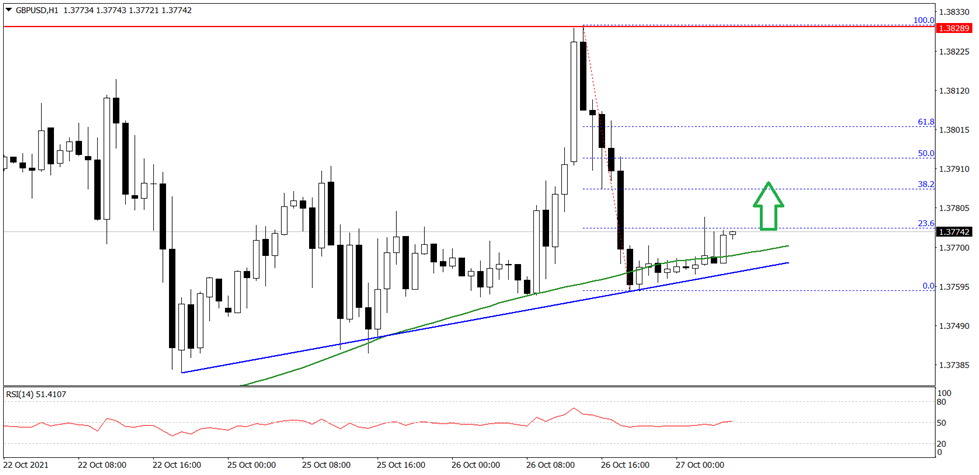
The main support is forming near the 1.3760 level. A break below the 1.3760 support level could even push the pair below the 1.3750 support. The next support sits at 1.3735.
An initial resistance on the upside is near the 1.3800 on FXOpen. The main resistance is now forming near the 1.3820 level. If there is a clear break above the 1.3800 and 1.3820 resistance levels, the pair could climb higher towards 1.3880.
US Stockmarkets Reach Record Highs
The USD edged higher against a number of its counterparts yesterday amidst low volatility, yet market attention is expected to remain on US stockmarkets as Dow Jones and S&P 500 reached new record high levels while Nasdaq also briefly touched its record high. There seems to be an increased interest for the tech sector and today we note the release of the earnings reports for Apple (#AAPL), Amazon (#AMZN), Bidu (#BIDU), Caterpillar (#CAT), pharmaceutical company Merck (#MRK), among others. As for financial releases we note the release of the durable goods orders growth rate for September, which is expected to decline into the negatives on a month-on-month basis and if so, could weaken the USD. Oil traders may be more interested in the release of the weekly EIA crude oil inventories figure, due out later in the American session especially after API’s release yesterday that showed another considerable increase in US oil inventories.
US 100 Cash (Nasdaq) rose yesterday briefly testing the 15715 (R1) resistance line, which is a record high level for the index. Given the correction lower that followed, we tend to maintain a bias for a stabilisation of the index, yet the RSI indicator below our 4-hour chart is at the reading of 62, implying an advantage for the bulls. Should the bulls actually regain control over the index, we may see it breaking the 15715 (R1) resistance line reaching new record high levels with its next target possibly being the 16000 (R2) round number. Should the bears take over, we may see Nasdaq breaking the 15365 (S1) support line, which provided ample of support in the past week and aim for the 15125 (S2) support level.
BoC’s confidence could boost the Looney
The CAD seems to remain rather stable against the USD while on the monetary front BoC’s interest rate decision is expected to monopolize the interest of CAD traders and the bank is widely expected to remain on hold at 0.25%. It should be noted that the accelerating hot Canadian inflation rates for September along with the stellar employment data for the same month have increased the pressure on the bank for a tightening of its QE program. The event is expected to provide further clues regarding the bank’s intentions, yet overall, we expect BoC to maintain a clearly hawkish tone. Analysts tend to note their expectations for a rate hike in Q3 next year, yet the bank’s QE program could be tapered even faster. Should the bank signal an earlier tightening of the bank’s monetary policy we may see the CAD gaining, while if it fails to meet the market’s hawkish expectations, we may see the CAD weakening considerably.
USD/CAD maintain a clear sideways motion between the 1.2425 (R1) resistance line and the 1.2330 (S1) support line. We maintain our bias for a sideways motion currently given the movement of the pair for the past week, yet BoC’s interest rate decision could alter the pair’s movement. On the other hand, it should be noted that the RSI indicator below our 4-hour chart is higher than the reading of 50, which could imply a slight advantage for the bulls. Should buyers be in charge of the pair’s direction we may see it breaking the 1.2425 (R1) resistance line and aim for the 1.2500 (R2) level. Should a selling interest be displayed by the market, we may see USD/CAD breaking the 1.2330 (S1) support line and aim for the 1.2250 (S2) level.
Today’s events and expectations
Today we note the release of Germany’s GfK Consumer Sentiment for November during the European session. On the fiscal front we would also note the planned speech of UK’s finance minister Rishi Sunak later on. In the American session we get from the US the durable goods orders growth rate for September and the weekly EIA crude oil inventories figure and from Canada BoC’s interest rate decision. In Thursday’s Asian session we note the release of BoJ’s interest rate decision, while RBA deputy governor Debelle is scheduled to speak.
US 100 Cash H4 Chart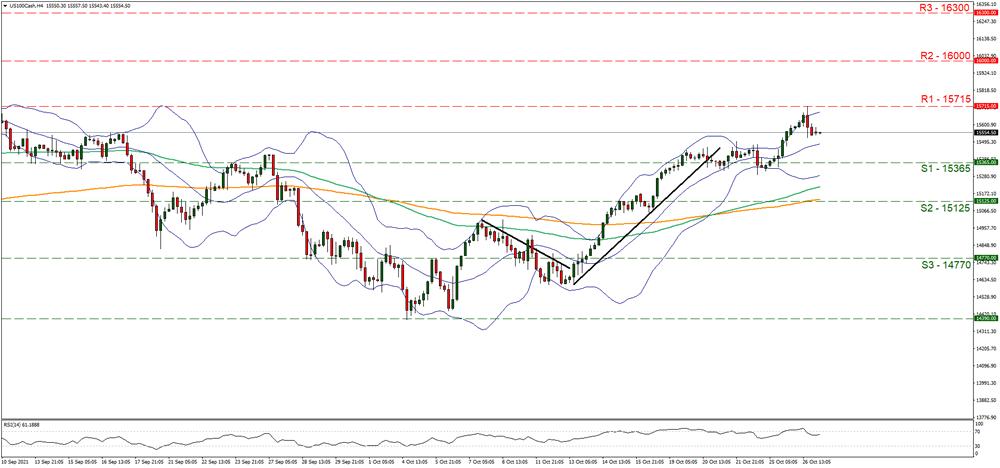
Support: 15365 (S1), 15125 (S2), 14770 (S3)
Resistance: 15715 (R1), 16000 (R2), 16300 (R3)
USD/CAD H4 Chart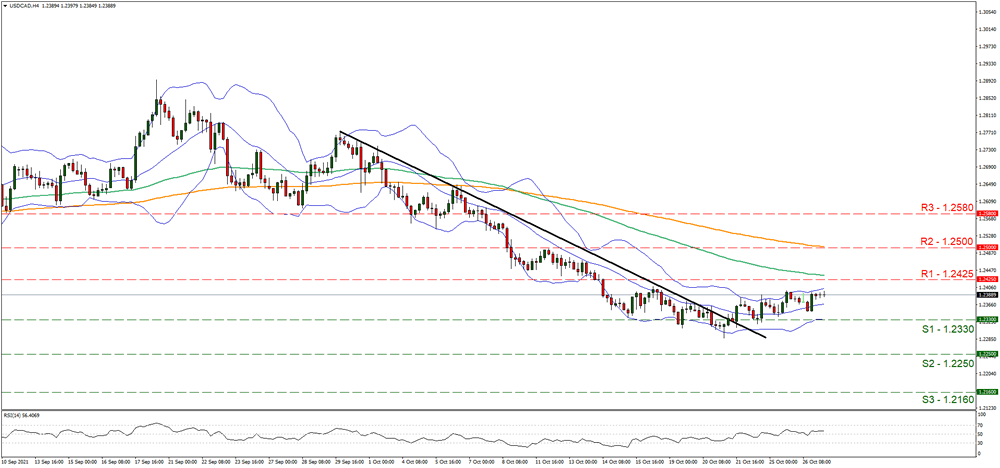
Support: 1.2330 (S1), 1.2250 (S2), 1.2160 (S3)
Resistance: 1.2425 (R1), 1.2500 (R2), 1.2580 (R3)