

Sample Category Title
ECB to stand pat, some previews
ECB is widely expected to keep monetary policy unchanged today. The central bank might shed some light on asset purchases after the end of the emergency program PEPP next March. But the details on what to follow will only be revealed at the December meeting, together with new economic projections. There are some expectations that the flexibility of the original APP would be increased, but this is far from being certain.
There are also speculations of an earlier rate hike, with market pricing it to happen by 2022 year end. But President Christine Lagarde would likely talk down such expectations. Instead, ECB would just reiterate that the policy rates would "remain at their present or lower levels until it sees inflation reaching 2% well ahead of the end of its projection horizon and durably for the rest of the projection horizon and judges that realized progress in underlying inflation is sufficiently advanced to be consistent with inflation stabilizing at 2% over the medium term".
Some previews on ECB:
Markets expect earlier RBA rate hike as it let yield surge
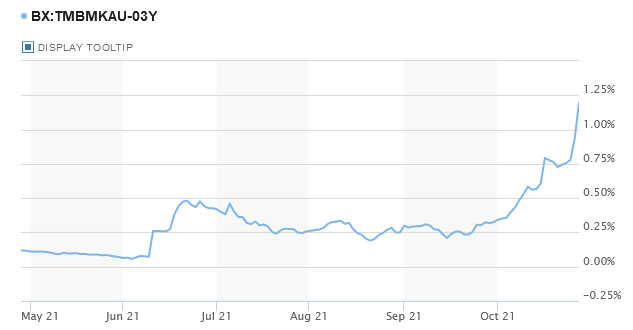
Australian bond yields surge sharply today after RBA skipped the asset purchases to defend the 0.10% April 2024 yield target. Yield on April 2024 AGS more than doubled to above 0.5%. Meanwhile, 3-year AGS yield extended recent rally and accelerated to as high as 1.19%.
The development prompted speculations that RBA would change its forward guidance to indicate that conditions for rate hike could come earlier than 2024. Westpac said it now confirm its expectation that RBA hike would come in February 2023. CBA is expecting a November 2022 hike while ANZ is forecasting a hike in H2 of 2023.
Separately, RBA Deputy Governor Guy DeBelle told the Senate today, "the monetary policy settings we have in place, as do other central banks around the world, are looking to generate a little higher inflation than we have seen over the last five, six years, as well generate more jobs." Nevertheless, he added, "a little bit more inflation is welcome, a lot more inflation isn't."
Elliott Wave View: FTSE In Wave 4 Pullback
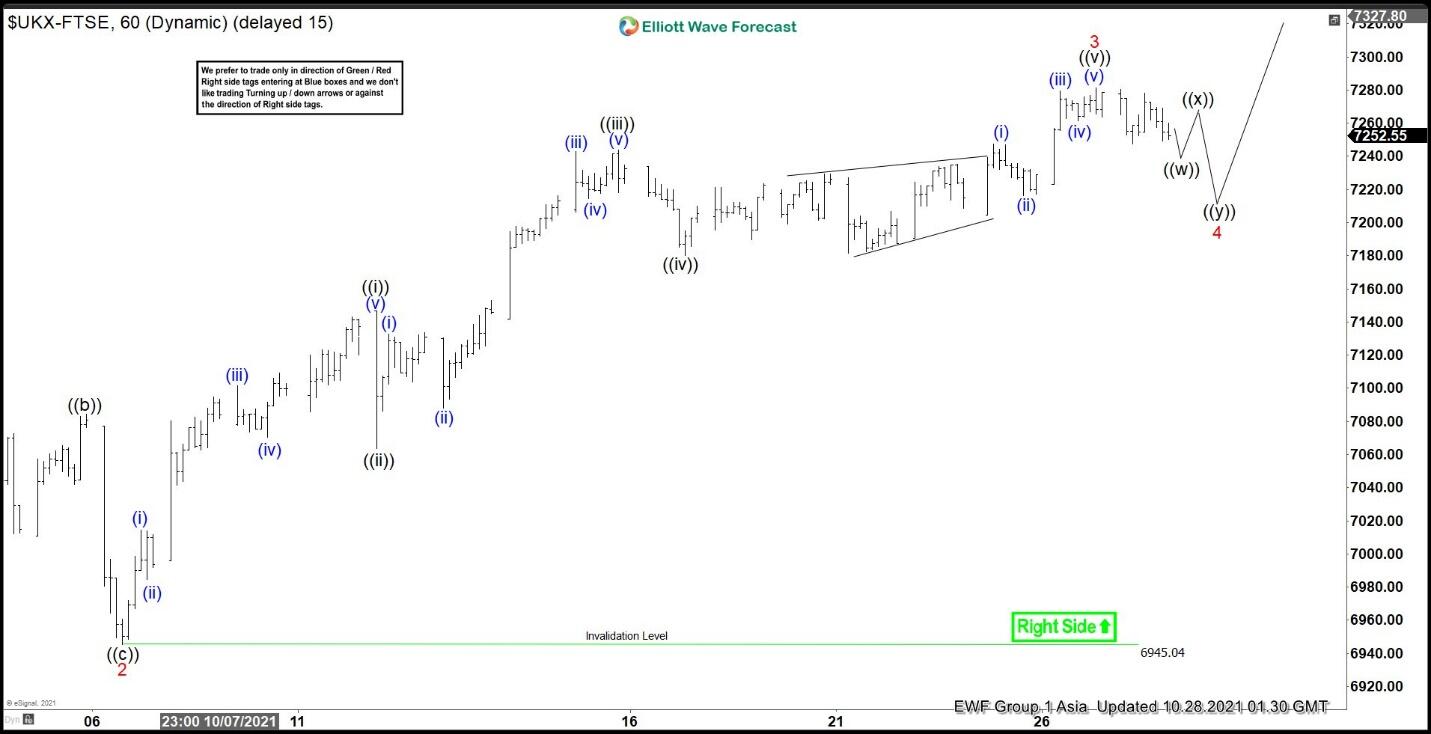
Financial Times Stock Exchange (FTSE) has continued higher following other major indices world wide. Short term Elliott Wave view suggests the rally from September 20, 2021 low is unfolding as a 5 waves impulse Elliott Wave structure. Up from September 20 low, wave 1 ended at 7159.61 and pullback in wave 2 ended at 6945.04. Index then resumes higher in wave 3 towards 7243.85. Internal subdivsiion of wave 3 is unfolding as an impulse in lesser degree.
Up from wave 2, wave ((i)) ended at 7146.85 and pullback in wave ((ii)) ended at 7063.43. Index then extends higher in wave ((iii)) towards 7243.85. Index then pullback in wave ((iv)) which completes at 7180.20. Afterwards, it resumes the rally to 7281.17 to complete wave ((v)) and wave 3. Wave 4 pullback is currently in progress to correct cycle from October 6 low before the rally resumes. Potential support area for wave 4 comes at 7153 – 7202. This is 23.6 – 38.2% Fibonacci retracement of wave 3. Near term, as far as wave 2 pivot at 6945.04 low remains intact, expect wave 4 pullback to find support in 3, 7, or 11 swing for further upside.
FTSE 60 Minutes Elliott Wave Chart
AUD/USD Eyes More Upsides Above 0.7550
Key Highlights
- AUD/USD gained pace above the 0.7450 resistance zone.
- A key bullish trend line is forming with support near 0.7435 on the 4-hours chart.
- EUR/USD is consolidating below 1.1650, and GBP/USD is stuck below 1.3800.
- The US Gross Domestic Product could grow 5.4% in Q3 2021 (Preliminary).
AUD/USD Technical Analysis
The Aussie dollar started a major increase from the 0.7200 support against the US Dollar. AUD/USD cleared the 0.7320 resistance zone to move into a positive zone.
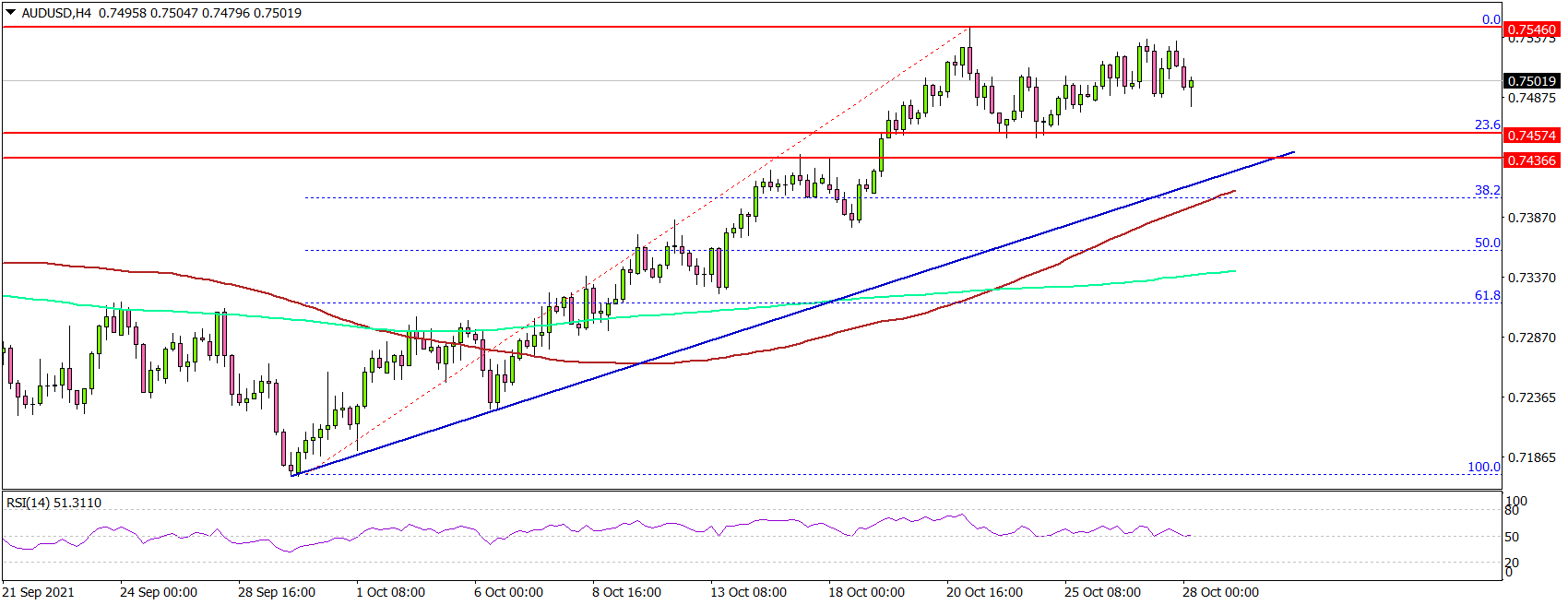
Looking at the 4-hours chart, the pair even traded above the 0.7450 level. There was a close above 0.7500, the 100 simple moving average (red, 4-hours), and the 200 simple moving average (green, 4-hours).
A high was formed near 0.7543 and the pair is now consolidating gains. The pair declined below the 0.7520 level. It tested the 23.6% Fib retracement level of the upward move from the 0.7170 swing low to 0.7543 high.
On the downside, there is a decent support forming near 0.7440 level. There is also a key bullish trend line forming with support near 0.7435 on the same chart.
The next major support is near 0.7380. It is close to the 50% Fib retracement level of the upward move from the 0.7170 swing low to 0.7543 high. A close below the 0.7380 level might push the pair towards the 0.7320 support.
On the upside, an immediate resistance is near the 0.7550 level level. The next major resistance is near the 0.7620 level, above which the pair might rise towards the 0.7700 level.
Looking at EUR/USD, the pair is still struggling to clear the 1.1650 resistance zone. Similarly, GBP/USD is facing hurdles near 1.3800.
Economic Releases
- ECB Interest Rate Decision – Forecast 0%, versus 0% previous.
- German Consumer Price Index for Oct 2021 (YoY) (Prelim) – Forecast +4.4%, versus +4.1% previous.
- German Consumer Price Index for Oct 2021 (MoM) (Prelim) – Forecast +0.5%, versus 0% previous.
- US Initial Jobless Claims - Forecast 290K, versus 290K previous.
- US Gross Domestic Product Q3 2021 (Preliminary) – Forecast 5.4% versus previous 6.2%.
We Confirm that the First RBA Cash Rate Increase will be February Board 2023
We confirm the view we have held since June 18 that the first rate increase from the RBA will be the February Board meeting in 2023. Markets continue to run ahead of the RBA’s likely timing where the policy approach has changed to favour patience.
Following the September quarter Inflation Report we confirm our forecast that the first rate hike (15 basis points) by the RBA will be in the March quarter, 2023, with the February 1 Board meeting being the most likely timing.
Last week I wrote, “Markets are right to challenge RBA guidance, but have now gone too far”.
At that point market pricing indicated the likelihood of two 25 basis point rate hikes to November next year with one priced in by August.
Prospects for our favoured first hike – 15 basis points to return the cash rate to 0.25% were priced in for as early as June.
All of this was going to be impacted by the Inflation Report for the September quarter that was to print on October 28.
We expected a headline inflation print of 0.8% and a core (Trimmed Mean) print of 0.5%.
Because the RBA will formulate its policy around the Trimmed Mean we expected that a “0.5%” print would cause the market to reset.
In the event the headline did print 0.8% but the Trimmed Mean printed 0.7%, an exciting development for the market.
Subsequent repricing in the market now has three 0.25% rate hikes by November; two hikes by August; with the first 0.25% hike coming in June; while, if the RBA favours the first move to be 0.15%, then it is expected in May.
When I wrote last Friday our forecasts entailed annual Trimmed Mean printing 2.8% by end 2022; and 2.5% by end June 2022.
As we have consistently emphasised, this expected lift in inflation reflected, in the first stage, the “collision” of strong demand growth, with supply constrained goods and labour markets. Those pressures will be most intense around the construction of new dwellings.
As we move through 2022 the source of the inflation pulse is likely to pivot from supply constraints to rising wages growth as the unemployment rate falls below 4% by year’s end. Wage pressures are the most reliable sign that inflation pressures will be sustained underpinning our forecast two year tightening cycle where we expect the cash rate to peak at 1.25% by end 2024.
That forecast assumed the following quarterly profile: 0.5% (September); 0.7% (December); 0.6% (March); 0.6% (June); 0.8% (September); and 0.7% (December) for growth in the Trimmed Mean.
So, the lift to 0.7% in the quarterly print for September has come a quarter earlier than we had expected.
There are some anomalies in the September Report – a range of components have been imputed due to the collapse in certain spending categories in the September quarter and the house purchase component has been affected by the expiration of the Home Builder subsidies in March.
However, it does not affect our forecast for 2022 which already incorporated some of the pressures we saw in the September Report.
On our forecasts, the first rate hike in February 2023 will follow the December quarter Inflation Report that will print on January 27 2023.
That report is likely to confirm that growth in the Trimmed Mean has held above 2.5% for three consecutive quarters, ample support for the Governor’s requirement “we want to see inflation around the middle of the target range and have reasonable confidence that inflation will not fall below the 2–3 per cent target range” (14 September).
To feel confident that the lift in inflation will be sustainable the Board will need to see a marked increase in wage inflation. Under our scenario the unemployment rate falls to 3.8% by end 2022 and wages growth lifts to 2.8% in 2022 - slightly short of the Governor’s guideline of 3%.
It is very important to understand that wage increases will not be “indexed” into the inflation profile.
The era of the 1970’s when “cost of living adjustments” figured in wage arrangements and employers, confident in their pricing power, were prepared to accept higher wages are unlikely to recur.
Even though the profile of inflation could probably justify a rate increase at the November 2022, meeting waiting a few months to assess the unemployment / wage profile would seem to be prudent.
Remember that the RBA believes that, in this cycle, it is justified in being patient to ensure a sustainable result. The almost “impatient” approach now embedded in markets may be underestimating the significance of the Governor’s commitment to moving patiently- only when the objectives of inflation and full employment have been firmly achieved rather than forecast.
Markets should be more aware that the rules of policy in Australia have changed.
And of course, our forecasts stand in direct contrast with the RBA’s forecasts that TM inflation will print 1.75% for 2021 and 2022.
These forecasts should be revised for the November Statement on Monetary Policy, hopefully to 2.0% and 2.5% respectively.
But we also have the other inputs into the Monetary Policy decision – the unemployment rate and wages growth.
Westpac is forecasting that wages growth will print 2.8% for 2022, up rom the current 1.7%, while the unemployment rate will fall to 3.8% by end 2022.
The RBA’s current forecasts are 2.5% for wages growth in 2022; and an unemployment rate down to 4.25% by end 2022.
Westpac’s forecasts for wages growth and the unemployment rate are much closer to the RBA’s than they are for inflation.
We would like to see slightly faster wages growth and a lower unemployment forecast when the RBA releases its revised forecasts.
Currently the RBA’s growth forecast for 2022 is 4.25% compared to Westpac’s 7.4%.
But our 2022 forecast is based on our current assessment that the Australian economy will contract by 4% in the September quarter whereas RBA noted in early August that they expected the economy to contract by “at least 1%” in the September quarter.
A deeper contraction in the September quarter (hours worked have already been estimated by the ABS to have contracted by 3% in the September quarter) is likely to see a stronger forecast recovery pace in 2022 as the economy returns to the pre delta trajectory (RBA’s assessment in August).
That adjustment could see the growth forecast in 2022 lifted to at least 6% consistent with faster employment growth; a lower unemployment rate and stronger wages growth.
Certainly, the Employment Reports and Payroll Reports since the August SOMP have also indicated a more resilient labour market.
Wages growth around 2.75% and an unemployment rate of 4% by end 2022 would seem a reasonable adjustment to the forecasts.
If we were to see such changes in the Bank’s forecasts in the November Statement on Monetary Policy the issue arises as to whether the Governor would be prepared to alter the guidance, “The central scenario for the economy is that this condition will not be met before 2024.”
Personally, I would strongly applaud acceptance that the Governor now expects that the conditions necessary to begin the move away from the emergency policy settings will be achieved earlier than previously expected.
The strong existing guidance, particularly during 2020, was key to underpinning confidence in the RBA’s commitment to doing everything reasonably within its powers to protect the Australian economy.
Success is now likely to come earlier than expected and a cautious recognition of that prospect would be welcome.
Market Morning Briefing: Aussie Could Not Rise Above 0.7550
STOCKS
Equities trade in a mixed fashion. Dow and Dax have dipped. Dow can fall towards 35500-35250 while below resistance at 36000. Dax can fall to 15400 but remains within 15400-15900 for the near term. Nikkei can fall to 28500/250 while below resistance at 29500/250. Shanghai has broken below support at 3550 and can fall towards 3500 in the next few sessions. Nifty and Sensex have scope to rise on the upside while above important supports at 18000 and 60000.
Dow (35490.69, -266.19, -0.74%) has come down sharply after testing the high of 35892.92 yesterday. While resistance at 36000 seems to be holding well, we may expect a corrective fall towards 35500-35250 levels.
DAX (15705.81, -51.25, -0.33%) has fallen after testing the high of 15744.79. A range of 15900-15400 may hold for the near term. Any break on either side can take the index towards 16000-16200 or 15200-15000 in the medium term. For now watch price action within 15900-15400.
Nikkei (28825.62, -272.62, -0.94%) has fallen sharply today. The index can fall while below 29500-29250 towards 28500-28250 or even lower in the near term. A break above 29500 is necessarily needed for Nikkei to rise and signal bullishness towards 30000/31000 in the longer run.
Shanghai (3530.90, -31.8, -0.89%) has broken below important trend support at 3550. Sustained trade below 3550 can take the index down to 3525-3500 initially.
Nifty (18210.95, -57.45, -0.31%) went up to test 18342.05 before coming down from there. The range of 18000-18400 is still intact and our view remains bullish on a break above 18400 towards 18600/800.Only a strong and sustained break below 18000, if seen can trigger a fall towards 17600/400 but this looks less likely for now.
Sensex (61143.33, -206.93, -0.34%) is heading towards the level of 62000 and 63000 in the medium term while above 60000/61000.
COMMODITIES
Volatility seen in commodities today. Crude prices have fallen sharply and probably indicating early signs of reversal. For now, a fall towards 80/78 on Brent and 79/77 on WTI is possible. Gold is up on Dollar weakness and it needs to sustain above 1800 to rise towards 1820/40. Else a fall back to 1780/60 cannot be negated. Silver can range within 23.50-25 while Copper has immediate support at 4.40 which needs to hold to see a bounce back to 4.45/50. A break below current levels can drag the price to lower levels of 4.30/25.
Brent (82.70) and WTI (81) have fallen sharply due to rise in US crude inventories stated by the API weekly release yesterday. Inventories rose 2.3mln barrels for week ended 22nd Oct, higher than amalyst expectations of 1.9mln barrel gain. This has sent down the crude prices sharply lower. The fall is healthy for the crude prices ahead of the OPEC meeting next week. A fall to 80/78 on Brent and 79/77 on WTI is likely to be seen in the next 1-2 sessions.
Gold (1801.10) has risen today on Dollar weakness. A strong and sustained break above 1800 is needed for the view to be bullish towards 1820/1840.While below 1800 the view remains bearish to see a fall down towards 1780/1760. Watch price action to see if the price sustains above 1800 or not.
Silver (24.09) is holding above 24 and could have scope for a rise back to 25. On the downside, 23.50 could be the limit.
Copper (4.3930) has fallen to test crucial support at current levels. A fall below 4.39 can drag the price lower towards 4.30/25 else a bounce from current levels can take the index back towards 4.45/50.
FOREX
Dollar Index has dipped below 94 taking Euro up to 1.16. Whether the movement would sustain or not needs to be seen. EURJPY has support near 131.50 which if holds can produce a bounce towards 132.50 soon. Aussie and Pound can be ranged within 0.7450-0.7550 and 1.37-1.38 respectively. Dollar-Yen can be ranged too within 114.50-113.20 for the near term before breaking on either side. USDCNY has risen well while above support near 6.3750. A rise towards 6.42 can be a possibility while the upmove sustains. USDINR can continue within narrow range of 74.90-75.05 and broad range of 74.70/50-75.20/25 for the medium term.
Dollar Index (93.81) has dipped from 94, unable to sustain higher. A range of 93.50-94 may hold for now and a break above 94, if seen can take the index to 94.50 before a decline is seen again from there. Narrow range of 93.50-94 and broad range of 93.50-94.50 may hold for the near term.
Euro (1.1608) is stuck around 1.16,finding it difficult to move on either side of the level. A test of 1.1650-1.17 is still a possibility on the upside while immediate downside could be limited to 1.1550.
EURJPY (131.86) has immediate support near 131.50 which can hold and produce a bounce to 132.50 in the near term. Any break below 131.50 would be further bearish towards 131-130.70/50. Watch price action while above 131.50.
Aussie (0.7504) could not rise above 0.7550 and has instead fallen from there. While below 0.7550, Aussie can fall towards 0.7450 keeping a range of 0.7550-0.7450 for the near term.
Pound (1.3741) broke below 1.3758 but is holding above 1.37 just now. Immediate range of 1.37-1.38 can be seen till we see a decisive break on either side.
Dollar-Yen (113.57) is ranged within 114.5-113.20 and could hold for some more sessions before a break on either side is seen in the medium term.
USDCNY (6.3983) has risen. While above support at 6.3750, there is chance for the pair to rise towards 6.42.
USDINR (75.03) traded within 74.90-75.05 yesterday and could hold within this range today also. Any break on either side can extend the movement towards 74.70/60/50 or 75.20/25. Rise from 75 is likely to be limited at resistance near 75.20/25.
INTEREST RATES
The US Treasury Yields have declined sharply at the far-end and the curve flattening strengthens. The far-end yields can fall further ahead of the US Federal Reserve meeting next week. The German yields have reversed lower as expected but indeed at a much faster pace. The expected fresh fall has begun and can extend in the coming days. The 10Yr and 5Yr GoI are stuck in a narrow range. They can consolidate in the near-term with a bearish bias.
The US 2Yr (0.52%) Treasury yield has risen sharply while the 5Yr (1.17%), 10Yr (1.55%) and the 30Yr (1.96%) have come-off sharply. The 30Yr has declined below 2% and can extend the fall to 1.85% while it sustains below 2%. The 10Yr can test 1.5% and can fall further to 1.4% on a break below 1.5%. The chances of seeing rise past 1.75% (10Yr) and 2.2% (30Yr) stands highly reduced now.
The German 2Yr (-0.66%) and 5Yr (-0.47%) yields remain stable while the 10Yr (-0.18%) and 30Yr (0.15%) have declined sharply. The 10Yr has come down towards -0.2% as expected and can fall further to -0.3% and even -0.4% in the coming weeks. The 30Yr has declined below 0.2% and can now fall to 0.1% initially and then 0% eventually.
The Indian 10Yr GoI (6.3356%) is stuck between 6.33% and 6.38% over the last few days. The view of seeing a broad consolidation between 6.3% and 6.4% remains intact. Bias is bearish to break 6.3% while below 6.4%.
The 5Yr GoI (5.7167%) continues to trade in the narrow 5.7%-5.76% within the broad 5.66%-5.76% range.
BoJ stands pat, downgrades 2021 GDP and CPI forecasts
BoJ kept monetary policy unchanged today as widely expected. Under the yield curve control framework, short-term policy interest rate is held at -0.1%. 10-year yield target is maintained at around 0%, with JGB purchases without upper limit. It also reiterated that BoJ will continue with QQE with YCC "as long as it is necessary" for maintaining inflation at 2% target in a stable manner. It will also continue expanding the monetary base core CPI exceeds 2% and stays above in a stable manner.
Economic projections comparing to July forecast:
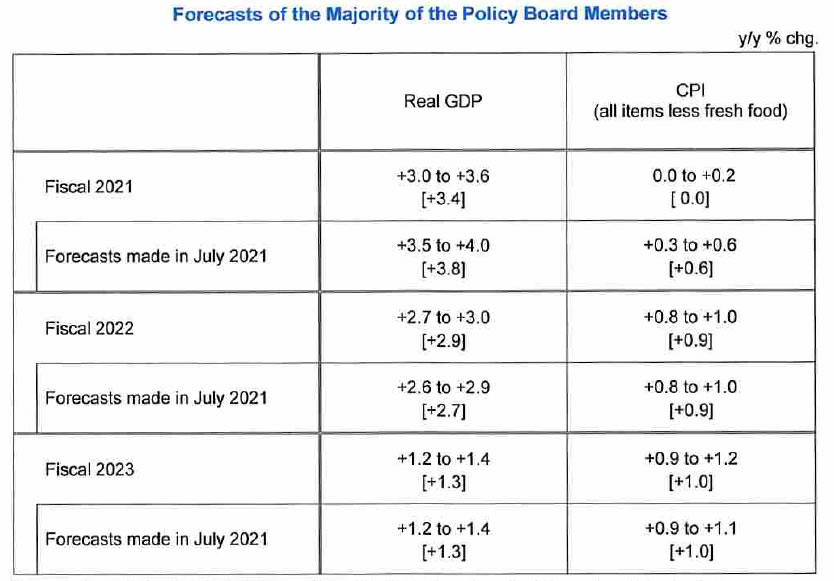
- Fiscal 2021 GDP growth downgraded from 3.8% to 3.4%.
- Fiscal 2022 GDP growth upgraded from 2.7% to 2.9%.
- Fiscal 2023 GDP growth unchanged at 1.3%.
- Fiscal 2021 CPI core downgraded from 0.6% to 0.0%.
- Fiscal 2022 CPI core unchanged at 0.9%.
- Fiscal 2023 CPI core unchanged at 1.0%.
Eco Data 10/28/21
[php_everywhere instance="1"]
Hawkish BOC Ends QE. May Hike Interest Rate in 2Q22 the Earliest
The BOC surprised to the hawkish side at the October meeting. Policymakers announced to end the QE program and begin the reinvestment process, compared with consensus of a reduction to the weekly purchase of CAD1B. While leaving the overnight rate unchanged at the effective lower bound of 0.25%, the timing for the first rate hike was pushed forward. While downgrading GDP growth forecasts for this year and 2022, inflation projections were revised higher through to 2023.
As noted in the statement, inflation pressures have been "stronger and more persistent than expected". Meanwhile, supply chain disruption and production bottlenecks “are not easing as quickly as we expected”. These suggested that inflation would “probably going to take a little longer to come back down”. Headline readings were projected to reach 3.4% in both 2021 and 2022, up from July’s forecasts of +3% and +2.4%, respectively. Inflation was expected to slow to about +2% towards end-2022 as supply disruptions ease, before reacceleration due to excess demand. Inflation will then ease to +2.3% in 2023, compared with July’s 2.2%.and 2023 was a touch higher at 2.3% (July: 2.2%).
The staff downgraded GDP growth forecasts to +5.1% and +4.3% for 2021 and 2022, from July’s +6% and +4.6%, respectively. As noted in the statement, “more severe supply disruptions and weaker foreign demand” were the key drivers of the downgrades. GDP growth for 2023 was, however, revised higher to +3.7% (July: +3.3%). The central bank cautioned over the high uncertainty of the outlook due to supply disruptions, labour market mismatches, and accelerated digital investments.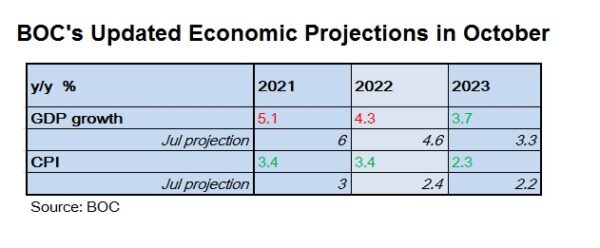
On the monetary policy, the BOC announced an end to QE and the beginning of the reinvestment phase. It also maintained the policy rate at 0.25%. Policymakers reiterated that the policy rate will stay at where it was “until economic slack is absorbed so that the 2% inflation target is sustainably achieved”. Yet, they expected that to happen “sometime in the middle quarters of 2022, compared with previous estimate of “the second half of 2022”.
BoC Ends QE, Advances Rate Hike Timing
- BoC switching to reinvestment phase of QE
- Economic slack to be absorbed around mid-2022
- Guidance puts April rate hike on the table
Strong inflation data and growing concerns about the persistence of price pressures intensified focus on today’s Bank of Canada meeting. The central bank responded with a more hawkish message than we anticipated, bringing forward the expected timing of economic slack being absorbed (now in the middle quarters of 2022 compared with the second half of 2022 in July and September’s statements) and clearly opening the door to a rate hike in April. The other key policy decision—ending QE by moving into the “reinvestment phase” of that program—was as expected and appropriate given progress in the economic recovery, but nonetheless likely added to the market’s hawkish interpretation.
Our call has been for two rate hikes in the second half of 2022 (July and October) though risks were already tilting toward earlier liftoff. An April start to tightening looks increasingly likely as long as we see continued progress in the economic and labour market recovery over the next six months. Today’s messaging doesn’t go quite as far as the 100 bps of tightening by the end of next year markets were pricing in ahead of the meeting, though the move higher in bond yields and the Canadian dollar shows investors see some validation of that view. We’ll release an updated interest rate forecast later next week.
The shift in timing for the economy reaching full capacity was despite the BoC downgrading its GDP growth forecasts for this year (5.1% vs. 6.0% in July) and next (4.3% vs. 4.6% in July). Those forecasts are now closely aligned with our projections. To square that with an earlier output gap closure, the bank narrowed its assessment of current slack and lowered its potential growth projections. While we agree that there is significant uncertainty surrounding the current degree of slack and pace of potential growth, the BoC massaging its forecasts is this way only adds to the perception that today’s hawkish shift is more about inflation concerns than the growth outlook.
In that regard, inflation saw the most notable revisions in today’s updated projections. CPI has surprised to the upside in recent months, and combined with firmer oil prices and more persistent price pressures (including supply bottlenecks) than previously expected, the bank revised its 2022 headline inflation forecast a full percentage point higher to 3.4%, matching its revised 2021 forecast. Such an extended period of above target inflation likely has the bank worried that higher inflation will become embedded in expectations and today’s statement noted it is closely watching inflation expectations and labour cost growth. We’ve seen an increase in near-term inflation expectations but medium- term expectations remain fairly well anchored, and despite tight labour market conditions there are few signs that wage growth is accelerating sharply at this point. As long as that remains the case, we think the bank will raise rates gradually in 2022 and 2023.