Sample Category Title
Market Noise Is Becoming Very Messy
One thing we are probably not going to have to worry about in markets in the coming weeks is volatility. The amount of noise assailing my eardrums from multiple directions is becoming very loud and conflicted. Chief amongst though is that old chestnut, inflation. Is it transitory or sticky? Well, that depends on who you are talking to. Overnight, the Bank of Canada abruptly ended its QE programme and signalled rate hikes are on the way. Similarly, the Brazil central bank surprised markets by hiking 1.50% to 7.75% to combat inflation and some anticipated pre-election fiscal largesse by President Fire-Starter. They also indicated that they would hike by as much again at their next policy meeting. Turkey’s dictator, meanwhile, has forced his central bank to cut rates despite rampant inflation. Long BRL/TRL anyone? Russia beat them all to the punch, hiking last week and the markets are locked and loaded for the RBNZ in November.
In contrast, the UK budget last night saw gilt yields sink as growth forecasts were upgraded for 2022, reducing the government’s projected borrowing requirement. The Bank of England hiking trade is suddenly looking very crowded. In the US, the inflation story is playing out mostly in the short end of the yield curve with yields rising there even as long-dated yields sink, leaving the US dollar stubbornly firm near the top of the week’s range. The Bank of Japan will, by contrast, remain unchanged at lower forever and this evening’s ECB policy meeting will more than likely feature the European Central Bank of Japan dampening longer-term inflation expectations even as they leave policy rates unchanged in negative territory. Europe is no closer to removing the monetary punch bowl to keep the lights on than they were a decade ago. It’s great if you are German though, as markets pay Germany to borrow from them. Even Australia, where the RBA has let more doves fly than Prince, seems to be on the cusp of changing tack, declining to intervene today to cap 3-year yields at their 0.10% target.
Fed expected to hit taper trigger
That mixed bag will receive another member next week in the form of the latest US Federal Reserve FOMC policy decision. The FOMC should announce the start of their tapering of QE, and this is a trade that has either been ignored by markets because it didn’t suit their buy everything narrative or has been woefully under-priced. Interest rates will still be near zero per cent even after QE is tapered, but in a world addicted to, and expecting the Federal Reserve to backstop the speculative excesses of the world, one shudders to think what a good dose of reality will bring to financial markets. One sweetener for the Fed to stay dovish going forward appears to be coming from Washington DC. The Democrats spending and tax plans appear to be in more disarray by the day and whatever emerges, if it does, will be a shadow of its former self. The Republicans won’t have to do any campaigning for next year’s mid-terms at this stage, the factions within the Democratic Party will do the job for them. Usually, that’s good for equities, American investors like government paralysis. Tonight’s US PCE Prices and Core Prices data may present a more near-term threat though if prices jump above forecast, with a lower GDP print already priced into markets.
The equity space is just as confused. China’s Evergrande faces another offshore coupon payment deadline tomorrow, with China’s government still relatively silent on the issue other than to tell the founder to use his own money to pay debtors first. The Communist Party Central Committee meeting looms between the 8th and 11th of November. President Xi’s shared prosperity policy hasn’t suddenly gone away and nor have the travails of the property sector. The delta variant is also girding itself to challenge the country’s Covid-19 zero policy and that’s on top of China’s energy crunch and supply-chain issues. Yet some notable commentators are urging investors to fill their boots and buy the dip in Chinese equities. On the regulatory challenge front alone, I’m not sure the repricing of risk into equity prices is complete; let’s hope they’re right. If anyone needs evidence to this fact, Reuters is reporting China’s state planner has met with representatives of China’s coal sector to help better identify those “profiteering” from soaring coal prices. China coal futures are limit-down this morning.
I must apologise to readers yesterday as I had the Apple results out by a day. Today is Apple day in fact and Amazon also releases its quarterly earnings as well. Although tech giants outperformed last night, it wasn’t enough to hold the Nasdaq in positive territory. Other indices sunk despite excellent results from the likes of Ford, and it seems that the US earnings story is running out of momentum. I expect both Apple and Amazon to deliver crowd-pleaser results today, but if Wall Street can’t rally on that, it may be time to batten down the hatches ahead of the FOMC next week which I continue to believe, is the one ring to rule them all. I note that Asia has steadfastly refused to buy into the American dream this week, with equity markets trading on the heavy side. China nerves will be part of that story, but so will the contradictory noise coming from the energy, commodity, fixed interest, and virus spaces amongst others. Samsung’s results are a classic case in point today. Excellent earnings but sounding warnings of memory chip prices and demand next year and supply chain disruptions while forecasting a recovery in corporate IT demand. A bit of a head-scratcher that one, especially as it is on both sides of that trade as a manufacturer and consumer.
Currency markets and precious metals are by contrast an ocean of calm, even as equity and bond markets are chasing their tails. Base metals have started to roll over and even energy prices look like they are on the cusp of a temporary correction lower. The China energy crunch and the prospect of lower refined metal and factory production could explain the base metal space. The prospect of Iranian oil returning to international markets, the energy space.
Markets tend to get very noisy with confusing movements before a large directional move. Nowhere is that more apparent than the crypto-verse. Bitcoin and ethereum have fallen this week as the post-ETF nonsense wears off and both are potentially on the cusp of a large correction lower. Meanwhile, another coin with a picture of a dog, Shiba Inu, has rallied by over 200% this week, making it a crypto-meme I suppose. I note it is not even built on its own code; it uses ethereum’s. Anyway, the price is super cheap, as opposed to the big two, and the retail space has piled into it in a meme-orgy. I received a TikTok today (as a file attachment, I don’t have an account. My daughters don’t want Dad in their “space”), in which had a bloke in a football shirt was exhorting viewers to “hold on and not sell” their cute doggy picture coins. He says hold on, I say pump and dump. And don’t get me started on (un)stable coins, supposedly back one-for-one with US dollars but whose issuers are incredibly elusive at proving just that.
The noise continues in Asia where the Bank of Japan, which has just left policy rates unchanged at -0.10% while downgrading CPI and GDP projections for 21/22, whilst slightly upgrading both for 2022/23. In Australia this morning, export prices rose by 6.20% in Q3 QoQ, but import prices rocketed higher to 5.40% from 1.90% previously as imported inflation rears its head. Australian 3-year CGB’s are trading at 0.50% this morning in response after the RBA did not intervene to cap rates at its 0.10% target. Yes, you read that correct, 0.10% target.
The Caligula’s of volatility will be loving life now, but like any one of his orgies, you get unlimited wine, but you risk getting chopped up as well. The contradictory noise across asset classes is signalling a big move is coming and I believe next week’s FOMC could be the catalyst if the FOMC holds its nerve. I am erring to a higher US dollar, higher US yields, lower equities, and a bit of a reckoning in the crypto-space. In the meantime, I’m going to fetch my earplugs.
Daily Technical Analysis
EUR/USD
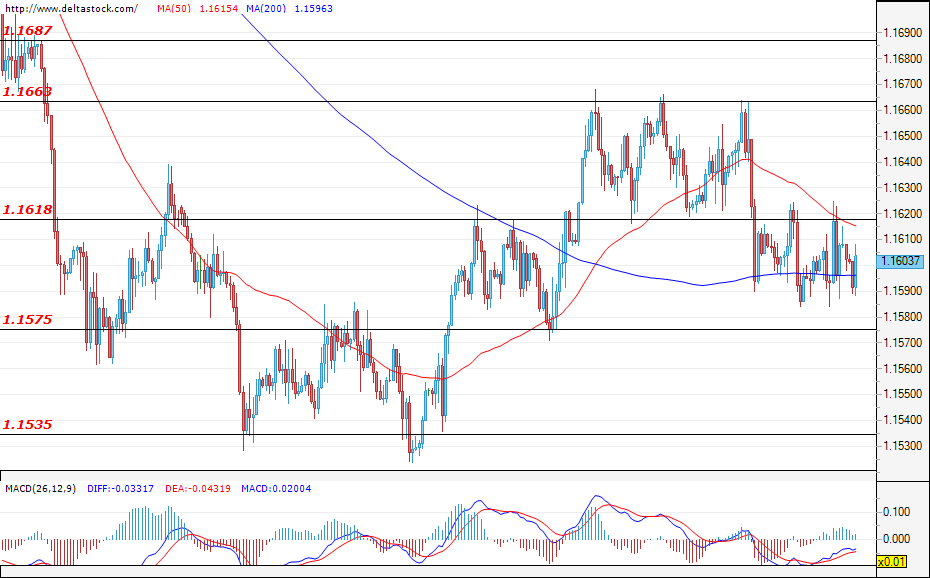
Current level - 1.1603
The bulls still cannot prevail over the bears and, at the time of writing, the currency pair is located under the 1.1618 resistance zone. The few failed attempts at breaching the mentioned level could give the bears the necessary incentive to attack the next significant support of 1.1575. Today, the focus for investors will be the announcement of the European Central Bank interest rate decision (11:45 GMT), as well as the announcement of the initial jobless claims data for the U.S. (12:30 GMT). The outcome of the mentioned economic news could largely determine the future of the currency pair.
| Resistance | Support | ||
| intraday | intraweek | intraday | intraweek |
| 1.1618 | 1.1687 | 1.1575 | 1.1410 |
| 1.1663 | 1.1750 | 1.1535 | 1.1280 |
USD/JPY
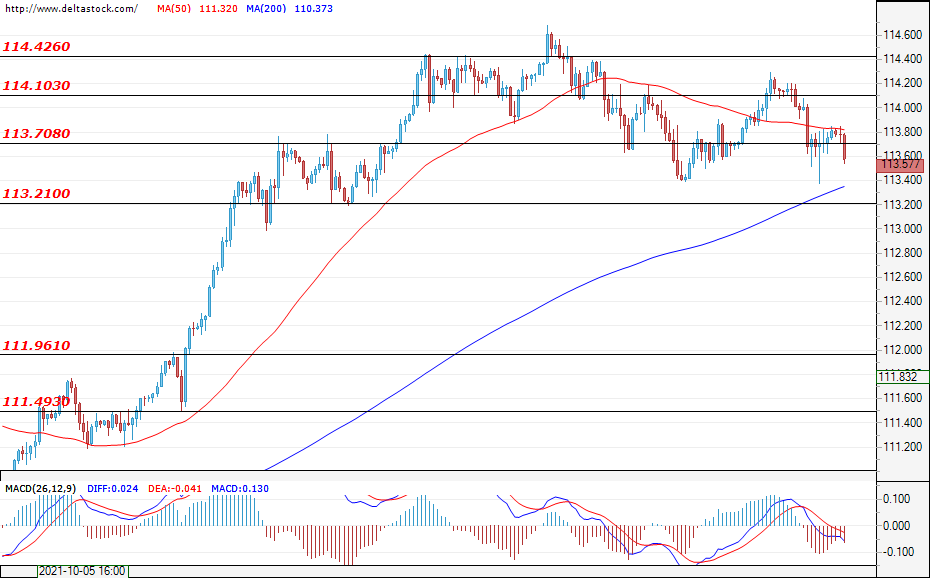
Current level - 113.57
The hesitant attack of the bulls on the 114.10 resistance zone did not lead to a success and directed the price move towards a test of the support zone of 113.70, thus giving the bears some breathing room. They, in turn, also failed to take full control of the market at the time of writing. A confirmation of the negative sentiment could occur in case of a confirmed breach of the support zone of 113.21. The Bank of Japan left the interest rate unchanged, which did not in any way affect the market or increase the volatility of the currency pair.
| Resistance | Support | ||
| intraday | intraweek | intraday | intraweek |
| 113.70 | 114.50 | 113.20 | 111.50 |
| 114.10 | 116.00 | 111.96 | 111.50 |
GBP/USD
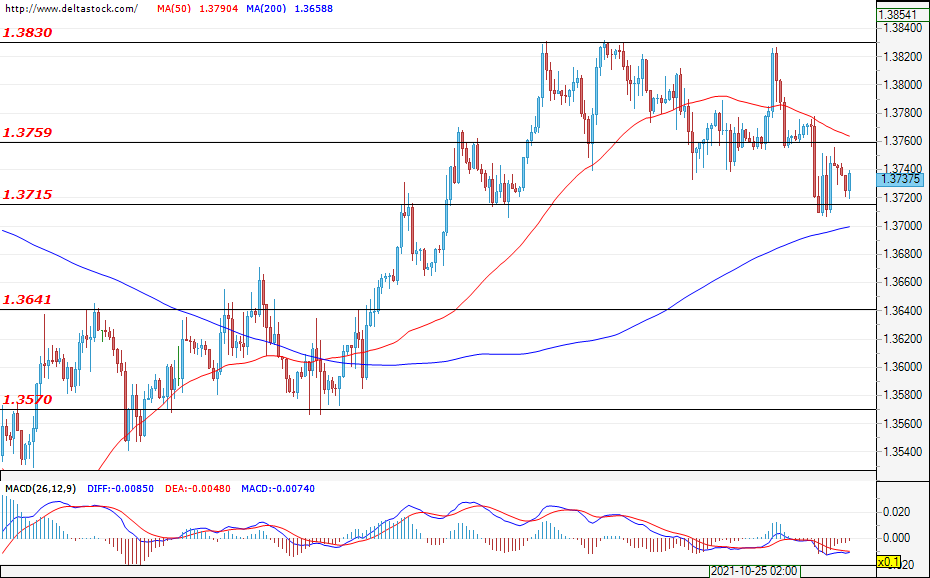
Current level - 1.3737
After the bears failed to breach the support zone of 1.3715, there was a subsequent failed attempt by the bulls at overcoming the resistance of 1.3760. At the time of writing, the sentiment is rather neutral, as neither the bulls nor the bears are currently prevailing. A breach of any of the mentioned levels could present the market participants with the necessary momentum needed to determine the future of the currency pair.
| Resistance | Support | ||
| intraday | intraweek | intraday | intraweek |
| 1.3760 | 1.3900 | 1.3715 | 1.3570 |
| 1.3830 | 1.4000 | 1.3640 | 1.3570 |
EUR/USD Outlook: Euro Would Accelerate Lower On Expected ECB’s Dovish Stance
The Euro ticks higher in early European trading on Thursday but remains in a directionless mode for the third consecutive day, as markets await today’s ECB policy meeting and US Q3 GDP data for fresh direction signals.
The central bank is expected to stay on hold and push back against growing expectations for a rate hike next year, fueled by rising inflation.
ECB President Lagarde is likely to repeat that the central bank is not in hurry to tighten policy even if many major central banks are planning to do so.
Such a scenario would be seen as a dovish steer from the ECB and negative for the single currency.
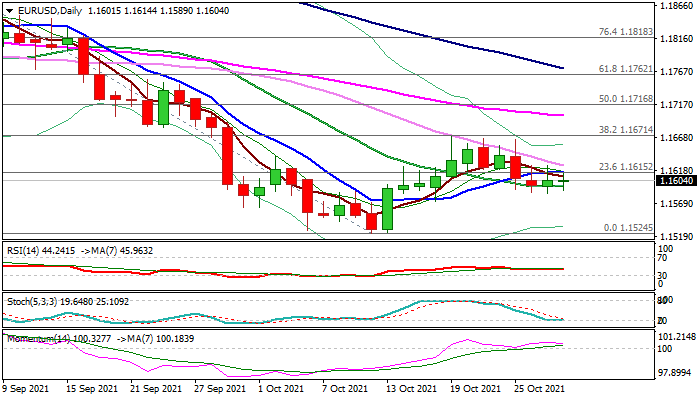
Daily studies are mixed but the near-term bias remains with bears as the action stays capped by daily Tenkan-sen (1.1620) following pullback after recovery was repeatedly rejected under pivotal Fibo barrier at 1.1671 (38.2% of 1.1909/1.1524) and momentum weakens.
On the other side, 20DMA (1.1596) still holds and guards more significant supports at 1.1568/57 (200WMA/weekly cloud base.
Expect an initial bearish signal on a firm break of 20DMA, which would be confirmed on a close below 200WMA/weekly cloud.
Conversely, lift above converging daily Tenkan-sen/Kijun-sen (1.1620/37) would ease downside pressure, but a sustained break of 1.1671 Fibo barriers would signal a continuation of recovery from 1.1524 (Oct 12 low).
Res: 1.1620, 1.1637, 1.1671, 1.1700.
Sup: 1.1596, 1.1568, 1.1557, 1.1492.
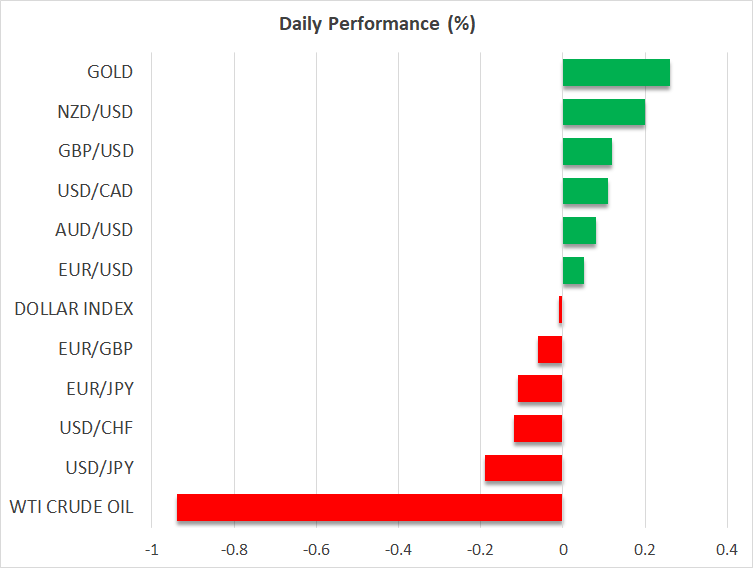
Will ECB Fight Market Pricing For Early Rate Hikes?
- ECB could tone down market expectations today, hurting euro
- Loonie jumps after BoC terminates QE program but oil prices weigh
- Stocks retreat amid worries of central bank error, US GDP eyed
 Euro reality check?
The spotlight will fall on the European Central Bank (ECB) today, which will conclude its latest meeting at 11:45 GMT. Stagflation risks have engulfed the euro area economy lately with the mayhem in supply chains, collateral damage from China, and the calamity in energy prices threatening to kneecap economic growth but keep inflation hot.
In this light, it is strange that money markets are pricing in an ECB rate increase for next year. Even though it is only a minor hike of 10 basis points, that still seems excessive. Traders are betting the central bank will be forced to respond to the surge in inflation expectations, which is typically a signal that inflation is here to stay.
But in Europe's case, this isn't a sign the economy is doing well. It merely reflects the spike in energy prices. The growth landscape remains grim and the labor market is nowhere close to a full recovery, so consumers won't have the pockets necessary to keep the inflation spiral going once supply constraints fade and energy prices stabilize.
Therefore, the ECB could play down the possibility of raising rates anytime soon. President Lagarde might highlight the various risks around economic growth and stress that this inflation episode still seems transitory, a message that would likely deal a blow to the euro.
US GDP coming up, BoC turns hawkish
But any euro weakness today might not be fully reflected in euro/dollar as the US GDP report could also disappoint. There's a sharp disconnect between Wall Street forecasts and Fed models on this one, with the consensus among economists being for a 2.7% annualized growth rate but the Atlanta Fed's GDPNow model standing at a mere 0.2%.
This spells some downside risks around the upcoming GDP number as the Delta outbreak and supply obstacles likely put the brakes on economic momentum during the quarter.
Over in Canada, the central bank took markets by storm after it terminated its QE program prematurely and signaled that rate increases could arrive several months ahead of schedule. That initially catapulted the loonie higher, but a sharp pullback in oil prices subsequently trimmed those gains.
Stocks lose altitude, yen shines
Bond markets are transmitting some ominous signals about what comes next. The yield curve is flattening, with short-dated yields charging higher but long-dated ones falling sharply. This usually reflects worries around economic growth and suggests central banks may ultimately be forced to backpedal on rate increases.
Reading too much into this dynamic isn't appropriate while central banks are still buying truckloads of bonds every day, but the stock market certainly took notice, retreating from record highs yesterday despite a solid day for earnings.
As always, falling long-dated yields are a blessing for the yen, which is racing higher today even after the Bank of Japan revised down its economic forecasts and confirmed rate increases are not on the horizon.
Finally, the Reserve Bank of Australia did not defend its yield target today, amplifying speculation that it might abandon yield curve control altogether and raise rates much sooner than previously signaled. Next week's policy meeting just became a whole lot more interesting.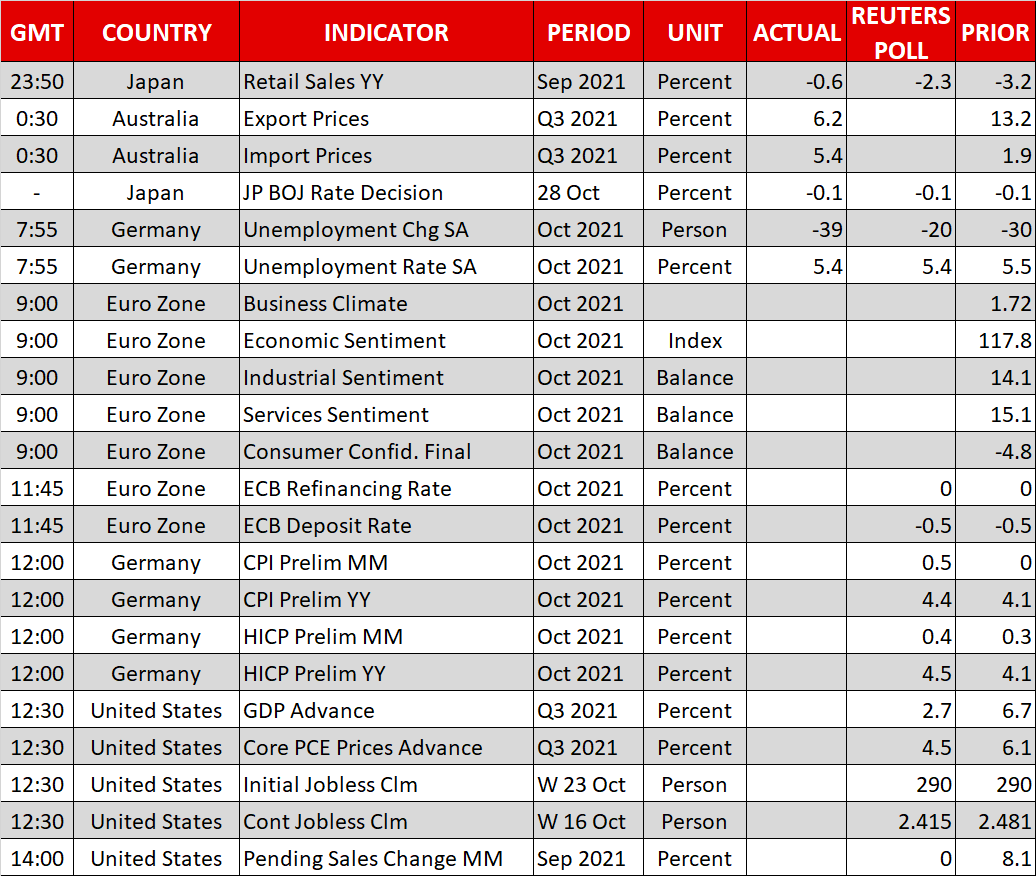
AUDUSD Stuck Around 0.7500, But Bias Still Positive
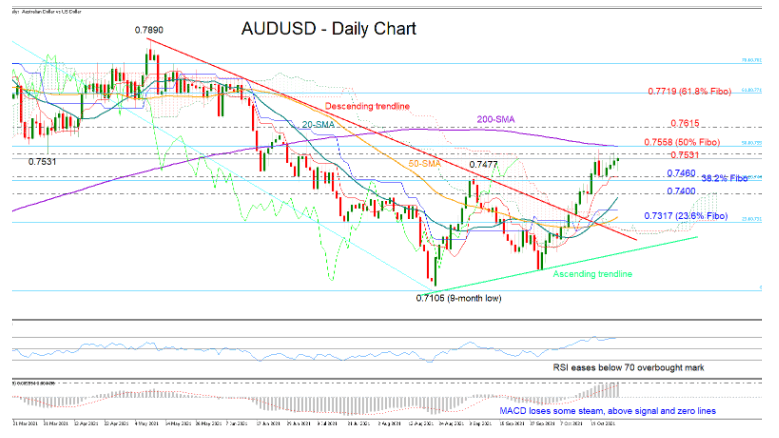
AUDUSD keeps fighting for a decisive close above the 0.7500 level for the second consecutive week, despite setting a foothold near the 0.7460 number.
The recent fruitless bullish attempts suggest buying forces are fizzling out, with the MACD and the RSI somewhat endorsing that view as the former is rising at a relatively softer pace and the latter seems to be creating a lower high below its 70 overbought mark. Yet, as long as the indicators remain within the bullish territory, there is an opportunity for further improvement in the market.
A decisive close above the 0.7531, and more importantly, beyond the 200-day simple moving average (SMA), where the 50% Fibonacci retracement of the 0.8006 – 0.7105 downleg is resting, would pave the way towards the 0.7615 resistance from June 25. Should the rally gain fresh momentum, the next key resistance could emerge around the 61.8% Fibonacci of 0.7719.
In the negative scenario, where the floor between the 0.7460 mark and the 38.2% Fibonacci of 0.7450 collapses, the price could immediately find support around the 0.7400 number. Note the 20-day SMA is also converging to the same level, therefore any break lower from here could prompt steeper declines likely towards the 23.6% Fibonacci of 0.7317. If that’s the case, the broken descending trendline stretched from the 0.7890 peak may also attract special attention before traders target the lower supportive trendline currently seen around 0.7250.
All in all, AUDUSD still has the potential to make further progress in the short term unless the price dips back below 0.7460.
XAUUSD Is Possibly Bearish
Technical analysis
The RSI is below level 50.
The Stochastics is near the overbought zone.
Most likely scenario – SELL
Target prices: 1,798.28 1,793.80
Alternative scenario – BUY
Target prices: 1,806.72 1,813.62
Key levels
Support 1,798.28 1,793.80
Resistance 1,806.72 1,813.62

USDCAD Plummets As Divergence Between Fed And Boc Widens
The Canadian dollar jumped against the US dollar after the latest Bank of Canada decision. The bank decided to leave interest rates unchanged at 0.25%. The bank also hinted that interest rate hikes will be coming soon. This is because the bank decided to wind down the quantitative easing policy. It expects that the economy will continue doing well in the coming months. It sees the economy rising by 6.5% in 2021 and then retreating to 4.5% in 2022. The bank expects that inflation will go back to 2% in the coming year.
The euro remained in a tight range against the US dollar as investors waited for the upcoming ECB decision. The decision comes at a time when the Eurozone economy is experiencing an uneven economic recovery. Also, inflation has jumped to the highest level in more than 13 years while the unemployment rate remains high. Therefore, analysts expect that Christine Lagarde will have to achieve a balancing act. She will likely maintain her previous stance that the bank is not close to hiking interest rates. She will also likely provide hints about when tapering will happen.
The US dollar index held steady as investors waited for the first estimate of the US GDP growth in the third quarter. Economists expect the data to show that the economic recovery moderated in the third quarter. Specifically, the median estimate is that the UK economy grew by 2.7% in the third quarter after growing by 6.7% in Q2. At the same time, they expect that the GDP price index rose by 5.5%. The dollar will also react to the latest initial jobless claims numbers. The data is expected to show that the number of initial jobless claims declined to 285k last week while continuing claims declined to 2.41 million.
EURUSD
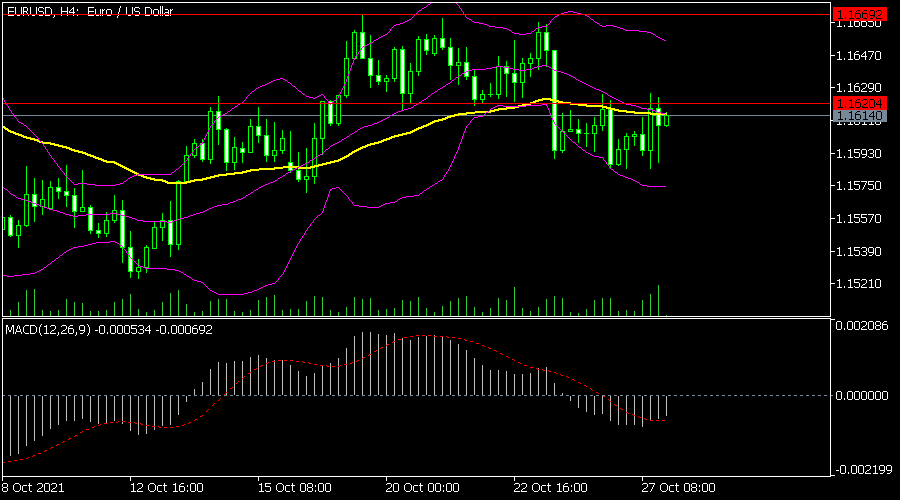
The EURUSD was relatively calm as investors waited for the ECB decision. The pair is trading at 1.1613, which was slightly above this week’s low at 1.1585. On the four-hour chart, the pair is along the middle line of the Bollinger Bands pattern. It is also along the 25-day moving average while the MACD has moved below the neutral line. Therefore, the pair will likely remain in the current range and break out in either direction after the ECB decision.
USDCAD
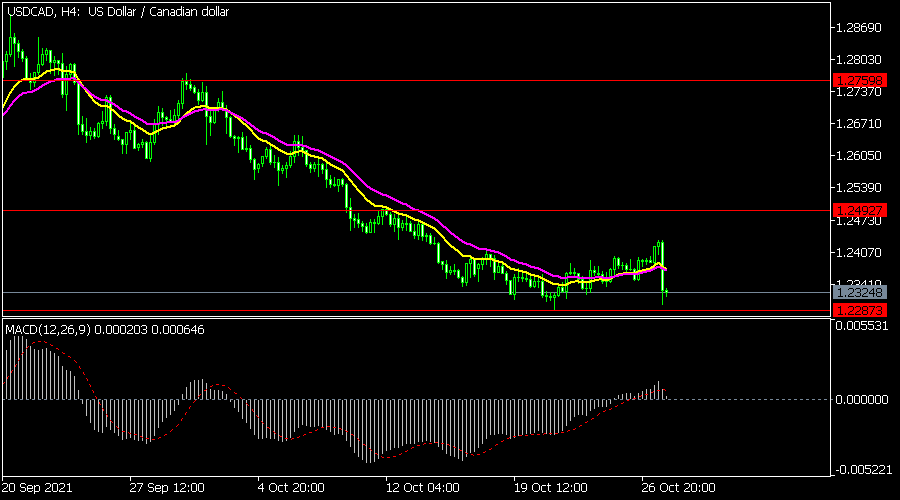
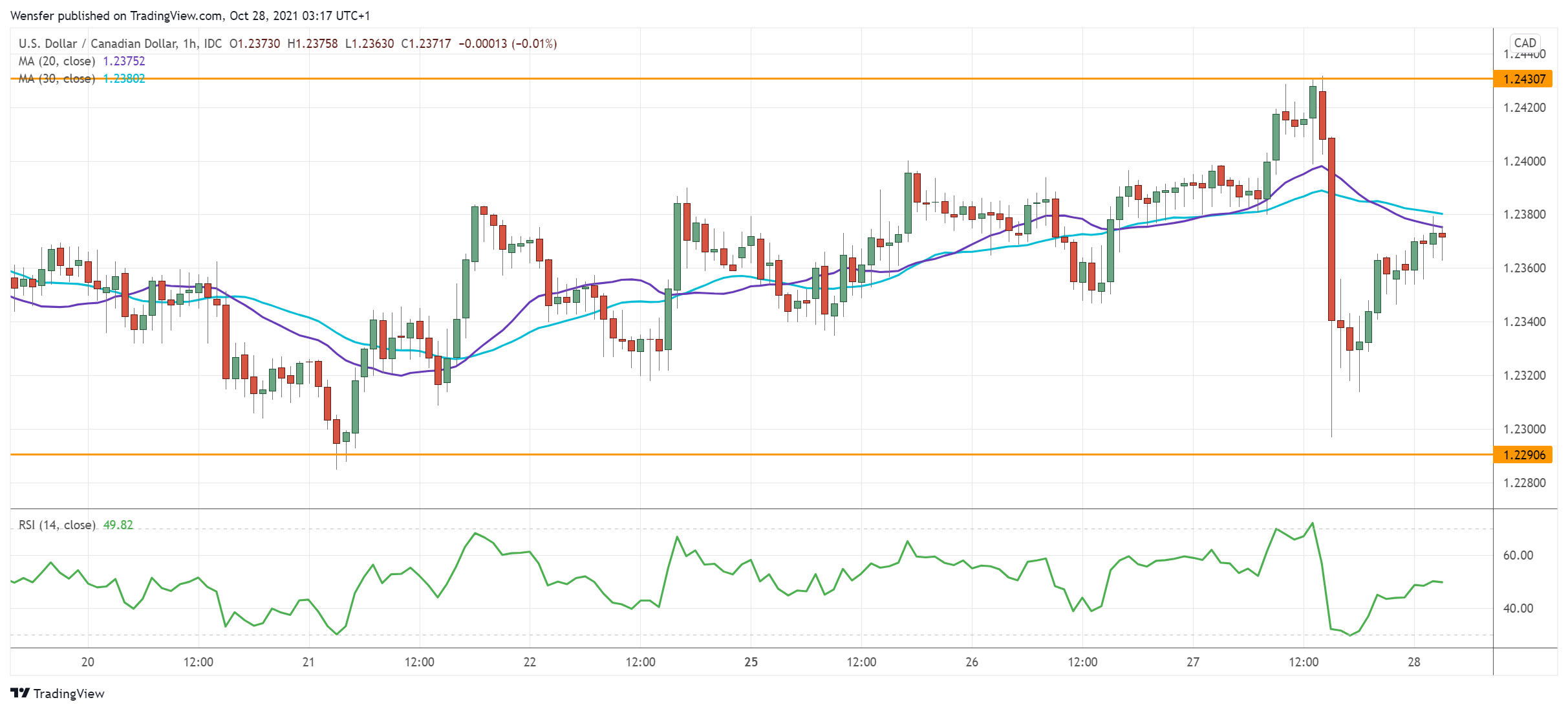
The USDCAD pair tumbled sharply after the latest BOC decision. It moved to a low of 1.2300, which was the lowest level since October 20th. On the four-hour chart, the pair moved below the short and longer-term moving averages while the MACD has formed a bullish divergence pattern. The pair will likely maintain the bearish momentum as the divergence between the Fed and BOC continue.
NDAQ
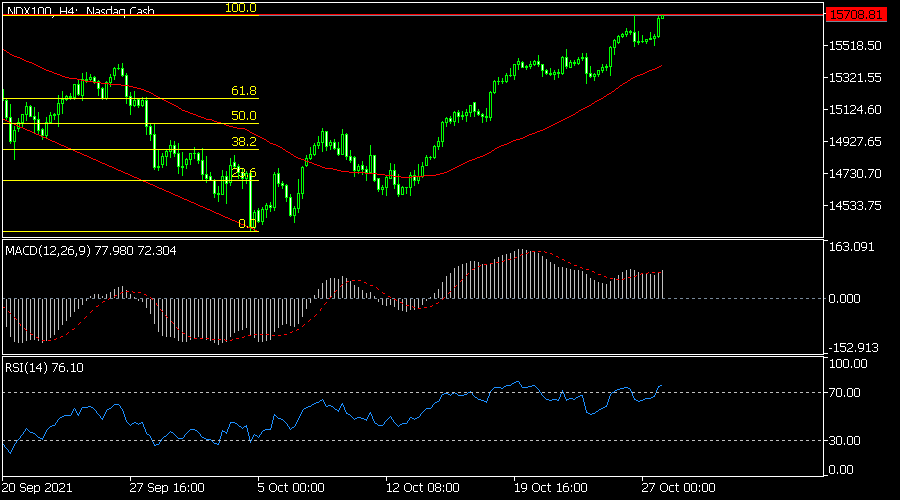
The Nasdaq 100 index soared to an all-time high as investors cheered the strong earnings by Microsoft and Google. The index is trading at $15,708, a level it has struggled to move above in the past few months. It is being supported by the short and longer-term moving averages. Momentum oscillators like the MACD and the RSI have also rebounded. Therefore, the path of least resistance for the index is to the upside.
US Oil Retraces After Overextension
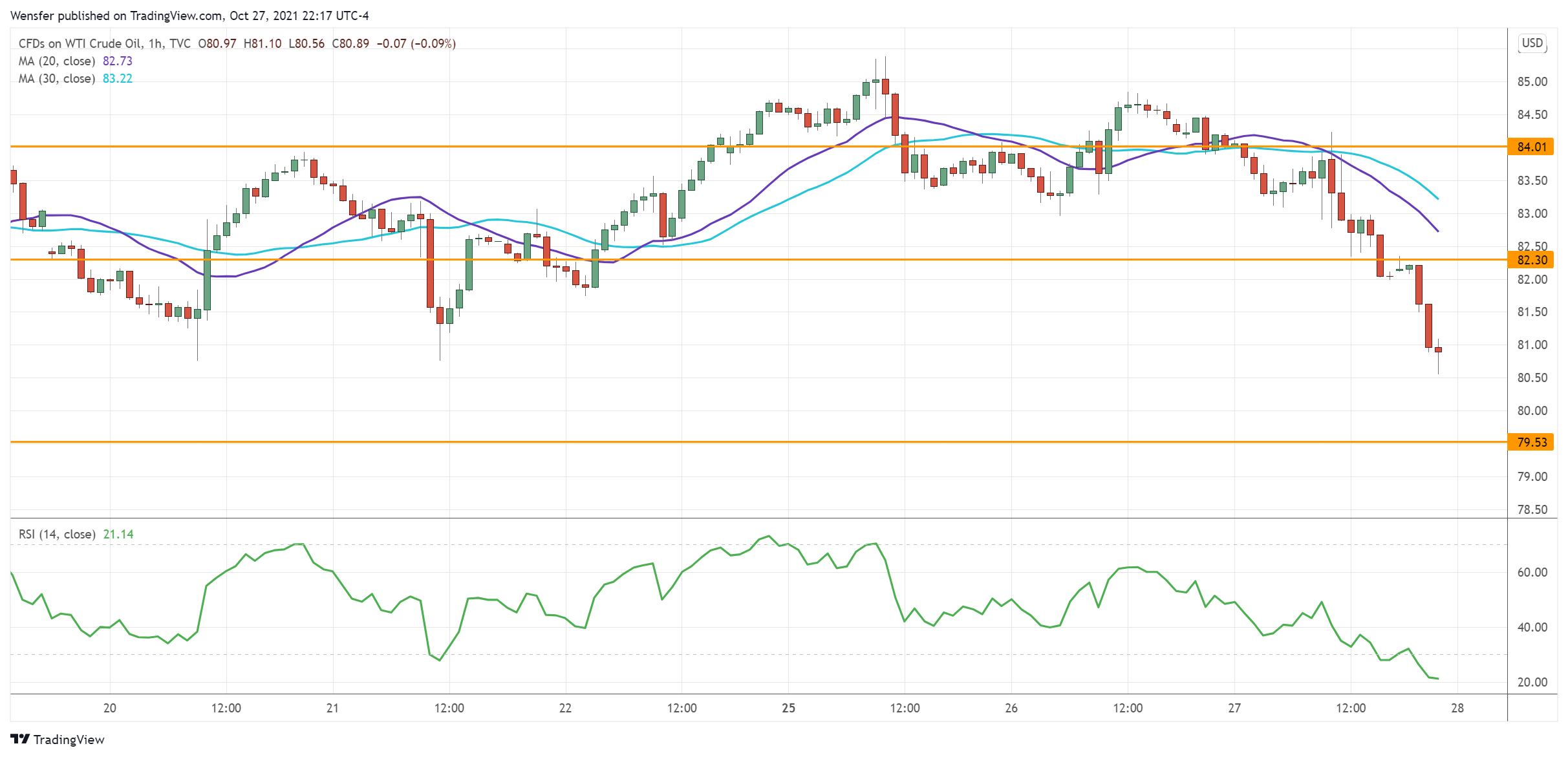
WTI crude tumbled after an unexpected surge in US inventories. Medium-term sentiment remains bullish, though an overbought RSI on the daily chart may prompt buyers to proceed with caution.
A fall below 82.50 and then 81.00 has exacerbated profit-takings as late buyers rushed for the exit. 79.50 is the next support.
A bearish breakout would extend the correction to 77.00 which was previously a resistance, making it an area of interest. An oversold RSI may trigger a rebound with 82.30 as a fresh resistance.
USD/CAD Pierces Through Supports
The Canadian dollar surged after the Bank of Canada ended its QE.
As the RSI from the daily chart showed an oversold situation, the greenback had attracted bargain hunters at its four-month low around 1.2300. However, it has given up all recent gains as it revisits the bottom.
1.2430 is now fresh resistance and the downtrend may resume. 1.2200 would be the next target as those who have been waiting for a catalyst join in. An oversold RSI has caused a temporary rebound which is likely to meet strong selling interest.
XAU/USD Consolidates Gains
Gold treads water as markets await a slew of central bank decisions in the coming days.
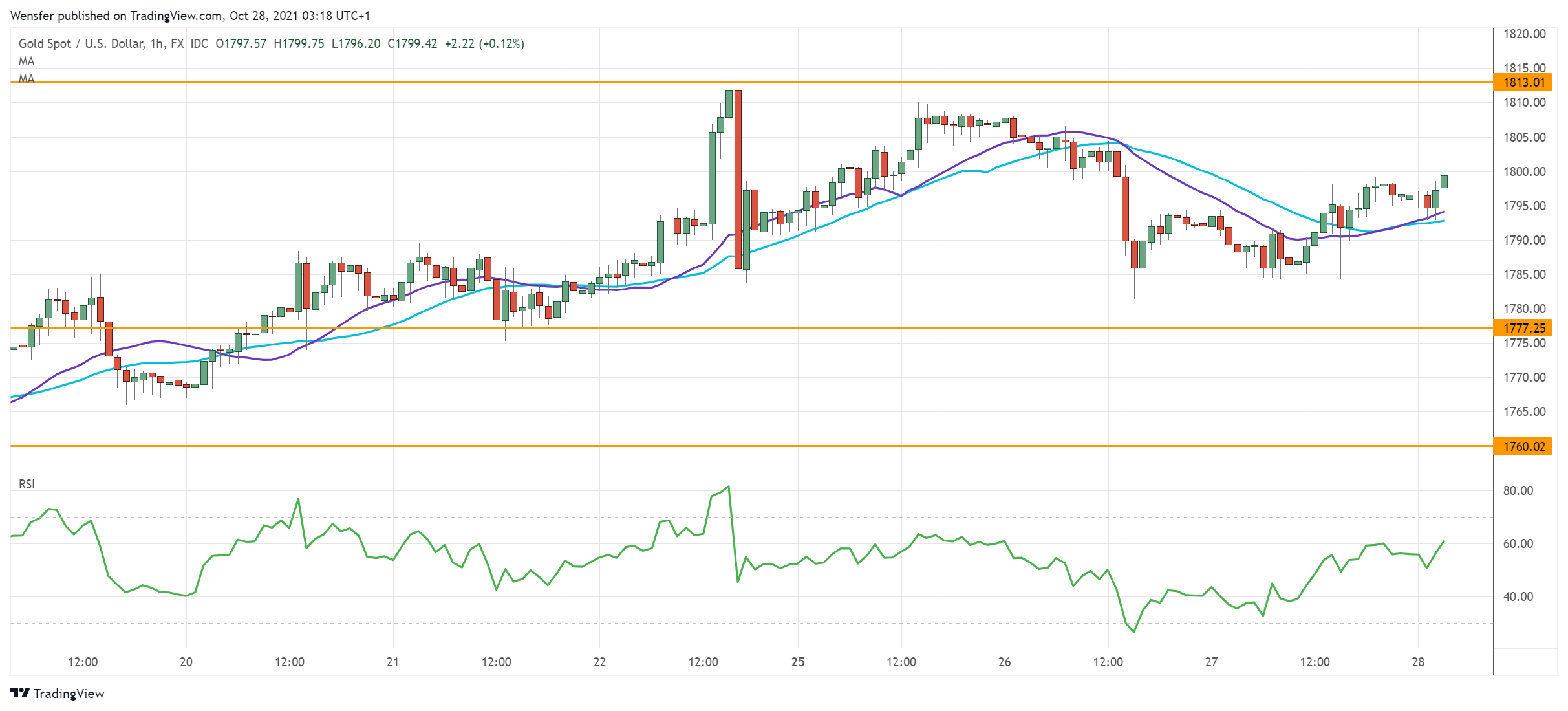
The recent break above the daily resistance at 1805 is a prerequisite for a bullish turnaround. However, the rally has met stiff selling pressure at the supply zone around 1813 which is at the origin of the September sell-off.
Along with a repeatedly overbought RSI, a combination of profit-taking and fresh selling may weigh on the precious metal in the short term. 1777 is the immediate support and its breach would send the price to 1760.