Sample Category Title
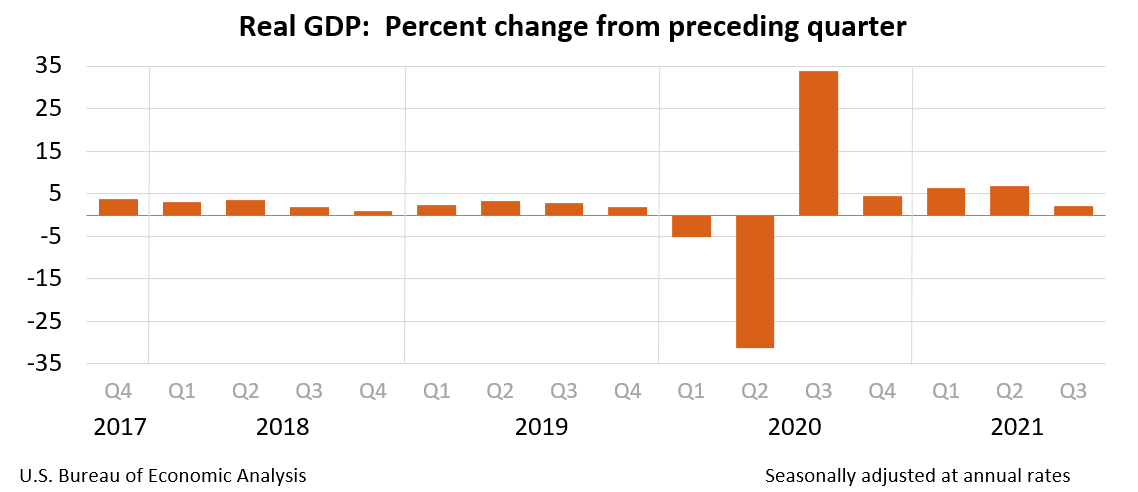
US GDP Edged Up 2.0% in Q3 as Supply Limited Growth
- GDP growth decelerated to 2.0% in Q3 from 6.7% in Q2
- Lack of availability of vehicles contributed to slower household and business spending
- Household purchasing power remains elevated, but much of the 'easy' growth to be had from the reopening of the economy is in the rear-view mirror
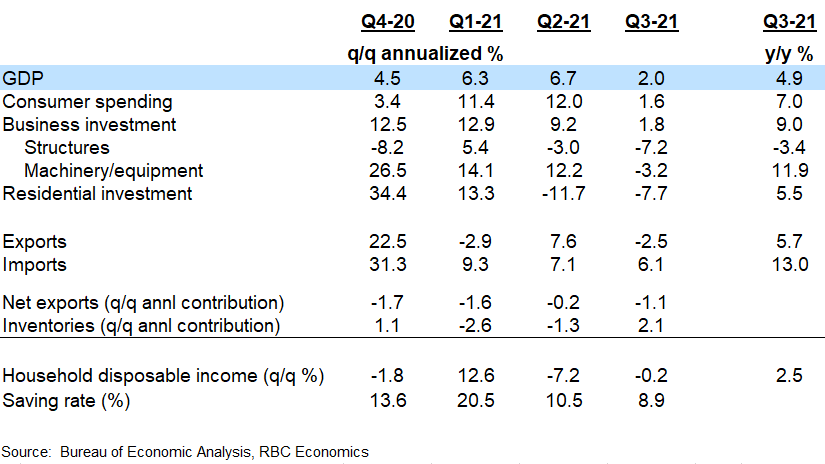
A large part of the slowing in US GDP growth in the third quarter can be attributed to supply chain disruptions limiting availability of products for purchase - particularly for motor vehicles. Consumer spending growth slowed to just 1.6% (annualized) after surging at double-digit rates in the prior 2 quarters when many parts of the country were reopening from earlier lockdowns. Most of the 9% pullback in spending on goods can be traced back to a sharp softening in consumer purchases of autos. A drop in business purchases of transportation equipment also contributed to a 3.2% pullback in business equipment investment, despite a big 11% increase in industrial equipment purchases.
Both of those declines have more to do with limits on the supply of vehicles available than underlying purchasing power. Household wages and salaries jumped almost 10% in the quarter. Overall disposable incomes were little changed as sizeable government supports continue to roll-off, but were still running 10% above pre-pandemic levels. And the household saving rate remained elevated at 8.9%. Spending on the high-contact services that have been among the hardest hit by lockdowns continued to recover. Overall spending on services was up 7.9% though remained 1.6% below pre-pandemic levels. Residential investment continued to come off the boil, with a 7.7% drop in Q3 that still left the level of activity running 13% above pre-pandemic levels.
The economy is expected to grow more quickly in the fourth quarter. Growth on the goods-producing side of the economy will continue to be limited by global supply chain disruptions and long-run capacity limits, including widely reported shortages of labour in some industries. But there is still room for further recovery in the services side of the economy. Still, it looks increasingly likely that much of the 'easy' growth to be had from the re-opening of the economy is in the rear-view mirror, and further gains will be harder to come by. We look for GDP to increase at a stronger 4.5% annualized pace in Q4.
US: Modest Economic Growth in Q3 as Stimulus Boost Reverses
The U.S. economy grew at a modest 2.0% annualized pace in the third quarter, slightly below consensus expectations.
After roaring ahead at a double-digit pace in the first half of the year, consumer spending grew only 1.6% annualized. That masks a massive divergence between spending on goods and services. Spending on durable goods reversed sharply, down 26.2% in Q3, while services grew at a healthy 7.9% pace. That still marks a slowing from 11.5% in the second quarter; some of it a natural deceleration after the initial reopening bounce, but some of it due to the surge in COVID-19 cases.
A reversal in equipment spending (-3.2%) contributed to a modest 1.8% pace for business investment. Structures investment also continued to decline, down 7.3%. Spending on intellectual property products did all the heavy lifting, up 12.2% in Q3, following through on a healthy 12.5% in Q2 and a 15.6% gain in Q1.
Residential investment fell for the second consecutive quarter, down 7.7%. Like spending on consumer durables and business equipment, residential investment grew at an unsustainable pace earlier in the pandemic and remains 13.4% higher than pre-pandemic levels.
Government spending rose a modest 0.8% in Q3, after a decline in Q2. A decline in federal government activity (-4.7%) due to the winddown of the Paycheck Protection Program was more than offset by a jump up in spending at the state and local level (+4.4%) propelled by school re-openings.
Inventories contributed two percentage points to annualized Q3 growth, after drawdowns subtracted an average of two percentage points in the first half of the year.
Imports grew at a healthy 6.1% pace, while exports dropped 2.5% in Q3. Therefore, net exports continued to subtract from growth (-1.1%-pts) as they have every quarter since the rebound began.
Finally, price pressures were strong in Q3, but not quite as strong as Q2. The core PCE deflator rose 4.5% on an annualized quarter-over-quarter basis (versus 6.1% in Q2).
Key Implications
The third quarter's slowdown can largely be chalked up to the slowdown in consumer spending from a stimulus-driven surge in the first half of the year. Two sizeable rounds of fiscal stimulus drove a surge in durables spending, which, even after Q3's decline, is still nearly 20% above pre-pandemic levels in real terms. The reversal in durables spending alone subtracted 2.7 percentage points from GDP growth. Supply chain constraints also played a role, with 2.4 percentage points of the durables drop due to the decline in spending on motor vehicles thanks to shortages in autos on dealer lots.
The surge in infections due to the Delta variant played a lesser role for consumers, with some evidence it constrained spending on food services and accommodation. We will see more on that in tomorrow's monthly PCE data. Delta is perhaps playing a bigger role on the global stage by contributing to shortages of various imported goods, and a slower recovery in many U.S. trading partners, constraining exports. The level of exports remains 10.3% below its Q4 2019 level, one of the only major GDP components, along with non-residential structures investment, that is still below its pre-pandemic level.
The slowdown in economic growth in Q3 is likely to prove a one-off with the economy set to accelerate a 4%+ pace in Q4. Tomorrow's consumer spending report for September will set the tone on how strong momentum was heading into the fourth quarter. We expect healthy growth in the quarters ahead, but slower than the initial phases of the rebound, as various supply constraints weigh on activity.
Sunset Market Commentary
Markets
You could’ve more or less skipped three quarters of today’s European session. Not even consensus-beating Spanish and German CPI managed to cause a wrinkle worth mentioning. The sidelines were crammed with investors awaiting the ECB policy meeting. As expected, not a lot changed, if not nothing. The ECB keeps the main policy rate at -0.5%, continues buying under APP at €20bn/m and sticks to buying under PEPP at a moderately lower pace to keep financing conditions favourable enough. The ECB remains confident of solid economic growth although momentum has moderated and the outlook gets cloudier as high (energy) prices may weigh on consumer demand and material and labour shortages hamper production. It is equally confident of its analysis that inflation is still temporary. Lagarde said they have discussed the topic extensively (talked about “inflation, inflation and inflation”) but in the end stuck to the view that energy, rising demand and supply bottlenecks are fueling prices these days and should ease in the course of next year. Markets disagree and have sent inflation expectations to multiyear highs over the course of the month while also starting to price in rate hikes (end 2022). On the latter, Lagarde echoed chief economist Lane, saying they are not in line with forward guidance – although she didn’t want to say markets were getting ahead of themselves either. All in all, the ECB did a poor job convincing markets of a view that increasingly isolates the central bank from most of its colleagues in advanced economies. “Temporary but for a little longer” doesn’t cut it anymore. Investors assume that the longer the ECB ignores what’s in plain sight, the harder it’ll have to react eventually. Hence today’s market reaction. German yields soared across the spectrum with yields as much as 6bps+ higher at some point before halving in early and typically volatile US dealings. Peripheral spreads widen up to 8 bps in Italy. US yields were caught in the slipstream but pared gains afterwards in lockstep with Germany. Changes vary from 1.8 bps (2y) to 3 bps (5y) over 0.8 bps (10y). US GDP disappointed slightly but that was already before yield’s momentum faded. Q3 GDP growth eased from 6.7% q/q (annualized) to 2% (vs 2.6% expected). Personal consumption accounted for half of the economic growth. Gross investments added 2% but exclusively on the back of inventories while net exports (-1%) weighed on growth. EUR/USD enjoys the rate support and bounces from sub 1.16 to 1.1636 currently.
News Headlines
The Swedish Statistical office reported that Sweden’s GDP growth rose 1.8% Q/Q, bringing activity in the economy to 4.7% y/y. Yesterday, the Budget office already highlighted the positive impact of strong growth on Sweden’s deficit and government debt metrices. The positive news flow recently translated in a rise of MM rates and rates in short-term government bonds. The Sept/Dec 3M FRA today jumped 10 bps to 0.305%. The krone maintains recent gains and is holding below the psychological barrier of EUR/SEK 10.00 (currently 9.9675).
The CBRT in its new inflation report expects inflation to be at 18.4% at the end of the year compared to 14.1% earlier. It also raised the 2022 forecast (from 7.8% to 11.8%) and 2023 (7.0% from 5.0%). Governor Kavcioglu repeated the CBTR’s view that some of the factors causing inflation to rise, including food and import prices and supply-side disruptions, are expected to ease in the near future. Next Turkish inflation data will be published on November 3. The lira again traded in the defensive today, with EUR/TYR rising to 11.17.
Preliminary Belgian Q3 GDP rose 1.8% Q/Q resulting in a 4.7% Y/Y growth, the National Bank of Belgium published today. Activity now exceeds the pre-corona level. Value added declined 0.1 % from the previous quarter in industry and was down 0.5 % in construction. Value added was up by 2.3 % in services. The Belgian statistics office reported Belgian inflation in October to have accelerated 1.47% M/M and 4.16 Y/Y. The latter was the highest reading since October 2008. Core inflation rose from 1.61% to 1.95%. The most significant price increases were registered in natural gas, electricity, motor fuels, heating oil, restaurants and cafés and the purchase of vehicles.
USD/JPY Mid-Day Outlook
Daily Pivots: (S1) 113.41; (P) 113.81; (R1) 114.24; More...
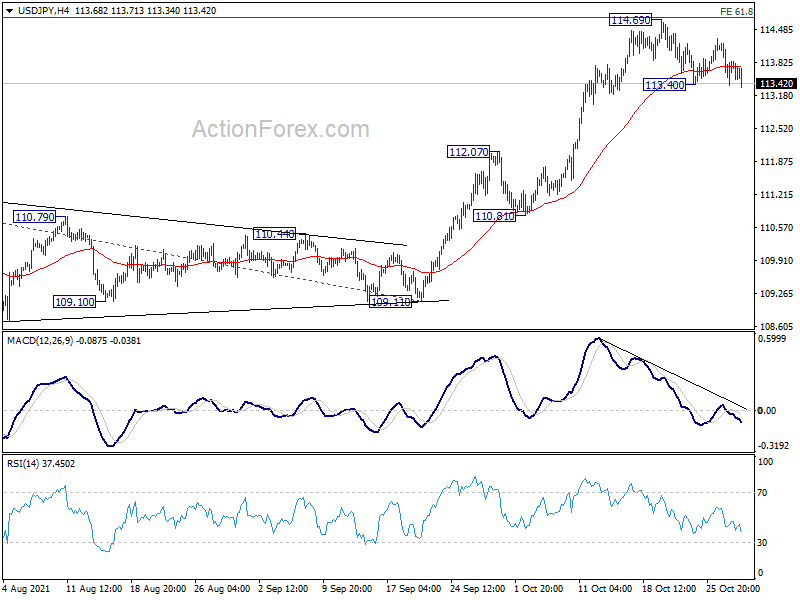
Intraday bias in USD/JPY is now mildly on the downside, as corrective fall from 114.69 is extending lower. Downside should be contained above 112.07 resistance turned support to bring rebound. On the upside, firm break of 114.69 will resume the larger up trend to 100% projection of 102.58 to 111.65 from 109.11 at 118.18 next.
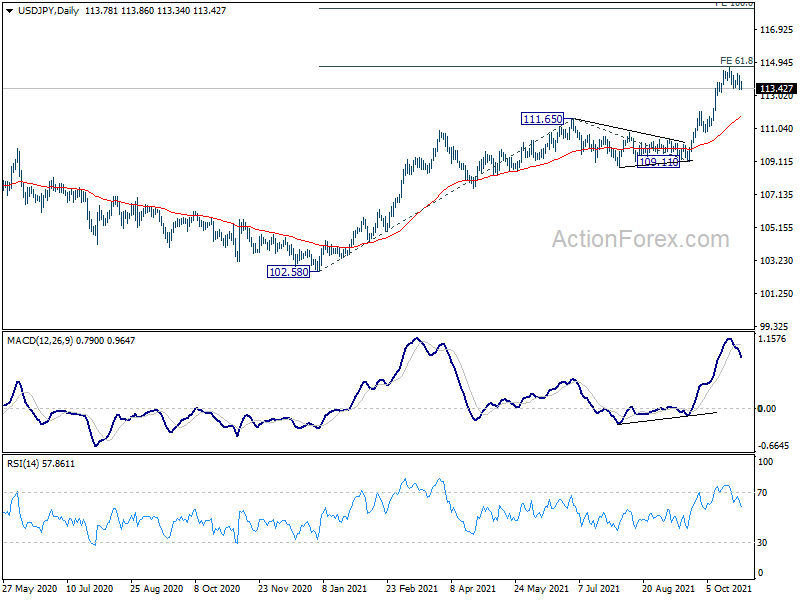
In the bigger picture, corrective decline from 118.65 (2016 high) should have completed at 101.18 already. Rise from the 102.58 is seen as the third leg of the up trend from 101.18. Next target is 114.54 resistance and then 118.65 high. This will now be the preferred case as long as 109.11 support hold, even in case of deep pull back.
USD/CHF Mid-Day Outlook
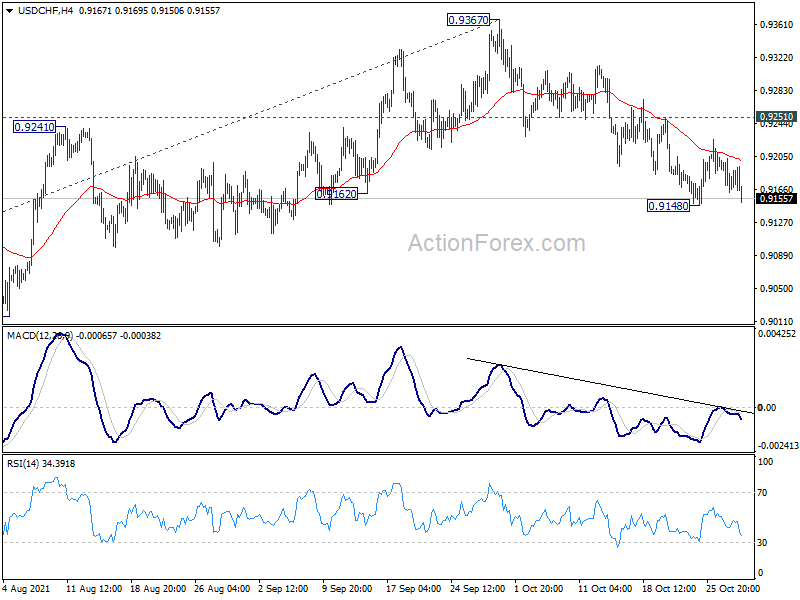
Daily Pivots: (S1) 0.9163; (P) 0.9183; (R1) 0.9202; More....
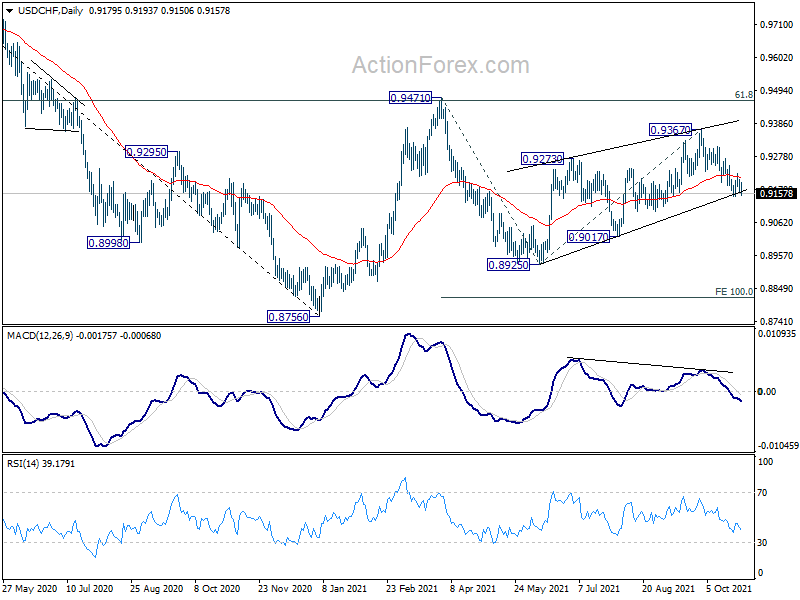
USD/CHF is holding above 0.9148 temporary low and intraday bias stays neutral first. Further decline is still in favor with 0.9251 minor resistance intact. Corrective rise from 0.8927 should be complete with three waves up to 0.9367, on bearish divergence condition in daily MACD. Below 0.9148 will target 0.9017 support first, and then 0.8925 support next. On the upside, however, break of 0.9251 minor resistance will turn bias back to the upside for retesting 0.9367 instead.
In the bigger picture, the corrective structure of the rebound from 0.8925 argues that fall from 0.9471 is not completed yet. It could either be the second leg of pattern from 0.8756 (2021 low), or resuming larger down trend from 1.0237 (2018 high). We'd pay attention to the downside momentum and assess the odds later. But for now, medium term outlook will be neutral at best as long as 0.9471 resistance holds.
GBP/USD Mid-Day Outlook
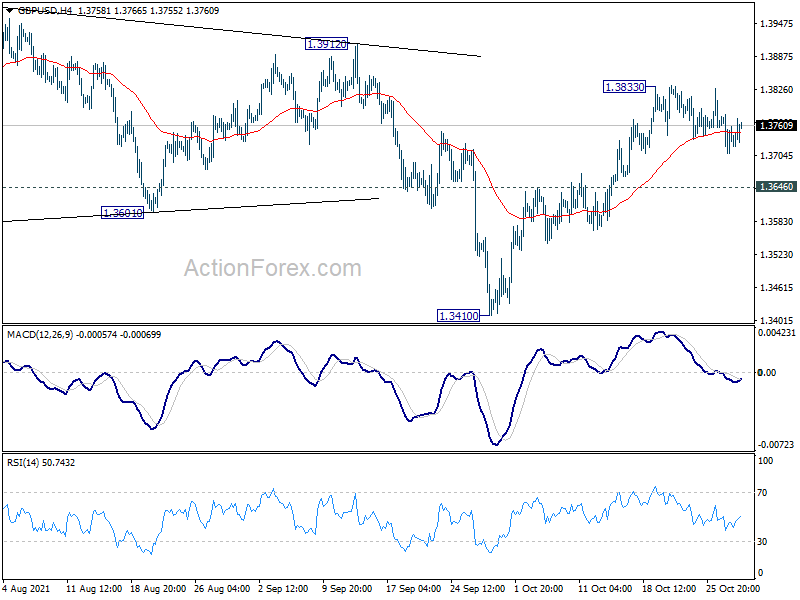
Daily Pivots: (S1) 1.3707; (P) 1.3744; (R1) 1.3778; More...
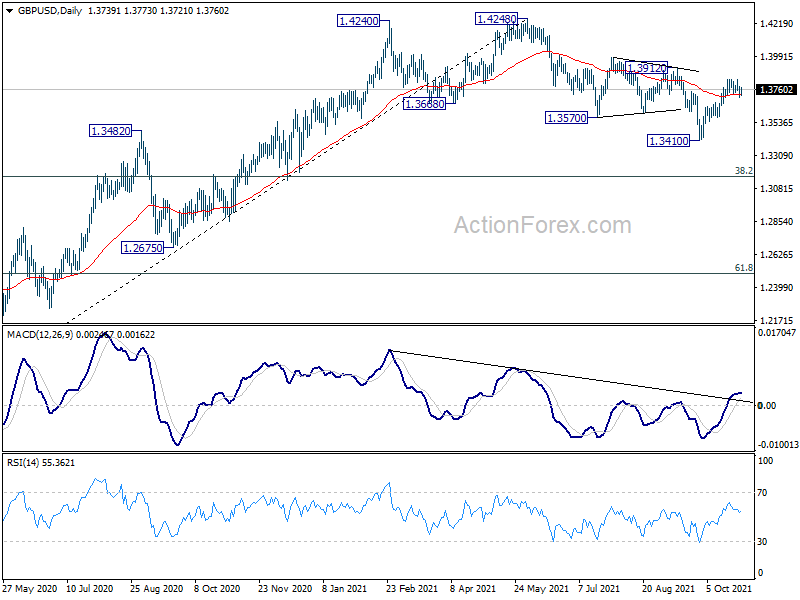
Intraday bias is still extending the consolidation from 1.3833 and intraday bias remains neutral. Further rise is expected with 1.3646 support intact. On the upside, above 1.3833 will target 1.3912 key structural resistance. Firm break there will indicate that the correction from 1.4248 is complete with three waves down to 1.3410. Further rally would then be seen to retest 1.4248 high. However, break of 1.3646 will turn bias to the downside for retesting 1.3410 low.
In the bigger picture, the structure of the fall from 1.4248 suggests that it's a correction to the up trend from 1.1409 (2020 low) only. While deeper fall cannot be ruled out yet, downside should be contained by 38.2% retracement of 1.1409 to 1.4248 at 1.3164, at least on first attempt, to bring rebound. On the upside, firm break of 1.4376 key resistance (2018 high) will add to the case of long term bullish reversal. However, sustained trading below 1.3164 will revive some medium term bearishness and target 61.8% retracement at 1.2493.
EUR/USD Mid-Day Outlook
Daily Pivots: (S1) 1.1583; (P) 1.1605; (R1) 1.1624; More...
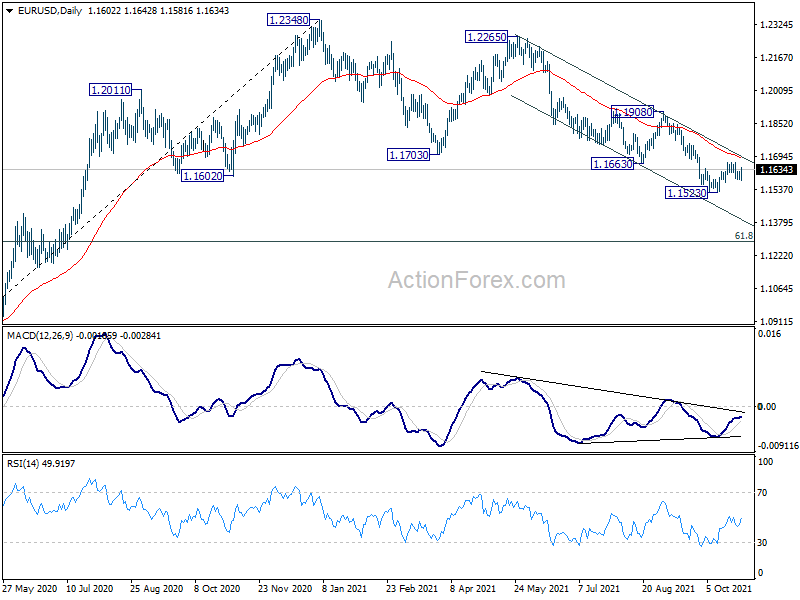
EUR/USD recovers today but stays below 1.1668 temporary top. Intraday bias remains neutral first. On the upside, break of 1.1668 will target 55 day EMA (now at 1.1688). Sustained break there will be a sign that larger correction from 1.2348 has completed. Stronger rally would be seen to 1.1908 resistance for confirmation. On the downside, though, break of 1.1571 minor support will turn bias back to the downside for 1.1523 support instead. Break there will resume larger fall from 1.2348.
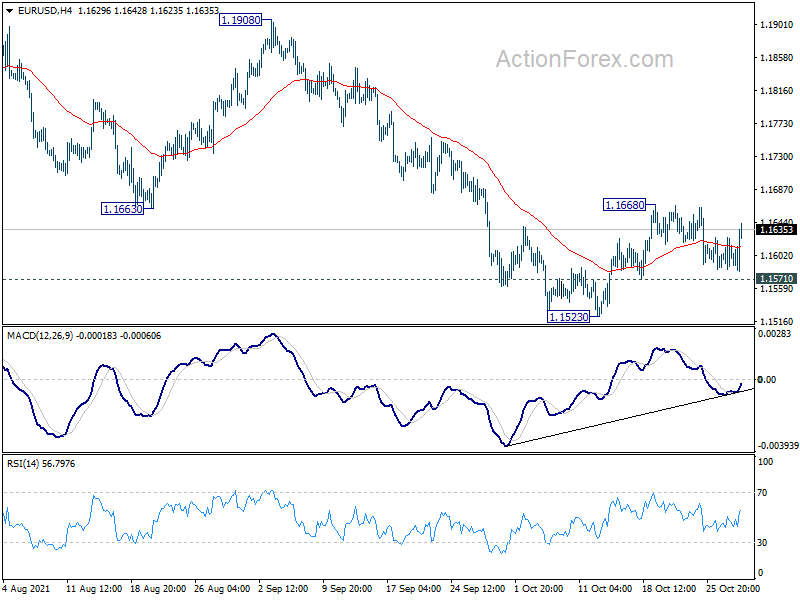
In the bigger picture, price actions from 1.2348 should at least be a correction to rise from 1.0635 (2020 low). As long as 1.1908 resistance holds, deeper fall would be seen to 61.8% retracement of 1.0635 to 1.2348 at 1.1289. Nevertheless break of 1.1908 resistance will revive medium term bullishness and turn focus back to 1.2348 high.
Euro Mildly Higher after ECB, Dollar Dips Slightly on GDP Miss
Major pairs and crosses are stuck inside yesterday's range so far, as consolidative trading continues. Euro appears to be lifted slightly by ECB's press conference but there is no follow through buying. Dollar also looks just a touch weaker after worse than expected Q3 GDP data. Overall, commodity currencies are the softer ones, with eyes on broader risk sentiment.
Technically, Euro would be back in focus for the rest of the week. In particular, break of 1.1668 minor resistance in EUR/USD will resume the rebound from 1.1523. Break of 0.8467 minor resistance in EUR/GBP will suggest short term bottoming at 0.8401. Similarly, break of 1.5598 minor resistance in EUR/AUD will also indicate short term bottoming at 1.5393. Break of all these levels will indicate that Euro is at least staging a broad based near term rebound.
In Europe, at the time of writing, FTSE is down -0.30%. DAX is down -0.42%. CAC is up 0.39%. Germany 10-year yield is up 0.064 at -0.112. Earlier in Asia, Nikkei dropped -0.96%. Hong Kong HSI dropped -0.28%. China Shanghai SSE dropped -0.28%. Japan 10-year JGB yield dropped -0.010 to 0.088.
US GDP grew 2.0% annualized in Q3, missed expectations
US GDP grew 2.0% annualized in Q3, below expectation of 2.6%. The increase in real GDP in the third quarter reflected increases in private inventory investment, personal consumption expenditures (PCE), state and local government spending, and nonresidential fixed investment that were partly offset by decreases in residential fixed investment, federal government spending, and exports. Imports, which are a subtraction in the calculation of GDP, increased.
US initial jobless claims dropped to 281k, continuing claims down to 2.24m
US initial jobless claims dropped -10k to 281k in the week ending October 23, slightly better than expectation of 289k. That's the lowest level since March 14, 2020. Four-week moving average of initial claims dropped -21k to 299k, lowest since March 14, 2020 too.
Continuing claims dropped -237k to 2243k in the week ending October 16, lowest since March 14, 2020. Four-week moving average of continuing claims dropped -142k to 2513k, lowest since March 21, 2020.
ECB stands pat, continues PEPP with moderately lower pace
ECB kept monetary policy unchanged as widely expected. The interest rates on the marginal lending facility and the deposit facility will remain unchanged at 0.00%, 0.25% and -0.50% respectively. The forward guidance is maintained.
That is, "the Governing Council expects the key ECB interest rates to remain at their present or lower levels until it sees inflation reaching two per cent well ahead of the end of its projection horizon and durably for the rest of the projection horizon, and it judges that realised progress in underlying inflation is sufficiently advanced to be consistent with inflation stabilising at two per cent over the medium term. This may also imply a transitory period in which inflation is moderately above target."
PEPP purchases will continue with a total envelop of EUR 1850B, until at least end of March 2022. The pace of net asset purchases will remain "moderately lower" than in Q2 and Q3. APP purchases will continue at a monthly pace of EUR 20B too.
Eurozone economic sentiment indicator rose to 118.6, EU ESI rose to 117.6
Eurozone Economic Sentiment Indicator rose to 118.6 in October, up from 117.8, above expectation of 116.9. Employment Expectations Indicator rose from 113.4 to 114.5. Industrial confidence rose from 14.1 to 14.2. Services confidence rose from 15.2 to 18.2. Consumer confidence dropped from -4.0 to -4.8. Retail trade confidence rose from 1.4 to 2.0. Construction confidence rose from 7.5 to 8.9.
EU ESI rose from 116.6 to 117.6. Amongst the largest EU economies, the ESI rose in Spain (+2.5), France (+2.1), Italy (+1.8), Poland (+1.5) and the Netherlands (+1.4), while it weakened slightly in Germany (-0.5).
From Germany, unemployment rate dropped to 5.4% in October, matched expectations.
BoJ stands pat, downgrades 2021 GDP and CPI forecasts
BoJ kept monetary policy unchanged today as widely expected. Under the yield curve control framework, short-term policy interest rate is held at -0.1%. 10-year yield target is maintained at around 0%, with JGB purchases without upper limit. It also reiterated that BoJ will continue with QQE with YCC "as long as it is necessary" for maintaining inflation at 2% target in a stable manner. It will also continue expanding the monetary base core CPI exceeds 2% and stays above in a stable manner.
Economic projections comparing to July forecast:
- Fiscal 2021 GDP growth downgraded from 3.8% to 3.4%.
- Fiscal 2022 GDP growth upgraded from 2.7% to 2.9%.
- Fiscal 2023 GDP growth unchanged at 1.3%.
- Fiscal 2021 CPI core downgraded from 0.6% to 0.0%.
- Fiscal 2022 CPI core unchanged at 0.9%.
- Fiscal 2023 CPI core unchanged at 1.0%.
BoJ Kuroda: Yen's recent weakening is definitely positive
In the post meeting press conference, BoJ Governor Haruhiko Kuroda said, "the yen's recent weakening, as a whole, is definitely positive for Japan's economy. It's good for exports and lifts the yen-based profits firms earn overseas. It more than offsets the negative impact from rising import costs."
"At present, currency rates are moving in line with fundamentals," he said. "I therefore see no problems with the moves". He added, "there's no pre-set norm on the desirable level of real, effective exchange rates. I won't comment on specific levels."
"In the long run, if growth accelerates and the output gap turns positive, we'll likely see inflation accelerate and heighten inflation expectations," Kuroda said. "Under current conditions, there are more merits than demerits in maintaining ultra-loose monetary policy."
EUR/USD Mid-Day Outlook
Daily Pivots: (S1) 1.1583; (P) 1.1605; (R1) 1.1624; More...
EUR/USD recovers today but stays below 1.1668 temporary top. Intraday bias remains neutral first. On the upside, break of 1.1668 will target 55 day EMA (now at 1.1688). Sustained break there will be a sign that larger correction from 1.2348 has completed. Stronger rally would be seen to 1.1908 resistance for confirmation. On the downside, though, break of 1.1571 minor support will turn bias back to the downside for 1.1523 support instead. Break there will resume larger fall from 1.2348.
In the bigger picture, price actions from 1.2348 should at least be a correction to rise from 1.0635 (2020 low). As long as 1.1908 resistance holds, deeper fall would be seen to 61.8% retracement of 1.0635 to 1.2348 at 1.1289. Nevertheless break of 1.1908 resistance will revive medium term bullishness and turn focus back to 1.2348 high.
Economic Indicators Update
| GMT | Ccy | Events | Actual | Forecast | Previous | Revised |
|---|---|---|---|---|---|---|
| 23:50 | JPY | Retail Trade Y/Y Aug | -0.60% | -2.30% | -3.20% | |
| 00:30 | AUD | Import Price Index Q/Q Q3 | 5.40% | 3.60% | 1.90% | |
| 02:45 | JPY | BoJ Rate Decision | -0.10% | -0.10% | -0.10% | |
| 07:55 | EUR | Germany Unemployment Rate Oct | 5.40% | 5.40% | 5.50% | |
| 07:55 | EUR | Germany Unemployment Change Oct | -39K | -20K | -30K | |
| 09:00 | EUR | Eurozone Economic Sentiment Indicator Oct | 118.6 | 116.9 | 117.8 | |
| 09:00 | EUR | Eurozone Services Sentiment Oct | 18.2 | 16.5 | 15.1 | 15.2 |
| 09:00 | EUR | Eurozone Industrial Confidence Oct | 14.2 | 12.5 | 14.1 | |
| 09:00 | EUR | Eurozone Consumer Confidence Oct F | -4.8 | -4.8 | -4.8 | -4 |
| 11:45 | EUR | ECB Rate Decision | 0.00% | 0.00% | 0.00% | |
| 12:00 | EUR | Germany CPI M/M Oct P | 0.50% | 0.50% | 0.00% | |
| 12:00 | EUR | Germany CPI Y/Y Oct P | 4.50% | 4.40% | 4.10% | |
| 12:30 | EUR | ECB Press Conference | ||||
| 12:30 | USD | Initial Jobless Claims (Oct 22) | 281K | 289K | 290K | |
| 12:30 | USD | GDP Annualized Q3 P | 2.00% | 2.60% | 6.70% | |
| 12:30 | USD | GDP Price Index Q3 P | 5.70% | 5.30% | 6.10% | |
| 14:00 | USD | Pending Home Sales M/M Sep | 2.10% | 8.10% | ||
| 14:30 | USD | Natural Gas Storage | 86B | 92B |
(ECB) Introductory Statement to the Press Conference
Good afternoon, the Vice-President and I welcome you to our press conference.
The euro area economy continues to recover strongly, although momentum has moderated to some extent. Consumers continue to be confident and their spending remains strong. But shortages of materials, equipment and labour are holding back production in some sectors. Inflation is rising, primarily because of the surge in energy prices but also as the recovery in demand is outpacing constrained supply. We foresee inflation rising further in the near term, but then declining in the course of next year.
Market interest rates have increased since our last meeting in early September. However, overall financing conditions currently remain favourable for firms, households and the public sector. Favourable financing conditions are essential for the economy to continue its recovery and to counter the negative impact of the pandemic on the inflation path.
We continue to judge that favourable financing conditions can be maintained with a moderately lower pace of net asset purchases under the pandemic emergency purchase programme (PEPP) than in the second and third quarters of this year.
We also confirmed our other measures, namely the level of the key ECB interest rates, our forward guidance on their likely future evolution, our purchases under the asset purchase programme (APP), our reinvestment policies and our longer-term refinancing operations, as detailed in the press release published at 13:45 today. We stand ready to adjust all of our instruments, as appropriate, to ensure that inflation stabilises at our two per cent target over the medium term.
I will now outline in more detail how we see the economy and inflation developing and will then talk about our assessment of financial and monetary conditions.
Economic activity
The economy continued to grow strongly in the third quarter, even though momentum moderated to some extent. We still expect output to exceed its pre-pandemic level by the end of the year.
The grip of the pandemic on the economy has visibly weakened, with restrictions being lifted as a result of successful health measures and large numbers of people now vaccinated. This is supporting consumer spending, especially on entertainment, dining, travel and transportation. But higher energy prices may reduce purchasing power in the months to come.
The recovery in domestic and global demand is also supporting production and business investment. That said, shortages of materials, equipment and labour are holding back the manufacturing sector. Delivery times have lengthened considerably, and transport costs and energy prices have surged. These constraints are clouding the outlook for the coming quarters.
The labour market continues to improve. Unemployment has fallen and the number of people in job retention schemes is down significantly from the peak last year. This supports the prospect of higher incomes and increased spending. But, both the number of people in the labour force and the hours worked in the economy remain below their pre-pandemic levels.
To sustain the recovery, targeted and coordinated fiscal support should continue to complement monetary policy. This support will also help the economy adjust to the structural changes that are under way. An effective implementation of the Next Generation EU programme and the "Fit for 55" package will contribute to a stronger, greener and more even recovery across euro area countries.
Inflation
Inflation increased to 3.4 per cent in September. We expect it to rise further this year. But while the current phase of higher inflation will last longer than originally expected, we expect inflation to decline in the course of next year.
The upswing in inflation largely reflects a combination of three factors. First, energy prices – especially for oil, gas and electricity – have risen sharply. In September, energy inflation accounted for about half of overall inflation. Second, prices are also going up because recovering demand related to the reopening of the economy is outpacing supply. These dynamics are especially visible in the prices of consumer services, as well as the prices of goods affected most strongly by supply shortages. And finally, base effects related to the end of the VAT cut in Germany are still contributing to higher inflation.
We expect the influence of all three factors to ease in the course of 2022 or to fall out of the year-on-year inflation calculation. As the recovery continues, the gradual return of the economy to full capacity will underpin a rise in wages over time. Market and survey-based measures of longer-term inflation expectations have moved closer to two per cent. These factors will support underlying inflation and the return of inflation to our target over the medium term.
Risk assessment
The recovery continues to depend on the course of the pandemic and further progress with vaccinations. We see the risks to the economic outlook as broadly balanced. In the near term, supply bottlenecks and rising energy prices are the main risks to the pace of recovery and the outlook for inflation. If supply shortages and higher energy prices last longer, these could slow down the recovery. At the same time, if persistent bottlenecks feed through into higher than anticipated wage rises or the economy returns more quickly to full capacity, price pressures could become stronger. However, economic activity could outperform our expectations if consumers become more confident and save less than currently expected.
Financial and monetary conditions
Growth and medium-term inflation dynamics still depend on favourable financing conditions for all sectors of the economy. Market interest rates have increased. Nevertheless, financing conditions for the economy remain favourable, not least because bank lending rates for firms and households remain at historically low levels. While there was a pick-up in September, lending to firms remains moderate. This continues to reflect the fact that firms generally need less external funding, since these have high cash holdings and are increasingly retaining their earnings. Lending to households remains strong, driven by demand for mortgages. Our most recent bank lending survey shows that credit conditions for firms stabilised and were supported – for the first time since 2018 – by a reduction in banks' risk perceptions. By contrast, banks are taking a slightly more cautious approach to housing loans and have tightened their lending standards for these loans accordingly. Bank balance sheets continue to be supported by favourable funding conditions and remain solid.
Conclusion
Summing up, the euro area economy continues to recover strongly, although at a more moderate pace. Rising energy prices, the recovery in demand and supply bottlenecks are currently pushing up inflation. While inflation will take longer to decline than previously expected, we expect these factors to ease in the course of next year. We continue to foresee inflation in the medium term remaining below our two per cent target. Our policy measures, including our revised forward guidance on the key ECB interest rates, are crucial to helping the economy shift to a sustained recovery and, ultimately, to bringing inflation over the medium term to our target.
We are now ready to take your questions.
US GDP grew 2.0% annualized in Q3, missed expectations
US GDP grew 2.0% annualized in Q3, below expectation of 2.6%. The increase in real GDP in the third quarter reflected increases in private inventory investment, personal consumption expenditures (PCE), state and local government spending, and nonresidential fixed investment that were partly offset by decreases in residential fixed investment, federal government spending, and exports. Imports, which are a subtraction in the calculation of GDP, increased.