Sample Category Title
Australia retail sales rose 1.3% mom in Sep, vary by state
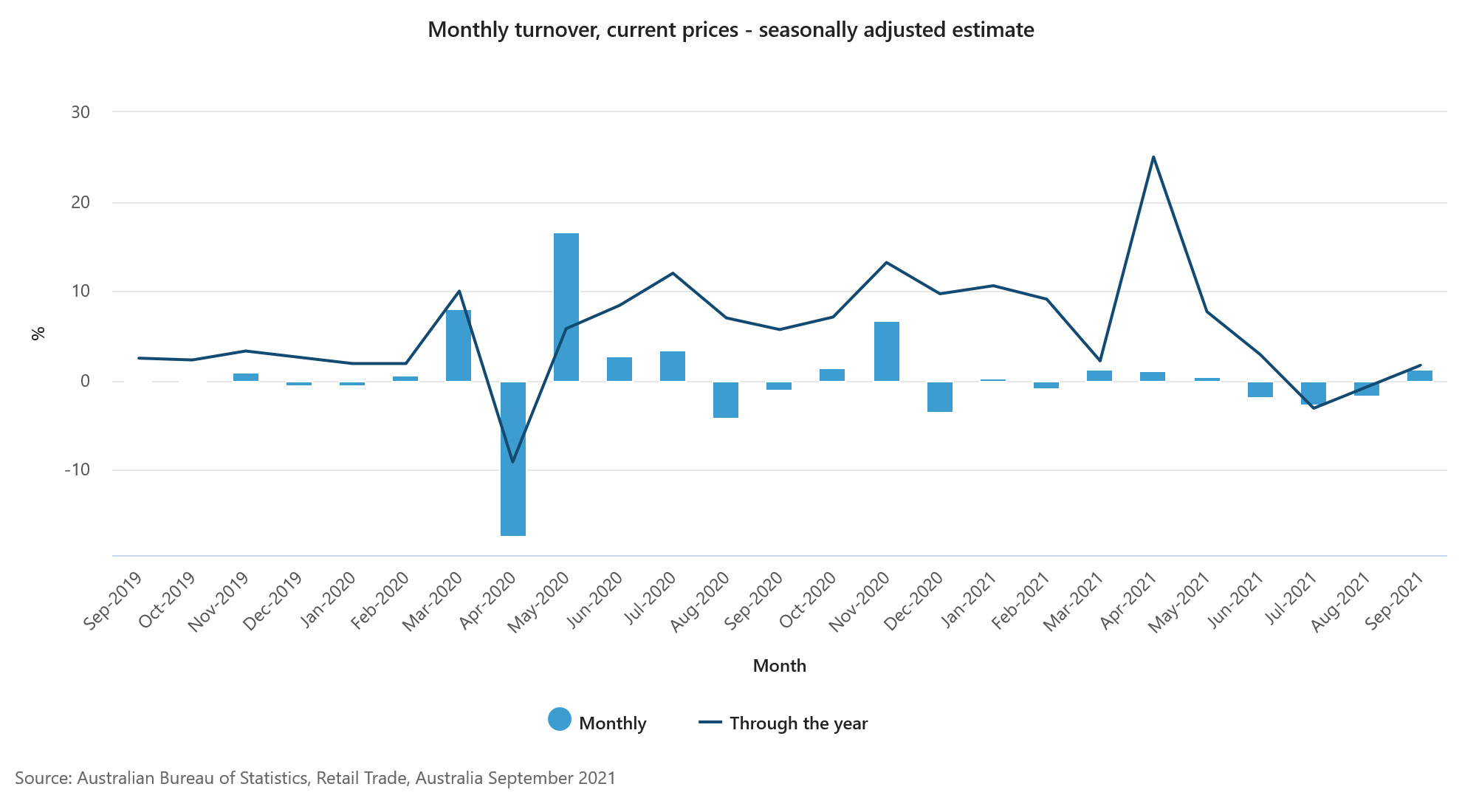
Australia retail sales rose 1.3% mom in September, much better than expectation of 0.2% mom. That's the first monthly growth since May. For the 12-month, sales rose 1.7% yoy.
"Retail turnover continues to vary by state, based on whether restrictions were imposed, removed or extended. Queensland sales rose to their highest level ever, up 5.2 per cent, with no lockdowns in September," Ben James, Director of Quarterly Economy Wide Statistics said.
"New South Wales also experienced a rise of 2.3 per cent despite having lockdowns, as some restrictions were eased or lifted. However, turnover for New South Wales remains 11.9 per cent lower than May 2021, the month before the most recent lockdown began."
Also released, PPI came in at 1.1% qoq, 2.9% qoq in Q3, versus expectation of 0.6% qoq, 3.2% yoy. Price sector credit rose 0.6% mom in September, matched expectations.
Japan industrial production dropped -5.4% mom in Sep, but expected to bounce back strongly ahead
Japan industrial production dropped sharply by -5.4% mom in September, much worse than expectation of -2.4% mom. The seasonally adjusted index of production at factories and mines dropped for the third straight month to 89.5, against the 2015 100 base of 100.
But looking ahead, the Ministry of Economy, Trade and Industry said output would bounce back by 6.4% in October, and then 5.7% in November, based on a poll of manufacturers. An official said, "output may have hit bottom in September since economic activities have been returning to normal in countries such as Vietnam and Malaysia since late September, and a recovery is expected, mainly in the auto industry."
Also released, unemployment was unchanged at 2.8% in September, matched expectations. Housing starts rose 4.3% yoy, versus expectation of 7.5% yoy. Consumer confidence dropped to 39.2, below expectation of 40.4. In October, Tokyo CPI core was unchanged at 0.10% yoy, below expectation of 0.3% yoy.
Cliff Notes: On Inflation Risks, Tension Building Between Market’s and Central Banks’ Views
Key insights from the week that was.
The past week has again been all about inflation and central bank expectations.
While the headline Australian CPI print for Q3 was in line with our expectation at 0.8%, the trimmed mean core was materially higher than forecast at 0.7%, taking the annual rate above the bottom of the RBA’s 2-3%yr inflation target for the first time since Q3 2015 (2.1%yr at Q3 2021). The primary drivers of aggregate inflation in the quarter were new dwelling purchase prices (3.3%) and auto fuel (7.1%). Notably for the outlook, the rise in dwelling purchase prices as a result of the unwinding of the HomeBuilder grant was smaller than anticipated; the greater contribution of fundamentals in Q3 and the future unwind of this grant’s effect points to a stronger outlook for this component.
Despite the upside surprise for Q3 trimmed mean inflation and markets rushing forward the timing of RBA rate hikes -- three rate hikes to 0.75% are now fully priced by November 2022 -- as outlined by Chief Economist Bill Evans yesterday, we continue to expect the first rate hike to come in February 2023, to be followed by a modest tightening cycle to 0.75% late-2023 and 1.25% in 2024. This sequence of hikes will occur after full employment is achieved (end-2022) and as inflation is sustained in the RBA’s target range.
Offshore, inflation also remained front of mind this week as two key central banks met. The Bank of Canada surprised by calling an abrupt end to its balance sheet expansion and by bringing forward guidance on the likely timing of a first rate hike, albeit only by a few months to mid-2022. While they recognised the recent surge in inflation due to supply-chain disruptions and energy prices as being more persistent than previously thought, progress in the labour market and in depleting slack in the economy more broadly remained the primary focus of the Governing Council’s policy making process.
In short: employment growth has outperformed expectations to date in the recovery and job openings remain elevated; amongst the Council, this has fostered a belief that slack in the economy will be used up by mid-2022, leading to the bringing forward of their rate guidance. Note though: if the labour market disappoints, the timing of the first rate hike can be pushed back; conversely, if global or domestic inflation surprises to the upside and is built into expectations, an earlier hike could be seen.
The ECB took a similar approach to their communications in October. President Lagarde also recognised that the effect of supply-chain disruptions and energy prices were going to be more significant and longer-lasting than previously anticipated. But these factors were given little weight when it came to the outlook for policy owing to their limited effect on inflation expectations. Instead, like the Bank of Canada, US’ FOMC and Australia’s RBA, the ECB continues to focus on remaining slack in the economy.
While the Euro Area’s labour market fared well through the pandemic thanks to wage subsidies, cyclically and structurally there is still considerable slack to erode via above-trend growth. As a consequence, the ECB is ready and willing to maintain asset purchases for a lot longer than the other central banks noted above. Indeed, it seems probable the open-ended Asset Purchase Program (APP) operational before the pandemic will continue indefinitely and, for a time, be supplemented by additional purchases after the pandemic envelope (PEPP) is closed end-March 2022. Any move on interest rates by the ECB therefore seems distant.
Next week, the run of central bank meetings will continue, with the Bank of England and US FOMC. While the market has moved to price a rate hike by the Bank of England of 15bps to 0.25%, the most significant development for global financial markets will be the FOMC’s formal taper announcement. Based on comments made by FOMC members before the pre-meeting blackout, this decision will put in place a timeline to end asset purchases around mid-2022. While the market has priced in quick follow-through for interest rates -- a fed funds rate hike is now priced by July 2022 -- such a rapid move is far from certain. Chair Powell and the FOMC have made clear time and time again they also see global influences for inflation as transitory and that the US labour market has considerable ground to make up. Very strong growth in employment as well as rising inflation expectations are likely necessary to see the Committee act with haste following the end of the taper.
Given the disappointing Q3 GDP report received overnight, an at-trend gain of 2% annualised largely as a result of weaker consumer demand, and continuing restrictions on the supply of labour, such an outturn for rates seems unlikely. Instead we continue to believe a pause in policy will be seen after the end of the taper till December 2022, when the first US hike will be delivered.
Also note that we remain of the view that this rate hike cycle will prove modest versus history across the world. As an example, for the US we expect it to end at 1.625% in 2024, below the FOMC’s longer-run guidance of 2.5% as well as the FOMC’s 2.0%yr inflation target – the latter meaning the real fed funds rate will still be negative at the peak of the cycle. Such an end point for this cycle is justified in our mind by years of below-target underlying inflation, suppressing expectations; a continued focus by business on efficiency; and the existing (and growing) level of global debt which means every basis point increase in interest rates is felt much more by borrowers than in the past.
Market Morning Briefing: Dollar Index Fell Sharply To Levels Below 93.50
STOCKS
Equities seem to have recovered a bit. Dow has risen back after a sharp rise seen in the previous session. Although there is scope to rise towards crucial resistance near 36000, while the level holds, medium term rise could be limited on the upside. Dax can test 15400 before rising back again towards 15600/800/900 in the medium term. Nikkei and Shanghai are stable. Nikkei can fall to 28250/000 while Shanghai is bullish while above 3500, else can fall to 3400/3350 before rising back. Nifty and Sensex saw a sharp fall breaking below respective supports at 18000 and 60000. A fall to 17400 and 59000 looks likely while below the broken supports if the indices are unable to bounce back immediately today.
Dow (35730.48, +239.79, +0.68%) has risen again today. The index can consolidate between 36000-35500/250 for some time before breaking on either side. 36000 is crucial resistance on the upside.
DAX (15696.33, -9.48, +0.06%) has dipped further. A range of 15900-15400 is holding well. A strong break on either side of the range is needed to form the next view and get clarity. While below 15900, we can see a fall towards 15400 in the coming sessions.
Nikkei (28792.53, -27.56, -0.096%) has fallen as resistance near 29250/500 seems to be holding well for now. The index has room to fall towards 28250/000 on a break below 28500 if seen in the near term. A strong rise past 29500 is needed for the view to be bullish towards 30000/31000 in the longer run which looks less likely for now.
Shanghai (3524.22, +5.80, +0.16%) has been stable.The support at 3500 is holding for now and can produce a bounce towards 3600 again. In case the index breaks below 3500,then the next level to watch will be 3400/3350.
Nifty (17857.25, -353.70, -1.94%) fell sharply yesterday and broke the support at 18000.While below 18000 the view remains bearish to see a further fall towards 17400 in the coming sessions, unless we see an immediate bounce from current levels today towards 18000/18200.
Sensex (59984.70, -1158.63, -1.89%) has also come down sharply yesterday and has fallen below support at 60000. While below 60000, the view is bearish to see a fall towards 59000.A strong rise above 60000 is needed for the view to be bullish again.
COMMODITIES
Crude prices have recovered from fall seen yesterday. Watch resistance at 85 and 83 on Brent and WTI respectively to see if the price holds lower or breaks above resistance in the near term. Gold and Silver have fallen back a bit. Gold can rise on a sustained break above 1800. Silver can trade within 23.50-24.50 for now. Copper has risen well and can rise towards 4.80/90 while above 4.40.
Brent (84) and WTI (82.84) have again risen back today after a sharp fall seen yesterday. Watch resistance at 85 on Brent and 83 on WTI.
Gold (1797.90) has been hovering near the level of 1800.A strong and sustained break above 1800 is needed for the view to be bullish towards 1820/1840. While below 1800,a fall towards 1770/60 cannot be negated.
Silver (24.02) has scope to test 23.50 before again rising back to 24+ levels in the medium term. Overall range of 23.50-24.50/25 may hold for now.
Copper (4.4330) has bounced back after testing the low of 4.30.While above 4.40,the view remains bullish towards 4.80/90 on the upside.
FOREX
Dollar Index fell sharply yesterday after the US GDP data release yesterday for Q3. There is scope for a fall towards 93 before bouncing back higher in the near term. This could take Euro up to 1.17-1.1750 in the near term before reversing from there. EURJPY may hold above 131.50 and rise towards 133-133.50. Aussie and Pound has scope to trade within 0.7550-0.7450 and 1.3650-1.3850 respectively for the near to medium term. USDCNY trades lower today but can have scope for a test of 6.40/42 if it does not fall immediately from current levels. USDINR can be ranged within 75.0-74.70 today.
Dollar Index (93.406) fell sharply to levels below 93.50 and while the fall sustains, it can test 93.30-93.00 before bouncing higher from there. Overall trend looks bearish which could be accompanied with some interim corrective upmoves. Any break below 93 can take the index down to 90-89.55 levels.
Euro (1.1674) rose to 1.1692 before coming off from there. While the Dollar Index trades lower, there may be scope for a rise in Euro towards 1.17-1.1750. While we may hold on to our longer term bearish view below 1.1750, any break above 1.1750 may signal fresh upmove targeting 1.18-1.19 on the upside in the longer run. Immediate levels to watch would be 1.17-1.1750.
EURJPY (132.61) is holding above 131.50 just now. While above 131.50, there is scope to rise back towards 133-133.50 in the near term. But a break below 131.50, if seen would bring in fresh bearishness in the medium term.
Aussie (0.7539) has interim resistance near 0.7550/60 and higher at 0.76 which if holds can produce a fall in Aussie in the near term towards 0.7450. Any sustained break above 0.76, if seen would bring in long term bullishness.
Pound (1.3791) is holding below important resistance near 1.3845/50 and while below that, a fall to 1.3650-1.36 can be seen eventually. Overall trend is bearish for the near term while below 1.3850.
Dollar-Yen (113.53) has support near 113.25-113.00 which if holds can produce a bounce back to 114.25/75 keeping a broad range of 113-114.75 for the near term. Any break below 113, if seen can indicate a fresh decline towards 112.25-112 in the medium term. A fall in Dollar Yen below 113 would look more likely as it has high directional correlation with Dollar Index which looks bearish from current levels.
USDCNY (6.3910) has fallen after testing 6.4046 yesterday. It can either sustain the fall and head towards 6.38 and lower in the near term or rise towards 6.42 on the upside before falling off from there.
USDINR (74.9250) bounced back from 74.76 yesterday holding above the interim support near 74.70. A range of 75-74.70/75 may hold for today.
INTEREST RATES
US Treasury Yields have inched up slightly but have immediate resistance ahead which will have to be broken for them to move up further. While the resistance holds, a further fall is possible in the coming days. On the German yields, the 30Yr looks bearish to fall further from here while the 10Yr is range bound for now with broader bias being bearish. The 10Yr and 5Yr GoI can consolidate in a broad range for some time before a fresh fall is seen.
The US 2Yr (0.49%) Treasury yield has dipped while the 5Yr (1.18%), 10Yr (1.57%) and the 30Yr (1.98%) have inched up slightly. It will have to be seen if the 10Yr and 30Yr manage to rise past 1.6% and 2% respectively which is needed to move back to 1.75% and 2.2%. While below 1.6% (10Yr) and 2% (30Yr) the 10Yr can test 1.5% and the 30Yr can fall to 1.85%. We will have to wait and watch.
The German 2Yr (-0.63%), 5Yr (-0.44%), 10Yr (-0.14%) and 30Yr (0.16%) have risen back well across tenors. But the broader view is bearish. The 30Yr can dip to 0.1%-0.05% while it remains below 0.2%. The 10Yr is stuck between -0.1% and -0.2%. The bias is bearish to break -0.2% and see a fall to -0.3% and -0.4% in the coming weeks.
The Indian 10Yr GoI (6.3670%) had risen back sharply from the low of 6.3046% yesterday. This keeps intact our view of seeing a consolidation between 6.3% and 6.4%. While below 6.4%, the broader bias is bearish to see a break below 6.3% and a fall to 6.2% eventually. A strong rise past 6.4% is needed to negate the bearishness.
The 5Yr GoI (5.7348%) has risen back from the low of 5.6941%. The broader range of 5.66%-5.76% remains intact. A sustained break below 5.70% can drag it to the lower end of the range. For now, the narrow 5.7%-5.76% range continues to remain in play.
USD/JPY: 100 SMA Holds The Key
Key Highlights
- USD/JPY started a downside correction from the 114.65 zone.
- It broke a key bullish trend line with support near 113.85 on the 4-hours chart.
- EUR/USD is attempting a major upside break above 1.1660.
- GBP/USD could accelerate higher if it clears the 1.3800 resistance.
USD/JPY Technical Analysis
The US Dollar extended its increase above 114.00 against the Japanese Yen. USD/JPY tested 114.65 before it started a downside correction.
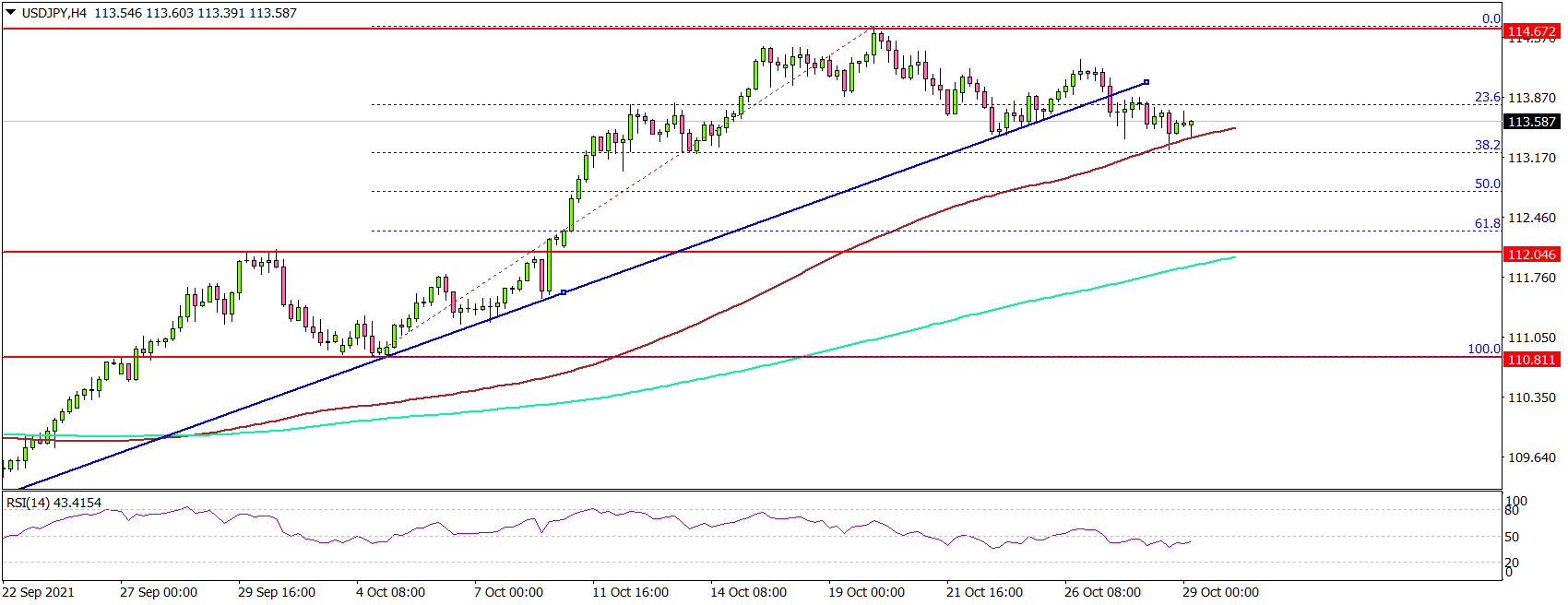
Looking at the 4-hours chart, the pair traded below the 114.00 support zone. The pair even traded below the 113.80 level, but the pair remained stable above the 100 simple moving average (red, 4-hours) and the 200 simple moving average (green, 4-hours).
It tested the 38.2% Fib retracement level of the upward move from the 110.81 swing low to 114.67 high. The pair is now holding the 113.50 support and the 100 SMA.
On the downside, there is a decent support forming near 113.50 level. The next major support is near 112.75. It is near to the 50% Fib retracement level of the upward move from the 110.81 swing low to 114.67 high. A close below the 112.75 level might push the pair towards the 112.00 support.
On the upside, an immediate resistance is near the 113.80 level. The next major resistance is near the 114.00 level, above which the pair might rise towards the 114.65 level.
Looking at EUR/USD, the pair is attempting a major upside break above the 1.1650 and 1.1660 resistance levels. The next key resistance is near 1.1720.
Economic Releases
- Euro Zone CPI for Oct 2021 (YoY, Preliminary) - Forecast +3.7%, versus +3.4% previous.
- Euro Zone Core CPI for Oct 2021 (YoY, Preliminary) - Forecast +1.9%, versus +1.9% previous.
- US Personal Income for April 2021 (MoM) - Forecast -0.2%, versus +0.2% previous.
Eco Data 10/29/21
[php_everywhere instance="1"]
ECB Review – Confirmed: Today’s meeting was a prelude to December
- Today's ECB meeting ended with no new decisions or a signal about the decisions that are to be taken at the December meeting, as widely expected (see our preview here). Lagarde personally expected PEPP to end in March22. TLTRO would be part of the December discussion.
- ECB concluded that the growth risks are broadly balanced, while at the same time acknowledging that the euro area is witnessing slower momentum.
- ECB's transitory inflation narrative, citing rising energy prices, supply-demand mismatches and German VAT base effects as the main drivers for current high inflation rates.
- Regarding market pricing, there was some convoluted push-back, which leaves ECB data dependent. So far, ECB was not concerned about the recent increase in short-term rates' impact on financing conditions.
Inflation, inflation, inflation – but not like other central banks!
At today's ECB meeting, ECB discussed three things according to Lagarde: Inflation, inflation and inflation. She boiled the conclusion down to three factors that drives inflation (see below), that made ECB conclude that the recent inflation pressures are transitory.
We had two main questions that we sought to get answered today
1) Not like other central banks: Asked to the question of ECB compared to other central banks that are turning more hawkish she said that comparison was 'odious'.
2) Markets pricing are ahead of themselves: Lagarde was asked several times on this issue. The first time was clear that ECB do not agree with market pricing, however the subsequent answers were less convincing, which also lead to strong intraday reaction in markets, where for example 1y1y EONIA swap traded within a 12bp top to bottom range through the press conference. On her clearest answer she said that; 'Our analysis certainly does not support that the conditions of our forward guidance are satisfied at the time of liftoff as expected by markets nor any time soon thereafter,'
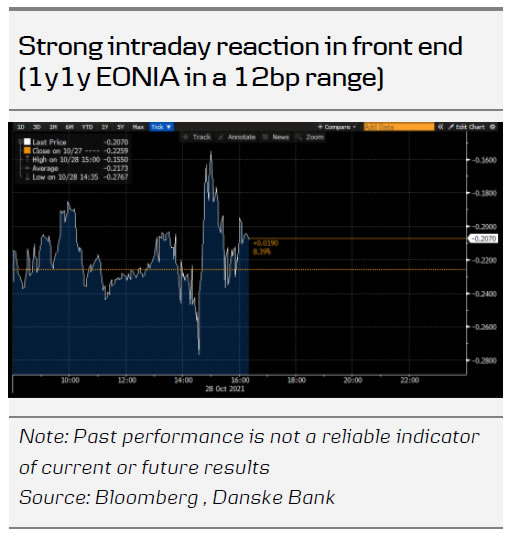
Ultimately, we are of the view that ECB do not expect to hike rates in the foreseeable future given ECB transitory inflation narrative. Whether this new found data dependence will last remains unknown. In any case, if inflation proves longer-lasting, the comments today makes us less confident that ECB would not change policy rates eventually.
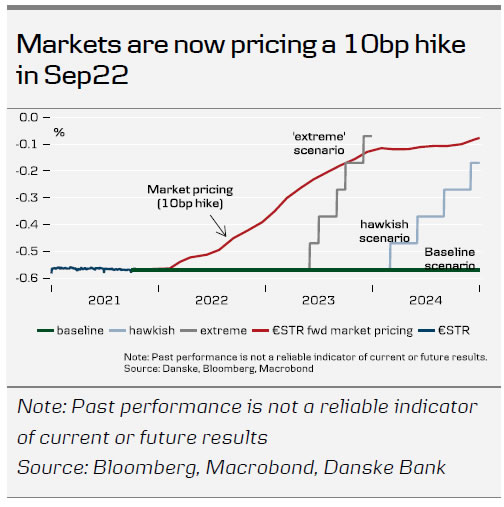
ECB says inflation surge is transitory, but markets doubt it
During the press conference, Lagarde stressed that the euro area economy continues to recover strongly, although momentum has moderated. While consumer spending remains strong, supply shortages are holding back production, clouding the outlook for the coming quarters. That said, risks to the economic outlook are still seen as broadly balanced and Lagarde also downplayed the risk of stagflation, arguing that there is no 'stagnation' in the first place (just somewhat slower growth momentum).
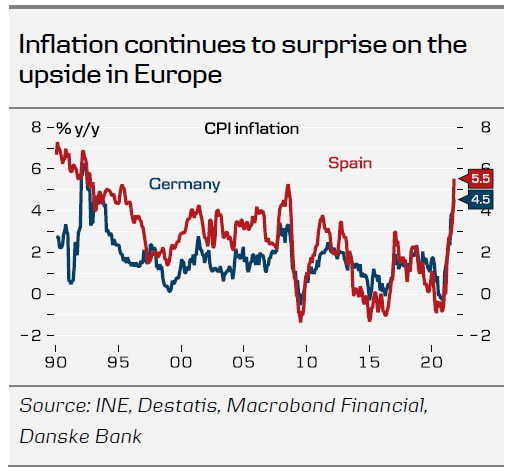
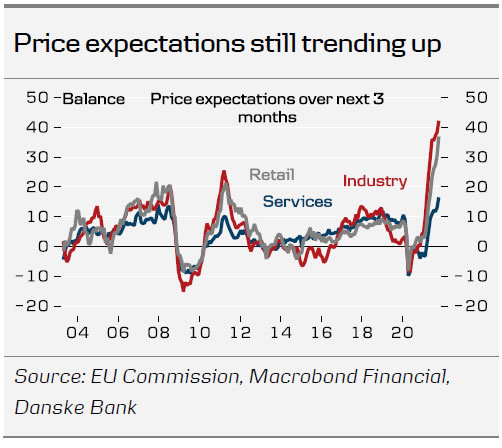
Lagarde also clearly stayed true to the ECB's transitory inflation narrative, citing 1) rising energy prices, 2) supply-demand mismatches and 3) base effects (such as German VAT) as the main drivers for current high inflation rates. While inflation is expected to stay high in the near-term (lasting a bit longer than previously expected), ECB still expects inflation pressures to ease again over the course of next year. One important reason for this remains that ECB does not yet seem worried about a wage-price-spiral, stating that the gradual return to full capacity will underpin a rise in wages only 'over time'. Upcoming wage rounds in Germany during 2022 will be key to watch in that respect in our view (see Research Euro Area - German wages: what to watch in 2022, 25 October). However, with Spanish and German CPI inflation surging to the highest level since the 1990s in October and price expectations still adjusting upwards across sectors, markets are increasingly discounting ECB's temporary inflation narrative.
EUR/USD uptick to prove temporary
Despite Lagarde's very dovish signals and overall appearance, EUR/USD followed the rates market higher. In our view, this is likely a temporary correlation and likely to soon be replaced by more downside risk as the European economy underwhelms amid inflation surprises. We do not generally see much of a link between spot EUR/USD and rising expectations towards euro area interest rates. On the contrary, Fed will probably lean more in to their hawkish views and arguably, too, the economy is better equipped at handling a slight slowdown in growth and higher yields. On net, we continue to forecast 1.10 in 12M EUR/USD.
ECB Plays Down Rate Hike Scenario But Euro Flies to Fresh Session Highs
Global flattening of yield curves
A flattening of global bond yield curves gained momentum on Thursday, ratcheting concerns about the pace of economic growth as more central banks start to signal higher interest rates in the foreseeable future amid the persisting inflationary pressures.
Specifically, the 2-year Treasury yield climbed to the highest since March 2020 on Wednesday, narrowing the gap with the 10-year yield, while the Canadian and Australian equivalents marked a multi-year daily increase following the hawkish rate statement from Bank of Canada on Wednesday and the RBA’s surprising decision not to buy April’s 2024 government bonds today.
The narrowing spread between the shorter and longer-term bond yields brought some risk-off into play, adding some support under the safe-haven gold, which continues to fight for a close above the $1,800 level despite the pickup above the 200-day simple moving average (SMA).
US data mixed
Speaking about growth, US GDP figures (annualized) missed expectations of a 2.7% expansion in the third quarter, reflecting a weaker growth of 2.0% instead. The reading is also way below the 6.7% number registered in the previous quarter, though fading base effects are probably the key technical driver for that weakness.
In positive news, initial jobless claims for the week ending Oct.23 beat forecasts once again, posting a fresh post-pandemic low at 280k versus 290k previously. The continuing claims, which are a better proxy for the unemployment rate, also retreated to new lows, raising speculation that next week’s nonfarm payrolls may bring some good news about the US labor market.
Dollar/yen reacted little to the aforementioned data, remaining stable around 113.65. Dollar/loonie and aussie/dollar were muted as well at 1.2365 and 0.7512 respectively.
Apple, Amazon Q3 earnings, Biden’s Capitol Hill visit in focus
Wall Street kicked off the day with moderate gains, with the S&P 500 recouping yesterday’s declines. The earnings season will feature Q3 releases from Apple and Amazon after the market close, therefore some volatility could pop up on Friday.
Prior to that, developments around Biden’s spending plan may attract special attention at the Capitol Hill today as the US President is planning to announce that a budget of $1.75 trillion has been secured ahead of the G20 summit, including a minimum tax on corporate profits, higher income taxes on the very wealthy, and a 1% surcharge on stock buybacks.
On Wednesday, the battle took another setback after Kyrsten Sinema, a moderate Democrat, opposed the proposal, making a deadline at the end of October difficult to be met.
ECB pushes back rate hike expectations
Meanwhile in the Eurozone, the intensifying energy crisis was not enough to change the ECB’s mindset on inflation. The central bank kept its policy settings steady as widely expected, with Christine Lagarde reiterating during her press conference that temporary factors are still behind the sharp price pressures, although those could last longer than initially expected but eventually evaporate in the medium term.
In other important notes, the ECB chief also downplayed the market pricing of a minor rate hike at the end of 2022, while confirming that the pandemic led PEPP bond program will officially end in March.
Despite her conservative tone, euro/dollar spiked to an intra-day high of 1.1644, bringing the 200-period SMA on the four-hour chart into scope. Euro/yen accelerated towards the key 132.16 resistance, while euro/pound gained a softer share of gains to trade at 0.8460.
In stock markets, the pan-European STOXX 600 index did not face any volatility from the ECB policy meeting, but steep losses in the energy sector are keeping the index in the negative area.
ECB Downplayed Urgency of Rate Hike to Tame Inflation
ECB’s meeting came in largely as we had anticipated. Policymakers acknowledged the stronger-than-expected inflation but downplayed the need to push forward rate hike. All monetary policy measures remained intact with the main refi rate, the marginal lending rate and the deposit rate staying at 0%, 0.25% and -0.5% respectively. The PEPP continued to work as planned and should be completed in March 2022. The December meeting would see updated economic projections and a formal announcement of the asset purchases plan after completion of the PEPP in March 2022.
Acceleration of both headline and core inflation proves more persistent than previously expected, President Christine Lagarde noted that “rising energy prices, the recovery in demand and supply bottlenecks are currently pushing up inflation”. She, however, reiterated the transitory nature of inflation. As she noted, “while inflation will take longer to decline than previously expected, we expect these factors to ease in the course of next year. We continue to foresee inflation in the medium-term remaining below our 2% targets”.
In response to market pricing of a rate by end-2022, Lagarde suggested that the ECB’s analysis “certainly does not support that the conditions of our forward guidance are satisfied at the time of liftoff as expected by markets, nor anytime soon thereafter”. She affirmed confidence that the central bank’s “anticipation and our analysis is actually correct”.
As such, policymakers retained the forward guidance, pledging to leave the policy rates at the “present or lower levels” until it sees inflation reaching 2% “well ahead of the end of its projection horizon and durably for the rest of the projection horizon”.
The PEPP should end in March 2022. A formal announcement, accompanied by the new asset purchase arrangement, will be made at the December meeting. Yet, Lagarde reiterate at the meeting that the reduction in QE purchases is “recalibration”, rather than “tapering”>
EURUSD climbed higher after the meeting. While this can be partly attributed to USD weakness after disappointing GDP growth data, the market does not appear to be convinced by ECB’s inflation outlook. Indeed, the latest data shows that German inflation surged to +4.5% y/y in October, highest in almost 3 decades, from +4.1% in the prior month. This exceeded consensus of +4.4%.
Euro Edges Higher after ECB Meeting
The euro is showing little movement after the ECB policy meeting. Currently, EUR/USD is trading at 1.1634, up 0.27% on the day.
ECB policy meeting a non-event
Many central banks are currently in a tightening cycle, notably the Federal Reserve and the Bank of England. Two notable exceptions are the ECB and the Bank of Japan, which continue to maintain an accommodative stance. Today’s ECB meeting was a non-event for the markets and the euro showed limited reaction.
As expected, the ECB did not make any announcements with regard to the future of the Pandemic Emergency Purchase Programme (PEPP), which is set to expire in March 2022. The December meeting may provide some insights as to what policy makers plan for the programme, and any hints that the programme will be wound up ahead of schedule would be bullish for the euro.
In a follow-up press conference, ECB President Christine Lagarde acknowledged that the current phase of high inflation would last longer than expected. This idea should sound very familiar, as Fed Chair Powell and other heads of major central banks have grudgingly said that inflation levels will persist longer than they had previously anticipated.
This is not really news for the markets, as inflation is pointing upwards. Eurozone CPI hit 3.4% in September and is expected to rise to 3.7% in October, which would mark a 13-year high. In Germany, inflation has accelerated for three straight months and climbed to 4.1% (YoY) in September, its highest level since 1993. With no indications that inflation in Germany or the rest of the eurozone will ease anytime soon, the ECB will find it more difficult to ignore the threat of high inflation, especially with the surge in energy prices only adding to inflation levels.
EUR/USD Technical
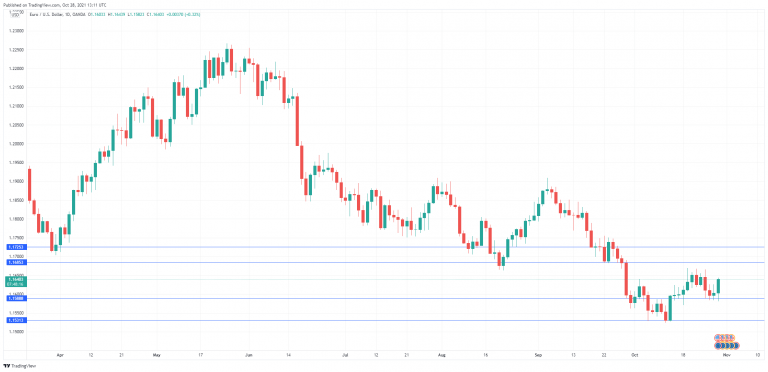
With EUR/USD showing little movement, the support and resistance lines remain unchanged:
- EUR/USD faces resistance lines at 1.1628 and 1.1685
- EUR/USD tested support at 1.1588 earlier in the day. Below, there is support at 1.1531