

Sample Category Title
EUR/JPY Day Outlook
Daily Pivots: (S1) 129.26; (P) 129.59; (R1) 130.23; More....
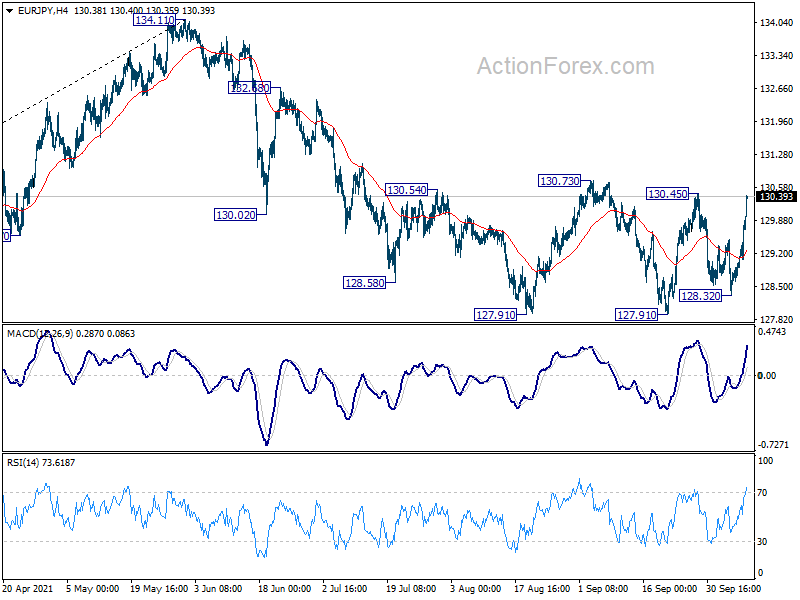
Immediate focus is now on 130.45 resistance in EUR/JPY. Decisive break there will indicate that corrective pattern from 134.11 has completed already. Further rise would be seen back to retest 134.11 high. However, rejection by 130.45 will keep near term outlook neutral, and maintain risk of another fall through 127.91 support.
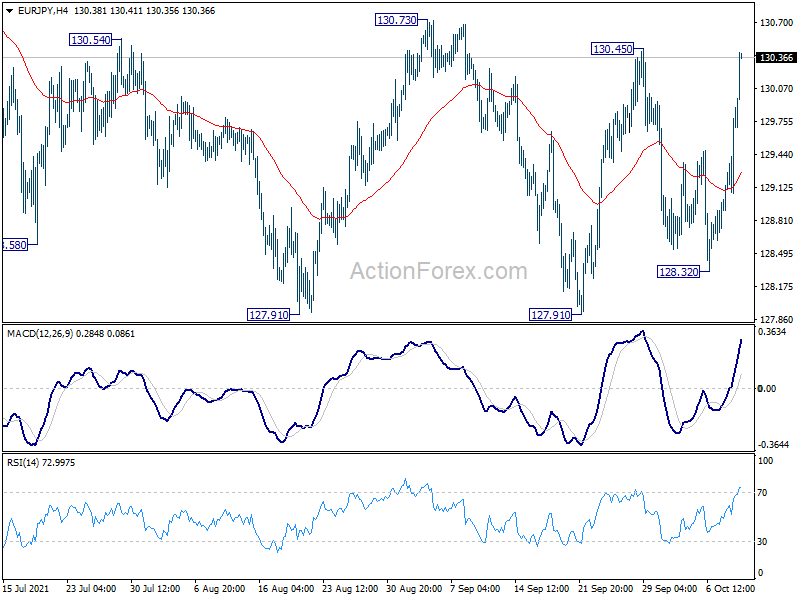
In the bigger picture, rise from 114.42 is seen as a medium term rising leg inside a long term sideway pattern. As long as 127.07 resistance turned support holds, further rise is still expected to retest 137.49 (2018 high). However, firm break of 127.07 will argue that the medium term trend has reversed, deeper fall would be seen to 61.8% retracement of 114.42 to 134.11 at 121.94.
GBP/JPY Daily Outlook
Daily Pivots: (S1) 152.23; (P) 152.58; (R1) 153.21; More...
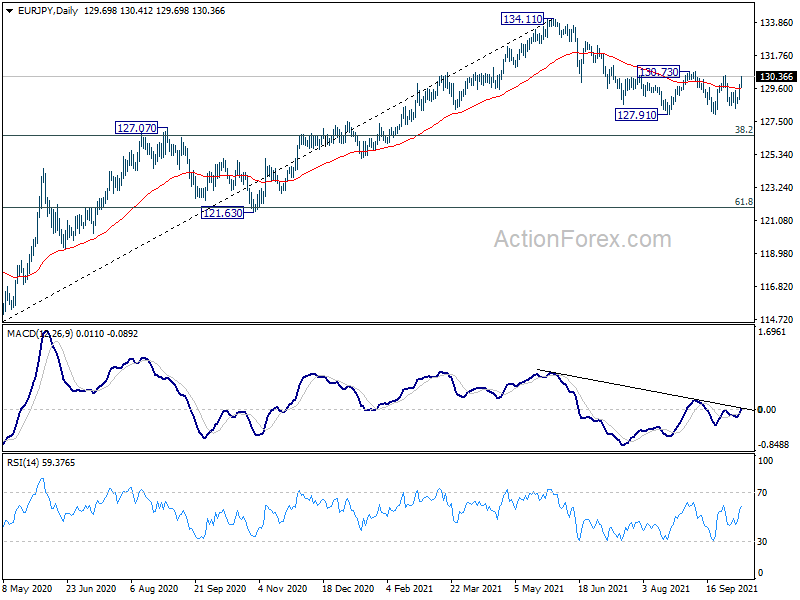
GBP/JPY's rally continues today and hits as high as 153.73 so far. As noted before, corrective pattern from 156.05 should have completed after defending 149.03 key support. Intraday bias stays on the upside for retesting 156.05 high. On the downside, break of 152.13 resistance turned support is needed to indicate completion of the rise from 149.20. Otherwise, we'd expect further rally ahead, even in case of retreat.
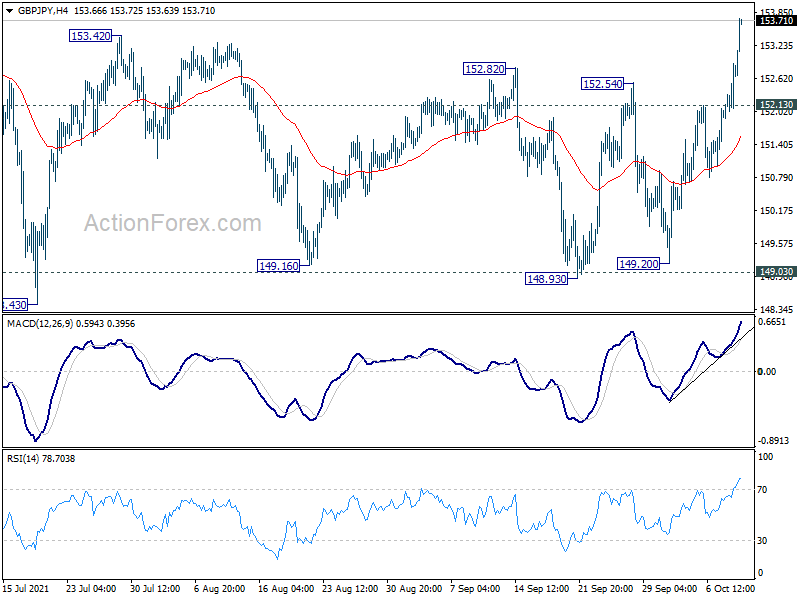
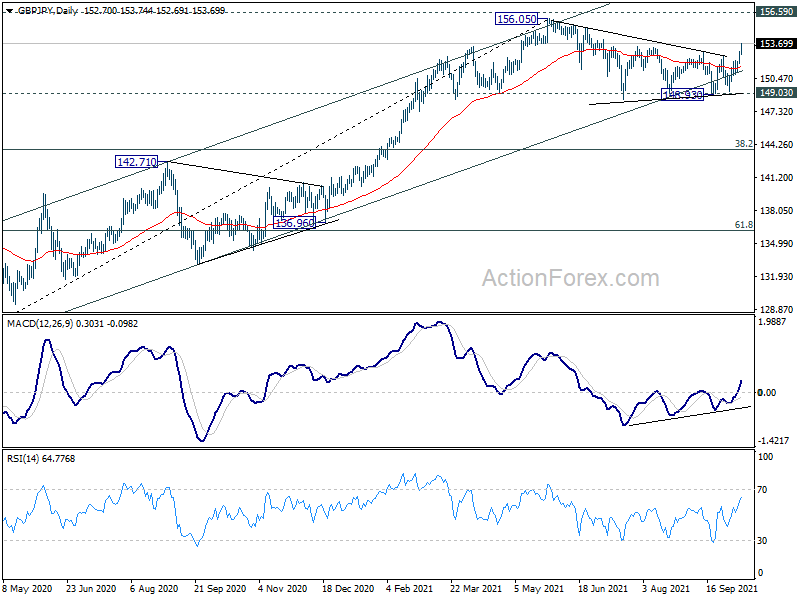
In the bigger picture, rise from 123.94 is seen as the third leg of the pattern from 122.75 (2016 low). As long as 149.03 support holds, such rise would still resume at a later stage. However, sustained break of 149.03 support will indicate rejection by 156.59 (2018 high). Fall from 156.05 would at least be correcting the whole rise from 123.94 (2020 low). Deeper fall would be seen back 38.2% retracement of 123.94 to 156.05 at 143.78 first.
Yen Selloff Continues on Strong Stocks and Yields, Sterling Lifted by Hawkish BoE Comments
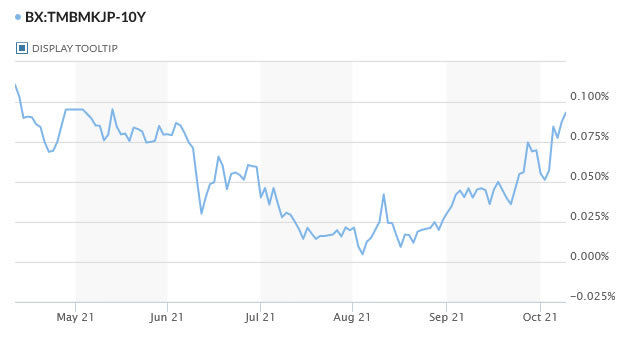
Yen's selloff continues as another week starts, backed by rebound in Asian stocks and Japanese yield. Indeed, 10-year JGB yield, currently at 0.093, is on track to 0.1 handle. Sterling is currently the strongest one, as lifted by hawkish comments from BoE officials over the weekend. Australian Dollar is following closely, leading other commodity currencies up too. Dollar, Euro and Swiss Franc are on the softer side.
Technically, 130.45 resistance in EUR/JPY would be a focus today. Firm break there would indicate completion of correction from 134.11, and pave the way to retest this high for the near term. More importantly, that would also align EUR/JPY's outlook with other Yen pairs, confirming broad based weakness in the Japanese currency.
In Asia, at the time of writing, Nikkei is up 1.57%. Hong Kong HSI is up 2.23%. China Shanghai SSE is up 0.38%. Singapore Strait Times is up 0.11%. Japan 10-year JGB yield is up 0.0058 at 0.093.
 BoE Saunders: Appropriate to price in a significantly earlier path of tightening
BoE hawk Michael Saunders said over the weekend, "markets have priced in over the last few months an earlier rise in Bank Rate than previously and I think that's appropriate."
Saunders noted that markets have fully priced in a February hike, and half priced a December hike. "I'm not trying to give a commentary on exactly which one, but I think it is appropriate that the markets have moved to pricing a significantly earlier path of tightening than they did previously," he said.
Separately, BoE Governor Andrew Bailey warned in an interview that inflation is "going to go higher, I'm afraid". "We have got some very big and unwanted price changes," he said, as the pandemic altered consumer behavior.
Fed Daly: Delta has taken a toll, but yet to derail us
San Francisco Fed President Mary Daly said on Sunday that there will be "ups and downs" in the job market recovery, as "Covid is not behind us". She admitted that "Delta has taken a toll" but remained upbeat that "it hasn't yet derailed us".
"It's too soon to say it's stalling, but certainly we're seeing the pain of COVID and the pain of the Delta variant impact the labor market," she said.
"I don't have a different view than I had on it when we first started. It's going to be hard and as goes Covid, so goes the economy," she added.
Daly also said, "everyone is feeling the rising prices" for energy, good and basic services. "This is really hard. And it's also really directly related to Covid. It's related to the supply bottlenecks, to the disruptions. But I don't see this as a long-term phenomenon."
US CPI to overshadow FOMC minutes, UK GDP watched
FOMC minutes is the only central bank related activity this week. The minutes would likely just reiterate that Fed is on track to start tapering asset purchases later this year. Meanwhile, rate hike is taken as a completely separately consideration and would depend be data dependent. More focuses could indeed be on consumer and producer inflation data, retail sales and jobless claims.
UK will also release GDP and employment. There are increasing speculations of an early rate hike by BoE, but again that would be data dependent. Elsewhere, German ZEW, Australia employment, New Zealand business sentiment, China trade balance, CPI and PPI will be closely watched too.
Here are some highlights for the week:
- Monday: Japan machine tool orders; Italy industrial production.
- Tuesday: Japan PPI; Australia NAB business confidence; UK employment; Germany ZEW economic sentiment.
- Wednesday: Australia Westpac consumer sentiment; New Zealand ANZ business confidence; Japan machine orders; China trade balance; UK GDP, productions, trade balance; Eurozone industrial production; US CPI, FOMC minutes.
- Thursday: Australia employment; China CPI, PPI; Swiss PPI; Canada manufacturing sales; US PPI, jobless claims.
- Friday: New Zealand BusinessNZ manufacturing index; Japan tertiary industry index; Eurozone trade balance; Canada wholesale sales; US retail sales, Empire state manufacturing index, import prices, U of Michigan sentiment, business inventories.
GBP/JPY Daily Outlook
Daily Pivots: (S1) 152.23; (P) 152.58; (R1) 153.21; More...
GBP/JPY's rally continues today and hits as high as 153.73 so far. As noted before, corrective pattern from 156.05 should have completed after defending 149.03 key support. Intraday bias stays on the upside for retesting 156.05 high. On the downside, break of 152.13 resistance turned support is needed to indicate completion of the rise from 149.20. Otherwise, we'd expect further rally ahead, even in case of retreat.
In the bigger picture, rise from 123.94 is seen as the third leg of the pattern from 122.75 (2016 low). As long as 149.03 support holds, such rise would still resume at a later stage. However, sustained break of 149.03 support will indicate rejection by 156.59 (2018 high). Fall from 156.05 would at least be correcting the whole rise from 123.94 (2020 low). Deeper fall would be seen back 38.2% retracement of 123.94 to 156.05 at 143.78 first.
Economic Indicators Update
| GMT | Ccy | Events | Actual | Forecast | Previous | Revised |
|---|---|---|---|---|---|---|
| 06:00 | JPY | Machine Tool Orders Y/Y Sep | 86.20% | |||
| 08:00 | EUR | Italy Industrial Output M/M Aug | 0.50% | 0.80% |
BoE Saunders: Appropriate to price in a significantly earlier path of tightening
BoE hawk Michael Saunders said over the weekend, "markets have priced in over the last few months an earlier rise in Bank Rate than previously and I think that's appropriate."
Saunders noted that markets have fully priced in a February hike, and half priced a December hike. "I'm not trying to give a commentary on exactly which one, but I think it is appropriate that the markets have moved to pricing a significantly earlier path of tightening than they did previously," he said.
Separately, BoE Governor Andrew Bailey warned in an interview that inflation is "going to go higher, I'm afraid". "We have got some very big and unwanted price changes," he said, as the pandemic altered consumer behavior.
FOMC to Taper in November Despite Another Disappointing Payroll Print
Overall, the September employment report points to the US labour market making good progress in trying circumstances. This momentum and apparent risks argues for a November taper announcement.
The September US employment report was, in some respects, very close to our expectations, but in others, completely counter. We anticipated participation would continue to lag in the month, leading the unemployment rate to fall. Indeed, in September, participation underperformed and unemployment outperformed, declining by 0.1ppt and 0.4ppts respectively, leaving the unemployment rate at 4.8%. Also underlying this result for the unemployment rate was another robust gain for household survey employment, up 526k in September after August’s 509k.
The supplemental data from this survey echoes the uncertainty on labour supply shown by the participation rate. In September, the proportion of workers teleworking because of the pandemic remained little changed at 13.2%, while 1.6 million people not currently in the labour force reported being unable to look for work because of the pandemic, equivalent to 1% of the labour force.
The household survey employment and unemployment rate outcomes are therefore a strong vote of confidence in the US labour market. However, they conflict with the headline outcome from the Employment Situation report, the nonfarm payrolls print.
For the second month in a row, at 194k, nonfarm payrolls came in at a fraction of the consensus estimate and the month-average gain for 2021-to-date, 561k at September.
Looking at the industry detail, there was one particularly noteworthy outcome. Despite the rapid re-opening of schools, September saw the loss of 180k jobs in education after seasonal adjustment (144k and 17k at the local and state government level, and 19k in the private sector) because job creation in the sector was notably weaker than it typically is at the start of the school year.
As the economy continues to re-open, significant catch-up hiring seems likely in this sector, with the BLS reporting that education payroll employment is currently 676k lower than in February 2020. Similar expectations can be justified for health and retail, among others, these two sectors having payroll counts 524k and 202k lower than February 2020.
Note, not only does it seem the pandemic is getting in the way of participation and employment, but also sampling. Highlighting this, the August gain for payrolls employment was revised up almost 60% in the September report, from 235k to 366k. It seems likely that the downside surprise seen in September will also be quickly made up through back revisions and/or an outsized gain(s) in coming months.
Looking ahead, even with a 1.2ppt rise in participation between now and end-2022, the US ‘only’ needs to create around 500k jobs per month to regain ‘full employment’, with an unemployment rate of 3.8% forecast by both the FOMC and Westpac at that time. As the two years prior to the pandemic saw average monthly payroll gains of almost 190k while the unemployment rate was at or below 4.0%, 500k of job gains per month in recovery is certainly achievable.
Overall, despite the headline payroll disappointment, there is enough strength and possibility in the underlying data to warrant the FOMC formally announcing a taper at their November meeting. The past fortnight has provided another very good reason to take this path: fiscal uncertainty.
The first step in monetary normalisation must be taken confidently and with clear focus. Neither is possible amid fiscal malaise, again to be seen in December given the short extensions granted for the debt ceiling and spending authority. History and political imperative tell us that, in the end, these procedural issues will be resolved. But amid fiery partisan debate, confidence is easy to unnerve, and attention swayed.
Further, note that, while we do not believe inflation will become a problem for the FOMC, the risks and market angst are clearly biased to the upside. This is true for wages too, with average hourly earnings currently up 4.6% versus a year ago. Increasingly accommodative monetary policy also risks financial stability, particularly with respect to house prices and household debt.
With the labour market making clear progress and given the above risks, it would be inappropriate to delay the taper decision until 2022 to wait out fiscal uncertainty. If the next step was a rate hike, arguably such a decision could be justified. However, the taper only slowly reduces the provision of additional support to the economy; it does not reduce it.
Fed Daly: Delta has taken a toll, but yet to derail us
San Francisco Fed President Mary Daly said on Sunday that there will be "ups and downs" in the job market recovery, as "Covid is not behind us". She admitted that "Delta has taken a toll" but remained upbeat that "it hasn't yet derailed us".
"It's too soon to say it's stalling, but certainly we're seeing the pain of COVID and the pain of the Delta variant impact the labor market," she said.
"I don't have a different view than I had on it when we first started. It's going to be hard and as goes Covid, so goes the economy," she added.
Daly also said, "everyone is feeling the rising prices" for energy, good and basic services. "This is really hard. And it's also really directly related to Covid. It's related to the supply bottlenecks, to the disruptions. But I don't see this as a long-term phenomenon."
Market Morning Briefing: USDCNY Broke Below 6.44
STOCKS
Dow trades at an important juncture and needs to either sustain above 34750-35000 in order to rise to 35250+ else a fall to 33750 will hold in the coming weeks. Dax on the other hand needs to sustain above 15200 to rise further from here. Nikkei and Shanghai trade higher today and can move up towards 29000/29500 and 3700 respectively if the rise sustains. Nifty can rise to 18000-18250 while above 17800. Sensex can also target 61000 while above 60000.
Dow (34746.25, -8.69, -0.025%) has risen to trade near crucial resistance at 34750-35000. If Dow manages to break above 35000, we can expect a rise to 35250 and higher eventually, else any rejection from 34750-35000 region can bring it down towards 33750 again.
DAX (15206.13, -44.73, -0.29%) needs to hold above 15200 in order to move up towards 15500 or higher. Any break below 15200 can again drag it down to 14900/800. Watch price action near current levels.
Nikkei (28488.95, +440.01, +1.57%) has surged today. A rise towards 29000\29500 is possible on the upside soon.
Shanghai (3606.28, +14.11, +0.39%) is hovering near the level of 3600.A sustained break above 3600 is needed to see a of 3700. Else the index can decline back towards 3550. Watch price action near 3600.
Nifty (17895.20, +104.85, +0.59%) tested 17941 before falling from there. Having broken the 17600-17800 range, the Nifty could now target a rise towards 18000-18250 and continue the longer term upmove.
Sensex (60059.06, +381.23, +0.64%) closed above 60000 on Friday opening up chances of a further rise towards 61000-62000 in the coming weeks.
COMMODITIES
Crude prices continue to surge and may test immediate resistance levels overhead. Very near term view is to see stronger crude for now. Gold ad Silver are stable and stuck near current levels. Unless some volatility creeps in, it is difficult to say which way it would move. Copper has immediate resistance near 4.30/35 and while that holds, a fall back to 4.20 looks possible.
Brent (83.49) and WTI (80.77) continue to rise sharply. But we would caution on longs just now as we see immediate resistance near 84-85 region just above current levels on Brent and near 81-82 on WTI. The resistances may hold to produce a fall in the near term. Watch price action near the mentioned resistance region just above current levels.
Gold (1759.40) and Silver (22.77) remain stuck and are stable at current levels. Unless there is any volatility in the prices, we continue to hold ranged view of 1740-1780 and 21.50-23 respectively.
Copper (4.2845) has immediate resistance at 4.30 and higher at 4.35 which may hold and produce a fall towards 4.20/15. Watch for a fall from immediate resistances overhead.
FOREX
Dollar Index fell below 94 but could not sustain and has bounced back well. While above 94, there is scope to test 95 on the upside. Euro trades below 1.1650/1.1600 and while these levels hold, view is bearish towards 1.1525-1.1500. USDJPY has risen well breaking above 112.50 and if the rise sustains, we may expect an eventual rise towards 114 in the coming weeks. EURJPY has been pulled by a weaker Yen and needs to break above 130.50/75 in order to move up further towards 131-132 else a fall back to 129-128 is possible. Watch price action near 130.50/75. USDCNY has broken below 6.44 and while that holds, a fall to 6.42/41 cannot be negated. On the USDINR, we need to see if the RBI holds the pair below 75.20 to prevent any further Rupee weakness. A range of 74.60-75.20/25 may hold for now.
Dollar Index (94.11) fell to 93.93 post the payrolls data on Friday but the index has bounced back again above 94.There is a fair possibility of rising towards 95 while above 94 else the index has to fall below 94 and sustain in order to bring in a lower possible target of 93. Wait and watch price action to see if the index sustains trade above 94 or falls lower.
Euro (1.1571) has immediate resistance at 1.16 and higher at 1.1625/50 which if holds in the near term can produce an eventual fall towards 1.1525-1.1500. View is bearish while below 1.1650/25 towards 1.1525/00.
EURJPY (130.19) has risen well, pulled up by the rise in USDJPY. We need to see if the cross can manage to rise above 130.50/75 in order to target fresh upper levels of 131-132 in the medium term. Else we may expect rejection from 130.75/50 back towards 129-128. Watch price action closely near 130.50/75.
Dollar-Yen (112.54) has broken above immediate resistance at 112.50 and while the rise sustains, we may expect a target of 114 on the upside in the coming 1-2 weeks.
Aussie (0.7327) is slowly rising and can test 0.7350 on the upside. A break above that is needed to take Aussie up towards 0.74-0.7450 in the near term else any rejection from 0.7350 can again drag it lower towards 0.72. Watch price action near 0.7350.
Pound (1.3640) has enough room on the upside to rise on a break above 1.3650-1.37 but while it finds difficult to rise above 1.3650-1.37, we may expect a ranged movement within 1.3650/37-1.3550 for the near term. A break above 1.37 can trigger a sharp rise towards 1.38-1.3850 in the coming 1-2 weeks.
USDCNY (6.4366) broke below 6.44, breaking the 6.44-6.47/48 range on the downside. While below 6.44, the pair can fall to test 6.41 in the near term. Immediate view is bearish while below 6.44.
USDINR (74.99) came off from 75.1575 on Friday as the central bank seems to have sold dollars near 75.10/12. We need to see if the RBI can keep the pair below 75.20 today also and dear the spot lower. In absence of RBI, there is scope for a rise to 75.3250 initially and then towards 75.50. Else while below 75.20, we can see a fall to 74.80/60 on the downside. Note that 74.60 is an important support.
INTEREST RATES
The US Treasury Yields have risen and are coming closer to their crucial resistance. A strong and sustained rise past the immediate resistances (1.65% on the 10Yr and 2.2% on the 30Yr) will pave way for a further rise and negate our view of seeing a reversal. The German yields continue to move up and are poised just below their crucial long-term resistances. We expect the resistances to hold and see a reversal in the coming days. The 10Yr GoI has risen sharply after the RBI policy meeting on Friday but has a key resistance ahead from where we expect it to turn lower in the coming days. The 5Yr GoI looks mixed and can be range bound in the near-term.
The US 2Yr (0.32%), 5Yr (1.06%), 10Yr (1.61%) and the 30Yr (2.16%) %) have risen further. The 10Yr has just crossed above 1.6%. A sustained rise past 1.65% will open doors for 1.75% and then 2% over the medium-term. The 30Yr has resistance at 2.2% which if broken will pave way for a rise to 2.4%. A break above 1.65% (10Yr) and 2.2% (30Yr) will negate our view of seeing a reversal in the Treasury yields that we have been expecting.
The German 2Yr (-0.70), 5Yr (-0.54%), 10Yr (-0.15%) and 30Yr (0.33%) yields continue to move up in line with our expectation. The 10Yr and the 30Yr are heading up towards -0.1% and 0.35% respectively. The levels of -0.1% (10Yr) and 0.35% (30Yr) are important long-term resistance which we expect to hold. A fresh fall is likely from there.
The Indian 10Yr GoI (6.3133%) surged on Friday but has key resistance coming up at 6.35%. We expect the 10Yr to reverse lower from 6.35% (revised up from 6.32% mentioned on Friday) and see a fresh fall to 6.26%-6.25% initially and then to 6.2% and lower eventually in the coming weeks.
The 5Yr GoI (5.7039%) tested 5.76% as expected and has come-off sharply from there. Immediate outlook is mixed. 5.66%-5.76% can be the range of trade. A strong break below 5.66% is needed to turn bearish and negate a break above 5.76% and a rise to 5.8% going forward.
EUR/USD: Recovery Could Fail Near 1.1650
Key Highlights
- EUR/USD extended its decline below the 1.1600 support.
- A major bearish trend line is forming with resistance near 1.1650 on the 4-hours chart.
- GBP/USD might recover further if it breaks the 1.3650 resistance.
- USD/JPY extended its increase above the 112.00 resistance.
EUR/USD Technical Analysis
The Euro started a major decline from well above 1.1650 against the US Dollar. EUR/USD even traded below 1.1600 and it is showing bearish signs.
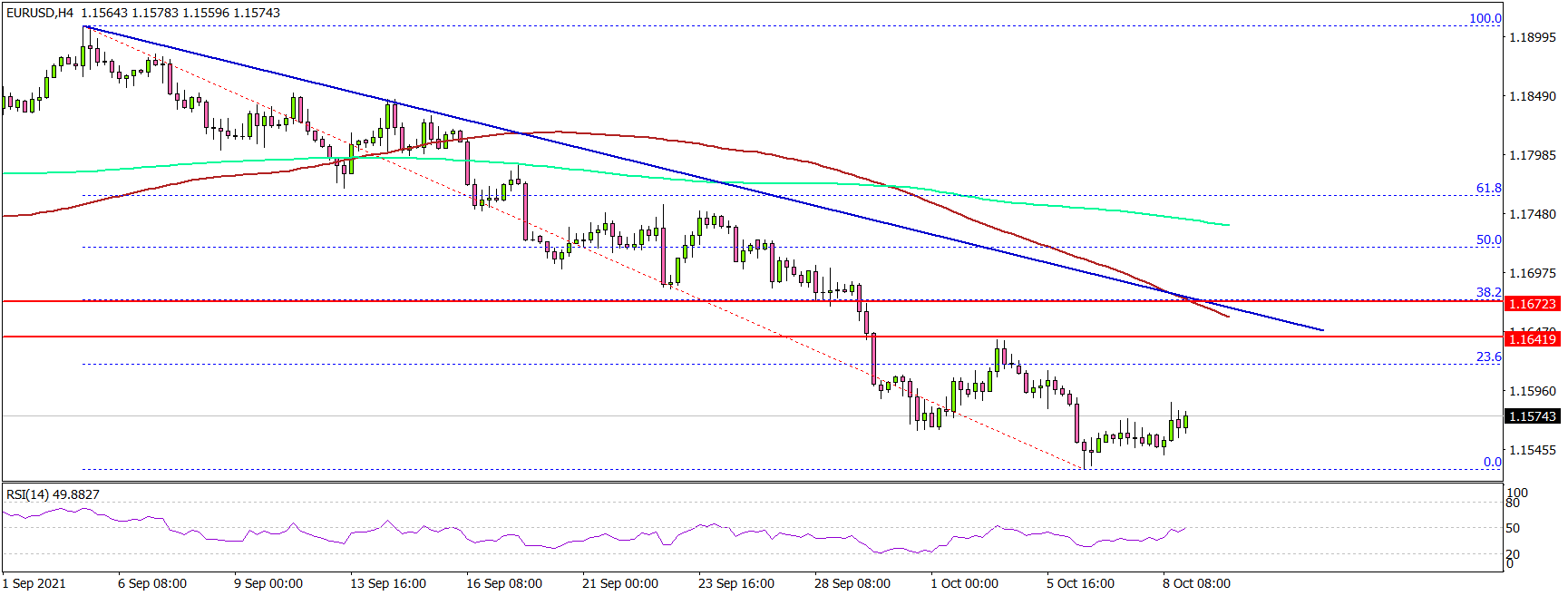
Looking at the 4-hours chart, the pair extended its decline below the 1.1600 and 1.1580 levels. The pair settled below 11650, the 100 simple moving average (red, 4-hours), and the 200 simple moving average (green, 4-hours).
A low was formed near 1.1528 and the pair is now consolidating losses. An immediate resistance on the upside is near the 1.1600 level.
The first major resistance is near the 1.1625 level. It is close to the 23.6% Fib retracement level of the downward move from the 1.1896 swing high to 1.1528 low. The main resistance is now forming near the 1.1650 level.
There is also a major bearish trend line forming with resistance near 1.1650 on the same chart. A clear break above 1.1650 is must for a sustained move higher.
An initial support on the downside is near the 1.1540 level. The next key support is near 1.1525, below which the pair may possibly continue lower towards the 1.1460 level.
Looking at GBP/USD, the pair corrected higher above 1.3600, but it is now facing a major resistance near the 1.3650 level.
Economic Releases
- UK NIESR GDP Estimate for Sep 2021 (3M) - Forecast +3.2%, versus +2.4% previous.
Eco Data 10/11/21
[php_everywhere instance="1"]
Forex and Cryptocurrency Forecast for 2022
EUR/USD: First Down, Then Up
The global economy is recovering from the effects of the COVID-19 pandemic, and this process will continue in 2022. At least. The forecast for global GDP growth of 6% is maintained this year. Growth will continue (unless there are new "surprises") to roughly 5% next year, according to preliminary forecasts. However, this is an average indicator, and it is the difference in the rates of recovery of the economies of different countries that will affect the rates of their national currencies.
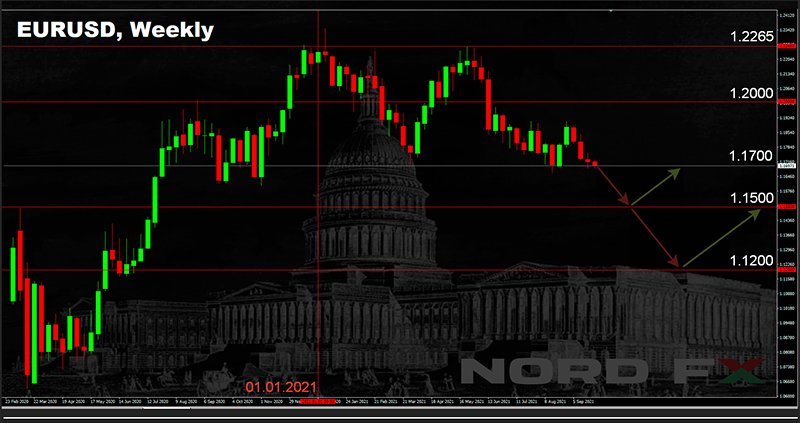
You can see quite different vector behavior of the EUR/USD pair since the beginning of the pandemic. Having started at 1.0635 in March 2020, the pair was already at 1.2350 in early January 2021. The weakening of the dollar has been affected by the intense pumping of the US economy with a huge dollar mass as part of the monetary stimulus (QE) policy implemented by the US Federal Reserve.
With the start of a new 2021 and the arrival of the administration of a new President Joe Biden in the White House, the market has a feeling of greater stability and the imminent winding down of QE. All the more so because macroeconomic indicators, particularly inflation and the labor market recovery, were encouraging. The dollar gained muscle and the EUR/USD pair dropped to 1.1700 by the end of March.
But dovish sentiment prevailed among the Fed's leadership, the pumping of the economy with money continued, the beginning of the curtailment of the quantitative easing program was postponed indefinitely, and one could not even think about raising the base interest rate. And the pair rose above the important psychological level 1.2000 again, reaching the height of 1.2265.
The competition between the central banks of Europe and the United States certainly did not end there. But while the ECB's rhetoric continued to be dovish, the statements of some Fed leaders already sounded a harsh hawkish note. Investors started to expect that the Fed would begin to roll back QE at the end of this year and will complete it in 2022, in order to start raising the discount rate in early 2023. And the dollar gained ground again, dropping the pair back into the 1.1700 zone.
At its September meeting, the American regulator did not announce any specific plans regarding the curtailment of the monetary stimulus program. But, if decision-making dynamics remain the same, the Fed will be ahead of the ECB by about six months.
On this basis, many experts predict the dollar will continue to strengthen in late 2021 and in the first half of 2022. In this case, the pair will continue to move south, first to support 1.1500 and then to 1.1200. Some particularly zeal bears predict the pair will even drop to the lows of March 2020.
As for the second half of 2022, according to a number of forecasts, the US economic situation will stabilize, while the "slow" Eurozone, on the contrary, will begin to gain momentum. A reduction in the European QE program and a rise in the euro interest rate could reverse the trend and return the pair to the 1.1700-1.2000 zone.
It is clear that the dynamics of the pair depends on many factors on both sides of the Atlantic Ocean: political, economic, and in recent years, epidemiological. One other major player is China, which also has a strong influence on the economies of both the Old World and the New World. Therefore, it should be understood that everything said is based on a vision of the situation at the moment, and can be (and should be) subject to adjustment many times over the coming months.
Cryptocurrencies: Virtual and Real Gold
While there is a rough understanding and political and economic justification of forecasts with the major currency pair EUR/USD, things look much more complicated as far as cryptocurrency is concerned. Despite the assurances of influencers, this market looks more like the epicenter of mass speculation over the past 1-1.5 years, rather than a reliable investment platform. The year is not over yet, but bitcoin has already managed to soar from $28,550 in January to $64,800 in April, then collapsed to $29,300 in July, and then repeat this rally, only on a slightly smaller scale.
The rate of the BTC/USD pair can be influenced not only by the decisions of US regulators and the Chinese government, but even the mood Elon Musk has woken up in. One of his tweets can make you a millionaire or rip you to the bone. That's why NordFX brokerage gives its clients the opportunity to make money not only on the growth, but also on the fall of cryptocurrency rates, even without having a single token in stock. Why take the risk and buy bitcoin and then sell it? After all, you can just open a sell trade right away.
Nobody knows exactly how much the reference cryptocurrency will cost. Expert opinions vary widely. Some, like Standart Chartered, see $100,000 by the end of this year, and some predict a rise to the same $100,000, but only by the end of 2022. And some, like the Nobel laureate Robert Schiller, are sure that this bubble will burst soon, burying the two trillion USD plus that the investors have invested in this market.
Much will depend on the recovery of the US economy, the pace of the winding down the monetary stimulus (QE) programme, the prospects for the Fed raising interest rates and the dynamics of treasury yields. These are factors that can severely reduce the risk appetite of institutional investors and return them to more familiar financial instruments.
For ethereum, the forecast of Standard Chartered experts is as favorable as for bitcoin and looks very optimistic. A range of $26,000-35,000 per coin was announced in an interview for Reuters. But that's not the limit either, especially if the bitcoin rate approaches $175,000 by the end of 2022.
According to a report by the major investment bank Goldman Sachs published in Forbes, the base cryptocurrency has the chance to lose its leading position, giving way to ethereum. Goldman Sachs believes that the main reason for the popularity of the main altcoin is the ability to create new applications. And also the fact that many financial instruments can be replaced on the basis of its platform. This includes, among other things, loans and other banking operations.
As for real, not digital, gold, a number of experts believe that this precious metal has yet to run out of growth potential in 2022. They do not rule out that the XAU/USD pair could break the August 2020 record and rise to $2,200-2,300 per ounce. However, the price performance of this reserve asset will also depend on investors' willingness or reluctance to take risks, as mentioned above.