Sample Category Title
EUR/GBP Weekly Outlook
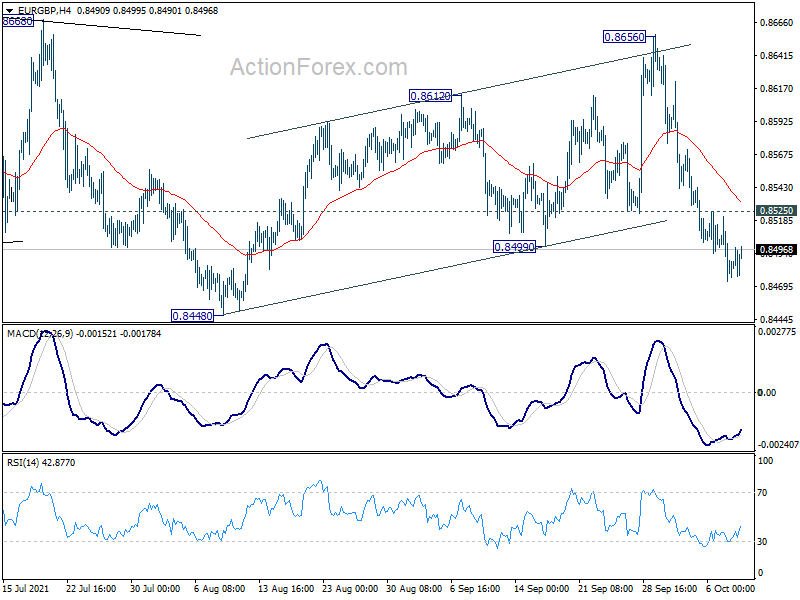
EUR/GBP's break of 0.8499 support last week suggests that corrective rise from 0.8447 has completed with three waves up to 0.8656. Initial bias stays on the downside this week for retesting 0.8448 low first. Firm break there resume larger down trend from 0.9499, towards 0.8276 key support. On the upside, above 0.8543 minor resistance will turn intraday bias neutral first. But risk will stay on the downside as long as 0.8656 resistance holds.
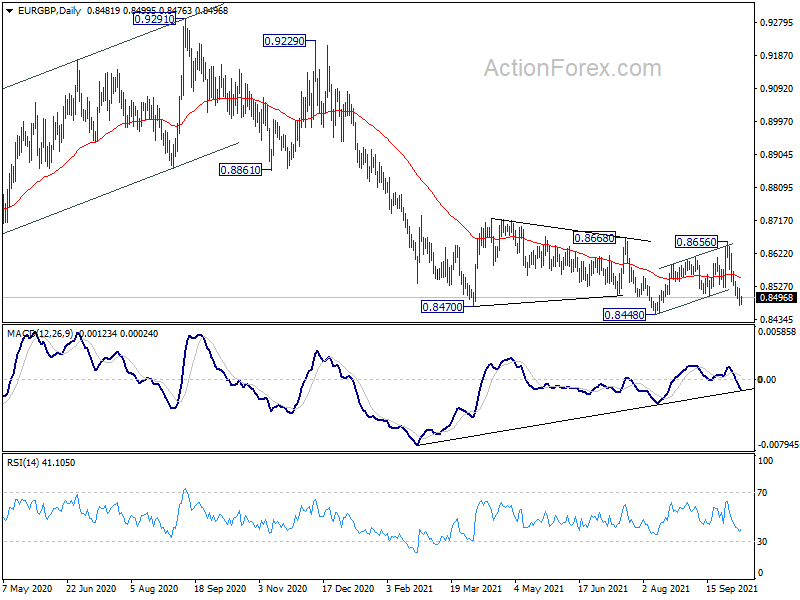
In the bigger picture, price actions from 0.9499 (2020 high) are still seen as developing into a corrective pattern. Deeper fall could be seen as long as 0.8668 resistance holds, towards long term support at 0.8276. However, firm break of 0.8668 resistance would argue that a medium term bottom was already formed. Stronger rise would be seen to 0.8861 support turned resistance to confirm completion of the corrective pattern.
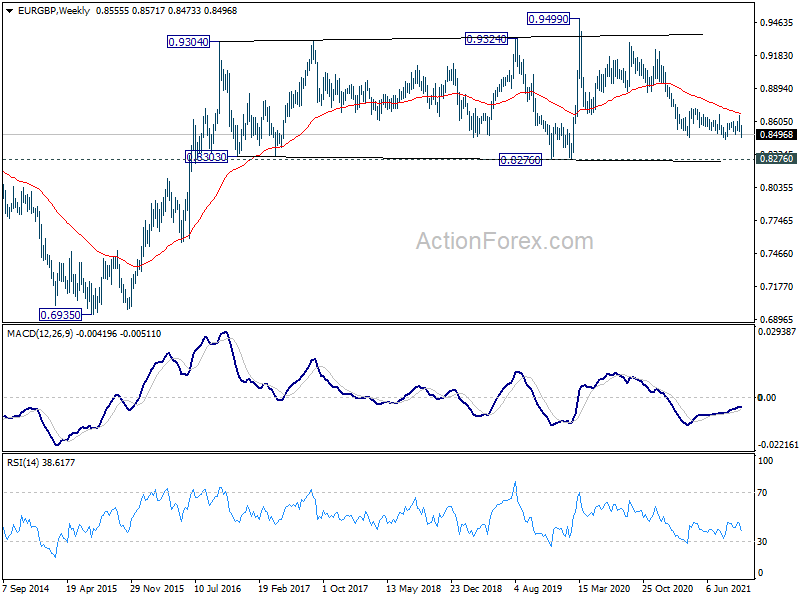
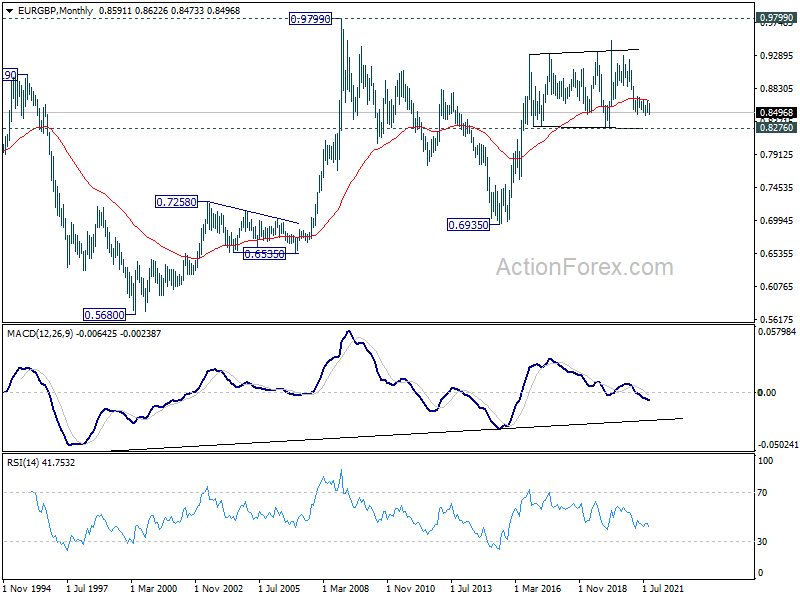
In the long term picture, outlook will stay bullish as long as 0.8276 support holds. Break of 0.9499 is in favor at a later stage, to resume the up trend from 0.6935 (2015 low).
EUR/AUD Weekly Outlook
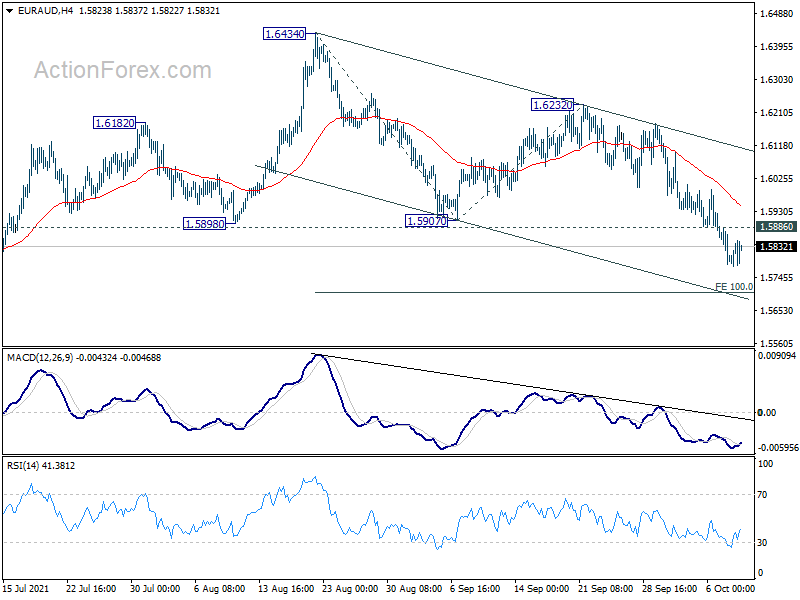
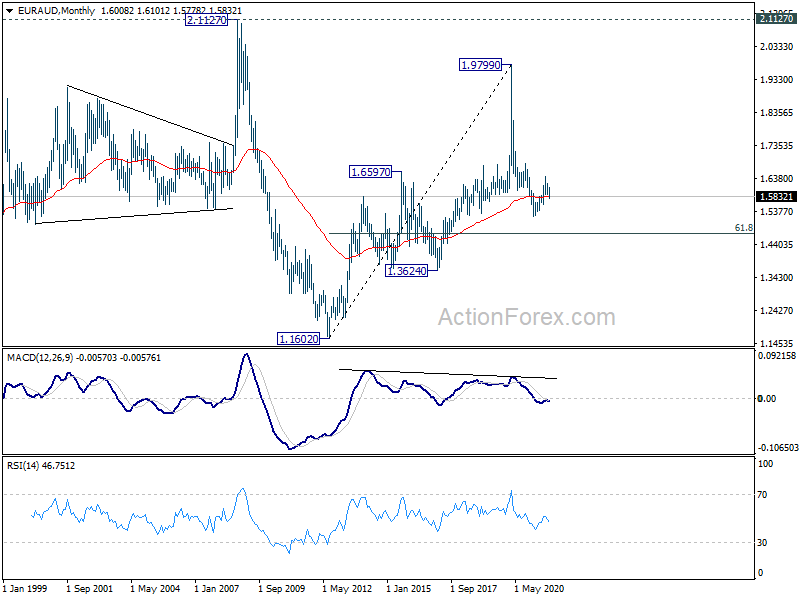
EUR/AUD dropped to as low as 1.5778 last week and the break of 1.5898 structural support argues that larger rise from 1.5250 has completed. Initial bias stays on the downside this week. Next target is 100% projection of 1.6434 to 1.5907 from 1.6232 at 1.5705 first. Break there will pave the way to 161.8% projection at 1.5379. On the upside, above 1.5886 minor resistance will turn bias neutral and bring consolidations. But near term outlook will now remain mildly bearish as long as 1.6232 resistance holds, in case of recovery.
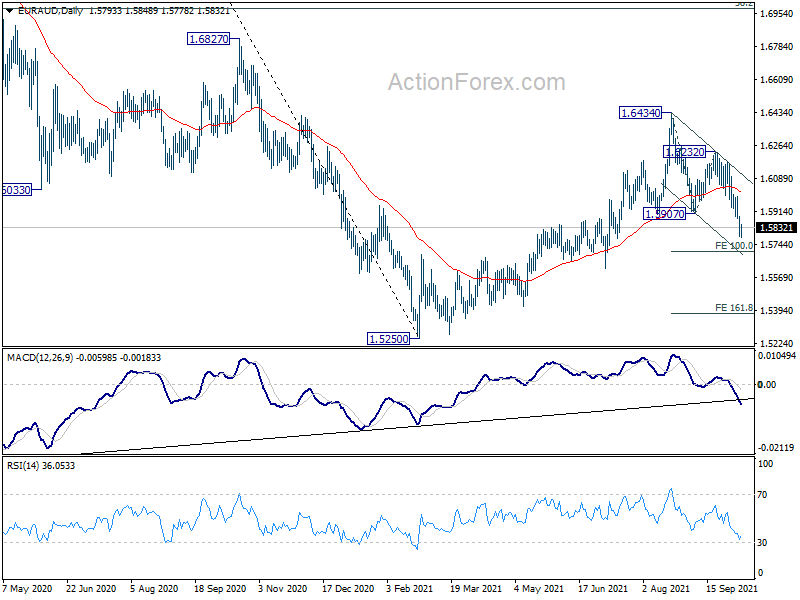
In the bigger picture, rise from 1.5250 medium term bottom is seen as a correction to the down trend from 1.9799 (2020 high) only. With 38.2% retracement of 1.9799 to 1.5250 at 1.6988 intact, such down trend is expected to resume at a later stage. Firm break of 1.5250 will target 61.8% retracement of 1.1602 (2012 low) to 1.9799 at 1.4733. In any case, sustained break of 1.6988 fibonacci level is needed to indicate long term reversal.
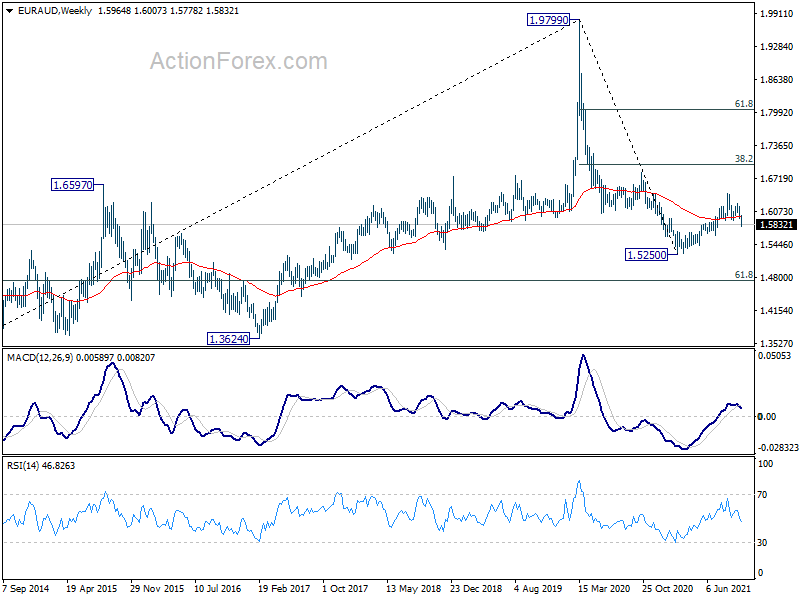
In the longer term picture, rise from 1.1602 (2012 low) should have already completed with three waves up to 1.9799 (2020 high). Fall from there is seen as a medium term to long term down leg as a long term down trend, or a sideway pattern. We'll assess the odds again at a later stage.
EUR/CHF Weekly Outlook
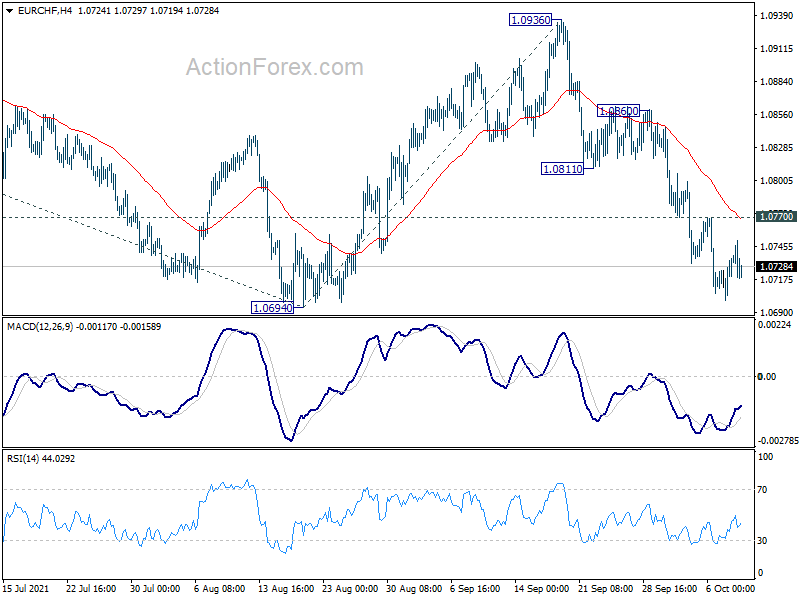
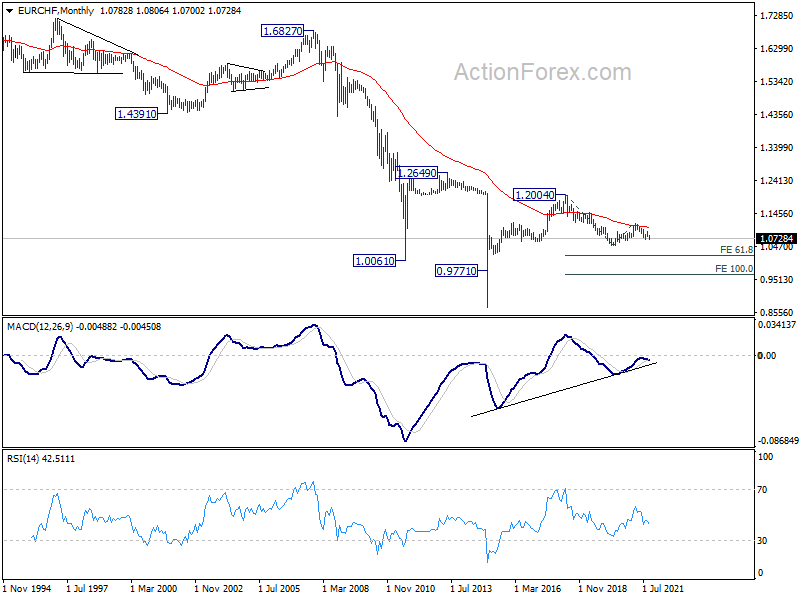
EUR/CHF's fall from 1.0936 extended lower last week. Further decline is expected this week as long as 1.0770 resistance holds. Decisive break of 1.0694 support will resume whole decline from 1.1149. Next target is 61.8% projection of 1.1149 to 1.0694 from 1.0936 at 1.0655. On the upside, though, break of 1.0770 minor resistance will turn bias back to the upside for rebound towards 1.0811 support turned resistance first.
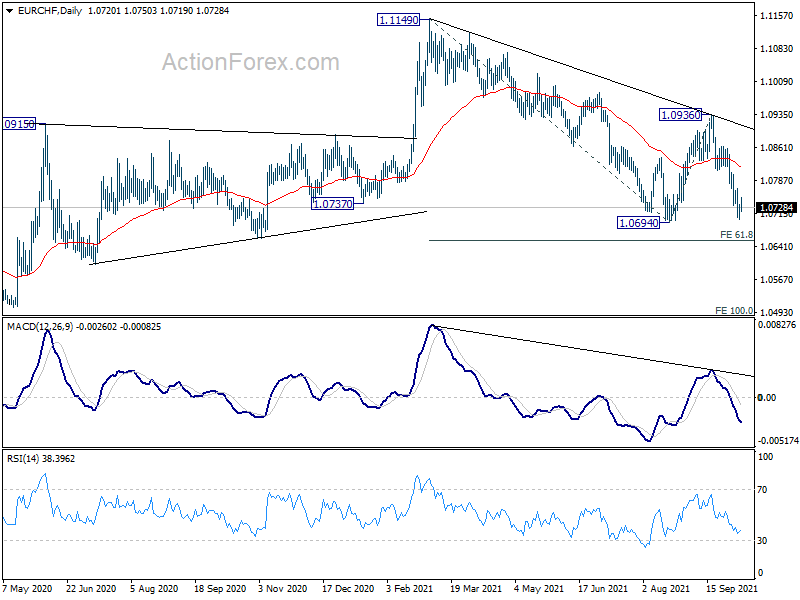
In the bigger picture, the rejection by 55 week EMA maintains medium term bearishness. Fall from 1.1149 (2021 high) is currently seen as the second leg of the patter from 1.0505 (2020 low) first. Hence, in case of deeper fall, we'd look for strong support from 1.0505 to bring rebound. However, sustained break of 1.0505 will resume the long term down trend from 1.2004 (2018 high). Also, medium term outlook will now be neutral at best as long as 1.0936 resistance holds.
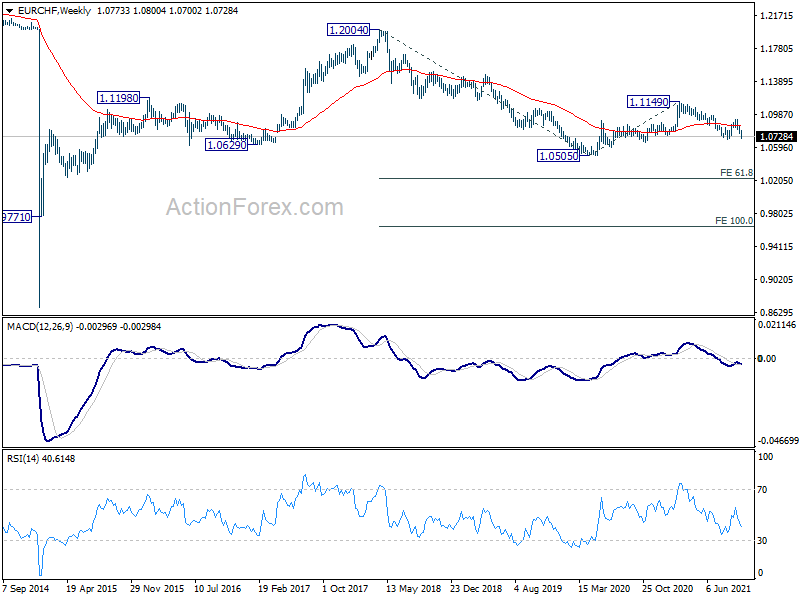
In the long term picture, rejection by 55 month EMA (now at 1.1037) maintains long term bearishness. Break of 1.0505 low will resume down trend to 61.8% projection of 1.2004 to 1.0505 to 1.1149 at 1.0223.
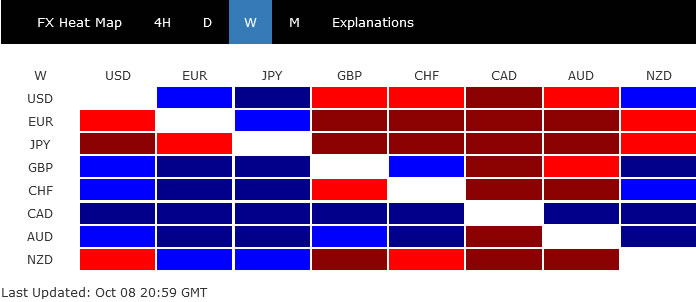
Yen Crosses Followed Yields Higher Against, Loonie Rode on Oil
Yen was once again sold off broadly last week, following late rally in treasury yields despite disappointing US job report. Resilience in overall risk appetite also kept the Japanese currency pressured. Meanwhile, Euro followed as as distant second worst on selloff in crosses, as well as Dollar. New Zealand Dollar's weakness was a surprise as RBNZ did deliver the anticipated rate hike.
On the other hand, Canadian Dollar jumped as the strongest, following both solid employment data and extended rise in oil prices. Australian Dollar was also helped by rally in coal price, even though RBA is set to lag behind major counterparts in exiting stimulus. Sterling was the third strongest one, on speculation that BoE could be forced to hike interest rate sooner.
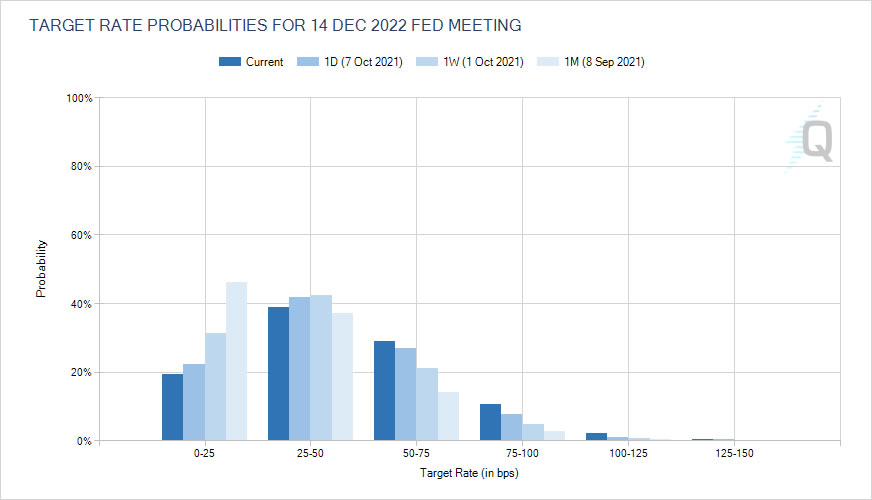
10-year yield surged past 1.6 as traders added to Fed hike bets
Despite disappointing non-farm payroll data, there was basically no change in expectations that Fed is on track to start tapering later this year. Indeed, traders continued to add bet on a Fed hike by the end of next year. Fed funds futures are pricing in less than 20% chance of Fed keeping interest rate at 0-0.25%, comparing to over 46% a month ago.
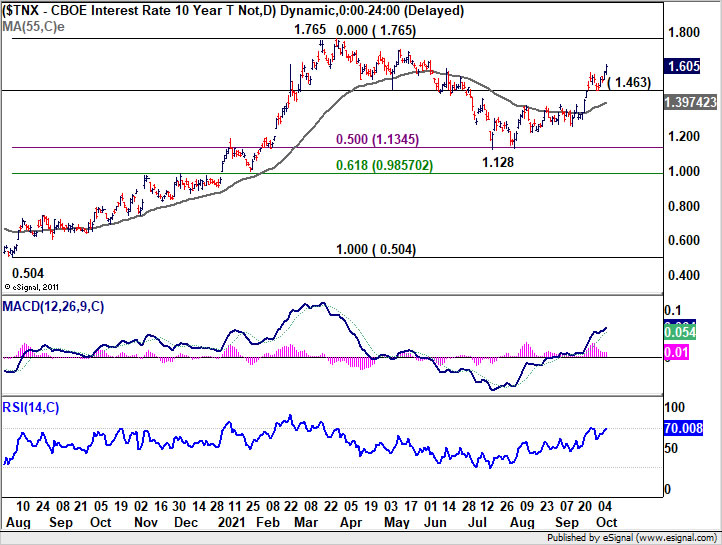
10-year yield also surged to close the week strongly at 1.605 as rise form 1.128 resumed. Further rise is expected as long as 1.463 support holds. TNX should target a test on 1.765 high in the near term. For now it's still unsure if upside momentum in TNX is able to push it through 1.765 to resume larger up trend from 0.504. That could very much depends on upcoming inflation data, and thus Fed hike speculations.
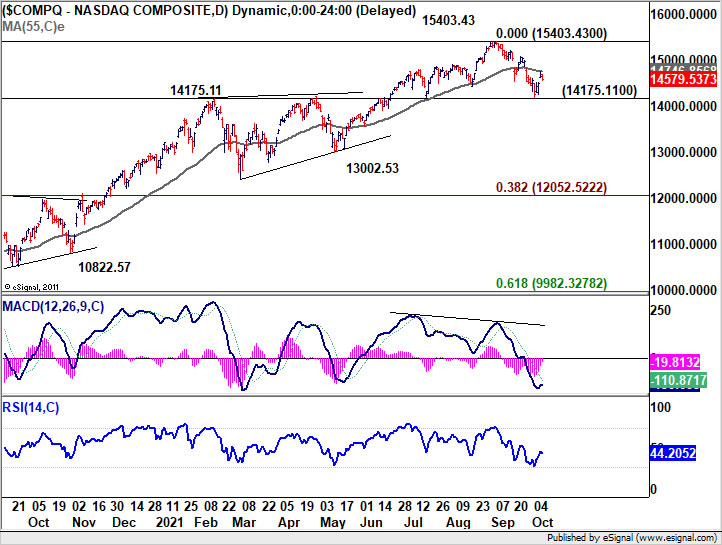
NASDAQ defended key support as stocks showed resilience
Stocks were also resilient last week. NASDAQ defended 14175.11 support and rebounded. Current development argues that the corrective pattern from 15403.43 is a relatively shallow one only, even if it's going to extend. Sustained trading above 55 day EMA would pave the way to retest this high. However, firm break of 1415.11 support would argue that NASAQ is already is a deep medium term correction, that should target 13002.53 structural support and possibly below.
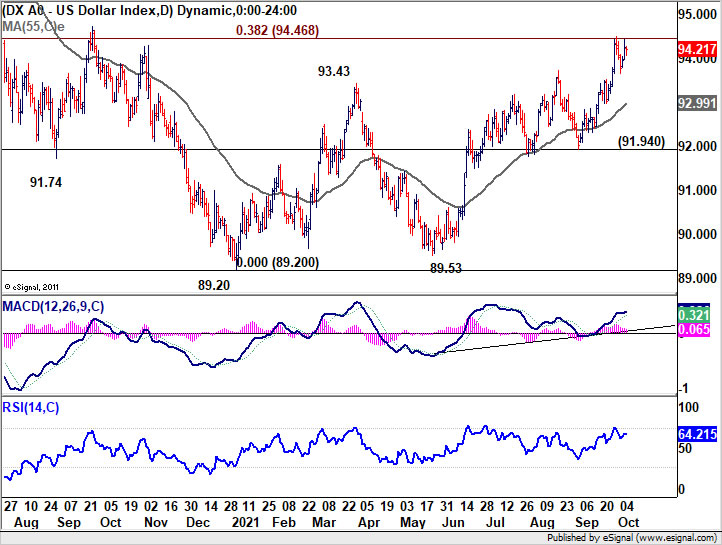
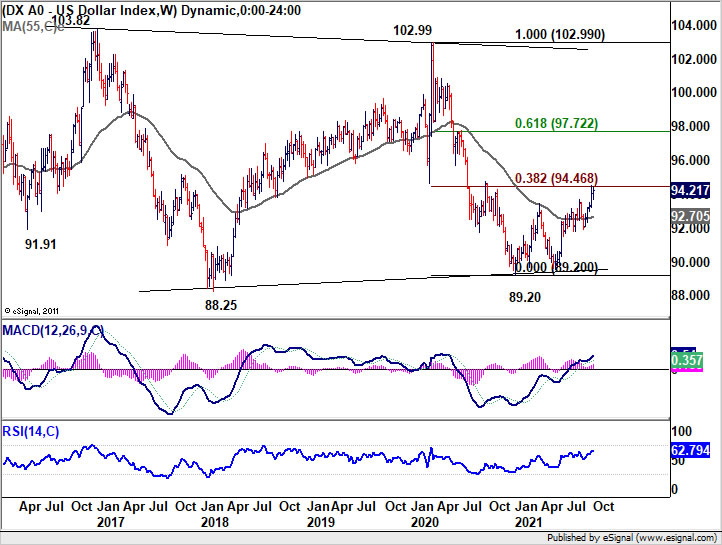
Dollar index still struggling to break through 94.46 fibonacci level
Dollar index continued to struggle to break through 38.2% retracement of 102.99 to 89.20 at 94.46 decisively last week. Dollar is partly supported by surging yield by capped by resilient risk appetite. For now, further rise is still in favor in DXY as long as 55 day EMA (now at 92.99) holds.
Sustained break of 94.46 carry larger bullish implication. That is, rise from 89.20 is already reversing the whole down trend from 102.99 (2020 high). In this case, stronger rally would be seen to 61.8% retracement of 97.72 and possibly above. However, firm break of 55 day EMA will dampen near term bullishness and turn focus back to 91.94 support instead.
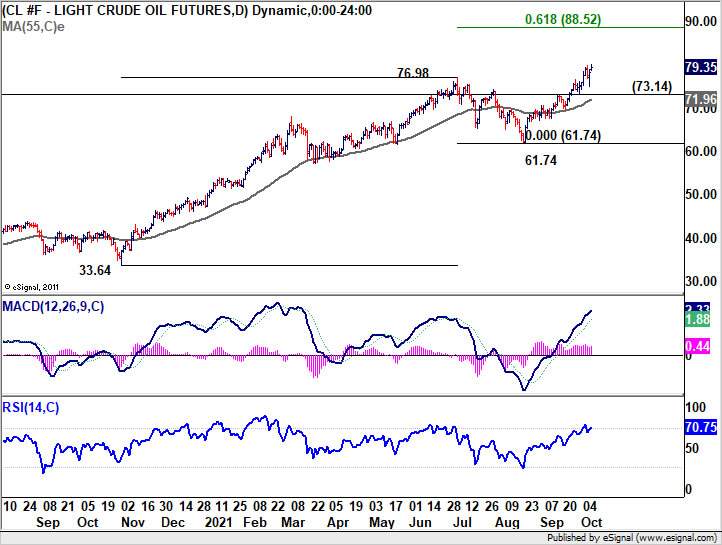
WTI breached 80 handle, on track to 88 fibonacci projection
WTI crude oil stayed firm last week and breached 80 handle for the first time since 2014, before closing at 79.35. Oil price followed broad based rally in energy and commodities including natural gas and coal. It's also supported by OPEC decision to stick to a prior agreement to increase production by a modest 400k bpd.
For now, near term outlook in WTI will stay bullish as long as 73.14 support holds. While daily RSI is slightly in overbought zone, there is no sign of loss of momentum in daily MACD yet. Further rise would be seen to 61.8% projection of 33.64 to 76.98 from 61.74 at 88.52, if WTI could sustain above 80 and build a base there.
CAD/JPY ended as top mover, to retest 91.16/62 resistance zone soon
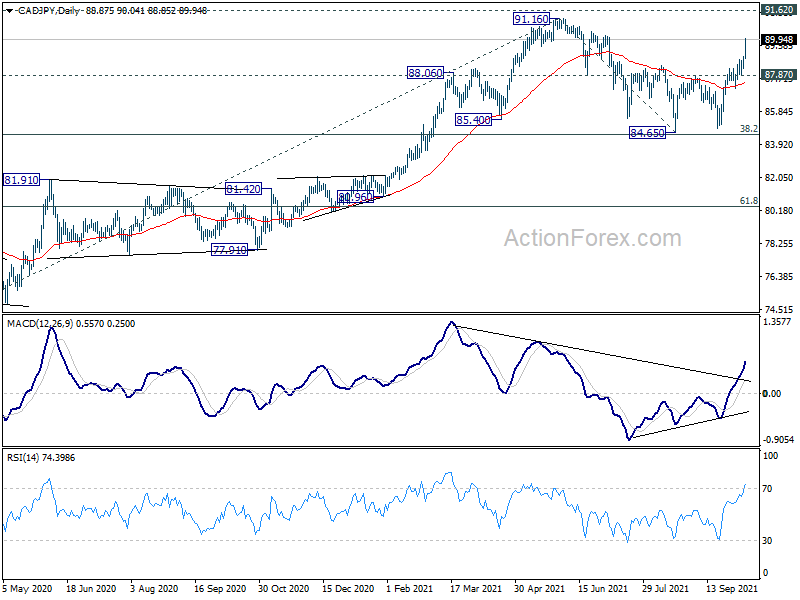
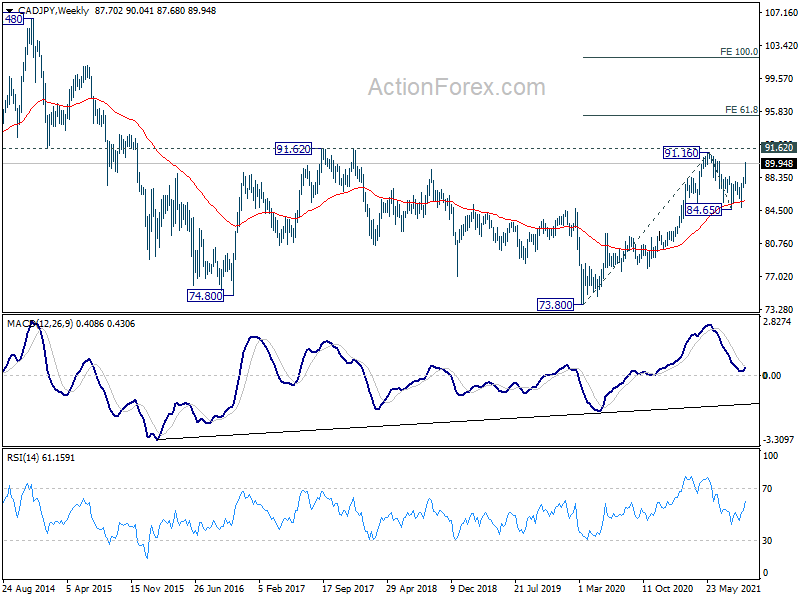
CAD/JPY ended as the biggest mover last week, on the back of solid Canadian job data, strong oil price, and selloff in Yen on rising yields. The development affirmed the case that correction from 91.16 has completed at 84.65, after defending 38.2% retracement of 73.80 to 84.65 at 84.52. The strong support from 55 week EMA also affirms medium term bullishness.
Further rise is now expected as long as 87.87 support holds. Decisive break of 91.16 will likely power CAD/JPY through 91.62 long term resistance. In the case, up trend from 73.80 should target 61.8% projection of 73.80 to 91.16 from 84.65 at 95.37 next.
USD/JPY Weekly Outlook
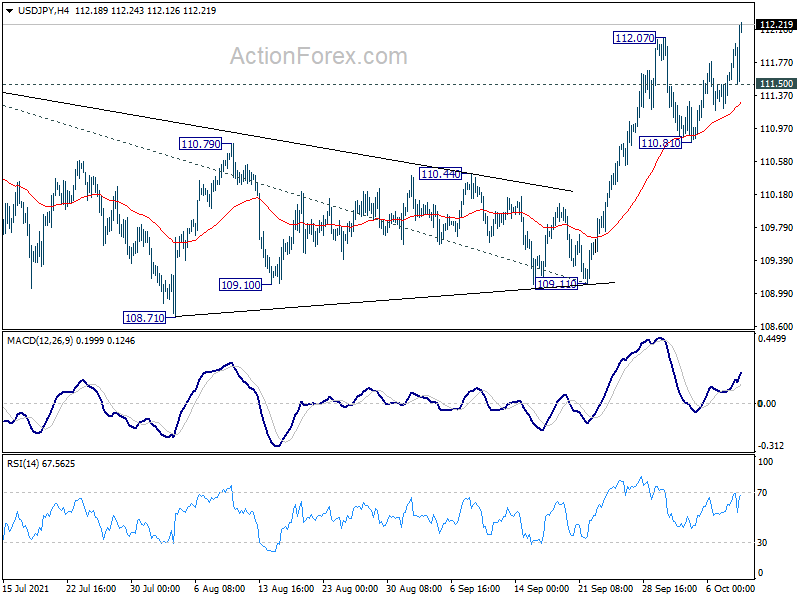
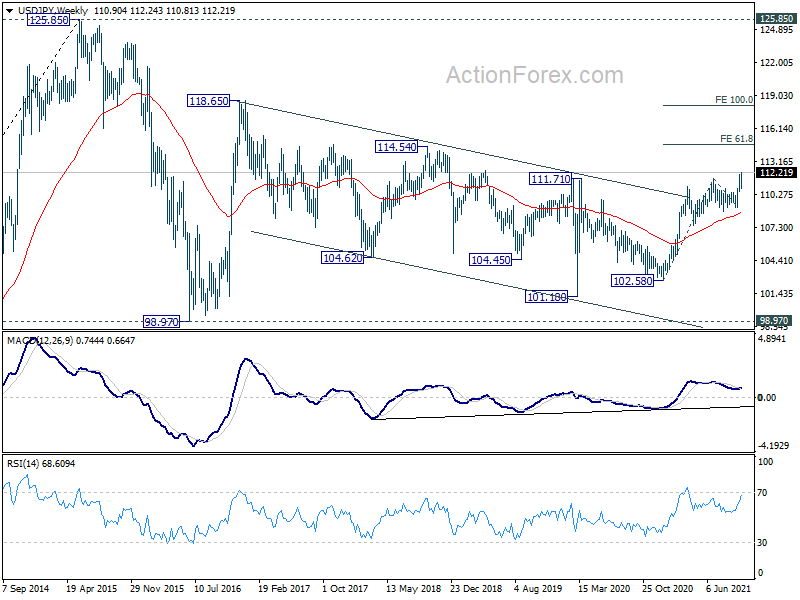
USD/JPY's rally resumed last week by breaking 112.07 temporary top and hit as high as 112.24. Initial bias stays on the upside this week. Current up trend from 102.58 should target 61.8% projection of 102.58 to 111.65 from 109.11 at 114.71 next. On the downside, below 111.50 minor support will turn intraday bias neutral first. But near term outlook will stay bullish as long as 110.81 support holds.
In the bigger picture, corrective decline from 118.65 (2016 high) should have completed at 101.18 already. Rise from the 102.58 is seen as the third leg of the up trend from 101.18. Next target is 114.54 resistance and then 118.65 high. This will now be the preferred case as long as 108.71 support hold, even in case of pull back.
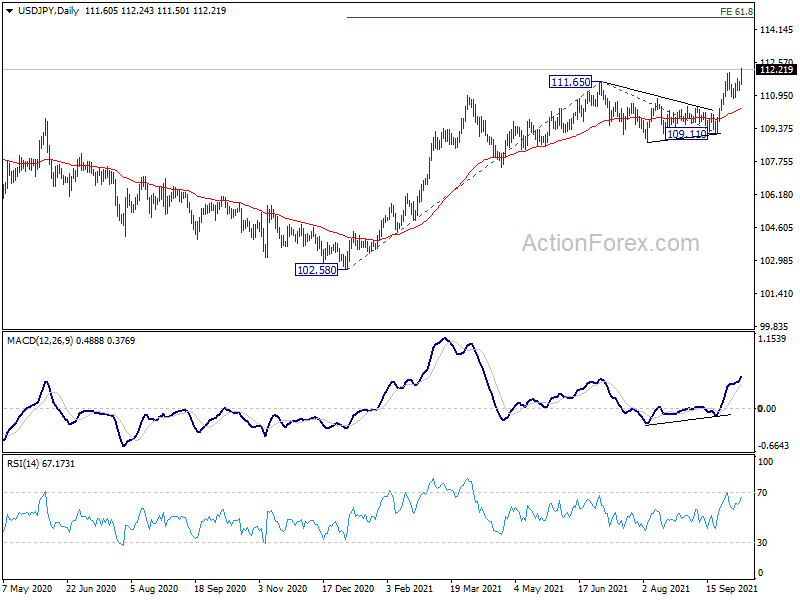
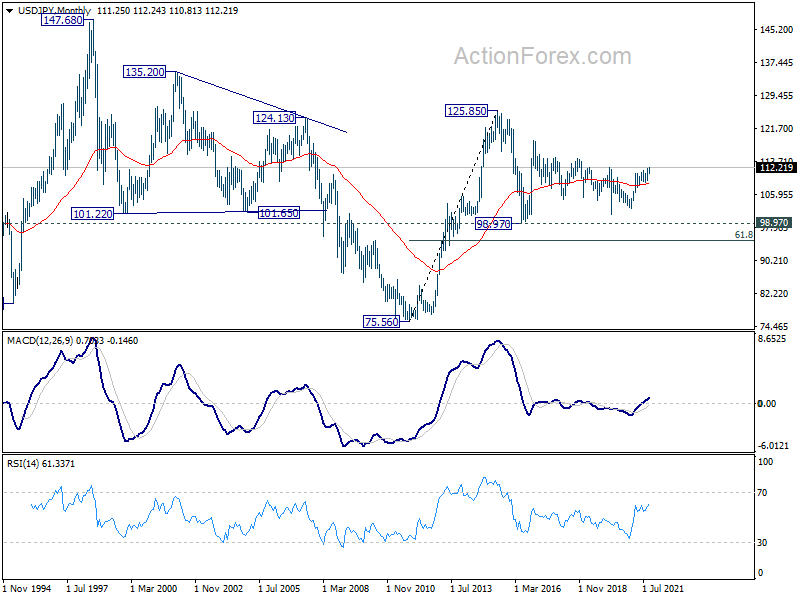
In the long term picture, the rise from 75.56 (2011 low) long term bottom to 125.85 (2015 high) is viewed as an impulsive move, no change in this view. Price actions from 125.85 are seen as a corrective pattern which could still extend. In case of deeper fall, downside should be contained by 61.8% retracement of 75.56 to 125.85 at 94.77. Up trend from 75.56 is expected to resume at a later stage for above 135.20/147.68 resistance zone.
Summary 10/11 – 10/15
Monday, Oct 11, 2021
[php_everywhere instance="1"]
Tuesday, Oct 12, 2021
[php_everywhere instance="2"]
Wednesday, Oct 13, 2021
[php_everywhere instance="3"]
Thursday, Oct 14, 2021
[php_everywhere instance="4"]
Friday, Oct 15, 2021
[php_everywhere instance="5"]
Weekly Economic & Financial Commentary: Another Disappointing Employment Report
Summary
United States: Another Disappointing Employment Report
- September's disappointing employment report, which showed employers adding just 194,000 jobs, once again highlights the supply-side challenges facing the United States, as labor is in short supply and there are widespread shortages of finished products and inputs. The extension of the debt ceiling to early December removes the most ominous storm cloud hanging over the economy, and may set the table for stronger gains in coming months.
- Next week: Consumer Price Index (Wednesday), Retail Sales (Friday)
International: Reserve Bank of New Zealand Raises Interest Rates & Canada on Recovery Path
- The Reserve Bank of New Zealand became the second developed economy central bank to raise interest rates during the current cycle, while its closest neighbor, the Reserve Bank of Australia, maintained its accommodative monetary policy stance at its October meeting. In Canada, the ongoing steady improvement in the labor market should prompt the central bank to further slow the pace of its government bond purchases at its monetary policy announcement later this month.
- Next week: U.K. GDP (Wednesday), Australian Employment (Thursday), Brazil Economic Activity (Friday)
Credit Market Insights: Pace of Consumer Credit Wanes after a Record Summer
- Consumer credit increased $14.4B in August, its weakest monthly increase since February. The lower-than-expected number points to another sign that August differed from July due to the Delta variant. A telltale mark of the public health deterioration was the weaker $3.0B increase in revolving debt, which reflects consumers' credit card purchases.
Topic of the Week: Debt Ceiling: See You in December?
- The U.S. Senate moved on Wednesday and Thursday to enact a law that would temporarily increase the nation's debt ceiling for a few months. Last week, Congress passed a stopgap funding bill that averted a federal government shutdown by re-authorizing current spending levels through December 3. This week's debt limit bill grants the federal government an additional $480 billion of borrowing capacity.
The Weekly Bottom Line: Strong Jobs Report Caps Week With A Bang
U.S. Highlights
- This week, Congress continued to bicker over the debt limit. Fortunately, both parties were able to come to an agreement that would lift the limit temporarily, kicking the can down the road.
- The September employment report was underwhelming as non-farm payrolls grew by a much lower-than-projected 194k. On the upside, the unemployment rate came in lower than expected at 4.8% partly due to a pullback in the labor force.
- The U.S. trade deficit hit a record high of $73.3 billion in August on the back of surging imports, which reached record levels. Of note, the widening deficit with China has prompted the U.S. to maintain the steep tariffs previously imposed.
Canadian Highlights
- North American gas prices whipsawed this week, first rising amid the on-going supply crisis and then dropping after a pledge by Russia to boost supply. Oil prices climbed on reports that the U.S. likely won’t tap its strategic reserve to ease supply concerns.
- This week’s dataflow was generally encouraging, with building permits remaining healthy, home sales inching higher in September and net trade adding to growth in August.
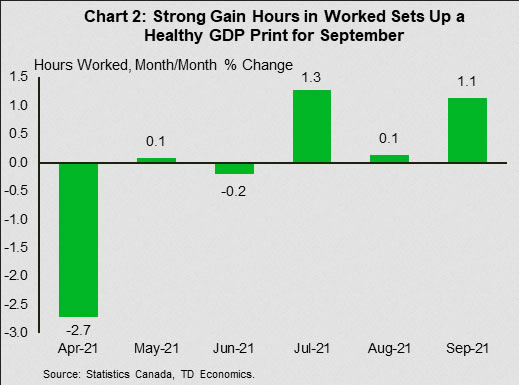
- September’s solid Labour Force Survey report showed an increase in the labour force, a healthy 157k job gain (driven by full-time positions), and a steep rise in hours worked. The latter signals an increase in monthly GDP and suggests good momentum heading into Q4.
U.S. - Nothing is Certain Except Debt and Taxes
The continued back and forth between Democrats and Republicans on the U.S. debt limit again captured headlines this week. While Democrats want a bipartisan suspension of the limit, Republicans have so far refused to play along. Cooler heads prevailed this week, as the parties reached a detente on Thursday. Senate Minority Leader Mitch McConnell proposed a short-term suspension of the debt ceiling until Democrats can pass a more permanent solution. The deal was accepted, and the Senate passed a $480bn debt-ceiling increase, which should keep the Treasury with enough money to pay its bills until December 3rd.
The key issue behind Republicans’ unwillingness to raise the debt limit is the President’s $3.5 trillion spending plan. Even among Democrats, there is not widespread agreement on such a large package. Since all Democratic Senate votes will be needed to pass the bill, party members have been busy trying to scale back bill expenses that will be financed through a slew of individual and corporate tax increases.
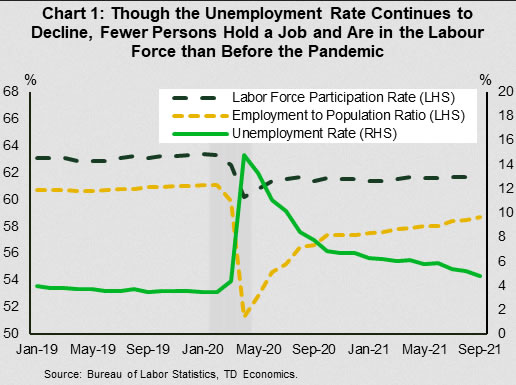
In economic news, the much-anticipated September jobs report was disappointing. The U.S. economy added 194k jobs over the month, much less than consensus expectations for a 500k increase. On the upside, the unemployment rate came in much lower than predicted, dropping to 4.8% from 5.2% in August. The rate fell due to stronger job growth in the household survey (+525k) but also due to a drop in the participation rate (Chart 1) and 183k persons leaving the work force. Employment in high paying sectors such as professional and business services were up (+60k), though the notable decline in education (-180k) was unexpected. The slow improvement in the labor force bears watching, as a persistent shortage of workers could weigh on the recovery going forward.
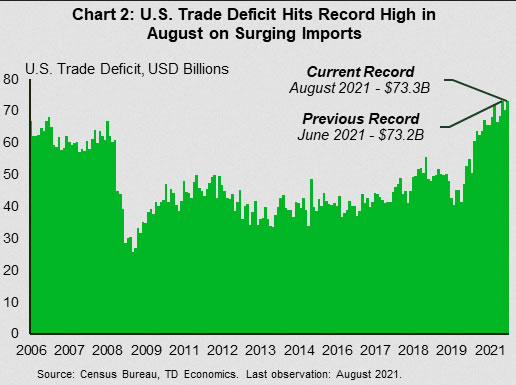
Elsewhere, the U.S. trade deficit hit a record in August on continued consumer demand for imports. The goods and services trade deficit widened to $73.3 billion in August from $70.3 billion in July. The deficit exceeded the previous record of $73.2 billion observed in June (Chart 2) as imports rose to a record high of $287 billion (+1.4% m/m), while exports rose by a smaller 0.5% to $213.7 billion.
Notably, the goods deficit with China widened to $31.7 billion (up 10.8% m/m), the largest gap since July 2019, due to continued strong imports and declining exports. This dynamic highlights a key source of friction between the two nations. China has yet to significantly increase its imports of U.S. products – an obligation under the bilateral trade agreement implemented last year. The U.S. has noted that while the current Administration will begin new talks with Beijing, existing steep tariffs imposed by the Trump administration will remain in effect.
The best news of the week came from the ISM Services Index, which showed that U.S. service sector activity accelerated in September. The index nudged upwards to 61.9 from 61.7 in August, beating market expectations for a decline to 60. This suggests that demand remains well supported, and while supply challenges may hamper progress, the U.S. economy should continue to recover, supported by high savings and strong balance sheets.
Canada - Strong Jobs Report Caps Week With A Bang
North American gas prices rode the highs and lows observed in international markets this week, with European gas prices first surging amid the intensifying energy crisis, then calming as Russia (an important supplier to the continent), pledged to step in with additional supply. Oil also whipsawed in tandem with gas, although it rose later in the week, touching levels last seen in 2014, on signals that the U.S. wouldn't tap its strategic reserve to help ease supply pressures (Chart 1).
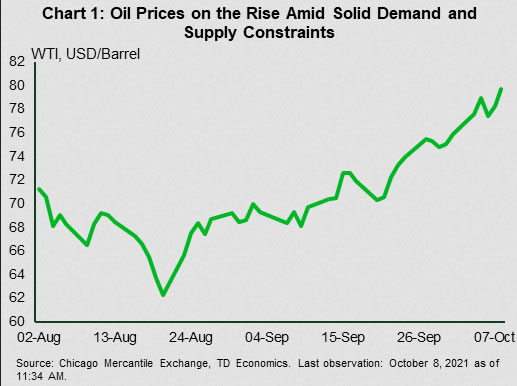
Gas prices have climbed sharply higher in recent weeks which could boost inflation, especially in Europe and Asia. However, North American gas markets are well supplied, providing some protection (see report). Oil prices have also rallied since late August and could see additional near-term upside as gas markets remain tight, although plentiful OPEC+ spare capacity and rising U.S. production could cap prices near current levels over the medium-term.
Equity market sentiment this week was boosted by news that the U.S. debt ceiling would be extended through to early December from its fast-approaching deadline of October 18th. Bond yields were also higher, although this likely reflects their correlation to U.S. rates, which have been on the rise.
Canadian data released this week generally offered an encouraging look at various aspects of the recovery, with the spotlight on construction, housing, international trade and job markets. Data released earlier this week pointed to construction activity remaining healthy in the near-term, as permit issuance was elevated relative to history in August. On the demand side, data from local real estate boards suggested that Canadian home sales may have managed a modest gain in September (full data is out next week), breaking a string of five straight monthly declines. Elsewhere, August's international trade data showed an increase in export volumes alongside a drop in imports, signaling a positive growth contribution from net trade.
On the labour market front, this morning's Labour Force Survey report showed an encouraging 0.7% m/m climb in the labour force, while the participation rate climbed to 65.5% - matching its pre-pandemic level. Of some note, employment dipped in a few industries that appear to be suffering from worker shortages, such as healthcare and social assistance and accommodation and food services. However, this is picking nits to a degree, as the rest of the report was very strong. Indeed, employment surged by 157k, bringing it all the way back to its pre-pandemic level. Compare that with the U.S., where the number of jobs is still 3.2% below where it was just before the pandemic struck.
The gain was also not driven by re-openings, as employment was higher in 10 of 16 industries. Hours worked climbed by 1.1% on the month, pointing to a good month for GDP which, in turn, would build in a nice hand-off for the fourth quarter. All in all, a very nice way to cap-off a busy week.
Silver – Another Failed Breakout?
Or more to come?
Are we about to see silver break out of the descending channel and bring an end to months of a downtrend?
The charts suggest we probably aren’t. Silver has rallied over the last week or so but today it’s run into significant resistance near the upper end of the descending channel and the long upper wick suggests it’s been strongly rejected.
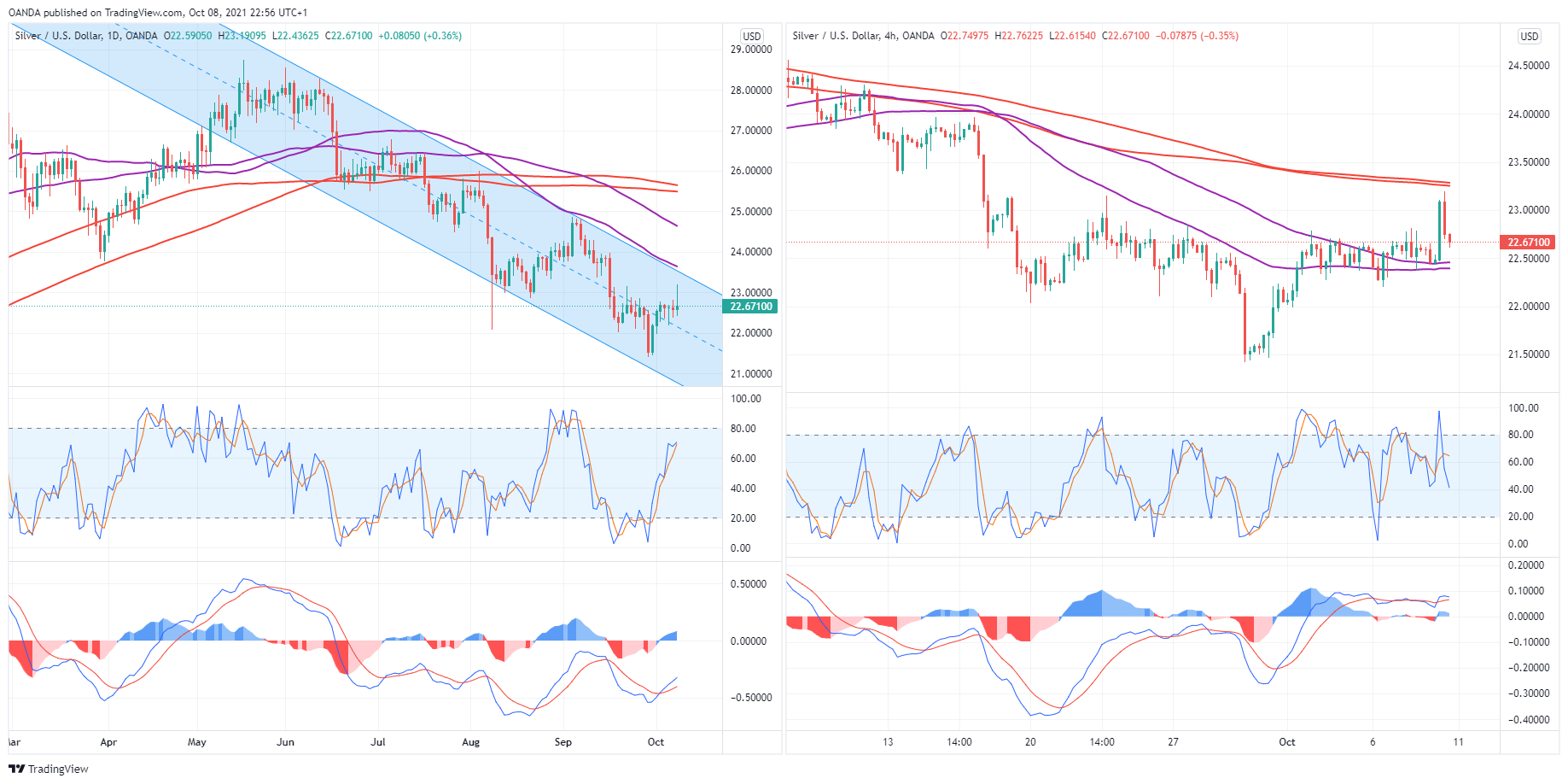
This fell just shy of the 55-day SMA , the lower end of the 55/89 band, which has been resistance since breaking below back in June.
Similarly, this resistance was found around the 200/233-period SMA band on the 4-hour chart which, barring a brief moment earlier this month, has been a solid ceiling, also since June.
Should it break above here, it could be a very bullish signal. But the early signs aren’t promising which may suggest the path of least resistance remains below.
Week Ahead – Fed Minutes and Inflation in Focus
A busy week in store
Another fascinating week in the markets and there’s little reason to think there isn’t plenty more to come in the final months of the year. Russian President Vladimir Putin calmed investor nerves this week, reassuring everyone that the country stands ready to stabilise the energy market just as the situation was getting out of control. Of course, that would be far easier if the controversial Nord Stream 2 pipeline’s approval was accelerated. Over to you, Germany.
The debt ceiling threat has been pushed back to December, alleviating mild concerns that lawmakers on both sides may not blink until it’s too late. All eyes remain on Washington though, as we wait to see whether President Biden will renominate Fed Chair Jerome Powell, just as the central bank prepares to taper its pandemic asset purchase program in November following a good enough September jobs report.
Evergrande may have taken a step back from the headlines but the company’s problems are far from over. Missed debt payments won’t be tolerated for much longer and investors will increasingly demand answers. We’re already seeing contagion as other developers miss payments and the situation will get far worse if something doesn’t change very soon.
Country
US
A weak payrolls report will not derail the Fed, and now markets can fully expect a formal taper announcement at the November 3rd FOMC meeting. Congress has also punted on making any hard decisions over the debt ceiling, infrastructure, and spending, so the focus on Wall Street will primarily fall on inflation. The September inflation report is expected to show pricing pressures remain elevated, but any hotter-than-expected readings could unnerve some investors.
Many traders are closely watching to see what President Biden does regarding renominating Fed Chair Powell. A decision could happen on or before October 13th, when Randal K. Quarles, Vice Chair for Supervision term expires. What has complicated Powell’s potential renomination has been the Fed trading scandal that impacted two presidents of Fed reserve banks and Fed Vice Chair Richard Clarida.
The upcoming week is filled with economic data releases and Fed speak. Many investors will pay close attention to the more dovish members, Evans and Brainard, to see if they are changing their tune about inflation being transitory. On Monday, Fed’s Evans gives introductory remarks at an award ceremony. On Tuesday, the NFIB Small Business Optimism report is expected to show some weakness, JOLTS job openings could remain near the 10.9 million level, and Fed’s Bostic will speak on inflation at the Peterson Institute.
Wednesday is the most important day of the week as Wall Street will closely follow the September US inflation report, the release of FOMC minutes, and what Fed’s Brainard says at the Fed Listen Event. Thursday contains the release of the weekly jobless claim, September PPI and is filled with Fed speak from Bostic, Logan, Barkin and Harker. Friday is the second most important day of the week as traders will follow the release of September retail sales, which should show the consumer is weakening. The Empire manufacturing report, the first regional index for October, is expected to show manufacturing activity slowed, but the primary focus for some might be the comments about supply chain issues. Fed’s Williams will also participate in a monetary policy panel.
EU
A quiet week ahead for the EU, with data releases primarily made up of tier two and three releases. The only exception being the ZEW economic sentiment figures on Tuesday.
UK
A scattering of economic data throughout the week to come, starting with NIESR GDP estimate on Monday, labour market figures on Tuesday and the official monthly GDP data on Wednesday. Tier two and three releases will also be released throughout the week.
Markets continue to price in three rate hikes by the end of next year, with the first potentially by this December.
Emerging Markets
Russia
Russia has positioned itself right at the centre of the energy crisis, with President Vladimir Putin claiming they’re ready to stabilise the market. It seems what will help with this is the approval of the politically divisive Nord Stream 2 pipeline which will enable more supplies. How fortunate. No data of note next week.
South Africa
Another quiet week on the data side, with business confidence index on Monday, manufacturing production index on Tuesday and retail sales on Wednesday.
Turkey
Rumours surfaced today that President Erdogan is losing patience with CBRT Governor Sahap Kavcioglu, just seven months after taking charge at the central bank. It would appear the Governor is on borrowed time if both his boss and the markets have lost faith in him.
With the lira trading at record lows, crossing your fingers and hoping inflation falls as you cut rates is unlikely to end well. Especially if you’re seemingly doing it to appease a President that is reportedly frustrated at it taking so long for the loosening process to begin. We may be about to see the fourth Governor sacking in a little over two and a half years.
Asia Pacific
China
China has another short week ahead, with Friday being a holiday. The data calendar is light with the highlight being inflation on Thursday which is expected to rise by 0.90% YoY.
China’s energy shortages are grabbing the headlines with the government instructing state energy companies to secure supplies at any cost. That will keep energy prices supported, but any signs that the situation is worsening may again lead to selling on the main indexes.
President Xi makes a speech on Taiwan this weekend, and depending on the contents, could see some volatility in regional markets on Monday.
Evergrande has slipped from the headlines this past week, but with another China developer defaulting on a foreign debt this week, markets are not far away from sparking another sell-off in Mainland and Hong Kong equity markets.
India
The RBI has left policy rates unchanged, saying that it remains accommodative. That has been despite inflation far outstripping policy settings leading to a stagflationary environment. The Indian Rupee has been under pressure for the past week. INR has immediately sold off after the RBI decision and may test 75.00, even 75.40.
Stagflationary fears could increase with the release of Industrial Production and WPI on Tuesday and Friday.
With energy prices remaining elevated, particularly coal and natural gas, the pressure will come on India’s current account as a massive net importer of energy. That might explain why the fizz has gone out of India’s stock market over the past week.
Australia & New Zealand
Data-wise, New Zealand releases Electronic Retail Spending on Monday, while Australia releases Consumer Confidence and Employment on Thursday which usually generates some intra-day volatility.
The RBNZ raised policy rates as expected but NZD/USD remains acutely vulnerable to the delta-variant which is now spreading outside Auckland to adjacent provinces. A deterioration over the weekend could see NZD/USD marked sharply lower on Monday’s open.
Japan
New Prime Minister Kishida has set a 31st October election and has promised cash payments to citizens affected by the virus and also a new supplementary budget (read fiscal goodie bag) after the election. Japan has a heavy data schedule including PPI, Reuters Tankan, Machinery Orders and Industrial Production. The overall tone is closely tied to US markets right now, so the data will only be useful for intra-session volatility.
Japan equities are maintaining a high correlation to Wall Street this week. Fiscal stimulus announcements are also providing support. USD/JPY has risen to near 112.00 as the US Dollar prices in the Fed taper and US yield remain firm.
Key Economic Events
Saturday, Oct. 9
- Czech Republic elections: Prime Minister Babis expected to win a second term.
- German Chancellor Merkel starts her delayed three-day visit to Israel.
- Danish Prime Minister Frederiksen begins three-day visit to India
- North Korea marks the anniversary of its ruling Workers’ Party of Korea.
Economic Data/Events
- China aggregate financing, money supply, new yuan loans
Sunday, Oct. 10
- Taiwan President Ing-wen gives annual address
Economic Data/Events
- New Zealand home sales
- China FDI
Monday, Oct. 11
- US and Canada Bond markets will be closed for the Columbus Day holiday and Canada’s Thanksgiving Day.
- IMF/World Bank annual meetings begin
- Fed’s Evans speaks at the Lawrence R. Klein Award virtual ceremony.
- Czech politics in focus: Babis to begin coalition negotiations.
Economic Data/Events
- Italy industrial production
- Japan machine tool orders
- Turkey current account
- UK industrial production
- South Africa business confidence
- Czech Republic CPI
- Norway CPI
- Denmark CPI
- Russia current account
Tuesday, Oct. 12
- IMF releases World Economic Outlook and Global Financial Stability Report.
- Atlanta Fed President Bostic speaks on inflation to the Peterson Institute for International Economics in Washington.
- The Singapore Defense Technology Summit
- The EU-Ukraine summit
- The G-20 trade ministers meet in Sorrento, Italy.
- Google Cloud Next conference
Economic Data/Events
- Australia NAB business conditions, consumer confidence
- Germany ZEW survey expectations
- India trade, industrial production, CPI
- Japan PPI
- Mexico international reserves, industrial production
- New Zealand ANZ Truckometer Heavy, net migration, card spending
- Russia trade
- South Africa manufacturing production
- Turkey industrial production
- UK jobless claims, unemployment
Wednesday, Oct. 13
- IMF Managing Director Georgieva and COP26 President Sharma speak during the IMF and World Bank annual meetings.
- The G-20 finance ministers and central bank governors meet in Washington.
- The Russian Energy Week conference begins
- Federal Reserve Vice Chair Randal Quarles’s term expires.
- President Biden could decide on renominating Fed Chair Powell
Economic Data/Events
- US FOMC minutes, CPI
- JP Morgan reports third quarter earnings
- Australia Westpac consumer confidence
- New Zealand food prices, ANZ activity outlook
- China trade, medium-term lending facilities
- Japan machinery orders, M2 money stock
- Eurozone industrial production
- Germany CPI
- South Africa retail sales
- Russia CPI
- UK industrial, manufacturing production, trade
Thursday, Oct. 14
- Reserve Bank of Australia Deputy Governor Debelle speaks at two-day CFA Australian Investment Conference
- FDA meeting over Moderna and Pfizer booster Covid shots
- Japan’s new Prime Minister Fumio Kishida to dissolve parliament ahead of expected October 31st national general election
Economic Data/Events
- US initial jobless claims, PPI
- India wholesale prices
- China PPI, CPI
- Australia unemployment, consumer inflation expectations
- Singapore GDP
- Japan industrial production
- Mexico central bank minutes
- Spain CPI
- Russia gold, forex reserves
- Poland current account
- U.K. RICS house prices
- EIA Crude Oil Inventory Report
- Earnings Reports from TSMC, Bank of America, Morgan Stanley, and Citigroup
Friday, Oct. 15
Economic Data/Events
- US business inventories, Sept Advance Retail Sales M/M: -0.3%e v +0.7% prior, Oct Empire Manufacturing: 25.0e v 34.3 prior, Oct Prelim University of Michigan consumer sentiment: 73.5e v 72.8 prior
- Canada existing home sales
- Eurozone new car registrations
- New Zealand manufacturing index
- Thailand forward contracts, foreign reserves
- France CPI
- Italy trade, CPI
- Poland CPI
Sovereign Rating Updates
- United Kingdom (Moody’s)
- France (DBRS)
WTI Oil Outlook: WTI Price Surges to New Multi-Year Highs on Global Energy Crunch
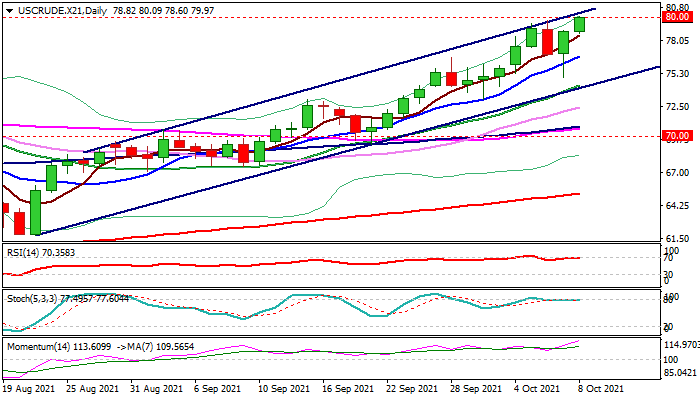
The WTI price probed through psychological $80 barrier for the first time since November 2014 on Friday and hit new 2021 high, on track for the fifth straight weekly gains and for over 5% advance this week.
Oil prices were boosted by global energy crunch that pushed natural gas prices to record high, on fears that a cold winter could add to obstacles in gas supplies, with many countries looking for alternative energies, such as coal. Rising natural gas and coal prices, as well as decision of the OPEC+ group to stick to gradual rather that strong increase in production, raised upside risks to the oil prices.
Many market observers expect the oil prices to continue rising and pointed to risk that oil could reach $100 per barrel within short period of time if the conditions in the energy sector do not improve.
WTI contract price is currently riding on the fifth wave of five-wave cycle from $61.79 (Aug 23 trough) which broke above its Fibo 138.2% expansion and eyes $81.86 (FE 161.8%) and $85.24 (FE 200%).
Full bullish setup of daily/weekly studies supports the action, with weekly close above $80 level to add to strong bullish signals. Corrective dips, under current conditions, will be expected to offer better buying opportunities.
Res: 80.09; 81.86; 85.24; 89.25.
Sup: 79.60; 76.95; 75.49; 75.06.