

Sample Category Title
Stagflation: 1970s Deja Vu?
Summary
- The term "stagflation", which was widely used in the 1970s and the early 1980s, essentially disappeared from the lexicon over the subsequent few decades. However, it has become in vogue again recently with the marked rise in inflation that is due, at least in part, to supply constraints.
- Stagnation can mean different things to different people. To some, it means an outright contraction in economic activity (i.e., recession). Even if "stagnation" is interpreted as an extended period of sluggish economic growth and elevated unemployment, we do not believe that the current economic environment meets this definition, as growth is anticipated to remain above trend.
- Inflation has been pushed up recently by a combination of supply shocks and strong demand. But as businesses continue to adjust, the pandemic ebbs globally in the year ahead, and spending on goods shifts back toward services, we expect to see inflation recede.
- In contrast to the 1970s, labor demand remains exceptionally strong, so the unemployment rate should also recede in coming quarters.
- An upward spiral in wages, which would push prices higher as it did in the 1970s and 1980s, looks less likely today. Employee bargaining power is weaker today than in those decades due to a lower proportion of the workforce being unionized, and very few workers today having wages that are automatically indexed to prices.
- Although the rate of CPI inflation is likely to remain elevated in the near term and growth has slowed from the breakneck pace registered earlier this year, we do not believe that the U.S. economy is embarking on a period of stagflation.
Is It 1973 Again?
Not only has the COVID pandemic caused widespread human suffering worldwide, but it also has had profound economic consequences. The lockdown of the economy in the spring of 2020 caused the U.S. unemployment rate to spike to nearly 15%. At the same time, supply constraints have led to marked increases in the prices of many goods and services, pushing the CPI inflation rate in the United States up to more than 5%, the highest rate in roughly 13 years. A word, which essentially was forgotten during the past few decades, has re-entered the lexicon: stagflation.
The term "stagflation" was coined during the 1970s to describe the economic backdrop of the times. The first part of the word is taken from "stagnation" while the second part comes from "inflation", and it broadly refers to an environment in which inflation and unemployment are both high (or inflation is high while the economy is in recession or economic growth is sluggish). Another phrase that measured the extent of inflation and unemployment was coined during that time: the so-called "Misery Index".1
The Misery Index, which shows the combination of the year-over-year rate of CPI inflation and the unemployment rate, spiked to nearly 20% in the aftermath of the OPEC oil supply shock (Figure 1). The price of crude oil nearly trebled between late 1973 and early 1974, and the volume of oil imports, which shot up from less than four million barrels per day (bpd) in 1971 to more than six million bpd in 1973, declined modestly in 1974. The moonshot in oil prices and the plateauing in imported oil supply caused the industrial sector of the American economy to go into a tailspin (Figure 2). The unemployment rate shot up to a high of 9% in early 1975 while the CPI inflation rate surged into double-digit territory.
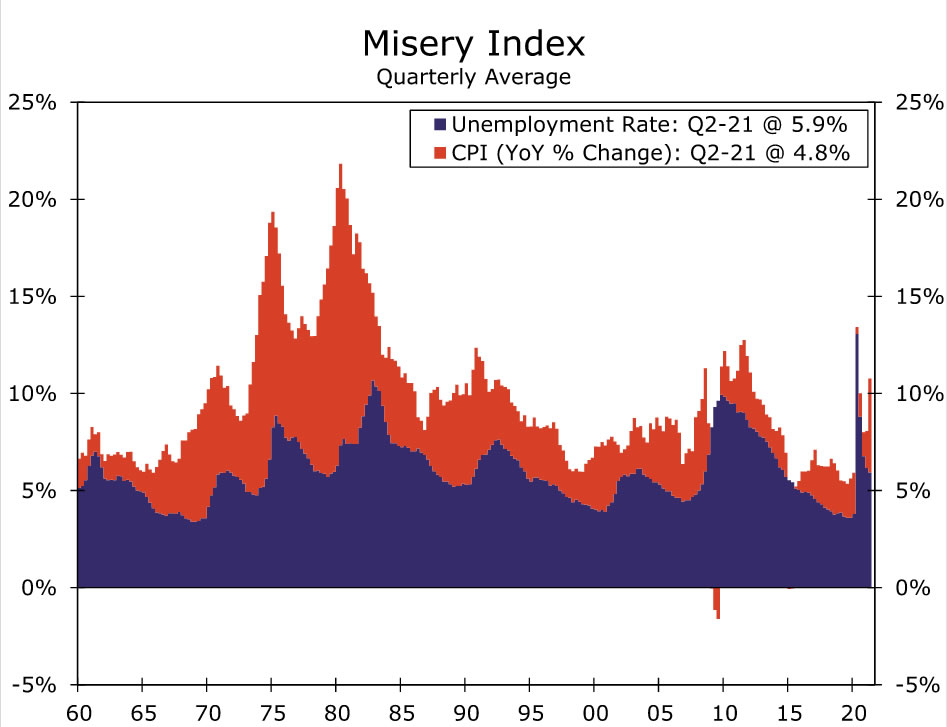
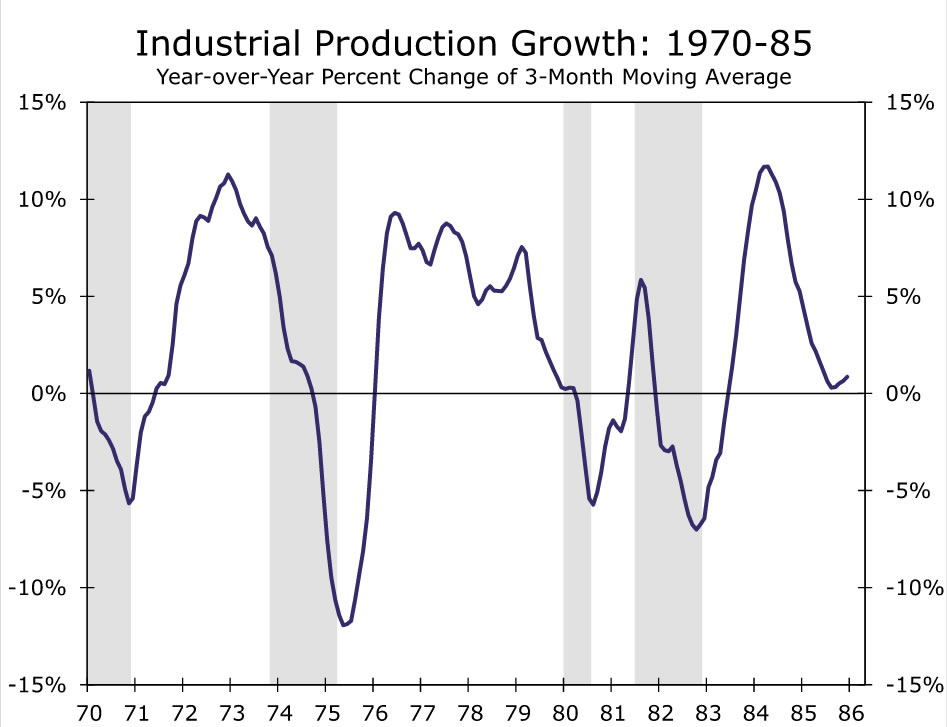
The Misery Index jumped even higher in early 1980 following the Iranian revolution in 1979. The price of crude oil more than doubled over the course of 1979, and industrial production contracted sharply again as oil imports declined. Labor costs continued to follow inflation, as roughly 60% of unionized workers were covered by cost of living adjustments (COLAs).2 The spike in interest rates that occurred in late 1979 and early 1980 added to the growth shock that hit the economy. The index receded as the economy exited the deep recession of 1981-82, and it generally remained in single-digit territory over the next few decades. It would rise into double digits occasionally, but never back to the heights of 1975 and 1980. The term "Misery Index", which was used extensively in the 1970s and early 1980s, faded from the lexicon. But the pandemic caused the index to spike again in early 2020 as the unemployment rate approached 15%. Although the index has subsequently receded on balance, it remains in double-digit territory at present.
Supply Constraints Central to Any Period of "Stagflation"
Stagflation can mean different things to different people. Inflation is rather straightforward, but stagnation may be interpreted in different ways. Does the economy need to be in an outright recession in order for it to stagnate? If so, then the economy is not stagnating at present because the National Bureau of Economic Research (NBER) has determined that the pandemic-induced recession ended in April 2020. Or does stagnation simply mean that economic growth is subpar and/or the unemployment rate is elevated? However strictly one views the stagnation half of stagflation, a poor growth environment in combination with elevated inflation implies the economy is suffering from some sort of supply shock.
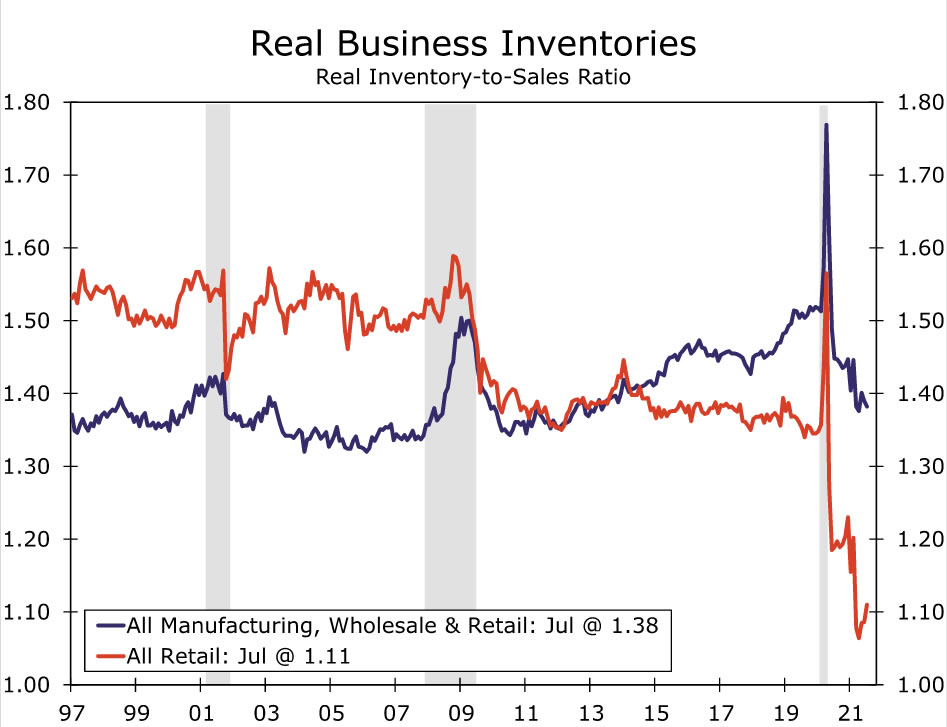
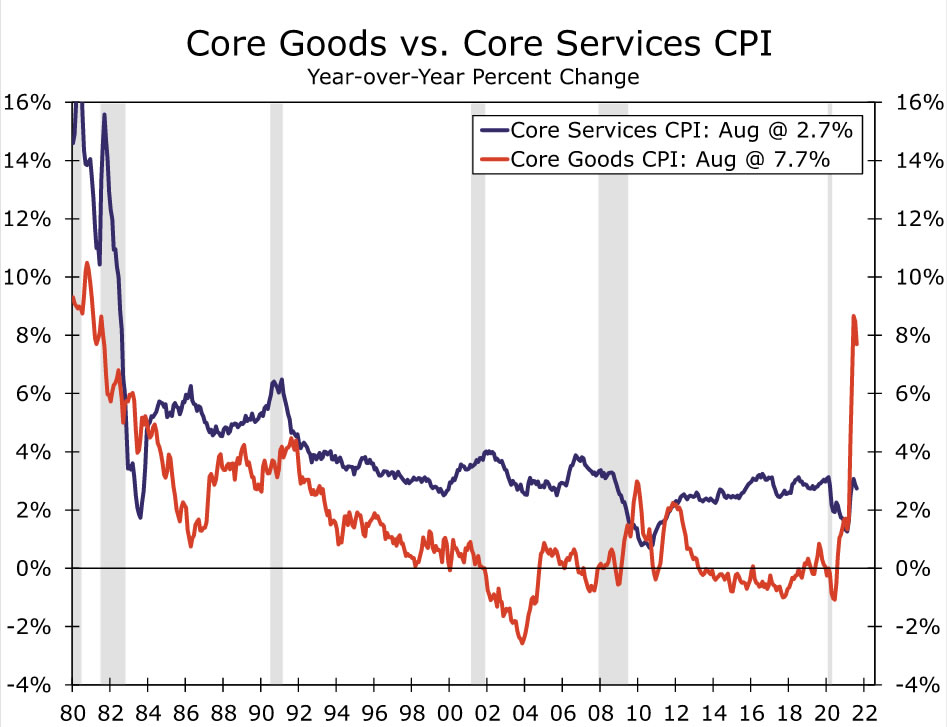
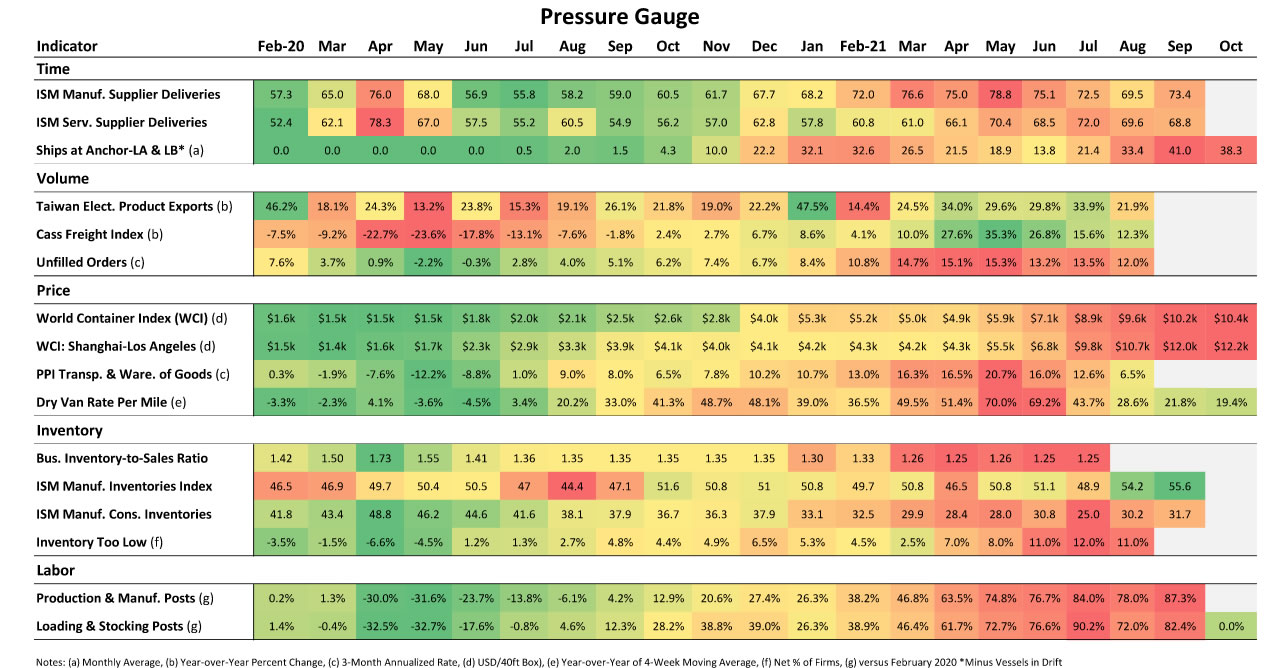
Elevated inflation at present stems in no small part from the bevy of supply shocks that have hit the tightly linked global economy since COVID. After the initial lockdowns in the early spring of 2020 that cratered production for a month or so, temporary factory shutdowns to contend with COVID outbreaks, parts shortages, fires, deep freezes and now insufficient energy have kept a wide range of businesses struggling to keep shipments flowing. Delicately choreographed supply chains have also struggled mightily, adding to the economy's supply woes. As our Pressure Gauge shows, bottlenecks remain severe across supply chains. The number of ships awaiting anchor at the ports of Los Angeles and Long Beach, together the country's largest, hit a record high in September, while inventories remain exceptionally low (Figure 3). Consumer goods inflation, even excluding food and energy, has rocketed to a 40+year high as a result (Figure 4). The ongoing supply struggles for everything from food to autos should keep inflation elevated in the near term. However, as businesses continue to adjust, the pandemic ebbs globally in the year ahead, and spending on goods shifts back toward services, we expect to see CPI inflation recede back toward 2% by the end of 2022.
Inflation? Yes. Stagnation? No.
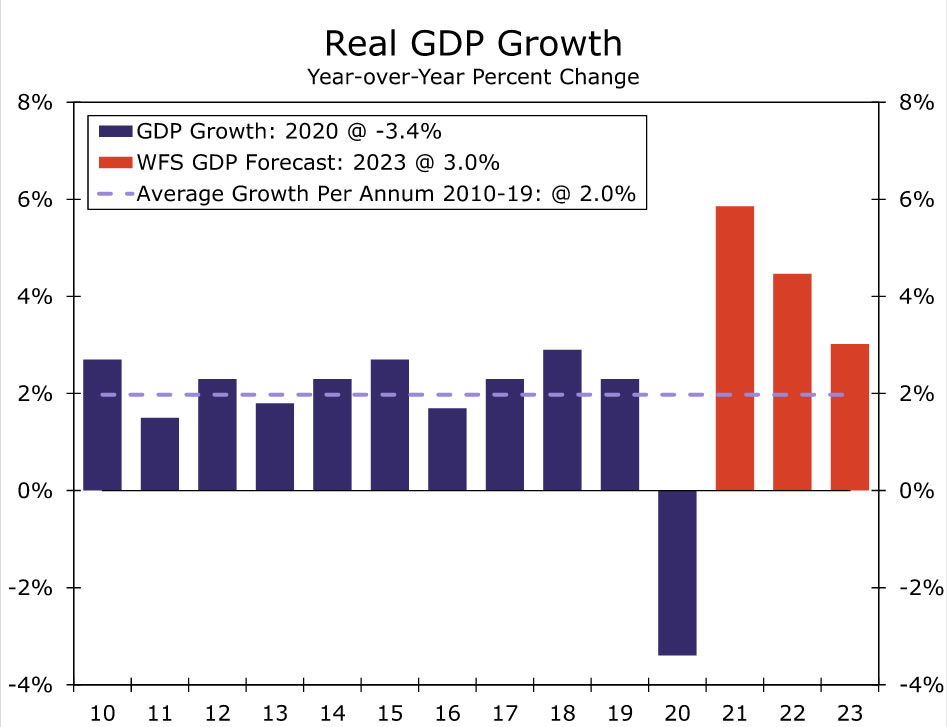
But the current bout of inflation is far from a pure supply shock. Inflation pressures have one foot firmly planted in strong demand. Output has roared back, eclipsing its pre-COVID peak in the second quarter of this year. The slowdown in real GDP growth relative to the first half of this year was inevitable with more distance put between one-time stimulus checks and the economy's broad re-opening in the spring. However, the economy is far from stagnating. Household balance sheets remain unusually strong on the heels of a recession, with $2.3 trillion in excess savings still logged. Austerity seems to be the last thing on the minds of the Biden administration and congressional Democrats and, unlike the 2010s, state and local governments generally have strong budget positions that give them the wherewithal to spend. US corporations' financial health also remains in solid shape thanks to soaring profits and low interest rates. We expect growth to remain above trend over the duration of our forecast horizon as a result (Figure 5). Growth may be slowing, but it is far from weak.
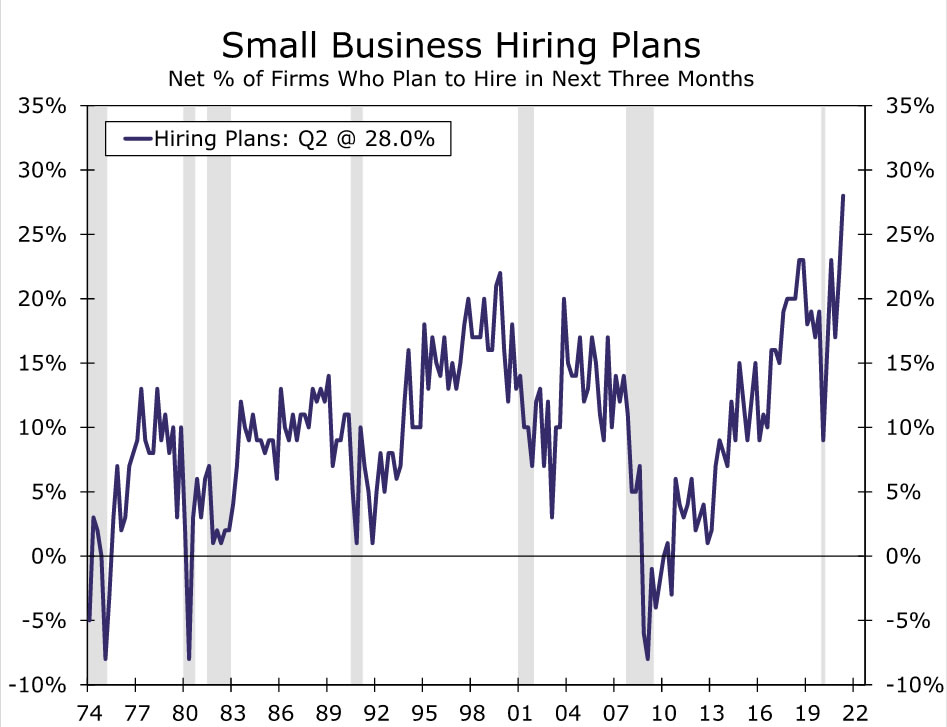
The prospects for the labor market are another important source of growth for the economy that marks a break from the 1970s. Labor demand remains exceptionally strong. A record share of businesses report that they are planning to hire, and the job opening rate is also at a record high (Figure 6). The lack of workers has been a major source of cost pressures in many industries, such as food services, in its own right. Yet an upward spiral in wages like the 1970s and 1980s looks less likely today. Employee bargaining power is weaker today, as only 6% of private-industry workers were unionized in 2020 compared with 17% in 1983 (the earliest year comparable data is available from the BLS). Unlike the 1970s, very few workers have wages that are automatically indexed to prices.
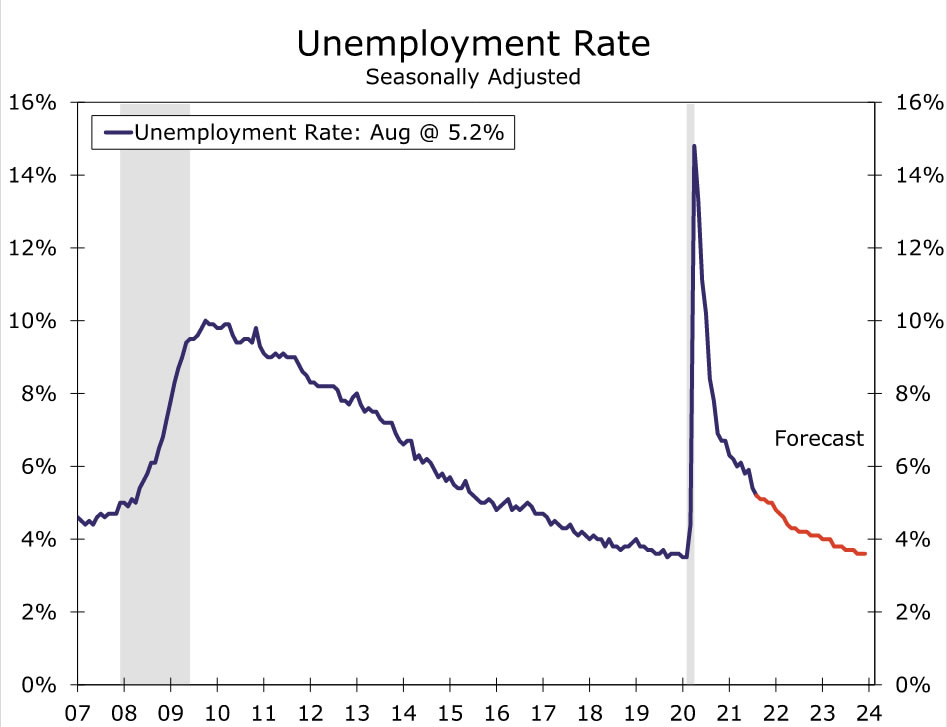
With hiring needs solid, employment growth is unlikely to go into reverse like in the mid- and late-1970s. We view the recent slowdown in hiring as more a function of constraints on the supply of labor, rather than faltering demand for workers that can incite the traditional recessionary dynamics of lower income, lower spending and even lower employment. With employers eager to hire, we expect the unemployment rate will continue to trend lower, albeit at a decreasing rate as the availability of labor should improve in the coming months.
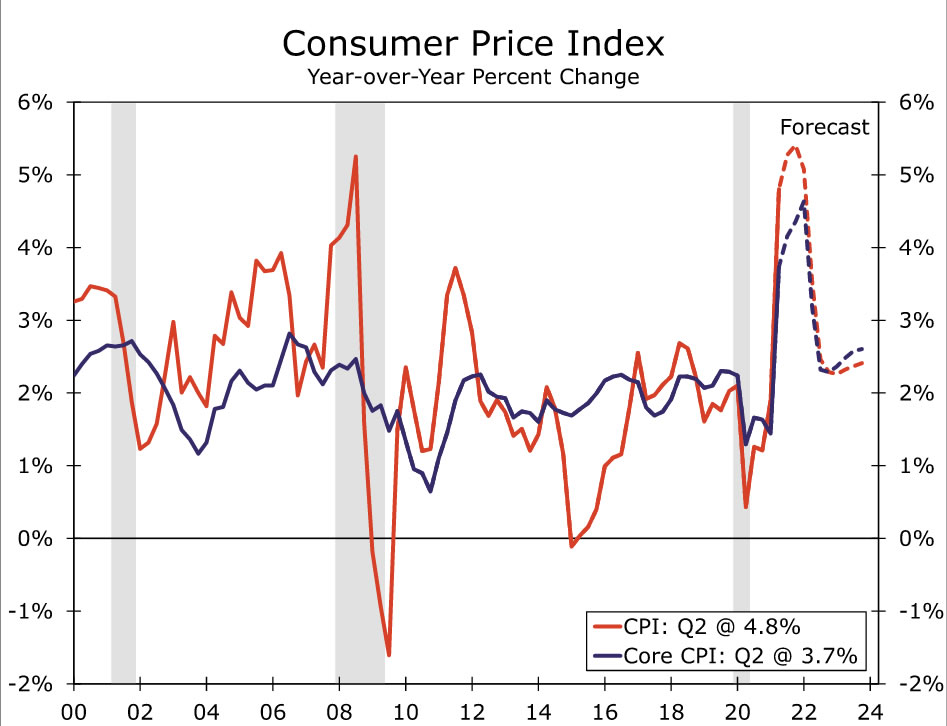
We do not explicitly forecast the Misery Index, but combining our forecasts for inflation and the unemployment rate shows the index is likely to remain near double-digits in the next few quarters. While the unemployment rate is expected to gradually recede (Figure 7), we expect CPI inflation, measured on a year-ago basis, to remain above 5% through the early part of 2022 (Figure 8). However, with the initial burst of reopening related price hikes behind us and bottlenecks across supply chains expected to ease over the year, we expect the Misery Index to be back into the mid-single digits late next year. In short, we do not believe that the U.S. economy is embarking on a period of stagflation.
Endnotes
1The economist Arthur Okun first referred to the combination of inflation and the unemployment rate as the Economic Discomfort Index. The term "Misery Index" is attributed to Ronald Reagan.
2Devine, J. "Cost-of-living Clauses: Trends and Current Characteristics" Bureau of Labor Statistics. December 1996.
Week Ahead – US Inflation in Focus as Energy Fears Cool
Panic around the energy crisis faded a little after Russia offered Europe a helping hand. Stock markets came back swinging but the FX complex didn’t see much relief, with the mighty dollar holding everything else down. Looking into next week, the inflation/growth story will remain front and center with the release of American CPI numbers and retail sales, as well as the latest Fed minutes.
Give me shelter
The US dollar has reclaimed its throne as king of the FX arena, slicing through its rivals as investors looked for shelter from the storm in equity and energy markets. From paralyzed supply chains to an energy crisis that threatens to cripple Europe and Asia, there’s a real risk that global growth slows but inflation remains hot.
And with bond yields rising everywhere because of inflation concerns, the dollar is almost the last defensive hedge left across all asset classes. Neither bonds nor gold nor the yen are attractive in an environment of rising yields.
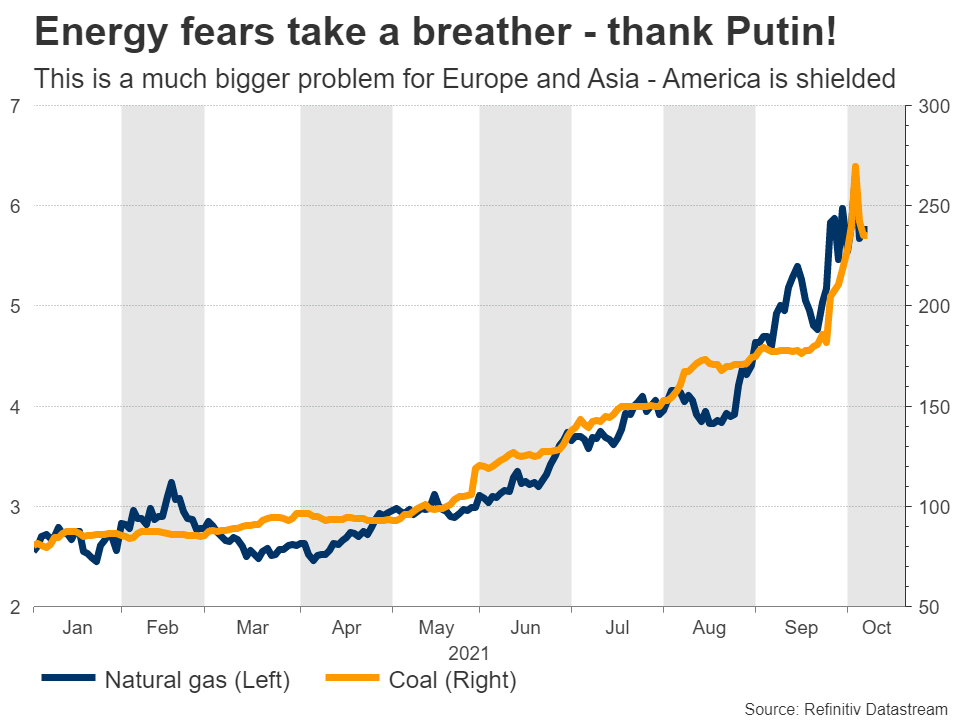
On top of everything, the American economy is heavily shielded from the power shortages thanks to its self-sufficiency on energy, and Congress is likely to deliver another massive spending package soon to power up the recovery. The fallout from the energy fiasco will probably impact Europe and Asia much more, hence the euro’s inability to recover even after Vladimir Putin promised to release more natural gas.
The other risk that haunted euro/dollar lately was the ghost of monetary policy divergence. The Fed is almost certain to dial down its asset purchases next month and markets are pricing in the first rate increase for December 2022, whereas the ECB is apparently ‘studying’ a new bond-buying program for next year when the emergency purchases end.
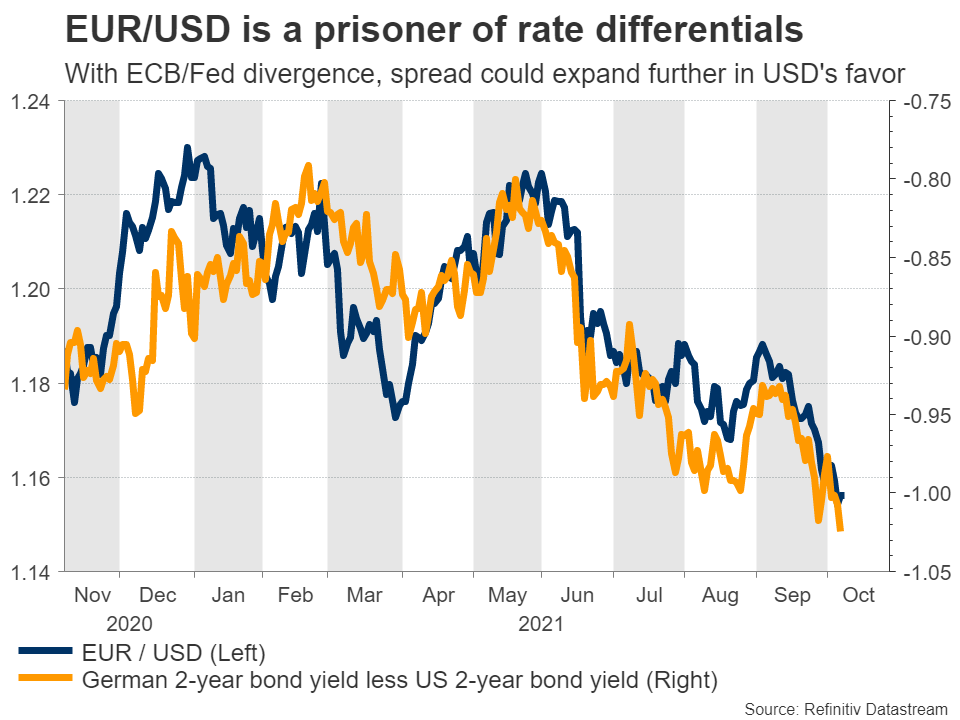
As such, the outlook for euro/dollar remains negative amid central bank divergence, demand for defensive plays, and America escaping a global slowdown with only minor injuries. The risk is that the Fed gets cold feet because of the unstable global environment and delays its normalization plans. But if the situation gets that bad, markets would probably be in panic mode so safe-haven demand could keep the dollar’s losses to a minimum.
Crucial US releases
Staying in America, the upcoming week promises to be quite exciting. Inflation numbers for September will be released on Wednesday, a few hours before the minutes of the latest FOMC meeting. Then on Friday, retail sales for the same month are due out.
The headline CPI rate is forecast to have ticked back up to 5.4% after a small dip in August, while the core rate is expected unchanged at 4.0%. Meanwhile, retail sales are projected to have declined a touch, but most of this weakness likely comes down to vehicle sales as the core figure that excludes those is expected to have risen. Combined, these would suggest inflationary forces remain strong and consumption healthy.
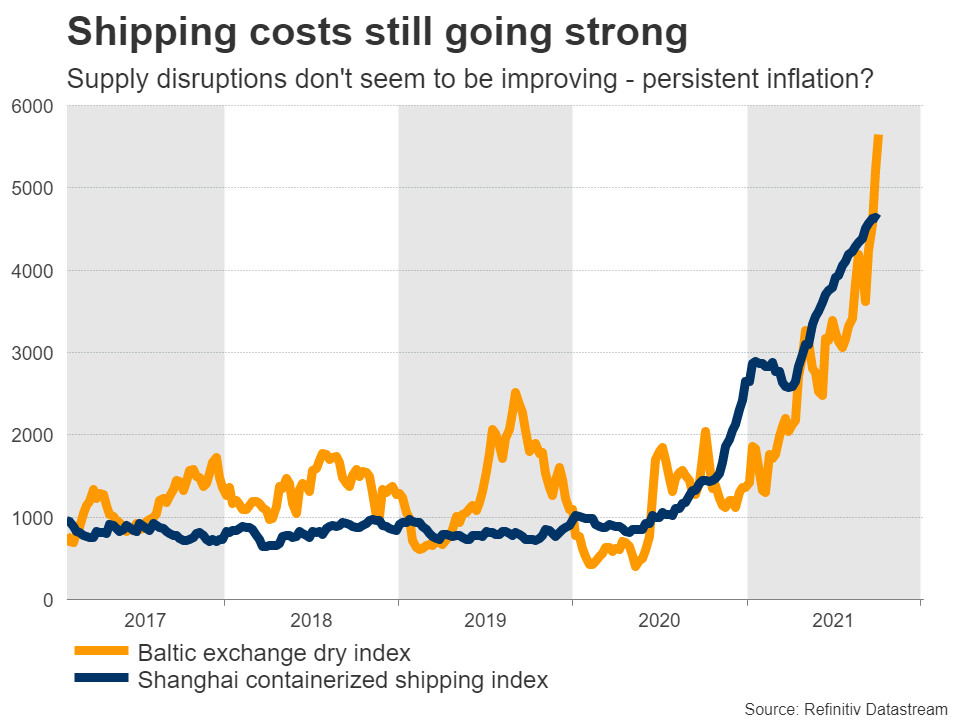
As for the minutes, this was the meeting when the Fed signaled it would taper its asset purchases soon absent some catastrophe in incoming data. Investors will therefore look for any hints around how many months the taper process could take. The conversation around whether inflation is transitory or persistent will also be interesting considering that supply chain disruptions don’t seem to be improving.
Sterling awaits data amid BoE hike bets
In the UK, the jobs report for August will hit the markets on Tuesday, ahead of GDP stats for the same month on Wednesday. Sterling enjoyed a wild rollercoaster ride lately, falling initially alongside stock markets but then recovering powerfully as investors started to price in more aggressive rate increases by the Bank of England to fight inflation.
Markets have almost priced in the first quarter-point rate increase for February, with another one to follow by June. This drastic shift boils down to inflation expectations. When central banks say inflation is ‘transitory’, the only way they can be confident about that is if inflation expectations remain stable, which shows that investors agree inflation will fade soon.
In this case, the opposite has happened. British inflation expectations skyrocketed lately, so markets now believe inflation will be persistent, likely because the UK is suffering more severe supply disruptions than most countries. Unfortunately, this might ultimately be a policy mistake. Central banks can’t fix broken supply chains, so by raising rates prematurely, that would simply slow down demand and by extension the recovery itself.
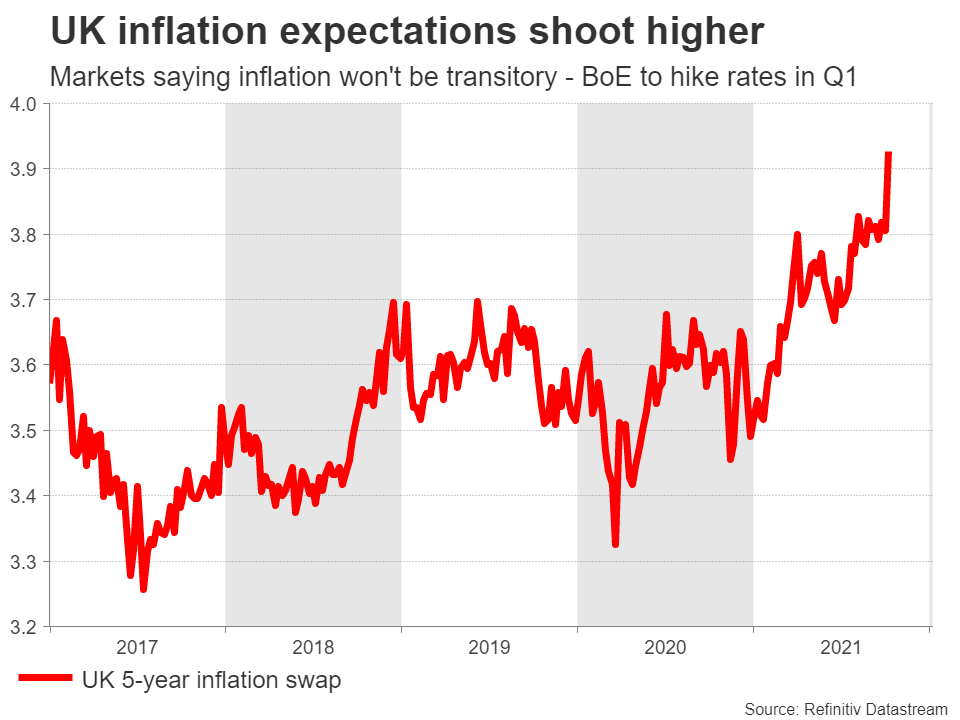
As for the pound, the outlook seems neutral at this stage. The BoE is already priced very aggressively, so the currency is unlikely to receive any more support from monetary policy. Instead, sterling’s fortunes will likely depend on how risk sentiment fares - whether stock markets continue to recover or whether energy and supply chain fears make a comeback.
Chinese and Australian stats
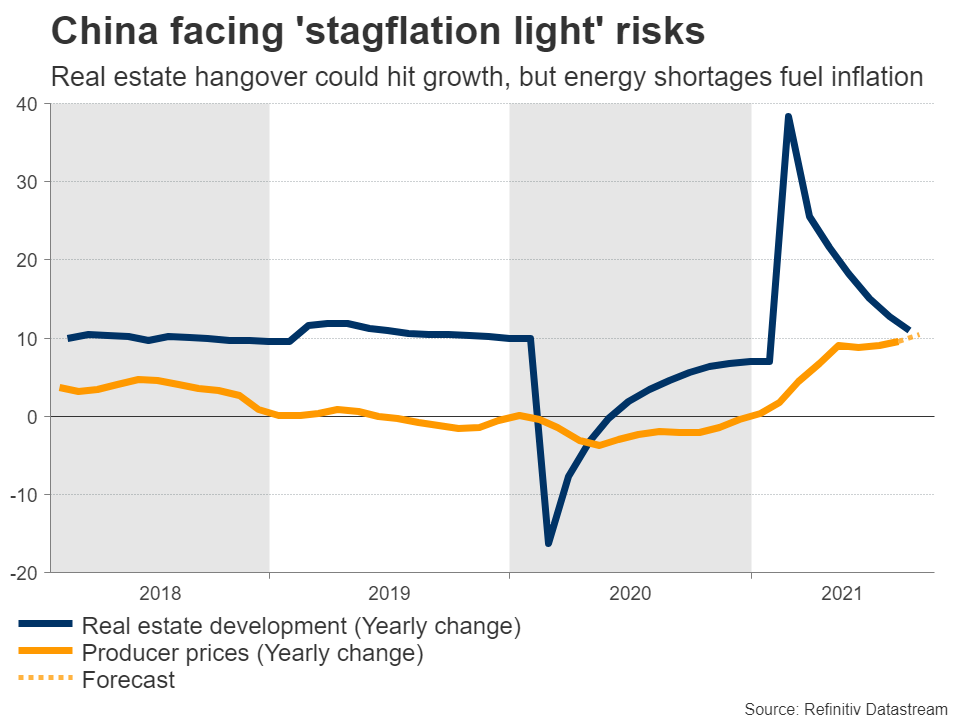
Over in China, trade numbers for September will be released Wednesday, before inflation figures for the same month on Thursday. These will be closely watched amid worries that the economic recovery is losing steam, as a painful deleveraging in the real estate sector has joined forces with power shortages that have plagued heavy industry.
The result might be a ‘stagflation light’ environment, whereby growth slows because of supply limits but inflation heats up as companies pass some of the higher costs down to consumers. This would inevitably impact the West too - if Chinese factory prices fire up, inflation would be exported across the world. Hence, all eyes will be on the upcoming producer prices, which are expected to have accelerated.
Finally in Australia, the jobs report for September is out on Thursday and expectations are for another round of sharp losses in employment, reflecting the recent lockdowns. That said, markets already know this was a tough month, so the aussie is more likely to be driven by the outlook for global growth, the energy crisis, and how the Chinese economy performs.
UK Jobs and GDP Data Unlikely to Relieve Pound’s Woes as UK Risks Grow
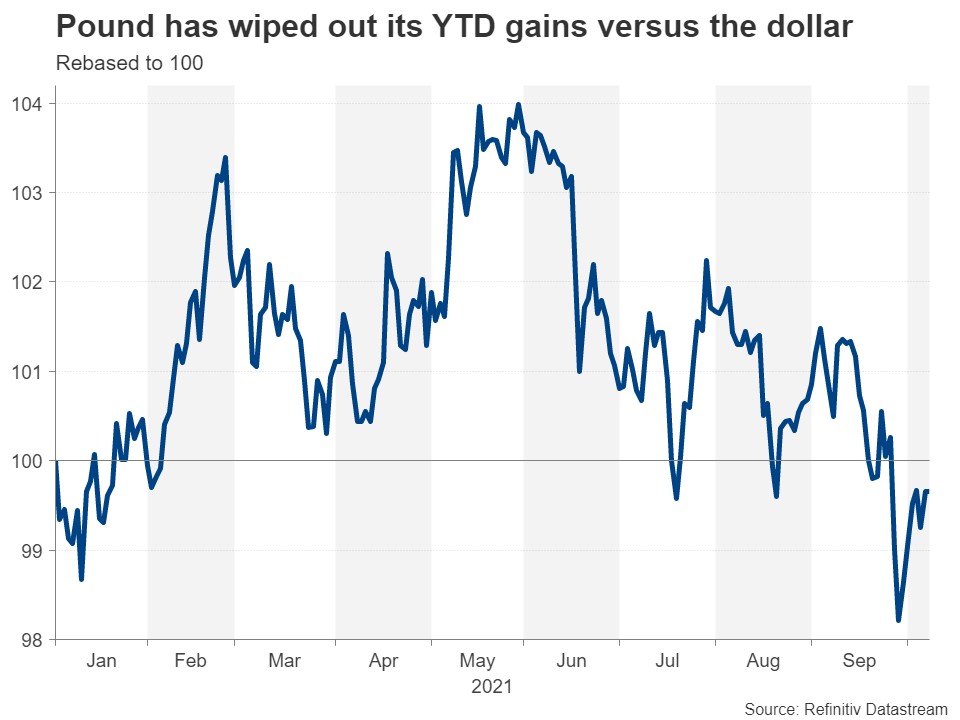
The latest employment report out of the United Kingdom will get the pound’s attention on Tuesday, which will be followed by GDP growth figures on Wednesday, both due at 06:00 GMT. The pound has gone from the best performing major currency at the start of the year to one of the worst over the past month as investors have downgraded their growth expectations for the British economy. Will the upcoming data send fresh warning signals about the UK’s economic health, or will they ease investors’ concerns?
Driver shortages bring economy to a standstill
Bottlenecks in global supply chains and the resulting shortages are being felt across all the major economies but they seem to be more acute in Britain, with many blaming the country’s departure from the European Union for exacerbating the problem. Specifically, the UK is experiencing a severe shortage of truck drivers, which is impacting everything from food deliveries to supermarkets to fuel supplies for petrol stations.
However, whilst there might be temporary fixes for the problems in the haulage industry, its associated shortages are not the only risks facing the UK economy. The soaring cost of natural gas, which Britain depends on for a big chunk of its non-renewable energy, has led to the collapse of several electricity providers and customers could soon see their bills skyrocket.
Inflation surge brings BoE rate hike closer
The combination of higher fuel prices and wages for truck drivers is likely to significantly push up costs for businesses who are already dealing with a host of other supply disruptions. Hence, they may have no choice but to pass on the increased costs to consumers.
The Bank of England is already alarmed at the prospect of inflation not only rising more rapidly than anticipated, but also staying elevated for a considerable period of time. Policymakers have recently been dropping hints that interest rates could rise as early as this year. An early rate hike would only add to the pain for businesses and consumers, dampening economic growth even more.
Will there be signs of trouble from the data?
Some of the supply-related constraints might be visible in the August readings for GDP growth and industrial output due on Wednesday. German industrial production data that’s already been released showed the sector took a bigger-than-expected hit in August from the supply problems. A similarly poor showing for the UK could weigh on sterling.
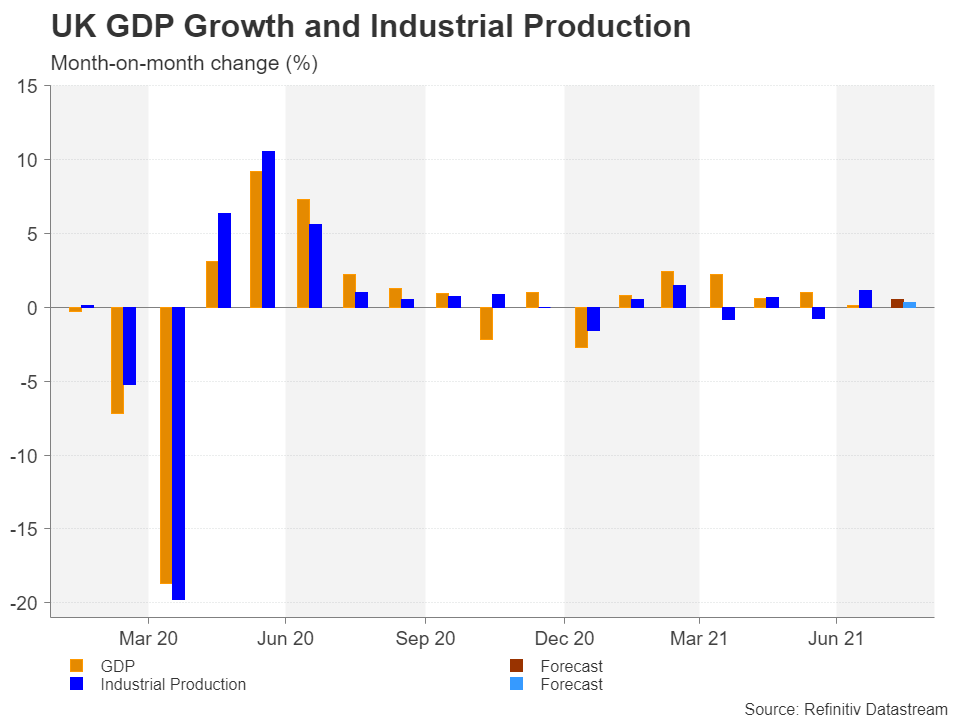
Investors will also be focusing on the jobs numbers coming out a day earlier for signs that more people might have joined the dole queue as the end of the government furlough scheme approached at the end of September. In particular, the claimant count and payrolls data for September will probably garner more interest than the headline employment print, which is one month behind.
Should unemployment claims, which have been falling since April, start to rise, it could flag a big jump in joblessness in October. However, if company payrolls continued to increase strongly in September amid the labour shortages, that could offset concerns about the effects of the furlough scheme drawing to a close.
Pound treads water despite rate hike bets
So where would all this leave the pound? The currency is currently attempting to overcome strong resistance in the $1.3630 region and overall better-than-expected numbers could help to overcome it, opening the way for the $1.37 handle. However, should the data badly miss the forecasts, fuelling worries about growth, cable could head back towards the September trough of $1.3410, which was a 9-month low. Below that level, the next target for the bears is the $1.33 mark that lies slightly beneath the 161.8% Fibonacci extension of the April-June upleg.
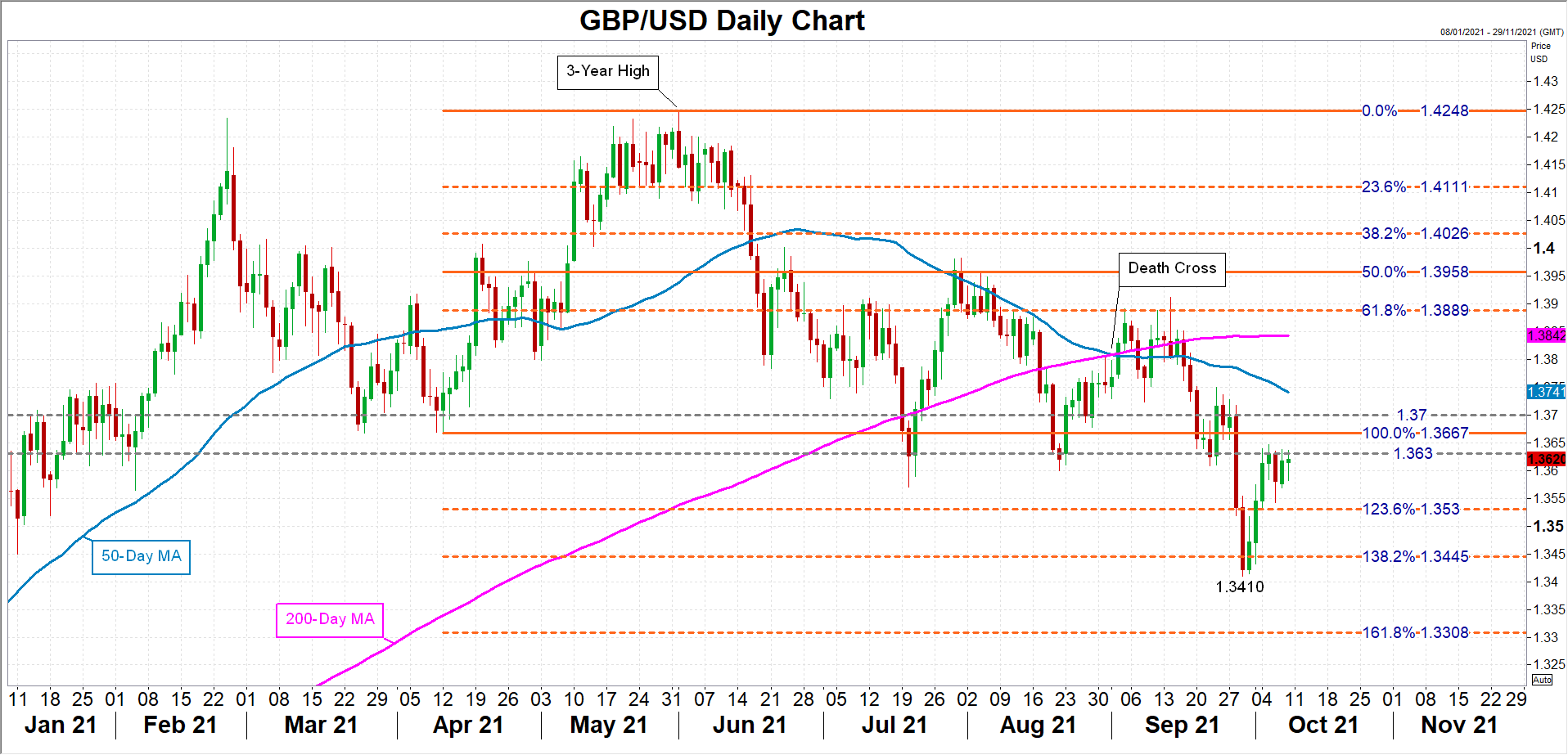
In the bigger picture, however, the pound’s direction will likely be determined more by the global growth outlook that sets the tone for broader risk sentiment and whether the US Federal Reserve will stay as hawkish given the growing downside risks. In the meantime, a more hawkish Bank of England will probably lend only modest support to sterling as investors are not convinced premature rate hikes are the way to go.
Forward Guidance: Supply Chain Disruptions Keep a Cap on Manufacturing Sector Gains
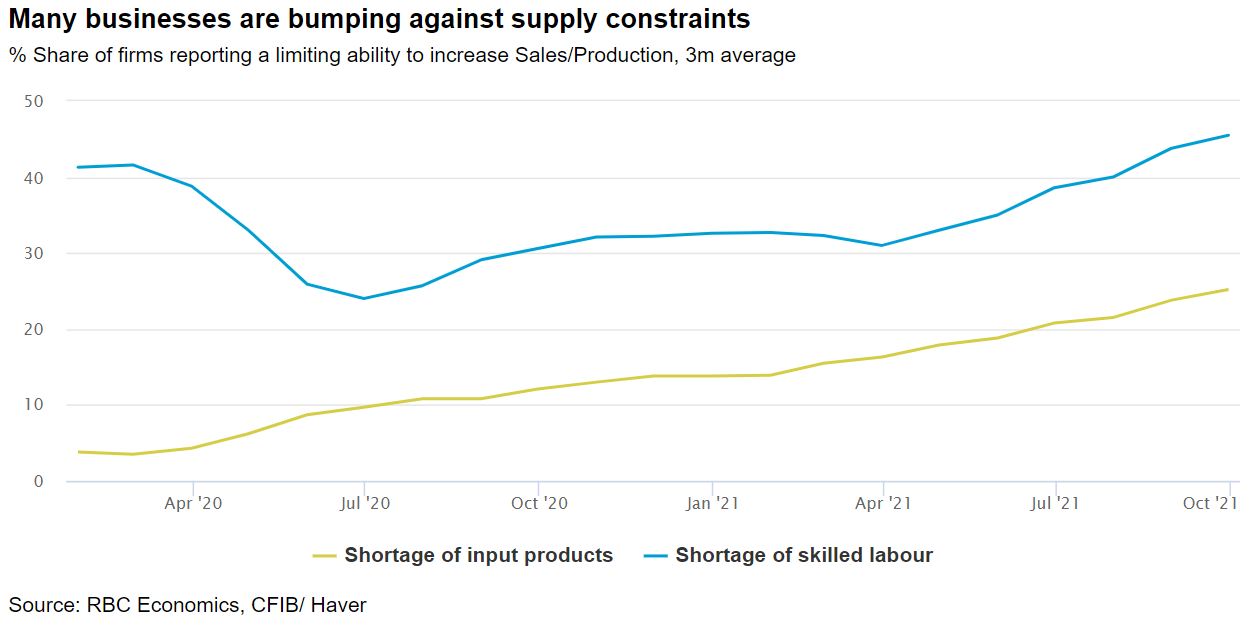
Supply chain disruptions will be at the heart of next week’s Canadian manufacturing and wholesale trade reports. We expect a flat reading for manufacturing sales in August versus Statistics Canada’s preliminary estimate of a 0.5% increase. A global semi-conductor shortage continues to disrupt auto production and businesses across the industrial sector are struggling to deal with higher input costs. Freight rates have skyrocketed, shipping times have lengthened, and reports of labour shortages are widespread.
Households are still flush with purchasing power thanks to government support and lack of spending options through the pandemic. But production is clearly bumping into capacity limits. That’s making inflation a greater concern than a shortfall in consumer demand. Next week’s US CPI report is expected to show still elevated price growth from a year ago (when prices were unusually low due to the pandemic). But it will also reveal a third consecutive of slower month over month growth compared to the immediate price surges that followed the reopening of the economy (particularly for motor vehicles). Most of the increase in producer input costs has yet to flow through to consumer prices. The longer supply chain disruptions last and commodity prices remain elevated however, the more likely price pressures become more pervasive and pronounced.
Week ahead data watch:
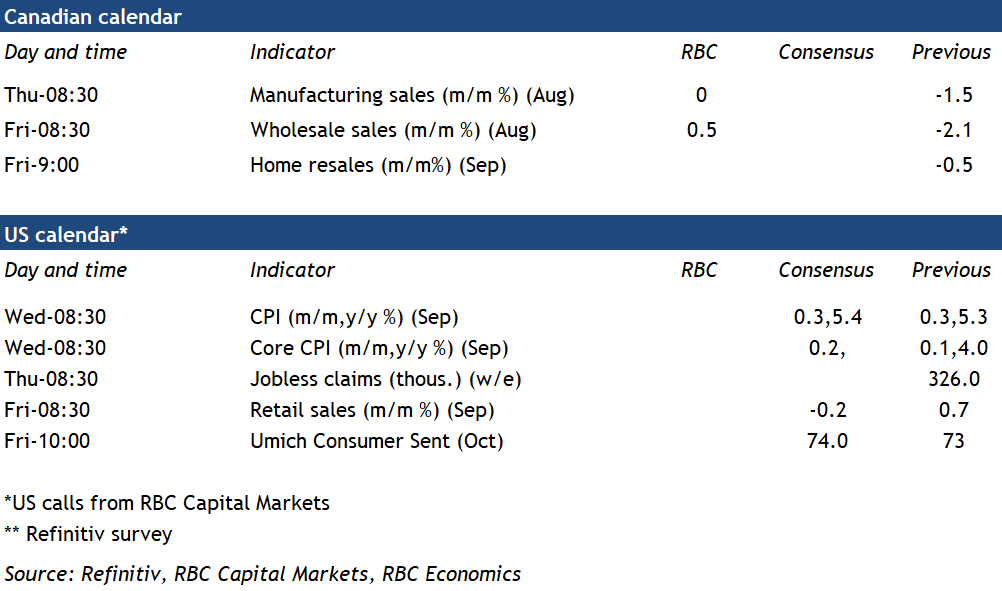
- Canadian wholesale trade likely increased by 0.5% in August, driven by higher sales of food and beverages, according to Statscan.
- US CPI for September will likely show another elevated YoY gain though the monthly pace of price increases is expected to remain smaller than the April-June surge during the initial reopening of the economy.
- Canadian home resales likely continued to moderate from exceptionally strong levels in September based on early local market reports.
Weekly Focus – Stagflation Risks Keep Rising
The past week added more signs that we could be heading for a stagflationary environment with weakening economic activity amid more persistent inflation pressures. New pockets of inflation keep popping up as supply side challenges continue. European gas prices shot higher again this week reaching six times the normal level. Comments from Russian President Vladimir Putin that indicated the country was prepared to help stabilize the market sent prices lower on Wednesday, but gas prices are still five times higher than before the prices started to soar. Oil prices also increased further this week to above USD80 per barrel. If these pressures persist we could see Euro inflation stay at high levels over the winter and continue to erode purchasing power of consumers, see Research Euro Area - Looming energy crisis creates a perfect storm, 4 October 2021. Other prices that have shot higher has been cotton (up 25% in a month) and coal (up more than 200% the past year).
Labour shortages also continue to be a challenge in most countries. In Asia, thousands of migrant workers employed in city factories are returning to their villages after lockdown measures have been lifted, adding to bottle necks in production. And in UK a lack of truck drivers have led to severe shortages of many goods, not least gasoline, see BBC.
On the activity front, German data on orders and industrial production disappointed this week. Orders dropped 7.7% m/m and industrial production plunged 4.0% m/m. Supply chain issues in the car sector are still an important factor for the weak industry performance, but signs of weakening demand in survey indicators suggest that more downside might lie ahead for Q4. On a more positive note, the US ISM manufacturing index increased in September and is still at a high level. Our leading indicators suggest it is a matter of time, though, before it starts declining, see Top 10 global cycle indicators, 4 October 2021.
After falling risk sentiment last week, markets have stabilized somewhat this week. Positive news on the US debt ceiling supported sentiment. Republicans and Democrats in Congress opened the door to a temporary solution to the debt ceiling issue, saying they would consider a stop-gap measure extending the borrowing limit until December. The Evergrande crisis has also calmed down somewhat, although the underlying problem is unresolved, see Research China - No 'Lehman moment' but financial stress is not over, 29 September 2021. In other news, President Biden stated that he has confidence in Fed Chairman 'at this time' suggesting that Powell will be reappointed later this autumn.
EUR/USD continued to drop this week as challenges continue in the euro area with weakening data and upward pressure on inflation from gas prices. We look for a further decline in the cross over the coming months.
Next week, focus turns to US data on CPI inflation and US retail sales. Consensus on US core CPI inflation is another muted increase of 0.2% m/m (was 0.9% m/m three months ago). In Europe we get the German ZEW, which has nose-dived lately, and UK monthly GDP. Developments in gas and electricity prices will also be in focus. In China, keep an eye on the property crisis data on credit. Finally, IMF publishes new forecasts on Wednesday.
A Flat End to the Week, Despite NFP Wobble
A bit of a flat end to an otherwise eventful week that has seen investors whipsaw between panic and optimism.
Massive vulnerabilities remain in the markets and even the two big success stories this week - debt ceiling and Russia's gas offer - are far from a solution. That hasn't stopped investors from celebrating them like a major victory, of course, while blissfully ignoring the multiple other downside risks to the outlook. Some things never change.
The deal on the debt ceiling that was passed by the Senate on Thursday has just kicked the can down the road and while the Democrats could use the time to raise it without Republican support, it is never that simple. They are clearly reluctant to do so without Republican votes ahead of next year's midterms and I expect we'll see more games in the interim.
Meanwhile, Vladimir Putin's comments on Wednesday in which he suggested Russia can stabilize the energy market came at the opportune moment. Natural gas prices were soaring and the stock markets were sliding, spooked by the prospect of a severe global energy crisis.
Energy prices remain extremely high and while promising, Putin's comments weren't a firm commitment to fill the shortfall in the market. Although it is a relief to hear it is possible. Which is where Nord Stream 2 enters the equation. Energy Minister Alexander Novak later claimed certification of the project may help cool gas prices. How subtle and convenient.
Given how politically divisive the pipeline is, it's no surprise that questions are being asked around the motivation of the Kremlin. Not to mention whether the pressure will become unbearable and the approval process accelerated in order to ease the pain this winter. Europe may feel it has little choice at this point after years of backing itself into a corner.
With all that said, there's certainly no guarantee that certification is accelerated or inevitable, which is why investors shouldn't get too carried away. Energy prices remain elevated and we are heading into crisis season, it's just investors that are burying their heads in the sand.
Markets largely give back NFP moves after knee-jerk response to headline number
The jobs report is what we've all been waiting for this week and it didn't disappoint. The headline NFP number was well below expectations and even a little shy of what many deemed the minimum to guarantee a taper this year, of 200,000. I'll be honest, I think it would have taken much less to trigger a wobble at the Fed. But that doesn't matter because once net revisions are factored in from previous months, a lot of the September miss was offset, which makes a taper announcement almost certain.
The only thing that can realistically stand in the way now would be a major taper tantrum in the markets. We've seen some nervousness this week but not nearly enough to cast much doubt on the decision next month. Unemployment slipped a little more than expected, aided by a drop in the participation rate which should become clearer in the coming months.
While the NFP was good enough, we've had an interesting reaction in the markets. The dollar slid after the release but has reversed those moves to trade back where it was ahead of the release. Gold surged on the dollar weakness but has managed to hold on to the bulk of the gains as US stocks remain a little off their pre-release levels. US yields slipped after the release but have also clawed back losses, leaving only gold to have not reversed its knee-jerk move.
Oil rally remains well supported after a brief pullback
Oil prices bounced back strongly on Thursday and are trading back near their highs from earlier in the week. Clearly, energy traders don't view the crisis as being magically resolved as a result of Putin's comments on Wednesday. Natural gas is still a little over 10% off its highs but it had made extraordinary gains in the weeks leading up to Wednesday, so this is a little more understandable.
Ultimately, the decision by OPEC+ not to increase output targets at the meeting earlier this week is a major tailwind for the rally and we're not seeing any loss of momentum at this stage. With the energy crisis contributing an additional 500,000 barrels in daily demand for crude, it's hard to imagine prices not hitting higher levels.
Gold jumps after jobs report
Gold prices are jumping in the aftermath of the US jobs report. The NFP number was well below expectations and more than offset the large upward revision to August. The dollar fell after the release as US yields declined, which propelled the yellow metal higher, up 1% on the day and not far from $1,800. While the dollar and yields reversed those losses, gold largely hung on.
Despite this, markets appear to be fully pricing in a rate hike by December next year, which is unlikely to settle the taper nerves. The jobs report was not so bad that policymakers will u-turn on their plans to taper this year - that was always highly unlikely - and now they'll just be hoping to avoid a full-blown taper tantrum in the markets. So far so good.
Bitcoin stable but eyeing record highs
Bitcoin has been relatively stable the last day or so, after spending much of the last week soaring higher. After surviving multiple tests of $40,000, the cryptocurrency broke above $45,000 and from there the bulls were back in control. And they've made up some impressive ground on the back of that to now trade around $55,000, with sights firmly set on making new all-time highs.
The prospect of the SEC approving up to four bitcoin ETF's in the coming weeks may be one thing exciting speculators and contributing to the surge we've seen in prices. If the regulator takes the plunge, many will view it as the next huge step towards more cash flowing into the market which could see it end the year on a high.
Sunset Market Commentary
Markets
European equity markets stabilized or saw minor profit taking after yesterday’s strong run with investors’ focus turning to the US payrolls report. At the same time, oil held near recent peak levels ($83 p/b). However, this time there was no clear directional market reaction, neither on equity nor in core bond markets. European inflation swaps/expectations even eased slightly off recent peak levels. The US payrolls brought quite a complex message for markets. Payrolls growth missed expectations by quite a big margin. The US economy added only 194 000 jobs in September versus 500 000 expected. However, the previous two months received a combined 169 000 upward revision and this month’s miss was mainly due to a decline in government employment. In this respect BLS reported potential distortions in the seasonal adjustment for the government education numbers. Average hourly earnings were strong (0.6% M/M), but the previous month was downwardly revised, resulting in an as expected 4.8% Y/Y. The unemployment rate (household survey) declined from 5.1% to 4.8% as employment in the survey rose 526k, while at the same time the labour force declined slightly. Once again no clear-cut story line. We assume that the report won’t stop the Fed from announcing tapering of bond purchases at the November 3 meeting. Still, the report was bit too diffuse to trigger an unequivocal directional market response. US yields dropped temporary after the report, but currently show again a modest steepening (2-y +0.4 bp, 30-y +3bp). The US 10-y yield continues testing the 1.60% barrier, but it looks tough. European/German yields mainly followed the post-payrolls reaction in the US, with yields rising modestly, too (0.1 bp for the 2-y; + 2.5 bp for 10-y yield). The -0.15% barrier in the German 10-y stays within reach. Peripheral EMU bonds continue to show resilience with the 10-y Italian spread narrowing 2 bp. European equities hardly reacted to the payrolls with most major indices hovering near yesterday’s closing levels. US indices also opened unchanged.
On the FX market, the dollar lost minor ground in the run-up to the payrolls release and headline payrolls miss triggered a very brief USD setback. EUR/USD tried to regain the 1.158 area, but the move had no strong enough momentum. The USD fought back to currently EUR/USD 1.156. Similar story for USD/JPY with the pair easily returning just below the 112 big figure. DXY found support in the 94 area (94.15). Sterling and the euro kept each other in balance. EUR/GBP held a tight range just below the 0.85 big figure.
News Headlines
Hungarian inflation accelerated from 4.9% to 5.5% in September. The figure matched analyst estimates and was the strongest pace since 2012. Core inflation (ex indirect tax effects) rose by 0.4 ppt to 4% and has effectively reached the upper bound of the MNB’s 3% +/- 1% inflation target. Demand-sensitive inflation, a core inflation measure which excludes processed food, rose to 4.1%, a 17-year high. Adding to the September price pressures was a further rise of industrial goods inflation as well as food prices. Services prices fell 0.1 ppt. The Hungarian forint lost ground today. Part of the move already occurred in the run-up to the release though. EUR/HUF is back north of 360(.48). In Central-Europe, only the zloty is worse off in the wake of NBP chair Glapinski pushing back against further tightening expectations and a ruling of the Polish constitutional court over the EU’s law order that brings the country and the European bloc again on collision course.
Canadian employment grew a consensus-crushing 157.1k in September (60k expected). Full-time employment (+193.6k) covered for the loss in part-time employment (-36.5k). The unemployment rate eased from 7.1% to 6.9%, a new post-Covid low. Furthermore, the participation rate jumped from 65.1% to 65.5%, equaling the level seen just before the crisis struck. The Canadian loonie strengthened against a weaker USD and is flirting with the USD/CAD 1.25 barrier. EUR/CAD fell off a cliff in recent days amid oil price support for CAD and an ailing euro. The currency pair extends losses to trade at the weakest (strongest for CAD) level since February 2020 (1.445).
USD Reigns Supreme Amid Energy Worries
Energy concerns took a breather after Russia offered to release more natural gas to Europe, but there wasn’t much relief in the FX market. USD continues to outperform as investors bet this crisis will hit Europe and Asia harder than America. The upcoming week seems quite exciting, with a barrage of crucial US data alongside the latest Fed minutes.
The highlights:
In America, inflation numbers will hit the markets Wednesday, a few hours before the minutes of the latest FOMC meeting. Then on Friday, retail sales stats will reveal how the consumer is holding up. All this will be crucial for USD, which has dominated the FX market lately as traders looked for shelter from the energy crisis.
In the UK, employment and GDP numbers for August will be released on Tuesday and Wednesday, respectively. As for GBP, the outlook seems neutral here as markets have already priced in aggressive rate increases by the Bank of England for next year.
Meanwhile, China’s trade and inflation data on Wednesday and Thursday, respectively, will reveal whether ‘stagflation’ risks are materializing, as a painful hangover in the property sector threatens to slow growth while power shortages keep inflation hot.
Oil had an amazing week, with WTI futures reaching new multi-year highs in sympathy to natural gas, which has gone parabolic. Meanwhile, gold prices were lifeless.
Stock markets staged a powerful comeback as energy fears cooled a little, but whether this rebound is sustainable will depend on the earnings season that begins next week.
Canada: Employment Returns to Pre-Pandemic Level in September
The Canadian labour market added 157k positions in September, well above the consensus median call for a gain of 60k jobs. This brough employment back to its pre-pandemic (February 2020) level. Gains were concentrated in full-time (+194k) employment, while part-time (-37k) employment fell last month.
The labour force also expanded in September, increasing by 139k. As employment gains were stronger, the unemployment rate dropped 0.2 percentage points to 6.9% in September.
By industry, the services sector (+142k) accounted for most the job growth last month. The increase was driven by public administration (+37k), information, culture and recreation (+33k), and professional, scientific and technical services (+30k). Notably, employment in accommodation and food services dropped -27k, the first decline in five months.
On the goods side, employment rose by 15k positions on the back of a 22k gain in the manufacturing industry, which was its largest gain since December 2020. Employment in construction (-11k) and agriculture (-4k) fell last month.
By province, employment picked up in Ontario (+74k), Quebec (+31k), Alberta (+20k), Manitoba (+8k), New Brunswick (+6k) and Saskatchewan (+5k). It was little changed elsewhere.
Lastly, total hours worked picked up 1.1%, but were still 1.5% below pre-pandemic level.
Key Implications
This was a solid report. Canada's labour market is now back at pre-pandemic levels, handily beating market expectations. Employment gains were broad-based with 10 of 16 industries seeing advances in September. In addition, participation in the labour market also reached the February 2020 rate for the first time since the pandemic struck last month.
Interestingly, despite the healthy gain in employment last month, unemployment only fell by 20k, and long-term unemployed workers — those who have been without work for 27 weeks or longer — was little changed. This could be reflecting the difficulties faced by long-term unemployed Canadians in finding new jobs, perhaps due to a deterioration of skillsets.
That said, ongoing income support programs, such as the Canada Recovery Benefit, may also be a contributing factor. This program, among others, is expiring at the end of the month, which could lead to more people rejoining the workforce in October, that is, unless it is extended.
US: Another Disappointing Month for Hiring in September, but Unemployment Rate Falls to 4.8%
Hiring disappointed expectations in September gaining only 194k jobs. Softening the blow somewhat, August's tally was revised up to a +366k gain (versus 235k previously). July was also revised up, for a combined 169k more jobs than previously reported.
The unemployment rate dropped more than expected to 4.8%, as job gains in the household survey were stronger at 526k. The number was also flattered by a 0.1 percentage point drop in the participation rate and 338k leaving the work force in the month.
As of September, nonfarm payroll employment was down 3.3% from its pre-pandemic (February 2020) level.
Employment gains were seen in leisure and hospitality (+74k), led by gains in art entertainment and recreations (+43k). The sector remains down 9.4%, or 1.6 million jobs, versus pre-pandemic levels.
Once again, job gains were up strongly in professional and business services (+60k). Gains were also seen in retail trade (+56k), transportation and warehousing (+47k), information services (+32k), manufacturing (+26k), and construction (+22k). Notably, employment in transportation and warehousing is now 1.2% higher than it was pre-pandemic.
Employment decreased by 144k in local government education, 17k in state government education and 19k in private education. Back-to-school hiring was lower than usual in September, resulting in a decline after seasonal adjustment. The pandemic has distorted seasonal hiring patterns in education, but overall employment in education remains well below pre-pandemic levels.
Key Implications
August's delta-driven slowdown in hiring appeared to carry over to September, further held back by 180k jobs lost in education. While September's number was disappointing, it wasn't terrible. Most sectors saw gains, and the unemployment rate continued to tick down. September's tally is unlikely to stay the Fed's hand on starting to taper asset purchases in November.
The persistent gray cloud on the labor market recovery has been the slow improvement in labor force participation. This bears watching as it is likely exacerbating many of the labor shortages that are occurring in different sectors, and could constrain the pace of hiring going forward.