Sample Category Title
Market Morning Briefing: Aussie Trades Above 0.73
STOCKS
Dow has risen sharply as expected and while the momentum holds, a rise to 35000 or higher looks possible next week. Dax has risen but does not look very strong just now and may again face a decline in the coming week. Nikkei and Shanghai have risen. Nikkei can head towards 28500-29000 while Shanghai looks bullish while above 3550. Nifty and Sensex have risen yesterday and could be slowly headed towards 17800-18000 and 60000 respectively.
Dow (34754.94, +337.95, +0.98%) finally rose to the upper end of our mentioned range yesterday, bouncing sharply from 33750 levels. A break above 34750 is needed to sustain in order to see further upmove towards 35000 or higher.
DAX (15250.86, +277.53, +1.85%) opened with a sharp gap up but closed lower yesterday. There is enough room on the upside to 15400/500 but while below 15200/250, a dip back to 15000 cannot be negated. Watch price action near current levels.
Nikkei (28275.52, +597.31, +2.16%) has risen sharply today. While above 28000, we continue to look for an eventual rise towards 28500/29000.
Shanghai (3588.25, +19.59, +0.55%) opened above 3600 today and is slowly coming down from there. While above 3550, we continue to look for a rise towards 3600 and eventually towards 3700.
Nifty (17790.35, +144.35, +0.82%) continues to rise within the 17600-17800 range and a break above 17800 is needed for the index to turn further bullish. Till then we may expect the mentioned range to hold.
Sensex (59677.83, +488.10, +0.82%) rose well yesterday. The index is slowly rising towards 60000.A strong break above 60000 is needed for the view to be bullish towards 61000, else a fall back towards 59000 is possible.
COMMODITIES
Crude prices drooped yesterday as the US Crude inventory stocks rose by 2.3mln barrels against expectations of a dip of 418,000 barrels. But the decline was short lived and news based as the prices have again shot up today indicating its intrinsic bullish potential to rise higher. However, we watch closely the immediate resistances on Crude prices. Gold and Silver are stable while Copper has risen sharply breaking above our mentioned 4.25 and could now be headed towards 4.35/40 on the upside.
Brent (83.00) and WTI (79.38) have risen yet again and in case they manage to sustain above 83 and 80 respectively, we may see a rise towards 85 and 82/83 respectively on Brent and WTI. Watch immediate resistance near 83 on Brent and 80 on WTI to see if they manage to hold and push the prices down from here itself.
Gold (1759.90) and Silver (22.52) remain stuck near same levels for the past few sessions and unless any movement on either side is seen, prices may remain stable within 1740-1780 and 21.50-23 region.
Copper (4.2770) has risen sharply breaking above our mentioned 4.25 yesterday. View is now bullish to see a rise towards 4.35\40.
FOREX
Dollar Index looks bullish towards 94.75 that can drag down Euro towards 1.1550-1.1495 in the near term. Aussie and Pound are headed higher slowly but need to break above interim resistances to move higher. EURJPY is stuck within the 128-130.50 range. USDCNY has moved up today and could be slowly headed higher. USDINR may rise today to 75 or higher as Euro weakness alone with higher crude prices may indicate Rupee weakness.
Dollar Index (94.237) can test 94.50-94.75 while above 94. Immediate range of 94.75-94.00 may hold for the next few sessions.
Euro (1.1552) is bearish while below 1.16 and can fall towards 1.15 before bouncing back from there. As mentioned yesterday, a dip to 1.1550-1.1495 looks possible in the next few ssessions.
EURJPY (129.213) can rise towards the upper end of the 128-130.50 range and unless a break above the range is seen, we may expect a fall back to 129 in the medium term after a test of 130.0-130.50.
Dollar-Yen (111.86) has risen and may rise towards 112-112.50 on the upside before falling off from there.
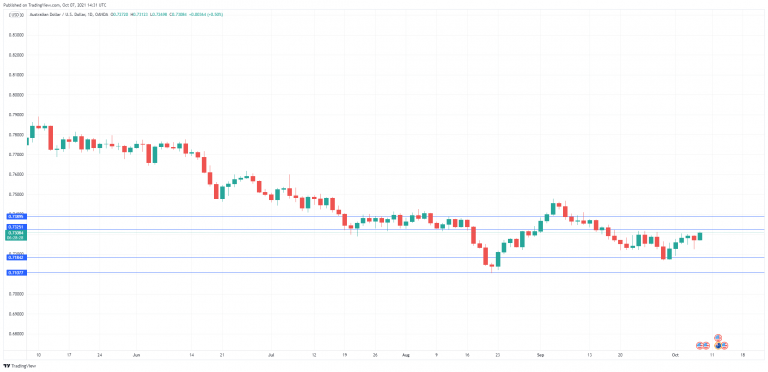
Aussie (0.7312) trades above 0.73 and can rise to test immediate resistance near 0.7350 which if holds can produce a fall towards 0.72 in the near term. A break above 0.7350 is needed for Aussie to rise further towards 0.74-0.7450 in the medium term.
Pound (1.3607) has enough room on the upside to rise on a break above 1.3650 but while it finds difficult to rise above 13650, we may expect a ranged movement within 1.3650-1.35 for the near term. We would look for an eventual break above 1.3650 to head towards 1.37/38 eventually in the next 1-2 weeks.
USDCNY (6.4511) has risen a bit and could be headed towards 6.46 in the near term.
USDINR (74.78) came off yesterday on fall in crude prices. With weakness seen in Euro today and crude prices back to higher levels, USDINR may rise today to attempt a test of 75 or higher.
INTEREST RATES
The US Treasury Yields have risen further sharply especially at the far-end. Key resistances are ahead for the 10Yr and 30Yr which we expect to hold. But if broken, a further rise is possible and our view of seeing a reversal will get negated. The US nonfarm payroll and the unemployment data release today will need a close watch. The German yields remain stable and higher. They have room to rise further from here to test their resistances and then can see a fresh fall. The 5Yr and 10Yr GoI are keeping alive the chances of seeing a further rise from here and test their resistances before witnessing a reversal.
The US 2Yr (0.31%) Treasury yield remains stable while the 5Yr (1.03%), 10Yr (1.59%) and the 30Yr (2.15%) %) have risen further. The 10Yr is just below the crucial resistance level of 1.6% while the 30Yr has room to test 2.2% from here. We expect a reversal from the levels mentioned above. But a strong rise past 1.6% (10Yr) and 2.2% (30Yr) will be bullish to see further rise which in turn will negate our view of seeing a reversal. The price action in the coming sessions will need a close watch.
The German 2Yr (-0.72), 5Yr (-0.56%), 10Yr (-0.19%) and 30Yr (0.30%) yields remain higher and stable. The yields can move up to -0.1% (10Yr) and 0.35% (30Yr) from here. But thereafter we expect them to reverse lower and see a fresh fall resuming the long-term downtrend.
The Indian 10Yr GoI (6.2674%) remained stable yesterday. There is room to test 6.3%-6.32% on the upside while the 10Yr sustains above 6.26%. But we reiterate that 6.32% is a strong resistance which can cap the upside and drag the yield lower to 6.2% and even lower in the coming weeks.
The 5Yr GoI (5.7125%) had risen back sharply after testing the support at 5.68% yesterday. As mentioned yesterday, a sustained break above 5.72% can take the yield up to 5.75%-5.76% and even 5.8% in the near-term. Thereafter a reversal is possible. For now, 5.68%-5.72% seems to be the range of trade. Also, the 5Yr will have to break below the 5.68%-5.66% support zone to become bearish.
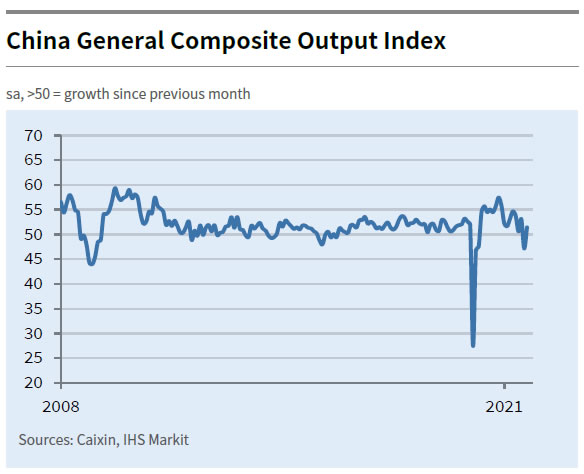
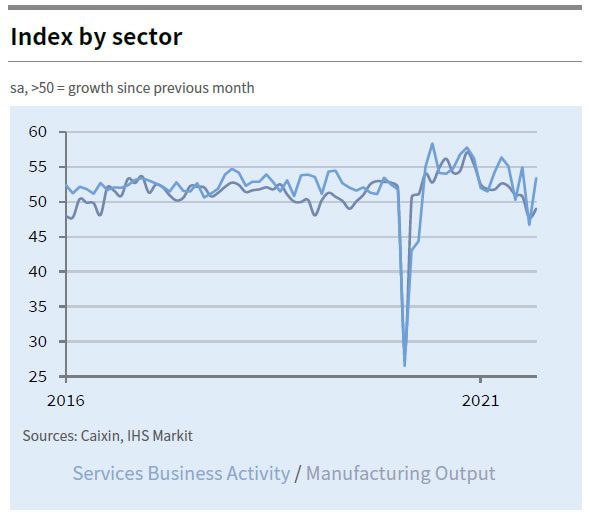
China Caixin PMI services rose to 53.4, PMI composite rose to 51.4
China Caixin PMI Services rose to 53.4 in September, up from August's 46.7, above expectation of 49.3. PMI Composite rose to 51.4, up from 47.2 in August.
Wang Zhe, Senior Economist at Caixin Insight Group said: "Both market supply and demand recovered, and improvement in the services sector was stronger than in the manufacturing sector. Impacted by the pandemic, overseas demand was weak. Employment was stable overall. Prices gauges remained high, indicating strong inflationary pressure."
ECB Lane: Eurozone far distance from inflation red zone
ECB Chief Economist Philip Lane said, "the red zone for everyone is if inflation became persistent at a number that's immoderately above the inflation target. That's a very far distance from where the euro area is." He added, "we have to be the counterweight, honestly, in this debate."
On inflation, he also said, "there's solid reasons to believe that a lot of this is to do with the reopening of the economy and there's very solid reasons to believe there's a significant transitory component."
Fed Mester sees employment mandate met by end of next year
Cleveland Fed Bank President Loretta Mester said in a panel discussion yesterday that inflation in the US is "pandemic related" only. "Fundamentally, if it's supply-side driven, that's not something monetary policy should be responding to," Mester added.
On monetary policy, she said, "our new strategy says, look, we're not going to be moving until we have average inflation being 2% and we're now going to be making up for past misses. I think we've basically met that part of the mandate."
"My forecast is that we'll meet that [employment] mandate by the end of next year, if things play out as I expect," Mester said.
"My baseline is we'll see inflation rates move back down as pent-up demand eases and supply-side challenges ease. But, as you know, that is taking longer than people thought and, in some cases supply chain issues are getting worse," Mester said.
BoC Macklem: Goods reasons to believe inflation is temporary
BoC Governor Tiff Macklem said yesterday that there's "a bit more persistence" in inflation than policy makers previously thought. But he added, " I think there are good reasons to believe that they are temporary,"
"Our job as a central bank is to make sure that one-off increase in prices doesn't become ongoing inflation... What we're really looking for is to see any signs of spreading," he added, noting that medium- to longer-term measures of expected inflation had not risen.
He also pointed to the "frictions" in the labor market, which took longer to work through. "We've never reopened an economy before. And I think what we're seeing is reopening an economy is a lot more complicated than closing one," he said.
GBP/JPY – A Breakout, Finally?
Rally has momentum
We’ve been waiting for a breakout in GBPJPY for some time and recently, the closing in of the moving average bands have given the impression that it’s not far away.
While the descending trend line above gives the impression that a break below is a little more likely than above, this is a trend that’s formed over a very long period of time, which arguably make it less reliable as a signal.
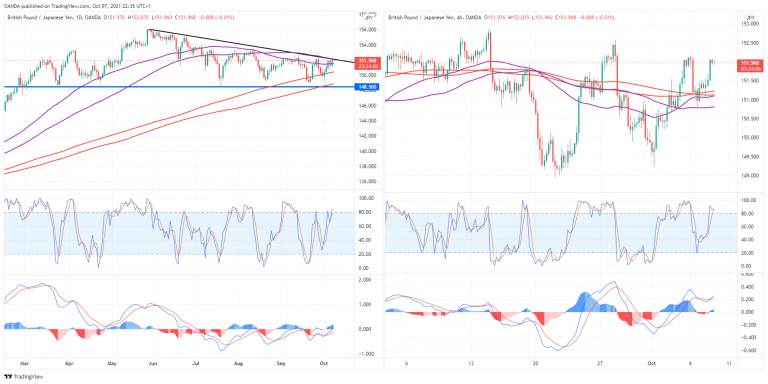
So when we’re seeing the pair rallying towards the upper trend line , a breakout looks very possible and, if it comes, it could be the start of a strong trend to the upside.
Not only would the pair break above the descending trend line , it would also break back above the 55/89-day SMA band for the first time in three months.
And the oscillators on the 4-hour chart suggests there’s plenty of momentum in the latest rally to threaten a breakout above the descending triangle . If it happens, the immediate test is roughly 152.50 but as long as we see a daily close above the trend line, there could be further to run.
USD/JPY Remains Elevated, US NFP Next
Key Highlights
- USD/JPY started a fresh increase above the 111.00 resistance.
- A key bullish trend line is forming with support near 111.55 on the 4-hours chart.
- EUR/USD is showing bearish signs below the 1.1600 level.
- GBP/USD is facing resistance near the key 1.3650 zone.
USD/JPY Technical Analysis
The US Dollar formed a base above the 111.00 level and started a fresh increase against the Japanese Yen. USD/JPY broke the 111.50 resistance to move further into a positive zone.
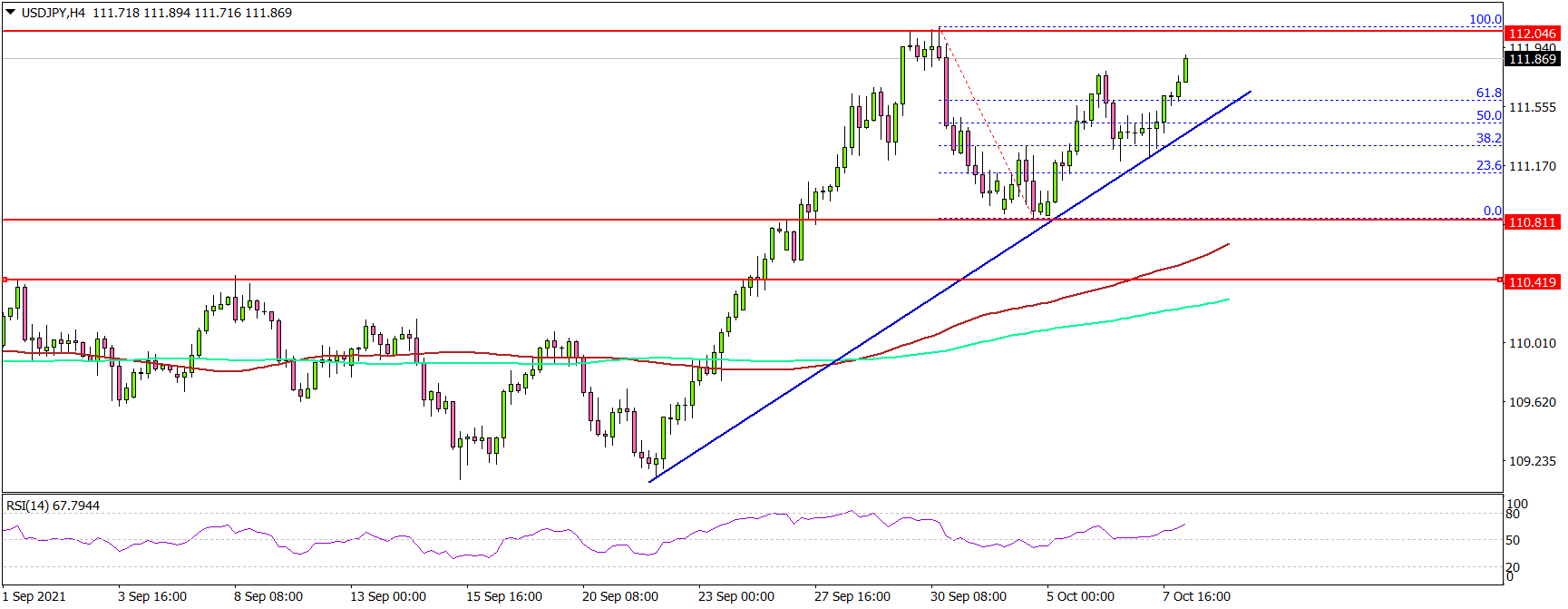
Looking at the 4-hours chart, the pair gained pace after it settled above the 111.20 level. There was a close above the 111.50 level, the 100 simple moving average (red, 4-hours), and the 200 simple moving average (green, 4-hours).
The recent low was formed near 110.81 before it started a fresh increase. The pair is now trading above the 111.50 and 111.60 levels.
There is also a key bullish trend line forming with support near 111.55 on the same chart. On the upside, the pair is facing a major hurdle near the 112.00 level. A clear break above the 112.00 level could open the doors for a larger increase.
The next major resistance is near the 112.40 level. Any more gains might set the pace for a move towards the 113.20 level.
An initial support on the downside is near the 111.50 level and the trend line. The next key support is near 111.20, below which the pair may possibly continue lower. In the stated case, the price could test the 110.40 level.
Looking at EUR/USD, the pair is slowly moving lower and it seems like there is a risk of a move towards the 1.1500 level in the near term.
Economic Releases
- US nonfarm payrolls for Sep 2021 – Forecast 488K, versus 235K previous.
- US Unemployment Rate for Sep 2021 - Forecast 5.1%, versus 5.2% previous.
- Canada’s employment Change payrolls for Sep 2021 – Forecast 60K, versus 90.2K previous.
- Canada’s Unemployment Rate for Sep 2021 - Forecast 6.9%, versus 7.1% previous.
Eco Data 10/8/21
[php_everywhere instance="1"]
GBP/USD Outlook: Renewed Rate Hike Hopes Keep Sterling Afloat
Cable edged higher on Thursday, following a limited pullback previous day, remaining inflated by improved global risk sentiment.
The Bank of England said that the size and duration of a recent jump in inflation is greater than expected, driven by fading negative impact from the pandemic and normalization of global supply and demand, but interest rates are likely to remain low in coming years.
Market analysts however, believe that the prospects for rate hike improved and expect a 15 basis points hike in December and further increases in 2022.
Sterling found a footstep at 1.3400 zone after erasing all gains in the first six months of 2021, with fresh optimism about earlier than expected rate hike, expected to keep the currency supported.
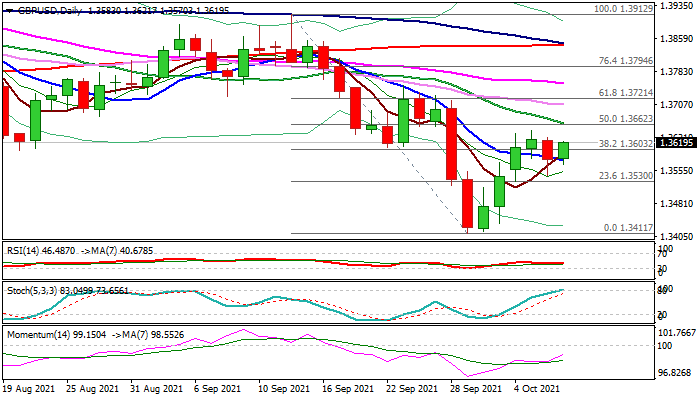
On the other side, technical studies on daily chart have improved, but still require verification on extension and close above pivotal resistance at 1.3662 (daily Kijun-sen/Fibo 38.2% of 1.3912/1.3411 descend/weekly Tenkan-sen).
Further strong bullish signal could be expected on break of next key barriers at 1.3731/50 (Fibo 38.2% of entire 1.4292/1.3411 pullback/weekly cloud top). Repeated close above 10DMA (1.3578) is need to keep near-term bias with bulls.
Res: 1.3631; 1.3647; 1.3662; 1.3707.
Sup: 1.3578; 1.3557; 1.3530; 1.3501.
AUD Moves Higher, NFP Next
The Australian dollar has found its legs on Thursday, in what has been an uneventful week. Currently, AUD/USD is trading at 0.7308, up 0.50% on the day.
The Australian dollar has had a mostly quiet week, and even an RBA policy decision on Tuesday failed to elicit much of a response from the currency. The RBA meeting was a yawner, with the Bank maintaining interest rates at a record low of 0.10% and its QE programme of AUD 4 billion/week. The rate statement was similar to the September statement, so it’s really not a surprise that Aussie didn’t react.
In his rate statement, RBA Governor Lowe repeated that he does not expect a rate hike before 2024. Of course, Lowe may be forced to press the rate trigger earlier if economic conditions change, such as inflation continuing to climb and threatening to overheat the economy. The central banks of New Zealand, Norway and others have already raised rates, and the Fed could well follow in 2022. As more central banks jump on the bandwagon and tighten policy, the RBA may have to revise its timetable for a rate hike to an earlier date.
All eyes are on US nonfarm payrolls for September, which will be released on Friday. This release has additional significance because the Fed would love to see some strong numbers before announcing a taper of its bond purchase programme.
Nonfarm payrolls created 235 thousand jobs in August, a weak reading. The consensus for September is around 500 thousand. If the economy can meet or beat this figure, that should cement a Fed taper in November or December and send the US dollar higher. If NFP misses the consensus, there will be more uncertainty over the timing of a taper, as well as concern over the strength of the US recovery, which could weigh on the US dollar. I would not be surprised to see volatility from AUD/USD in Friday’s North American session.
AUD/USD Technical
- AUD/USD is putting pressure on resistance at 0.7325. Next, there is resistance at 0.7389, protecting the round number of 0.7400
- The pair has support at 0.7184. Below, there is support at 0.7107