

Sample Category Title
EUR/USD Elliott Wave Analysis: Searches for Support
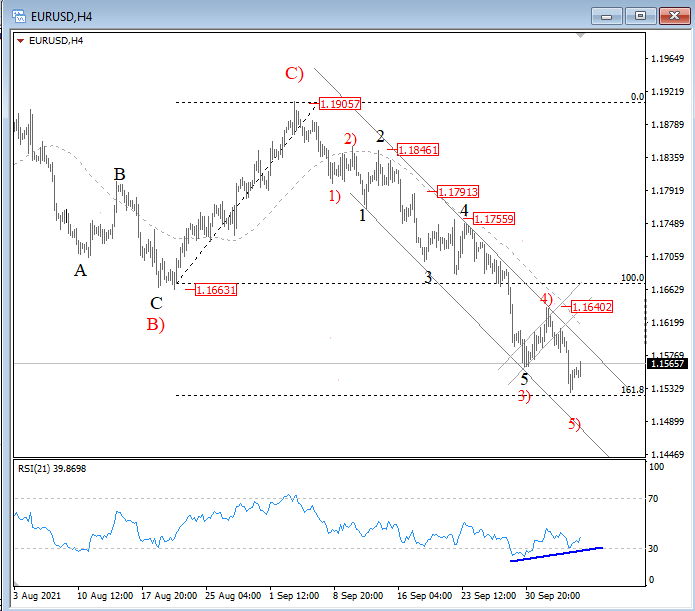
We can see some choppy and slow price action on FX market ahead of Friday's NFP report. EURUSD Ideally, there is going to be another and final drop in the next 24 hours and then possible reversal after NFP tomorrow.
As per Elliott Wave analysis, EURUSD is coming down on 4h chart as expected, now out of a minor bear flag that we labeled as wave 4 so looks like the final fifth wave down is now in progress. Technicall, support is at 1.1500/1.1530 area where bears may slow down and RSI is forming bullish divegernce. However, any bullish turn can be confirmed only if we get an impulse back above 1.1640 and 1.1663.
EUR/USD 4h Elliott Wave analysis
ECB Accounts: Support from sustained pace of net PEPP purchases deemed essential
In the accounts of ECB's September 8-9 meeting, Governing Council members concurred with the assessment that "an accommodative monetary policy stance remained". Also, "policy support from a sustained pace of net purchases under the PEPP, along with the other instruments and the recalibrated forward guidance, was deemed essential".
Financing conditions had "had remained favourable or had loosened further" since June, and was "visible across a broad spectrum of indicators". Inflation outlook had a "significant improvement over the course of the year". However, the near-term increase in inflation was "largely driven by temporary factors that would fade in the medium term and not call for policy tightening."
Regarding the reduction in PEPP purchase pace in Q4, on the one hand, it was argued that "a symmetric application of the PEPP framework would call for a more substantial reduction in the pace of purchases". On the other hand, "reference was made to the recent repricing in nominal bond yields, which called for a prudent reduction in the pace of purchases".
Also, it's noted that "markets were already expecting an end to net asset purchases under the PEPP by March 2022", but such expectation was "not showing a significant impact on financing conditions".
Overall, all members agreed to "moderately scale down the pace of purchases under the PEPP".
WTI Futures Retreat From The 7-Year High
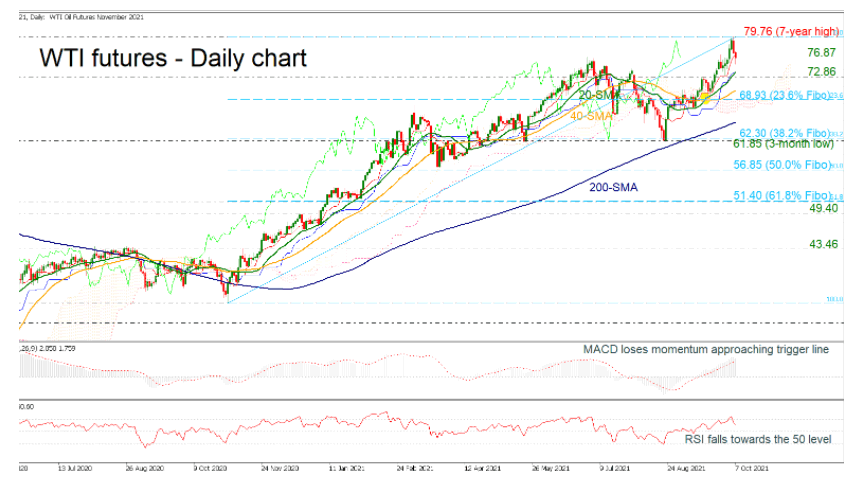
WTI crude oil futures have been in a somewhat negative correction mode over the last couple of sessions after the aggressive upside rally towards the seven-year high of 79.76 on Wednesday.
Regarding the technical indicators, the MACD oscillator is losing ground in the positive region and is approaching its trigger line for a possible bearish crossover. Moreover, the RSI is heading south after the jump to the overbought territory. The red Tenkan-sen line is sloping down above the blue Kijun-sen line; however, the 20- and 40-day simple moving averages (SMAs) are still moving higher.
Should prices keep moving lower, immediate support could come at 72.86, which the 20-day SMA also lies. Below that, the 23.6% Fibonacci retracement level of the upward wave from 34.02 to 79.76 at 68.93 is another major support. A drop below this area would take the commodity closer to the 200-day SMA currently at 65.00 and significantly weaken the bullish long-term structure. Further losses would open the way towards the 62.30 barrier, which is the 38.2% Fibonacci.
To the upside, there is immediate resistance at the multi-year high of 79.76, while above that, the next major resistance to watch is the 86.39 barrier, taken from the inside swing low in April 2013.
To conclude, crude oil prices have been in a strong upside structure since October 2020 and only declines underneath the 200-day SMA at 65.00 and the 61.8% Fibonacci at 51.40 may shift the outlook to neutral.
(ECB) Monetary policy accounts 8-9 September 2021
Account of the monetary policy meeting of the Governing Council of the European Central Bank held in Frankfurt am Main on Wednesday and Thursday, 8-9 September 2021
1. Review of financial, economic and monetary developments and policy options
Financial market developments
Ms Schnabel reviewed the financial market developments since the Governing Council's previous monetary policy meeting on 21-22 July 2021.
The pronounced decline in ten-year US Treasury yields and euro area GDP-weighted sovereign yields observed just before the previous Governing Council meeting had proven persistent despite the ongoing recovery from the pandemic crisis. More recently, yields had been trending somewhat higher but, overall, they had not risen back to the levels seen during the last recovery in 2017-18, or even to the levels seen earlier in 2021. Very low interest rates also continued to prevail across the currency union. Sovereign bond spreads over German Bunds had remained resilient at levels below or close to post-2008 lows.
The decomposition of nominal ten-year euro area overnight index swap (OIS) rates into their inflation and real rate components showed that market-based measures of inflation compensation had continued to increase over the summer. This had been putting upward pressure on nominal rates as was to be expected at this stage of the economic cycle. Based on the developments in inflation expectations alone, the nominal ten-year OIS yields would be 65 basis points above the level prevailing at the time of the monetary policy meeting on 9-10 December 2020, at which the Governing Council had pledged to preserve favourable financing conditions. But a significant parallel decline in real interest rates had offset a large part of the rise in nominal yields. The real ten-year risk-free rate in the euro area had reached yet another record low over the summer. At below -1.8 per cent, it currently stood at an exceptional distance from its average level since the outbreak of the global financial crisis.
The factors that might help explain the current low real yields remained the subject of intense market speculation. Two factors were mentioned most frequently by analysts. The first related to the spread of the Delta virus variant, which had started to affect mobility in some regions. However, to the extent that lower real yields reflected concerns about growth, this pointed to a decoupling between bond markets on the one hand and stock markets on the other hand. Despite rising infection numbers, stock markets had continued their rally over the summer as earnings expectations continued to increase. The EURO STOXX was up by another 5.5 per cent since the Governing Council's previous monetary policy meeting. Indices across the euro area had made broad gains. Euro area corporate bond spreads, too, had remained resilient throughout the past few months, with spreads remaining close to the lows observed over the past decade, despite higher leverage. Corporate bond spreads had recently also been supported by favourable rating actions. Credit rating upgrades had outpaced downgrades by a substantial margin in the third quarter of 2021.
The second factor that could help explain current low real yields related to the possibility that the market may have recently reappraised the way central banks would adjust policy rates. There were some indications that the relationship between expected inflation and expected future interest rates might have changed since the outbreak of the coronavirus (COVID-19) pandemic, especially in the euro area. This suggested that the market may have started internalising a more patient reaction function of the ECB with respect to the conditions that the Governing Council needed to see in order to start raising policy rates. There was also evidence that, after the announcement of the ECB's new forward guidance, the top of the risk distribution around the future evolution of the three-month EURIBOR had been truncated, meaning that investors had effectively priced out contingencies that foreshadowed a very steep increase in policy rates.
The compression of the risk distribution in response to the ECB's new strategy and the revised forward guidance had initially also further flattened the forward curve. The forward curve had shifted outwards visibly after the strategy announcement, but had retraced its path more recently. The most recent Survey of Monetary Analysts (SMA) suggested that the ECB's new forward guidance was likely to have contributed to the initial outward shift.
Model-based evidence corroborated the view that monetary policy had been putting downward pressure on yields in recent months. In particular, the model results suggested that since the announcement of the ECB's new strategy, and again after the announcement of the ECB's new forward guidance, monetary policy had consistently been putting downward pressure on long-term risk-free rates. However, this contribution had softened in recent weeks.
The resistance of global sovereign bond yields to moving higher had occurred in an environment of investors pricing in risks of higher inflation in the future. Option prices suggested that, in the United States, the market currently attached a probability of around 80 per cent to inflation over the next five years being, on average, above the Federal Reserve System's 2 per cent target. In the euro area, the market-implied probabilities were considerably smaller, but had also increased notably to above 30 per cent. In euro area bond markets, model-based analysis also suggested that the inflation risk premium had increased significantly since the start of the year, albeit from very depressed levels, implying that the compensation that investors currently required for this risk still remained small by historical standards.
Finally, prospects of higher interest rates in the United States had caused sizeable shifts in foreign exchange markets, with investors having increased their US dollar net long positions since about June 2021 to levels similar in magnitude to those seen at the heights of the COVID-19 pandemic in 2020. In August the euro had temporarily reached the lowest level against the US dollar in almost a year, as expected short-term interest rate differentials between the United States and the euro area had widened. The euro had moderately appreciated since then.
Overall, financial conditions had eased since the Governing Council's previous monetary policy meeting in July and also since the last comprehensive joint assessment of the inflation outlook and financing conditions in June, as indicated by a range of financial condition indices.
The global environment and economic and monetary developments in the euro area
Mr Lane reviewed the global environment and the recent economic and monetary developments in the euro area.
As regards the external environment, the persistence of supply bottlenecks and the spread of the Delta variant remained concerns. With respect to global activity, the global Purchasing Managers' Indices (PMIs) were retreating after a period of strong increases, indicating a degree of normalisation, while remaining overall above the threshold of 50, indicating continued expansion. Looking at developments in PMIs for activity by region, a gap between developments in advanced and emerging economies was opening up. As regards developments in global trade, world merchandise imports were broadly stable in June after declining in the previous two months. Bottlenecks, which were also reflected by increases in suppliers' delivery times, could be linked to losses in exports.
Since the July Governing Council monetary policy meeting, the euro exchange rate had declined by 0.4 per cent in nominal effective terms, while increasing by 0.6 per cent against the US dollar. Oil prices were broadly unchanged (up by 0.7 per cent) amid still heightened uncertainty about the outlook for global oil demand and supply.
Turning to the euro area, the rebound in demand was continuing, while supply bottlenecks were constraining the production of goods. GDP growth in the second quarter of 2021 was 2.2 per cent, which was substantially stronger than the 1.4 per cent foreseen in the June Eurosystem staff projections, showing that the European economy had already recovered far more than previously expected. This rebound was driven by an increase in domestic demand, which was in turn linked to the rapid reopening of high-contact services. Moreover, containment measures had had a less negative impact on economic growth than had been anticipated, which indicated stronger learning effects.
The September 2021 ECB staff projections foresaw the swift economic rebound persisting during the second half of 2021, driven by a reopening of the economy, continued strong policy support and a global recovery. Growth was projected to remain very strong in 2022 before slowing down in 2023. Compared with the June 2021 Eurosystem staff projections, real GDP growth had been revised up for 2021 and was broadly unchanged for 2022 and 2023. The date by which real GDP was projected to reach pre-crisis levels again had been brought forward by one quarter to the end of 2021.
The latest quarterly business survey from the European Commission confirmed that developments in activity in the industrial sector were heavily affected by shortages of materials, space and equipment, which were less important factors for services. A lack of demand was no longer seen to be an issue in both manufacturing and services. While labour shortages had not played an important role earlier in the pandemic, in manufacturing they had started to emerge and labour had also become scarcer in services.
Consumer confidence had improved, but it remained unclear how this would map into consumer spending as households were not reporting an improvement in their personal economic situation to the same degree. Developments in household bank deposits as an up-to-date, high-frequency proxy for savings showed that households continued to save less than during the height of the pandemic.
Looking at investment, strong demand was supported by a rapid recovery in spending on housing and on business investment, which had also led to an increase in demand for external financing for investment.
On the trade front, growth in extra-euro area goods exports had flattened in the second quarter of 2021, partly owing to supply bottlenecks which had dampened trade dynamics. At the same time, indicators for services exports had signalled a further improvement driven by a steady recovery in tourism, which was an important component of cross-border trade for many countries. Overall, tourism was not yet back to pre-pandemic levels. Intra-EU flights had recovered significantly but extra-EU flights were still far below pre-pandemic levels, in part reflecting continued restrictions on extra-EU travel.
Regarding the labour market, the rebound was continuing and some labour shortages had been emerging. The unemployment rate had declined in July to 7.6 per cent, which was 0.2 percentage points lower than in June and 0.2 percentage points higher than in February 2020 before the pandemic started. The importance of job retention schemes had continued to decrease in recent months, but they still provided a substantial degree of support to the labour market, covering around 3 per cent of the labour force in July.
Employment surveys signalled a robust recovery in the labour market. The PMI composite employment index remained well above the threshold of 50. Many firms reported in the European Commission's business survey for the third quarter of 2021 that they were finding it increasingly difficult to meet their demand for labour.
Turning to nominal developments, headline inflation had increased to 3.0 per cent in August, from 2.2 per cent in July. The increase reflected higher inflation in all the components, in particular non-energy industrial goods (NEIG), while services inflation had remained more subdued. High NEIG inflation partly reflected pipeline pressures. However, the unusually high rates of inflation were assessed to be largely temporary.
In the September ECB staff projections, headline inflation was projected to rise further until the end of this year and then to fall back in the first half of 2022 before gradually strengthening from mid-2022. Compared with the June 2021 Eurosystem staff projections, the September projections for inflation in the Harmonised Index of Consumer Prices (HICP) had been revised up, mainly driven by higher energy inflation in the first half of the horizon. HICP inflation excluding energy and food had also been revised up owing to pressures along the pricing chain amid mismatches in demand and supply, less slack and the weaker euro.
Comparing the September ECB staff projections with forecasts from other international institutions and the private sector indicated that the ECB staff projections for both growth and inflation were above other forecasts for the early part of the horizon, but broadly in line with other forecasts for 2023.
Temporary and special effects had continued to have a substantial impact on inflation dynamics in recent months, complicating the assessment of the inflation figures. These effects included shifts in seasonal sales, base effects and also the effects of the change in HICP weights at the beginning of 2021, which varied over time.
Measures of underlying inflation, comprising a broad range of indicators, were by and large moving gradually upwards, which gave grounds for confidence that the negative pandemic shock of last year was being reversed and hope that upward pressure would continue. But underlying inflation remained at subdued levels and quite far away from 2 per cent. Services inflation had increased, driven mainly (according to data available up to July) by the reopening of the high-contact sector.
Regarding wage developments, compensation per employee had increased in the second quarter of 2021, rising by 8 per cent in year-on-year terms, largely as a result of base effects owing to the extreme developments in the second quarter of last year, reflecting a normalisation of work patterns rather than an increase in negotiated wages. Overall, wage pressures remained low and quite heterogenous across countries.
Growth in the GDP deflator for the euro area had moderated in the second quarter to 0.55 per cent, after reaching 1.57 per cent in the first quarter of 2021. Overall, the reduction in the growth rate of the GDP deflator reflected developments in the terms of trade and more precisely a sharp increase in import prices. PMI survey data on input and output price developments indicated that profit margins continued to be under pressure, mainly driven by increases in input costs.
Market-based measures of inflation compensation in the euro area had increased since the July Governing Council meeting, but remained below 2 per cent.
Regarding financial and monetary developments, market interest rates were somewhat higher than at the time of the July monetary policy meeting of the Governing Council. Risk asset markets had been largely resilient, with equity prices reaching record highs. Overall, financial conditions had eased and broad financing conditions for firms, households and the public sector remained favourable.
With respect to monetary developments, firms' borrowing costs continued to be accommodative, while balance sheet conditions remained fragile and heterogeneous. Euro area bank lending rates stood on average close to their early 2020 values, while they had decreased more in countries more affected by the pandemic. The annual growth of lending to firms had remained moderate in July, at broadly the same pace as in June, reflecting benign factors such as a recovery in earnings.
Bank profitability had recovered partially compared with last year, which was in part linked to some reductions in risk provisions thanks to the better than expected macroeconomic outlook. In parallel, bank funding costs had decreased, reflecting low bank bond yields, substantial participation in the third series of targeted longer-term refinancing operations (TLTRO III), and continuing downward pressure from ample deposits.
Looking at sectoral deposit flows and broad money (M3), in recent months households' and firms' monthly flows into deposits had returned to their long-term averages for the first time since the outbreak of the COVID-19 crisis, thus leading to a further moderation in overall monetary dynamics. This could be seen as a further sign of normalisation.
Turning to fiscal policies, it was important to recall that in the September ECB staff projections the fiscal stimulus for 2021 was expected to be around double the size of the stimulus included in the December 2020 Eurosystem staff projections. After the record fiscal response to the COVID-19 crisis, the September baseline projections continued to show a strong improvement in the fiscal outlook over the projection horizon, especially over 2022-23 – reversing the fiscal impulse.
Monetary policy considerations and policy options
Summing up, Mr Lane remarked that the rebound phase in the recovery of the euro area economy was increasingly advanced. Output had risen in the second quarter by more than expected, and it was likely to exceed its pre-pandemic level by the end of the year. With more than 70 per cent of European adults fully vaccinated, there had been an extensive reopening of the economy and the services sector was recovering (if still unevenly). Manufacturing continued to perform solidly, even though materials shortages and supplier bottlenecks were holding back production. The pick-up in activity was fostering a rapid improvement in the labour market. While further normalisation of economic activity could be expected in the coming months, the global spread of the Delta virus variant and concerns about the longer-term effectiveness of vaccinations could yet delay the full restoration of global economic activity and the full reopening of the euro area economy. In line with this assessment, the September 2021 ECB staff projections foresaw growth of 5.0 per cent in 2021 (which was higher than previously anticipated) and broadly unchanged growth of 4.6 per cent in 2022 and 2.1 per cent in 2023.
HICP inflation had increased to 3.0 per cent in August from 2.2 per cent in July. The increase reflected higher prices in all components but was especially strong in the NEIG category. This notable upswing in inflation was assessed as largely temporary. Higher energy inflation reflected a higher than usual month-on-month increase in energy prices in August and the strong rise in oil prices since around the middle of last year. The reversal of the temporary VAT reduction in Germany would affect year-on-year inflation rates until the end of this year. The increase in NEIG inflation had been partly due to a base effect caused by the postponement of seasonal sales last year from July to August in some countries.
The higher cost pressures stemming from temporary shortages of materials and equipment could be expected to ease. As a result, while headline inflation was likely to rise further this year, these factors should ease or would fall out of the year-on-year inflation calculation by early 2022. The September projections foresaw HICP inflation at an average of 2.2 per cent in 2021, before returning to 1.7 per cent in 2022 and 1.5 per cent in 2023. Compared with the June 2021 projections, headline inflation had been revised up throughout the projection horizon. Inflation excluding food and energy prices was projected to average 1.3 per cent in 2021, 1.4 per cent in 2022 and 1.5 per cent in 2023, having also been revised up from the June 2021 projections. While the negative impact of the pandemic on the projected inflation path had still not been fully reversed and inflation was still foreseen to remain far below the two per cent target over the projection horizon, the upward shift in the revised inflation projections reflected the better growth outlook and a faster reduction in the degree of slack in the economy.
Risks to the economic outlook remained broadly balanced. A larger than expected decrease in the savings rate and a faster improvement in the pandemic situation could lead to a stronger expansion than currently envisaged. Inflation could be slightly higher than currently expected if supply bottlenecks were to last longer and feed through into higher than anticipated wage rises. At the same time, the economic outlook could deteriorate if the pandemic worsened, which could delay the further reopening of the economy, or if supply shortages turned out to be more persistent than currently expected.
According to a broad spectrum of indicators, financing conditions had remained favourable since the Governing Council's previous quarterly assessment in June. While there had been a decline over the summer, the recent repricing of debt securities meant that long-term market interest rates were now at similar levels to those prevailing at the time of the previous quarterly assessment in June.
Preserving favourable financing conditions remained necessary to support the economy on its recovery path. A sustained pace of net purchases under the pandemic emergency purchase programme (PEPP), along with the other instruments and the recalibrated forward guidance, was an essential condition for preserving a monetary policy stance that would offset the negative impact of the pandemic on inflation and thereby support the re-anchoring of inflation solidly around the new target over the medium term. At the same time, in line with the PEPP framework adopted in December and the Governing Council's commitment to pursuing a monetary policy stance that was always proportionate to its objective, persistently favourable financing conditions in a context of a somewhat improved medium-term outlook for inflation and increasing inflation expectations made it possible to scale down moderately the pace of purchases under the PEPP in the last few months of the year. While a substantially lower pace of purchases under the PEPP than had been implemented in recent months could risk an unwarranted tightening in market interest rates (with associated currency appreciation) that would be inconsistent with countering the downward impact of the pandemic on the projected path of inflation, a pace of net purchases that was moderately lower was the proportionate measure that, at the current juncture, could "lock in" the amount of monetary accommodation that was still necessary.
Based on the above, Mr Lane proposed for the fourth quarter that net purchases under the PEPP be calibrated at a moderately lower pace than in the previous two quarters. The monthly purchase pace would continue to be implemented flexibly according to market conditions, to react to short-term shocks exerting upward pressure on benchmark interest rates or, likewise, to allow the rate of purchases to be reduced if favourable conditions could be maintained with an even lower pace.
Furthermore, Mr Lane emphasised that the Governing Council also needed to confirm all of its other monetary policy measures, namely the level of the key ECB interest rates, its forward guidance on their likely future evolution, its purchases under the asset purchase programme (APP), its reinvestment policies and its longer-term refinancing operations.
2. Governing Council's discussion and monetary policy decisions
Economic and monetary analyses
With regard to the economic analysis, members generally agreed with the assessment of the current economic situation in the euro area and the risks to the outlook provided by Mr Lane in his introduction. The rebound phase in the recovery of the euro area economy was increasingly advanced. Output was expected to exceed its pre-pandemic level by the end of the year. With more than 70 per cent of European adults fully vaccinated, the economy had largely reopened, allowing consumers to spend more and companies to increase production. While rising immunity to the coronavirus meant that the impact of the pandemic was now less severe, the global spread of the Delta variant could yet delay the full reopening of the economy. The current increase in inflation was expected to be largely temporary and underlying price pressures were building up only slowly. The inflation outlook in the new staff projections had been revised slightly upwards, but in the medium term inflation was foreseen to remain well below the ECB's two per cent target.
As regards the external environment, members broadly shared the assessment provided by Mr Lane in his introduction that the recovery in global economic activity and trade remained solid but was moderating, owing to the further spread of the Delta variant and to supply bottlenecks. Attention was drawn to the risks to the outlook arising from comparatively lower vaccination rates and the worsening of the pandemic in emerging market economies in recent months relative to advanced economies, which could lead to more persistent or more widespread disruptions to supply chains.
Turning to euro area developments, real GDP had rebounded by 2.2 per cent in the second quarter of the year, which was more than had been expected, and was on track for strong growth in the third quarter. The recovery built on the success of the vaccination campaigns in Europe, which had allowed a significant reopening of the economy. Members broadly agreed with the improvement in the euro area growth outlook included in the new projections and expressed a greater degree of confidence in the baseline scenario, while acknowledging that uncertainty remained elevated. With the lifting of restrictions, the services sector was benefiting from people returning to shops and restaurants and from the rebound in travel and tourism. Manufacturing was performing strongly, even though production continued to be held back by shortages of materials and equipment.
Overall, recent developments indicated that economic activity could be expected to return to its pre-crisis level in the fourth quarter of the year – a quarter earlier than had been expected in the June 2021 Eurosystem staff projections. The output gap was also expected to close sooner than previously expected. However, there remained some way to go before the damage to the economy caused by the pandemic was overcome. There were still more than two million fewer people employed than before the pandemic, especially among the younger and lower skilled, and the number of workers in job retention schemes also remained substantial.
Members assessed the risks to the economic outlook as broadly balanced. On the upside, economic activity could outperform expectations if consumers became more confident and saved less than currently expected. It was noted that consumer spending was increasing and savings appeared to be returning to normal more quickly than had been expected, although consumers remained somewhat cautious in the light of the pandemic developments. Households were benefiting not only from accumulated savings, but possibly also from positive wealth effects given the significant rise in prices for financial assets and real estate. The labour market was also improving rapidly, holding out the prospect of higher incomes and greater spending. Unemployment was declining and the number of people in job retention schemes had fallen significantly from the peak in 2020. The recovery in domestic and global demand was further boosting optimism among firms, which was supporting business investment. A faster improvement in the pandemic situation could also lead to a stronger expansion than currently envisaged.
Regarding possible downside risks, it was underlined that the economic outlook could deteriorate if the pandemic worsened, which could delay the further reopening of the economy, or if supply shortages turned out to be more persistent than currently expected and held back production. It could not be excluded that the shortages and bottlenecks observed so far would not only last longer but might also affect more economies and further sectors. However, the point was made that some moderation in growth was naturally to be expected, in line with the experience of other reopening economies.
The spread of the Delta variant had so far not required lockdown measures to be reimposed. Nevertheless, it could slow the recovery in global trade and the full reopening of the economy. Although the economy had shown more resilience to new waves of the virus in recent quarters, the recovery remained dependent on the evolution of the pandemic and on the progress made with vaccination campaigns. The assumed timing of a relaxation of containment measures had been pushed back in almost every projection round.
Regarding fiscal policies, members stressed that, to support the recovery, ambitious, targeted and coordinated fiscal policy should continue to complement monetary policy. In particular, the Next Generation EU programme would help ensure a stronger and uniform recovery across euro area countries. It would also accelerate the green and digital transitions, support structural reforms and lift long-term growth. While fiscal policy was expected to be expansionary in 2021 and 2022, members considered that the prospects for 2023 were more uncertain.
With regard to price developments, there was broad agreement with the assessment presented by Mr Lane in his introduction. Inflation had increased to 3.0 per cent in August. It was expected to rise further during the autumn but to decline in 2022. This temporary upswing in inflation mainly reflected the strong increase in oil prices since the middle of 2020, the reversal of the temporary VAT reduction in Germany, delayed summer sales in 2020 and cost pressures that stemmed from temporary shortages of materials and equipment. In the course of 2022 these factors should ease or would fall out of the year-on-year inflation calculation. Underlying inflation pressures had edged up. As the economy recovered further, underlying inflation was expected to rise over the medium term. This increase was expected to be only gradual since it would take time for the economy to return to operating at full capacity. Wages were therefore expected to grow only moderately. However, if supply bottlenecks lasted longer and fed through into higher than anticipated wage rises, price pressures could be more persistent.
Members agreed with the hump-shaped pattern of inflation in the September ECB staff projections and generally concurred that higher short-term inflation was largely temporary. At the same time, they considered that the degree of persistence of the inflation shock and, especially, the outlook for inflation in 2023 were more uncertain, with the risk that inflation in 2023 might turn out to be higher than projected. In this context, the view was also expressed that the baseline projection for inflation in 2023 was too low.
Attention was drawn to the fact that both headline and core inflation had surprised to the upside relative to recent projections, with inflation being underestimated for some time. This raised doubts about how well the models relied on in the projections were able to capture what was currently happening in the economy, the structural changes implied by the pandemic and the impact of the ECB's new monetary policy strategy. Closer attention needed to be paid to direct and granular evidence, such as data collected from businesses, unions and households. This was seen as essential around turning points and in periods of possible "regime shifts".
With respect to the September staff projections, it was argued that inflation could be higher if a different path materialised for oil prices, if the supply bottlenecks were more persistent or if the Phillips curve became steeper. Moreover, taking owner-occupied housing into account would lead to a higher expected path for inflation. It was also noted that, even if the current inflation shock was largely temporary, it would only require a relatively small percentage of the current shock to become permanent for inflation to be close to 2 per cent at the end of the projection horizon.
The importance of taking climate change policies and the future development of carbon prices into account was emphasised. Their impact was likely to lead to sustained upward price pressures for a number of years. Carbon prices would inevitably have to increase substantially to ensure that the objectives of the Paris Agreement were reached, with the direct effects of climate policies on energy prices likely to affect price developments in the later years of the projection horizon.
At the same time, there was little evidence so far of second-round effects on wage negotiations. Wage developments and unit labour costs, which were necessary components of durable underlying inflation, remained quite subdued, and wage negotiations so far had taken expectations of only rather moderate future price movements into account. However, it was also argued that "this time might be different" in the sense that the length and magnitude of the shock to inflation, combined with supply bottlenecks and excess savings, might lead to higher second-round effects than in the past. Hence, it was important to monitor closely current wage negotiations. Nevertheless, it was noted that the best-performing Phillips curves maintained by ECB staff indicated lower inflation at the end of the projection horizon than was foreseen in the ECB's projections.
Considering recent developments in inflation expectations, members noted that measures of longer-term inflation expectations had continued to increase but remained some distance from the ECB's inflation target. Market-based indicators of inflation expectations had risen to their highest level in many years, with the five-year forward inflation-linked swap rate five years ahead now exceeding 1.7 per cent, which was some 50 basis points higher than before the pandemic. While it was positive news that market expectations of deflation were very low, inflation options markets continued to signal that investors did not see a risk of recent high euro area inflation rates extending into the medium term. However, it was recalled that the inflation expectations of households and businesses, which were different from those of financial market participants, also needed to be considered.
Members thus broadly concurred that, despite further improvement, the inflation outlook remained some way from the ECB's target level. At the same time, risks to the inflation outlook, as embodied in the September 2021 ECB staff projections, were widely regarded as being tilted to the upside. However, it was also cautioned that the recent underestimation of inflation had to be interpreted in the context of the previous prolonged period of overestimation and the continued shortfall of longer-term inflation expectations from the target.
Turning to the monetary and financial analysis, members broadly concurred with the assessment provided by Mr Lane in his introduction. Bank lending rates for firms and households were at historically low levels while lending to households was holding up, especially for house purchases. A remark was made about the extent to which the sharp rise in housing investment, house prices and mortgage volumes might have been fuelled by the ECB's monetary policy in the wake of the pandemic and in view of ample forced savings, much of which was probably invested in real estate. At the same time, it was recalled that lower equilibrium interest rates implied higher housing values, while leverage would not necessarily increase with real estate purchases if households drew on the savings they had accumulated during the pandemic.
The growth of lending to firms had slowed, mainly because firms were still well funded after borrowing heavily in the first wave of the pandemic. It was noted that government support had transferred risks to the public sector and helped firms through the crisis, thereby avoiding a spike in non-performing loans and bankruptcies, which should mitigate the risk of financial amplification. As the economy opened up, firms were benefiting from the recovery. Large cash holdings and increasing retained earnings reduced firms' need for external funding. Solid bank balance sheets continued to ensure that sufficient credit was available, while for larger firms bond issuance was an attractive alternative to bank loans. It had to be acknowledged, however, that many firms and households had taken on more debt during the pandemic, which made their financial health potentially vulnerable to a deterioration in the economic outlook and could worsen the quality of banks' balance sheets. Even so, overall, risks of financial amplification were considered to be small.
Monetary policy stance and policy considerations
Members concurred with Mr Lane's assessment that an accommodative monetary policy stance remained necessary to offset the negative impact of the pandemic on inflation and to support the re-anchoring of inflation expectations solidly around the Governing Council's new target over the medium term. Hence, policy support from a sustained pace of net purchases under the PEPP, along with the other instruments and the recalibrated forward guidance, was deemed essential for preserving the necessary monetary policy accommodation and for reaffirming the Governing Council's commitment to its new monetary policy strategy. At the same time, under the PEPP framework which the Governing Council had agreed upon at its December 2020 meeting, a calibration of the pace of purchases was required based on a joint assessment of financing condition and the inflation outlook.
Regarding the assessment of financing conditions, it was noted that, overall, conditions had remained favourable or had loosened further since the Governing Council's previous quarterly assessment in June. Moreover, they had improved notably since the Governing Council's decision, earlier in the year, to significantly increase the pace of purchases under the PEPP. This improvement was visible across a broad spectrum of indicators. A rise in inflation expectations had brought euro area real short and long-term interest rates to historically low levels. Regarding financial conditions, stock prices had risen while the euro had depreciated broadly. Bank lending rates for firms and households, as well as corporate bond spreads, had remained near historical lows. At the same time, it was observed that the recent repricing had led to some volatility in long-term market interest rates.
As for the assessment of the inflation outlook, a significant improvement over the course of the year was acknowledged. It was also observed that the staff inflation projection had been revised up in the previous projection rounds, thereby breaking the trend of the earlier successive downward revisions and pointing to the emergence of upside risks. However, it was noted that the near-term increase in inflation was largely driven by temporary factors that would fade in the medium term and not call for policy tightening. According to the September ECB staff projections, inflation was not expected to persistently reach levels that fully offset the pandemic impact on the inflation path at the relevant medium-term horizon, and it remained well below the ECB's new inflation target.
Based on the joint assessment, and in line with the PEPP framework adopted in December 2020, members agreed that persistently favourable financing conditions along with a somewhat improved medium-term outlook for inflation would allow the Governing Council to moderately scale down the pace of purchases under the PEPP while confirming all other monetary policy measures, namely the level of the key ECB interest rates, the Governing Council's forward guidance on their likely future evolution, the purchases under the APP, the reinvestment policies and the longer-term refinancing operations. A number of comments were made in both directions on the recalibration of the pace of purchases under the PEPP, proposed by Mr Lane.
On the one hand, it was argued that a symmetric application of the PEPP framework would call for a more substantial reduction in the pace of purchases, also in the light of potential side effects of an elevated level of purchases. From this perspective, a pace of purchases similar to the level prevailing at the beginning of the year would be appropriate. Such a pace would still provide a greater degree of monetary accommodation than at the start of the year, as both financing conditions and the economic outlook had improved in the meantime. In addition, the embedded flexibility would allow for a meaningful increase in purchases to address market tensions, if needed.
On the other hand, reference was made to the recent repricing in nominal bond yields, which called for a prudent reduction in the pace of purchases. A concern was expressed that a slower pace might induce market perceptions of a tighter than expected monetary policy, which could result in a tightening of financing conditions. In particular, there was a risk that a reduction in PEPP purchases in the next few months would be interpreted as tapering, which could affect other components of the monetary policy stance. This might drive euro area interest rates higher and thwart an incipient increase in inflation expectations.
At the same time, the argument was made that markets were already expecting an end to net asset purchases under the PEPP by March 2022. This expectation was not showing a significant impact on financing conditions, which should generate confidence that the recalibration of the PEPP purchase pace to reflect the improvement in financing conditions and the inflation outlook would not lead to an unwarranted tightening in market interest rates. Attention was drawn to the substantial stock of assets that the Eurosystem had acquired since the beginning of the year, which would provide significant accommodation over the coming years by compressing the term premium, even if the pace of purchases was reduced.
It was reiterated that the PEPP was designed as an emergency programme that had a clearly defined objective of countering the impact of the pandemic on the path of inflation and should be distinguished from the general monetary policy stance, for which other instruments were available. The point was made that, even without the PEPP, the overall monetary policy stance remained highly accommodative. The calibration of the PEPP purchase pace in line with the PEPP framework needed to be judged against the prevailing financial conditions and the inflation outlook. A view was expressed, however, that the perception of a premature removal of accommodation could raise questions on the Governing Council's determination to deliver on its inflation target and its commitment to persistent and forceful policy action in the vicinity of the effective lower bound in order to avoid negative deviations from the inflation target becoming entrenched.
Overall, balancing the various arguments, all members agreed that, in line with the framework adopted in December 2020, persistently favourable financing conditions along with a somewhat improved medium-term outlook for inflation would allow the Governing Council to moderately scale down the pace of purchases under the PEPP, in line with Mr Lane's proposal.
With regard to implementation, it was stressed that flexibility according to market conditions remained a key feature of the PEPP, allowing for a flexibility margin to react to short-term shocks exerting upward pressure on benchmark interest rates or, likewise, allowing the pace of purchases to be reduced if favourable conditions could be maintained with an even lower pace.
Attention was also drawn to the Governing Council's efforts to be more transparent and to communicate better with the general public, thereby fostering trust, as highlighted in the monetary policy strategy review. In particular, it was suggested that more information be provided in official communication about the reasoning behind the APP, the PEPP and related policy decisions.
Monetary policy decisions and communication
Regarding communication, members underlined that the improvement in the outlook had to be acknowledged and that the Governing Council's policy measures were producing the intended effects. Although the temporary nature of the near-term rise in inflation had to be stressed, it was felt that upside risks to the longer-term outlook for inflation had to be monitored and communicated carefully. At the same time, it was deemed important to avoid creating the impression that the Governing Council was satisfied with the current outlook for inflation.
With respect to the moderate reduction in the pace of net asset purchases under the PEPP, this was seen as proportionate, gradual and in line with the joint assessment of the improvement in financing conditions and the inflation outlook. It had to be made clear that the decision constituted a recalibration of the programme in response to current conditions and did not imply tapering or an end to asset purchases under the PEPP.
Moreover, with a moderately lower pace of purchases, the ECB's monetary policy remained highly accommodative overall. The Governing Council stressed its determination to act forcefully and persistently, in line with its revised monetary policy strategy, to anchor inflation expectations solidly at its two per cent target.
Finally, it was underlined that the Governing Council would continue to purchase flexibly according to market conditions. If favourable financing conditions could be maintained with asset purchase flows that did not exhaust the envelope over the net purchase horizon of the PEPP, the envelope would not need to be used in full and, equally, the envelope could be recalibrated if required to maintain favourable financing conditions.
Taking into account the foregoing discussion among the members, upon a proposal by the President, the Governing Council took the following monetary policy decisions:
Based on a joint assessment of financing conditions and the inflation outlook, the Governing Council judged that favourable financing conditions could be maintained with a moderately lower pace of net asset purchases under the PEPP than in the previous two quarters. The monthly purchase pace would continue to be implemented flexibly according to market conditions.
The Governing Council also confirmed its other measures, namely the level of the key ECB interest rates, its forward guidance on their likely future evolution, its purchases under the APP, its reinvestment policies and its longer-term refinancing operations, as set out in the press release to be published after the meeting.
The members of the Governing Council subsequently finalised the monetary policy statement, which the President and the Vice-President would, as usual, deliver at the press conference following the end of the current Governing Council meeting.
Monetary policy statement
Monetary policy statement to the press conference of 9 September 2021
Press release
Meeting of the ECB's Governing Council, 8-9 September 2021
Members
- Ms Lagarde, President
- Mr de Guindos, Vice-President
- Mr Centeno
- Mr Elderson
- Mr Hernández de Cos*
- Mr Herodotou
- Mr Holzmann
- Mr Kazāks
- Mr Kažimír*
- Mr Knot
- Mr Lane
- Mr Makhlouf
- Mr Müller
- Mr Panetta
- Mr Rehn*
- Mr Reinesch
- Ms Schnabel
- Mr Scicluna
- Mr Stournaras
- Mr Šimkus
- Mr Vasle*
- Mr Villeroy de Galhau
- Mr Visco
- Mr Weidmann
- Mr Wunsch
* Members not holding a voting right in September 2021 under Article 10.2 of the ESCB Statute.
Other attendees
- Mr Dombrovskis, Commission Executive Vice-President**
- Ms Senkovic, Secretary, Director General Secretariat
- Mr Smets, Secretary for monetary policy, Director General Economics
- Mr Winkler, Deputy Secretary for monetary policy, Senior Adviser, DG Economics
** In accordance with Article 284 of the Treaty on the Functioning of the European Union.
Accompanying persons
- Mr Arce
- Mr Bitans
- Ms Buch
- Mr Demarco
- Ms Donnery
- Mr Gaiotti
- Ms Goulard
- Mr Haber
- Mr Kaasik
- Mr Kuodis
- Mr Kyriacou
- Mr Lünnemann
- Mr Novo
- Mr Ódor
- Mr Sleijpen
- Mr Tavlas
- Mr Vanackere
- Mr Välimäki
- Ms Žumer Šujica
Other ECB staff
- Mr Proissl, Director General Communications
- Mr Straub, Counsellor to the President
- Ms Rahmouni-Rousseau, Director General Market Operations
- Mr Rostagno, Director General Monetary Policy
- Mr Sousa, Deputy Director General Economics
Release of the next monetary policy account foreseen on Thursday, 25 November 2021.
NZ Dollar Steadies After Slide
The New Zealand dollar has stabilized on Thursday, after taking a tumble a day earlier. The pair is currently trading at 0.6925, up 0.16% on the day.
It was a rough day at the office for the kiwi on Wednesday, as the currency fell 0.70%. At one point, NZD/USD was down 1.10%, as the RBNZ’s historic rate hike failed to give the New Zealand dollar any support whatsoever. The central bank raised the cash rate from 0.25% to 0.50%, the first rate hike in seven years, but the market had priced in the move.
RBNZ plans to continue rate hikes
The RBNZ was poised to press the rate trigger in August, but an outbreak of the Delta variant led to a national lockdown, and policy makers felt that the timing for a rate hike was not optimal. However, there are pressing reasons to raise rates. The RBNZ is projecting that inflation will rise above 4% in the short-term, well above the upper limit of the Bank’s target of 3%. The housing sector is red-hot and the labour market is robust. However, there are downside risks to the economy as well – primarily the Covid outbreak in Auckland and the weak global recovery.
These conflicting factors pose a dilemma for policy makers with regard to the timing and frequency of future rate hikes. The RBNZ is looking at a series of hikes lasting in 2022 and could raise rates again as early as November. However, if economic conditions deteriorate, the central bank may have to hold off a second rate hike until after the New Year.
In the US, the focus is on the August non-farm payroll report on Friday. The private ADP employment report climbed to 568 thousand, which was higher than expected. Still, the ADP release is not a reliable indicator of how the official NFP will perform. A print of 500,000+ would likely cement a Fed taper in the next month or two and provide a boost for the US dollar. Anything lower will raise doubts about the timing of a taper and could weigh on the greenback.
NZD/USD Technical
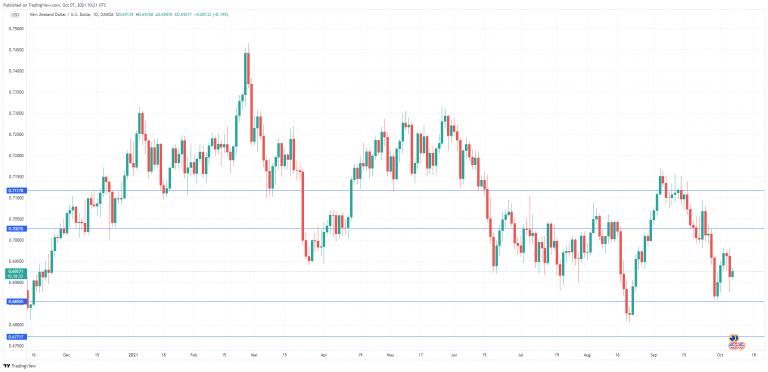
- There is resistance at 0.7028, followed by 0.7117
- 0.6855 has some breathing room as NZD/USD partially recovered from a sharp slide on Wednesday. Below, there is support at 0.6771
Risk Appetite Finds Some Hope On Possible US Debt Ceiling Deal , Relief In Energy Prices
Notes/Observations
- Germany Aug Industrial Production data missing expectations and adds to the string of disappointing indicators showing region’s conditions have worsened.
- Risk appetite finding some fresh legs as Senate Democrats seem poised to accept a Republican proposal to defer the showdown over the debt ceiling until later this year.
- Focus remains on Fri Non-farm payroll report to gauge whether the Fed would signal a withdraw of monetary stimulus.
Asia
- BOJ quarterly Regional Economic Report (Sakura): Downgrades assessments of 5 of 9 regions. Cited summer surge in infection cases and production cuts from supply shortages.
- China President Xi will speak on Taiwan Policy on Oct 9th speech - Taiwan press.
- Senior White House official: Pres Biden and Pres Xi will hold a virtual meeting before the end of 2021.
Coronavirus
- South Korea said to begin transition away from coronavirus rules starting Nov 9th - Korea Daily.
Europe
- ECB said to be studying new bond buying plan for when PEPP ended, plan to prevent widening of spreads. New program would complement older asset purchase plan.
Americas
- Senate Democrats signaled they would accept GOP Leader McConnell short-term debt ceiling raise offer for two months.
- Senior White House official stated that President Biden and China President Xi to hold a virtual meeting before the end of 2021.
Energy
- White House Press Sec Psaki stated that the Administration would take more steps as needed on oil prices; Declined to comment on potential release of crude from Strategic Petroleum Reserve (SPR).
- Energy Sec Granholm nted in an interview that release of crude oil from Strategic Petroleum Reserve was a 'tool that's under consideration' to tame fuel price rises; Did not rule out a ban on crude oil exports.
- Goldman Sachs analyst: US SPR oil release might total 60M barrels and likely pose a $3 downside risk.
Speakers/Fixed income/FX/Commodities/Erratum
Equities
- Indices [Stoxx600 +1.10% at 455.86, FTSE +0.78% at 7,051.30, DAX +1.14% at 15,142.35, CAC-40 +1.17% at 6,568.75 , IBEX-35 +1.60% at 8,915.50, FTSE MIB +0.95% at 25,848.00, SMI +1.19% at 11,706.97, S&P 500 Futures +0.58%].
- Market Focal Points/Key Themes: European indices open higher across the board and remained firmly in the green as the session progressed; sectors leading to the upside include utilities and technology; while consumer discretionary and energy sectors among the laggards; oil and gas subsector under pressure following lower crude prices, Shell update; Spanish utilities supported after government looks to modify price caps; Vonovia gets majory of voting rights in Deutsche Wohnen takeover; earnings expected in the upcoming US session include Conagra and Lamb Weston Holdings.
Equities
- Consumer discretionary: Motorpoint [MOTR.UK] +5% (trading update), Robert Walters [RWA.UK] +2.5% (trading update).
- Energy: National Grid [NG.UK] +1% (comments on UK gas/electricity outlook), Royal Dutch Shell [RDSA.NL] -1.5% (Q3 update),
- Financials: CMC Markets [CMCX.UK] -1% (trading update), Morses [MCL.UK] -6% (earnings).
Speakers
- ECB's Stournaras (Greece) reiterated stance that ECB to discuss policy options in Dec and stress it would look to continue to aim to avoid fragmentation. No need to change monetary policy stance at this time as inflation was far below the 2% target in the medium-term. Saw no reason for Greece to be excluded from QE (**Note: ECB does buy Greek bonds in PEPP program but not in conventional QE (APP program). The market rate hike views did not reflect ECB guidance.
- ECB’s Elderson (Netherlands, SSM member): Climate change is squarely part of mandate.
- BOE's Pill (chief economist): inflation concerns are growing in UK with inflation looking more long lasting.
- Sweden Central Bank (Riksbank) member Jansson reiterated view that uptick in inflation seen as temporary. Inflation needed support to remain at target. Expansionary policy needed to support labor market; high long-term unemployment was a concern.
- Turkey Central Bank (CBRT) Gov Kavcioglu reiterated stance that transitory inflation factors to taper off. Reiterated view that policy stance based on core inflation and demand factors. Policy to be tight enough for disinflation.
- EU's Sefcovic commented that implementation of Northern Ireland Protocol will require compromise from both sides. Reiterated there will be no renegotiation of the Protocol. Recent rhetoric by UK official on triggering Article 16 have not been helpful. To finalize measures on Northern Ireland Protocol by middle of next week and would be very far reaching.
- Japan Fin Min Suzuki reiterated that must keep target of balancing budget by FY25; fiscal discipline needed to keep market's trust. Closely watching FX movements; stability in currency markets was vital.
Currencies/Fixed Income
- USD was slightly weaker as risk appetite tried to find some legs. Sentiment aided by hopes on a US debt ceiling deal, Russia pledging to help stabilize the global energy market.
- EUR/USD was slightly higher in a quiet session after testing 14-month lows recently. Dealers noted that ECB potential new program of bond buying to avoid even a hint of taper turmoil was a headwind for the pair. Germany Aug Industrial Production data missed expectations and added to the string of disappointing indicators showing region’s conditions have worsened. Focus on release of the ECB Sept Minutes for clues on the central bank’s pain threshold on inflation.
Economic data
- (NL) Netherlands Sept CPI M/M: 0.1% v 0.4% prior; Y/Y: 2.7% v 2.4% prior.
- (NL) Netherlands Sept CPI EU Harmonized M/M: -0.2% v +0.5% prior; Y/Y: 3.0% v 2.9%e.
- (CH) Swiss Sept Unemployment Rate: 2.6% v 2.7%e; Unemployment Rate (seasonally adj): 2.8% v 2.8%e.
- (DE) Germany Aug Industrial Production M/M: -4.0% v -0.5%e; Y/Y: 1.7% v 5.0%e.
- (UK) Sept Halifax House Price Index: M/M: 1.7% v 0.7% prior; Y/Y: 7.4% v 7.1% prior.
- (NO) Norway Aug Industrial Production M/M: 2.7% v 0.0% prior; Y/Y: 2.7% v 1.3% prior.
- (NO) Norway Aug Manufacturing Production M/M: 0.0% v -0.6% prior; Y/Y: 2.2% v 5.5% prior.
- (DK) Denmark Aug Industrial Production M/M: 5.1% v 5.3% prior.
- (ZA) South Africa Sept Gross Reserves: $57.1B v $58.1Be; Net Reserves: $55.0B v $55.3Be.
- (FR) France Aug Trade Balance: -€6.7B v -€7.1B prior; Current Account Balance: -€1.3B v -€3.4B prior.
- (CH) Swiss Sept Foreign Currency Reserves (CHF): 939.8B v 929.4B prior.
- (AT) Austria Sept Wholesale Price Index M/M: 0.8% v 0.0% prior; Y/Y: 13.5% v 12.0% prior.
- (CZ) Czech Aug National Trade Balance (CZK): -28.1B v -5.9Be.
- (CZ) Czech Aug Industrial Output Y/Y: 1.4% v 5.1%e; Construction Output Y/Y: 1.2% v 0.5% prior.
- (MY) Malaysia end-Sept Foreign Reserves: $115.2B v $116.2B prior mid-month reading.
- (UR) Ukraine Sept Official Reserve Assets: $28.7B v $28.7Be.
- (CN) China Sept Foreign Reserves: $3.201B v $3.220Te.
- (HK) Hong Kong Sept Foreign Reserves: $495.0B v $497.0B.
- (SE) Sweden Sept Budget Balance (SEK): 11.5B v 43.4B prior.
- (IT) Italy Aug Retail Sales M/M: 0.4% v 0.3%e; Y/Y: 1.9% v 2.0%e.
- (CZ) Czech Sept International Reserves: $170.4B v $171.2prior.
- (UK) Q2 Final Output Per Hour Y/Y: 4.3% v 3.1% prelim; Unit Labor Costs Y/Y: -3.8% v +5.9% prior.
- (CY) Cyprus Sept CPI M/M: % v 1.6% prior; Y/Y: % v 5.0% prior.
- (IS) Iceland Sept Preliminary Trade Balance (ISK): B v -36.3B prior.
- (SG) Singapore Sept Foreign Reserves: $B v $418.2B prior.
Fixed income Issuance
- (ES) Spain Debt Agency (Tesoro) sold total €4.42B vs. €4.-5.0B indicated range in 2028, 2031 and 2048 bonds.
- Sold €1.59B in 0.00% Jan 2028 SPGB bonds; Avg yield: -0.025% v -0.133% prior; Bid-to-cover: 1.99x v 2.10x prior.
- Sold €1.69B in 0.50% Oct 2031 SPGB bonds; Avg Yield: 0.466% v 0.326%prior; bid-to-cover: 1.43x v 1.41x prior.
- Sold €1.14B in 2.70% Oct 2048 SPGB bonds; Avg Yield: 1.256% v 1.270% prior; Bid-to-cover: 1.59x v 1.49x prior.
- (ES) Spain Debt Agency (Tesoro) sold €510M vs. €250-750M indicated range in 0.70% Nov 2033 inflation-linked bonds (SPGBi); Real Yield: -1.074% v -1.025% prior; Bid-to-cover: 1.41x v 1.88x prior.
- (FR) France Debt Agency (AFT) sold total €10.999B vs. €10.0-11.0B indicated range in 2030, 2031, 2053 and 2066 Bonds.
- Sold €2.956B in 2.50% May 2030 Oat; Avg Yield: -0.05% v -0.27% prior; Bid-to-cover: 2.47x v 2.15x prior.
- Sold €4.93B in 0.0% Nov 2031 Oat; Avg Yield: +0.15% v -0.05% prior; Bid-to-cover: 2.12x v 1.81x prior.
- Sold €2.03BB in 0.75% May 2053 Oat; Avg Yield: 0.96% v 0.918% syndicate; bid-to-cover: 2.14x.
- Sold €1.078B in 1.75% May 2066 Oat; Avg Yield: % v 0.83% prior, Bid-to-cover: 2.78x v 1.68x prior.
Looking Ahead
- (IT) Bank of Italy Report on Balance-Sheet Aggregates.
- (EG) Egypt Sept Net Reserves: No est v $40.7B prior.
- (CO) Colombia Sept Consumer Confidence Index: -6.4e v -8.2 prior.
- 05:25 (EU) Daily ECB Liquidity Stats.
- 05:30 (HU) Hungary Debt Agency (AKK) to sell bonds.
- 06:00 (IE) Ireland Aug Industrial Production M/M: No est v 7.7% prior; Y/Y: No est v 15.6% prior.
- 06:45 (US) Daily Libor Fixing.
- 07:00 (ZA) South Africa Aug Electricity Production Y/Y: No est v 3.5% prior; Electricity Consumption Y/Y: No est v 2.9% prior.
- 07:00 (MX) Mexico Sept CPI M/M: 0.6%e v 0.2% prior; Y/Y: 6.0%e v 5.6% prior; CPI Core M/M: 0.5%e v 0.4% prior.
- 07:00 (CN) China PBoC Gov Yi Gang at BIS event.
- 07:30 (EU) ECB Account of Sept Rate Decision.
- 07:30 (US) Sept Challenger Job Cuts: No est v -15.7K prior; Y/Y: No est v -86.4% prior.
- 07:30 (CL) Chile Central Bank Traders Survey (bi-monthly).
- 07:30 (CL) Chile Sept Trade Balance: No est v $0.0B prior; Total Exports: No est v $7.8B prior; Total Imports: No est v $7.8B prior; Copper Exports: No est v $4.4B prior.
- 07:30 (CL) Chile Sept International Reserves: No est v $52.0B prior.
- 08:00 (PL) Poland Sept Official Reserves: No est v $169.5B prior.
- 08:00 (CL) Chile Aug Nominal Wage M/M: No est v 1.3% prior; Y/Y: No est v 6.5% prior.
- 08:00 (UK) Daily Baltic Dry Bulk Index.
- 08:00 (AT) ECB's Holzmann (Austria).
- 08:30 (US) Initial Jobless Claims: 349Ke v 362K prior; Continuing Claims: 2.765Me v 2.802M prior.
- 08:30 (US) Weekly USDA Net Export Sales.
- 09:00 (IL) Israel Central Bank (BOI) Interest Rate Decision: Expected to leave Base Rate unchanged at 0.10%.
- 09:00 (RU) Russia Sept Official Reserve Assets: $619.0Be v $618.2B prior.
- 09:00 (RU) Russia Gold and Forex Reserve w/e Oct 1st: No est v $617.9B prior.
- 09:00 (IE) ECB’s Lane (Ireland, chief economist).
- 09:00 (DE) ECB’s Schnabel (Germany).
- 09:00 (PL) Poland Central Bank (NBP) Gov Glapinski press conference.
- 10:00 (CA) Canada Sept Ivey Purchasing Managers Index (seasonally adj): No est v 66.0 prior; PMI (unadj): No est v 63.8 prior.
- 10:30 (TR) Turkey Sept Cash Budget Balance (TRY): No est v 64.3B prior.
- 10:30 (US) Weekly EIA Natural Gas Inventories.
- 11:45 (US) Fed’s Mester.
- 11:45 (IE) ECB’s Lane (Ireland, chief economist).
- 12:00 (CA) Bank of Canada (BOC) Gov Macklem.
- 15:00 (US) Aug Consumer Credit: $17.5Be v $17.0B prior.
- 15:00 (AR) Argentina Aug Industrial Production Y/Y: No est v 13.0% prior; Construction Activity Y/Y: No est v 19.8% prior.
- 19:00 (PE) Peru Central Bank (BCRP) Interest Rate Decision: Expected to raise Reference Rate by 50bps to 1.50%.
- 19:30 (JP) Japan Aug Labor Cash Earnings Y/Y: 0.4%e v 0.6% prior (revised from 1.0%); Real Cash Earnings Y/Y: 0.5%e v 0.3% prior (revised from 0.7%).
- 19:30 (JP) Japan Aug Household Spending Y/Y: -1.2%e v +0.7% prior.
- 19:50 (JP) Japan Aug Current Account Balance: ¥1.474Te v ¥1.911T prior; Adjusted Current Account : ¥1.146Te v ¥1.413T prior; Trade Balance (BoP Basis): -¥385.3Be v +¥622.3B prior.
- 20:30 (AU) RBA Financial Stability Review.
- 21:45 (CN) China Sept Caixin PMI Services: 49.2e v 46.7 prior; PMI Composite: No est v 47.2 prior.
Silver Bullish Head And Shoulders Pattern On H4 Time Frame
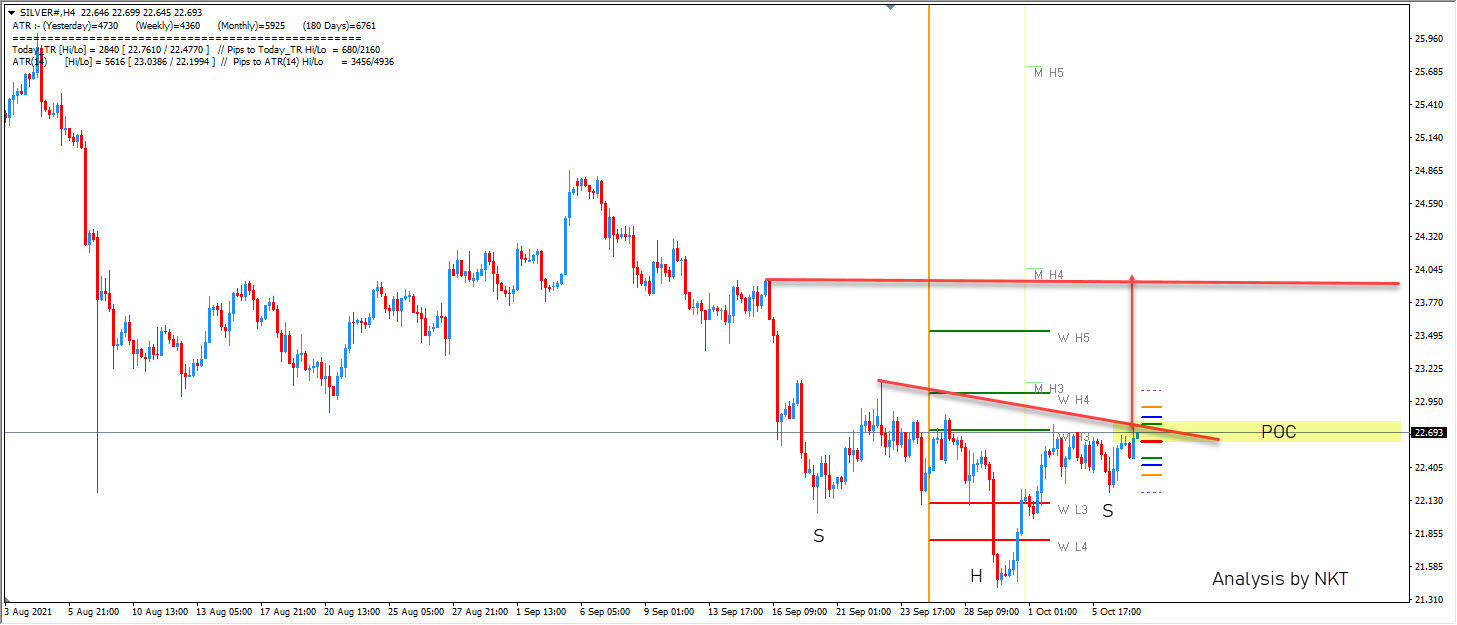
Silver looks bullish and it can have an imminent breakout.
Inverted SHS pattern is pushing the price higher up. If we see the breakout above the trend line at the POC zone the market should be moving higher to 22.95, 23.29 and 24.01. The move should be also based on momentum and bulls should be safe. Look for a h4 candle which closes above the trendline 22.72 for a confirmation.
Stocks Rebound As Gloom Eases, Oil And Dollar Pull Back
- Sentiment improves after energy prices ease; US debt deal and Biden-Xi meeting help too
- Strong turnaround on Wall Street pulls global stocks higher but inflation threat not gone
- Aussie and kiwi lead rebound in FX but energy crisis fears still weigh on euro and pound
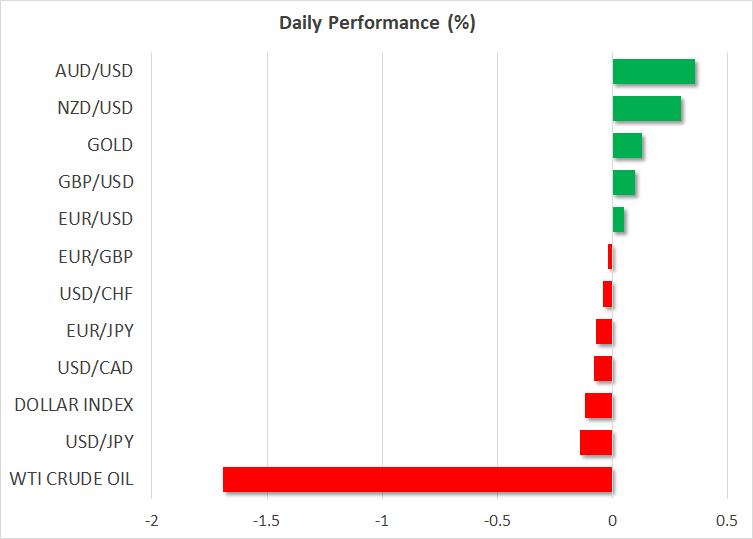
Fears of an energy crunch subside, for now
Markets were in a much more cheerful mood on Thursday as some of the gloom around a deepening global energy crisis, soaring inflation and never-ending supply disruptions was lifted. An intervention by Russia’s president, Vladimir Putin, to ease Europe’s natural gas shortage by offering to boost exports to the continent sparked a sharp pullback in UK and European gas contracts, dragging oil prices lower too.
Although Britain’s and the EU’s energy woes are far from being resolved, some of the panic appears to have dissipated for now on hopes that there is the political will to deescalate the power crisis. The surge in energy prices is just another unintended side effect of the demand and supply shocks triggered by the economic shutdowns and ensuing blitz of fiscal and monetary stimulus. However, if businesses and consumers are forced to foot the bill of fuel costs going through the roof, the economic impact could be far greater than that from the price hikes stemming from the broader supply constraints.
This might explain why the euro and pound have been underperforming lately, as investors adjust their expectations of the UK and Eurozone economies enjoying uninterrupted growth for the rest of the year and through 2022.
Equities revel in energy, US debt ceiling relief
WTI oil snapped its four-day winning streak to retreat from seven-year highs on Wednesday, extending its losses to more than 5% today, while coal prices also tumbled. Energy stocks took a hit but the rest of the equity market was in a buoyant mood.
The S&P 500 reversed sharply higher, having slumped at the open, to close up by 0.4%. Tech stocks rebounded as well, helping the Nasdaq Composite add 0.5%. Shares in Asia and Europe also turned green today, with US stock futures pointing to solid gains at the open.
Aside from the dip in energy prices, there was relief for the markets on other fronts too. The US Senate looks set to vote later today on a bill that would allow the Democrats to temporarily lift the debt ceiling until December following a deal with the Republicans. Although lawmakers would have to address the issue again in a couple months’ time and Democrats still have to reach a compromise between party moderates and progressives on the size of the spending bill, the deal does at least remove the immediate threat of the US government defaulting on its debt.
Meanwhile, reports that President Biden and Chinese leader Xi Jinping have agreed to hold a virtual meeting before the year end further calmed the heightened market anxiety of recent days.
Dollar resists selling pressure, aussie and kiwi bounce back
In the currency markets, the US dollar drifted slightly lower, having steadied from yesterday’s slide, as expectations of Fed tapering and lingering risks to the global growth outlook kept the losses in check. The euro and pound were struggling to maintain positive momentum, inching marginally higher against the greenback today. The Canadian dollar didn’t fare much better but the aussie and kiwi put up a decent fight.
The Australian dollar bounced back strongly from yesterday’s low of $0.7224 to briefly top the $0.73 level earlier today. In addition to the improved risk appetite, the relaxation of lockdown restrictions in Australia further bolstered the antipodean currency.
The New Zealand dollar, on the other hand, recovered above the $0.69 level, with yesterday’s buy the rumour sell the news reaction to the RBNZ’s decision to hike rates likely overdone.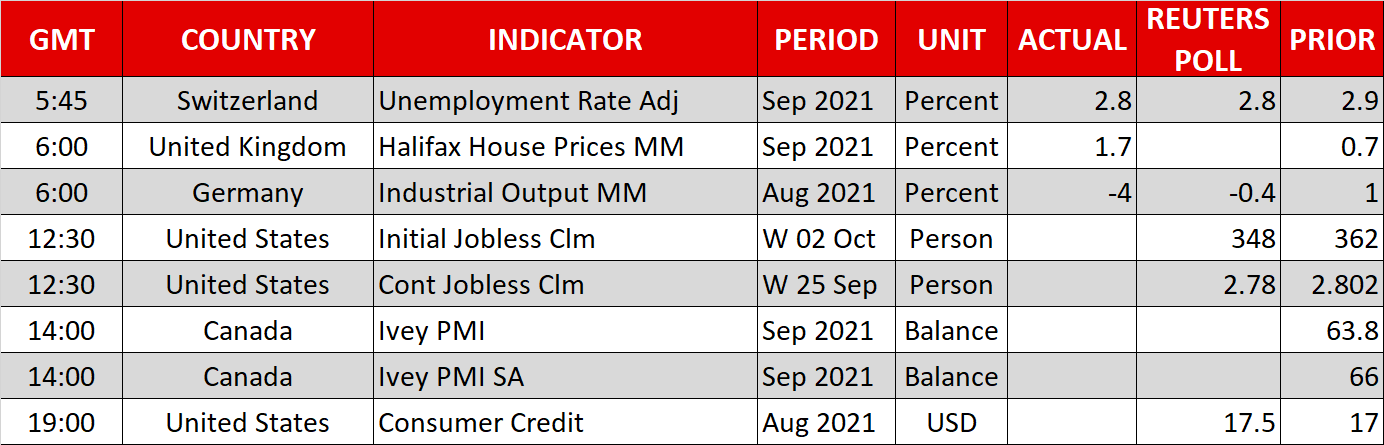
BoE Pill: Risks to economic and inflation outlook becoming two-sided
In reply to a questionnaire by the Treasury Select Committee, BoE policymaker Huw Pill said he expected interest rates to "remain at relatively low levels for the coming years, even as the impact of the COVID-19 pandemic recede."
But he acknowledged that "balance of risks is currently shifting towards great concerns about the inflation outlook." Also, "current strength of inflation looks set to prove more long lasting than originally anticipated." He emphasized that "risks to the economic and inflation outlook are again clearly becoming two-sided".
On BoE's balance sheet, Pill said, "at a time when financial markets appear to be functioning normally, a gradual and predictable reduction in the stock of asset purchases can be achieved without disrupting markets and/or creating an undesired abrupt tightening of financial and monetary conditions".
ECB Stournaras: Speculation of 2023 rate hike is not in accordance with our forward guidance
ECB Governing Council member Yannis Stournaras told Bloomberg TV that speculations for a first hike around mid-2023 are "not in accordance with our forward guidance". He added that the central bank will try to avoid any disruption after the end of the PEPP.
"Asset purchases aim at favorable financing conditions, at smooth transition of monetary policy to prevent any kind of fragmentation in jurisdictions in the euro area," Stournaras said. "I'm sure that the Governing Council will continue to aim at this."
Stournaras also said Eurozone is "not in the same position" as the US on inflation. He said, "the inflation forecasts are lower for the euro zone than in the U.S. and in the U.K. It's natural that we're in a different phase of monetary policy."
Separately, Governing Council member Francois Villeroy de Galhau said he expected inflation to fall back below 2% within a year.