Sample Category Title
USD/JPY Mid-Day Outlook
Daily Pivots: (S1) 111.16; (P) 111.47; (R1) 111.75; More...
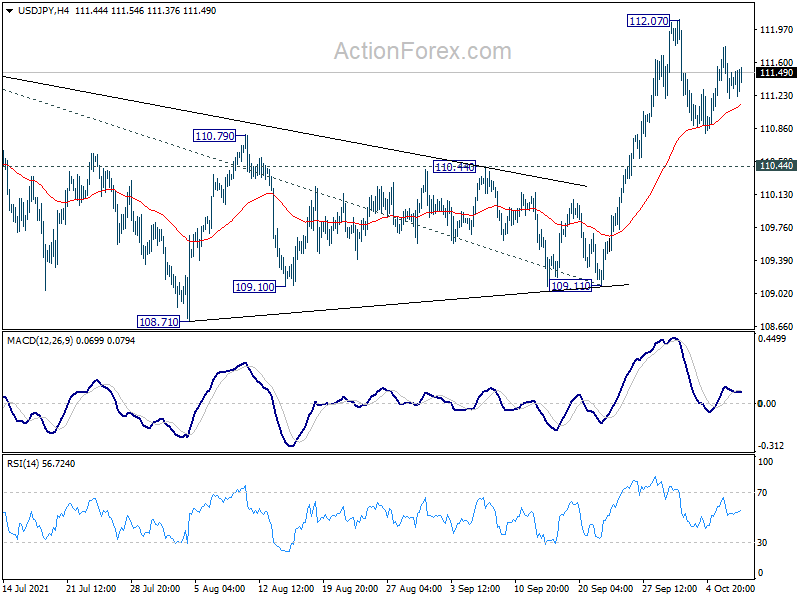
Intraday bias in USD/JPY remains neutral as consolidation from 112.07 is still extending. Another retreat cannot be ruled out, but downside should be contained by 110.44 support to bring another rally. On the upside, above 112.07 will extend larger rise to 61.8% projection of 102.58 to 111.65 from 109.11 at 114.71 next. However, break of 110.44 will dampen the bullish case and turn focus back to 109.11 support.
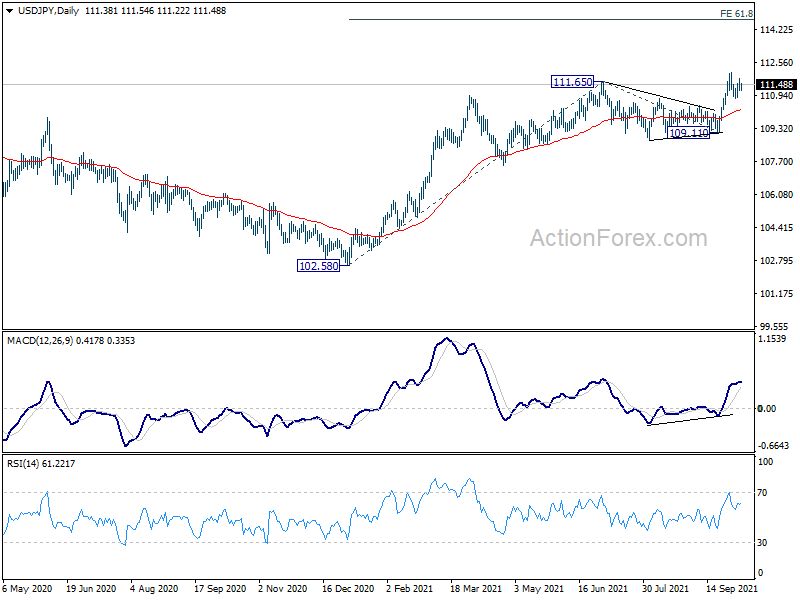
In the bigger picture, break of 111.71 resistance suggests that the whole corrective decline from 118.65 (2016 high) has completed at 101.18 (2020 low) already. Medium term bullishness is also affirmed as USD/JPY stays well above 55 week EMA (now at 108.60). Sustained trading above 111.71 will affirm this bullish case. Rise from 101.18 could then be resuming whole rally from 98.97 (2016 low) through 118.65. This will now be the preferred case as long as 108.71 support holds.
USD/CHF Mid-Day Outlook
Daily Pivots: (S1) 0.9261; (P) 0.9285; (R1) 0.9297; More....
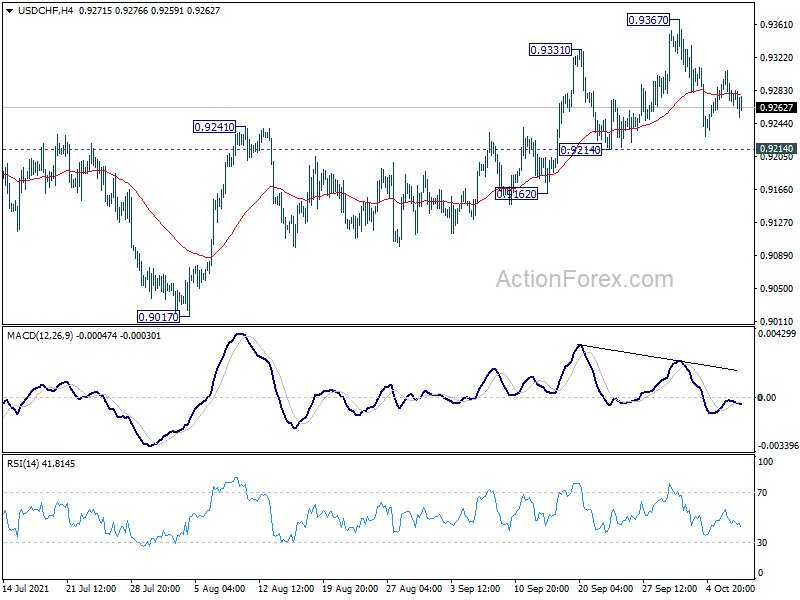
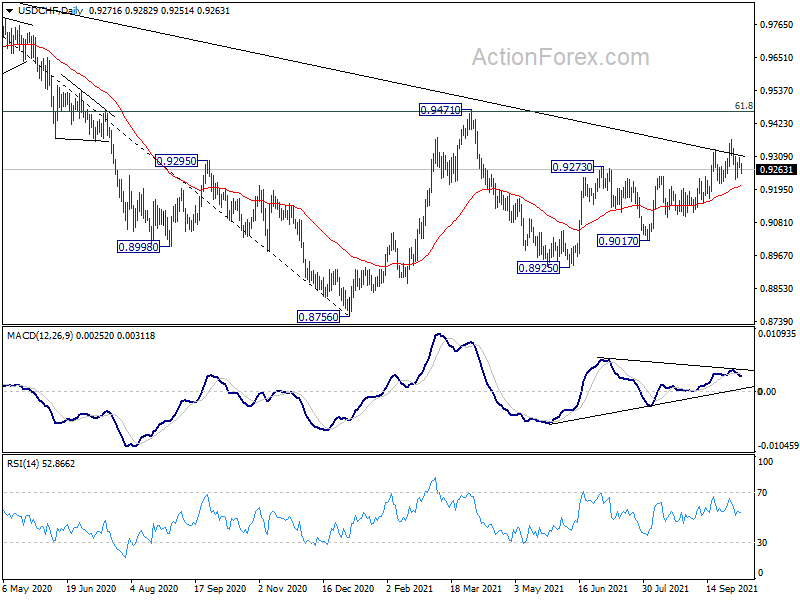
Intraday bias in USD/CHF remains neutral as range trading continues. As long as 0.9214 support holds, further rally is in favor. On the upside, break of 0.9367 will resume the rise from 0.8925 to 0.9471 key resistance next. On the downside, however, break of 0.9214 will turn bias back to the downside for 0.9017 support again.
In the bigger picture, the strong rally above 55 week EMA (now at 0.9188) now tilts favor to the case of bullish trend reversal. That is, decline from 1.3042 (2016 high) is probably completed at 0.8756 already. Sustained break of 0.9471 resistance should confirm this case and pave the way to retest 1.0342 ahead. However, rejection by 0.9471 will mix up the outlook again and retain some medium term bearishness.
GBP/USD Mid-Day Outlook
Daily Pivots: (S1) 1.3542; (P) 1.3589; (R1) 1.3633; More...
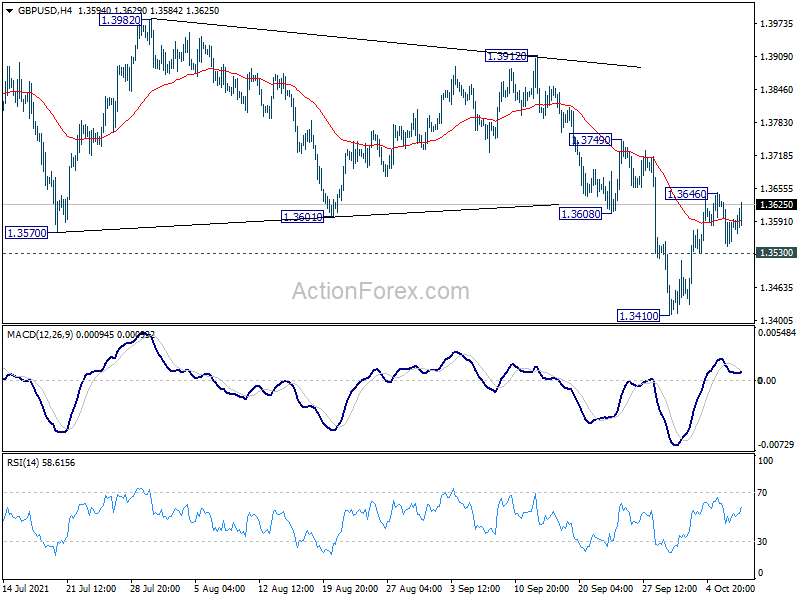
Intraday bias in GBP/USD remains neutral for the moment. On the upside, above 1.3646 will resume the rebound from 1.3410 short term bottom for 1.3749 resistance first, which is close to 55 day EMA (now at 1.3730). On the downside, though, below 1.3530 minor support will retain near term bearishness, and turn bias back to the downside for 1.3410 low. Firm break there will extend the fall from 1.4248 and target 1.3164 medium term fibonacci level next.
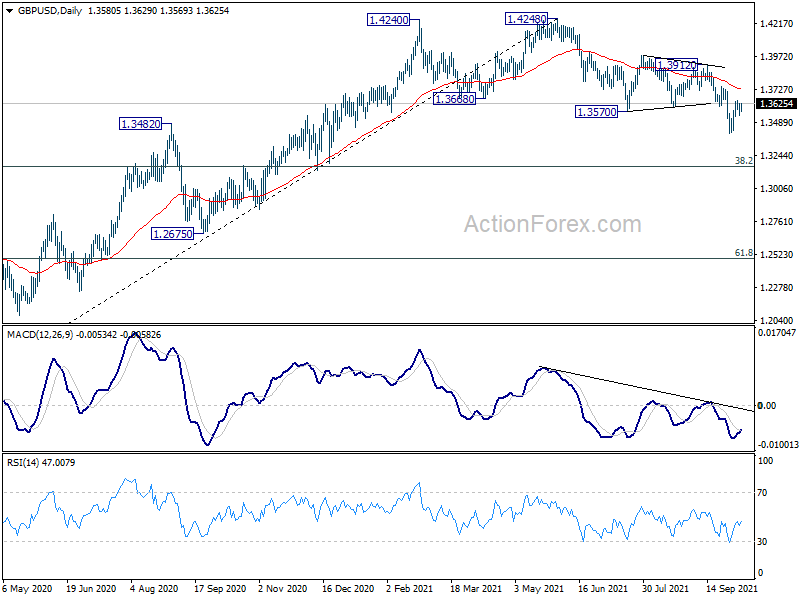
In the bigger picture, fall from 1.4248 is at least a correction to the up trend from 1.1409 (2020 low). Such correction could extend to 38.2% retracement of 1.1409 to 1.4248 at 1.3164 before completion. However, considering the rejection by 1.4376 key resistance (2018 high), sustained trading below 1.3164 will argue that it's indeed a bearish trend reversal and would target 61.8% retracement at 1.2493. Nevertheless, break of 1.3912 resistance will revive medium term bullishness and target 1.4248/4376 resistance zone again.
US Open Note – Stocks Turn Green on Temporary Risk On; Antipodeans Outperform
Risk-on trading returns
Risk-on sentiment continued to navigate markets during late European trading hours on Thursday as worries about the energy crisis took the back seat for the time being and the risk of a government default in the US was expected to be ease today after Democrats showed willingness to raise the debt ceiling to December on the Senate floor.
Following complaints that Russia is holding back its energy supplies, mainly from Europe, Vladimir Putin said that his government is ready to boost exports to stabilize the rally in energy prices, with WTI oil retreating to a one-week low of $74.96/barrel before correcting slightly higher. An unexpected increase in US weekly crude inventories on Wednesday also weighed on oil prices.
The inflation drama and the fiscal debate in the US, which is a key barrier to Biden’s massive 4 trillion budget, will probably keep spooking investors for the remainder of the year, though a temporary relief was enough to lift stock markets today after an aggressive sell-off during the previous days.
The pan-European STOXX 600 accelerated by 1.2%, with basic materials leading the rally, while the S&P 500, Nasdaq 100, and Dow Jones are also pushing for an equivalent reward.
Dollar index holds near one-year high; jobless claims beat forecasts
In FX markets, risk-sensitive currencies such as the aussie and the kiwi outperformed across the board, but the former has yet to step above the nearby 0.7300 – 0.7325 resistance area against the US dollar, while the latter cannot celebrate its progress either since it is still fluctuating below the 70.00 bar.
Despite the build on risk sentiment, the greenback managed to hold on to its gains, and even approach yesterday’s one-year high of 94.49. Perhaps the positive surprise in the private ADP employment report on Wednesday secured some support under the king dollar on Wednesday, brightening prospects for Friday’s nonfarm payrolls report, and therefore raising the odds for bond tapering as soon as next month.
Initial jobless claims for the week ending October 2 aided optimism for the US economy as well, declining to 326k from 362k previously and closer to September’s low of 310k. The forecast was for a softer pullback to 348k. Despite that, the data did not cause a significant reaction in dollar, with dollar/yen remaining stable around 111.50 for the second consecutive day.
Comments from Japan’s new Prime Minister earlier in the day have likely provided support to the yen after the PM warned that a falling currency may elevate import costs.
Euro holds bearish position; pound slightly up
In European currencies, the battered euro remained trapped in a bearish game, last seen at 1.1551 and near the 15-month low of 1.1528. Unlike the Fed, the ECB is not planning to cut its traditional bond purchases. Instead, it is studying a new bond-buying program to complement the existing APP scheme in order to prevent any negative shocks when the emergency pandemic purchases expire in March.
The pound is in a slightly better position today, marking an intra-day high of 1.3610 versus the dollar. Earlier in the day, BoE chief Huw Pill admitted that “the magnitude and duration of the transient inflation spike is proving greater than expected”, increasing the odds for a tighten monetary policy, although he signaled sharp actions will be avoided on the rate front.
Sunset Market Commentary
Markets
These days, it doesn’t take much for markets to move from a ‘glass-half-empty’ to ‘a glass-half-full’ mood. Financial stability issues in China, the US debt ceiling and, evidently, the potential consequences of higher energy price on the economic recovery and on global markets, they all were evident reasons for markets to turn nervous of late. At least today, these topics in one way or another turned positive or moved a bit to the background. Hong-Kong equities rebounded, US Republicans and Democrats might find common ground at least to postpone the debt-ceiling deadline well into December. Last but not least, the disruptive part of the inflation narrative also abated with European natural gas prices and oil easing off recent peak levels. The intra-price dynamics both of oil (Brent still north of $80 p/b) and gas shows that the topic might returning at any time. Still, there was room for a positive repositioning. European equities mostly gain between 1.2% and 1.8%. US indices also open with gains of 1%. (EMU) inflation expectations easing from recent peak levels caused (especially European) bonds and equities to walk the same path. German yields are declining between 0.7 bp (2-y) and 1.5 bp (10-y). Headlines/rumours that the ECB is preparing a new format to modify bond buying after the end of PEPP in March 2022 maybe added to the outperformance of European bonds. The presumption that the new framework might be selective/flexible was an additional positive for peripheral bonds. Italy outperforms with the 10-y spread versus Germany narrowing 4 bp. US yields initially hovered around yesterday’s closing levels. A faster than expected decline in weekly jobless claims (326K from 364k) helped to US yields back in green (0.6 bp for 2-y yield, 4 bp for 30-y). Markets evidently look forward to tomorrow’s US payrolls. After yesterday’s ADP report, the odds are for solid September job growth. Key question of course is whether good eco news will be considered as supporting a constructive/balanced market reaction.
Few ‘decisive’ moves in the major currency cross rates today. The DXY USD-index (94.20) held near recent peak levels, but with no real attempt top break higher. The mirror image is visible in EUR/USD. Despite a positive risk sentiment, the pair struggles to avoid further losses below the 1.1550/30 area. The yen is losing a few ticks (USD/JPY 111.50). EUR/GBP is testing the 0.85 barrier. CE currencies (EUR/CZK 25.38, EUR/HUF 358) also succeeded only modest progress. The zloty even reversed part of yesterday post-NBP gains as NBP governor Glapinski said the NBP is in a ‘longer wait-and-see mode’ after yesterday’s rate hike. EUR/PLN trades near the 4.56 handle.
News Headlines
Bank of England’s chief economist Pill said both the size and duration of the recent jump in inflation is greater than expected but stuck to the view that inflationary pressures should subside as global demand and supply normalizes. Headline and core inflation accelerated to 3.2% and 3.1% respectively. Answering questions from lawmakers, Pill said he expected interest rates to remain at “relatively low levels for the coming years”, suggesting any BoE tightening cycle won’t go very far. Markets in the meantime have pulled forward rate hike bets considerably as the energy crisis (a.o.) spurred long-term inflation expectations to the highest level in 13 years, just shy of 4%.
The European Commission will finalize measures mid next week aimed at resolving the post-Brexit trading issues in Northern Ireland by the end of this year or early 2022. Talks are then scheduled to last throughout the rest of October and November. Trade of goods from mainland UK to Northern Ireland face some difficulties since the Brexit as a result of the NI protocol that established in effect a border in the Irish Sea. London wants the protocol to be reviewed and has threatened on Monday to blow up the agreement by triggering Article 16 without a solution soon.
EUR/USD Mid-Day Outlook
Daily Pivots: (S1) 1.1524; (P) 1.1563; (R1) 1.1595; More...
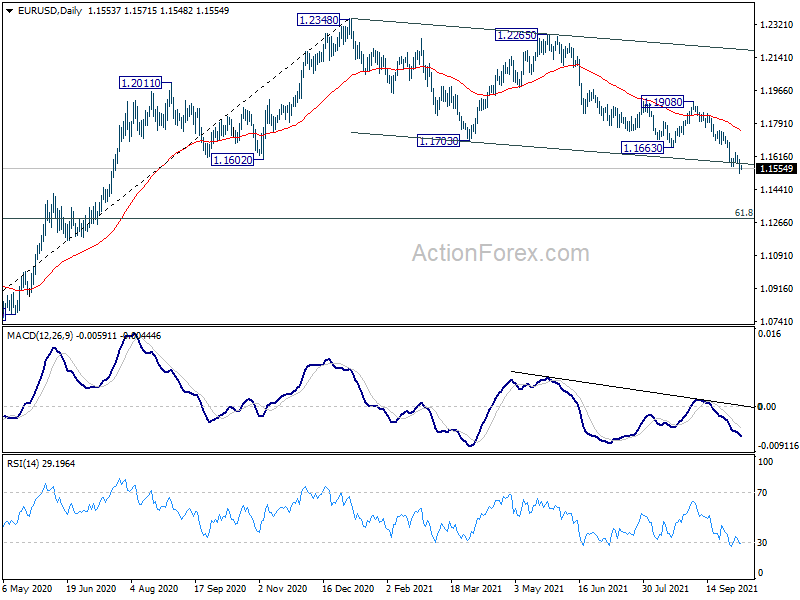
Intraday bias in EUR/USD remains on the downside for the moment. The decline from 1.2348 high is in progress and should target 1.1289 medium term fibonacci level. On the upside, break of 1.1639 resistance is needed to indicate short term bottoming. Otherwise, outlook will stay bearish in case of recovery.
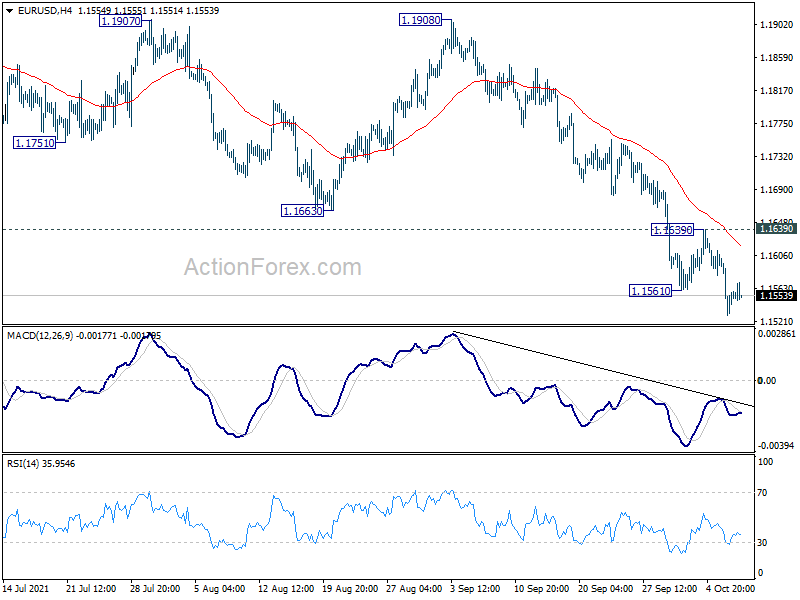
In the bigger picture, sustained break of 1.1602 will argue that rise from 1.0635 (2020 low) has completed at 1.2348. Deeper fall would be seen to 61.8% retracement of 1.0635 to 1.2348 at 1.1289. Note also that rejection by 55 week EMA (1.1830) also carries medium term bearish implication. Firm break of 1.1289 will pave the way to retest 1.0635 low. On the upside, though, break of 1.1908 resistance will revive medium term bullishness and turn focus back to 1.2348 high.
Euro Stays Pressured in Slow Markets, Risk Appetite Returning
Selloff in Euro remains the main theme in slow markets today. Return of risk appetite is also weighing down Dollar and Yen. On the other hand, commodity currencies are generally strong, with Aussie having an upper hand over Kiwi and Loonie. Sterling is mixed for now, partly supported by buying against European majors. While stocks are rebounding, major indexes are staying in familiar range. Traders would like to wait for tomorrow's US NFP before taking a committed stance.
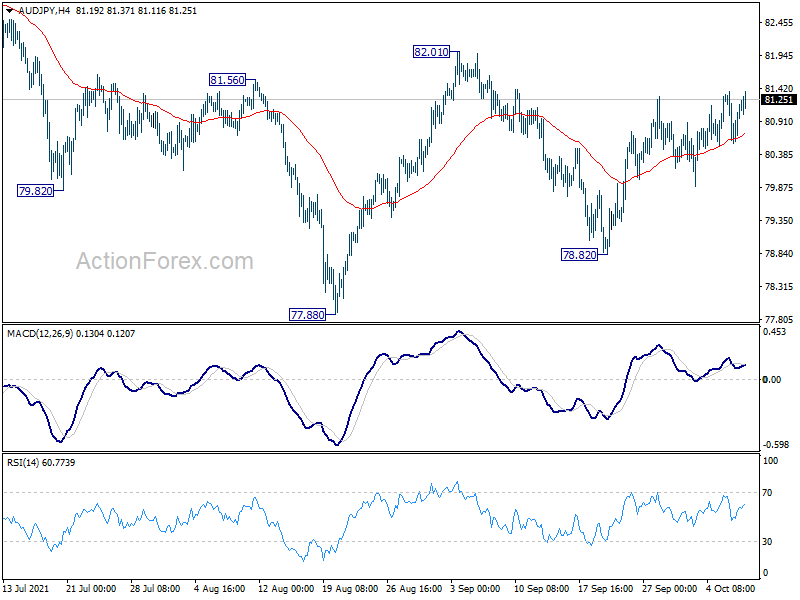
Technically, as EUR/AUD is breaking away from 1.5898 structural support cleanly, we'd also keep an eye on 0.7315 minor resistance in AUD/USD. Firm break there will argue that the pull back from 0.7477 has completed and further rise could be seen through this resistance to resume the whole rebound from 0.7105. AUD/JPY appears to be building a base for further rise with help from 4 hour 55 EMA. Break of 82.01 resistance will resume the rebound from 77.88.
In Europe, at the time of writing, FTSE is up 1.20%. DAX is up 1.45%. CAC is up 1.63%. Germany 10-year yield is down -0.0016 at -0.191. Earlier in Asia, Nikkei rose 0.54%. Hong Kong HSI rose 3.07%. Singapore Strait Times rose 0.56%. 10 year JGB yield dropped -0.0071 to 0.078.
US initial jobless claims dropped to 326k, below expectations
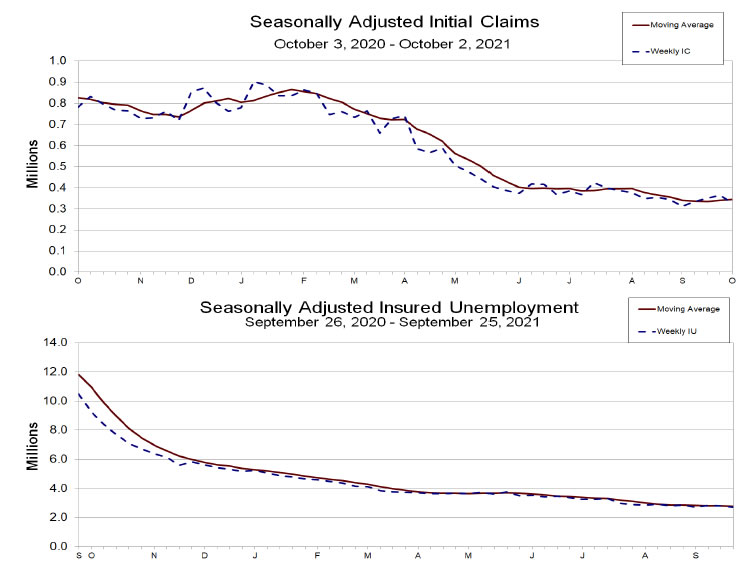
US initial jobless claims dropped -38k to 326k in the week ending October 2, below expectation of 349k. Four-week moving average of initial claims rose 3.5k to 344k.
Continuing claims dropped -97k to 2714k in the week ending September 25, lowest since March 14, 2020. Four-week moving average of continuing claims dropped -34.5k to 2765k, lowest since March 21, 2020.
ECB Accounts: Support from sustained pace of net PEPP purchases deemed essential
In the accounts of ECB's September 8-9 meeting, Governing Council members concurred with the assessment that "an accommodative monetary policy stance remained". Also, "policy support from a sustained pace of net purchases under the PEPP, along with the other instruments and the recalibrated forward guidance, was deemed essential".
Financing conditions had "had remained favourable or had loosened further" since June, and was "visible across a broad spectrum of indicators". Inflation outlook had a "significant improvement over the course of the year". However, the near-term increase in inflation was "largely driven by temporary factors that would fade in the medium term and not call for policy tightening."
Regarding the reduction in PEPP purchase pace in Q4, on the one hand, it was argued that "a symmetric application of the PEPP framework would call for a more substantial reduction in the pace of purchases". On the other hand, "reference was made to the recent repricing in nominal bond yields, which called for a prudent reduction in the pace of purchases".
Also, it's noted that "markets were already expecting an end to net asset purchases under the PEPP by March 2022", but such expectation was "not showing a significant impact on financing conditions".
Overall, all members agreed to "moderately scale down the pace of purchases under the PEPP".
ECB Stournaras: Speculation of 2023 rate hike is not in accordance with our forward guidance
ECB Governing Council member Yannis Stournaras told Bloomberg TV that speculations for a first hike around mid-2023 are "not in accordance with our forward guidance". He added that the central bank will try to avoid any disruption after the end of the PEPP.
"Asset purchases aim at favorable financing conditions, at smooth transition of monetary policy to prevent any kind of fragmentation in jurisdictions in the euro area," Stournaras said. "I'm sure that the Governing Council will continue to aim at this."
Stournaras also said Eurozone is "not in the same position" as the US on inflation. He said, "the inflation forecasts are lower for the euro zone than in the U.S. and in the U.K. It's natural that we're in a different phase of monetary policy."
Separately, Governing Council member Francois Villeroy de Galhau said he expected inflation to fall back below 2% within a year.
Released in European session, Italy retail sales rose 0.4% mom in August versus expectation of 0.2% mom. France trade deficit narrowed to EUR -6.7B in August, versus expectation of EUR -6.8B. Germany industrial production dropped -4.0% mom in August, versus expectation of -0.5% mom. From Swiss, unemployment rate dropped to 2.8% in September while foreign currency reserves rose to CHF 940B.
BoE Pill: Risks to economic and inflation outlook becoming two-sided
In reply to a questionnaire by the Treasury Select Committee, BoE policymaker Huw Pill said he expected interest rates to "remain at relatively low levels for the coming years, even as the impact of the COVID-19 pandemic recede."
But he acknowledged that "balance of risks is currently shifting towards great concerns about the inflation outlook." Also, "current strength of inflation looks set to prove more long lasting than originally anticipated." He emphasized that "risks to the economic and inflation outlook are again clearly becoming two-sided".
On BoE's balance sheet, Pill said, "at a time when financial markets appear to be functioning normally, a gradual and predictable reduction in the stock of asset purchases can be achieved without disrupting markets and/or creating an undesired abrupt tightening of financial and monetary conditions".
Australia AiG services ticked up to 45.7 in Sep, mild upturn expected in Oct
Australia AiG Performance of Services Index rose slightly by 0.1 pts to 45.7 in September, marking a second month in contraction. Looking at some details, sales rose 1.4 to 41.4. Employment dropped -1.4 to 52.0. New orders dropped -7.6 to 39.8. Supplier deliveries rose 3.0 to 47.0. Finished stocks rose 15.8 to 53.5. Input prices dropped -.7.0 to 64.5. Selling prices dropped -1.4 to 53.9.
Ai Group Chief Executive, Innes Willox, said: "Restrictions associated with the delta outbreaks in south eastern Australia were the major contributor to the continued contraction of the Australian services sector in September... While predictions are highly conditional, we are expecting a mild upturn in October followed by further gains as restrictions are eased in line with higher levels of vaccination."
BoJ Kuroda expects economy to recover as pandemic impact subsides
BoJ Governor Haruhiko Kuroda said Japan's economy is expected to recover ahead as the impact of the pandemic gradually subsides. BoJ is closely watching the coronavirus impact. He pledged again that it "won't hesitate to ease policy further if necessary".
Kuroda also said that core CPI is expected to linger around 0% for the near term, but it would "pick up pace gradually". Also, the financial system remains stable and financial conditions are accommodative overall.
EUR/USD Mid-Day Outlook
Daily Pivots: (S1) 1.1524; (P) 1.1563; (R1) 1.1595; More...
Intraday bias in EUR/USD remains on the downside for the moment. The decline from 1.2348 high is in progress and should target 1.1289 medium term fibonacci level. On the upside, break of 1.1639 resistance is needed to indicate short term bottoming. Otherwise, outlook will stay bearish in case of recovery.
In the bigger picture, sustained break of 1.1602 will argue that rise from 1.0635 (2020 low) has completed at 1.2348. Deeper fall would be seen to 61.8% retracement of 1.0635 to 1.2348 at 1.1289. Note also that rejection by 55 week EMA (1.1830) also carries medium term bearish implication. Firm break of 1.1289 will pave the way to retest 1.0635 low. On the upside, though, break of 1.1908 resistance will revive medium term bullishness and turn focus back to 1.2348 high.
Economic Indicators Update
| GMT | Ccy | Events | Actual | Forecast | Previous | Revised |
|---|---|---|---|---|---|---|
| 21:30 | AUD | AiG Performance of Services Index Sep | 45.7 | 45.6 | ||
| 05:00 | JPY | Leading Economic Index Aug P | 101.8 | 104.3 | 104.1 | |
| 05:45 | CHF | Unemployment Rate Sep | 2.80% | 2.80% | 2.90% | |
| 06:00 | EUR | Germany Industrial Production M/M Aug | -4.00% | -0.50% | 1.00% | 1.30% |
| 06:45 | EUR | France Trade Balance (EUR) Aug | -6.7B | -6.8B | -7.0B | -7.1B |
| 07:00 | CHF | Foreign Currency Reserves (CHF) Sep | 940B | 929B | ||
| 08:00 | EUR | Italy Retail Sales M/M Aug | 0.40% | 0.20% | -0.40% | -0.30% |
| 11:30 | EUR | ECB Monetary Policy Accounts | ||||
| 11:30 | USD | Challenger Job Cuts Y/Y Sep | -84.90% | -86.40% | ||
| 12:30 | USD | Initial Jobless Claims (Oct 1) | 326K | 349K | 362K | 364K |
| 14:00 | CAD | Ivey PMI Sep | 60.7 | 66 | ||
| 14:30 | USD | Natural Gas Storage | 104B | 88B |
US initial jobless claims dropped to 326k, below expectations
US initial jobless claims dropped -38k to 326k in the week ending October 2, below expectation of 349k. Four-week moving average of initial claims rose 3.5k to 344k.
Continuing claims dropped -97k to 2714k in the week ending September 25, lowest since March 14, 2020. Four-week moving average of continuing claims dropped -34.5k to 2765k, lowest since March 21, 2020.
CAD Calm ahead of Job Reports
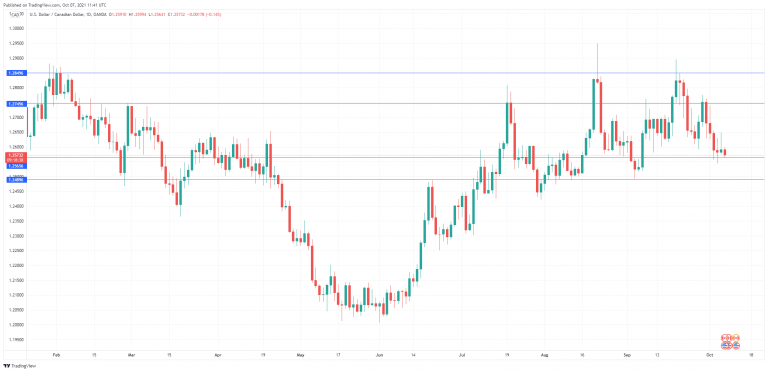
The Canadian dollar is trading quietly in the Thursday session. Currently, USD/CAD is trading at 1.2570, down 0.016% on the day. On Friday, both Canada and the US release key employment reports, so we could see strong strong movement from the Canadian dollar before the weekend.
The US will release nonfarm payrolls, one of the most highly anticipated events on the data calendar. The consensus is around 450 thousand new jobs for September, which would be a significant improvement over the August release of just 235 thousand. The upcoming release has added significance because the Fed appears committed to tapering and is looking for strong economic data before pressing the trigger.
An NFP reading of 500 thousand or more would likely result in the Fed tapering in November or December. That means that a strong NFP should give a lift to the US dollar. Conversely, a reading below 500K could add to the uncertainty over the timing of a taper and weigh on the US dollar. The wage growth release should also not be ignored. If the forecast of 0.4% is widely missed, it could affect the movement of USD/CAD.
Canada also releases key employment data on Friday. The economy has been struggling, as reflected by GDP, which has reeled over four straight months of negative growth. In August, the economy created 95 thousand jobs, but that is expected to slow to about 60 thousand for September. Unemployment is forecast to drop to 6.9%, down from 7.1%. If these releases are stronger than anticipated, the Canadian dollar could gain ground, depending of course on the US employment report.
The Bank of Canada will also be closely monitoring Friday’s job releases. Strong Canadian job numbers would point to an improving recovery and would support the case to raise rates sooner rather than later. Like the Federal Reserve, the BoC will want to see solid data and ensure that the recovery is on a strong footing before tightening policy.
USD/CAD Technical
- USD/CAD is testing support at 1.2565. Below, there is support at 1.2489
- There is resistance at 1.2745 and 1.2849
EUR/USD Elliott Wave Analysis: Searches for Support
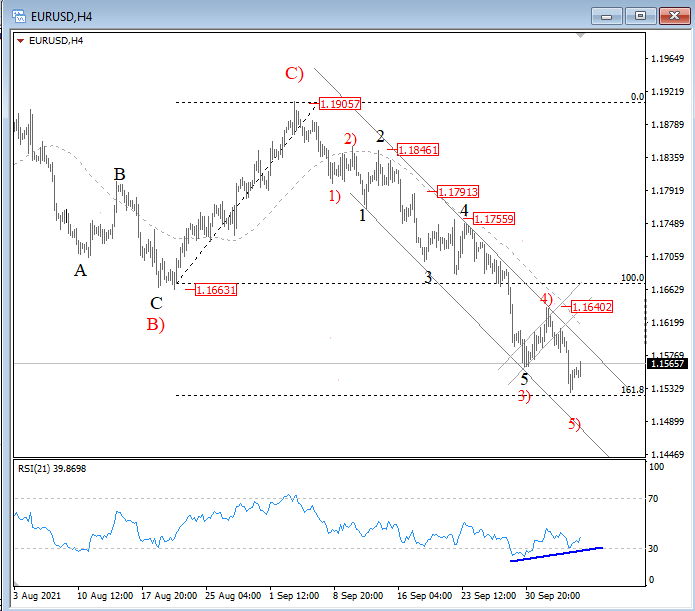
We can see some choppy and slow price action on FX market ahead of Friday's NFP report. EURUSD Ideally, there is going to be another and final drop in the next 24 hours and then possible reversal after NFP tomorrow.
As per Elliott Wave analysis, EURUSD is coming down on 4h chart as expected, now out of a minor bear flag that we labeled as wave 4 so looks like the final fifth wave down is now in progress. Technicall, support is at 1.1500/1.1530 area where bears may slow down and RSI is forming bullish divegernce. However, any bullish turn can be confirmed only if we get an impulse back above 1.1640 and 1.1663.
EUR/USD 4h Elliott Wave analysis