

Sample Category Title
US ADP employment grew 568k in Sep, recovery continues to make progress
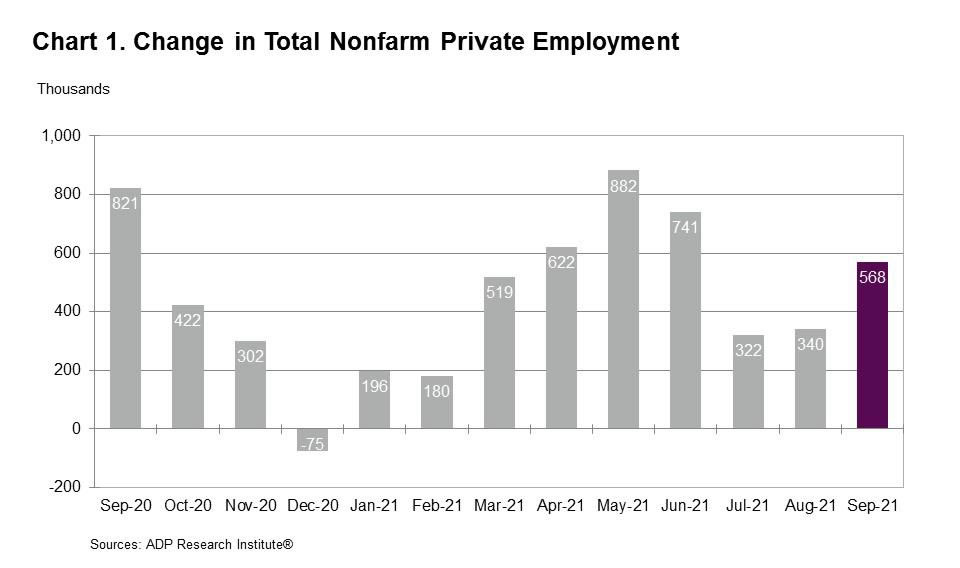
US ADP private sector employment grew 568k in September, above expectation of 475k. By company size, small businesses added 63k jobs, medium businesses added 115k, large businesses added 390k. By sector, goods-producing jobs grew 102k, and service-providing jobs rose 466k.
"The labor market recovery continues to make progress despite a marked slowdown from the 748,000 job pace in the second quarter," said Nela Richardson, chief economist, ADP. "Leisure and hospitality remains one of the biggest beneficiaries to the recovery, yet hiring is still heavily impacted by the trajectory of the pandemic, especially for small firms. Current bottlenecks in hiring should fade as the health conditions tied to the COVID-19 variant continue to improve, setting the stage for solid job gains in the coming months."
Roaring Dollar Turns To Nonfarm Payrolls
The US employment report for September will hit the markets at 12:30 GMT Friday. It will single-handedly decide whether the Fed pushes the taper button next month. As for the dollar, it has sliced through its rivals lately as investors searched for shelter from the stock market storm. The bigger picture remains positive in an environment where the Fed normalizes faster than the ECB and BoJ, and with the American economy being shielded from the global energy crisis.
Crises everywhere
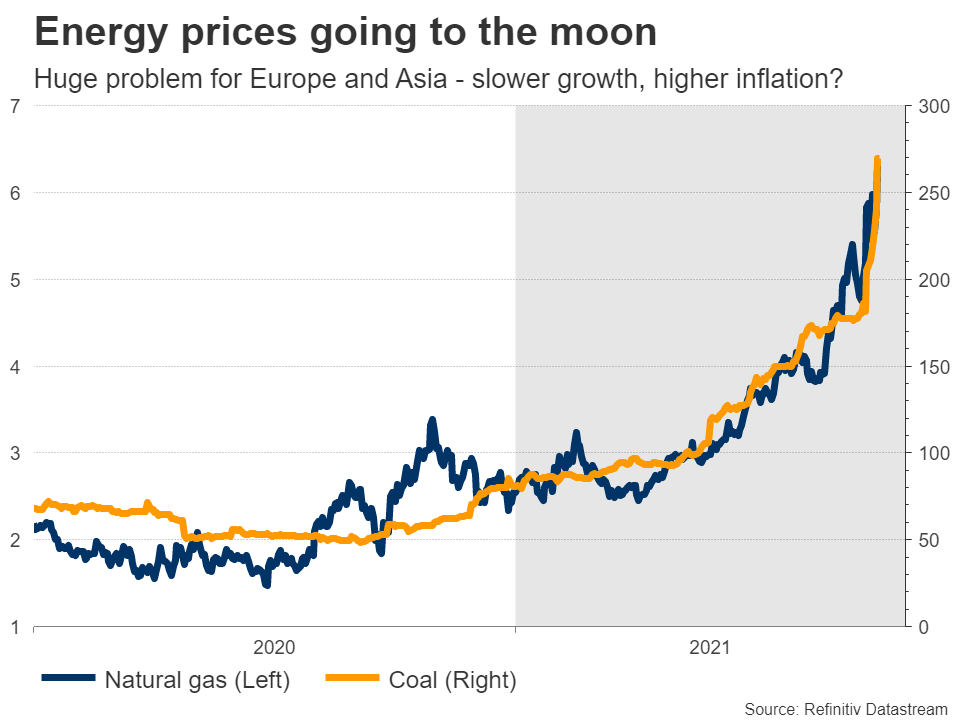
It’s a good time to be the world’s reserve currency. From paralyzed supply chains to an energy crisis that has engulfed Europe and Asia, markets are grappling with a variety of risks that threaten to hamstring economic growth and simultaneously keep inflation hot for longer.
With investors playing defense and the US economy insulated from the global power crisis thanks to its self-sufficiency on energy, the dollar has reclaimed its throne as king of the FX market.
The other element that has turbocharged the dollar is market pricing around the Fed. At its latest meeting, the central bank signaled that if the next employment report is solid, it would get the tapering process rolling in November.
Policymakers were split evenly on whether rates should be lifted next year already, but markets seem more confident as the first rate increase is now almost fully priced in for December 2022.
Solid jobs report?
Turning to the upcoming dataset, nonfarm payrolls are forecast to have risen by 450k in September, pushing the unemployment rate down one tick to 5.1%. Wage growth is expected to have picked up too, with average hourly earnings projected to reach 4.6% in yearly terms from 4.3% previously.
Labor market indicators were mixed during the month. Employment growth accelerated in the ISM manufacturing survey, but it slowed down in the services sector, which accounts for a much bigger part of the economy. Likewise, the Markit PMIs showed that job creation picked up, but remained subdued by historical standards.
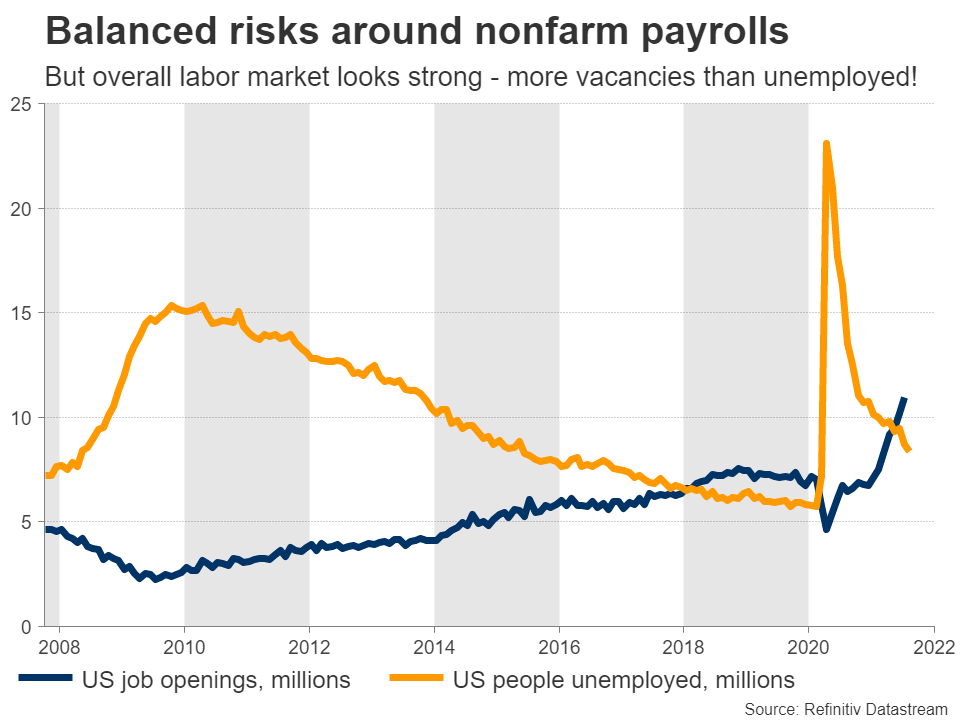
As such, the risks surrounding the NFP forecast seem balanced - it’s difficult to call for either a large positive surprise or a massive disappointment. An employment report that’s roughly in line with the forecasts is unlikely to move the needle for the dollar. What usually happens in such cases is a minor spike that fades almost instantly - just volatility without a clear direction.
Dollar outlook still bright
In the bigger picture though, the outlook for the reserve currency remains positive. With bond yields rising across the world because of inflation concerns, the dollar is the last remaining defensive hedge across markets, as neither bonds nor gold nor the yen are attractive in this environment.
Meanwhile, the US economy remains solid and is heavily shielded from the worsening energy crisis, which will impact Europe and Asia much more. Consumption has been strong, the labor market is healing quickly, and Congress will likely deliver another multi-trillion spending package soon to recharge the recovery.
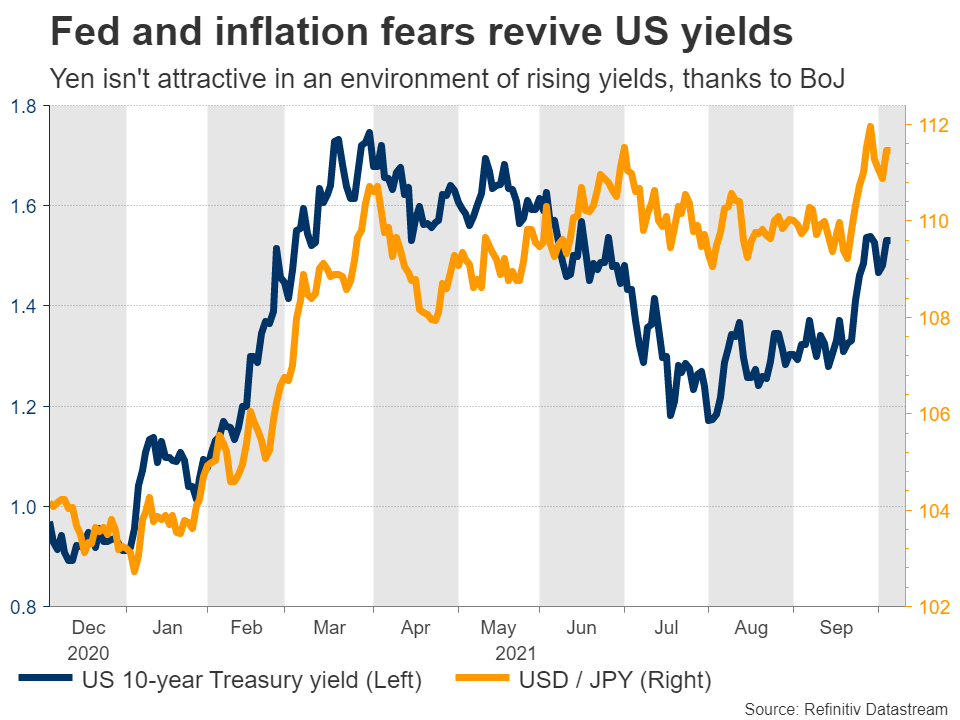
All this allows the Fed to taper its asset purchases and ultimately raise rates, something that could put even more upward pressure on US yields, making the dollar more attractive against low-yielding currencies like the euro and yen over time.
The risk is that the Fed gets cold feet because of the global environment turning darker and delays its normalization plans. But if the situation gets bad enough for this to happen, the markets would probably be in panic mode and safe-haven demand for the dollar might remain elevated, keeping any losses to a minimum.
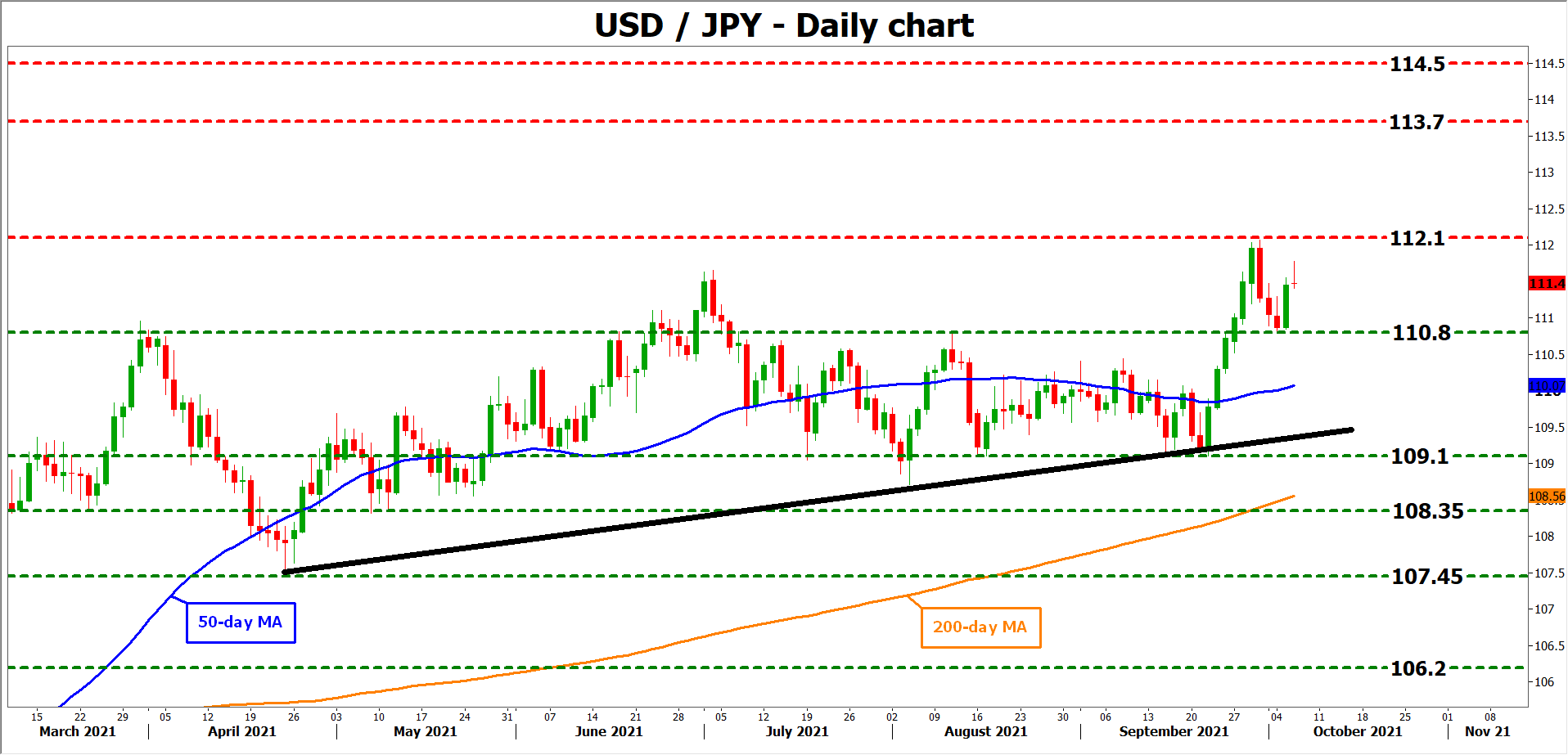
Taking a technical look at dollar/yen, a potential break above the 112.10 region could open the door towards the 113.70 zone.
On the downside, a violation below the 110.80 level might bring into play the 50-day moving average, currently at 110.07.
RBNZ Hikes, But NZD Takes A Plunge
We continue to see sharp volatility from the New Zealand dollar. NZD/USD enjoyed a three-day rally, but has squandered most of these gains on Wednesday. The pair is currently trading at 0.6885, down 1.10% on the day.
RBNZ hikes rates
The markets were expecting a rate hike from the Reserve Bank of New Zealand, and this time the central bank didn’t disappoint, raising rates from 0.25% to 0.50%. The RBNZ was poised to press the rate trigger in August, but an outbreak of the Delta variant led to a national lockdown, and policy makers felt that the timing for a rate hike was not optimal. Fast forward to October, when the government has abandoned its zero-tolerance policy on Covid and will rely on a vaccination program to keep Covid at bay. This has made the optics of a rate hike more palatable. The economic conditions clearly justify a rate hike – inflation is above the RBNZ target of 1-3% and the employment market is robust.
Despite the rate raise, which was the first since 2014, the kiwi not only didn’t get a lift but has plunged over a full cent. This can be attributed to growing concerns over the US debt ceiling, Evergrande and a possible energy crisis. The rate hike was well-telegraphed by the RBNZ and as far as the markets are concerned, this was a non-event.
It’s important to keep in mind that the rate hike is not a one-shot deal; the RBNZ plans a series of hikes into 2022, with another rise on the way perhaps in November. Only a handful of central banks have started to raise interest rates, and with the Fed focusing on tapering rather than a rate move, the New Zealand dollar should receive a lift as the RBNZ embarks on a cycle of rate hikes.
NZD/USD Technical
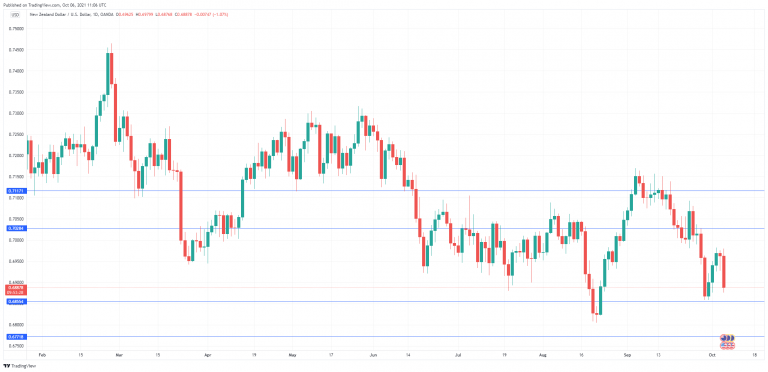
- There is resistance at 0.7028, followed by 0.7117
- 0.6855 has weakened in support as NZD/USD has fallen sharply. Below, there is support at 0.6771
NZDUSD Gains Non-Existent Despite 25bps Rate Hike
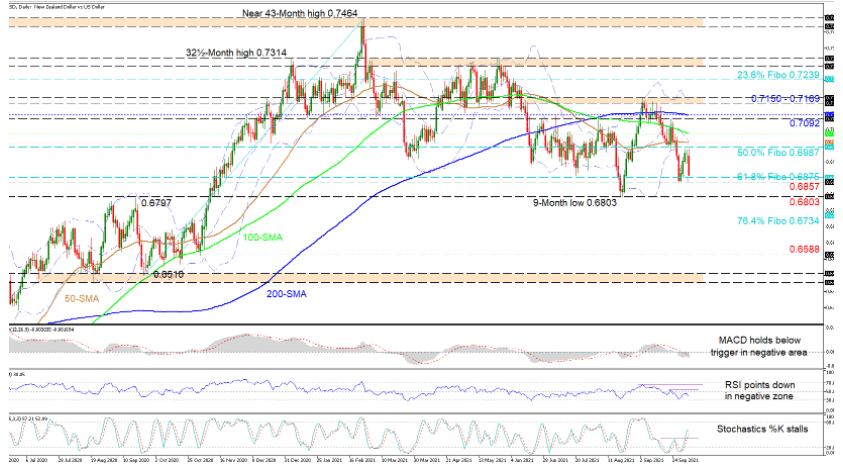
NZDUSD appears to have failed to capitalise on the 25bps rate hike to 0.50% out of the Reserve Bank of New Zealand (RBNZ), which was delivered in the Asian trading session. The pair is dropping towards the 0.6875 level, that being the 61.8% Fibonacci retracement of the up leg from 0.6510 until 0.7464, the lower region of a mostly sideways market that began around June 18. The overall trendless simple moving averages (SMAs) are also confirming the fairly ranging price action in the pair.
The short-term oscillators are reflecting the increase in negative impetus. The MACD is falling beneath its red trigger line in the bearish region, while the RSI is indicating the rise in downward forces. The stalling in the stochastic %K line is hinting that sellers may soon gain a clear upper hand, extending the recent price decline.
If sellers maintain control, a prompt support zone could arise from the 61.8% Fibo of 0.6875 until the neighbouring low of 0.6857. If the price steers past the lower Bollinger band, next downside friction could transpire from the 9-month trough of 0.6803. Should this bottom defence of the recently ranging market fail to halt further declines from unfolding, the pair may then shoot for the 76.4% Fibo of 0.6734 before diving for the 0.6588 barrier.
In the event buyers return and push the price higher, upside constraints could commence from the 50.0% Fibo of 0.6987 and the resistance region overhead between the 50-day SMA at 0.7003 and the 100-day SMA at 0.7037. Conquering these tough obstacles may reinforce positive powers to challenge the 0.7092-0.7106 barricade. Should buying interest prevail above the 200-day SMA, the 0.7150-0.7169 ceiling of the three-and-a-half-month consolidation could calm buoyant buyers from reaching the 23.6% Fibo of 0.7239.
Summarizing, in the short-term picture, NZDUSD is exhibiting a slight negative demeanour despite being stuck in a trading range. For a more definitive direction to mature, the price would need to break either below 0.6803 or above 0.7169.
GBP/USD Outlook: Risk Aversion And UK Data Miss Push Sterling Lower After Four-Day Rally
Fresh risk aversion, combined with weaker than expected UK data, pushed sterling nearly 0.5% down in European trading on Wednesday.
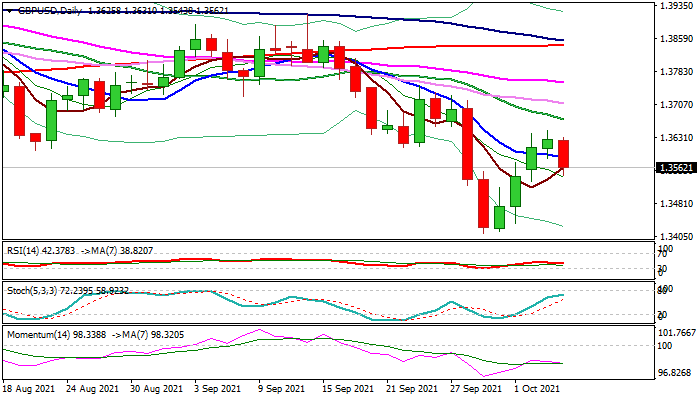
Strong rebound in past four days lost steam at initial barrier at 1.3641 (Aug 20 low) and ahead of 1.3662 pivot (daily Kijun-sen / 50% retracement of 1.3912/1.3412 descend), with reversal pattern forming on daily chart and generating strong bearish signal.
Daily moving averages are again in full bearish configuration and momentum turned south, already deeply in the negative territory, while 100/200DMA’s are converging and about to form a bear-cross that would add to signs that short recovery might be over.
Fresh weakness sees a minimum requirement on daily close below 1.3575 (cracked Fibo 38.2% of 1.3411/1.3647 upleg) to confirm bearish stance.
Firm dollar amid growing concerns that surging energy prices could further boost inflation and prompt interest rate hike, add pressure on pound.
Traders focus on today’s US ADP private sector jobs data, often used as an indication for more significant NFP release Sep 473K f/c vs Aug 235K), due on Friday, which could further underpin US dollar on better than expected results.
Res: 1.3603, 1.3631, 1.3647, 1.3662.
Sup: 1.3530, 1.3501, 1.3467, 1.3411.
S&P 500 Bearish Trend Resumes
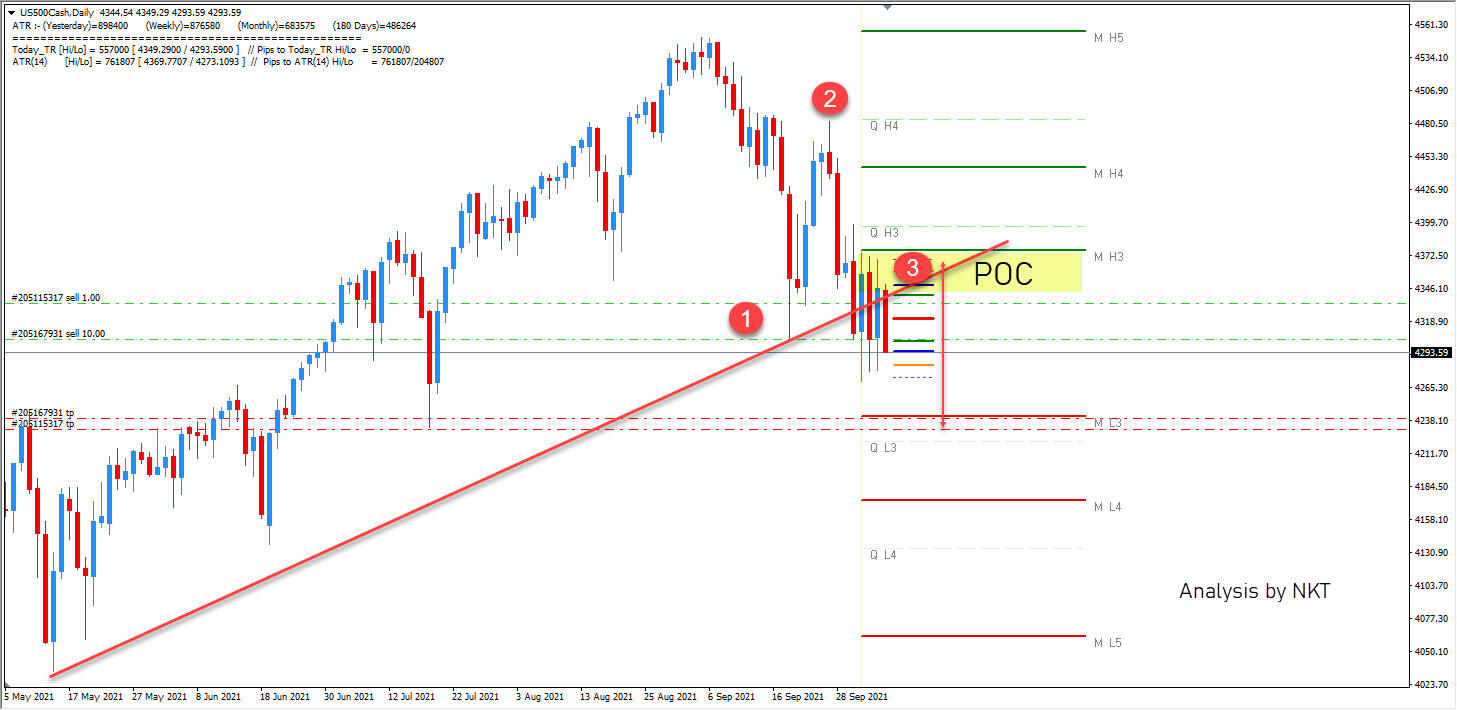
The US500 continues with a bearish trend. We should see new lows.
The 4350 zone was good to go short. The market reacted with a retracement retracement yesterday exactly to the resistance zone. If momentum continues, which I do expect, we should see 4240 level hit. The trend is bearish now and selling on rallies is the option now. 1-2-3 pattern breakout says it all.
Oil Upswing Continues, Gold
Oil coattails natural gas higher
An unchanged OPEC+ continued to reverberate through oil markets overnight, lifting prices, as did the near 10% overnight rally in natural gas prices. Brent crude finished 1.55% higher at USD 82.55, and WTI rallied 1.85% to USD 70.05 a barrel. Both remain around those levels in Asia as local markets digest another overnight jump in prices.
The overnight US API Crude Inventory data showed only a modest increase in crude in storage. The official Crude Inventory data tonight will assume greater importance. A tiny fall of 400,000 barrels is expected, but if crude stocks drop substantially, oil is likely to have another excuse to rally aggressively once again.
Brent crude will find plenty of support on dips to USD 79.00 and USD 76.00 a barrel. After rising through USD 82.00 overnight, it has no meaningful resistance ahead of the 2018 highs around USD 87.00 a barrel in its sights. WTI will be well supported on dips to USD 76.00 and USD 75.00 a barrel. Having cleared USD 78.50 overnight, the charts suggest that a rally to USD 84.00 a barrel is not out of the question.
The only caveat on further immediate rallies is that the relative strength indexes (RSIs) on both contracts are now in very overbought territory. That may signal some daily pullbacks this week but does not change the underlying bullish case for oil. Any sudden dips in prices to cull speculative longs are likely to be met with just as quick price rebounds.
Business as usual for gold
The old inverse correlation between gold and the US dollar returned overnight. As firmer US yields and a resumption of the US dollar uptrend pushed gold 0.55% lower to USD 1760.00 an ounce. In Asia, with the US dollar continuing to rise, gold has fallen by 0.30% to USD 1755.00 an ounce.
It looks as though some risk-hedging is still around, however, and I continue to expect gold to find some support at USD 1750.00 and USD 1740.00 an ounce with resistance at USD 1785.00 capping gains into Friday’s US data. More important support lies at USD 1720.00 an ounce, with the USD 1800.00 to USD 1810.00 an ounce zone, containing the 100 and 200-day moving averages, forming a formidable zone of resistance.
A firm US Non-Farm Payroll number on Friday will put the Fed taper back in play with no ambiguity. That will see the gold downtrend resume with renewed momentum.
Continued Spike In Energy Prices Weighing Upon Risk Appetite
Notes/Observations
- German Aug Factory Orders fall more than expected weighed down by auto sector.
- Safe haven flows aid USD as energy surge drives inflation concerns.
- More central banks hike rates to combat inflation (RBNZ overnight, Iceland during EU session; awaiting any surprise out of Poland).
Asia
- Reserve Bank of New Zealand (RBNZ) raised its Official Cash Rate (OCR) by 25bps to 0.50% (as expected) for its 1st rate hike since July 2014.
- South Korea Sept CPI data registered its 6th straight month above target (Y/Y: 2.5% v 2.3%e) with core rate being the fasted in 4 years; keeps rate hike pressures on BOK.
- US President Biden stated he spoke with China President Xi on Taiwan and agreed to abide by Taiwan agreement.
Europe
- ECB chief Lagarde stated that would pay close attention to wage developments and inflation expectations.
- UK PM Johnson said to be planning to announce a 'significant' boost to minimum wage within next few weeks to £9.42/hr (currently £8.91/hr for workers 23 and over).
- Spain, Czech Republic, France, Romania and Greece call on EU investigation into the gas market. Asking European Union to develop a toolkit to immediately react to dramatic price surges.
Americas
- President Biden stated that carving out for Filibuster on debt ceiling was a possibility.
- White House Press Sec Jean-Pierre stated that President Biden held constructive meeting with Democratic lawmakers. Biden had confidence in Fed Chair Powell (following renewed criticism of Powell from Sen Warren).
- Senate Banking Chair Crapo (R-ID) said he would vote to confirm Powell if President Biden were to nominate him for another.
- Rep. Pramila Jayapal (D-WA): President Biden’s $1.5T for economic bill was 'too small' and 'not going to happen. Saw number going to be somewhere between 1.5- 3.5T (Note: Biden said to have recently suggested a package in the range of $1.9-$2.2T).
Energy
- Weekly API Crude Oil Inventories: +1.0M v +4.1M prior (2nd straight build).
Speakers/Fixed income/FX/Commodities/Erratum
Equities
- Indices [Stoxx600 -1.75% at 448.02, FTSE -1.43% at 6,976.24, DAX -2.13% at 14,870.95, CAC-40 -1.85% at 6,454.85, IBEX-35 -1.63% at 8,781.50, FTSE MIB -1.92% at 25,458.00, SMI -1.13% at 11,433.00, S&P 500 Futures -1.14%].
- Market Focal Points/Key Themes: European indices open lower across the board and slipped further into the red as the session wore on; generalized lack of risk appetite attributed to concerns over energy and supply chains; less negative sectors include financials and health care; while leaders to the downside include telecom and consumer discretionary; Wienerberger acquires Struxura; EutelSat raises stake in OneWeb; GN Store Nord acquires SteelSeries; corporate events later in the session include Dow Investor Day.
Equities
- Consumer discretionary: Tesco [TSCO.UK] +4% (earnings; raises outlook; buyback), PageGroup [PAGE.UK] +7% (trading update; raises outlook), TUI [TUI1.DE] -1% (trading update; capital increase).
- Consumer staples: Imperial Brands [IMB.UK] -2% (trading update).
- Healthcare: Bayer [BAYN.DE] -1% (Jury verdict).
- Industrials: GN Store Nord [GN.DK] +5% (acquisition; pauses buyback).
- Telecom: Deutsche Telekom [DTE.DE] -4% (share sale).
Speakers
- ECB's Centeno (Portugal) stated that saw signals of easing in growth momentum.
- France Fin Min Le Maire stated that a consensus was emerging on minimum tax rate of 15%. Debate now on the base for minimum rate.
- EU Energy Commissioner Simon stated that the spike in gas prices was due to a combination of factors; level lower than 10-year average but adequate to cover winter season needs. Russia did not any excess gas capacity to region. Analyzing member States proposals including gas reserves. To act at this time the EU govts could provide targeted support to customers, direct payments to those most at risk, cut energy taxes and shift charges to general taxation.
- EU leaders to discuss energy crisis in detail at the Oct 21-22nd summit.
- Ireland Foreign Min Coveney reiterated view that hopeful Ireland could be a part of new tax rate measure. UK govt was not likely to trigger Article 16 soon. Northern Ireland Protocol document would not change and added he did not read too much into the rhetoric at the UK conservative conference.
- Sweden Central Bank (Riksbank) Dep Gov Skingsley stated that the outlook for inflation was on the weak side but not time to change monetary policy plan at this time. Watchful but not worried by price and wage developments.
- Iceland Central Bank (Sedibanki) Policy Statement noted it would apply the tools at its disposal to ensure inflation moved back to target within an acceptable time frame (noted that Sept CPI was at 4.4%). Underlying inflation had eased but remains at a significant level. H1 GDP growth was weaker compared to Aug forecasts but indicators implied a strong Q3 recovery. It maintained its 2021 GDP growth forecast at 4.0%.
- Russia Central Bank official Tremasov noted that CBR was expected to raise its CPI outlook at next meeting.
- EU court advisor stated that Nord Stream 2 could challenge EU rules and the court’s ruling was non-binding; Final ruling was expected in a few months.
Currencies/Fixed income
- USD maintained its firm tone against the major pairs as concerns about soaring energy prices prompted some safe-haven flows. Dealers were looking ahead to Friday's US Non-farm payroll report to gauge whether the Fed remained on course to start tapering asset purchases in November.
- EUR/USD approaching 1.1550 as EU data was showing more headwinds on the growth front.
- GBP/USD was softer to hold below the key 1.36 resistance area. Brexit concerns over Irish Protocol and fishing rights weighing on Cable.
- USD/JPY staying below the pivotal 112 level for the time being.
Economic data
- (DE) Germany Aug Factory Orders M/M: -7.7% v -2.2%e; Y/Y: 11.7% v 16.4%e.
- (ES) Spain Aug Industrial Production M/M: -0.3% v +0.9%e; Y/Y: 1.8% v 3.5%e; Industrial Output NSA (unadj) Y/Y: 3.6% v 0.4% prior.
- (HU) Hungary Aug Retail Sales Y/Y: 4.1% v 2.8%e.
- (HU) Hungary Aug Industrial Production M/M: -2.7% v -0.5% prior; Y/Y: 0.6% v 3.9%e.
- (DE) Germany Sept Construction PMI: 47.1 v 44.6 prior.
- (SE) Sweden Aug GDP Indicator M/M: -3.8% v -0.5%e; Y/Y: 2.4% v 8.0% prior.
- (SE) Sweden Aug Private Sector Production M/M: -4.7% v +2.9% prior; Y/Y: 3.4% v 10.7% prior.
- (SE) Sweden Aug Industrial Orders M/M: -2.4% v -1.5% prior; Y/Y: 2.3% v 13.0% prior.
- (SE) Sweden Aug Industry Production Value Y/Y: 0.8% v 13.3% prior; Service Production Value Y/Y: 5.3% v 10.0% prior.
- (SE) Sweden Aug Household Consumption M/M: -1.1% v +0.8% prior; Y/Y: 4.6% v 6.6% prior.
- (TW) Taiwan Sept CPI Y/Y: 2.6% v 2.3%e; CPI Core Y/Y: 1.7% v 1.5%e; WPI Y/Y: 12.0% v 12.0% prior.
- (UK) Sept Construction PMI: 52.6 v 54.0e.
- (IS) Iceland Central Bank (Sedibanki) raised its 7-Day Term Deposit Rate by 25bps to 1.50%.
- (EU) Euro Zone Aug Retail Sales M/M: 0.3% v 0.8%e; Y/Y: 0.0% v 0.4%e.
Fixed income issuance
- (SK) Slovakia Debt Agency (Ardal) opened it book to sell EUR-denominated 30-year bond; guidance seen +55bps to mid-swaps.
- (IN) India sold total INR200B vs. INR200B indicated in 3-month, 6-month and 12-month bills.
- (DK) Denmark sold total DKK3.395B in 2024, 2030 and 2031 DGB Bonds.
- (SE) Sweden sold total SEK3.5B vs. SEL3.5B indicated in 2026 and 2032 Bonds.
- (UK) DMO sold £2.25B in 0.50% Jan 2029 Gilts; Avg Yield: 0.948% v 0.575% prior; bid-to-cover: 2.21x v 2.30x prior; Tail: 0.3bps v 0.3bps prior.
Looking ahead
- (PL) Poland Central Bank (NBP) Interest Rate Decision: Expected to leave Base Rate unchanged at 0.10%.
- (IL) Israel Aug Leading “S” Indicator M/M: No est v 0.2% prior.
- (RU) Russia Sept Light Vehicle Car Sales Y/Y: No est v -17.0% prior.
- 05:25 (EU) Daily ECB Liquidity Stats.
- 05:30 (DE) Germany to sell €4.0B in 0% Oct 2026 BOBL.
- 05:30 (GR) Greece Debt Agency (PDMA) to sell €625M in 13-week Bills.
- 05:30 (ZA) South Africa announces details of next bond auction (held on Tuesdays).
- 06:00 (IE) Ireland Sept Unemployment Rate: No est v 6.4% prior.
- 06:00 (EU) EU Commission to sell 3-month and 6-month bills.
- 06:45 (US) Daily Libor Fixing.
- 07:00 (RU) Russia to sell RUB10B in Mar 2032 inflation-linked OFZ bonds.
- 07:00 (US) MBA Mortgage Applications w/e Oct 1st: No est v -1.1% prior.
- 07:00 (BR) Brazil Sept FGV Inflation IGP-DI M/M: -0.6%e v -0.1% prior; Y/Y: 23.4%e v 28.2% prior.
- 07:00 (MX) Mexico July Gross Fixed Investment: 15.1%e v 17.1% prior.
- 07:00 (MX) Mexico Sept Vehicle Production: No est v 237.0K prior; Vehicle Exports: No est v 212.7K prior.
- 07:00 (UK) Weekly PM Question time in House.
- 08:00 (HU) Hungary Central Bank (MNB) Sept Minutes.
- 08:00 (BR) Brazil Aug Retail Sales M/M: 0.7%e v 1.2% prior; Y/Y: 2.1%e v 5.7% prior.
- 08:00 (BR) Brazil Aug Broad Retail Sales M/M: -0.5%e v +1.1% prior; Y/Y: 3.1%e v 7.1% prior.
- 08:00 (UK) Daily Baltic Dry Bulk Index.
- 08:15 (US) Sept ADP Employment Change: +430Ke v +374K prior.
- 09:00 (BR) Brazil Sept Vehicle Production: No est v 164.0K prior; Vehicle Sales: No est v 172.8K prior; Vehicle Exports: No est v 29.4K prior.
- 09:00 (EU) ECB weekly QE bond buying update.
- 09:45 (UK) BOE to buy £1.147B in APF Gilt purchase operation (7-20 years).
- 10:30 (US) Weekly DOE Oil Inventories.
- 12:00 (RU) Russia Sept CPI M/M: 0.5%e v 0.2% prior; Y/Y: 7.3%e v 6.7% prior.
- 12:00 (RU) Russia Sept Core CPI M/M: 0.5%e v 0.6% prior; Y/Y: 7.3%e v 7.1% prior.
- 12:00 (CA) Canada to sell 2-year Notes.
- 19:00 (KR) South Korea Aug Current Account Balance: No est v $8.2B prior; Balance of Goods (BOP): No est v $5.7B prior.
- 22:00 (JP) Japan Sept Tokyo Avg Office vacancies: no est v 6.3 prior.
- 23:00 (TH) Thailand Sept Consumer Confidence: No est v 39.6 prior; Economic Confidence: No est v 33.8 prior.
- 23:00 (ID) Indonesia Sept Foreign Reserves: No est v $144.8B prior.
Risk Sentiment On Edge As NFP Looms
- Stocks struggling as downside risks linger.
- US nonfarm payrolls next major marker for Fed’s taper timeline.
- Global energy crunch weighs on risk appetite.
- WTI futures closing in on psychological $80/bbl.
- Gold muted by rising expectations for tapering.
Equities are on a slippery slope as markets hold fast to expectations that the Fed’s tapering should commence next month. Asian and European stocks are in the red while US futures are also lower at the time of writing and set to pare Tuesday’s advance. The 100-day moving averages for both the S&P 500 and Dow have gone from offering support to resisting gains. Gold prices are being suppressed around the mid-$1700 region by a US dollar index that’s consolidating near its year-to-date highs, with the greenback supported by rising Treasury yields.
US jobs print to green-light tapering
Market participants worldwide will be using Friday’s nonfarm payrolls print as confirmation of the Fed’s tapering timeline. An official print around the median forecast of 488k should pave the way for US policymakers to start easing up on their bond purchases. After all, Fed Chair Jerome Powell has already stated that the inflation criteria for tapering has been met; all that remains are further gains in the US labour market. The better-than-expected Markit and ISM readings on the services sector for September also suggest that the US economic recovery has enough resilience to justify the Fed slowing the pace of its bond buying programme.
Tougher resistance for stocks
Investors must remain vigilant over upcoming major risks, including stagflation fears stemming from surging commodity prices that fuel runaway inflation and erode the global economic recovery. Germany’s steeper-than-expected contraction in August factory orders is only amplifying concerns that supply bottlenecks could persist and continue to ramp up consumer prices. Inflationary pressures that last for longer than expected could hasten policy tightening by major central banks, with the RBNZ being the latest to hike interest rates while the Bank of England is open to such a move before the end of 2021.
Uncertainties surrounding the US government’s debt ceiling and President Biden’s longer-term spending plans are only adding to the headwinds for stock markets, while geopolitical tensions continue bubbling beneath the surface. Such risks leave global equities with a propensity for more declines, having exhausted many of the reasons for substantial gains.
Oil benchmarks surge higher
Crude oil continues to march north, despite Saudi Aramco lowering its oil prices to customers. OPEC+ refrained from loosening the oil taps beyond what was initially planned at its recent meeting. The extra 400k bpd of incoming supplies is seemingly not enough to satiate a world that’s desperate for oil ahead of the winter season and “fuel switching”. However, should today’s EIA data show an unexpected build in US inventories, defying whispers of a 550k barrel drawdown, that could prompt some unwinding of oil’s recent gains and delay WTI’s ascent to the $80 mark. Overall, the uptrend for oil prices remains very much intact as long as natural gas prices carry on rising and global oil supplies struggle to keep pace with surging demand.
NFP could trigger next major move for gold
So far this month, spot gold has been confined within a $23 dollar range around $1750, with markets unwilling to make a decisive move ahead of the upcoming US jobs report. Gold prices are subdued as markets grow more accustomed to the heightened prospects of the Fed’s tapering which is boosting the dollar and US real yields. Should Friday’s NFP exceed market expectations, then we could see spot gold break down through the its month-to-date range and retest the end-September lows around $1720.
While stagflation fears and physical bullion demand may offer support for the precious metal, a stronger floor may only arrive around the $1670 region which held up well in the first quarter of the year. That implies more room to the downside for gold which could be realised upon further advances in Treasury yields and the US dollar.
US Dollar On The Move
The US dollar advances
The bull market correction of the US dollar may have come to an end as the greenback resumed its rally overnight, boosted by firm longer-end US yields. US debt ceiling fears ebbed, and the dollar index finished 0.20% higher at 93.98, climbing to 94.05 in Asia. The index has clear support at 93.65, although resistance at 94.50 remains some distance away. That range will likely contain until the US data on Friday.
EUR/USD continues trading in a narrow range on each side of 1.1600. Its rally was capped after ECB’s Lagarde said a rate hike would have no effect in this commodity price-driven environment. For once, I couldn’t agree more. The British pound continues to surprise though after strong Services PMI data yesterday. It rose to 1.3620 overnight before easing to 1.3615 in Asia. It is flirting with its downside breakout line at these levels, and another close above 1.3620 this evening raises the possibility of a short-squeeze to 1.3750. With US yields firming overnight, USD/JPY mechanically rose to 111.45 overnight, climbing to 111.60 today. It remains a yield differential play and this rally could easily reverse course. Only a weekly close above 112.00 might change that narrative in my eyes.
AUD/USD and NZD/USD both traded sideways overnight, but as the sentiment mood has darkened in Asia, both have been quickly sold heavily. AUD/USD has fallen 0.37% to 0.7265, and NZD/USD has fallen 0.43% to 0.6930, with the 0.25% RBNZ rate hike clearly completely priced in. Both will continue to be flung around on the waves of flip-flopping risk sentiment for the rest of the week until the US Non-Farms hopefully, resolves the picture. Of the two, NZD/USD remains the most vulnerable. With the delta-variant outside the Auckland boundaries now, a key supportive factor for NZD over the last 18 months is quickly eroding and could cause an RBNZ pause going forward.
The previous US dollar weakness has had a minimal impact on Asian currencies this week, reflecting their sensitivity to the very real possibility that a Fed taper will be locked and loaded after Friday’s US data. USD/THB and USD/PHP have run into mysterious walls on the upside, hinting that their respective central banks are selling US dollars. But otherwise, Asian currencies are continuing to trade softer versus the greenback. With energy prices continuing to skyrocket, most of which is priced and transacted in US dollars, Asia’s price-taking orientation means regional Asian currencies will remain under pressure, with perhaps the Malaysian ringgit and Indonesian rupiah as exceptions. USD/INR and USD/KRW remain near recent highs at 74.547 and 1189.70 today. 75.000 and 1192.00 look like their respective central bank lines in the sand for now, but I don’t discount both testing those points this week. A combination of a stronger US dollar driven by higher US yields and risk sentiment, and higher energy prices, will continue to be a toxic cocktail for regional currencies.