

Sample Category Title
Gold Struggles Below $1,780, Oil Corrects Lower
Key Highlights
- Gold price corrected higher from the $1,720 region.
- A major bearish trend line is forming with resistance near $1,760 on the 4-hours chart.
- The US ADP employment increased 568K in Sep 2021, up from the last 340K (revised).
- EUR/USD extended its decline and traded to a new monthly low at 1.1529.
Gold Price Technical Analysis
This past week, gold extended its decline below $1,740 against the US Dollar. The price traded close to the $1,720 region, where the bulls took a stand.
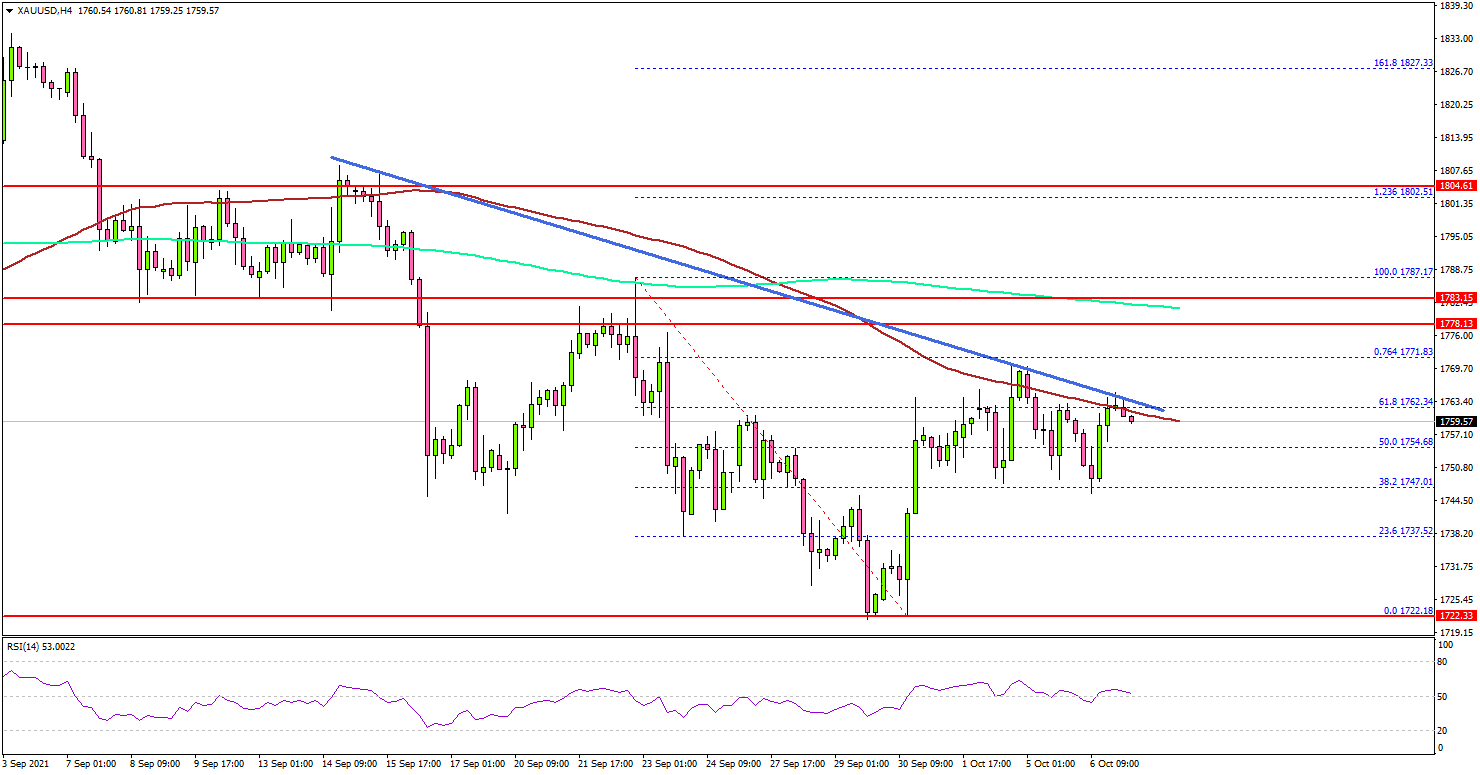
The 4-hours chart of XAU/USD indicates that the price traded as low as $1,722. It also settled below the $1,780 pivot level, the 100 simple moving average (red, 4-hours), and the 200 simple moving average (green, 4-hours).
Recently, there was an upside correction above the $1,740 level. The price climbed above the 50% Fib retracement level of the key drop from the $1,787 swing high to $1,722 low.
It even spiked above the $1,765 resistance. However, it seems like the price is struggling to gain pace above $1,760. There is also a major bearish trend line forming with resistance near $1,760 on the same chart.
The next key resistance is near the $1,770 zone. It is near the 76.4% Fib retracement level of the key drop from the $1,787 swing high to $1,722 low.
The main hurdle sits at $1,780, above which the price could rise towards $1,800. Any more gains could lead the price towards the $1,825 level.
Looking at EUR/USD, the pair remained in a bearish zone and it even traded below the 1.1550 support level. Besides, crude oil price corrected lower below $78.00.
Economic Releases to Watch Today
- US Initial Jobless Claims - Forecast 350K, versus 362K previous.
Eco Data 10/7/21
[php_everywhere instance="1"]
EUR/USD Slides to 10-Week Low
The euro is in negative territory for a second straight day. Currently, EUR/USD is trading at 1.1538, down 0.51% on the day.
ECB’s Lagarde says no to raising rates
The euro started the week with gains and pushed up the 11.6 line, but dovish comments from ECB President Christine Lagarde put a lid on any hope of a rally, and EUR/USD is now closing in on the 1.15 level. Lagarde dismissed any expectations of a rate hike from the ECB, saying that it would not have any effect in the current environment of high commodity prices. In September, Lagarde dismissed the notion of a taper by the Bank, stating “the lady isn’t tapering”.
Lagarde has signalled that she has no intention of following other central banks and tightening policy. Last week, she said that there were “no signs that this increase in inflation is becoming broad-based”. If you recall hearing similar declarations from Fed Chair Jerome Powell, your memory is spot on. Powell had insisted that inflation is transitory, but was forced to acknowledge in his congressional testimony last week that inflation would not ease anytime soon.
In September, Lagarde dismissed the notion of a taper by the Bank, stating “the lady isn’t tapering”. However, she may come under pressure to change her tune if eurozone inflation continues to rise. CPI hit a 10-year high in August of 3 per cent, above the ECB’s target of 2 per cent. Inflation could continue to surge, driven by higher energy prices, strong domestic demand and chronic supply-chain disruptions. Some analysts are projecting that inflation could rise as high as 4 per cent before the end of the year, and it’s difficult to picture the ECB standing idly by if inflation becomes red-hot and threatens to overheat the eurozone economy.
EUR/USD Technical
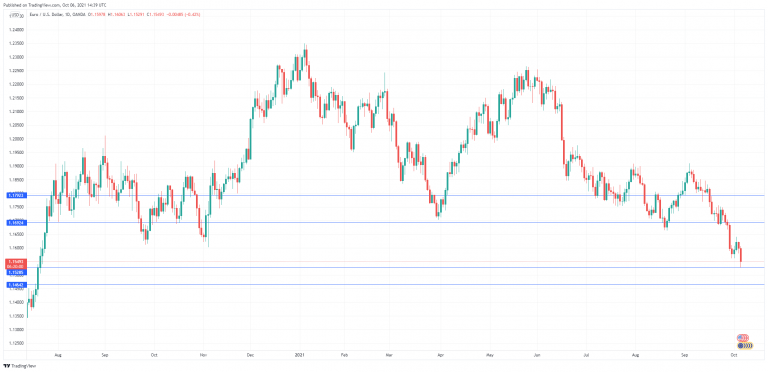
- On the downside, 1.1528 is under pressure as support. 1.1468 is the next support line
- 1.1692 is the next line of resistance, followed by 1.1792
Sunset Market Commentary
Markets
Energy markets were set ablaze once again as investor fears turned into outright panic at the start of European dealings. Dutch gas futures at a certain point surged 40% in just two hours, prompting the EU to pledge to action that may include aid and tax cuts while also proposing stronger gas storage and supply security rules. The Secretary General of OPEC+ tried to sooth markets as well with comments that it is committed to keep the oil market sustainable. On a sidenote, Saudi Arabia effectively cut oil prices this morning for customers in Asia, Europe and the US. Brent oil today sheds a little more than 1%. Russia’s Putin later said his country stands ready to help stabilize energy markets with gas supplies to Europe perhaps reaching a new record. Good Guy Putin helped to pull the sting out of spiraling gas prices and send gas futures from 40% higher to 2% lower for the day. The wall of stagflation worries hit equities hard with the EuroStoxx50 tumbling 2.5% intraday and temporarily forfeiting the 4k handle before trimming to 1.3%. Wall Street opens with declines of about 0.5%. The core bond yield’s jump during Asian/early European dealings of 4-5 bps eased throughout the session and in lockstep with easing energy prices. European inflation expectations (10y inflation swap) reversed a further rise to 2.04% to 1.98%. German yields currently trade flat across the curve. The US curve flattens with yields marginally higher at the short end (+1 bp, 5y) and lower at the long end (-1.7 bps, 30y). A strong ADP job report (+568k vs 430k expected) bodes well for Friday’s official payrolls. Markets largely ignored the figure however since it only confirms baked-in expectations of tapering to start in November. The dollar continues to dominate on FX markets. EUR/USD in particular is under heavy pressure. The currency pair tanked to the lowest level since June 2020 (1.155). Only the Japanese yen is able to withstand the greenback (USD/JPY marginally lower near 111.38). Sterling’s performance in these uncertain days has been remarkable for some time now, that includes today. EUR/GBP is trading a narrow sideways pattern dangerously close to the 0.85 support. Even cable (GBP/USD) is holding up relatively well (1.358).
News Headlines
Hungarian industrial production declined 2.7% M/M in August, reducing the Y/Y growth (WDA) from 10.2% to just 0.6% Y/Y. According to KSH, most parts of the manufacturing sector still contributed to Y/Y increase. However, production in the car sector shrank significantly as some auto plants were obligated to shut down production due to shortages of semiconductors. Output in electronical equipment also decreased. On the other hand, output in food, drinks and tobacco increased. In a separate report, the KSH reported Y/Y retail sales growth at 4.1% Y/Y in August, up from 3.0% in July and above market expectations for a stabilization. Sales of food products rose 1.7% Y/Y while non-food produces rose 7.8% Y/Y. The forint in the meantime weakened again to the EUR/HUF 360 mark as higher core yields and a risk-off sentiment is weighing on regional currencies.
In Germany, the Free Democrats (FDP) and the Green party agreed to propose starting talks with the SPD on Thursday. The SPD accepted. Both the Greens and FDP are still keep open the possibility negotiations with the CDU/CSU. However they don’t indeed to hold no parallel talks for now.
The National Bank of Poland raised the main policy rate by 40 bps to 0.50%. This was a big surprise. Analysts unanimously expected the NBP to keep the policy rate unchanged at 0.1% today. A potential re-evaluation was only expected that the November meeting when the NBP will have a new inflation forecast available. However, a sharp rise in inflation and pressure from rising core yields apparently convinced a majority in governor Glapinski’s MPC to put aside the narrative that current rise in inflation was mainly due to factors that are out of reach of domestic monetary policy. The NBP policy statement is not available yet. The zloty in two intraday moves strengthened from the EUR/PLN 4.63 to currently trade near EUR/PLN 4.55.
US Open Note – Stocks Remain Subdued, and Greenback Remains Buoyant
Risk appetite absent, as dollar resilient after ADP Non-Farm jobs result
Risk sentiment remains somewhat suppressed today, while the 10-year yield of 1.53% and inflationary pressures have kept the advance in the reserve currency buoyant.
Yesterday’s ISM services PMI employment component of 53.0, above the 50.0 barrier, may have assisted today’s upbeat jobs data of 568K, which beat the forecast of 425K. Stubborn inflation and a strong NFP number could provide fuel for the Fed to go ahead with announcing its tapering plans around the November meeting, but nothing is certain. The dollar index is currently lingering around the 94.30 barrier.
Despite recent strength in the reserve currency, the Swiss franc and the Japanese yen are faring slightly better against the greenback with the USD/CHF and USD/JPY pair’s dipping to 0.9285 and 111.33 respectively.
Eurozone and UK under Energy squeeze
Worries are growing that European soaring energy prices and supply shortages could curb the pace of the recovery as gas prices rise by 40%. However, it is unlikely the ECB will change its dovish stance and will retain a cautious and accommodative tone. On the back of this, disappointing August factory orders in Germany of -7.7%, which came in much lower, than awaited weaker expectations of -2.3%, along with a miss in Eurozone retail sales of 0.3% for an August forecast of 0.7% has weighed further on the euro. This is signaling hampered consumer spending in the respective month. The euro is currently around $1.1545 failing to produce any lift after stronger ADP private sector jobs data.
As the northern part of the world moves into the winter season, rising energy costs are due to cause further strain on economies and households. The rise is adding to the inflation fire and could start to hurt industrial production, and down the road, jobs as well. Growing natural gas demand is causing huge pressure on oil stockpiles.
The UK is dealing with fuel supply shortages as well as truckers, and persistent rising energy prices can’t be good as the weather gets colder. A possible rate hike at this point won’t help people’s disposable income, but Prime Minister Boris Johnson will raise the minimum wage to help somewhat counter the rise in energy prices. The pound rebounded somewhat to $1.3572, despite a firm dollar.
Oil, gold and commodity currencies start to bounce back
WTI oil futures latest price retraction has stabilized around the $78.00 per barrel mark. An expected rise in stockpiles by 1mln barrels is estimated and the surging prices in natural gas and coal are adding to the energy crisis and raising the demand for crude and oil manufactured goods.
The RBNZ interest rate event (25bps hike to 0.50%) appears may have already been discounted in the NZD/USD pair and the lack of a more hawkish tone from the RBNZ may have been deciphered by markets as weakness, which resulted in today’s decline in the pair from early hours of Wednesday.
Nonetheless, the antipodean currencies are making a comeback following today’s drop. The aussie and the kiwi have found traction around the 0.7226 and 0.6876 respective levels and have gained positive momentum.
Gold also picked up and steered to $1,760 after finding some footing around the $1,747 level.
Scheduled at 14:30 GMT are US crude oil inventories, while later at 15:30 GMT, FOMC Member Bostic is due to speak.
USD/JPY Mid-Day Outlook
Daily Pivots: (S1) 111.04; (P) 111.30; (R1) 111.73; More...
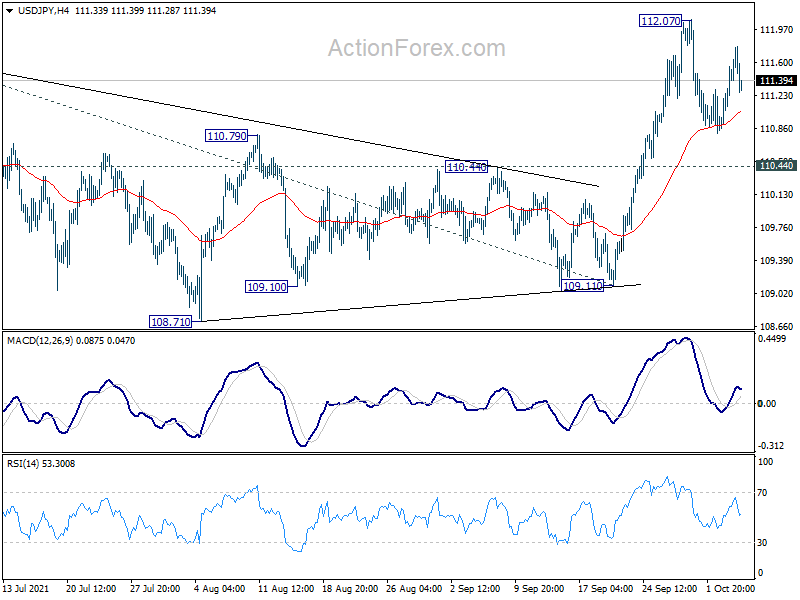
Intraday bias in USD/JPY remains neutral as consolidation from 112.07 could extend further. Another retreat cannot be ruled out, but downside should be contained by 110.44 support to bring another rally. On the upside, above 112.07 will extend larger rise to 61.8% projection of 102.58 to 111.65 from 109.11 at 114.71 next. However, break of 110.44 will dampen the bullish case and turn focus back to 109.11 support.
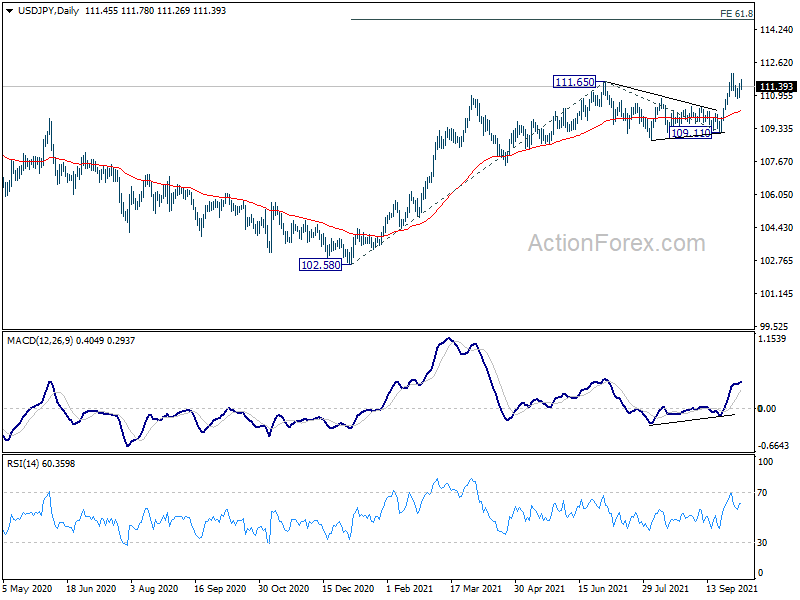
In the bigger picture, break of 111.71 resistance suggests that the whole corrective decline from 118.65 (2016 high) has completed at 101.18 (2020 low) already. Medium term bullishness is also affirmed as USD/JPY stays well above 55 week EMA (now at 108.60). Sustained trading above 111.71 will affirm this bullish case. Rise from 101.18 could then be resuming whole rally from 98.97 (2016 low) through 118.65. This will now be the preferred case as long as 108.71 support holds.
USD/CHF Mid-Day Outlook
Daily Pivots: (S1) 0.9252; (P) 0.9270; (R1) 0.9300; More....
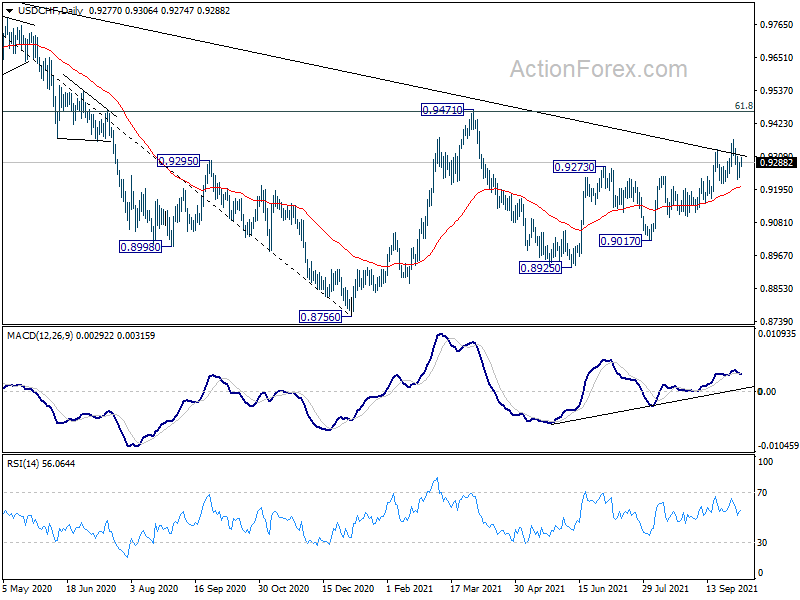
USD/CHF is still bounded in range trading below 0.9367 and intraday bias remains neutral. As long as 0.9214 support holds, further rally is in favor. On the upside, break of 0.9367 will resume the rise from 0.8925 to 0.9471 key resistance next. On the downside, however, break of 0.9214 will turn bias back to the downside for 0.9017 support again.
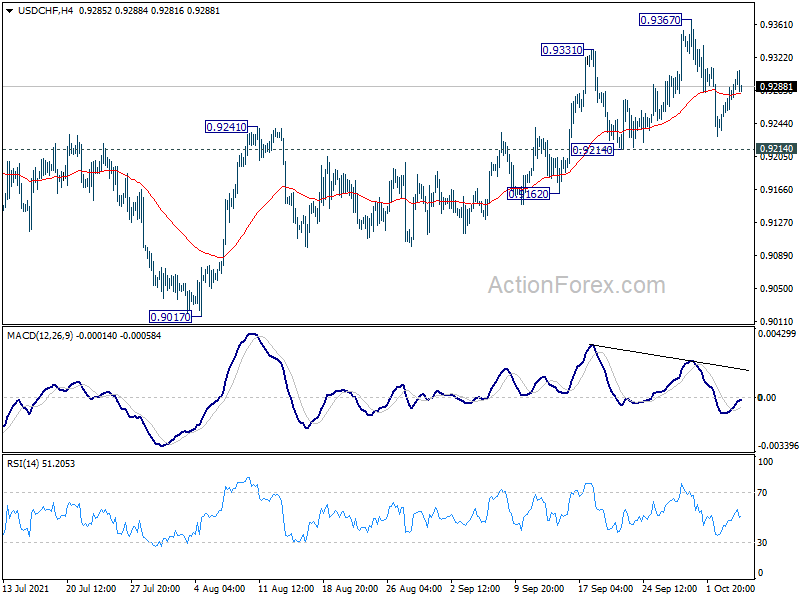
In the bigger picture, the strong rally above 55 week EMA (now at 0.9188) now tilts favor to the case of bullish trend reversal. That is, decline from 1.3042 (2016 high) is probably completed at 0.8756 already. Sustained break of 0.9471 resistance should confirm this case and pave the way to retest 1.0342 ahead. However, rejection by 0.9471 will mix up the outlook again and retain some medium term bearishness.
GBP/USD Mid-Day Outlook
Daily Pivots: (S1) 1.3591; (P) 1.3620; (R1) 1.3654; More...
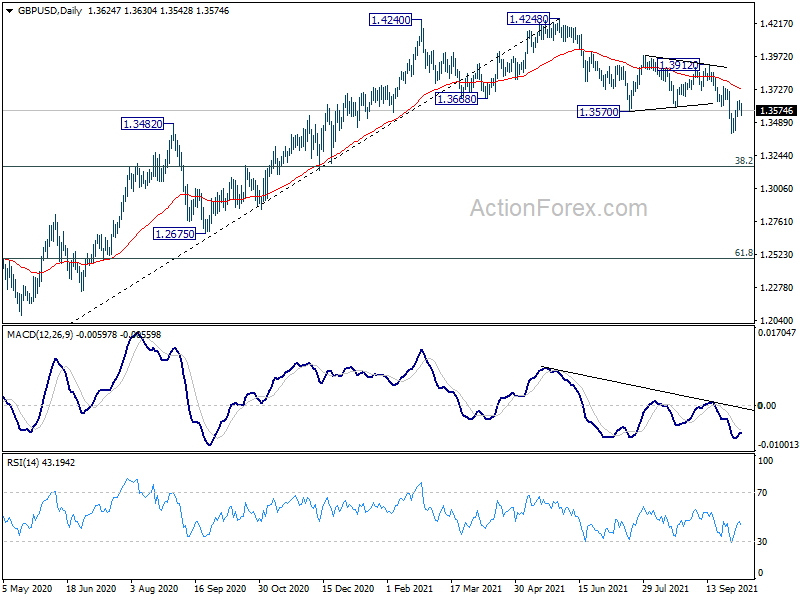
GBP/USD retreated after hitting 1.3646 and intraday bias is turned neutral first. On the upside, above 1.3646 will resume the rebound from 1.3410 short term bottom for 1.3749 resistance first, which is close to 55 day EMA (now at 1.3741). On the downside, though, below 1.3530 minor support will retain near term bearishness, and turn bias back to the downside for 1.3410 low. Firm break there will extend the fall from 1.4248 and target 1.3164 medium term fibonacci level next.
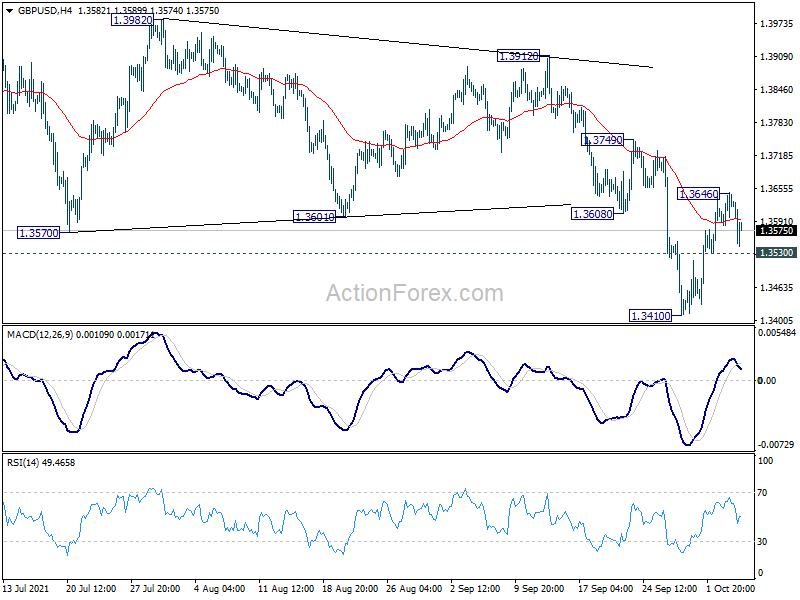
In the bigger picture, fall from 1.4248 is at least a correction to the up trend from 1.1409 (2020 low). Such correction could extend to 38.2% retracement of 1.1409 to 1.4248 at 1.3164 before completion. However, considering the rejection by 1.4376 key resistance (2018 high), sustained trading below 1.3164 will argue that it's indeed a bearish trend reversal and would target 61.8% retracement at 1.2493. Nevertheless, break of 1.3912 resistance will revive medium term bullishness and target 1.4248/4376 resistance zone again.
EUR/USD Mid-Day Outlook
Daily Pivots: (S1) 1.1579; (P) 1.1600; (R1) 1.1620; More...
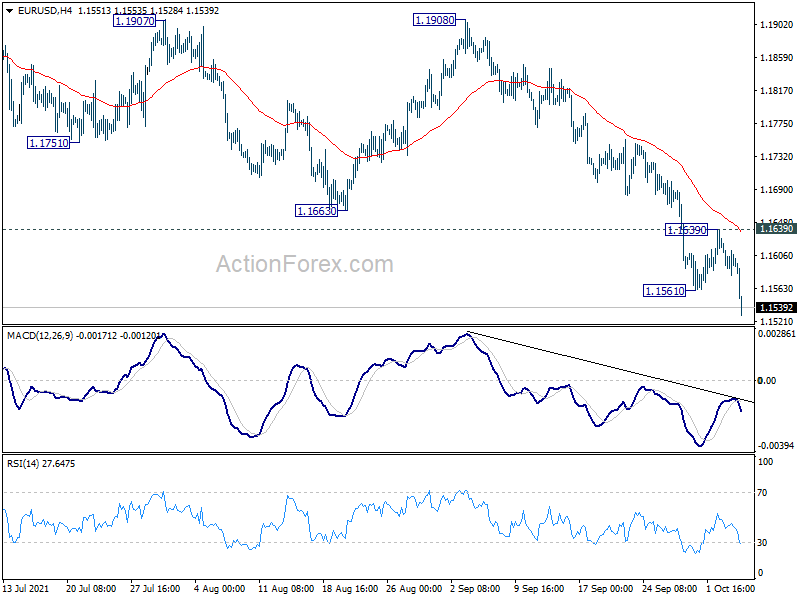
EUR/USD's decline resumes by breaking 1.1561 temporary low. Break of channel support also indicates downside acceleration. Intraday bias is back on the downside and deeper fall would be seen to 1.1289 medium term fibonacci level. On the upside, break of 1.1639 resistance is needed to indicate short term bottoming. Otherwise, outlook will stay bearish in case of recovery.
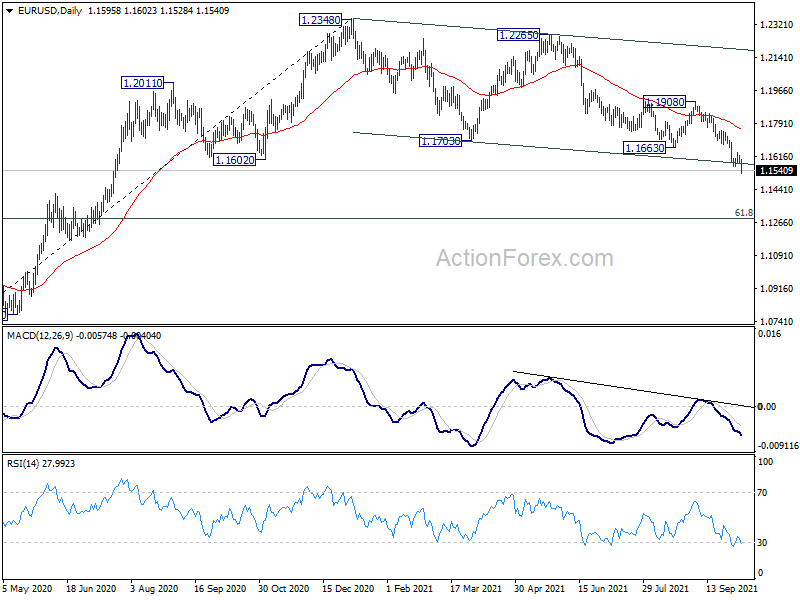
In the bigger picture, sustained break of 1.1602 will argue that rise from 1.0635 (2020 low) has completed at 1.2348. Deeper fall would be seen to 61.8% retracement of 1.0635 to 1.2348 at 1.1289. Note also that rejection by 55 week EMA (1.1830) also carries medium term bearish implication. Firm break of 1.1289 will pave the way to retest 1.0635 low. On the upside, though, break of 1.1908 resistance will revive medium term bullishness and turn focus back to 1.2348 high.
Dollar Stronger on ADP, Falling Stocks and Rising Yields, Euro Tumbles
The markets are back on risk-off mode again today, while major global treasury yields trade higher. Stronger than expected ADP job data provides little support to over sentiment. Yen is leading the way higher, followed by Dollar and Swiss Franc. On the other hand, despite RBNZ delivering the expected rate hike, New Zealand Dollar is leading commodity currencies lower. Euro is also weak together, as pressured by Dollar, Yen and other European majors.
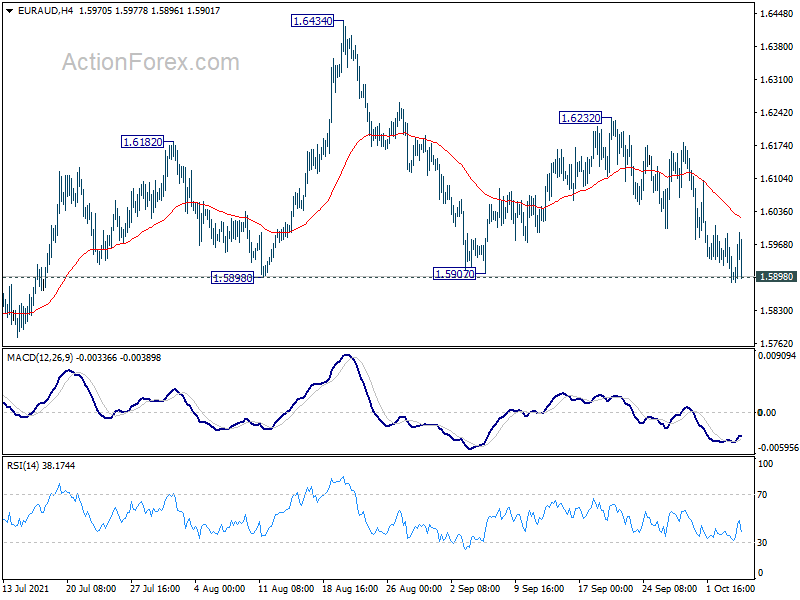
Technically, EUR/USD's decline resumes by breaking 1.1561 temporary low. EUR/CHF hits as low as 1.0712 and it's on track to retest 1.0694 low. EUR/GBP's break of 0.8499 support should also set the stage for retesting 0.8448 low. A focus now is on whether EUR/AUD could sustain below 1.5898 structural support to indicate near term bearish reversal.
In Europe, at the time of writing, FTSE is down -1.51%. DAX is down -1.70%. CAC is down -1.83%. Germany 10-year yield is up 0.005 at -0.179. Earlier in Asia, Nikkei dropped -1.05%. Hong Kong HSI dropped -0.57%. Singapore Strait Times rose 0.51%. Japan 10-year JGB yield rose 0.0275 to 0.085.
US ADP employment grew 568k in Sep, recovery continues to make progress
US ADP private sector employment grew 568k in September, above expectation of 475k. By company size, small businesses added 63k jobs, medium businesses added 115k, large businesses added 390k. By sector, goods-producing jobs grew 102k, and service-providing jobs rose 466k.
"The labor market recovery continues to make progress despite a marked slowdown from the 748,000 job pace in the second quarter," said Nela Richardson, chief economist, ADP. "Leisure and hospitality remains one of the biggest beneficiaries to the recovery, yet hiring is still heavily impacted by the trajectory of the pandemic, especially for small firms. Current bottlenecks in hiring should fade as the health conditions tied to the COVID-19 variant continue to improve, setting the stage for solid job gains in the coming months."
Eurozone retail sales rose 0.3% mom in Aug, EU up 0.3% mom
Eurozone retail sales rose 0.3% mom in August, well below expectation of 0.8% mom rise. Volume of retail trade increased by 1.8% for non-food products, while it fell by 0.1% for automotive fuels and by 1.7% for food, drinks and tobacco.
EU retail sales rose 0.3% mom. Among Member States for which data are available, the highest monthly increases in total retail trade were registered in Malta (+2.7%), Ireland (+2.5%) and Slovakia (+2.0%). The largest decreases were observed in Denmark (-1.4%), Estonia and France (both -1.2%).
UK PMI construction dropped to 52.6, severe loss of momentum
UK PMI Construction dropped to 52.6 in September, down from August's 55.2, missed expectation of 53.9. Markit said output growth eased for the third month running. Sub-contractor charges increased at survey-record pace. Widespread supply shortages led to rapid cost inflation.
Tim Moore, Director at IHS Markit said: "September data highlighted a severe loss of momentum for the construction sector as labour shortages and the supply chain crisis combined to disrupt activity on site. The volatile price and supply environment has started to hinder new business intakes... Shortages of building materials and a lack of transport capacity led to another rapid increase in purchase prices... Measured overall, prices charged by sub-contractors increased at the fastest rate since the survey began in April 1997."
BoJ Kuroda: No pressing need for firms to raise wages and selling prices
BoJ Governor Haruhiko Kuroda said in a speech, Japan's economy has "picked up", led by exports and the manufacturing sector. "If Japan can simultaneously protect public health and improve consumption activities through the use of vaccination certificates, for example, the economic recovery trend is very likely to become more pronounced, even in the services sector, also supported by the materialization of pent-up demand," he added.
On the contrasting development in CPI compared with the US, Kuroda said demand in Japan "has not recovered as rapidly as that in the U.S". Also, "many Japanese firms have essentially maintained their labor, supply-side constraints in Japan have not been as severe as in the U.S., and there has been no pressing need for firms to raise wages and selling prices."
RBNZ hikes OCR to 0.50%, maintains hawkish bias
RBNZ raised the Official Cash Rate by 25bps to 0.50% as widely expected, as "it is appropriate to continue reducing the level of monetary stimulus so as to maintain low inflation and support maximum sustainable employment." It maintains a hawkish bias and said, "further removal of monetary policy stimulus is expected over time, with future moves contingent on the medium-term outlook for inflation and employment."
In the accompany statement, it's noted that current COVID-19-related restrictions "have not materially changed the medium-term outlook" for inflation and employment. Capacity pressures "remain evident" and economic data highlighted that the economy "has been performing strongly in aggregate". Headline CPI is expected to rise above 4% in the near term before returning towards 2% target midpoint over the medium term.
More on RBNZ:
EUR/USD Mid-Day Outlook
Daily Pivots: (S1) 1.1579; (P) 1.1600; (R1) 1.1620; More...
EUR/USD's decline resumes by breaking 1.1561 temporary low. Break of channel support also indicates downside acceleration. Intraday bias is back on the downside and deeper fall would be seen to 1.1289 medium term fibonacci level. On the upside, break of 1.1639 resistance is needed to indicate short term bottoming. Otherwise, outlook will stay bearish in case of recovery.
In the bigger picture, sustained break of 1.1602 will argue that rise from 1.0635 (2020 low) has completed at 1.2348. Deeper fall would be seen to 61.8% retracement of 1.0635 to 1.2348 at 1.1289. Note also that rejection by 55 week EMA (1.1830) also carries medium term bearish implication. Firm break of 1.1289 will pave the way to retest 1.0635 low. On the upside, though, break of 1.1908 resistance will revive medium term bullishness and turn focus back to 1.2348 high.
Economic Indicators Update
| GMT | Ccy | Events | Actual | Forecast | Previous | Revised |
|---|---|---|---|---|---|---|
| 01:00 | NZD | RBNZ Rate Decision | 0.50% | 0.50% | 0.25% | |
| 01:00 | NZD | RBNZ Rate Statement | ||||
| 06:00 | EUR | Germany Factory Orders M/M Aug | -7.70% | -1.50% | 3.40% | |
| 08:30 | GBP | Construction PMI Sep | 52.6 | 53.9 | 55.2 | |
| 09:00 | EUR | Eurozone Retail Sales M/M Aug | 0.30% | 0.80% | -2.30% | -2.60% |
| 12:15 | USD | ADP Employment Change Sep | 568K | 475K | 374K | |
| 14:30 | USD | Crude Oil Inventories | 0.8M | 4.6M |