Sample Category Title
EUR/USD Outlook: Bears Regain Traction After Minor Recovery But May Stay On Hold Until US NFP Data
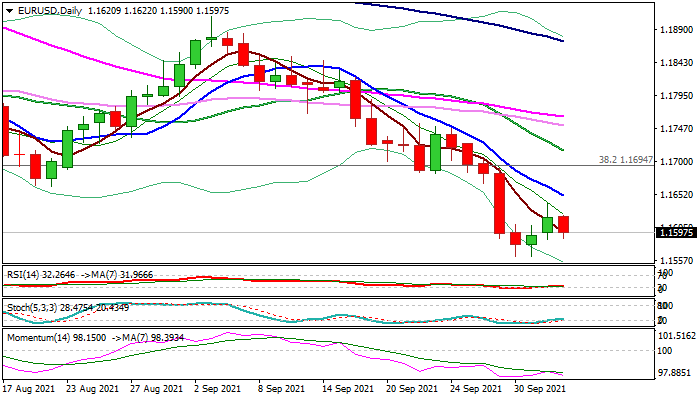
The Euro returns to red on Tuesday after minor correction in past two days lost traction ahead of initial resistances at 1.1660 zone.
The pair keeps negative tone but probes below pivotal 1.16 support zone, so far lacked strength to make a clear break, keeping in play scenario of extend consolidation before bears resume.
Traders also focus on Friday’s release of US NFP data (Sep 488K f/c vs Aug 235K) which could further inflate the dollar on strong release (at/above expectations) that would increase pressure on euro and prompt continuation of larger downtrend through pivotal supports at 1.1538 (weekly cloud base) and 1.1492 (50% retracement of 1.0635/1.2349).
Bears are expected to remain intact under strong barriers at 1.1656/64 (daily Tenkan-sen / former low of Aug 20.
Res: 1.1639, 1.1664, 1.1695, 1.1736.
Sup: 1.1587, 1.1562, 1.1538, 1.1492.
EUR/USD Analysis: Bounces Off 1.1640
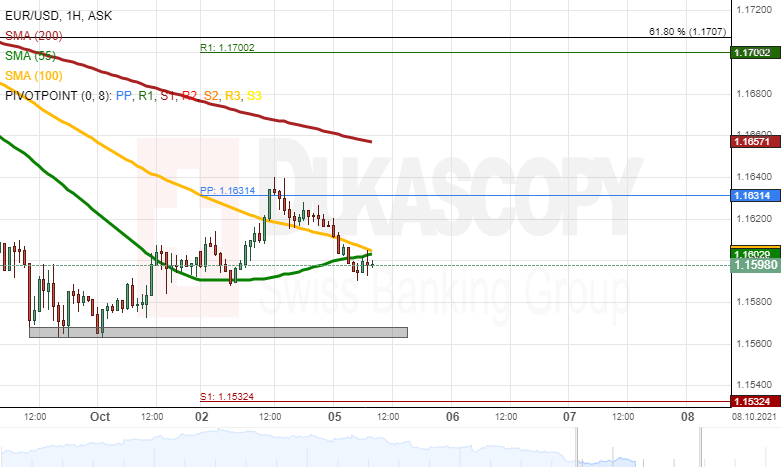
The EUR/USD recovery found resistance in the 1.1640 level on Monday. Afterwards, a decline began, which during the Tuesday morning hours had reached below the support of the 100 and 55-hour simple moving averages. Moreover, the pair had reached below the 1.1600 mark.
If the pair continues to decline, it would do so due to the resistance of the 55 and 100-hour simple moving averages near 1.1600. A potential decline would look for support in the September 30 low level zone at 1.1562/1.1569. Below this zone, the 1.1500 mark could act as support.
On the other hand, a failure of the simple moving averages to provide resistance might result in the pair reaching the weekly simple pivot point at 1.1631 and the 1.1640 mark. Above these levels, the 200-hour SMA is capable of providing resistance near 1.1650.
GBP/USD Analysis: Trades Above 1.3600
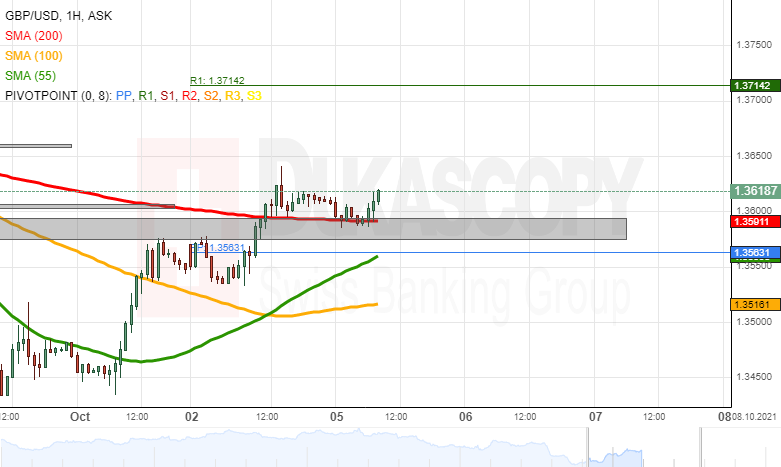
On Monday, the surge of the GBP/USD reached above the resistance zone that is located below the 1.3600 mark and the 200-hour simple moving average. However, after the surge, the pair retraced back down and up to Tuesday's European morning the rate traded above the mentioned technical levels.
If the support levels cause a surge, the GBP/USD would most likely reach for the weekly R1 simple pivot point at 1.3714. Although, note that the 1.3650 mark could provide resistance and slow down a potential surge.
On the other hand, a passing of the 200-hour SMA and the support zone below the 1.3600 level would almost immediately find additional support in the weekly simple pivot point at 1.3563 and the 55-hour simple moving average at 1.3560. Below these technical levels, the 100-hour SMA might serve as support at 1.3515.
USD/JPY Analysis: Trades Between SMAs
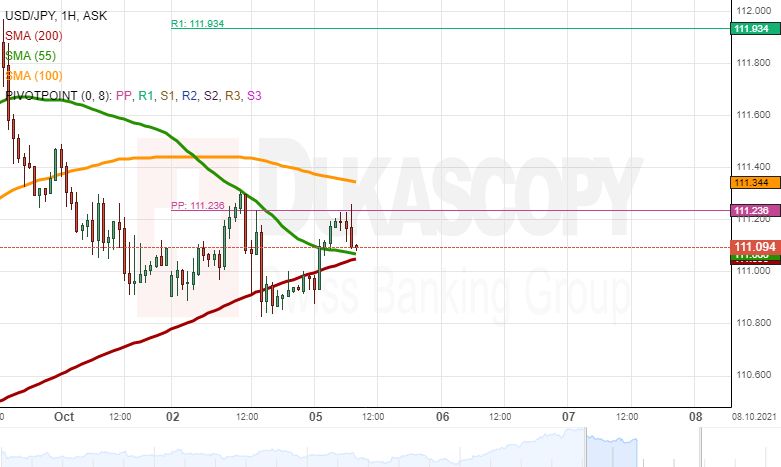
On Tuesday morning, the USD/JPY was located between the support of the 55 and 200-hour simple moving averages near 111.05 and the resistance of the weekly simple pivot point at 111.24 and the 100-hour SMA at 111.35.
If the pair surges and passes the weekly simple pivot point and the 100-hour simple moving average, the USD/JPY might aim at the resistance of the weekly R1 simple pivot point at 111.93. Above the pivot point, the 112.00 level could once again serve as resistance.
Meanwhile, a decline would look for support in the 55 and 200-hour simple moving averages at 111.05. In addition, the 111.00 level could provide support. However, note that the 200-hour SMA and the 111.00 failed to hold and were pierced during Monday's trading. Due to that reason, it can be assumed that a potential decline could reach the weekly S1 simple pivot point at 110.39.
Gold Analysis: Reaches 1,770.00 Level
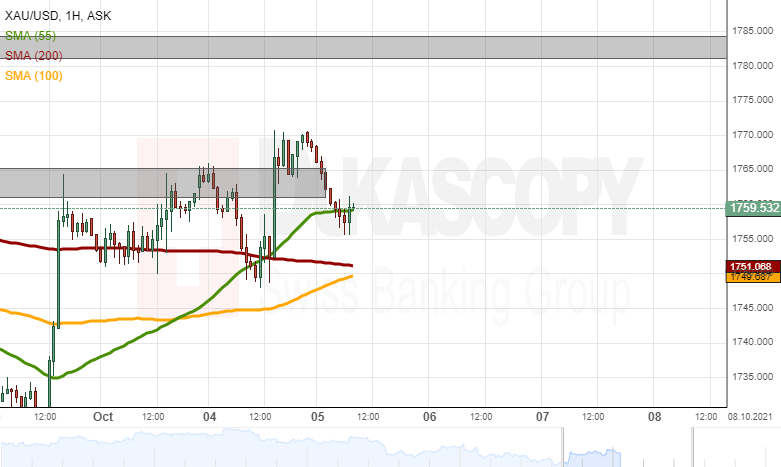
The resistance zone that is located below the 1,765.00 mark, failed to keep the price of gold down. Late on Monday, the price reached above the resistance zone and touched the 1,770.00 level. The 1,770.00 mark provided resistance and caused a retracement down.
If the price for gold continues to decline, it could look for support in the 100 and 200-hour simple moving averages that strengthen the 1,750.00 mark's support. A passing of the 1,750.00 level would look for support in round price levels before reaching the September low level at 1,723.00.
A potential surge would most likely test round price levels like the 1,770.00 mark before reaching the September 21 and 23 high levels near 1,783.00.
Rising Commodity Prices Raise Fears Of Increasing Global Inflation
The US stock market closed with another decline yesterday. Dow Jones index decreased by 0.94%, S&P 500 index fell by 1.3%, Nasdaq Composite lost 2.14%. The 10-year US Treasury bond yield reached 1.56% last week, the highest level since June, as investors worried about inflationary pressures and tighter monetary policy. Former US President Donald Trump claims, "inflation is going to ravage our country." All of it strengthens the correction in the technology sector as capital flows into the real economy.
Current US President Joe Biden says that a possible US default will threaten the dollar's status as the world's reserve currency, and raising the national debt ceiling has nothing to do with the infrastructure bill and is about paying past debts, not cutting new spendings. "A failure to raise the debt limit will call into question Congress’s willingness to meet our obligations that we’ve already incurred," Joe Biden said.
Yesterday, there was a large-scale failure in the services of many Internet companies. The biggest problems were observed in the work of Facebook, Instagram, and WhatsApp. A few hours after the outage began, the "facebook.com" domain, as well as the data of more than 1.5 billion Facebook users, were for sale. The Facebook stock decreased by 4.9% yesterday, the biggest drop since November 2020. There are also reports of outages at Google, Youtube, Netflix, Twitter, and Zoom.
S&P 500 companies increased earnings by 96.3% in the second quarter, the strongest increase since the fourth quarter of 2009. But third-quarter growth is expected to be much more modest, with an estimate of 29.4% year-over-year. JPMorgan and other major banks are set to begin their quarterly reporting season in two weeks.
Pfizer and Biontech received a positive CHMP (Committee for Medicinal Products for Human Use) approval for COVID-19 booster vaccines in the European Union.
European stock indices closed yesterday's trading with a decline. By the close of trading the composite index Stoxx Europe 600 decreased by 0.47%, German DAX lost 0.79%, British FTSE 100 lost 0.23%, French CAC 40 decreased by 0.61%, Spanish IBEX 35 and Italian FTSE MIB lost 0.09% and 0.6%, respectively. Energy crisis, slowdown of the economic growth, and problems in the global supply chain put pressure upon the quotes.
Oil in the US hit a 7-year high after OPEC+ refused to accelerate production, despite the fact that the switch from gas to oil boosted global oil demand. OPEC+ officials believe the market is balanced. However, there is evidence that OPEC+ countries have agreed to increase production by 400,000 bpd in November.
Asian stocks also declined as rising commodity prices heightened fears of rising global inflation. The broadest index of Asia-Pacific stocks outside Japan, MSCI, fell by 1.3%, declining for the third session in a row. Japanese stocks decreased by 2.8%, South Korean stocks lost 2.5%, and Australian stocks decreased by 1%.
China's Communist Party continues to tighten its control on the country's Internet giants and is using its wealth to pay for its ambitions to reduce its dependence on the US and European technology. The party says that anti-trust legislation will be a priority until 2025, and the competition will help create jobs and raise living standards.
China has sent 56 military aircraft to Taiwan's air defense zone. In turn, Taiwan calls on China to stop its irresponsible and provocative actions.
Main market quotes:
- S&P 500 (F) 4,300.46 −56.58 (−1.30%)
- Dow Jones 34,002.92 −323.54 (−0.94%)
- DAX 15,036.55 −119.89 (−0.79%)
- FTSE 100 7,011.01 −16.06 (−0.23%)
- USD Index 93.80 −0.24 (−0.26%)
Important events for today:
- Japan Tokyo Core Consumer Price Index at 02:30 (GMT+3);
- Australia Retail Sales (m/m) at 03:30 (GMT+3);
- Australia RBA Interest Rate Decision at 06:30 (GMT+3);
- Australia RBA Rate Statement at 06:30 (GMT+3);
- Japan BoJ Gov Haruhiko Kuroda’s Speech (TBA);
- Eurozone Services PMI (m/m) at 11:00 (GMT+3);
- UK Services PMI (m/m) at 11:30 (GMT+3);
- US ISM Services PMI (m/m) at 17:00 (GMT+3);
- Eurozone ECB President Lagarde’s Speech at 18:00 (GMT+3).
Energy Risks Plague Stocks, Oil Joins The Party
- Oil rallies after OPEC does nothing, intensifying energy crisis
- Stock markets take another hit, tech leading the way lower
- Dollar awaits ISM services survey, kiwi looks to RBNZ rate hike
OPEC adds fuel to energy crisis
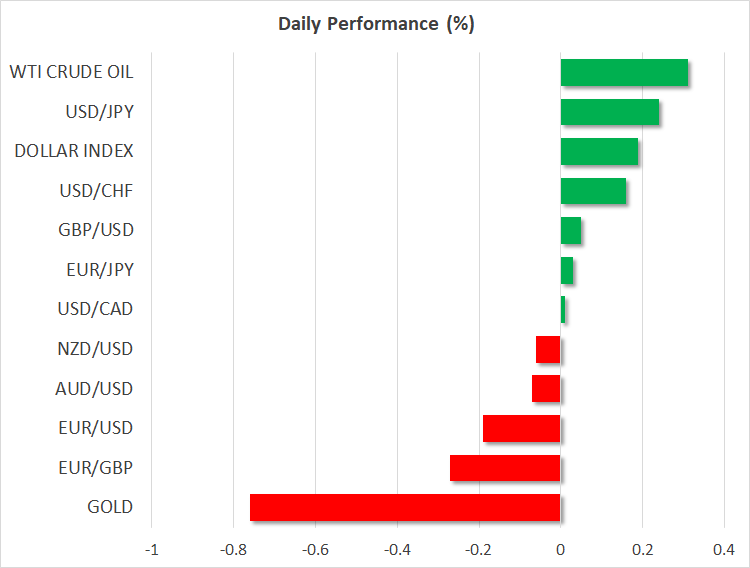
The world’s dominant oil cartel did not accelerate its production increases yesterday, propelling oil prices to new multi-year highs and fanning the flames of the raging energy crisis. With natural gas and coal prices going through the roof lately, crude oil has joined the party in sympathy as power producers look for any alternatives.
The risk is that this energy shortage will kneecap economic growth by squeezing real incomes for consumers faced with higher bills, and simultaneously keep inflation hot by inflicting more damage on struggling supply chains. Central banks cannot fix supply shocks - only governments have the tools to intervene.
Subsidies may be the weapon of choice as they would cushion the blow to consumers immediately and negate political turmoil, but that’s not a bulletproof strategy either as it would likely prolong and even exacerbate the eruption in energy markets. There aren’t any easy solutions, hence why investors have their finger on the panic button.
Tech stocks feel the heat
The unfolding crisis has left its marks on equity markets, with Wall Street closing sharply lower on Monday. What’s striking is that tech and growth names got hit the hardest whereas value plays held up relatively well, almost resembling a reopening rotation.
This aversion to tech and growth stocks likely comes down to Treasury yields, which refused to play along with the defensive mood and instead ticked higher as inflation worries remained on the radar. Higher yields decrease the present value of future cash flows in a typical valuation model.
Admittedly though, equity markets have been remarkably resilient. The S&P 500 is only 5% away from its record highs, which suggests that dip buyers haven’t thrown in the towel yet despite the escalating risks. Without any positive catalysts on the horizon, this sense of nervousness is unlikely to fade until the earnings season kicks off in two weeks' time, at which point corporate executives will shed some light on the magnitude of the fallout.
Dollar and kiwi in the spotlight
In the FX sphere, it was a relatively quiet session. The US dollar was relatively stable, unable to capitalize on the uptick in yields or the general risk-off tone. As for today, all eyes will be on the ISM services survey for September. It will provide crucial information on the growth outlook, supply chains and inflation, as well as how the labor market fared ahead of Friday’s employment report.
Meanwhile in Australia, the Reserve Bank adopted a slightly more cautious tone today, acknowledging the impact that the latest lockdowns will have on the economy. The reaction in the aussie was muted.
The real fireworks might be in the New Zealand dollar early on Wednesday, when the central bank is widely expected to raise interest rates. However, the risks surrounding the kiwi seem tilted to the downside as markets have almost fully priced in three rate hikes over the next three meetings, leaving lots of scope for disappointment if the RBNZ fails to execute perfectly.
Indeed, while the domestic economy is doing phenomenally well considering that it’s coming out of a lockdown, the worsening global outlook cannot be ignored for long in a small export-heavy economy like New Zealand.
EURJPY Neutral, But Finds Its Feet At The 61.8% Fibonacci
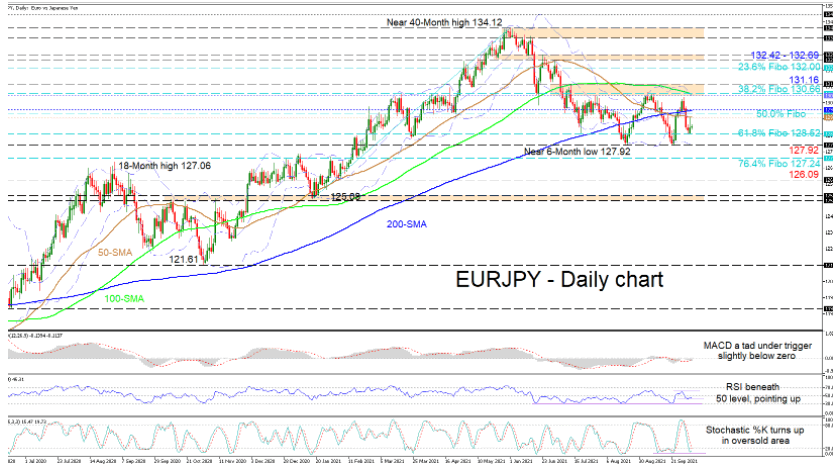
EURJPY has bounced at the 129.61 level, that being the 50.0% Fibonacci retracement of the up leg from 125.08 until the near 40-Month peak of 134.12, after retreating beneath the 50- and 200-day simple moving averages (SMAs). Price action over the last one-and-a-half-months has been consolidating between 127.92 and the 38.2% Fibo of 130.66. The trendless 50- and 100-day SMAs are reflecting a lack of positive impetus, favouring slightly the downside.
The short-term oscillators are indicating that buyers are struggling to gain the upper hand as positive momentum appears feeble. The MACD, not too far below zero, is floating just underneath its red trigger line, while the RSI is fighting to conquer the 50 level. The stochastic oscillator is in oversold territory but the upturn in the %K line has yet to confirm a surge in positive forces.
If upside pressures remain scarce, abrupt support could arise from the 61.8% Fibo of 128.52 before sellers challenge the reinforced defence of the positive structure at 127.92. Should this key barricade fail to keep the bears at bay, a price dive under the lower Bollinger band could meet support at the 76.4% Fibo of 127.24 prior to targeting the 126.09 barrier.
However, if buying interest increases, initial tough upside limitations could stem from the region between the 50- and 200-day SMAs at 129.39 and 129.79. Driving the price higher, the bulls may encounter another resistance border from the upper Bollinger band at 130.54 until the 131.16 level. Triumphing over this obstacle that also contains the 100-day SMA and the 38.2% Fibo of 130.66, may bolster upside momentum bringing the 23.6% Fibo of 132.00, and neighbouring resistance border of 132.42-132.69 into focus.
Summarizing, EURJPY’s current price action remains confined between 127.92 and 130.66. For a more definitive price direction to evolve, the pair would need to break either below or above the previously mentioned limits.
UK PMI services finalized at 55.4, supply chain crisis put a considerable brake on recovery
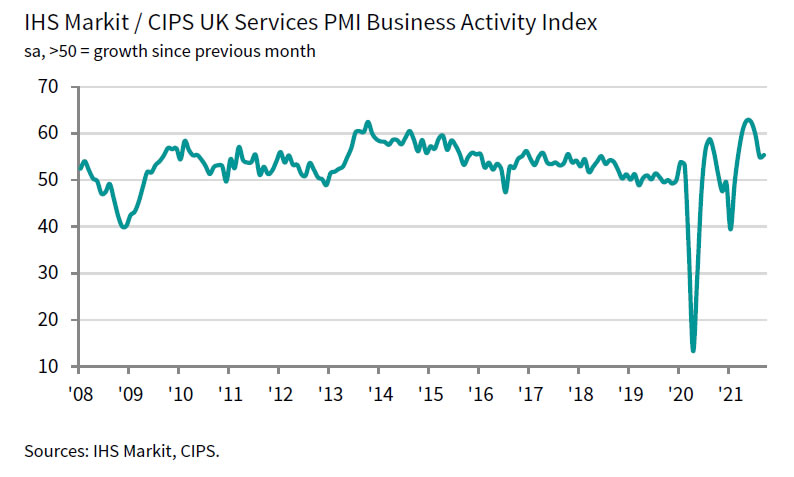
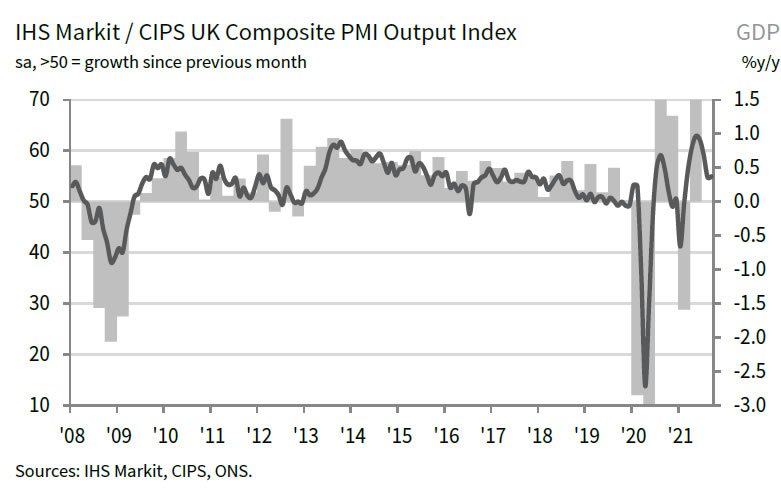
UK PMI Services was finalized at 55.4 in September, up slightly from August's 55.0. PMI Composite was finalized at 54.9, up fractionally form August's 54.8. Markit said charges rose at record pace amid supply constraints and spike in costs. Staff shortages held back output and new orders. Backlogs accumulated for the seventh month running.
Tim Moore, Economics Director at IHS Markit: "The supply chain crisis put a considerable brake on recovery in the UK service sector during September. Survey respondents widely noted that shortages of staff, raw materials and transport had resulted in lost business opportunities... Another spike in operating expenses was reported... even though this data is yet to fully reflect the inflationary impact of the UK fuel crisis and surging energy prices...
"Tight constraints on business capacity and rampant supply chain uncertainty meant that service providers have become more willing to pass on higher costs to customers. The latest rise in average prices charged by UK service sector firms was the fastest in over 25 years of data collection, with many businesses reporting more frequent reviews of pricing due to escalating cost increases by suppliers."
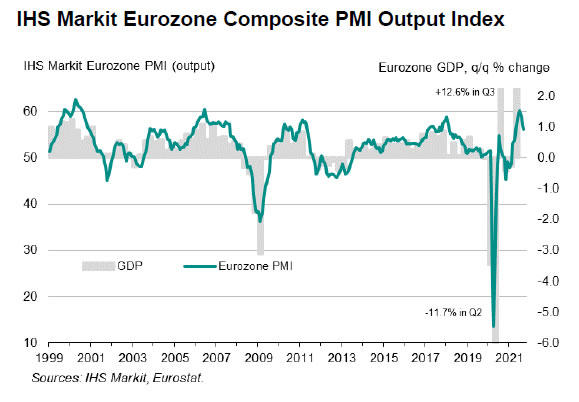
Eurozone PMI composite finalized at 56.2, unwelcome mix of rising price pressures but slower growth
Eurozone PMI Services was finalized at 56.4, down from August's 59.0. PMI Composite was finalized at 56.2, down from August's 59.0. Looking at some member states, Ireland PMI Composite was finalized at 61.5, Spain at 57.0, Italy at 56.6, Germany at 55.4, France at 55.3.
Chris Williamson, Chief Business Economist at IHS Markit said: "The current economic situation in the eurozone is an unwelcome mix of rising price pressures but slower growth. Both are linked to supply shortages, especially in manufacturing, which has seen a steeper fall in output growth than services... Although for now the overall rate of expansion remains relatively solid by historical standards, the economy enters the final quarter of the year on a slowing growth trajectory. A drop in business confidence to the lowest since February adds further downside risks to the outlook."